
Types of Rasa Pradeep Trikha MLS University
AS
Published · 30 slides · 0 views

1 / 1

Description
Types of Rasa Pradeep Trikha MLS University Udaipur NAVARASA Shringara Hāsyam Raudram Karuna Bibhatsya Bhayānaka Veera Adbhuta Santa Types of Rasa Shungarakarunaviraroudrahasyabhayanka, Bibhatsadbhutashantshyanavanatyerasahsrmuta
Related Topics
Share
Embed code
Download this presentation From Below
"Types of Rasa Pradeep Trikha MLS University" is the property of its rightful owner. Permission is granted to download and print the materials on this website for personal, non-commercial use only, and to display it on your personal computer provided you do not modify the materials and that you retain all copyright notices contained in the materials. By downloading content from our website, you accept the terms of this agreement.
Presentation Transcript
01
Types of Rasa Pradeep Trikha
MLS University
Udaipur<br>
MLS University
Udaipur<br>
02
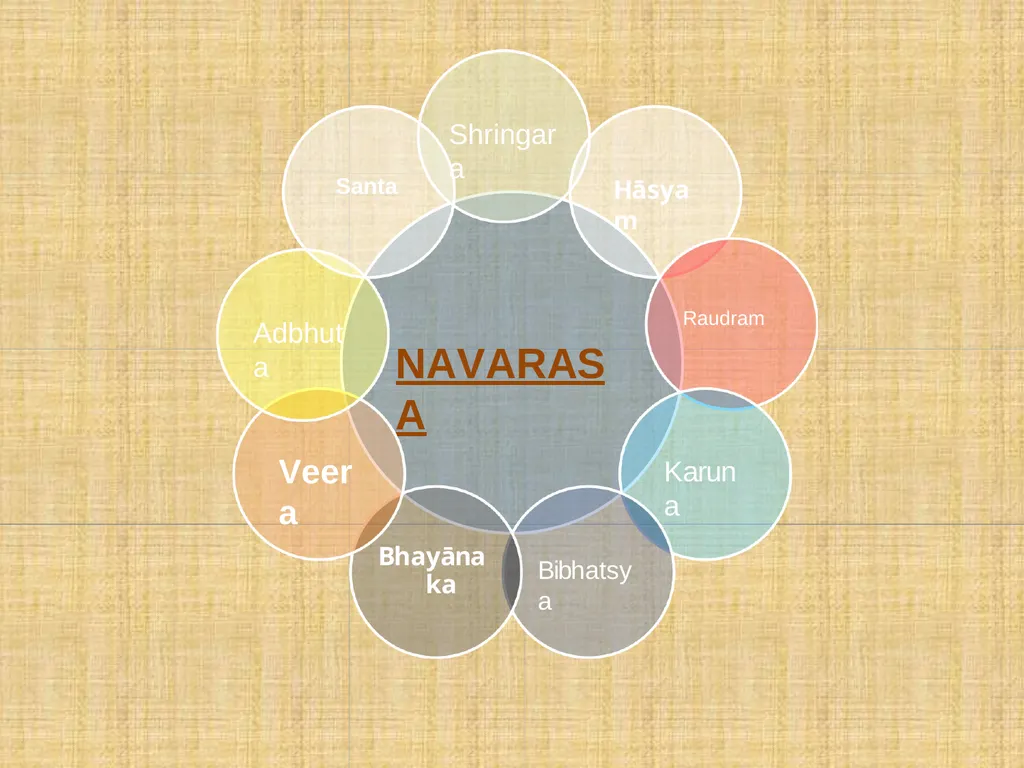
NAVARASA Shringara Hāsyam Raudram Karuna Bibhatsya Bhayānaka Veera Adbhuta Santa<br>
03
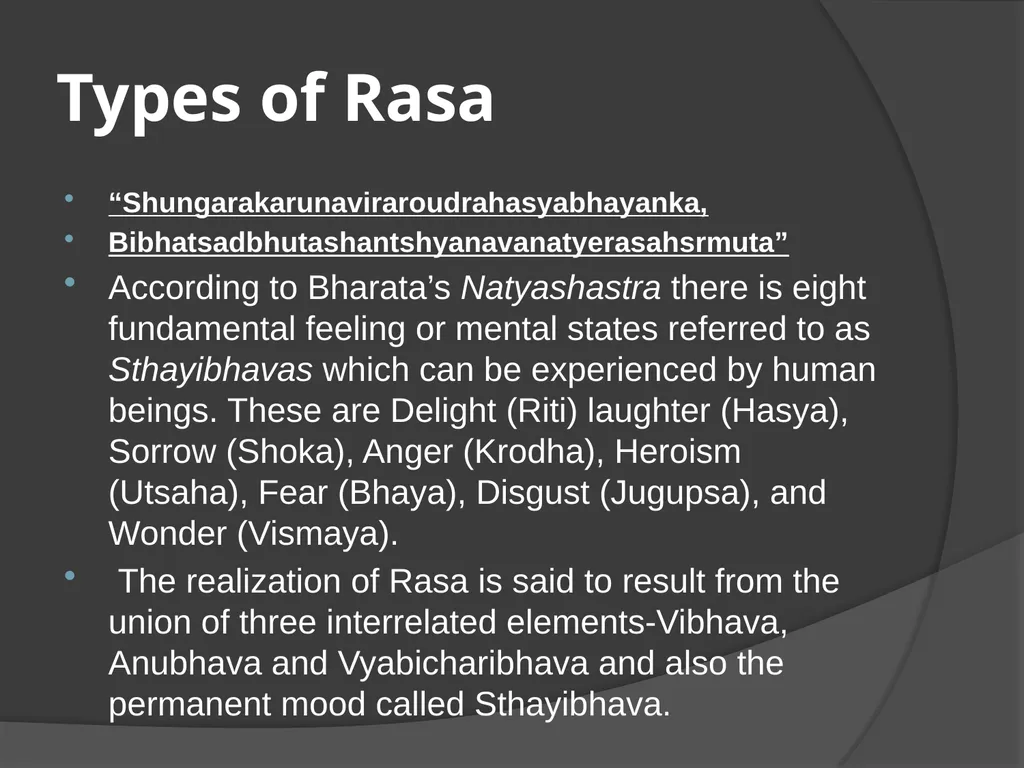
Types of Rasa “Shungarakarunaviraroudrahasyabhayanka,
Bibhatsadbhutashantshyanavanatyerasahsrmuta”
According to Bharata’s Natyashastra there is eight fundamental feeling or mental states referred to as Sthayibhavas which can be experienced by human beings. These are Delight (Riti) laughter (Hasya), Sorrow (Shoka), Anger (Krodha), Heroism (Utsaha), Fear (Bhaya), Disgust (Jugupsa), and Wonder (Vismaya).
The realization of Rasa is said to result from the union of three interrelated elements-Vibhava, Anubhava and Vyabicharibhava and also the permanent mood called Sthayibhava.<br>
04
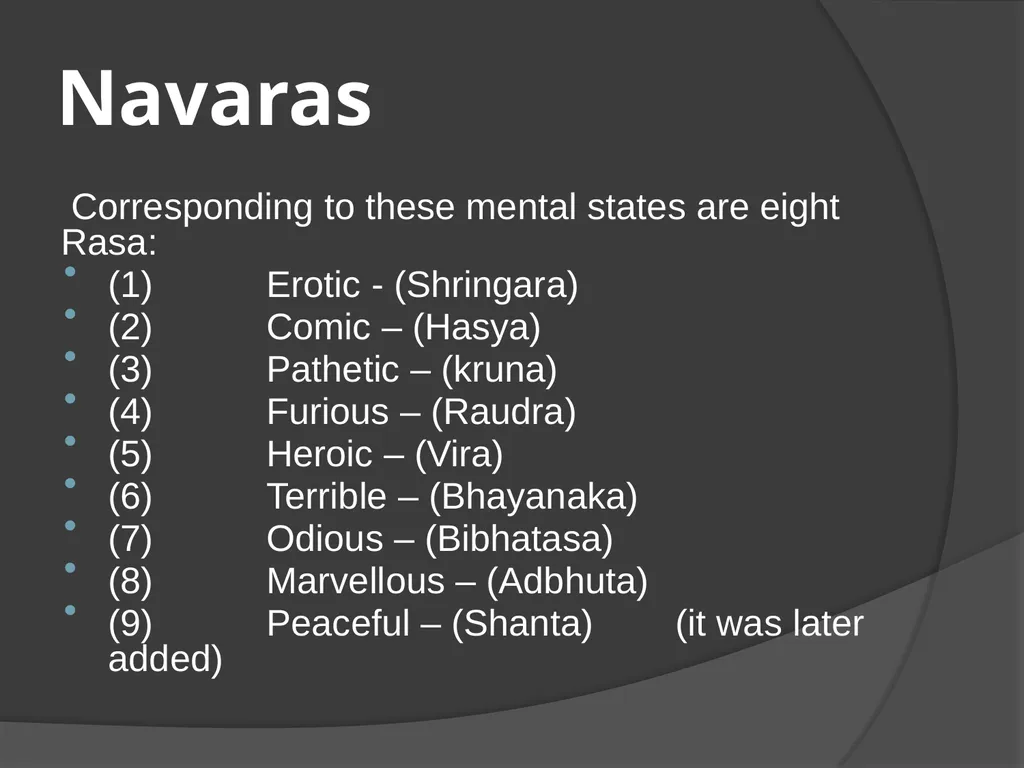
Navaras Corresponding to these mental states are eight Rasa:
(1) Erotic - (Shringara)
(2) Comic – (Hasya)
(3) Pathetic – (kruna)
(4) Furious – (Raudra)
(5) Heroic – (Vira)
(6) Terrible – (Bhayanaka)
(7) Odious – (Bibhatasa)
(8) Marvellous – (Adbhuta)
(9) Peaceful – (Shanta) (it was later added)<br>
(1) Erotic - (Shringara)
(2) Comic – (Hasya)
(3) Pathetic – (kruna)
(4) Furious – (Raudra)
(5) Heroic – (Vira)
(6) Terrible – (Bhayanaka)
(7) Odious – (Bibhatasa)
(8) Marvellous – (Adbhuta)
(9) Peaceful – (Shanta) (it was later added)<br>
05
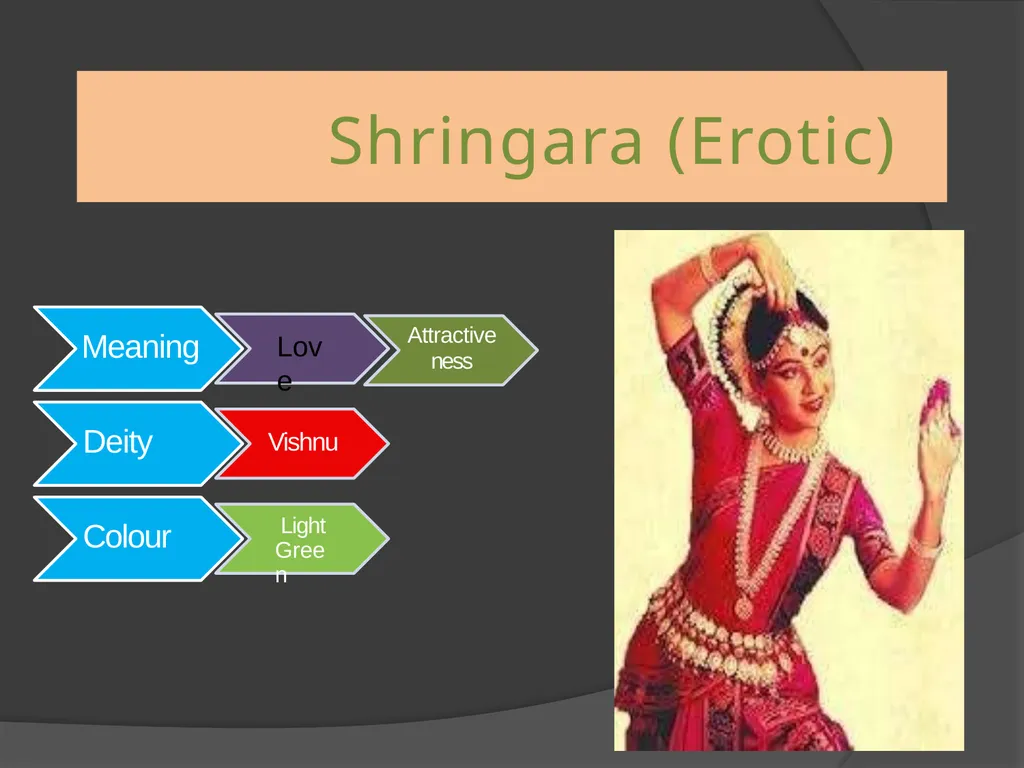
Shringara (Erotic) Meaning Love Attractive
ness Deity Vishnu Colour Light Green<br>
ness Deity Vishnu Colour Light Green<br>
06
Shringara Emerges from the dominant state of love and is associated with the Lord Vishnu. The mutual affection of love is found not only between man and woman but also between birds, animals and the other entire creature.
Erotic Sentiment in union arises from determinants like pleasure of the season the enjoyment of Garlands the company of beloved persons, objects etc…
Its consequences are clever movement of eyes, eyebrows, soft and delicate movement of the body, sweet words and similar other things.
Kalidasa’s Abhigyana Shakuntalam narrates the union of Shakuntala and Dushyant.
Sringara is reach in pleasure, associated with desired object favourable music and poetry and is related with either the union or the separation of man and woman.<br>
07
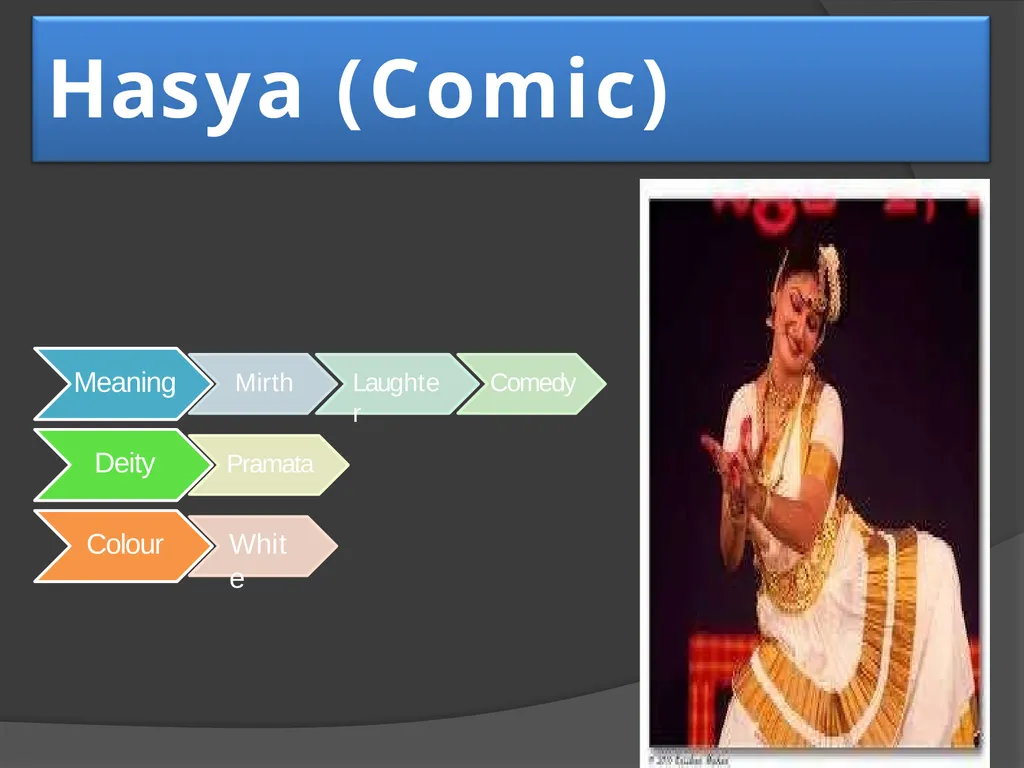
Hasya (Comic) Meaning Mirth Laughter Comedy Deity Pramata Colour White<br>
08
Hasaya According to Bharatamuni - Humor arises from the grotesque and custom of others, shameless character craze for sensual; pleasure, mischief, foul words. Physical handicapped accusation of others and the like.”
Laughter related to his or her own self its cold self-centered laughter
Centered – in – others are of six types:-
(1) Slight smile (smita)
(2) Smile (hasita)
(3) Gentle Laughter (vihasita)
(4) Laughter of Ridicule (uphasita )
(5) Vulgar Laughter (aphasita)
(6) Excessive laughter (atihasita)
The best example of Hasya Rasa is “Tarak Maheta ka UltaChashma”. It create big laughter among the audience. It shows both types of laughers<br>
09
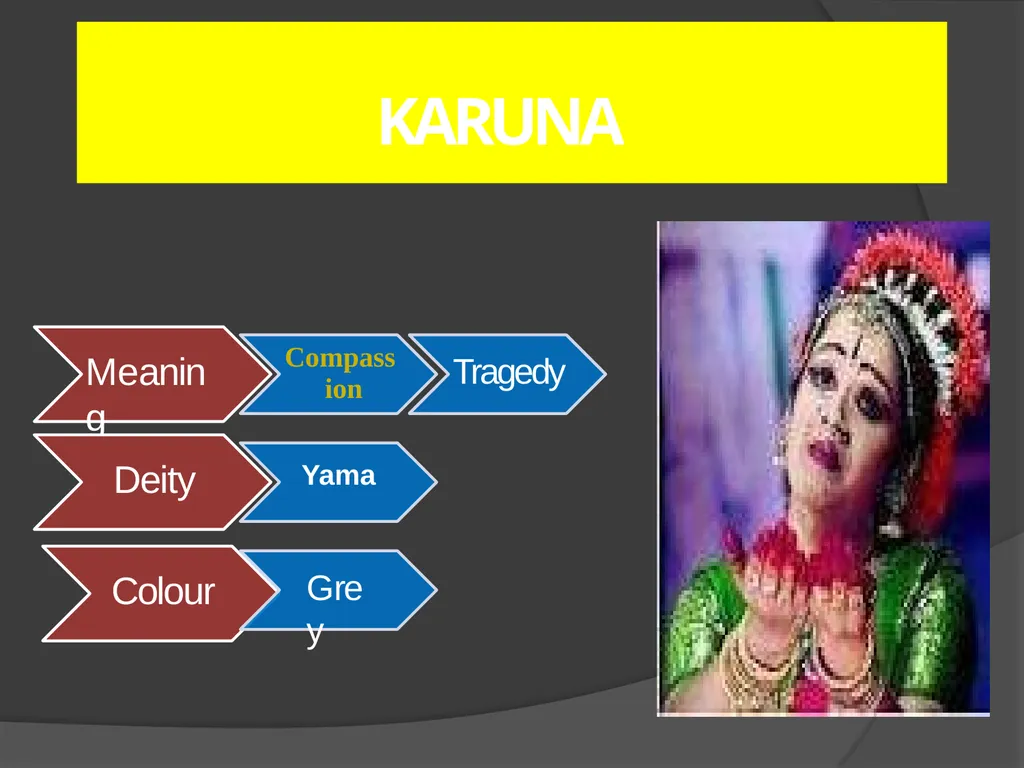
Meaning Compassion Tragedy Deity Yama Colour Grey KARUNA<br>
10
Karuna (Pathos) The pathetic sentiment arises from the dominant state of sorrow.
Cause is presented through the separation from dear one, loose of wealth, death, accident or any type of misfortune.
Consequences are wailing, shedding of tears, remebering the beloved
In Abhigyanshakuntalam the separation of Shakuntala and Dhushyant due to cruse, generates pathos. We also find same types of pathos in Romeo and Juliet, the death of Juliet create Karuna Rasa.
“Pathos is the very delicate Rasa, during its experience the heart melts a great deal.”<br>
11
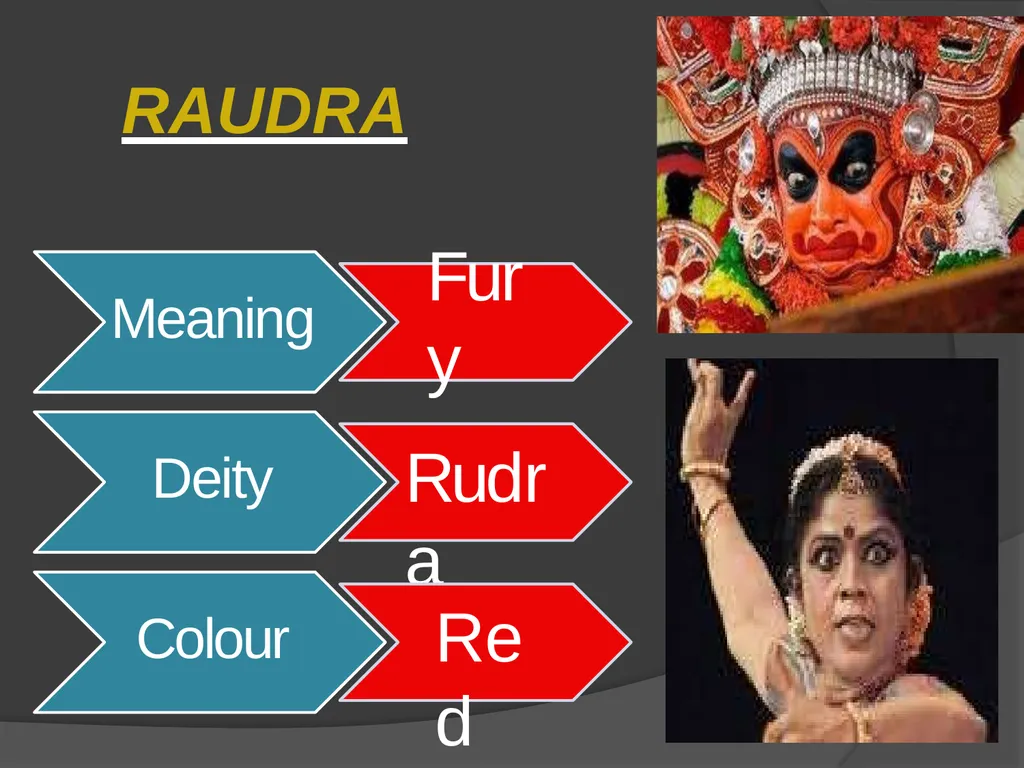
RAUDRA Meaning Fury Deity Rudra Colour Red<br>
12
Raudra (Furious) Is related to Furious Sentiment is created by striking blows, cutting, mutilation and piercing swords in wars and fights and tumult of the battle and the like.
Many critiques say that the furious Sentiment is full of conflict of arms, and in it words movements and deeds are terrible and tearful.
Transitory states connected with the furious sentiment are presence of mind determinations energy indignation perception.<br>
Many critiques say that the furious Sentiment is full of conflict of arms, and in it words movements and deeds are terrible and tearful.
Transitory states connected with the furious sentiment are presence of mind determinations energy indignation perception.<br>
13
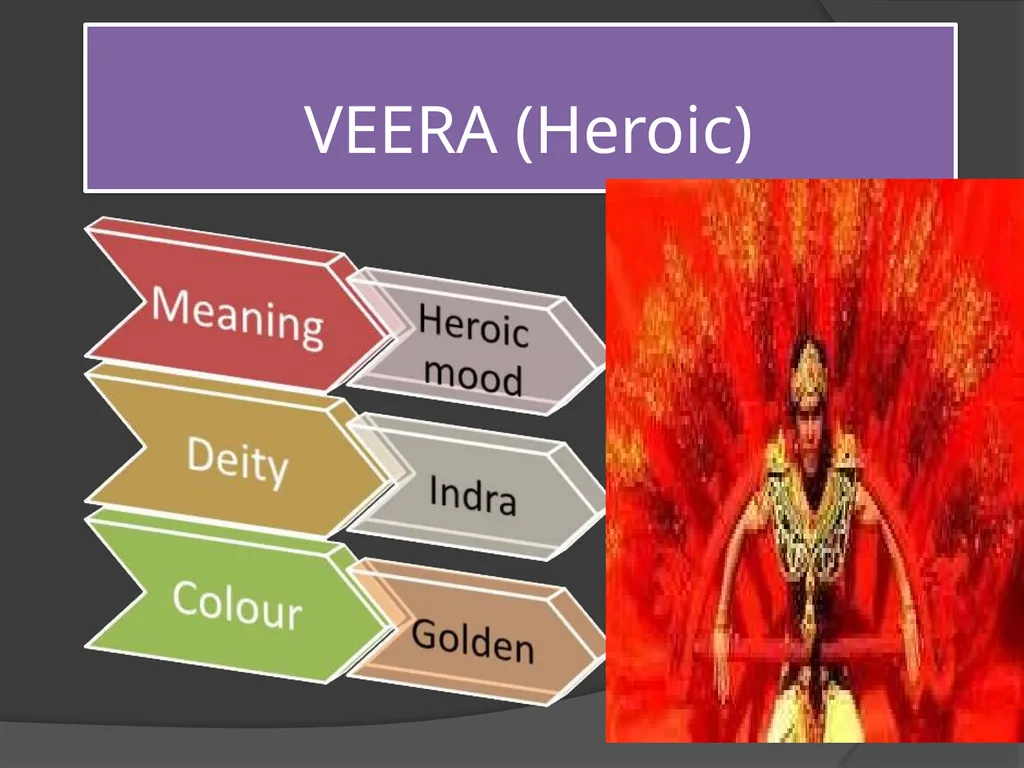
VEERA (Heroic)<br>
14
Vira Special condition are :- high energy, perseverance, optimising absence of surprise and presence of mind.
Heroic sentiment reflects to the superior type of person and has energy or enthusiasm has its basis.
Represented with the colour ‘yellowish or orange, mixture of both colours’.
In theatre represented through firmness, passions, heroism, charity diplomacy and the like.
Three kinds (Natyashastra):-,
(1) Valor of Munificence (Danvira)
(2) Valor of virtue (Dharmvira)
(3) Valor of war (Yudhavira)
Recent critics have add the fourth type of ‘Valor of Mercy’(Dayavira). The entire valor interrelated with each other. We found, Karana in Mahabharta was called as Danvira Yudhishthira was known Dharmvira. Arjuna was Yudhavira. Shreedamaa was the best example of Dyavira.<br>
15
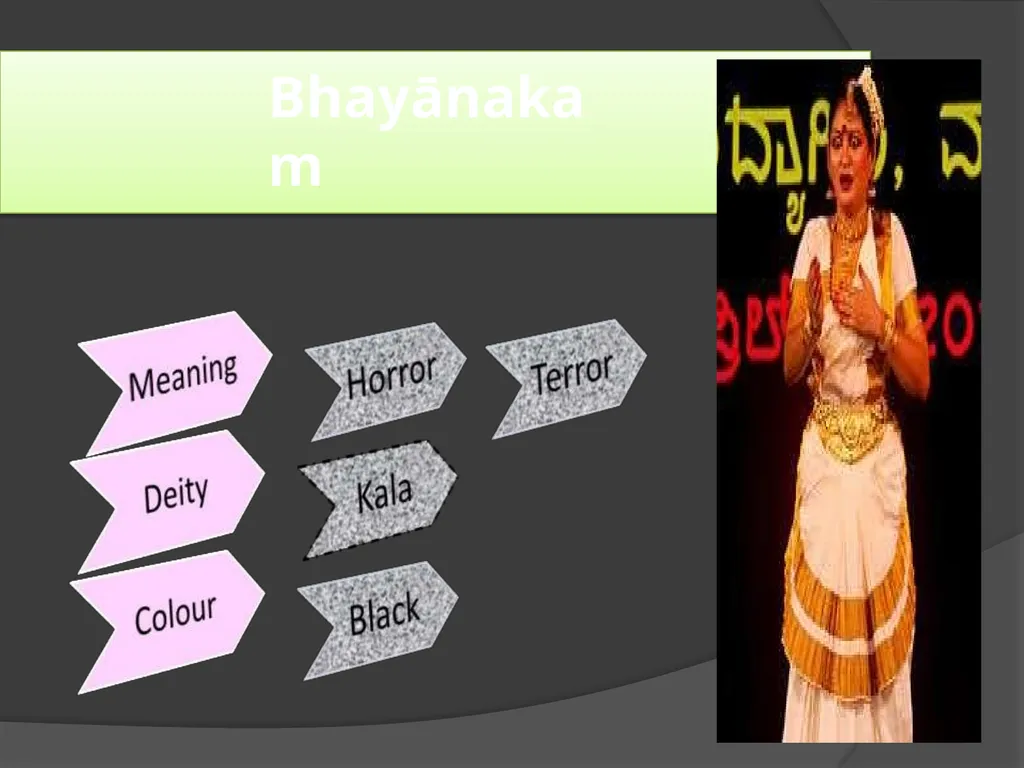
Bhayānakam<br>
16
Bhayanakam The Terrible sentiment has its dominant state of fear.
Black color refers Bhayanaka Rasa
Usually created by fearful atmosphere like Hideous, Noise, side of ghost panic and anxiety due to a timely cry of Jackal or hyena
Represented on the stage by swing of the hand and the feet, horripilation, change of colour and loss of voice.
According to many critics fear is not natural to Nobel character and on contrary what excites fear in ordinary people excites anger in violent.
In many horror movies we found Bhayanaka Rasa. When Rama in forest and fight with ‘Rakshasa’ at that time we fell ‘Bhaya’.<br>
17
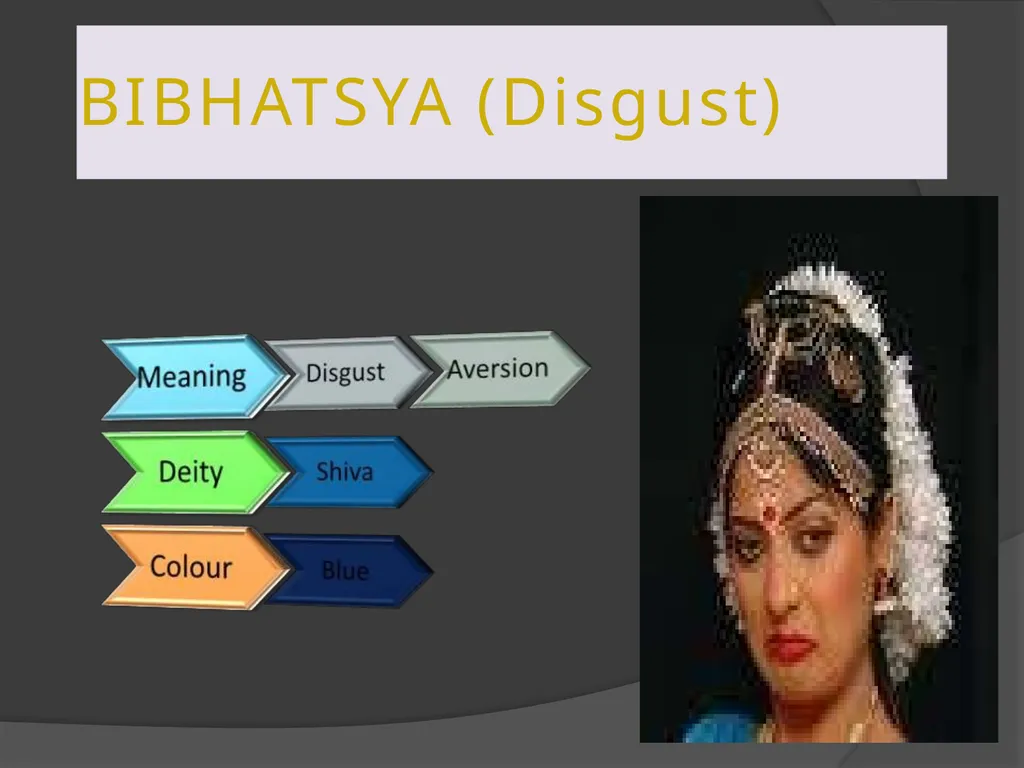
BIBHATSYA (Disgust)<br>
18
Bibhatsaya Is related to Odious sentiments has its basic the dominant state of disgust
It is created by determinants like hearing of unpleasant, offensive, impure and harmful things or sing them or discussing them.
Consequences are such as stopping the movement of all the kinds. Narrowing down of the mouth vomiting.
The emotion evoked by anything that nauseating
It generates revolt or sickens us.
When something comes to our notice that is coarse and graceless, beneath human dignity
For example ‘When prince Siddhartha was a young man and for the first time he sickness, old age and death, he was moved to disgust which later translate in to sorrow, deep introspection and peace, as he transformed into Gautama, the Buddha.”<br>
19
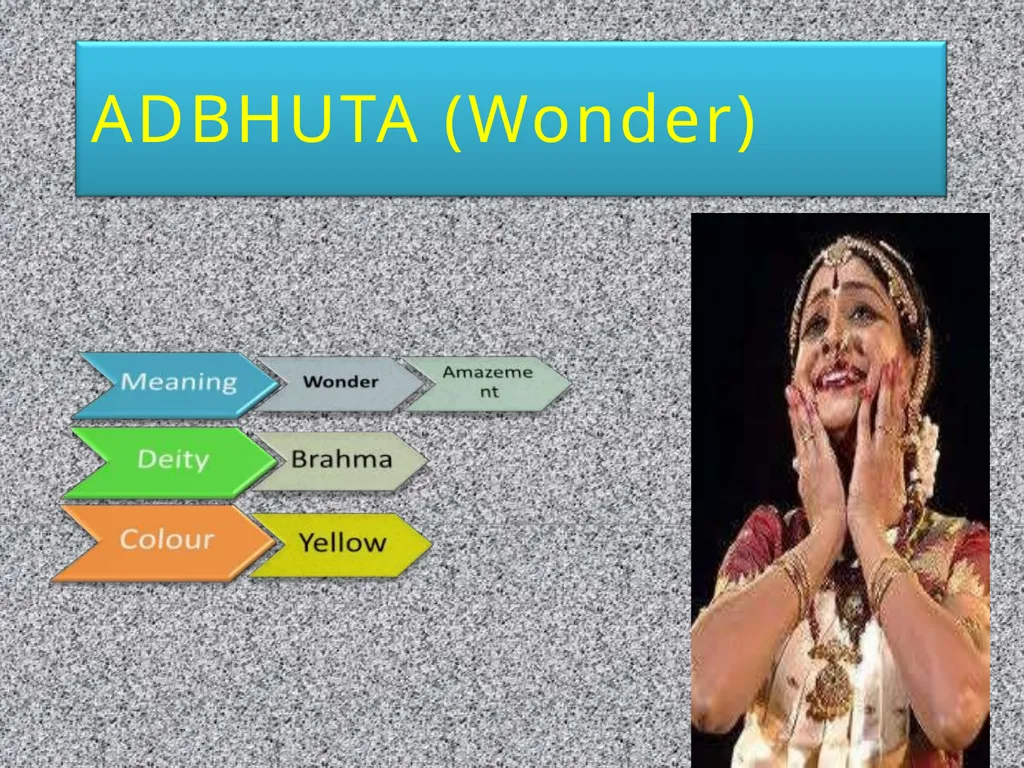
ADBHUTA (Wonder)<br>
20
Adbhuta The marvellous sentiment has its basic occurs only in the dominant state of atonement.
The preceding deity of the sentiment is ‘Brahman’. It is created by determinants search as slight of heavenly begins or events attainment of object.
In this we found superior mention or temple, and seven storied place and illusory and magical acts.
Consequences are ‘wide opening of eyes, looking with fixed gas horripilation and tears with joy.
Bharatamuni has mentioned this Rasa in his treaties the ‘Natyashastra’ he elaborately states for each its colour.
Adbhuta Rasa is a curiosity of man regarding the creation of the world and all its wonders, For example, ‘the glory of a king returning from a successful battle, the magical feats of a god are both adbhuta for a common man.’<br>
21
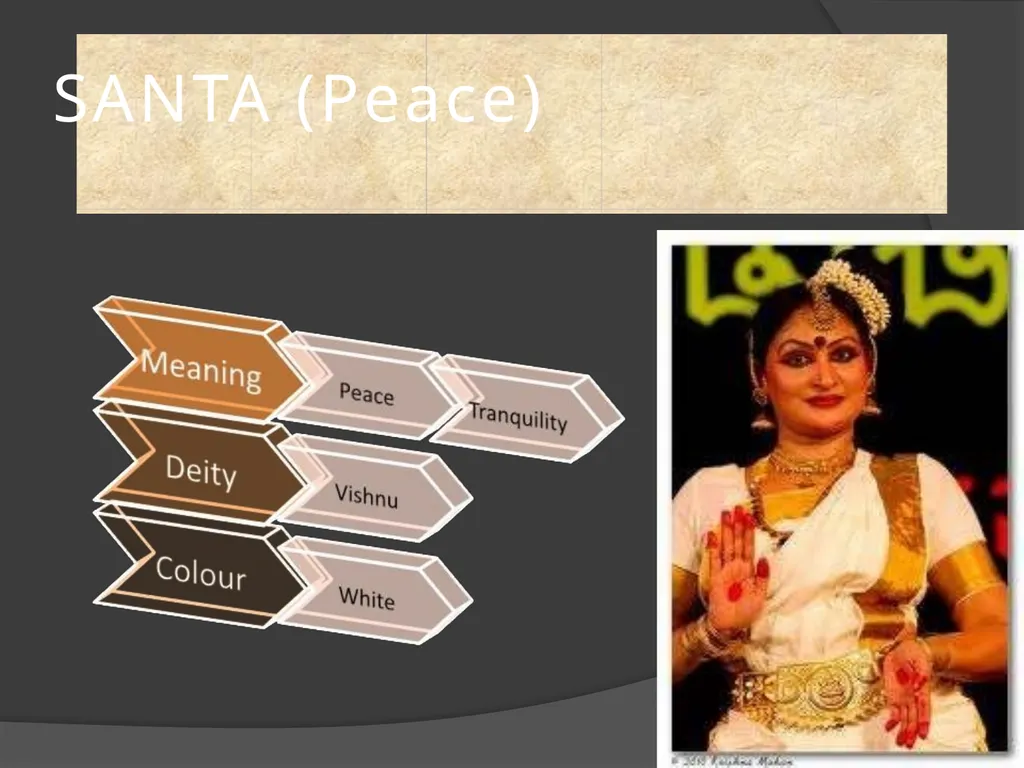
SANTA (Peace)<br>
22
Santa Rasa Santa connotes tranquillity, repose, serenity, the "peace that passes understanding."
The Mahabharata is diverse and intense full of conflicts and tensions portrayed in the from the schizophrenia of individuals to disastrous wars between clans.
Anandavardhana considered that the dominant rasa of the epic is the santa. Commenting on the hesitation of some theorists to accommodate the santa, Anada K. Coomaraswamy says: "In the first place there is really a disturbance, in the second there is the experience of a peace that cannot be described as an emotion in the sense that fear and love and hate are emotions. It is for this reason that Indian rhetoricians have hesitated to reckon 'peace' (Shanti) as a flavour (rasa) in one category with the other flavours."<br>
23
Santa Rasa (I) The santa rasa is the maharasa.
All feelings in aesthetic experience merge out of the santa and are in the end submerged in it.
All rasas are relished in a state of perfect tranquillity born out of the withdrawal of our ego from our practical interests.
There is a sense of repose in consciousness (samvidvisranti) when we are immersed in the aesthetic object to the exclusion of everything else. The feelings evoked do not struggle for an outlet. They enact themselves on the stage of our consciousness.
When our desire is directed to things not in consciousness the mind is agitated.<br>
24
Santa Rasa (II) Pain is only another name for the disturbance in consciousness caused by such desires, worries, etc.
But in the state of the santa, the maharasa, the consciousness is devoid of such agitations caused by egoistic desires.
In ordinary experience we find either emotional conflicts and the resulting tensions or passive relaxation.
But in rasa there is a unique union of the two opposites, tension and tranquillity.
The content of a poem, which is man's social experience pregnant with contradictions, evokes reverberations of feelings in the reader's heart.
But the feelings and emotions do not rise and subside haphazardly; their movements are strictly controlled and disciplined by the objective structure and texture, the form of the poem. Just as the poem achieves an inseparable integration of content and form, poetic experience unites the tension born out of conflicting emotions with repose resulting from the trans-personalized attitude<br>
25
Theory(Vad)-1 Bhatt Lollat : His school known as ‘utpattivad’. He says that there is no Rasa in us, but Rasa should be created in our mind. Nayak (hero) creates Rasa in our mind. Rasa essentially embodies the emotional state that the work of art seeks to portray. It hopes to evoke a resonant emotion in the audience. He says that feeling(pratiti) of rasa are just knowledge, how it is become joyful (Asvadya)? For example when we see smock we feel (Pratiti) that there is fair. But we cannot feel rasa in sane manner.<br>
26
Theory- 2 Shree Shankuk : Is known as ‘Anumativada’. It points out the drawbacks of Bhatta Lollat . However, there is no mention of proper rasaprakreeya (process of Rasa). According to him Rasa comes from the imagination (anuman) of the audience. We found four types of imaginations:
‘yathartha’(as it is)e.g.’ He is Rama
‘Sadrushya’ (like)e.g. He is similar to Rama
‘Sanshya’ (doubt)e.g. He is like Rama.
Mithya (false)e.g. He is not Rama
First we believe that he is Rama but actually he is not Rama but a person played role of Rama. Same in the picture of Horse, and we cannot says that it is a Horse. We can also say that it is not Horse because it is a picture of horse not a real one. We can say that willing suspension of disbelief.<br>
27
Theory- 3 BhattaNayaka: Is school known as ‘Bhuteekvada’. He gives a principle of ‘Sadharanikaran’. Rasa is not in Hero but audience have to create it. He says that ‘sadharnikaran’ (commonness) is necessary between audience and Nayak (Hero) for creating Rasa or enjoying the play. Audience and Hero have power of grasping (Bhavna). His emphasis is on sthaibhava and sadharnikaran, and says rasa does not come from Hero, and nor from original character. It’s come from the ‘sadharnikarn’ of audience. But if the audience, first go through the persona of Mr. A, who play the role of Rama at this stage he cannot enjoy the play. But slowly people started doing ‘sadharnikaran’ and forget about Mr. A, and think about the original Rama, a people think that Mr. A is an original Rama, and then Rasa is created in the mind of people.<br>
28
Theory- 4 Abhinav Gupt: Is known as ‘Abhivyanjnavada’. In his work ‘Abhinavbharti’ he talks about Rasa theory. In this work, he writes about the rasasutra of Bharata in consonance with the theory of abhivyakti (expression).He says that when the hero (Nayak) and the audience, both forget about their personality, who is he or her at that level they feel Rasa and enjoy the play. For example, Mr. A played a role of hero or Rama. When Mr. A totally identifies, enters in to the character of Rama. He thinks that now he is original Rama. Form audience one person knows Mr. A at that time he can’t enjoy the play. But when he accepts Mr. A as a Rama and forgets that he is Mr. A. At this level both Hero and audience really get pleasure form the play. We get true meaning of ‘Rasaprakriya’ from Abhinavgupta<br>
29
Conclusion After knowing all this, hear we can says that ‘Rasa’ comes from the ‘Bhava’ and Bhava have no language. In short both are connected with each other. “The term ‘rasa’ has a twofold significance: it means the ‘Aesthetic content of literary art’ and also ‘Aesthetic relish’ which the reader-spectator enjoys.”
The sources of origin of the ‘Rasa’ are the four basic sentiments-‘Erotic’, ‘Furious’, ‘Heroic’, ‘Odious’. The Erotic sentiment is light- green (syama), the comic is described as White, the pathetic is Grey (Kapota) and fearful is (Red), the Heroic is yellow-Red (Gaur), Terrible is Black, the Odious is (Blue) and the Marvelous is yellow. The ‘Erotic’ (sentiment) has Vishnu as Deity, the ‘comic’ is pramaatha, the ‘furious’ is Rudra; the pathetic is Yama, Odious is Mahakala, terrible is Kala, the Heroic is Mahendra and the Marvelous has Brahma as it deity.
Although the concept of rasa is fundamental to many forms of Indian art including dance, music, musical theater, cinema and literature, the treatment, interpretation, usage and actual performance of a particular Rasa differs greatly between different styles and school of Abhinaya, and the huge regional differences even within one style.<br>