Understanding the Tear Film Subtitle The Tear Film The tear film is an incredibly complex structure, that has vitally important role in the health of our eyes. Our tears are like no other fluid in the body and their function is to cover the
"Understanding the Tear Film Subtitle The Tear Film" is the property of its rightful owner. Permission is granted to
download and print the materials on this website for personal, non-commercial use only, and to display it
on your personal computer provided you do not modify the materials and that you retain all copyright
notices contained in the materials. By downloading content from our website, you accept the terms of this
agreement.
Presentation Transcript
01
Understanding the Tear Film Subtitle<br>
02
The Tear Film The tear film is an incredibly complex structure, that has vitally important role in the health of our eyes.
Our tears are like no other fluid in the body and their function is to cover the surface of the eye at any given time, to protect and moisturise as well as help provide clear vision.<br>
03
Functions of the Tear Film The tear film covers the ocular surface and has the following essential roles:
Protects the eye from the environment
Provides lubrication to the ocular surface during blinking
Maintains a smooth surface for light refraction and clear stable vision
Provides oxygen and preserves the health of the conjunctiva and the avascular cornea
Flushes away contaminants/debris
Helps to prevent infection<br>
04
Functions of the Tear Film The tear film is approximately 3 to 10 μL in volume, 3 μm thick, and secreted at a rate of 1 to 2 μL/min1,2.
The pH of tears is approximately 7.45 and ranges between 7.14 to 7.82, depending on diurnal and seasonal influences2.<br>
05
Different types of tears3. Biochemically there are three uniquely different types of tears
Basal tears are typically present on the ocular surface, providing nutrients to the ocular surface, maintaining ocular comfort, and ridding the surface of debris.
Reflex tears are those released in response to irritants, including chemicals and foreign bodies. Reflex tears are produced in higher quantities than basal tears and are involved in flushing the ocular surface of irritants.
Closed eye tears are those lubricating the eyes during sleep.<br>
06
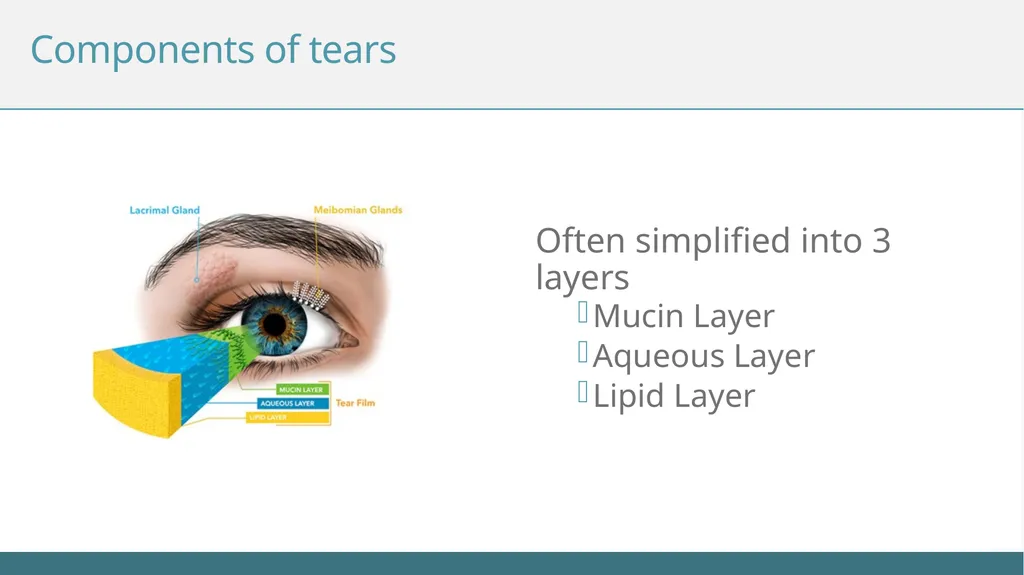
Components of tears Often simplified into 3 layers
Mucin Layer
Aqueous Layer
Lipid Layer<br>
07
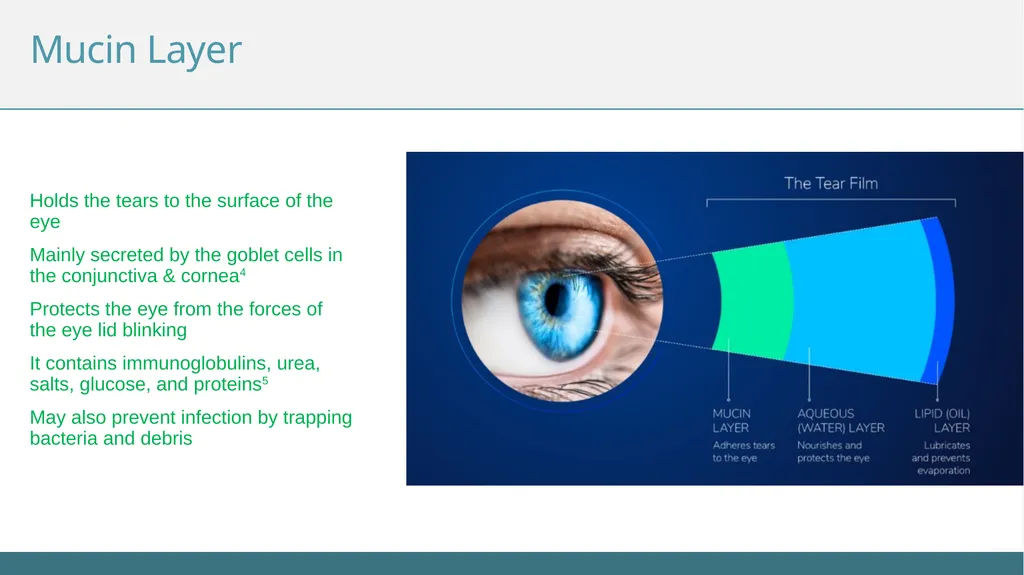
Mucin Layer Holds the tears to the surface of the eye
Mainly secreted by the goblet cells in the conjunctiva & cornea4
Protects the eye from the forces of the eye lid blinking
It contains immunoglobulins, urea, salts, glucose, and proteins5
May also prevent infection by trapping bacteria and debris<br>
08
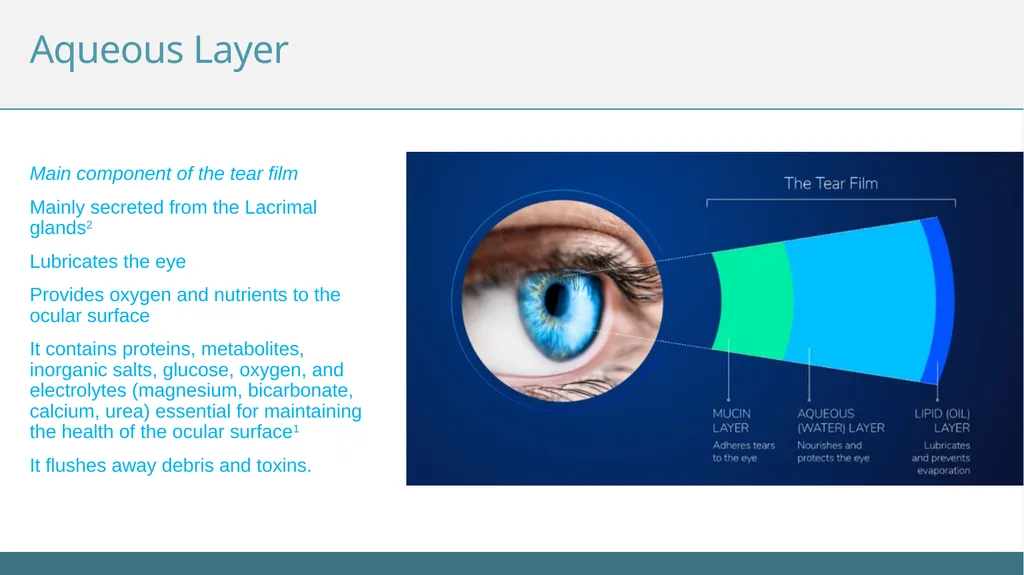
Aqueous Layer Main component of the tear film
Mainly secreted from the Lacrimal glands2
Lubricates the eye
Provides oxygen and nutrients to the ocular surface
It contains proteins, metabolites, inorganic salts, glucose, oxygen, and electrolytes (magnesium, bicarbonate, calcium, urea) essential for maintaining the health of the ocular surface1
It flushes away debris and toxins.<br>
09
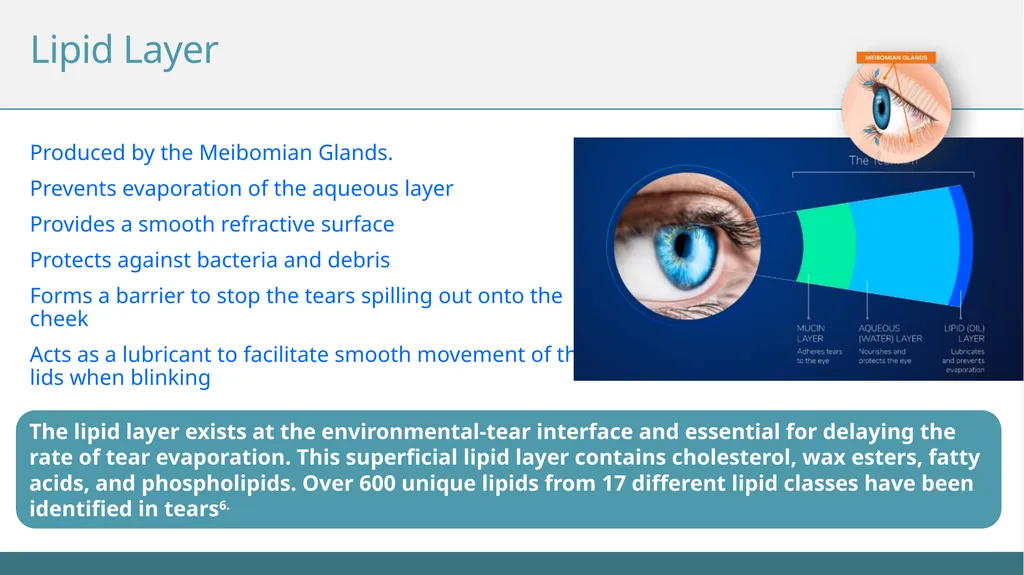
Lipid Layer Produced by the Meibomian Glands.
Prevents evaporation of the aqueous layer
Provides a smooth refractive surface
Protects against bacteria and debris
Forms a barrier to stop the tears spilling out onto the cheek
Acts as a lubricant to facilitate smooth movement of the lids when blinking The lipid layer exists at the environmental-tear interface and essential for delaying the rate of tear evaporation. This superficial lipid layer contains cholesterol, wax esters, fatty acids, and phospholipids. Over 600 unique lipids from 17 different lipid classes have been identified in tears6.<br>
10
The Tear Film All these different components work together to provide a protective and lubricating layer to the surface of our eyes, but they need to be in the right quantities to provide a stable tear film.
If any part is altered or reduced then the tear film cannot function effectively, causing it to become unstable and lead to the signs & symptoms of dry eye.<br>
11
The Tear Film It is now understood to be more of a blend of layers and DEWS II report suggest a two-phase model of the tear film7.
A Mucoaqueous layer with a greater concentration of mucin closest to the cornea, and a higher concentration of aqueous towards the lipid layer
An overlying (outer) lipid layer<br>
12
Summary Tears are important to the overall health of our eyes and our vision.
Each time we blink, a protective layer of tears is spread like a film over the front of our eye.
The tear film can be described with 3 layers: 1) mucin layer 2) aqueous layer 3) lipid layer
Recent studies suggest that the mucin and aqueous layers are combined to form a mucoaqueous layer
When our tear film becomes unstable, symptoms of dry eye can occur.<br>