
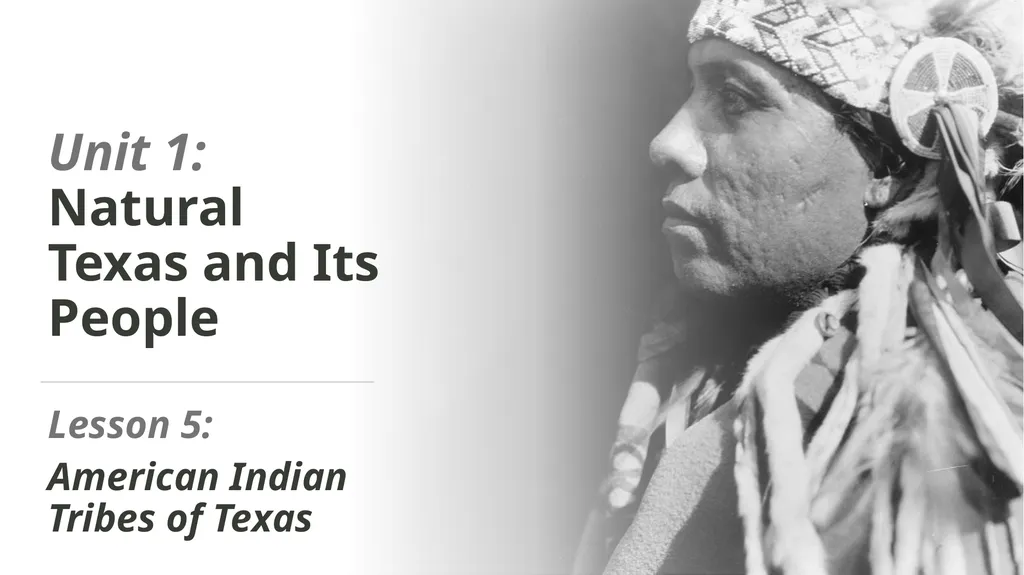
Unit 1: Natural Texas and Its People Lesson 5:
LV
Published · 24 slides · 0 views

1 / 1

Description
Unit 1: Natural Texas and Its People Lesson 5: American Indian Tribes of Texas American Indian Tribes of Texas Warm-up https:education.texashistory.unt.edu https:education.texashistory.unt.edu Warm-up Day 1: Follow the directions below
Related Topics
Share
Embed code
Download this presentation From Below
"Unit 1: Natural Texas and Its People Lesson 5:" is the property of its rightful owner. Permission is granted to download and print the materials on this website for personal, non-commercial use only, and to display it on your personal computer provided you do not modify the materials and that you retain all copyright notices contained in the materials. By downloading content from our website, you accept the terms of this agreement.
Presentation Transcript
01
Unit 1:
Natural Texas and Its People Lesson 5:
American Indian Tribes of Texas<br>
American Indian Tribes of Texas<br>
02
American Indian Tribes of Texas
Warm-up https://education.texashistory.unt.edu<br>
03
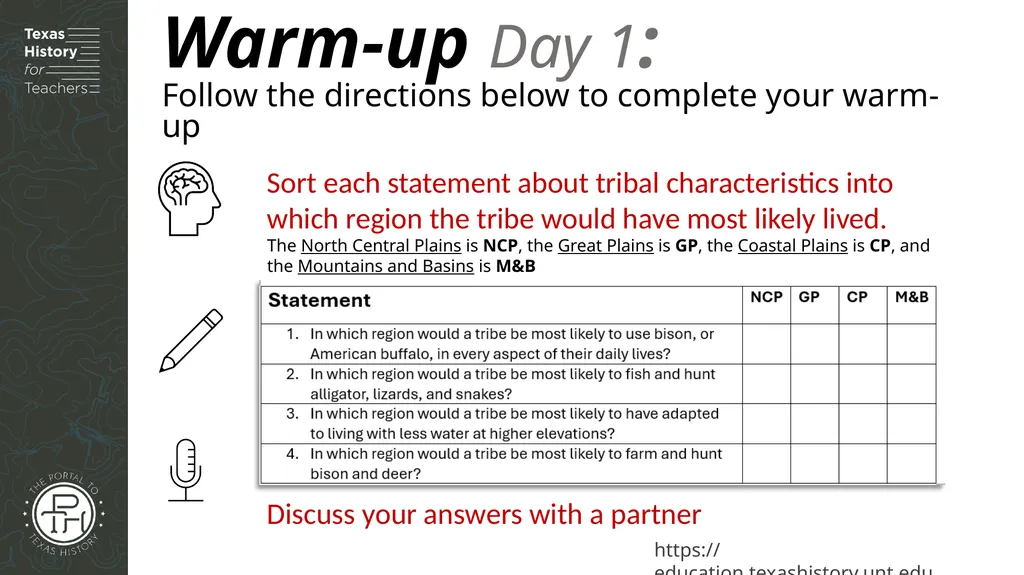
https://education.texashistory.unt.edu Warm-up Day 1:
Follow the directions below to complete your warm-up Sort each statement about tribal characteristics into which region the tribe would have most likely lived.
The North Central Plains is NCP, the Great Plains is GP, the Coastal Plains is CP, and the Mountains and Basins is M&B Discuss your answers with a partner<br>
The North Central Plains is NCP, the Great Plains is GP, the Coastal Plains is CP, and the Mountains and Basins is M&B Discuss your answers with a partner<br>
04
https://education.texashistory.unt.edu Share with the class
Warm-up Day 1 Tribes would be most likely to _________ in the _______ region<br>
05
https://education.texashistory.unt.edu Essential Question What are the characteristics of various early American Indian tribes of Texas ?<br>
06
https://education.texashistory.unt.edu In today’s lesson…
Day 1 We will study early American Indian tribes who lived in different regions of Texas.
I will take notes that summarize the significant information about tribal shelter, food, mobility, culture, and location in Texas.<br>
I will take notes that summarize the significant information about tribal shelter, food, mobility, culture, and location in Texas.<br>
07
https://education.texashistory.unt.edu Warm-up Day 2:
Follow the directions below to complete your warm-up Directions: Imagine you are an early American Indian from one of the tribes you learned about yesterday, and you are living in Texas hundreds of years ago. Tell a little about a typical day in your life. Discuss with a partner: Share your response with a partner. Do not tell them your tribe or region. See if they can use clues from your response to guess the correct region and tribe.<br>
08
https://education.texashistory.unt.edu Essential Question
Day 2 How do the environmental differences between the regions affect how American Indian tribes lived across Texas?<br>
09
https://education.texashistory.unt.edu In today’s lesson…
Day 2 We will analyze how geographic differences in Texas regions influenced the lives of early American Indian tribes.
I will compare the characteristics of two tribes from different regions.<br>
I will compare the characteristics of two tribes from different regions.<br>
10
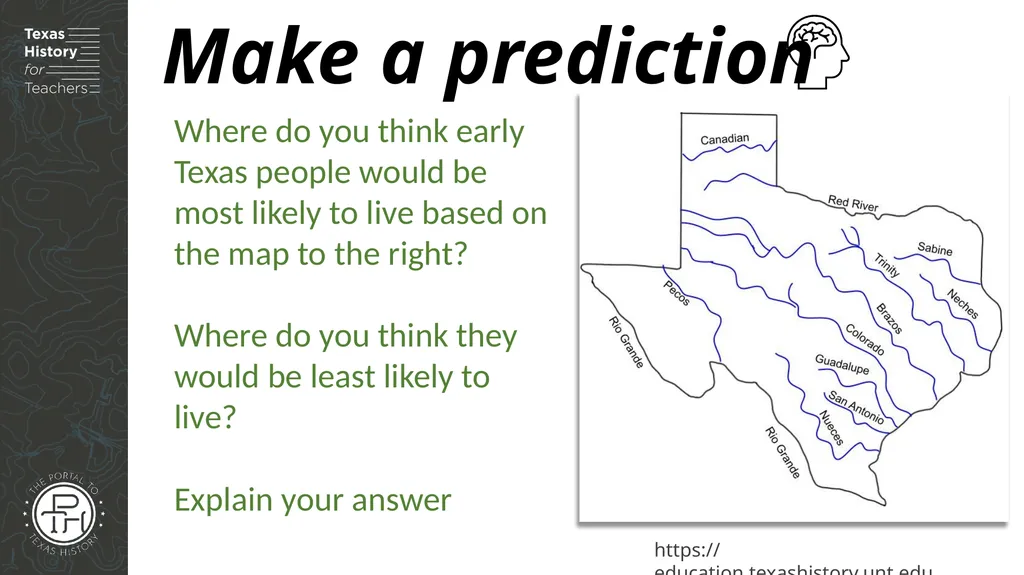
https://education.texashistory.unt.edu Make a prediction Where do you think early Texas people would be most likely to live based on the map to the right?
Where do you think they would be least likely to live?
Explain your answer<br>
Where do you think they would be least likely to live?
Explain your answer<br>
11
https://education.texashistory.unt.edu Caddo The Caddo were a large group of Indigenous tribes spread across Texas, Oklahoma, Arkansas, and Louisiana. Their full name was Kadohadacho, which was shortened by the French who later encountered them.
The Caddo people lived in large, agricultural communities in one of the most fertile parts of Texas. They farmed “the three sisters” – corn, beans, and squash. The built large, dome-shaped grass houses that could stand 50 feet tall. Many families often lived in one home.
The Caddo people developed advanced, sophisticated societies that were the largest and most powerful of all the early Indigenous Texas tribes. They made ceramic pots for cooking and storing food and held ceremonies for important occasions. They built large mounds of earth for these celebrations.
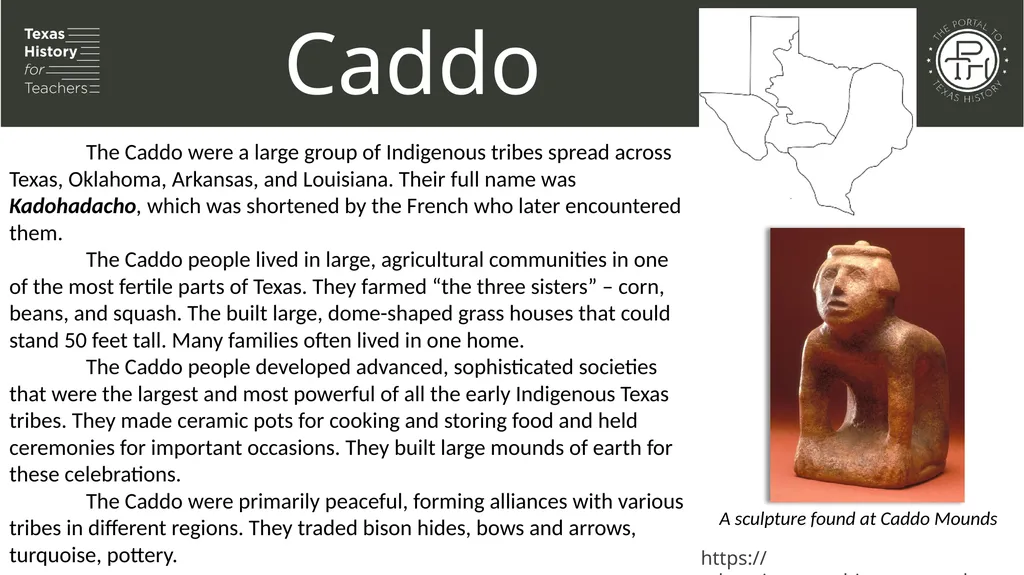
The Caddo were primarily peaceful, forming alliances with various tribes in different regions. They traded bison hides, bows and arrows, turquoise, pottery. A sculpture found at Caddo Mounds<br>
12
https://education.texashistory.unt.edu Wichita Despite how we often refer to it, the Wichita tribe wasn’t one tribe at all. It was a collection of different smaller tribes that worked together and shared a similar language and culture. When many groups come together to form an alliance or partnership, it is called a confederacy.
The Wichita confederacy often called themselves Kitikiti’sh, or “The Raccoon-Eyed People” because many Wichita people painted or tattooed the skin around their eyes.
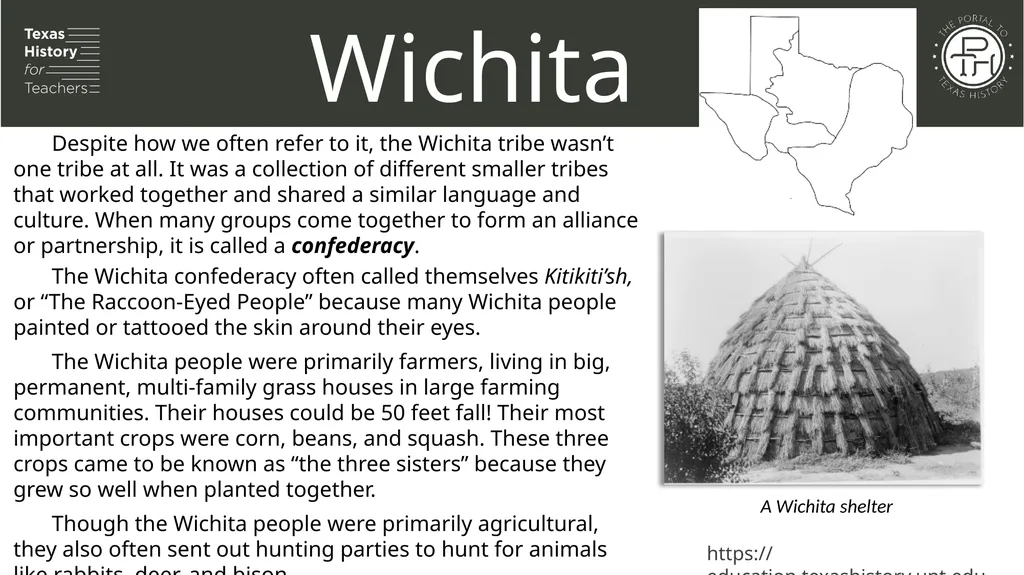
The Wichita people were primarily farmers, living in big, permanent, multi-family grass houses in large farming communities. Their houses could be 50 feet fall! Their most important crops were corn, beans, and squash. These three crops came to be known as “the three sisters” because they grew so well when planted together.
Though the Wichita people were primarily agricultural, they also often sent out hunting parties to hunt for animals like rabbits, deer, and bison. A Wichita shelter<br>
13
https://education.texashistory.unt.edu Atakapa The word Atakapa means “Man-eater.” This name was likely given to them by a different tribe of American Indians. It referred to a practice of ritual cannibalism, which typically took place as part of tribal warfare. The Atakapa may have eaten the flesh of their enemies killed in battle.
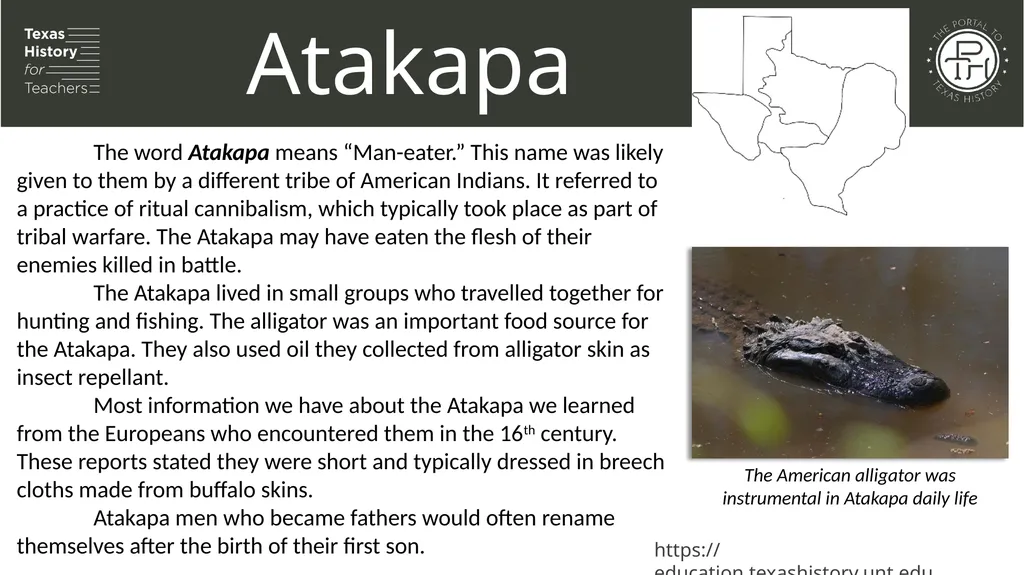
The Atakapa lived in small groups who travelled together for hunting and fishing. The alligator was an important food source for the Atakapa. They also used oil they collected from alligator skin as insect repellant.
Most information we have about the Atakapa we learned from the Europeans who encountered them in the 16th century. These reports stated they were short and typically dressed in breech cloths made from buffalo skins.
Atakapa men who became fathers would often rename themselves after the birth of their first son. The American alligator was instrumental in Atakapa daily life<br>
14
https://education.texashistory.unt.edu Karankawa Like many American Indian tribes in Texas, the Karankawa were not only one tribe, but a collection of smaller tribes that shared a similar language and culture.
The word Karankawa most likely meant “dog lover,” as reported by the Spanish who encountered them. The Karankawa were known for keeping dogs that were described as a coyote-fox breed.
The Karankawa were semi-nomadic, moving when they needed new resources. They were primarily hunter-gatherers and fishers. Their diet consisted of fish, turtles, plants, and other animals.
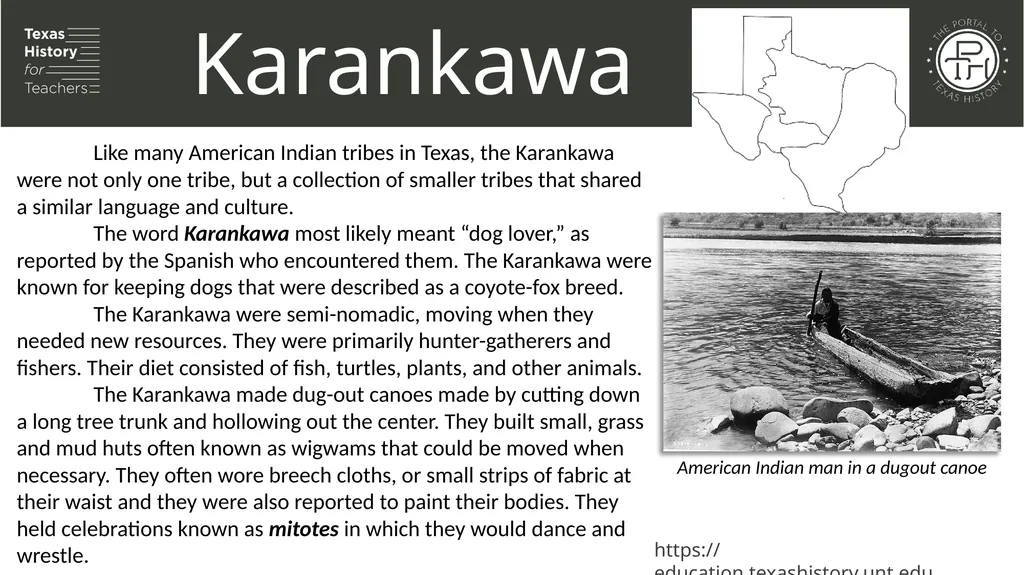
The Karankawa made dug-out canoes made by cutting down a long tree trunk and hollowing out the center. They built small, grass and mud huts often known as wigwams that could be moved when necessary. They often wore breech cloths, or small strips of fabric at their waist and they were also reported to paint their bodies. They held celebrations known as mitotes in which they would dance and wrestle. American Indian man in a dugout canoe<br>
15
https://education.texashistory.unt.edu Coahuiltecan Like many other Indigenous tribes, the Coahuiltecan was not only one tribe, rather hundreds of small groups who shared similar languages and cultural characteristics.
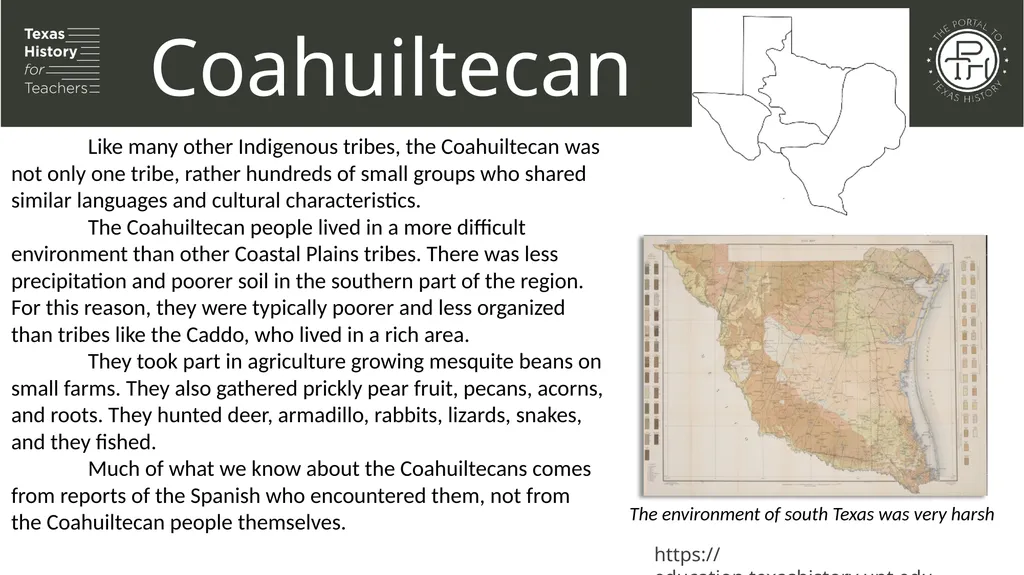
The Coahuiltecan people lived in a more difficult environment than other Coastal Plains tribes. There was less precipitation and poorer soil in the southern part of the region. For this reason, they were typically poorer and less organized than tribes like the Caddo, who lived in a rich area.
They took part in agriculture growing mesquite beans on small farms. They also gathered prickly pear fruit, pecans, acorns, and roots. They hunted deer, armadillo, rabbits, lizards, snakes, and they fished.
Much of what we know about the Coahuiltecans comes from reports of the Spanish who encountered them, not from the Coahuiltecan people themselves. The environment of south Texas was very harsh<br>
16
https://education.texashistory.unt.edu Comanche Unlike many other American Indian tribes, the Comanche did not live in Texas until the early 1700s. After the arrival of Spanish horses in the 1500s, they adapted themselves into a powerful horse culture during the 1600s and then migrated south toward Texas from areas near present-day Colorado and Wyoming. Like other tribes, the Comanche were actually many different bands of American Indians who shared similar language and culture.
The Comanche were fierce warriors. The word Comanche actually means “enemy.” It was the name used by an enemy tribe of Ute Indians. The Comanche called themselves Numinu, meaning “the people.” Fighting from horses, the Comanche soon became one of the most powerful groups in Texas.
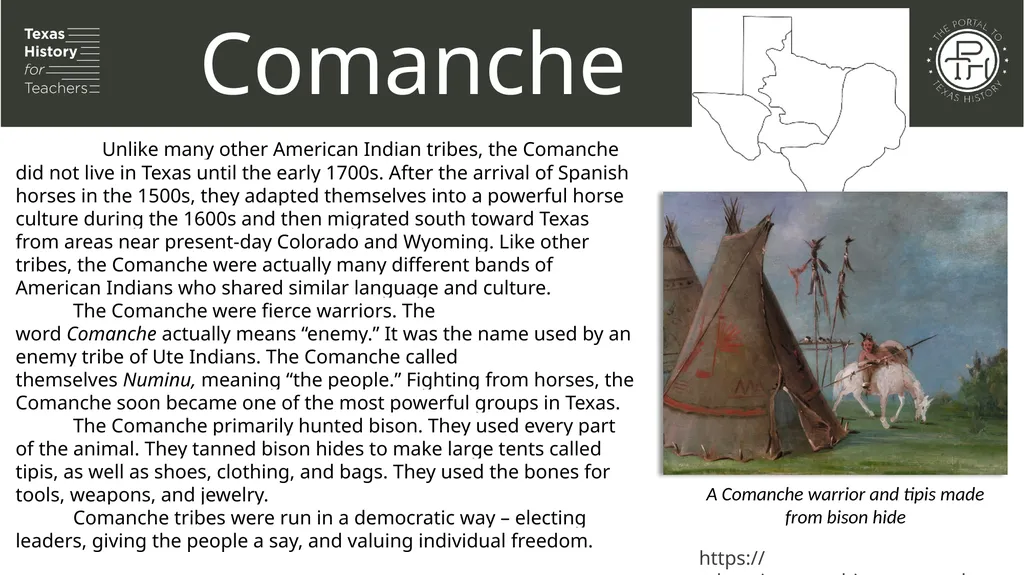
The Comanche primarily hunted bison. They used every part of the animal. They tanned bison hides to make large tents called tipis, as well as shoes, clothing, and bags. They used the bones for tools, weapons, and jewelry.
Comanche tribes were run in a democratic way – electing leaders, giving the people a say, and valuing individual freedom. A Comanche warrior and tipis made from bison hide<br>
17
https://education.texashistory.unt.edu Apache The Apache migrated into Texas in the 1500s for resources and trade with the Spanish and French. The term Apache is a title given to this tribe by their Zuni enemies. Apache means “enemy.” The name the Apache used for themselves was Ndee, or “the People.”
The Apache hunted American buffalo, rabbit, and sheep. They sometimes grew or gathered beans, seeds, roots, and squash. They made a type of beer called tiswin made from corn.
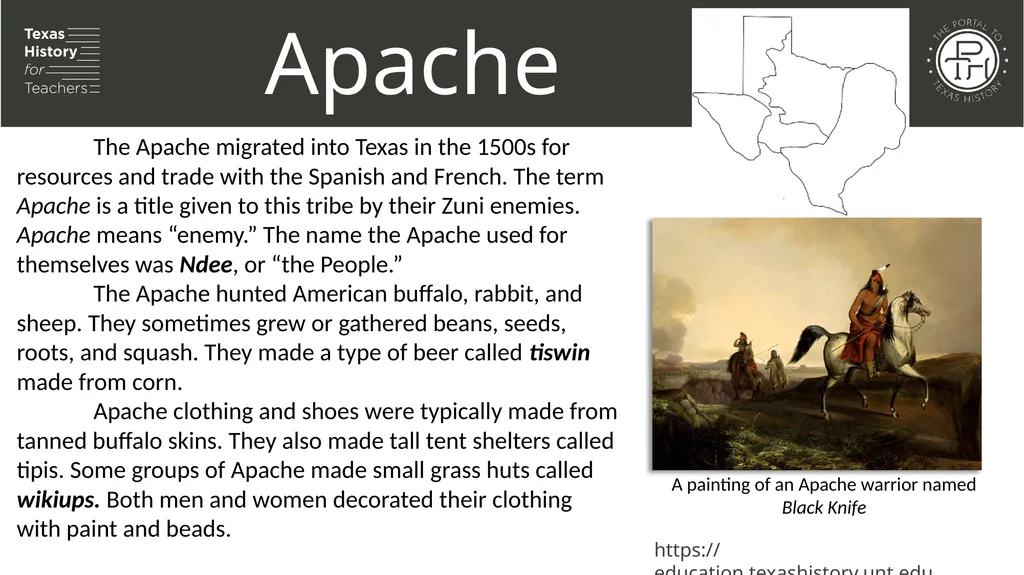
Apache clothing and shoes were typically made from tanned buffalo skins. They also made tall tent shelters called tipis. Some groups of Apache made small grass huts called wikiups. Both men and women decorated their clothing with paint and beads. A painting of an Apache warrior named Black Knife<br>
18
https://education.texashistory.unt.edu Kiowa The Kiowa people didn’t migrate into Texas until the 1800s. The Kiowa were also fierce warriors, though they made a lasting peace with the Comanche in the late 1700s.
The Kiowa people depended on the buffalo for food, shelter, clothing, tools, and other items. They also hunted deer and rabbits, and gathered wild fruits, vegetables, and berries.
The sun played an important role in Kiowa religious beliefs. They held Sun Dance ceremonies in the early summer for ten or more days.
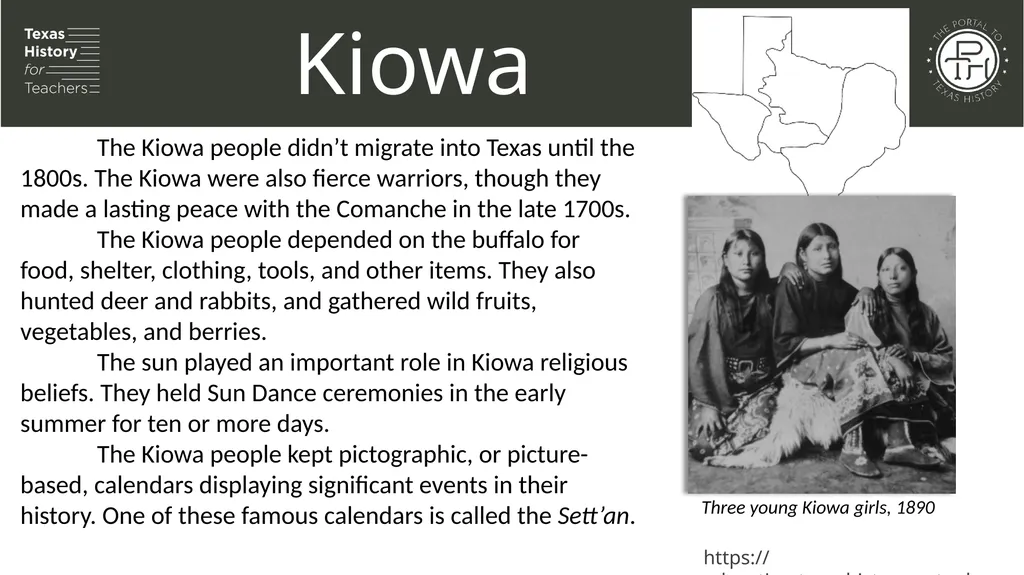
The Kiowa people kept pictographic, or picture-based, calendars displaying significant events in their history. One of these famous calendars is called the Sett’an. Three young Kiowa girls, 1890<br>
19
https://education.texashistory.unt.edu Jumano By the 1700s, the name Jumano was given to three groups of people who shared a similar language and culture in the American southwest.
The Jumano of west Texas were buffalo hunters and traders. When the Spanish arrived in Texas, the Jumano acted as middle-men trading between the Spanish and other tribes.
The Spanish often referred to the Jumano as the “naked people” because they often wore very little clothing. They were also called “striped people” because of the stripes many Jumano people would paint on their bodies.
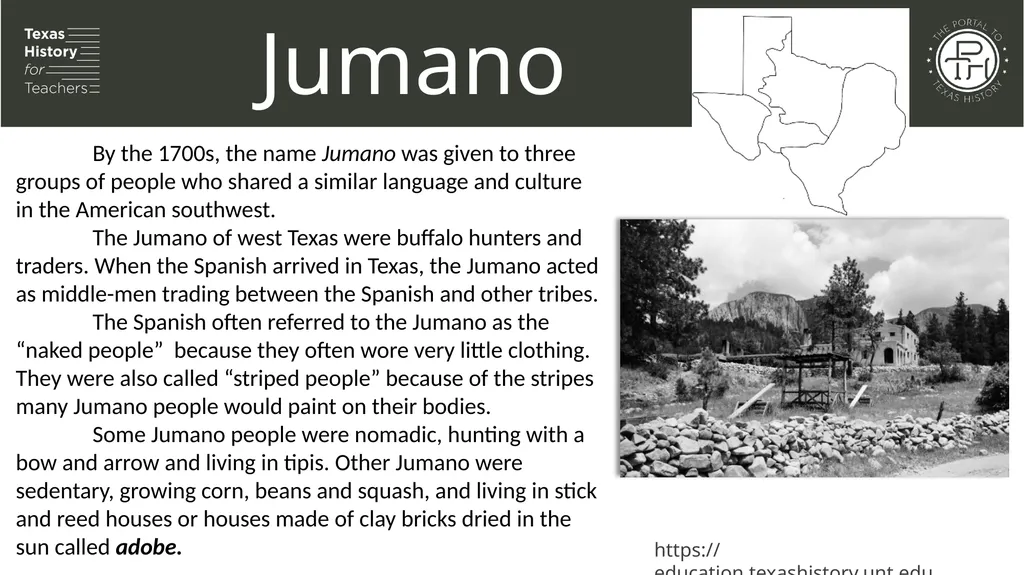
Some Jumano people were nomadic, hunting with a bow and arrow and living in tipis. Other Jumano were sedentary, growing corn, beans and squash, and living in stick and reed houses or houses made of clay bricks dried in the sun called adobe.<br>
20
https://education.texashistory.unt.edu Tigua The Tigua were a Puebloan tribe who lived in homes made of clay bricks dried in the sun. The Tigua lived in approximately 13 different permanent villages made up of about 200 adobe houses. They spoke a language called Tiwa which is now nearly extinct.
The Tigua people were primarily farmers, growing corn, beans, and squash. These three crops grew so well together they were often called “the three sisters.” The Tigua also got food by hunting deer, rabbits, antelope, and bears, and gathering berries, which they stored in beautiful handmade and painted pottery.
The Tigua made their clothes out of leather, fur, and cotton which they grew on farms. They held religious ceremonies and dances before and after their harvests.
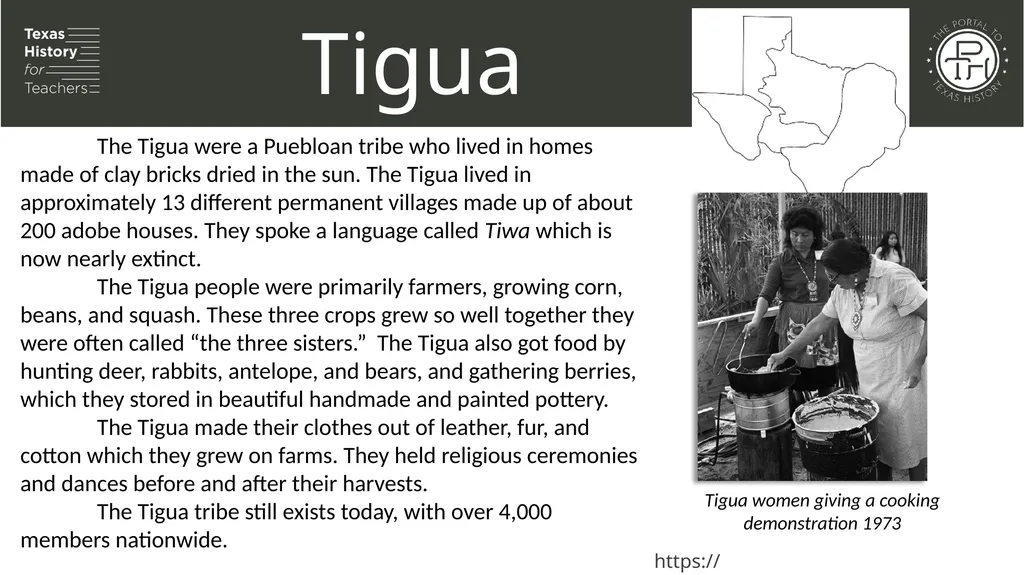
The Tigua tribe still exists today, with over 4,000 members nationwide. Tigua women giving a cooking demonstration 1973<br>
21
https://education.texashistory.unt.edu Exit Ticket
Day 1 From the notes you took today, choose one tribe from one region and answer the following question:
PROMPT: What were two characteristics of the tribe you have chosen, and how were those characteristics influenced by the region they lived in?
Use the sentence stem provided to help you organize your answer<br>
PROMPT: What were two characteristics of the tribe you have chosen, and how were those characteristics influenced by the region they lived in?
Use the sentence stem provided to help you organize your answer<br>
22
https://education.texashistory.unt.edu Share with the class
Exit Ticket Day 1 The ______ tribe of the _________ region typically ____________ because they lived in an area with ______________<br>
23
https://education.texashistory.unt.edu Exit Ticket
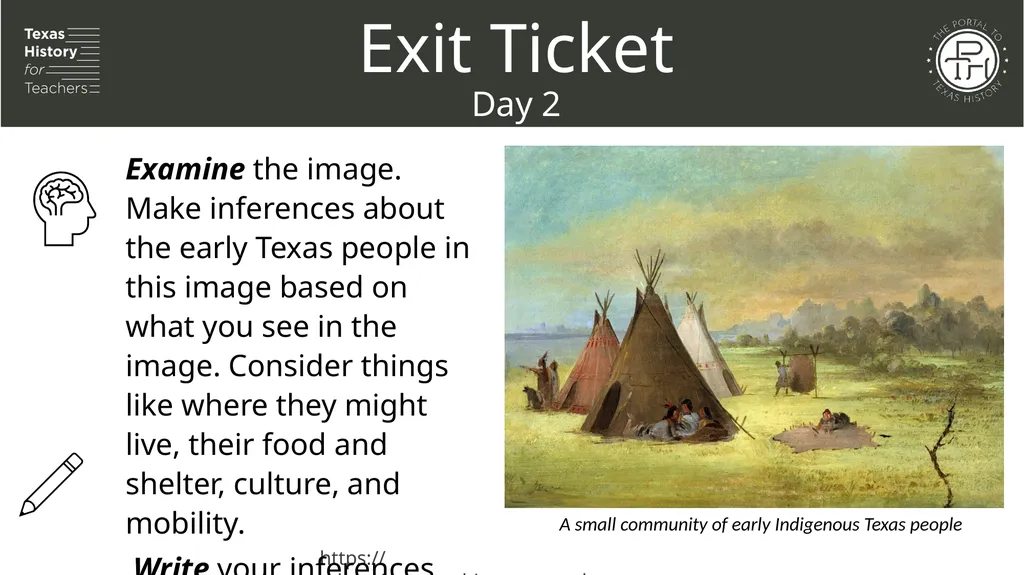
Day 2 Examine the image. Make inferences about the early Texas people in this image based on what you see in the image. Consider things like where they might live, their food and shelter, culture, and mobility.
Write your inferences next to the image. A small community of early Indigenous Texas people<br>
Write your inferences next to the image. A small community of early Indigenous Texas people<br>
24
https://education.texashistory.unt.edu Share with the class
Exit Ticket Day 2 I can infer that this tribe probably _____________ because in the picture I see ___________________<br>