
UNIT IV The Federal Parliament of Switzerland
TG
Published · 18 slides · 0 views

1 / 1

Description
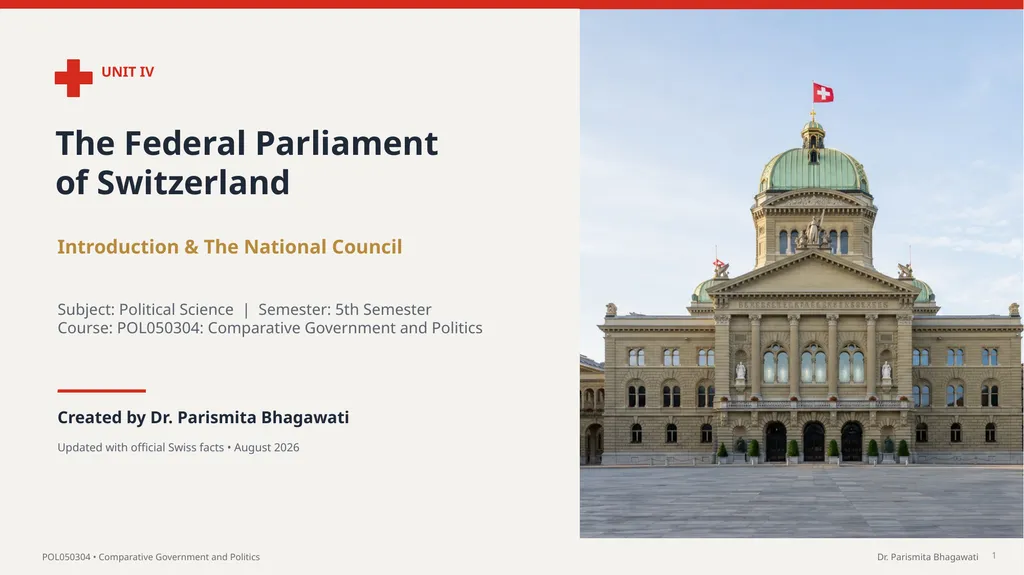
UNIT IV The Federal Parliament of Switzerland Introduction The National Council Subject: Political Science Semester: 5th Semester Course: POL050304: Comparative Government and Politics Created by Dr. Parismita Bhagawati Updated with
Related Topics
Share
Embed code
Download this presentation From Below
"UNIT IV The Federal Parliament of Switzerland" is the property of its rightful owner. Permission is granted to download and print the materials on this website for personal, non-commercial use only, and to display it on your personal computer provided you do not modify the materials and that you retain all copyright notices contained in the materials. By downloading content from our website, you accept the terms of this agreement.
Presentation Transcript
01
UNIT IV The Federal Parliament
of Switzerland Introduction & The National Council Subject: Political Science | Semester: 5th Semester
Course: POL050304: Comparative Government and Politics Created by Dr. Parismita Bhagawati Updated with official Swiss facts • August 2026 1<br>
of Switzerland Introduction & The National Council Subject: Political Science | Semester: 5th Semester
Course: POL050304: Comparative Government and Politics Created by Dr. Parismita Bhagawati Updated with official Swiss facts • August 2026 1<br>
02
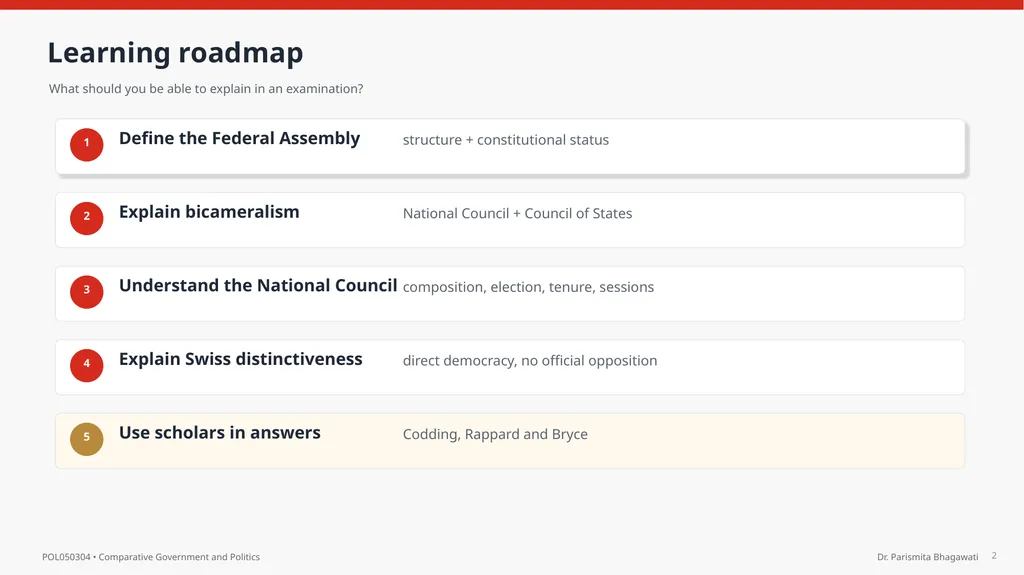
Learning roadmap What should you be able to explain in an examination? 1 Define the Federal Assembly structure + constitutional status 2 Explain bicameralism National Council + Council of States 3 Understand the National Council composition, election, tenure, sessions 4 Explain Swiss distinctiveness direct democracy, no official opposition 5 Use scholars in answers Codding, Rappard and Bryce 2<br>
03
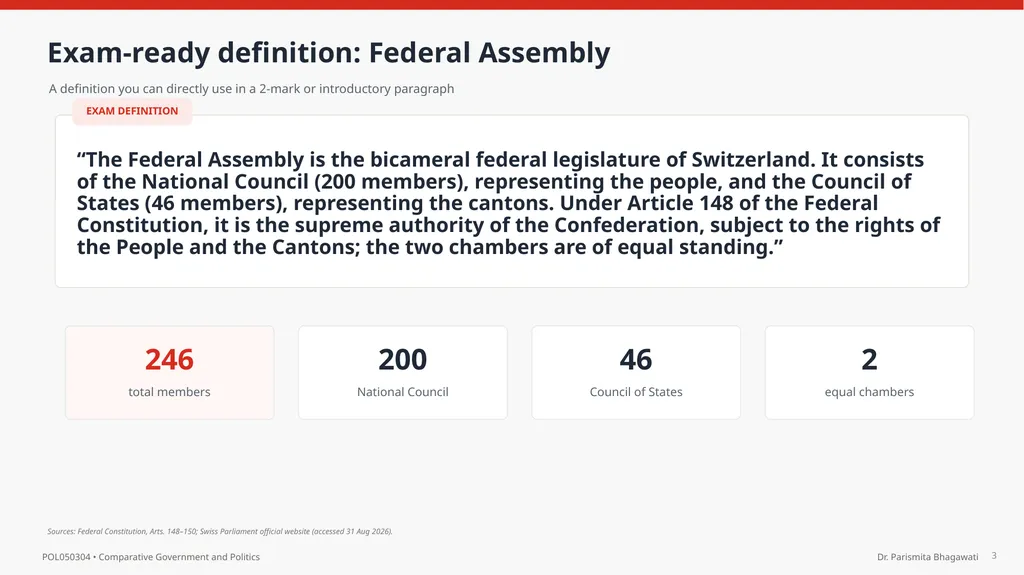
Exam-ready definition: Federal Assembly A definition you can directly use in a 2-mark or introductory paragraph “The Federal Assembly is the bicameral federal legislature of Switzerland. It consists of the National Council (200 members), representing the people, and the Council of States (46 members), representing the cantons. Under Article 148 of the Federal Constitution, it is the supreme authority of the Confederation, subject to the rights of the People and the Cantons; the two chambers are of equal standing.” EXAM DEFINITION 246 total members 200 National Council 46 Council of States 2 equal chambers Sources: Federal Constitution, Arts. 148–150; Swiss Parliament official website (accessed 31 Aug 2026). 3<br>
04
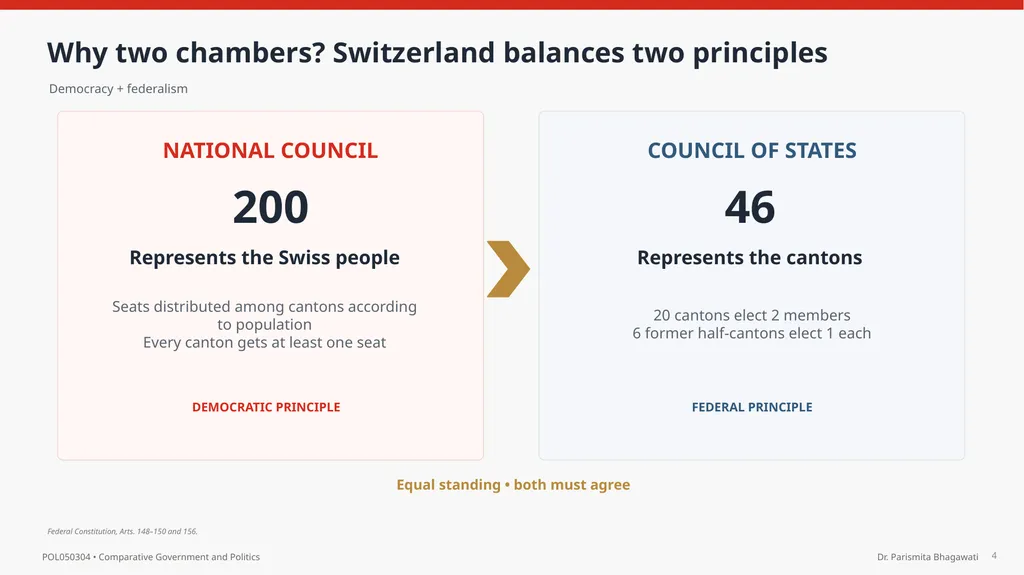
Why two chambers? Switzerland balances two principles Democracy + federalism NATIONAL COUNCIL 200 Represents the Swiss people Seats distributed among cantons according to population
Every canton gets at least one seat DEMOCRATIC PRINCIPLE COUNCIL OF STATES 46 Represents the cantons 20 cantons elect 2 members
6 former half-cantons elect 1 each FEDERAL PRINCIPLE Equal standing • both must agree Federal Constitution, Arts. 148–150 and 156. 4<br>
Every canton gets at least one seat DEMOCRATIC PRINCIPLE COUNCIL OF STATES 46 Represents the cantons 20 cantons elect 2 members
6 former half-cantons elect 1 each FEDERAL PRINCIPLE Equal standing • both must agree Federal Constitution, Arts. 148–150 and 156. 4<br>
05
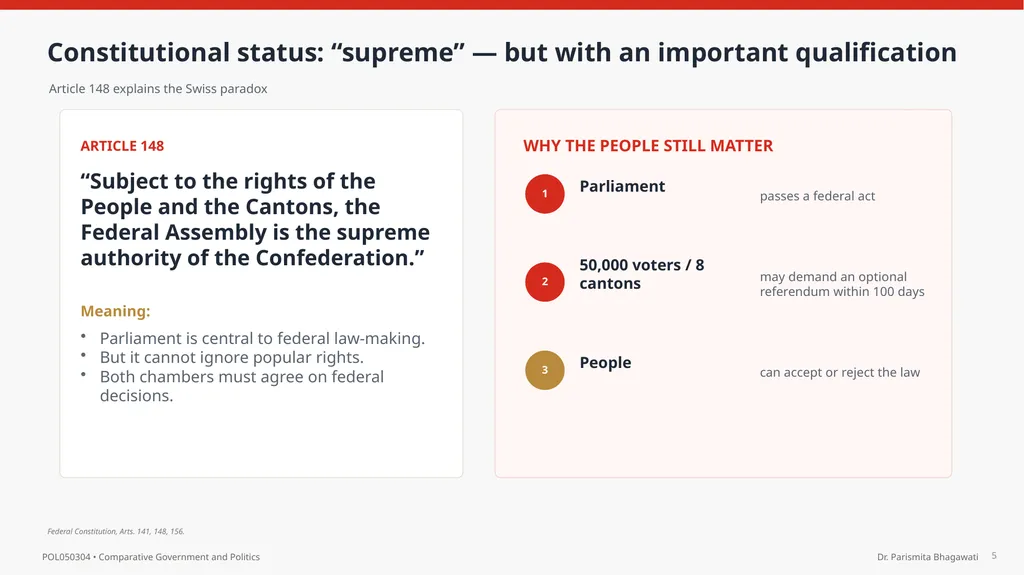
Constitutional status: “supreme” — but with an important qualification Article 148 explains the Swiss paradox ARTICLE 148 “Subject to the rights of the People and the Cantons, the Federal Assembly is the supreme authority of the Confederation.” Meaning: Parliament is central to federal law-making.
But it cannot ignore popular rights.
Both chambers must agree on federal decisions. WHY THE PEOPLE STILL MATTER 1 Parliament passes a federal act 2 50,000 voters / 8 cantons may demand an optional referendum within 100 days 3 People can accept or reject the law Federal Constitution, Arts. 141, 148, 156. 5<br>
06
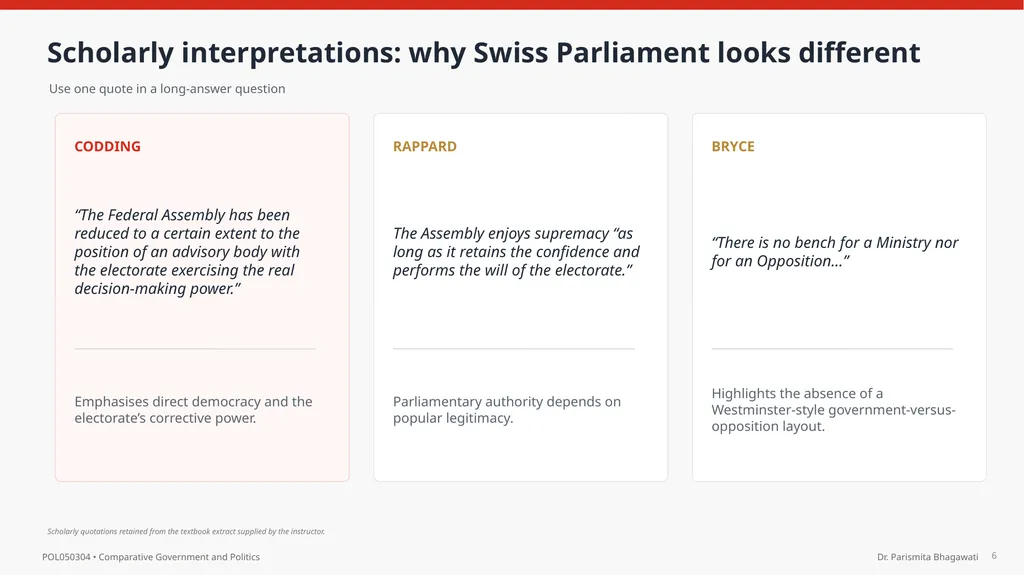
Scholarly interpretations: why Swiss Parliament looks different Use one quote in a long-answer question CODDING “The Federal Assembly has been reduced to a certain extent to the position of an advisory body with the electorate exercising the real decision-making power.” Emphasises direct democracy and the electorate’s corrective power. RAPPARD The Assembly enjoys supremacy “as long as it retains the confidence and performs the will of the electorate.” Parliamentary authority depends on popular legitimacy. BRYCE “There is no bench for a Ministry nor for an Opposition...” Highlights the absence of a Westminster-style government-versus-opposition layout. Scholarly quotations retained from the textbook extract supplied by the instructor. 6<br>
07
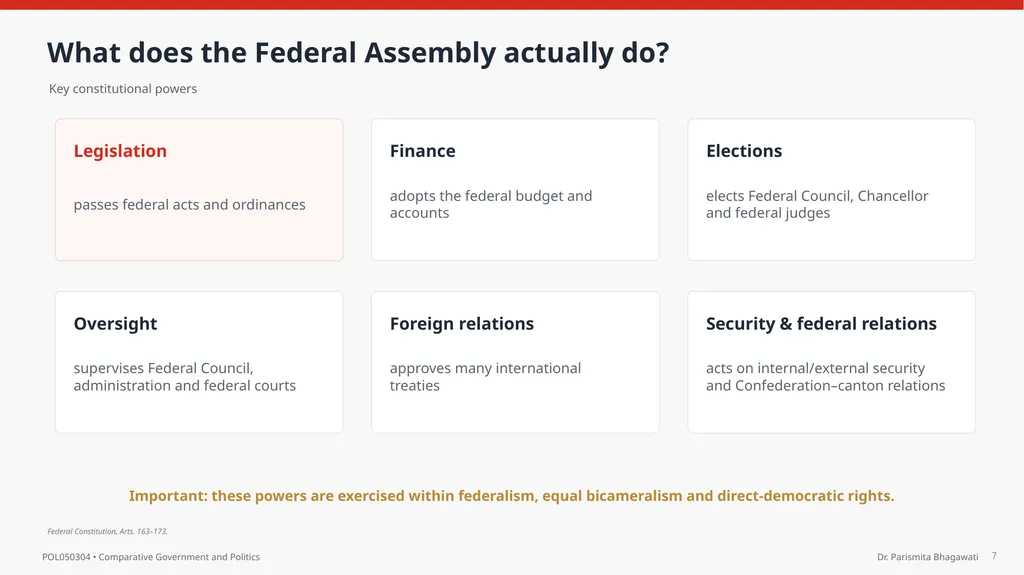
What does the Federal Assembly actually do? Key constitutional powers Legislation passes federal acts and ordinances Finance adopts the federal budget and accounts Elections elects Federal Council, Chancellor and federal judges Oversight supervises Federal Council, administration and federal courts Foreign relations approves many international treaties Security & federal relations acts on internal/external security and Confederation–canton relations Important: these powers are exercised within federalism, equal bicameralism and direct-democratic rights. Federal Constitution, Arts. 163–173. 7<br>
08
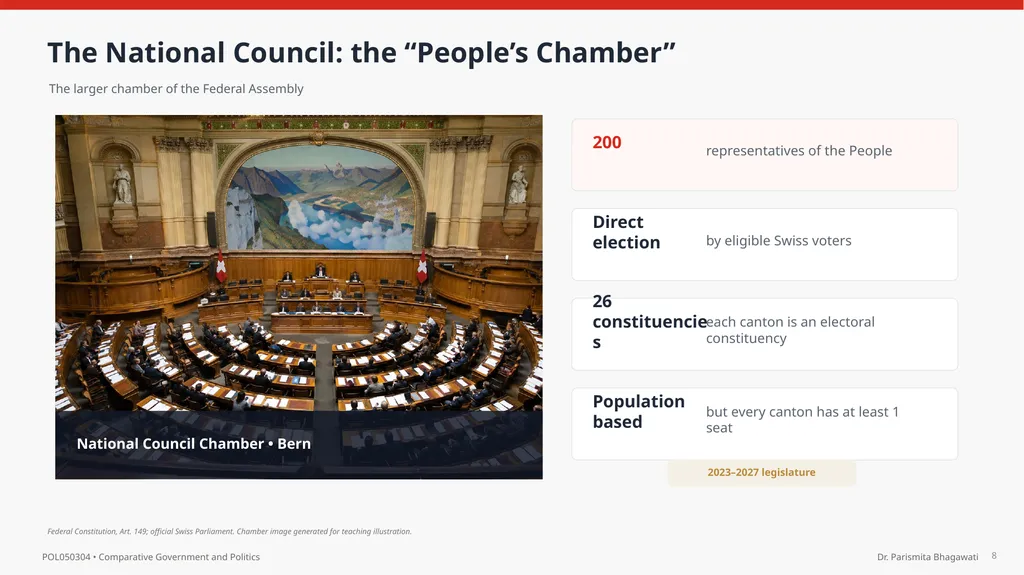
The National Council: the “People’s Chamber” The larger chamber of the Federal Assembly National Council Chamber • Bern 200 representatives of the People Direct election by eligible Swiss voters 26 constituencies each canton is an electoral constituency Population based but every canton has at least 1 seat 2023–2027 legislature Federal Constitution, Art. 149; official Swiss Parliament. Chamber image generated for teaching illustration. 8<br>
09
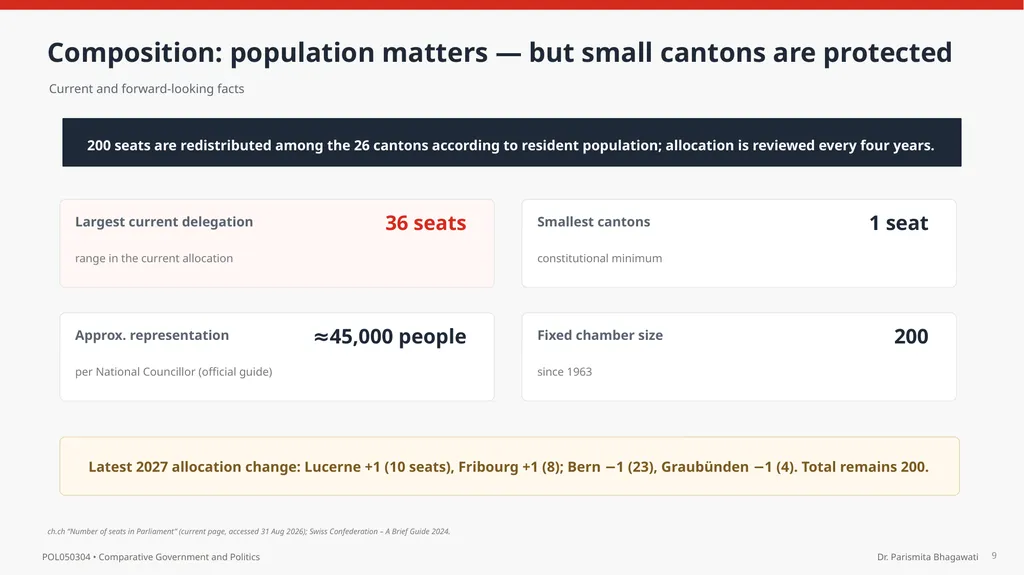
Composition: population matters — but small cantons are protected Current and forward-looking facts 200 seats are redistributed among the 26 cantons according to resident population; allocation is reviewed every four years. Largest current delegation 36 seats range in the current allocation Smallest cantons 1 seat constitutional minimum Approx. representation ≈45,000 people per National Councillor (official guide) Fixed chamber size 200 since 1963 Latest 2027 allocation change: Lucerne +1 (10 seats), Fribourg +1 (8); Bern −1 (23), Graubünden −1 (4). Total remains 200. ch.ch “Number of seats in Parliament” (current page, accessed 31 Aug 2026); Swiss Confederation – A Brief Guide 2024. 9<br>
10
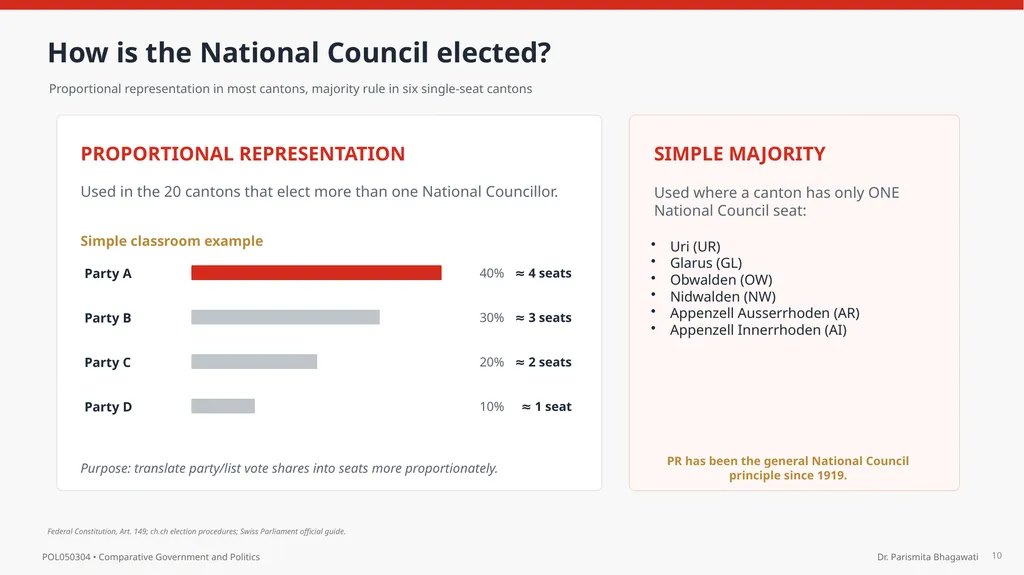
How is the National Council elected? Proportional representation in most cantons, majority rule in six single-seat cantons PROPORTIONAL REPRESENTATION Used in the 20 cantons that elect more than one National Councillor. Simple classroom example Party A 40% ≈ 4 seats Party B 30% ≈ 3 seats Party C 20% ≈ 2 seats Party D 10% ≈ 1 seat Purpose: translate party/list vote shares into seats more proportionately. SIMPLE MAJORITY Used where a canton has only ONE National Council seat: Uri (UR)
Glarus (GL)
Obwalden (OW)
Nidwalden (NW)
Appenzell Ausserrhoden (AR)
Appenzell Innerrhoden (AI) PR has been the general National Council principle since 1919. Federal Constitution, Art. 149; ch.ch election procedures; Swiss Parliament official guide. 10<br>
Glarus (GL)
Obwalden (OW)
Nidwalden (NW)
Appenzell Ausserrhoden (AR)
Appenzell Innerrhoden (AI) PR has been the general National Council principle since 1919. Federal Constitution, Art. 149; ch.ch election procedures; Swiss Parliament official guide. 10<br>
11
Who can vote and who can become a National Councillor? Modern rules — with one important historical note CURRENT RULES Swiss citizens aged 18 or above can vote at federal level.
A person eligible to vote may be elected to the National Council.
Members are directly elected by the people.
Constitutional incompatibility: a member cannot simultaneously sit in another of the National Council, Council of States, Federal Council or Federal Supreme Court. HISTORICAL MILESTONE 1971 Women obtained voting and electoral rights at the federal level. Teaching note: older texts may list restrictions that have since been reformulated. For exams, prefer the current constitutional rule on eligibility and incompatibility. Federal Constitution, Arts. 136, 143–144; Swiss Parliament historical materials on women’s suffrage. 11<br>
12
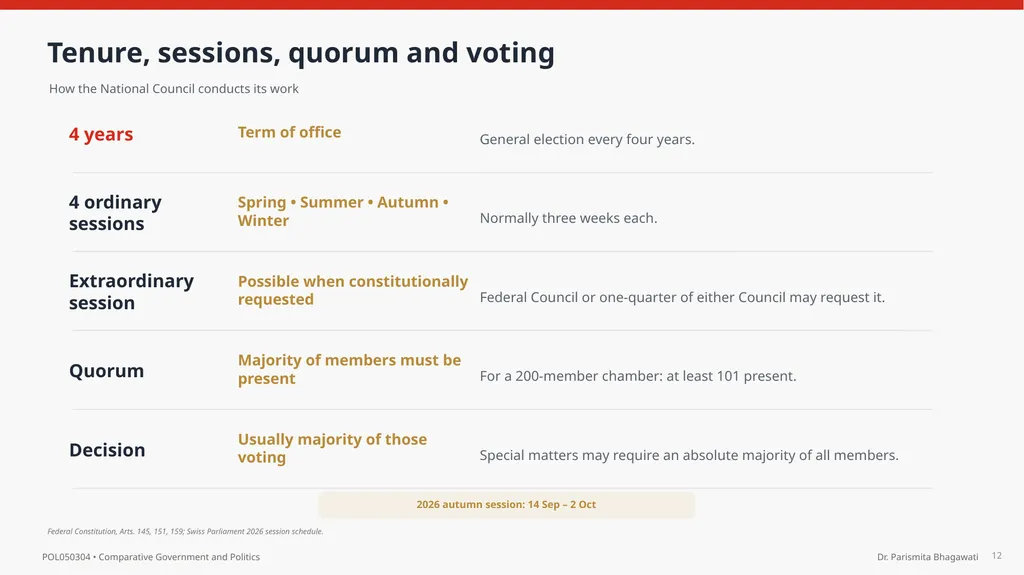
Tenure, sessions, quorum and voting How the National Council conducts its work 4 years Term of office General election every four years. 4 ordinary sessions Spring • Summer • Autumn • Winter Normally three weeks each. Extraordinary session Possible when constitutionally requested Federal Council or one-quarter of either Council may request it. Quorum Majority of members must be present For a 200-member chamber: at least 101 present. Decision Usually majority of those voting Special matters may require an absolute majority of all members. 2026 autumn session: 14 Sep – 2 Oct Federal Constitution, Arts. 145, 151, 159; Swiss Parliament 2026 session schedule. 12<br>
13
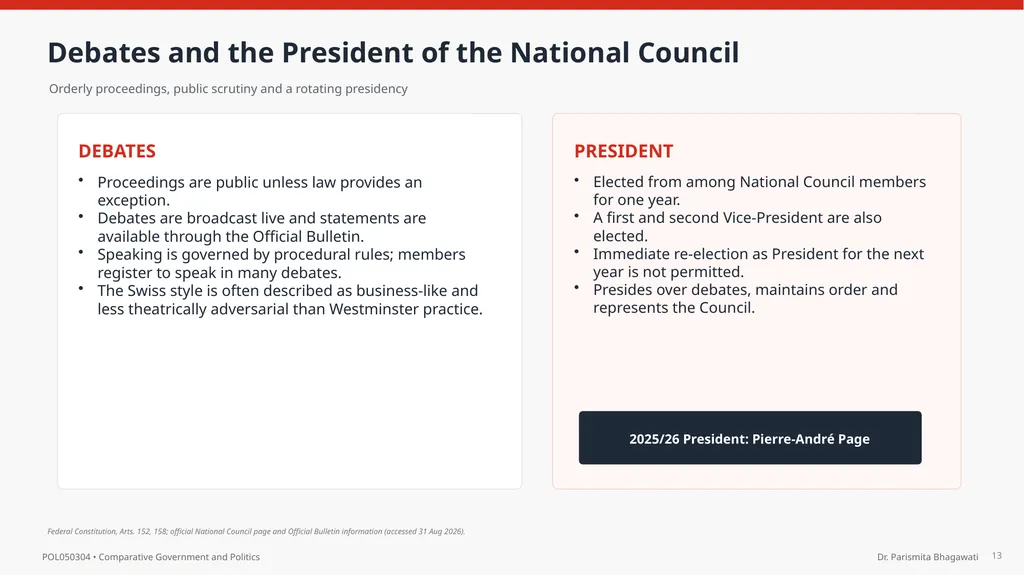
Debates and the President of the National Council Orderly proceedings, public scrutiny and a rotating presidency DEBATES Proceedings are public unless law provides an exception.
Debates are broadcast live and statements are available through the Official Bulletin.
Speaking is governed by procedural rules; members register to speak in many debates.
The Swiss style is often described as business-like and less theatrically adversarial than Westminster practice. PRESIDENT Elected from among National Council members for one year.
A first and second Vice-President are also elected.
Immediate re-election as President for the next year is not permitted.
Presides over debates, maintains order and represents the Council. 2025/26 President: Pierre-André Page Federal Constitution, Arts. 152, 158; official National Council page and Official Bulletin information (accessed 31 Aug 2026). 13<br>
14
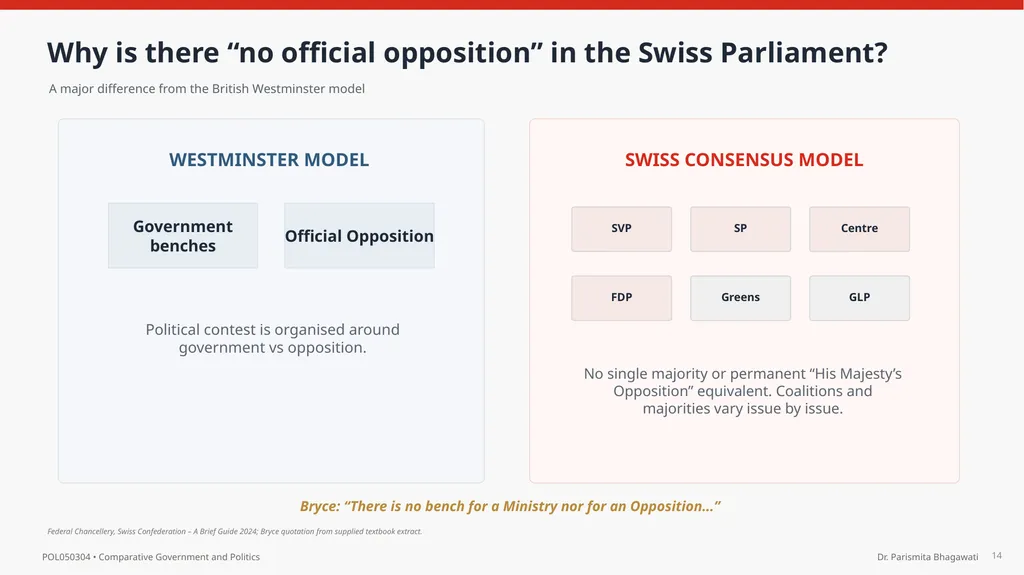
Why is there “no official opposition” in the Swiss Parliament? A major difference from the British Westminster model WESTMINSTER MODEL Government benches Official Opposition Political contest is organised around government vs opposition. SWISS CONSENSUS MODEL SVP SP Centre FDP Greens GLP No single majority or permanent “His Majesty’s Opposition” equivalent. Coalitions and majorities vary issue by issue. Bryce: “There is no bench for a Ministry nor for an Opposition...” Federal Chancellery, Swiss Confederation – A Brief Guide 2024; Bryce quotation from supplied textbook extract. 14<br>
15
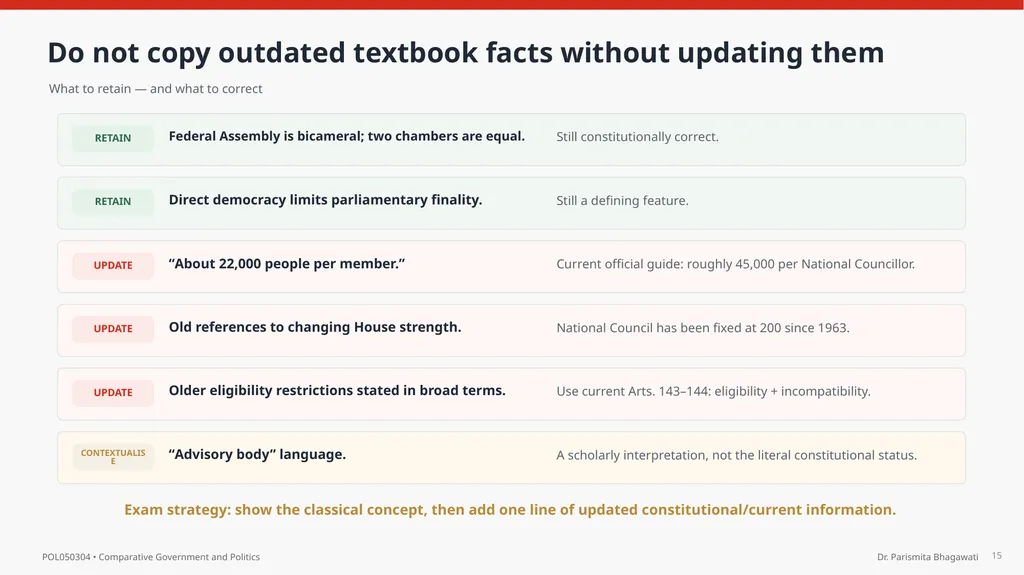
Do not copy outdated textbook facts without updating them What to retain — and what to correct RETAIN Federal Assembly is bicameral; two chambers are equal. Still constitutionally correct. RETAIN Direct democracy limits parliamentary finality. Still a defining feature. UPDATE “About 22,000 people per member.” Current official guide: roughly 45,000 per National Councillor. UPDATE Old references to changing House strength. National Council has been fixed at 200 since 1963. UPDATE Older eligibility restrictions stated in broad terms. Use current Arts. 143–144: eligibility + incompatibility. CONTEXTUALISE “Advisory body” language. A scholarly interpretation, not the literal constitutional status. Exam strategy: show the classical concept, then add one line of updated constitutional/current information. 15<br>
16
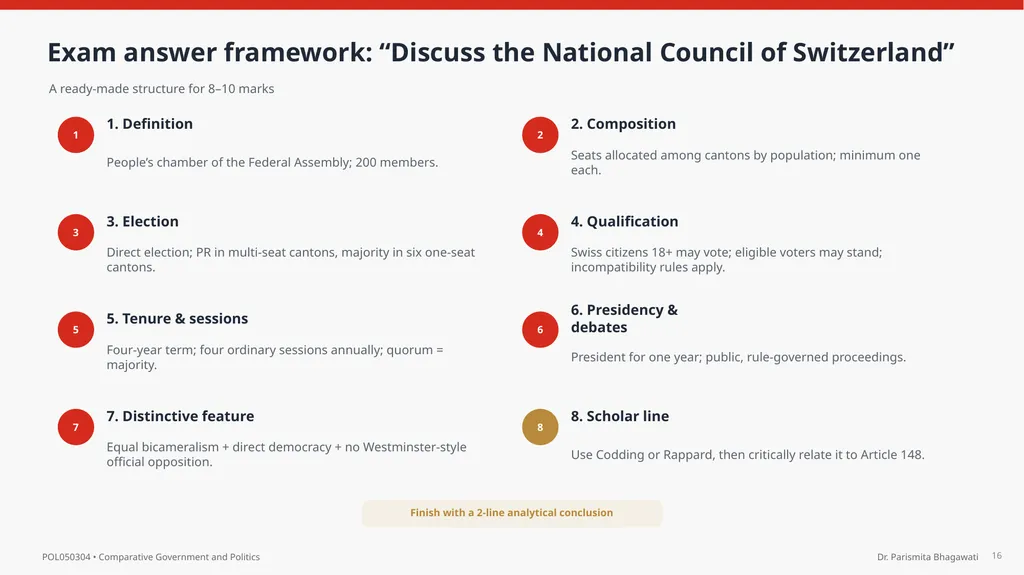
Exam answer framework: “Discuss the National Council of Switzerland” A ready-made structure for 8–10 marks 1 1. Definition People’s chamber of the Federal Assembly; 200 members. 2 2. Composition Seats allocated among cantons by population; minimum one each. 3 3. Election Direct election; PR in multi-seat cantons, majority in six one-seat cantons. 4 4. Qualification Swiss citizens 18+ may vote; eligible voters may stand; incompatibility rules apply. 5 5. Tenure & sessions Four-year term; four ordinary sessions annually; quorum = majority. 6 6. Presidency & debates President for one year; public, rule-governed proceedings. 7 7. Distinctive feature Equal bicameralism + direct democracy + no Westminster-style official opposition. 8 8. Scholar line Use Codding or Rappard, then critically relate it to Article 148. Finish with a 2-line analytical conclusion 16<br>
17
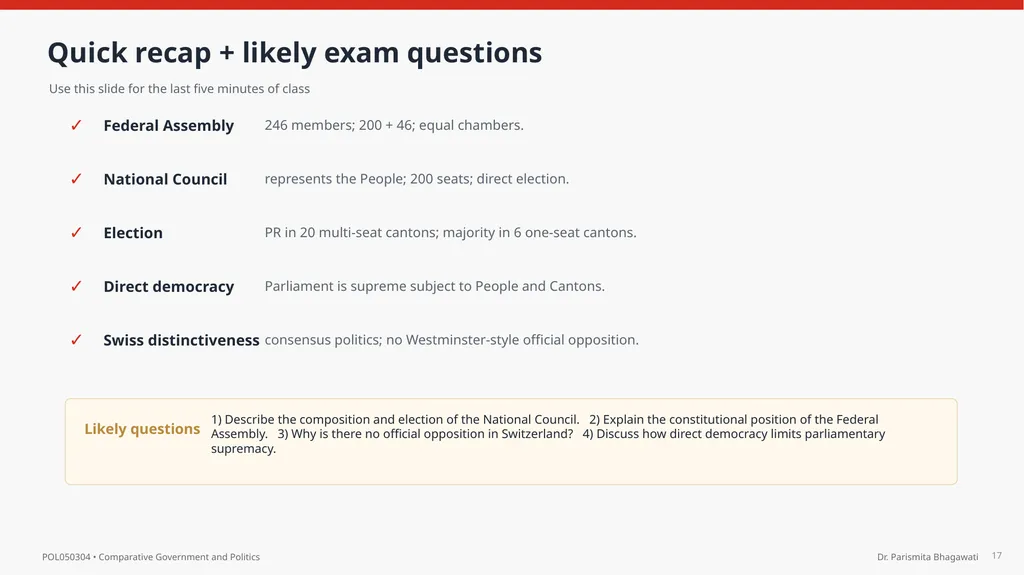
Quick recap + likely exam questions Use this slide for the last five minutes of class ✓ Federal Assembly 246 members; 200 + 46; equal chambers. ✓ National Council represents the People; 200 seats; direct election. ✓ Election PR in 20 multi-seat cantons; majority in 6 one-seat cantons. ✓ Direct democracy Parliament is supreme subject to People and Cantons. ✓ Swiss distinctiveness consensus politics; no Westminster-style official opposition. Likely questions 1) Describe the composition and election of the National Council. 2) Explain the constitutional position of the Federal Assembly. 3) Why is there no official opposition in Switzerland? 4) Discuss how direct democracy limits parliamentary supremacy. 17<br>
18
Sources and further reading Primary and official sources used for the updated facts Federal Constitution of the Swiss Confederation — Arts. 136, 141, 143–169, 193.
Swiss Parliament (parlament.ch) — National Council, parliamentary groups, committees, sessions and Official Bulletin.
Swiss Confederation / Federal Chancellery — The Swiss Confederation: A Brief Guide 2024.
ch.ch — Procedures for election of the National Council; Number of seats in Parliament.
About Switzerland (FDFA) — Political system, updated 29 April 2026.
Textbook extract supplied by the instructor — scholarly quotations from Codding, Rappard and Bryce. Teaching note: statistical and office-holder facts were checked against official Swiss sources on 31 August 2026. 18<br>