Welcoming and Inclusion Introductions Its Karaoke Time! What Is Your Go-To Signature Song? special Education 101: What Do You Need To Know? What Do You Know about Special Education? What is Special Education? Special education is governed
"Welcoming and Inclusion Introductions It’s Karaoke" is the property of its rightful owner. Permission is granted to
download and print the materials on this website for personal, non-commercial use only, and to display it
on your personal computer provided you do not modify the materials and that you retain all copyright
notices contained in the materials. By downloading content from our website, you accept the terms of this
agreement.
Presentation Transcript
01
Welcoming and Inclusion Introductions It’s Karaoke Time! What Is Your Go-To Signature Song?<br>
02
special Education 101: What Do You Need To Know?<br>
03
What Do You Know about Special Education?<br>
04
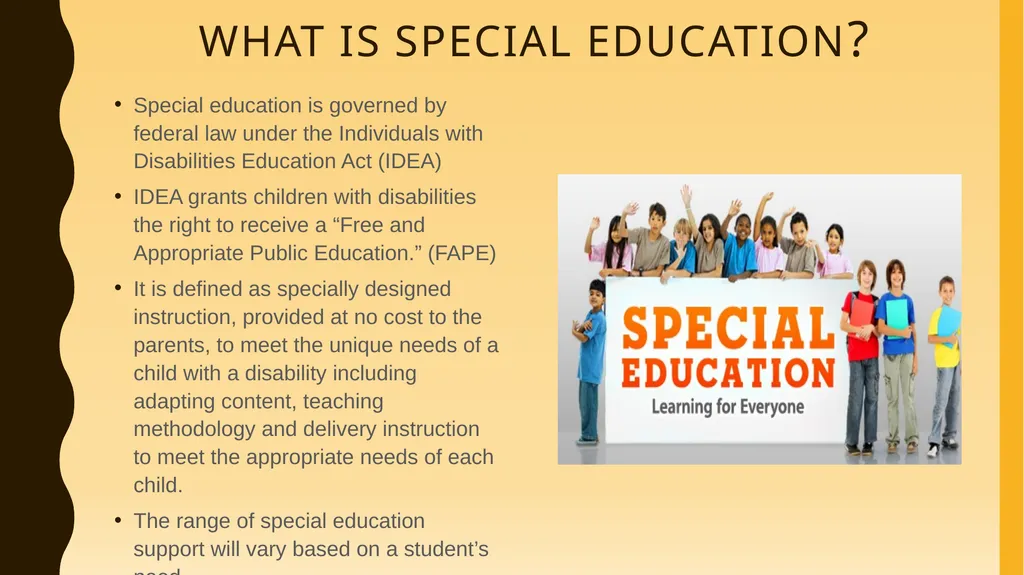
What is Special Education? Special education is governed by federal law under the Individuals with Disabilities Education Act (IDEA)
IDEA grants children with disabilities the right to receive a “Free and Appropriate Public Education.” (FAPE)
It is defined as specially designed instruction, provided at no cost to the parents, to meet the unique needs of a child with a disability including adapting content, teaching methodology and delivery instruction to meet the appropriate needs of each child.
The range of special education support will vary based on a student’s need.<br>
05
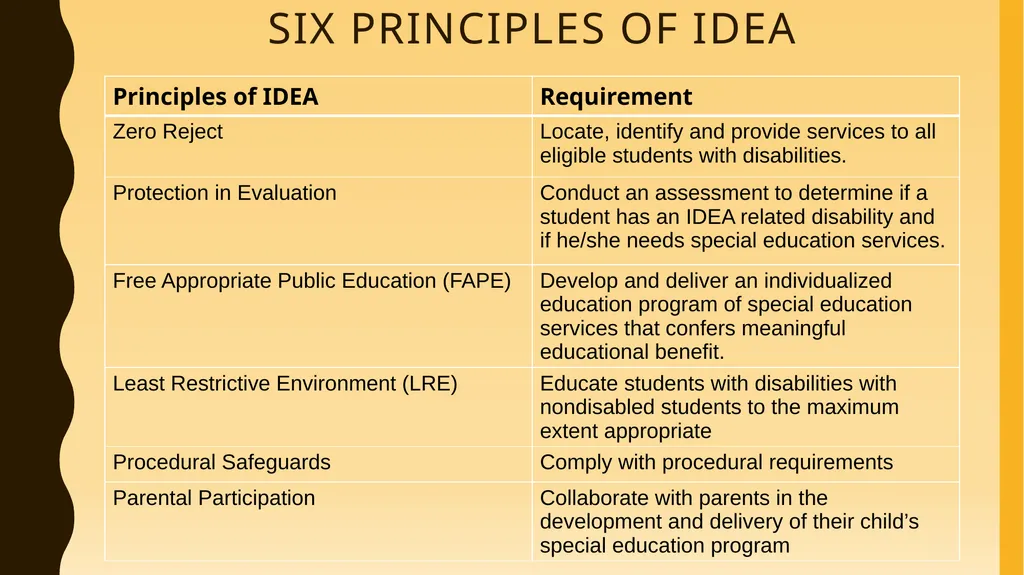
Six Principles of IDEA<br>
06
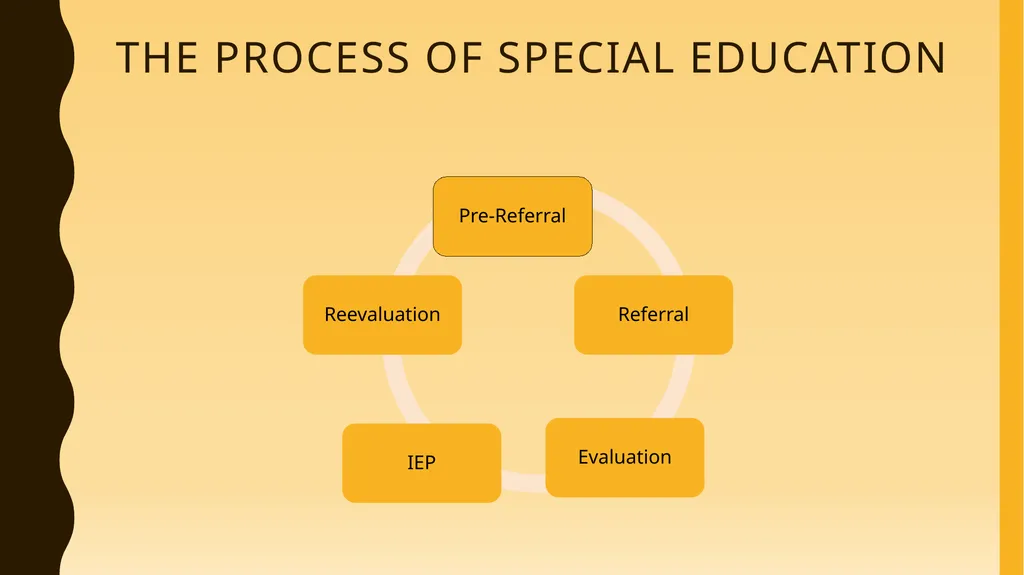
The process of special education<br>
07
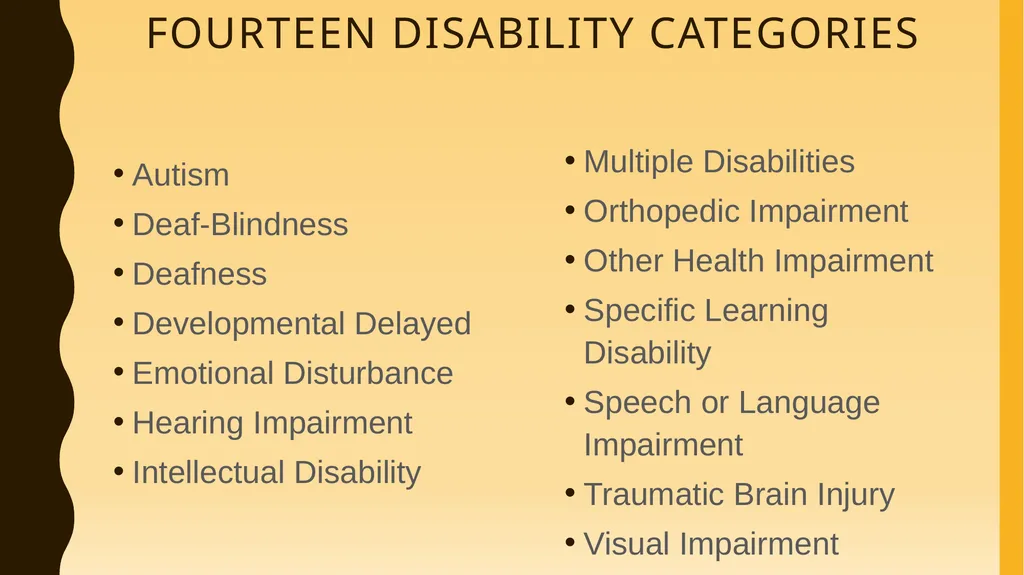
Fourteen Disability Categories Multiple Disabilities
Orthopedic Impairment
Other Health Impairment
Specific Learning Disability
Speech or Language Impairment
Traumatic Brain Injury
Visual Impairment Autism
Deaf-Blindness
Deafness
Developmental Delayed
Emotional Disturbance
Hearing Impairment
Intellectual Disability<br>
08
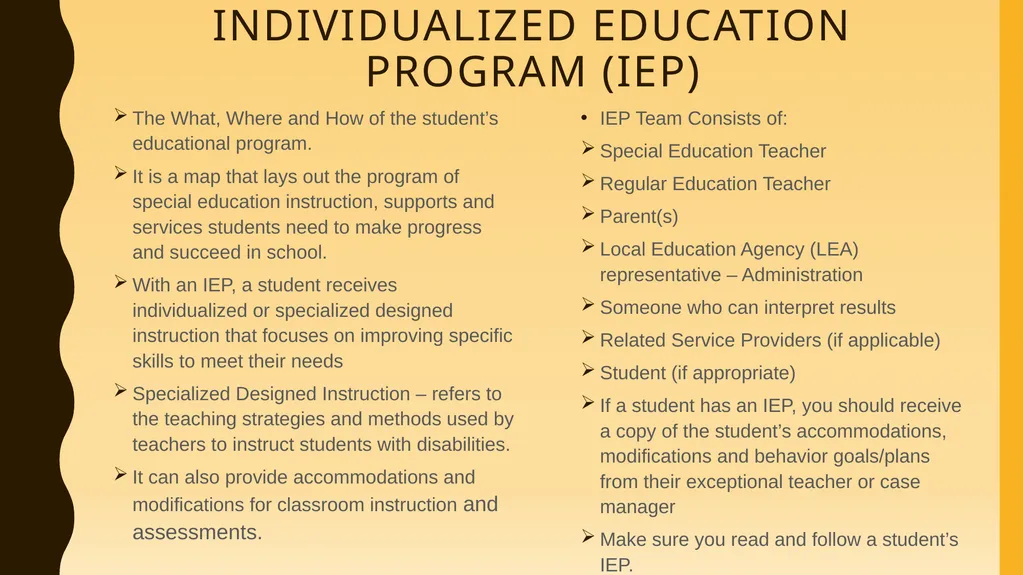
Individualized Education Program (IEP) The What, Where and How of the student’s educational program.
It is a map that lays out the program of special education instruction, supports and services students need to make progress and succeed in school.
With an IEP, a student receives individualized or specialized designed instruction that focuses on improving specific skills to meet their needs
Specialized Designed Instruction – refers to the teaching strategies and methods used by teachers to instruct students with disabilities.
It can also provide accommodations and modifications for classroom instruction and assessments. IEP Team Consists of:
Special Education Teacher
Regular Education Teacher
Parent(s)
Local Education Agency (LEA) representative – Administration
Someone who can interpret results
Related Service Providers (if applicable)
Student (if appropriate)
If a student has an IEP, you should receive a copy of the student’s accommodations, modifications and behavior goals/plans from their exceptional teacher or case manager
Make sure you read and follow a student’s IEP.<br>
09
Accommodations Versus Modifications Accommodations allow students with a disability to learn, have access to and be tested on the same curriculum as students without disabilities.
Accommodations do not change what the students are expected to learn but rather how the student learns the curriculum.
Examples of Accommodations – read aloud, small group setting, or extended time
Modifications are changes in what the student is expected to learn that is different from the general education curriculum.
With modifications, the curriculum is adjusted or the achievement standard is lowered.
Examples of Modifications – complete fewer or different classwork/homework assignments, or modified grading.<br>
10
Some Common Acronyms ADA – Americans with Disabilities Act
APE – Adaptive Physical Education
AT – Assistive Technology
BIP – Behavior Intervention Plan
CD – Cognitive Delay
ESY – Extended School Year
FAPE – Free Appropriate Public Education
FBA – Functional Behavior Assessment
FERPA – Family Educational Rights and Privacy Act
GE – General Education
LEA – Local Education Agency
LRE – Least Restrictive Environment
OT – Occupational Therapy
PT – Physical Therapy
SLP – Speech Language Pathologist<br>
11
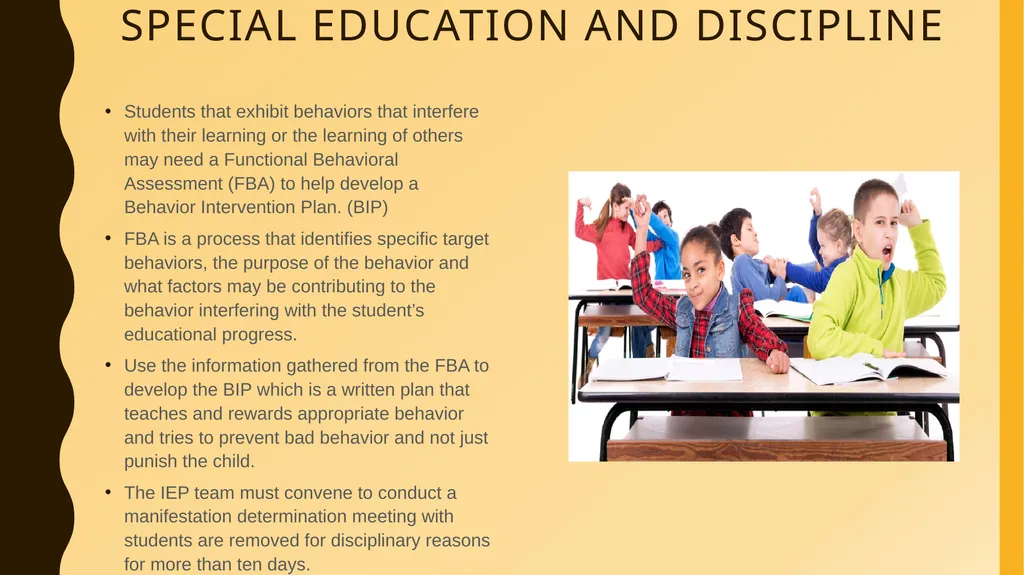
Special Education and Discipline Students that exhibit behaviors that interfere with their learning or the learning of others may need a Functional Behavioral Assessment (FBA) to help develop a Behavior Intervention Plan. (BIP)
FBA is a process that identifies specific target behaviors, the purpose of the behavior and what factors may be contributing to the behavior interfering with the student’s educational progress.
Use the information gathered from the FBA to develop the BIP which is a written plan that teaches and rewards appropriate behavior and tries to prevent bad behavior and not just punish the child.
The IEP team must convene to conduct a manifestation determination meeting with students are removed for disciplinary reasons for more than ten days.<br>
12
What are Your Responsibilities? Know your students
Know your district’s procedures and expectations (or who to go to)
Collect and present data regarding the student’s progress in the general education curriculum
Implementation of the IEP – be an active and effective member of IEP team<br>
13
Don’t Be Afraid of What Could Go Wrong But Focus On What Could Go Right<br>
14
Questions, Comments or Concerns? Contact Information:
Kimberly Gibbs, EC Director
Email address: kgibbs@beaufort.k12.nc.us
Phone Number: 252-940-6580<br>