04
Wellness is the art and science of getting people to practice healthy habits [regardless of their health status].<br>
05
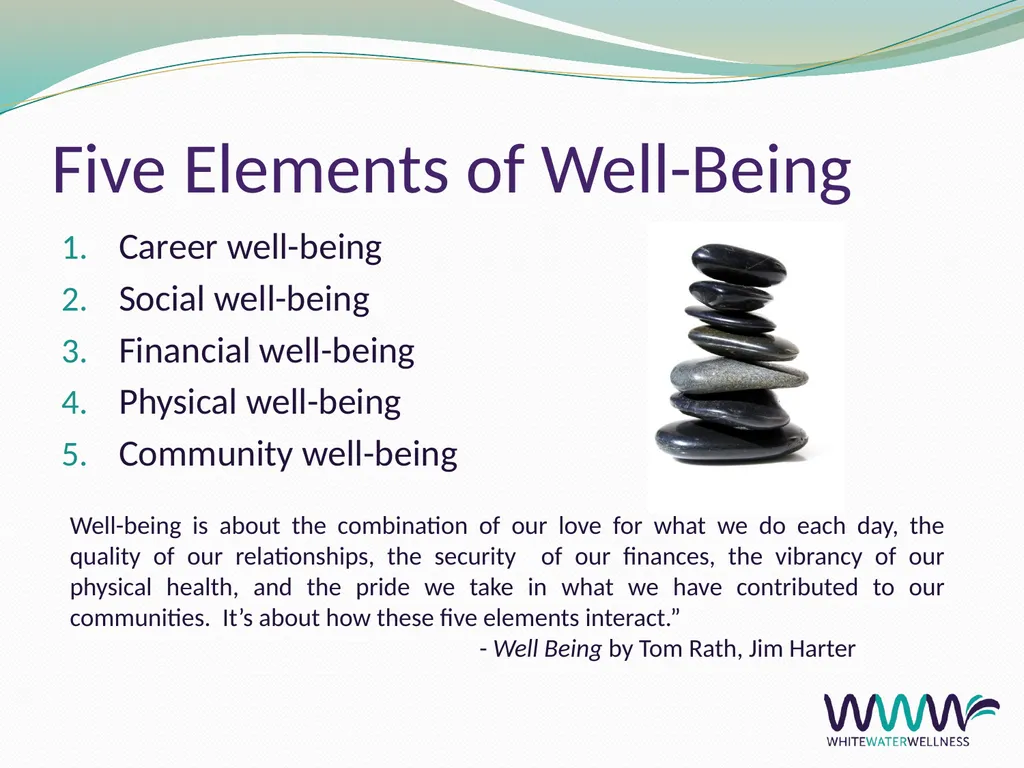
Five Elements of Well-Being Career well-being
Social well-being
Financial well-being
Physical well-being
Community well-being Well-being is about the combination of our love for what we do each day, the quality of our relationships, the security of our finances, the vibrancy of our physical health, and the pride we take in what we have contributed to our communities. It’s about how these five elements interact.”
- Well Being by Tom Rath, Jim Harter<br>
06
66% of people are doing well in at least one of these areas
7% are thriving in all five
Biggest threat to wellbeing = ourselves
Career wellbeing: most essential of the 5
Do you like what you do each day?
Boosts your chances of reaching wellbeing in other areas<br>
07
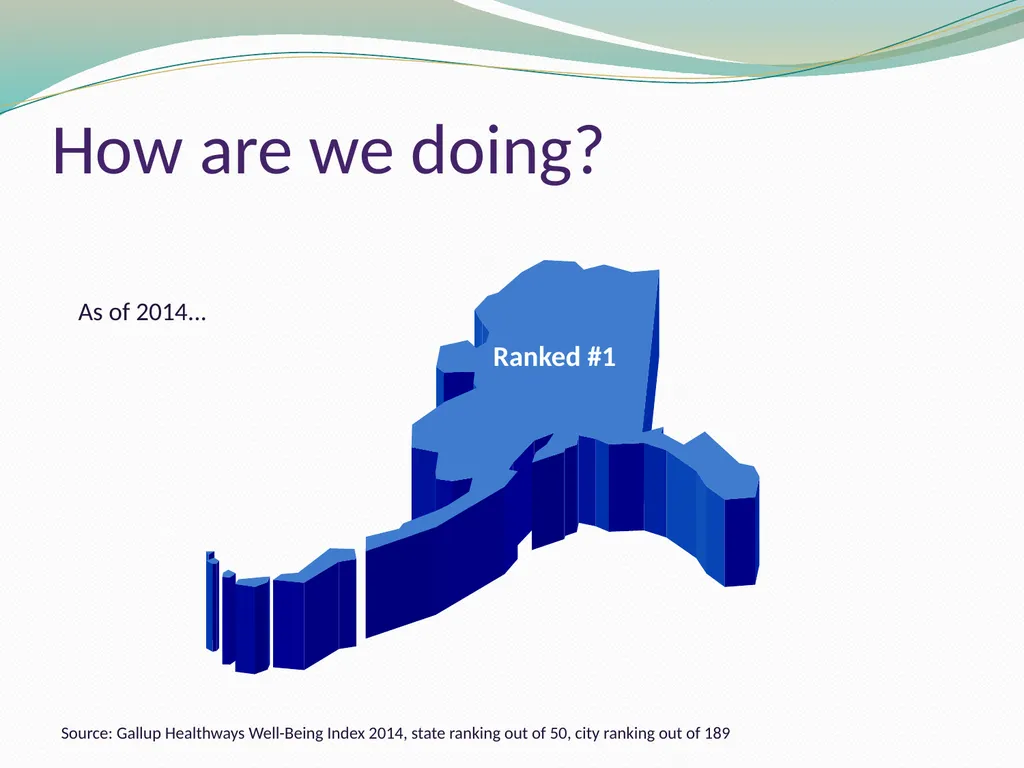
How are we doing? Source: Gallup Healthways Well-Being Index 2014, state ranking out of 50, city ranking out of 189 As of 2014...<br>
08
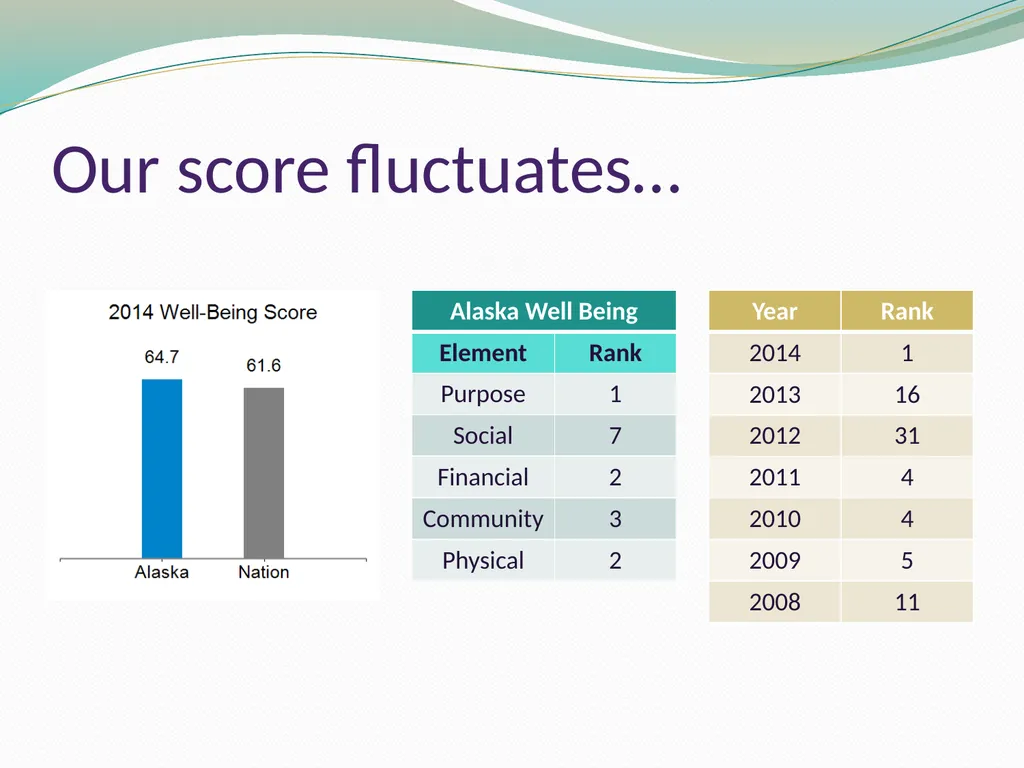
Our score fluctuates…<br>
09
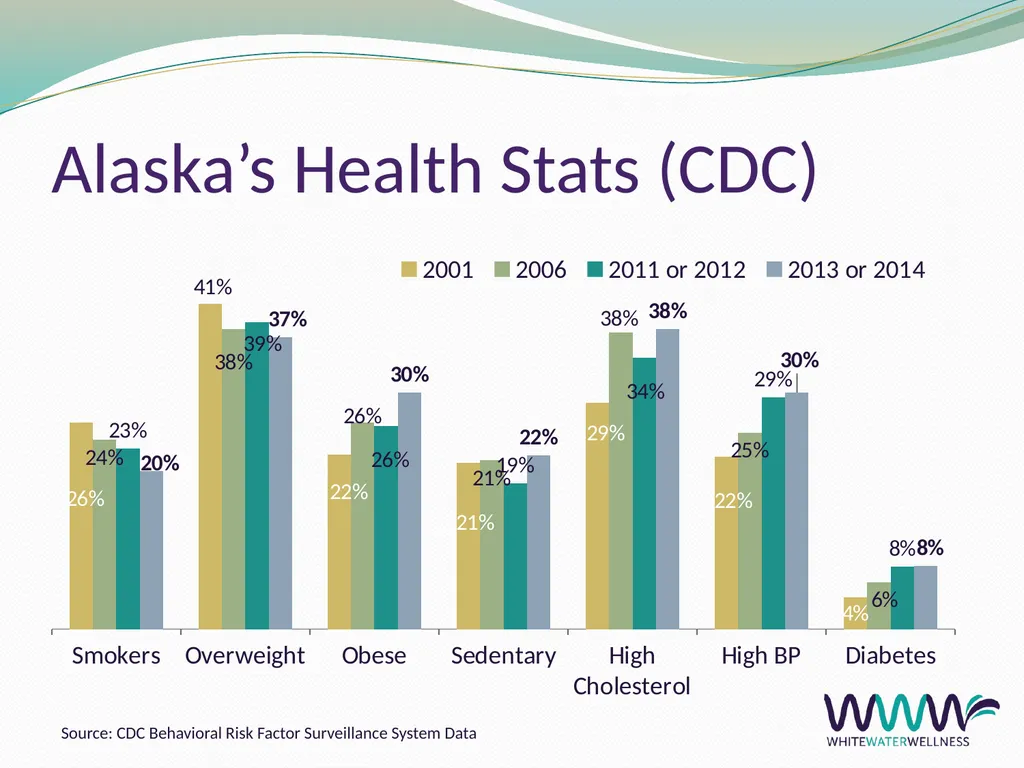
Alaska’s Health Stats (CDC) Source: CDC Behavioral Risk Factor Surveillance System Data<br>
10
Why are we talking about this at work?<br>
11
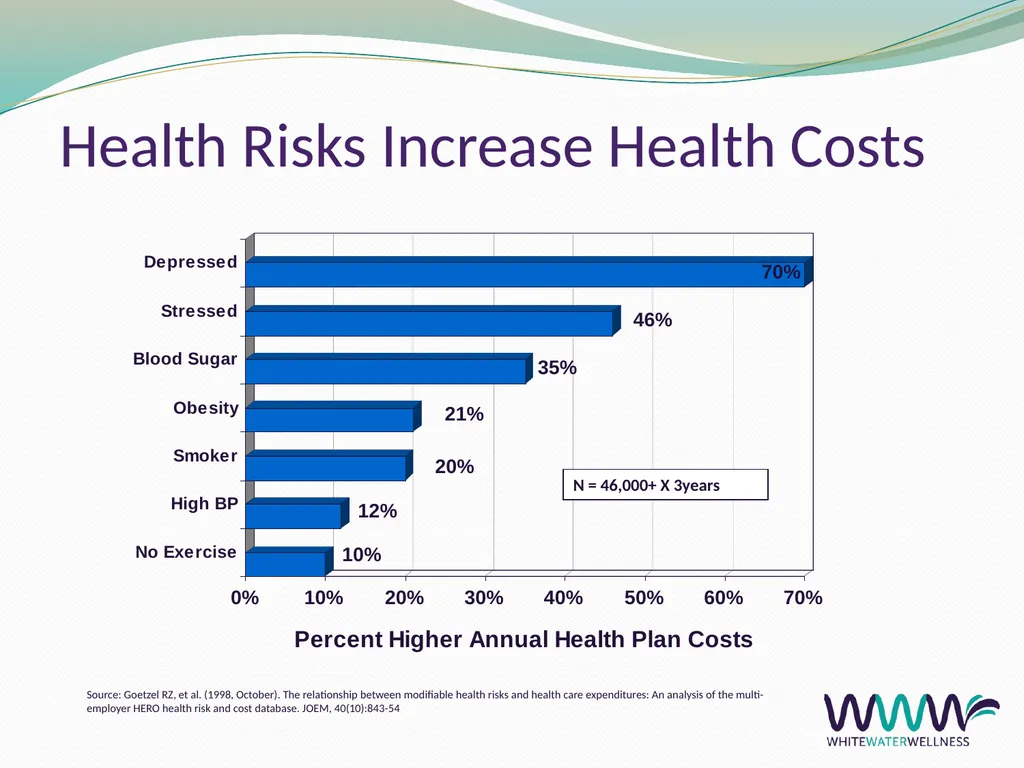
Health Risks Increase Health Costs Source: Goetzel RZ, et al. (1998, October). The relationship between modifiable health risks and health care expenditures: An analysis of the multi-employer HERO health risk and cost database. JOEM, 40(10):843-54 N = 46,000+ X 3years<br>
12
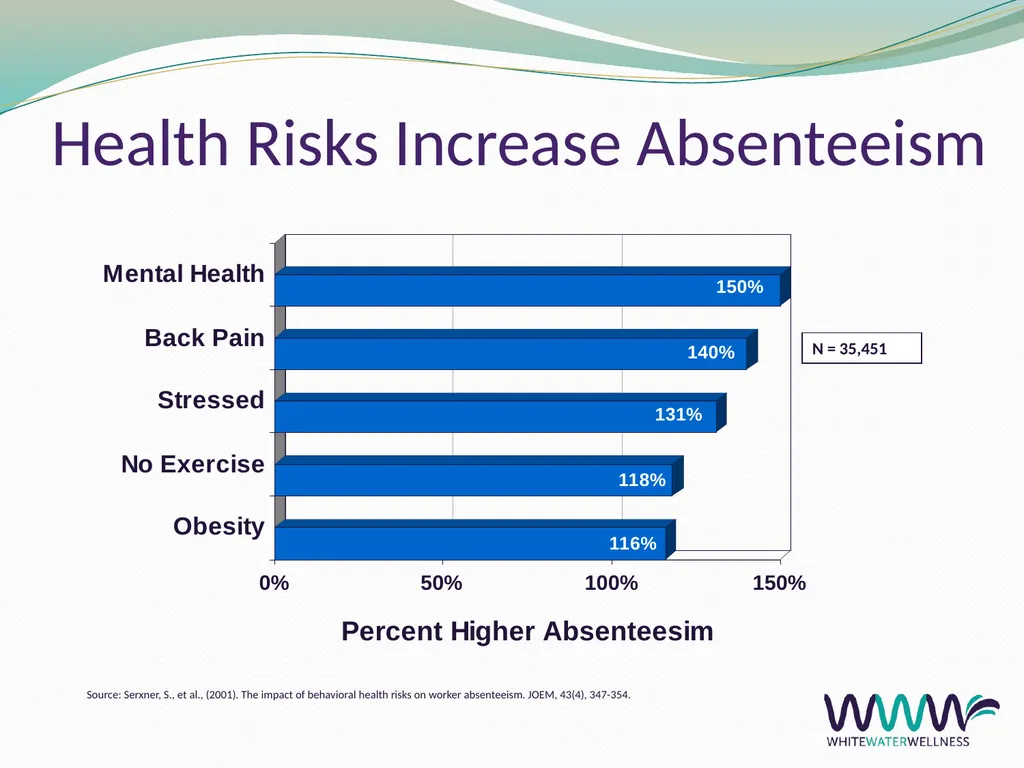
Health Risks Increase Absenteeism Source: Serxner, S., et al., (2001). The impact of behavioral health risks on worker absenteeism. JOEM, 43(4), 347-354. N = 35,451<br>
13
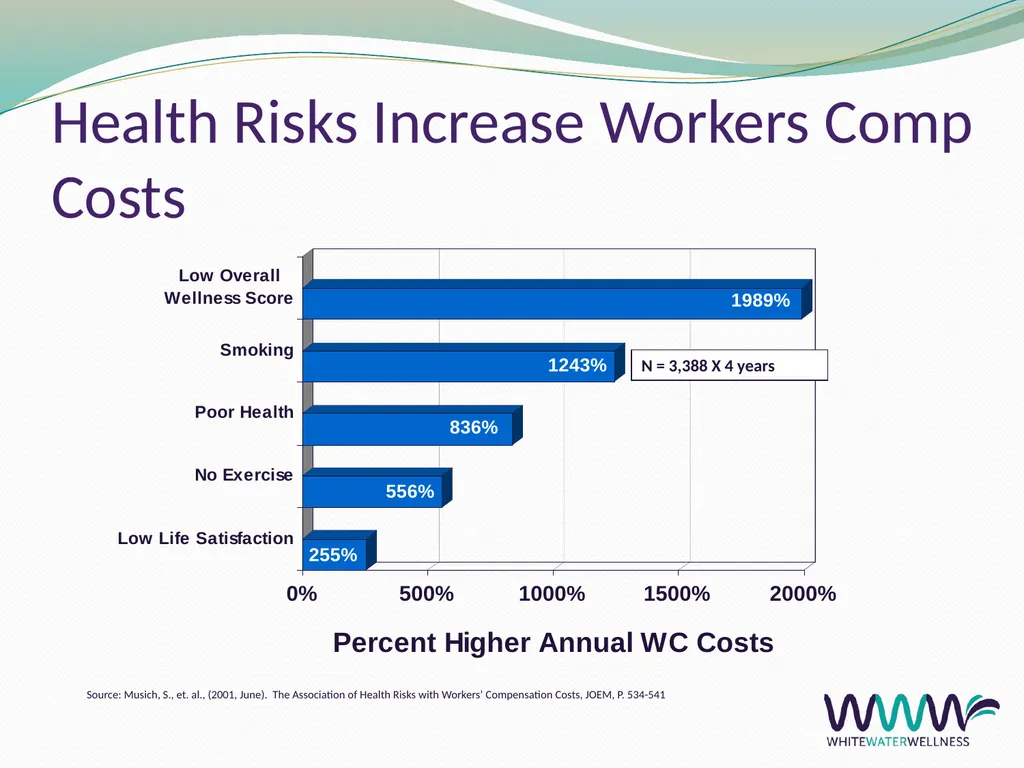
Health Risks Increase Workers Comp Costs Source: Musich, S., et. al., (2001, June). The Association of Health Risks with Workers’ Compensation Costs, JOEM, P. 534-541 N = 3,388 X 4 years<br>
14
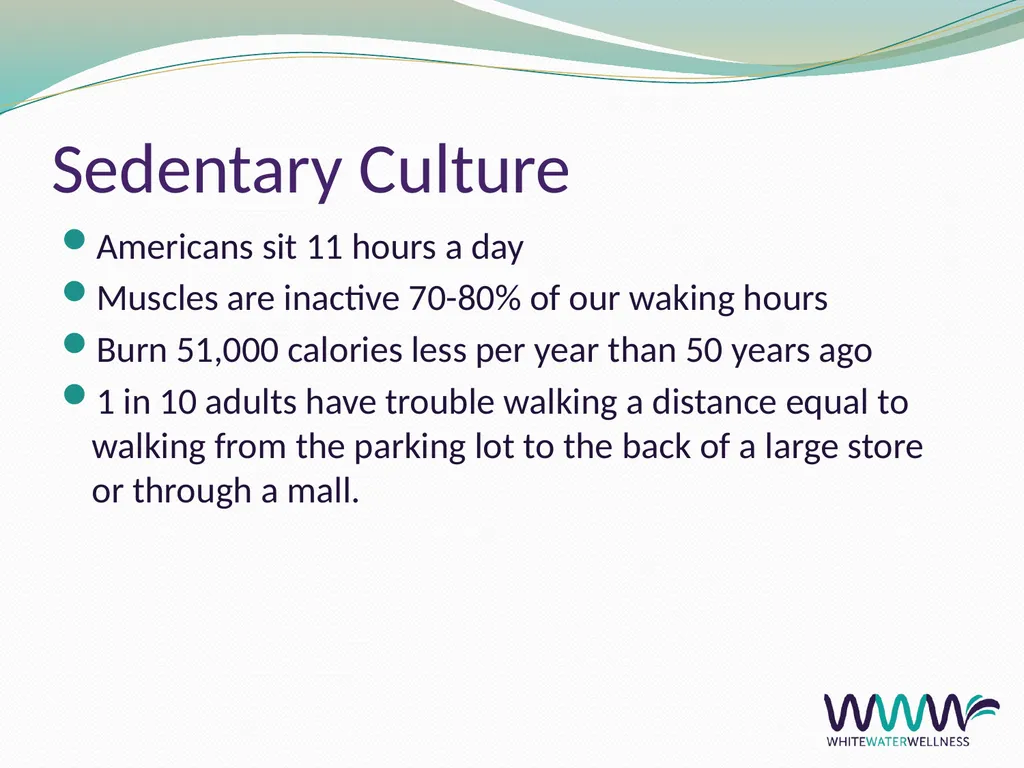
Sedentary Culture Americans sit 11 hours a day
Muscles are inactive 70-80% of our waking hours
Burn 51,000 calories less per year than 50 years ago
1 in 10 adults have trouble walking a distance equal to walking from the parking lot to the back of a large store or through a mall.<br>
15
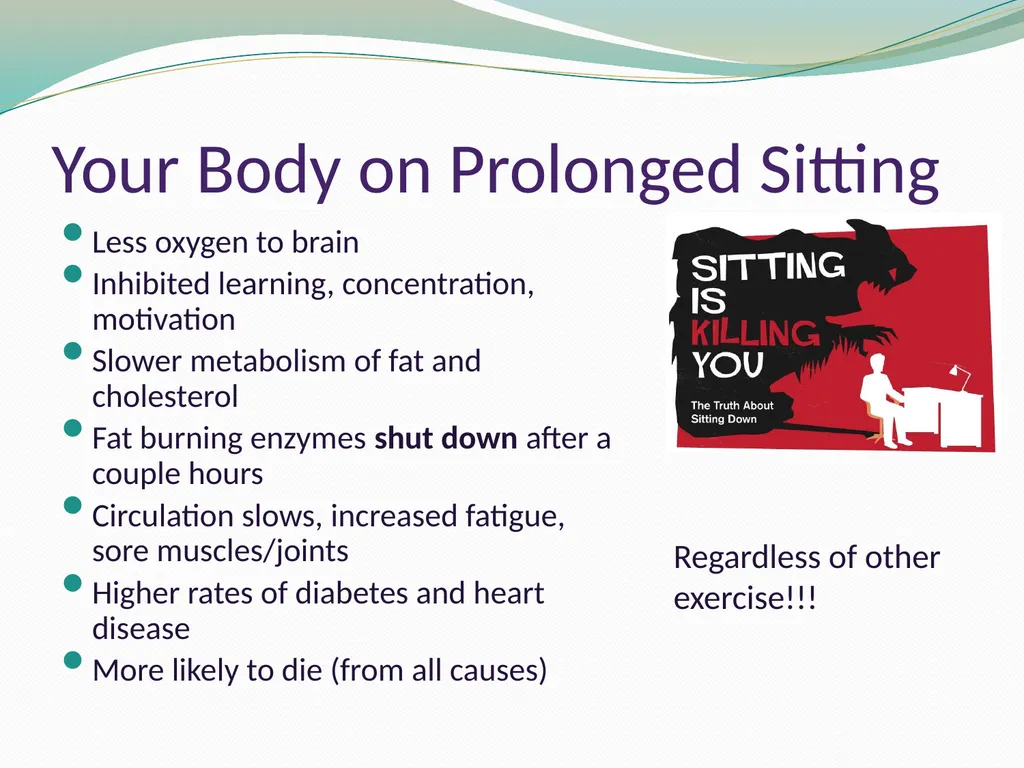
Your Body on Prolonged Sitting Less oxygen to brain
Inhibited learning, concentration, motivation
Slower metabolism of fat and cholesterol
Fat burning enzymes shut down after a couple hours
Circulation slows, increased fatigue, sore muscles/joints
Higher rates of diabetes and heart disease
More likely to die (from all causes) Regardless of other exercise!!!<br>
16
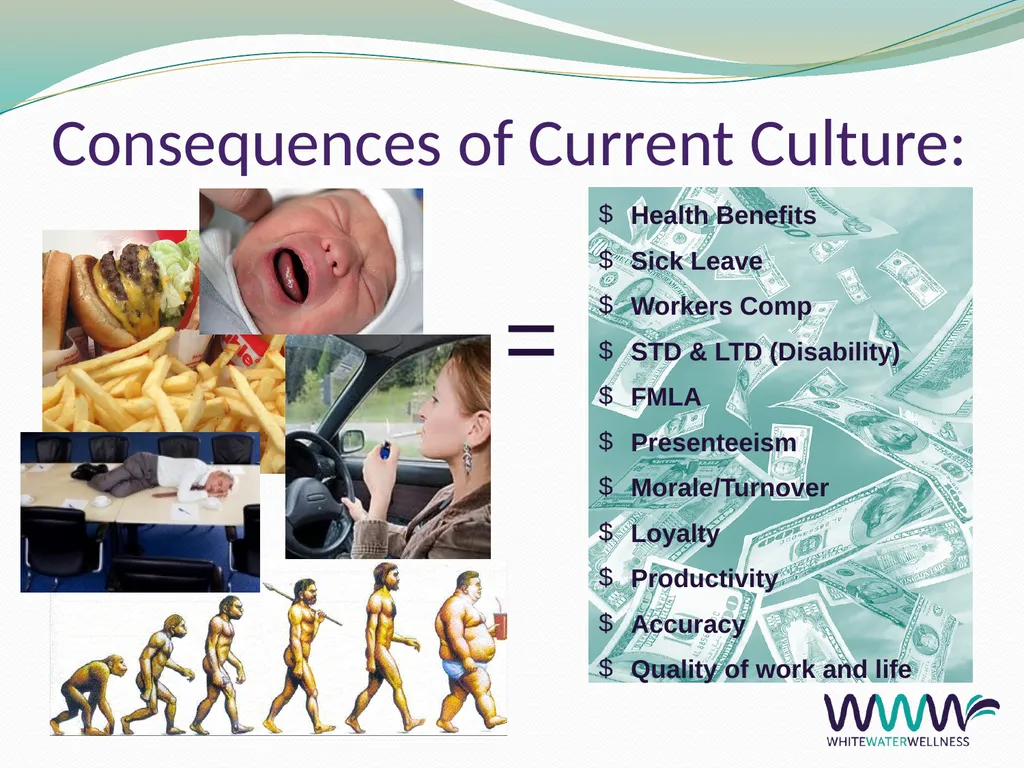
Consequences of Current Culture: =<br>
17
How do we tackle this?<br>
18
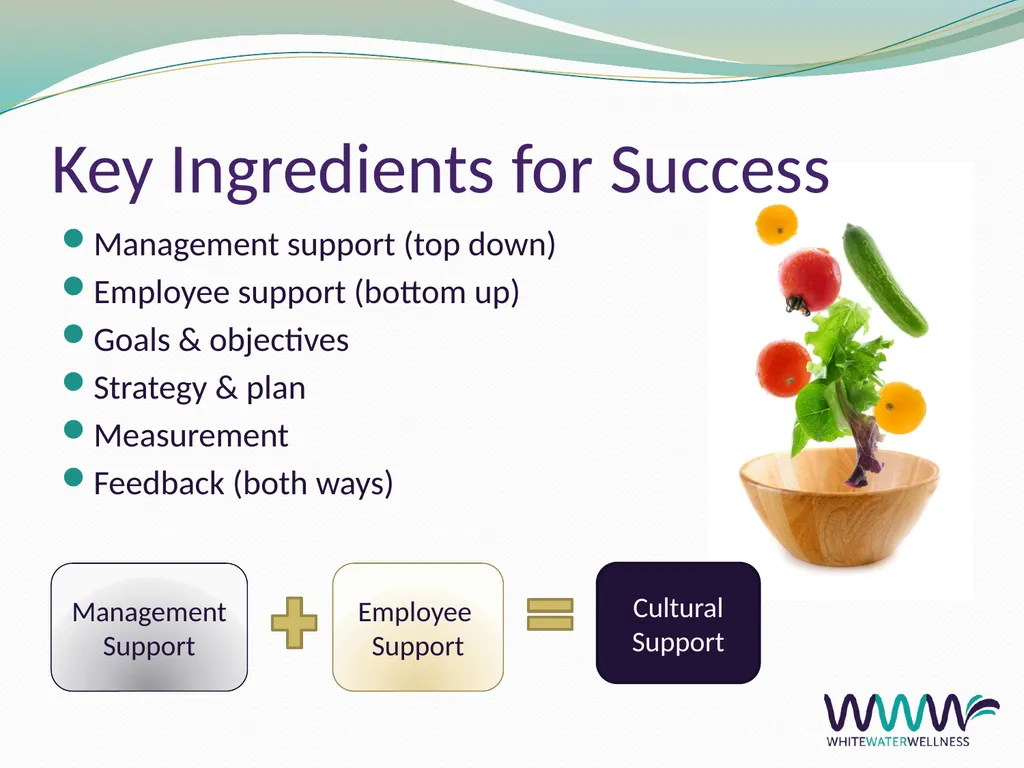
Key Ingredients for Success Management support (top down)
Employee support (bottom up)
Goals & objectives
Strategy & plan
Measurement
Feedback (both ways) Management Support Employee
Support Cultural Support<br>
19
Program Components & Variations General Focus Participation Focus Disease management
Health & well-being
Morale (fun, team-building)
Work-life balance Individualized
Group-based
Voluntary
Involuntary Scope of Program Comprehensive
Campaign-based or issue-based Participant Experience Passive
Active & empowered<br>
20
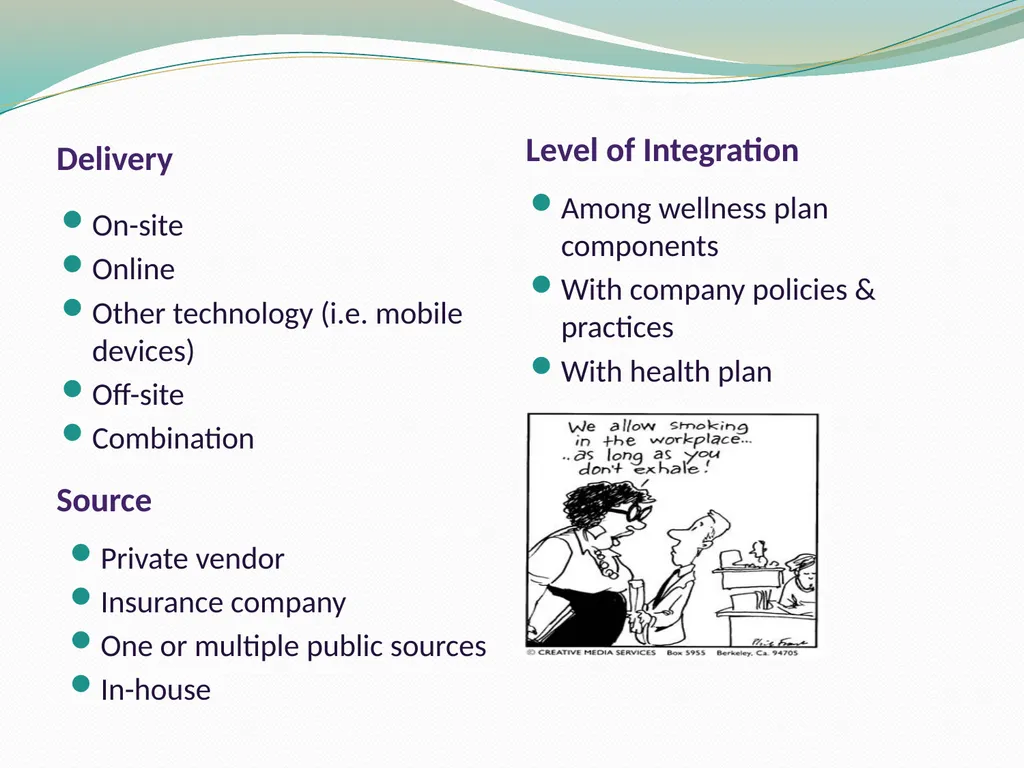
Delivery Level of Integration On-site
Online
Other technology (i.e. mobile devices)
Off-site
Combination Among wellness plan components
With company policies & practices
With health plan Source Private vendor
Insurance company
One or multiple public sources
In-house<br>
21
Incentives Group based
Individual
Competition
Money or financial
Tangible or intangible
Carrot vs. Stick
Integration with health plan
“Entry fee” concept
Loss aversion<br>
22
The Incentive Debate… They CAN (and DO) change behavior
But does it last?
Which is better, the carrot or the stick?
Do incentives kill intrinsic motivation?
Some incentives are not so obvious…
Be thoughtful & cautious in design of incentives<br>
23
An incentive will get someone to try something new, but people have to see someone they know and trust doing that behavior before they are willing to make a permanent change.<br>
24
Legal & Compliance Considerations Regulating bodies:
IRS, DOL, HHS
(Potential) Applicable laws and regulations:
ERISA: HIPAA, COBRA
GINA: Genetic Information Nondiscrimination Act
ACA (Affordable Care Act)
IRC: taxation of incentives
ADA (Americans with Disabilities Act)
Civil Rights Act of 1964 (Title VII)
State laws
Is your wellness program part of or linked to a group health plan?
i.e. discounted premiums based on health factors<br>
25
Do you have to follow ACA rules? Participatory Plans Health Contingent Plans Rewards based on participation only, no health factors
Offered to all similarly situated individuals
DOES NOT HAVE TO MEET THESE REQUIREMENTS Rewards based on meeting a standard related to a health factor
Two categories:
Activity-Only
Outcome-Based
BOTH MUST MEET THE REQUIREMENTS OUTLINED IN THE REGULATIONS (But they differ slightly)<br>
26
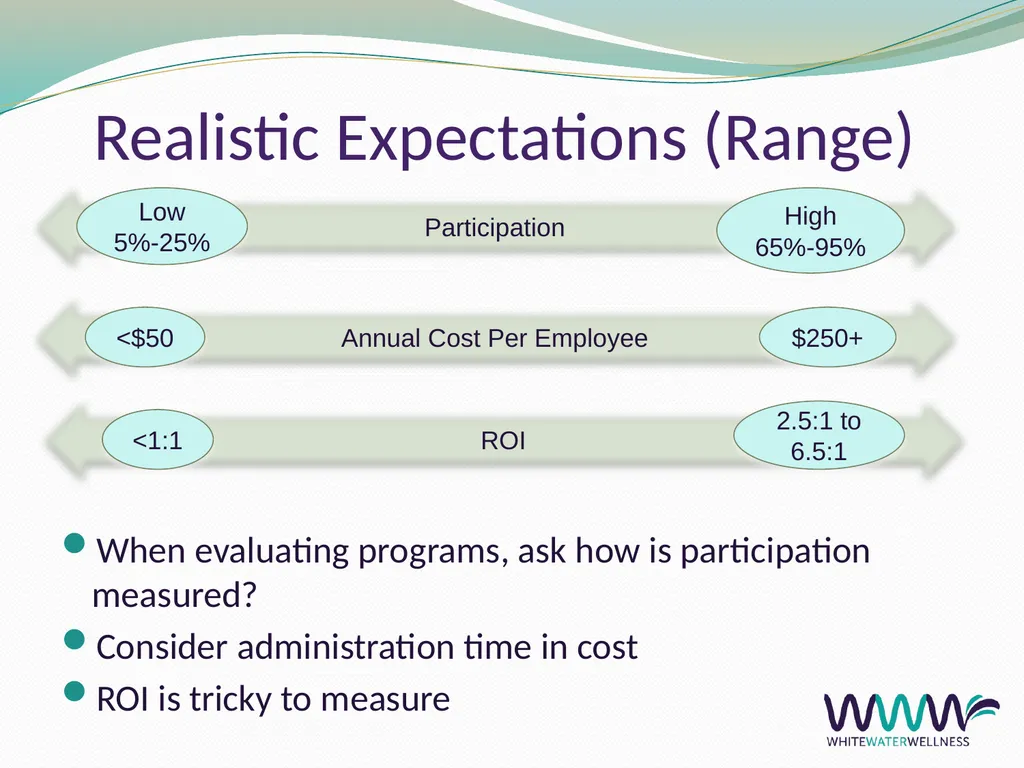
Realistic Expectations (Range) When evaluating programs, ask how is participation measured?
Consider administration time in cost
ROI is tricky to measure<br>
27
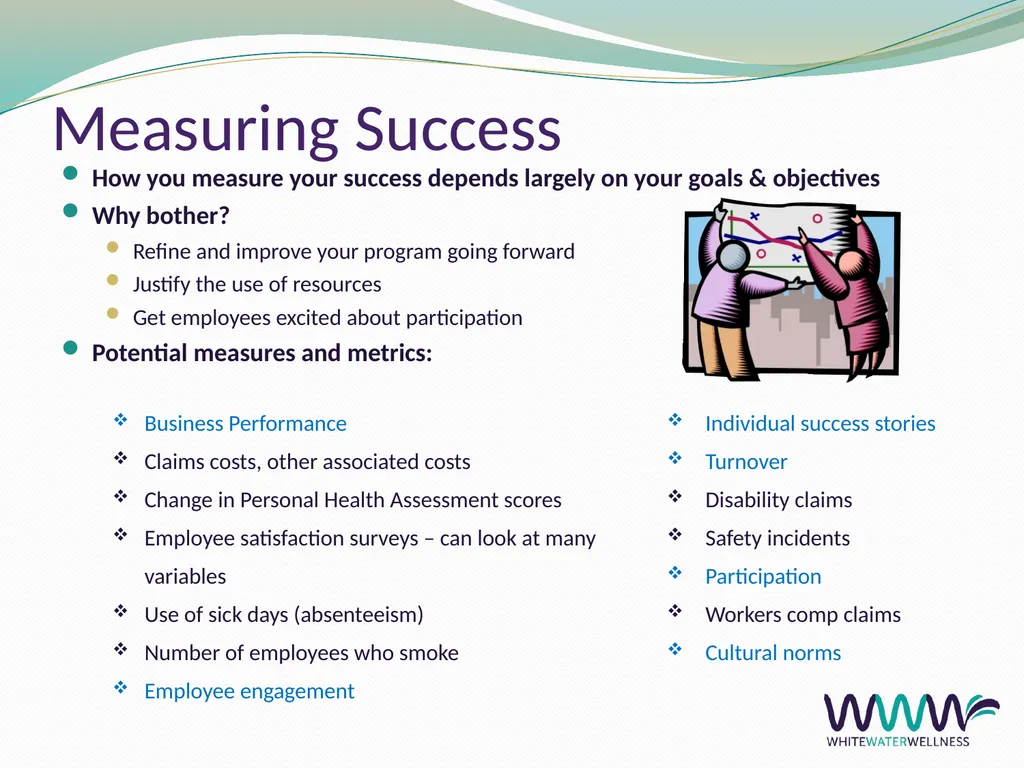
Measuring Success How you measure your success depends largely on your goals & objectives
Why bother?
Refine and improve your program going forward
Justify the use of resources
Get employees excited about participation
Potential measures and metrics: Business Performance
Claims costs, other associated costs
Change in Personal Health Assessment scores
Employee satisfaction surveys – can look at many variables
Use of sick days (absenteeism)
Number of employees who smoke
Employee engagement Individual success stories
Turnover
Disability claims
Safety incidents
Participation
Workers comp claims
Cultural norms<br>
28
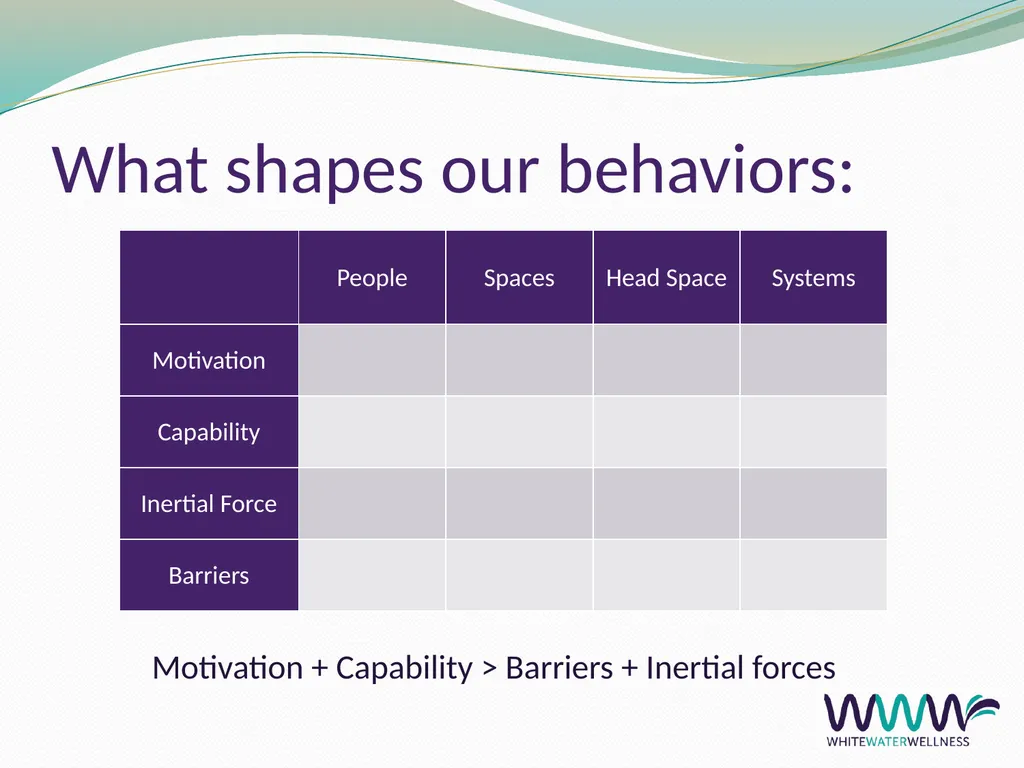
What shapes our behaviors: Motivation + Capability > Barriers + Inertial forces<br>
29
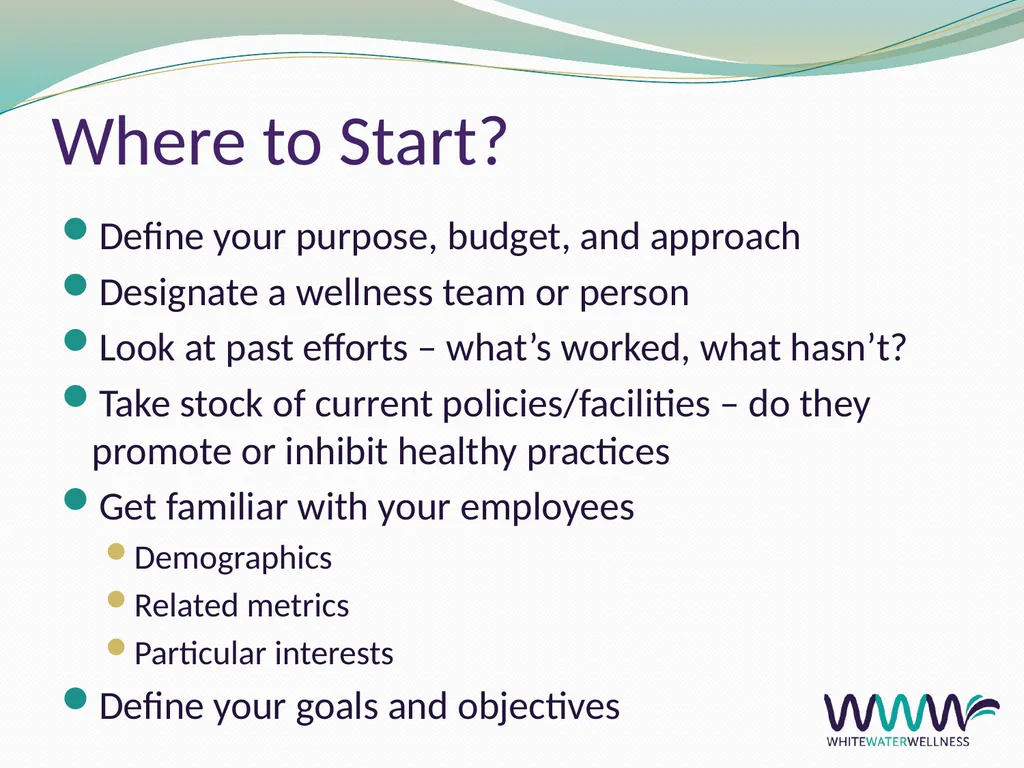
Where to Start? Define your purpose, budget, and approach
Designate a wellness team or person
Look at past efforts – what’s worked, what hasn’t?
Take stock of current policies/facilities – do they promote or inhibit healthy practices
Get familiar with your employees
Demographics
Related metrics
Particular interests
Define your goals and objectives<br>
30
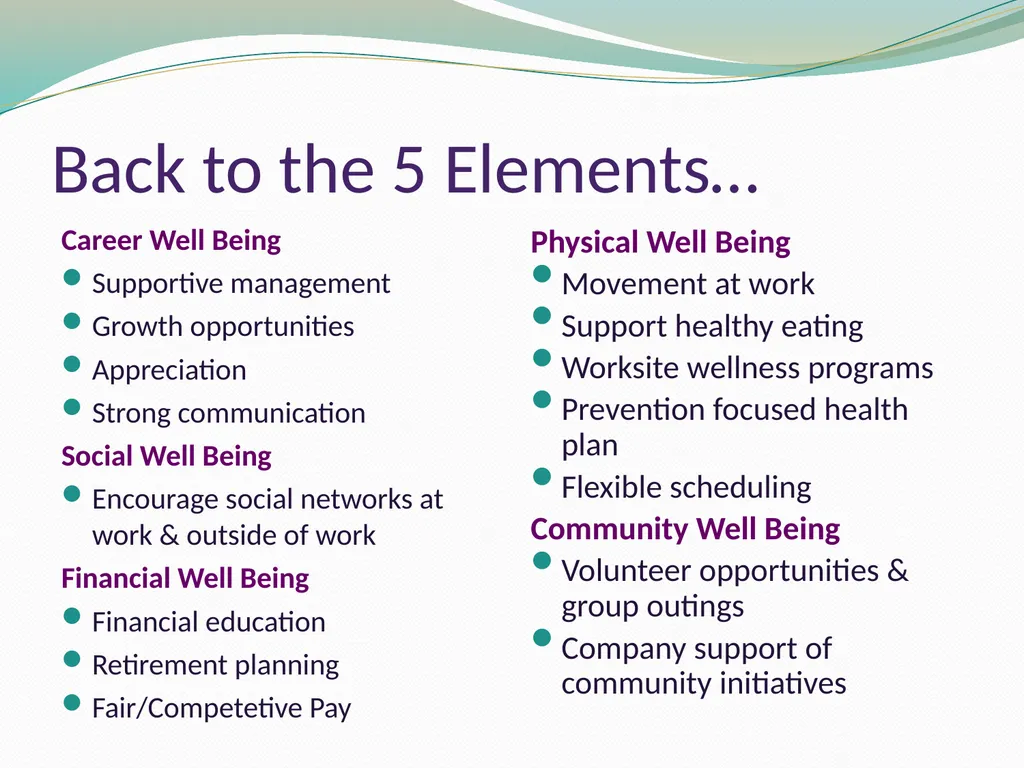
Back to the 5 Elements… Career Well Being
Supportive management
Growth opportunities
Appreciation
Strong communication
Social Well Being
Encourage social networks at work & outside of work
Financial Well Being
Financial education
Retirement planning
Fair/Competetive Pay Physical Well Being
Movement at work
Support healthy eating
Worksite wellness programs
Prevention focused health plan
Flexible scheduling
Community Well Being
Volunteer opportunities & group outings
Company support of community initiatives<br>
31
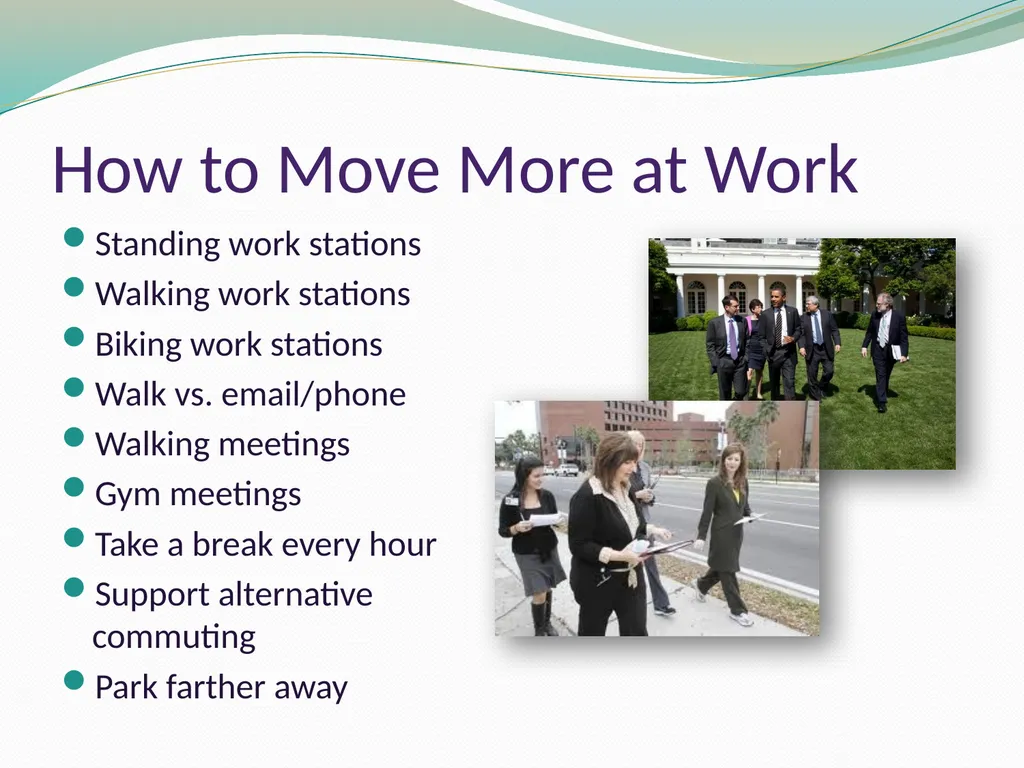
How to Move More at Work Standing work stations
Walking work stations
Biking work stations
Walk vs. email/phone
Walking meetings
Gym meetings
Take a break every hour
Support alternative commuting
Park farther away<br>
32
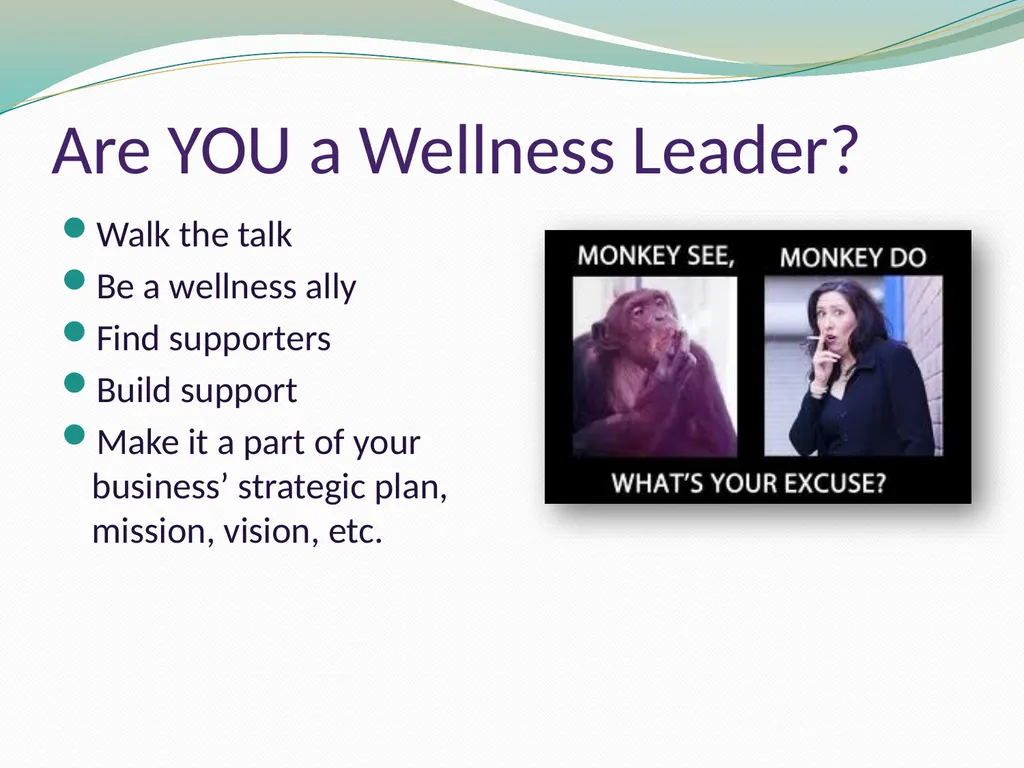
Are YOU a Wellness Leader? Walk the talk
Be a wellness ally
Find supporters
Build support
Make it a part of your business’ strategic plan, mission, vision, etc.<br>
33
Most people spend their years sacrificing their health to gain their wealth, only later to spend their wealth reclaiming their health.<br>
34
Resources Welcoa: www.welcoa.com
Centers for Disease Control (CDC): www.cdc.gov/nccdphp/dnpao/hwi/index.htm
National Wellness Institute (NWI): www.nationalwellness.org
LinkedIn Groups
State of Alaska: www.hss.state.ak.us/dph/chronic/worksite/default.htm
HERO Scorecard: http://hero-health.org/scorecard/<br>
35
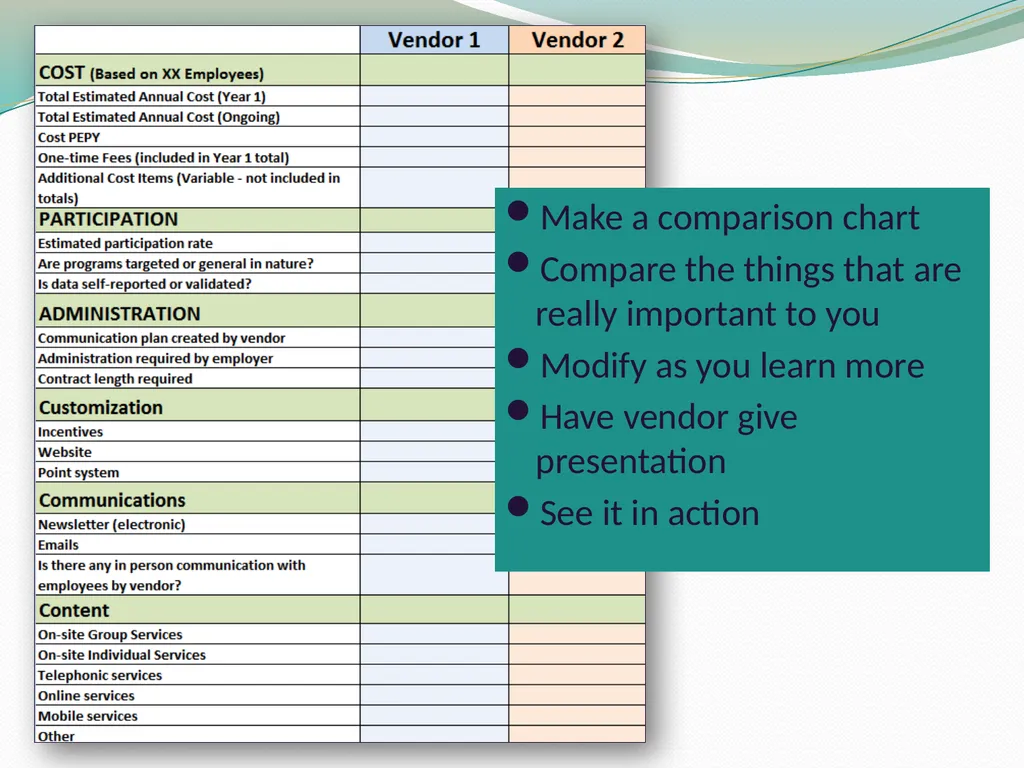
Make a comparison chart
Compare the things that are really important to you
Modify as you learn more
Have vendor give presentation
See it in action<br>
36
Questions? cara@whitewaterwellness.com
907-223-4883<br>