What is suicide? What is world suicide prevention day? The International Association for Suicide Prevention (IASP) initiated World Suicide Prevention Day in 2003. The day is co-sponsored by the World Federation for Mental Health and World
"What is suicide? What is world suicide prevention" is the property of its rightful owner. Permission is granted to
download and print the materials on this website for personal, non-commercial use only, and to display it
on your personal computer provided you do not modify the materials and that you retain all copyright
notices contained in the materials. By downloading content from our website, you accept the terms of this
agreement.
Presentation Transcript
01
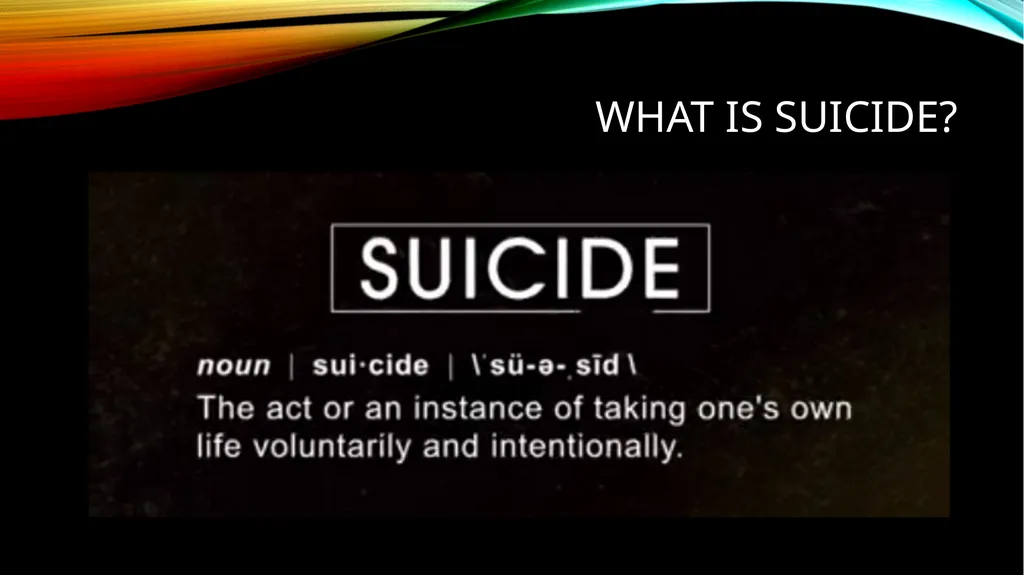
What is suicide?<br>
02
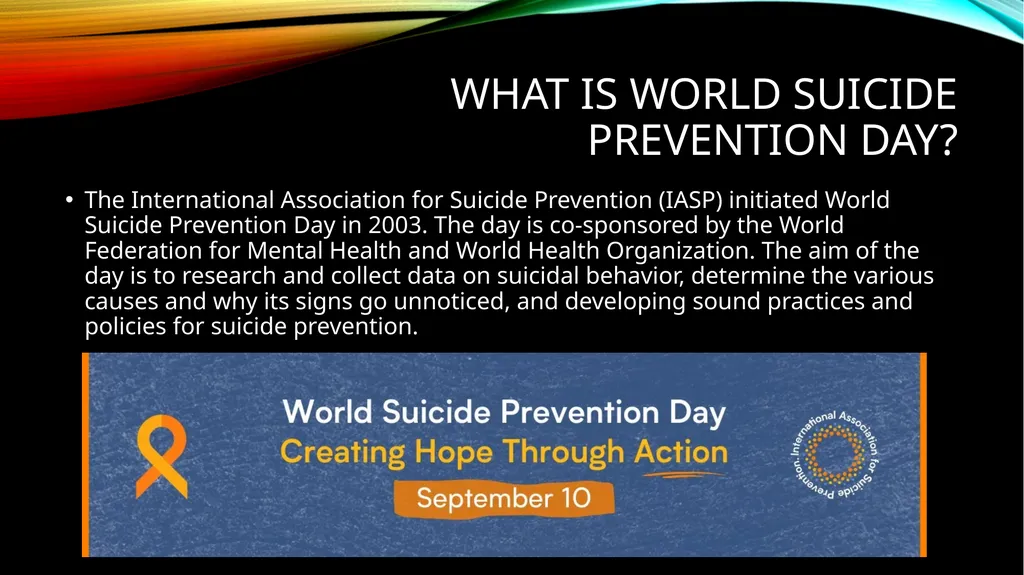
What is world suicide prevention day? The International Association for Suicide Prevention (IASP) initiated World Suicide Prevention Day in 2003. The day is co-sponsored by the World Federation for Mental Health and World Health Organization. The aim of the day is to research and collect data on suicidal behavior, determine the various causes and why its signs go unnoticed, and developing sound practices and policies for suicide prevention.<br>
03
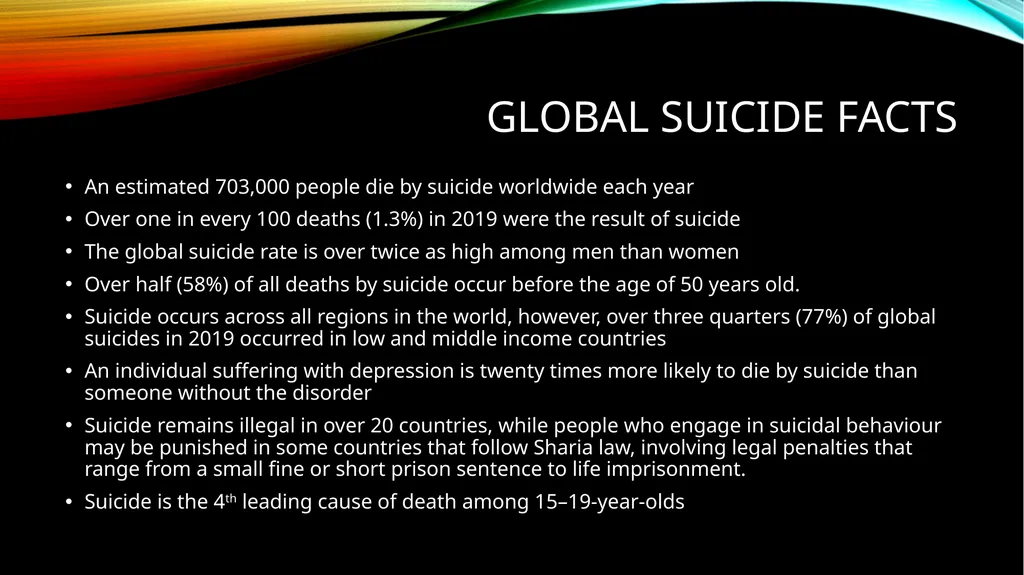
Global suicide facts An estimated 703,000 people die by suicide worldwide each year
Over one in every 100 deaths (1.3%) in 2019 were the result of suicide
The global suicide rate is over twice as high among men than women
Over half (58%) of all deaths by suicide occur before the age of 50 years old.
Suicide occurs across all regions in the world, however, over three quarters (77%) of global suicides in 2019 occurred in low and middle income countries
An individual suffering with depression is twenty times more likely to die by suicide than someone without the disorder
Suicide remains illegal in over 20 countries, while people who engage in suicidal behaviour may be punished in some countries that follow Sharia law, involving legal penalties that range from a small fine or short prison sentence to life imprisonment.
Suicide is the 4th leading cause of death among 15–19-year-olds<br>
04
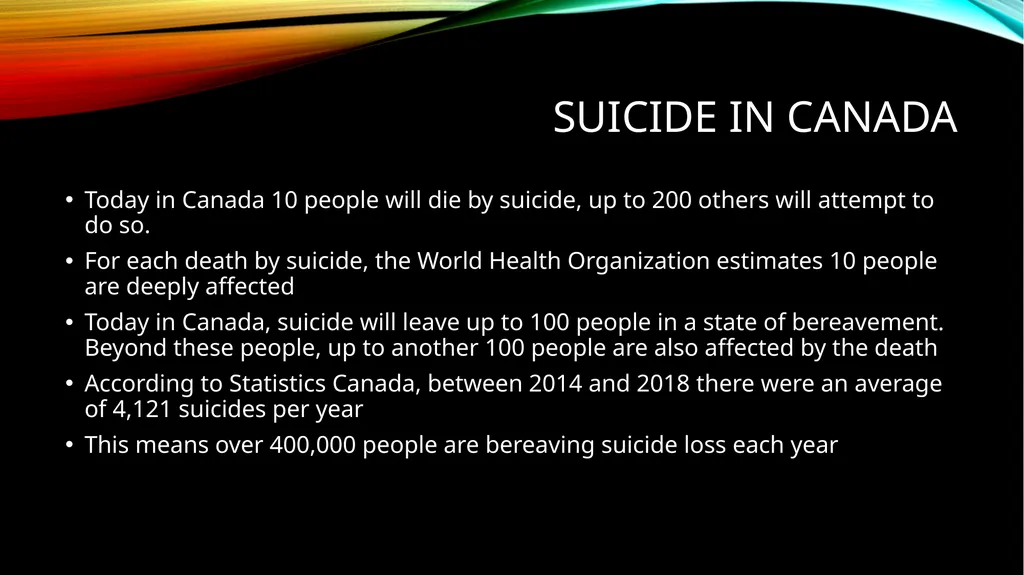
Suicide in Canada Today in Canada 10 people will die by suicide, up to 200 others will attempt to do so.
For each death by suicide, the World Health Organization estimates 10 people are deeply affected
Today in Canada, suicide will leave up to 100 people in a state of bereavement. Beyond these people, up to another 100 people are also affected by the death
According to Statistics Canada, between 2014 and 2018 there were an average of 4,121 suicides per year
This means over 400,000 people are bereaving suicide loss each year<br>
05
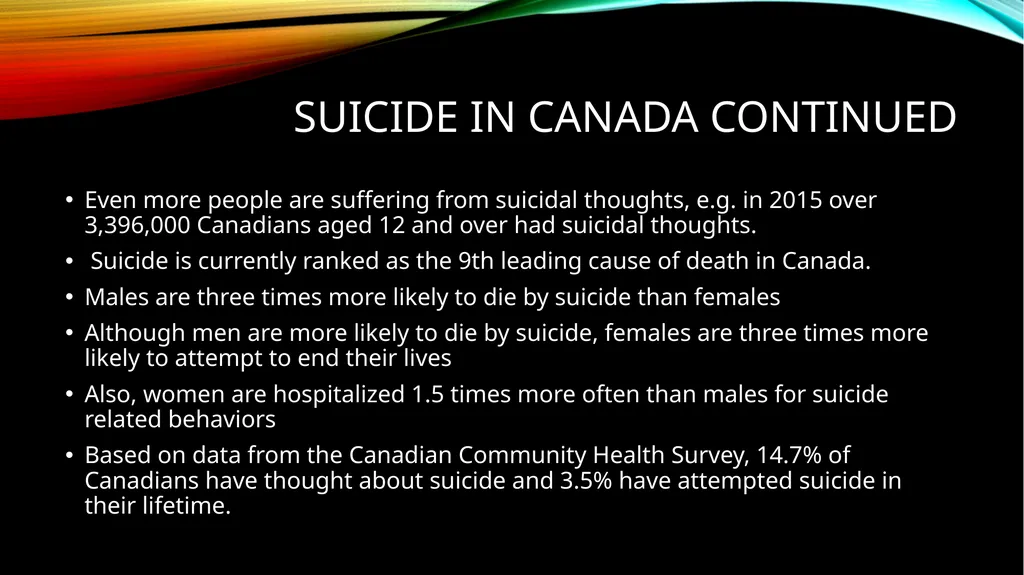
Suicide in Canada continued Even more people are suffering from suicidal thoughts, e.g. in 2015 over 3,396,000 Canadians aged 12 and over had suicidal thoughts.
Suicide is currently ranked as the 9th leading cause of death in Canada.
Males are three times more likely to die by suicide than females
Although men are more likely to die by suicide, females are three times more likely to attempt to end their lives
Also, women are hospitalized 1.5 times more often than males for suicide related behaviors
Based on data from the Canadian Community Health Survey, 14.7% of Canadians have thought about suicide and 3.5% have attempted suicide in their lifetime.<br>
06
Suicide in British columbia An average of about 550 British Columbians died by suicide annually between 2008 and 2018
Men and Women ages 50-59 are the most likely to die by suicide
Of all suicide deaths 75% were men between 2008-2018<br>
07
Why do people die by suicide Suicide is a complex issue involving numerous factors and should not be attributed to any one single cause. Not all people who die by suicide have been diagnosed with a mental illness and not all people with a mental illness attempt to end their lives by suicide.
People who experience suicidal thoughts and feelings are suffering with tremendous emotional pain. People who have died by suicide typically had overwhelming feelings of hopelessness, despair, and helplessness. Suicide is not about a moral weakness or a character flaw. People considering suicide feel as though their pain will never end and that suicide is the only way to stop the suffering.
Many factors and circumstances can contribute to someone’s decision to end their life. Factors such as loss, addictions, childhood trauma or other forms of trauma, depression, serious physical illness, and major life changes can make some people feel overwhelmed and unable to cope. It is important to remember that it isn’t necessarily the nature of the loss or stressor that is as important as the individual’s experience of these things feeling unbearable.<br>
08
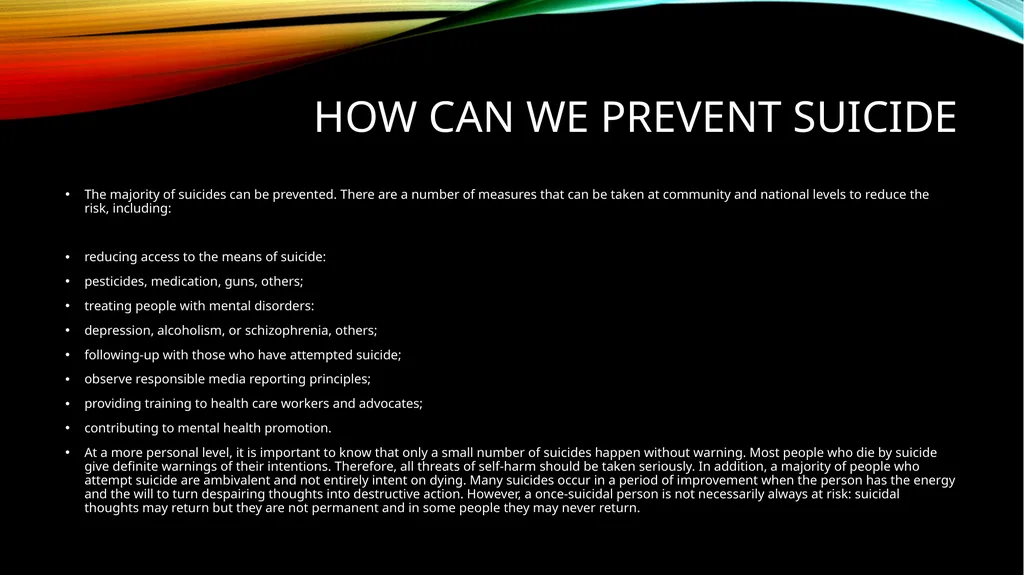
How can we prevent suicide The majority of suicides can be prevented. There are a number of measures that can be taken at community and national levels to reduce the risk, including:
reducing access to the means of suicide:
pesticides, medication, guns, others;
treating people with mental disorders:
depression, alcoholism, or schizophrenia, others;
following-up with those who have attempted suicide;
observe responsible media reporting principles;
providing training to health care workers and advocates;
contributing to mental health promotion.
At a more personal level, it is important to know that only a small number of suicides happen without warning. Most people who die by suicide give definite warnings of their intentions. Therefore, all threats of self-harm should be taken seriously. In addition, a majority of people who attempt suicide are ambivalent and not entirely intent on dying. Many suicides occur in a period of improvement when the person has the energy and the will to turn despairing thoughts into destructive action. However, a once-suicidal person is not necessarily always at risk: suicidal thoughts may return but they are not permanent and in some people they may never return.<br>
09
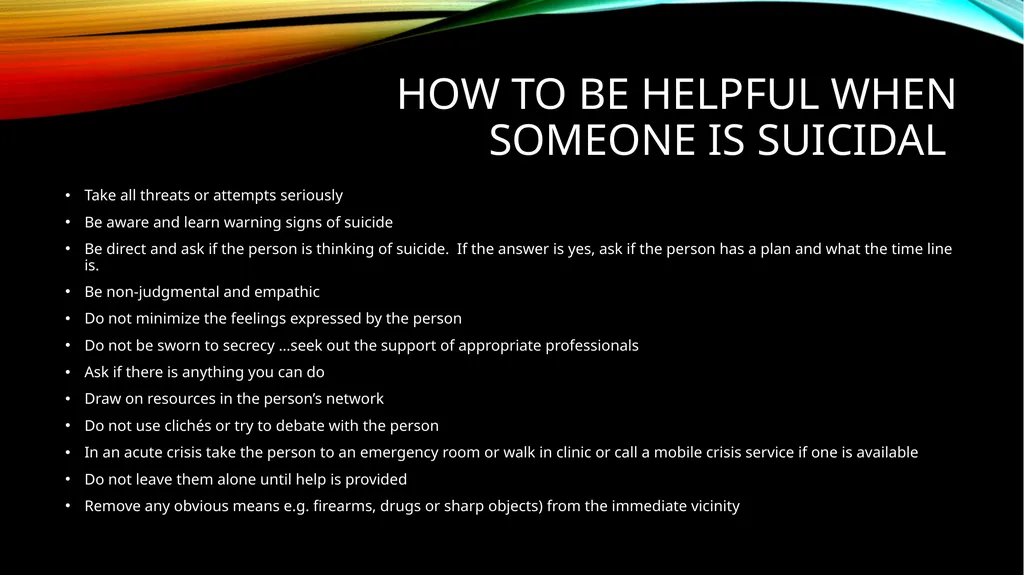
How to be helpful when someone is suicidal Take all threats or attempts seriously
Be aware and learn warning signs of suicide
Be direct and ask if the person is thinking of suicide. If the answer is yes, ask if the person has a plan and what the time line is.
Be non-judgmental and empathic
Do not minimize the feelings expressed by the person
Do not be sworn to secrecy …seek out the support of appropriate professionals
Ask if there is anything you can do
Draw on resources in the person’s network
Do not use clichés or try to debate with the person
In an acute crisis take the person to an emergency room or walk in clinic or call a mobile crisis service if one is available
Do not leave them alone until help is provided
Remove any obvious means e.g. firearms, drugs or sharp objects) from the immediate vicinity<br>
10
Are you feeling suicidal? If you or someone you know is having thoughts of suicide, call 1-800-784-2433 (1-800-SUICIDE), or call the crisis line at 1-888-305-CARE(2273).
Help is available! We are here to listen, here to help – 24 hours a day, 7 days a week.<br>
11
references Please visit the Canadian Association for Suicide Prevention website at
https://suicideprevention.ca/?locale=en
Please visit the International Association for Suicide Prevention website at
https://www.iasp.info/wspd2021/