
What’s New in ANSI/ESD S20.20-2021 © 2022
YM
Published · 24 slides · 0 views

1 / 1








Description
Whats New in ANSIESD S20.20-2021 2022 Copyright Desco Industries, Inc Desco.com Whats New in ANSIESD S20.20-2021 What is the history of S20.20? There are and were several standards used by the military and commercial worlds. All a bit
Related Topics
Share
Embed code
Download this presentation From Below
"What’s New in ANSI/ESD S20.20-2021 © 2022" is the property of its rightful owner. Permission is granted to download and print the materials on this website for personal, non-commercial use only, and to display it on your personal computer provided you do not modify the materials and that you retain all copyright notices contained in the materials. By downloading content from our website, you accept the terms of this agreement.
Presentation Transcript
01
What’s New in
ANSI/ESD S20.20-2021 © 2022 Copyright Desco Industries, Inc Desco.com<br>
02
What’s New in ANSI/ESD S20.20-2021 What is the history of S20.20?
There are and were several standards used by the military and commercial worlds. All a bit different, all a bit incomplete. In 1999 the military and commercial worlds got together and decided to create one standard. Utilizing the best information from all the standards they created S20.20 series of Standards. S20.20 was revised in 2007, 2014 and again in 2021.<br>
There are and were several standards used by the military and commercial worlds. All a bit different, all a bit incomplete. In 1999 the military and commercial worlds got together and decided to create one standard. Utilizing the best information from all the standards they created S20.20 series of Standards. S20.20 was revised in 2007, 2014 and again in 2021.<br>
03
ANSI/ESD S20.20-2021 is an update that has a number of changes.
Key elements that include changes:
Product Qualification
Grounding
Insulators
Isolated Conductors
Garment Testing
Packaging
Marking
Tailoring What’s New in ANSI/ESD S20.20-2021<br>
Key elements that include changes:
Product Qualification
Grounding
Insulators
Isolated Conductors
Garment Testing
Packaging
Marking
Tailoring What’s New in ANSI/ESD S20.20-2021<br>
04
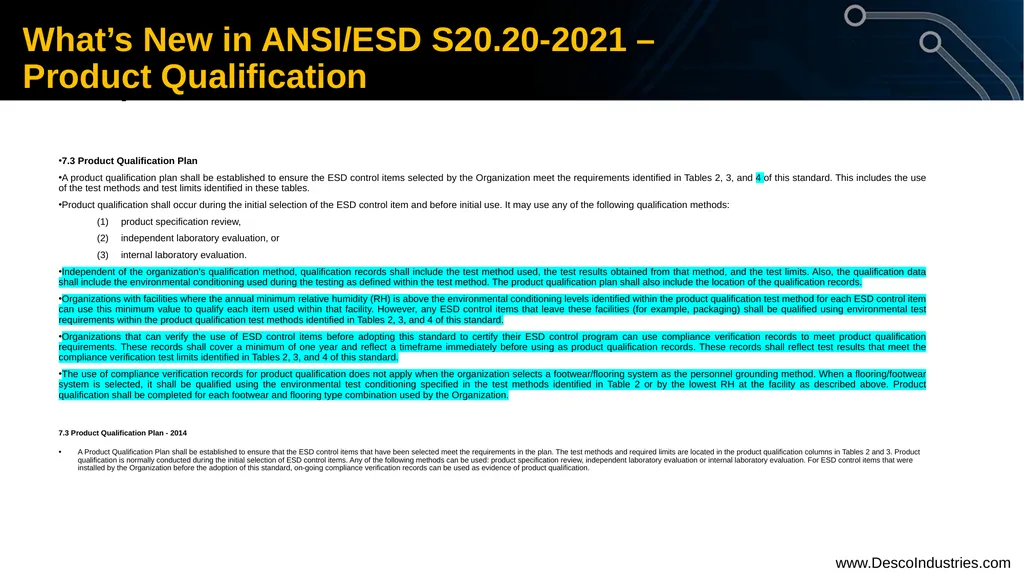
7.3 Product Qualification Plan
A product qualification plan shall be established to ensure the ESD control items selected by the Organization meet the requirements identified in Tables 2, 3, and 4 of this standard. This includes the use of the test methods and test limits identified in these tables.
Product qualification shall occur during the initial selection of the ESD control item and before initial use. It may use any of the following qualification methods:
product specification review,
independent laboratory evaluation, or
internal laboratory evaluation.
Independent of the organization's qualification method, qualification records shall include the test method used, the test results obtained from that method, and the test limits. Also, the qualification data shall include the environmental conditioning used during the testing as defined within the test method. The product qualification plan shall also include the location of the qualification records.
Organizations with facilities where the annual minimum relative humidity (RH) is above the environmental conditioning levels identified within the product qualification test method for each ESD control item can use this minimum value to qualify each item used within that facility. However, any ESD control items that leave these facilities (for example, packaging) shall be qualified using environmental test requirements within the product qualification test methods identified in Tables 2, 3, and 4 of this standard.
Organizations that can verify the use of ESD control items before adopting this standard to certify their ESD control program can use compliance verification records to meet product qualification requirements. These records shall cover a minimum of one year and reflect a timeframe immediately before using as product qualification records. These records shall reflect test results that meet the compliance verification test limits identified in Tables 2, 3, and 4 of this standard.
The use of compliance verification records for product qualification does not apply when the organization selects a footwear/flooring system as the personnel grounding method. When a flooring/footwear system is selected, it shall be qualified using the environmental test conditioning specified in the test methods identified in Table 2 or by the lowest RH at the facility as described above. Product qualification shall be completed for each footwear and flooring type combination used by the Organization.
7.3 Product Qualification Plan - 2014
A Product Qualification Plan shall be established to ensure that the ESD control items that have been selected meet the requirements in the plan. The test methods and required limits are located in the product qualification columns in Tables 2 and 3. Product qualification is normally conducted during the initial selection of ESD control items. Any of the following methods can be used: product specification review, independent laboratory evaluation or internal laboratory evaluation. For ESD control items that were installed by the Organization before the adoption of this standard, on-going compliance verification records can be used as evidence of product qualification. www.DescoIndustries.com - P What’s New in ANSI/ESD S20.20-2021 –
Product Qualification<br>
05
What’s New in ANSI/ESD S20.20-2021-
Product Qualification Summary
Strict temperature and humidity controls removed for items staying in that facility
Lowest level of humidity identified in facility can be used for items staying in that facility
For materials going to a different facility, formal temperature and humidity controls of that facility must be used.
Compliance Verification records of products tested for at least a year before S20.20 was implemented can be used for product qualification (exception – flooring/footwear product qualification)
Regardless of the chosen Product Qualification method the following must be supplied – Test Method used, Test Results obtained, Test Limits used, Environmental Conditioning used during testing<br>
06
What’s New in ANSI/ESD S20.20-2021 – Product Qualification – Flooring/Footwear Flooring/Footwear Product Qualification
2014 – Strict requirements on temperature and humidity during testing process. Product qualification shall be completed for each footwear and flooring type combination used by the Organization.
2021 - When a flooring/footwear system is selected, it shall be qualified using the environmental test conditioning specified in the test methods identified in Table 2 or by the lowest RH at the facility as described above. Product qualification shall be completed for each footwear and flooring type combination used by the Organization.
End user Loaner Agreement
Allows customers to be able to do their own one time test of footwear and flooring combinations
Demo - Body Voltage Meter<br>
07
What’s New in ANSI/ESD S20.20-2021 –
Product Qualification -Flooring/Footwearat Summary
Strict temperature and humidity controls removed for products staying in that facility
Lowest level of humidity identified in facility can be used
On file Compliance Verification record can not be used (Compliance Verification involves testing footwear and floor separately)
Each combination of flooring and footwear must be qualified (example - 4 types of flooring and 3 types of footwear results in 12 separate qualifications)
Statguard Flooring has Body Voltage Meter to perform tests, can be loaned to customers<br>
08
What’s New in ANSI/ESD S20.20-2021 - Grounding ww.DescoIndustries.com 8.1 Grounding/Equipotential Bonding Systems
Grounding/equipotential bonding systems shall be used to ensure that ESDS items, personnel, and any other conductors that come into contact with ESDS items (for example, mobile equipment) are at the same electrical potential. An implementing process shall be selected from Table 1.
There are no requirements for a compliance verification plan for testing the grounding system; only initial verification is required. If ground fault circuit interrupters (GFCI) are installed at the user's facility, this measurement is not required.
NOTE: Verification of the grounding system should be considered after electrical system maintenance or service additions.<br>
09
What’s New in ANSI/ESD S20.20-2021 - Grounding Summary
System testing required only in initial set up, unless GFCI (ground fault circuit interrupters) are in place, then initial testing is not required.
System verification should be considered after electrical system maintenance or service additions.<br>
System testing required only in initial set up, unless GFCI (ground fault circuit interrupters) are in place, then initial testing is not required.
System verification should be considered after electrical system maintenance or service additions.<br>
10
What’s New in ANSI/ESD S20.20-2021 - Insulators 8.3.1 Insulators
The Organization's ESD control program shall include a plan for handling insulators to mitigate field induced CDM damage. All nonessential insulators shall be separated from any ESDS item by at least 300 mm. Areas can be designated within the EPA to store static generating items provided the areas do not cause any of the requirements below to be exceeded. When qualifying a process to be deployed in an EPA, process essential insulators shall be evaluated in accordance with how the insulators will be used.
For initial process qualification and ongoing compliance verification measurements, one of the following criteria shall be met:
Measure the field at the location where the ESDS item is handled. The electrostatic field shall be less than 5000 volts/meter (125 volts/inch).
or
For any process essential insulators located less than or equal to 25 mm from an unprotected ESDS item, the voltage on the surface of the insulator shall be less than 125 volts when measured with a non-contact electrostatic voltmeter. When using an electrostatic field meter, the reading shall be less than 125 volts when measured at the meter's stipulated measuring distance.
For any process essential insulators located more than 25 mm, but less than 300 mm from an unprotected ESDS item, the voltage on the surface of the insulator shall be less than 2000 volts when measured with a non-contact electrostatic voltmeter. When using an electrostatic field meter, the reading shall be less than 2000 volts when measured at the meter's stipulated measuring distance.
NOTE: Insulators should be measured after normal handling that could occur during the processing of ESDS items with materials in use in the EPA. The insulators should not be artificially charged. See ESD TR20.20 for more information.
NOTE: See ESD TR20.20 for more information on insulators and charge mitigation techniques.
NOTE: The accurate measurement of electrostatic fields requires that the person making the measurement is familiar with the operation of the measuring equipment. An electrostatic field meter responds to the electrostatic field emanating from a charged surface and converts the field into a voltage when the meter is positioned at the meter's stipulated distance. When measuring relatively large conductors, the electrostatic field meter reading is the actual voltage on the conductor when measured at the meter's stipulated measuring distance. However, for non-uniformly charged insulators, the voltage indicated by the field meter (when measured at the meter's stipulated measuring distance) is an average of the electrostatic field strengths of the charged insulator.
NOTE: If a non-contact electrostatic voltmeter is used, care must be taken to ensure the non-contact electrostatic voltmeter's spot resolution (the smallest measurement area that the meter can resolve) is smaller than the insulator being measured. For a non-contact electrostatic voltmeter, this is a combination of aperture size and distance to the object. It is recommended to measure the item at the smallest distance stated by the manufacturer.<br>
11
What’s New in ANSI/ESD S20.20-2021 - Insulators Summary
Change from inches to millimeters – 300 mm = 1 foot, 25mm = 1 inch
Nonessential Insulators must be 1 foot away - (example – a non essential insulator with 800 volts is not allowed to be 1 inch away, must be 12 inches – an essential insulator with 800 volts is allowed to be 1 inch away)
Rubbing an insulator to maximize charge before measuring is no longer allowed. Maximum charge must be measured normal handling of the insulator.
Difference between field meter and non-contact electrostatic voltmeter – field meter must be 1 inch away from target when measuring, non-contact electrostatic volt meter measuring distance is adjustable.<br>
12
What’s New in ANSI/ESD S20.20-2021 –
Isolated Conductors 8.3.2 Isolated Conductors
If a conductor that cannot be grounded or equipotentially bonded comes into contact with an ESDS item, the process shall ensure that the potential between the isolated conductor and ground is between ‑35 volts and +35 volts.
For an isolated conductor that does not come into contact with an ESDS item, the requirements for insulators in Section 8.3.1 shall be met.
NOTE: For accurate measurements, it is recommended to use a high impedance contact voltmeter. If a non-contact electrostatic voltmeter or electrostatic field meter is used, care must be taken to ensure the spot resolution (the smallest measurement area that the meter can resolve) is smaller than the isolated conductor being measured. For a non-contact electrostatic voltmeter, this is a combination of aperture size and distance to the object. It is recommended to measure the item at the smallest distance stated by the manufacturer.
8.3.2 Isolated Conductors - 2014
When establishing an ESD Control Plan, if a conductor that comes into contact with an ESDS item cannot be grounded or equipotentially bonded, then the process must ensure that the difference in potential between the conductor and the contact of the ESDS item is less than 35 volts.
This can be accomplished by measuring the ESDS item and the conductor by using a non-contact electrostatic voltmeter or a high impedance contact electrostatic voltmeter. www.DescoIndustries.com<br>
13
What’s New in ANSI/ESD S20.20-2021 –
Isolated Conductors Examples of Isolated Conductors
In Circuit Testers
Device Level Microprobes
Cables for Testing
Testing Process
Determine if it is an isolated conductor. The first measurement is to see if the connection to ground is less than 1x10*9 ohms. If it is less than that, the conductor is grounded and no further measurement is required.
If the conductor is greater than 1x10*9 ohms, now you have to do the measurement of less than 35 volts to ground. This should be done after the conductor is in normal use in the process.
* High Impedance Contact Voltmeter recommended<br>
14
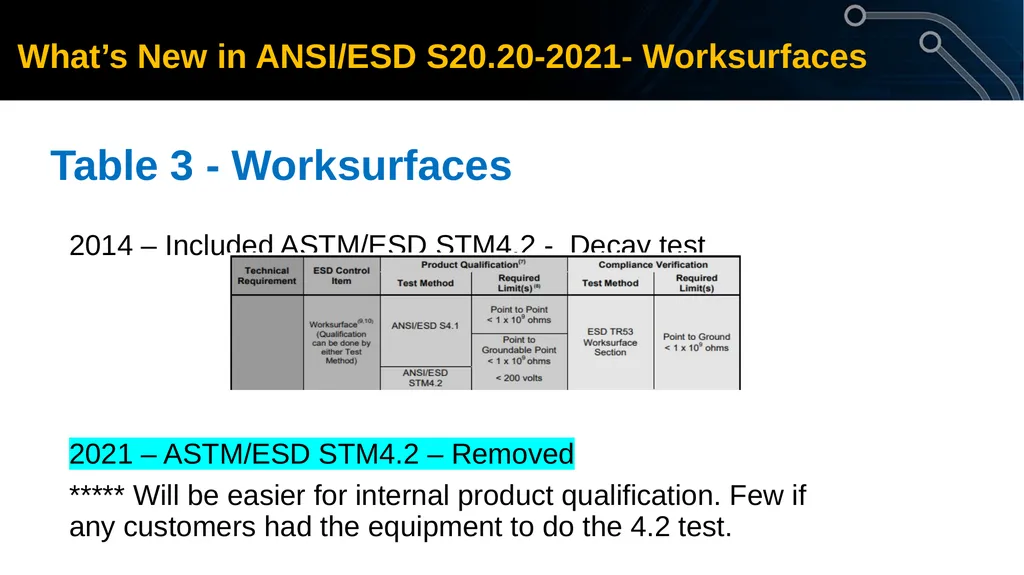
Table 3 - Worksurfaces 2014 – Included ASTM/ESD STM4.2 - Decay test
2021 – ASTM/ESD STM4.2 – Removed
***** Will be easier for internal product qualification. Few if any customers had the equipment to do the 4.2 test. What’s New in ANSI/ESD S20.20-2021- Worksurfaces<br>
2021 – ASTM/ESD STM4.2 – Removed
***** Will be easier for internal product qualification. Few if any customers had the equipment to do the 4.2 test. What’s New in ANSI/ESD S20.20-2021- Worksurfaces<br>
15
What’s New in ANSI/ESD S20.20-2021- Packaging 8.4 Packaging
A packaging plan shall be established to define packaging requirements, both inside and outside the EPA, per ANSI/ESD S541 or the contract, purchase order, drawing, or other documentation necessary to meet customer requirements. Test methods and test limits required for the various types of ESD protective packaging used by the Organization per ANSI/ESD S541 are summarized in Table 4.
Packaging considered 'single use' shall be subjected to the same product qualification and compliance verification requirements outlined in Sections 7.3 and 7.4 and shall meet the corresponding test method and test limit requirements of Table 4.
8.4 Packaging -2014
The organization shall define ESD protective packaging requirements, both inside and outside the EPA per ANSI/ESD S541 or in accordance with the contract, purchase order, drawing or other documentation necessary to meet customer requirements.
NOTE: When ESDS items are placed on packaging materials and the ESDS items have work being performed on them, then the packaging materials become worksurfaces. The worksurface requirements for resistance to ground apply. www.DescoIndustries.com<br>
16
What’s New in ANSI/ESD S20.20-2021- Packaging From ANSI-ESD 20.20 – 2021, Table 4
ANSI-ESD 11.11 – Surface Resistance Measurement of Static Dissipative Planar Materials
Surface Resistance Meter, Concentric Ring
ANSI-ESD 11.12 – Volume Resistance Measurement of Static Dissipative Planar Materials
Surface Resistance Meter, Concentric Ring
ANSI-ESD 11.13 – Two Point Resistance Measurement
Surface Resistance Meter, Two Point Probe
ANSI-ESD 11.31 – Evaluating the Performance of Electrostatic Shielding Material
Testing can be done at NC1<br>
17
What’s New in ANSI/ESD S20.20-2021- Packaging Summary
Packaging must be qualified under the same requirements of other products. Testing/qualifying standards are listed in Table 4.<br>
Packaging must be qualified under the same requirements of other products. Testing/qualifying standards are listed in Table 4.<br>
18
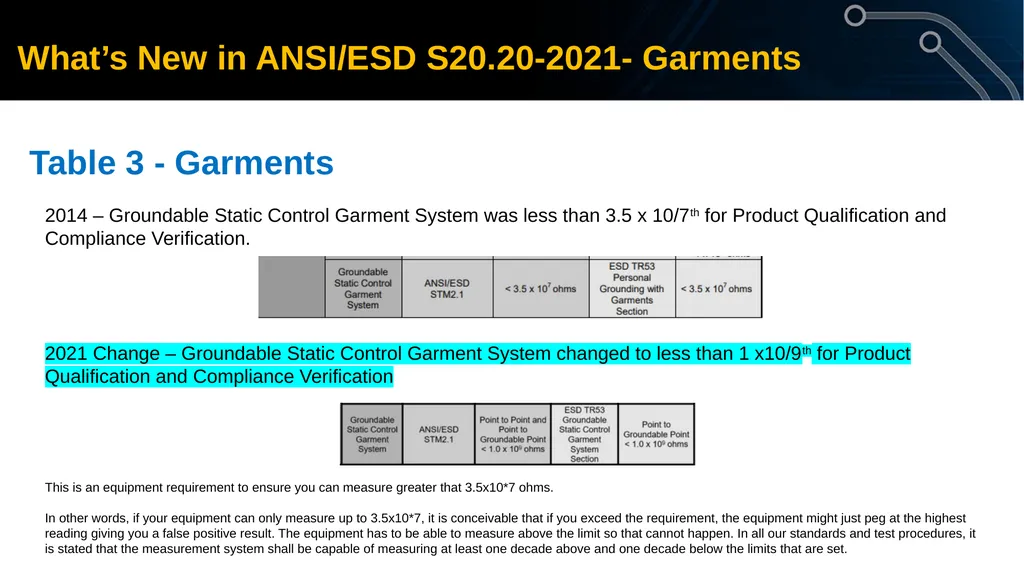
Table 3 - Garments 2014 – Groundable Static Control Garment System was less than 3.5 x 10/7th for Product Qualification and Compliance Verification.
2021 Change – Groundable Static Control Garment System changed to less than 1 x10/9th for Product Qualification and Compliance Verification
This is an equipment requirement to ensure you can measure greater that 3.5x10*7 ohms. In other words, if your equipment can only measure up to 3.5x10*7, it is conceivable that if you exceed the requirement, the equipment might just peg at the highest reading giving you a false positive result. The equipment has to be able to measure above the limit so that cannot happen. In all our standards and test procedures, it is stated that the measurement system shall be capable of measuring at least one decade above and one decade below the limits that are set. What’s New in ANSI/ESD S20.20-2021- Garments<br>
19
What’s New in ANSI/ESD S20.20-2021- Garments<br>
20
ANSI/ESD S20.20-2021 - Technical and Administrative Non Product Specific – Technical – Marking 8.5 Marking
ESDS items, system, or packaging marking shall be per customer contracts, purchase orders, drawings, or other documentation. When the contract, purchase order, drawing, or other documentation does not define ESDS items, system, or packaging marking, the Organization developing the ESD control program plan should consider the need for marking. If it is determined that marking is required, it shall be documented as part of the ESD control program plan. If it is determined that marking is not required, it does not have to be documented as part of the ESD control program plan.
NOTE: See ANSI/ESD S8.1 for symbols that can be used.
8.5 Marking - 2014
ESDS items, system or packaging marking shall be in accordance with customer contracts, purchase orders, drawing or other documentation. When the contract, purchase order, drawing or other documentation does not define ESDS items, system or packaging marking, the Organization, in developing the ESD Control Program Plan, shall consider the need for marking. If it is determined that marking is required, it shall be documented as part of the ESD Control Program Plan. www.DescoIndustries.com<br>
21
What’s New in ANSI/ESD S20.20-2021- Tailoring 6.3 Tailoring
This document, or portions thereof, may not apply to all ESD control programs. Any deviation from, or exclusion of, a requirement of this document is considered tailoring. Tailored requirements shall be summarized in the ESD control program plan and include the justification and technical rationale for the deviation or exclusion of the requirement from the plan. See Annex C for more information.
Annex C – see Annex C on pages 14-15 of ANSI/ESD S20.20-2021 for details. Basically it gives examples and explanations of what is a considered a good tailoring situation and what is not a good tailoring situation.
6.3 Tailoring - 2014
This document, or portions thereof, may not apply to all applications. Tailoring is accomplished by evaluating the applicability of each requirement for the specific application. Upon completion of the evaluation, requirements may be deleted or modified outside the limits of this standard. Tailoring decisions, including rationale and technical justifications, shall be documented in the ESD Control Program Plan. www.DescoIndustries.com<br>
22
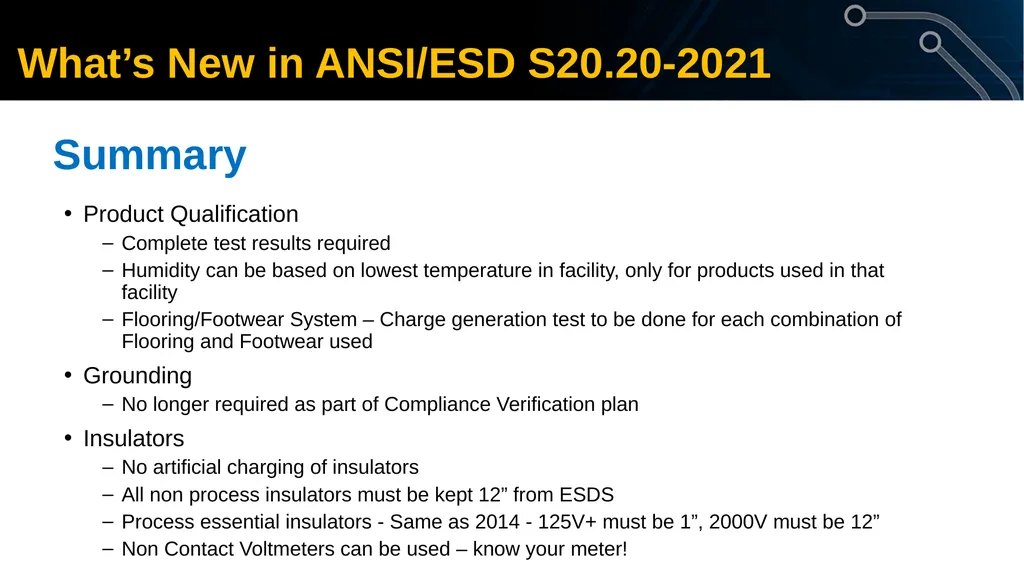
Summary Product Qualification
Complete test results required
Humidity can be based on lowest temperature in facility, only for products used in that facility
Flooring/Footwear System – Charge generation test to be done for each combination of Flooring and Footwear used
Grounding
No longer required as part of Compliance Verification plan
Insulators
No artificial charging of insulators
All non process insulators must be kept 12” from ESDS
Process essential insulators - Same as 2014 - 125V+ must be 1”, 2000V must be 12”
Non Contact Voltmeters can be used – know your meter! What’s New in ANSI/ESD S20.20-2021<br>
23
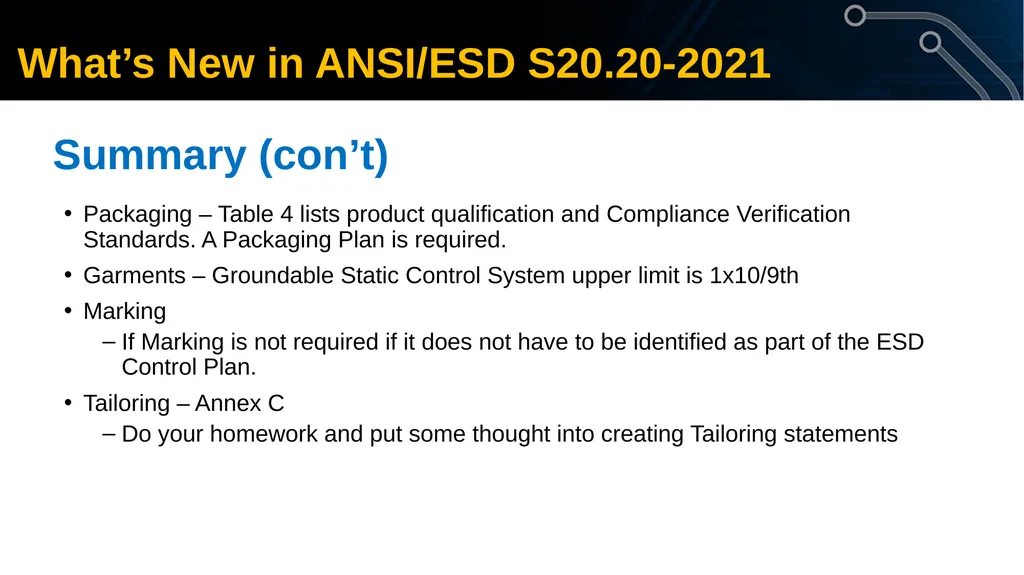
Summary (con’t) Packaging – Table 4 lists product qualification and Compliance Verification Standards. A Packaging Plan is required.
Garments – Groundable Static Control System upper limit is 1x10/9th
Marking
If Marking is not required if it does not have to be identified as part of the ESD Control Plan.
Tailoring – Annex C
Do your homework and put some thought into creating Tailoring statements What’s New in ANSI/ESD S20.20-2021<br>
24
Summary (con’t) Marking
If Marking is not required if it does not have to be identified as part of the ESD Control Plan.
Tailoring – Annex C
Do your homework and put some thought into creating Tailoring statements. What’s New in ANSI/ESD S20.20-2021<br>
If Marking is not required if it does not have to be identified as part of the ESD Control Plan.
Tailoring – Annex C
Do your homework and put some thought into creating Tailoring statements. What’s New in ANSI/ESD S20.20-2021<br>