
WHY HAS SOUTH AFRICA’S INDUSTRIAL POLICY FAILED TO
MJ
Published · 21 slides · 0 views

1 / 1
Description
WHY HAS SOUTH AFRICAS INDUSTRIAL POLICY FAILED TO HALT DEINDUSTRIALISATION AND TRANSFORM THE ECONOMY? ANDREW MURRAY ANNUAL NEIL AGGETT LABOUR STUDIES LECTURE 14 NOVEMBER 2023 INDUSTRIAL POLICY IN CONTEXT Shift from import-substitution
Related Topics
Share
Embed code
Download this presentation From Below
"WHY HAS SOUTH AFRICA’S INDUSTRIAL POLICY FAILED TO" is the property of its rightful owner. Permission is granted to download and print the materials on this website for personal, non-commercial use only, and to display it on your personal computer provided you do not modify the materials and that you retain all copyright notices contained in the materials. By downloading content from our website, you accept the terms of this agreement.
Presentation Transcript
01
WHY HAS SOUTH AFRICA’S INDUSTRIAL POLICY FAILED TO HALT DEINDUSTRIALISATION AND TRANSFORM THE ECONOMY? ANDREW MURRAY
ANNUAL NEIL AGGETT LABOUR STUDIES LECTURE
14 NOVEMBER 2023<br>
ANNUAL NEIL AGGETT LABOUR STUDIES LECTURE
14 NOVEMBER 2023<br>
02
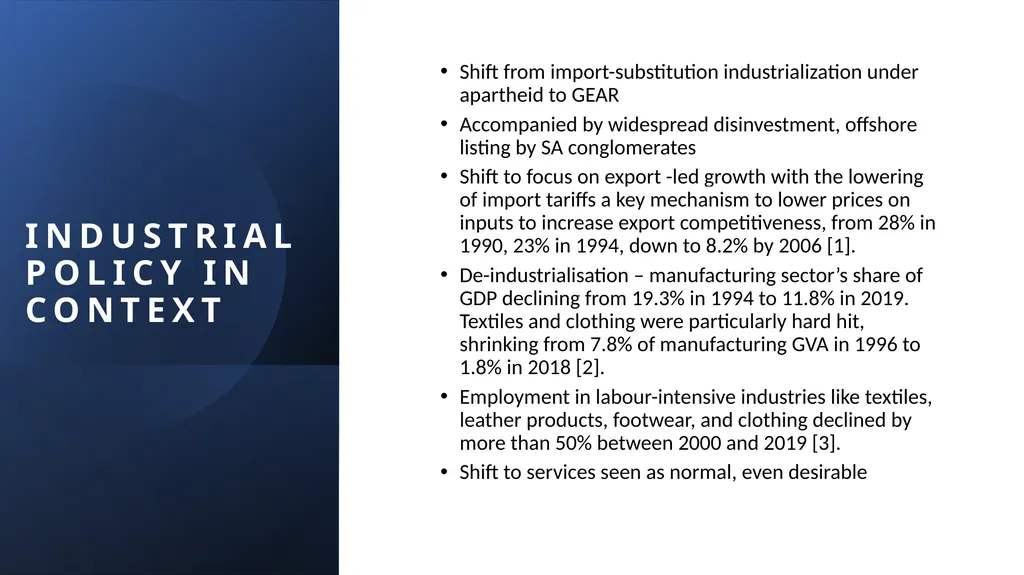
INDUSTRIAL POLICY IN CONTEXT Shift from import-substitution industrialization under apartheid to GEAR
Accompanied by widespread disinvestment, offshore listing by SA conglomerates
Shift to focus on export -led growth with the lowering of import tariffs a key mechanism to lower prices on inputs to increase export competitiveness, from 28% in 1990, 23% in 1994, down to 8.2% by 2006 [1].
De-industrialisation – manufacturing sector’s share of GDP declining from 19.3% in 1994 to 11.8% in 2019. Textiles and clothing were particularly hard hit, shrinking from 7.8% of manufacturing GVA in 1996 to 1.8% in 2018 [2].
Employment in labour-intensive industries like textiles, leather products, footwear, and clothing declined by more than 50% between 2000 and 2019 [3].
Shift to services seen as normal, even desirable<br>
03
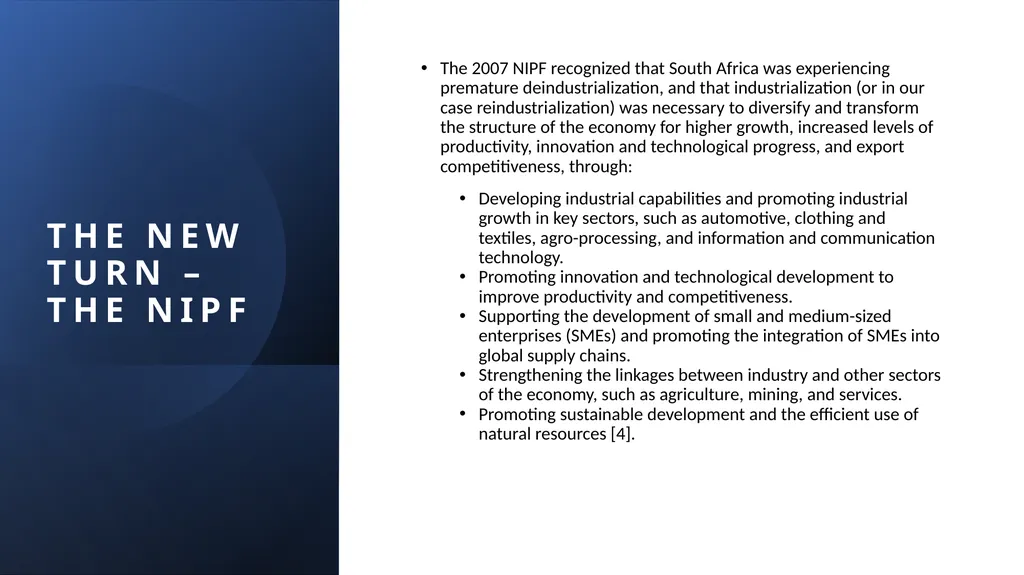
THE NEW TURN – THE NIPF The 2007 NIPF recognized that South Africa was experiencing premature deindustrialization, and that industrialization (or in our case reindustrialization) was necessary to diversify and transform the structure of the economy for higher growth, increased levels of productivity, innovation and technological progress, and export competitiveness, through:
Developing industrial capabilities and promoting industrial growth in key sectors, such as automotive, clothing and textiles, agro-processing, and information and communication technology.
Promoting innovation and technological development to improve productivity and competitiveness.
Supporting the development of small and medium-sized enterprises (SMEs) and promoting the integration of SMEs into global supply chains.
Strengthening the linkages between industry and other sectors of the economy, such as agriculture, mining, and services.
Promoting sustainable development and the efficient use of natural resources [4].<br>
04
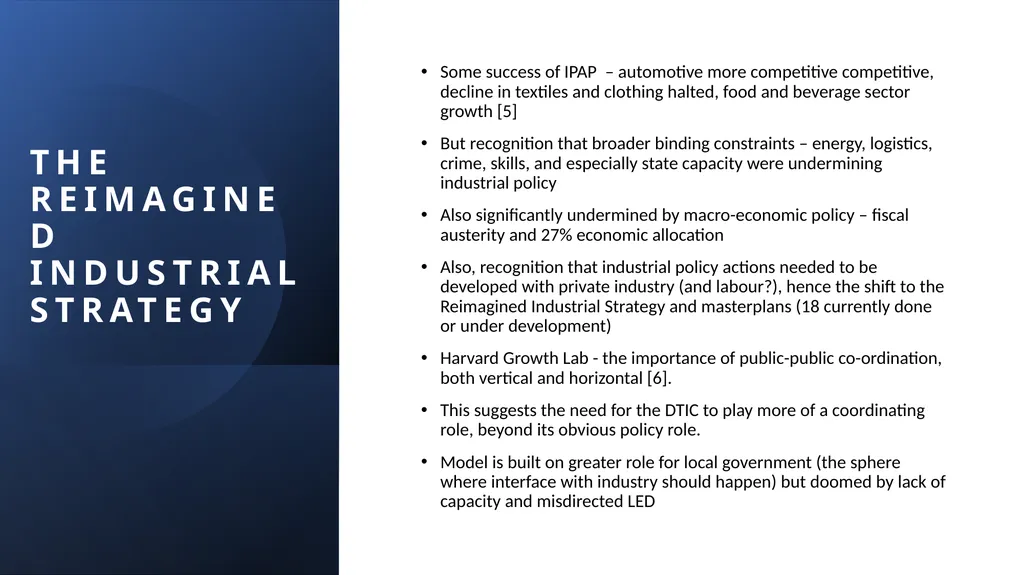
THE REIMAGINED INDUSTRIAL STRATEGY Some success of IPAP – automotive more competitive competitive, decline in textiles and clothing halted, food and beverage sector growth [5]
But recognition that broader binding constraints – energy, logistics, crime, skills, and especially state capacity were undermining industrial policy
Also significantly undermined by macro-economic policy – fiscal austerity and 27% economic allocation
Also, recognition that industrial policy actions needed to be developed with private industry (and labour?), hence the shift to the Reimagined Industrial Strategy and masterplans (18 currently done or under development)
Harvard Growth Lab - the importance of public-public co-ordination, both vertical and horizontal [6].
This suggests the need for the DTIC to play more of a coordinating role, beyond its obvious policy role.
Model is built on greater role for local government (the sphere where interface with industry should happen) but doomed by lack of capacity and misdirected LED<br>
05
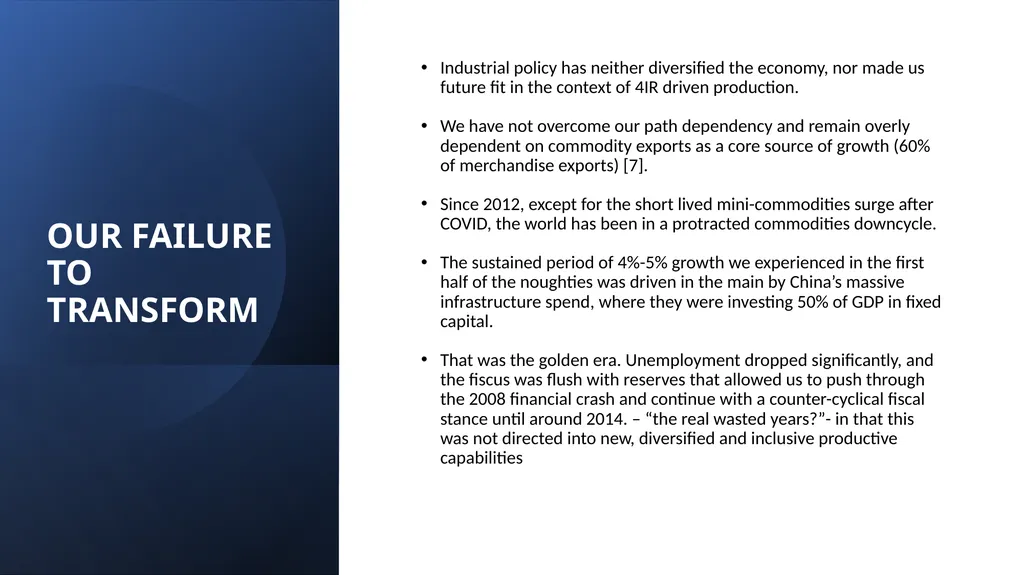
OUR FAILURE TO TRANSFORM Industrial policy has neither diversified the economy, nor made us future fit in the context of 4IR driven production.
We have not overcome our path dependency and remain overly dependent on commodity exports as a core source of growth (60% of merchandise exports) [7].
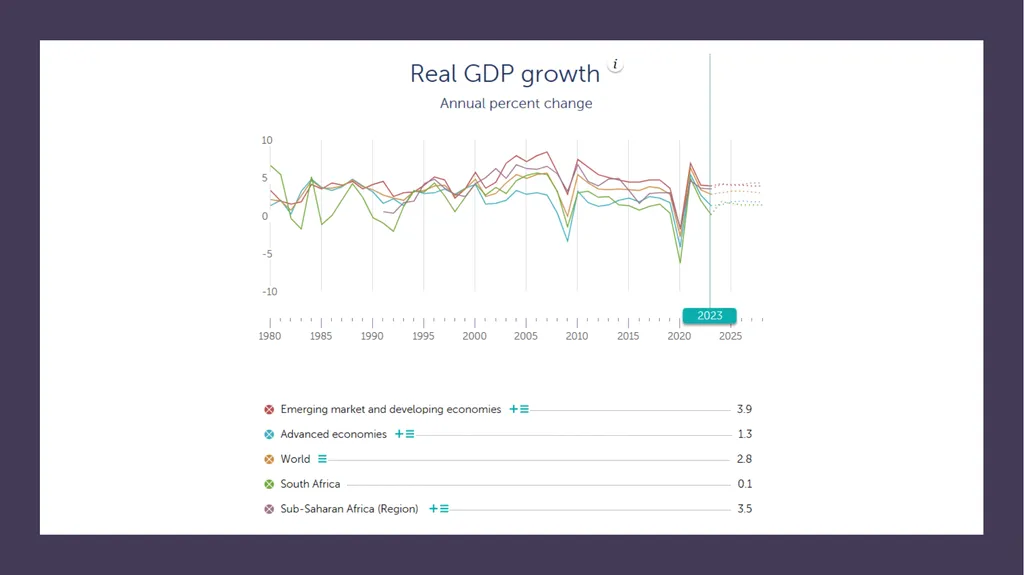
Since 2012, except for the short lived mini-commodities surge after COVID, the world has been in a protracted commodities downcycle.
The sustained period of 4%-5% growth we experienced in the first half of the noughties was driven in the main by China’s massive infrastructure spend, where they were investing 50% of GDP in fixed capital.
That was the golden era. Unemployment dropped significantly, and the fiscus was flush with reserves that allowed us to push through the 2008 financial crash and continue with a counter-cyclical fiscal stance until around 2014. – “the real wasted years?”- in that this was not directed into new, diversified and inclusive productive capabilities<br>
06
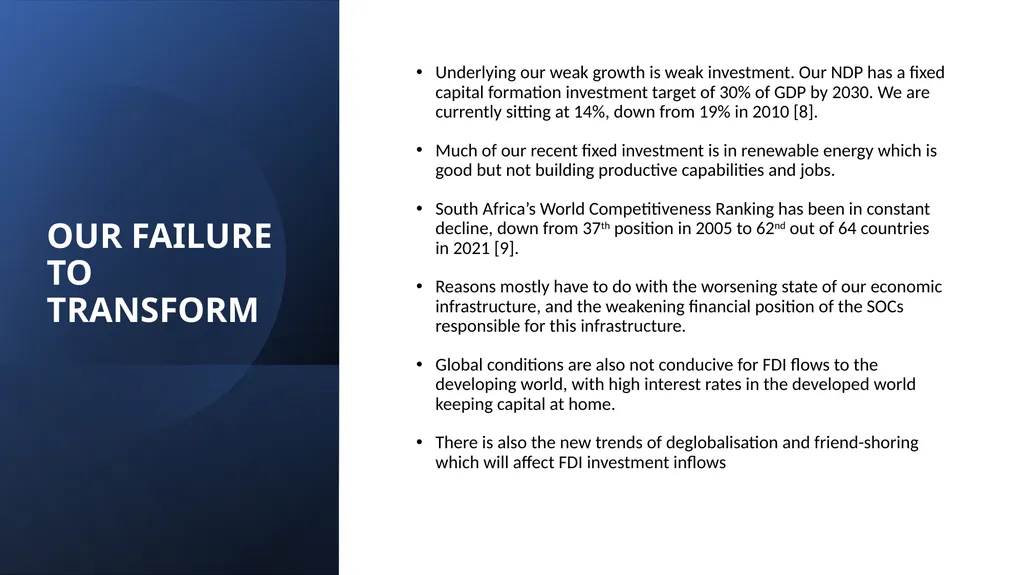
OUR FAILURE TO TRANSFORM Underlying our weak growth is weak investment. Our NDP has a fixed capital formation investment target of 30% of GDP by 2030. We are currently sitting at 14%, down from 19% in 2010 [8].
Much of our recent fixed investment is in renewable energy which is good but not building productive capabilities and jobs.
South Africa’s World Competitiveness Ranking has been in constant decline, down from 37th position in 2005 to 62nd out of 64 countries in 2021 [9].
Reasons mostly have to do with the worsening state of our economic infrastructure, and the weakening financial position of the SOCs responsible for this infrastructure.
Global conditions are also not conducive for FDI flows to the developing world, with high interest rates in the developed world keeping capital at home.
There is also the new trends of deglobalisation and friend-shoring which will affect FDI investment inflows<br>
07
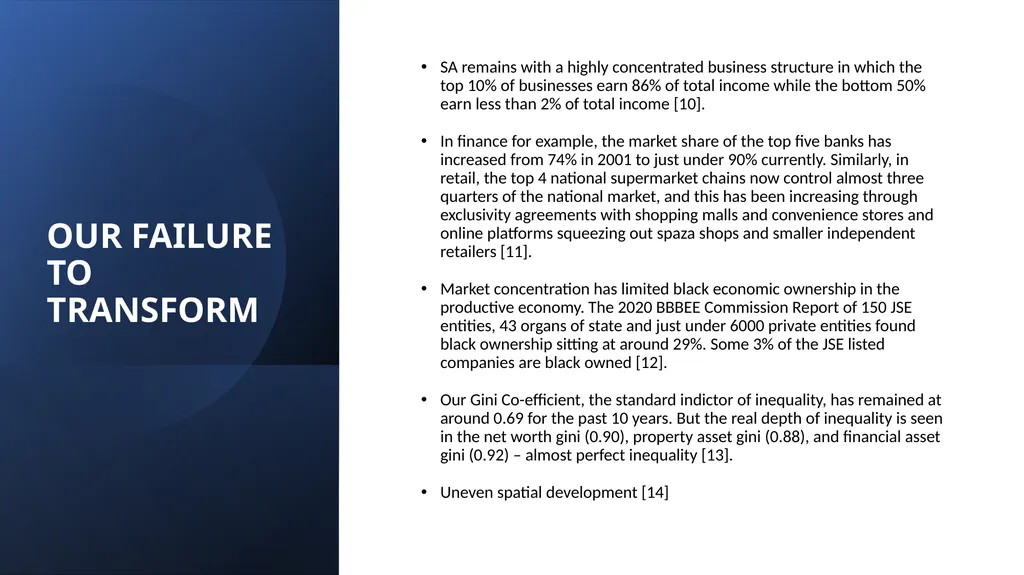
OUR FAILURE TO TRANSFORM SA remains with a highly concentrated business structure in which the top 10% of businesses earn 86% of total income while the bottom 50% earn less than 2% of total income [10].
In finance for example, the market share of the top five banks has increased from 74% in 2001 to just under 90% currently. Similarly, in retail, the top 4 national supermarket chains now control almost three quarters of the national market, and this has been increasing through exclusivity agreements with shopping malls and convenience stores and online platforms squeezing out spaza shops and smaller independent retailers [11].
Market concentration has limited black economic ownership in the productive economy. The 2020 BBBEE Commission Report of 150 JSE entities, 43 organs of state and just under 6000 private entities found black ownership sitting at around 29%. Some 3% of the JSE listed companies are black owned [12].
Our Gini Co-efficient, the standard indictor of inequality, has remained at around 0.69 for the past 10 years. But the real depth of inequality is seen in the net worth gini (0.90), property asset gini (0.88), and financial asset gini (0.92) – almost perfect inequality [13].
Uneven spatial development [14]<br>
08
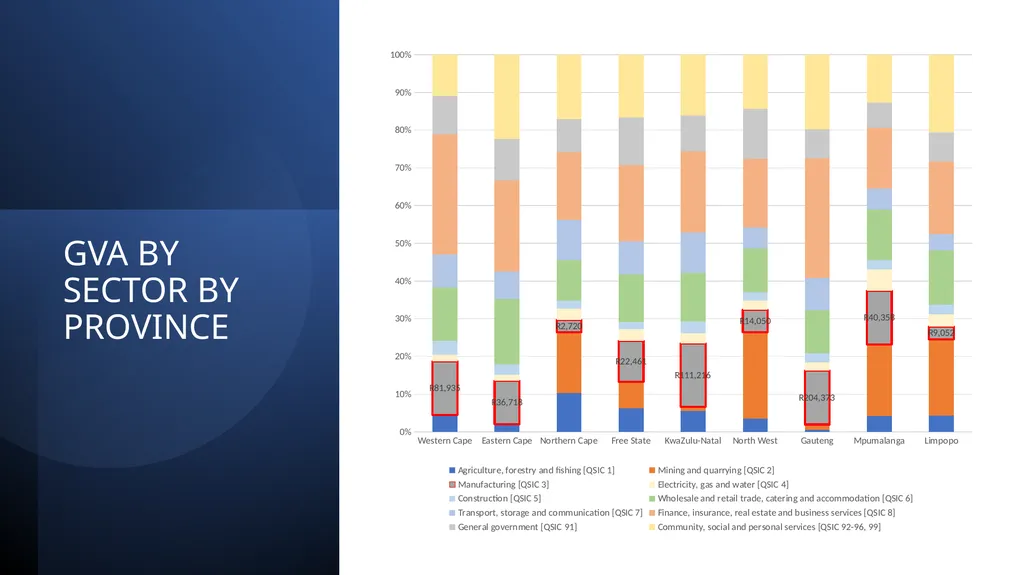
GVA BY SECTOR BY PROVINCE<br>
09
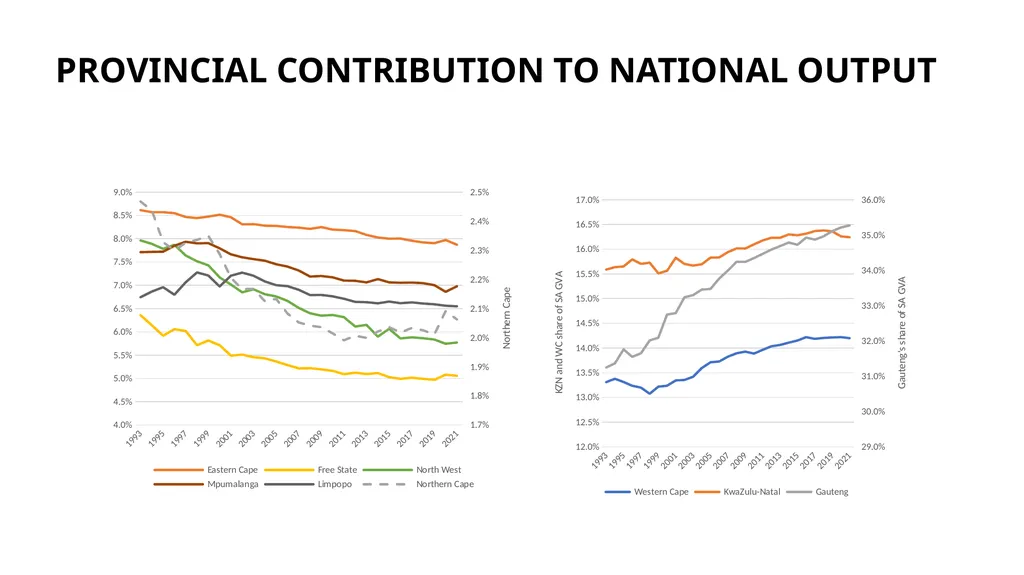
PROVINCIAL CONTRIBUTION TO NATIONAL OUTPUT<br>
10
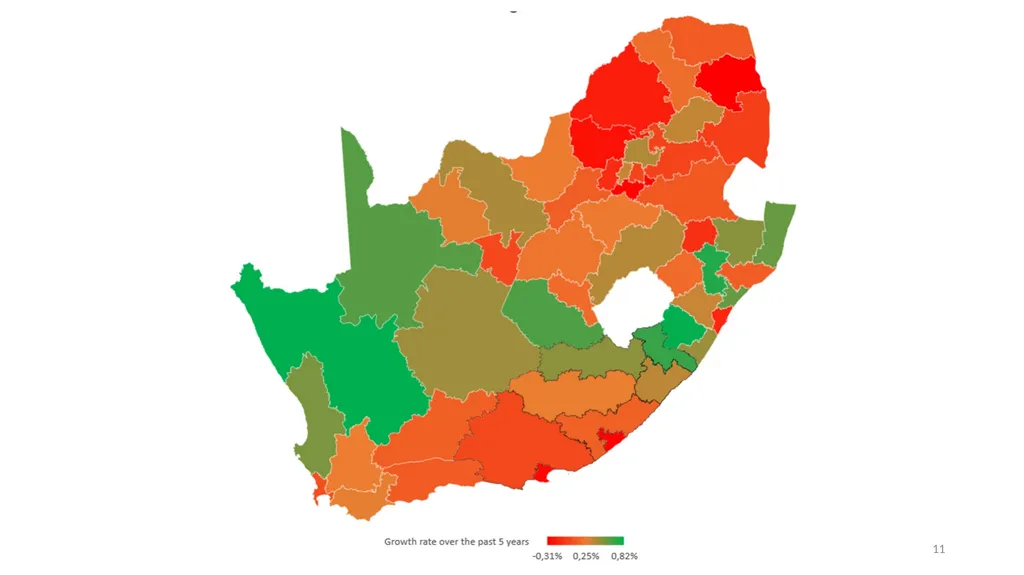
11<br>
11
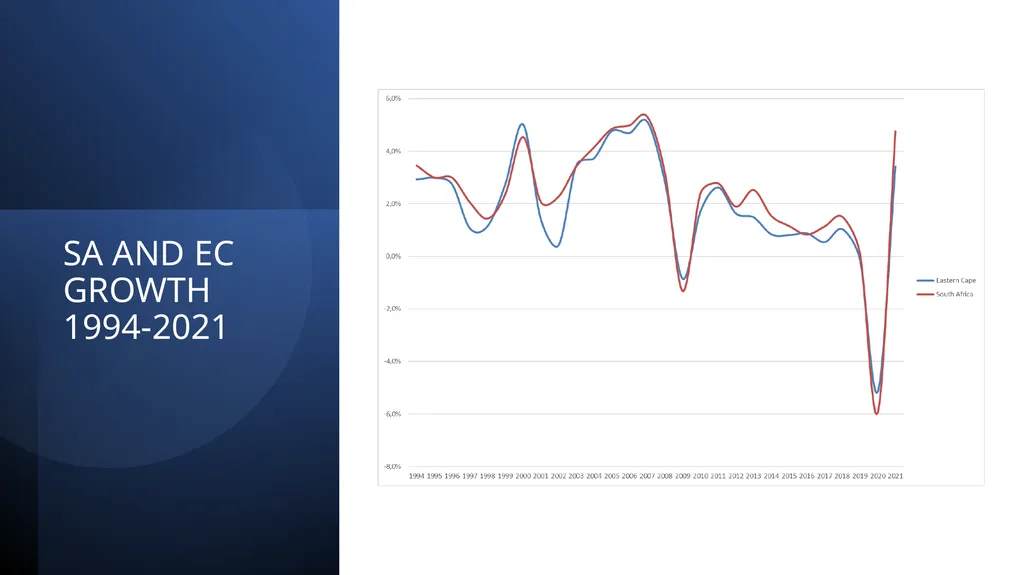
SA AND EC GROWTH 1994-2021<br>
12
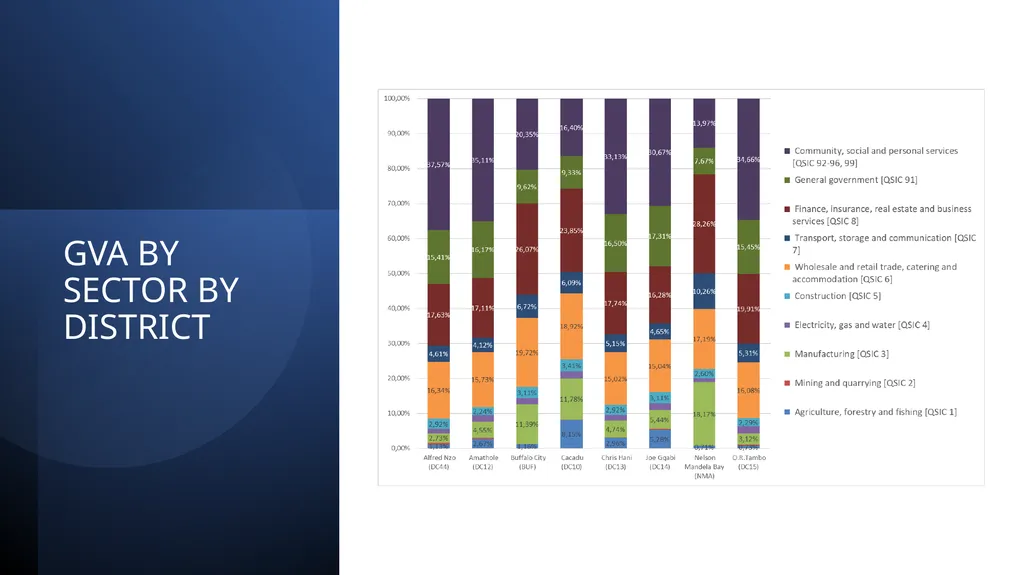
GVA BY SECTOR BY DISTRICT<br>
13
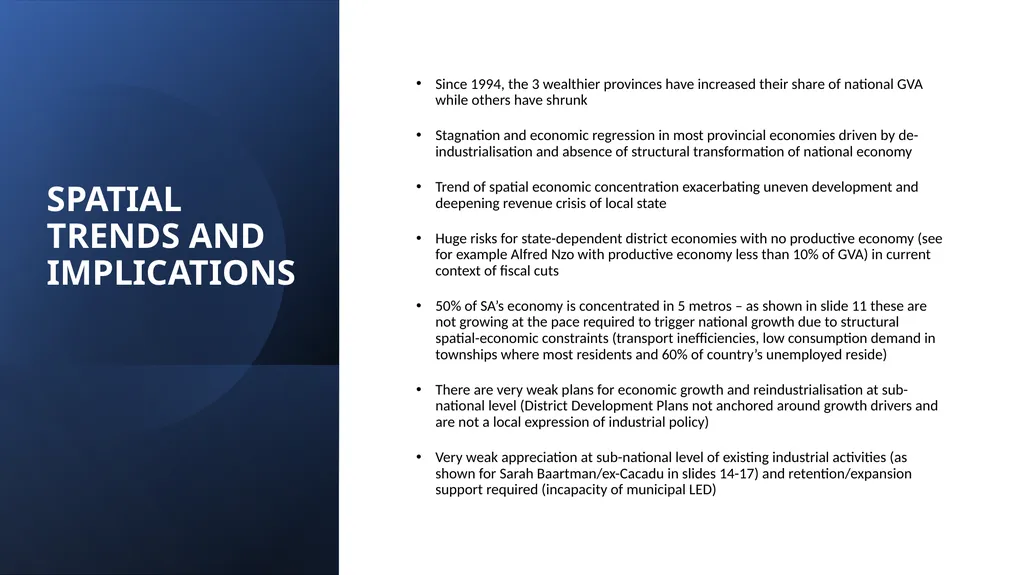
SPATIAL TRENDS AND IMPLICATIONS Since 1994, the 3 wealthier provinces have increased their share of national GVA while others have shrunk
Stagnation and economic regression in most provincial economies driven by de-industrialisation and absence of structural transformation of national economy
Trend of spatial economic concentration exacerbating uneven development and deepening revenue crisis of local state
Huge risks for state-dependent district economies with no productive economy (see for example Alfred Nzo with productive economy less than 10% of GVA) in current context of fiscal cuts
50% of SA’s economy is concentrated in 5 metros – as shown in slide 11 these are not growing at the pace required to trigger national growth due to structural spatial-economic constraints (transport inefficiencies, low consumption demand in townships where most residents and 60% of country’s unemployed reside)
There are very weak plans for economic growth and reindustrialisation at sub-national level (District Development Plans not anchored around growth drivers and are not a local expression of industrial policy)
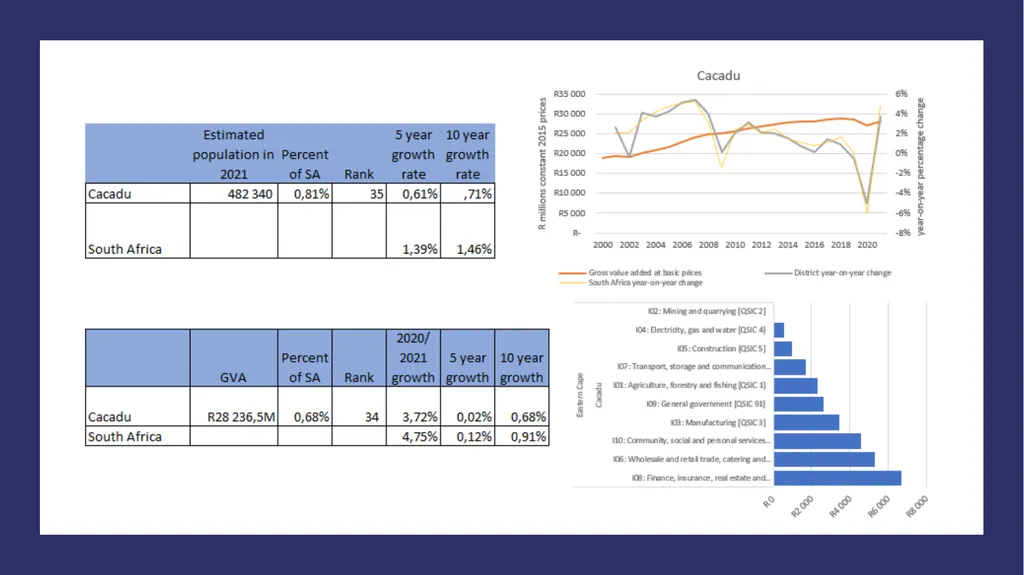
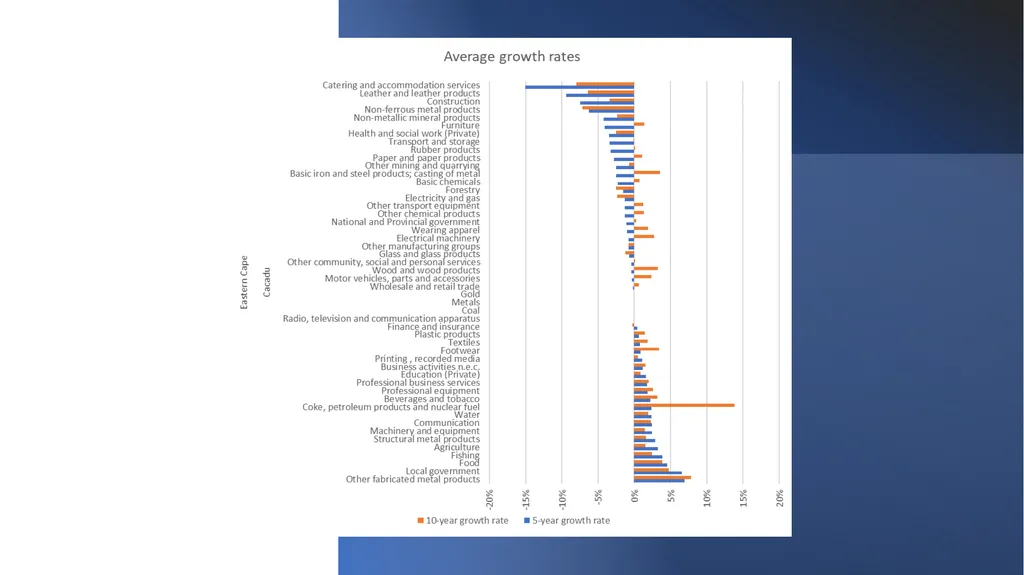
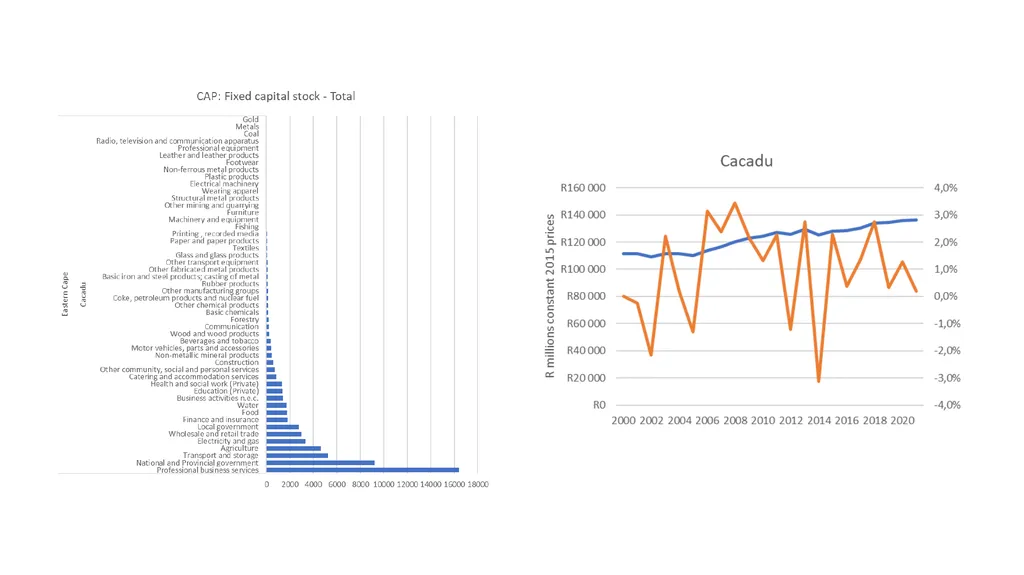
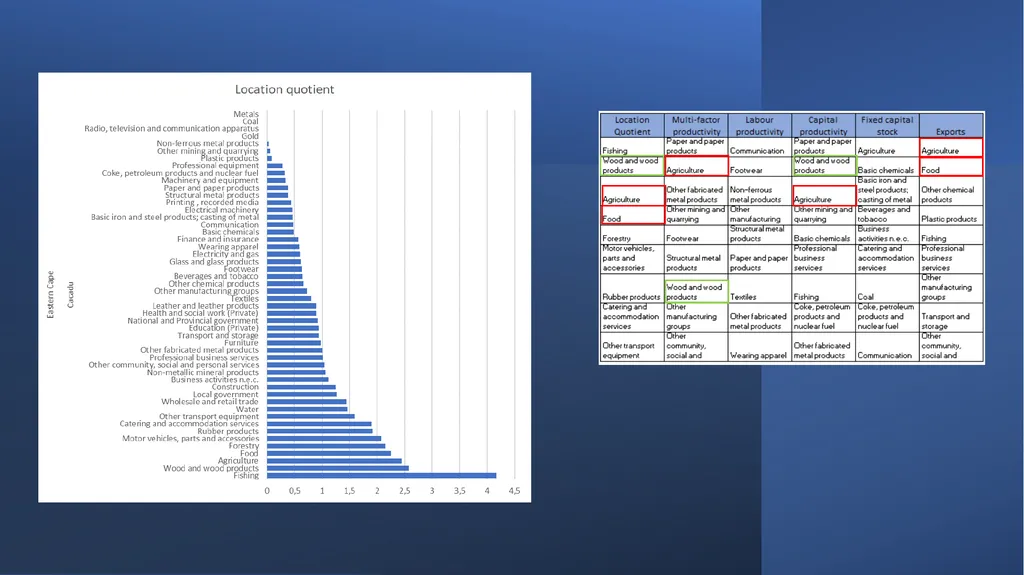
Very weak appreciation at sub-national level of existing industrial activities (as shown for Sarah Baartman/ex-Cacadu in slides 14-17) and retention/expansion support required (incapacity of municipal LED)<br>
14
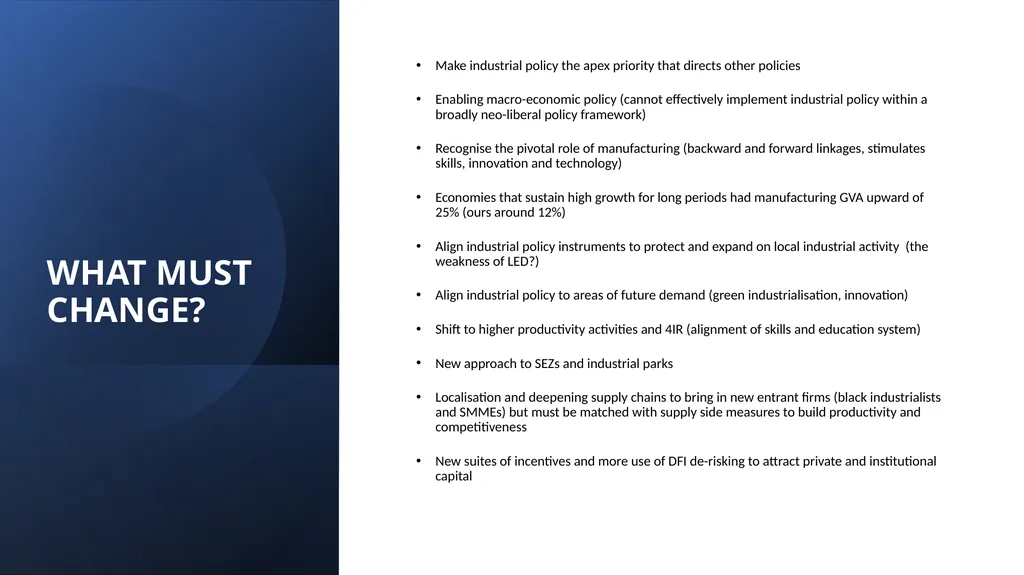
WHAT MUST CHANGE? Make industrial policy the apex priority that directs other policies
Enabling macro-economic policy (cannot effectively implement industrial policy within a broadly neo-liberal policy framework)
Recognise the pivotal role of manufacturing (backward and forward linkages, stimulates skills, innovation and technology)
Economies that sustain high growth for long periods had manufacturing GVA upward of 25% (ours around 12%)
Align industrial policy instruments to protect and expand on local industrial activity (the weakness of LED?)
Align industrial policy to areas of future demand (green industrialisation, innovation)
Shift to higher productivity activities and 4IR (alignment of skills and education system)
New approach to SEZs and industrial parks
Localisation and deepening supply chains to bring in new entrant firms (black industrialists and SMMEs) but must be matched with supply side measures to build productivity and competitiveness
New suites of incentives and more use of DFI de-risking to attract private and institutional capital<br>
15
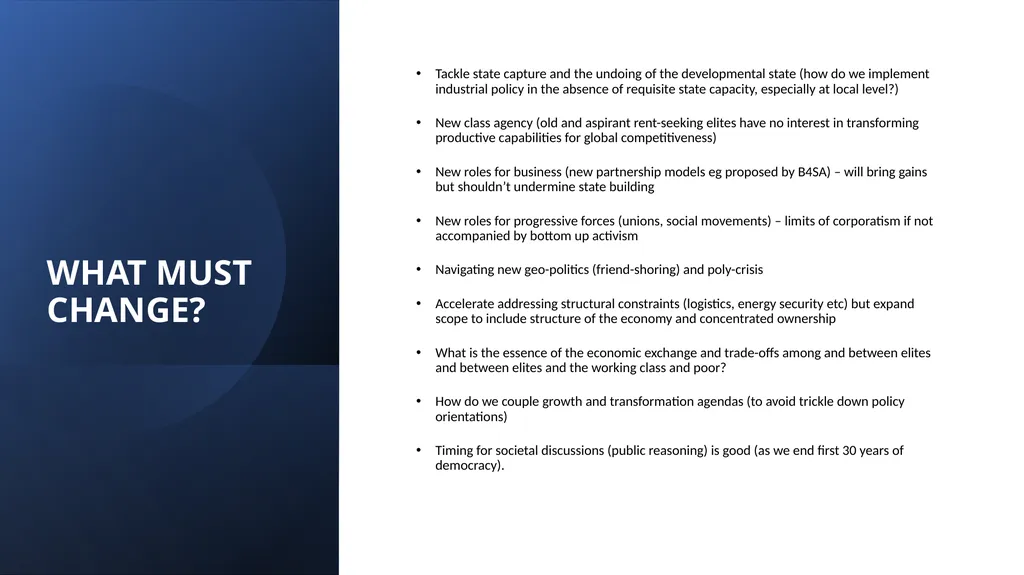
WHAT MUST CHANGE? Tackle state capture and the undoing of the developmental state (how do we implement industrial policy in the absence of requisite state capacity, especially at local level?)
New class agency (old and aspirant rent-seeking elites have no interest in transforming productive capabilities for global competitiveness)
New roles for business (new partnership models eg proposed by B4SA) – will bring gains but shouldn’t undermine state building
New roles for progressive forces (unions, social movements) – limits of corporatism if not accompanied by bottom up activism
Navigating new geo-politics (friend-shoring) and poly-crisis
Accelerate addressing structural constraints (logistics, energy security etc) but expand scope to include structure of the economy and concentrated ownership
What is the essence of the economic exchange and trade-offs among and between elites and between elites and the working class and poor?
How do we couple growth and transformation agendas (to avoid trickle down policy orientations)
Timing for societal discussions (public reasoning) is good (as we end first 30 years of democracy).<br>
16
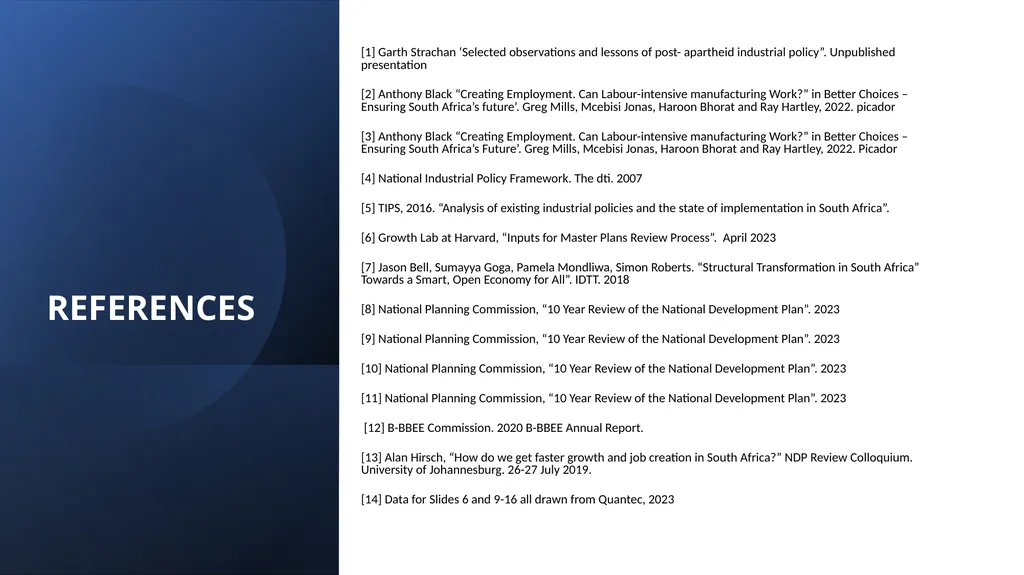
REFERENCES [1] Garth Strachan ‘Selected observations and lessons of post- apartheid industrial policy”. Unpublished presentation
[2] Anthony Black “Creating Employment. Can Labour-intensive manufacturing Work?” in Better Choices – Ensuring South Africa’s future’. Greg Mills, Mcebisi Jonas, Haroon Bhorat and Ray Hartley, 2022. picador
[3] Anthony Black “Creating Employment. Can Labour-intensive manufacturing Work?” in Better Choices – Ensuring South Africa’s Future’. Greg Mills, Mcebisi Jonas, Haroon Bhorat and Ray Hartley, 2022. Picador
[4] National Industrial Policy Framework. The dti. 2007
[5] TIPS, 2016. “Analysis of existing industrial policies and the state of implementation in South Africa”.
[6] Growth Lab at Harvard, “Inputs for Master Plans Review Process”. April 2023
[7] Jason Bell, Sumayya Goga, Pamela Mondliwa, Simon Roberts. “Structural Transformation in South Africa” Towards a Smart, Open Economy for All”. IDTT. 2018
[8] National Planning Commission, “10 Year Review of the National Development Plan”. 2023
[9] National Planning Commission, “10 Year Review of the National Development Plan”. 2023
[10] National Planning Commission, “10 Year Review of the National Development Plan”. 2023
[11] National Planning Commission, “10 Year Review of the National Development Plan”. 2023
[12] B-BBEE Commission. 2020 B-BBEE Annual Report.
[13] Alan Hirsch, “How do we get faster growth and job creation in South Africa?” NDP Review Colloquium. University of Johannesburg. 26-27 July 2019.
[14] Data for Slides 6 and 9-16 all drawn from Quantec, 2023<br>