
WORKSHOPS PUBLIC HEALTH PROMOTION AND
OM
Published · 71 slides · 0 views

1 / 1



Description
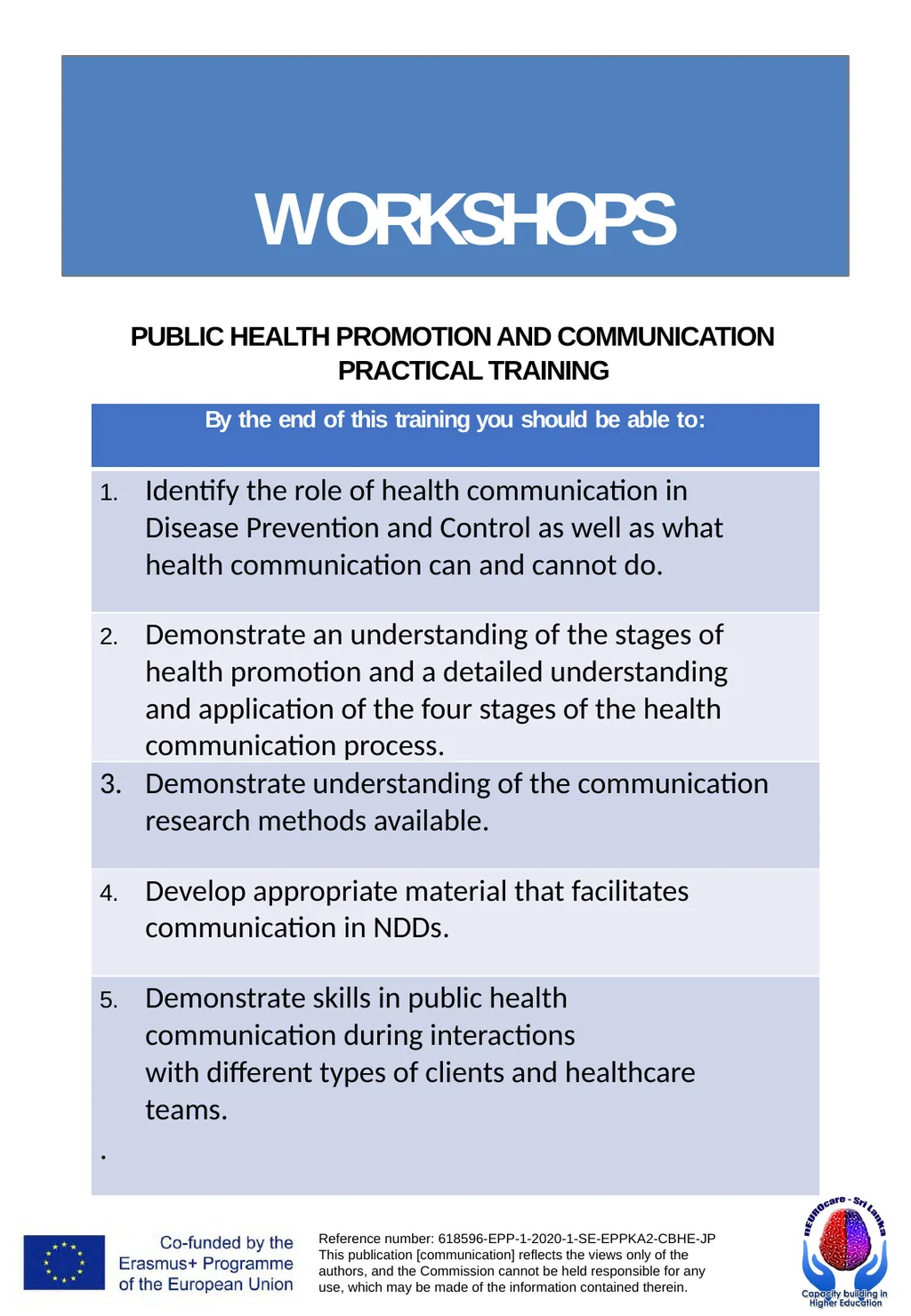
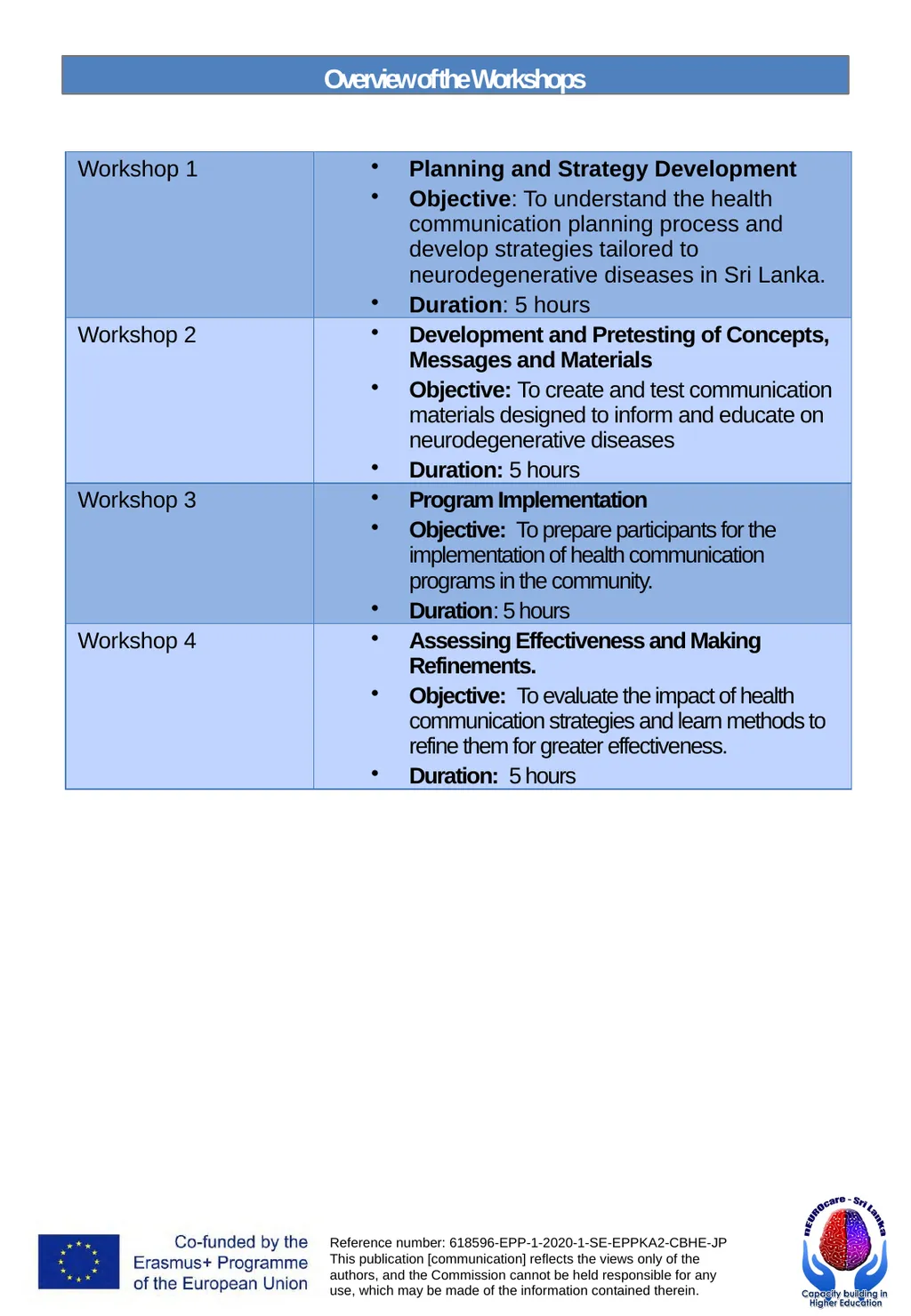
WORKSHOPS PUBLIC HEALTH PROMOTION AND COMMUNICATION PRACTICAL TRAINING Overview of the Workshops General Instructions Prior to commencing each exercise, it is imperative that all students thoroughly review the assigned reading materials.
Related Topics
Share
Embed code
Download this presentation From Below
"WORKSHOPS PUBLIC HEALTH PROMOTION AND" is the property of its rightful owner. Permission is granted to download and print the materials on this website for personal, non-commercial use only, and to display it on your personal computer provided you do not modify the materials and that you retain all copyright notices contained in the materials. By downloading content from our website, you accept the terms of this agreement.
Presentation Transcript
01
WORKSHOPS PUBLIC HEALTH PROMOTION AND COMMUNICATION
PRACTICAL TRAINING<br>
PRACTICAL TRAINING<br>
02
Overview of the Workshops<br>
03
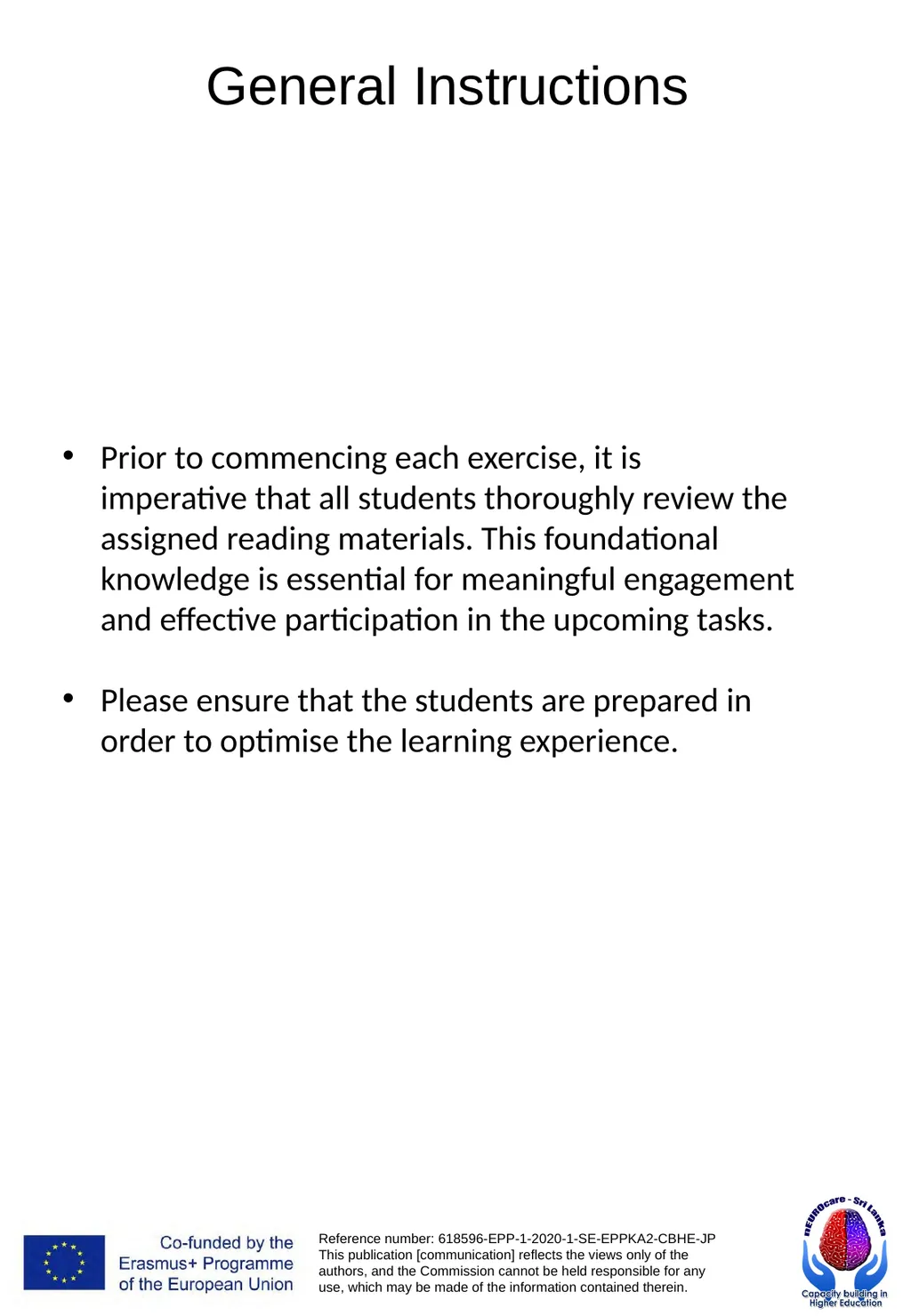
General Instructions Prior to commencing each exercise, it is imperative that all students thoroughly review the assigned reading materials. This foundational knowledge is essential for meaningful engagement and effective participation in the upcoming tasks.
Please ensure that the students are prepared in order to optimise the learning experience.<br>
Please ensure that the students are prepared in order to optimise the learning experience.<br>
04
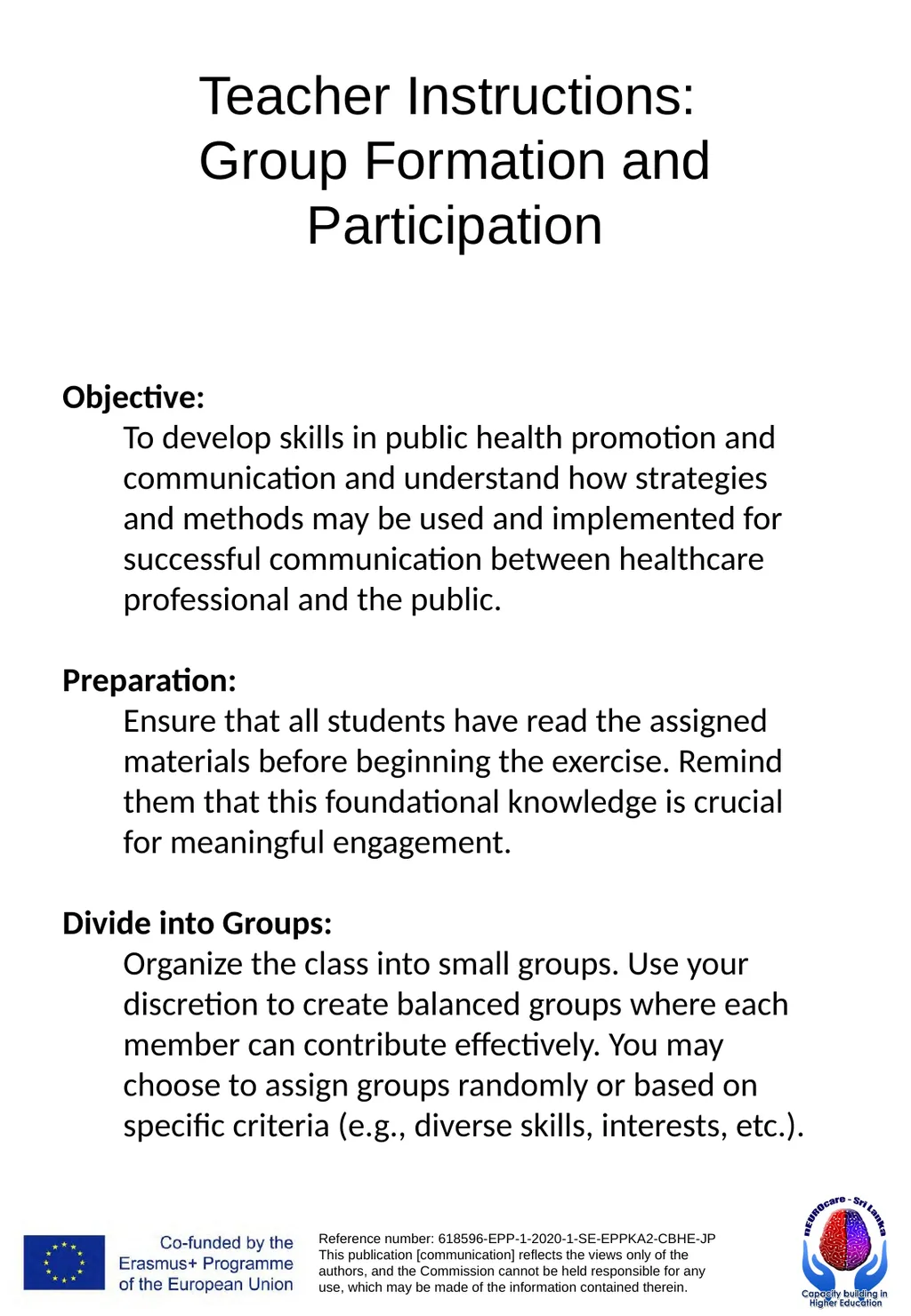
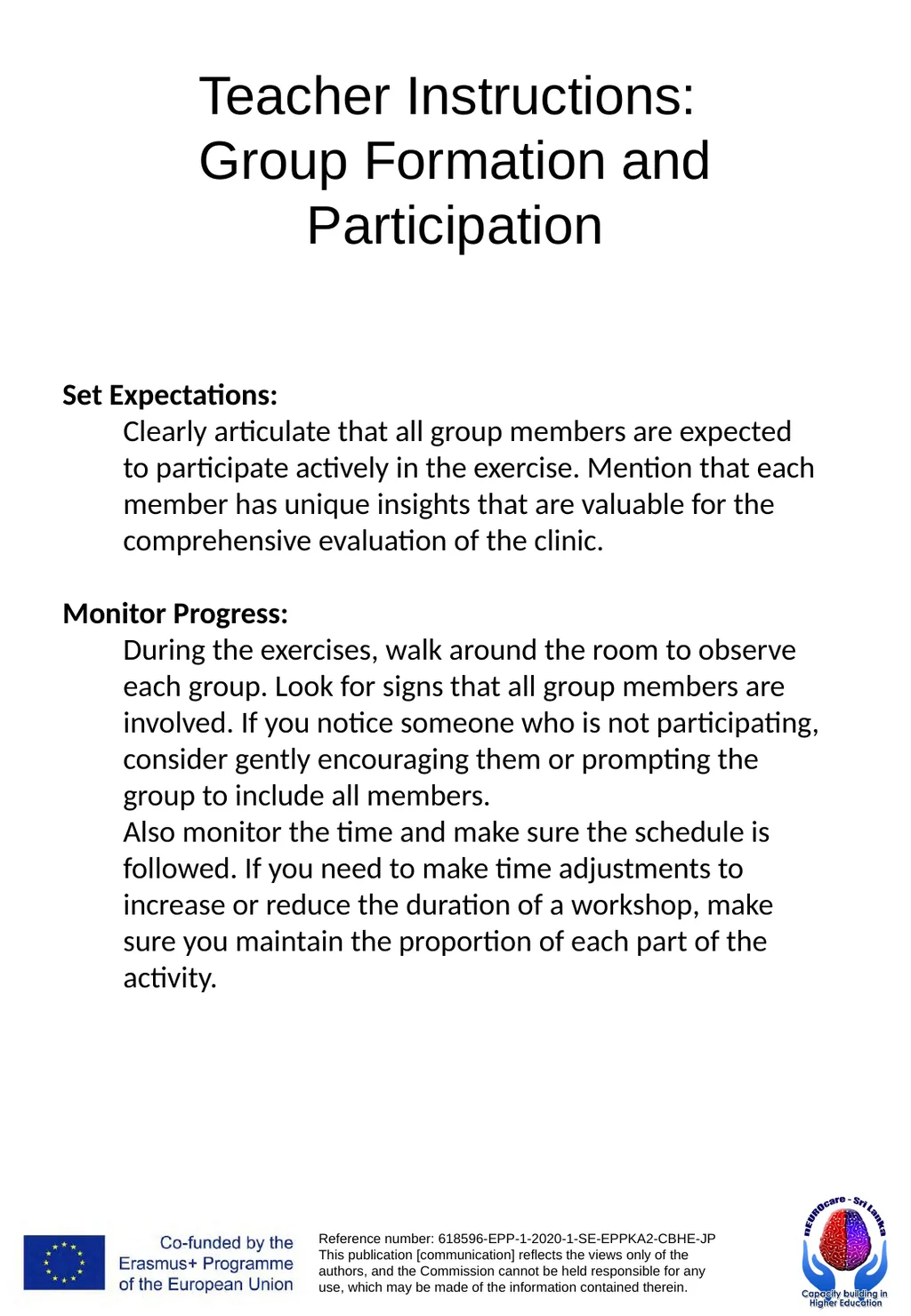
Teacher Instructions:
Group Formation and Participation Objective:
To develop skills in public health promotion and communication and understand how strategies and methods may be used and implemented for successful communication between healthcare professional and the public.
Preparation:
Ensure that all students have read the assigned materials before beginning the exercise. Remind them that this foundational knowledge is crucial for meaningful engagement.
Divide into Groups:
Organize the class into small groups. Use your discretion to create balanced groups where each member can contribute effectively. You may choose to assign groups randomly or based on specific criteria (e.g., diverse skills, interests, etc.).<br>
05
Teacher Instructions:
Group Formation and Participation Set Expectations:
Clearly articulate that all group members are expected to participate actively in the exercise. Mention that each member has unique insights that are valuable for the comprehensive evaluation of the clinic.
Monitor Progress:
During the exercises, walk around the room to observe each group. Look for signs that all group members are involved. If you notice someone who is not participating, consider gently encouraging them or prompting the group to include all members.
Also monitor the time and make sure the schedule is followed. If you need to make time adjustments to increase or reduce the duration of a workshop, make sure you maintain the proportion of each part of the activity.<br>
06
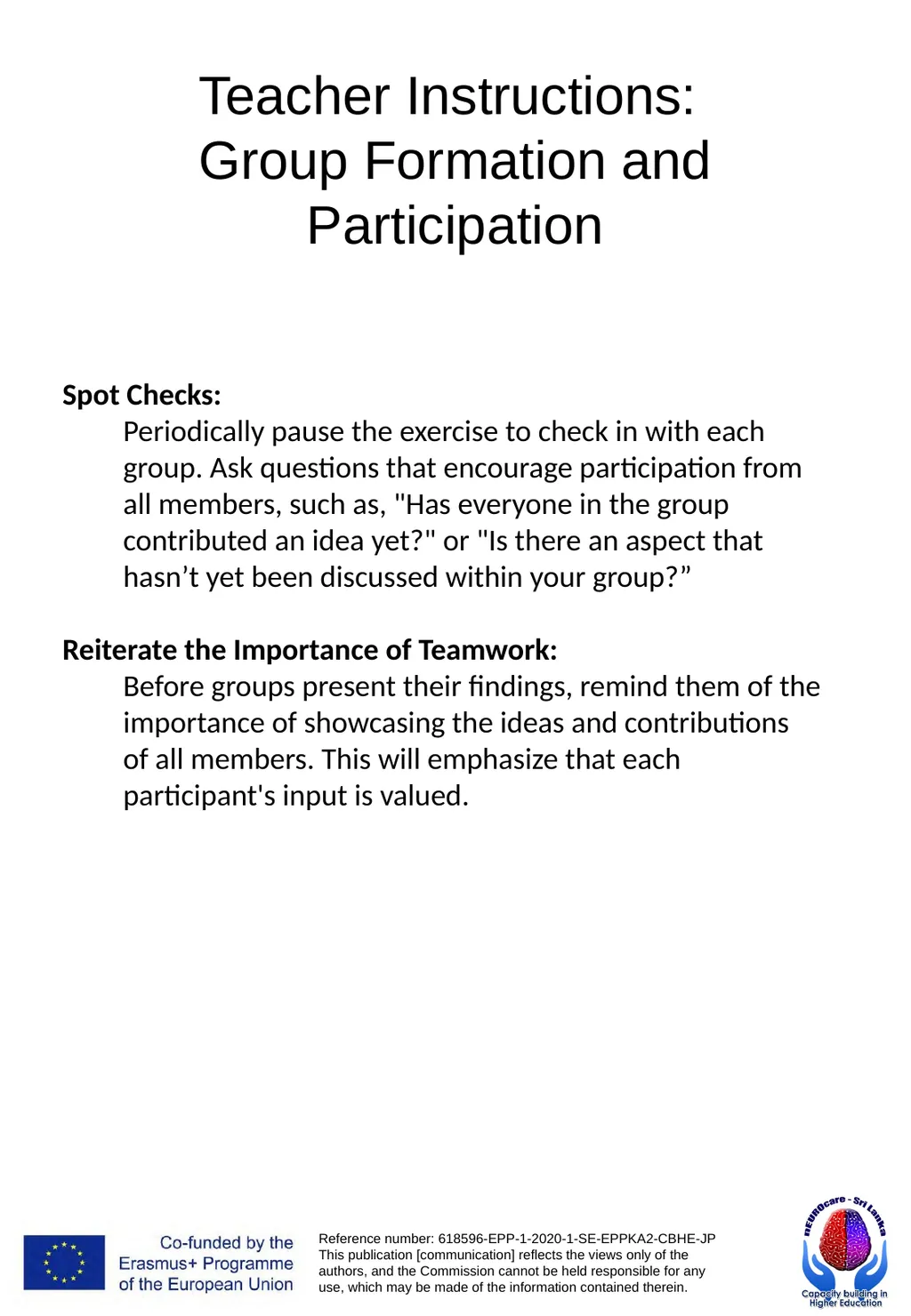
Teacher Instructions:
Group Formation and Participation Spot Checks:
Periodically pause the exercise to check in with each group. Ask questions that encourage participation from all members, such as, "Has everyone in the group contributed an idea yet?" or "Is there an aspect that hasn’t yet been discussed within your group?”
Reiterate the Importance of Teamwork:
Before groups present their findings, remind them of the importance of showcasing the ideas and contributions of all members. This will emphasize that each participant's input is valued.<br>
07
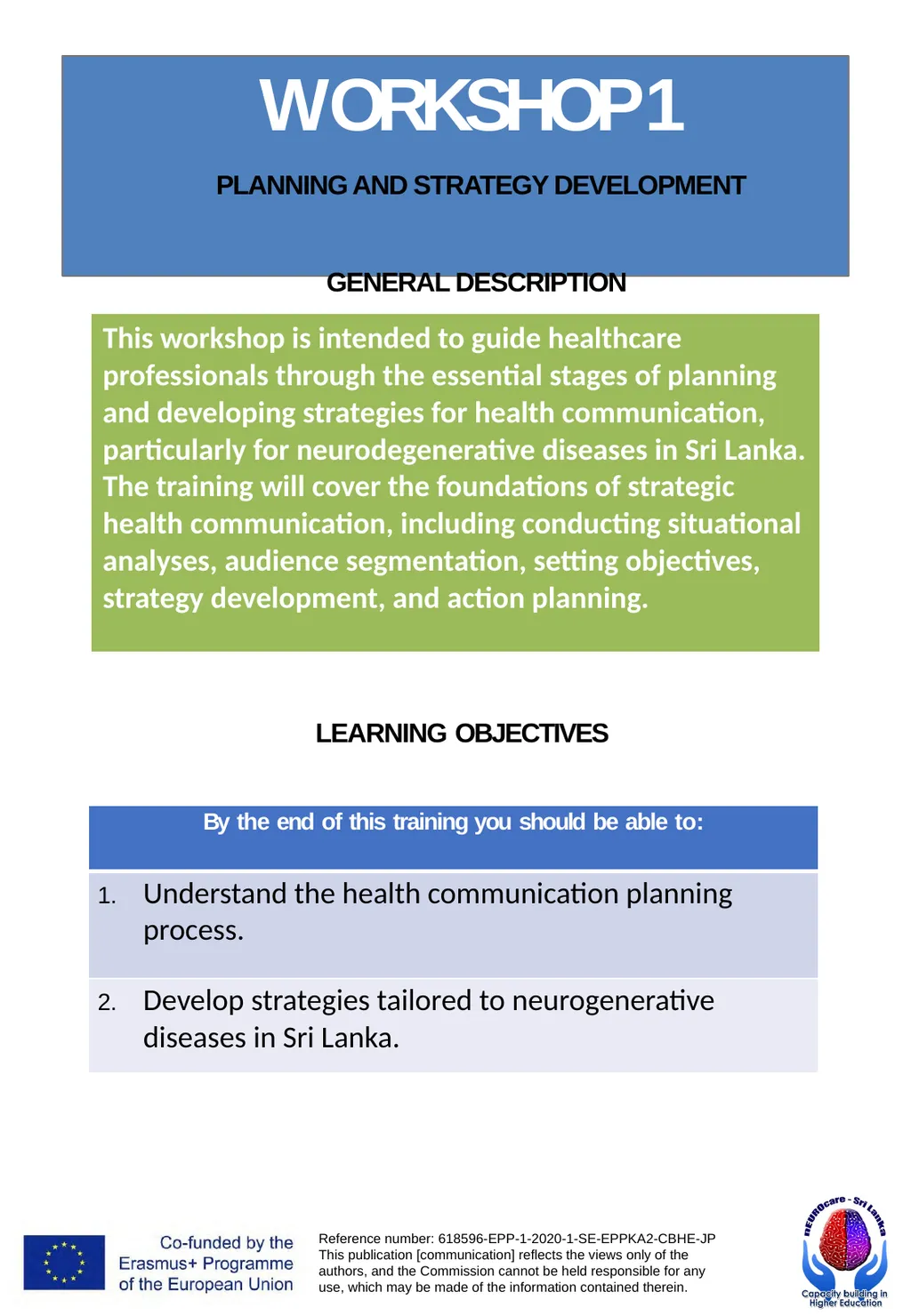
WORKSHOP 1 LEARNING OBJECTIVES PLANNING AND STRATEGY DEVELOPMENT GENERAL DESCRIPTION<br>
08
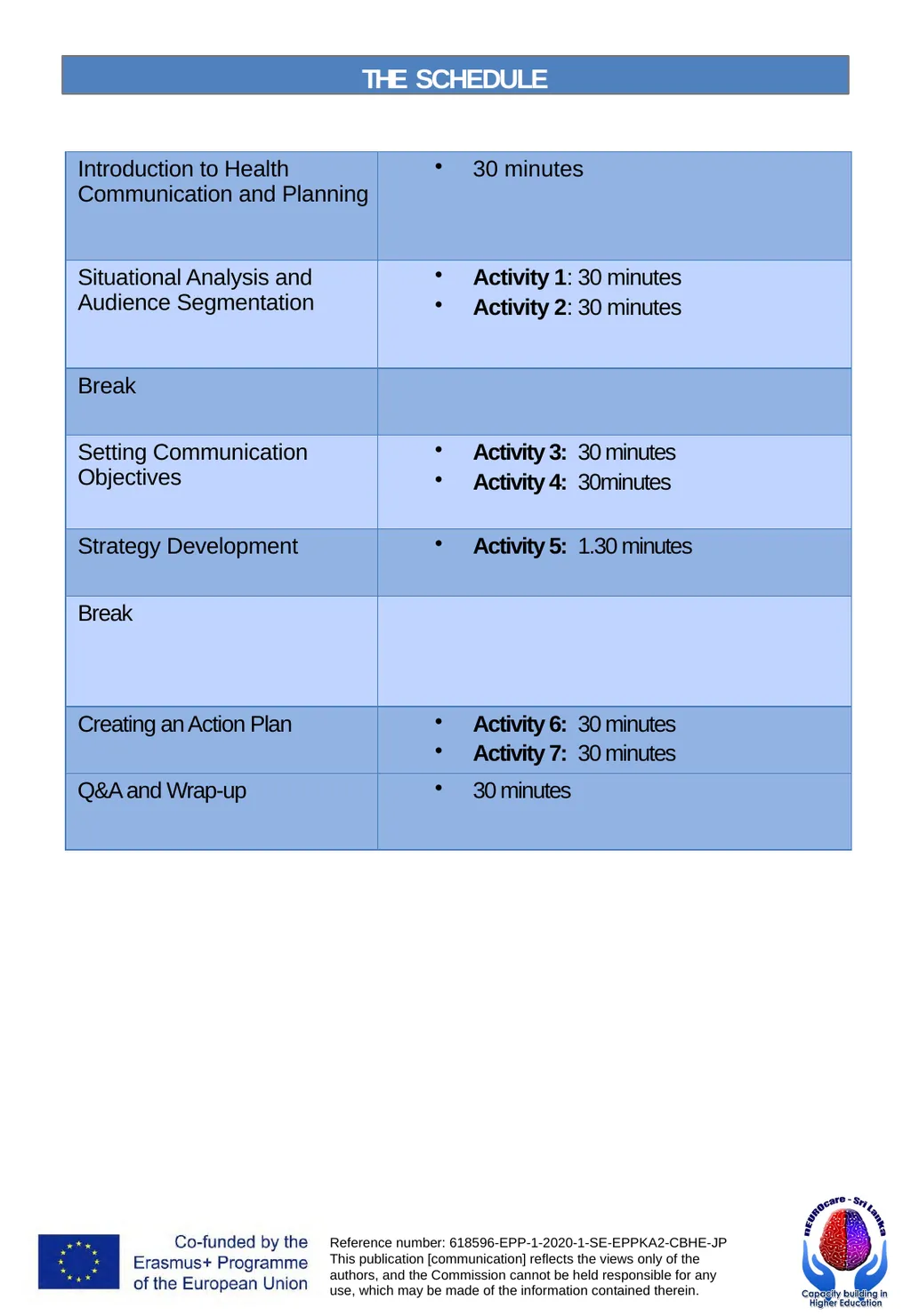
THE SCHEDULE<br>
09
Introduction to Health Communication and Planning
30 minutes<br>
30 minutes<br>
10
Activity The initial activity involves an introduction to health communication and planning using an overview of strategic health communication. Students are asked to form small groups to discuss the importance of planning in health promotion for neurodegenerative diseases.
They then share their ideas with the whole group in order to emphasize the role of planning in the whole process. Instructions<br>
They then share their ideas with the whole group in order to emphasize the role of planning in the whole process. Instructions<br>
11
Situational Analysis and Audience Segmentation
Activity 1
30 minutes<br>
Activity 1
30 minutes<br>
12
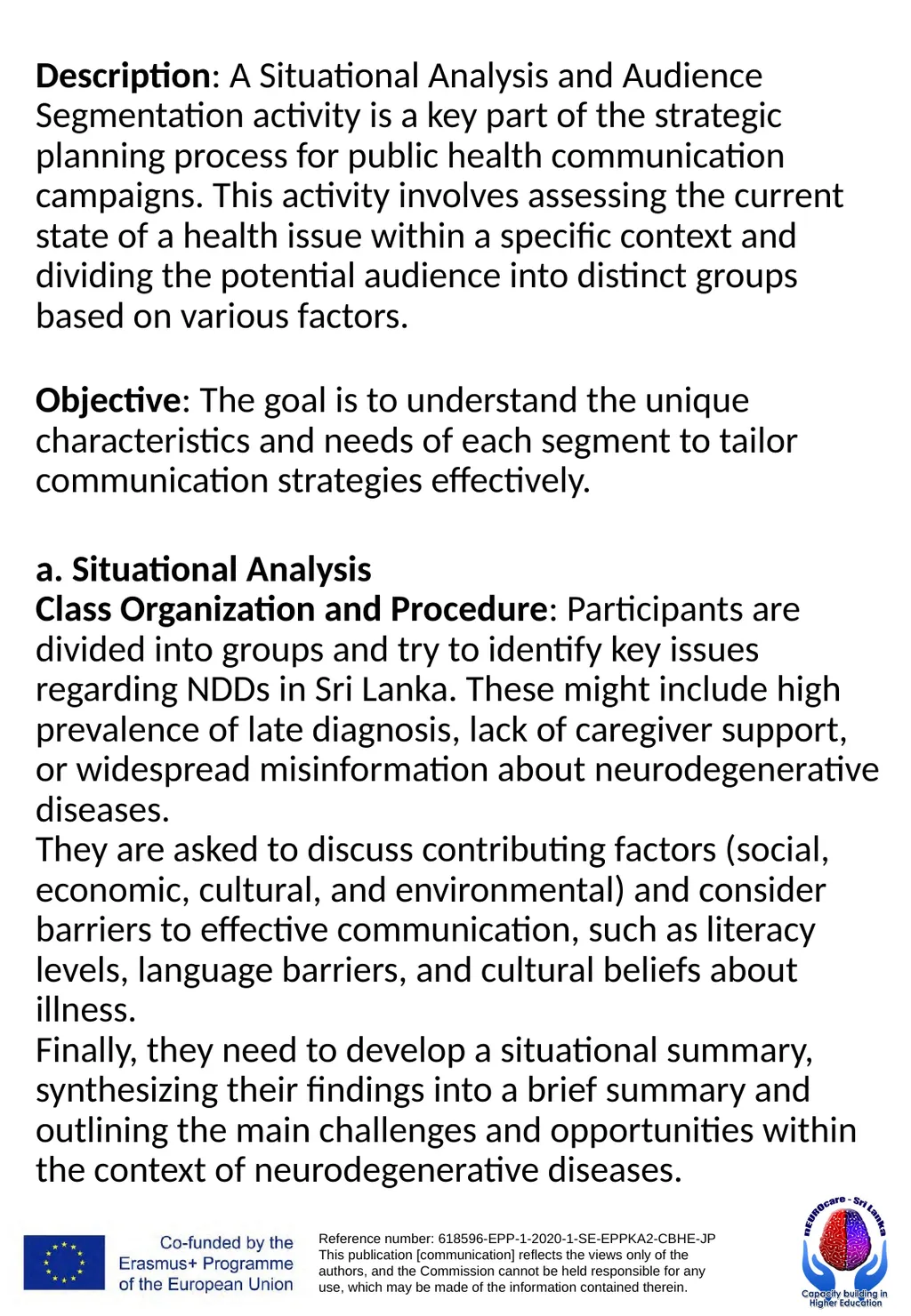
Activity 2 Description: A Situational Analysis and Audience Segmentation activity is a key part of the strategic planning process for public health communication campaigns. This activity involves assessing the current state of a health issue within a specific context and dividing the potential audience into distinct groups based on various factors.
Objective: The goal is to understand the unique characteristics and needs of each segment to tailor communication strategies effectively.
a. Situational Analysis
Class Organization and Procedure: Participants are divided into groups and try to identify key issues regarding NDDs in Sri Lanka. These might include high prevalence of late diagnosis, lack of caregiver support, or widespread misinformation about neurodegenerative diseases.
They are asked to discuss contributing factors (social, economic, cultural, and environmental) and consider barriers to effective communication, such as literacy levels, language barriers, and cultural beliefs about illness.
Finally, they need to develop a situational summary, synthesizing their findings into a brief summary and outlining the main challenges and opportunities within the context of neurodegenerative diseases.<br>
13
Situational Analysis and Audience Segmentation
Activity 2
30 minutes<br>
Activity 2
30 minutes<br>
14
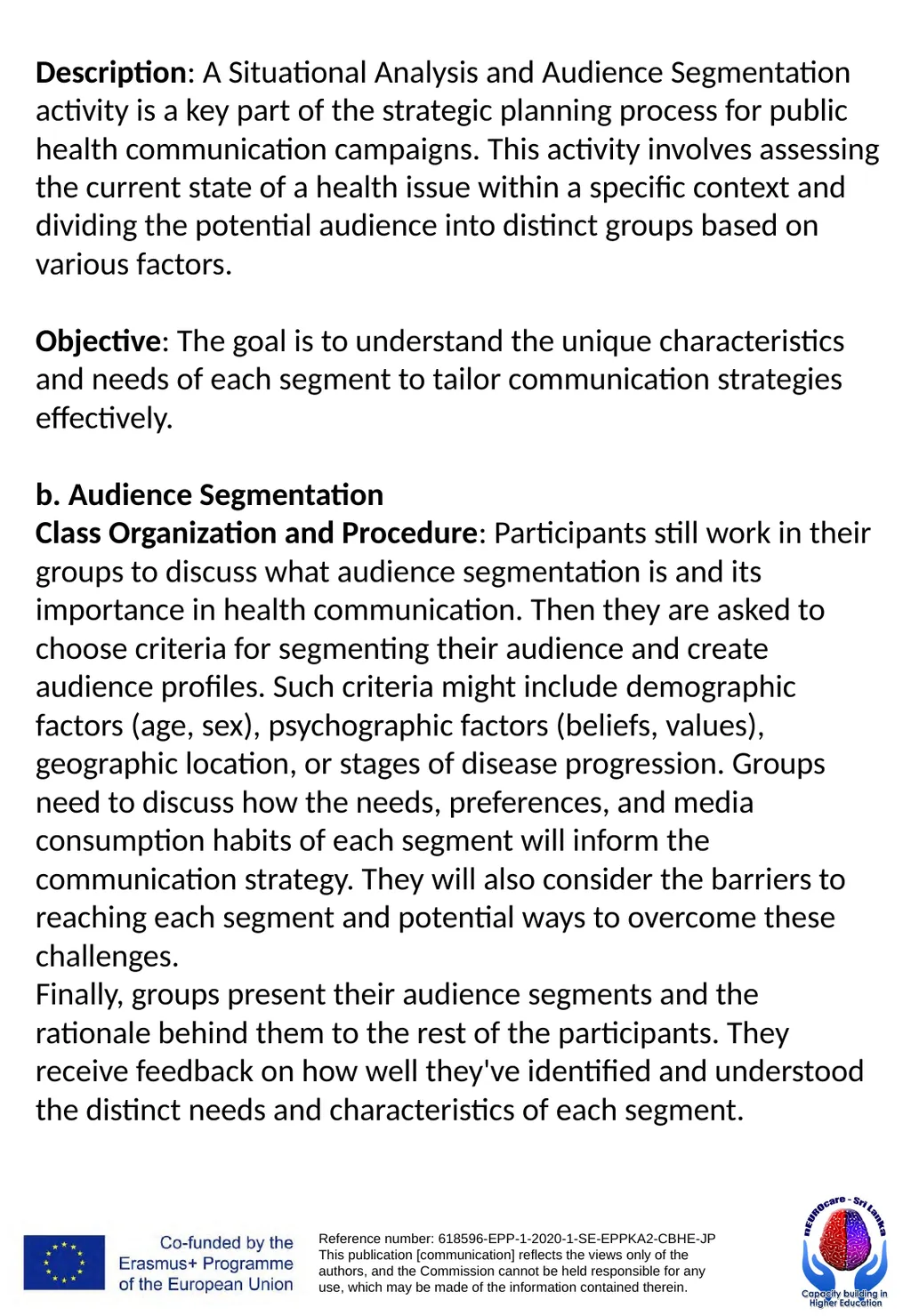
Activity 2 Description: A Situational Analysis and Audience Segmentation activity is a key part of the strategic planning process for public health communication campaigns. This activity involves assessing the current state of a health issue within a specific context and dividing the potential audience into distinct groups based on various factors.
Objective: The goal is to understand the unique characteristics and needs of each segment to tailor communication strategies effectively.
b. Audience Segmentation
Class Organization and Procedure: Participants still work in their groups to discuss what audience segmentation is and its importance in health communication. Then they are asked to choose criteria for segmenting their audience and create audience profiles. Such criteria might include demographic factors (age, sex), psychographic factors (beliefs, values), geographic location, or stages of disease progression. Groups need to discuss how the needs, preferences, and media consumption habits of each segment will inform the communication strategy. They will also consider the barriers to reaching each segment and potential ways to overcome these challenges.
Finally, groups present their audience segments and the rationale behind them to the rest of the participants. They receive feedback on how well they've identified and understood the distinct needs and characteristics of each segment.<br>
15
Setting Communication Objectives Activity 3
60 minutes<br>
60 minutes<br>
16
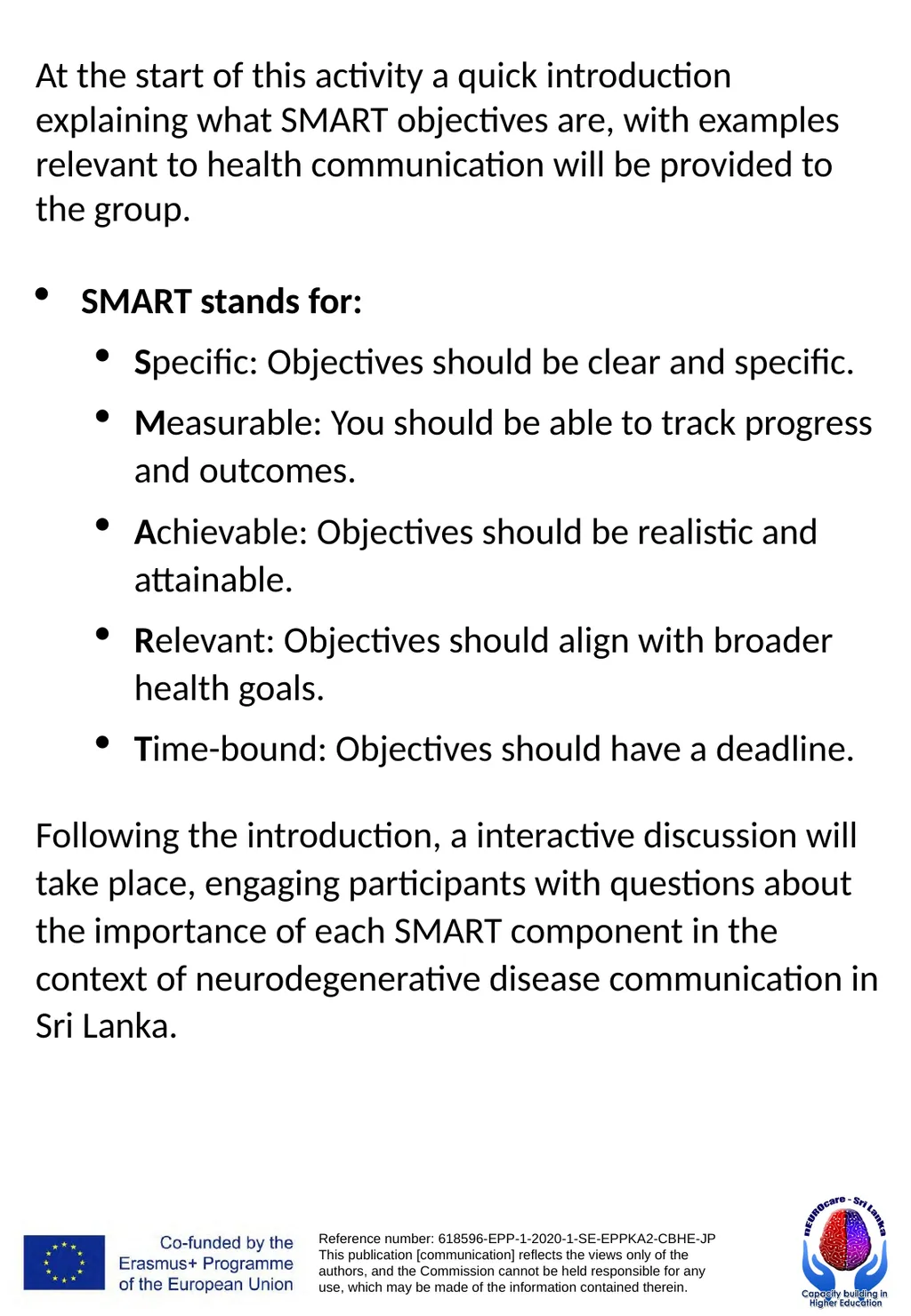
Activity (20min) At the start of this activity a quick introduction explaining what SMART objectives are, with examples relevant to health communication will be provided to the group.
SMART stands for:
Specific: Objectives should be clear and specific.
Measurable: You should be able to track progress and outcomes.
Achievable: Objectives should be realistic and attainable.
Relevant: Objectives should align with broader health goals.
Time-bound: Objectives should have a deadline.
Following the introduction, a interactive discussion will take place, engaging participants with questions about the importance of each SMART component in the context of neurodegenerative disease communication in Sri Lanka.<br>
17
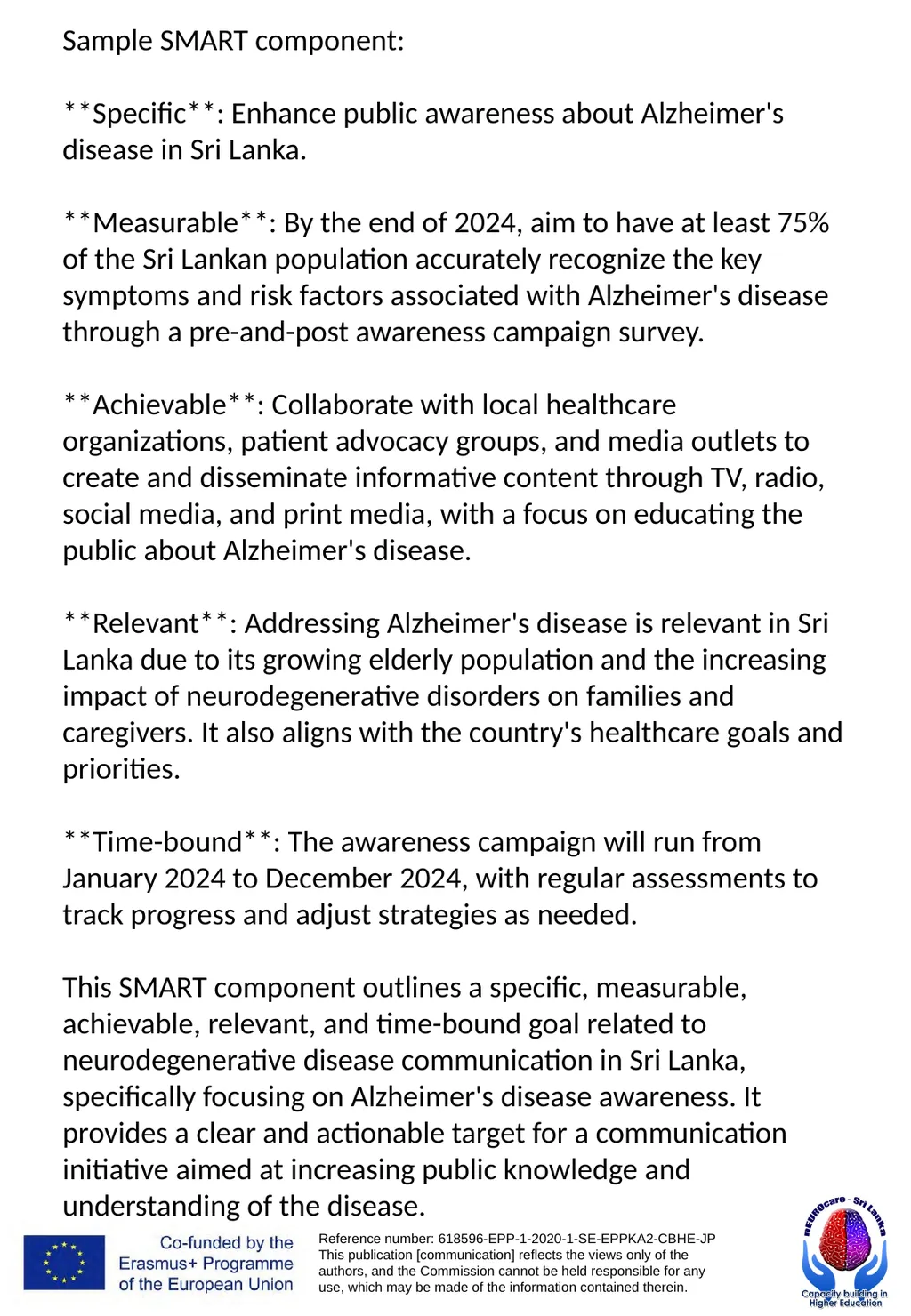
Sample SMART component:
**Specific**: Enhance public awareness about Alzheimer's disease in Sri Lanka.
**Measurable**: By the end of 2024, aim to have at least 75% of the Sri Lankan population accurately recognize the key symptoms and risk factors associated with Alzheimer's disease through a pre-and-post awareness campaign survey.
**Achievable**: Collaborate with local healthcare organizations, patient advocacy groups, and media outlets to create and disseminate informative content through TV, radio, social media, and print media, with a focus on educating the public about Alzheimer's disease.
**Relevant**: Addressing Alzheimer's disease is relevant in Sri Lanka due to its growing elderly population and the increasing impact of neurodegenerative disorders on families and caregivers. It also aligns with the country's healthcare goals and priorities.
**Time-bound**: The awareness campaign will run from January 2024 to December 2024, with regular assessments to track progress and adjust strategies as needed.
This SMART component outlines a specific, measurable, achievable, relevant, and time-bound goal related to neurodegenerative disease communication in Sri Lanka, specifically focusing on Alzheimer's disease awareness. It provides a clear and actionable target for a communication initiative aimed at increasing public knowledge and understanding of the disease.<br>
18
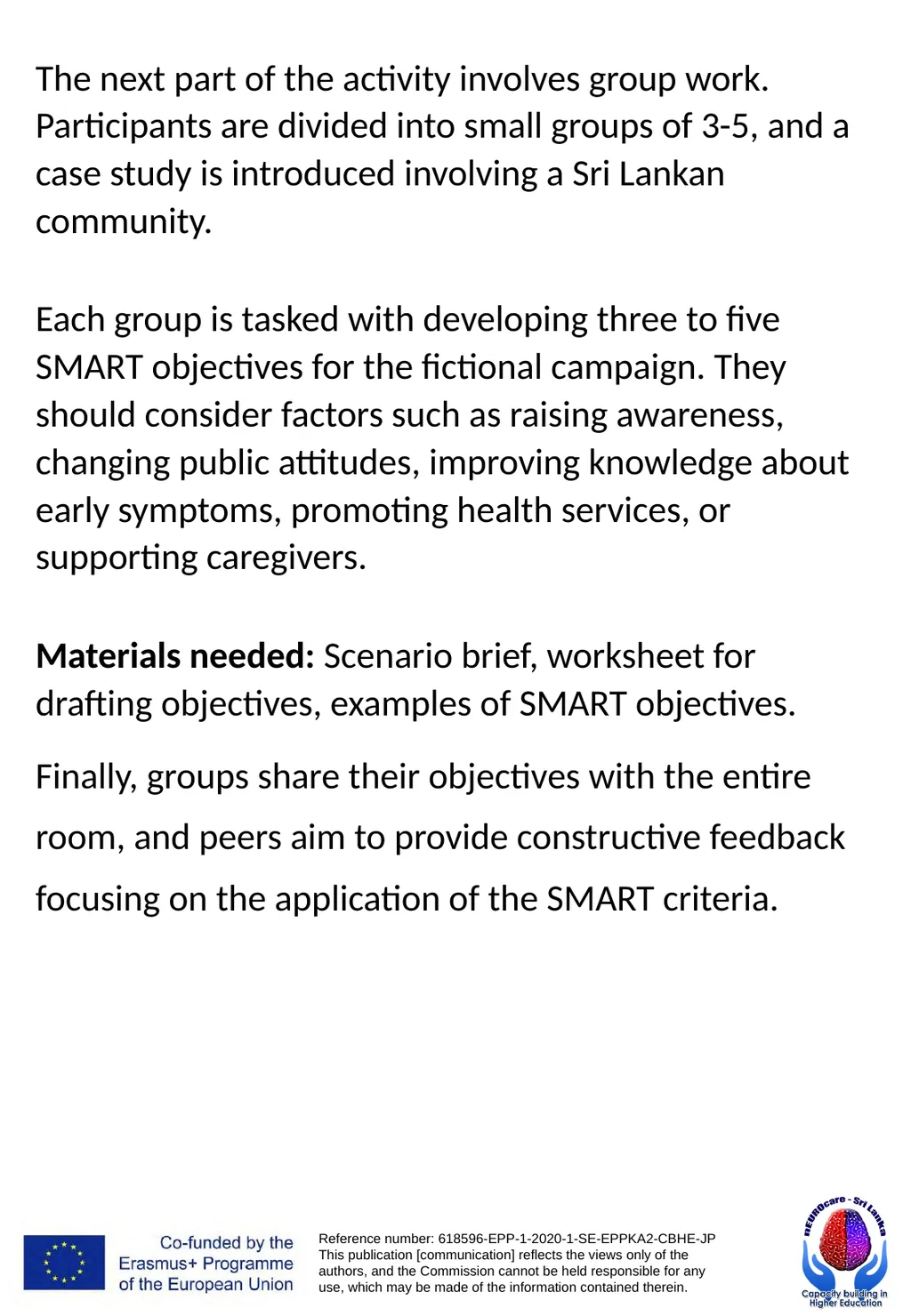
Activity (20min) The next part of the activity involves group work. Participants are divided into small groups of 3-5, and a case study is introduced involving a Sri Lankan community.
Each group is tasked with developing three to five SMART objectives for the fictional campaign. They should consider factors such as raising awareness, changing public attitudes, improving knowledge about early symptoms, promoting health services, or supporting caregivers.
Materials needed: Scenario brief, worksheet for drafting objectives, examples of SMART objectives.
Finally, groups share their objectives with the entire
room, and peers aim to provide constructive feedback
focusing on the application of the SMART criteria.<br>
19
Strategy Development Activity 4
90 minutes<br>
90 minutes<br>
20
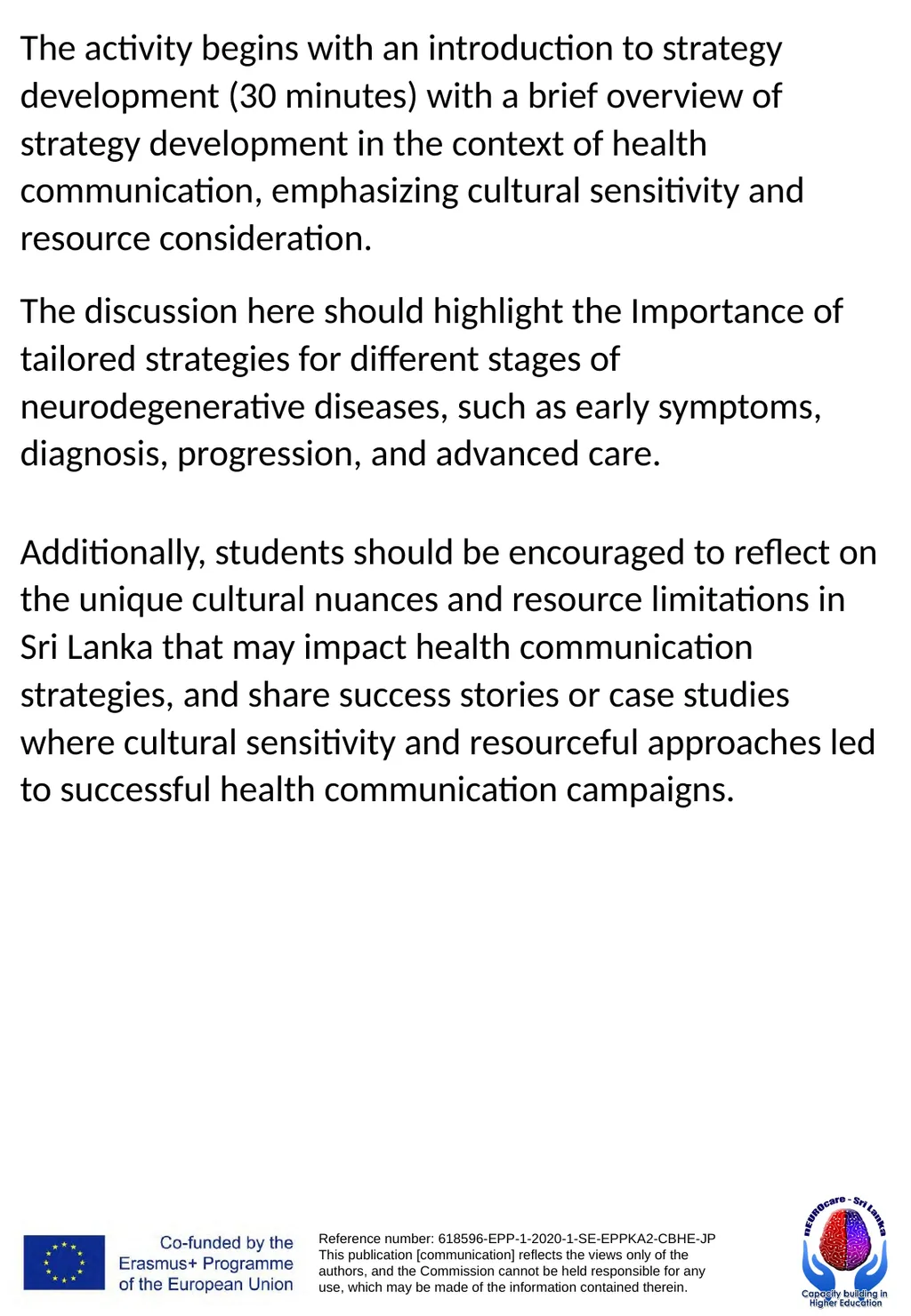
Activity 1 The activity begins with an introduction to strategy development (30 minutes) with a brief overview of strategy development in the context of health communication, emphasizing cultural sensitivity and resource consideration.
The discussion here should highlight the Importance of tailored strategies for different stages of neurodegenerative diseases, such as early symptoms, diagnosis, progression, and advanced care.
Additionally, students should be encouraged to reflect on the unique cultural nuances and resource limitations in Sri Lanka that may impact health communication strategies, and share success stories or case studies where cultural sensitivity and resourceful approaches led to successful health communication campaigns.<br>
21
Activity 1 Following the introduction, students will be divided into groups of 3-5 people for their group work (40 minutes)
Each group will focus on a different stage of neurodegenerative diseases. Groups will be asked to develop strategic approaches that include communication channels, messages, and engagement activities. Strategies should reflect an understanding of cultural beliefs and practices in rural and urban settings of Sri Lanka. Consideration should be given to leveraging existing resources effectively and identifying needs for additional resources.
When the group work is finished, presentations and feedback (20 minutes) will follow. Each group will present their strategic approach, justifying their choices with respect to cultural sensitivity and resource availability. Other groups and facilitators will aim to provide constructive feedback, discussing the feasibility, potential impact, and areas for improvement.<br>
22
Creating an Action Plan Activity 5
60 minutes<br>
60 minutes<br>
23
Activity In the introduction of this activity (25 minutes), students will divided into groups and will be asked to search for an example of an effective action plan from a successful health communication campaign. Focus on how clear timelines, defined responsibilities, and strategic resource allocation contributed to the campaign's success. The successful plan will be discussed in the whole group before moving to the group activity.
During the group activity (25 minutes), each group will be presented with a case representing a different scenario for a neurodegenerative disease communication campaign. Groups will use a provided template to draft an action plan that outlines the steps needed to implement their assigned communication strategy. They should specify timelines for each step, assign clear responsibilities to team members, and plan for resource allocation, taking into account potential constraints.<br>
During the group activity (25 minutes), each group will be presented with a case representing a different scenario for a neurodegenerative disease communication campaign. Groups will use a provided template to draft an action plan that outlines the steps needed to implement their assigned communication strategy. They should specify timelines for each step, assign clear responsibilities to team members, and plan for resource allocation, taking into account potential constraints.<br>
24
Activity Key Focus: Encourage groups to consider realistic timelines, the division of labor, and resource management to optimize campaign efficacy.
At the end of the activity (10 minutes), each group will quickly present their drafted action plan, emphasizing the rationale behind their timelines, responsibilities, and resource planning.<br>
At the end of the activity (10 minutes), each group will quickly present their drafted action plan, emphasizing the rationale behind their timelines, responsibilities, and resource planning.<br>
25
Conclusion and Q&A (15 minutes) Recap of the workshop's key takeaways
Open floor for questions, discussions, and sharing personal experiences. Wrap-up and Q & A
30 minutes<br>
Open floor for questions, discussions, and sharing personal experiences. Wrap-up and Q & A
30 minutes<br>
26
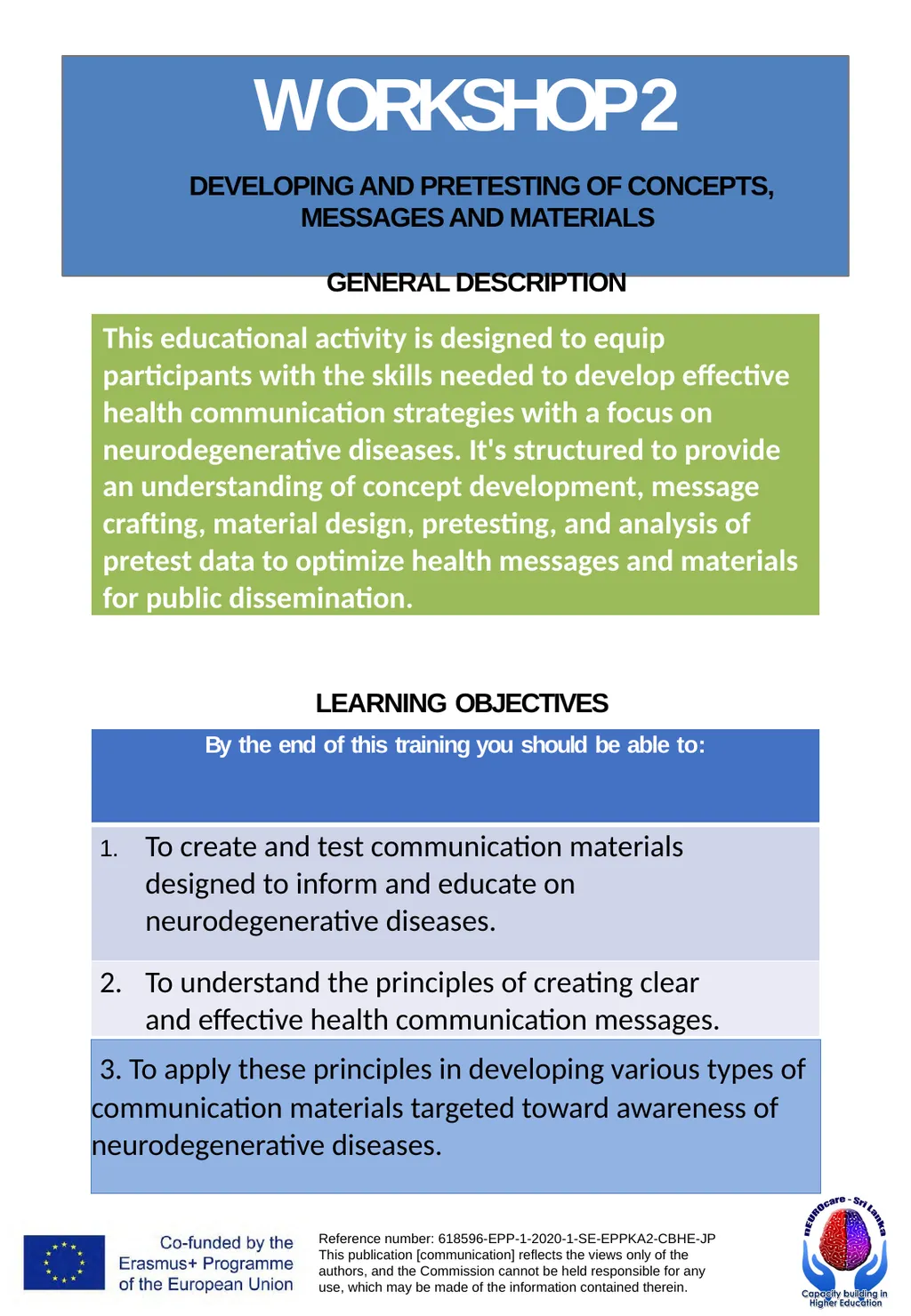
WORKSHOP 2 LEARNING OBJECTIVES DEVELOPING AND PRETESTING OF CONCEPTS, MESSAGES AND MATERIALS GENERAL DESCRIPTION<br>
27
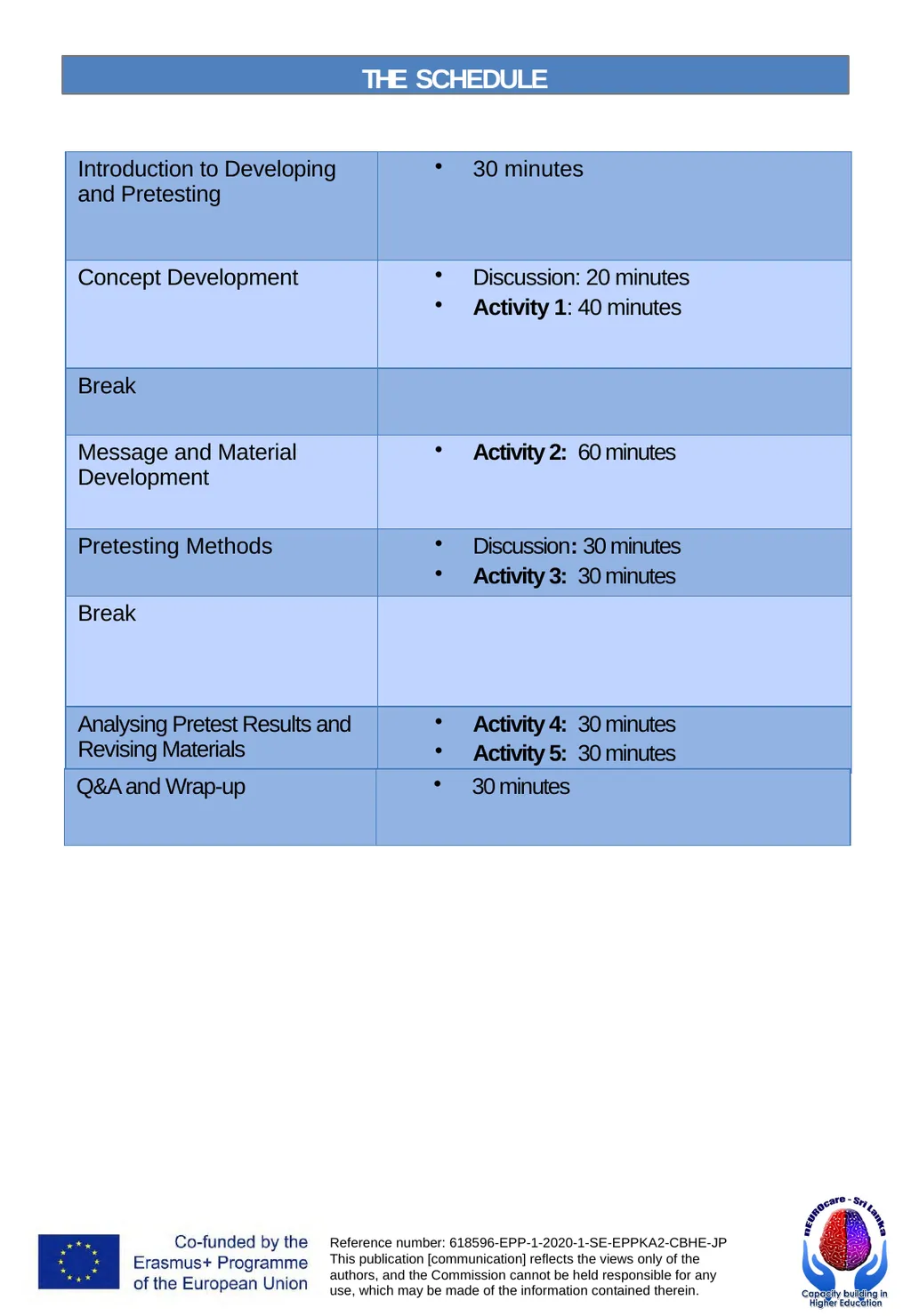
THE SCHEDULE<br>
28
Introduction to Developing and Pretesting
30 minutes<br>
30 minutes<br>
29
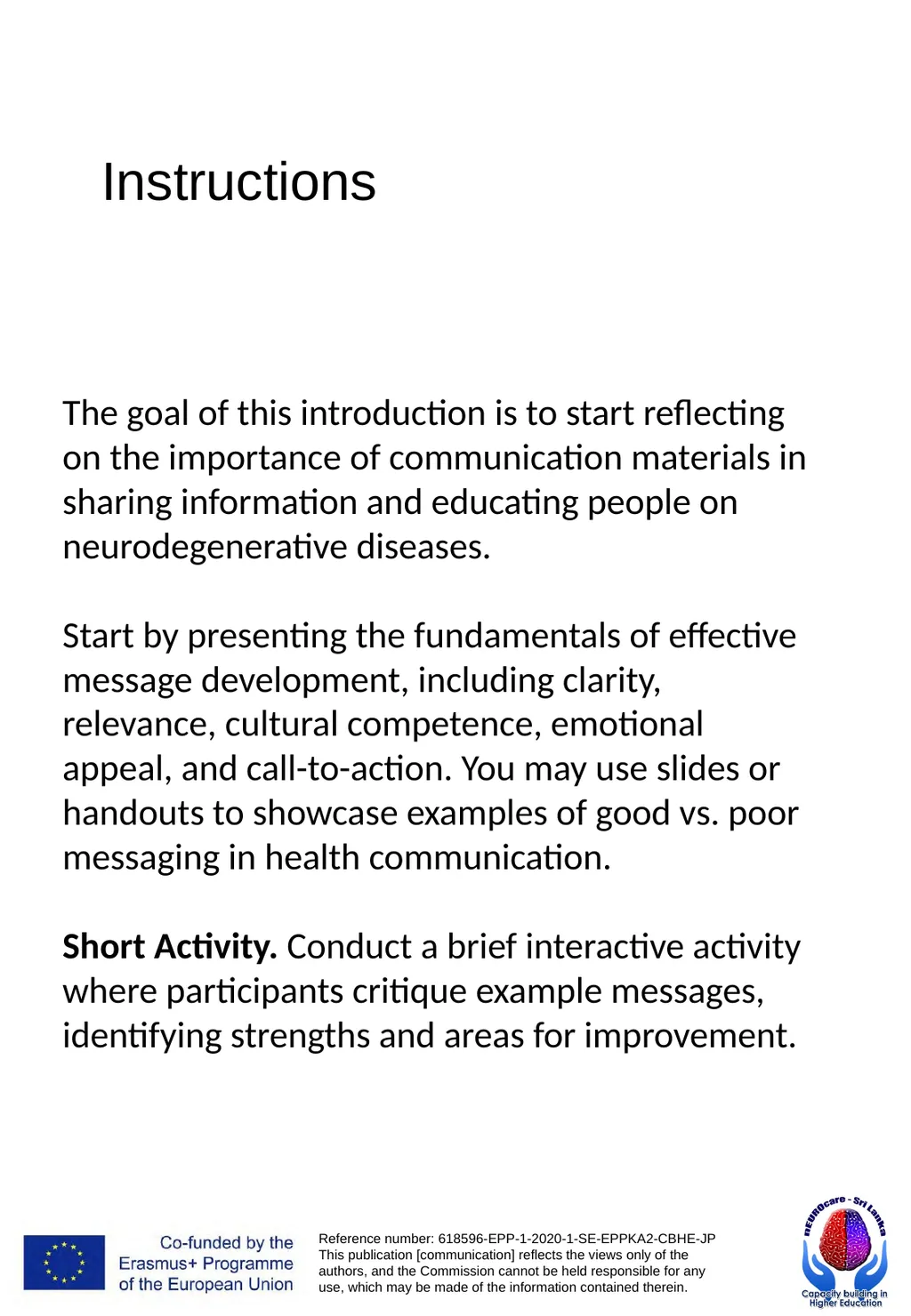
Activity The goal of this introduction is to start reflecting on the importance of communication materials in sharing information and educating people on neurodegenerative diseases.
Start by presenting the fundamentals of effective message development, including clarity, relevance, cultural competence, emotional appeal, and call-to-action. You may use slides or handouts to showcase examples of good vs. poor messaging in health communication.
Short Activity. Conduct a brief interactive activity where participants critique example messages, identifying strengths and areas for improvement. Instructions<br>
30
Concept Development
Activity 1
60 minutes<br>
Activity 1
60 minutes<br>
31
Activity 2 Ask the participants to form pairs and after 20 minutes of preparation, to share with their partner reflections about what a successful health communication concept might be.
Allow participants to discuss and share ideas between them (20 minutes), before pairing up again to generate ideas for concepts related to neurodegenerative disease awareness (20 minutes).<br>
Allow participants to discuss and share ideas between them (20 minutes), before pairing up again to generate ideas for concepts related to neurodegenerative disease awareness (20 minutes).<br>
32
Message and Material Development Activity 2
60 minutes<br>
60 minutes<br>
33
Activity (20min) Start this activity by discussing the importance of matching the message to the medium and audience. During the discussion, introduce various materials like brochures, posters, and digital content, providing samples of effective materials used in health campaigns.
Group activity (30 minutes): Participants are tasked with developing a piece of communication material based on the messages they crafted earlier. Assign each group a different format (brochure, poster, digital content).
Design Stations: Set up areas with materials for creating these items, including computers for digital content, art supplies for posters, and templates for brochures.
Facilitation: Walk around to provide guidance and ensure messages are being translated effectively into materials.
Presentations and Wrap-up (20 minutes)
Each group presents their material, explaining the rationale behind the design choices and messaging. Participants and facilitators need to offer constructive feedback, highlighting the effective use of message and design principles.<br>
34
Pretest Methods Activity 3
60 minutes<br>
60 minutes<br>
35
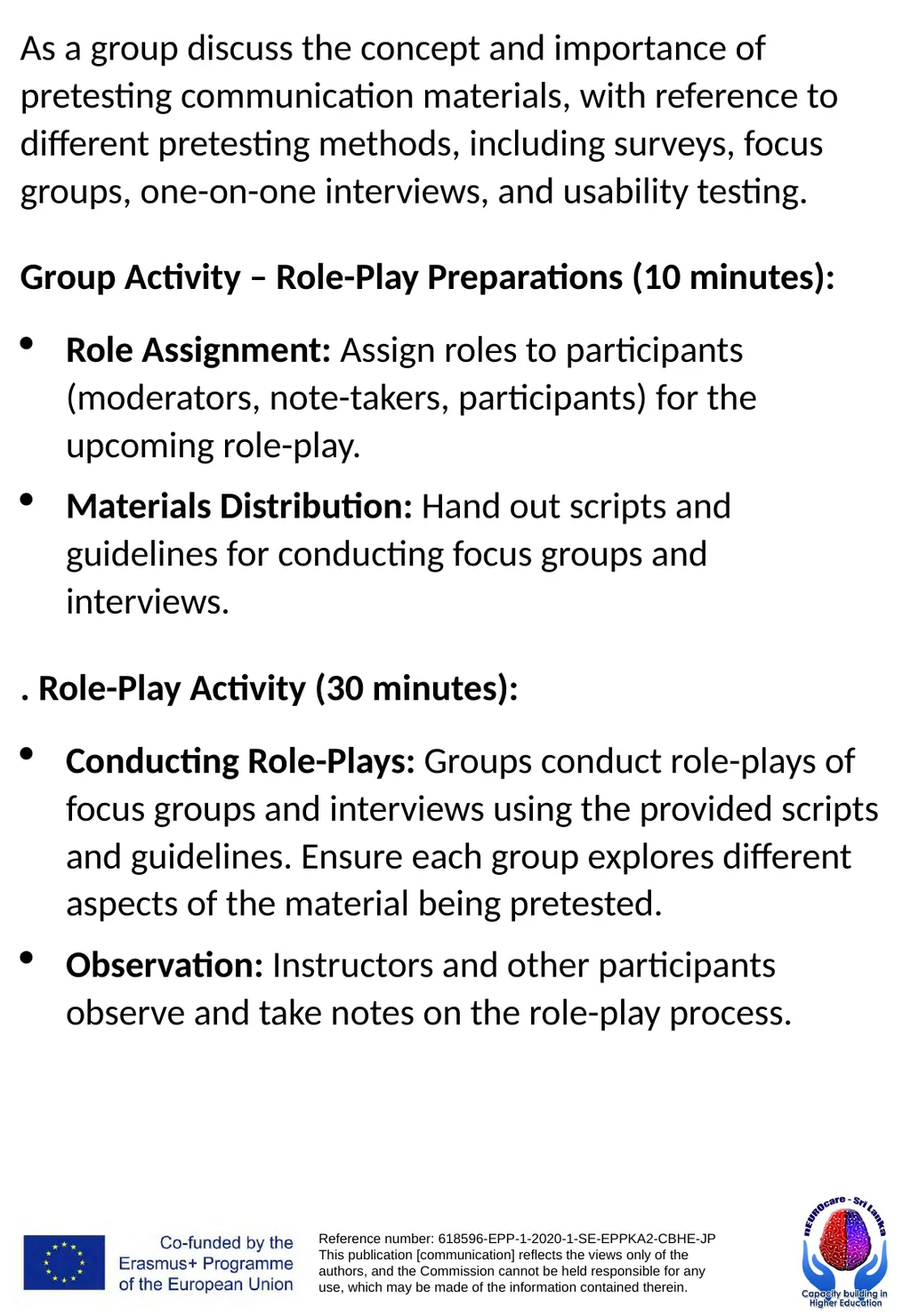
Activity 1 As a group discuss the concept and importance of pretesting communication materials, with reference to different pretesting methods, including surveys, focus groups, one-on-one interviews, and usability testing.
Group Activity – Role-Play Preparations (10 minutes):
Role Assignment: Assign roles to participants (moderators, note-takers, participants) for the upcoming role-play.
Materials Distribution: Hand out scripts and guidelines for conducting focus groups and interviews.
. Role-Play Activity (30 minutes):
Conducting Role-Plays: Groups conduct role-plays of focus groups and interviews using the provided scripts and guidelines. Ensure each group explores different aspects of the material being pretested.
Observation: Instructors and other participants observe and take notes on the role-play process.<br>
36
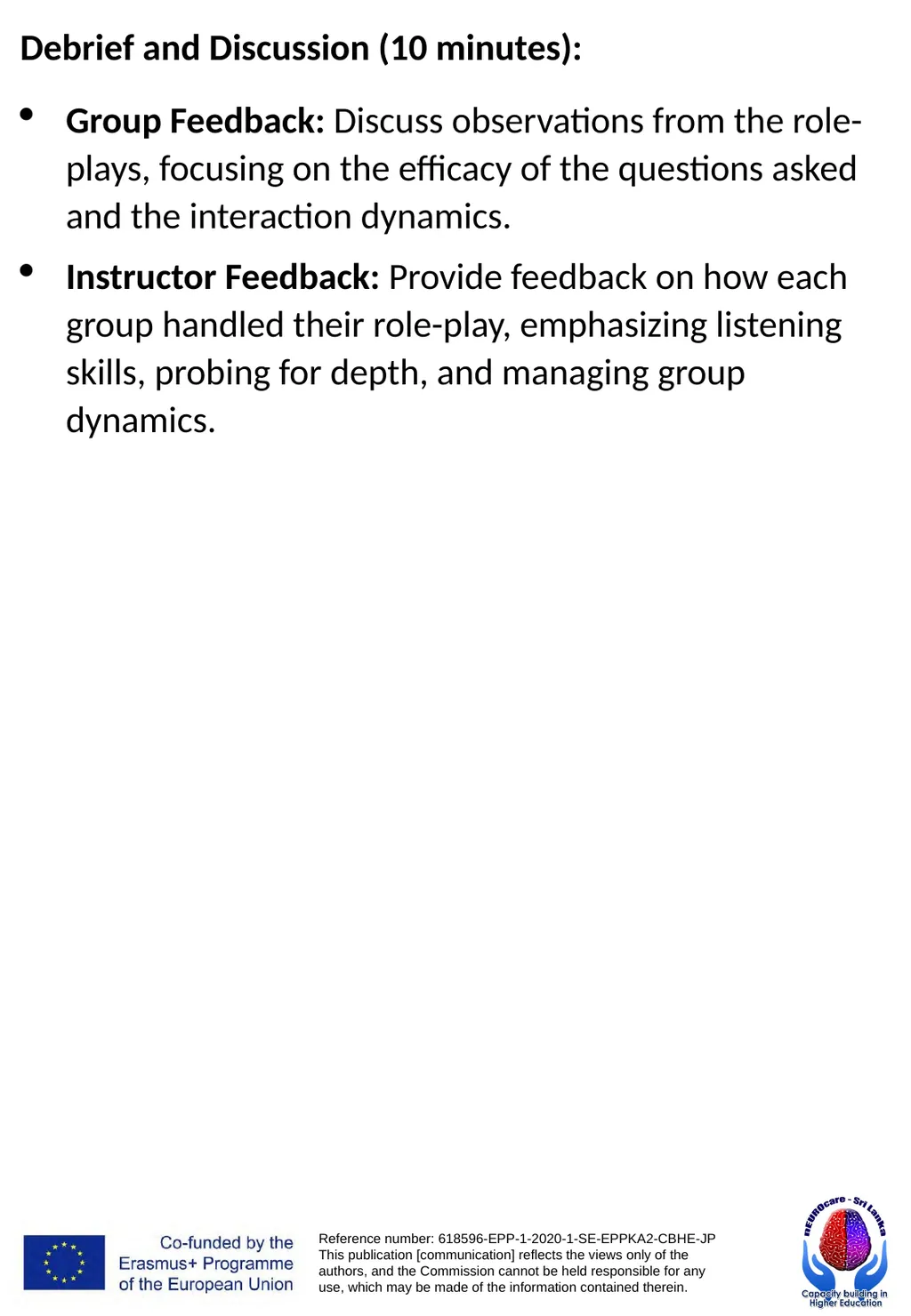
Activity 1 Debrief and Discussion (10 minutes):
Group Feedback: Discuss observations from the role-plays, focusing on the efficacy of the questions asked and the interaction dynamics.
Instructor Feedback: Provide feedback on how each group handled their role-play, emphasizing listening skills, probing for depth, and managing group dynamics.<br>
Group Feedback: Discuss observations from the role-plays, focusing on the efficacy of the questions asked and the interaction dynamics.
Instructor Feedback: Provide feedback on how each group handled their role-play, emphasizing listening skills, probing for depth, and managing group dynamics.<br>
37
Analysing Pretest Results and Revising Materials Activity 5
60 minutes<br>
60 minutes<br>
38
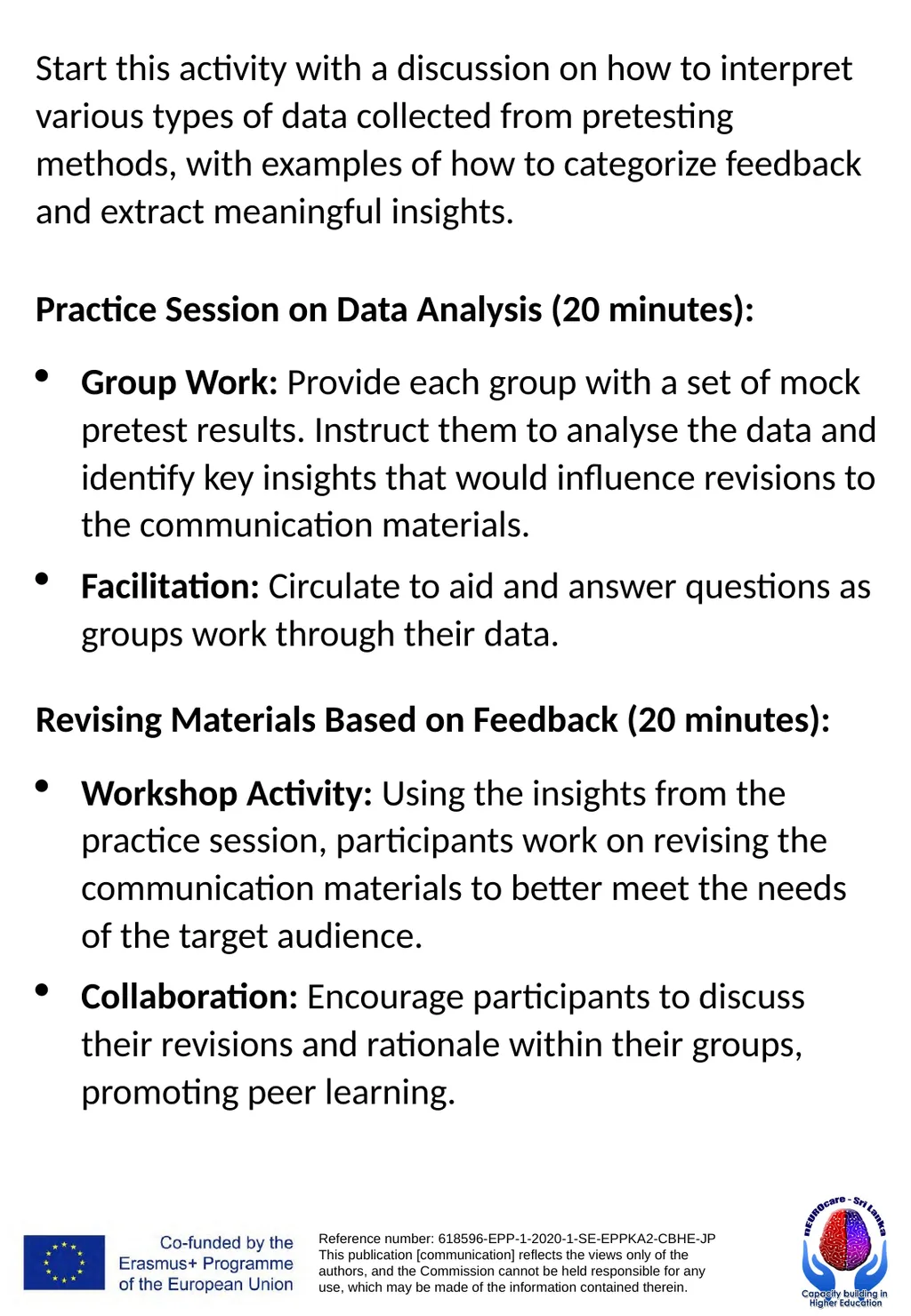
Activity Start this activity with a discussion on how to interpret various types of data collected from pretesting methods, with examples of how to categorize feedback and extract meaningful insights.
Practice Session on Data Analysis (20 minutes):
Group Work: Provide each group with a set of mock pretest results. Instruct them to analyse the data and identify key insights that would influence revisions to the communication materials.
Facilitation: Circulate to aid and answer questions as groups work through their data.
Revising Materials Based on Feedback (20 minutes):
Workshop Activity: Using the insights from the practice session, participants work on revising the communication materials to better meet the needs of the target audience.
Collaboration: Encourage participants to discuss their revisions and rationale within their groups, promoting peer learning.<br>
39
Activity Presentation and Feedback (10 minutes):
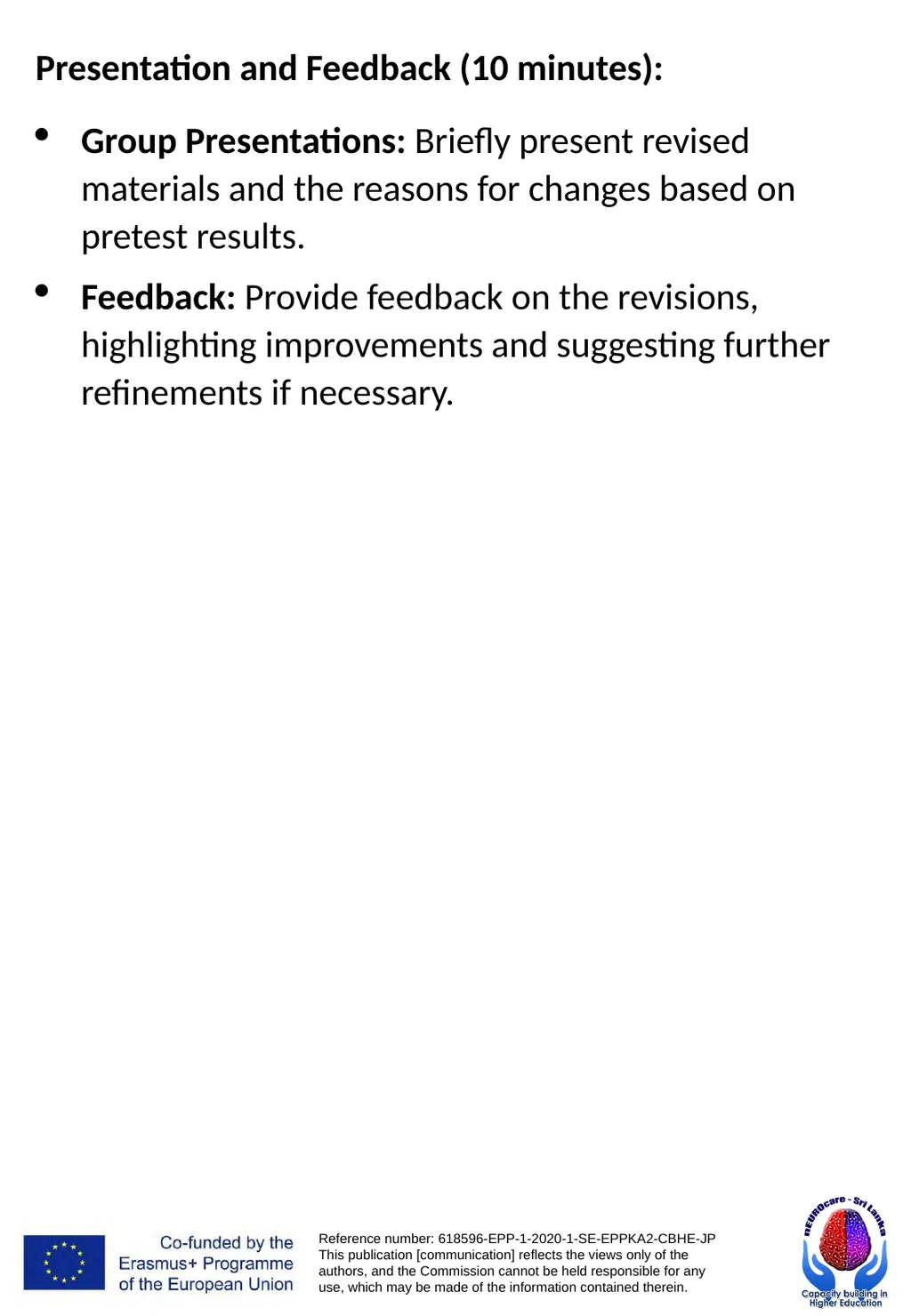
Group Presentations: Briefly present revised materials and the reasons for changes based on pretest results.
Feedback: Provide feedback on the revisions, highlighting improvements and suggesting further refinements if necessary.<br>
Group Presentations: Briefly present revised materials and the reasons for changes based on pretest results.
Feedback: Provide feedback on the revisions, highlighting improvements and suggesting further refinements if necessary.<br>
40
Conclusion and Q&A (15 minutes) Recap of the workshop's key takeaways
Open floor for questions, discussions, and sharing personal experiences. Wrap-up and Q & A
30 minutes<br>
Open floor for questions, discussions, and sharing personal experiences. Wrap-up and Q & A
30 minutes<br>
41
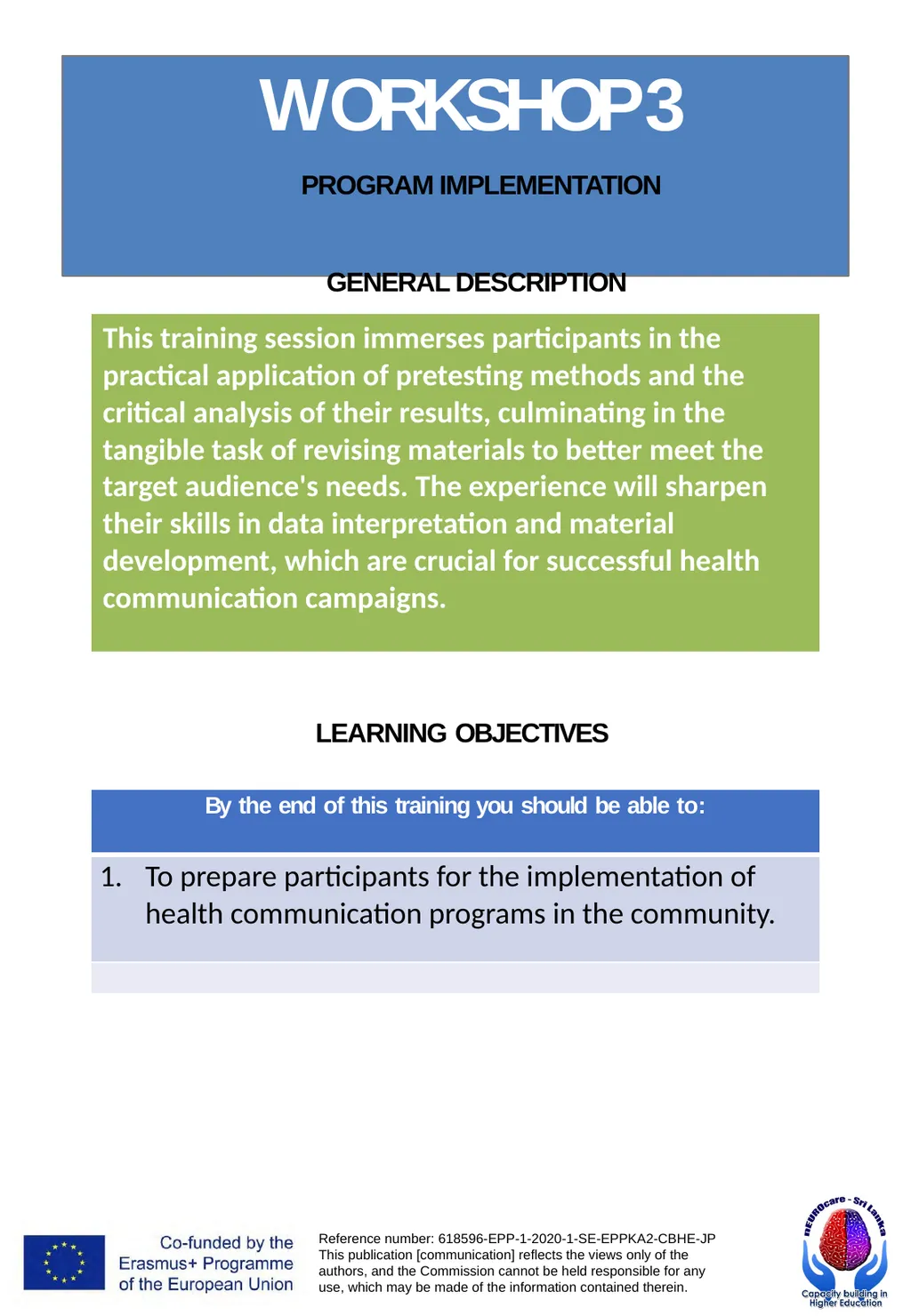
WORKSHOP 3 LEARNING OBJECTIVES PROGRAM IMPLEMENTATION GENERAL DESCRIPTION<br>
42
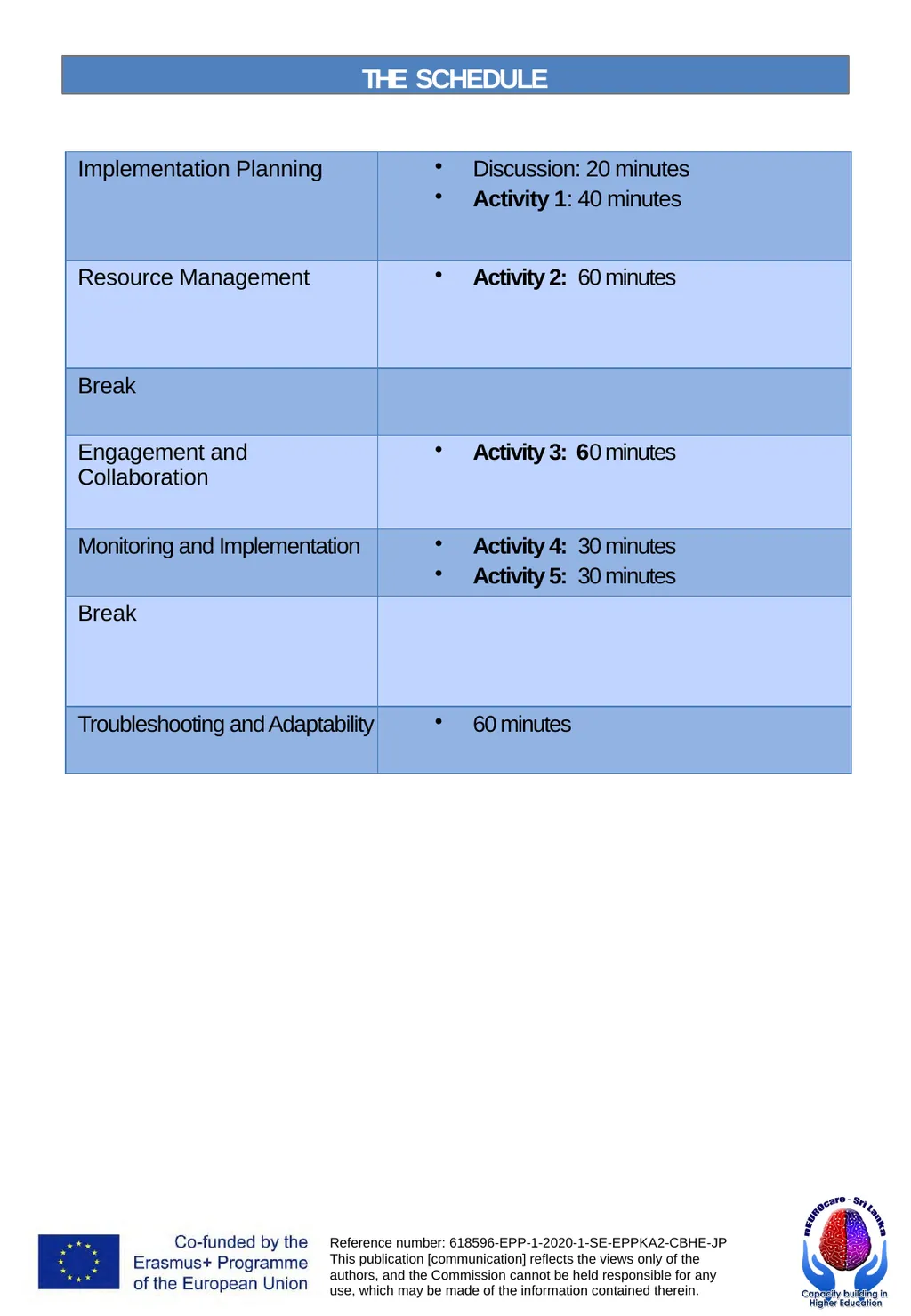
THE SCHEDULE<br>
43
Implementation Planning
Activity 1
60 minutes<br>
Activity 1
60 minutes<br>
44
Activity Start this activity with a brief overview (10 minutes) of the implementation phases: pre-implementation, implementation, and post-implementation. During the discussion, highlight the importance of each phase and its impact on the success of health communication programs.
Group Activity (30 minutes): Break participants into small groups to draft a comprehensive checklist that covers all phases of implementation. Encourage sharing of ideas and peer feedback.
Presentations (10 minutes): Each group will present their checklist and receive constructive feedback, discussing the critical components that should be included in the checklist.<br>
45
Resource Management
Activity 2
60 minutes<br>
Activity 2
60 minutes<br>
46
Activity 2 Begin this activity with a discussion (15 minutes) of the types of resources needed, such as human, financial, and material.
Brainstorming: Have participants list potential resources they might need for a hypothetical health communication program.
Case Studies on Resource Innovation (35 minutes):
Present case studies that demonstrate innovative resource management in low-resource settings. Split participants in groups and analyze the strategies used in the case studies and their applicability to the participants' contexts.
Reflection and Sharing Insights (10 minutes):
Participants share their thoughts on how they can apply these strategies in their work and discussion with the whole group.<br>
47
1. Aravind Eye Care System - India: Aravind Eye Care System has become a global model for delivering high-quality eye care in a resource-constrained environment. It conducts millions of surgeries annually and has had a significant impact on reducing blindness in India and beyond.
Innovative Resource Management:
-High-Volume, Low-Cost Model: Aravind adopted a high-volume, low-cost model to perform a large number of cataract surgeries efficiently and affordably.
-Tiered Pricing Structure: Patients are charged based on their ability to pay, ensuring that those who can afford to pay more cross-subsidize the treatment of the poor.
-Telemedicine: Aravind uses telemedicine to provide remote consultations and reduce the need for physical infrastructure.
-Training Programs: They train non-medical personnel, like nurses and technicians, to perform specific tasks, reducing the burden on highly-trained ophthalmologists.
-Efficient Supply Chain: Aravind manages the supply chain of eye care materials effectively to minimize waste and costs.
2. M-Pesa - Kenya: M-Pesa revolutionized financial services in Kenya and other countries with similar challenges. It provided access to banking, reduced the risks associated with carrying cash, and enabled economic empowerment for millions of people. (Mobile Money; Leveraging Existing Infrastructure; Agent Network; Low Transaction Cost)<br>
48
Engagement and Collaboration Activity 3
60 minutes<br>
60 minutes<br>
49
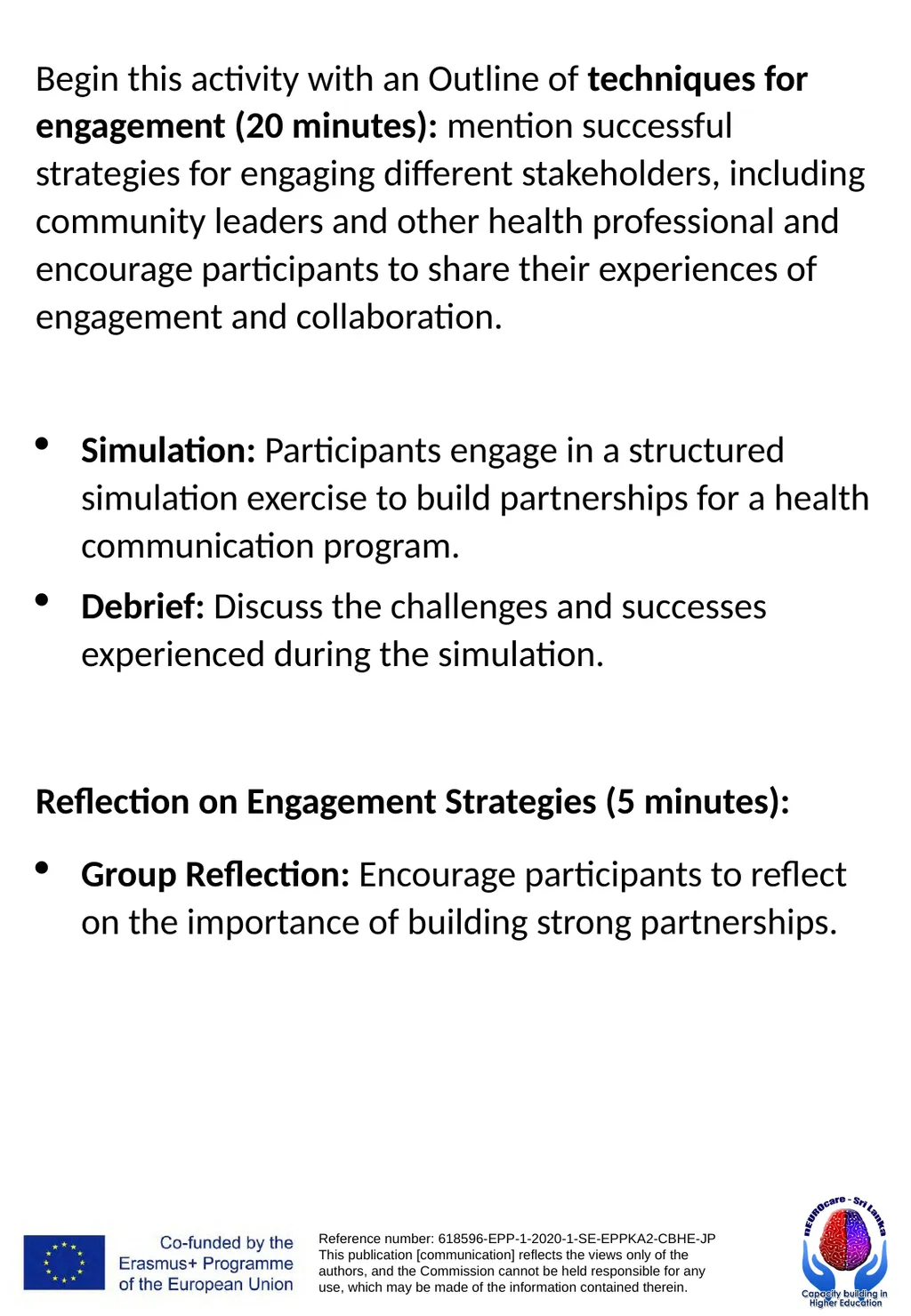
Activity (20min) Begin this activity with an Outline of techniques for engagement (20 minutes): mention successful strategies for engaging different stakeholders, including community leaders and other health professional and encourage participants to share their experiences of engagement and collaboration.
Simulation: Participants engage in a structured simulation exercise to build partnerships for a health communication program.
Debrief: Discuss the challenges and successes experienced during the simulation.
Reflection on Engagement Strategies (5 minutes):
Group Reflection: Encourage participants to reflect on the importance of building strong partnerships.<br>
50
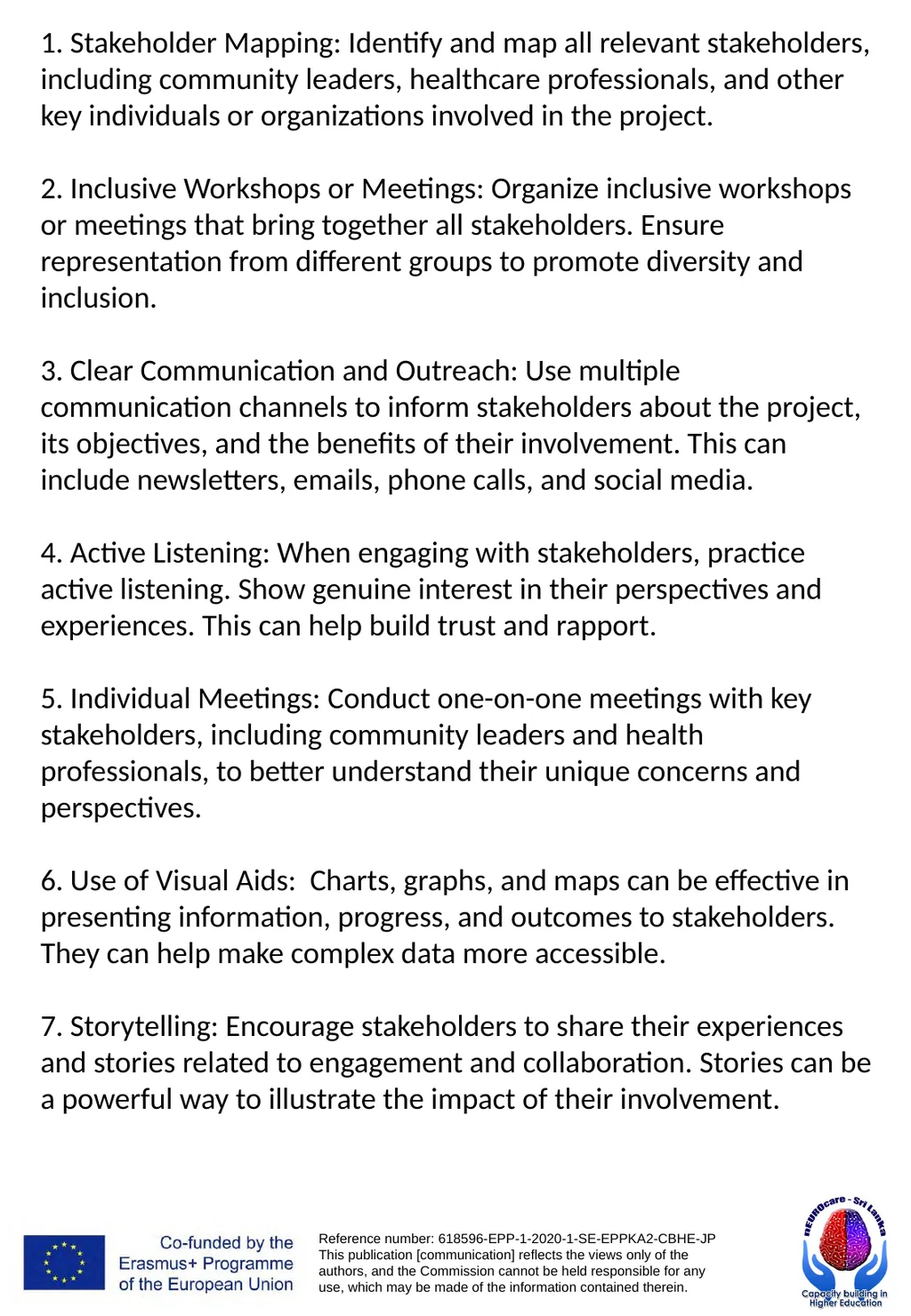
1. Stakeholder Mapping: Identify and map all relevant stakeholders, including community leaders, healthcare professionals, and other key individuals or organizations involved in the project.
2. Inclusive Workshops or Meetings: Organize inclusive workshops or meetings that bring together all stakeholders. Ensure representation from different groups to promote diversity and inclusion.
3. Clear Communication and Outreach: Use multiple communication channels to inform stakeholders about the project, its objectives, and the benefits of their involvement. This can include newsletters, emails, phone calls, and social media.
4. Active Listening: When engaging with stakeholders, practice active listening. Show genuine interest in their perspectives and experiences. This can help build trust and rapport.
5. Individual Meetings: Conduct one-on-one meetings with key stakeholders, including community leaders and health professionals, to better understand their unique concerns and perspectives.
6. Use of Visual Aids: Charts, graphs, and maps can be effective in presenting information, progress, and outcomes to stakeholders. They can help make complex data more accessible.
7. Storytelling: Encourage stakeholders to share their experiences and stories related to engagement and collaboration. Stories can be a powerful way to illustrate the impact of their involvement.<br>
51
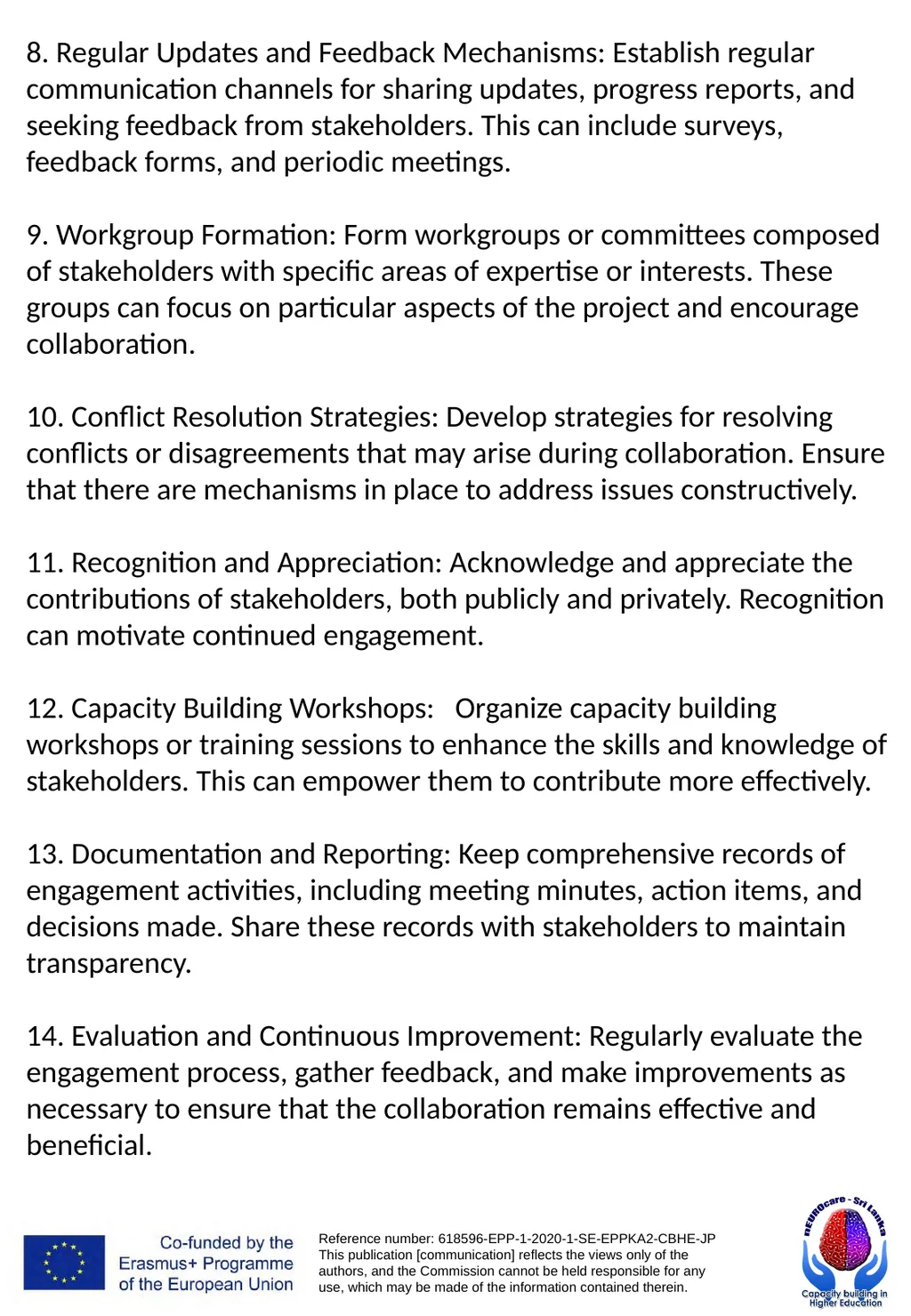
8. Regular Updates and Feedback Mechanisms: Establish regular communication channels for sharing updates, progress reports, and seeking feedback from stakeholders. This can include surveys, feedback forms, and periodic meetings.
9. Workgroup Formation: Form workgroups or committees composed of stakeholders with specific areas of expertise or interests. These groups can focus on particular aspects of the project and encourage collaboration.
10. Conflict Resolution Strategies: Develop strategies for resolving conflicts or disagreements that may arise during collaboration. Ensure that there are mechanisms in place to address issues constructively.
11. Recognition and Appreciation: Acknowledge and appreciate the contributions of stakeholders, both publicly and privately. Recognition can motivate continued engagement.
12. Capacity Building Workshops: Organize capacity building workshops or training sessions to enhance the skills and knowledge of stakeholders. This can empower them to contribute more effectively.
13. Documentation and Reporting: Keep comprehensive records of engagement activities, including meeting minutes, action items, and decisions made. Share these records with stakeholders to maintain transparency.
14. Evaluation and Continuous Improvement: Regularly evaluate the engagement process, gather feedback, and make improvements as necessary to ensure that the collaboration remains effective and beneficial.<br>
52
Monitoring Implementation Activity 4
60 minutes<br>
60 minutes<br>
53
Activity 1 The activity should start with a presentation of Key Performance Indicators (KPIs) (15 minutes). The latter are measurable values that demonstrate how effectively a company or organization is achieving its key business objectives. Organizations use KPIs to evaluate their success at reaching targets.
When it comes to health communication programs, KPIs might include measures such as:
Reach and engagement metrics (e.g., the number of people reached by a campaign, website traffic, social media engagement)
Conversion rates (e.g., the number of people who took a desired action after exposure to communication materials, such as getting screened for a disease)
Knowledge and awareness changes (e.g., pre- and post-campaign surveys to assess changes in awareness or understanding of a health issue)
Behavioral changes (e.g., the number of people adopting healthier behaviors following a campaign)
Cost-effectiveness (e.g., cost per individual reached or per behavior change)<br>
54
Activity 1 KPI Monitoring Tools are the tools and software solutions used to track these indicators, from simple spreadsheets to complex data analytics platforms.
Analytics Software: Programs like Google Analytics can track website and social media performance, providing data on user engagement, demographics, and behavior.
Dashboard Software: Tools like Tableau, Microsoft Power BI, or Klipfolio allow users to create visual dashboards that display KPIs in real-time, making them easy to monitor at a glance.
Customer Relationship Management (CRM) Systems: CRM systems like Salesforce or HubSpot can be used to track engagements, conversions, and other customer-related KPIs.
Project Management Tools: Software like Asana, Trello, or Monday.com can help track the progress of various tasks and objectives in a project, showing how closely timelines and goals are being met.
Survey Tools: Platforms like SurveyMonkey or Google Forms can be used to conduct pre- and post-intervention surveys to assess changes in knowledge, attitudes, and behaviors.<br>
55
Activity 1 Health Information Systems: In the context of healthcare, specific health information systems (like electronic health records) can track patient outcomes, adherence to treatment, and other health-related KPIs.
Social Listening Tools: Tools like Hootsuite, Brandwatch, or Mention can track mentions, sentiment, and engagement across social media platforms.
Financial Management Software: For tracking cost-related KPIs, financial software like QuickBooks or Xero can be instrumental.
When selecting a KPI monitoring tool, it's important to consider the specific needs of the health communication program, including the type of data to be collected, the complexity of data analysis required, the ease of use, integration with other systems, and the budget for such tools.<br>
56
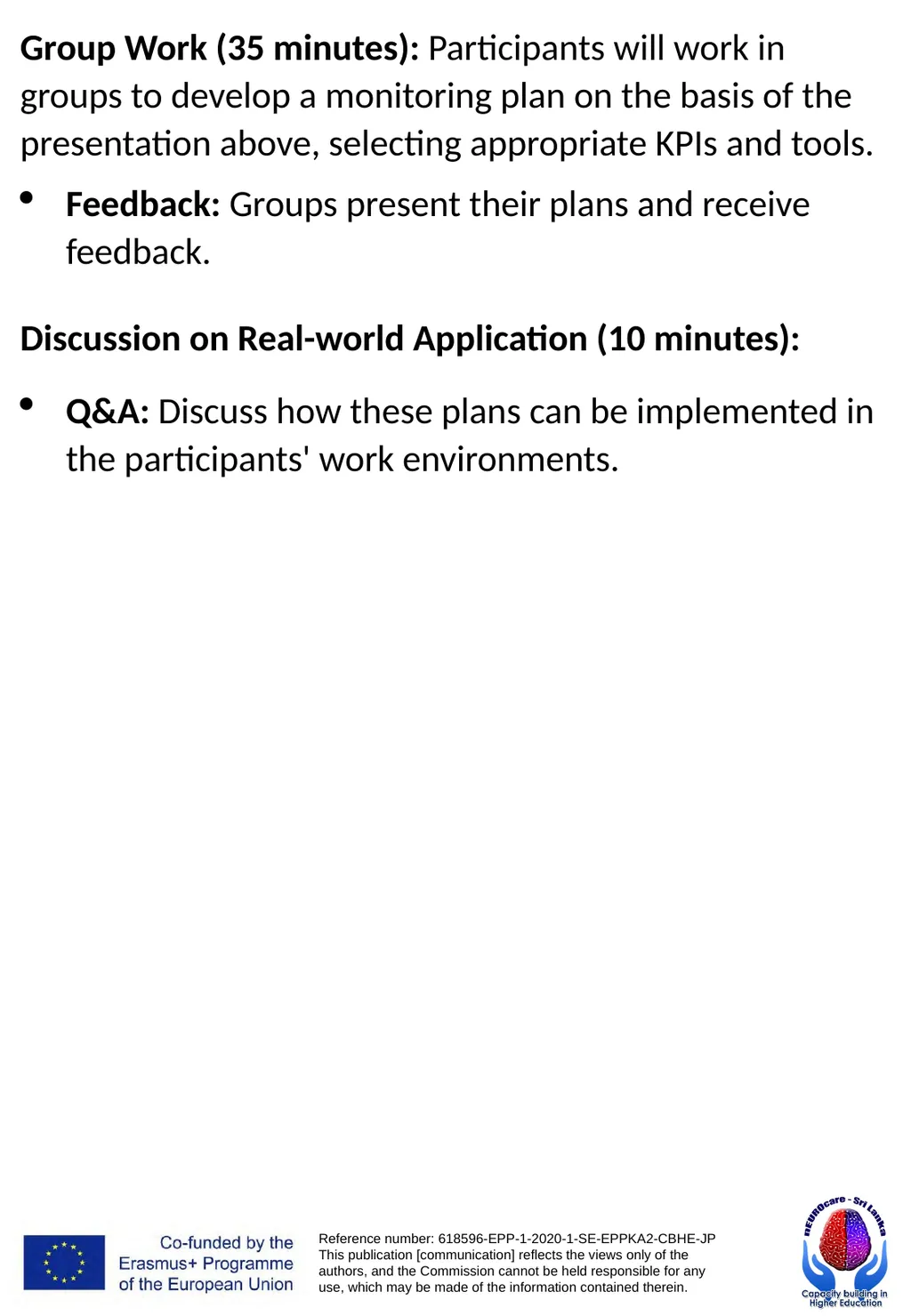
Activity 1 Group Work (35 minutes): Participants will work in groups to develop a monitoring plan on the basis of the presentation above, selecting appropriate KPIs and tools.
Feedback: Groups present their plans and receive feedback.
Discussion on Real-world Application (10 minutes):
Q&A: Discuss how these plans can be implemented in the participants' work environments.<br>
Feedback: Groups present their plans and receive feedback.
Discussion on Real-world Application (10 minutes):
Q&A: Discuss how these plans can be implemented in the participants' work environments.<br>
57
Troubleshooting and Adaptability
Activity 5
60 minutes<br>
Activity 5
60 minutes<br>
58
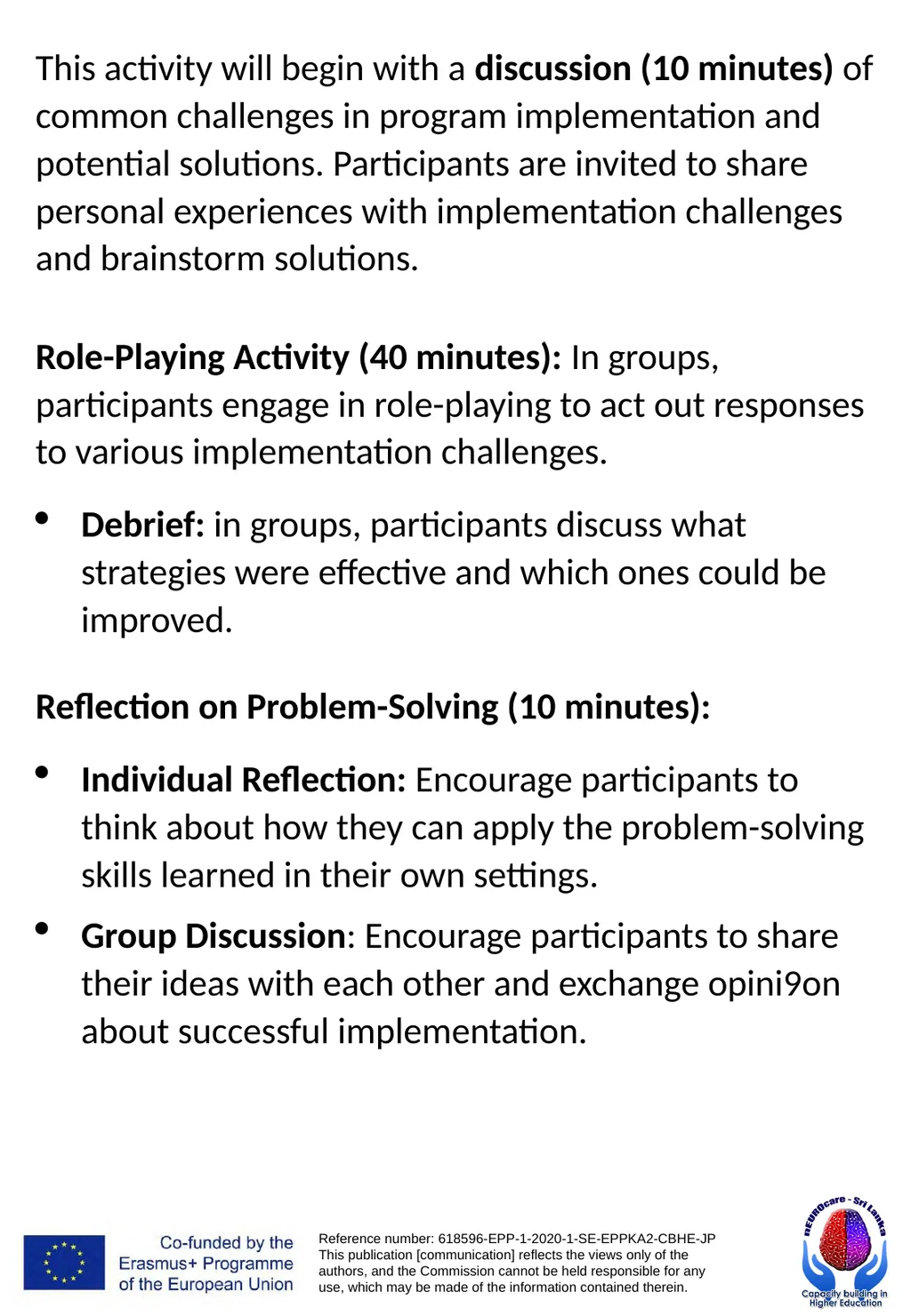
Activity This activity will begin with a discussion (10 minutes) of common challenges in program implementation and potential solutions. Participants are invited to share personal experiences with implementation challenges and brainstorm solutions.
Role-Playing Activity (40 minutes): In groups, participants engage in role-playing to act out responses to various implementation challenges.
Debrief: in groups, participants discuss what strategies were effective and which ones could be improved.
Reflection on Problem-Solving (10 minutes):
Individual Reflection: Encourage participants to think about how they can apply the problem-solving skills learned in their own settings.
Group Discussion: Encourage participants to share their ideas with each other and exchange opini9on about successful implementation.<br>
59
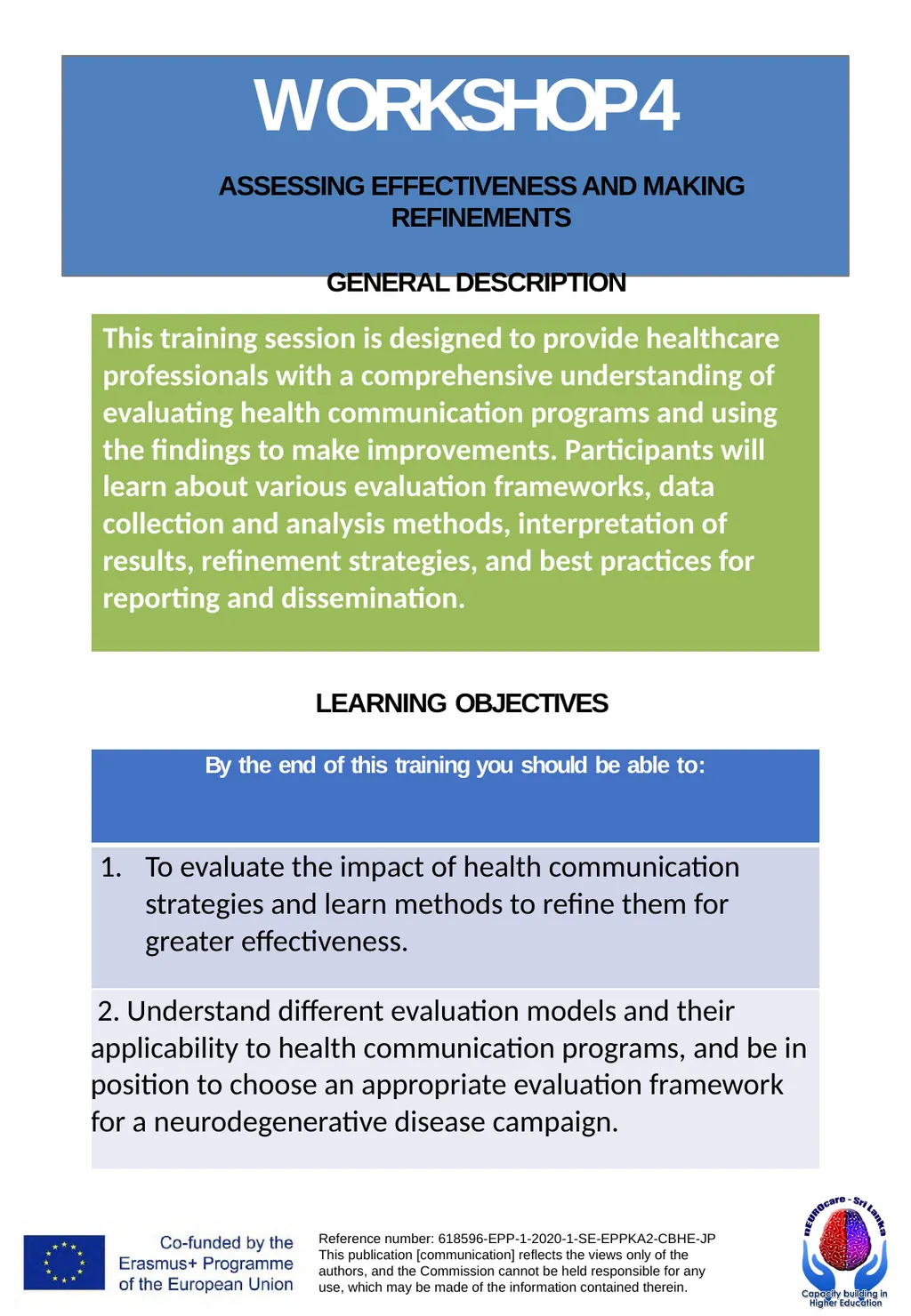
WORKSHOP 4 LEARNING OBJECTIVES ASSESSING EFFECTIVENESS AND MAKING REFINEMENTS GENERAL DESCRIPTION<br>
60
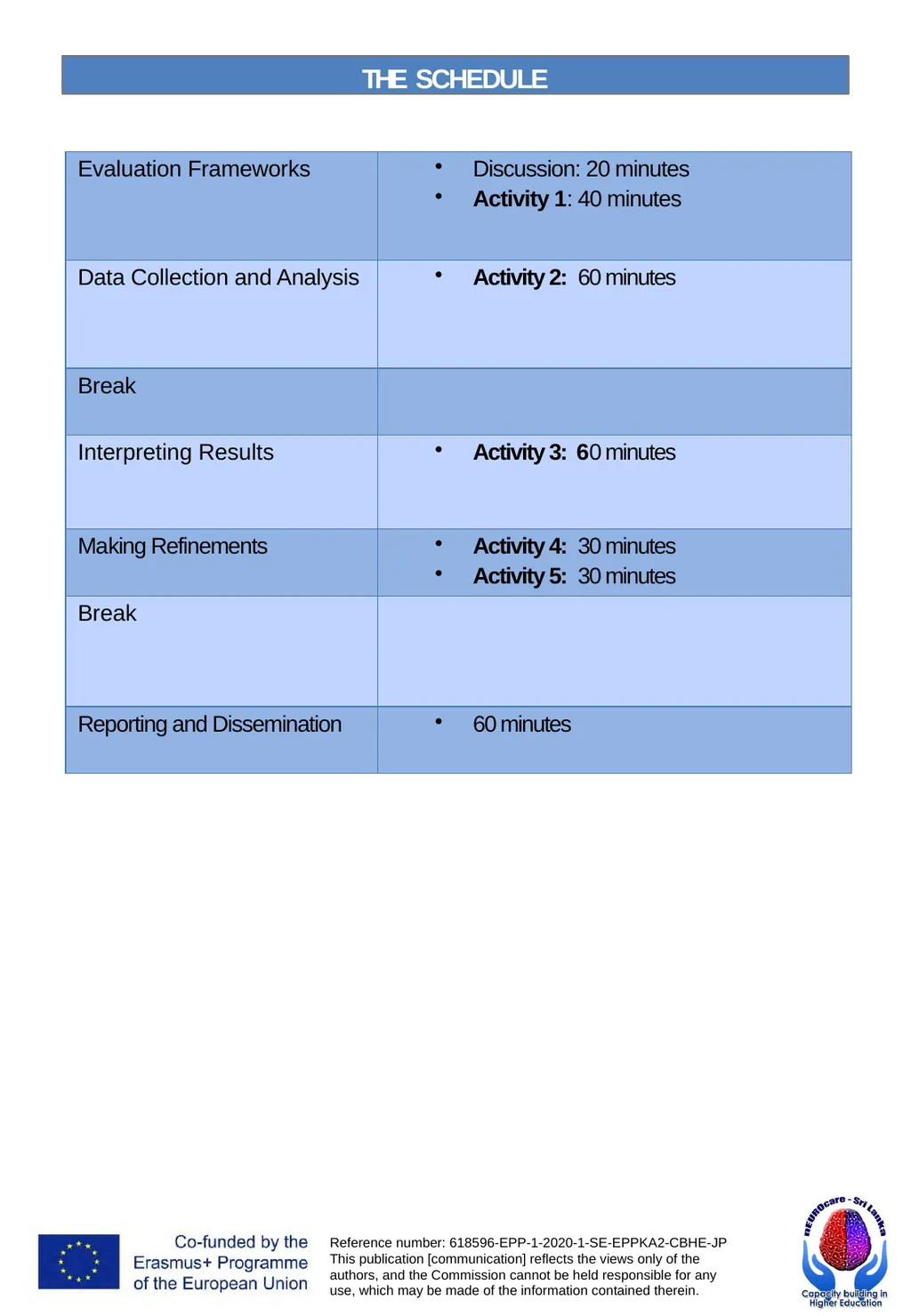
THE SCHEDULE<br>
61
Evaluation
Frameworks
Activity 1
60 minutes<br>
Frameworks
Activity 1
60 minutes<br>
62
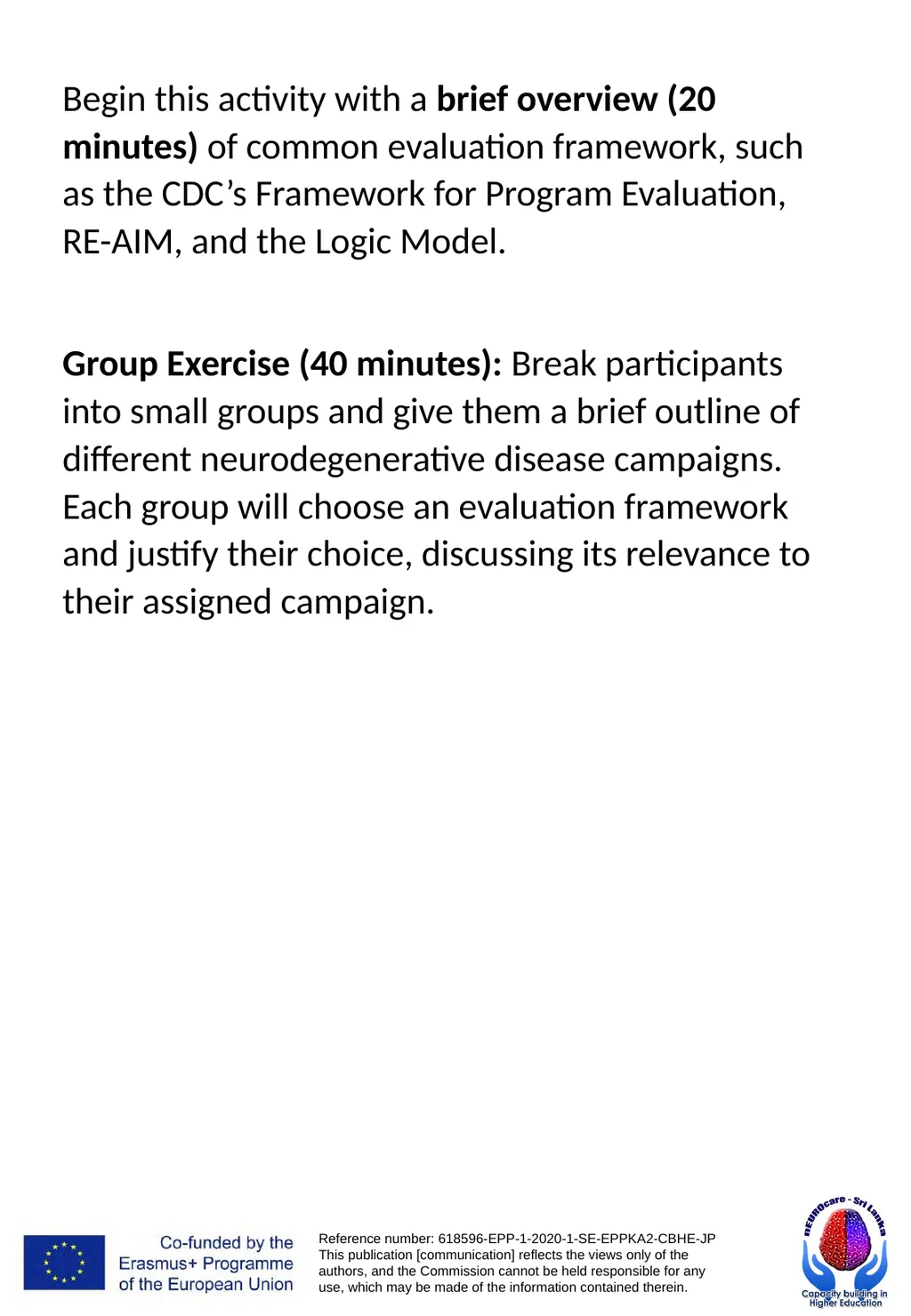
Activity Begin this activity with a brief overview (20 minutes) of common evaluation framework, such as the CDC’s Framework for Program Evaluation, RE-AIM, and the Logic Model.
Group Exercise (40 minutes): Break participants into small groups and give them a brief outline of different neurodegenerative disease campaigns. Each group will choose an evaluation framework and justify their choice, discussing its relevance to their assigned campaign.<br>
Group Exercise (40 minutes): Break participants into small groups and give them a brief outline of different neurodegenerative disease campaigns. Each group will choose an evaluation framework and justify their choice, discussing its relevance to their assigned campaign.<br>
63
Data Collection and Analysis
Activity 2
60 minutes<br>
Activity 2
60 minutes<br>
64
Activity 2 Begin this activity with a discussion (15 minutes) regarding methods for data collection, including surveys, focus groups, interviews, and observational studies. Emphasize on the pros and cons of each method and how it can be used in different contexts. Also it is important to discuss how results will be analysed so students can become aware of the relationship between instruments and subsequent analyses. Also it is important to discuss how results wi
Practical Workshop (45 minutes): Participants will develop data collection instruments, such as questionnaires and interview guides, tailored to a fictional health campaign focusing on a specific neurodegenerative disease.<br>
Practical Workshop (45 minutes): Participants will develop data collection instruments, such as questionnaires and interview guides, tailored to a fictional health campaign focusing on a specific neurodegenerative disease.<br>
65
Interpreting Results
Activity 3
60 minutes<br>
Activity 3
60 minutes<br>
66
Activity (20min) The first part of this activity is a Workshop (30 minutes), where participants will be provided with sets of data from fictional campaign evaluations. They will work in groups to interpret these data, draw conclusions, and prepare key insights.
Case Study Discussion (30 minutes): Participants will be asked to review real-life examples of health communication program evaluations that led to successful refinements and outcomes.<br>
Case Study Discussion (30 minutes): Participants will be asked to review real-life examples of health communication program evaluations that led to successful refinements and outcomes.<br>
67
Making Refinements Activity 4
60 minutes<br>
60 minutes<br>
68
Activity 1 Begin this activity with a brief Strategy Session (15 minutes) where the group discusses continuous quality improvement cycles and how to implement them in health programs.
Group Work (45 minutes): Using hypothetical evaluation results, groups will draft a plan for refining an existing health communication campaign, focusing on neurodegenerative diseases.<br>
Group Work (45 minutes): Using hypothetical evaluation results, groups will draft a plan for refining an existing health communication campaign, focusing on neurodegenerative diseases.<br>
69
Reporting and Dissemination
Activity 5
60 minutes<br>
Activity 5
60 minutes<br>
70
Activity Start this activity with a brief overview (15 minutes) of key elements of a good evaluation report and tips for effective dissemination of findings.
Continue with a writing exercise (45 minutes) where participants will outline an evaluation report, highlighting methodology, key findings, implications, and recommendations.<br>
Continue with a writing exercise (45 minutes) where participants will outline an evaluation report, highlighting methodology, key findings, implications, and recommendations.<br>
71
Conclusion and Q&A (15 minutes) Recap of the workshop's key takeaways
Open floor for questions, discussions, and sharing personal experiences. Wrap-up and Q & A
30 minutes<br>
Open floor for questions, discussions, and sharing personal experiences. Wrap-up and Q & A
30 minutes<br>