
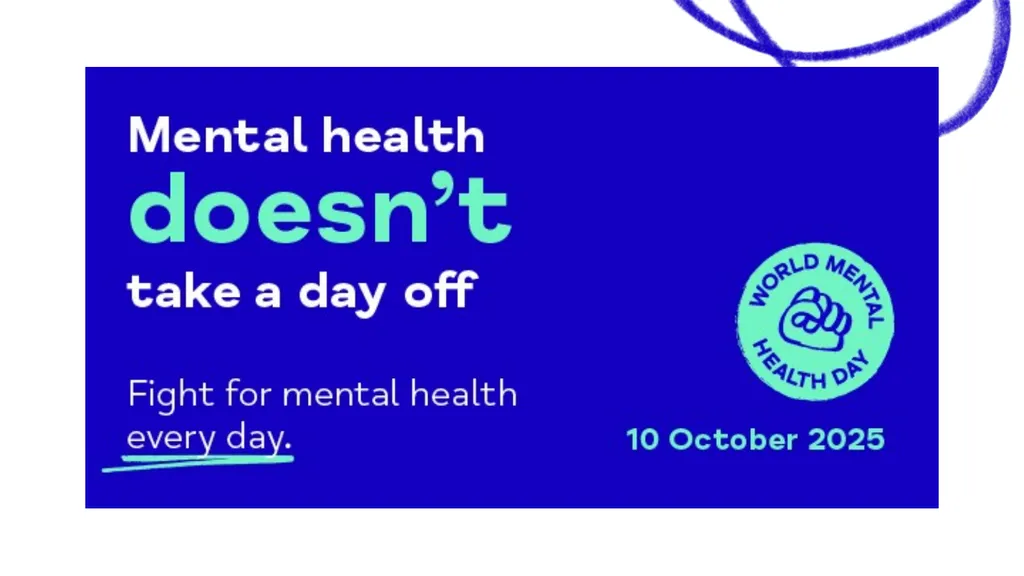
World Mental Health Day 10 October 2025 No mind
MY
Published · 36 slides · 0 views

1 / 1



Description
World Mental Health Day 10 October 2025 No mind left behind Mind is a charity who work to make sure everybody can get the support they need. Information and advice for young people aged 11-18. www.mind.org.ukfor-young-people Ground rules
Related Topics
Share
Embed code
Download this presentation From Below
"World Mental Health Day 10 October 2025 No mind" is the property of its rightful owner. Permission is granted to download and print the materials on this website for personal, non-commercial use only, and to display it on your personal computer provided you do not modify the materials and that you retain all copyright notices contained in the materials. By downloading content from our website, you accept the terms of this agreement.
Presentation Transcript
01
World Mental Health Day 10 October 2025<br>
02
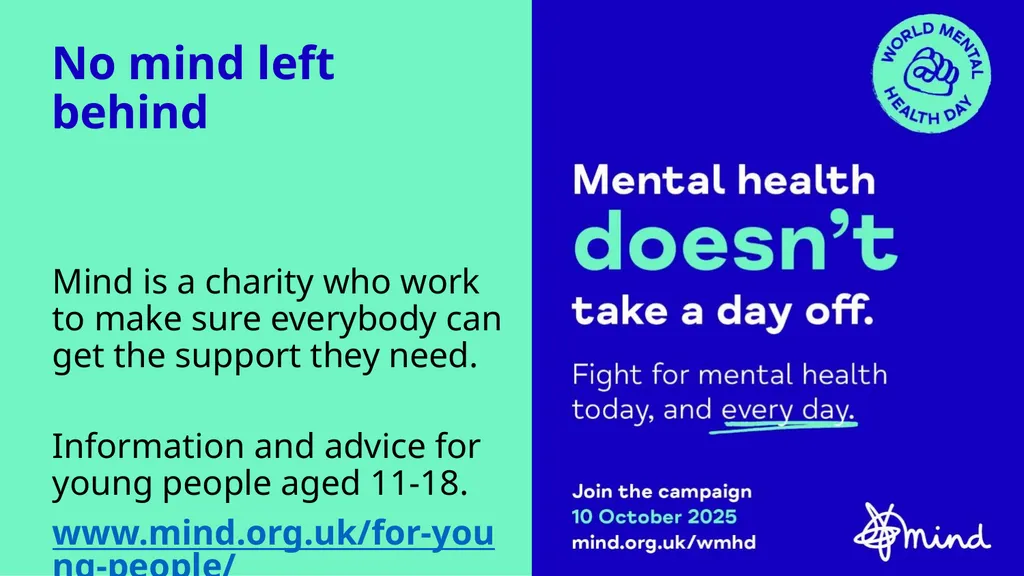
No mind left behind Mind is a charity who work to make sure everybody can get the support they need.
Information and advice for young people aged 11-18.
www.mind.org.uk/for-young-people/<br>
Information and advice for young people aged 11-18.
www.mind.org.uk/for-young-people/<br>
03
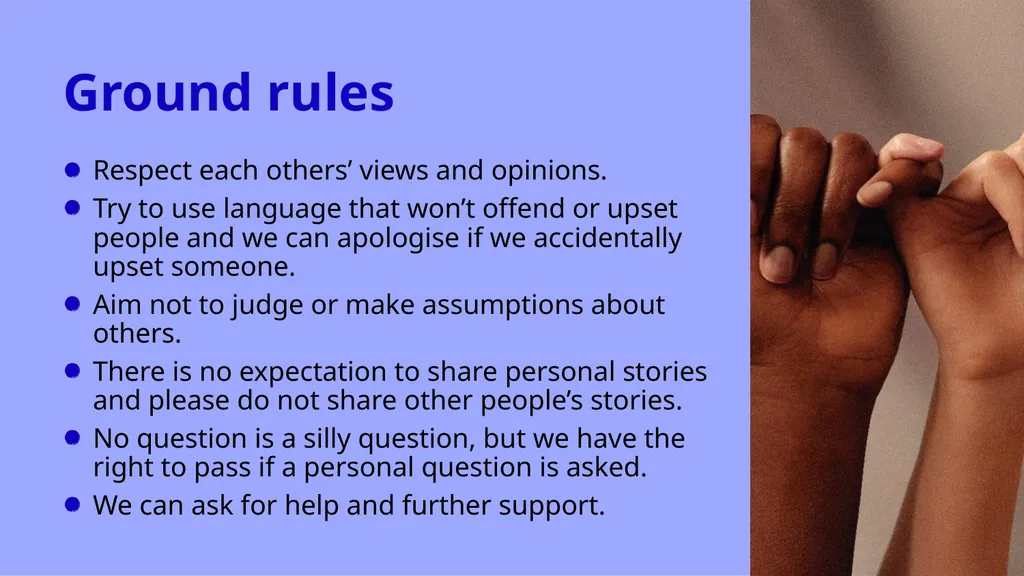
Ground rules Respect each others’ views and opinions.
Try to use language that won’t offend or upset people and we can apologise if we accidentally upset someone.
Aim not to judge or make assumptions about others.
There is no expectation to share personal stories and please do not share other people’s stories.
No question is a silly question, but we have the right to pass if a personal question is asked.
We can ask for help and further support.<br>
04
Mental Health Awareness Learning objective: To learn how mental health is an important part of life, when and how to get support. Learning outcomes: You will be able to:
explain how mental health impacts, and is impacted by, many other areas of life.
recognise when and why we might seek support for our mental health.
identify possible barriers to seeking support, and what could reduce these.
explain what support is available and how to access it.<br>
explain how mental health impacts, and is impacted by, many other areas of life.
recognise when and why we might seek support for our mental health.
identify possible barriers to seeking support, and what could reduce these.
explain what support is available and how to access it.<br>
05
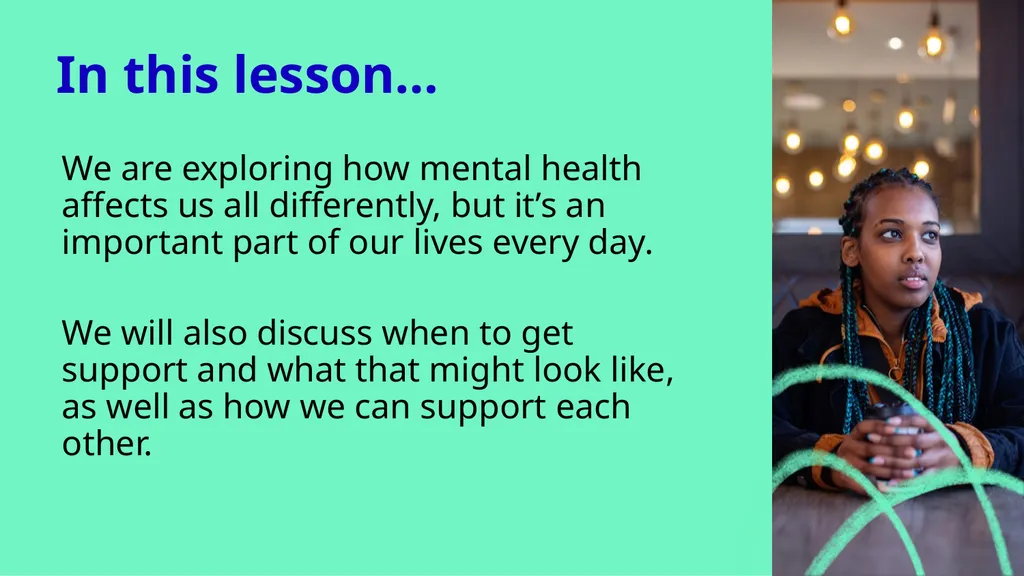
In this lesson… We are exploring how mental health affects us all differently, but it’s an important part of our lives every day.
We will also discuss when to get support and what that might look like, as well as how we can support each other.<br>
We will also discuss when to get support and what that might look like, as well as how we can support each other.<br>
06
Mental health is about how we think, feel and act.
Just like physical health, we all have mental health and need to take care of it.
Our mental health changes all the time and can range from good to poor. Mental health<br>
Just like physical health, we all have mental health and need to take care of it.
Our mental health changes all the time and can range from good to poor. Mental health<br>
07
Good mental health means we generally feel able to cope. We can think about things in a calm way. And we’re able to understand and express our emotions in helpful ways. Poor mental health means that the way we think, feel or behave is difficult to cope with. We might stop enjoying things. Or we might not want to be around people as much. It can look different for everyone.<br>
08
Mental health doesn’t take a day off. What does this statement mean to you?
What thoughts, images and ideas do you have?<br>
What thoughts, images and ideas do you have?<br>
09
Mental health can be connected to… physical health relationships money ? school sleep socialising news stories<br>
10
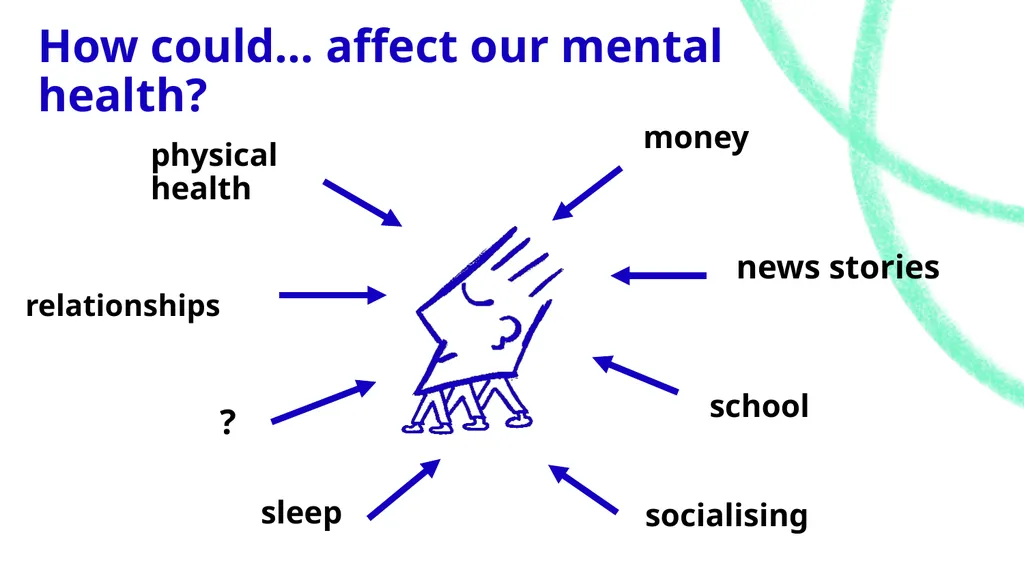
physical health relationships money ? school sleep socialising news stories How could… affect our mental health?<br>
11
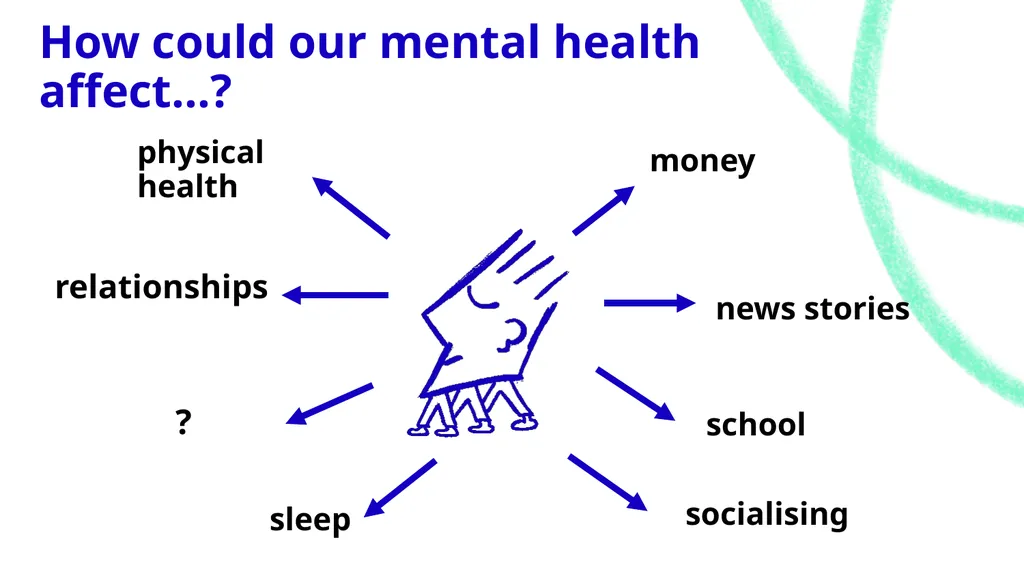
physical health relationships money ? school sleep socialising news stories How could our mental health affect…?<br>
12
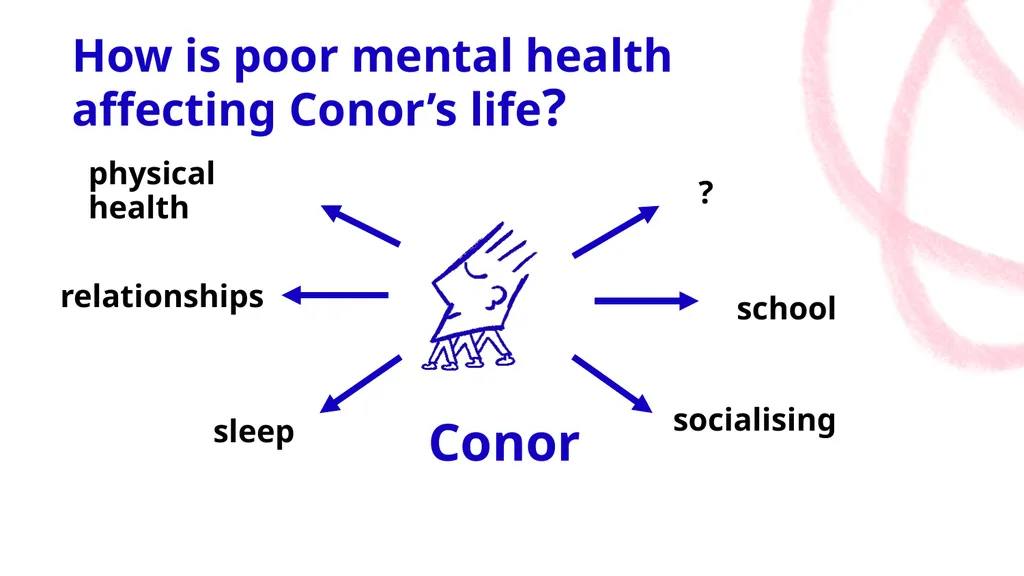
Conor Conor has been feeling ‘low’ for a while now. Things that used to feel fun and enjoyable now just feel like a hassle, and he doesn’t have the energy to do anything much. He’s stopped going to football club, and out with his friends.
Now, he spends most of his time indoors and keeps missing school days. He finds it hard to fall asleep, and although he feels tired a lot, doesn’t go to bed until late. His mum has noticed and said he is getting lazy. Conor isn’t being lazy - he’s just finding it hard to cope with everyday things.<br>
Now, he spends most of his time indoors and keeps missing school days. He finds it hard to fall asleep, and although he feels tired a lot, doesn’t go to bed until late. His mum has noticed and said he is getting lazy. Conor isn’t being lazy - he’s just finding it hard to cope with everyday things.<br>
13
Conor physical health socialising sleep school relationships ? How is poor mental health affecting Conor’s life?<br>
14
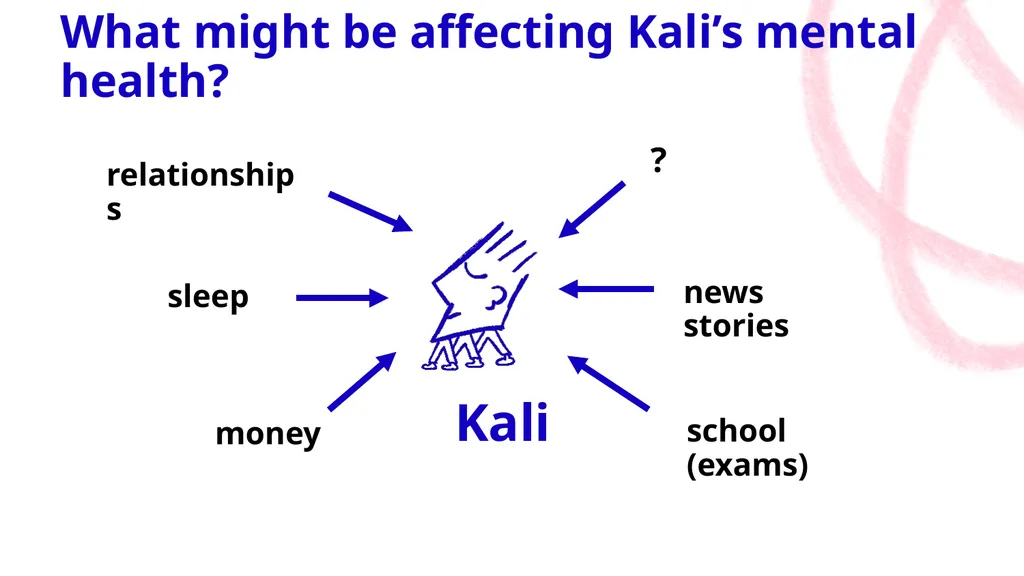
Kali Kali’s family life used to be so much fun - days out, holidays, and shopping trips. Now her dad has lost his job and there isn’t the money. Kali’s parents argue a lot, even though they didn’t use to. On top of that, the news stories are full of awful things about the world… and she has exams coming soon too! Kali is worrying so much about the future that it is all she can think about. She can’t sleep because she is up worrying at night, and finds it hard to go out and do things because she is worried about what might happen.<br>
15
Kali money news stories sleep ? relationships What might be affecting Kali’s mental health? school (exams)<br>
16
Knowing when to get support Everyone can feel sad, worried, angry or fed up at times. But sometimes we might need more help.
For example, if the feelings:
have lasted for a while
affect us most days
stop us from doing the things we enjoy
make us feel like we can't cope.
You do not have to wait for things to get worse to ask for support!<br>
For example, if the feelings:
have lasted for a while
affect us most days
stop us from doing the things we enjoy
make us feel like we can't cope.
You do not have to wait for things to get worse to ask for support!<br>
17
Why might we find it hard to ask for support?<br>
18
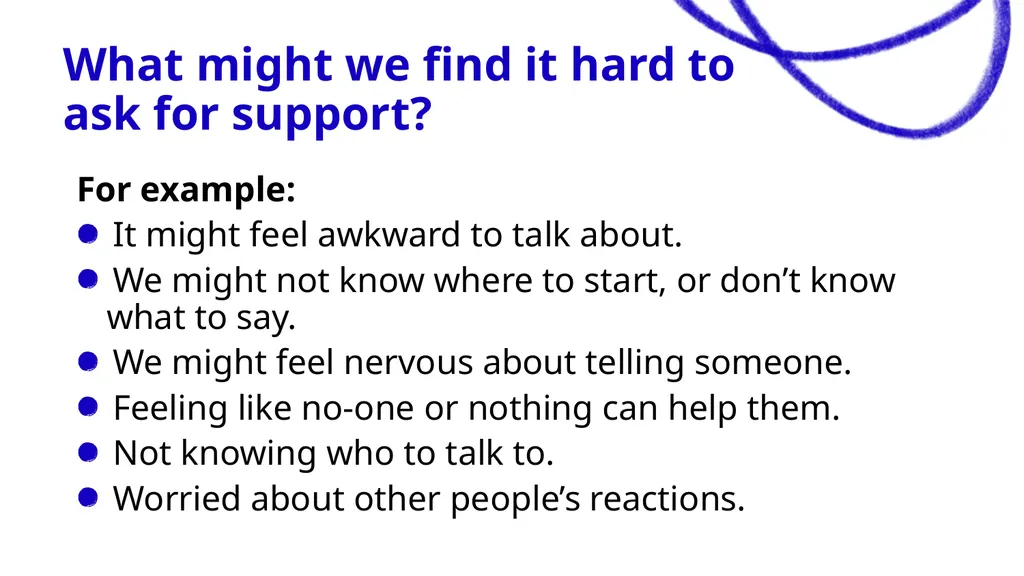
What might we find it hard to ask for support? For example:
It might feel awkward to talk about.
We might not know where to start, or don’t know what to say.
We might feel nervous about telling someone.
Feeling like no-one or nothing can help them.
Not knowing who to talk to.
Worried about other people’s reactions.<br>
It might feel awkward to talk about.
We might not know where to start, or don’t know what to say.
We might feel nervous about telling someone.
Feeling like no-one or nothing can help them.
Not knowing who to talk to.
Worried about other people’s reactions.<br>
19
What could help us ask for support?<br>
20
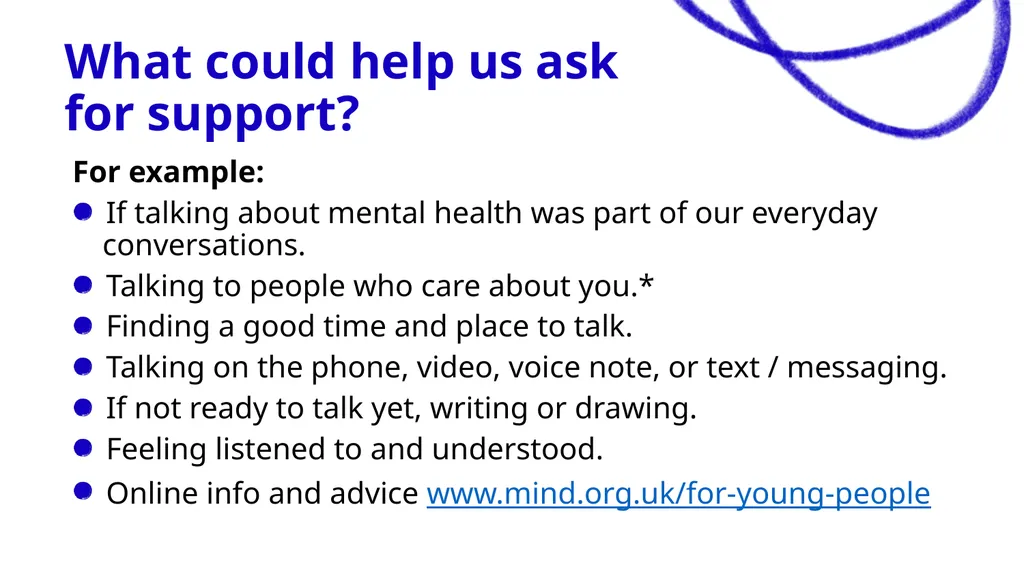
What could help us ask for support? For example:
If talking about mental health was part of our everyday conversations.
Talking to people who care about you.*
Finding a good time and place to talk.
Talking on the phone, video, voice note, or text / messaging.
If not ready to talk yet, writing or drawing.
Feeling listened to and understood.
Online info and advice www.mind.org.uk/for-young-people<br>
21
Online and text support Phone: 0800 1111
www.childline.org.uk
Free, confidential, 24-hour, online, text or phone support. Text ‘SHOUT’ to 85258
Free, confidential, 24-hour, text support.<br>
www.childline.org.uk
Free, confidential, 24-hour, online, text or phone support. Text ‘SHOUT’ to 85258
Free, confidential, 24-hour, text support.<br>
22
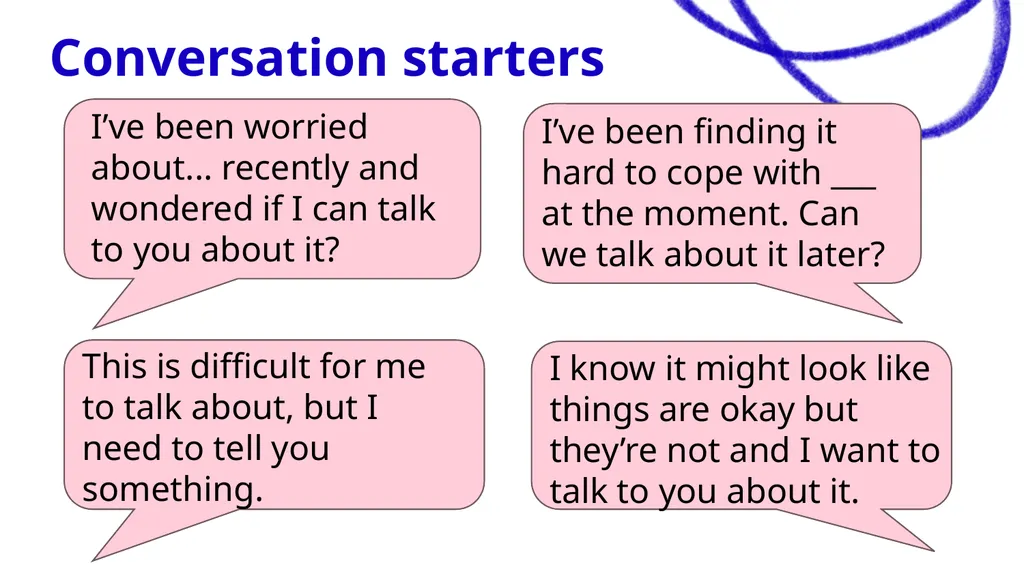
Conversation starters This is difficult for me to talk about, but I need to tell you something. I’ve been worried about... recently and wondered if I can talk to you about it? I’ve been finding it hard to cope with ___ at the moment. Can we talk about it later? I know it might look like things are okay but they’re not and I want to talk to you about it.<br>
23
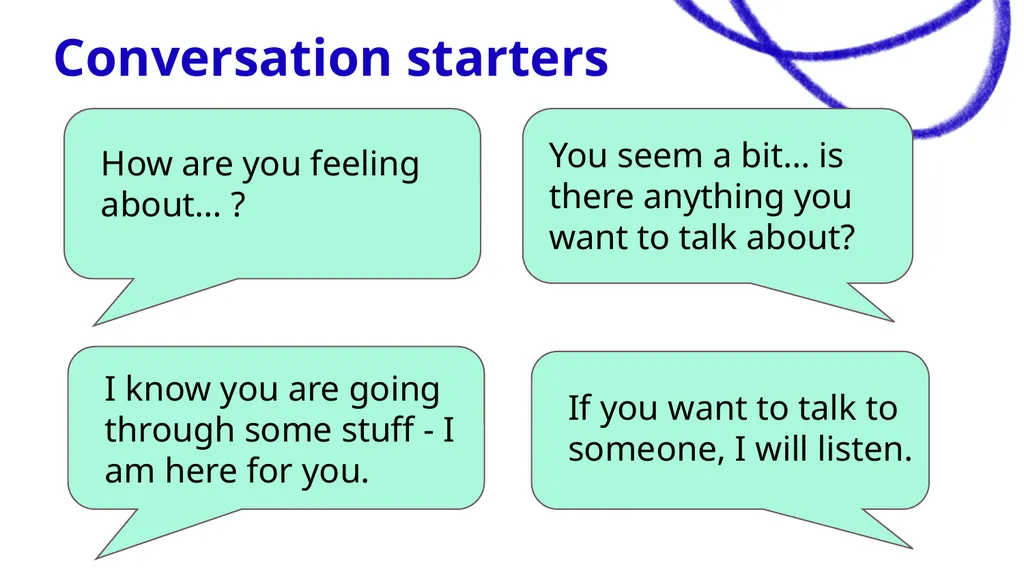
Conversation starters I know you are going through some stuff - I am here for you. How are you feeling
about… ? You seem a bit… is there anything you want to talk about? If you want to talk to someone, I will listen.<br>
about… ? You seem a bit… is there anything you want to talk about? If you want to talk to someone, I will listen.<br>
24
Information and resources
for teachers<br>
25
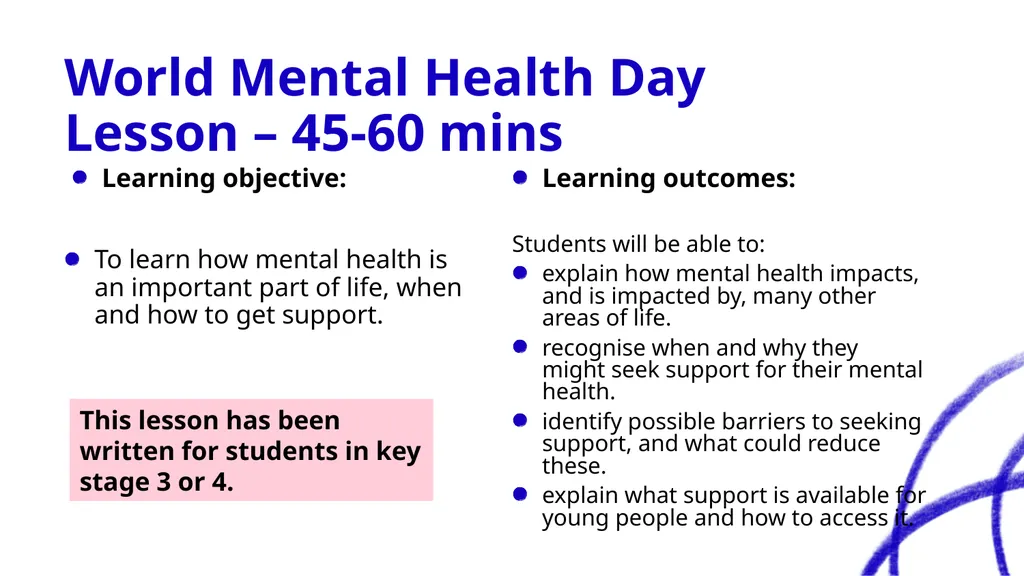
World Mental Health Day
Lesson – 45-60 mins Learning outcomes: Students will be able to:
explain how mental health impacts, and is impacted by, many other areas of life.
recognise when and why they might seek support for their mental health.
identify possible barriers to seeking support, and what could reduce these.
explain what support is available for young people and how to access it. Learning objective: To learn how mental health is an important part of life, when and how to get support. This lesson has been written for students in key stage 3 or 4.<br>
26
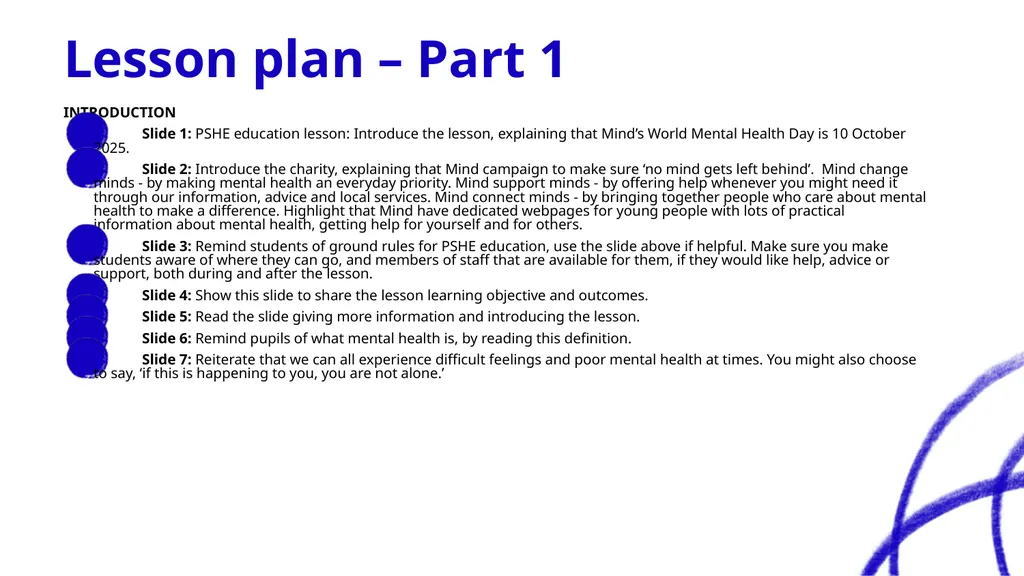
Lesson plan – Part 1 INTRODUCTION
Slide 1: PSHE education lesson: Introduce the lesson, explaining that Mind’s World Mental Health Day is 10 October 2025.
Slide 2: Introduce the charity, explaining that Mind campaign to make sure ‘no mind gets left behind’. Mind change minds - by making mental health an everyday priority. Mind support minds - by offering help whenever you might need it through our information, advice and local services. Mind connect minds - by bringing together people who care about mental health to make a difference. Highlight that Mind have dedicated webpages for young people with lots of practical information about mental health, getting help for yourself and for others.
Slide 3: Remind students of ground rules for PSHE education, use the slide above if helpful. Make sure you make students aware of where they can go, and members of staff that are available for them, if they would like help, advice or support, both during and after the lesson.
Slide 4: Show this slide to share the lesson learning objective and outcomes.
Slide 5: Read the slide giving more information and introducing the lesson.
Slide 6: Remind pupils of what mental health is, by reading this definition.
Slide 7: Reiterate that we can all experience difficult feelings and poor mental health at times. You might also choose to say, ‘if this is happening to you, you are not alone.’<br>
27
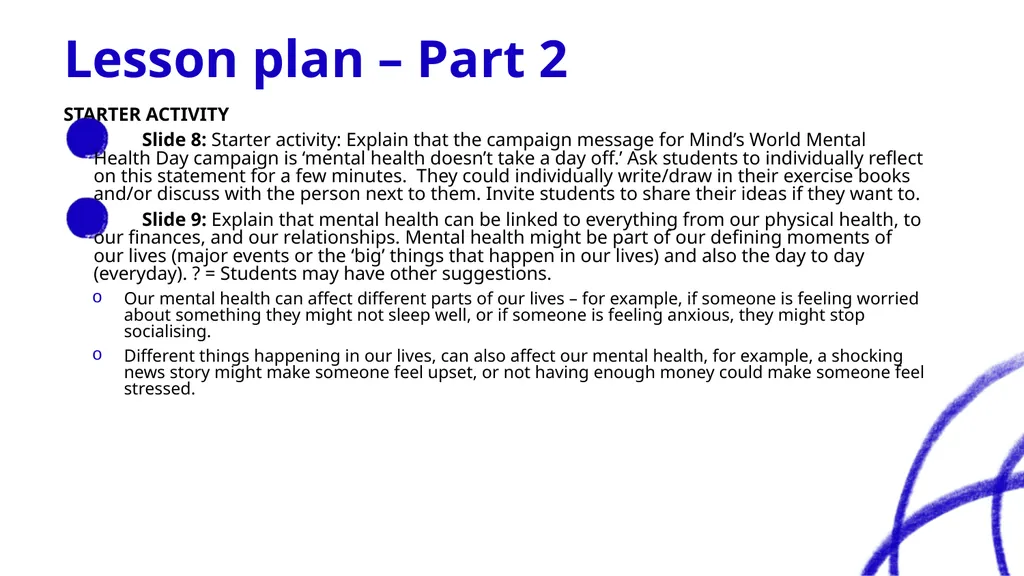
Lesson plan – Part 2 STARTER ACTIVITY
Slide 8: Starter activity: Explain that the campaign message for Mind’s World Mental Health Day campaign is ‘mental health doesn’t take a day off.’ Ask students to individually reflect on this statement for a few minutes. They could individually write/draw in their exercise books and/or discuss with the person next to them. Invite students to share their ideas if they want to.
Slide 9: Explain that mental health can be linked to everything from our physical health, to our finances, and our relationships. Mental health might be part of our defining moments of our lives (major events or the ‘big’ things that happen in our lives) and also the day to day (everyday). ? = Students may have other suggestions.
Our mental health can affect different parts of our lives – for example, if someone is feeling worried about something they might not sleep well, or if someone is feeling anxious, they might stop socialising.
Different things happening in our lives, can also affect our mental health, for example, a shocking news story might make someone feel upset, or not having enough money could make someone feel stressed.<br>
28
Lesson plan – Part 3 MAIN ACTIVITY 1
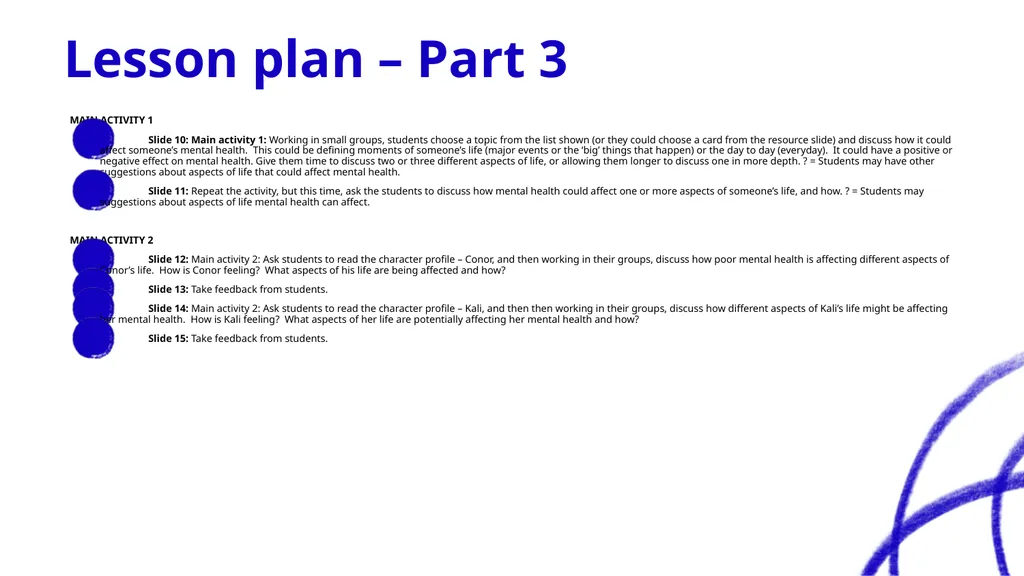
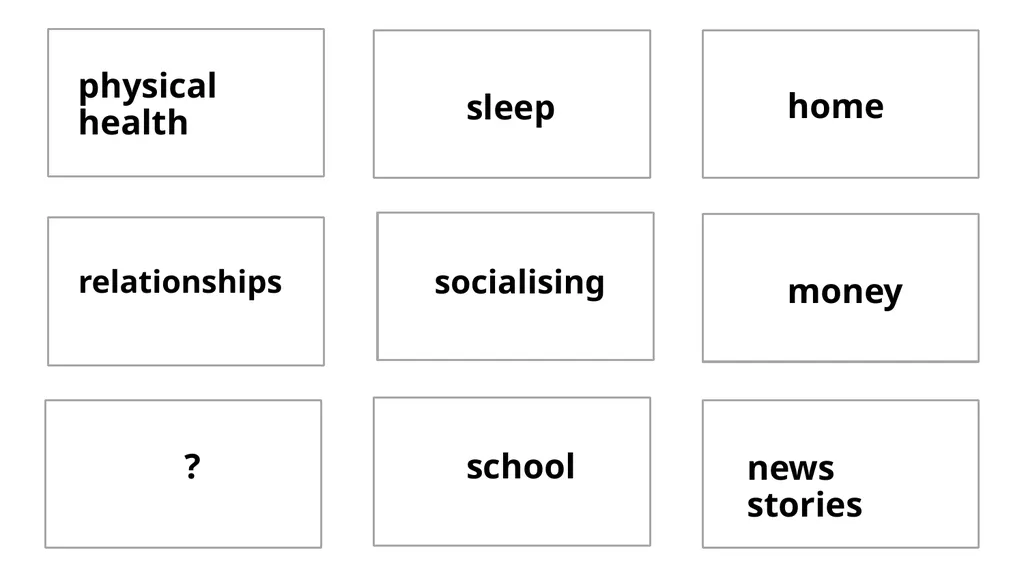
Slide 10: Main activity 1: Working in small groups, students choose a topic from the list shown (or they could choose a card from the resource slide) and discuss how it could affect someone’s mental health. This could be defining moments of someone’s life (major events or the ‘big’ things that happen) or the day to day (everyday). It could have a positive or negative effect on mental health. Give them time to discuss two or three different aspects of life, or allowing them longer to discuss one in more depth. ? = Students may have other suggestions about aspects of life that could affect mental health.
Slide 11: Repeat the activity, but this time, ask the students to discuss how mental health could affect one or more aspects of someone’s life, and how. ? = Students may suggestions about aspects of life mental health can affect.
MAIN ACTIVITY 2
Slide 12: Main activity 2: Ask students to read the character profile – Conor, and then working in their groups, discuss how poor mental health is affecting different aspects of Conor’s life. How is Conor feeling? What aspects of his life are being affected and how?
Slide 13: Take feedback from students.
Slide 14: Main activity 2: Ask students to read the character profile – Kali, and then then working in their groups, discuss how different aspects of Kali’s life might be affecting her mental health. How is Kali feeling? What aspects of her life are potentially affecting her mental health and how?
Slide 15: Take feedback from students.<br>
29
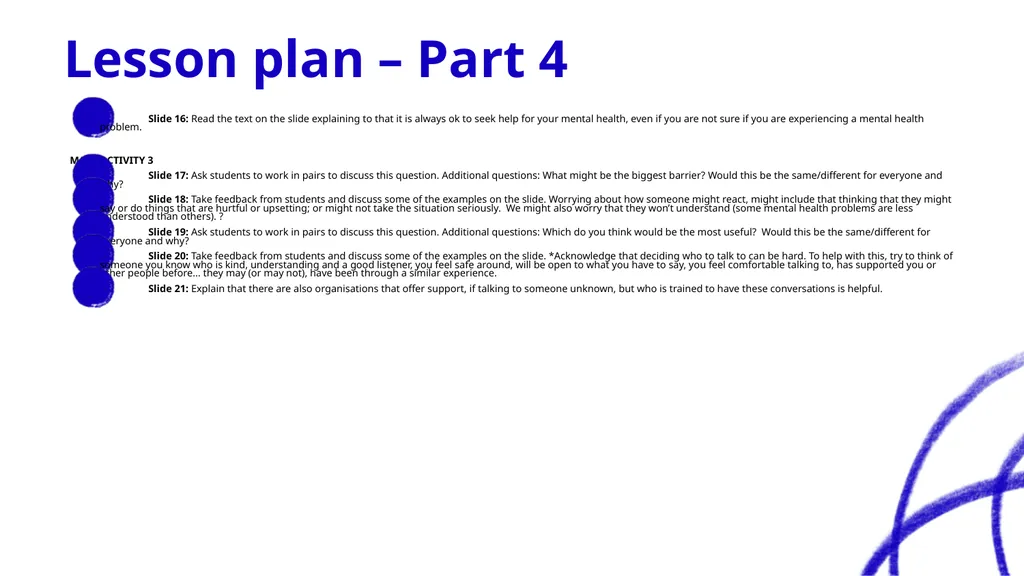
Lesson plan – Part 4 Slide 16: Read the text on the slide explaining to that it is always ok to seek help for your mental health, even if you are not sure if you are experiencing a mental health problem.
MAIN ACTIVITY 3
Slide 17: Ask students to work in pairs to discuss this question. Additional questions: What might be the biggest barrier? Would this be the same/different for everyone and why?
Slide 18: Take feedback from students and discuss some of the examples on the slide. Worrying about how someone might react, might include that thinking that they might say or do things that are hurtful or upsetting; or might not take the situation seriously. We might also worry that they won’t understand (some mental health problems are less understood than others). ?
Slide 19: Ask students to work in pairs to discuss this question. Additional questions: Which do you think would be the most useful? Would this be the same/different for everyone and why?
Slide 20: Take feedback from students and discuss some of the examples on the slide. *Acknowledge that deciding who to talk to can be hard. To help with this, try to think of someone you know who is kind, understanding and a good listener, you feel safe around, will be open to what you have to say, you feel comfortable talking to, has supported you or other people before… they may (or may not), have been through a similar experience.
Slide 21: Explain that there are also organisations that offer support, if talking to someone unknown, but who is trained to have these conversations is helpful.<br>
30
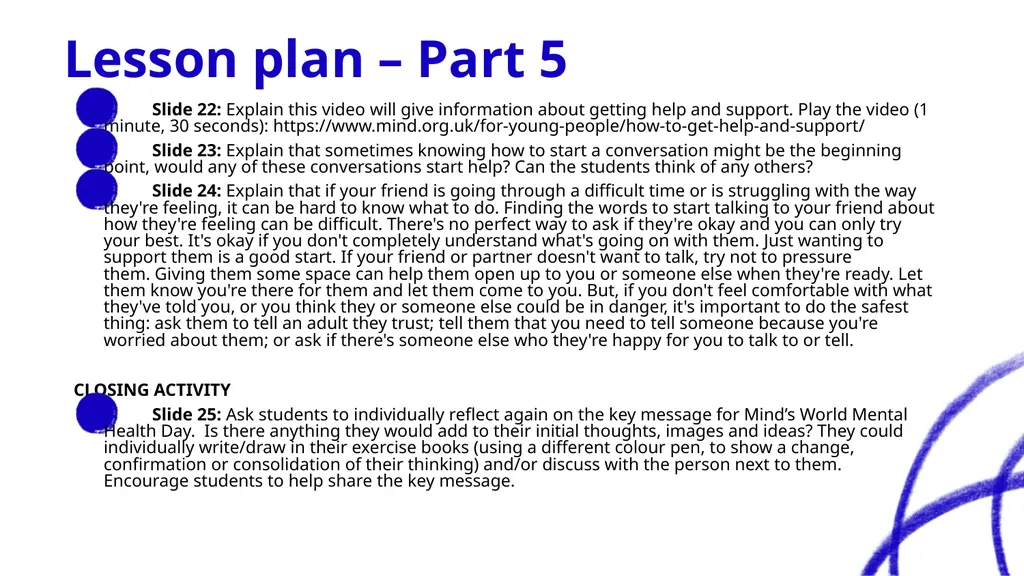
Lesson plan – Part 5 Slide 22: Explain this video will give information about getting help and support. Play the video (1 minute, 30 seconds): https://www.mind.org.uk/for-young-people/how-to-get-help-and-support/
Slide 23: Explain that sometimes knowing how to start a conversation might be the beginning point, would any of these conversations start help? Can the students think of any others?
Slide 24: Explain that if your friend is going through a difficult time or is struggling with the way they're feeling, it can be hard to know what to do. Finding the words to start talking to your friend about how they're feeling can be difficult. There's no perfect way to ask if they're okay and you can only try your best. It's okay if you don't completely understand what's going on with them. Just wanting to support them is a good start. If your friend or partner doesn't want to talk, try not to pressure them. Giving them some space can help them open up to you or someone else when they're ready. Let them know you're there for them and let them come to you. But, if you don't feel comfortable with what they've told you, or you think they or someone else could be in danger, it's important to do the safest thing: ask them to tell an adult they trust; tell them that you need to tell someone because you're worried about them; or ask if there's someone else who they're happy for you to talk to or tell.
CLOSING ACTIVITY
Slide 25: Ask students to individually reflect again on the key message for Mind’s World Mental Health Day. Is there anything they would add to their initial thoughts, images and ideas? They could individually write/draw in their exercise books (using a different colour pen, to show a change, confirmation or consolidation of their thinking) and/or discuss with the person next to them. Encourage students to help share the key message.<br>
31
physical health relationships ? sleep socialising school news stories money home<br>
32
Curriculum Links – secondary Statutory Health Education, Department for Education (DfE)
Mental wellbeing
By the end of secondary school, pupils should know:
how to recognise the early signs of mental wellbeing concerns.
how to critically evaluate when something they do or are involved in has a positive or negative effect on their own or others’ mental health. This lesson helps to address the following statutory requirements, which can be found in full, here.<br>
33
Curriculum Links – KS3 This lesson helps to address the following learning opportunities from the PSHE Association Programme of Study. Self-concept Students learn…
H2. to understand what can affect wellbeing and resilience (e.g. life changes, relationships, achievements and employment).
Health and wellbeing Students learn…
H7. the characteristics of mental and emotional health and strategies for managing these
H10. a range of healthy coping strategies and ways to promote wellbeing and boost mood, including… the value of positive relationships in providing support.
H12. how to recognise when they or others need help with their mental health and wellbeing; sources of help and support and strategies for accessing what they need.<br>
34
Curriculum Links – KS4 This lesson helps to address the following learning opportunities from the PSHE Association Programme of Study. Self-concept Students learn…
H2. how self-confidence, self-esteem, and mental health are affected positively and negatively by internal and external influences and ways of managing this.
Emotional health and wellbeing Students learn…
H6. about change and its impact on mental health and wellbeing and to recognise the need for emotional support during life changes and/or difficult experiences.
H7. a broad range of strategies — cognitive and practical — for promoting their own emotional wellbeing, for avoiding negative thinking and for ways of managing mental health concerns
H8. to recognise warning signs of common mental and emotional health concerns (including stress, anxiety and depression), what might trigger them and what help or treatment is available.
Healthy lifestyles Students learn…
H14. about the health services available to people; strategies to become a confident user of the NHS and other health services; to overcome potential concerns or barriers to seeking help.<br>