
Year 10 To what extent was Anglo-Saxon England
MS
Published · 91 slides · 0 views

1 / 1

Description
Year 10 To what extent was Anglo-Saxon England Egalitarian? 1 Teacher notes Please note that the given tasks are suggestions only. Teachers may wish to make adaptations to suit their cohort. When students are examining images or maps,
Related Topics
Share
Embed code
Download this presentation From Below
"Year 10 To what extent was Anglo-Saxon England" is the property of its rightful owner. Permission is granted to download and print the materials on this website for personal, non-commercial use only, and to display it on your personal computer provided you do not modify the materials and that you retain all copyright notices contained in the materials. By downloading content from our website, you accept the terms of this agreement.
Presentation Transcript
01
Year 10
To what extent was Anglo-Saxon England Egalitarian? 1<br>
To what extent was Anglo-Saxon England Egalitarian? 1<br>
02
Teacher notes Please note that the given tasks are suggestions only. Teachers may wish to make adaptations to suit their cohort.
When students are examining images or maps, please enlarge these so students can see the details.
Each lesson has a vocabulary focus. One is a scripted example for teachers to say to students. The other is a task for students to complete.
Try to make sure that all five stages of vocabulary instruction are used across the unit.
Vocabulary tasks can be completed during any stage of the lesson, so please move the relevant slides to where they best fit within each lesson.
At the end of the lesson, return to the learning question to ensure students are able to answer the question.
For Lesson 5, students are expected to produce an essay in accordance with the Edexcel GCSE specification. 2<br>
03
3 Lesson 1 Learning question
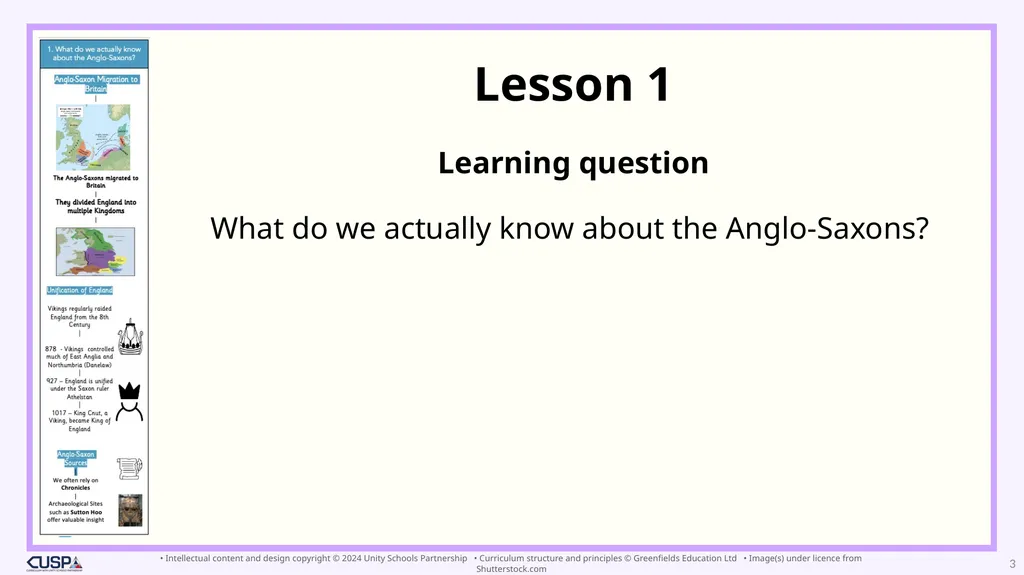
What do we actually know about the Anglo-Saxons?<br>
What do we actually know about the Anglo-Saxons?<br>
04
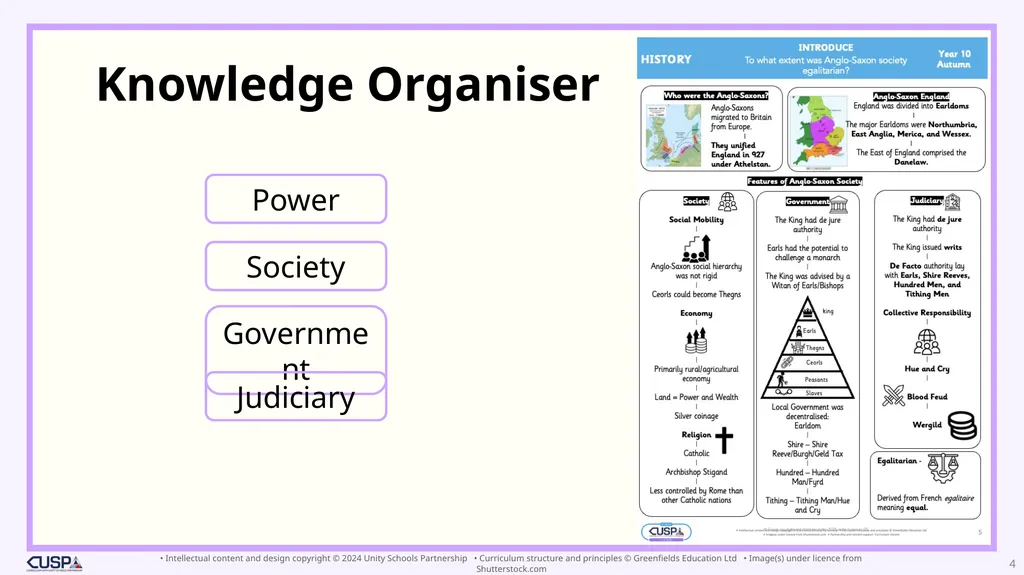
Knowledge Organiser 4 Power Society Government Judiciary<br>
05
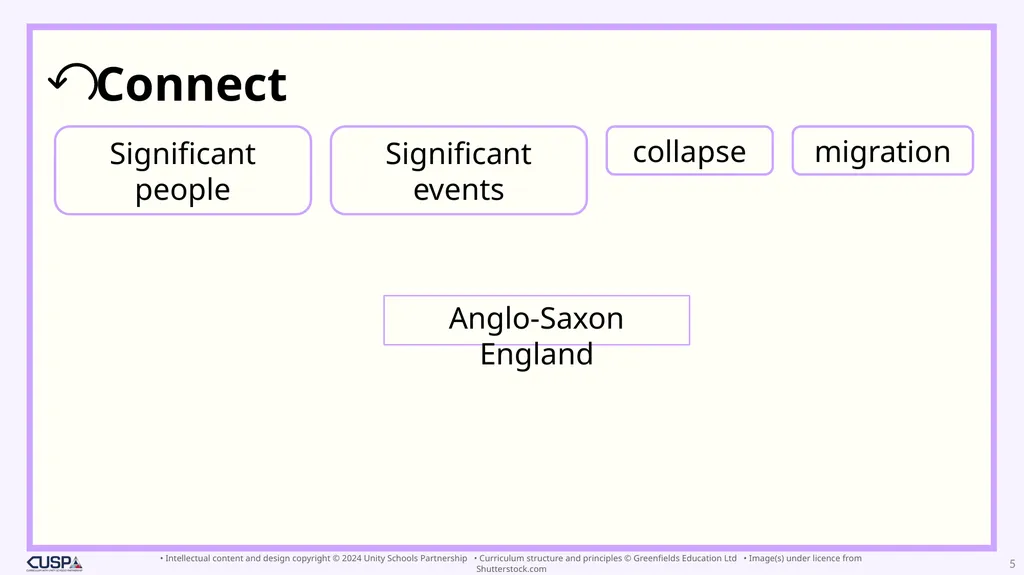
Connect Anglo-Saxon England 5 Significant people Significant events collapse migration<br>
06
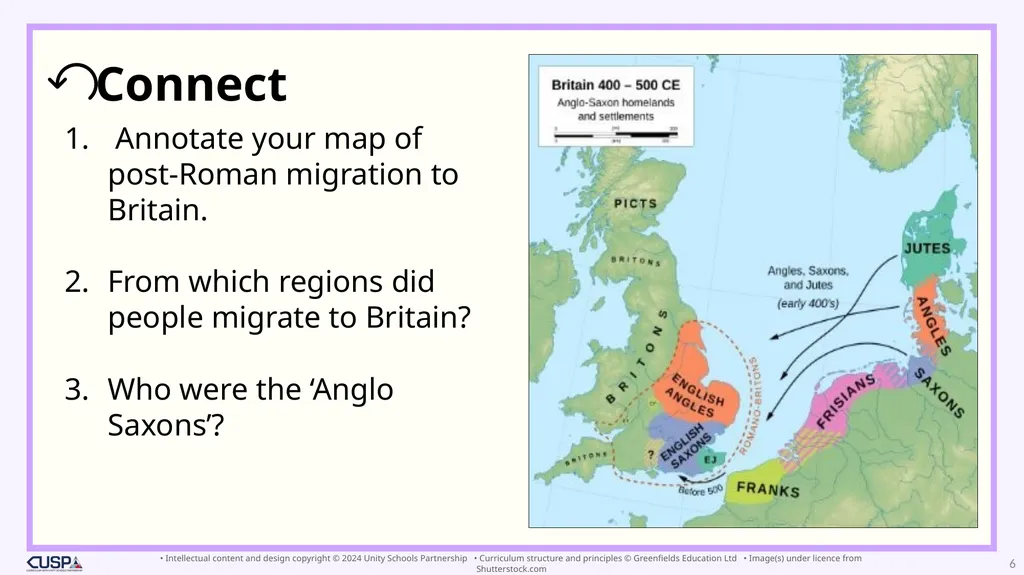
Connect Annotate your map of post-Roman migration to Britain.
From which regions did people migrate to Britain?
Who were the ‘Anglo Saxons’? 6<br>
From which regions did people migrate to Britain?
Who were the ‘Anglo Saxons’? 6<br>
07
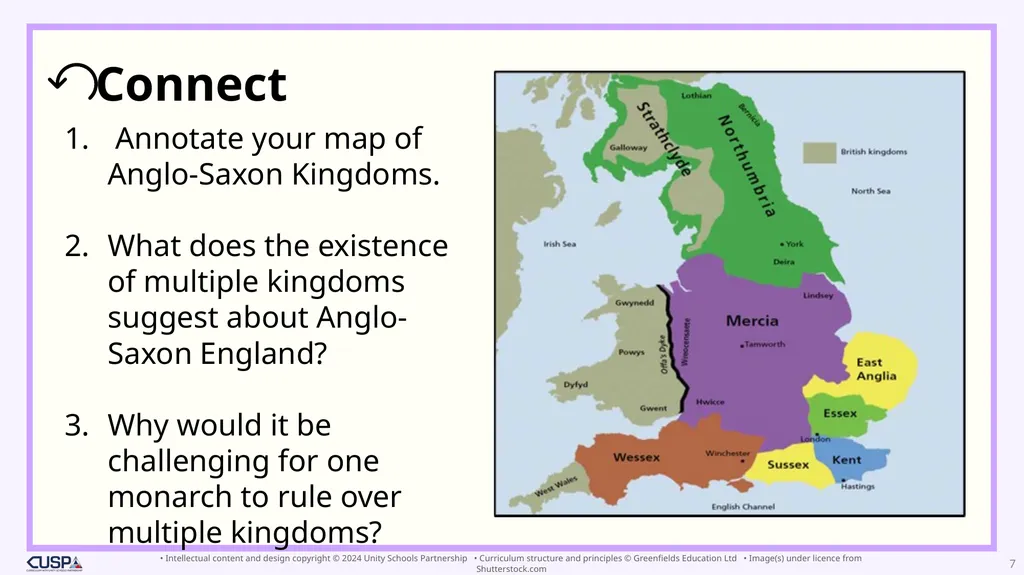
Connect Annotate your map of Anglo-Saxon Kingdoms.
What does the existence of multiple kingdoms suggest about Anglo-Saxon England?
Why would it be challenging for one monarch to rule over multiple kingdoms? 7<br>
What does the existence of multiple kingdoms suggest about Anglo-Saxon England?
Why would it be challenging for one monarch to rule over multiple kingdoms? 7<br>
08
Vocabulary 8<br>
09
Vocabulary – connect Build a pathway connecting words related to Danelaw… Danelaw<br>
10
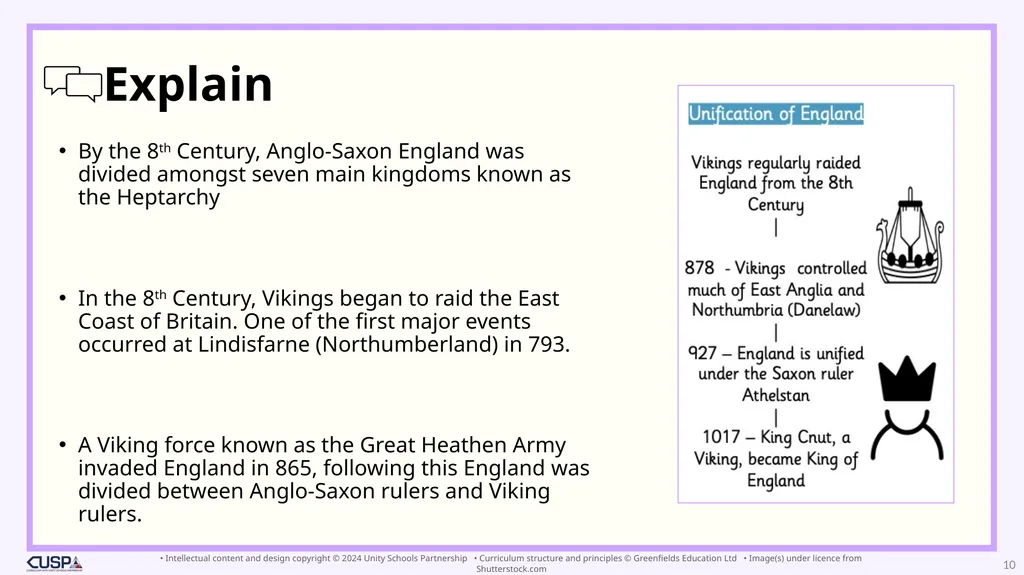
Explain 10 By the 8th Century, Anglo-Saxon England was divided amongst seven main kingdoms known as the Heptarchy
In the 8th Century, Vikings began to raid the East Coast of Britain. One of the first major events occurred at Lindisfarne (Northumberland) in 793.
A Viking force known as the Great Heathen Army invaded England in 865, following this England was divided between Anglo-Saxon rulers and Viking rulers.<br>
11
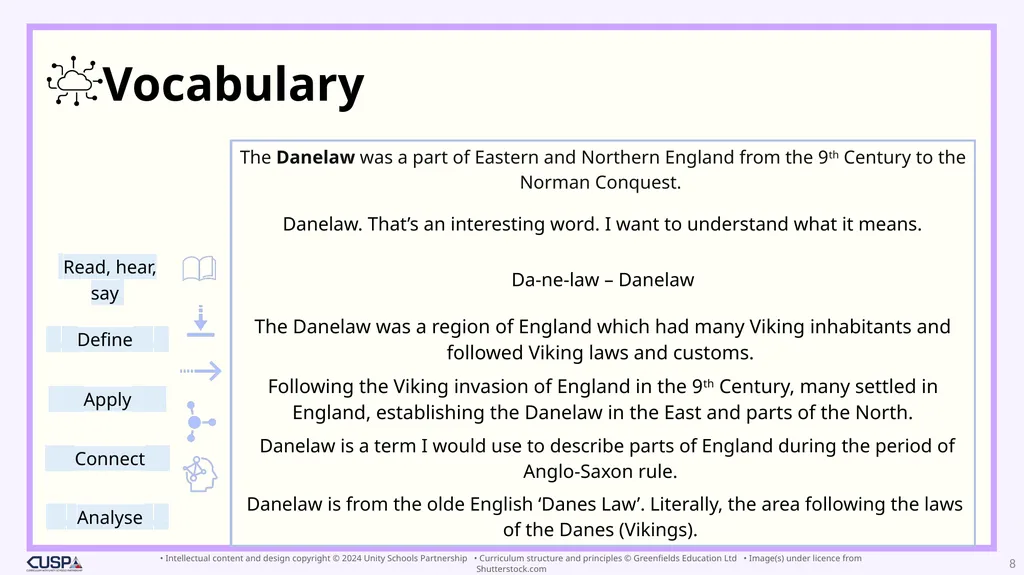
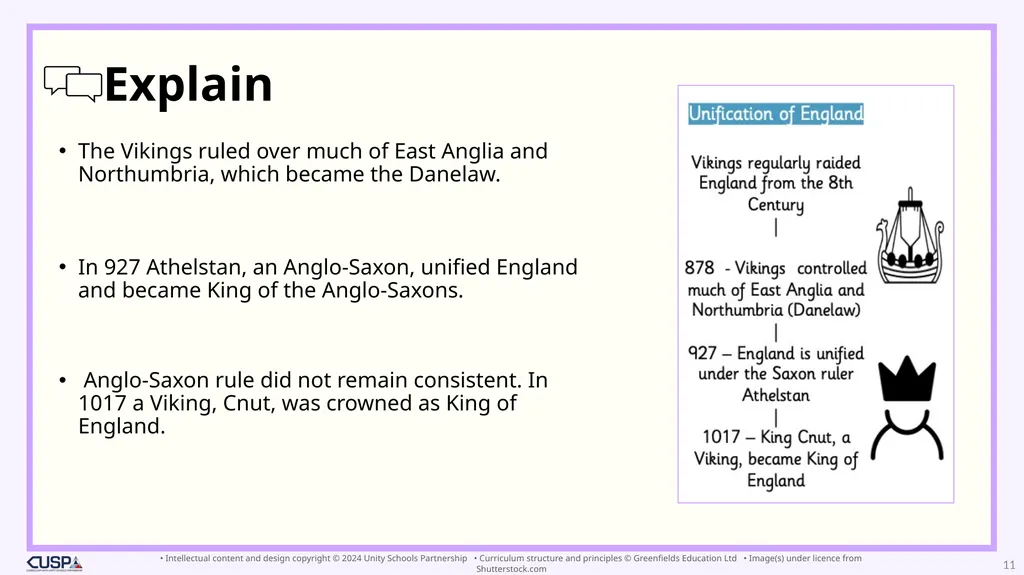
Explain 11 The Vikings ruled over much of East Anglia and Northumbria, which became the Danelaw.
In 927 Athelstan, an Anglo-Saxon, unified England and became King of the Anglo-Saxons.
Anglo-Saxon rule did not remain consistent. In 1017 a Viking, Cnut, was crowned as King of England.<br>
In 927 Athelstan, an Anglo-Saxon, unified England and became King of the Anglo-Saxons.
Anglo-Saxon rule did not remain consistent. In 1017 a Viking, Cnut, was crowned as King of England.<br>
12
Attempt Map out the narrative of Anglo-Saxon England. 12<br>
13
Why would England be a difficult nation to rule for an Anglo-Saxon monarch in 1042? 13 Apply<br>
14
14 This all happened a 1000 years ago, how do we know any of this happened? Explain<br>
15
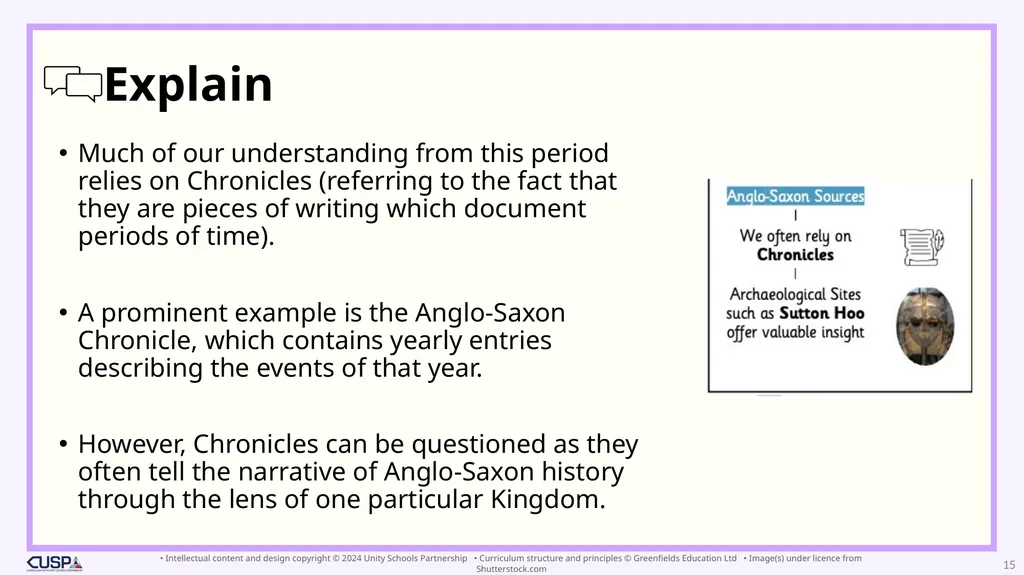
Explain 15 Much of our understanding from this period relies on Chronicles (referring to the fact that they are pieces of writing which document periods of time).
A prominent example is the Anglo-Saxon Chronicle, which contains yearly entries describing the events of that year.
However, Chronicles can be questioned as they often tell the narrative of Anglo-Saxon history through the lens of one particular Kingdom.<br>
A prominent example is the Anglo-Saxon Chronicle, which contains yearly entries describing the events of that year.
However, Chronicles can be questioned as they often tell the narrative of Anglo-Saxon history through the lens of one particular Kingdom.<br>
16
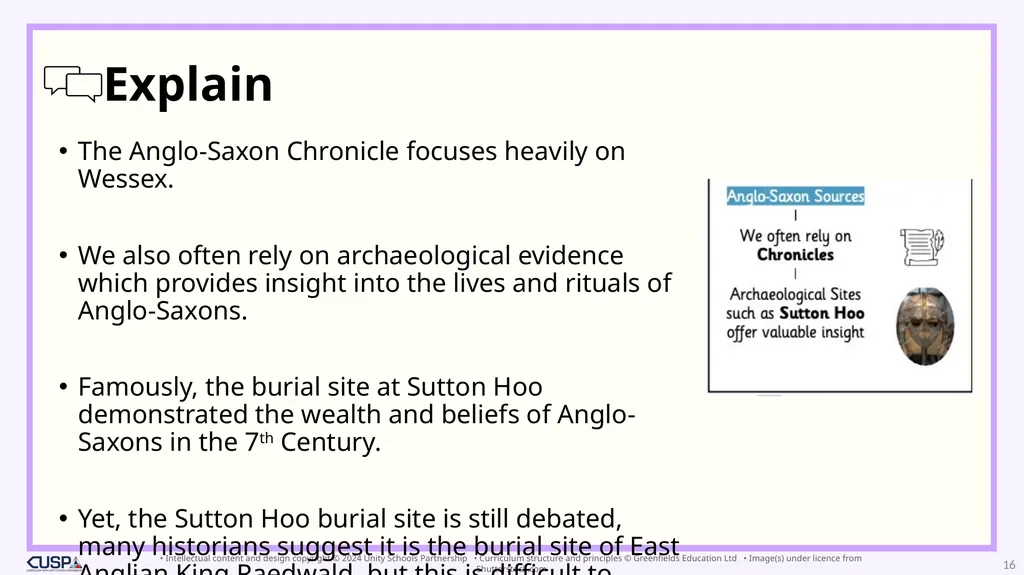
Explain 16 The Anglo-Saxon Chronicle focuses heavily on Wessex.
We also often rely on archaeological evidence which provides insight into the lives and rituals of Anglo-Saxons.
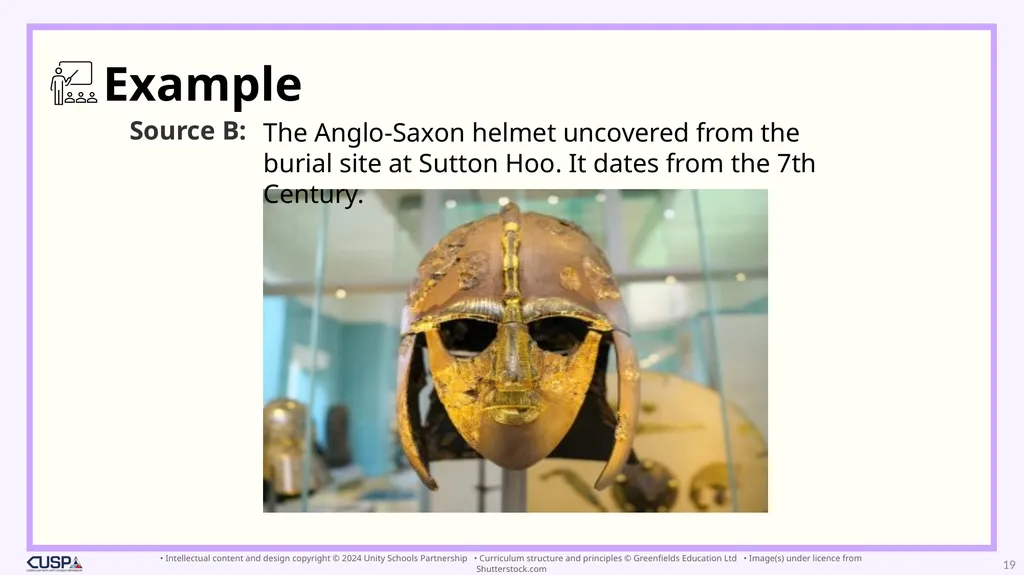
Famously, the burial site at Sutton Hoo demonstrated the wealth and beliefs of Anglo-Saxons in the 7th Century.
Yet, the Sutton Hoo burial site is still debated, many historians suggest it is the burial site of East Anglian King Raedwald, but this is difficult to pinpoint with certainty.<br>
17
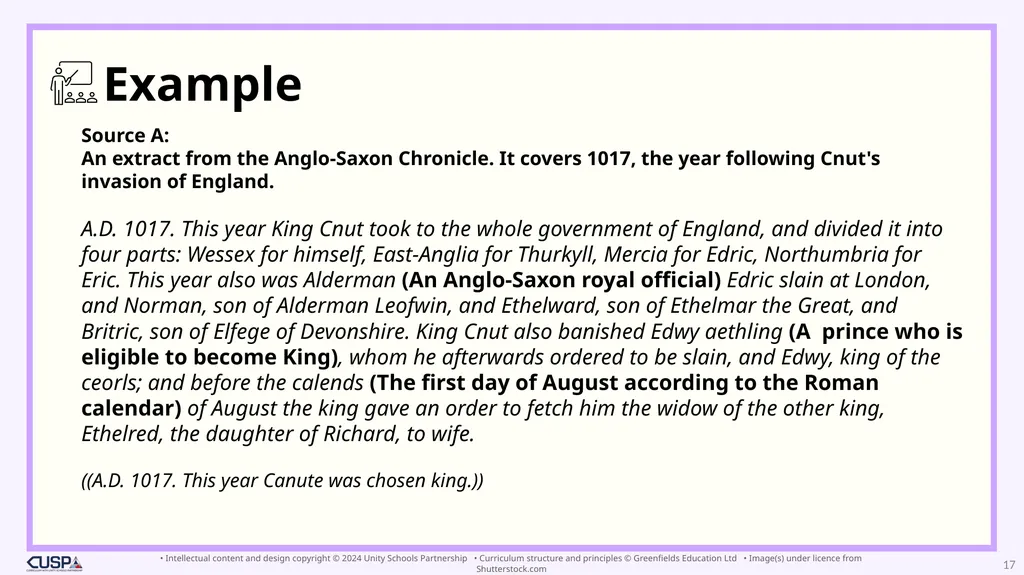
17 Source A:
An extract from the Anglo-Saxon Chronicle. It covers 1017, the year following Cnut's invasion of England.
A.D. 1017. This year King Cnut took to the whole government of England, and divided it into four parts: Wessex for himself, East-Anglia for Thurkyll, Mercia for Edric, Northumbria for Eric. This year also was Alderman (An Anglo-Saxon royal official) Edric slain at London, and Norman, son of Alderman Leofwin, and Ethelward, son of Ethelmar the Great, and Britric, son of Elfege of Devonshire. King Cnut also banished Edwy aethling (A prince who is eligible to become King), whom he afterwards ordered to be slain, and Edwy, king of the ceorls; and before the calends (The first day of August according to the Roman calendar) of August the king gave an order to fetch him the widow of the other king, Ethelred, the daughter of Richard, to wife.
((A.D. 1017. This year Canute was chosen king.)) Example<br>
18
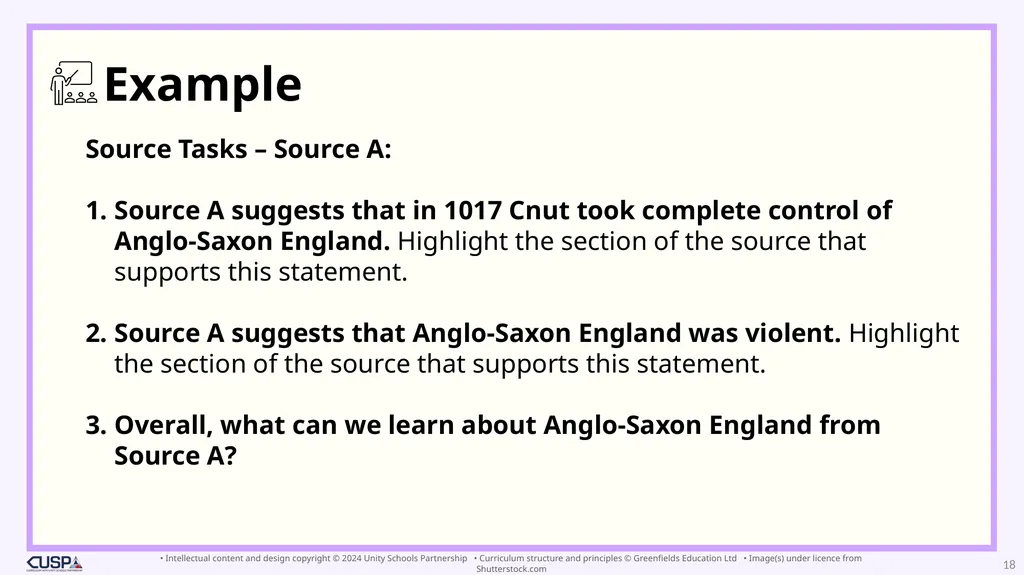
18 Source Tasks – Source A:
Source A suggests that in 1017 Cnut took complete control of Anglo-Saxon England. Highlight the section of the source that supports this statement.
Source A suggests that Anglo-Saxon England was violent. Highlight the section of the source that supports this statement.
Overall, what can we learn about Anglo-Saxon England from Source A? Example<br>
19
19 Example Source B: The Anglo-Saxon helmet uncovered from the burial site at Sutton Hoo. It dates from the 7th Century.<br>
20
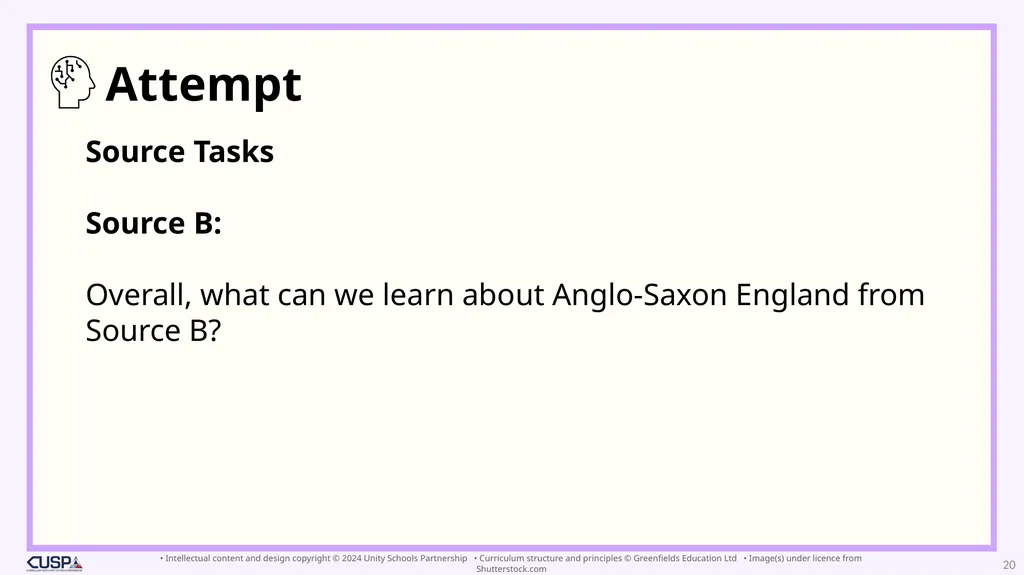
20 Source Tasks
Source B:
Overall, what can we learn about Anglo-Saxon England from Source B? Attempt<br>
Source B:
Overall, what can we learn about Anglo-Saxon England from Source B? Attempt<br>
21
Challenge 21 How do we know about the Anglo-Saxons?'
Why is our knowledge of the Anglo-Saxon period limited to an extent?<br>
Why is our knowledge of the Anglo-Saxon period limited to an extent?<br>
22
22 Is there further information that can be added to your pathway or annotations on your Knowledge Note?
Let’s return to our learning question. What do we actually know about the Anglo-Saxons? Reflection<br>
Let’s return to our learning question. What do we actually know about the Anglo-Saxons? Reflection<br>
23
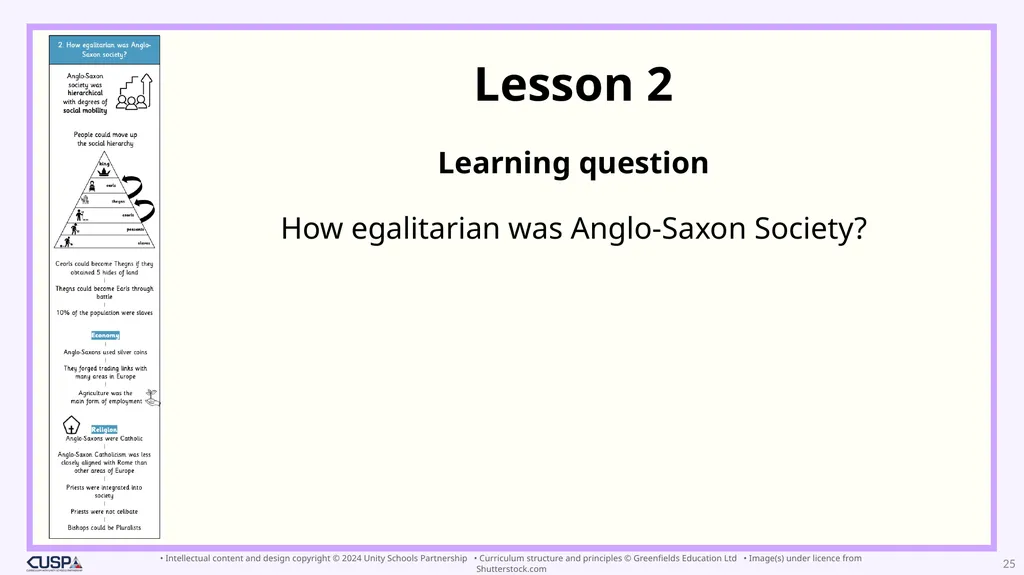
25 Lesson 2 Learning question
How egalitarian was Anglo-Saxon Society?<br>
How egalitarian was Anglo-Saxon Society?<br>
24
Connect What do you now know about the Anglo-Saxons?
Use the following key terms in your answer:
Migration
Danelaw
Unification
Chronicles 26<br>
Use the following key terms in your answer:
Migration
Danelaw
Unification
Chronicles 26<br>
25
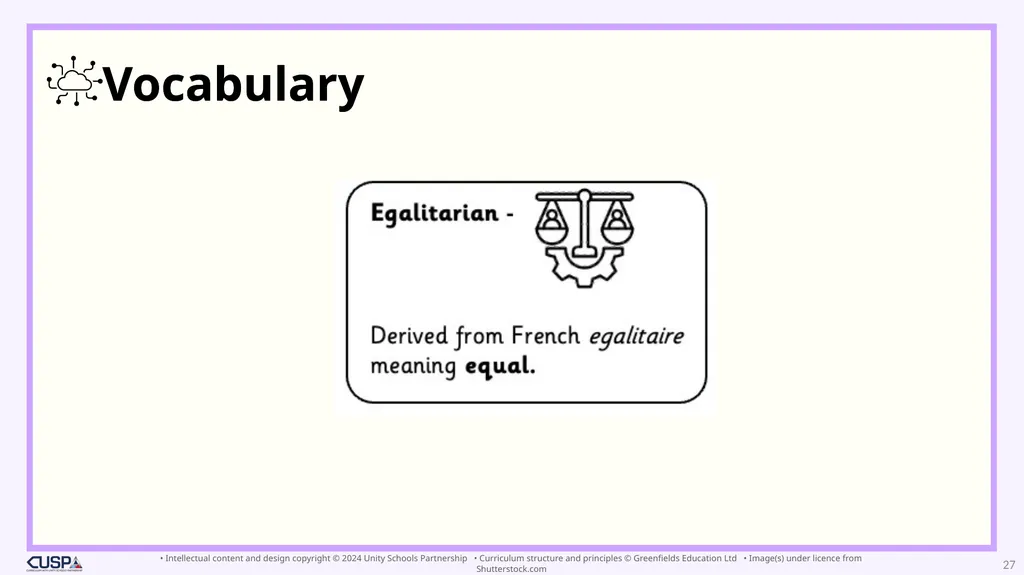
Vocabulary 27 Vocabulary<br>
26
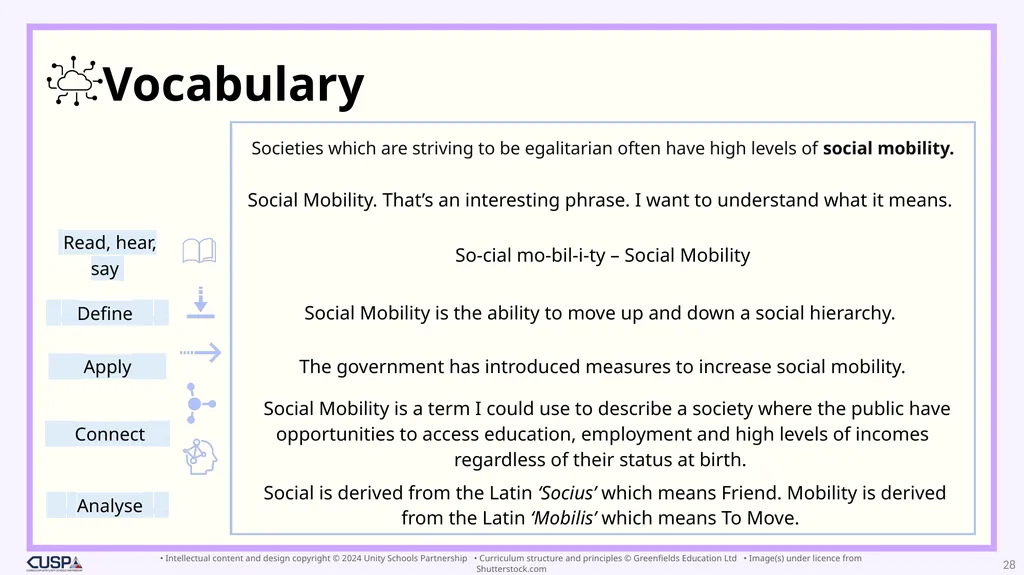
28 Vocabulary<br>
27
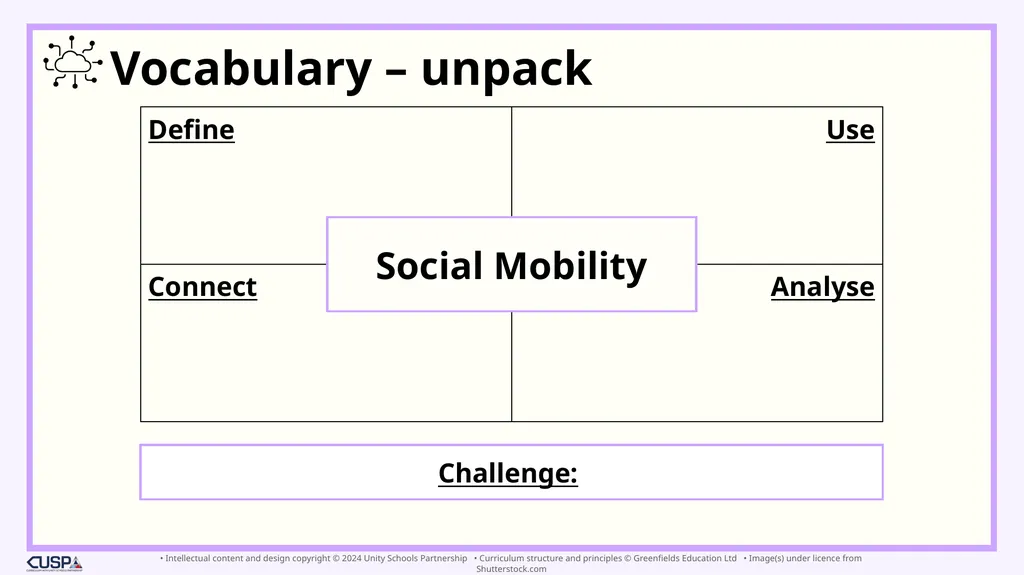
Vocabulary – unpack Social Mobility Challenge:<br>
28
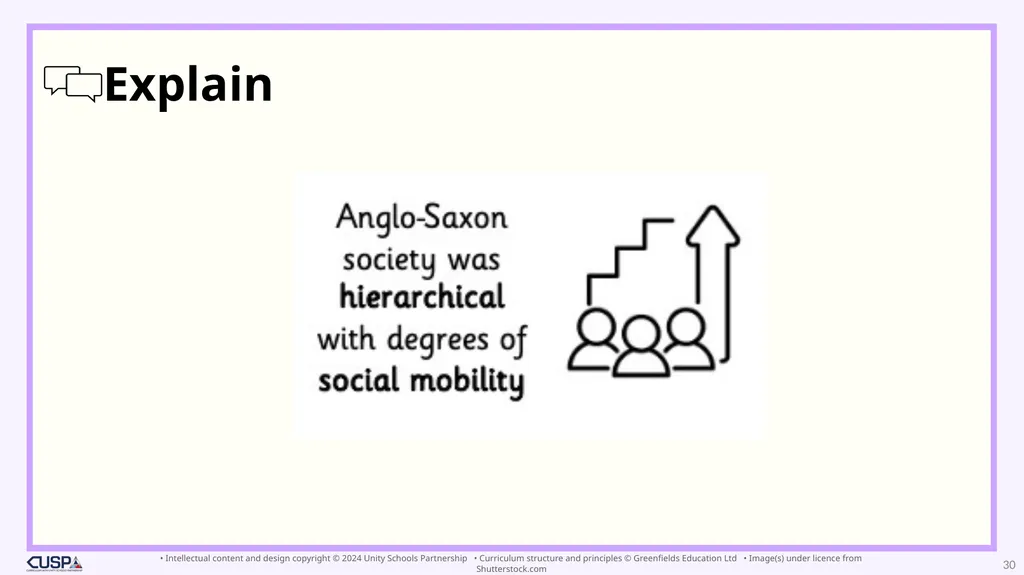
Explain 30<br>
29
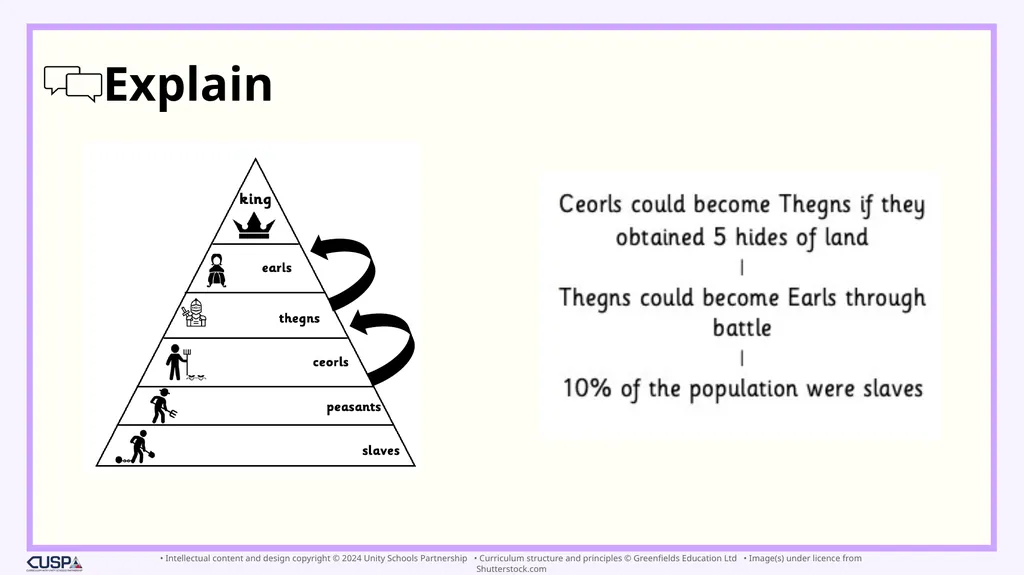
Explain<br>
30
Attempt Social Mobility in Anglo-Saxon England. 32<br>
31
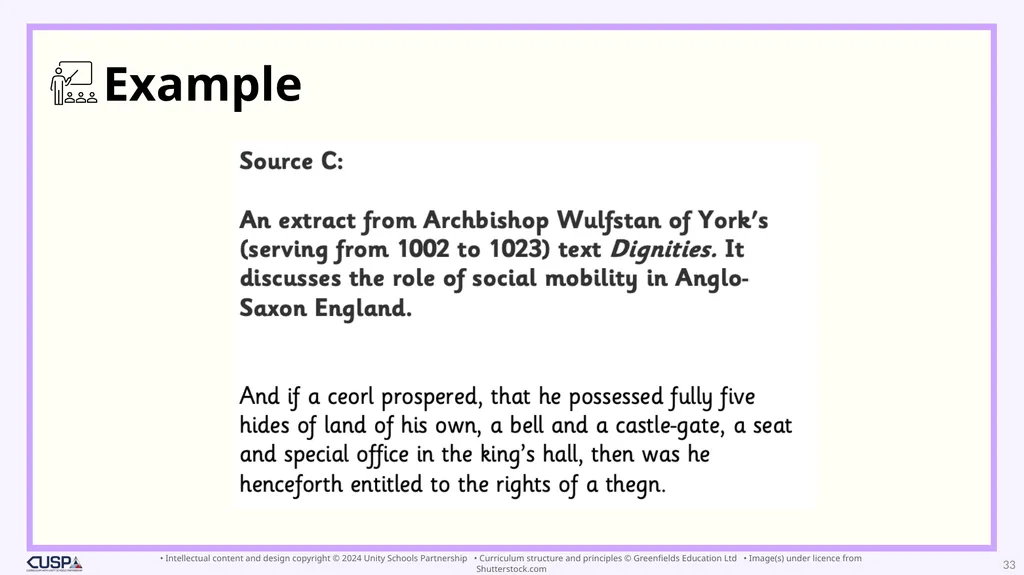
33 Example<br>
32
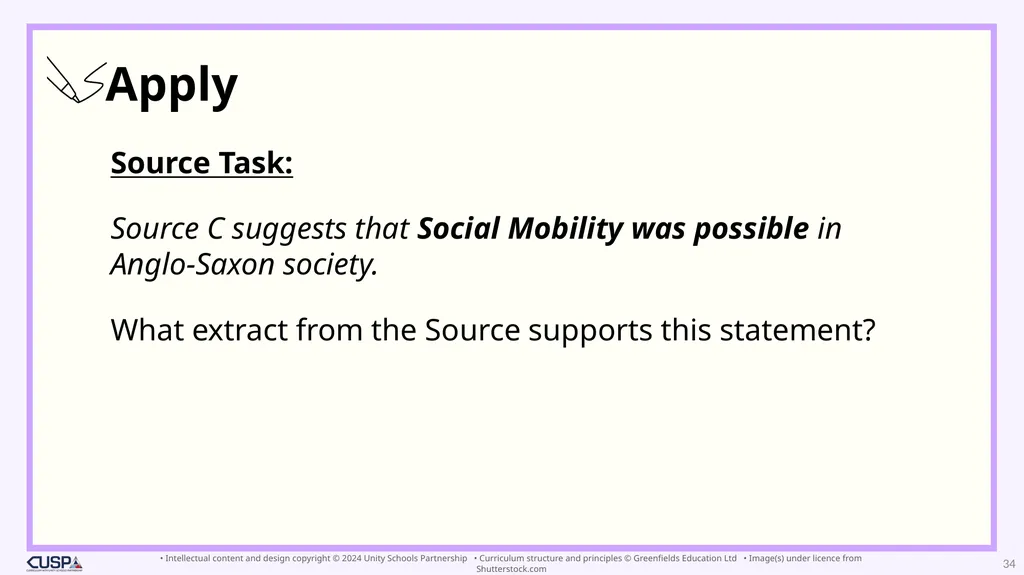
Apply 34 Source Task:
Source C suggests that Social Mobility was possible in Anglo-Saxon society.
What extract from the Source supports this statement?<br>
Source C suggests that Social Mobility was possible in Anglo-Saxon society.
What extract from the Source supports this statement?<br>
33
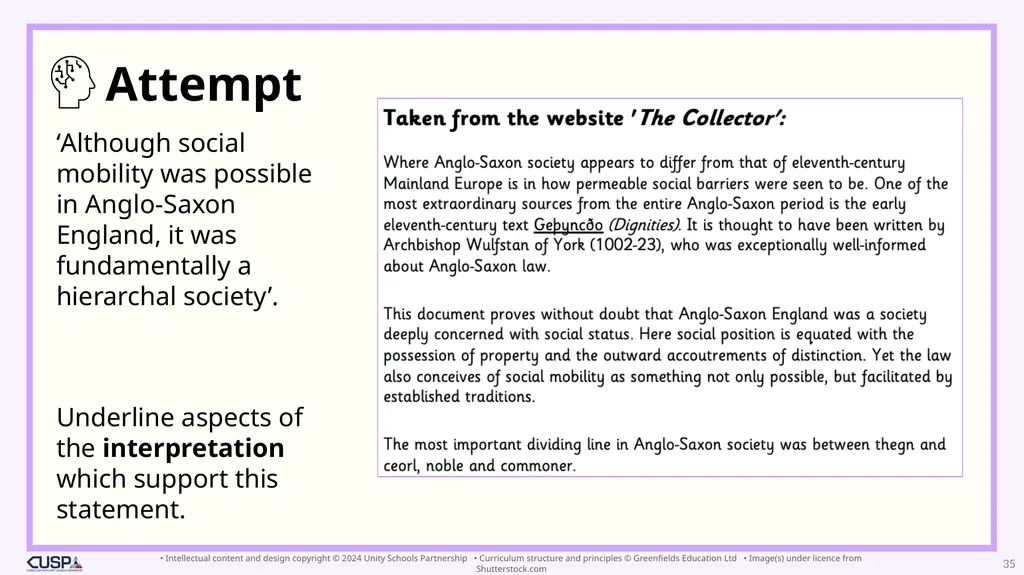
Attempt 35 ‘Although social mobility was possible in Anglo-Saxon England, it was fundamentally a hierarchal society’.
Underline aspects of the interpretation which support this statement.<br>
Underline aspects of the interpretation which support this statement.<br>
34
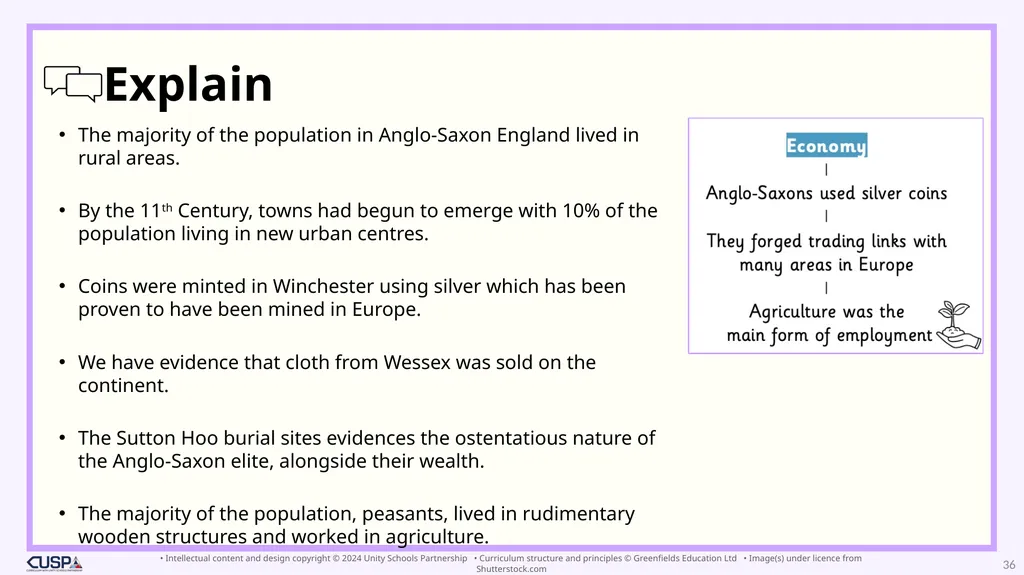
Explain 36 The majority of the population in Anglo-Saxon England lived in rural areas.
By the 11th Century, towns had begun to emerge with 10% of the population living in new urban centres.
Coins were minted in Winchester using silver which has been proven to have been mined in Europe.
We have evidence that cloth from Wessex was sold on the continent.
The Sutton Hoo burial sites evidences the ostentatious nature of the Anglo-Saxon elite, alongside their wealth.
The majority of the population, peasants, lived in rudimentary wooden structures and worked in agriculture.<br>
35
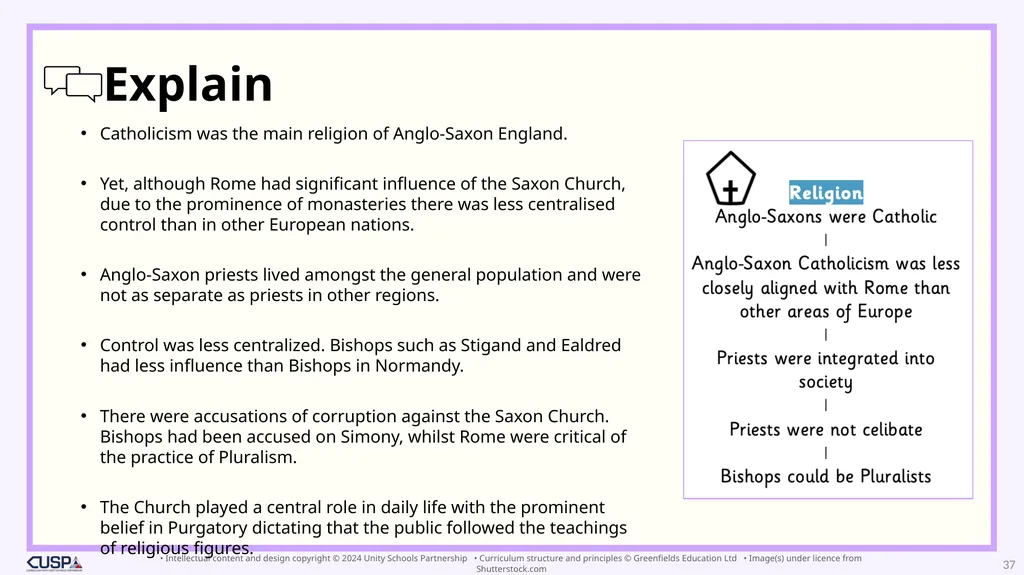
Explain 37 Catholicism was the main religion of Anglo-Saxon England.
Yet, although Rome had significant influence of the Saxon Church, due to the prominence of monasteries there was less centralised control than in other European nations.
Anglo-Saxon priests lived amongst the general population and were not as separate as priests in other regions.
Control was less centralized. Bishops such as Stigand and Ealdred had less influence than Bishops in Normandy.
There were accusations of corruption against the Saxon Church. Bishops had been accused on Simony, whilst Rome were critical of the practice of Pluralism.
The Church played a central role in daily life with the prominent belief in Purgatory dictating that the public followed the teachings of religious figures.<br>
36
Challenge 38 How egalitarian was Anglo-Saxon Society?<br>
37
Challenge 39 How egalitarian was Anglo-Saxon Society?
Pupil One
Instigator: It is evident that Anglo-Saxon society was egalitarian as…
Pupil Two
Challenger: However, this view can be challenged because…<br>
Pupil One
Instigator: It is evident that Anglo-Saxon society was egalitarian as…
Pupil Two
Challenger: However, this view can be challenged because…<br>
38
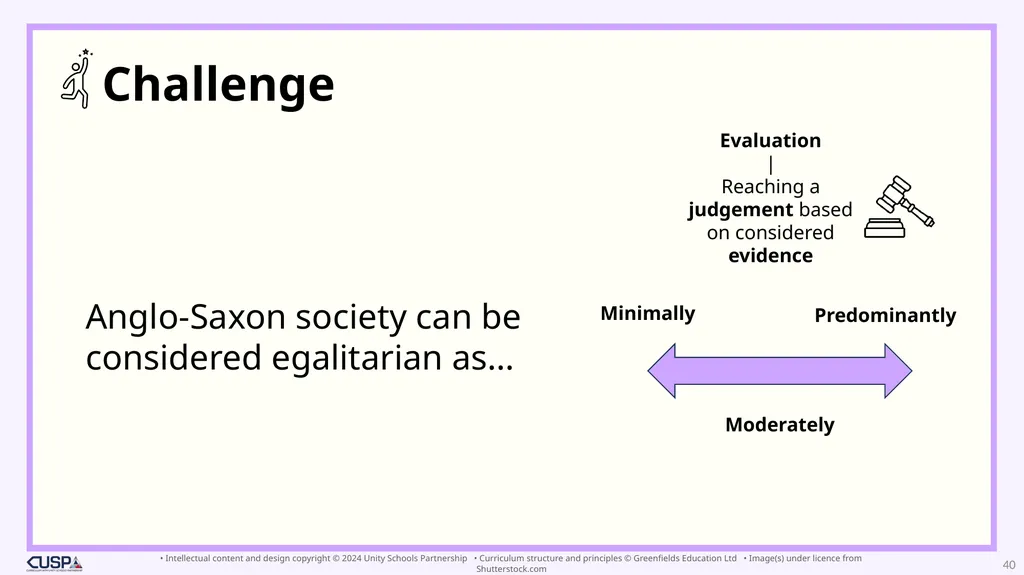
Challenge 40 Anglo-Saxon society can be considered egalitarian as… Evaluation
|
Reaching a judgement based on considered evidence Minimally Predominantly Moderately<br>
39
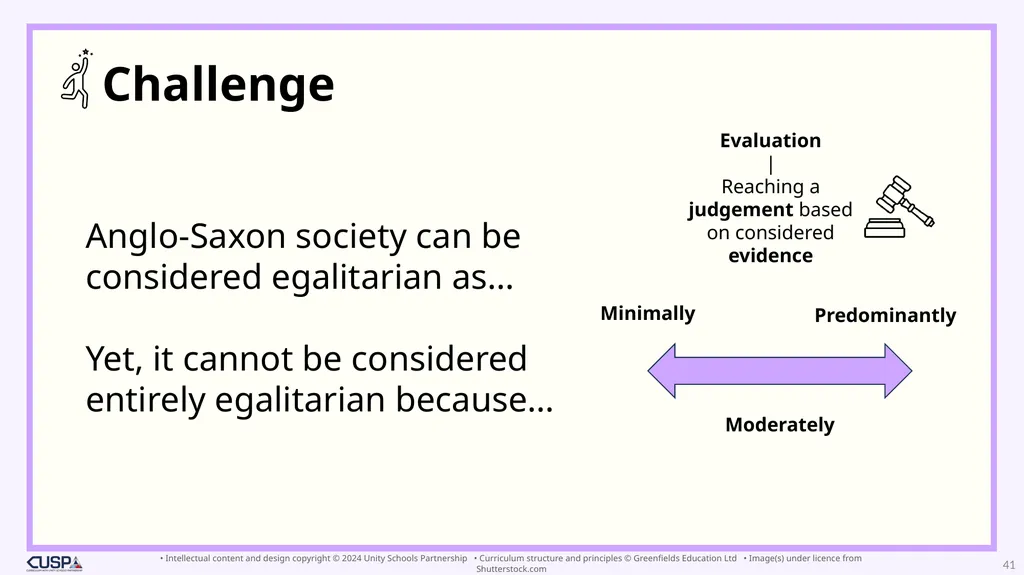
Challenge 41 Anglo-Saxon society can be considered egalitarian as…
Yet, it cannot be considered entirely egalitarian because… Evaluation | Reaching a judgement based on considered evidence Minimally Predominantly Moderately<br>
Yet, it cannot be considered entirely egalitarian because… Evaluation | Reaching a judgement based on considered evidence Minimally Predominantly Moderately<br>
40
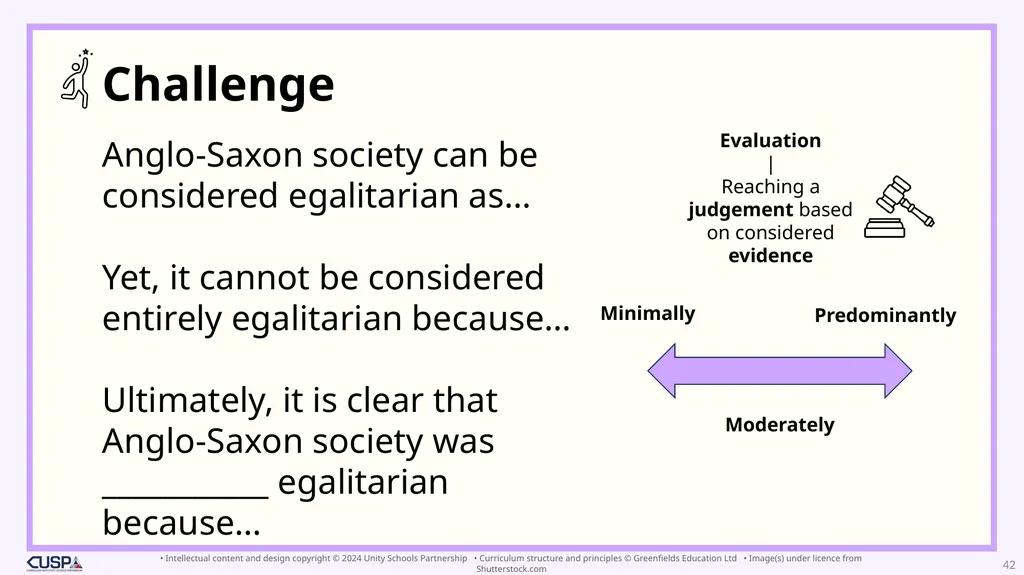
Challenge 42 Anglo-Saxon society can be considered egalitarian as…
Yet, it cannot be considered entirely egalitarian because…
Ultimately, it is clear that Anglo-Saxon society was ___________ egalitarian because… Evaluation | Reaching a judgement based on considered evidence Minimally Predominantly Moderately<br>
Yet, it cannot be considered entirely egalitarian because…
Ultimately, it is clear that Anglo-Saxon society was ___________ egalitarian because… Evaluation | Reaching a judgement based on considered evidence Minimally Predominantly Moderately<br>
41
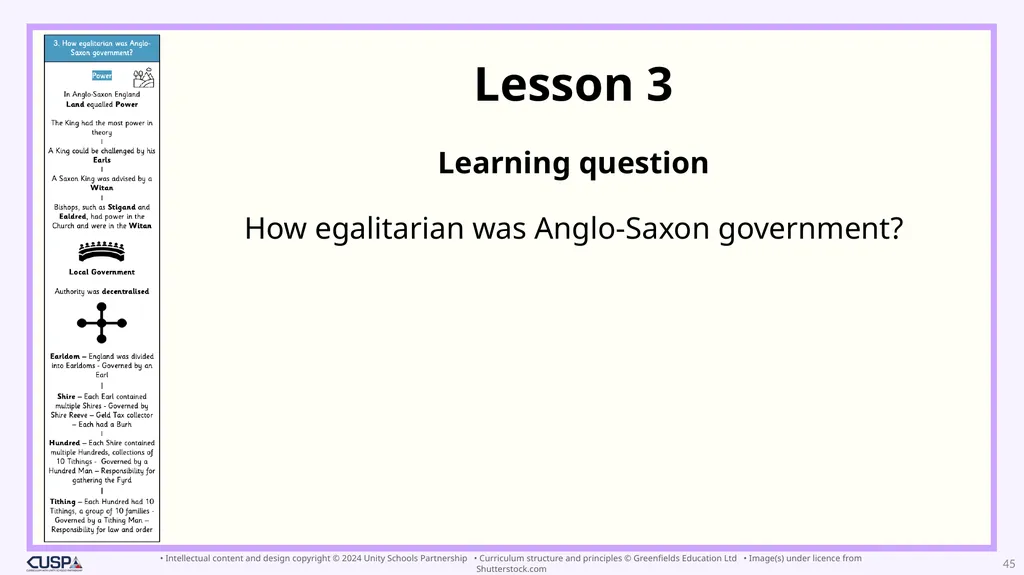
45 Lesson 3 Learning question
How egalitarian was Anglo-Saxon government?<br>
How egalitarian was Anglo-Saxon government?<br>
42
Connect 46 Describe Anglo-Saxon society using the following key terms:
Hierarchy
Social Mobility
Economy
Religion
Egalitarian<br>
Hierarchy
Social Mobility
Economy
Religion
Egalitarian<br>
43
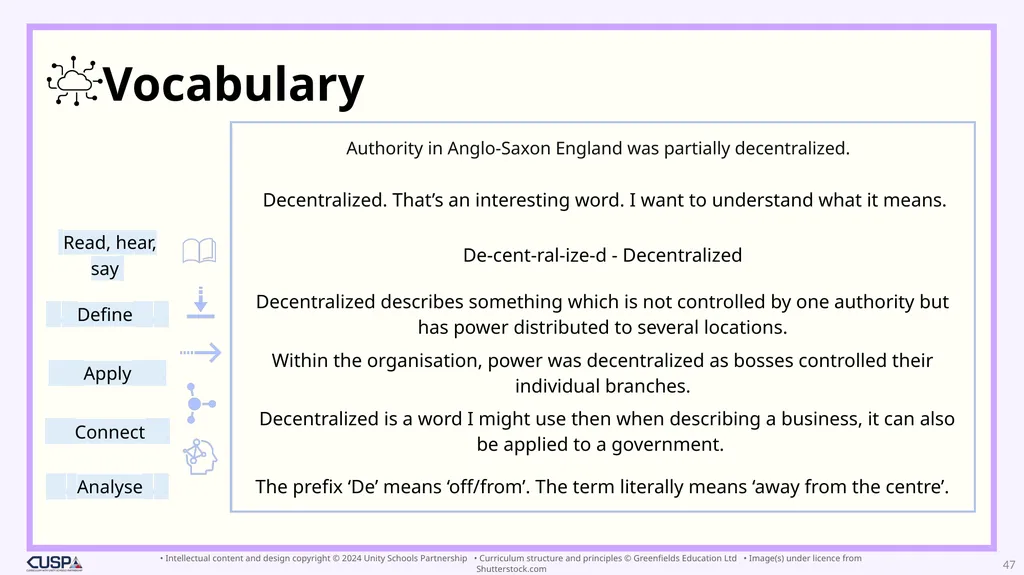
47 Vocabulary<br>
44
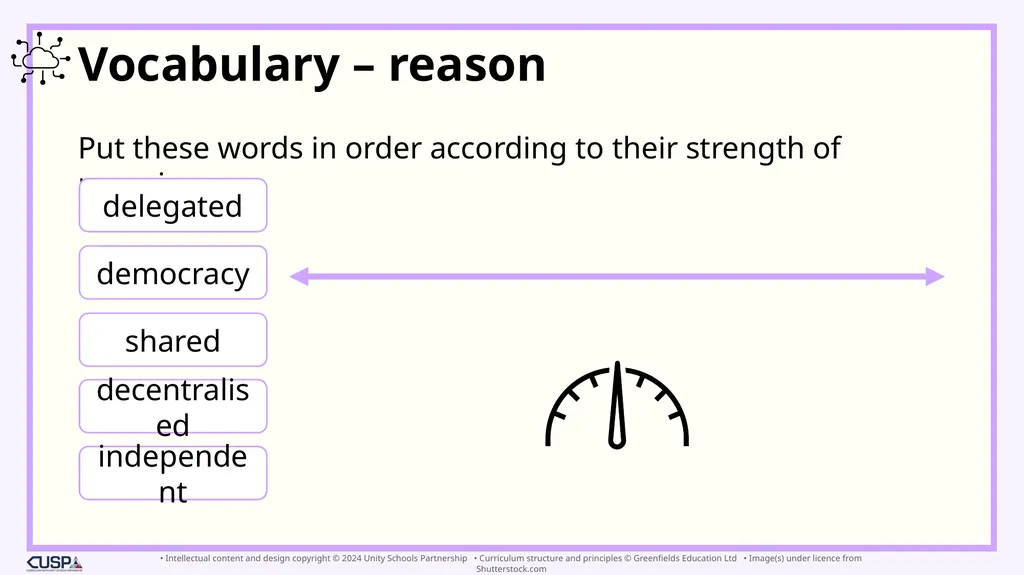
Vocabulary – reason Put these words in order according to their strength of meaning.<br>
45
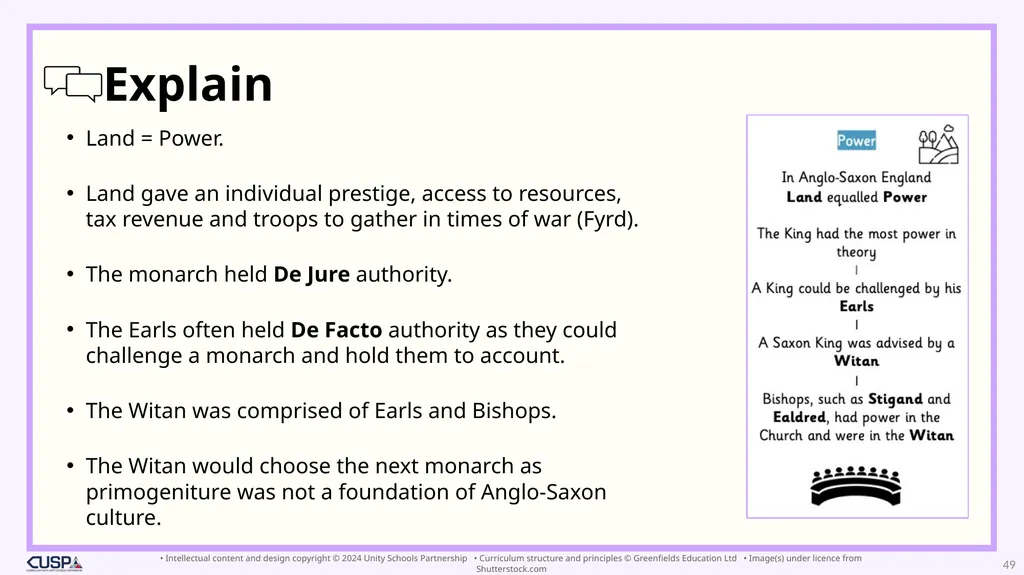
Explain 49 Land = Power.
Land gave an individual prestige, access to resources, tax revenue and troops to gather in times of war (Fyrd).
The monarch held De Jure authority.
The Earls often held De Facto authority as they could challenge a monarch and hold them to account.
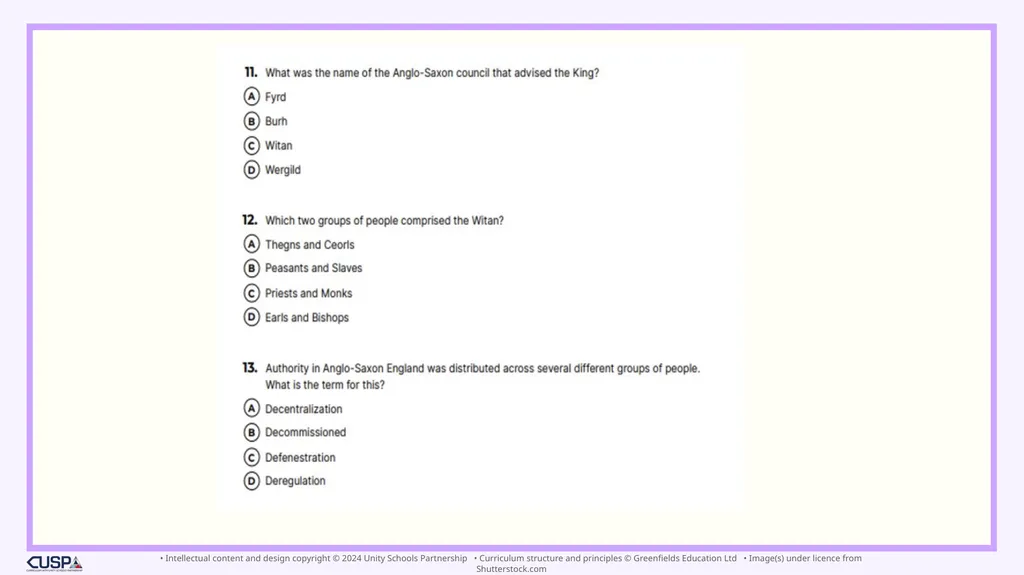
The Witan was comprised of Earls and Bishops.
The Witan would choose the next monarch as primogeniture was not a foundation of Anglo-Saxon culture.<br>
46
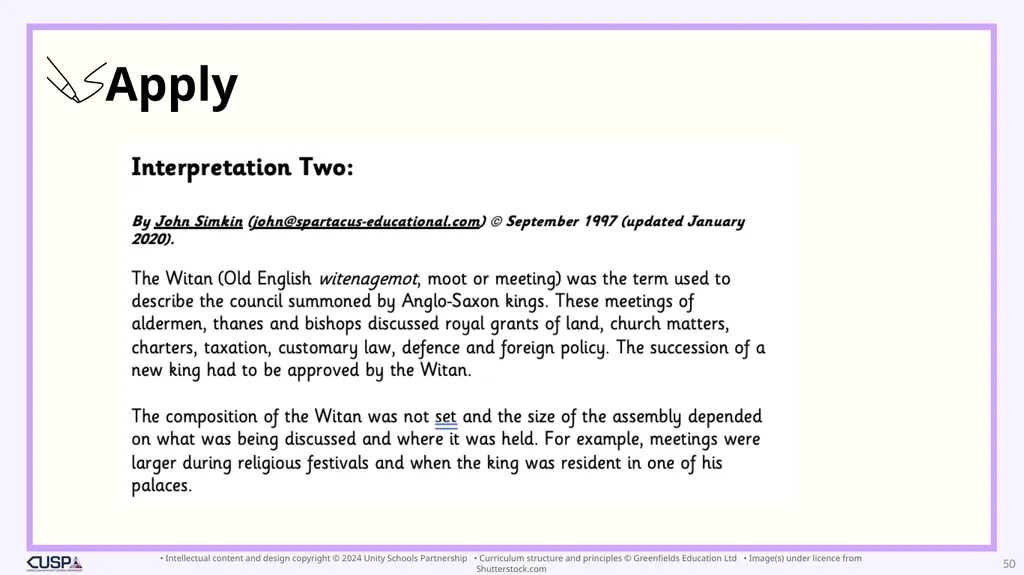
Apply 50<br>
47
51 An Anglo-Saxon monarch’s power was not absolute.
What evidence do we have to support this statement?
Explain why this statement is accurate? Attempt<br>
What evidence do we have to support this statement?
Explain why this statement is accurate? Attempt<br>
48
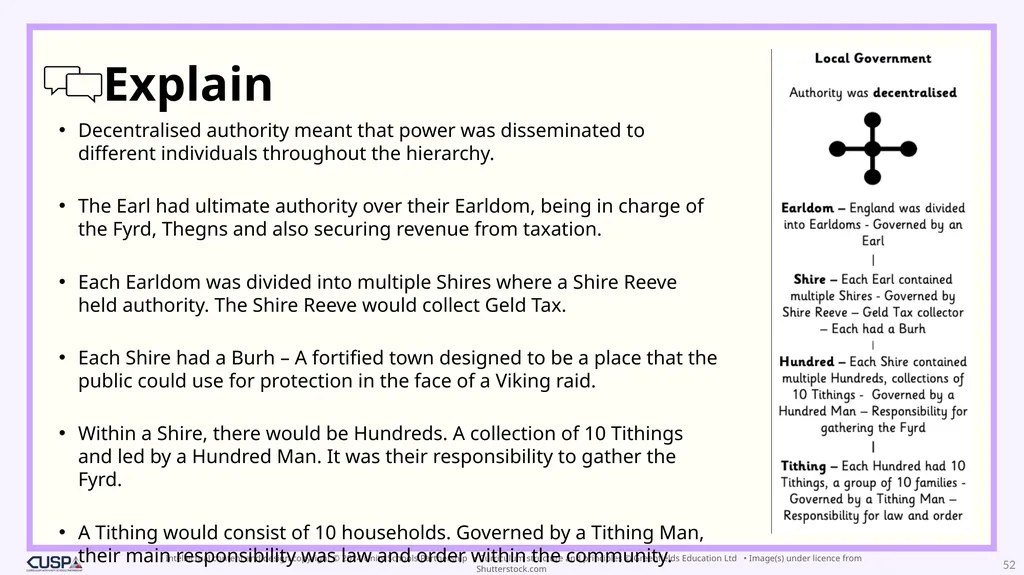
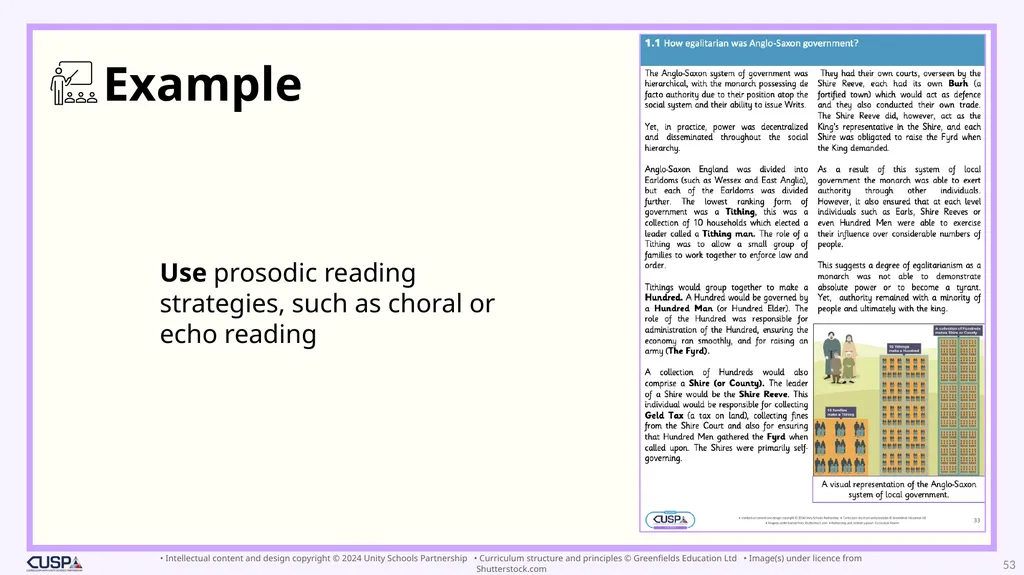
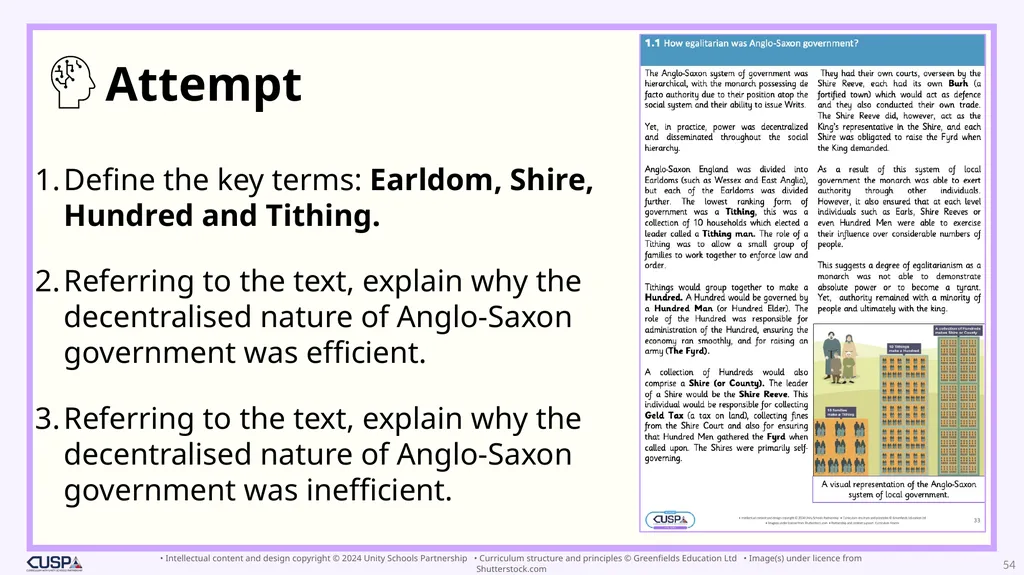
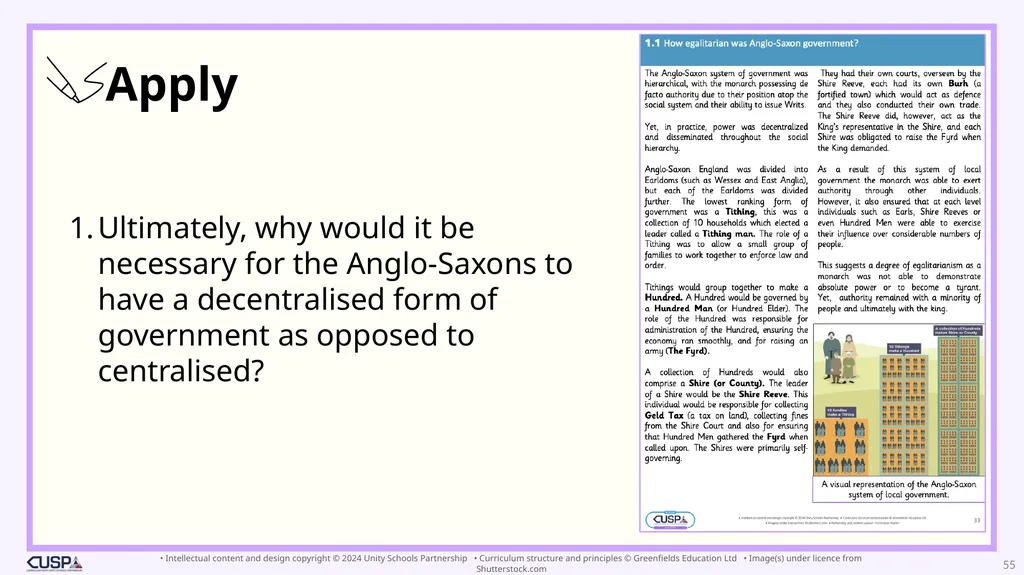
Explain 52 Decentralised authority meant that power was disseminated to different individuals throughout the hierarchy.
The Earl had ultimate authority over their Earldom, being in charge of the Fyrd, Thegns and also securing revenue from taxation.
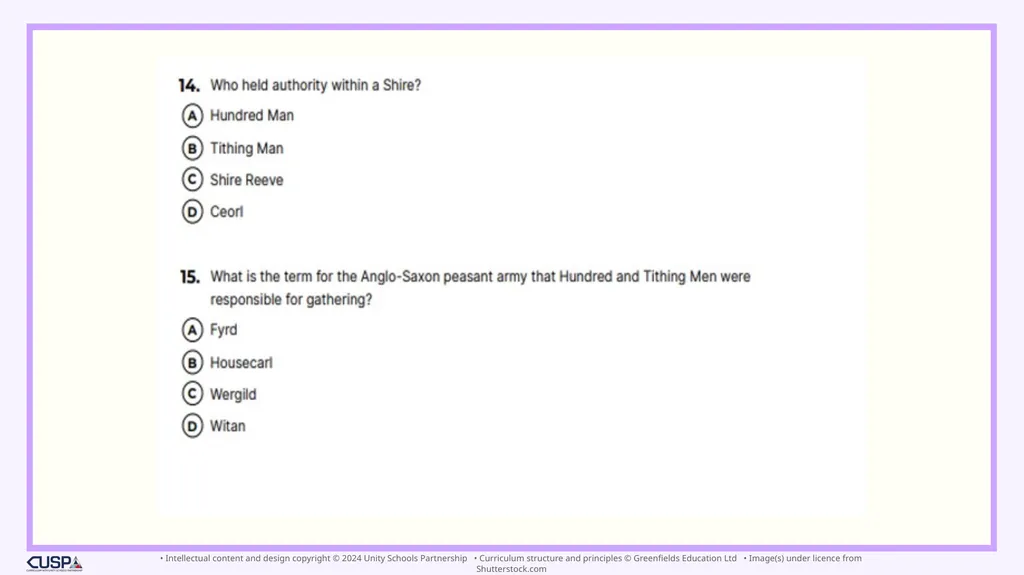
Each Earldom was divided into multiple Shires where a Shire Reeve held authority. The Shire Reeve would collect Geld Tax.
Each Shire had a Burh – A fortified town designed to be a place that the public could use for protection in the face of a Viking raid.
Within a Shire, there would be Hundreds. A collection of 10 Tithings and led by a Hundred Man. It was their responsibility to gather the Fyrd.
A Tithing would consist of 10 households. Governed by a Tithing Man, their main responsibility was law and order within the community.<br>
49
53 Example Use prosodic reading strategies, such as choral or echo reading<br>
50
54 Define the key terms: Earldom, Shire, Hundred and Tithing.
Referring to the text, explain why the decentralised nature of Anglo-Saxon government was efficient.
Referring to the text, explain why the decentralised nature of Anglo-Saxon government was inefficient. Attempt<br>
Referring to the text, explain why the decentralised nature of Anglo-Saxon government was efficient.
Referring to the text, explain why the decentralised nature of Anglo-Saxon government was inefficient. Attempt<br>
51
55 Ultimately, why would it be necessary for the Anglo-Saxons to have a decentralised form of government as opposed to centralised? Apply<br>
52
Challenge 56 How egalitarian was Anglo-Saxon Government?
Pupil One
Instigator: It is evident that Anglo-Saxon government was egalitarian as…
Pupil Two
Challenger: However, this view can be challenged because…<br>
Pupil One
Instigator: It is evident that Anglo-Saxon government was egalitarian as…
Pupil Two
Challenger: However, this view can be challenged because…<br>
53
Challenge 57 Anglo-Saxon government can be considered egalitarian as… Evaluation
|
Reaching a judgement based on considered evidence Minimally Predominantly Moderately<br>
54
Challenge 58 Anglo-Saxon government can be considered egalitarian as…
Yet, it cannot be considered entirely egalitarian because… Evaluation | Reaching a judgement based on considered evidence Minimally Predominantly Moderately<br>
Yet, it cannot be considered entirely egalitarian because… Evaluation | Reaching a judgement based on considered evidence Minimally Predominantly Moderately<br>
55
Challenge 59 Anglo-Saxon government can be considered egalitarian as…
Yet, it cannot be considered entirely egalitarian because…
Ultimately, it is clear that Anglo-Saxon government was ___________ egalitarian because…<br>
Yet, it cannot be considered entirely egalitarian because…
Ultimately, it is clear that Anglo-Saxon government was ___________ egalitarian because…<br>
56
62 Lesson 4 Learning question
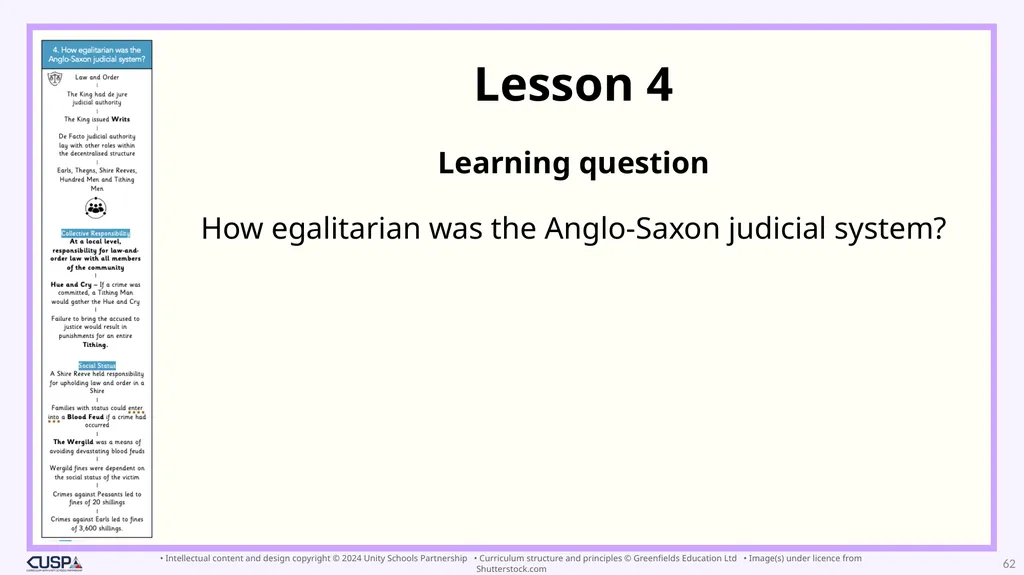
How egalitarian was the Anglo-Saxon judicial system?<br>
How egalitarian was the Anglo-Saxon judicial system?<br>
57
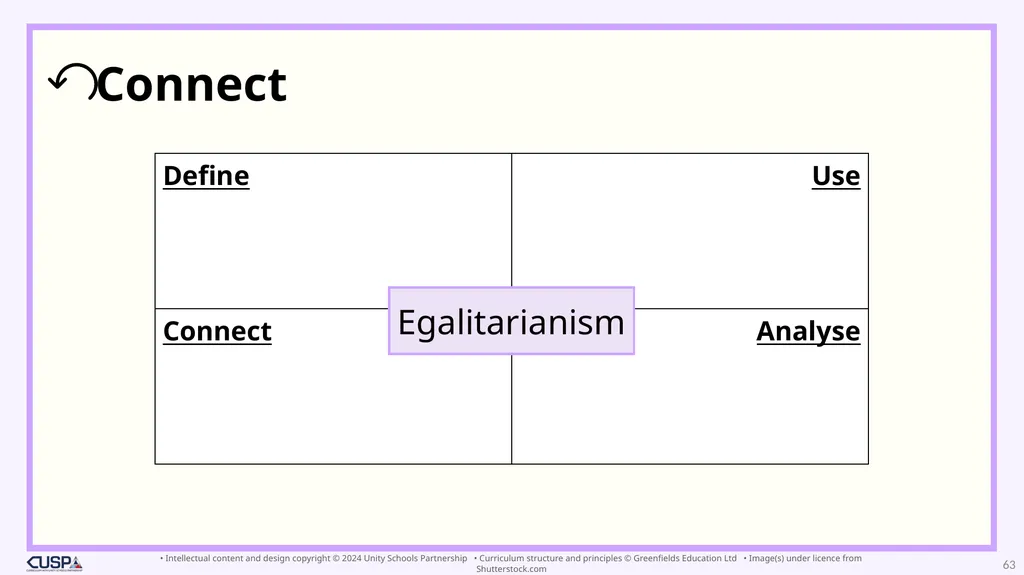
63 Egalitarianism Connect<br>
58
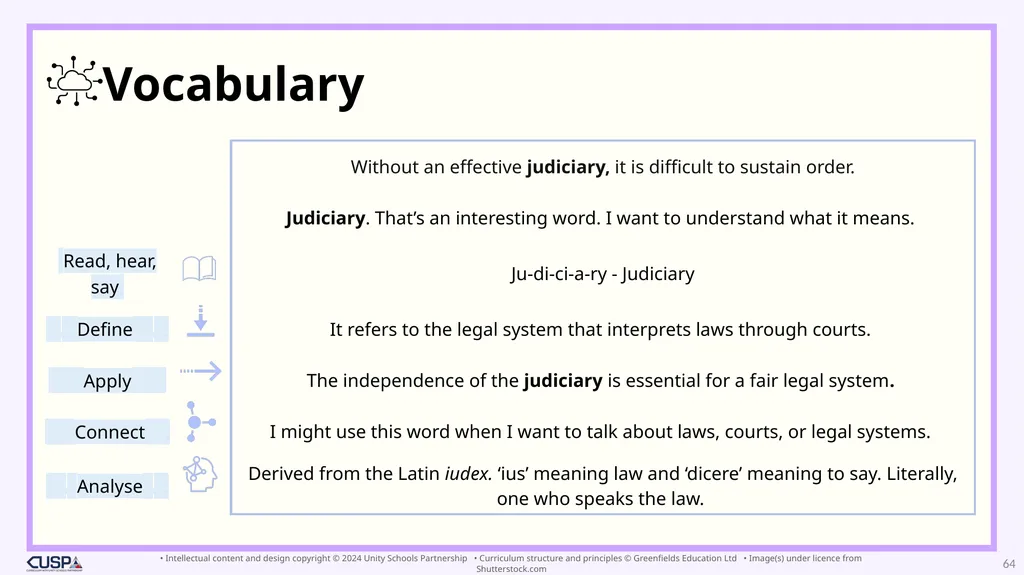
Vocabulary 64<br>
59
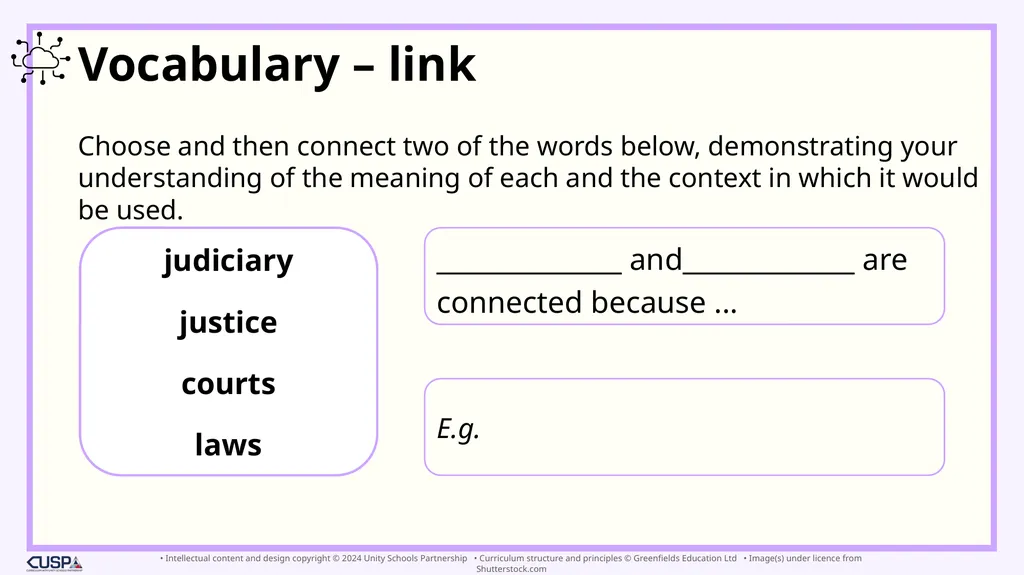
Vocabulary – link Choose and then connect two of the words below, demonstrating your understanding of the meaning of each and the context in which it would be used. judiciary
justice
courts
laws ______________ and_____________ are connected because ... E.g.<br>
justice
courts
laws ______________ and_____________ are connected because ... E.g.<br>
60
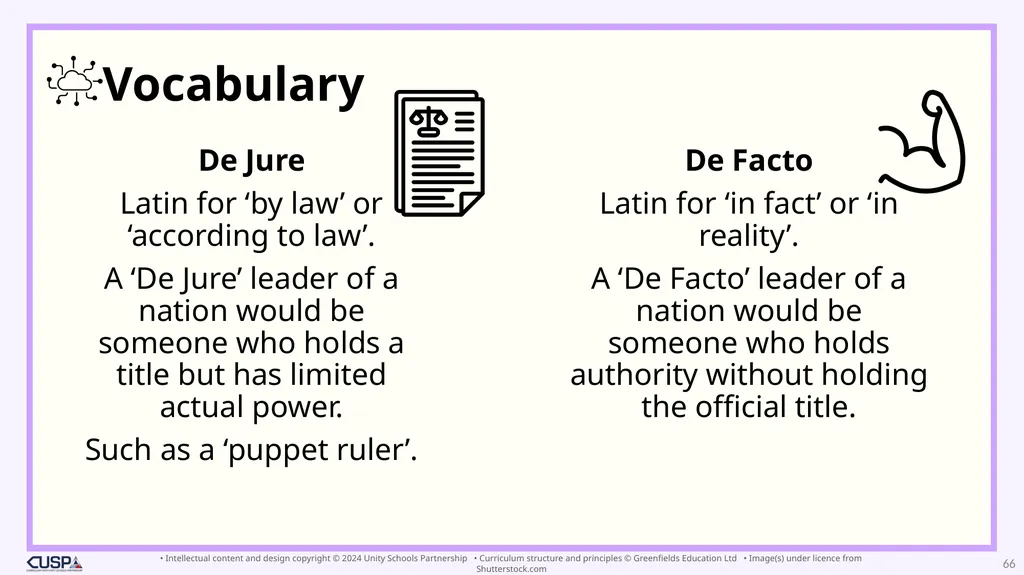
Vocabulary 66 De Facto
Latin for ‘in fact’ or ‘in reality’.
A ‘De Facto’ leader of a nation would be someone who holds authority without holding the official title. De Jure
Latin for ‘by law’ or ‘according to law’.
A ‘De Jure’ leader of a nation would be someone who holds a title but has limited actual power.
Such as a ‘puppet ruler’.<br>
61
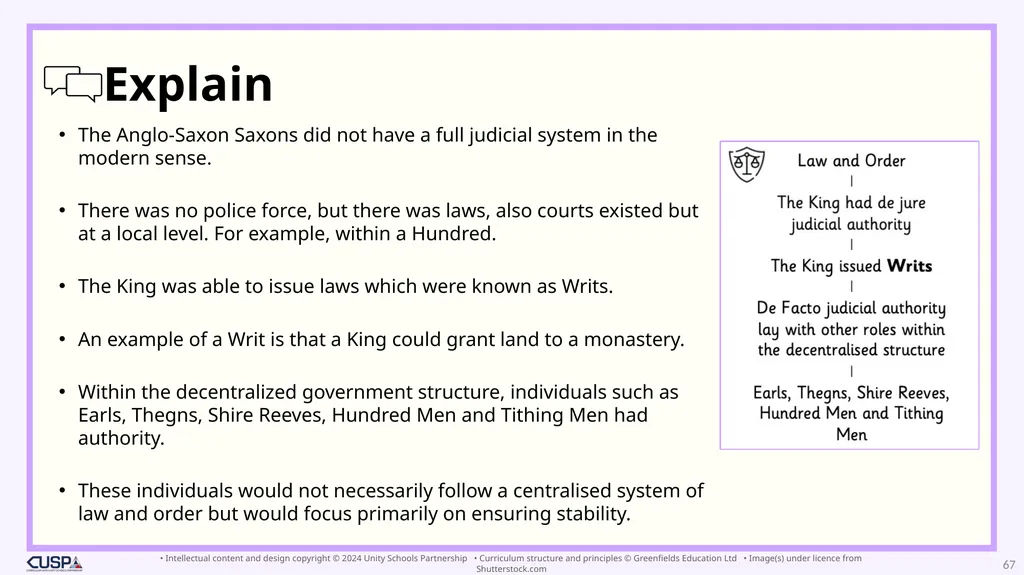
Explain 67 The Anglo-Saxon Saxons did not have a full judicial system in the modern sense.
There was no police force, but there was laws, also courts existed but at a local level. For example, within a Hundred.
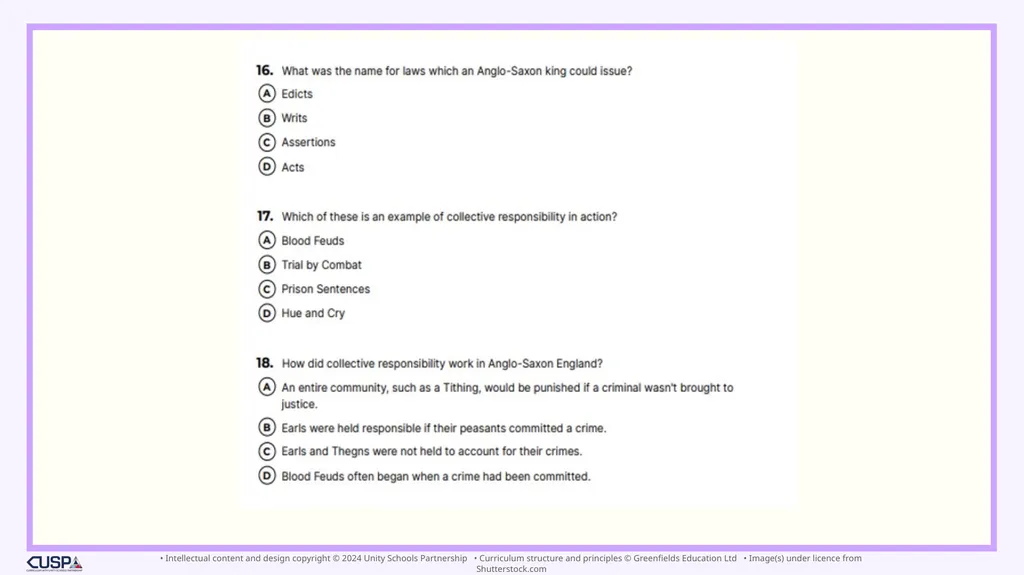
The King was able to issue laws which were known as Writs.
An example of a Writ is that a King could grant land to a monastery.
Within the decentralized government structure, individuals such as Earls, Thegns, Shire Reeves, Hundred Men and Tithing Men had authority.
These individuals would not necessarily follow a centralised system of law and order but would focus primarily on ensuring stability.<br>
62
Vocabulary 68 Collective Responsibility
|
Where responsibility lies with all people within a community.
For example, we are all collective responsible within a school for ensuring that our expectations and values are upheld.<br>
Where responsibility lies with all people within a community.
For example, we are all collective responsible within a school for ensuring that our expectations and values are upheld.<br>
63
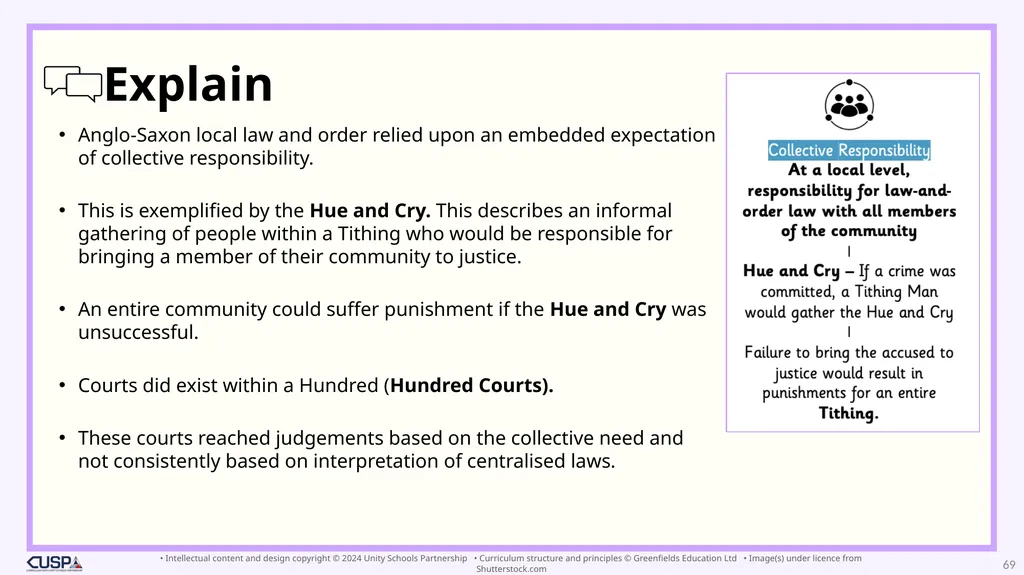
Explain 69 Anglo-Saxon local law and order relied upon an embedded expectation of collective responsibility.
This is exemplified by the Hue and Cry. This describes an informal gathering of people within a Tithing who would be responsible for bringing a member of their community to justice.
An entire community could suffer punishment if the Hue and Cry was unsuccessful.
Courts did exist within a Hundred (Hundred Courts).
These courts reached judgements based on the collective need and not consistently based on interpretation of centralised laws.<br>
64
70 What role did collective responsibility play in the Anglo-Saxon legal system?
How would the system of collective responsibility be of benefit to Anglo-Saxon society as a whole? Attempt<br>
How would the system of collective responsibility be of benefit to Anglo-Saxon society as a whole? Attempt<br>
65
Vocabulary 71 Wergild
A system of fines the Anglo-Saxon used as a punishment for crimes.
The amount of the fine depended upon the social rank of the victim.
It literally translates as ‘Man Price’.<br>
A system of fines the Anglo-Saxon used as a punishment for crimes.
The amount of the fine depended upon the social rank of the victim.
It literally translates as ‘Man Price’.<br>
66
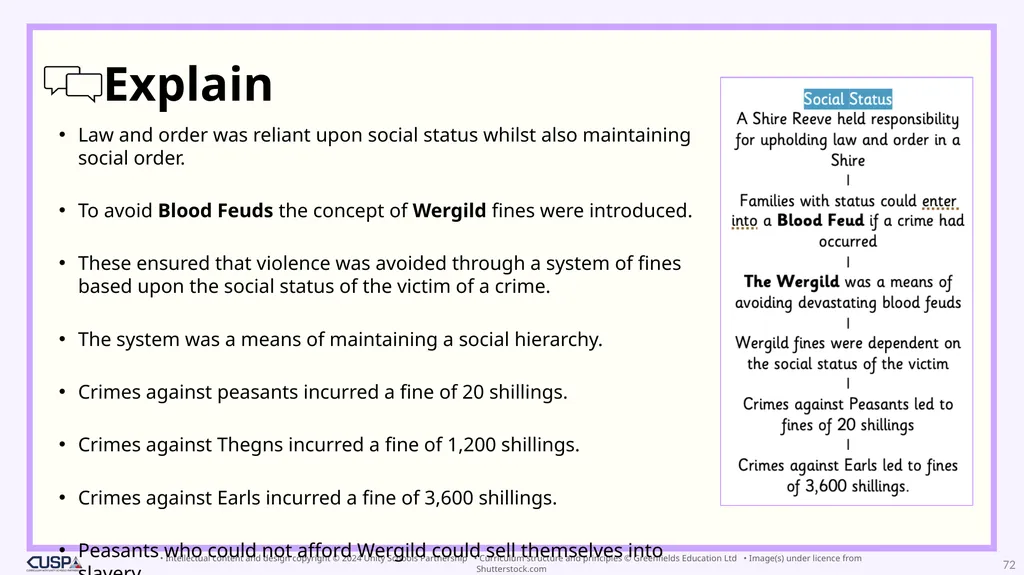
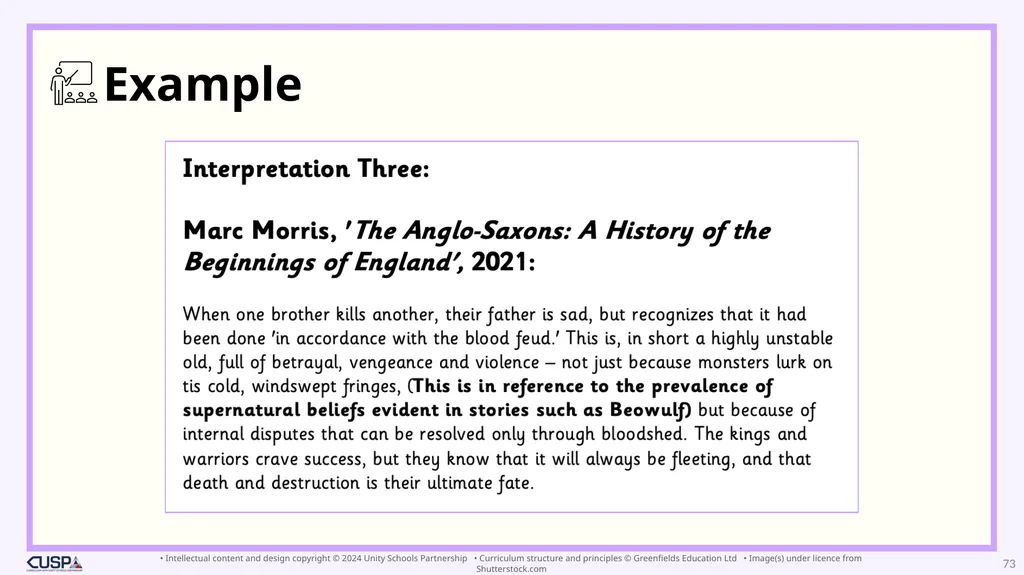
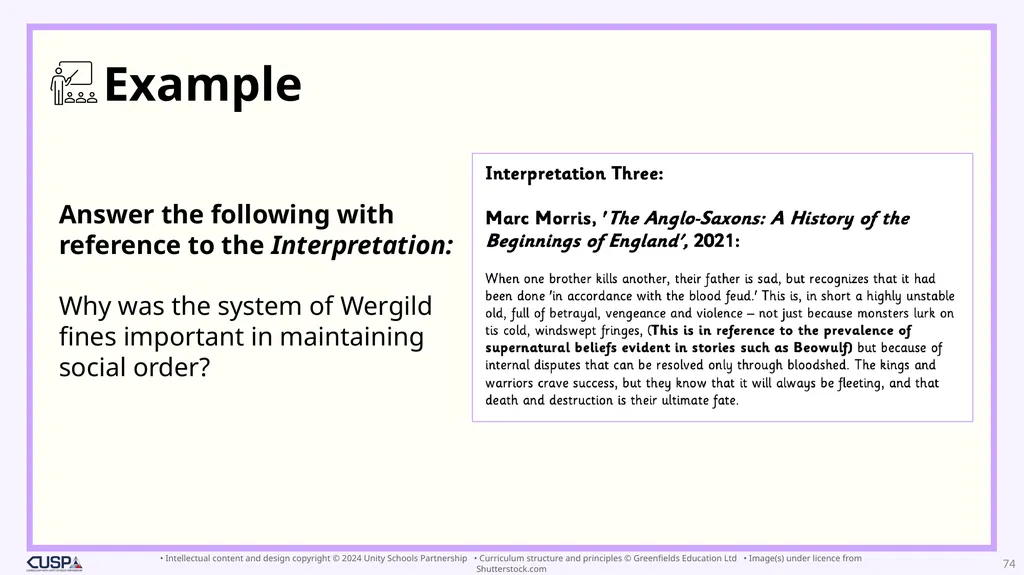
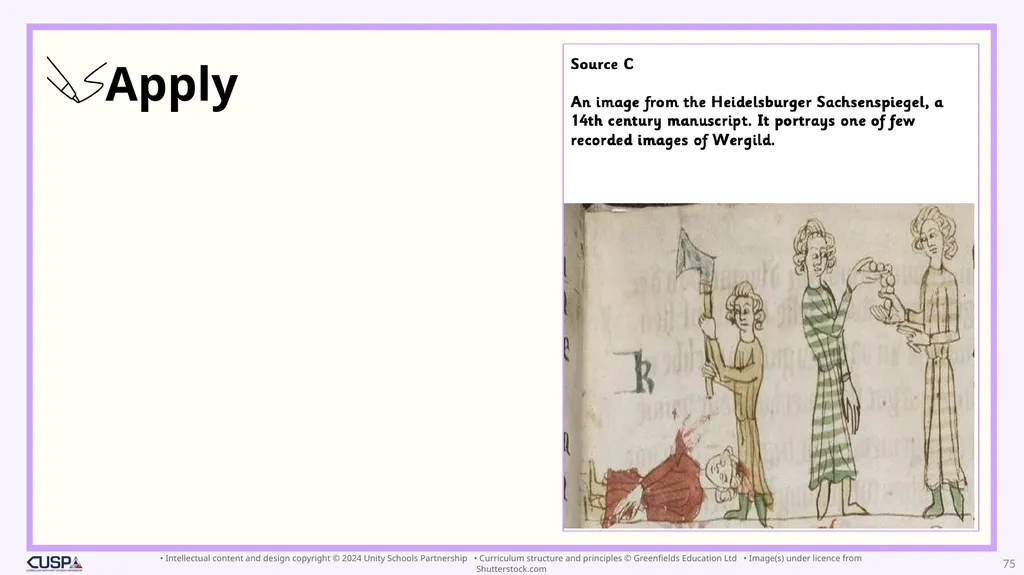
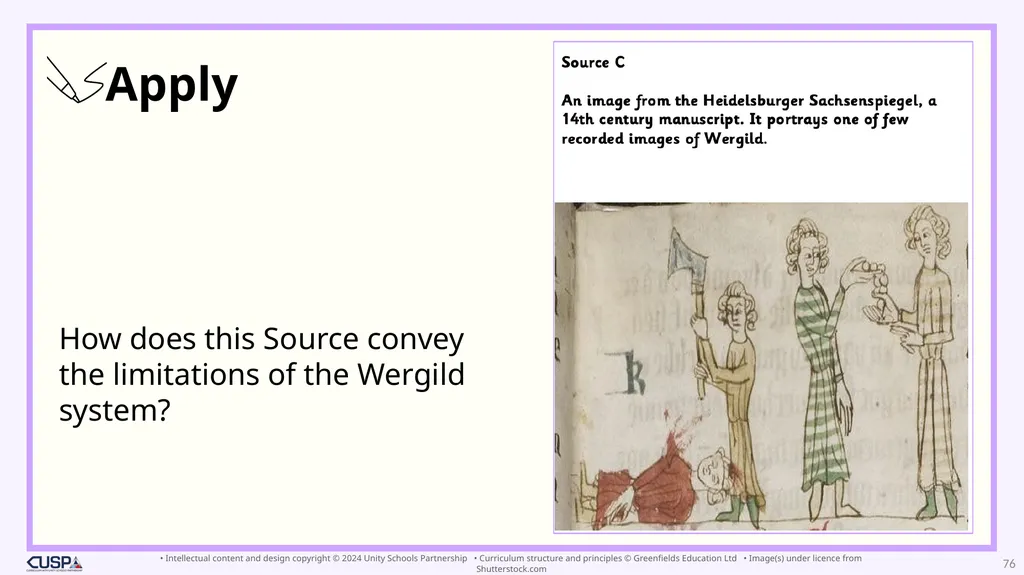
Explain 72 Law and order was reliant upon social status whilst also maintaining social order.
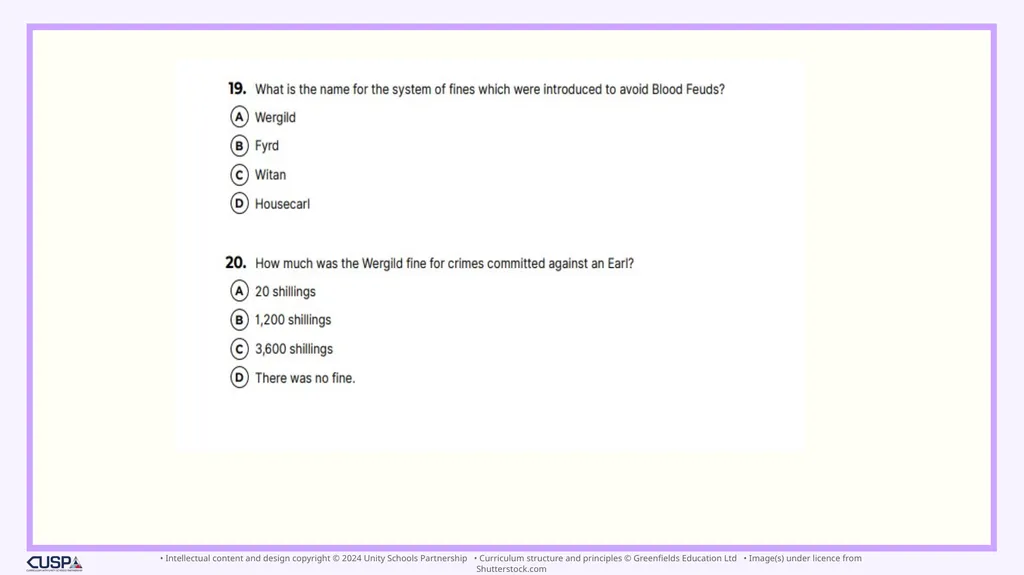
To avoid Blood Feuds the concept of Wergild fines were introduced.
These ensured that violence was avoided through a system of fines based upon the social status of the victim of a crime.
The system was a means of maintaining a social hierarchy.
Crimes against peasants incurred a fine of 20 shillings.
Crimes against Thegns incurred a fine of 1,200 shillings.
Crimes against Earls incurred a fine of 3,600 shillings.
Peasants who could not afford Wergild could sell themselves into slavery.<br>
67
Example 73<br>
68
Example 74 Answer the following with reference to the Interpretation:
Why was the system of Wergild fines important in maintaining social order?<br>
Why was the system of Wergild fines important in maintaining social order?<br>
69
Apply 75<br>
70
Apply 76 How does this Source convey the limitations of the Wergild system?<br>
71
Challenge 77 How egalitarian was the Anglo-Saxon judicial system?
Pupil One: Instigator – It is evident that the Anglo-Saxon judicial system was egalitarian as…
Pupil Two: Challenger – However, this view can be challenged because…<br>
Pupil One: Instigator – It is evident that the Anglo-Saxon judicial system was egalitarian as…
Pupil Two: Challenger – However, this view can be challenged because…<br>
72
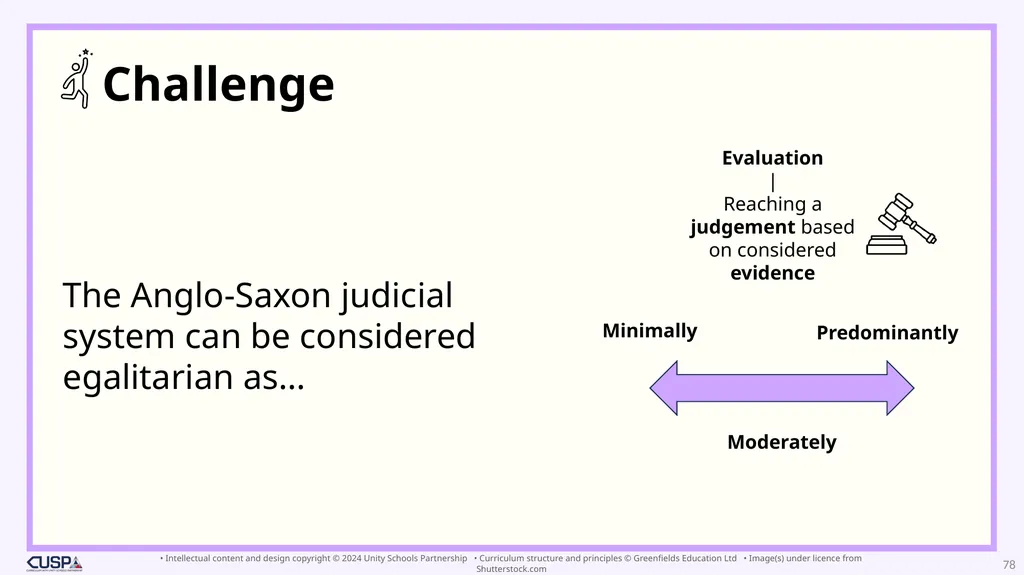
Challenge 78 The Anglo-Saxon judicial system can be considered egalitarian as…<br>
73
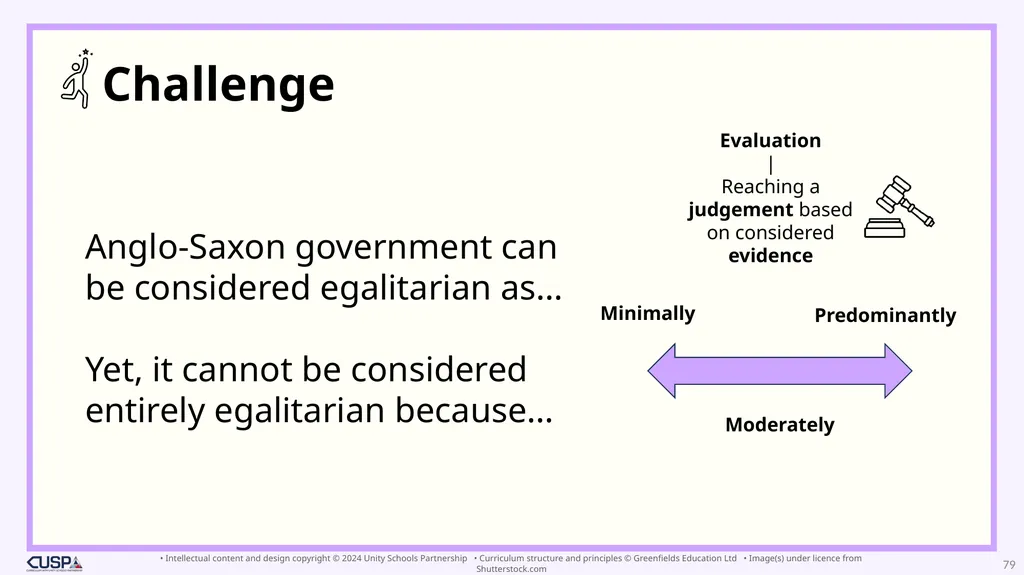
Challenge 79 Anglo-Saxon government can be considered egalitarian as…
Yet, it cannot be considered entirely egalitarian because…<br>
Yet, it cannot be considered entirely egalitarian because…<br>
74
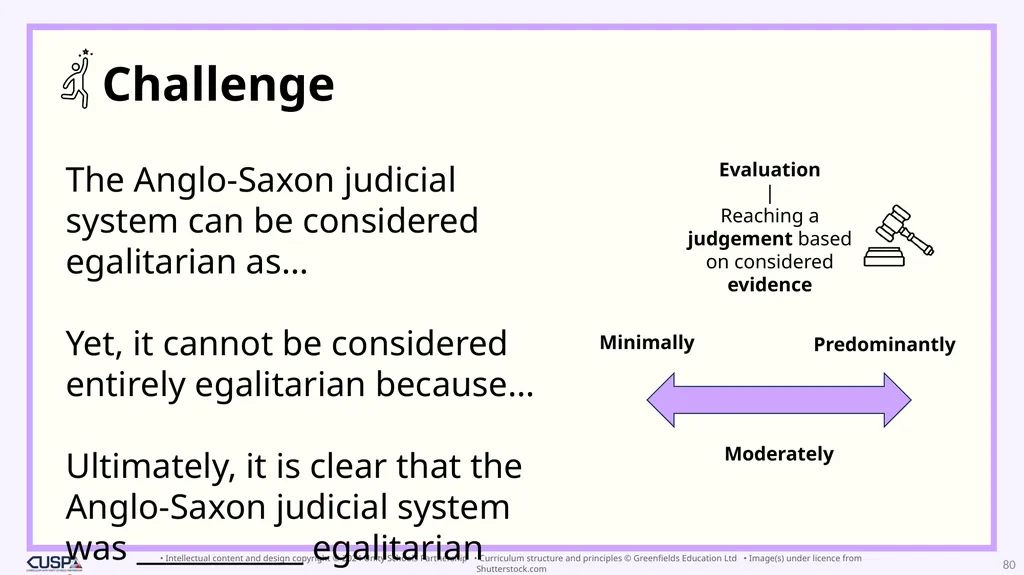
Challenge 80 The Anglo-Saxon judicial system can be considered egalitarian as…
Yet, it cannot be considered entirely egalitarian because…
Ultimately, it is clear that the Anglo-Saxon judicial system was ___________ egalitarian because…<br>
Yet, it cannot be considered entirely egalitarian because…
Ultimately, it is clear that the Anglo-Saxon judicial system was ___________ egalitarian because…<br>
75
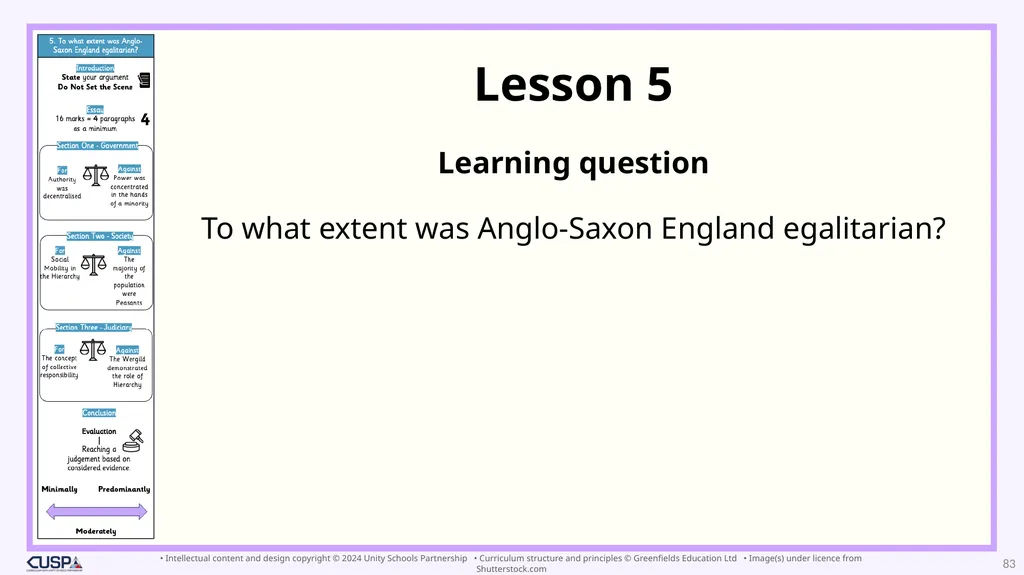
83 Lesson 5 Learning question
To what extent was Anglo-Saxon England egalitarian?<br>
To what extent was Anglo-Saxon England egalitarian?<br>
76
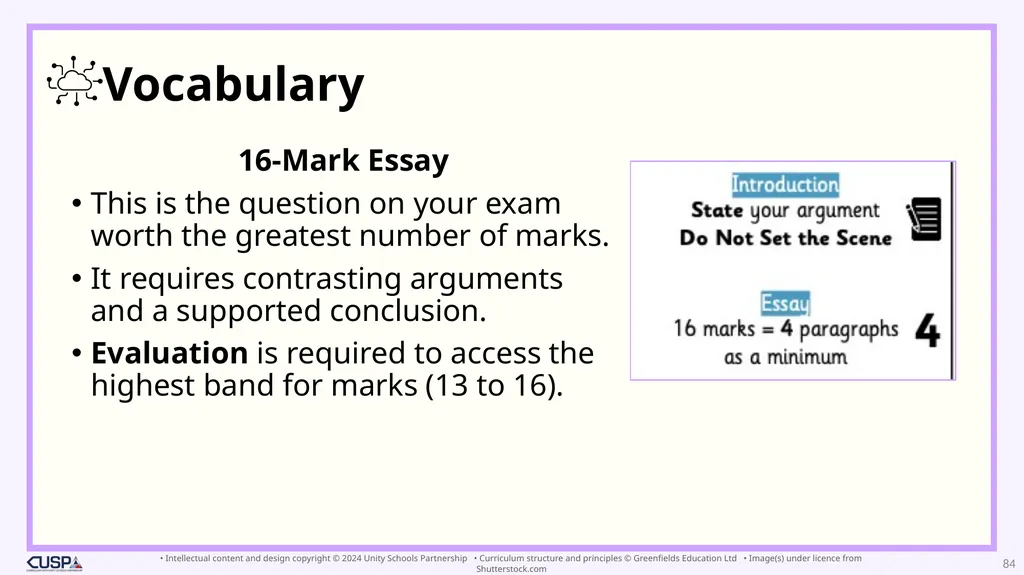
Vocabulary 84 16-Mark Essay
This is the question on your exam worth the greatest number of marks.
It requires contrasting arguments and a supported conclusion.
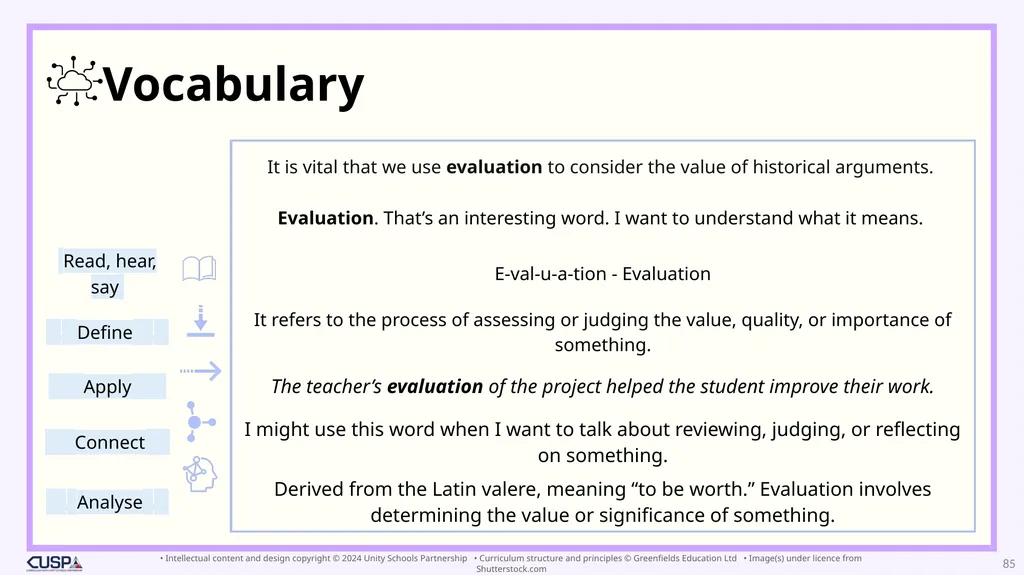
Evaluation is required to access the highest band for marks (13 to 16).<br>
This is the question on your exam worth the greatest number of marks.
It requires contrasting arguments and a supported conclusion.
Evaluation is required to access the highest band for marks (13 to 16).<br>
77
Vocabulary 85<br>
78
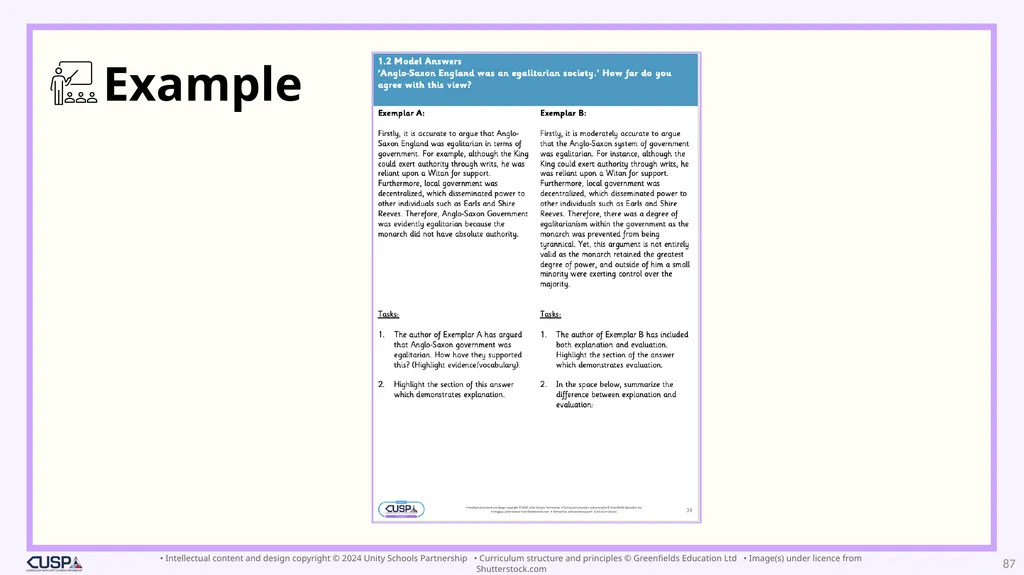
Example 87<br>
79
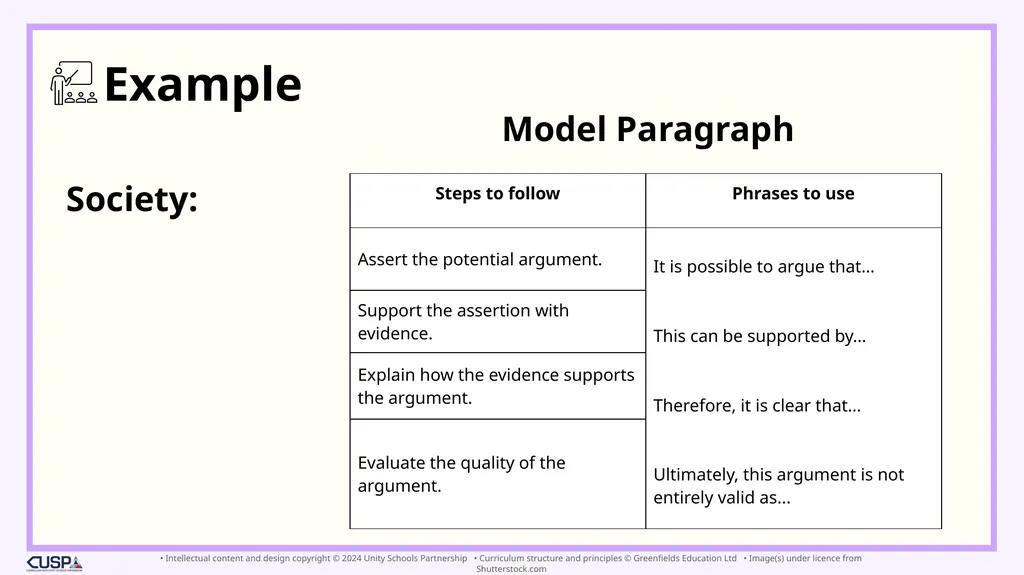
Example Society: Model Paragraph<br>
80
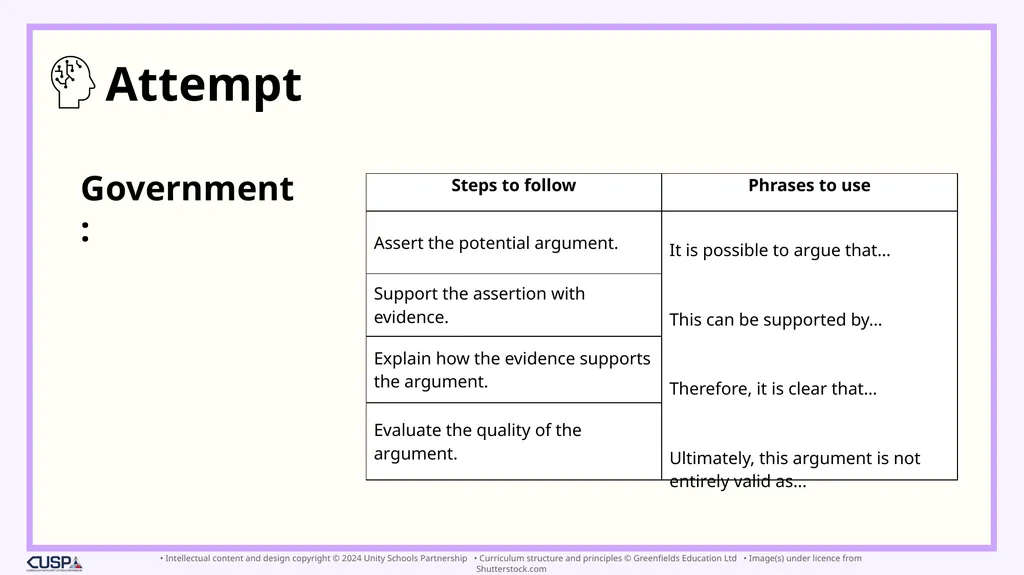
Government: Attempt<br>
81
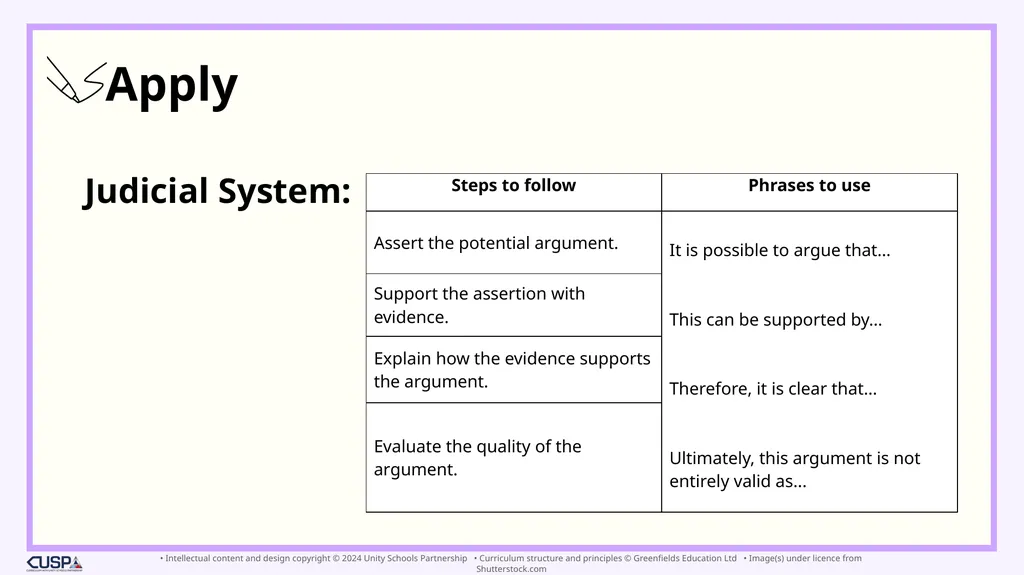
Judicial System: Apply<br>
82
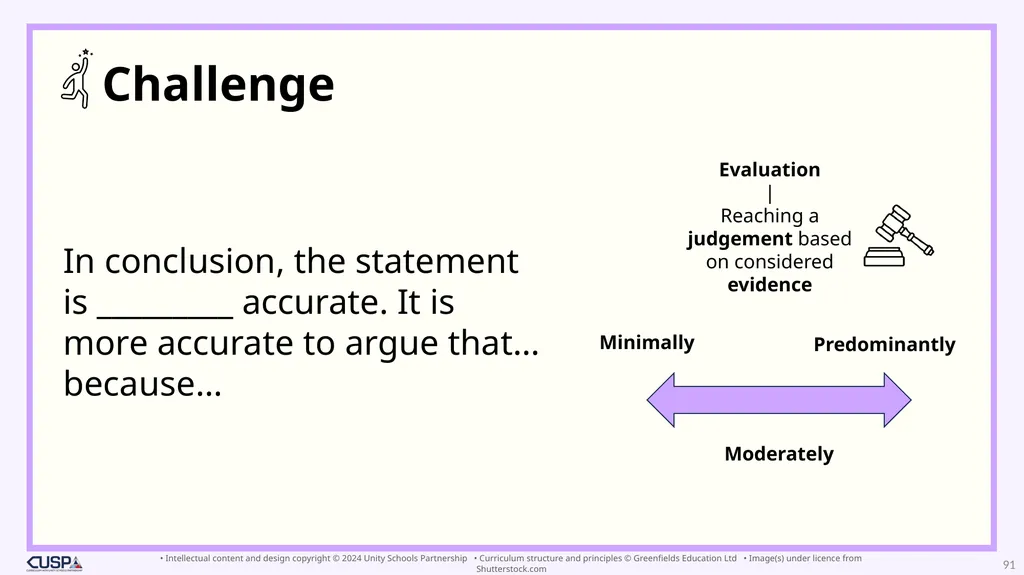
Challenge 91 In conclusion, the statement is _________ accurate. It is more accurate to argue that…because…<br>