
1 Food Safety Management Systems Chapter Number 10



Description: 1 Food Safety Management Systems Chapter Number 10 Class Name Instructor Name Date, Semester Book Title Book Author Learning Objectives After this presentation, you should be able to complete the following Learning Outcomes 10.0 2 10.1 10.2
Related Topics
Download Presentation
"1 Food Safety Management Systems Chapter Number 10" is the property of its rightful owner. Permission is granted to download and print the materials on this website for personal, non-commercial use only, and to display it on your personal computer provided you do not modify the materials and that you retain all copyright notices contained in the materials. By downloading content from our website, you accept the terms of this agreement.
Presentation Transcript
slide1. 1 Food Safety Management Systems Chapter Number 10 Class Name
Instructor Name
Date, Semester
Book Title
Book Author<br>
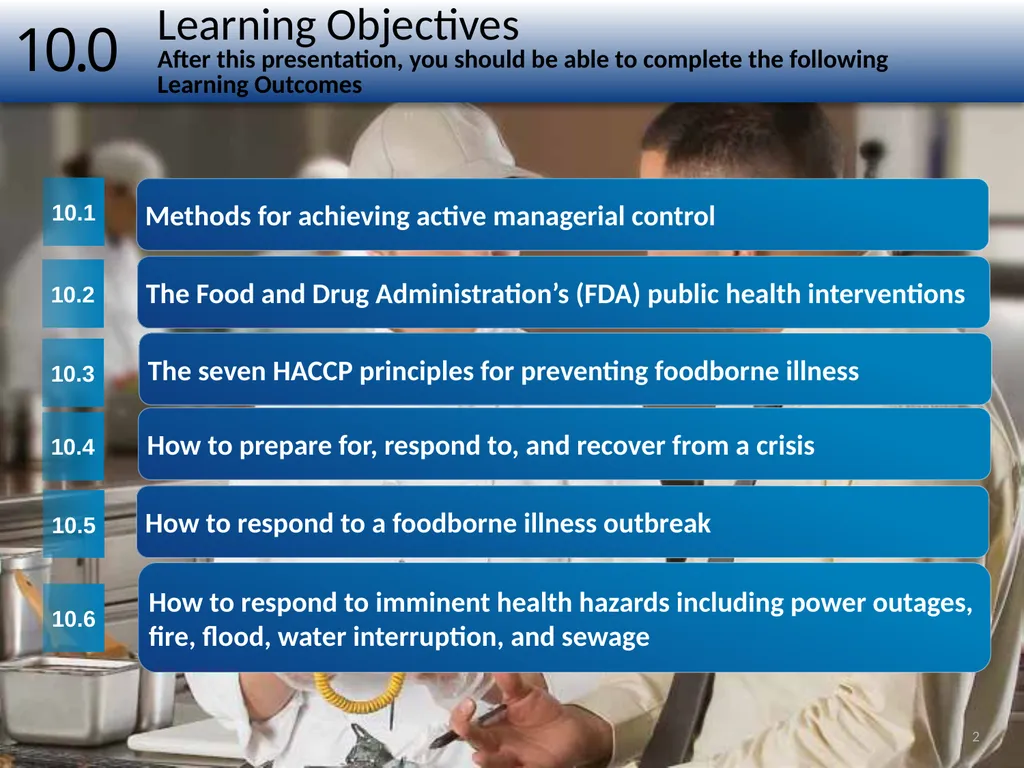
slide2. Learning Objectives After this presentation, you should be able to complete the following Learning Outcomes 10.0 2 10.1 10.2 10.3 10.4 Methods for achieving active managerial control The Food and Drug Administration’s (FDA) public health interventions The seven HACCP principles for preventing foodborne illness How to prepare for, respond to, and recover from a crisis 10.5 10.6 How to respond to a foodborne illness outbreak How to respond to imminent health hazards including power outages, fire, flood, water interruption, and sewage<br>
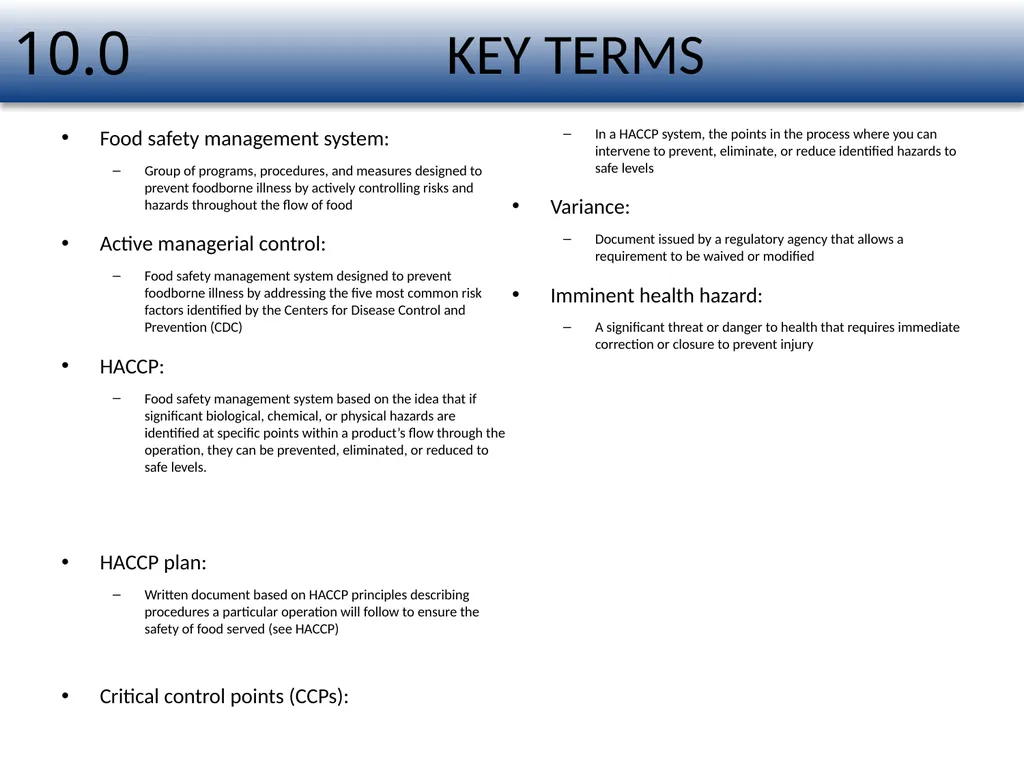
slide3. Food safety management system:
Group of programs, procedures, and measures designed to prevent foodborne illness by actively controlling risks and hazards throughout the flow of food
Active managerial control:
Food safety management system designed to prevent foodborne illness by addressing the five most common risk factors identified by the Centers for Disease Control and Prevention (CDC)
HACCP:
Food safety management system based on the idea that if significant biological, chemical, or physical hazards are identified at specific points within a product’s flow through the operation, they can be prevented, eliminated, or reduced to safe levels.
HACCP plan:
Written document based on HACCP principles describing procedures a particular operation will follow to ensure the safety of food served (see HACCP)
Critical control points (CCPs):
In a HACCP system, the points in the process where you can intervene to prevent, eliminate, or reduce identified hazards to safe levels
Variance:
Document issued by a regulatory agency that allows a requirement to be waived or modified
Imminent health hazard:
A significant threat or danger to health that requires immediate correction or closure to prevent injury KEY TERMS 10.0<br>
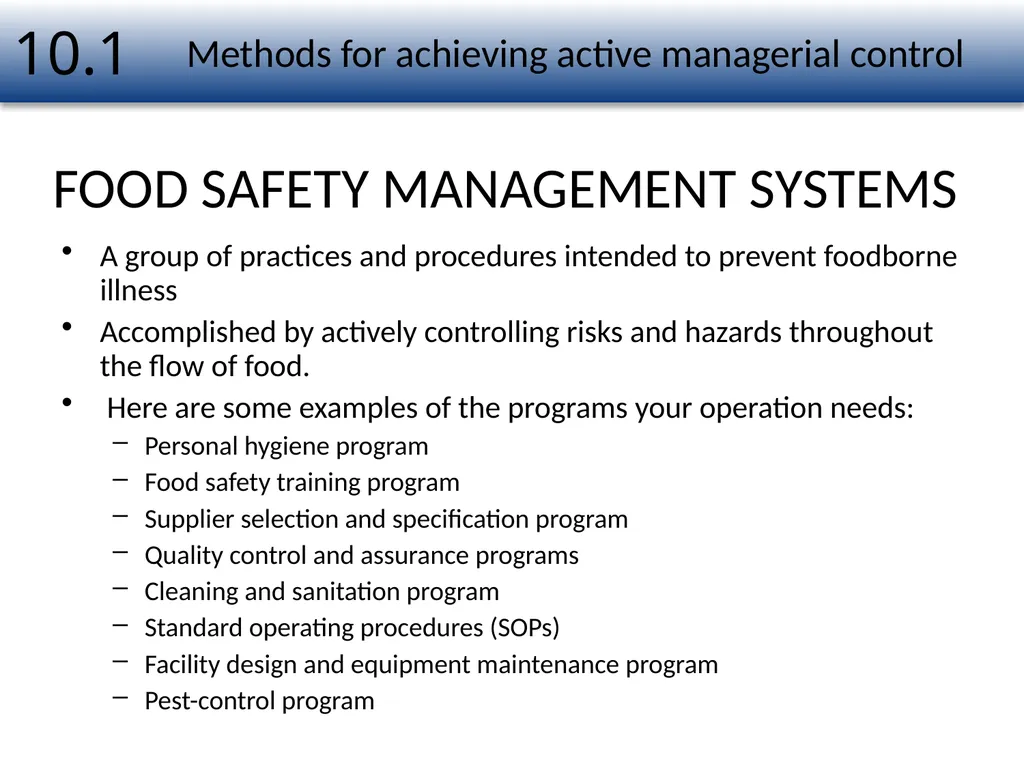
slide4. A group of practices and procedures intended to prevent foodborne illness
Accomplished by actively controlling risks and hazards throughout the flow of food.
Here are some examples of the programs your operation needs:
Personal hygiene program
Food safety training program
Supplier selection and specification program
Quality control and assurance programs
Cleaning and sanitation program
Standard operating procedures (SOPs)
Facility design and equipment maintenance program
Pest-control program FOOD SAFETY MANAGEMENT SYSTEMS Methods for achieving active managerial control 10.1<br>
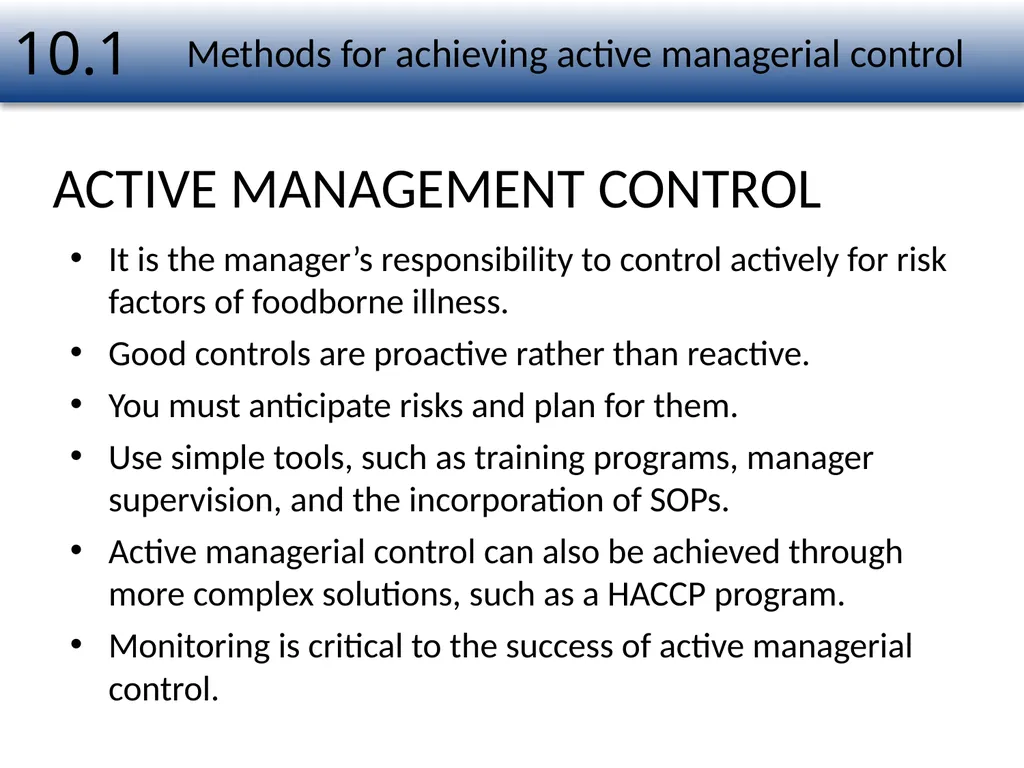
slide5. It is the manager’s responsibility to control actively for risk factors of foodborne illness.
Good controls are proactive rather than reactive.
You must anticipate risks and plan for them.
Use simple tools, such as training programs, manager supervision, and the incorporation of SOPs.
Active managerial control can also be achieved through more complex solutions, such as a HACCP program.
Monitoring is critical to the success of active managerial control. ACTIVE MANAGEMENT CONTROL Methods for achieving active managerial control 10.1<br>
slide6. Demonstration of knowledge
Show that you know what to do to keep food safe.
Staff health controls
Procedures must be put in place to make sure staff are practicing personal hygiene.
Controlling hands as a vehicle of contamination
Controls must be put in place to prevent bare-hand contact with ready-to-eat food.
Time and temperature parameters for controlling pathogens
Procedures must be put in place to limit the time food spends in the temperature danger zone.
Consumer advisories
Notices must be provided to customers if you serve raw or undercooked menu items. THE FDA’S PUBLIC HEALTH INTERVENTIONS The Food and Drug Administration’s (FDA) public health interventions 10.2<br>
slide7. Each HACCP principle builds on the information gained from the previous principle:
Conduct a hazard analysis.
Determine critical control points (CCPs).
Establish critical limits.
Establish monitoring procedures.
Identify corrective actions.
Verify that the system works.
Establish procedures for record keeping and documentation. SEVEN HACCP PRINCIPLES The seven HACCP principles for preventing foodborne illness 10.3<br>
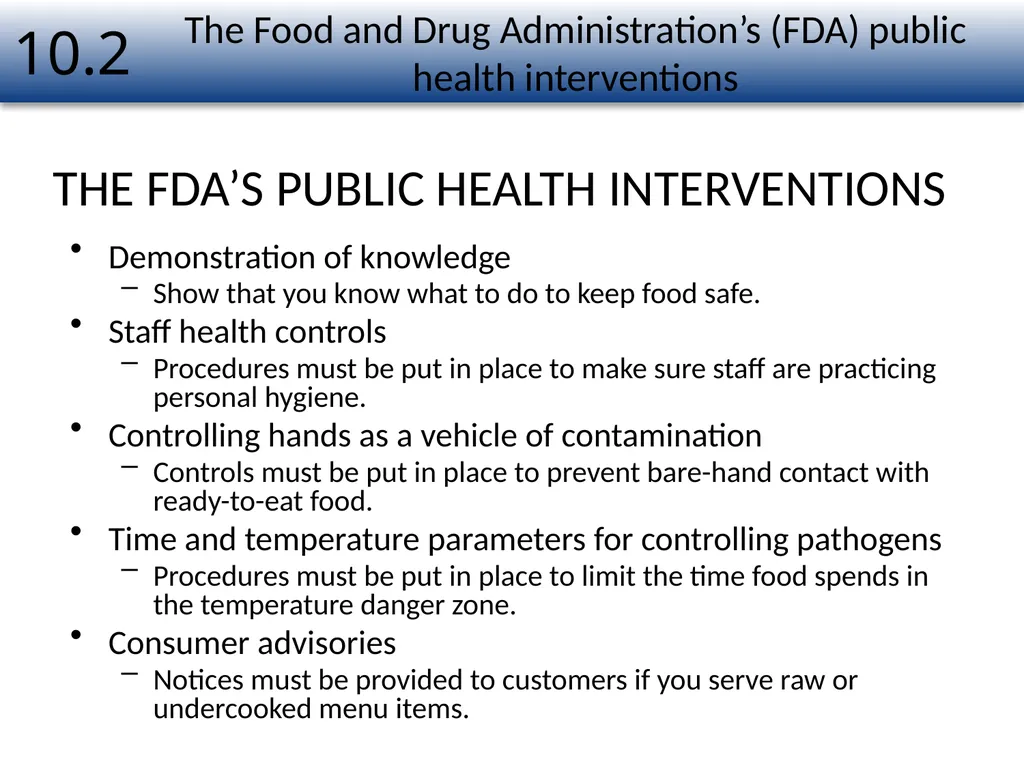
slide8. The seven HACCP principles for preventing foodborne illness 10.3 First, identify and assess potential hazards in the food you serve. Start by looking at how food is processed in your operation.
Prepping and cooking for same-day service (grilled chicken sandwiches, hamburgers, etc.)
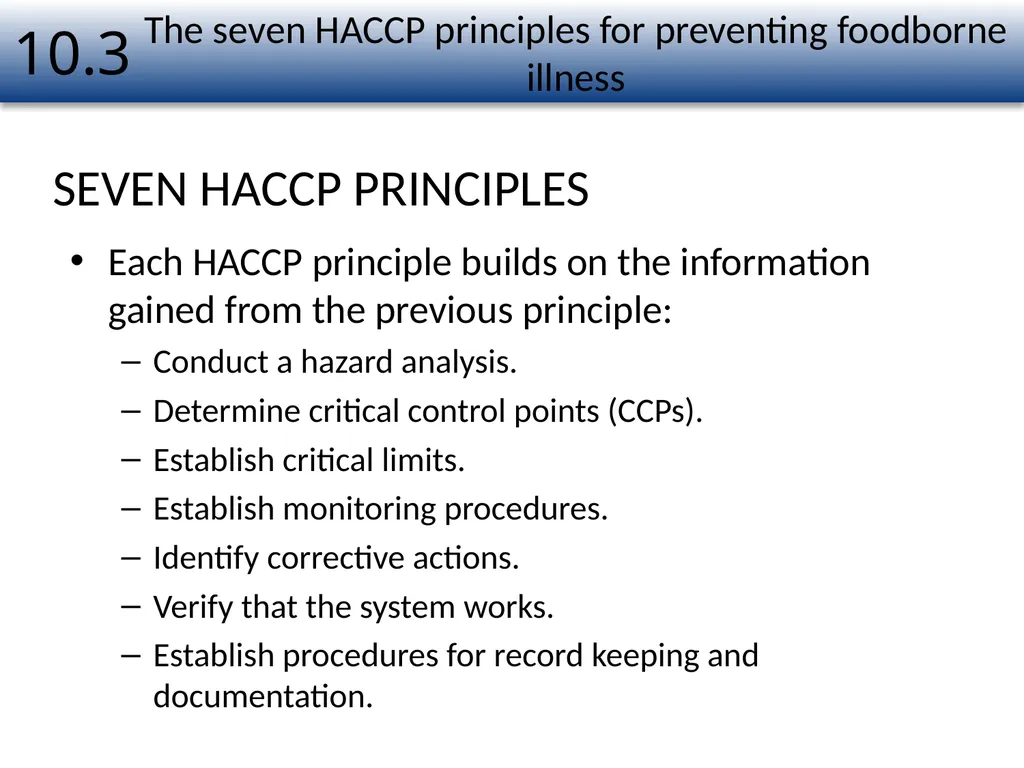
Prepping, cooking, holding, cooling, reheating, and serving (chili, soup, pasta sauce with meat, etc.) SEVEN HACCP PRINCIPLES (cont.) 1 Conduct a hazard analysis. 2 Determine critical control points. Find the points in the process where the identified hazard(s) can be prevented, eliminated, or reduced to safe levels.
These are the critical control points (CCPs). Depending on the process, there may be more than one CCP.<br>
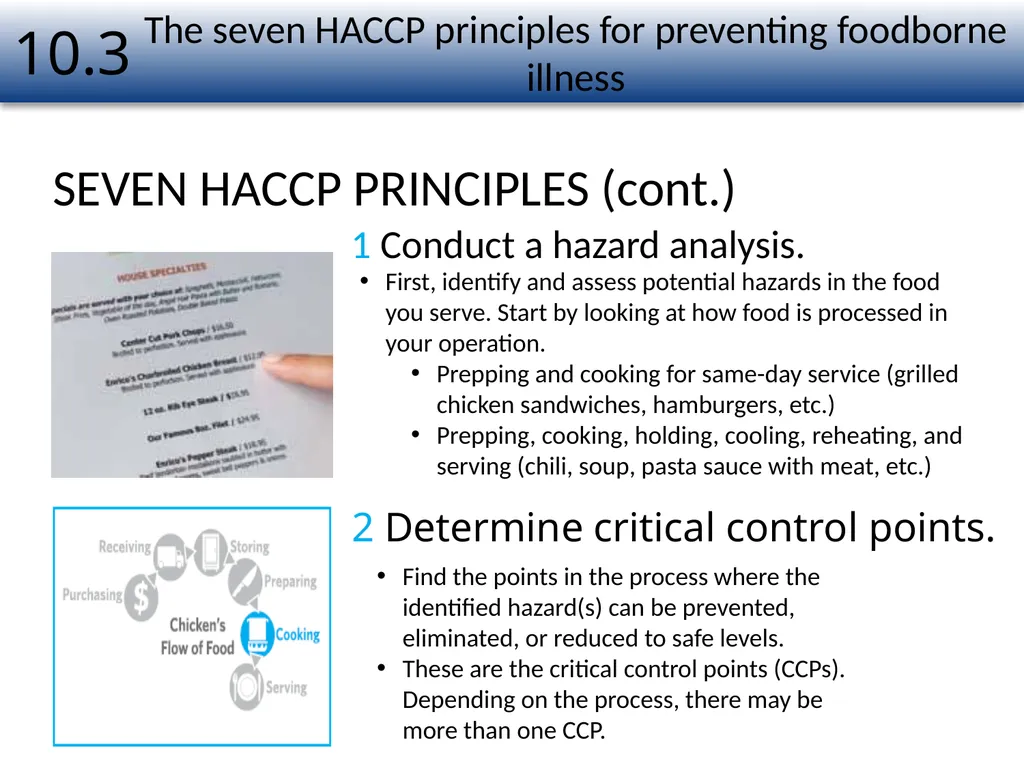
slide9. The seven HACCP principles for preventing foodborne illness 10.3 For each CCP, establish minimum or maximum limits.
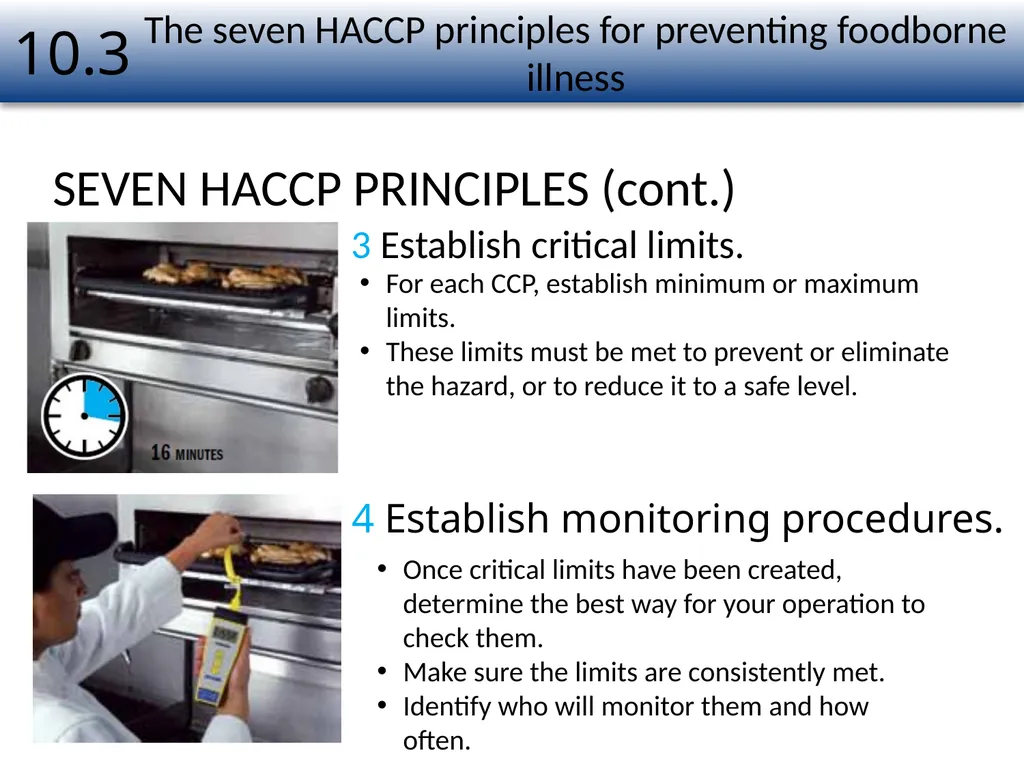
These limits must be met to prevent or eliminate the hazard, or to reduce it to a safe level. SEVEN HACCP PRINCIPLES (cont.) 3 Establish critical limits. 4 Establish monitoring procedures. Once critical limits have been created, determine the best way for your operation to check them.
Make sure the limits are consistently met.
Identify who will monitor them and how often.<br>
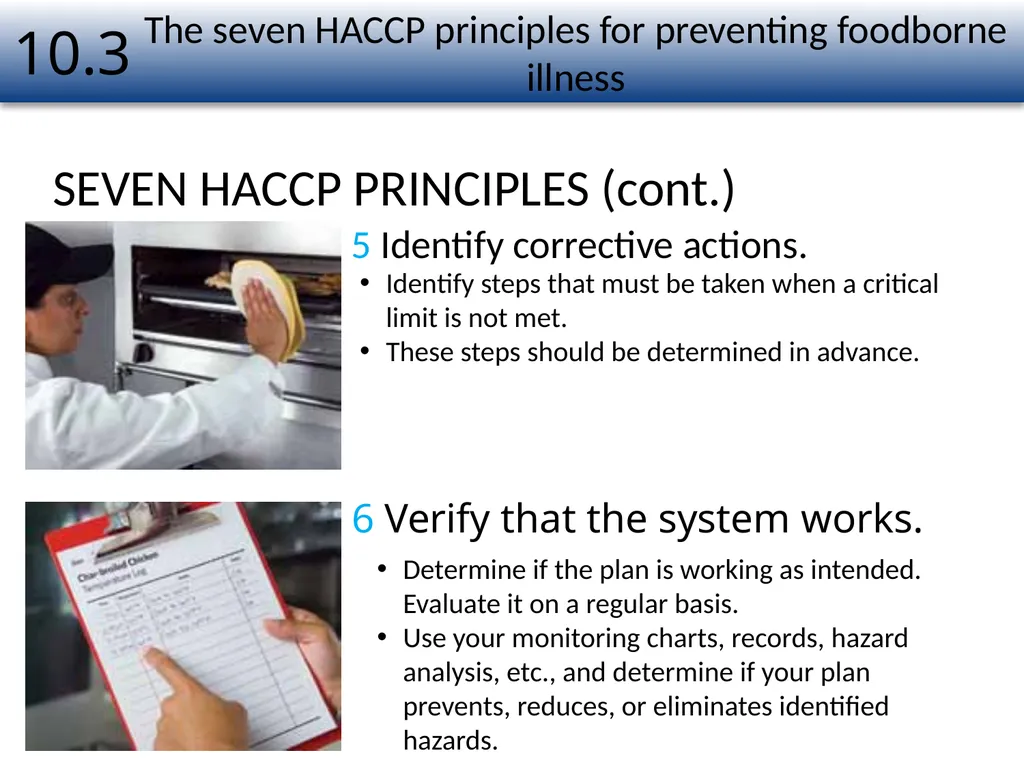
slide10. The seven HACCP principles for preventing foodborne illness 10.3 Identify steps that must be taken when a critical limit is not met.
These steps should be determined in advance. SEVEN HACCP PRINCIPLES (cont.) 5 Identify corrective actions. 6 Verify that the system works. Determine if the plan is working as intended. Evaluate it on a regular basis.
Use your monitoring charts, records, hazard analysis, etc., and determine if your plan prevents, reduces, or eliminates identified hazards.<br>
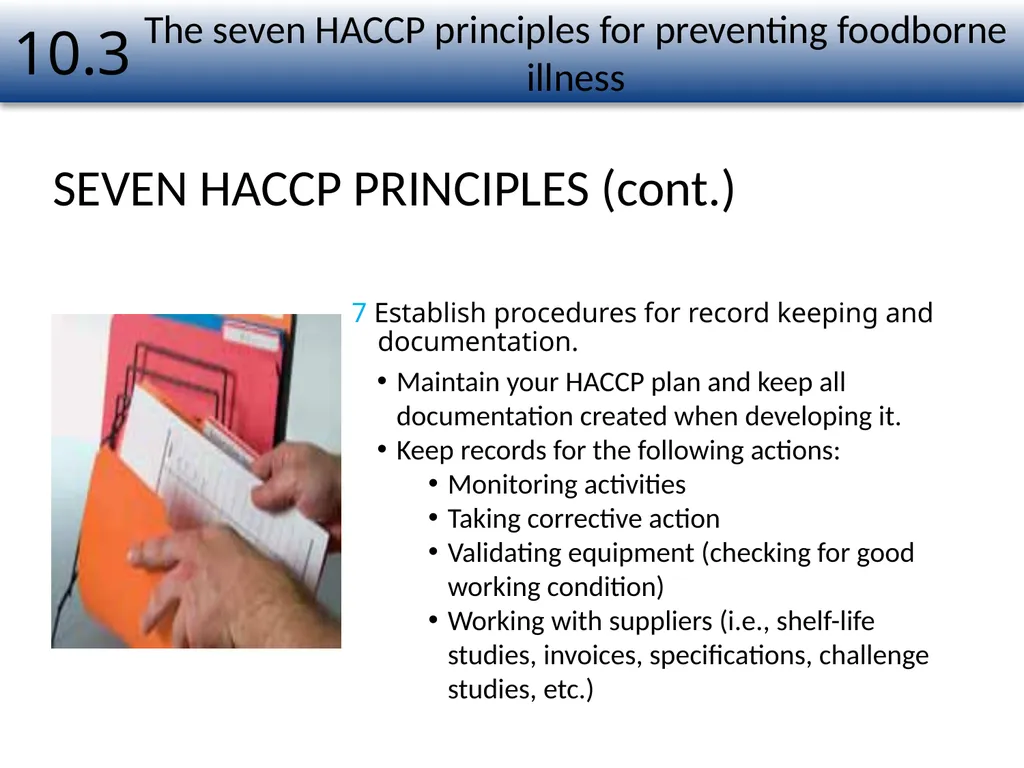
slide11. The seven HACCP principles for preventing foodborne illness 10.3 SEVEN HACCP PRINCIPLES (cont.) 7 Establish procedures for record keeping and documentation. Maintain your HACCP plan and keep all documentation created when developing it.
Keep records for the following actions:
Monitoring activities
Taking corrective action
Validating equipment (checking for good working condition)
Working with suppliers (i.e., shelf-life studies, invoices, specifications, challenge studies, etc.)<br>
slide12. Creating a Crisis-Management Team
To begin, create a crisis-management team. The size of the team will depend on the size of the operation. If your operation is large, the team may include representatives from the following departments:
Senior management (president/CEO, etc.)
Risk management (quality assurance, legal, etc.)
Public relations
Operations
Finance
Marketing
Human resources CRISIS MANAGEMENT—BEING PREPARED FOR THE INEVITABLE How to prepare for, respond to, and recover from a crisis 10.4<br>
slide13. Emergency contact list
Create an emergency contact list with all necessary numbers and post it by phones.
Crisis-communication plan
List of media responses or a question-and-answer sheet suggesting what to say for each crisis
Sample press releases that can be tailored quickly to each incident
List of media contacts to call for press conferences or news briefings
Include a media-relations plan with “dos and don’ts” for dealing with the media.
Plan for communicating with staff during the crisis. Possibilities include shift meetings, email, a telephone tree, etc. CRISIS MANAGEMENT—BEING PREPARED FOR THE INEVITABLE How to prepare for, respond to, and recover from a crisis 10.4<br>
slide14. Develop the form with legal guidance and include all critical information.
The form may contain the following:
What and when the customer ate at the operation
When the customer first got sick, what the symptoms were, and how long the customer experienced them
When and where the customer sought medical attention, what the diagnosis was, and what treatment was received
What other food was eaten by the customer PREPARING FOR A FOODBORNE ILLNESS OUTBREAK How to prepare for, respond to, and recover from a crisis 10.4<br>
slide15. To recover from a foodborne illness outbreak, you will need to take several steps.
They should be planned in advance and include the following:
Working with the regulatory authority to resolve issues
Cleaning and sanitizing all areas of the operation
Throwing out all suspect food
Investigating to find the cause of the outbreak
Reviewing food handling procedures to identify if standards are not being met or procedures are not working; establish new procedures or revise existing ones based on the investigation results
Developing a plan to reassure customers that the food you serve is safe FOODBORNE ILLNESS OUTBREAK RESPONSES How to respond to a foodborne illness outbreak 10.5<br>
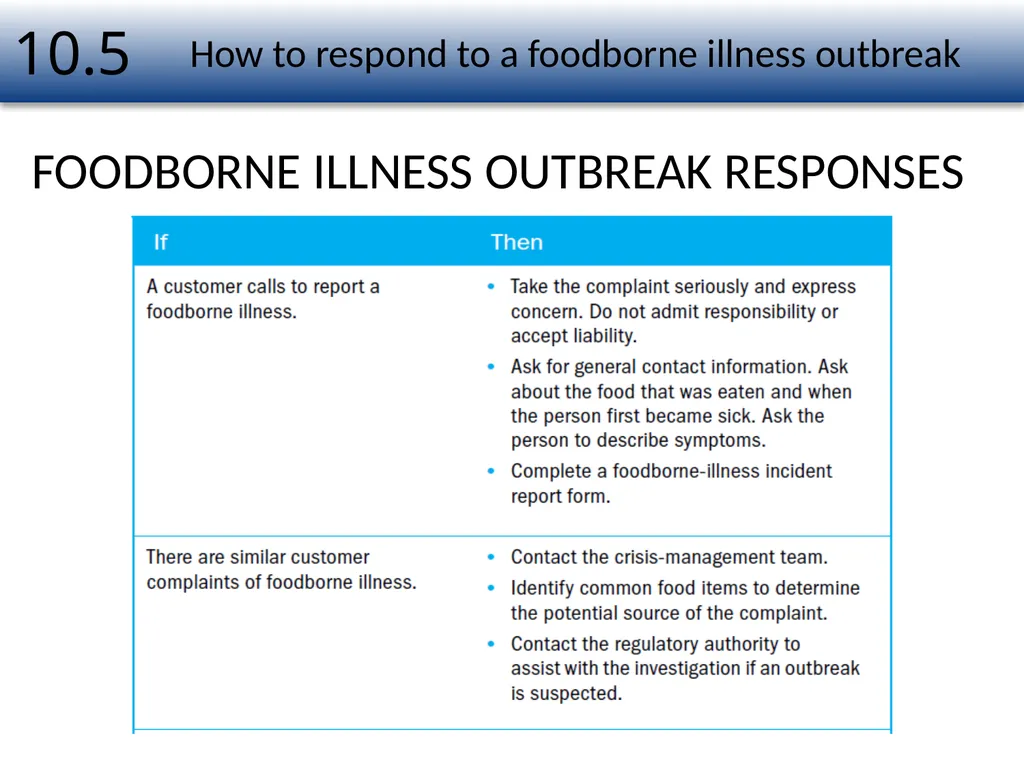
slide16. FOODBORNE ILLNESS OUTBREAK RESPONSES How to respond to a foodborne illness outbreak 10.5<br>
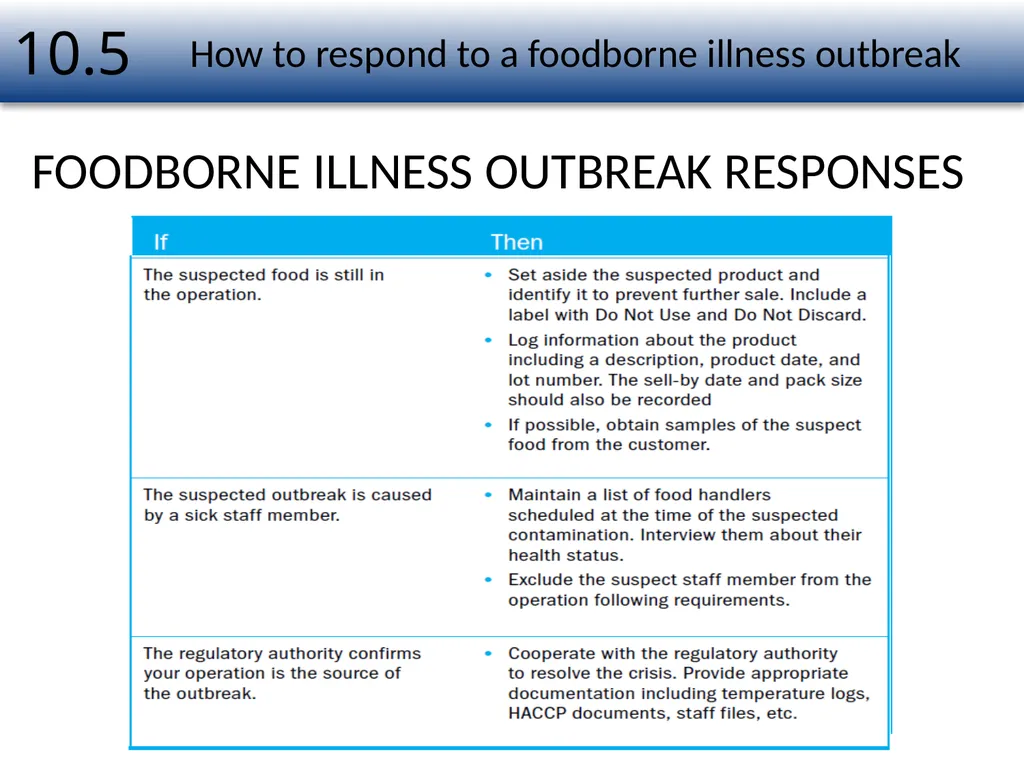
slide17. FOODBORNE ILLNESS OUTBREAK RESPONSES How to respond to a foodborne illness outbreak 10.5<br>
slide18. A significant threat or danger to health that requires immediate correction or closure to prevent injury
If there is a significant risk to the safety or the security of your food, service must be stopped and the local regulatory authority must be notified.
Spoiled or contaminated food must be thrown out, along with food in packaging that is not intact. IMMINENT HEALTH HAZARDS How to respond to imminent health hazards including power outages, fire, flood, water interruption, and sewage 10.6<br>
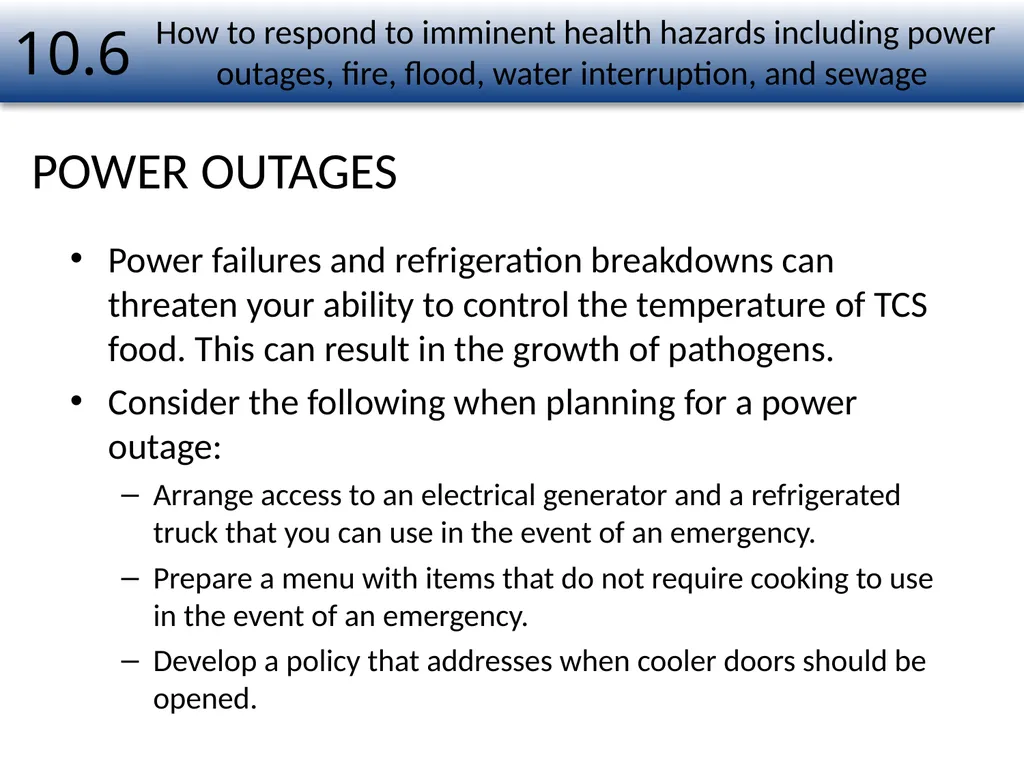
slide19. Power failures and refrigeration breakdowns can threaten your ability to control the temperature of TCS food. This can result in the growth of pathogens.
Consider the following when planning for a power outage:
Arrange access to an electrical generator and a refrigerated truck that you can use in the event of an emergency.
Prepare a menu with items that do not require cooking to use in the event of an emergency.
Develop a policy that addresses when cooler doors should be opened. POWER OUTAGES How to respond to imminent health hazards including power outages, fire, flood, water interruption, and sewage 10.6<br>
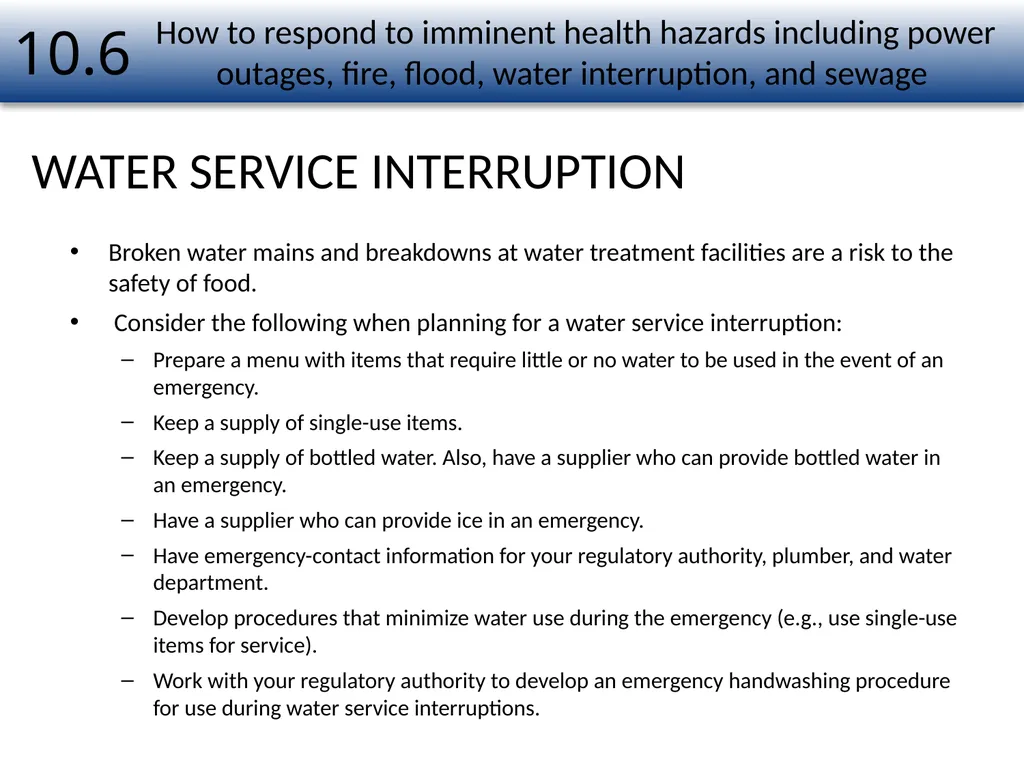
slide20. Broken water mains and breakdowns at water treatment facilities are a risk to the safety of food.
Consider the following when planning for a water service interruption:
Prepare a menu with items that require little or no water to be used in the event of an emergency.
Keep a supply of single-use items.
Keep a supply of bottled water. Also, have a supplier who can provide bottled water in an emergency.
Have a supplier who can provide ice in an emergency.
Have emergency-contact information for your regulatory authority, plumber, and water department.
Develop procedures that minimize water use during the emergency (e.g., use single-use items for service).
Work with your regulatory authority to develop an emergency handwashing procedure for use during water service interruptions. WATER SERVICE INTERRUPTION How to respond to imminent health hazards including power outages, fire, flood, water interruption, and sewage 10.6<br>
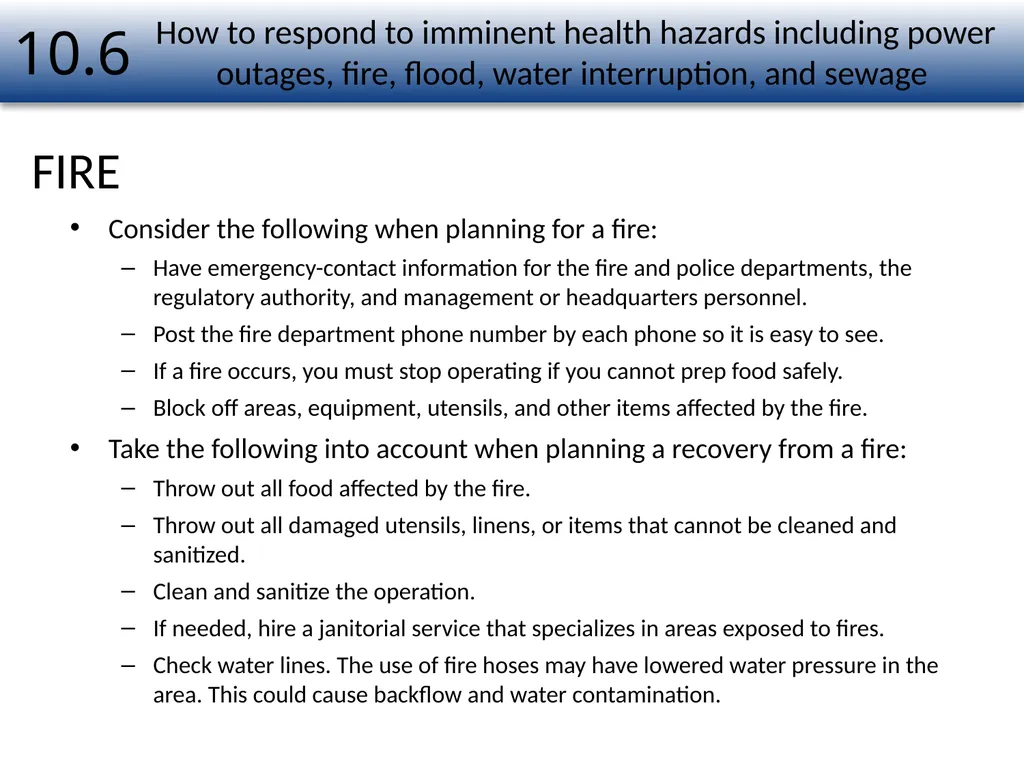
slide21. Consider the following when planning for a fire:
Have emergency-contact information for the fire and police departments, the regulatory authority, and management or headquarters personnel.
Post the fire department phone number by each phone so it is easy to see.
If a fire occurs, you must stop operating if you cannot prep food safely.
Block off areas, equipment, utensils, and other items affected by the fire.
Take the following into account when planning a recovery from a fire:
Throw out all food affected by the fire.
Throw out all damaged utensils, linens, or items that cannot be cleaned and sanitized.
Clean and sanitize the operation.
If needed, hire a janitorial service that specializes in areas exposed to fires.
Check water lines. The use of fire hoses may have lowered water pressure in the area. This could cause backflow and water contamination. FIRE How to respond to imminent health hazards including power outages, fire, flood, water interruption, and sewage 10.6<br>
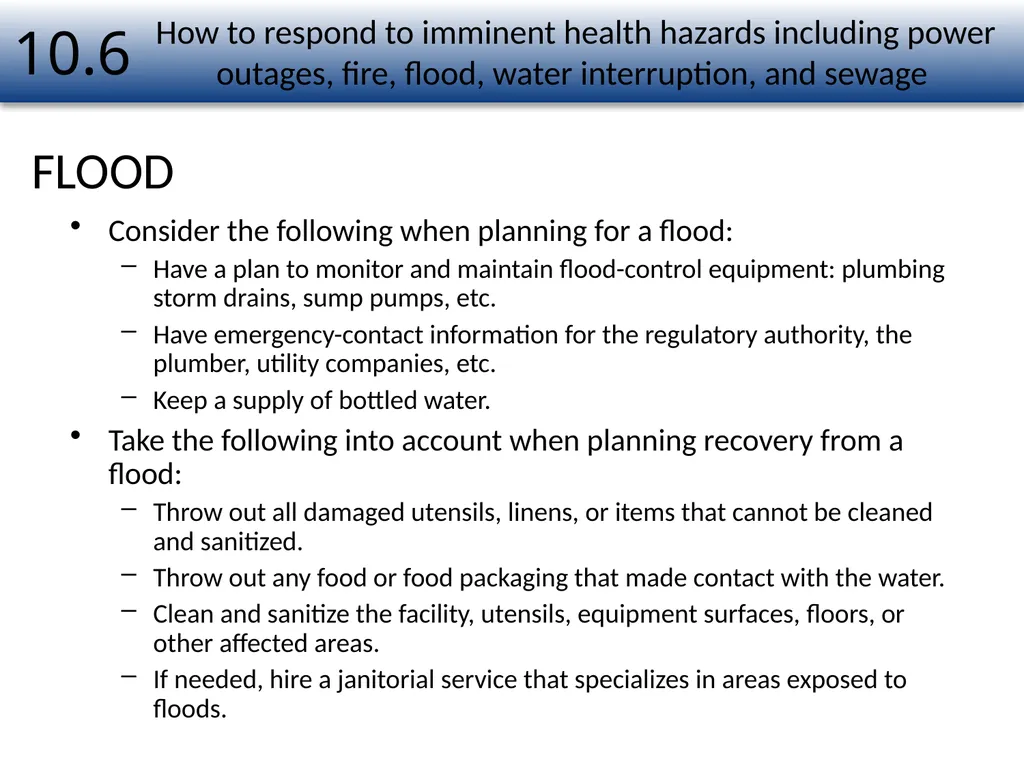
slide22. Consider the following when planning for a flood:
Have a plan to monitor and maintain flood-control equipment: plumbing storm drains, sump pumps, etc.
Have emergency-contact information for the regulatory authority, the plumber, utility companies, etc.
Keep a supply of bottled water.
Take the following into account when planning recovery from a flood:
Throw out all damaged utensils, linens, or items that cannot be cleaned and sanitized.
Throw out any food or food packaging that made contact with the water.
Clean and sanitize the facility, utensils, equipment surfaces, floors, or other affected areas.
If needed, hire a janitorial service that specializes in areas exposed to floods. FLOOD How to respond to imminent health hazards including power outages, fire, flood, water interruption, and sewage 10.6<br>
Instructor Name
Date, Semester
Book Title
Book Author<br>
slide2. Learning Objectives After this presentation, you should be able to complete the following Learning Outcomes 10.0 2 10.1 10.2 10.3 10.4 Methods for achieving active managerial control The Food and Drug Administration’s (FDA) public health interventions The seven HACCP principles for preventing foodborne illness How to prepare for, respond to, and recover from a crisis 10.5 10.6 How to respond to a foodborne illness outbreak How to respond to imminent health hazards including power outages, fire, flood, water interruption, and sewage<br>
slide3. Food safety management system:
Group of programs, procedures, and measures designed to prevent foodborne illness by actively controlling risks and hazards throughout the flow of food
Active managerial control:
Food safety management system designed to prevent foodborne illness by addressing the five most common risk factors identified by the Centers for Disease Control and Prevention (CDC)
HACCP:
Food safety management system based on the idea that if significant biological, chemical, or physical hazards are identified at specific points within a product’s flow through the operation, they can be prevented, eliminated, or reduced to safe levels.
HACCP plan:
Written document based on HACCP principles describing procedures a particular operation will follow to ensure the safety of food served (see HACCP)
Critical control points (CCPs):
In a HACCP system, the points in the process where you can intervene to prevent, eliminate, or reduce identified hazards to safe levels
Variance:
Document issued by a regulatory agency that allows a requirement to be waived or modified
Imminent health hazard:
A significant threat or danger to health that requires immediate correction or closure to prevent injury KEY TERMS 10.0<br>
slide4. A group of practices and procedures intended to prevent foodborne illness
Accomplished by actively controlling risks and hazards throughout the flow of food.
Here are some examples of the programs your operation needs:
Personal hygiene program
Food safety training program
Supplier selection and specification program
Quality control and assurance programs
Cleaning and sanitation program
Standard operating procedures (SOPs)
Facility design and equipment maintenance program
Pest-control program FOOD SAFETY MANAGEMENT SYSTEMS Methods for achieving active managerial control 10.1<br>
slide5. It is the manager’s responsibility to control actively for risk factors of foodborne illness.
Good controls are proactive rather than reactive.
You must anticipate risks and plan for them.
Use simple tools, such as training programs, manager supervision, and the incorporation of SOPs.
Active managerial control can also be achieved through more complex solutions, such as a HACCP program.
Monitoring is critical to the success of active managerial control. ACTIVE MANAGEMENT CONTROL Methods for achieving active managerial control 10.1<br>
slide6. Demonstration of knowledge
Show that you know what to do to keep food safe.
Staff health controls
Procedures must be put in place to make sure staff are practicing personal hygiene.
Controlling hands as a vehicle of contamination
Controls must be put in place to prevent bare-hand contact with ready-to-eat food.
Time and temperature parameters for controlling pathogens
Procedures must be put in place to limit the time food spends in the temperature danger zone.
Consumer advisories
Notices must be provided to customers if you serve raw or undercooked menu items. THE FDA’S PUBLIC HEALTH INTERVENTIONS The Food and Drug Administration’s (FDA) public health interventions 10.2<br>
slide7. Each HACCP principle builds on the information gained from the previous principle:
Conduct a hazard analysis.
Determine critical control points (CCPs).
Establish critical limits.
Establish monitoring procedures.
Identify corrective actions.
Verify that the system works.
Establish procedures for record keeping and documentation. SEVEN HACCP PRINCIPLES The seven HACCP principles for preventing foodborne illness 10.3<br>
slide8. The seven HACCP principles for preventing foodborne illness 10.3 First, identify and assess potential hazards in the food you serve. Start by looking at how food is processed in your operation.
Prepping and cooking for same-day service (grilled chicken sandwiches, hamburgers, etc.)
Prepping, cooking, holding, cooling, reheating, and serving (chili, soup, pasta sauce with meat, etc.) SEVEN HACCP PRINCIPLES (cont.) 1 Conduct a hazard analysis. 2 Determine critical control points. Find the points in the process where the identified hazard(s) can be prevented, eliminated, or reduced to safe levels.
These are the critical control points (CCPs). Depending on the process, there may be more than one CCP.<br>
slide9. The seven HACCP principles for preventing foodborne illness 10.3 For each CCP, establish minimum or maximum limits.
These limits must be met to prevent or eliminate the hazard, or to reduce it to a safe level. SEVEN HACCP PRINCIPLES (cont.) 3 Establish critical limits. 4 Establish monitoring procedures. Once critical limits have been created, determine the best way for your operation to check them.
Make sure the limits are consistently met.
Identify who will monitor them and how often.<br>
slide10. The seven HACCP principles for preventing foodborne illness 10.3 Identify steps that must be taken when a critical limit is not met.
These steps should be determined in advance. SEVEN HACCP PRINCIPLES (cont.) 5 Identify corrective actions. 6 Verify that the system works. Determine if the plan is working as intended. Evaluate it on a regular basis.
Use your monitoring charts, records, hazard analysis, etc., and determine if your plan prevents, reduces, or eliminates identified hazards.<br>
slide11. The seven HACCP principles for preventing foodborne illness 10.3 SEVEN HACCP PRINCIPLES (cont.) 7 Establish procedures for record keeping and documentation. Maintain your HACCP plan and keep all documentation created when developing it.
Keep records for the following actions:
Monitoring activities
Taking corrective action
Validating equipment (checking for good working condition)
Working with suppliers (i.e., shelf-life studies, invoices, specifications, challenge studies, etc.)<br>
slide12. Creating a Crisis-Management Team
To begin, create a crisis-management team. The size of the team will depend on the size of the operation. If your operation is large, the team may include representatives from the following departments:
Senior management (president/CEO, etc.)
Risk management (quality assurance, legal, etc.)
Public relations
Operations
Finance
Marketing
Human resources CRISIS MANAGEMENT—BEING PREPARED FOR THE INEVITABLE How to prepare for, respond to, and recover from a crisis 10.4<br>
slide13. Emergency contact list
Create an emergency contact list with all necessary numbers and post it by phones.
Crisis-communication plan
List of media responses or a question-and-answer sheet suggesting what to say for each crisis
Sample press releases that can be tailored quickly to each incident
List of media contacts to call for press conferences or news briefings
Include a media-relations plan with “dos and don’ts” for dealing with the media.
Plan for communicating with staff during the crisis. Possibilities include shift meetings, email, a telephone tree, etc. CRISIS MANAGEMENT—BEING PREPARED FOR THE INEVITABLE How to prepare for, respond to, and recover from a crisis 10.4<br>
slide14. Develop the form with legal guidance and include all critical information.
The form may contain the following:
What and when the customer ate at the operation
When the customer first got sick, what the symptoms were, and how long the customer experienced them
When and where the customer sought medical attention, what the diagnosis was, and what treatment was received
What other food was eaten by the customer PREPARING FOR A FOODBORNE ILLNESS OUTBREAK How to prepare for, respond to, and recover from a crisis 10.4<br>
slide15. To recover from a foodborne illness outbreak, you will need to take several steps.
They should be planned in advance and include the following:
Working with the regulatory authority to resolve issues
Cleaning and sanitizing all areas of the operation
Throwing out all suspect food
Investigating to find the cause of the outbreak
Reviewing food handling procedures to identify if standards are not being met or procedures are not working; establish new procedures or revise existing ones based on the investigation results
Developing a plan to reassure customers that the food you serve is safe FOODBORNE ILLNESS OUTBREAK RESPONSES How to respond to a foodborne illness outbreak 10.5<br>
slide16. FOODBORNE ILLNESS OUTBREAK RESPONSES How to respond to a foodborne illness outbreak 10.5<br>
slide17. FOODBORNE ILLNESS OUTBREAK RESPONSES How to respond to a foodborne illness outbreak 10.5<br>
slide18. A significant threat or danger to health that requires immediate correction or closure to prevent injury
If there is a significant risk to the safety or the security of your food, service must be stopped and the local regulatory authority must be notified.
Spoiled or contaminated food must be thrown out, along with food in packaging that is not intact. IMMINENT HEALTH HAZARDS How to respond to imminent health hazards including power outages, fire, flood, water interruption, and sewage 10.6<br>
slide19. Power failures and refrigeration breakdowns can threaten your ability to control the temperature of TCS food. This can result in the growth of pathogens.
Consider the following when planning for a power outage:
Arrange access to an electrical generator and a refrigerated truck that you can use in the event of an emergency.
Prepare a menu with items that do not require cooking to use in the event of an emergency.
Develop a policy that addresses when cooler doors should be opened. POWER OUTAGES How to respond to imminent health hazards including power outages, fire, flood, water interruption, and sewage 10.6<br>
slide20. Broken water mains and breakdowns at water treatment facilities are a risk to the safety of food.
Consider the following when planning for a water service interruption:
Prepare a menu with items that require little or no water to be used in the event of an emergency.
Keep a supply of single-use items.
Keep a supply of bottled water. Also, have a supplier who can provide bottled water in an emergency.
Have a supplier who can provide ice in an emergency.
Have emergency-contact information for your regulatory authority, plumber, and water department.
Develop procedures that minimize water use during the emergency (e.g., use single-use items for service).
Work with your regulatory authority to develop an emergency handwashing procedure for use during water service interruptions. WATER SERVICE INTERRUPTION How to respond to imminent health hazards including power outages, fire, flood, water interruption, and sewage 10.6<br>
slide21. Consider the following when planning for a fire:
Have emergency-contact information for the fire and police departments, the regulatory authority, and management or headquarters personnel.
Post the fire department phone number by each phone so it is easy to see.
If a fire occurs, you must stop operating if you cannot prep food safely.
Block off areas, equipment, utensils, and other items affected by the fire.
Take the following into account when planning a recovery from a fire:
Throw out all food affected by the fire.
Throw out all damaged utensils, linens, or items that cannot be cleaned and sanitized.
Clean and sanitize the operation.
If needed, hire a janitorial service that specializes in areas exposed to fires.
Check water lines. The use of fire hoses may have lowered water pressure in the area. This could cause backflow and water contamination. FIRE How to respond to imminent health hazards including power outages, fire, flood, water interruption, and sewage 10.6<br>
slide22. Consider the following when planning for a flood:
Have a plan to monitor and maintain flood-control equipment: plumbing storm drains, sump pumps, etc.
Have emergency-contact information for the regulatory authority, the plumber, utility companies, etc.
Keep a supply of bottled water.
Take the following into account when planning recovery from a flood:
Throw out all damaged utensils, linens, or items that cannot be cleaned and sanitized.
Throw out any food or food packaging that made contact with the water.
Clean and sanitize the facility, utensils, equipment surfaces, floors, or other affected areas.
If needed, hire a janitorial service that specializes in areas exposed to floods. FLOOD How to respond to imminent health hazards including power outages, fire, flood, water interruption, and sewage 10.6<br>