
2015/16 Annual Report presentation to the
Description: 201516 Annual Report presentation to the Portfolio Committee on Public Works 25 October 2016 1 Presentation Overview Contextual Background Organisational Strategic Overview Performance Highlights Governance Human Resource Management
Related Topics
Download Presentation
"2015/16 Annual Report presentation to the" is the property of its rightful owner. Permission is granted to download and print the materials on this website for personal, non-commercial use only, and to display it on your personal computer provided you do not modify the materials and that you retain all copyright notices contained in the materials. By downloading content from our website, you accept the terms of this agreement.
Presentation Transcript
slide1. 2015/16 Annual Report presentation to the Portfolio Committee on Public Works
25 October 2016 1<br>
slide2. Presentation Overview Contextual Background
Organisational Strategic Overview
Performance Highlights
Governance
Human Resource Management
Financial Information
Conclusion and Recommendations 2<br>
slide3. 3 1. Contextual Background<br>
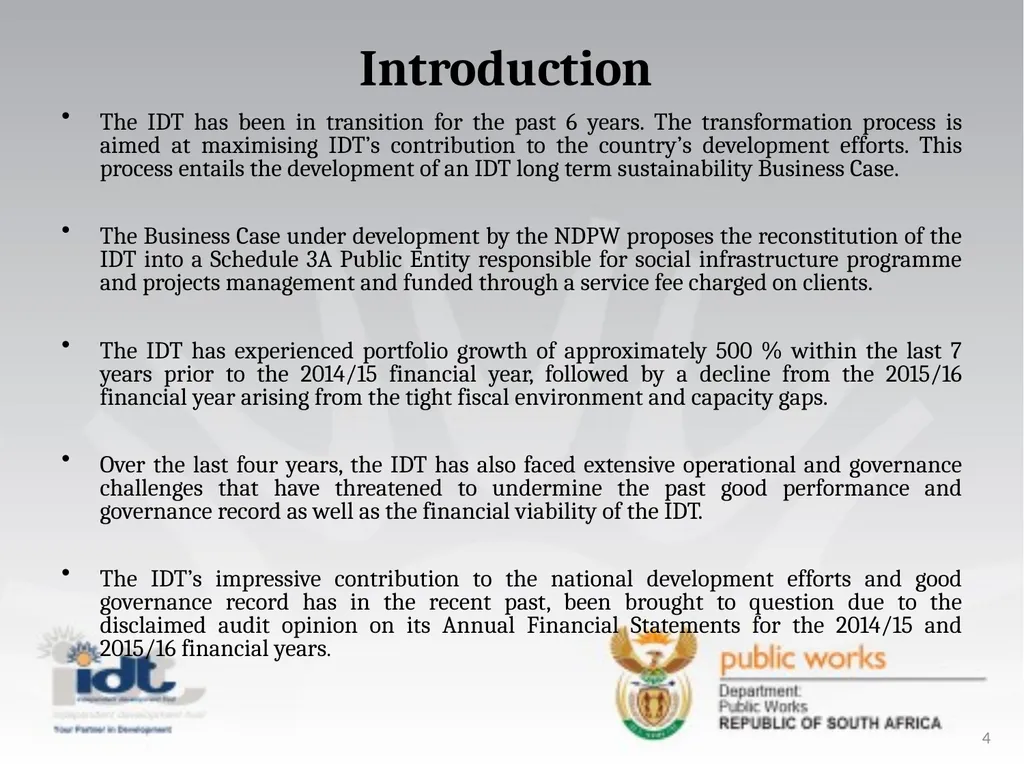
slide4. Introduction 4 The IDT has been in transition for the past 6 years. The transformation process is aimed at maximising IDT’s contribution to the country’s development efforts. This process entails the development of an IDT long term sustainability Business Case.
The Business Case under development by the NDPW proposes the reconstitution of the IDT into a Schedule 3A Public Entity responsible for social infrastructure programme and projects management and funded through a service fee charged on clients.
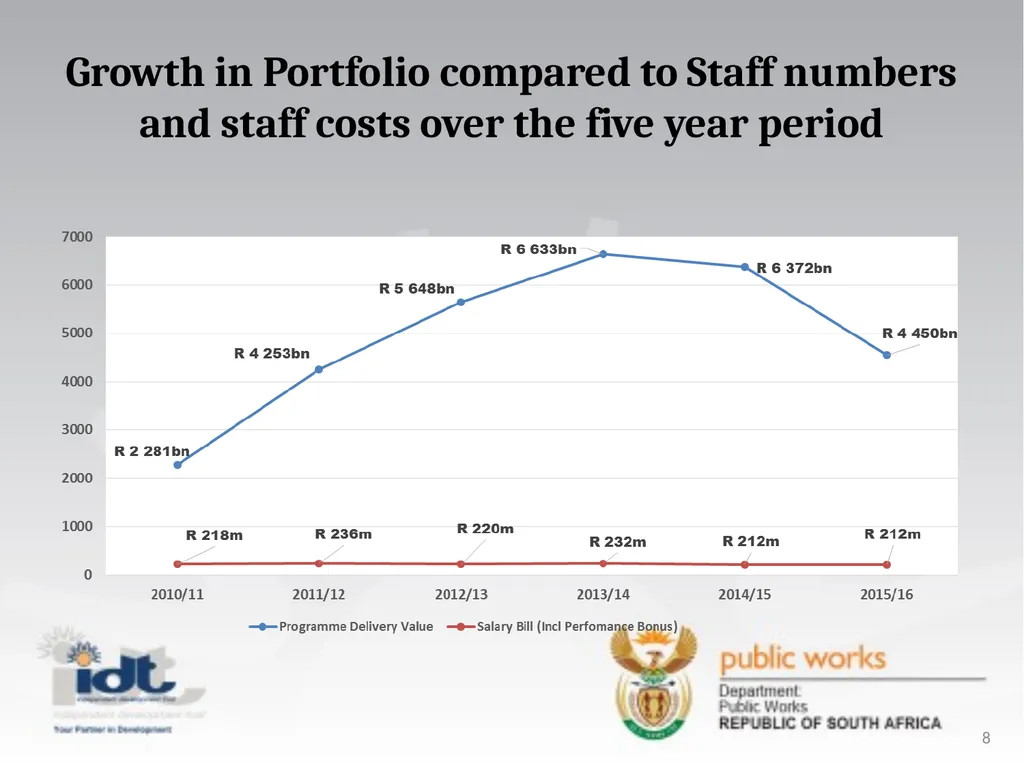
The IDT has experienced portfolio growth of approximately 500 % within the last 7 years prior to the 2014/15 financial year, followed by a decline from the 2015/16 financial year arising from the tight fiscal environment and capacity gaps.
Over the last four years, the IDT has also faced extensive operational and governance challenges that have threatened to undermine the past good performance and governance record as well as the financial viability of the IDT.
The IDT’s impressive contribution to the national development efforts and good governance record has in the recent past, been brought to question due to the disclaimed audit opinion on its Annual Financial Statements for the 2014/15 and 2015/16 financial years.<br>
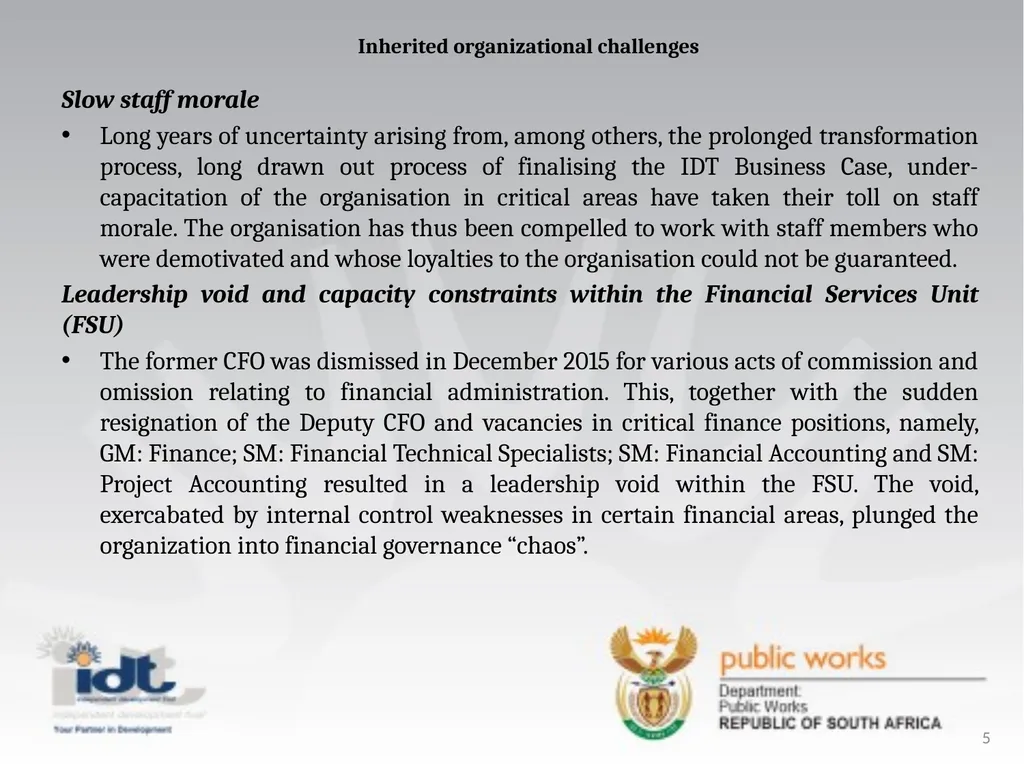
slide5. Inherited organizational challenges 5 Slow staff morale
Long years of uncertainty arising from, among others, the prolonged transformation process, long drawn out process of finalising the IDT Business Case, under-capacitation of the organisation in critical areas have taken their toll on staff morale. The organisation has thus been compelled to work with staff members who were demotivated and whose loyalties to the organisation could not be guaranteed.
Leadership void and capacity constraints within the Financial Services Unit (FSU)
The former CFO was dismissed in December 2015 for various acts of commission and omission relating to financial administration. This, together with the sudden resignation of the Deputy CFO and vacancies in critical finance positions, namely, GM: Finance; SM: Financial Technical Specialists; SM: Financial Accounting and SM: Project Accounting resulted in a leadership void within the FSU. The void, exercabated by internal control weaknesses in certain financial areas, plunged the organization into financial governance “chaos”.<br>
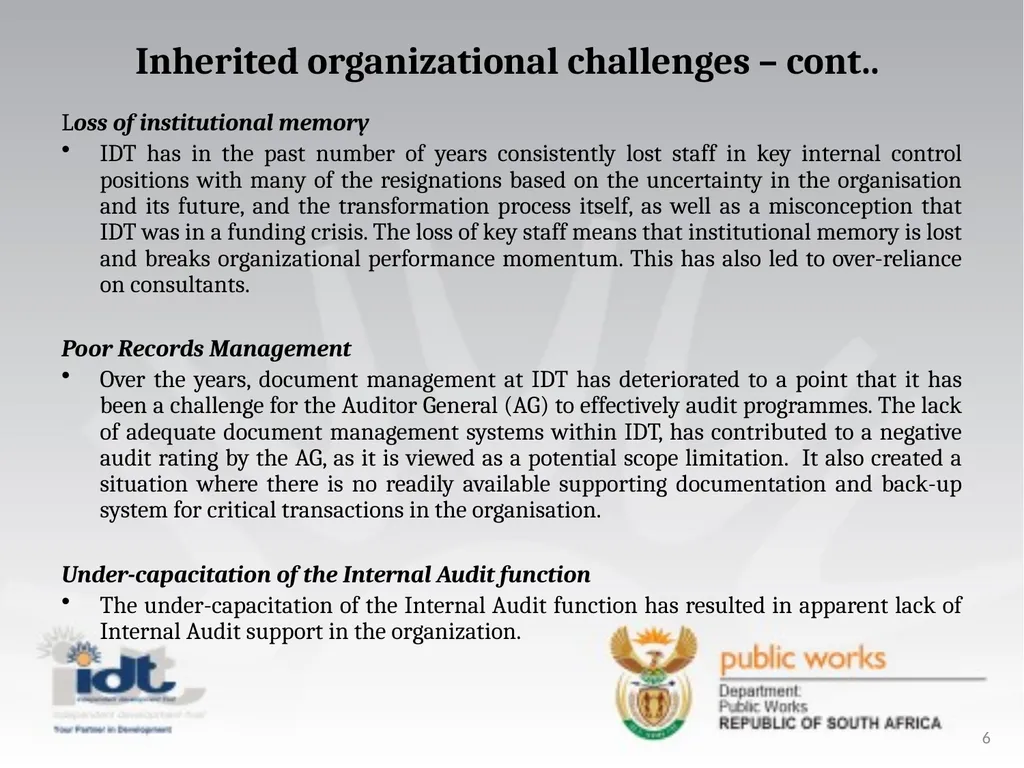
slide6. Inherited organizational challenges – cont.. Loss of institutional memory
IDT has in the past number of years consistently lost staff in key internal control positions with many of the resignations based on the uncertainty in the organisation and its future, and the transformation process itself, as well as a misconception that IDT was in a funding crisis. The loss of key staff means that institutional memory is lost and breaks organizational performance momentum. This has also led to over-reliance on consultants.
Poor Records Management
Over the years, document management at IDT has deteriorated to a point that it has been a challenge for the Auditor General (AG) to effectively audit programmes. The lack of adequate document management systems within IDT, has contributed to a negative audit rating by the AG, as it is viewed as a potential scope limitation. It also created a situation where there is no readily available supporting documentation and back-up system for critical transactions in the organisation.
Under-capacitation of the Internal Audit function
The under-capacitation of the Internal Audit function has resulted in apparent lack of Internal Audit support in the organization. 6<br>
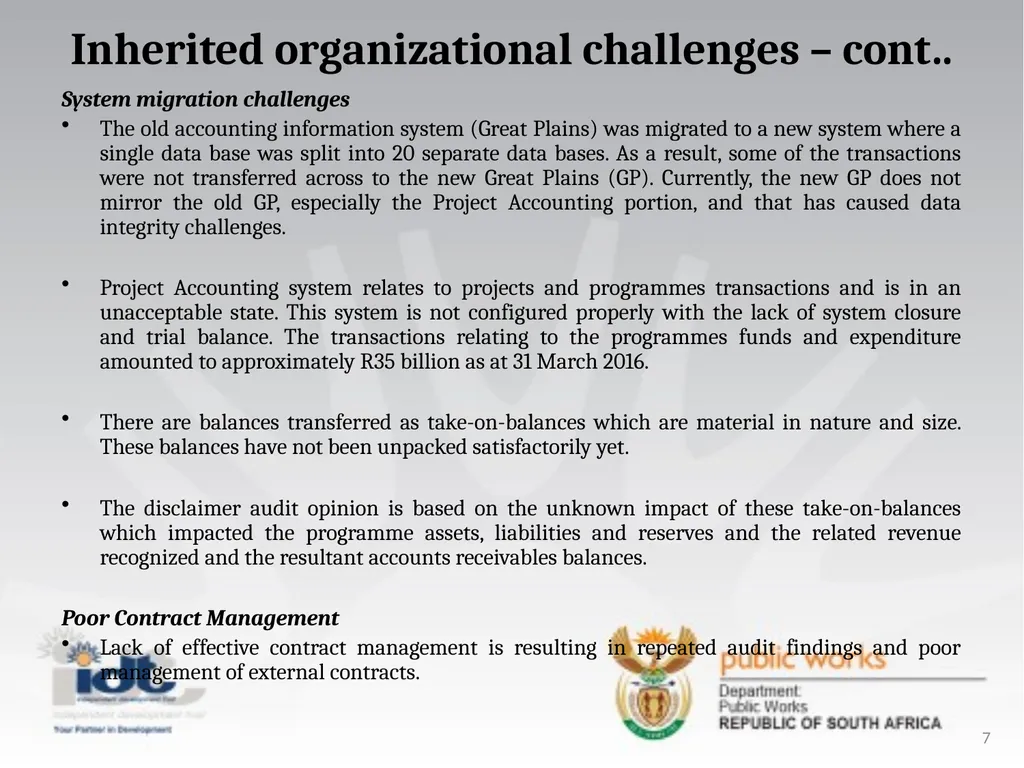
slide7. Inherited organizational challenges – cont.. System migration challenges
The old accounting information system (Great Plains) was migrated to a new system where a single data base was split into 20 separate data bases. As a result, some of the transactions were not transferred across to the new Great Plains (GP). Currently, the new GP does not mirror the old GP, especially the Project Accounting portion, and that has caused data integrity challenges.
Project Accounting system relates to projects and programmes transactions and is in an unacceptable state. This system is not configured properly with the lack of system closure and trial balance. The transactions relating to the programmes funds and expenditure amounted to approximately R35 billion as at 31 March 2016.
There are balances transferred as take-on-balances which are material in nature and size. These balances have not been unpacked satisfactorily yet.
The disclaimer audit opinion is based on the unknown impact of these take-on-balances which impacted the programme assets, liabilities and reserves and the related revenue recognized and the resultant accounts receivables balances.
Poor Contract Management
Lack of effective contract management is resulting in repeated audit findings and poor management of external contracts. 7<br>
slide8. Growth in Portfolio compared to Staff numbers and staff costs over the five year period 8<br>
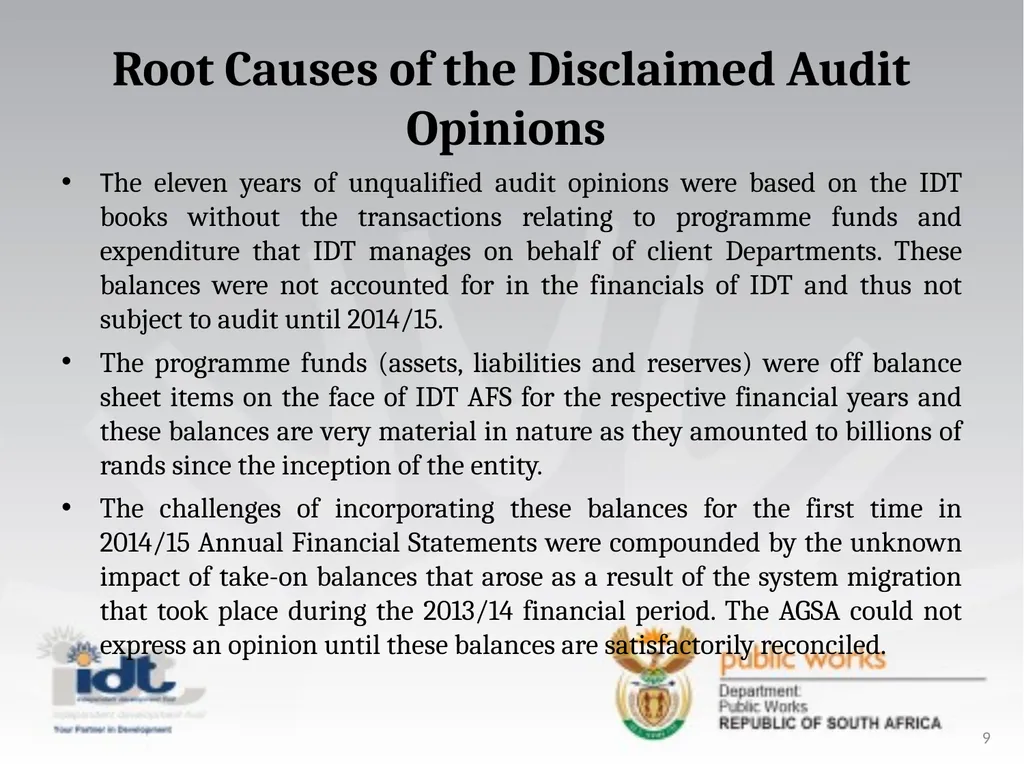
slide9. Root Causes of the Disclaimed Audit Opinions The eleven years of unqualified audit opinions were based on the IDT books without the transactions relating to programme funds and expenditure that IDT manages on behalf of client Departments. These balances were not accounted for in the financials of IDT and thus not subject to audit until 2014/15.
The programme funds (assets, liabilities and reserves) were off balance sheet items on the face of IDT AFS for the respective financial years and these balances are very material in nature as they amounted to billions of rands since the inception of the entity.
The challenges of incorporating these balances for the first time in 2014/15 Annual Financial Statements were compounded by the unknown impact of take-on balances that arose as a result of the system migration that took place during the 2013/14 financial period. The AGSA could not express an opinion until these balances are satisfactorily reconciled. 9<br>
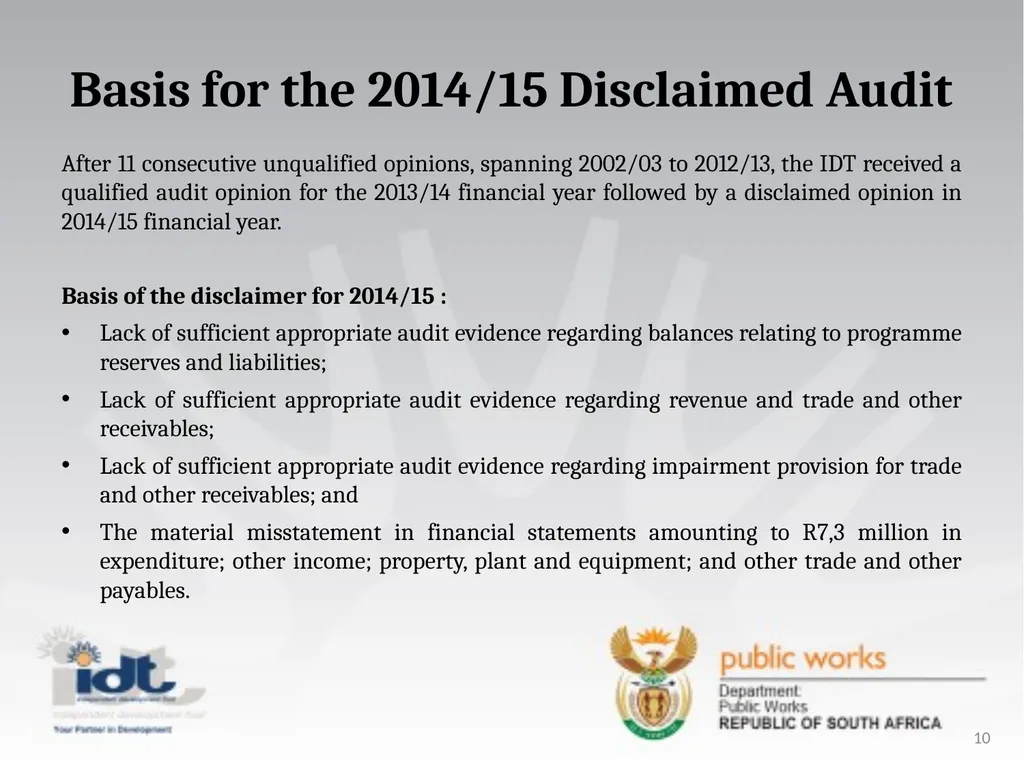
slide10. Basis for the 2014/15 Disclaimed Audit 10 After 11 consecutive unqualified opinions, spanning 2002/03 to 2012/13, the IDT received a qualified audit opinion for the 2013/14 financial year followed by a disclaimed opinion in 2014/15 financial year.
Basis of the disclaimer for 2014/15 :
Lack of sufficient appropriate audit evidence regarding balances relating to programme reserves and liabilities;
Lack of sufficient appropriate audit evidence regarding revenue and trade and other receivables;
Lack of sufficient appropriate audit evidence regarding impairment provision for trade and other receivables; and
The material misstatement in financial statements amounting to R7,3 million in expenditure; other income; property, plant and equipment; and other trade and other payables.<br>
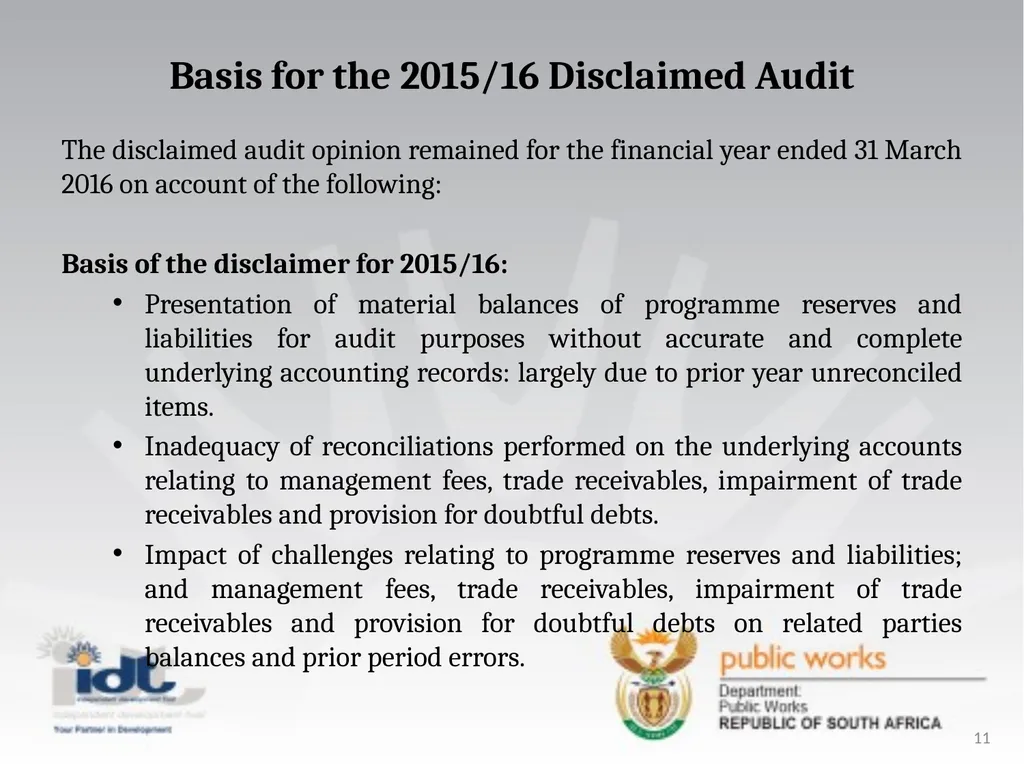
slide11. Basis for the 2015/16 Disclaimed Audit The disclaimed audit opinion remained for the financial year ended 31 March 2016 on account of the following:
Basis of the disclaimer for 2015/16:
Presentation of material balances of programme reserves and liabilities for audit purposes without accurate and complete underlying accounting records: largely due to prior year unreconciled items.
Inadequacy of reconciliations performed on the underlying accounts relating to management fees, trade receivables, impairment of trade receivables and provision for doubtful debts.
Impact of challenges relating to programme reserves and liabilities; and management fees, trade receivables, impairment of trade receivables and provision for doubtful debts on related parties balances and prior period errors. 11<br>
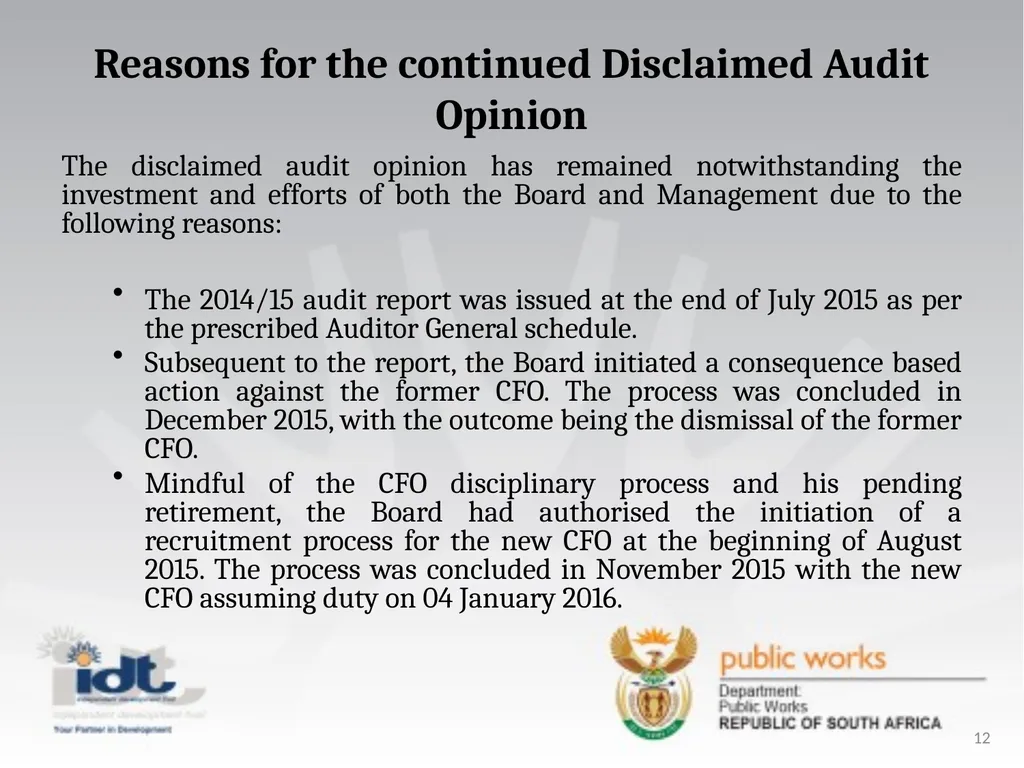
slide12. Reasons for the continued Disclaimed Audit Opinion 12 The disclaimed audit opinion has remained notwithstanding the investment and efforts of both the Board and Management due to the following reasons:
The 2014/15 audit report was issued at the end of July 2015 as per the prescribed Auditor General schedule.
Subsequent to the report, the Board initiated a consequence based action against the former CFO. The process was concluded in December 2015, with the outcome being the dismissal of the former CFO.
Mindful of the CFO disciplinary process and his pending retirement, the Board had authorised the initiation of a recruitment process for the new CFO at the beginning of August 2015. The process was concluded in November 2015 with the new CFO assuming duty on 04 January 2016.<br>
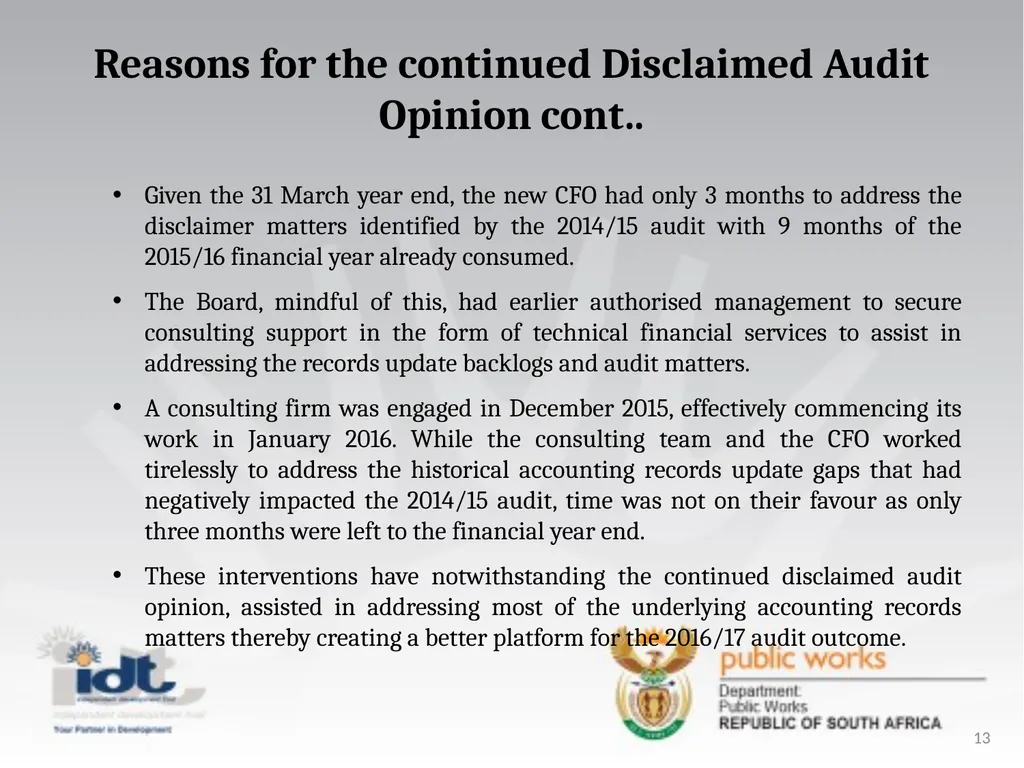
slide13. Reasons for the continued Disclaimed Audit Opinion cont.. 13 Given the 31 March year end, the new CFO had only 3 months to address the disclaimer matters identified by the 2014/15 audit with 9 months of the 2015/16 financial year already consumed.
The Board, mindful of this, had earlier authorised management to secure consulting support in the form of technical financial services to assist in addressing the records update backlogs and audit matters.
A consulting firm was engaged in December 2015, effectively commencing its work in January 2016. While the consulting team and the CFO worked tirelessly to address the historical accounting records update gaps that had negatively impacted the 2014/15 audit, time was not on their favour as only three months were left to the financial year end.
These interventions have notwithstanding the continued disclaimed audit opinion, assisted in addressing most of the underlying accounting records matters thereby creating a better platform for the 2016/17 audit outcome.<br>
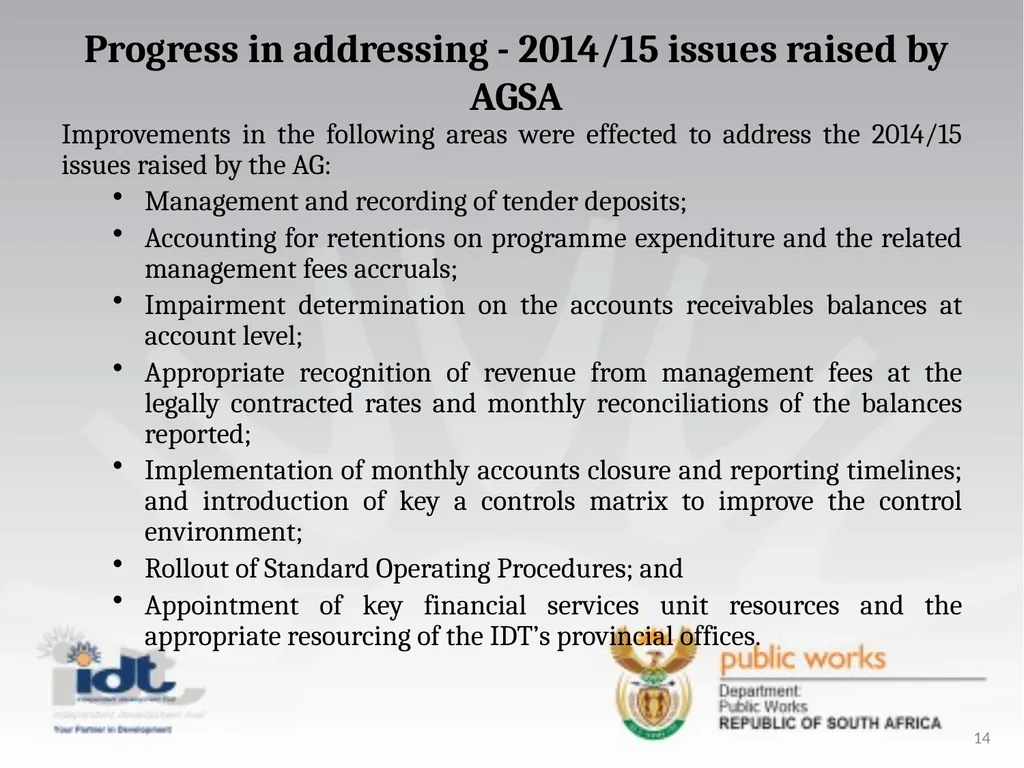
slide14. Progress in addressing - 2014/15 issues raised by AGSA Improvements in the following areas were effected to address the 2014/15 issues raised by the AG:
Management and recording of tender deposits;
Accounting for retentions on programme expenditure and the related management fees accruals;
Impairment determination on the accounts receivables balances at account level;
Appropriate recognition of revenue from management fees at the legally contracted rates and monthly reconciliations of the balances reported;
Implementation of monthly accounts closure and reporting timelines; and introduction of key a controls matrix to improve the control environment;
Rollout of Standard Operating Procedures; and
Appointment of key financial services unit resources and the appropriate resourcing of the IDT’s provincial offices. 14<br>
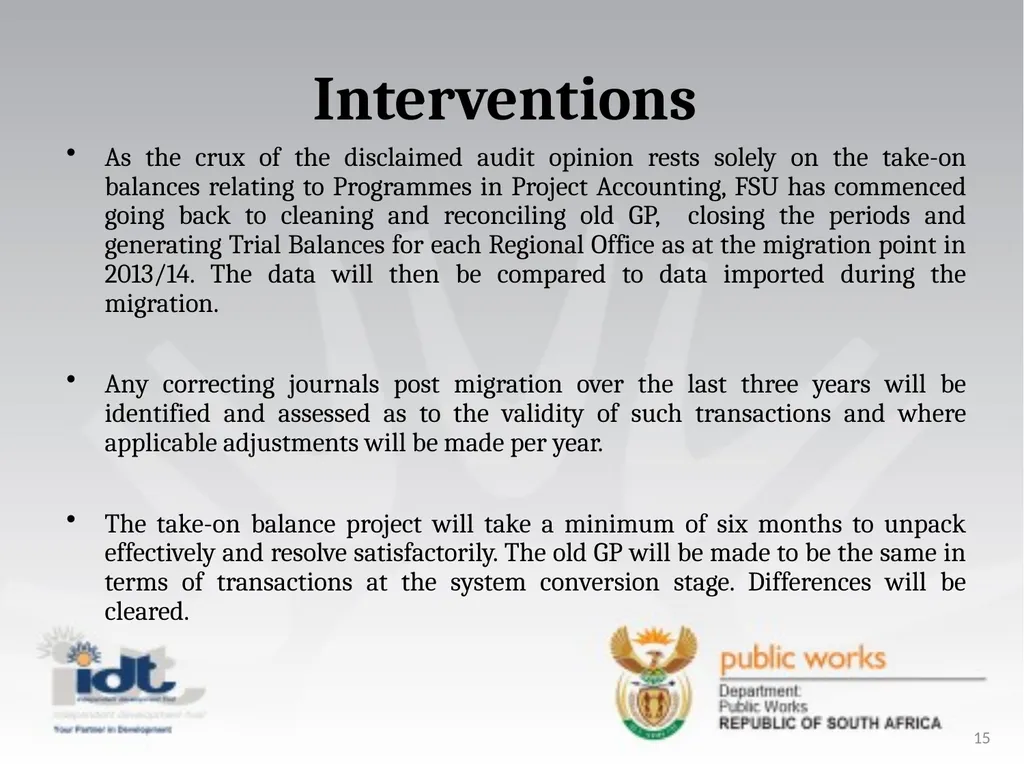
slide15. Interventions As the crux of the disclaimed audit opinion rests solely on the take-on balances relating to Programmes in Project Accounting, FSU has commenced going back to cleaning and reconciling old GP, closing the periods and generating Trial Balances for each Regional Office as at the migration point in 2013/14. The data will then be compared to data imported during the migration.
Any correcting journals post migration over the last three years will be identified and assessed as to the validity of such transactions and where applicable adjustments will be made per year.
The take-on balance project will take a minimum of six months to unpack effectively and resolve satisfactorily. The old GP will be made to be the same in terms of transactions at the system conversion stage. Differences will be cleared. 15<br>
slide16. Interventions conti. .. Audit Action Plan for 2015/16 developed and coordinated at senior manager level within the office of the CFO.
The plan will be forwarded to AGSA for review this month and a meeting will be scheduled for final discussion and interim review .
Close monitoring and regular reporting by Internal Audit and Financial Technical Support from the office of the CFO to Executive Committee Finance Committee, Audit and Risk Committee and ultimately the Board of Trustees. 16<br>
slide17. Interventions conti. .. A high level skills and competency assessment has been conducted which resulted in training being embarked upon on the Accounting system and other relevant accounting processes.
Standard Operating Procedures have been developed for Project Accounting and implemented effectively from 01 September 2016. These have been workshopped throughout IDT to enable consequence management where there is non compliance and dereliction of duties by responsible officials.
Regular formal meetings and feedback sessions are held by all of the Financial Leadership Teams of IDT where key controls issues and finance risks are addressed with applicable corrective and remedial actions.
Performance contracts are also being reviewed to be job specific and linked to current challenges facing the organisation. Continuous training, ongoing monitoring and evaluation of performance is conducted.
The Finance Leadership Team Regional level is being reviewed and will be structured to ensure that staff with the appropriate skills set lead these finance units. 17<br>
slide18. Interventions conti. .. Concerted efforts are being made to improve the state of record management in the organisation. A File Plan for IDT, prepared in line with the requirements of the National Archives of South Africa Act of 1996, was submitted to and approved by the National Archives on 18 May 2016.
The organisation is currently reviewing its Records Management Policy and Information Security Framework.
A Promotion of Access to Information Act (PAIA) Manual has been reviewed and submitted to the Department of Justice and Correctional Services for Gazetting.
Fridays are declared Records Management Days, days on which staff is encouraged to work on filing. 18<br>
slide19. Systemic Interventions: Organisational Renewal 19 The Board initiated in the previous reporting period a 3-pronged approach to remedy the situation:
Leadership review and management accountability
The Turnaround Strategy and Plan; and
A comprehensive audit action plan.
Paramount to the Board’s plan is:
Initiating of good governance and clean administration evidenced by clean / unqualified audit reports;
Holding of officials responsible for transgression accountable;
Building the IDT into a leading public sector social infrastructure programme implementation and management agency; and
Supporting the long term IDT sustainability and transformation process.<br>
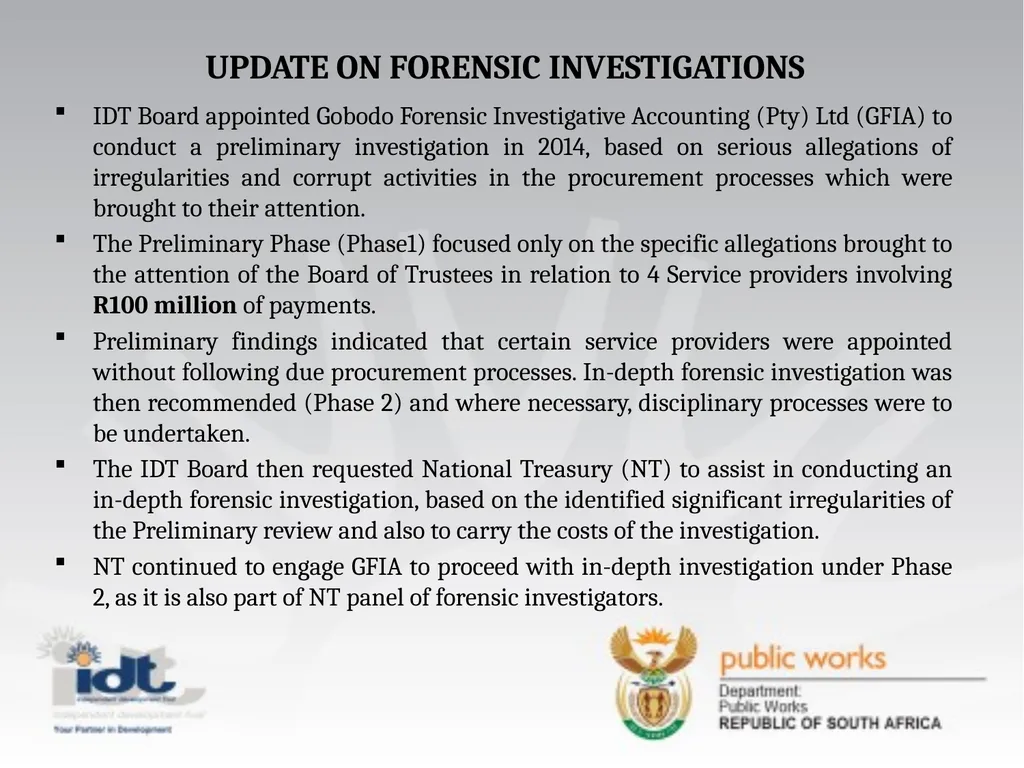
slide20. UPDATE ON FORENSIC INVESTIGATIONS IDT Board appointed Gobodo Forensic Investigative Accounting (Pty) Ltd (GFIA) to conduct a preliminary investigation in 2014, based on serious allegations of irregularities and corrupt activities in the procurement processes which were brought to their attention.
The Preliminary Phase (Phase1) focused only on the specific allegations brought to the attention of the Board of Trustees in relation to 4 Service providers involving R100 million of payments.
Preliminary findings indicated that certain service providers were appointed without following due procurement processes. In-depth forensic investigation was then recommended (Phase 2) and where necessary, disciplinary processes were to be undertaken.
The IDT Board then requested National Treasury (NT) to assist in conducting an in-depth forensic investigation, based on the identified significant irregularities of the Preliminary review and also to carry the costs of the investigation.
NT continued to engage GFIA to proceed with in-depth investigation under Phase 2, as it is also part of NT panel of forensic investigators.<br>
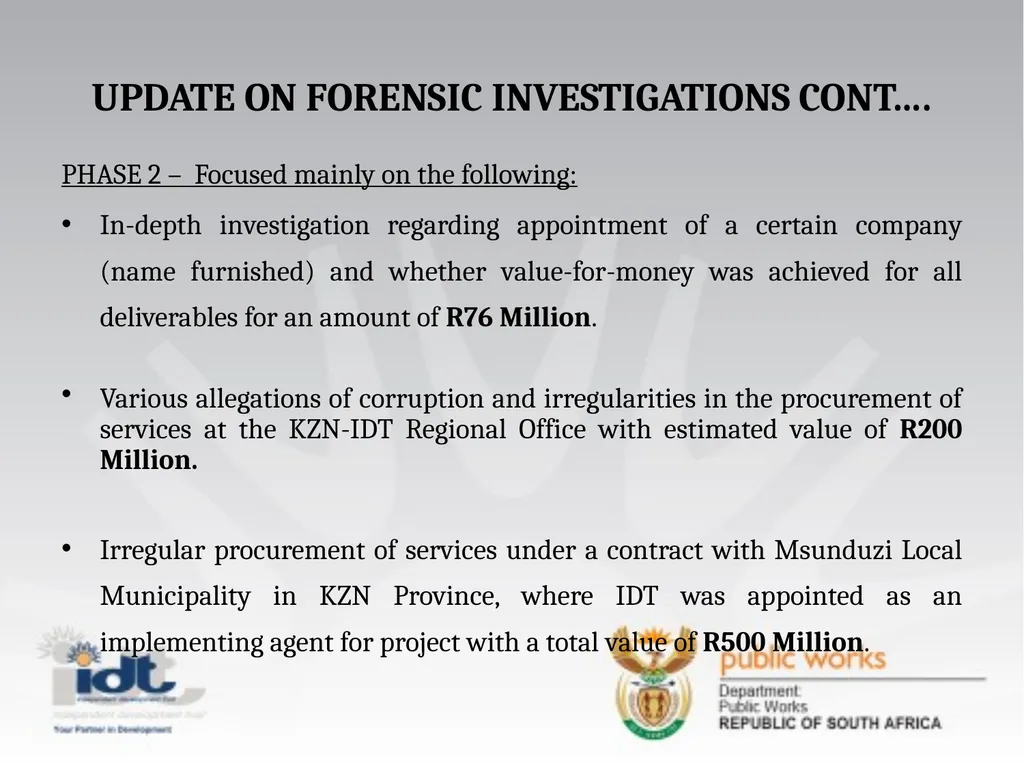
slide21. UPDATE ON FORENSIC INVESTIGATIONS CONT…. PHASE 2 – Focused mainly on the following:
In-depth investigation regarding appointment of a certain company (name furnished) and whether value-for-money was achieved for all deliverables for an amount of R76 Million.
Various allegations of corruption and irregularities in the procurement of services at the KZN-IDT Regional Office with estimated value of R200 Million.
Irregular procurement of services under a contract with Msunduzi Local Municipality in KZN Province, where IDT was appointed as an implementing agent for project with a total value of R500 Million.<br>
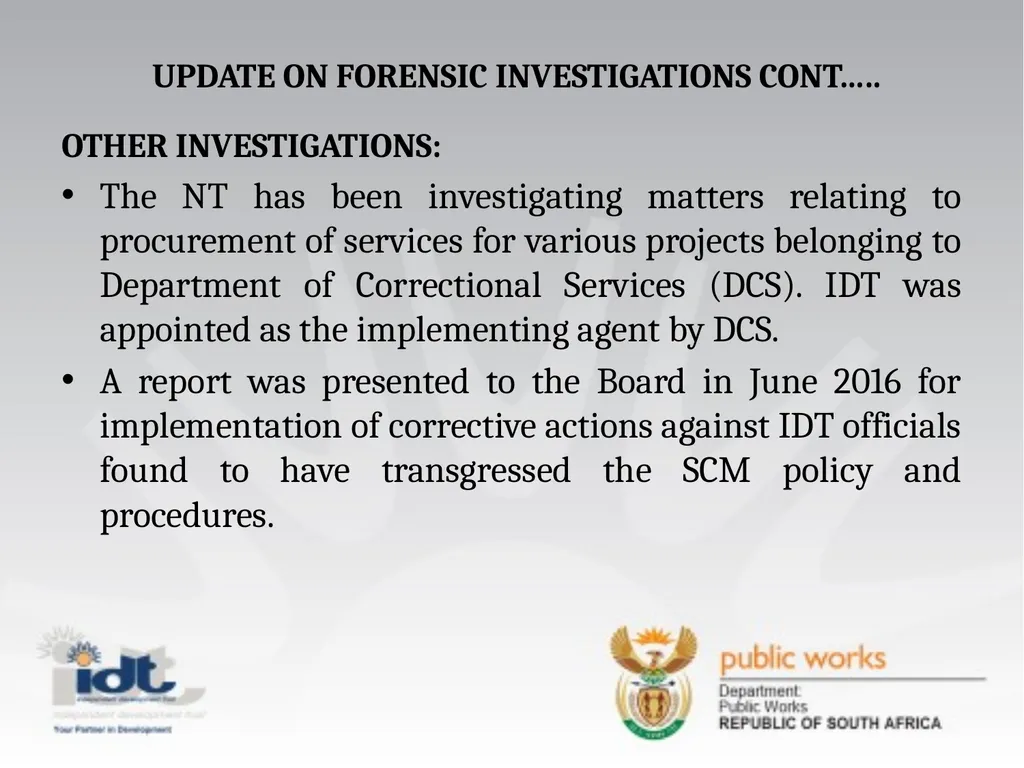
slide22. UPDATE ON FORENSIC INVESTIGATIONS CONT….. OTHER INVESTIGATIONS:
The NT has been investigating matters relating to procurement of services for various projects belonging to Department of Correctional Services (DCS). IDT was appointed as the implementing agent by DCS.
A report was presented to the Board in June 2016 for implementation of corrective actions against IDT officials found to have transgressed the SCM policy and procedures.<br>
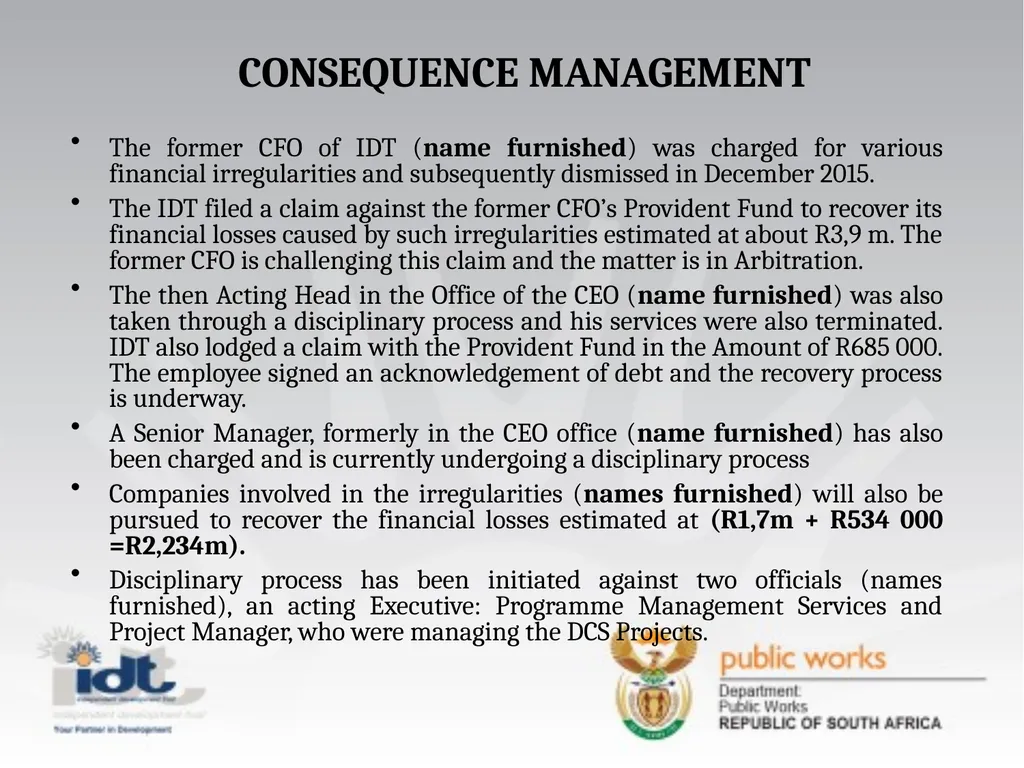
slide23. CONSEQUENCE MANAGEMENT The former CFO of IDT (name furnished) was charged for various financial irregularities and subsequently dismissed in December 2015.
The IDT filed a claim against the former CFO’s Provident Fund to recover its financial losses caused by such irregularities estimated at about R3,9 m. The former CFO is challenging this claim and the matter is in Arbitration.
The then Acting Head in the Office of the CEO (name furnished) was also taken through a disciplinary process and his services were also terminated. IDT also lodged a claim with the Provident Fund in the Amount of R685 000. The employee signed an acknowledgement of debt and the recovery process is underway.
A Senior Manager, formerly in the CEO office (name furnished) has also been charged and is currently undergoing a disciplinary process
Companies involved in the irregularities (names furnished) will also be pursued to recover the financial losses estimated at (R1,7m + R534 000 =R2,234m).
Disciplinary process has been initiated against two officials (names furnished), an acting Executive: Programme Management Services and Project Manager, who were managing the DCS Projects.<br>
slide24. Turnaround Strategy 24 The objectives of the IDT Turnaround Strategy, covering the period 1 April 2015 to 31 March 2018, are to:
Strategically position the IDT as a premier social infrastructure programme delivery management entity;
Regain confidence of the Shareholder, client departments and stakeholders;
Ensuring financial sustainability, prudent financial management and accountability for the IDT as well as for client funds;
Attract and retain appropriately qualified, committed and motivated personnel;
Develop and utilise effective and efficient business systems and processes to successfully implement programmes that contribute to the improvements in the quality of life of communities.<br>
slide25. Turnaround Strategy Pillars 25 The following pillars provide the basis for the Turnaround:
Financial viability improvements;
Organisational integrity, governance, accountability and compliance;
Service delivery improvements and Innovation;
Organisational reconfiguration, professionalization and image building.<br>
slide26. 26 2. Organisational Strategic Overview<br>
slide27. Organisational Strategic Overview 27 Primary Purpose: A state implementing agency supporting government with programme and project management of social infrastructure delivery. As an entity within the DPW family, the work of the IDT speaks directly to the mandate of the Department of Public Works.
Vision: To be a leading public sector developmental programme implementation and management agency.
Mission: The IDT manages and delivers integrated quality social infrastructure programmes on behalf of government on time, cost effectively and through a people centred approach.
Our approach: The IDT’s approach to social infrastructure development entails social facilitation and empowerment necessary to prepare communities to receive, participate in, own and sustain their own development.<br>
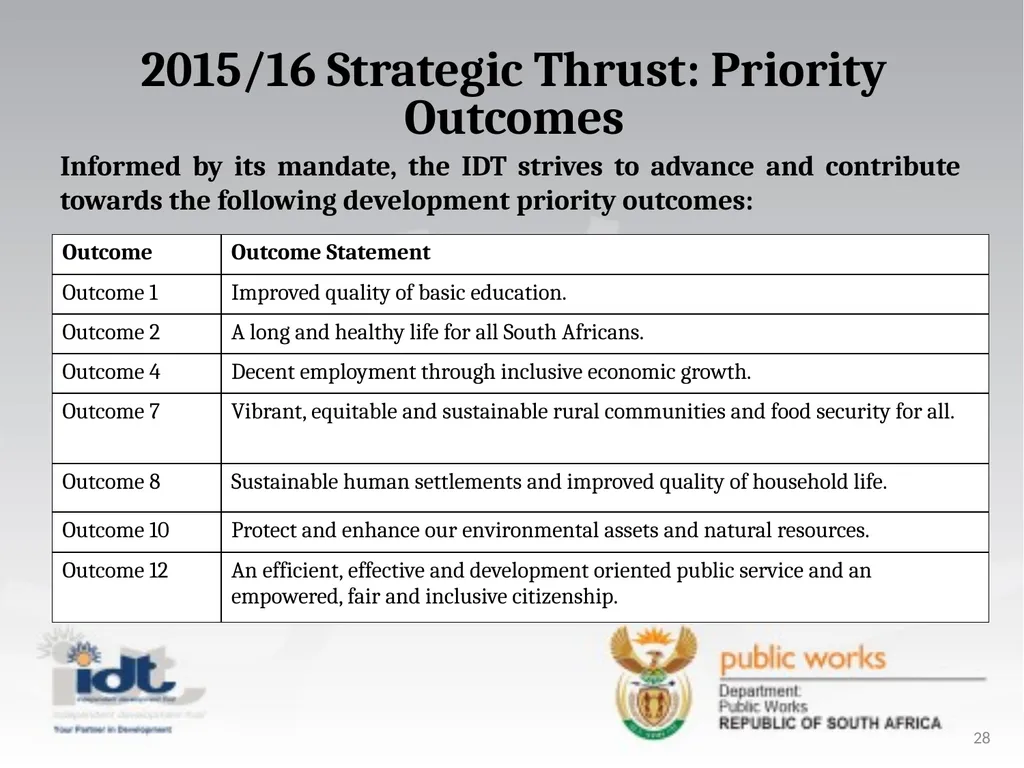
slide28. 2015/16 Strategic Thrust: Priority Outcomes 28 Informed by its mandate, the IDT strives to advance and contribute towards the following development priority outcomes:<br>
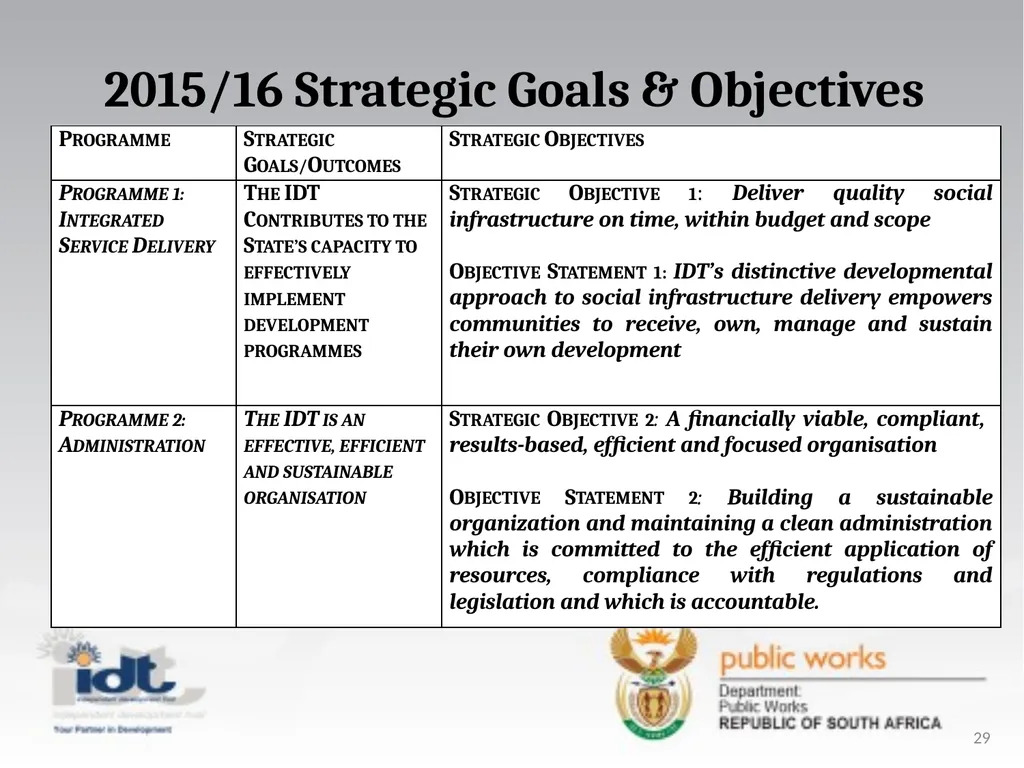
slide29. 2015/16 Strategic Goals & Objectives 29<br>
slide30. 30 3. Performance Highlights<br>
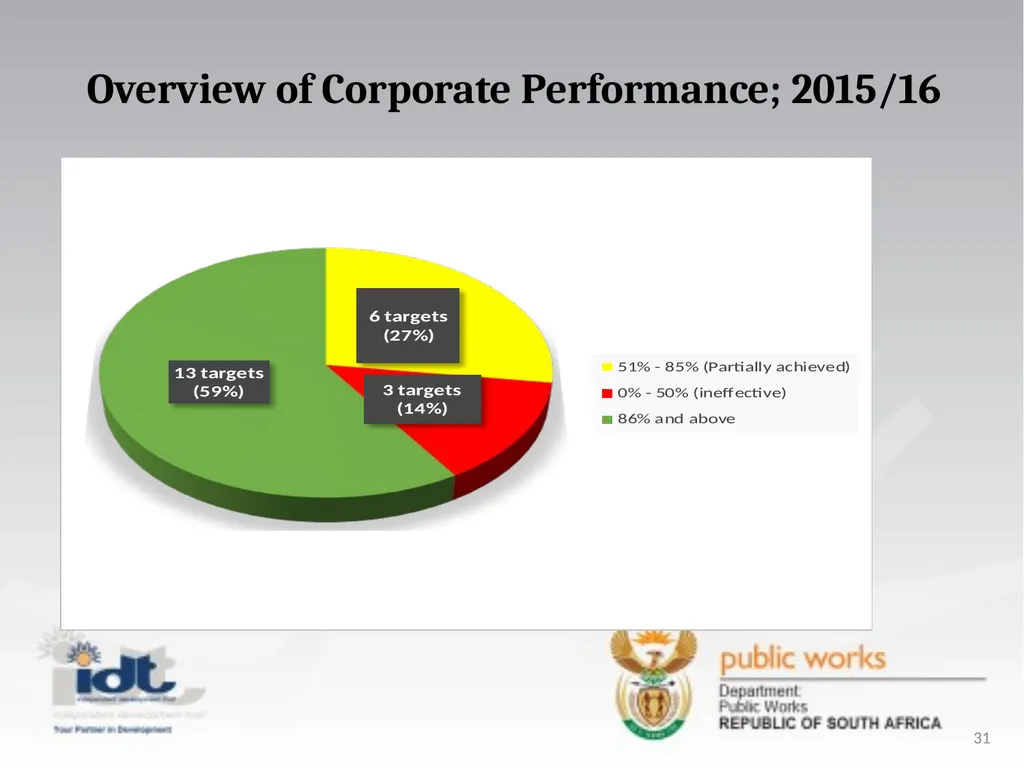
slide31. Overview of Corporate Performance; 2015/16 31<br>
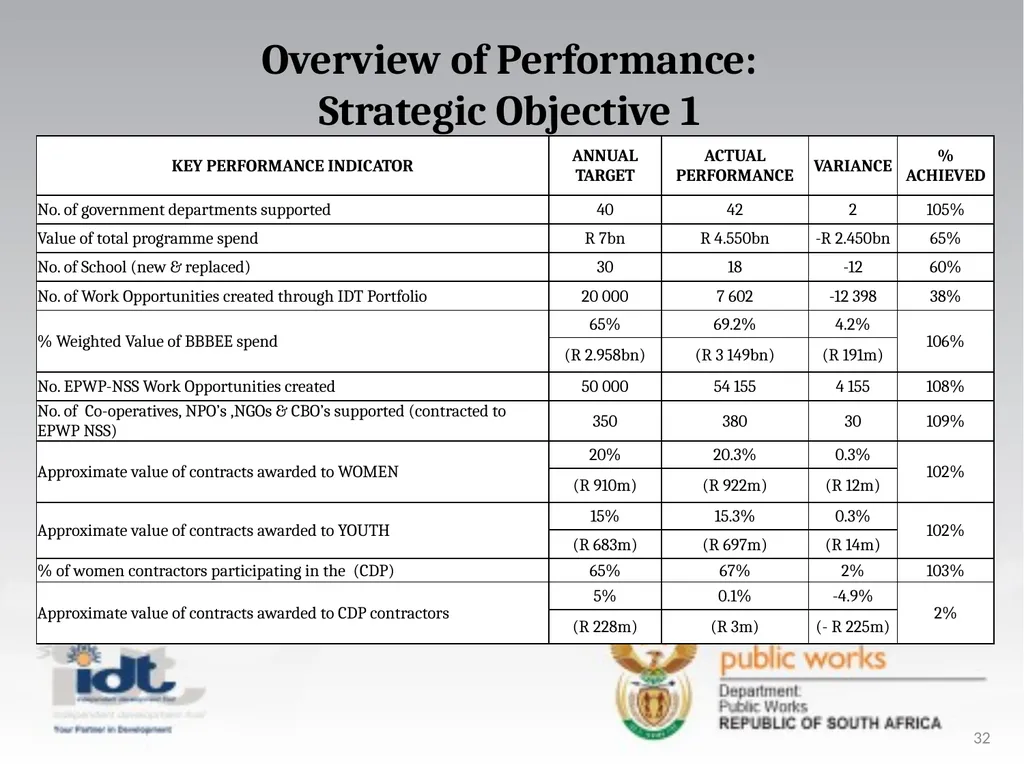
slide32. Overview of Performance: Strategic Objective 1 32<br>
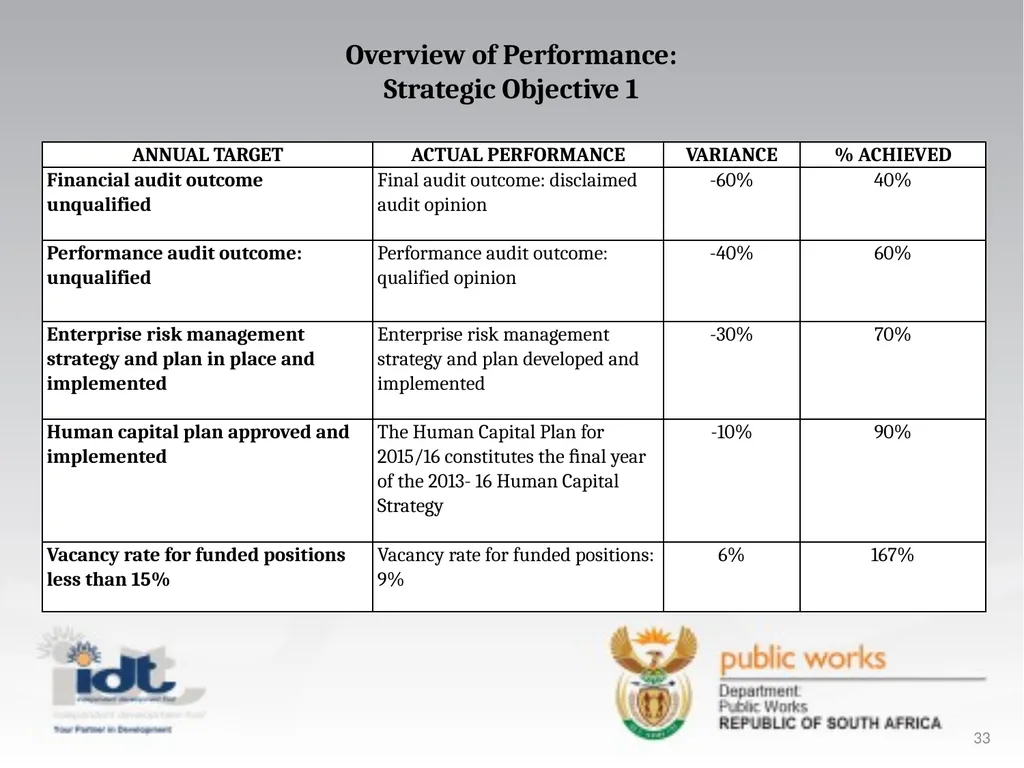
slide33. Overview of Performance: Strategic Objective 1 33<br>
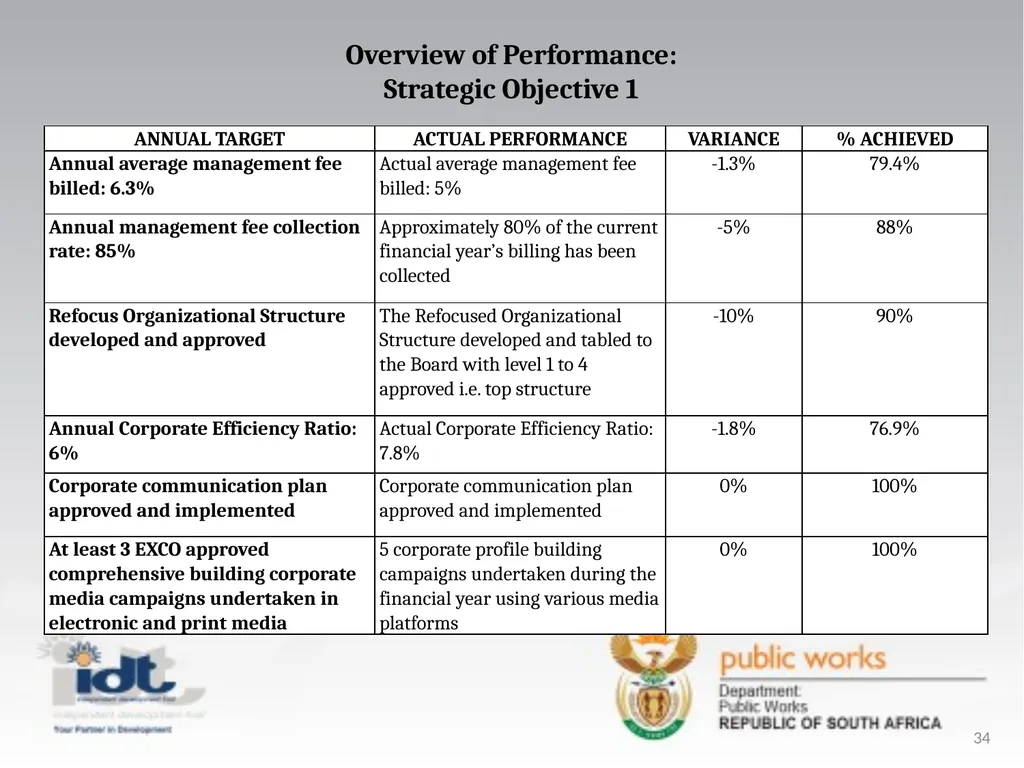
slide34. Overview of Performance: Strategic Objective 1 34<br>
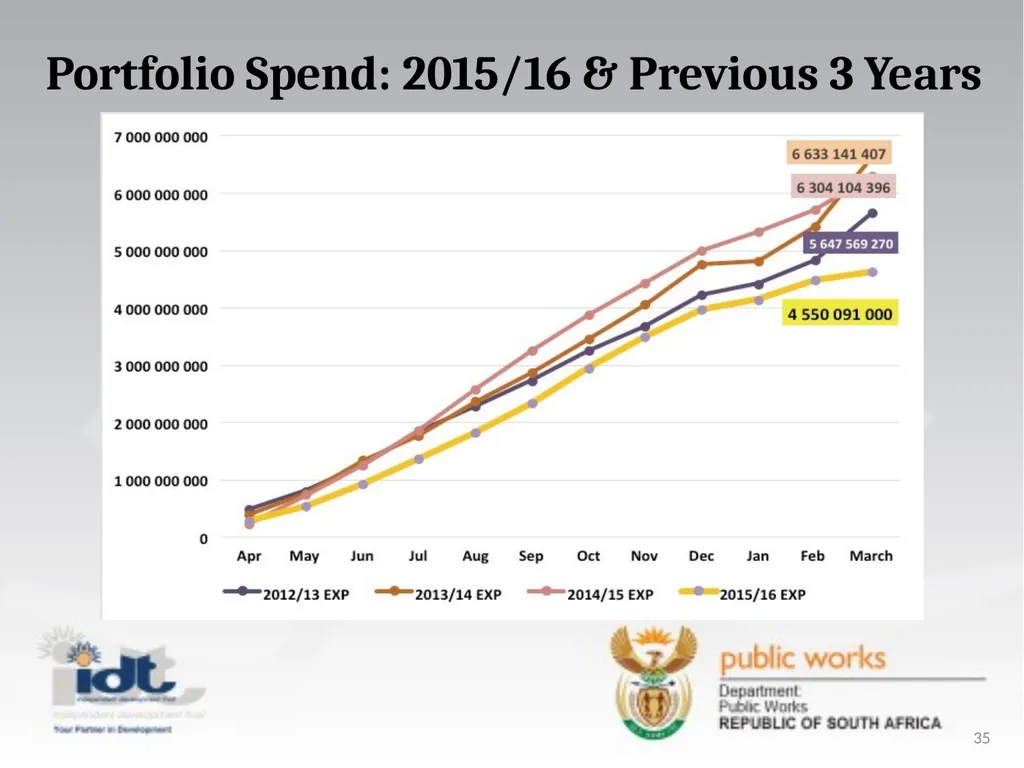
slide35. Portfolio Spend: 2015/16 & Previous 3 Years 35<br>
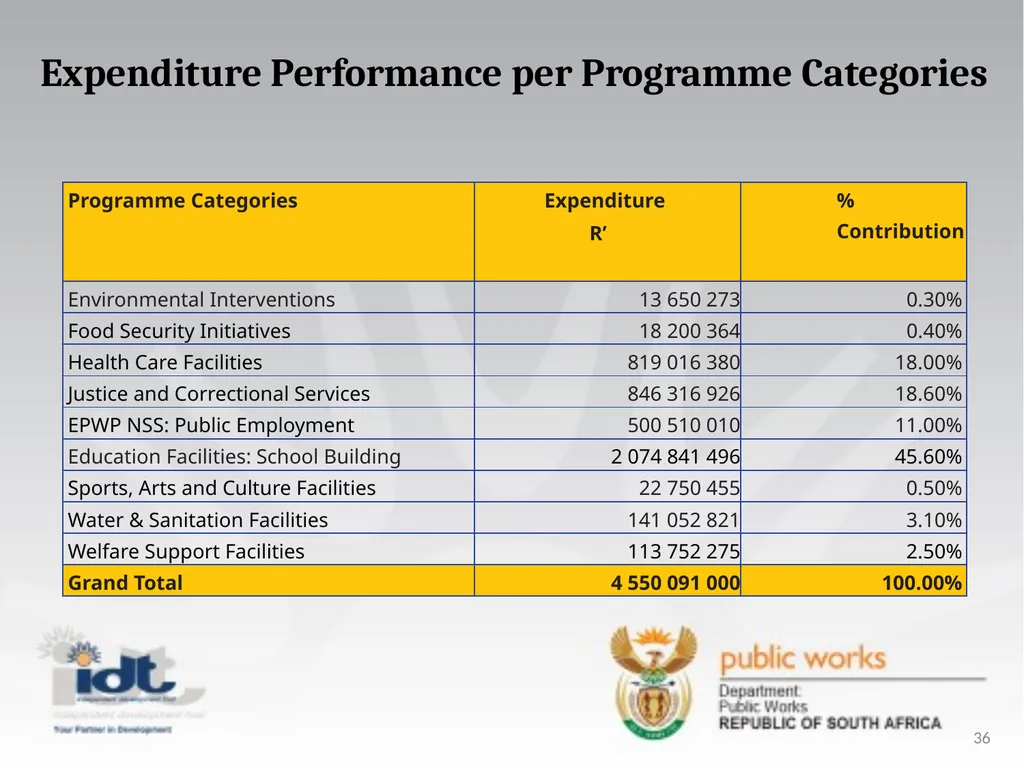
slide36. Expenditure Performance per Programme Categories 36<br>
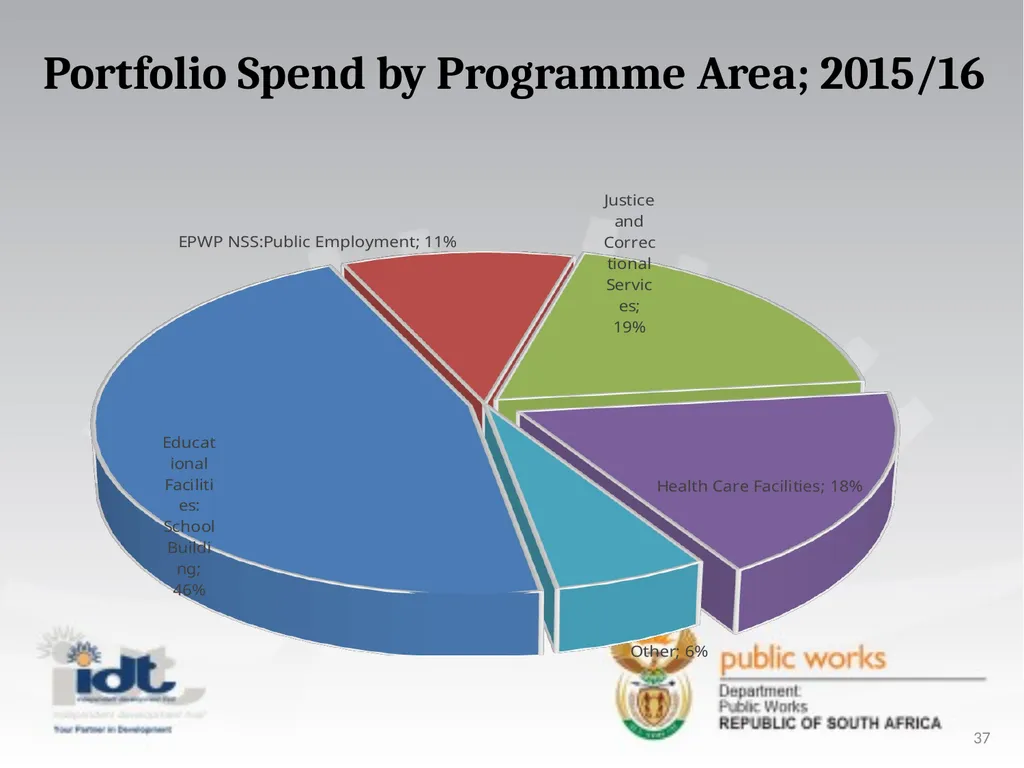
slide37. Portfolio Spend by Programme Area; 2015/16 37<br>
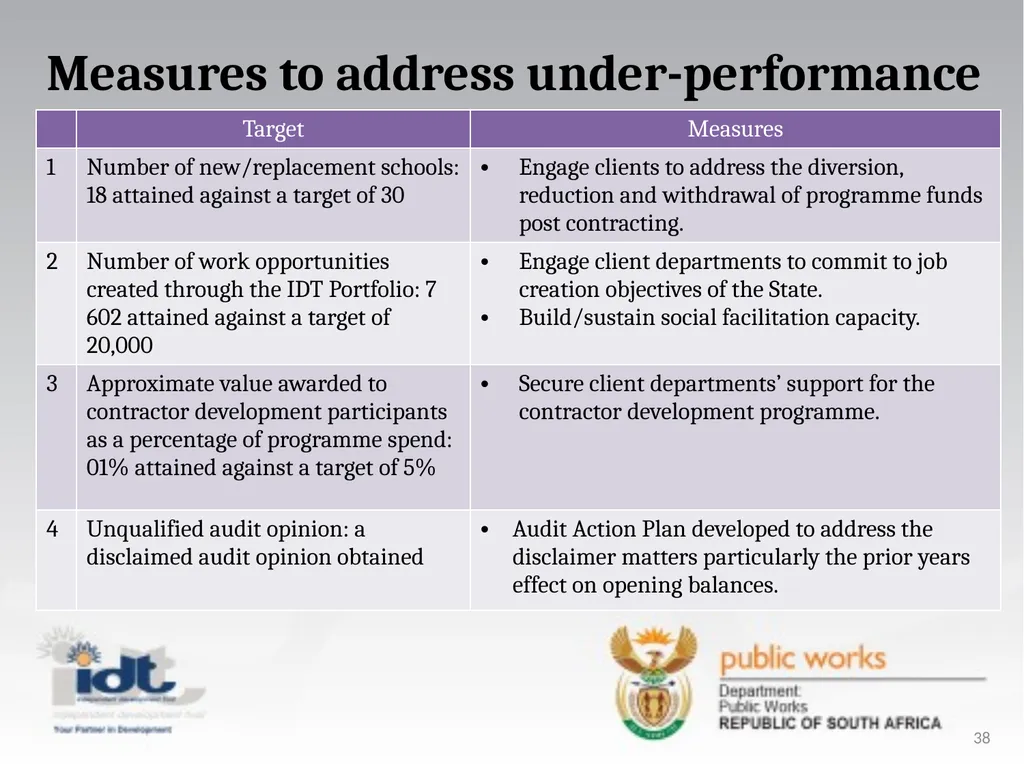
slide38. Measures to address under-performance 38<br>
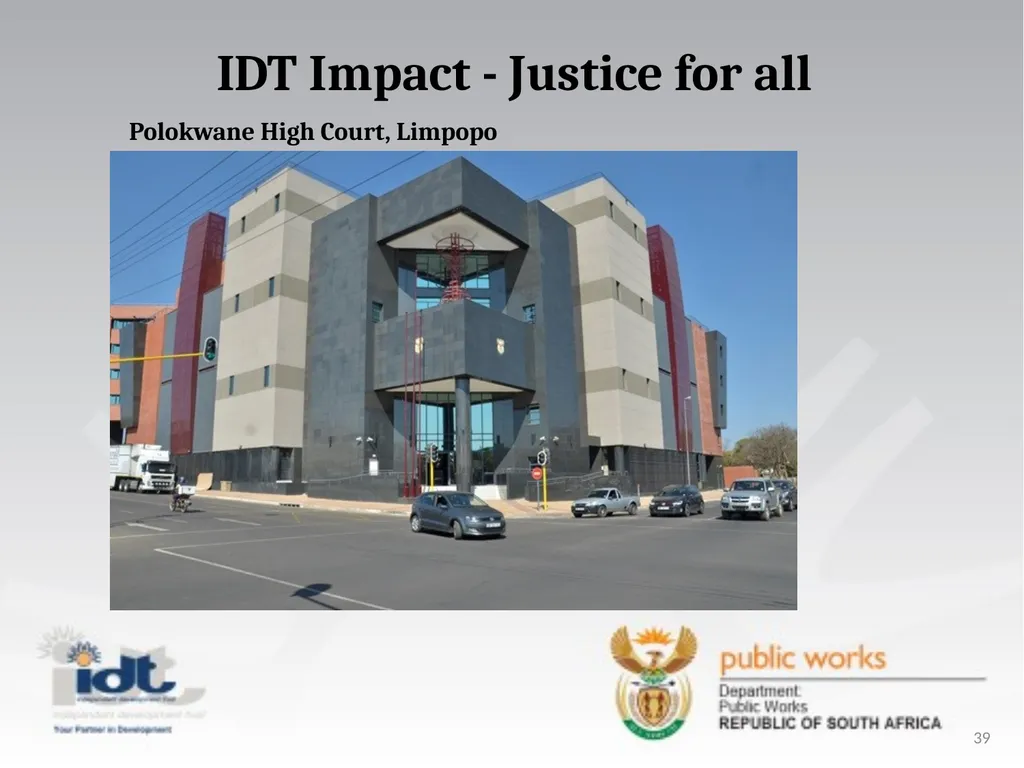
slide39. IDT Impact - Justice for all 39 Polokwane High Court, Limpopo<br>
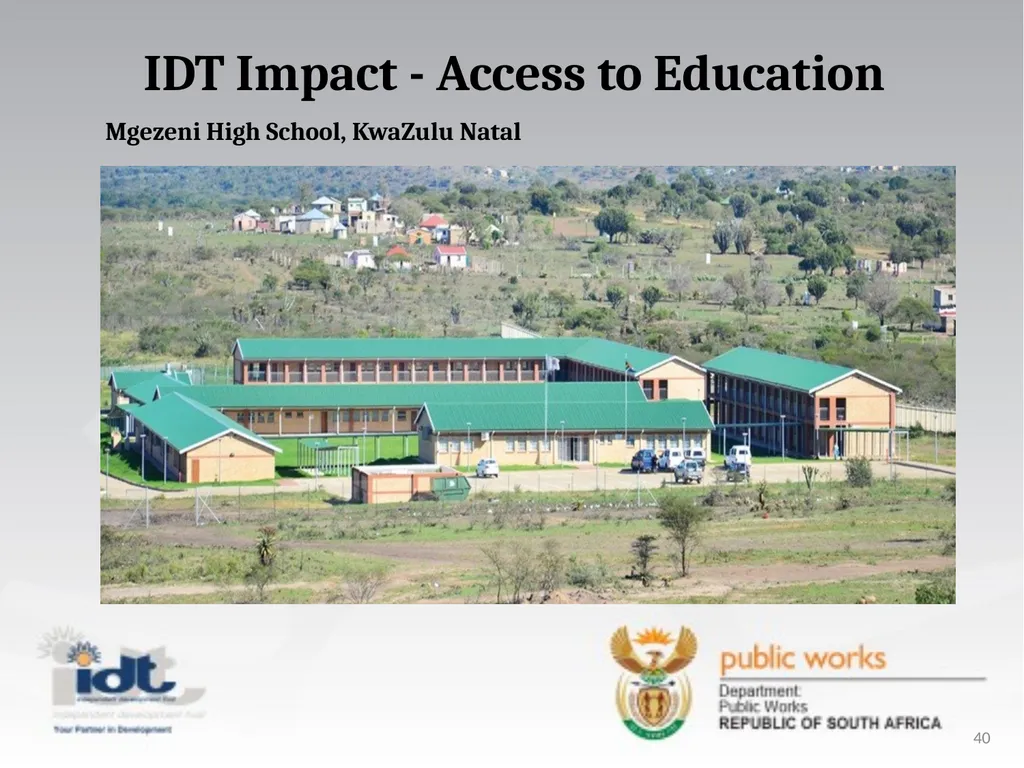
slide40. IDT Impact - Access to Education 40 Mgezeni High School, KwaZulu Natal<br>
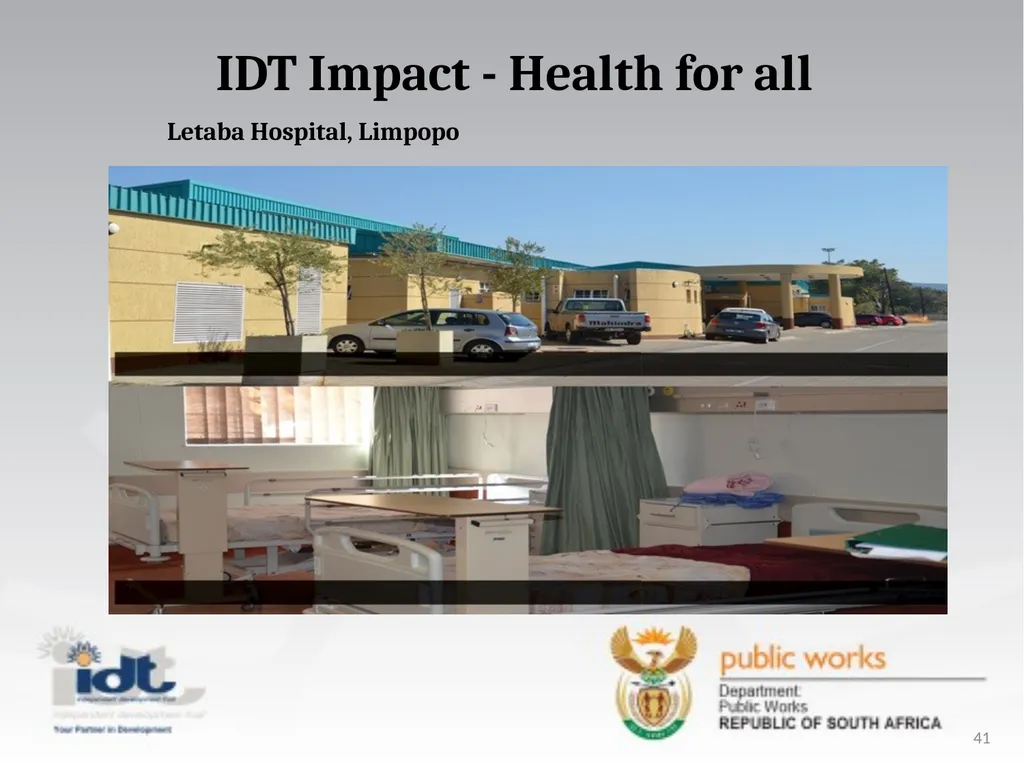
slide41. IDT Impact - Health for all 41 Letaba Hospital, Limpopo<br>
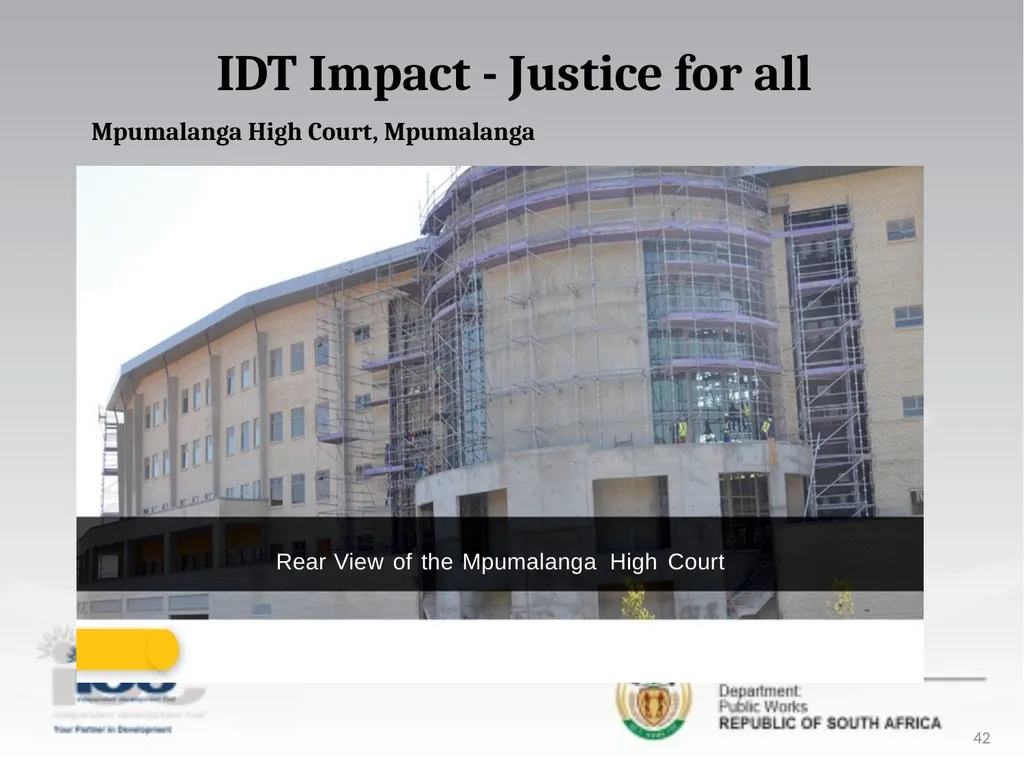
slide42. IDT Impact - Justice for all 42 Mpumalanga High Court, Mpumalanga Rear View of the Mpumalanga High Court<br>
slide43. 43 4.
Governance<br>
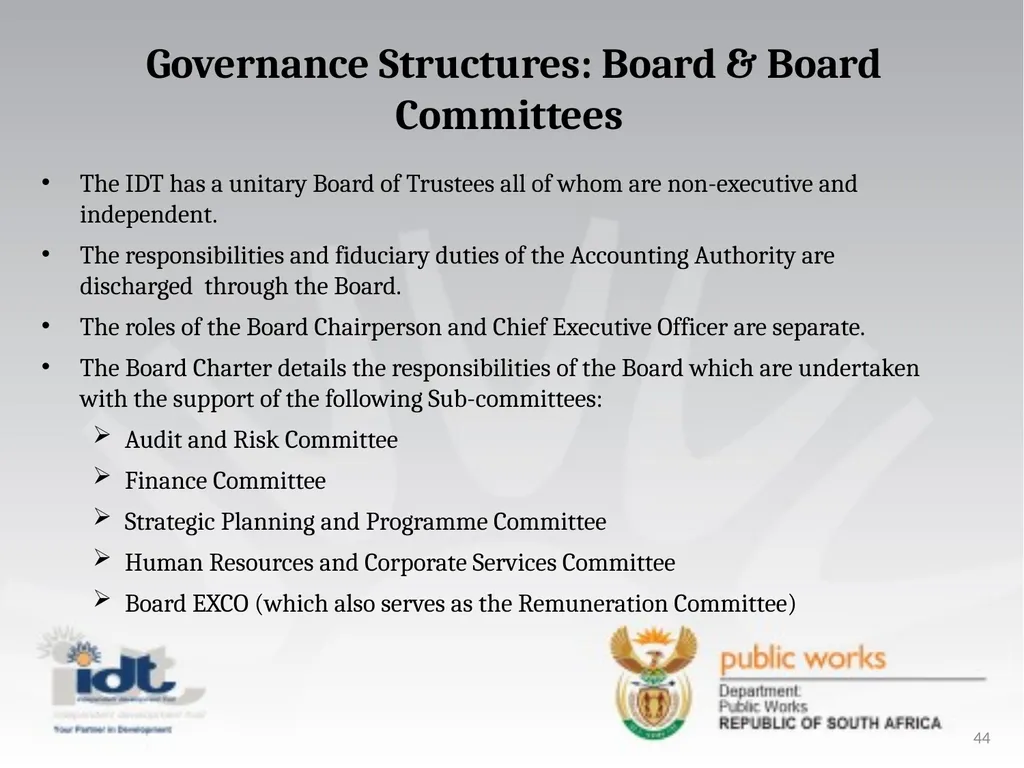
slide44. Governance Structures: Board & Board Committees 44 The IDT has a unitary Board of Trustees all of whom are non-executive and independent.
The responsibilities and fiduciary duties of the Accounting Authority are discharged through the Board.
The roles of the Board Chairperson and Chief Executive Officer are separate.
The Board Charter details the responsibilities of the Board which are undertaken with the support of the following Sub-committees:
Audit and Risk Committee
Finance Committee
Strategic Planning and Programme Committee
Human Resources and Corporate Services Committee
Board EXCO (which also serves as the Remuneration Committee)<br>
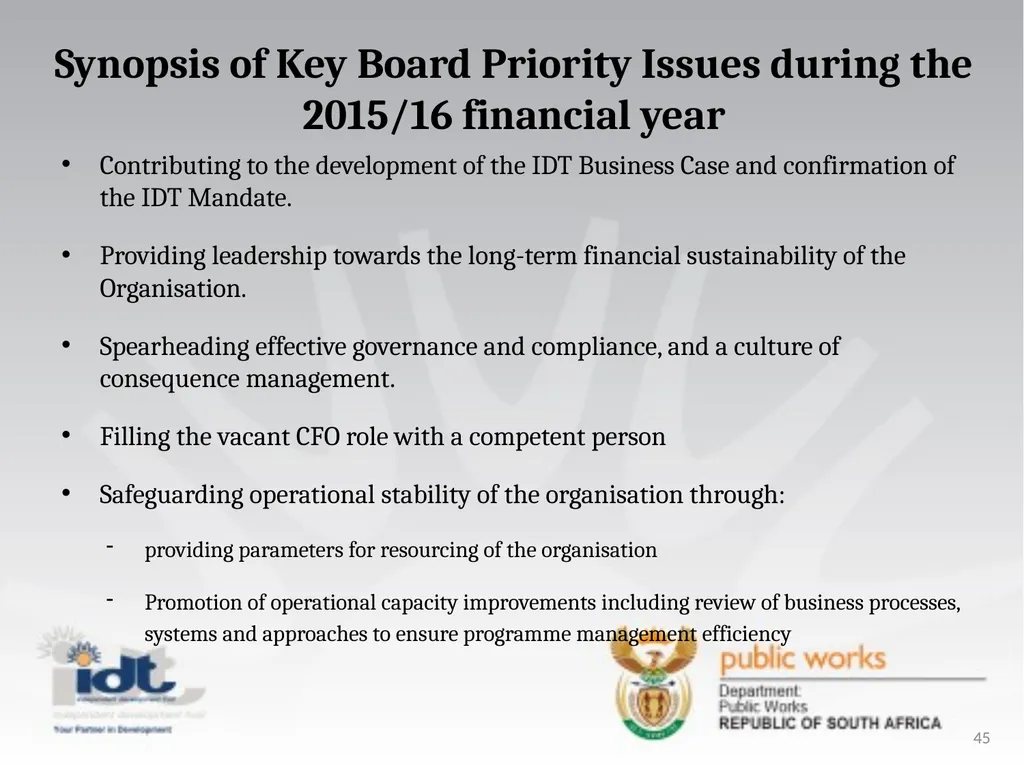
slide45. Synopsis of Key Board Priority Issues during the 2015/16 financial year Contributing to the development of the IDT Business Case and confirmation of the IDT Mandate.
Providing leadership towards the long-term financial sustainability of the Organisation.
Spearheading effective governance and compliance, and a culture of consequence management.
Filling the vacant CFO role with a competent person
Safeguarding operational stability of the organisation through:
providing parameters for resourcing of the organisation
Promotion of operational capacity improvements including review of business processes, systems and approaches to ensure programme management efficiency 45<br>
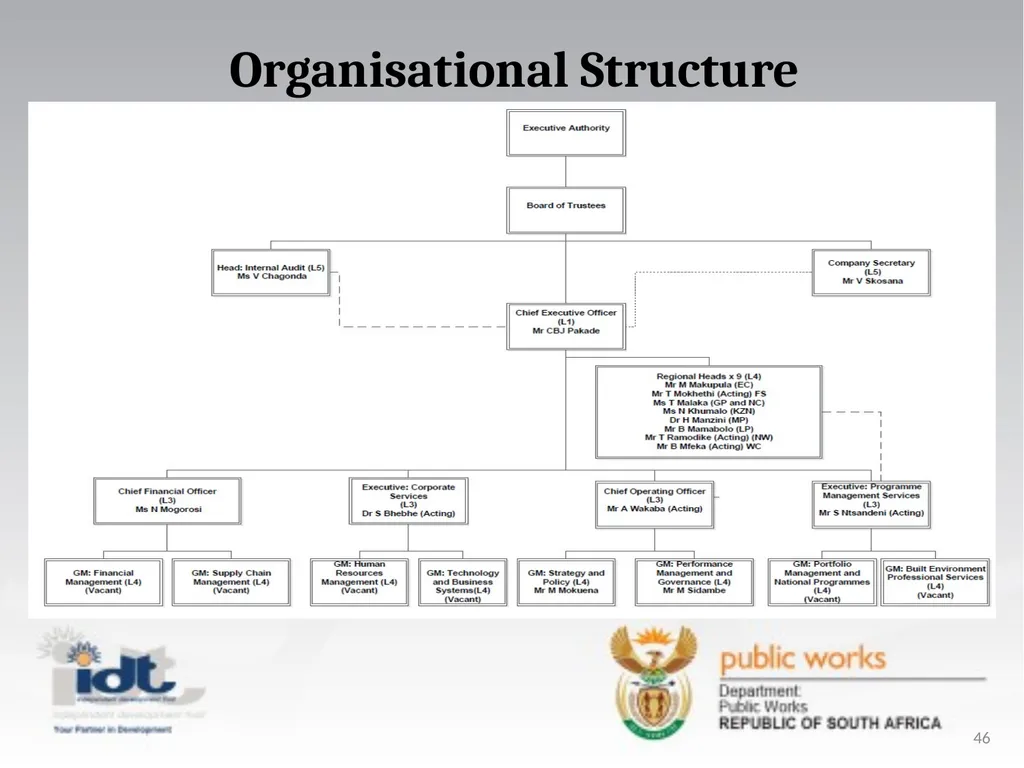
slide46. Organisational Structure 46<br>
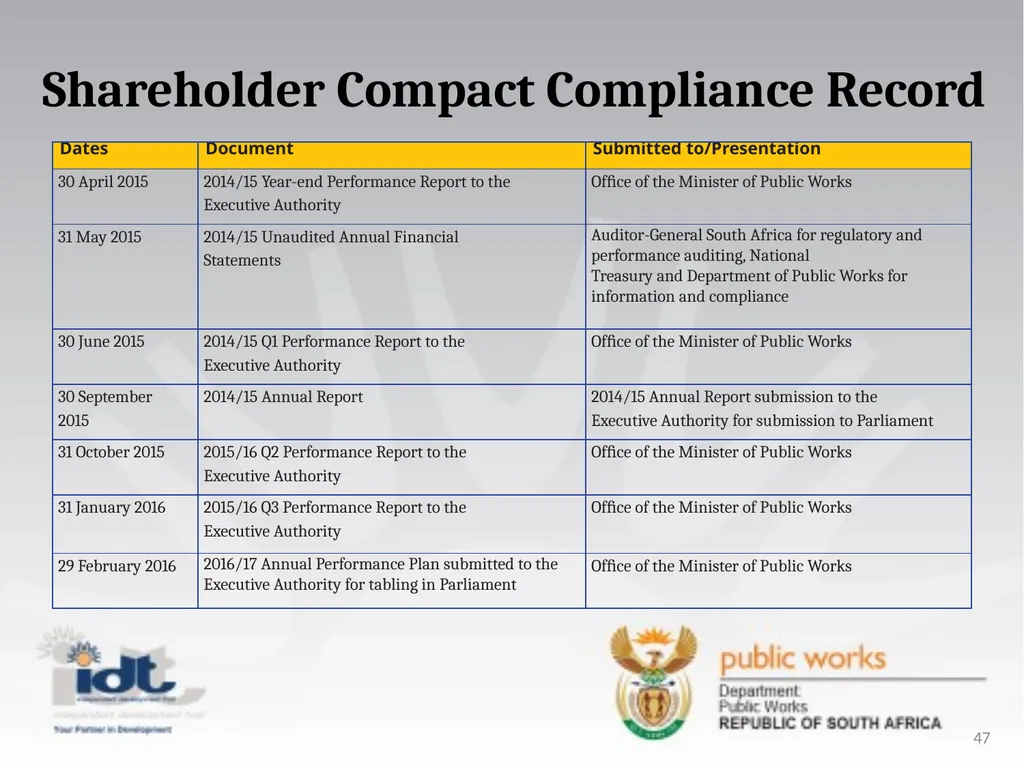
slide47. Shareholder Compact Compliance Record 47<br>
slide48. 48 5.
Human Resource Management<br>
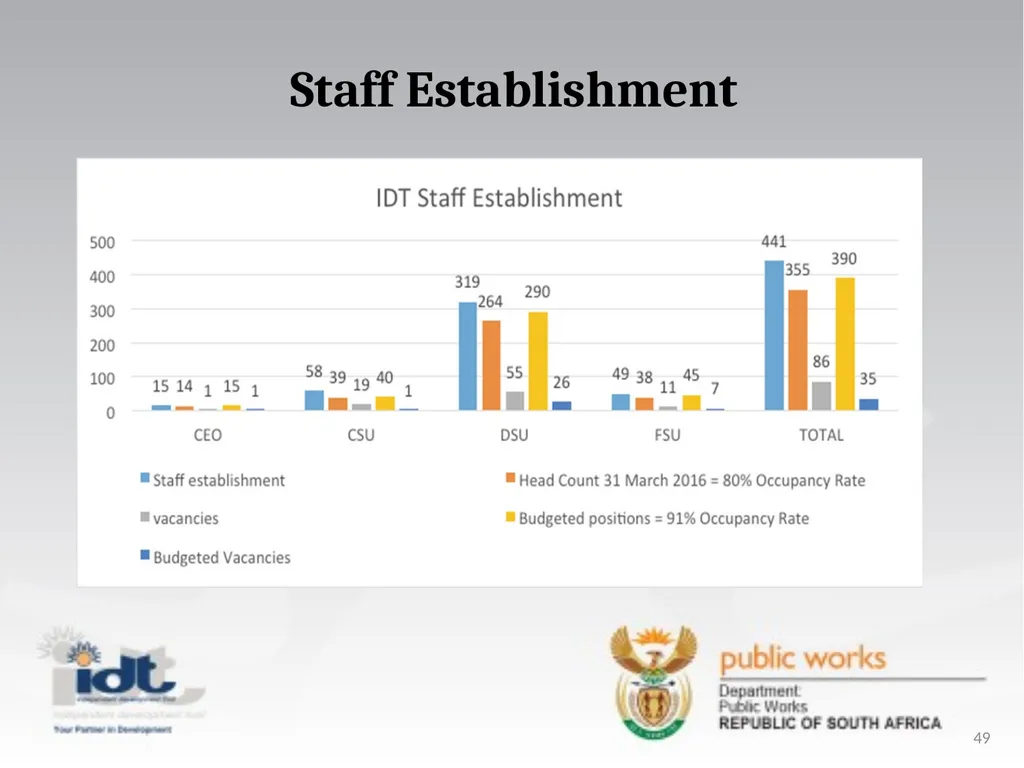
slide49. Staff Establishment 49<br>
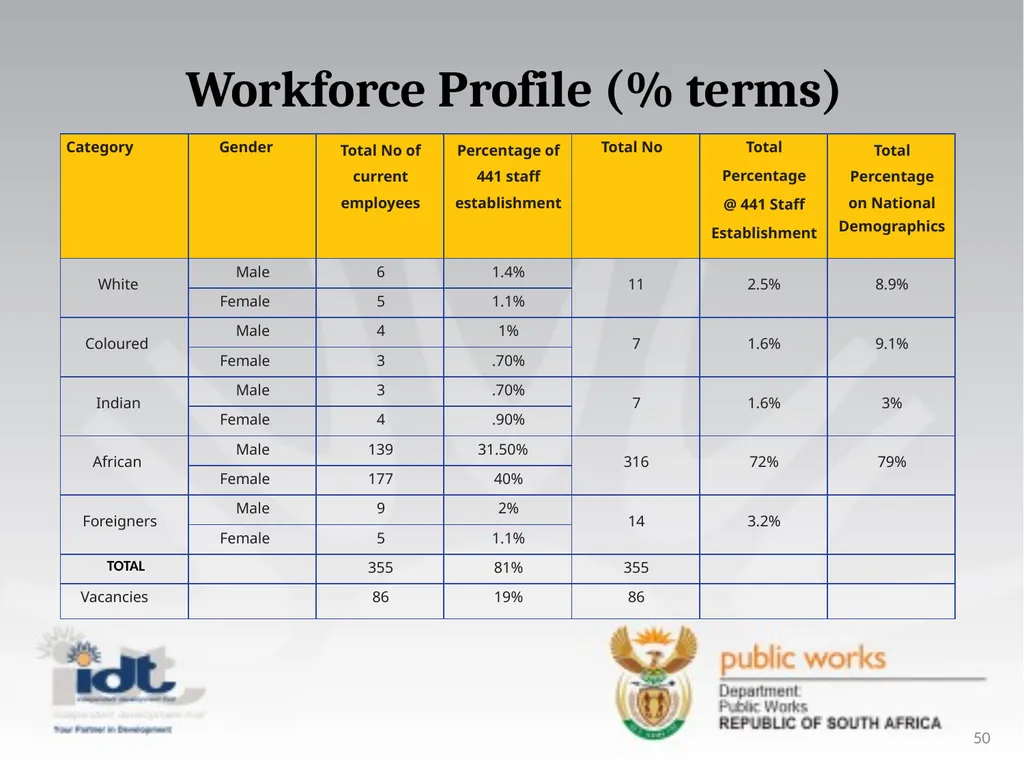
slide50. Workforce Profile (% terms) 50<br>
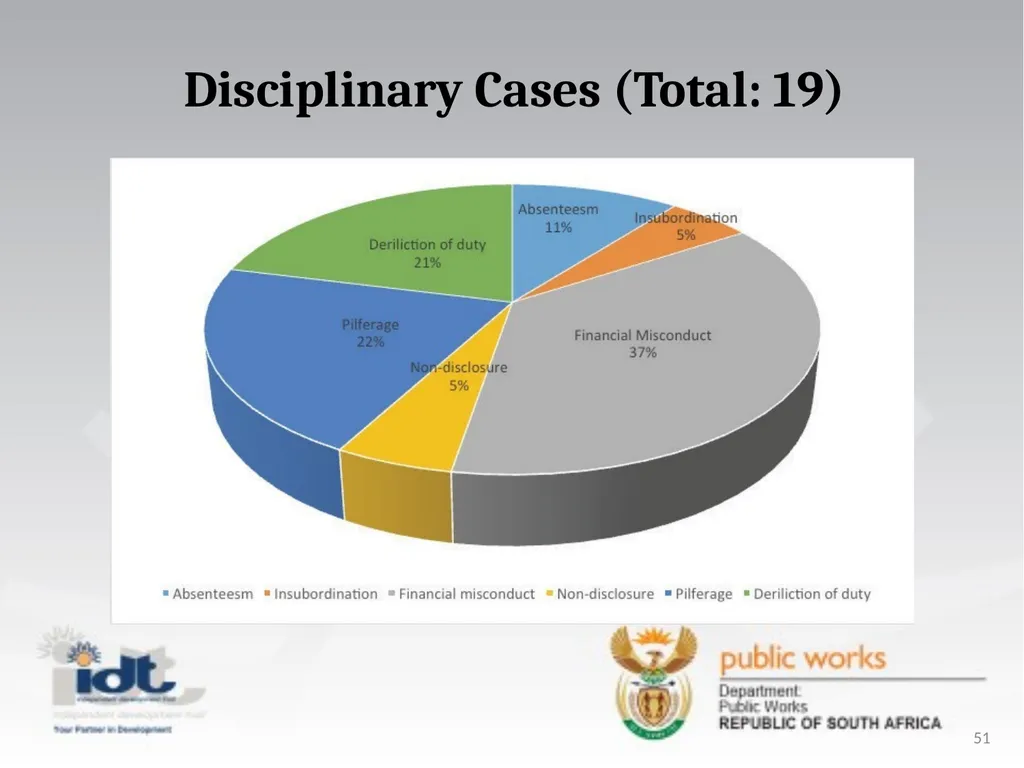
slide51. Disciplinary Cases (Total: 19) 51<br>
slide52. 52 6. Financial Information<br>
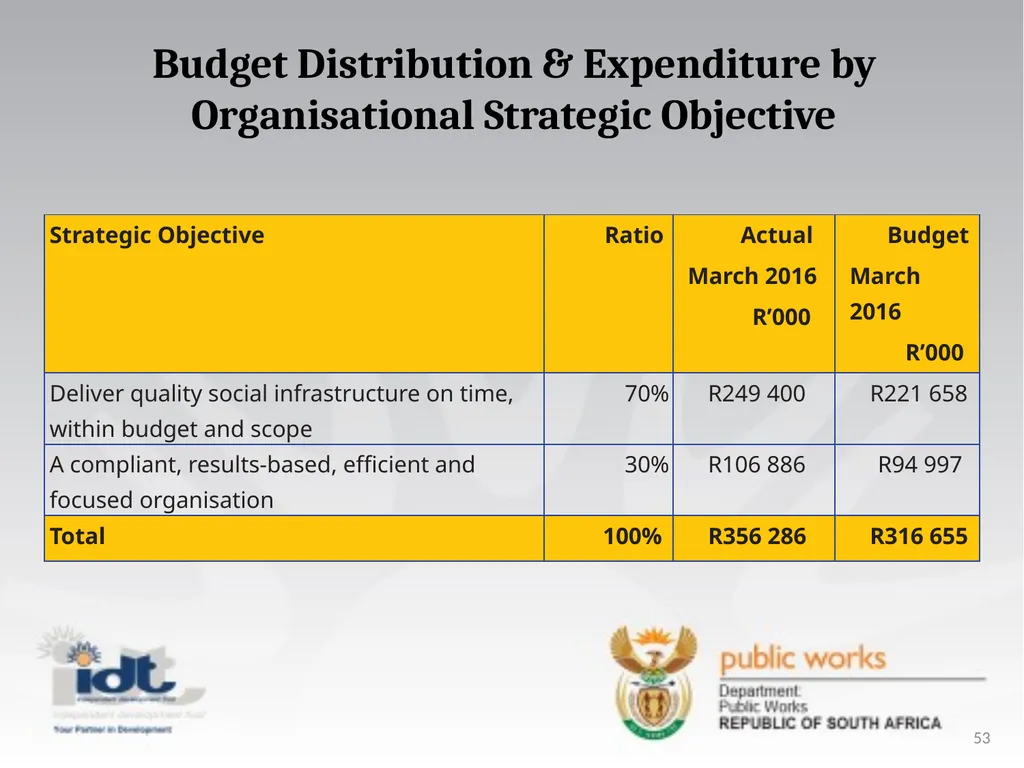
slide53. Budget Distribution & Expenditure by Organisational Strategic Objective 53<br>
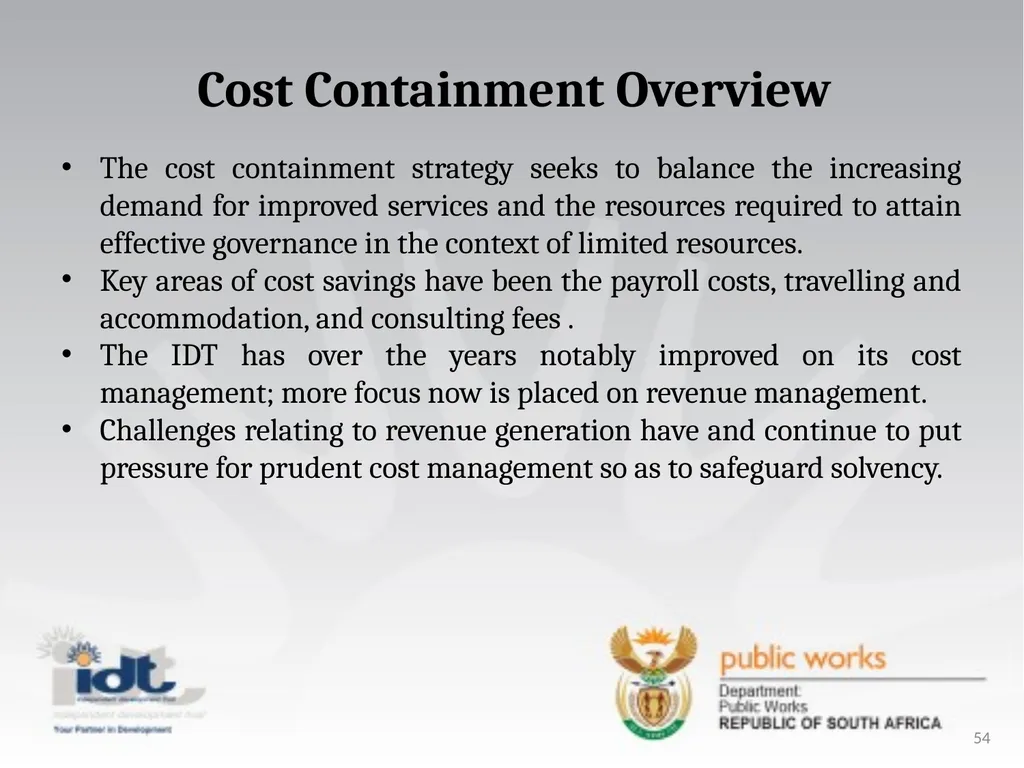
slide54. Cost Containment Overview 54 The cost containment strategy seeks to balance the increasing demand for improved services and the resources required to attain effective governance in the context of limited resources.
Key areas of cost savings have been the payroll costs, travelling and accommodation, and consulting fees .
The IDT has over the years notably improved on its cost management; more focus now is placed on revenue management.
Challenges relating to revenue generation have and continue to put pressure for prudent cost management so as to safeguard solvency.<br>
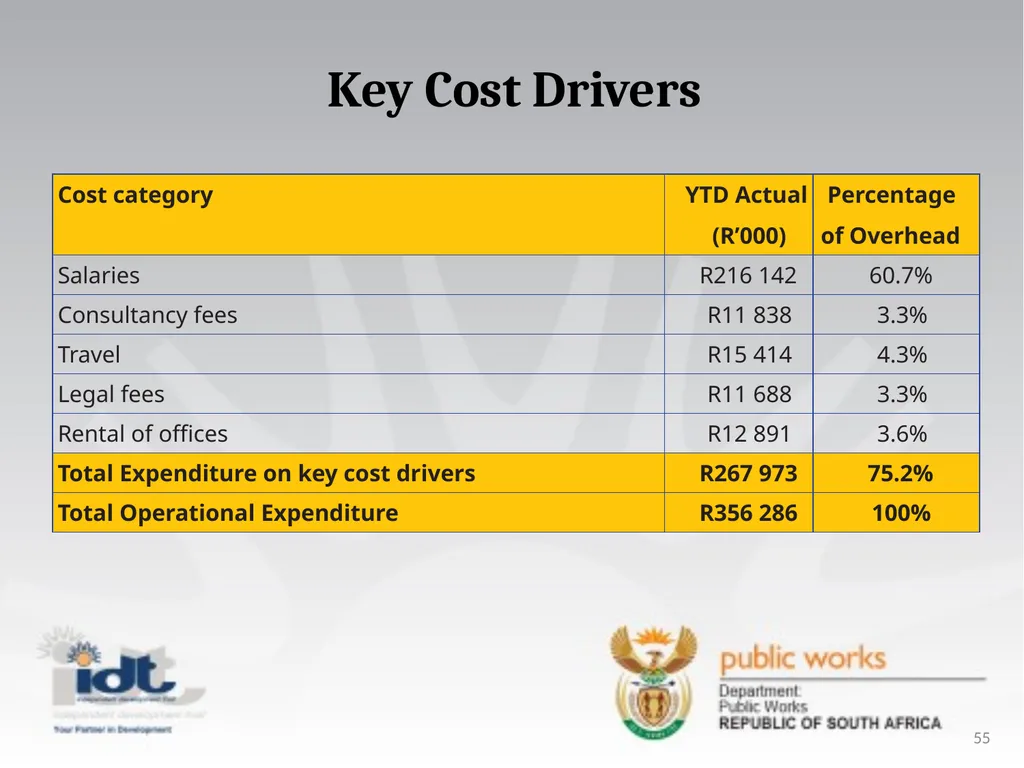
slide55. Key Cost Drivers 55<br>
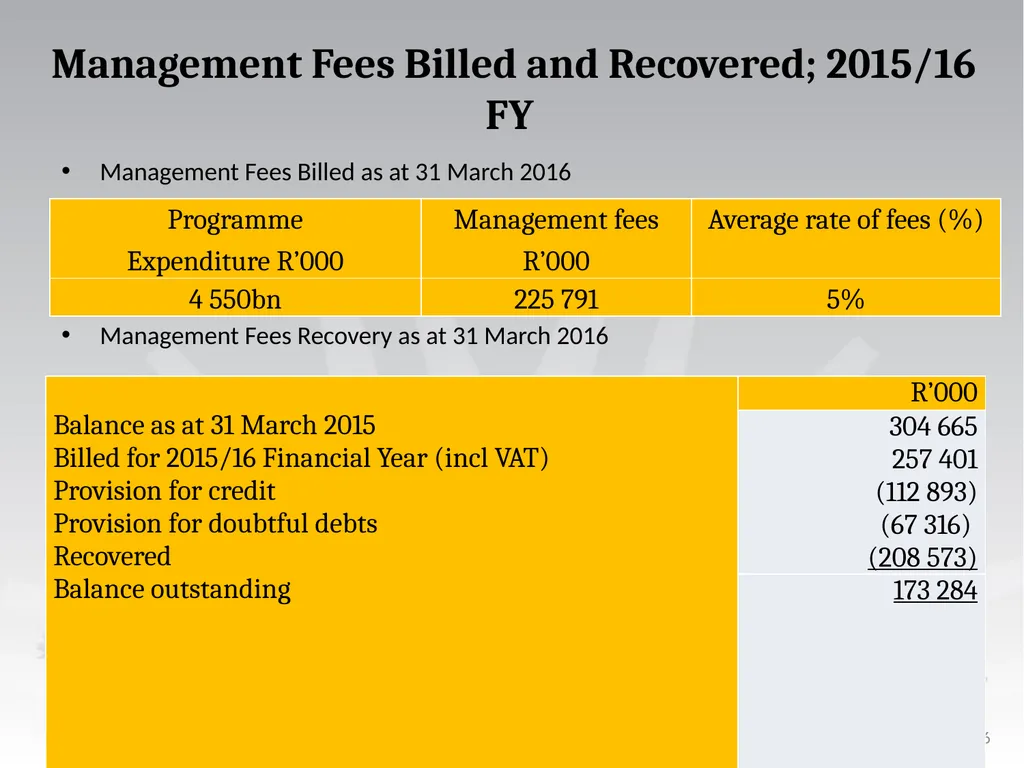
slide56. Management Fees Billed and Recovered; 2015/16 FY 56 Management Fees Billed as at 31 March 2016
Management Fees Recovery as at 31 March 2016<br>
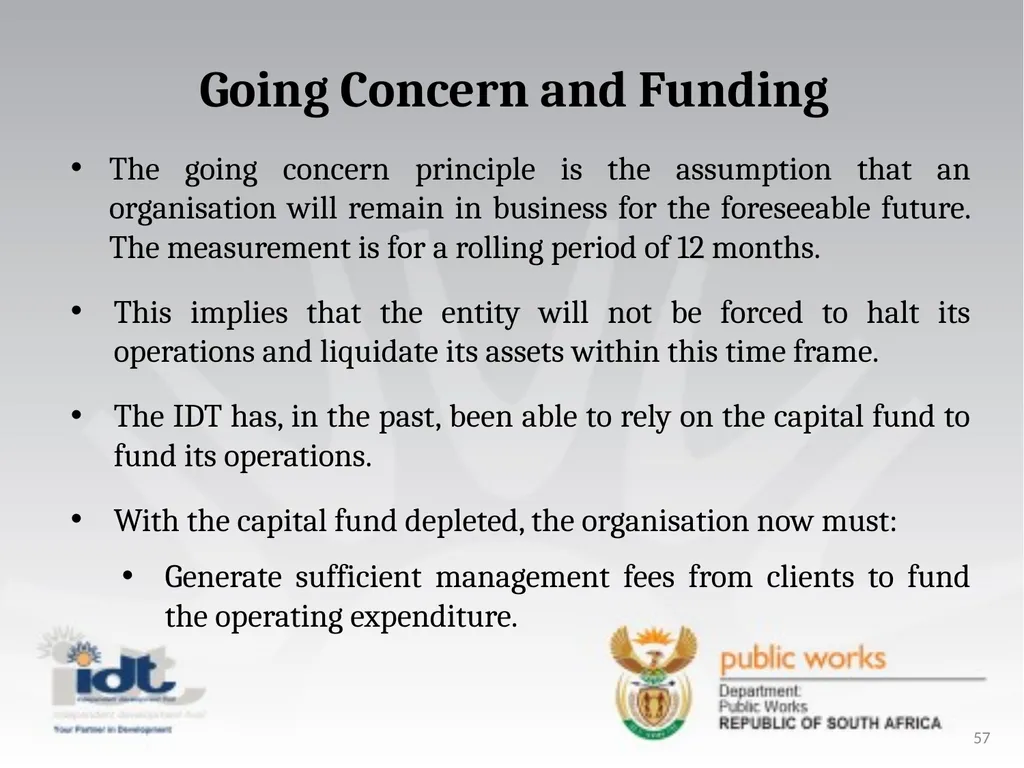
slide57. Going Concern and Funding 57 The going concern principle is the assumption that an organisation will remain in business for the foreseeable future. The measurement is for a rolling period of 12 months.
This implies that the entity will not be forced to halt its operations and liquidate its assets within this time frame.
The IDT has, in the past, been able to rely on the capital fund to fund its operations.
With the capital fund depleted, the organisation now must:
Generate sufficient management fees from clients to fund the operating expenditure.<br>
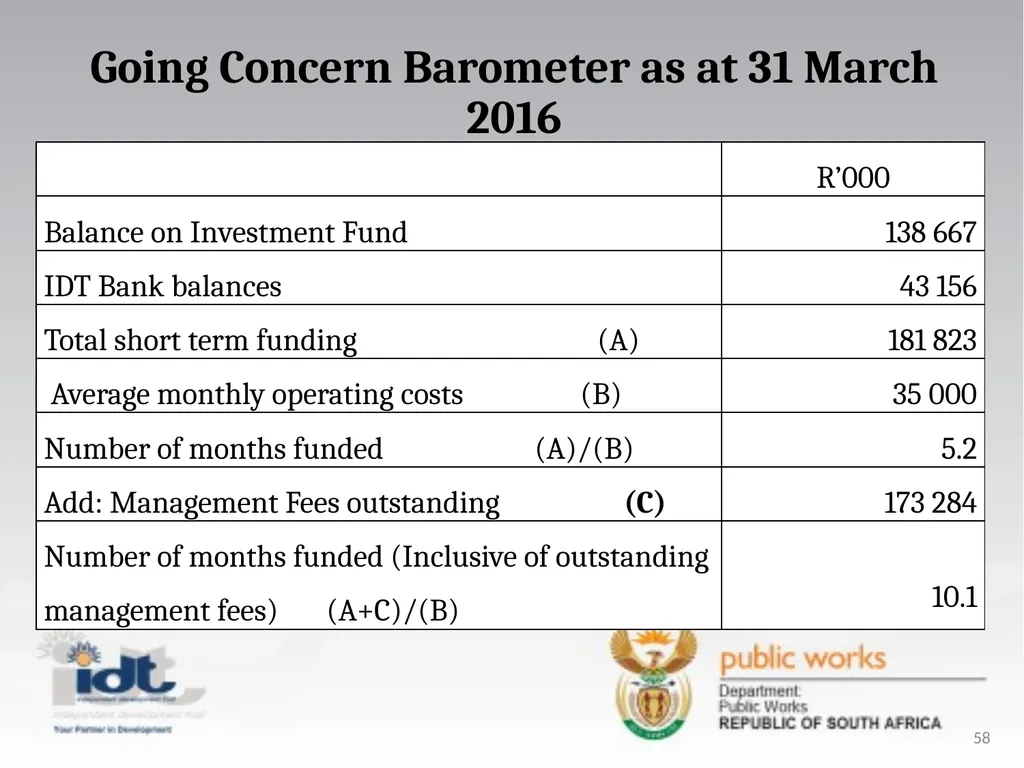
slide58. Going Concern Barometer as at 31 March 2016 58<br>
slide59. 59 7. Conclusion & Recommendations<br>
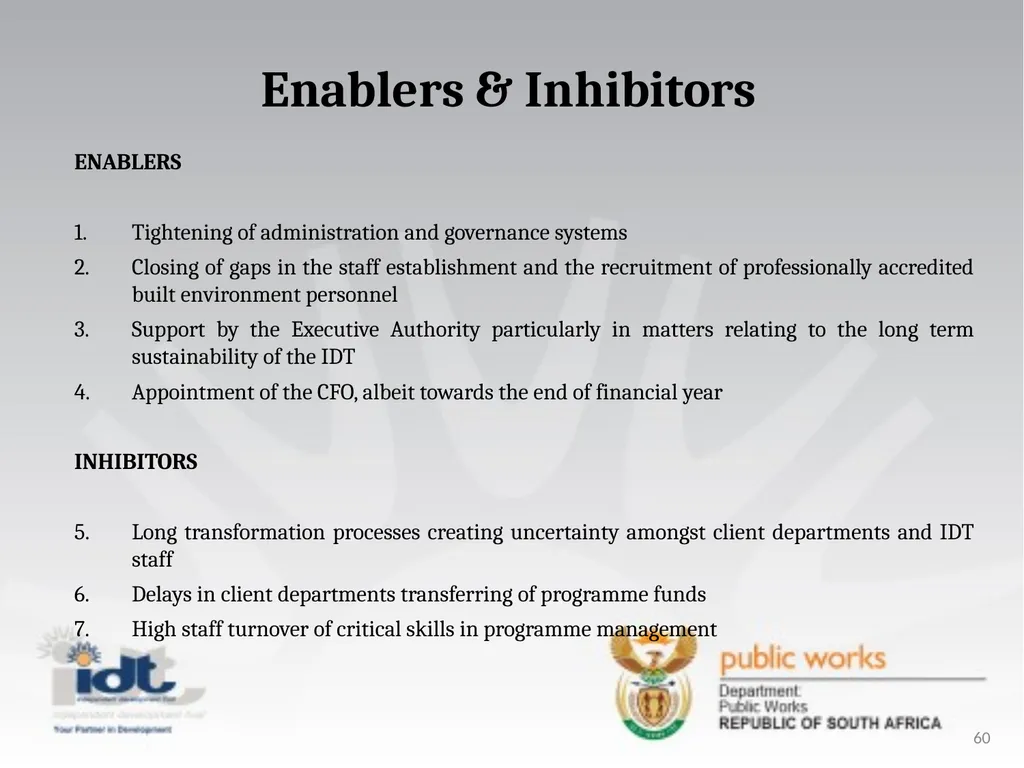
slide60. Enablers & Inhibitors 60 ENABLERS
Tightening of administration and governance systems
Closing of gaps in the staff establishment and the recruitment of professionally accredited built environment personnel
Support by the Executive Authority particularly in matters relating to the long term sustainability of the IDT
Appointment of the CFO, albeit towards the end of financial year
INHIBITORS
Long transformation processes creating uncertainty amongst client departments and IDT staff
Delays in client departments transferring of programme funds
High staff turnover of critical skills in programme management<br>
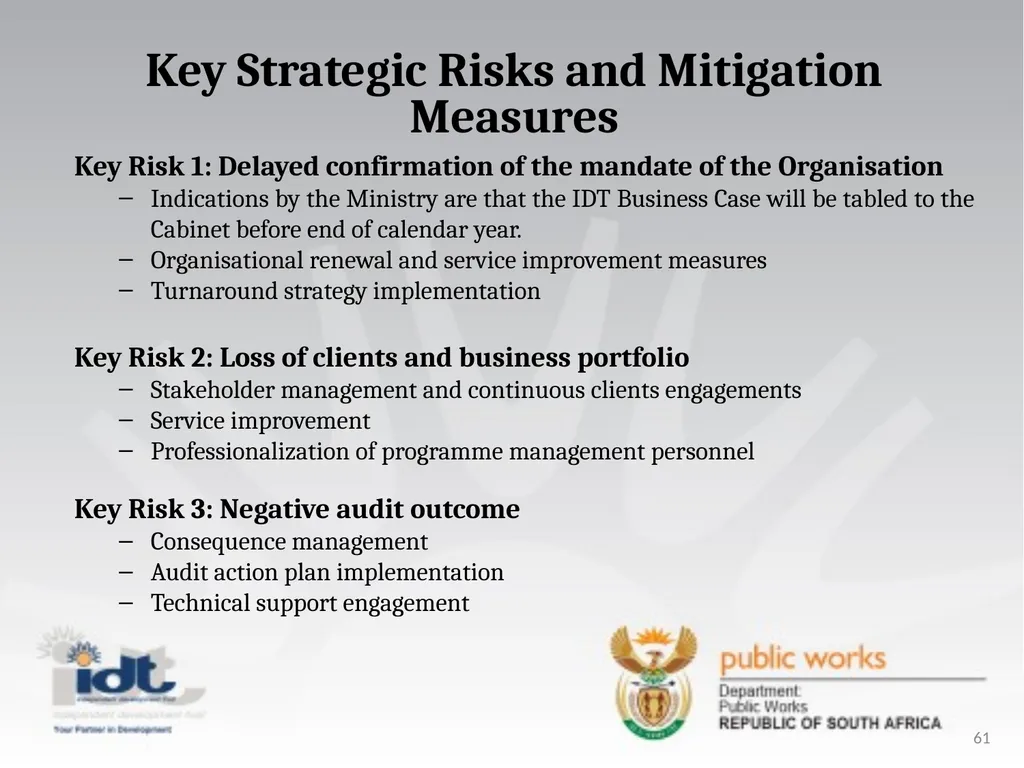
slide61. Key Strategic Risks and Mitigation Measures 61 Key Risk 1: Delayed confirmation of the mandate of the Organisation
Indications by the Ministry are that the IDT Business Case will be tabled to the Cabinet before end of calendar year.
Organisational renewal and service improvement measures
Turnaround strategy implementation
Key Risk 2: Loss of clients and business portfolio
Stakeholder management and continuous clients engagements
Service improvement
Professionalization of programme management personnel
Key Risk 3: Negative audit outcome
Consequence management
Audit action plan implementation
Technical support engagement<br>
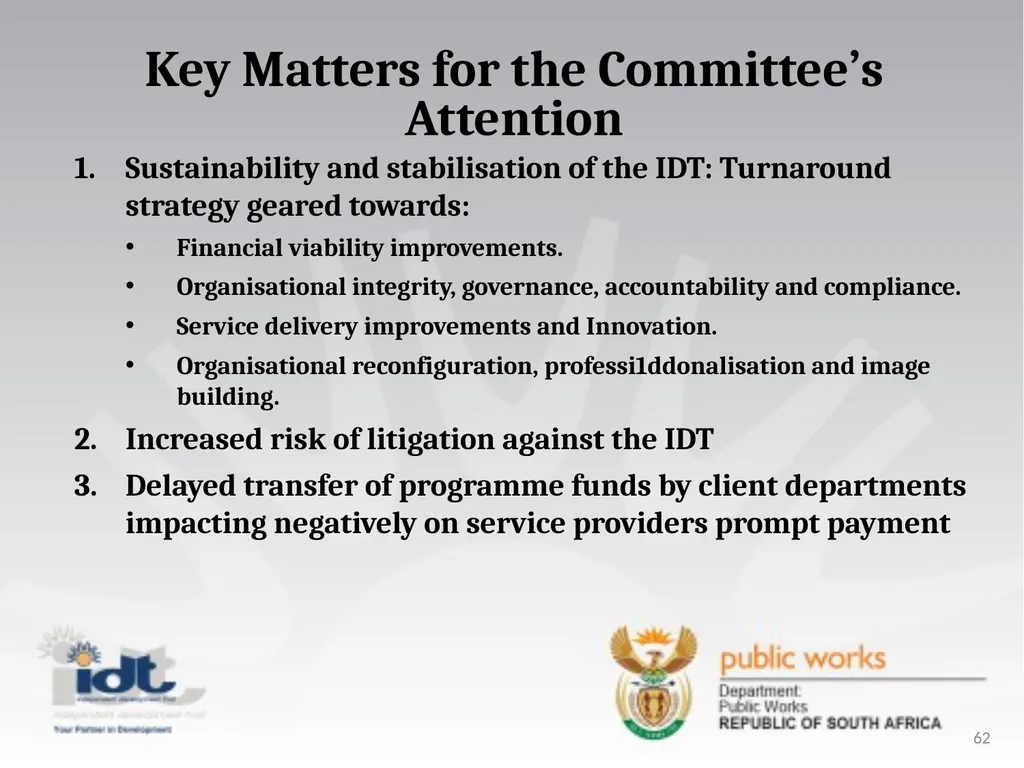
slide62. Key Matters for the Committee’s Attention 62 Sustainability and stabilisation of the IDT: Turnaround strategy geared towards:
Financial viability improvements.
Organisational integrity, governance, accountability and compliance.
Service delivery improvements and Innovation.
Organisational reconfiguration, professi1ddonalisation and image building.
Increased risk of litigation against the IDT
Delayed transfer of programme funds by client departments impacting negatively on service providers prompt payment<br>
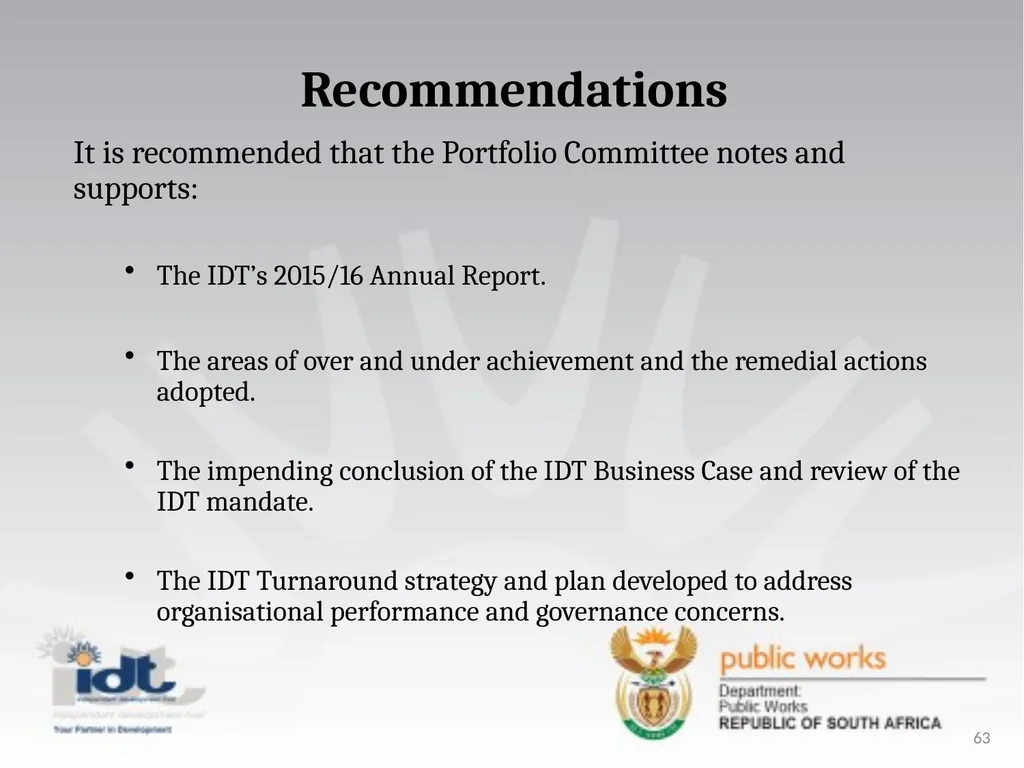
slide63. Recommendations 63 It is recommended that the Portfolio Committee notes and supports:
The IDT’s 2015/16 Annual Report.
The areas of over and under achievement and the remedial actions adopted.
The impending conclusion of the IDT Business Case and review of the IDT mandate.
The IDT Turnaround strategy and plan developed to address organisational performance and governance concerns.<br>
slide64. 64 Thank You
Independent Development Trust
Deliberations, Inputs & Responses<br>
slide2. Presentation Overview Contextual Background
Organisational Strategic Overview
Performance Highlights
Governance
Human Resource Management
Financial Information
Conclusion and Recommendations 2<br>
slide3. 3 1. Contextual Background<br>
slide4. Introduction 4 The IDT has been in transition for the past 6 years. The transformation process is aimed at maximising IDT’s contribution to the country’s development efforts. This process entails the development of an IDT long term sustainability Business Case.
The Business Case under development by the NDPW proposes the reconstitution of the IDT into a Schedule 3A Public Entity responsible for social infrastructure programme and projects management and funded through a service fee charged on clients.
The IDT has experienced portfolio growth of approximately 500 % within the last 7 years prior to the 2014/15 financial year, followed by a decline from the 2015/16 financial year arising from the tight fiscal environment and capacity gaps.
Over the last four years, the IDT has also faced extensive operational and governance challenges that have threatened to undermine the past good performance and governance record as well as the financial viability of the IDT.
The IDT’s impressive contribution to the national development efforts and good governance record has in the recent past, been brought to question due to the disclaimed audit opinion on its Annual Financial Statements for the 2014/15 and 2015/16 financial years.<br>
slide5. Inherited organizational challenges 5 Slow staff morale
Long years of uncertainty arising from, among others, the prolonged transformation process, long drawn out process of finalising the IDT Business Case, under-capacitation of the organisation in critical areas have taken their toll on staff morale. The organisation has thus been compelled to work with staff members who were demotivated and whose loyalties to the organisation could not be guaranteed.
Leadership void and capacity constraints within the Financial Services Unit (FSU)
The former CFO was dismissed in December 2015 for various acts of commission and omission relating to financial administration. This, together with the sudden resignation of the Deputy CFO and vacancies in critical finance positions, namely, GM: Finance; SM: Financial Technical Specialists; SM: Financial Accounting and SM: Project Accounting resulted in a leadership void within the FSU. The void, exercabated by internal control weaknesses in certain financial areas, plunged the organization into financial governance “chaos”.<br>
slide6. Inherited organizational challenges – cont.. Loss of institutional memory
IDT has in the past number of years consistently lost staff in key internal control positions with many of the resignations based on the uncertainty in the organisation and its future, and the transformation process itself, as well as a misconception that IDT was in a funding crisis. The loss of key staff means that institutional memory is lost and breaks organizational performance momentum. This has also led to over-reliance on consultants.
Poor Records Management
Over the years, document management at IDT has deteriorated to a point that it has been a challenge for the Auditor General (AG) to effectively audit programmes. The lack of adequate document management systems within IDT, has contributed to a negative audit rating by the AG, as it is viewed as a potential scope limitation. It also created a situation where there is no readily available supporting documentation and back-up system for critical transactions in the organisation.
Under-capacitation of the Internal Audit function
The under-capacitation of the Internal Audit function has resulted in apparent lack of Internal Audit support in the organization. 6<br>
slide7. Inherited organizational challenges – cont.. System migration challenges
The old accounting information system (Great Plains) was migrated to a new system where a single data base was split into 20 separate data bases. As a result, some of the transactions were not transferred across to the new Great Plains (GP). Currently, the new GP does not mirror the old GP, especially the Project Accounting portion, and that has caused data integrity challenges.
Project Accounting system relates to projects and programmes transactions and is in an unacceptable state. This system is not configured properly with the lack of system closure and trial balance. The transactions relating to the programmes funds and expenditure amounted to approximately R35 billion as at 31 March 2016.
There are balances transferred as take-on-balances which are material in nature and size. These balances have not been unpacked satisfactorily yet.
The disclaimer audit opinion is based on the unknown impact of these take-on-balances which impacted the programme assets, liabilities and reserves and the related revenue recognized and the resultant accounts receivables balances.
Poor Contract Management
Lack of effective contract management is resulting in repeated audit findings and poor management of external contracts. 7<br>
slide8. Growth in Portfolio compared to Staff numbers and staff costs over the five year period 8<br>
slide9. Root Causes of the Disclaimed Audit Opinions The eleven years of unqualified audit opinions were based on the IDT books without the transactions relating to programme funds and expenditure that IDT manages on behalf of client Departments. These balances were not accounted for in the financials of IDT and thus not subject to audit until 2014/15.
The programme funds (assets, liabilities and reserves) were off balance sheet items on the face of IDT AFS for the respective financial years and these balances are very material in nature as they amounted to billions of rands since the inception of the entity.
The challenges of incorporating these balances for the first time in 2014/15 Annual Financial Statements were compounded by the unknown impact of take-on balances that arose as a result of the system migration that took place during the 2013/14 financial period. The AGSA could not express an opinion until these balances are satisfactorily reconciled. 9<br>
slide10. Basis for the 2014/15 Disclaimed Audit 10 After 11 consecutive unqualified opinions, spanning 2002/03 to 2012/13, the IDT received a qualified audit opinion for the 2013/14 financial year followed by a disclaimed opinion in 2014/15 financial year.
Basis of the disclaimer for 2014/15 :
Lack of sufficient appropriate audit evidence regarding balances relating to programme reserves and liabilities;
Lack of sufficient appropriate audit evidence regarding revenue and trade and other receivables;
Lack of sufficient appropriate audit evidence regarding impairment provision for trade and other receivables; and
The material misstatement in financial statements amounting to R7,3 million in expenditure; other income; property, plant and equipment; and other trade and other payables.<br>
slide11. Basis for the 2015/16 Disclaimed Audit The disclaimed audit opinion remained for the financial year ended 31 March 2016 on account of the following:
Basis of the disclaimer for 2015/16:
Presentation of material balances of programme reserves and liabilities for audit purposes without accurate and complete underlying accounting records: largely due to prior year unreconciled items.
Inadequacy of reconciliations performed on the underlying accounts relating to management fees, trade receivables, impairment of trade receivables and provision for doubtful debts.
Impact of challenges relating to programme reserves and liabilities; and management fees, trade receivables, impairment of trade receivables and provision for doubtful debts on related parties balances and prior period errors. 11<br>
slide12. Reasons for the continued Disclaimed Audit Opinion 12 The disclaimed audit opinion has remained notwithstanding the investment and efforts of both the Board and Management due to the following reasons:
The 2014/15 audit report was issued at the end of July 2015 as per the prescribed Auditor General schedule.
Subsequent to the report, the Board initiated a consequence based action against the former CFO. The process was concluded in December 2015, with the outcome being the dismissal of the former CFO.
Mindful of the CFO disciplinary process and his pending retirement, the Board had authorised the initiation of a recruitment process for the new CFO at the beginning of August 2015. The process was concluded in November 2015 with the new CFO assuming duty on 04 January 2016.<br>
slide13. Reasons for the continued Disclaimed Audit Opinion cont.. 13 Given the 31 March year end, the new CFO had only 3 months to address the disclaimer matters identified by the 2014/15 audit with 9 months of the 2015/16 financial year already consumed.
The Board, mindful of this, had earlier authorised management to secure consulting support in the form of technical financial services to assist in addressing the records update backlogs and audit matters.
A consulting firm was engaged in December 2015, effectively commencing its work in January 2016. While the consulting team and the CFO worked tirelessly to address the historical accounting records update gaps that had negatively impacted the 2014/15 audit, time was not on their favour as only three months were left to the financial year end.
These interventions have notwithstanding the continued disclaimed audit opinion, assisted in addressing most of the underlying accounting records matters thereby creating a better platform for the 2016/17 audit outcome.<br>
slide14. Progress in addressing - 2014/15 issues raised by AGSA Improvements in the following areas were effected to address the 2014/15 issues raised by the AG:
Management and recording of tender deposits;
Accounting for retentions on programme expenditure and the related management fees accruals;
Impairment determination on the accounts receivables balances at account level;
Appropriate recognition of revenue from management fees at the legally contracted rates and monthly reconciliations of the balances reported;
Implementation of monthly accounts closure and reporting timelines; and introduction of key a controls matrix to improve the control environment;
Rollout of Standard Operating Procedures; and
Appointment of key financial services unit resources and the appropriate resourcing of the IDT’s provincial offices. 14<br>
slide15. Interventions As the crux of the disclaimed audit opinion rests solely on the take-on balances relating to Programmes in Project Accounting, FSU has commenced going back to cleaning and reconciling old GP, closing the periods and generating Trial Balances for each Regional Office as at the migration point in 2013/14. The data will then be compared to data imported during the migration.
Any correcting journals post migration over the last three years will be identified and assessed as to the validity of such transactions and where applicable adjustments will be made per year.
The take-on balance project will take a minimum of six months to unpack effectively and resolve satisfactorily. The old GP will be made to be the same in terms of transactions at the system conversion stage. Differences will be cleared. 15<br>
slide16. Interventions conti. .. Audit Action Plan for 2015/16 developed and coordinated at senior manager level within the office of the CFO.
The plan will be forwarded to AGSA for review this month and a meeting will be scheduled for final discussion and interim review .
Close monitoring and regular reporting by Internal Audit and Financial Technical Support from the office of the CFO to Executive Committee Finance Committee, Audit and Risk Committee and ultimately the Board of Trustees. 16<br>
slide17. Interventions conti. .. A high level skills and competency assessment has been conducted which resulted in training being embarked upon on the Accounting system and other relevant accounting processes.
Standard Operating Procedures have been developed for Project Accounting and implemented effectively from 01 September 2016. These have been workshopped throughout IDT to enable consequence management where there is non compliance and dereliction of duties by responsible officials.
Regular formal meetings and feedback sessions are held by all of the Financial Leadership Teams of IDT where key controls issues and finance risks are addressed with applicable corrective and remedial actions.
Performance contracts are also being reviewed to be job specific and linked to current challenges facing the organisation. Continuous training, ongoing monitoring and evaluation of performance is conducted.
The Finance Leadership Team Regional level is being reviewed and will be structured to ensure that staff with the appropriate skills set lead these finance units. 17<br>
slide18. Interventions conti. .. Concerted efforts are being made to improve the state of record management in the organisation. A File Plan for IDT, prepared in line with the requirements of the National Archives of South Africa Act of 1996, was submitted to and approved by the National Archives on 18 May 2016.
The organisation is currently reviewing its Records Management Policy and Information Security Framework.
A Promotion of Access to Information Act (PAIA) Manual has been reviewed and submitted to the Department of Justice and Correctional Services for Gazetting.
Fridays are declared Records Management Days, days on which staff is encouraged to work on filing. 18<br>
slide19. Systemic Interventions: Organisational Renewal 19 The Board initiated in the previous reporting period a 3-pronged approach to remedy the situation:
Leadership review and management accountability
The Turnaround Strategy and Plan; and
A comprehensive audit action plan.
Paramount to the Board’s plan is:
Initiating of good governance and clean administration evidenced by clean / unqualified audit reports;
Holding of officials responsible for transgression accountable;
Building the IDT into a leading public sector social infrastructure programme implementation and management agency; and
Supporting the long term IDT sustainability and transformation process.<br>
slide20. UPDATE ON FORENSIC INVESTIGATIONS IDT Board appointed Gobodo Forensic Investigative Accounting (Pty) Ltd (GFIA) to conduct a preliminary investigation in 2014, based on serious allegations of irregularities and corrupt activities in the procurement processes which were brought to their attention.
The Preliminary Phase (Phase1) focused only on the specific allegations brought to the attention of the Board of Trustees in relation to 4 Service providers involving R100 million of payments.
Preliminary findings indicated that certain service providers were appointed without following due procurement processes. In-depth forensic investigation was then recommended (Phase 2) and where necessary, disciplinary processes were to be undertaken.
The IDT Board then requested National Treasury (NT) to assist in conducting an in-depth forensic investigation, based on the identified significant irregularities of the Preliminary review and also to carry the costs of the investigation.
NT continued to engage GFIA to proceed with in-depth investigation under Phase 2, as it is also part of NT panel of forensic investigators.<br>
slide21. UPDATE ON FORENSIC INVESTIGATIONS CONT…. PHASE 2 – Focused mainly on the following:
In-depth investigation regarding appointment of a certain company (name furnished) and whether value-for-money was achieved for all deliverables for an amount of R76 Million.
Various allegations of corruption and irregularities in the procurement of services at the KZN-IDT Regional Office with estimated value of R200 Million.
Irregular procurement of services under a contract with Msunduzi Local Municipality in KZN Province, where IDT was appointed as an implementing agent for project with a total value of R500 Million.<br>
slide22. UPDATE ON FORENSIC INVESTIGATIONS CONT….. OTHER INVESTIGATIONS:
The NT has been investigating matters relating to procurement of services for various projects belonging to Department of Correctional Services (DCS). IDT was appointed as the implementing agent by DCS.
A report was presented to the Board in June 2016 for implementation of corrective actions against IDT officials found to have transgressed the SCM policy and procedures.<br>
slide23. CONSEQUENCE MANAGEMENT The former CFO of IDT (name furnished) was charged for various financial irregularities and subsequently dismissed in December 2015.
The IDT filed a claim against the former CFO’s Provident Fund to recover its financial losses caused by such irregularities estimated at about R3,9 m. The former CFO is challenging this claim and the matter is in Arbitration.
The then Acting Head in the Office of the CEO (name furnished) was also taken through a disciplinary process and his services were also terminated. IDT also lodged a claim with the Provident Fund in the Amount of R685 000. The employee signed an acknowledgement of debt and the recovery process is underway.
A Senior Manager, formerly in the CEO office (name furnished) has also been charged and is currently undergoing a disciplinary process
Companies involved in the irregularities (names furnished) will also be pursued to recover the financial losses estimated at (R1,7m + R534 000 =R2,234m).
Disciplinary process has been initiated against two officials (names furnished), an acting Executive: Programme Management Services and Project Manager, who were managing the DCS Projects.<br>
slide24. Turnaround Strategy 24 The objectives of the IDT Turnaround Strategy, covering the period 1 April 2015 to 31 March 2018, are to:
Strategically position the IDT as a premier social infrastructure programme delivery management entity;
Regain confidence of the Shareholder, client departments and stakeholders;
Ensuring financial sustainability, prudent financial management and accountability for the IDT as well as for client funds;
Attract and retain appropriately qualified, committed and motivated personnel;
Develop and utilise effective and efficient business systems and processes to successfully implement programmes that contribute to the improvements in the quality of life of communities.<br>
slide25. Turnaround Strategy Pillars 25 The following pillars provide the basis for the Turnaround:
Financial viability improvements;
Organisational integrity, governance, accountability and compliance;
Service delivery improvements and Innovation;
Organisational reconfiguration, professionalization and image building.<br>
slide26. 26 2. Organisational Strategic Overview<br>
slide27. Organisational Strategic Overview 27 Primary Purpose: A state implementing agency supporting government with programme and project management of social infrastructure delivery. As an entity within the DPW family, the work of the IDT speaks directly to the mandate of the Department of Public Works.
Vision: To be a leading public sector developmental programme implementation and management agency.
Mission: The IDT manages and delivers integrated quality social infrastructure programmes on behalf of government on time, cost effectively and through a people centred approach.
Our approach: The IDT’s approach to social infrastructure development entails social facilitation and empowerment necessary to prepare communities to receive, participate in, own and sustain their own development.<br>
slide28. 2015/16 Strategic Thrust: Priority Outcomes 28 Informed by its mandate, the IDT strives to advance and contribute towards the following development priority outcomes:<br>
slide29. 2015/16 Strategic Goals & Objectives 29<br>
slide30. 30 3. Performance Highlights<br>
slide31. Overview of Corporate Performance; 2015/16 31<br>
slide32. Overview of Performance: Strategic Objective 1 32<br>
slide33. Overview of Performance: Strategic Objective 1 33<br>
slide34. Overview of Performance: Strategic Objective 1 34<br>
slide35. Portfolio Spend: 2015/16 & Previous 3 Years 35<br>
slide36. Expenditure Performance per Programme Categories 36<br>
slide37. Portfolio Spend by Programme Area; 2015/16 37<br>
slide38. Measures to address under-performance 38<br>
slide39. IDT Impact - Justice for all 39 Polokwane High Court, Limpopo<br>
slide40. IDT Impact - Access to Education 40 Mgezeni High School, KwaZulu Natal<br>
slide41. IDT Impact - Health for all 41 Letaba Hospital, Limpopo<br>
slide42. IDT Impact - Justice for all 42 Mpumalanga High Court, Mpumalanga Rear View of the Mpumalanga High Court<br>
slide43. 43 4.
Governance<br>
slide44. Governance Structures: Board & Board Committees 44 The IDT has a unitary Board of Trustees all of whom are non-executive and independent.
The responsibilities and fiduciary duties of the Accounting Authority are discharged through the Board.
The roles of the Board Chairperson and Chief Executive Officer are separate.
The Board Charter details the responsibilities of the Board which are undertaken with the support of the following Sub-committees:
Audit and Risk Committee
Finance Committee
Strategic Planning and Programme Committee
Human Resources and Corporate Services Committee
Board EXCO (which also serves as the Remuneration Committee)<br>
slide45. Synopsis of Key Board Priority Issues during the 2015/16 financial year Contributing to the development of the IDT Business Case and confirmation of the IDT Mandate.
Providing leadership towards the long-term financial sustainability of the Organisation.
Spearheading effective governance and compliance, and a culture of consequence management.
Filling the vacant CFO role with a competent person
Safeguarding operational stability of the organisation through:
providing parameters for resourcing of the organisation
Promotion of operational capacity improvements including review of business processes, systems and approaches to ensure programme management efficiency 45<br>
slide46. Organisational Structure 46<br>
slide47. Shareholder Compact Compliance Record 47<br>
slide48. 48 5.
Human Resource Management<br>
slide49. Staff Establishment 49<br>
slide50. Workforce Profile (% terms) 50<br>
slide51. Disciplinary Cases (Total: 19) 51<br>
slide52. 52 6. Financial Information<br>
slide53. Budget Distribution & Expenditure by Organisational Strategic Objective 53<br>
slide54. Cost Containment Overview 54 The cost containment strategy seeks to balance the increasing demand for improved services and the resources required to attain effective governance in the context of limited resources.
Key areas of cost savings have been the payroll costs, travelling and accommodation, and consulting fees .
The IDT has over the years notably improved on its cost management; more focus now is placed on revenue management.
Challenges relating to revenue generation have and continue to put pressure for prudent cost management so as to safeguard solvency.<br>
slide55. Key Cost Drivers 55<br>
slide56. Management Fees Billed and Recovered; 2015/16 FY 56 Management Fees Billed as at 31 March 2016
Management Fees Recovery as at 31 March 2016<br>
slide57. Going Concern and Funding 57 The going concern principle is the assumption that an organisation will remain in business for the foreseeable future. The measurement is for a rolling period of 12 months.
This implies that the entity will not be forced to halt its operations and liquidate its assets within this time frame.
The IDT has, in the past, been able to rely on the capital fund to fund its operations.
With the capital fund depleted, the organisation now must:
Generate sufficient management fees from clients to fund the operating expenditure.<br>
slide58. Going Concern Barometer as at 31 March 2016 58<br>
slide59. 59 7. Conclusion & Recommendations<br>
slide60. Enablers & Inhibitors 60 ENABLERS
Tightening of administration and governance systems
Closing of gaps in the staff establishment and the recruitment of professionally accredited built environment personnel
Support by the Executive Authority particularly in matters relating to the long term sustainability of the IDT
Appointment of the CFO, albeit towards the end of financial year
INHIBITORS
Long transformation processes creating uncertainty amongst client departments and IDT staff
Delays in client departments transferring of programme funds
High staff turnover of critical skills in programme management<br>
slide61. Key Strategic Risks and Mitigation Measures 61 Key Risk 1: Delayed confirmation of the mandate of the Organisation
Indications by the Ministry are that the IDT Business Case will be tabled to the Cabinet before end of calendar year.
Organisational renewal and service improvement measures
Turnaround strategy implementation
Key Risk 2: Loss of clients and business portfolio
Stakeholder management and continuous clients engagements
Service improvement
Professionalization of programme management personnel
Key Risk 3: Negative audit outcome
Consequence management
Audit action plan implementation
Technical support engagement<br>
slide62. Key Matters for the Committee’s Attention 62 Sustainability and stabilisation of the IDT: Turnaround strategy geared towards:
Financial viability improvements.
Organisational integrity, governance, accountability and compliance.
Service delivery improvements and Innovation.
Organisational reconfiguration, professi1ddonalisation and image building.
Increased risk of litigation against the IDT
Delayed transfer of programme funds by client departments impacting negatively on service providers prompt payment<br>
slide63. Recommendations 63 It is recommended that the Portfolio Committee notes and supports:
The IDT’s 2015/16 Annual Report.
The areas of over and under achievement and the remedial actions adopted.
The impending conclusion of the IDT Business Case and review of the IDT mandate.
The IDT Turnaround strategy and plan developed to address organisational performance and governance concerns.<br>
slide64. 64 Thank You
Independent Development Trust
Deliberations, Inputs & Responses<br>