6 Collaborating to Create Regional Economic Opportunity Brian Shonk Vice Chancellor for Academic Affairs U. of Arkansas Community College at Batesville (AR) Jay Falkner President Carl Albert State College (OK) BRIEF Webinar Agenda: Overview
"6 Collaborating to Create Regional Economic" is the property of its rightful owner. Permission is granted to
download and print the materials on this website for personal, non-commercial use only, and to display it
on your personal computer provided you do not modify the materials and that you retain all copyright
notices contained in the materials. By downloading content from our website, you accept the terms of this
agreement.
Presentation Transcript
01
6 Collaborating to Create Regional Economic Opportunity Brian Shonk
Vice Chancellor for Academic Affairs
U. of Arkansas Community College at Batesville (AR)
Jay Falkner
President
Carl Albert State College (OK) BRIEF<br>
02
Webinar Agenda: Overview of the Rural Leader Learning Community
Rethink Partnerships as Relationships to Drive Economic Opportunity
Build Strong, Lasting Relationships
Highlights from the authors’ colleges
Discussion questions
Contact information 2<br>
03
Rural Community College Leader Series The Rural Leader Learning Community — established by NCII in 2020 with funding support by Ascendium Education Group — is a group of 26 rural community college leaders who came together over the past year to explore a range of issues.
The series of briefs, which come from rural college perspective, shows how institutions aim to regain control of their regions’ talent pipelines, serve as engines of economic improvement, and thus provide opportunities for both individual upward mobility and regional stability. 3<br>
04
Rural Community College Leader Series 4 The Big Picture
Brief 1: Creating a College-Going Mindset
Brief 2: Acting Boldly to Build Financial Solvency
Brief 3: Cultivating Partnerships to Support Students’ Basic Needs
Brief 4: Diversifying Faculty at Rural Colleges
Brief 5: Redesigning Advising and Support Services
Brief 6: Collaborating to Create Regional Economic Opportunity Link to the briefs - http://ncii-improve.com/rural-community-college-leader-series/<br>
05
Rural Community College Leader Series 5 THE EQUITY IMPERATIVE
Rural colleges share the conviction that they exist in large part to build communities, interrupt persistent poverty cycles, and promote the economic upward mobility of their students.
Efforts related to improving diversity, equity, and inclusion have a variety of motivators and whatever their origins, these efforts are as important in rural America as they are in urban areas.
Rural colleges serve populations that include first-generation students, low-income students, students of color, adults re-entering higher education, gender nonconforming students, and others.
While each community is different, every college has current and potential students who face barriers that other students do not.
To stay true to its mission, each college must acknowledge and purposefully work to break down these barriers and close opportunity gaps.<br>
06
Rethink Partnerships as Relationships to Drive Economic Opportunity Through partnerships colleges can:
Develop the talent regional employers need.
Lead conversations that imagine and then create new avenues of opportunity in their region.
Engage students who would not otherwise enroll in college, including first-generation students; students of color; and foster, homeless, and adjudicated youth — and engage them starting early in their lives.
Help students who have unskilled or semi-skilled jobs follow career pathways that align skill development with careers in high-demand, high-wage occupations.
Develop certificate and degree programs that include workforce credit and stacked credentials. These approaches allow students to work while learning and have currency in the workplace. 6 “Our overarching
focus should be on
relationships that
expand economic
opportunity and
growth.”<br>
07
Build Strong, Lasting Relationships Strong relationships have long-term benefit for all parties where there is an understanding of each other’s needs and are working toward common goals.
Developing and maintaining relationships takes hard work, but it is worthwhile.
Everyone at a college can develop relationships, but presidents must drive this work and model partnership building for others on campus.
The importance of good communication cannot be underestimated.
Good communication is intentional, focused, and ongoing. It starts with listening to identify mutual goals, and it evolves as the parties develop and then implement strategies to meet those goals.
Dedicating the time and energy to communicate effectively with our partners is important so we can establish, grow, and cement meaningful relationships. 7<br>
08
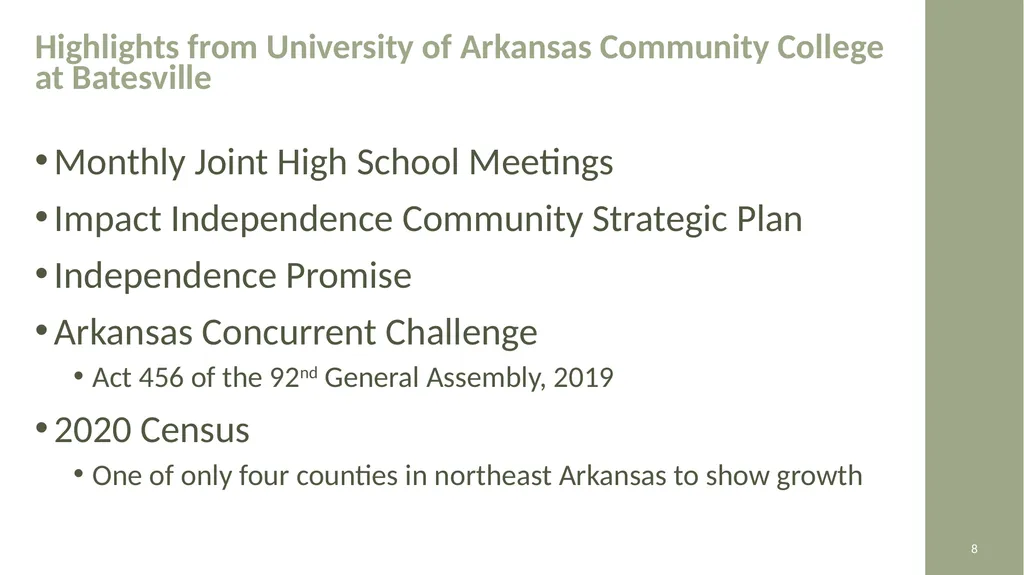
Highlights from University of Arkansas Community College at Batesville Monthly Joint High School Meetings
Impact Independence Community Strategic Plan
Independence Promise
Arkansas Concurrent Challenge
Act 456 of the 92nd General Assembly, 2019
2020 Census
One of only four counties in northeast Arkansas to show growth 8<br>
09
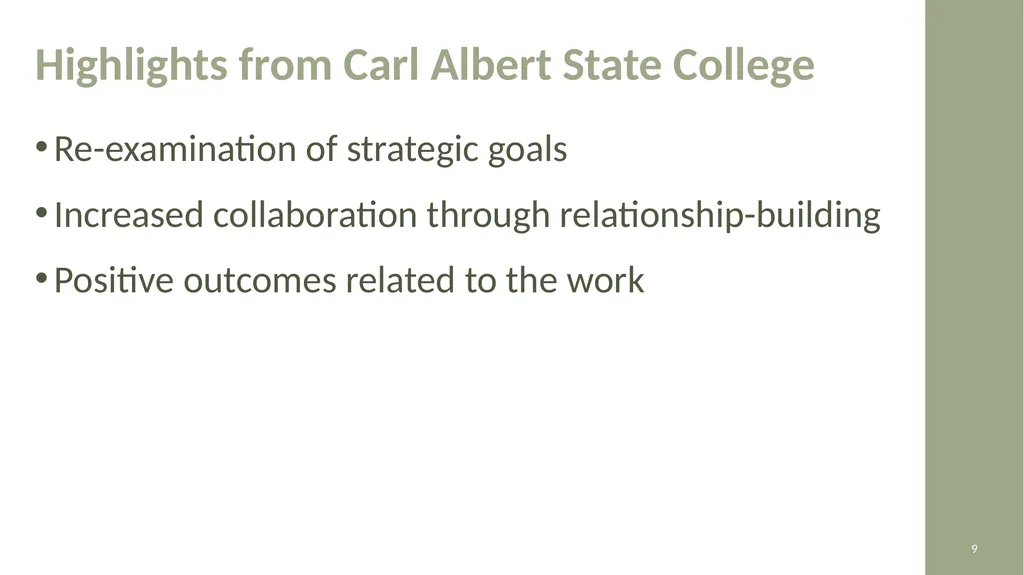
Highlights from Carl Albert State College 9 Re-examination of strategic goals
Increased collaboration through relationship-building
Positive outcomes related to the work<br>
10
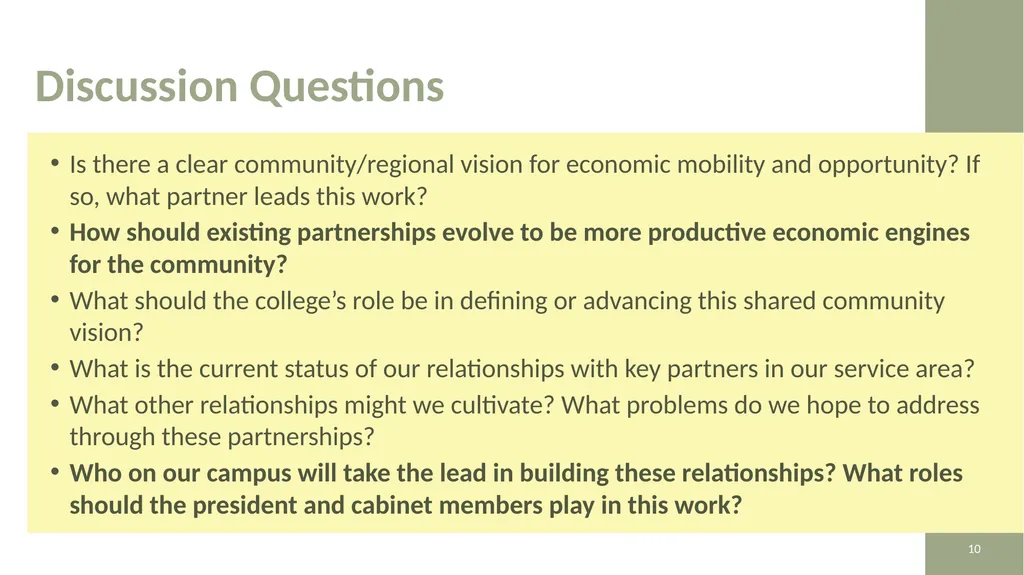
Discussion Questions Is there a clear community/regional vision for economic mobility and opportunity? If so, what partner leads this work?
How should existing partnerships evolve to be more productive economic engines for the community?
What should the college’s role be in defining or advancing this shared community vision?
What is the current status of our relationships with key partners in our service area?
What other relationships might we cultivate? What problems do we hope to address through these partnerships?
Who on our campus will take the lead in building these relationships? What roles should the president and cabinet members play in this work? 10<br>
11
Contact Information: For questions about Brief #6 email: Brian Shonk – brian.shonk@uaccb.edu Jay Falkner – jfalkner@carlalbert.edu For questions about the Rural Leader Learning Community email: Gretchen Schmidt – gretchen@ncii-improve.com Chris Baldwin – cbaldwin@baldwin-consulting.com Join a live webinar about the entire series on September 8, 2021 at 2pm ET
The webinar registration link along with briefs can be found on the NCII website:
http://ncii-improve.com/rural-community-college-leader-series/<br>