Advancing the Ball on Clean Energy While Leveraging Low Gas Prices Restructuring Roundtable June 15, 2012 Peter Rothstein, President New England Clean Energy Council Advancing the Ball on Clean Energy While Leveraging Low Gas Prices Today:
Related Topics
Share
Embed code
Download this presentation From Below
"Advancing the Ball on Clean Energy While" is the property of its rightful owner. Permission is granted to
download and print the materials on this website for personal, non-commercial use only, and to display it
on your personal computer provided you do not modify the materials and that you retain all copyright
notices contained in the materials. By downloading content from our website, you accept the terms of this
agreement.
Presentation Transcript
01
Advancing the Ball on Clean Energy While Leveraging Low Gas Prices
Restructuring Roundtable
June 15, 2012
Peter Rothstein, President
New England Clean Energy Council<br>
02
Advancing the Ball on Clean Energy While Leveraging Low Gas Prices Today:
Overall trends & scenarios
Renewables directions
Efficiency returns
System investment impacts
Next Steps:
This decade & beyond<br>
03
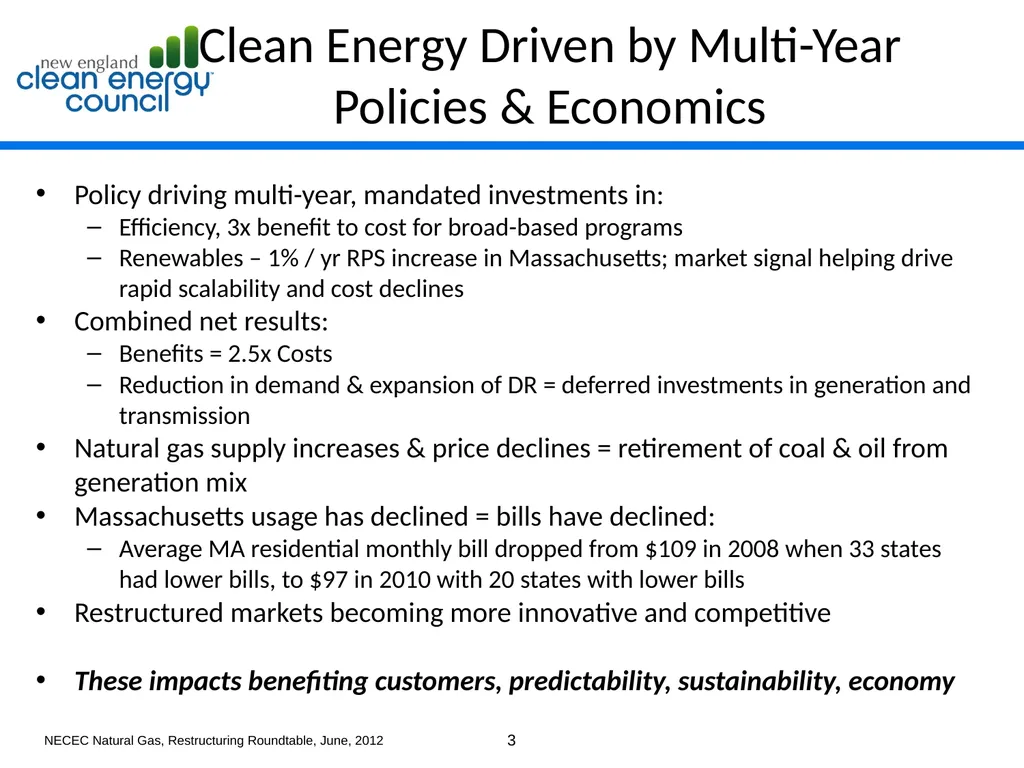
Clean Energy Driven by Multi-Year Policies & Economics Policy driving multi-year, mandated investments in:
Efficiency, 3x benefit to cost for broad-based programs
Renewables – 1% / yr RPS increase in Massachusetts; market signal helping drive rapid scalability and cost declines
Combined net results:
Benefits = 2.5x Costs
Reduction in demand & expansion of DR = deferred investments in generation and transmission
Natural gas supply increases & price declines = retirement of coal & oil from generation mix
Massachusetts usage has declined = bills have declined:
Average MA residential monthly bill dropped from $109 in 2008 when 33 states had lower bills, to $97 in 2010 with 20 states with lower bills
Restructured markets becoming more innovative and competitive
These impacts benefiting customers, predictability, sustainability, economy<br>
04
Energy Trends: Not Straight Line or Simple Costs Looking at short-term low natural gas prices, some will say “everything is ok - we don’t need to invest in energy efficiency, renewables, clean technology as much”
However, the future is never a straight line for very long
The future includes straight line trends, with unpredictable, disruptive changes:
Oil global market impacts
Efficiency and DR dramatically impacting peak use
Nat gas supply disruptions in Europe
New linkages, trading in international markets (LNG)
Impacts of delays / investments in major transmission
New, disruptive technologies
New environmental regulations
A long-term, cost-effective energy system comes from thinking about risk & insurance
We need a balanced portfolio of energy resources – “all of the above” to mitigate price volatility & price levels, enhance energy security & reliability, reduce impacts
We need increasingly competitive markets with cost-effective procurement criteria
We need mechanisms for new technologies and disruptive, step-changes in technology<br>
05
Increasing Competitiveness of Renewables Wind:
Analysts estimate that incremental turbine technology improvements have the potential to decrease costs by 10-30 percent in the 2015-2020 period, bringing the unsubsidized levelized cost into the $42-67 per MWh range
If such innovation occurs, and if natural gas prices inch upwards, wind power could be broadly competitive in that time frame Solar (DOE Sunshot goals):
Launched in 2011, DOE SunShot Initiative aims to reduce the price of solar energy systems by about 75% from 2010 and 2020
Achieving this level of price reductions could result in solar meeting 14% of U.S. electricity needs by 2030 and 27% by 2050
Realizing these price and installation targets will require a combination of evolutionary and revolutionary technological changes Sources: Gas Boom Poses Challenges for Renewables and Nuclear. Breakthrough Institute, April 2012
DOE Sunshot Vision Study, 2011<br>
06
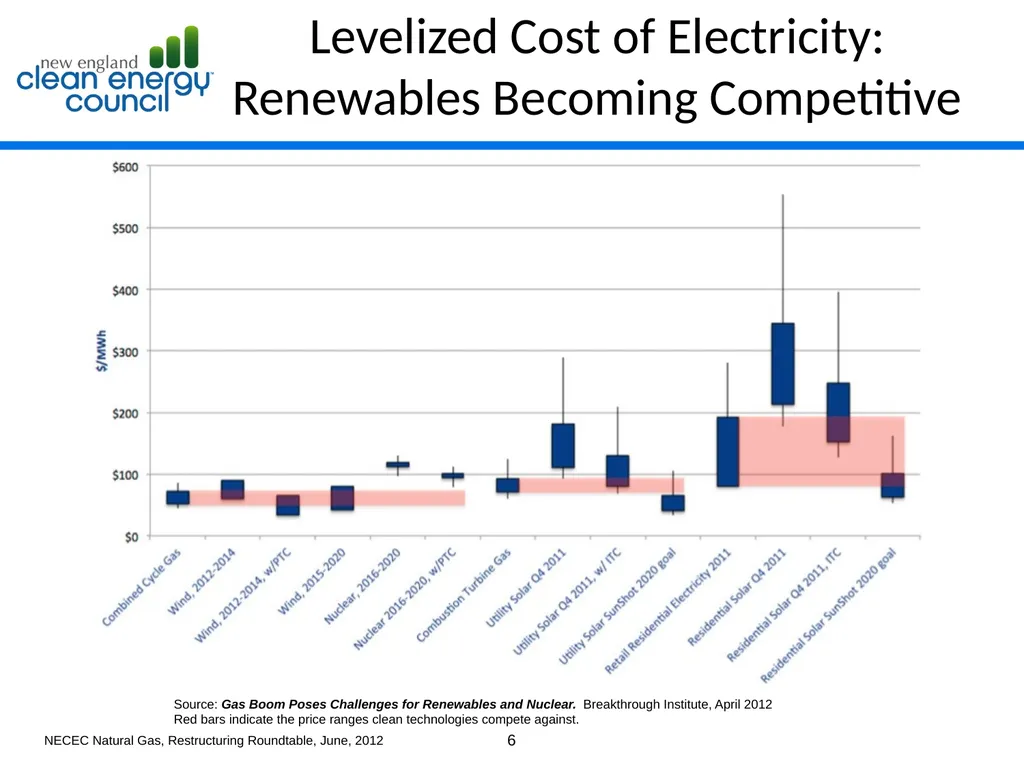
Levelized Cost of Electricity: Renewables Becoming Competitive Source: Gas Boom Poses Challenges for Renewables and Nuclear. Breakthrough Institute, April 2012
Red bars indicate the price ranges clean technologies compete against.<br>
07
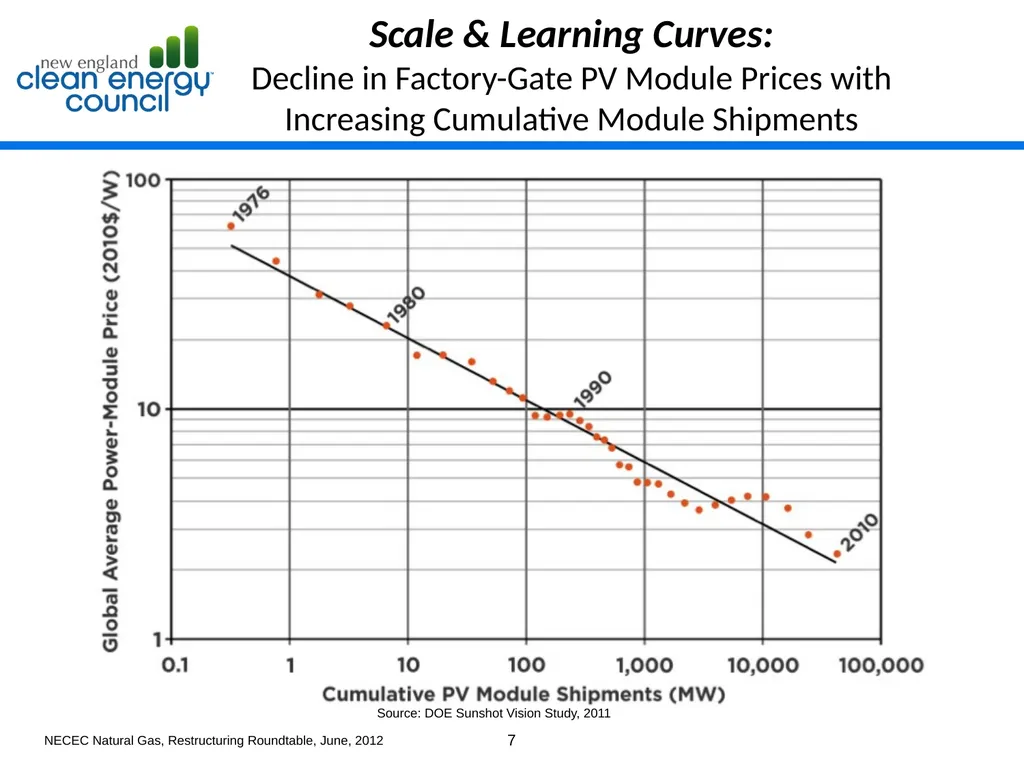
Scale & Learning Curves: Decline in Factory-Gate PV Module Prices with Increasing Cumulative Module Shipments Source: DOE Sunshot Vision Study, 2011<br>
08
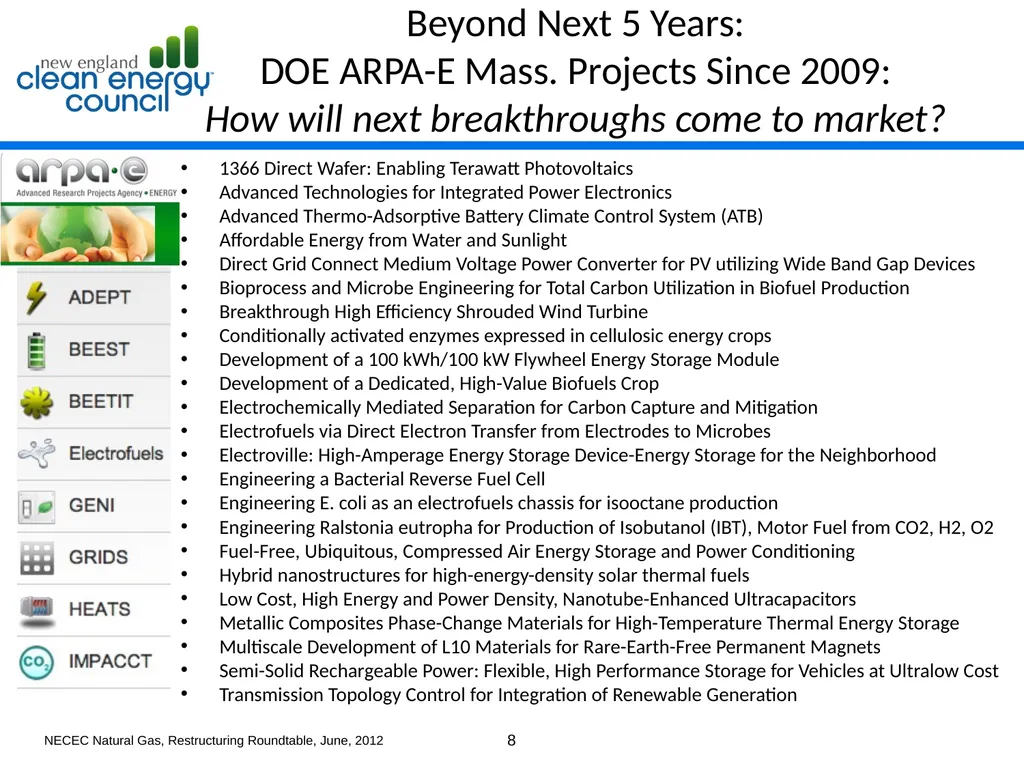
Beyond Next 5 Years: DOE ARPA-E Mass. Projects Since 2009: How will next breakthroughs come to market? 1366 Direct Wafer: Enabling Terawatt Photovoltaics
Advanced Technologies for Integrated Power Electronics
Advanced Thermo-Adsorptive Battery Climate Control System (ATB)
Affordable Energy from Water and Sunlight
Direct Grid Connect Medium Voltage Power Converter for PV utilizing Wide Band Gap Devices
Bioprocess and Microbe Engineering for Total Carbon Utilization in Biofuel Production
Breakthrough High Efficiency Shrouded Wind Turbine
Conditionally activated enzymes expressed in cellulosic energy crops
Development of a 100 kWh/100 kW Flywheel Energy Storage Module
Development of a Dedicated, High-Value Biofuels Crop
Electrochemically Mediated Separation for Carbon Capture and Mitigation
Electrofuels via Direct Electron Transfer from Electrodes to Microbes
Electroville: High-Amperage Energy Storage Device-Energy Storage for the Neighborhood
Engineering a Bacterial Reverse Fuel Cell
Engineering E. coli as an electrofuels chassis for isooctane production
Engineering Ralstonia eutropha for Production of Isobutanol (IBT), Motor Fuel from CO2, H2, O2
Fuel-Free, Ubiquitous, Compressed Air Energy Storage and Power Conditioning
Hybrid nanostructures for high-energy-density solar thermal fuels
Low Cost, High Energy and Power Density, Nanotube-Enhanced Ultracapacitors
Metallic Composites Phase-Change Materials for High-Temperature Thermal Energy Storage
Multiscale Development of L10 Materials for Rare-Earth-Free Permanent Magnets
Semi-Solid Rechargeable Power: Flexible, High Performance Storage for Vehicles at Ultralow Cost
Transmission Topology Control for Integration of Renewable Generation<br>
09
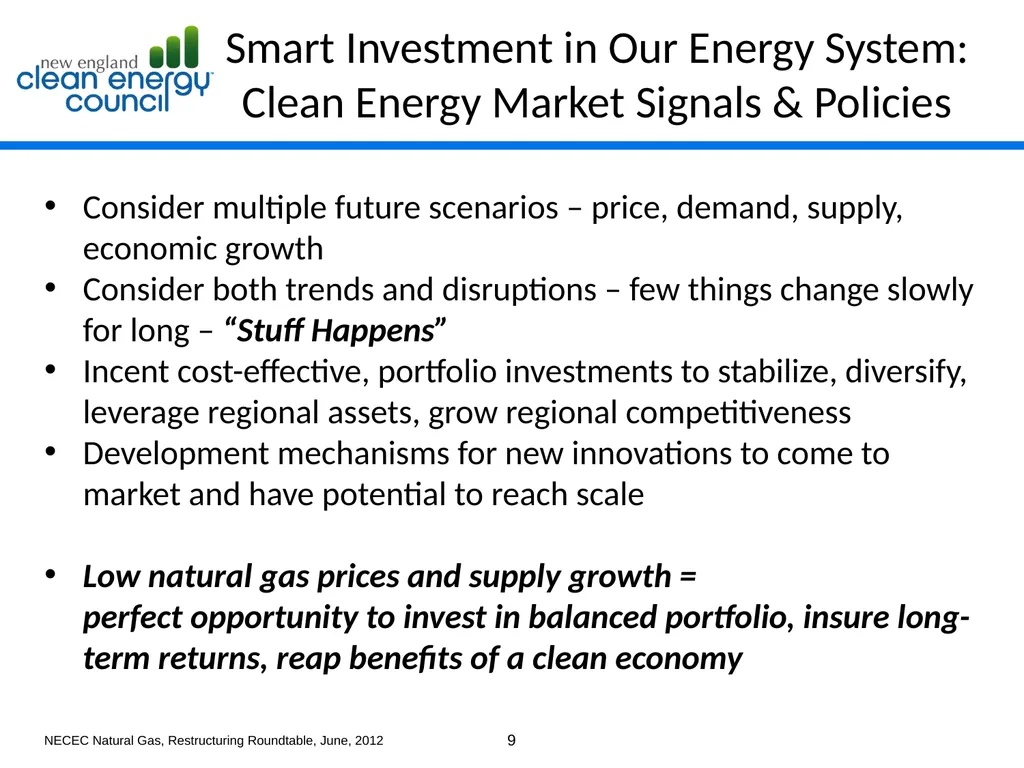
Smart Investment in Our Energy System: Clean Energy Market Signals & Policies Consider multiple future scenarios – price, demand, supply, economic growth
Consider both trends and disruptions – few things change slowly for long – “Stuff Happens”
Incent cost-effective, portfolio investments to stabilize, diversify, leverage regional assets, grow regional competitiveness
Development mechanisms for new innovations to come to market and have potential to reach scale
Low natural gas prices and supply growth = perfect opportunity to invest in balanced portfolio, insure long-term returns, reap benefits of a clean economy<br>