Background There is a significant amount of litera
Description: Background There is a significant amount of literature which makes claims, or provides some evidence for, the impact of nature on mental health and well-being (Keniger et al. 2013; Nisbet et al. 2011). Subjective nature connectedness is a s
Related Topics
Download Presentation
"Background There is a significant amount of litera" is the property of its rightful owner. Permission is granted to download and print the materials on this website for personal, non-commercial use only, and to display it on your personal computer provided you do not modify the materials and that you retain all copyright notices contained in the materials. By downloading content from our website, you accept the terms of this agreement.
Presentation Transcript
slide1. Background
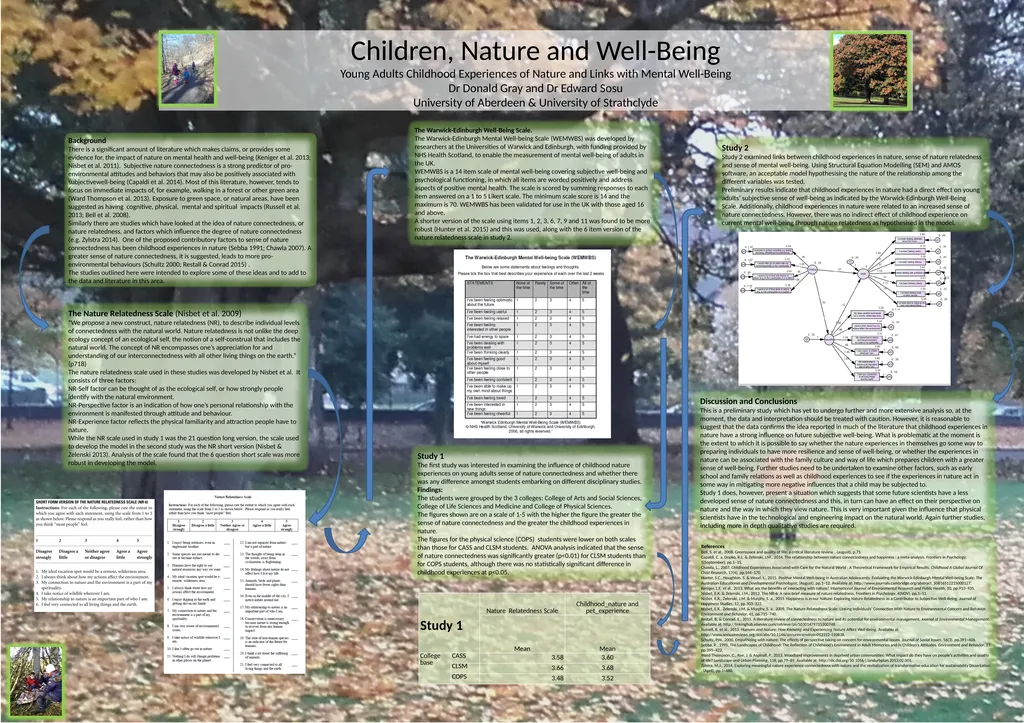
There is a significant amount of literature which makes claims, or provides some evidence for, the impact of nature on mental health and well-being (Keniger et al. 2013; Nisbet et al. 2011). Subjective nature connectedness is a strong predictor of pro-environmental attitudes and behaviors that may also be positively associated with subjectivewell-being (Capaldi et al. 2014). Most of this literature, however, tends to focus on immediate impacts of, for example, walking in a forest or other green area (Ward Thompson et al. 2013). Exposure to green space, or natural areas, have been suggested as having cognitive, physical, mental and spiritual impacts (Russell et al. 2013; Bell et al. 2008).
Similarly there are studies which have looked at the idea of nature connectedness, or nature relatedness, and factors which influence the degree of nature connectedness (e.g. Zylstra 2014). One of the proposed contributory factors to sense of nature connectedness has been childhood experiences in nature (Sebba 1991; Chawla 2007). A greater sense of nature connectedness, it is suggested, leads to more pro-environmental behaviours (Schultz 2000; Restall & Conrad 2015) .
The studies outlined here were intended to explore some of these ideas and to add to the data and literature in this area. The Nature Relatedness Scale (Nisbet et al. 2009)
“We propose a new construct, nature relatedness (NR), to describe individual levels of connectedness with the natural world. Nature relatedness is not unlike the deep ecology concept of an ecological self, the notion of a self-construal that includes the natural world. The concept of NR encompasses one’s appreciation for and understanding of our interconnectedness with all other living things on the earth.” (p718)
The nature relatedness scale used in these studies was developed by Nisbet et al. It consists of three factors:
NR-Self factor can be thought of as the ecological self, or how strongly people identify with the natural environment.
NR-Perspective factor is an indication of how one’s personal relationship with the environment is manifested through attitude and behaviour.
NR-Experience factor reflects the physical familiarity and attraction people have to nature.
While the NR scale used in study 1 was the 21 question long version, the scale used to develop the model in the second study was the NR short version (Nisbet & Zelenski 2013). Analysis of the scale found that the 6 question short scale was more robust in developing the model. Study 1
The first study was interested in examining the influence of childhood nature experiences on young adults sense of nature connectedness and whether there was any difference amongst students embarking on different disciplinary studies.
Findings:
The students were grouped by the 3 colleges: College of Arts and Social Sciences, College of Life Sciences and Medicine and College of Physical Sciences.
The figures shown are on a scale of 1-5 with the higher the figure the greater the sense of nature connectedness and the greater the childhood experiences in nature.
The figures for the physical science (COPS) students were lower on both scales than those for CASS and CLSM students. ANOVA analysis indicated that the sense of nature connectedness was significantly greater (p<0.01) for CLSM students than for COPS students, although there was no statistically significant difference in childhood experiences at p<0.05. Study 2
Study 2 examined links between childhood experiences in nature, sense of nature relatedness and sense of mental well-being. Using Structural Equation Modelling (SEM) and AMOS software, an acceptable model hypothesising the nature of the relationship among the different variables was tested.
Preliminary results indicate that childhood experiences in nature had a direct effect on young adults’ subjective sense of well-being as indicated by the Warwick-Edinburgh Well-Being Scale. Additionally, childhood experiences in nature were related to an increased sense of nature connectedness. However, there was no indirect effect of childhood experience on current mental well-being through nature relatedness as hypothesised in the model. Children, Nature and Well-Being
Young Adults Childhood Experiences of Nature and Links with Mental Well-Being
Dr Donald Gray and Dr Edward Sosu
University of Aberdeen & University of Strathclyde Discussion and Conclusions
This is a preliminary study which has yet to undergo further and more extensive analysis so, at the moment, the data and interpretation should be treated with caution. However, it is reasonable to suggest that the data confirms the idea reported in much of the literature that childhood experiences in nature have a strong influence on future subjective well-being. What is problematic at the moment is the extent to which it is possible to say whether the nature experiences in themselves go some way to preparing individuals to have more resilience and sense of well-being, or whether the experiences in nature can be associated with the family culture and way of life which prepares children with a greater sense of well-being. Further studies need to be undertaken to examine other factors, such as early school and family relations as well as childhood experiences to see if the experiences in nature act in some way in mitigating more negative influences that a child may be subjected to.
Study 1 does, however, present a situation which suggests that some future scientists have a less developed sense of nature connectedness and this, in turn can have an effect on their perspective on nature and the way in which they view nature. This is very important given the influence that physical scientists have in the technological and engineering impact on the natural world. Again further studies, including more in depth qualitative studies are required. The Warwick-Edinburgh Well-Being Scale.
The Warwick-Edinburgh Mental Well-being Scale (WEMWBS) was developed by researchers at the Universities of Warwick and Edinburgh, with funding provided by NHS Health Scotland, to enable the measurement of mental well-being of adults in the UK.
WEMWBS is a 14 item scale of mental well-being covering subjective well-being and psychological functioning, in which all items are worded positively and address aspects of positive mental health. The scale is scored by summing responses to each item answered on a 1 to 5 Likert scale. The minimum scale score is 14 and the maximum is 70. WEMWBS has been validated for use in the UK with those aged 16 and above.
A shorter version of the scale using items 1, 2, 3, 6, 7, 9 and 11 was found to be more robust (Hunter et al. 2015) and this was used, along with the 6 item version of the nature relatedness scale in study 2. References
Bell, S. et al., 2008. Greenspace and quality of life: a critical literature review. , (august), p.75.
Capaldi, C. a, Dopko, R.L. & Zelenski, J.M., 2014. The relationship between nature connectedness and happiness : a meta-analysis. Frontiers in Psychology, 5(September), pp.1–15.
Chawla, L., 2007. Childhood Experiences Associated with Care for the Natural World : A Theoretical Framework for Empirical Results. Childhood A Global Journal Of Child Research, 17(4), pp.144–170.
Hunter, S.C., Houghton, S. & Wood, L., 2015. Positive Mental Well-being in Australian Adolescents: Evaluating the Warwick-Edinburgh Mental Well-being Scale. The Australian Educational and Developmental Psychologist, (August), pp.1–12. Available at: http://www.journals.cambridge.org/abstract_S0816512215000127.
Keniger, L.E. et al., 2013. What are the benefits of interacting with nature? International Journal of Environmental Research and Public Health, 10, pp.913–935.
Nisbet, E.K. & Zelenski, J.M., 2013. The NR-6: A new brief measure of nature relatedness. Frontiers in Psychology, 4(NOV), pp.1–11.
Nisbet, E.K., Zelenski, J.M. & Murphy, S. a., 2011. Happiness is in our Nature: Exploring Nature Relatedness as a Contributor to Subjective Well-Being. Journal of Happiness Studies, 12, pp.303–322.
Nisbet, E.K., Zelenski, J.M. & Murphy, S. a., 2009. The Nature Relatedness Scale: Linking Individuals’ Connection With Nature to Environmental Concern and Behavior. Environment and Behavior, 41, pp.715–740.
Restall, B. & Conrad, E., 2015. A literature review of connectedness to nature and its potential for environmental management. Journal of Environmental Management. Available at: http://linkinghub.elsevier.com/retrieve/pii/S0301479715300748.
Russell, R. et al., 2013. Humans and Nature: How Knowing and Experiencing Nature Affect Well-Being, Available at: http://www.annualreviews.org/doi/abs/10.1146/annurev-environ-012312-110838.
Schultz, P.W., 2000. Empathizing with nature: The effects of perspective taking on concern for environmental issues. Journal of Social Issues, 56(3), pp.391–406.
Sebba, R., 1991. The Landscapes of Childhood: The Reflection of Childhood’s Environment in Adult Memories and in Children's Attitudes. Environment and Behavior, 23, pp.395–422.
Ward Thompson, C., Roe, J. & Aspinall, P., 2013. Woodland improvements in deprived urban communities: What impact do they have on people’s activities and quality of life? Landscape and Urban Planning, 118, pp.79–89. Available at: http://dx.doi.org/10.1016/j.landurbplan.2013.02.001.
Zylstra, M.J., 2014. Exploring meaningful nature experience connectedness with nature and the revitalization of transformative education for sustainability Dissertation. , (April), pp.1–688.<br>
There is a significant amount of literature which makes claims, or provides some evidence for, the impact of nature on mental health and well-being (Keniger et al. 2013; Nisbet et al. 2011). Subjective nature connectedness is a strong predictor of pro-environmental attitudes and behaviors that may also be positively associated with subjectivewell-being (Capaldi et al. 2014). Most of this literature, however, tends to focus on immediate impacts of, for example, walking in a forest or other green area (Ward Thompson et al. 2013). Exposure to green space, or natural areas, have been suggested as having cognitive, physical, mental and spiritual impacts (Russell et al. 2013; Bell et al. 2008).
Similarly there are studies which have looked at the idea of nature connectedness, or nature relatedness, and factors which influence the degree of nature connectedness (e.g. Zylstra 2014). One of the proposed contributory factors to sense of nature connectedness has been childhood experiences in nature (Sebba 1991; Chawla 2007). A greater sense of nature connectedness, it is suggested, leads to more pro-environmental behaviours (Schultz 2000; Restall & Conrad 2015) .
The studies outlined here were intended to explore some of these ideas and to add to the data and literature in this area. The Nature Relatedness Scale (Nisbet et al. 2009)
“We propose a new construct, nature relatedness (NR), to describe individual levels of connectedness with the natural world. Nature relatedness is not unlike the deep ecology concept of an ecological self, the notion of a self-construal that includes the natural world. The concept of NR encompasses one’s appreciation for and understanding of our interconnectedness with all other living things on the earth.” (p718)
The nature relatedness scale used in these studies was developed by Nisbet et al. It consists of three factors:
NR-Self factor can be thought of as the ecological self, or how strongly people identify with the natural environment.
NR-Perspective factor is an indication of how one’s personal relationship with the environment is manifested through attitude and behaviour.
NR-Experience factor reflects the physical familiarity and attraction people have to nature.
While the NR scale used in study 1 was the 21 question long version, the scale used to develop the model in the second study was the NR short version (Nisbet & Zelenski 2013). Analysis of the scale found that the 6 question short scale was more robust in developing the model. Study 1
The first study was interested in examining the influence of childhood nature experiences on young adults sense of nature connectedness and whether there was any difference amongst students embarking on different disciplinary studies.
Findings:
The students were grouped by the 3 colleges: College of Arts and Social Sciences, College of Life Sciences and Medicine and College of Physical Sciences.
The figures shown are on a scale of 1-5 with the higher the figure the greater the sense of nature connectedness and the greater the childhood experiences in nature.
The figures for the physical science (COPS) students were lower on both scales than those for CASS and CLSM students. ANOVA analysis indicated that the sense of nature connectedness was significantly greater (p<0.01) for CLSM students than for COPS students, although there was no statistically significant difference in childhood experiences at p<0.05. Study 2
Study 2 examined links between childhood experiences in nature, sense of nature relatedness and sense of mental well-being. Using Structural Equation Modelling (SEM) and AMOS software, an acceptable model hypothesising the nature of the relationship among the different variables was tested.
Preliminary results indicate that childhood experiences in nature had a direct effect on young adults’ subjective sense of well-being as indicated by the Warwick-Edinburgh Well-Being Scale. Additionally, childhood experiences in nature were related to an increased sense of nature connectedness. However, there was no indirect effect of childhood experience on current mental well-being through nature relatedness as hypothesised in the model. Children, Nature and Well-Being
Young Adults Childhood Experiences of Nature and Links with Mental Well-Being
Dr Donald Gray and Dr Edward Sosu
University of Aberdeen & University of Strathclyde Discussion and Conclusions
This is a preliminary study which has yet to undergo further and more extensive analysis so, at the moment, the data and interpretation should be treated with caution. However, it is reasonable to suggest that the data confirms the idea reported in much of the literature that childhood experiences in nature have a strong influence on future subjective well-being. What is problematic at the moment is the extent to which it is possible to say whether the nature experiences in themselves go some way to preparing individuals to have more resilience and sense of well-being, or whether the experiences in nature can be associated with the family culture and way of life which prepares children with a greater sense of well-being. Further studies need to be undertaken to examine other factors, such as early school and family relations as well as childhood experiences to see if the experiences in nature act in some way in mitigating more negative influences that a child may be subjected to.
Study 1 does, however, present a situation which suggests that some future scientists have a less developed sense of nature connectedness and this, in turn can have an effect on their perspective on nature and the way in which they view nature. This is very important given the influence that physical scientists have in the technological and engineering impact on the natural world. Again further studies, including more in depth qualitative studies are required. The Warwick-Edinburgh Well-Being Scale.
The Warwick-Edinburgh Mental Well-being Scale (WEMWBS) was developed by researchers at the Universities of Warwick and Edinburgh, with funding provided by NHS Health Scotland, to enable the measurement of mental well-being of adults in the UK.
WEMWBS is a 14 item scale of mental well-being covering subjective well-being and psychological functioning, in which all items are worded positively and address aspects of positive mental health. The scale is scored by summing responses to each item answered on a 1 to 5 Likert scale. The minimum scale score is 14 and the maximum is 70. WEMWBS has been validated for use in the UK with those aged 16 and above.
A shorter version of the scale using items 1, 2, 3, 6, 7, 9 and 11 was found to be more robust (Hunter et al. 2015) and this was used, along with the 6 item version of the nature relatedness scale in study 2. References
Bell, S. et al., 2008. Greenspace and quality of life: a critical literature review. , (august), p.75.
Capaldi, C. a, Dopko, R.L. & Zelenski, J.M., 2014. The relationship between nature connectedness and happiness : a meta-analysis. Frontiers in Psychology, 5(September), pp.1–15.
Chawla, L., 2007. Childhood Experiences Associated with Care for the Natural World : A Theoretical Framework for Empirical Results. Childhood A Global Journal Of Child Research, 17(4), pp.144–170.
Hunter, S.C., Houghton, S. & Wood, L., 2015. Positive Mental Well-being in Australian Adolescents: Evaluating the Warwick-Edinburgh Mental Well-being Scale. The Australian Educational and Developmental Psychologist, (August), pp.1–12. Available at: http://www.journals.cambridge.org/abstract_S0816512215000127.
Keniger, L.E. et al., 2013. What are the benefits of interacting with nature? International Journal of Environmental Research and Public Health, 10, pp.913–935.
Nisbet, E.K. & Zelenski, J.M., 2013. The NR-6: A new brief measure of nature relatedness. Frontiers in Psychology, 4(NOV), pp.1–11.
Nisbet, E.K., Zelenski, J.M. & Murphy, S. a., 2011. Happiness is in our Nature: Exploring Nature Relatedness as a Contributor to Subjective Well-Being. Journal of Happiness Studies, 12, pp.303–322.
Nisbet, E.K., Zelenski, J.M. & Murphy, S. a., 2009. The Nature Relatedness Scale: Linking Individuals’ Connection With Nature to Environmental Concern and Behavior. Environment and Behavior, 41, pp.715–740.
Restall, B. & Conrad, E., 2015. A literature review of connectedness to nature and its potential for environmental management. Journal of Environmental Management. Available at: http://linkinghub.elsevier.com/retrieve/pii/S0301479715300748.
Russell, R. et al., 2013. Humans and Nature: How Knowing and Experiencing Nature Affect Well-Being, Available at: http://www.annualreviews.org/doi/abs/10.1146/annurev-environ-012312-110838.
Schultz, P.W., 2000. Empathizing with nature: The effects of perspective taking on concern for environmental issues. Journal of Social Issues, 56(3), pp.391–406.
Sebba, R., 1991. The Landscapes of Childhood: The Reflection of Childhood’s Environment in Adult Memories and in Children's Attitudes. Environment and Behavior, 23, pp.395–422.
Ward Thompson, C., Roe, J. & Aspinall, P., 2013. Woodland improvements in deprived urban communities: What impact do they have on people’s activities and quality of life? Landscape and Urban Planning, 118, pp.79–89. Available at: http://dx.doi.org/10.1016/j.landurbplan.2013.02.001.
Zylstra, M.J., 2014. Exploring meaningful nature experience connectedness with nature and the revitalization of transformative education for sustainability Dissertation. , (April), pp.1–688.<br>