
BASIC EDUCATION 2020/21-2024/25 STRATEGIC PLAN AND

Description: BASIC EDUCATION 202021-202425 STRATEGIC PLAN AND ANNUAL PERFORMANCE PLAN 202223 Portfolio Committee on Basic Education 15 March 2022 1 PRESENTATION OUTLINE Purpose Size and Shape of the Basic Education Sector Background Government
Related Topics
Download Presentation
"BASIC EDUCATION 2020/21-2024/25 STRATEGIC PLAN AND" is the property of its rightful owner. Permission is granted to download and print the materials on this website for personal, non-commercial use only, and to display it on your personal computer provided you do not modify the materials and that you retain all copyright notices contained in the materials. By downloading content from our website, you accept the terms of this agreement.
Presentation Transcript
slide1. BASIC EDUCATION 2020/21-2024/25 STRATEGIC PLAN AND ANNUAL PERFORMANCE PLAN 2022/23 Portfolio Committee on Basic Education
15 March 2022 1<br>
slide2. PRESENTATION OUTLINE Purpose
Size and Shape of the Basic Education Sector
Background
Government priorities
2019-2024 Medium-Term Strategic Framework (MTSF) and Education Sector Priorities
Action Plan to 2024: Towards the Realisation of Schooling 2030
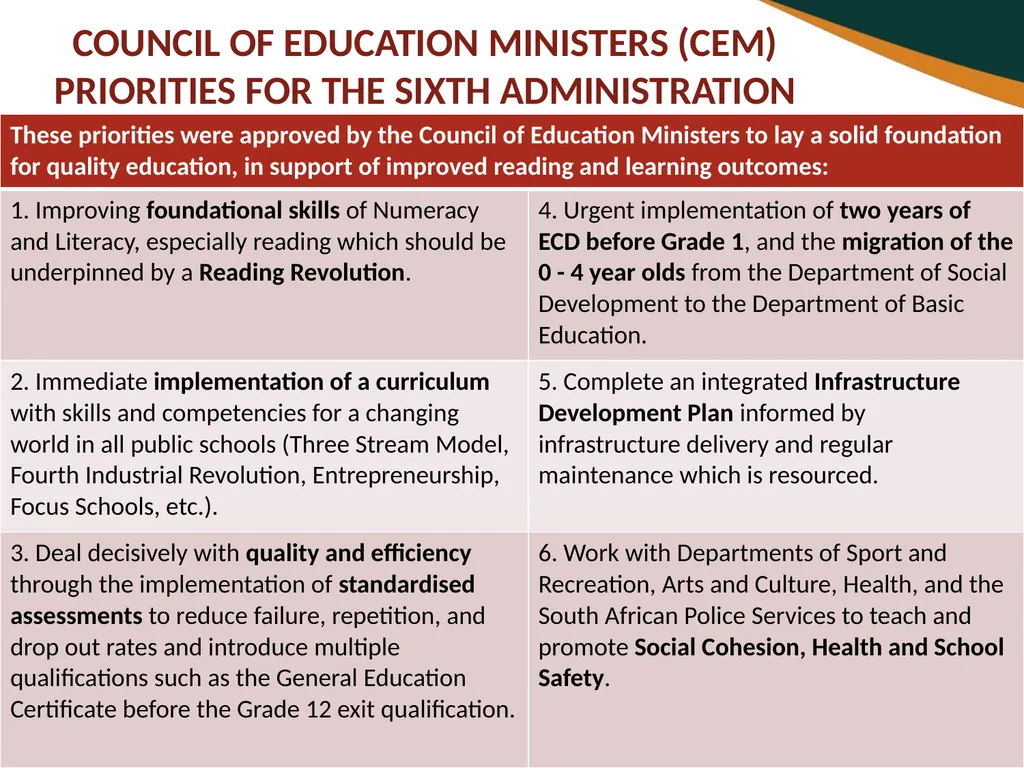
Council of Education Ministers (CEM) priorities
State of the Nation Address (SoNA) 2021/ 2022
Progress on selected deliverables (Including Infrastructure, Learning/Materials)
ECD Function Shift
Annual plans towards long term outcomes.
Linking MTSF outcomes to APP – approach and Strategic outcomes
The DBE APP 2022/23 development process
DBE SP 2020/21-2024/25
The DBE APP 2022/23
2022 Budget Allocation
Recommendation 2<br>
slide3. PURPOSE To present the Department of Basic Education (DBE) Annual Performance Plan (APP) 2022/23 to the Portfolio on Basic Education. 3<br>
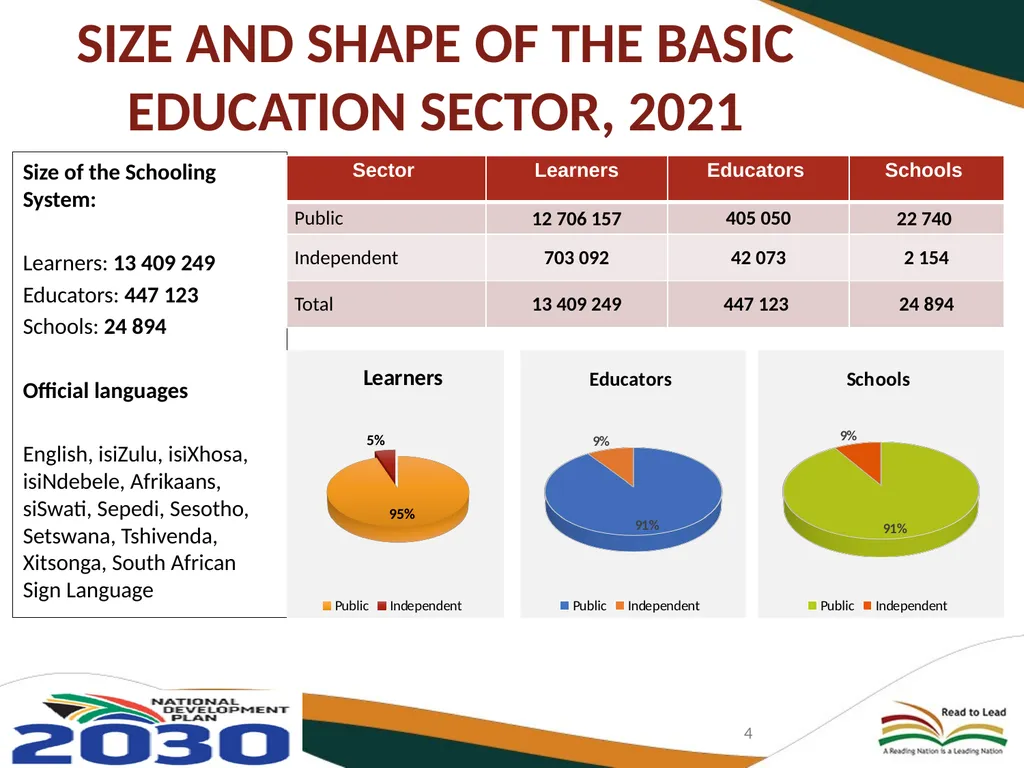
slide4. SIZE AND SHAPE OF THE BASIC EDUCATION SECTOR, 2021 Size of the Schooling System:
Learners: 13 409 249
Educators: 447 123
Schools: 24 894
Official languages
English, isiZulu, isiXhosa, isiNdebele, Afrikaans, siSwati, Sepedi, Sesotho, Setswana, Tshivenda, Xitsonga, South African Sign Language 4<br>
slide5. BACKGROUND The presentation outlines the approach to Government-wide NDP priorities and the Education sector priorities based on the NDP 2030, MTSF 2019-2024 and Action Plan to 2024. The intention is to ensure programme activities in the sector to align with medium and long- term goals.
The Strategic Plan 2020/21-2024/25 is anchored on the Government’s long-term plan; the National Development Plan 2030: Our future – make it work, the MTSF 2019-2024 and the Action Plan to 2024.
The Annual Performance Plan (APP) sets out what the Department intends doing in the financial year and during the Medium-Term Expenditure Framework (MTEF) period to implement its Strategic Plan.
In fulfilling its legal obligation, the Department must produce and table an APP annually to Parliament. The Strategic Plan should cover a period of at least five years and can be amended during the five-year period it covers.
The APP 2022/23 represents the third year activities towards achieving the objectives contained in the DBE Strategic Plan 2020/21-2024/25. 5<br>
slide6. LEARNING LOSSES Since its outbreak two years ago, the COVID-19 pandemic has disrupted education systems globally, affecting the most vulnerable learners the hardest.
It has increased inequalities and aggravated a pre-existing education crisis.
Enrolment in the first quarter of 2021 was around 50 000 (0.4%) lower than expected.
The problem concentrated in lower grades.
54% of contact time was lost in 2020 due to closures and rotations.
In the second half of 2021, 22% of contact was time lost due to rotations and
regular absenteeism.
These averages hide huge inequalities across grades and schools.
In historically disadvantaged schools, around 70% of a year’s worth of learning was lost in 2020.
For every day of schooling lost, around 1.3 days of learning are lost. 6<br>
slide7. KEY GOVERNMENT PRIORITIES The MTSF 2019–2024 translates the ruling party’s electoral mandate into government’s priorities over a five-year period. The Basic Education is critical in priority 2,3, 4 and 6:
Priority 1: A capable, ethical and developmental state.
Priority 2: Economic transformation and job creation.
Priority 3: Education, skills and health.
Priority 4: Consolidating the social wage through reliable and quality basic services.
Priority 5: Spatial integration, human settlements and local government.
Priority 6: Social cohesion and safe communities.
Priority 7: A better Africa and world. 7<br>
slide8. 2019-2024 MEDIUM-TERM STRATEGIC FRAMEWORK (MTSF) AND EDUCATION SECTOR PRIORITIES 8<br>
slide9. 2019 – 2024 MEDIUM TERM STRATEGIC FRAMEWORK (MTSF) OUTCOMES Outcome 1: Improved school-readiness of children.
Outcome 2: 10-year-old learners enrolled in publicly funded schools read for meaning.
Outcome 3: Youths better prepared for further studies and the world of work beyond Grade 9.
Outcome 4: Youths leaving the schooling system more prepared to contribute towards a prosperous and equitable South Africa.
Outcome 5: School physical infrastructure and environment that inspires learners to learn and teachers to teach. 9<br>
slide10. ACTION PLAN TO 2024: TOWARDS THE REALISATION OF SCHOOLING 2030 10<br>
slide11. ACTION PLAN TO 2024 The Action Plan to 2024: Towards the Realisation of Schooling 2030 is the sector plan for basic education.
It has been reviewed and strengthened for the 2020-2024 planning cycle.
The Action Plan is based on 27 national goals that are intended to improve basic education across all levels.
13 of these goals, are output goals, dealing with better school results and better enrolment of learners in schools.
The remaining 14 goals deal with things that must happen for the output goals to be realised. 11<br>
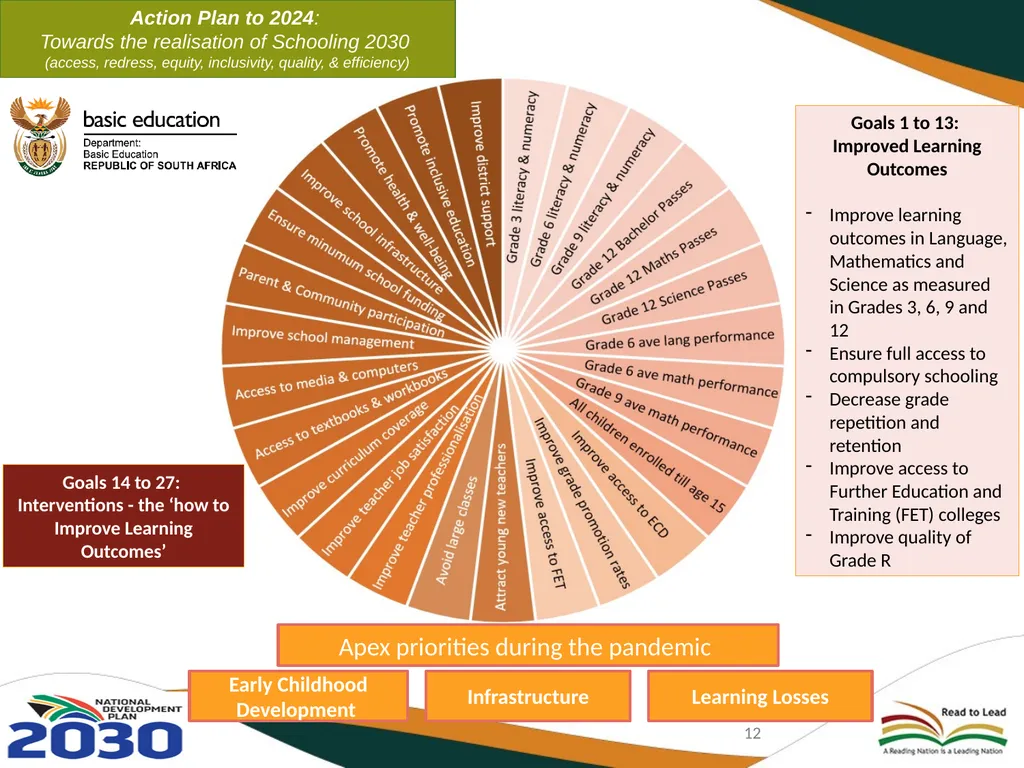
slide12. Action Plan to 2024:
Towards the realisation of Schooling 2030
(access, redress, equity, inclusivity, quality, & efficiency) Goals 1 to 13:
Improved Learning Outcomes
Improve learning outcomes in Language, Mathematics and Science as measured in Grades 3, 6, 9 and 12
Ensure full access to compulsory schooling
Decrease grade repetition and retention
Improve access to Further Education and Training (FET) colleges
Improve quality of Grade R Goals 14 to 27:
Interventions - the ‘how to Improve Learning Outcomes’ Apex priorities during the pandemic Early Childhood Development Infrastructure Learning Losses 12<br>
slide13. COUNCIL OF EDUCATION MINISTERS (CEM) PRIORITIES FOR THE SIXTH ADMINISTRATION 13<br>
slide14. STATE OF THE NATION ADDRESS (SoNA) 14<br>
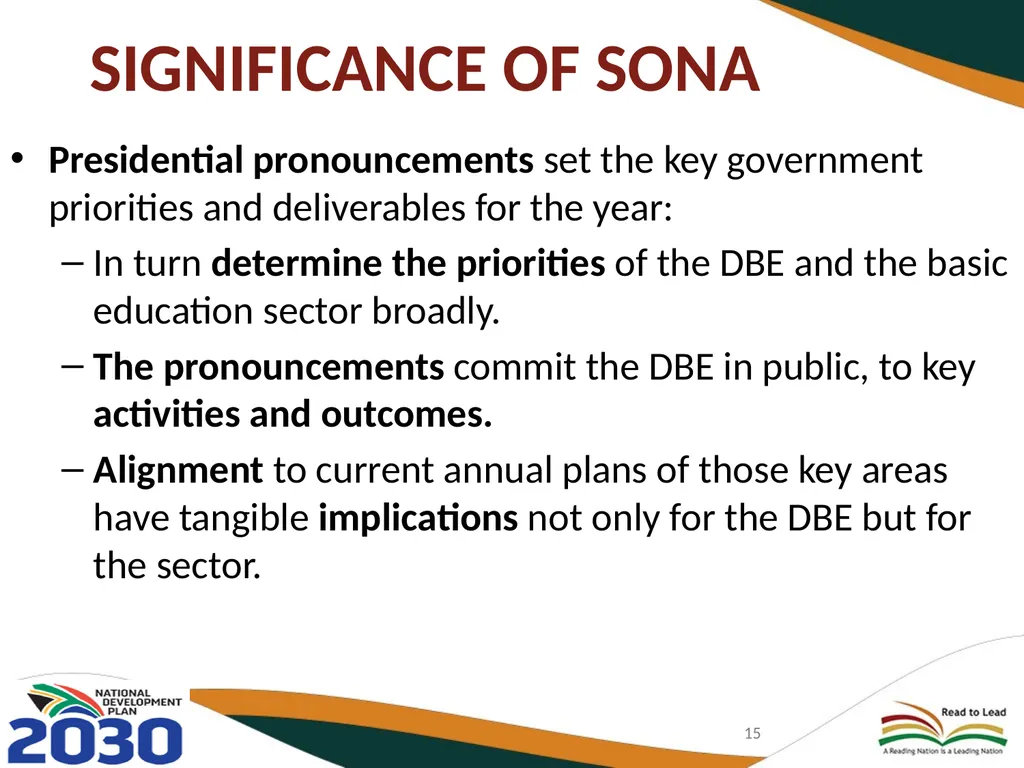
slide15. SIGNIFICANCE OF SONA Presidential pronouncements set the key government priorities and deliverables for the year:
In turn determine the priorities of the DBE and the basic education sector broadly.
The pronouncements commit the DBE in public, to key activities and outcomes.
Alignment to current annual plans of those key areas have tangible implications not only for the DBE but for the sector. 15<br>
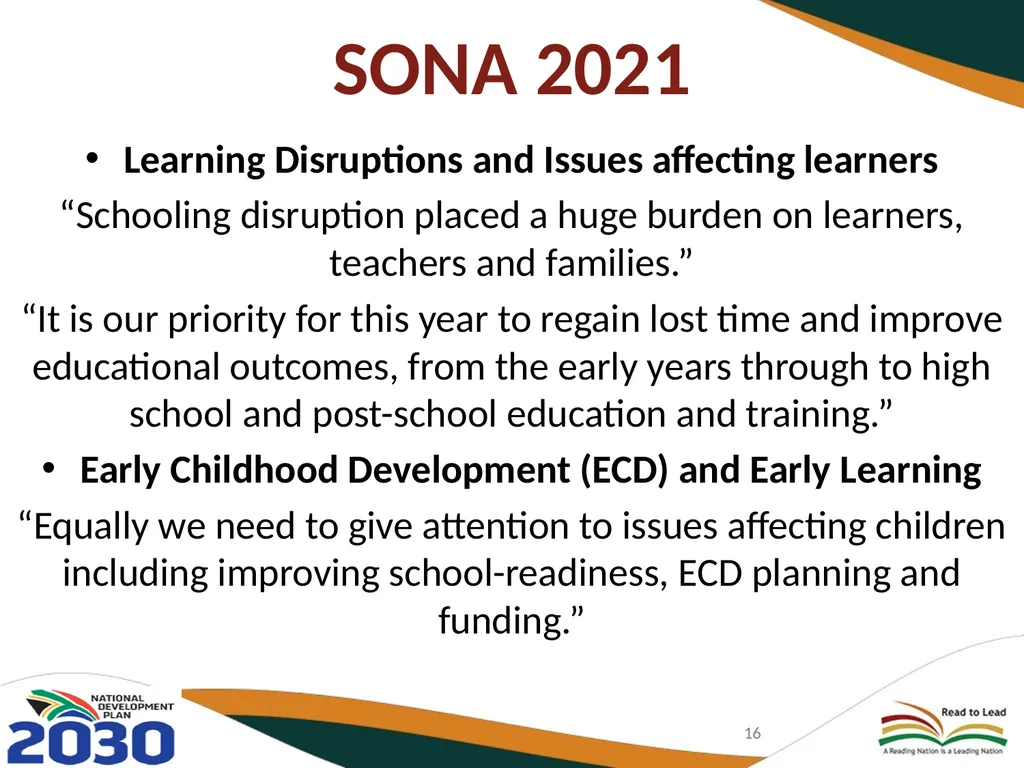
slide16. SONA 2021 Learning Disruptions and Issues affecting learners
“Schooling disruption placed a huge burden on learners, teachers and families.”
“It is our priority for this year to regain lost time and improve educational outcomes, from the early years through to high school and post-school education and training.”
Early Childhood Development (ECD) and Early Learning
“Equally we need to give attention to issues affecting children including improving school-readiness, ECD planning and funding.” 16<br>
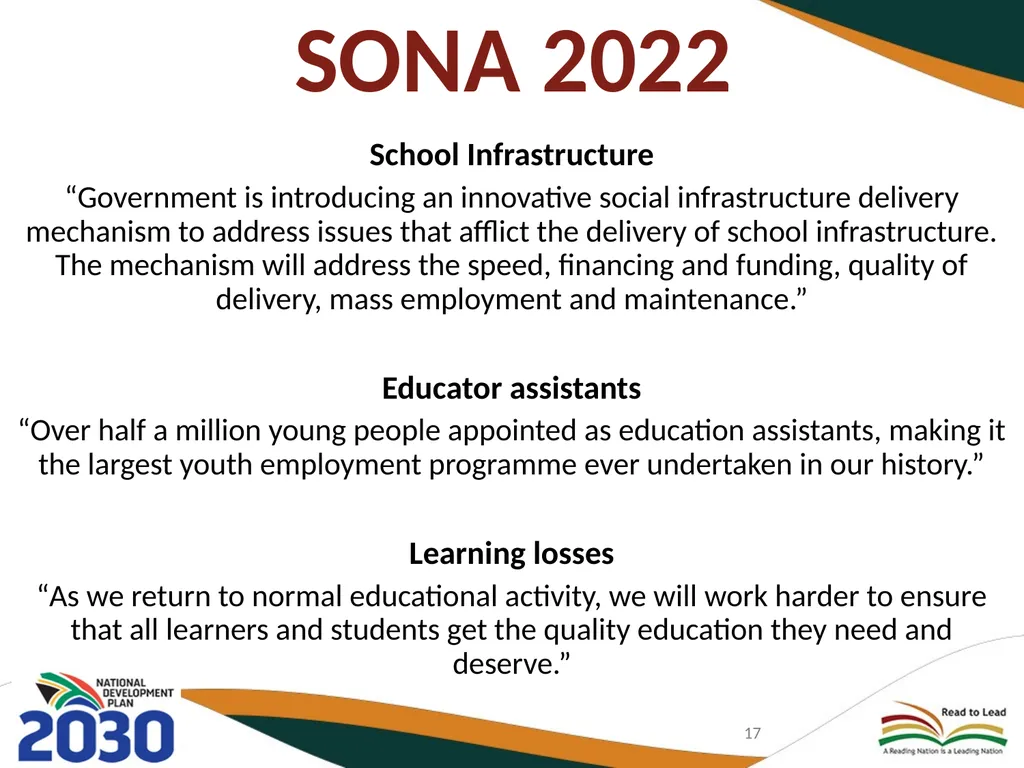
slide17. SONA 2022 School Infrastructure
“Government is introducing an innovative social infrastructure delivery mechanism to address issues that afflict the delivery of school infrastructure. The mechanism will address the speed, financing and funding, quality of delivery, mass employment and maintenance.”
Educator assistants
“Over half a million young people appointed as education assistants, making it the largest youth employment programme ever undertaken in our history.”
Learning losses
“As we return to normal educational activity, we will work harder to ensure that all learners and students get the quality education they need and deserve.” 17<br>
slide18. PROGRESS ON SELECTED KEY DELIVERABLES 18<br>
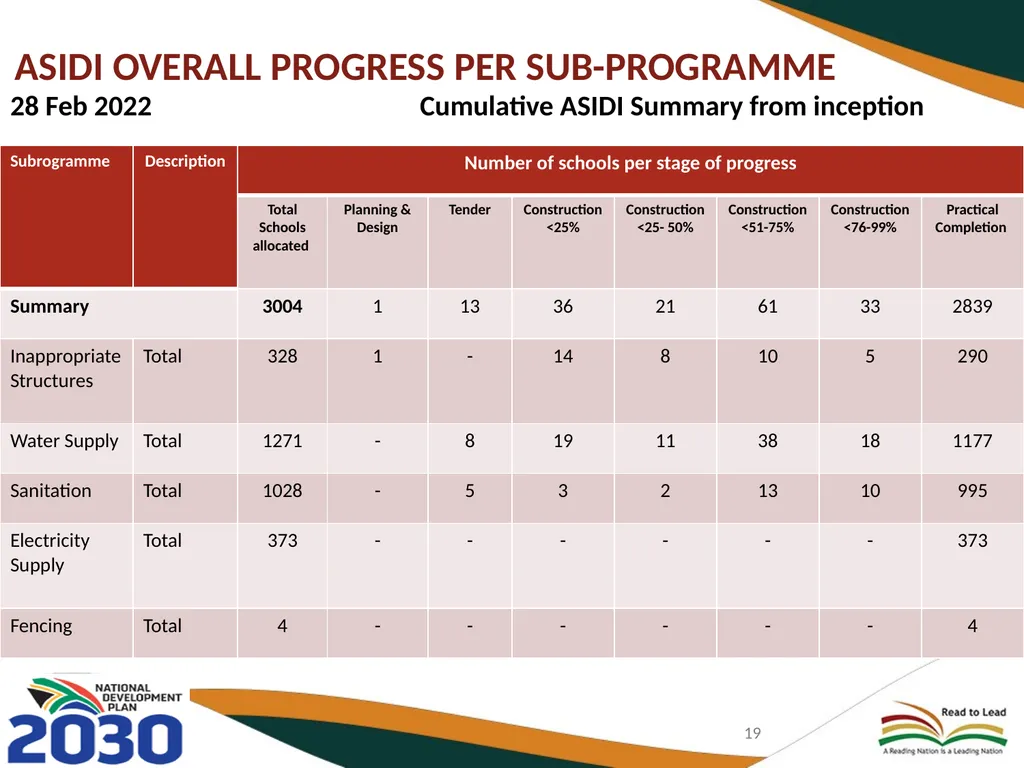
slide19. ASIDI OVERALL PROGRESS PER SUB-PROGRAMME 28 Feb 2022 Cumulative ASIDI Summary from inception 19<br>
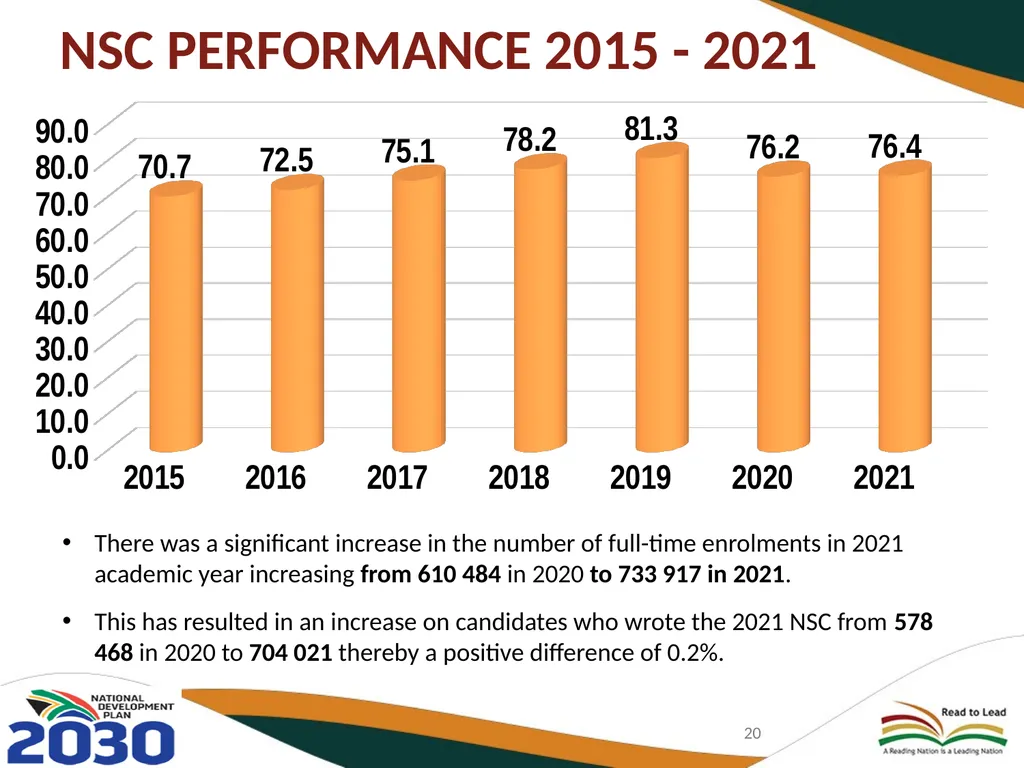
slide20. NSC PERFORMANCE 2015 - 2021 There was a significant increase in the number of full-time enrolments in 2021 academic year increasing from 610 484 in 2020 to 733 917 in 2021.
This has resulted in an increase on candidates who wrote the 2021 NSC from 578 468 in 2020 to 704 021 thereby a positive difference of 0.2%. 20<br>
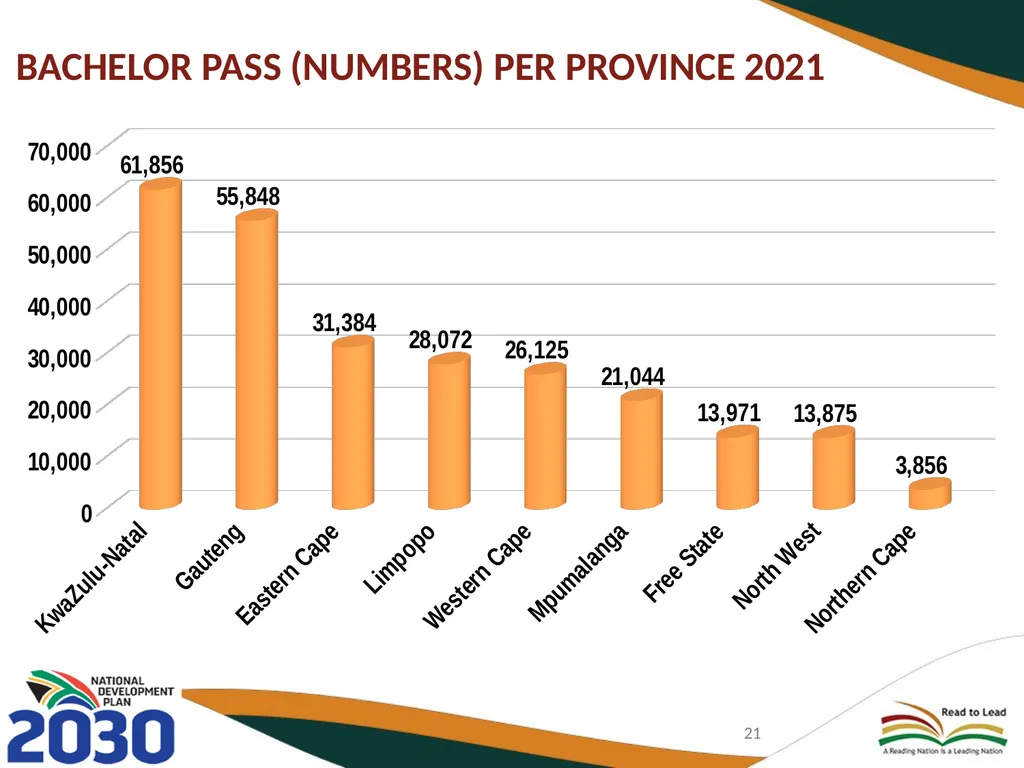
slide21. BACHELOR PASS (NUMBERS) PER PROVINCE 2021 21<br>
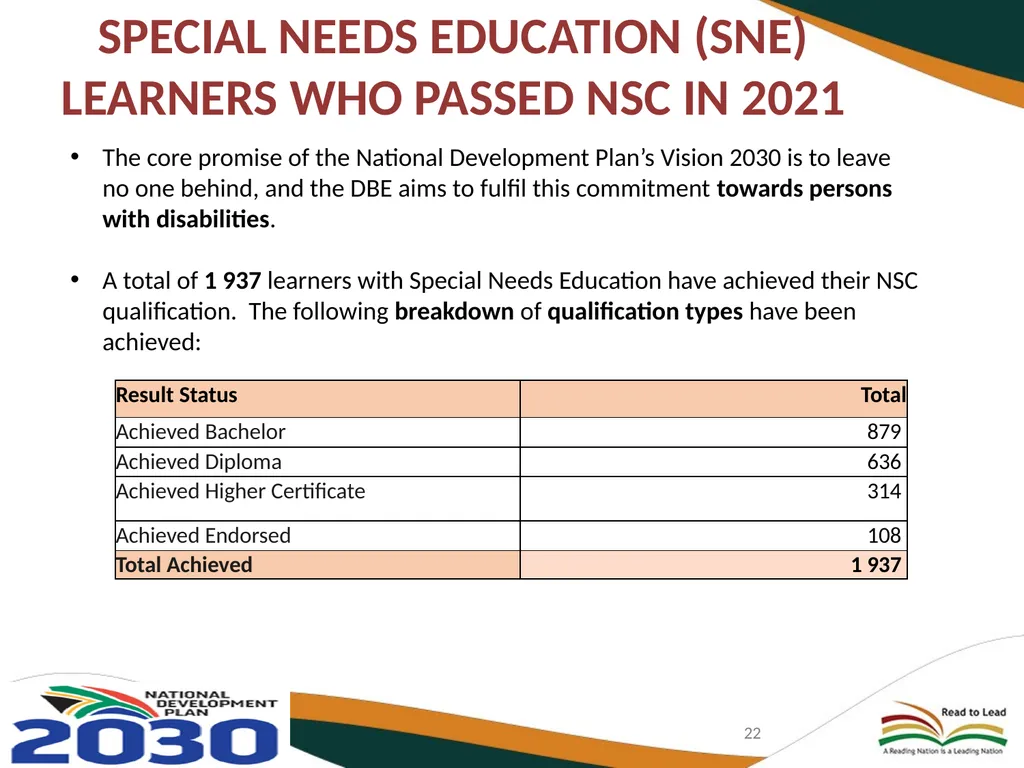
slide22. SPECIAL NEEDS EDUCATION (SNE) LEARNERS WHO PASSED NSC IN 2021 The core promise of the National Development Plan’s Vision 2030 is to leave no one behind, and the DBE aims to fulfil this commitment towards persons with disabilities.
A total of 1 937 learners with Special Needs Education have achieved their NSC qualification. The following breakdown of qualification types have been achieved: 22<br>
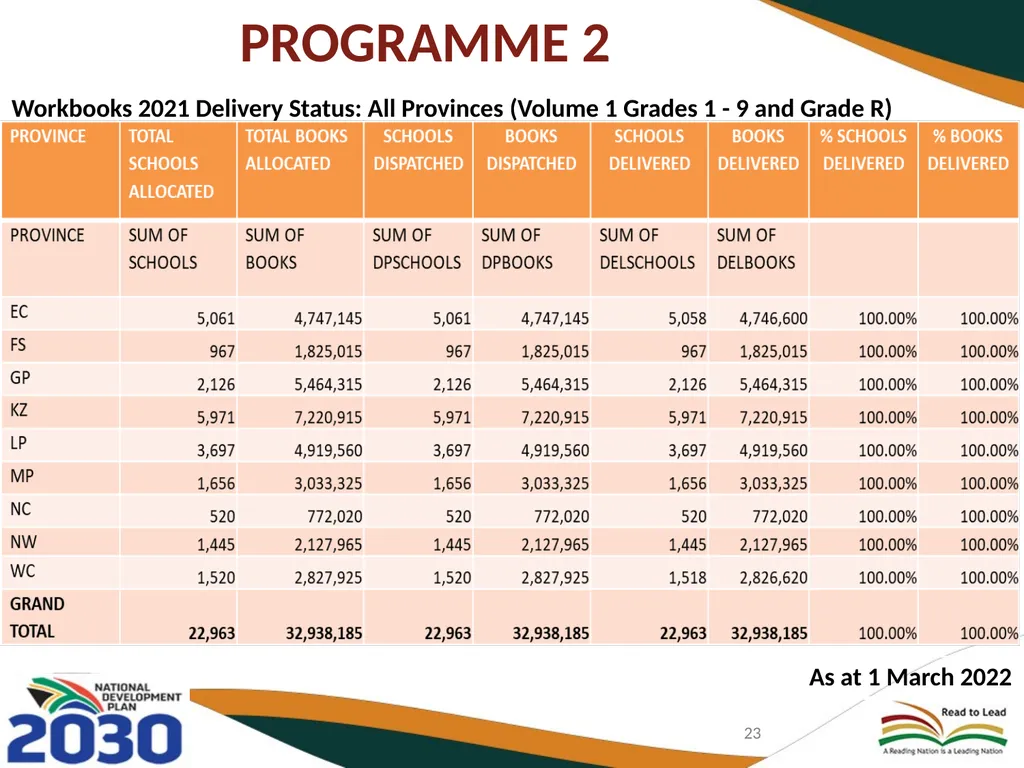
slide23. PROGRAMME 2 Workbooks 2021 Delivery Status: All Provinces (Volume 1 Grades 1 - 9 and Grade R) 23<br>
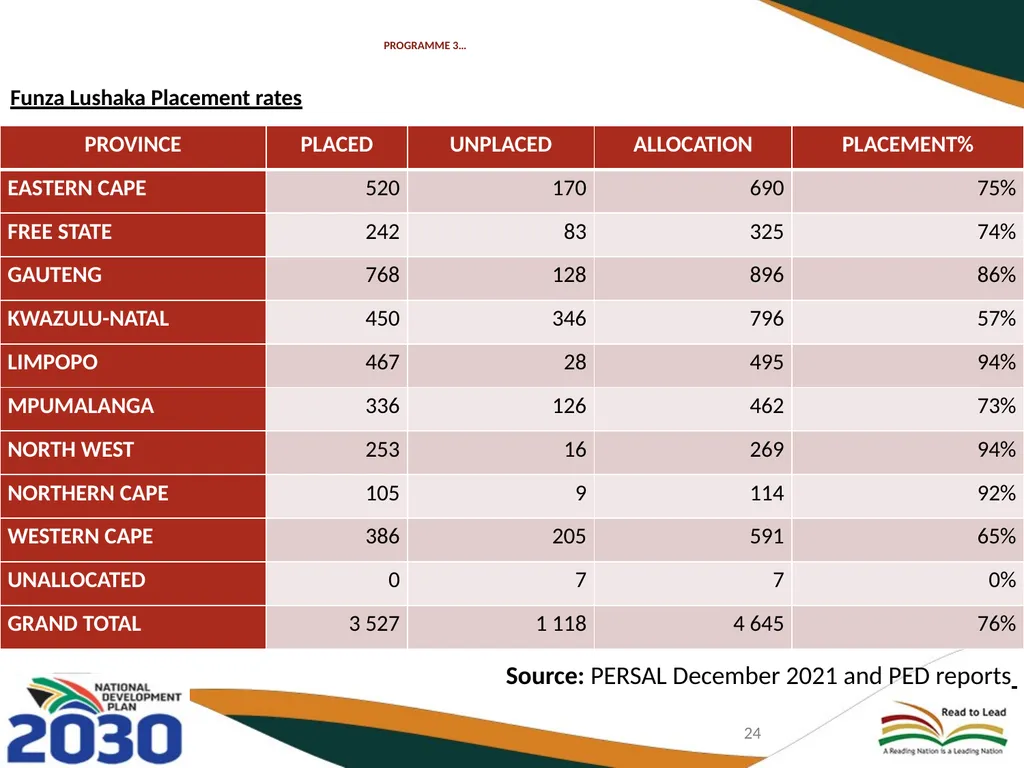
slide24. PROGRAMME 3… Funza Lushaka Placement rates Source: PERSAL December 2021 and PED reports 24<br>
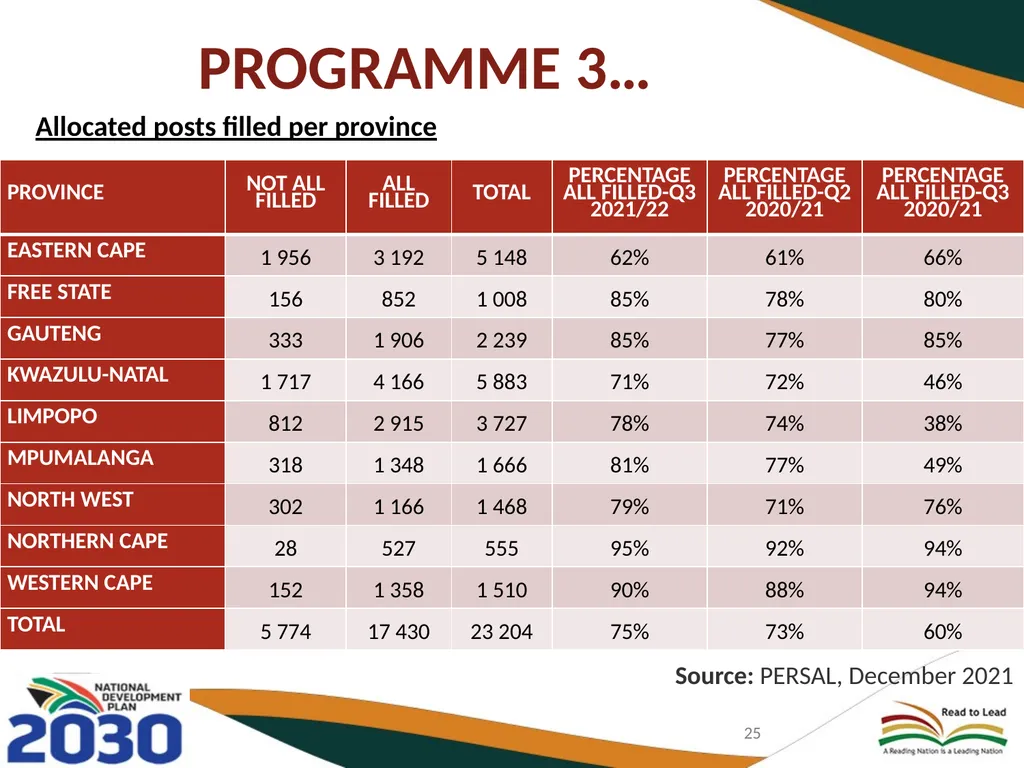
slide25. PROGRAMME 3… Allocated posts filled per province Source: PERSAL, December 2021 25<br>
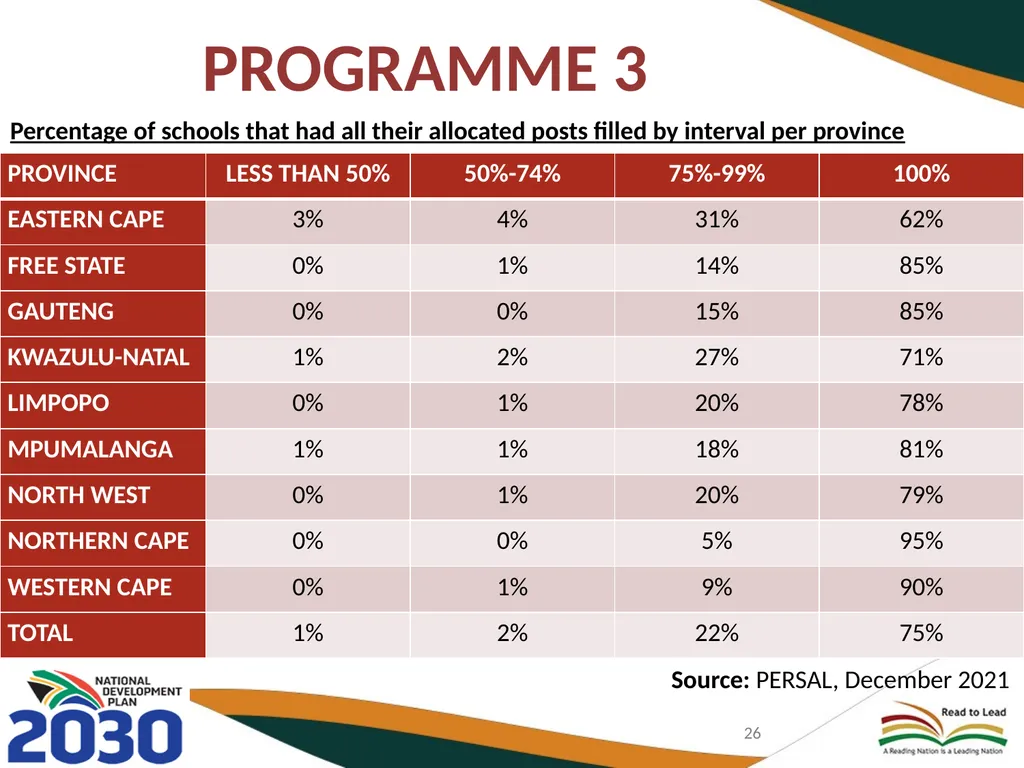
slide26. PROGRAMME 3 Percentage of schools that had all their allocated posts filled by interval per province Source: PERSAL, December 2021 26<br>
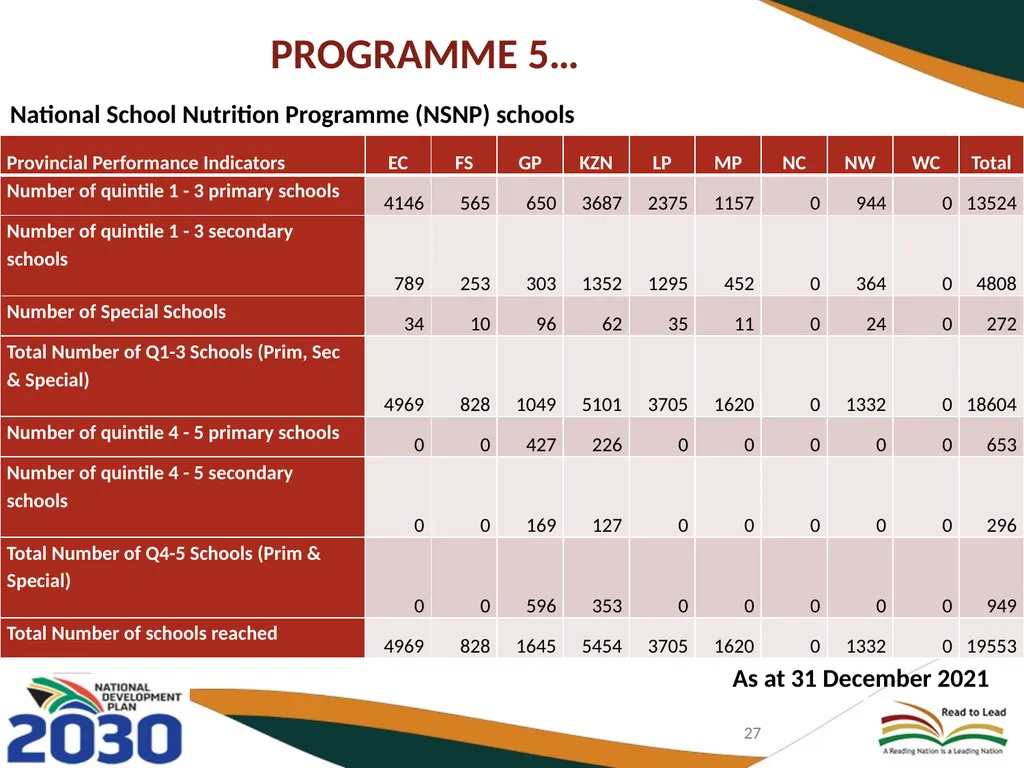
slide27. PROGRAMME 5… National School Nutrition Programme (NSNP) schools National School Nutrition Programme (NSNP) schools 27<br>
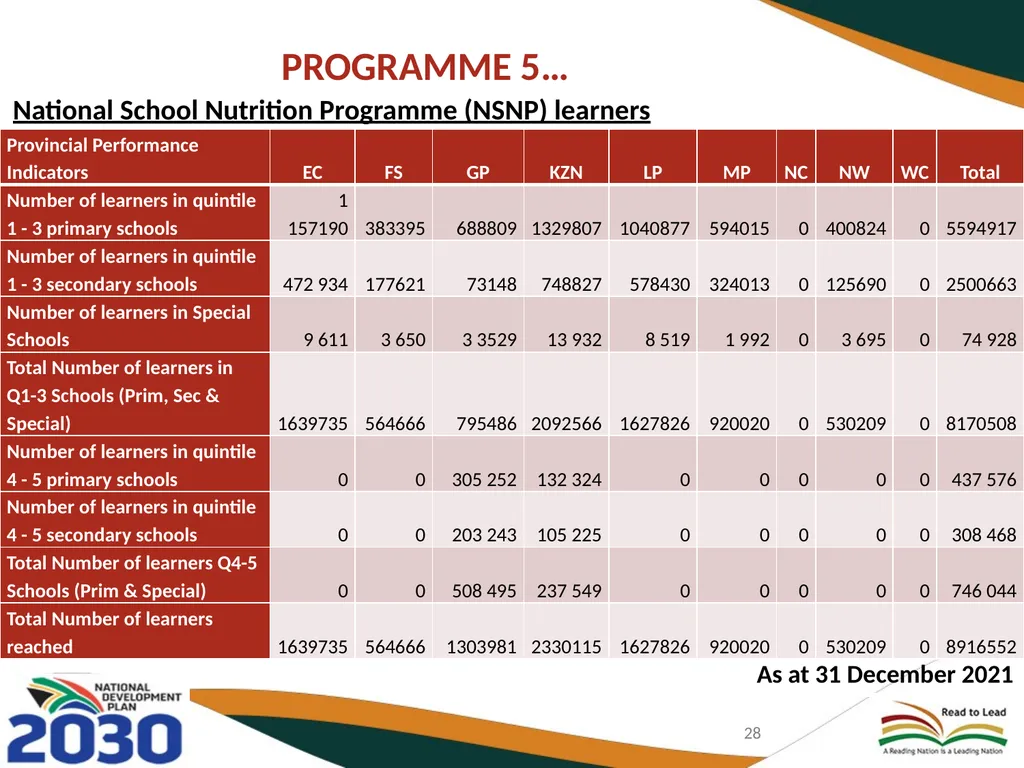
slide28. PROGRAMME 5… National School Nutrition Programme (NSNP) learners 28<br>
slide29. EARLY CHILDHOOD DEVELOPMENT (ECD) FUNCTION SHIFT 29<br>
slide30. ECD FUNCTION SHIFT PROGRESS Service Delivery: Three (3) modalities for offering ECD
Quality assurance, registration, capacity and systems urgently needed to achieve NDP goals
Institutional arrangements and function shift
The Minister and Department of Basic Education (DBE) will receive the responsibility for the ECD function on 1 April 2022 through the Proclamation signed by the President on 27 June 2021.
The Minister of Finance tabled the function shift in the Medium Term Budget Policy Statement.
Planning, data and information
Census of all Early Learning Programmes: Collected data in 37 000 ECD programmes, provided services to 1.5 million children.
Early Years Index and baseline assessment of Early Learning Programmes: The data collection was completed.
Registration system under development, adapted for use. 30<br>
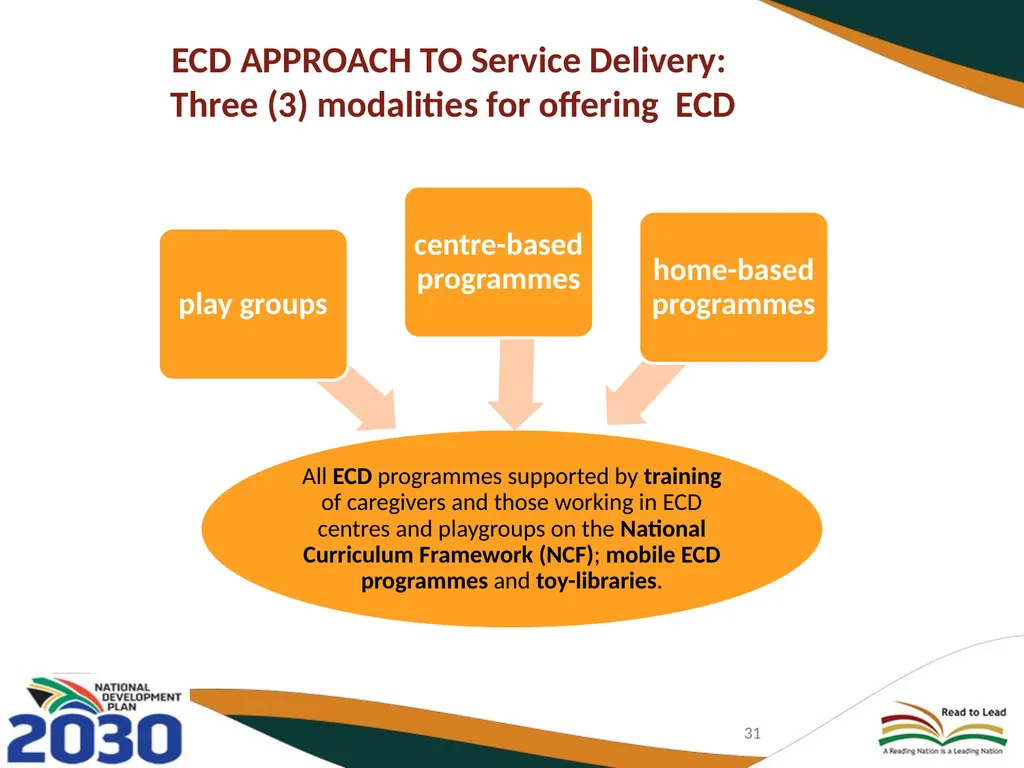
slide31. ECD APPROACH TO Service Delivery: Three (3) modalities for offering ECD 31<br>
slide32. ECD FUNCTION SHIFT PROGRESS Coordination and change management critical
Educational Management Information Systems (EMIS)
Human Resources (HR)
Funding – expenditure review and funding
Institutional arrangements and business process
Capacity development and preparation in sector
New function and new system
New service delivery arrangements
Reporting and coordination through HEDCOM and interprovincial forum
New planning and other arrangements 32<br>
slide33. ANNUAL PLANS TOWARDS LONG TERM OUTCOMES 33<br>
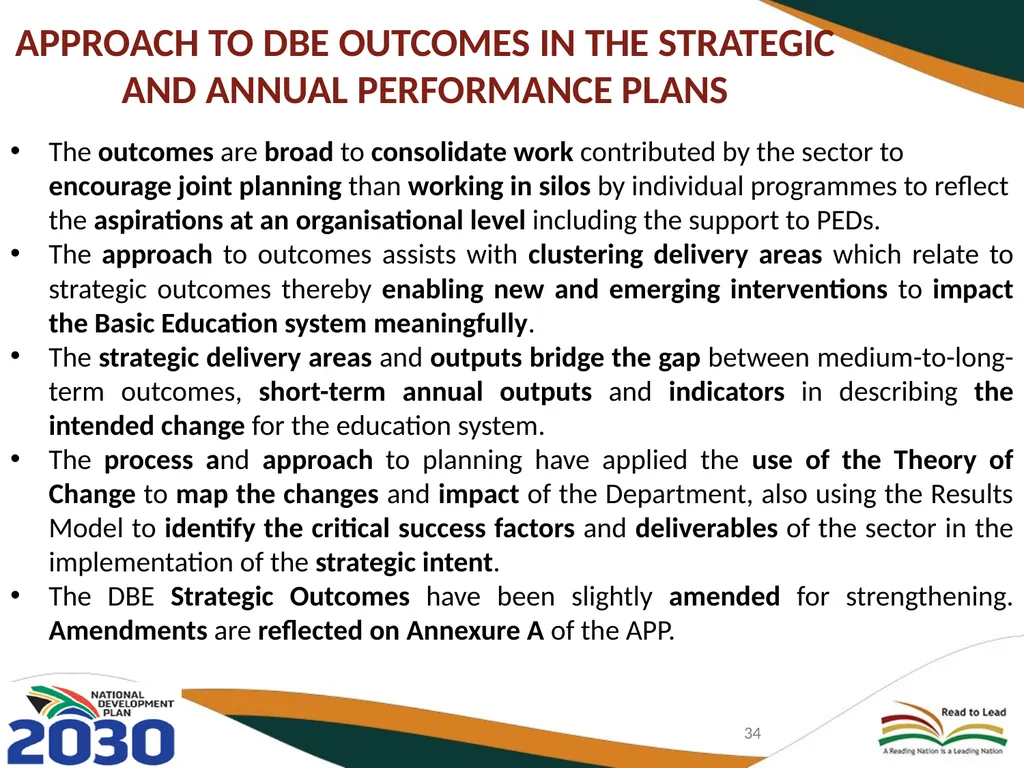
slide34. APPROACH TO DBE OUTCOMES IN THE STRATEGIC AND ANNUAL PERFORMANCE PLANS The outcomes are broad to consolidate work contributed by the sector to encourage joint planning than working in silos by individual programmes to reflect the aspirations at an organisational level including the support to PEDs.
The approach to outcomes assists with clustering delivery areas which relate to strategic outcomes thereby enabling new and emerging interventions to impact the Basic Education system meaningfully.
The strategic delivery areas and outputs bridge the gap between medium-to-long-term outcomes, short-term annual outputs and indicators in describing the intended change for the education system.
The process and approach to planning have applied the use of the Theory of Change to map the changes and impact of the Department, also using the Results Model to identify the critical success factors and deliverables of the sector in the implementation of the strategic intent.
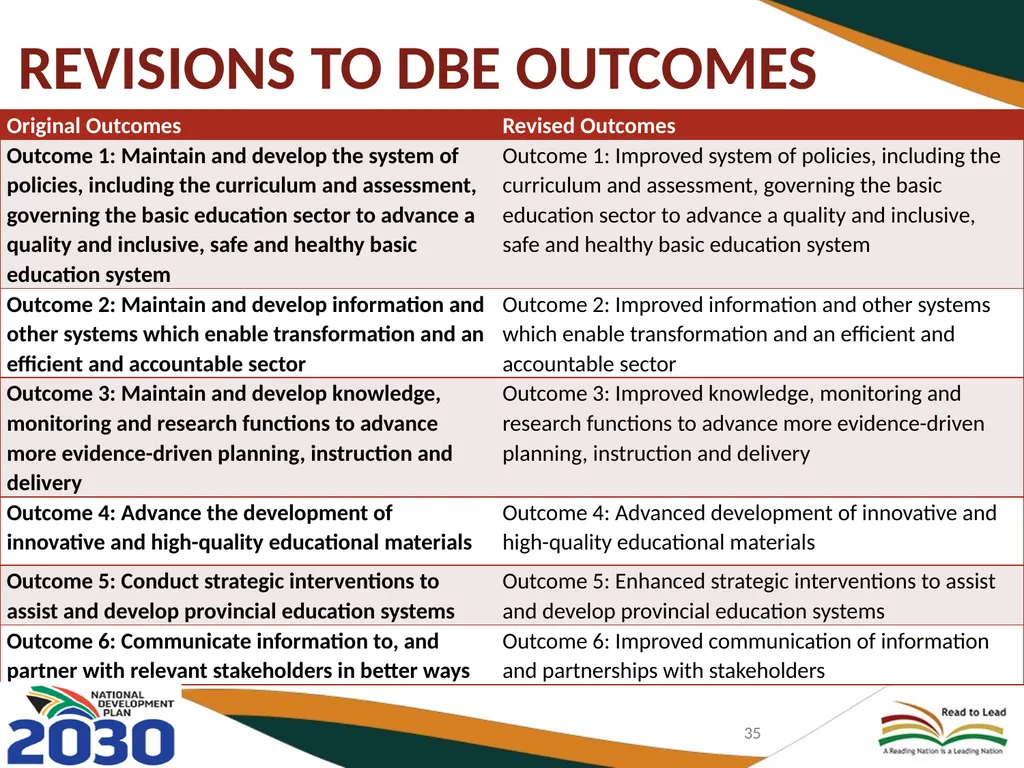
The DBE Strategic Outcomes have been slightly amended for strengthening. Amendments are reflected on Annexure A of the APP. 34<br>
slide35. REVISIONS TO DBE OUTCOMES 35<br>
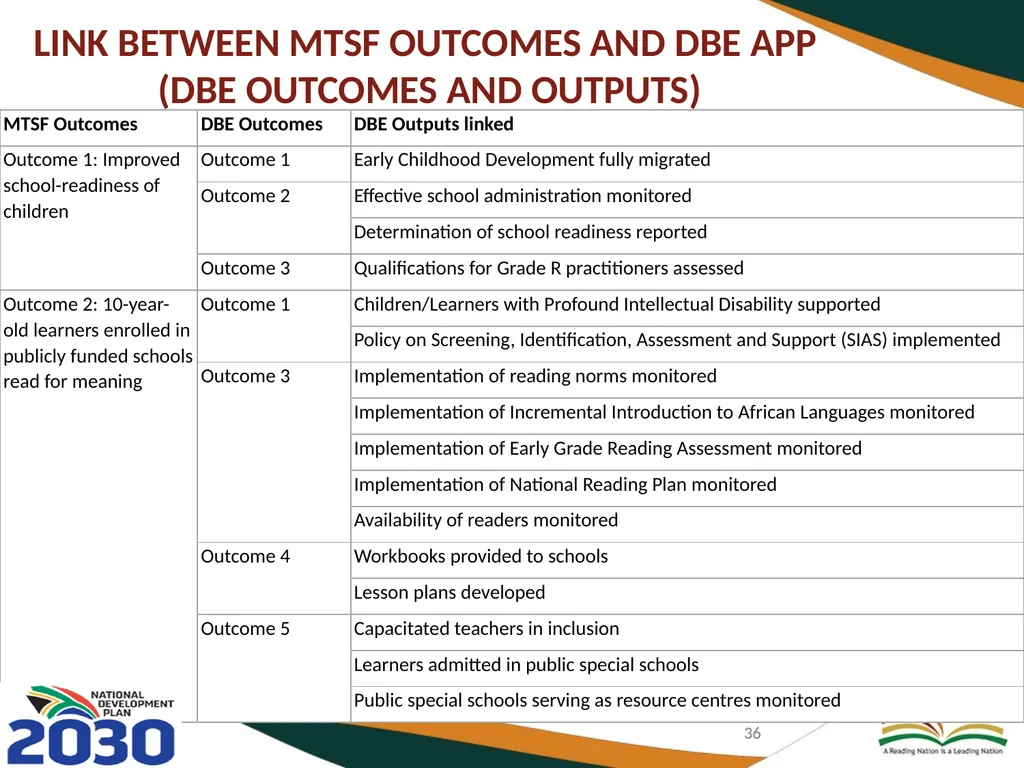
slide36. LINK BETWEEN MTSF OUTCOMES AND DBE APP (DBE OUTCOMES AND OUTPUTS) 36<br>
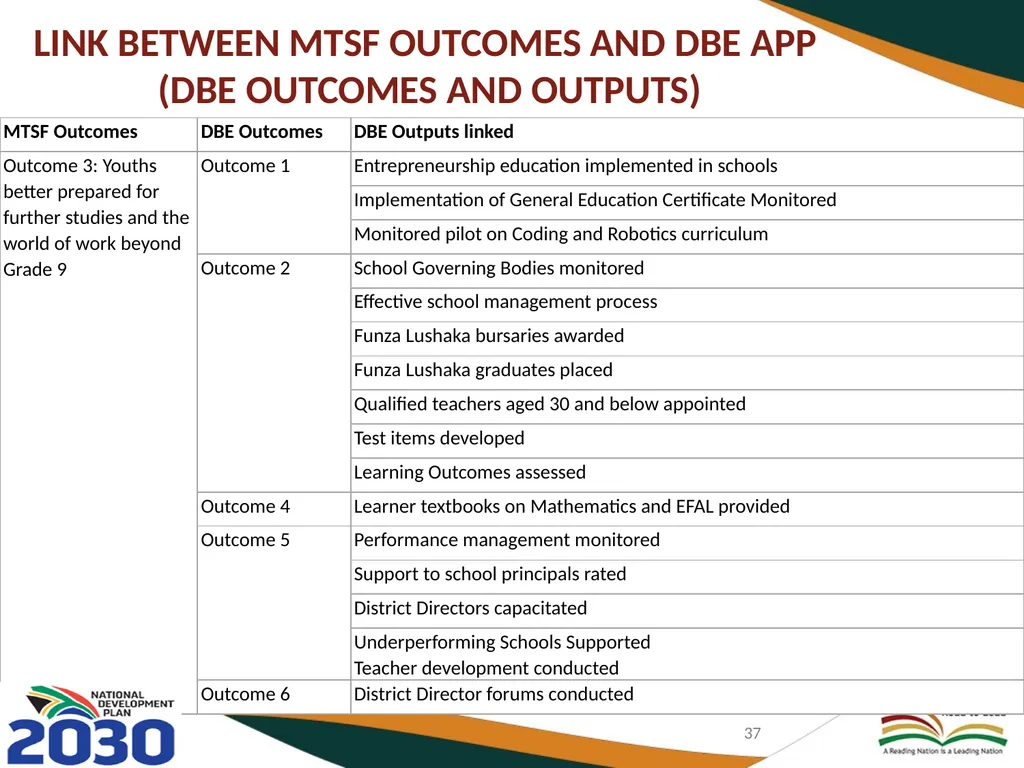
slide37. LINK BETWEEN MTSF OUTCOMES AND DBE APP (DBE OUTCOMES AND OUTPUTS) 37<br>
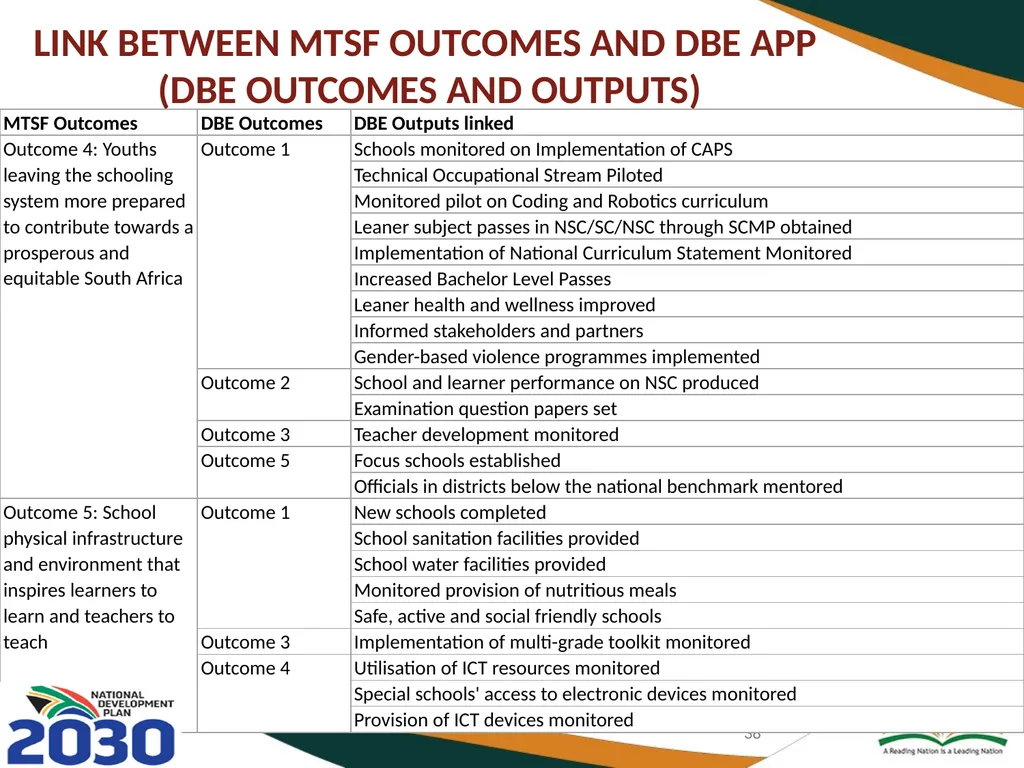
slide38. LINK BETWEEN MTSF OUTCOMES AND DBE APP (DBE OUTCOMES AND OUTPUTS) 38<br>
slide39. THE DBE APP 2022/23 DEVELOPMENT PROCESS 39<br>
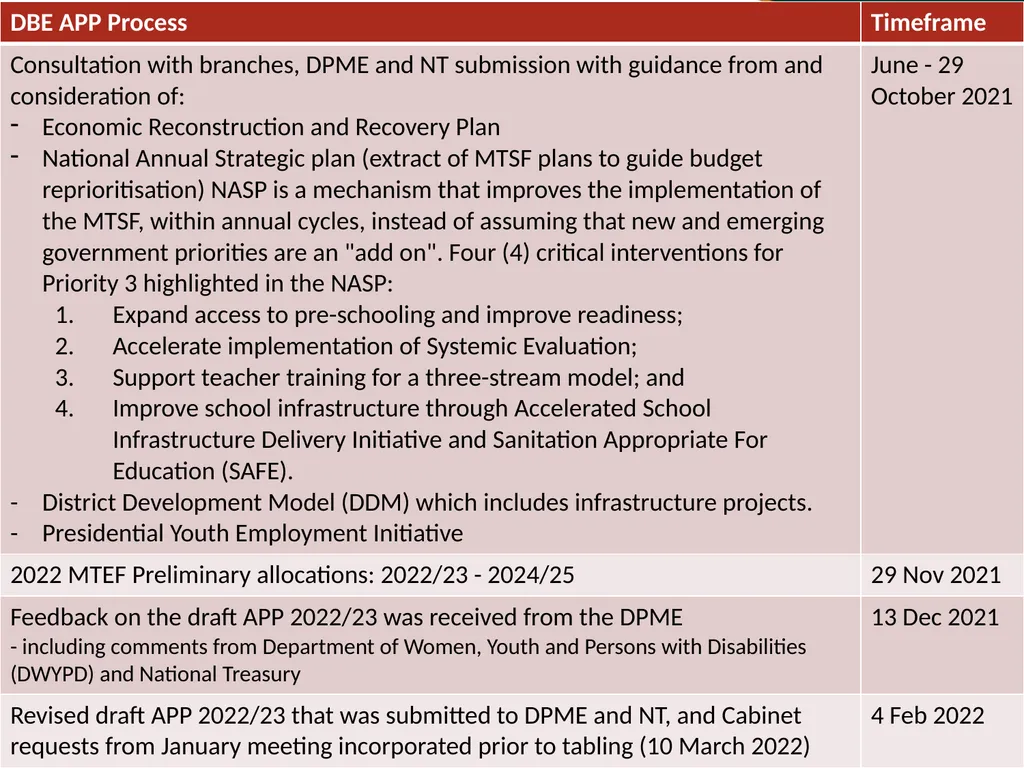
slide40. 2022/23 DBE APP DEVELOPMENT PROCESS 40<br>
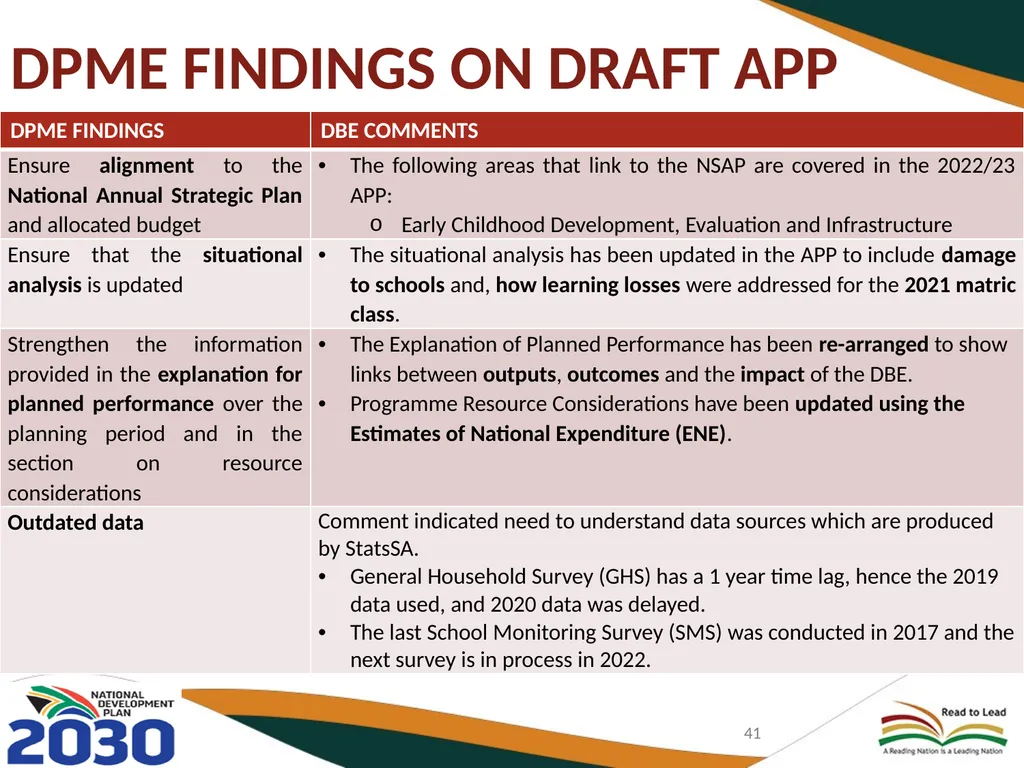
slide41. DPME FINDINGS ON DRAFT APP 41<br>
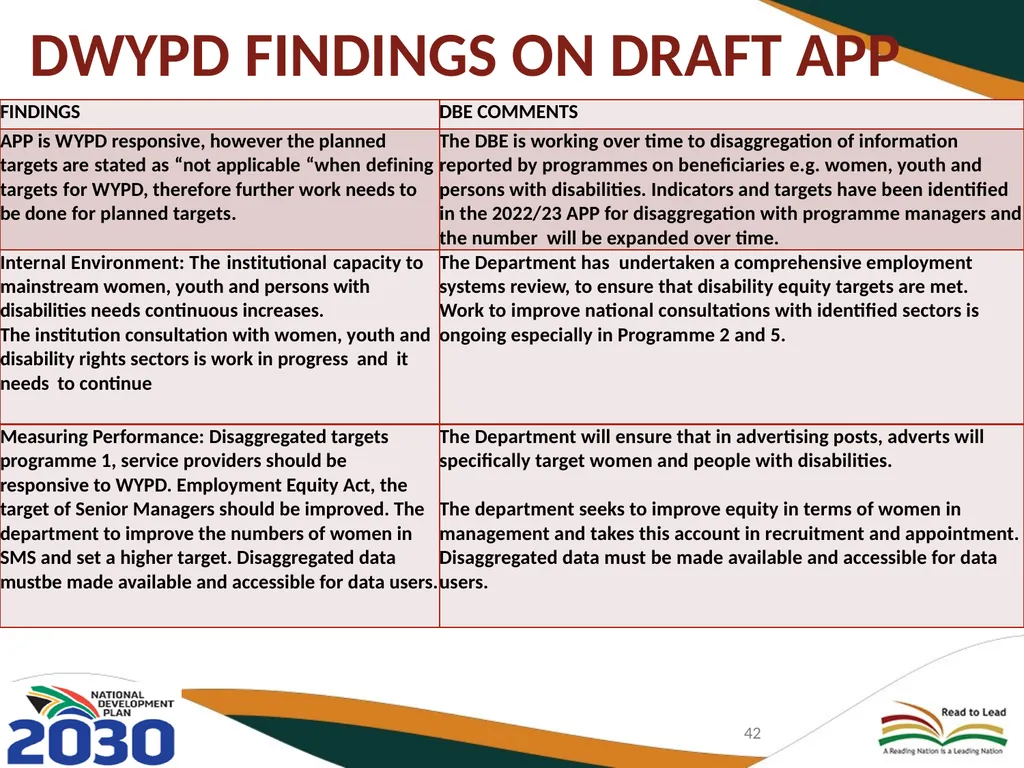
slide42. DWYPD FINDINGS ON DRAFT APP 42<br>
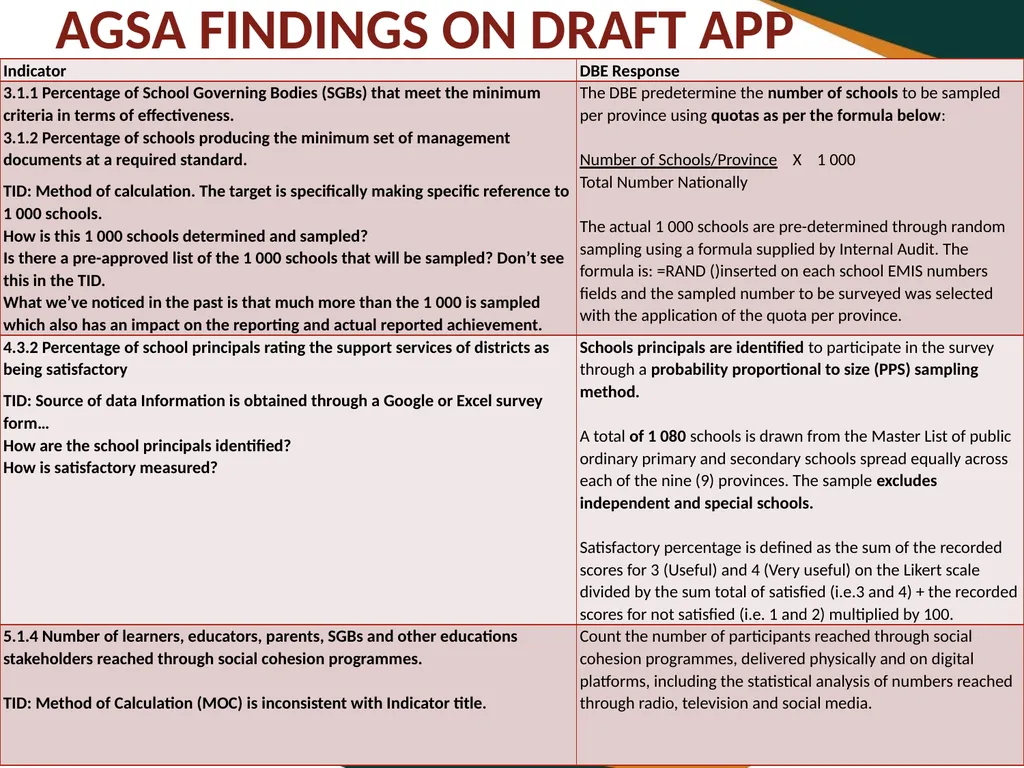
slide43. AGSA FINDINGS ON DRAFT APP 43<br>
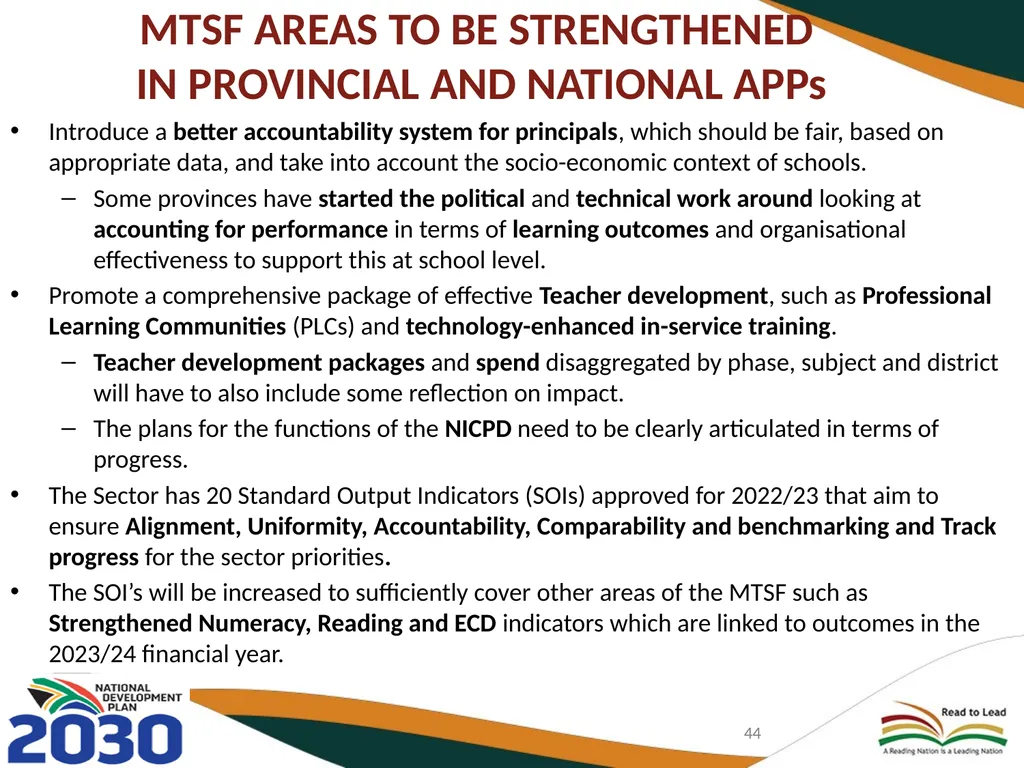
slide44. MTSF AREAS TO BE STRENGTHENED IN PROVINCIAL AND NATIONAL APPs Introduce a better accountability system for principals, which should be fair, based on appropriate data, and take into account the socio-economic context of schools.
Some provinces have started the political and technical work around looking at accounting for performance in terms of learning outcomes and organisational effectiveness to support this at school level.
Promote a comprehensive package of effective Teacher development, such as Professional Learning Communities (PLCs) and technology-enhanced in-service training.
Teacher development packages and spend disaggregated by phase, subject and district will have to also include some reflection on impact.
The plans for the functions of the NICPD need to be clearly articulated in terms of progress.
The Sector has 20 Standard Output Indicators (SOIs) approved for 2022/23 that aim to ensure Alignment, Uniformity, Accountability, Comparability and benchmarking and Track progress for the sector priorities.
The SOI’s will be increased to sufficiently cover other areas of the MTSF such as Strengthened Numeracy, Reading and ECD indicators which are linked to outcomes in the 2023/24 financial year. 44<br>
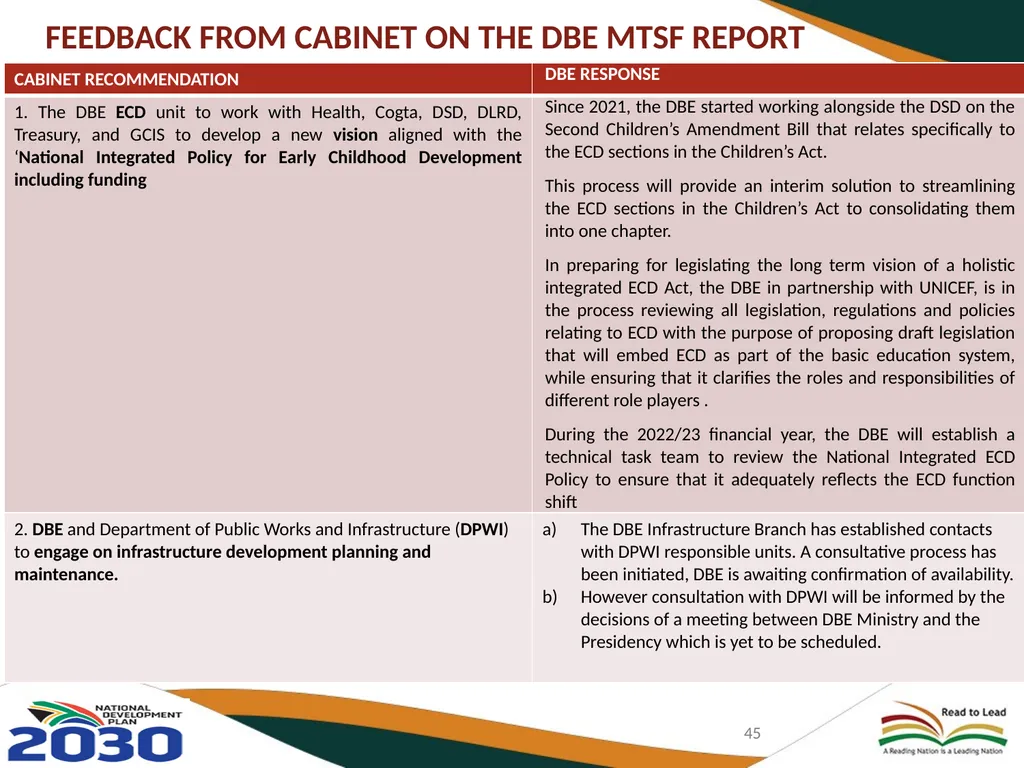
slide45. FEEDBACK FROM CABINET ON THE DBE MTSF REPORT 45<br>
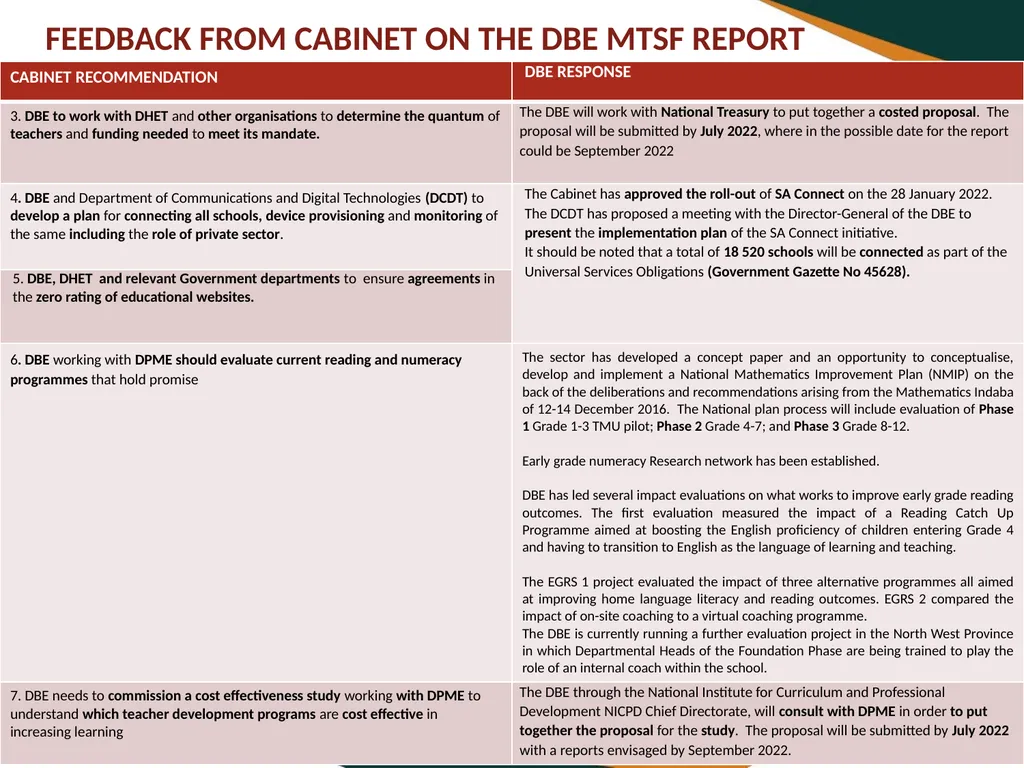
slide46. FEEDBACK FROM CABINET ON THE DBE MTSF REPORT 46<br>
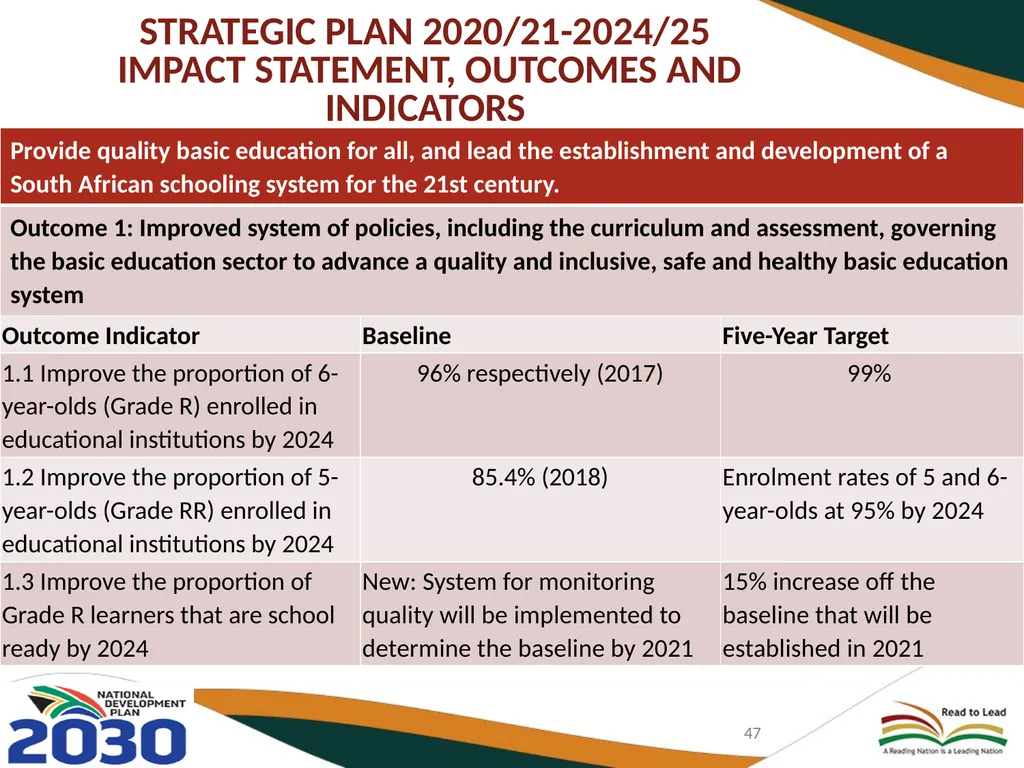
slide47. STRATEGIC PLAN 2020/21-2024/25 IMPACT STATEMENT, OUTCOMES AND INDICATORS 47<br>
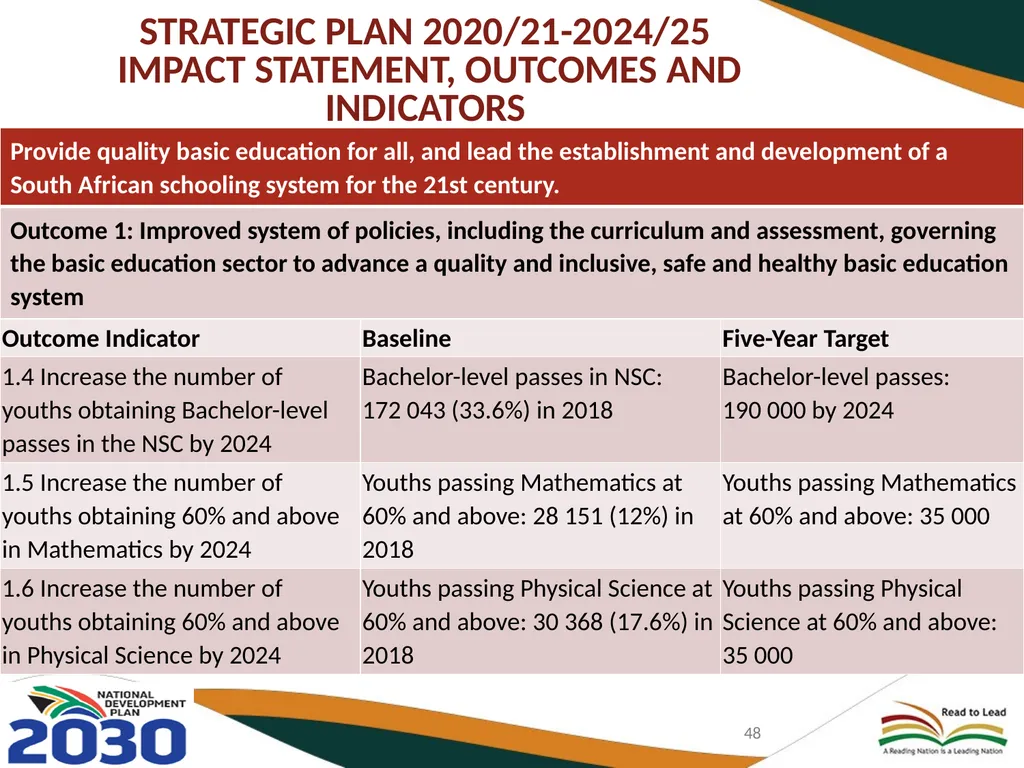
slide48. STRATEGIC PLAN 2020/21-2024/25 IMPACT STATEMENT, OUTCOMES AND INDICATORS 48<br>
slide49. THE DBE STRATEGIC PLAN 2020/21-2024/25 49<br>
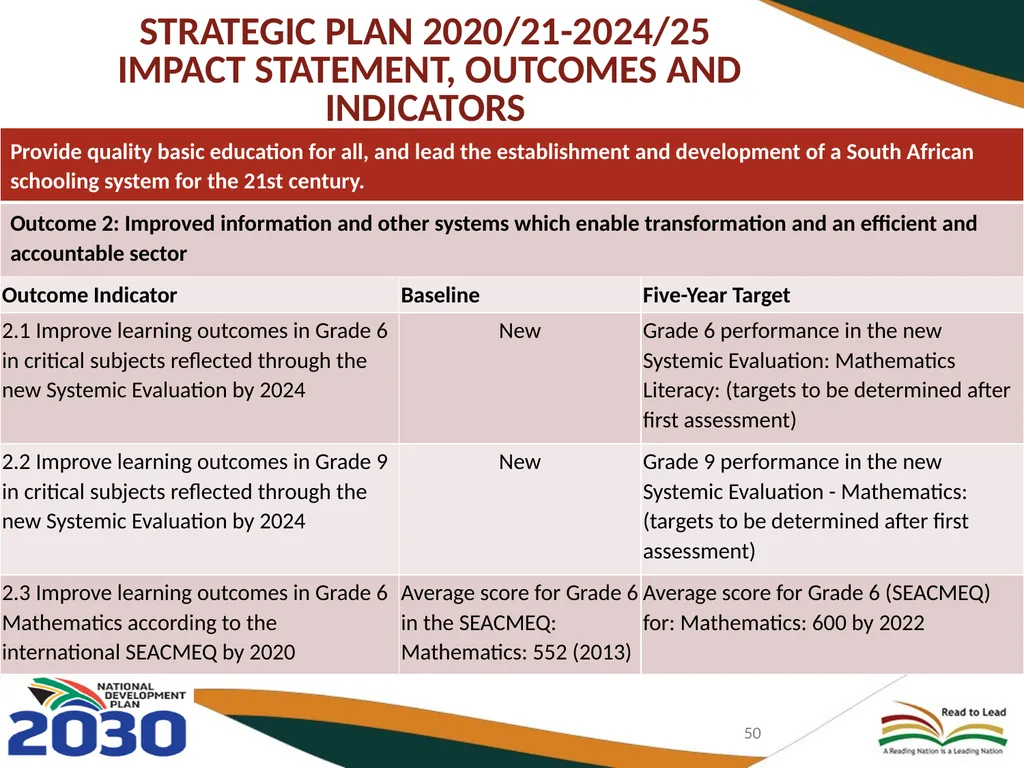
slide50. STRATEGIC PLAN 2020/21-2024/25 IMPACT STATEMENT, OUTCOMES AND INDICATORS 50<br>
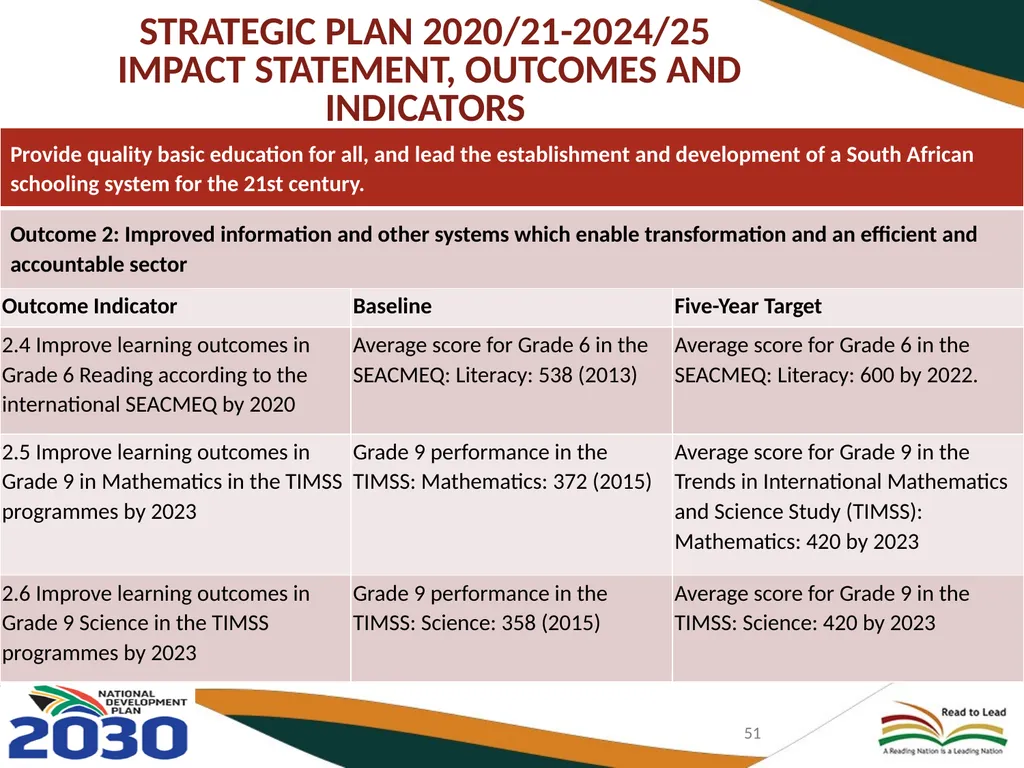
slide51. STRATEGIC PLAN 2020/21-2024/25 IMPACT STATEMENT, OUTCOMES AND INDICATORS 51<br>
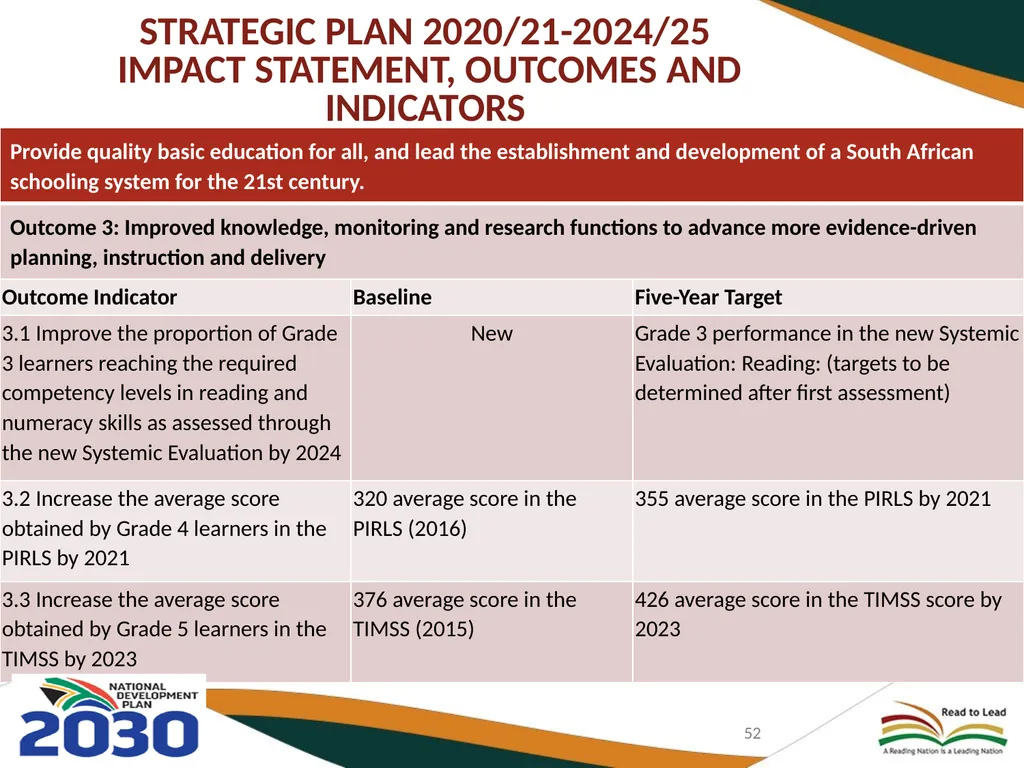
slide52. STRATEGIC PLAN 2020/21-2024/25 IMPACT STATEMENT, OUTCOMES AND INDICATORS 52<br>
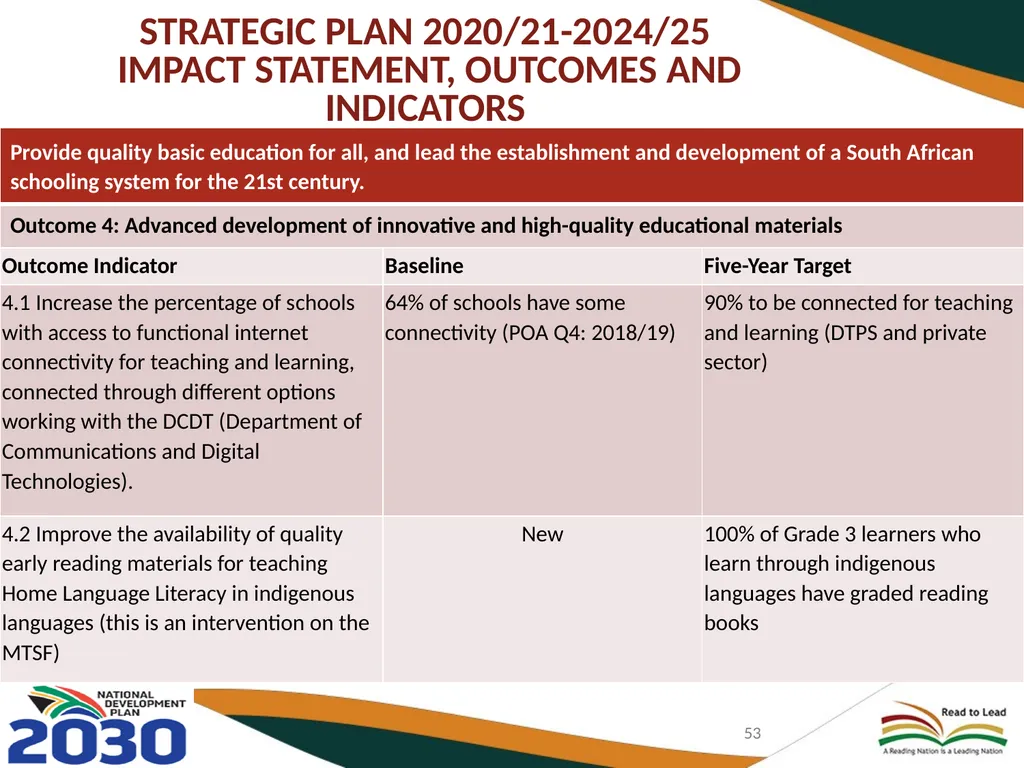
slide53. STRATEGIC PLAN 2020/21-2024/25 IMPACT STATEMENT, OUTCOMES AND INDICATORS 53<br>
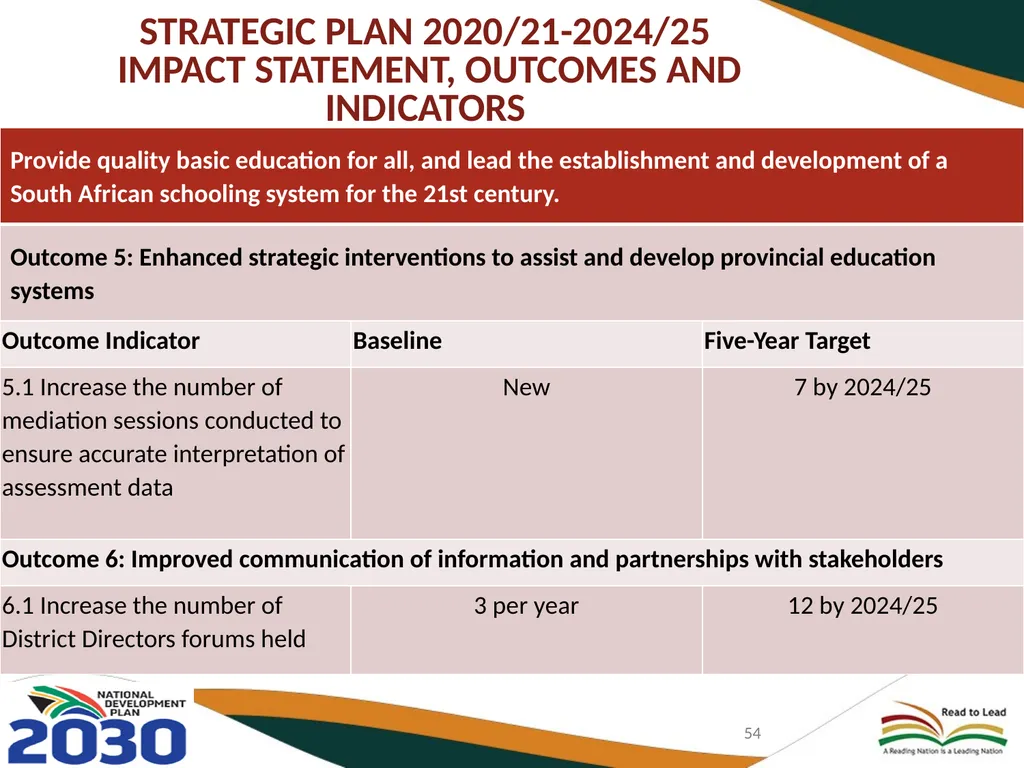
slide54. STRATEGIC PLAN 2020/21-2024/25 IMPACT STATEMENT, OUTCOMES AND INDICATORS 54<br>
slide55. THE DBE ANNUAL PERFORMANCE PLAN 2022/23 55<br>
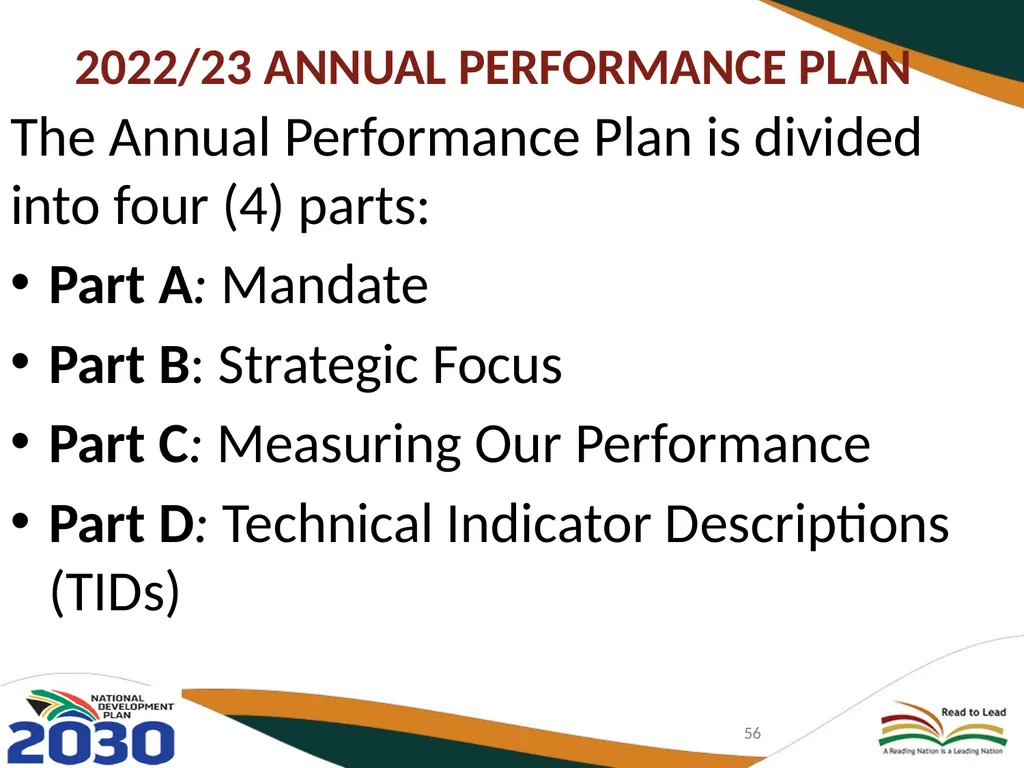
slide56. 2022/23 ANNUAL PERFORMANCE PLAN The Annual Performance Plan is divided into four (4) parts:
Part A: Mandate
Part B: Strategic Focus
Part C: Measuring Our Performance
Part D: Technical Indicator Descriptions (TIDs) 56<br>
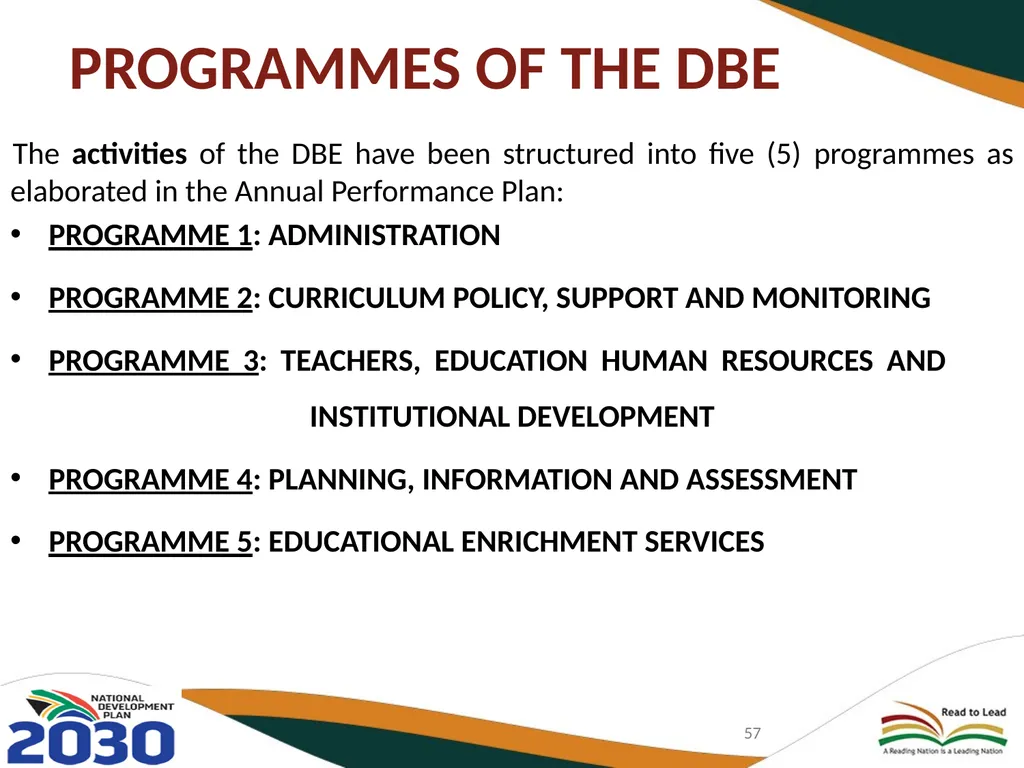
slide57. PROGRAMMES OF THE DBE The activities of the DBE have been structured into five (5) programmes as elaborated in the Annual Performance Plan:
PROGRAMME 1: ADMINISTRATION
PROGRAMME 2: CURRICULUM POLICY, SUPPORT AND MONITORING
PROGRAMME 3: TEACHERS, EDUCATION HUMAN RESOURCES AND INSTITUTIONAL DEVELOPMENT
PROGRAMME 4: PLANNING, INFORMATION AND ASSESSMENT
PROGRAMME 5: EDUCATIONAL ENRICHMENT SERVICES 57<br>
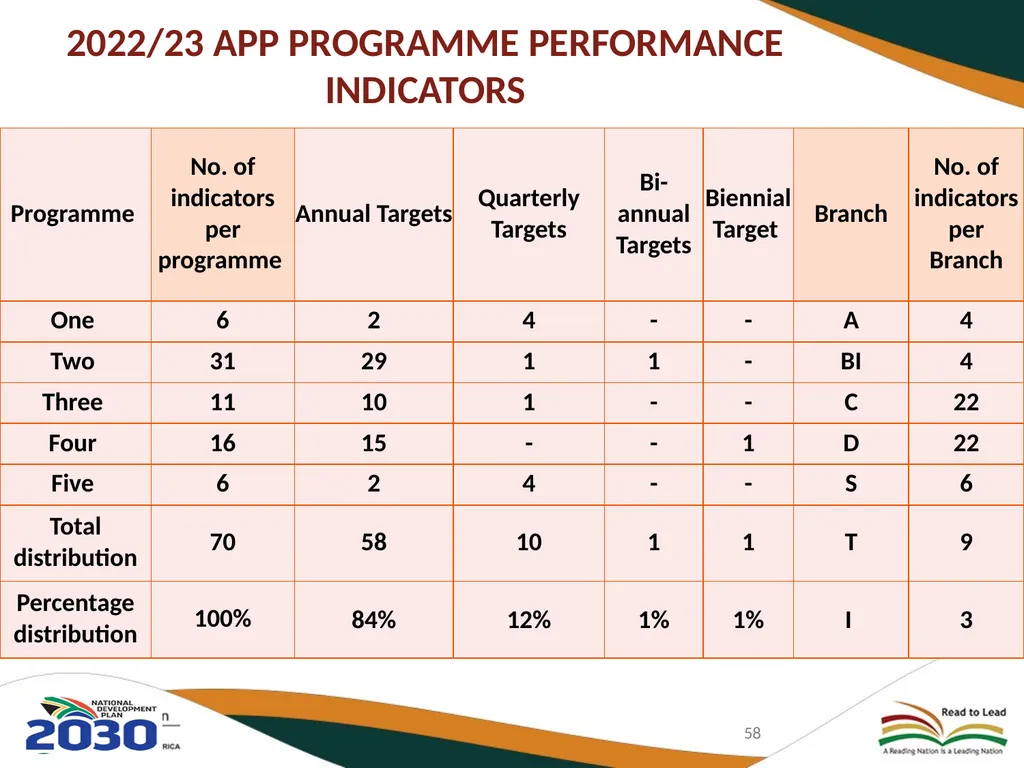
slide58. 2022/23 APP PROGRAMME PERFORMANCE INDICATORS 58<br>
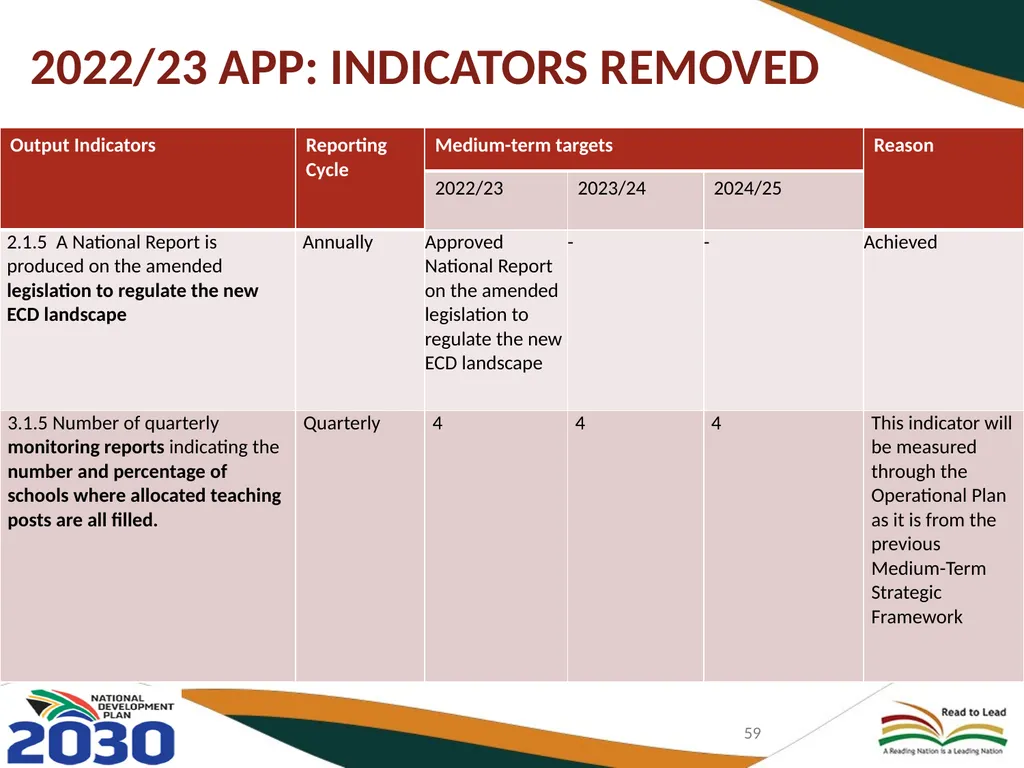
slide59. 2022/23 APP: INDICATORS REMOVED 59<br>
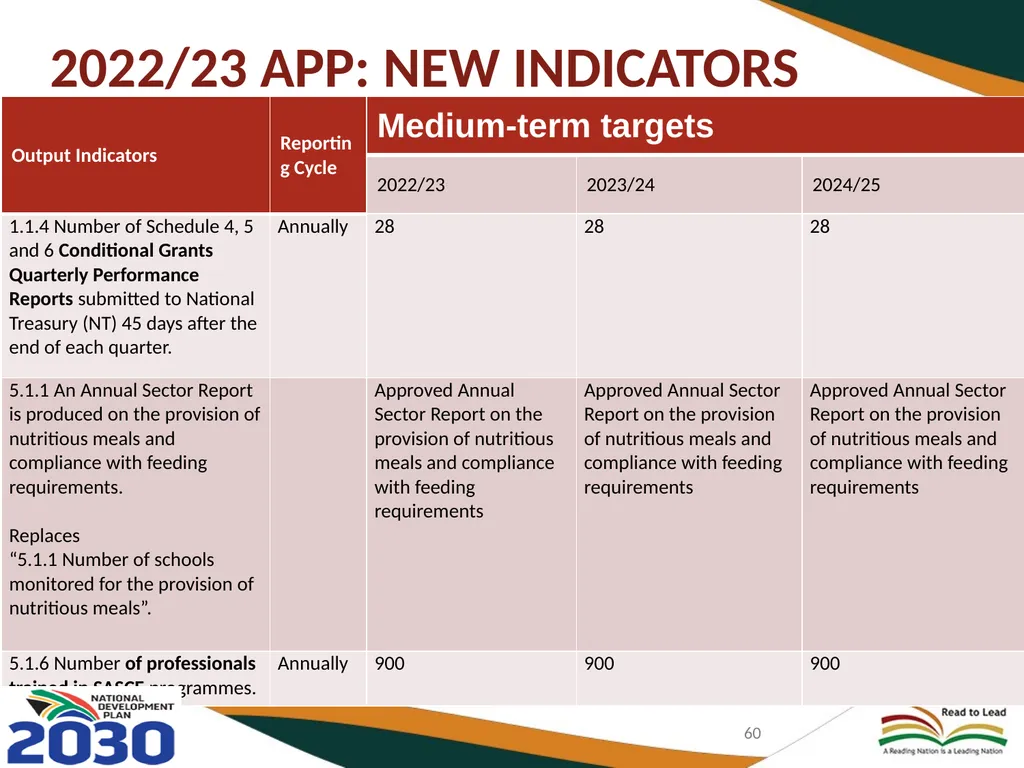
slide60. 2022/23 APP: NEW INDICATORS 60<br>
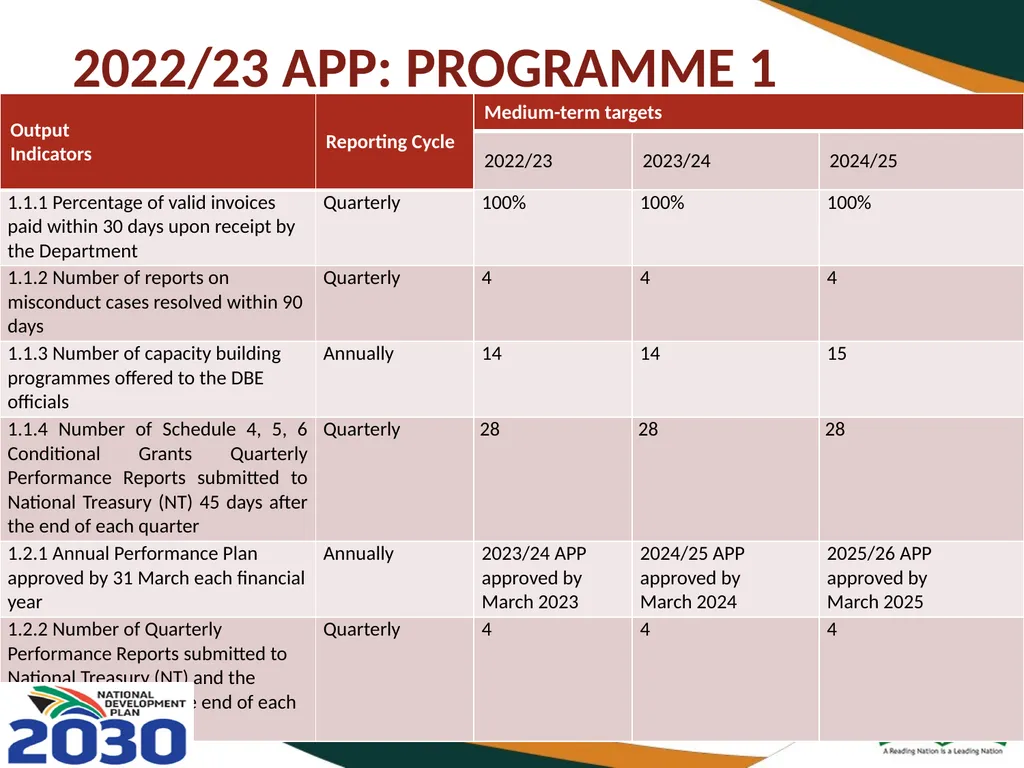
slide61. 2022/23 APP: PROGRAMME 1 61<br>
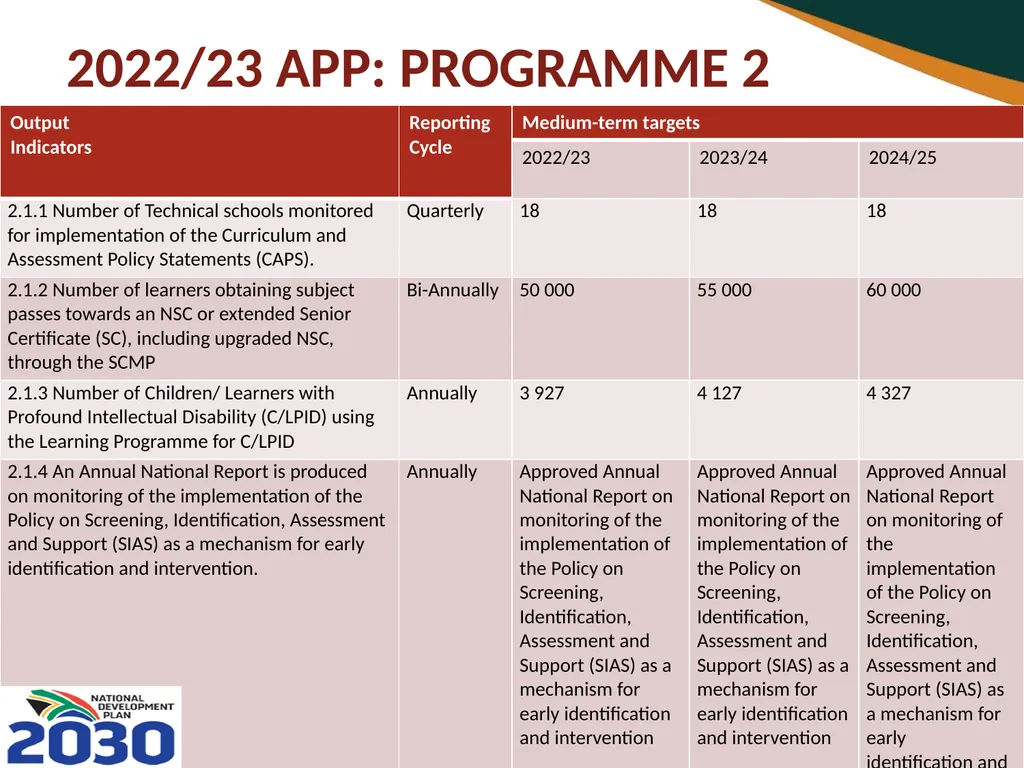
slide62. 2022/23 APP: PROGRAMME 2 62<br>
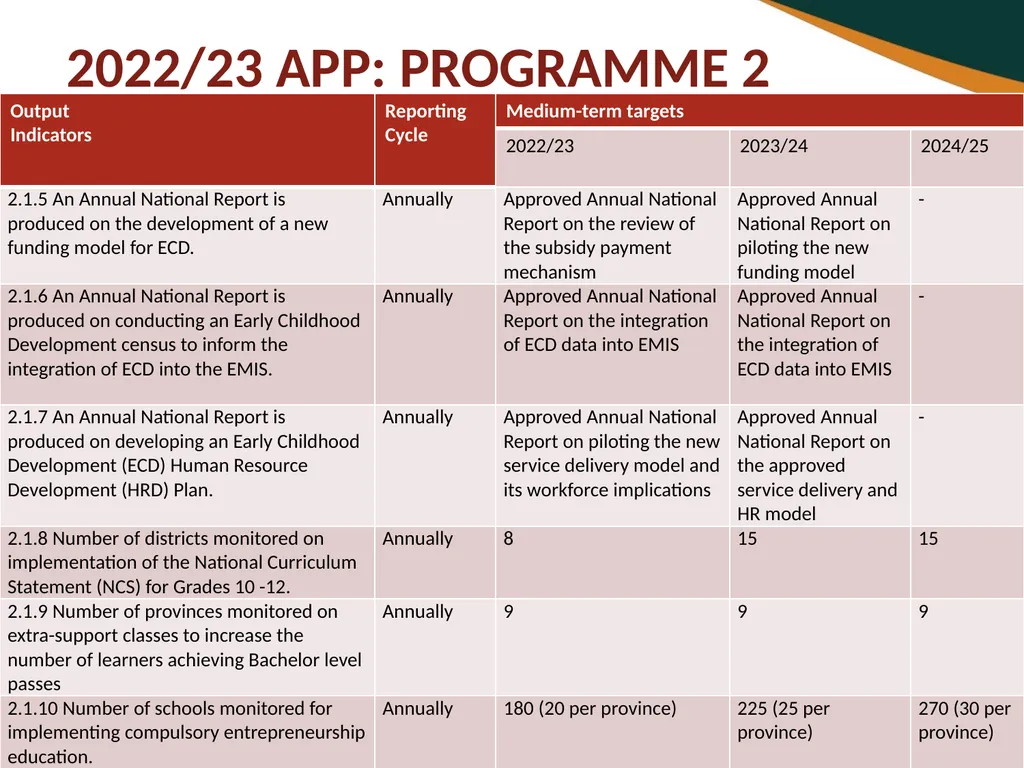
slide63. 2022/23 APP: PROGRAMME 2 63<br>
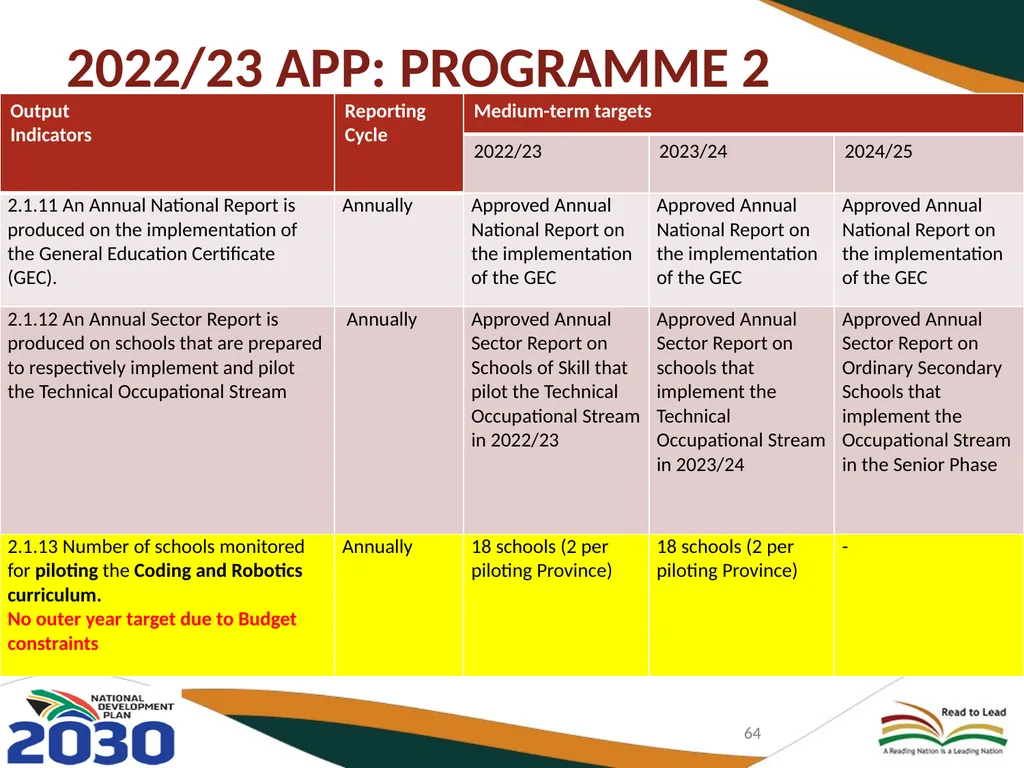
slide64. 2022/23 APP: PROGRAMME 2 64<br>
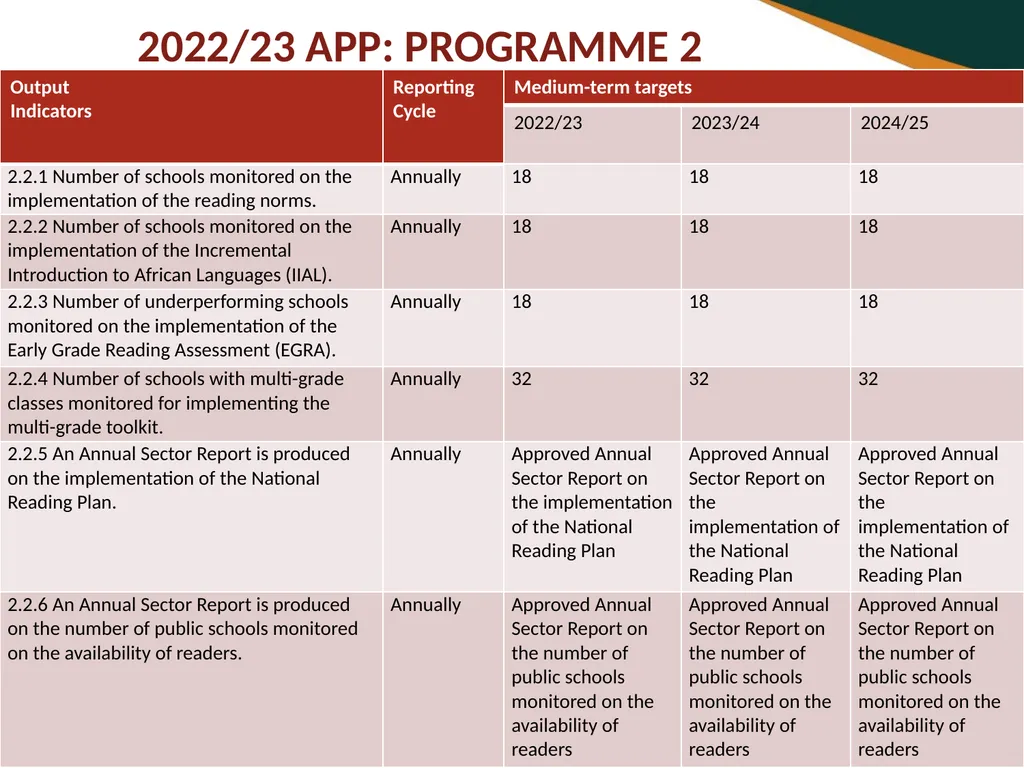
slide65. 2022/23 APP: PROGRAMME 2 65<br>
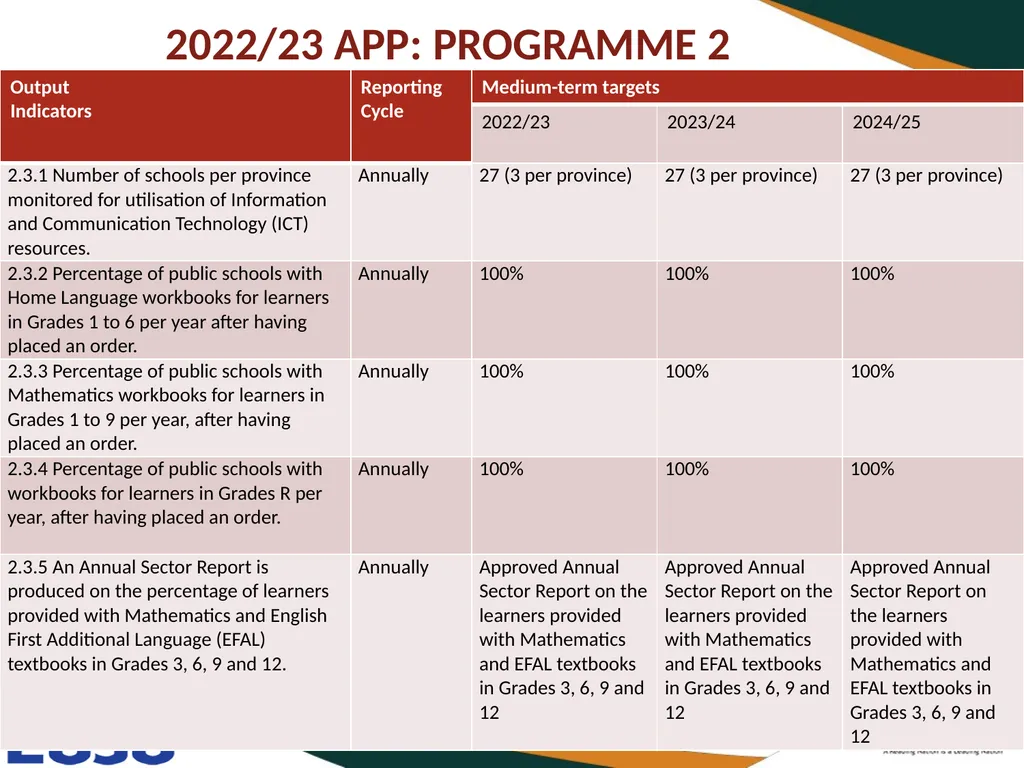
slide66. 2022/23 APP: PROGRAMME 2 66<br>
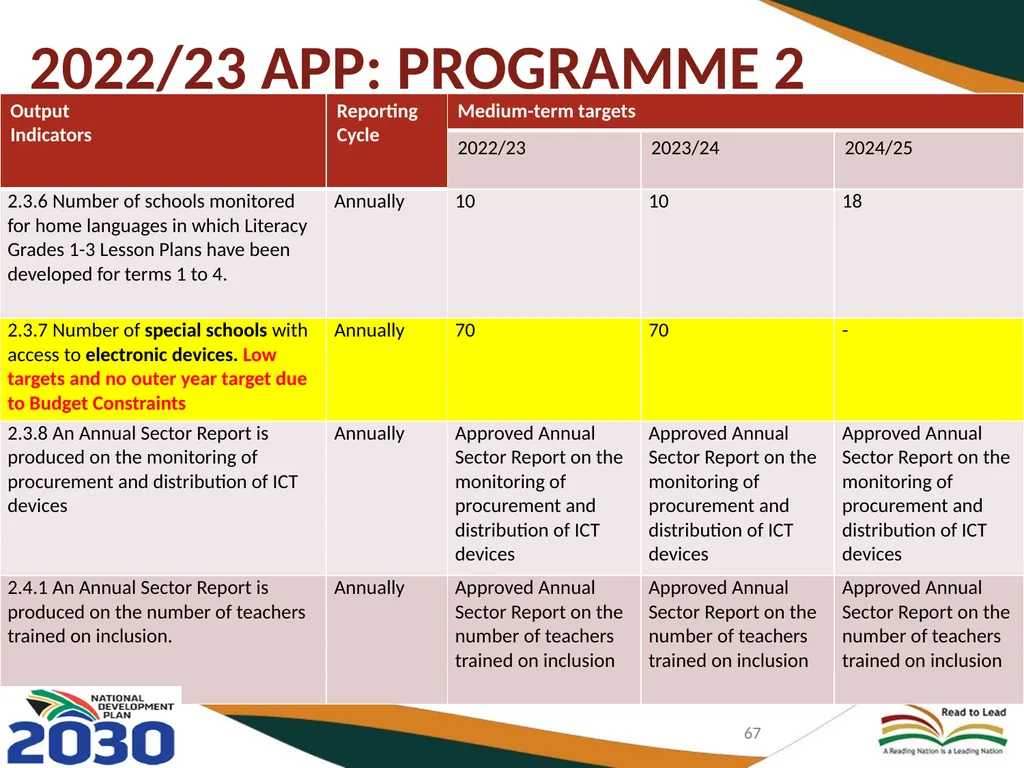
slide67. 2022/23 APP: PROGRAMME 2 67<br>
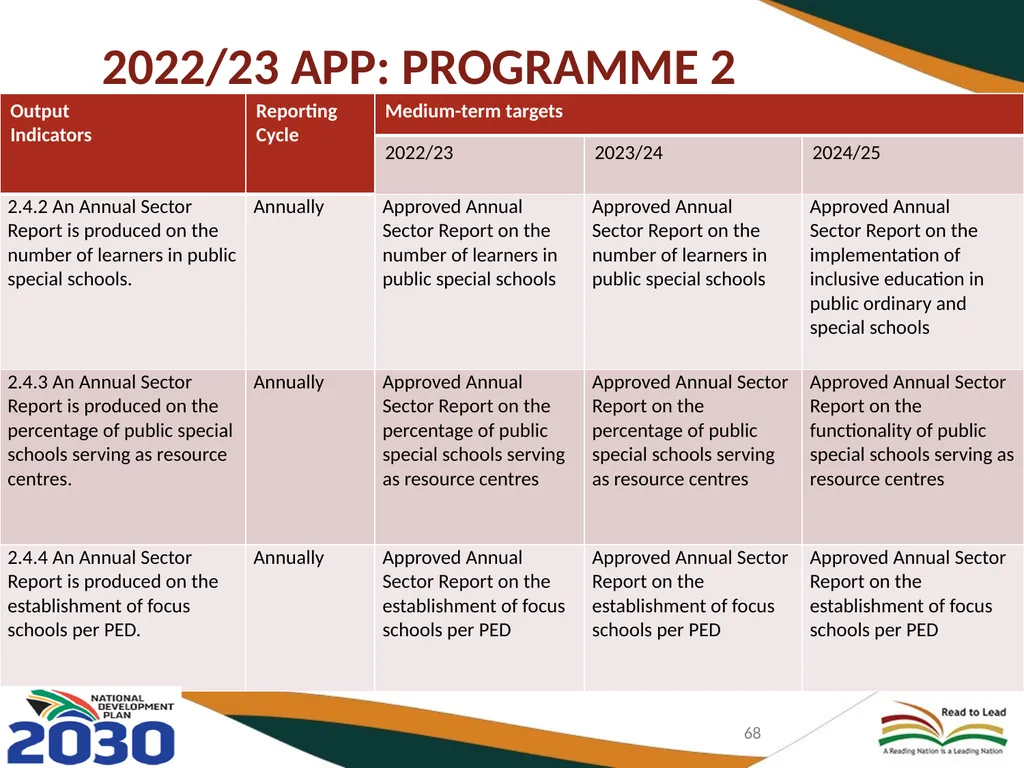
slide68. 2022/23 APP: PROGRAMME 2 68<br>
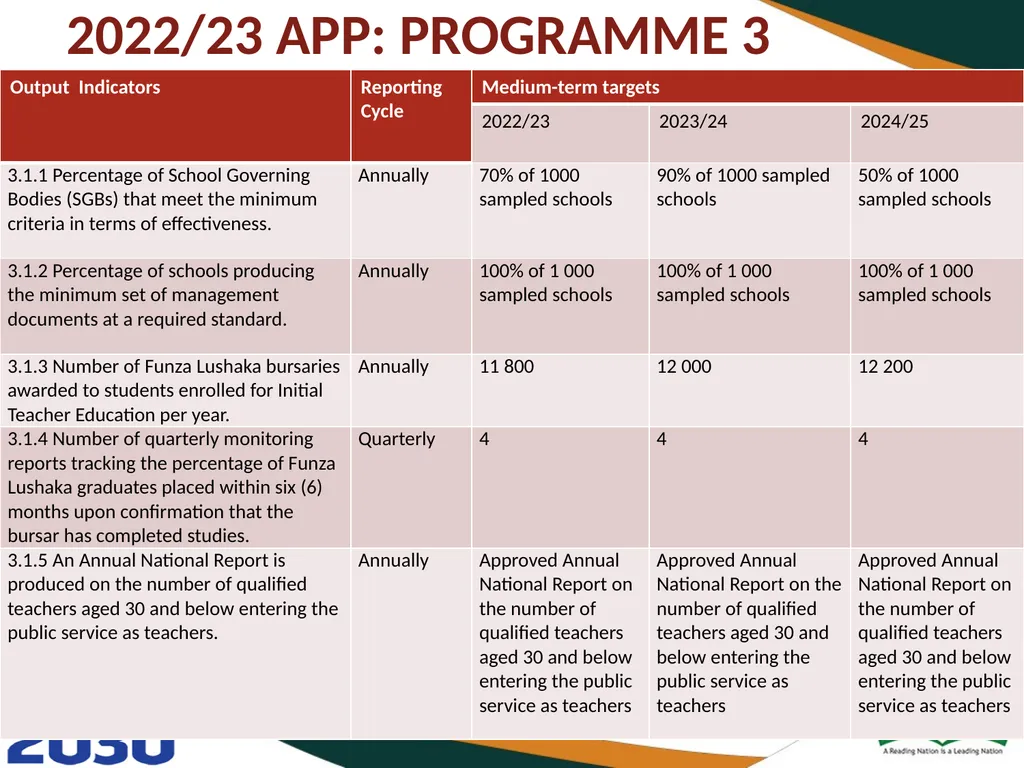
slide69. 2022/23 APP: PROGRAMME 3 69<br>
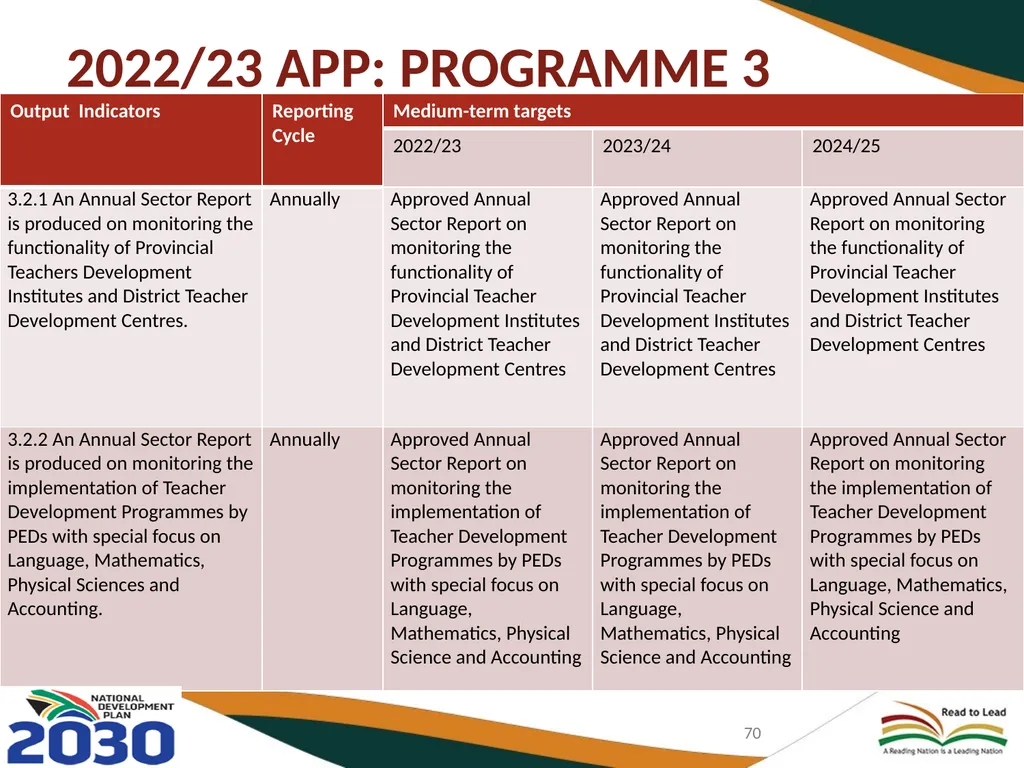
slide70. 2022/23 APP: PROGRAMME 3 70<br>
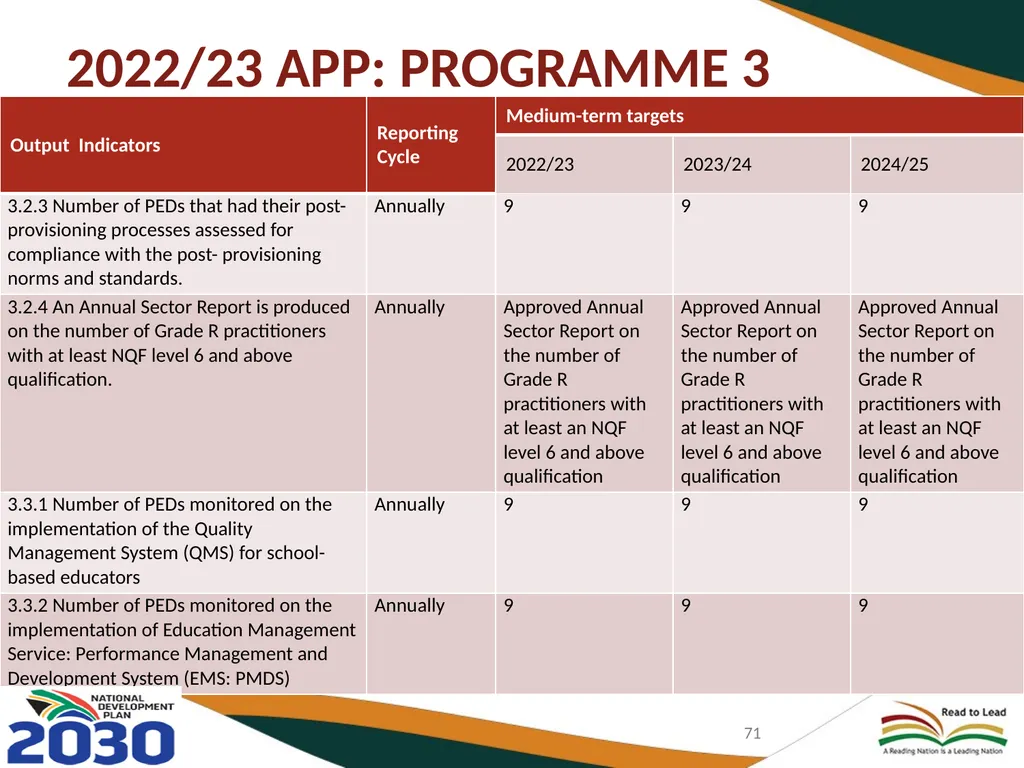
slide71. 2022/23 APP: PROGRAMME 3 71<br>
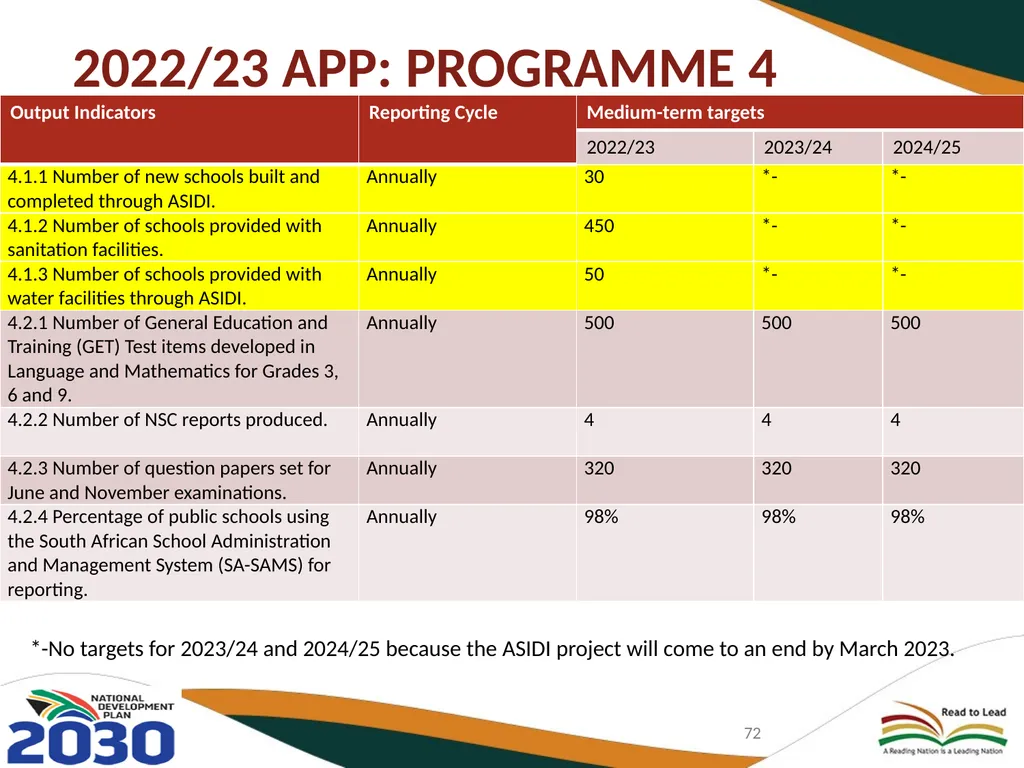
slide72. 2022/23 APP: PROGRAMME 4 *-No targets for 2023/24 and 2024/25 because the ASIDI project will come to an end by March 2023. 72<br>
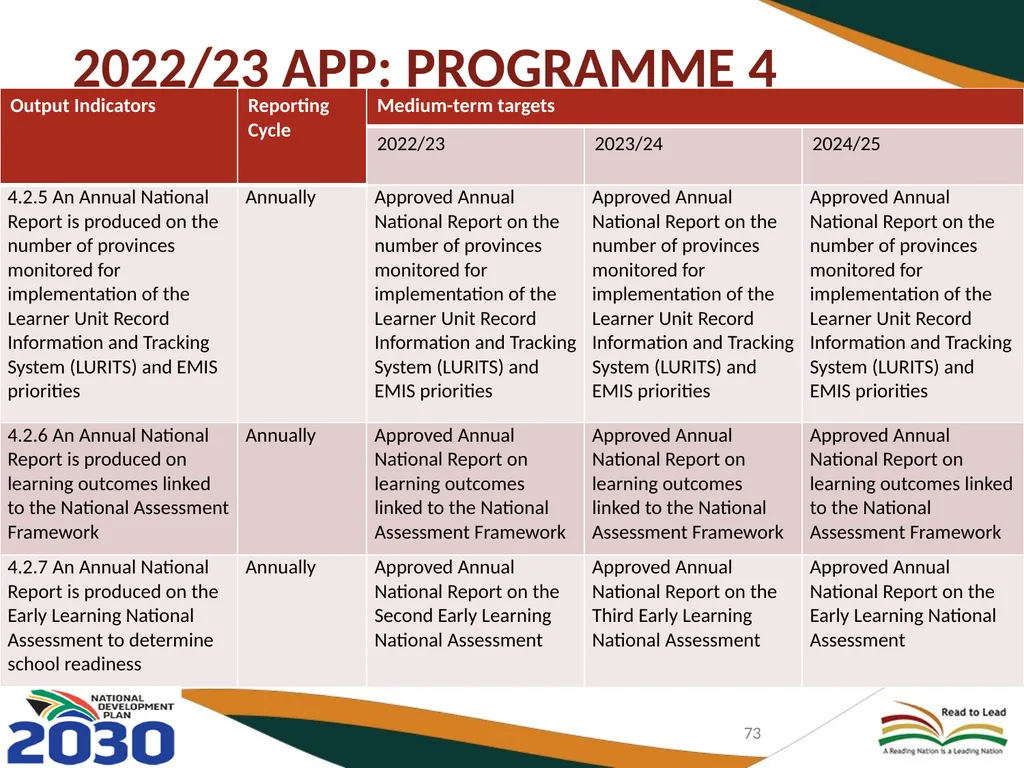
slide73. 2022/23 APP: PROGRAMME 4 73<br>
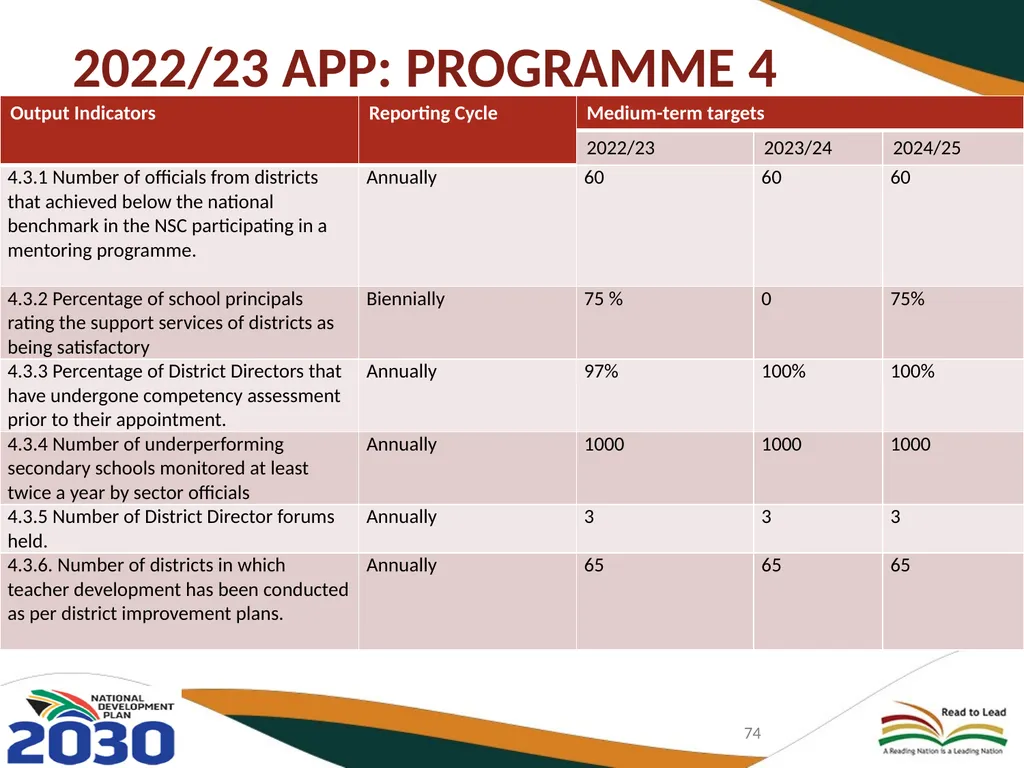
slide74. 2022/23 APP: PROGRAMME 4 74<br>
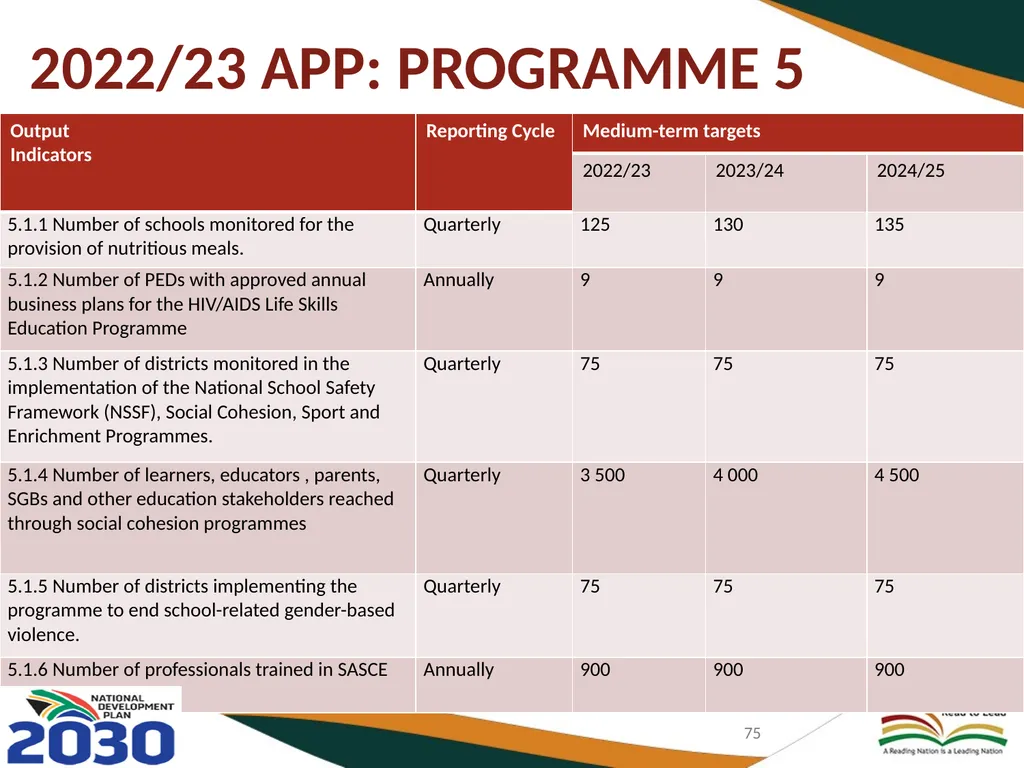
slide75. 2022/23 APP: PROGRAMME 5 75<br>
slide76. 2022 BUDGET ALLOCATIONS 76<br>
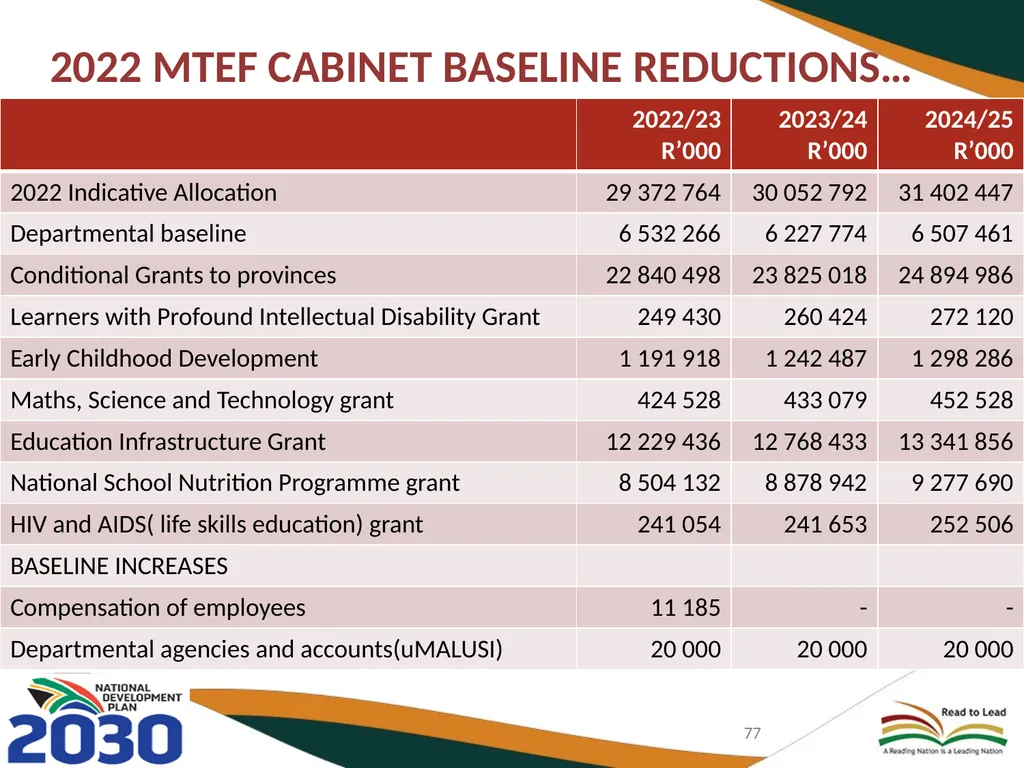
slide77. 2022 MTEF CABINET BASELINE REDUCTIONS… 77<br>
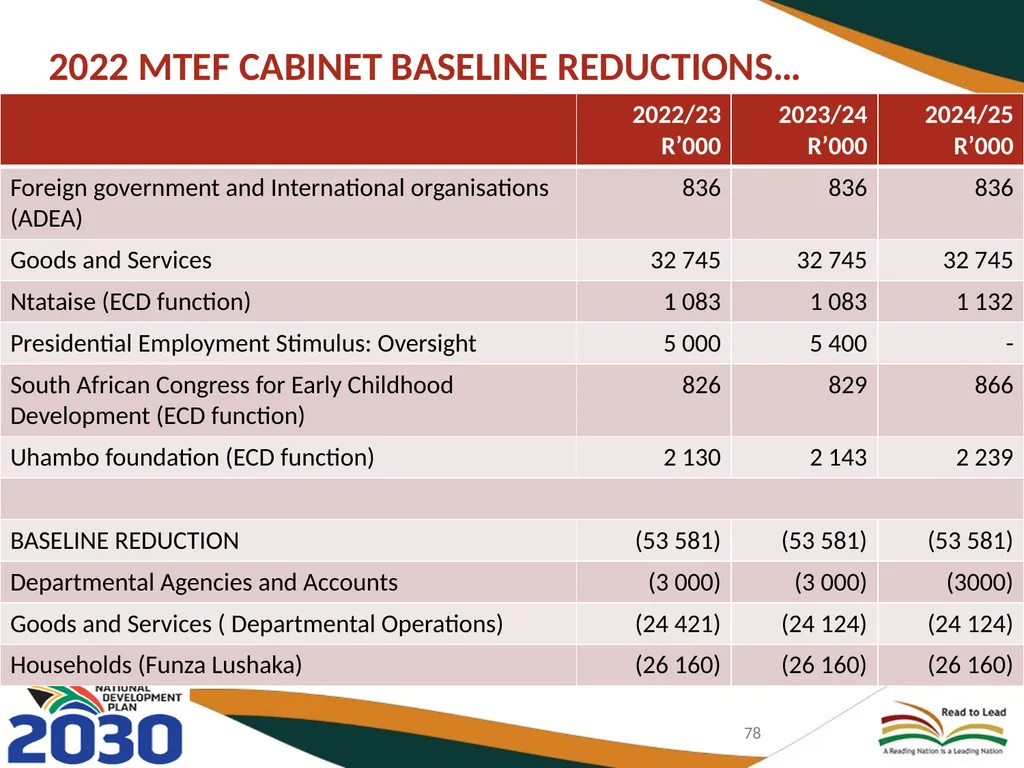
slide78. 2022 MTEF CABINET BASELINE REDUCTIONS… 78<br>
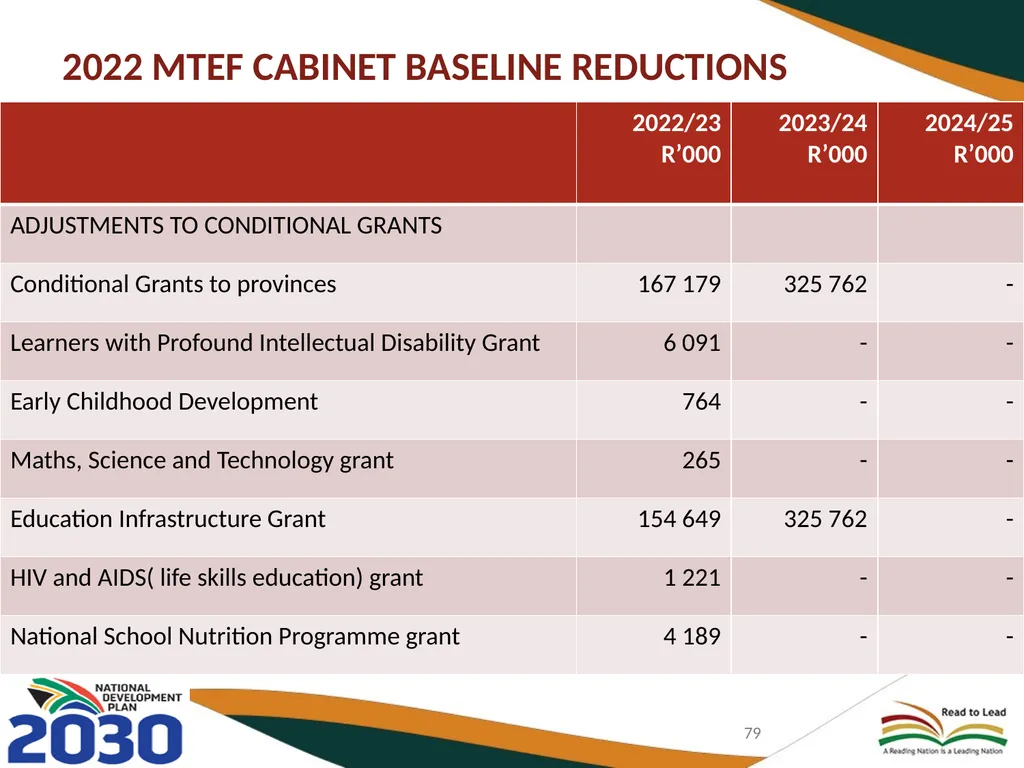
slide79. 2022 MTEF CABINET BASELINE REDUCTIONS 79<br>
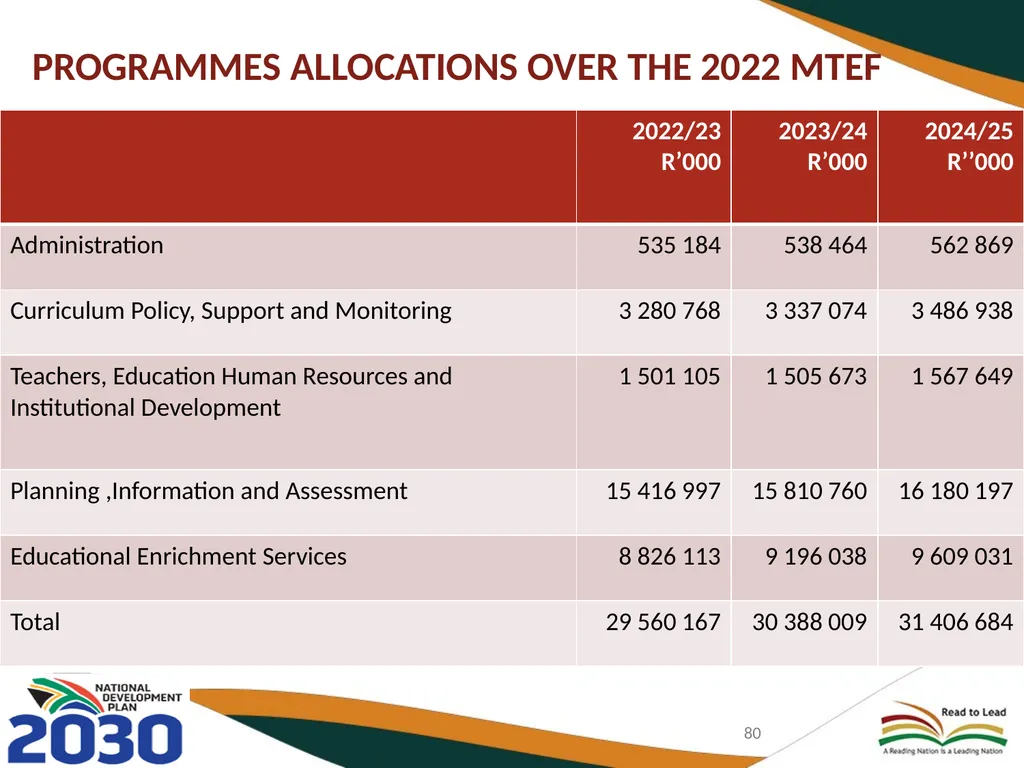
slide80. PROGRAMMES ALLOCATIONS OVER THE 2022 MTEF 80<br>
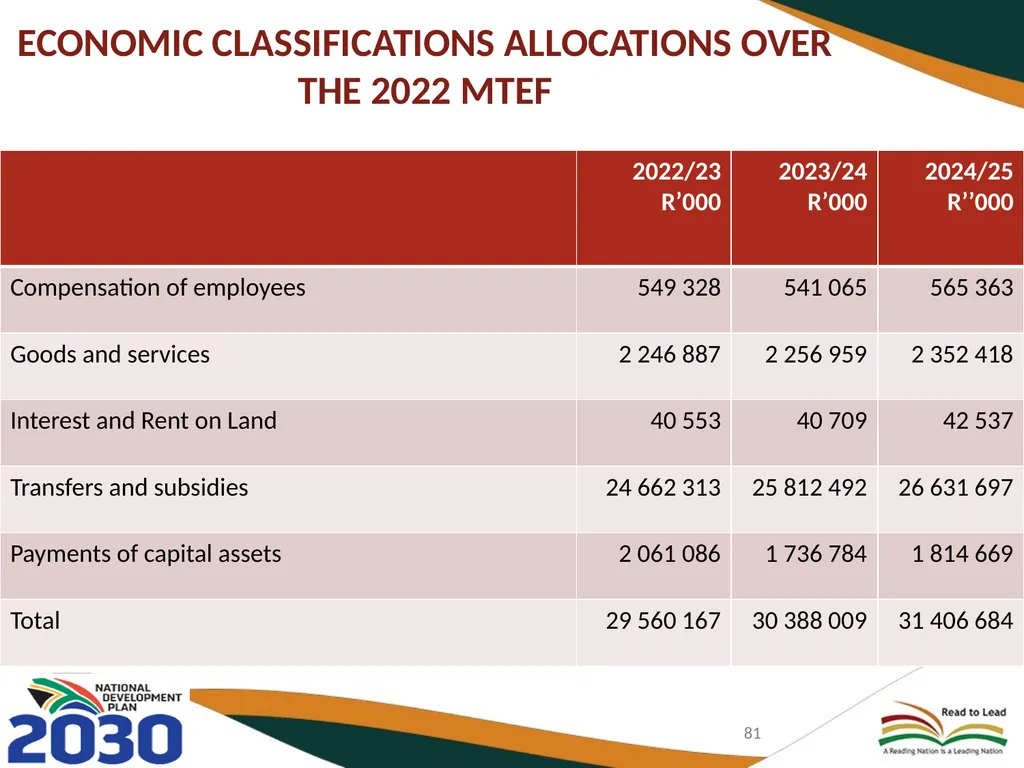
slide81. ECONOMIC CLASSIFICATIONS ALLOCATIONS OVER THE 2022 MTEF 81<br>
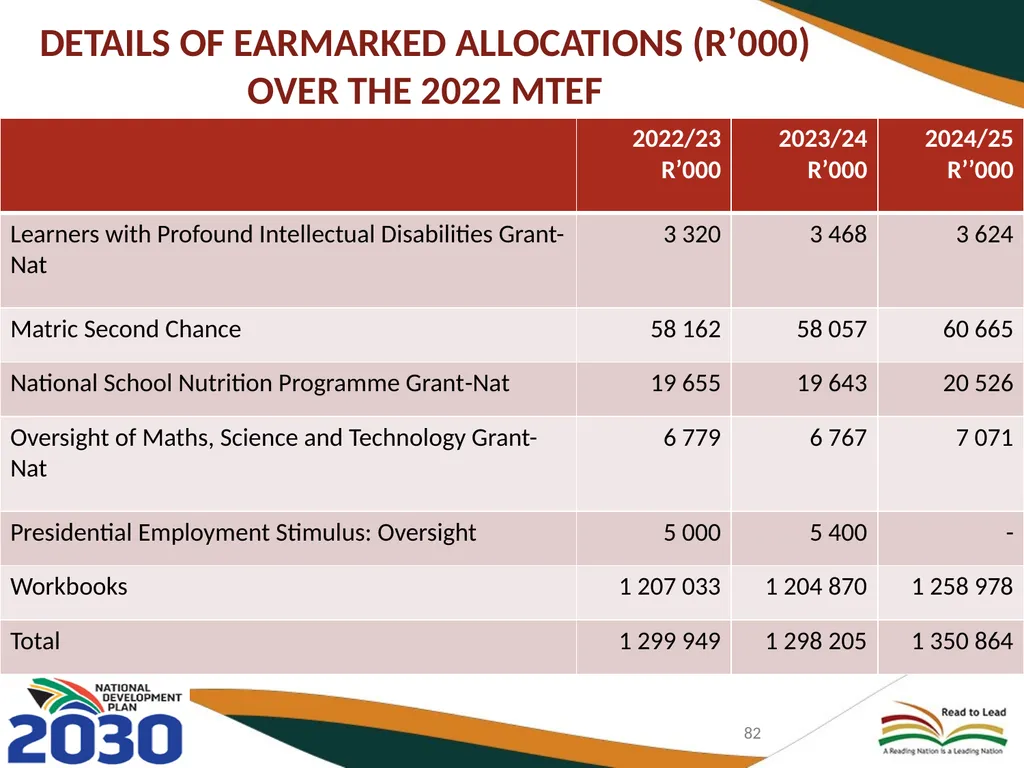
slide82. DETAILS OF EARMARKED ALLOCATIONS (R’000) OVER THE 2022 MTEF 82<br>
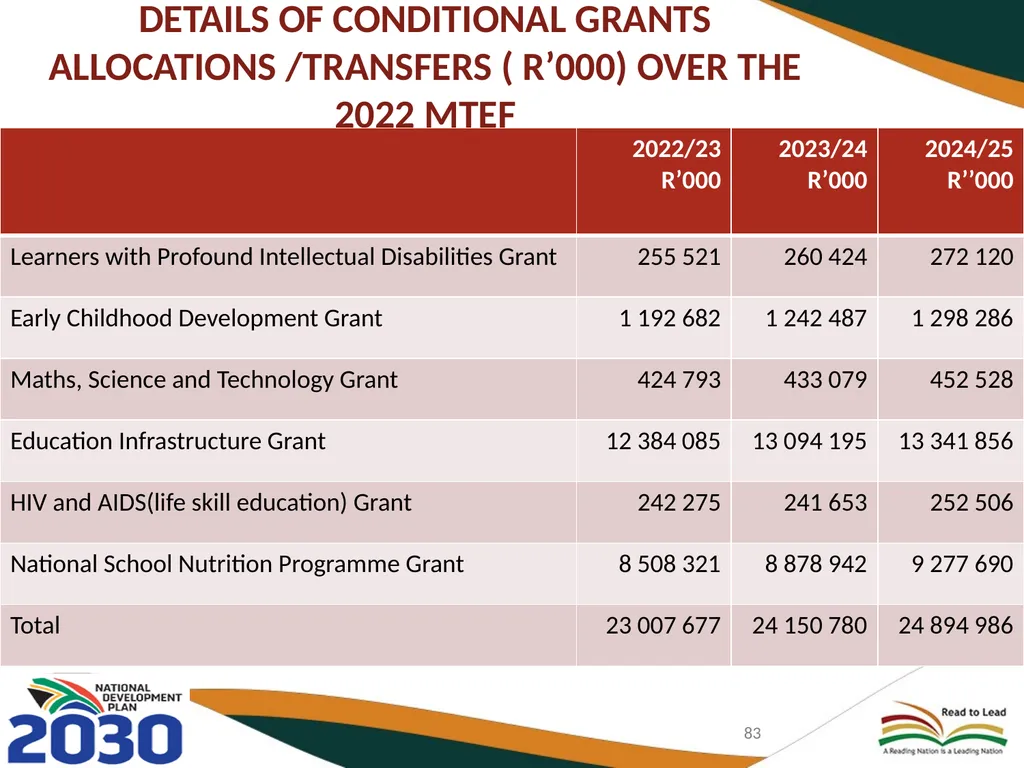
slide83. DETAILS OF CONDITIONAL GRANTS ALLOCATIONS /TRANSFERS ( R’000) OVER THE 2022 MTEF 83<br>
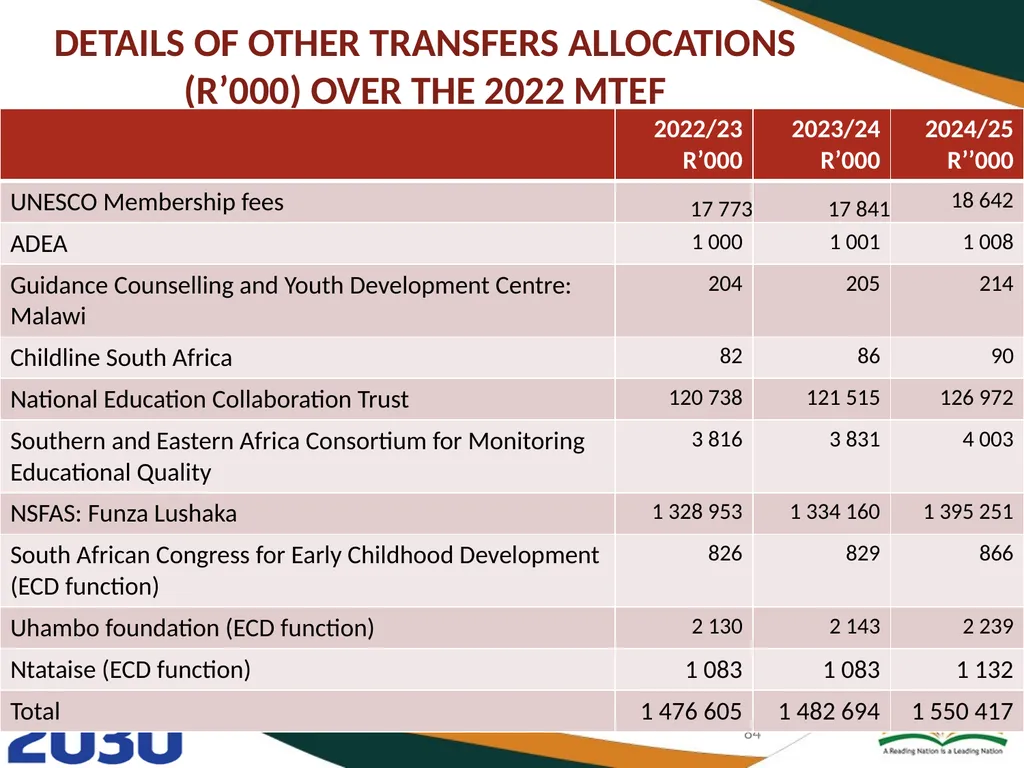
slide84. DETAILS OF OTHER TRANSFERS ALLOCATIONS (R’000) OVER THE 2022 MTEF 84<br>
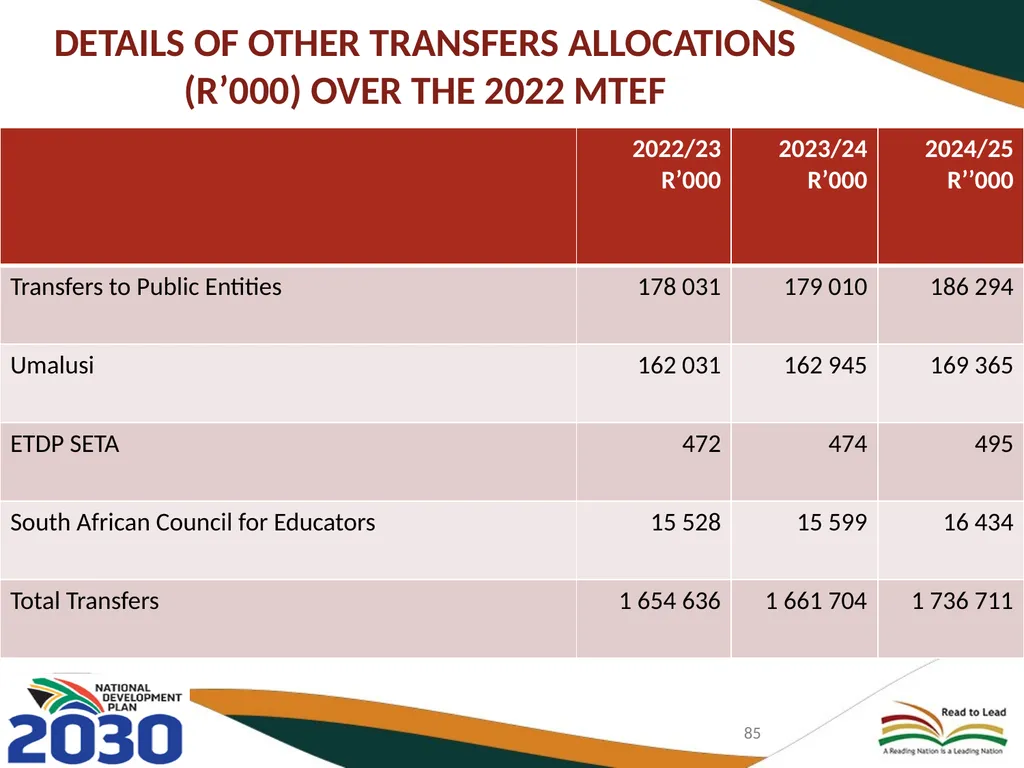
slide85. DETAILS OF OTHER TRANSFERS ALLOCATIONS (R’000) OVER THE 2022 MTEF 85<br>
slide86. RECOMMENDATION It is recommended that the Portfolio on Basic Education note and discuss the DBE Annual Performance Plan 2022/23. 86<br>
slide87. 87<br>
15 March 2022 1<br>
slide2. PRESENTATION OUTLINE Purpose
Size and Shape of the Basic Education Sector
Background
Government priorities
2019-2024 Medium-Term Strategic Framework (MTSF) and Education Sector Priorities
Action Plan to 2024: Towards the Realisation of Schooling 2030
Council of Education Ministers (CEM) priorities
State of the Nation Address (SoNA) 2021/ 2022
Progress on selected deliverables (Including Infrastructure, Learning/Materials)
ECD Function Shift
Annual plans towards long term outcomes.
Linking MTSF outcomes to APP – approach and Strategic outcomes
The DBE APP 2022/23 development process
DBE SP 2020/21-2024/25
The DBE APP 2022/23
2022 Budget Allocation
Recommendation 2<br>
slide3. PURPOSE To present the Department of Basic Education (DBE) Annual Performance Plan (APP) 2022/23 to the Portfolio on Basic Education. 3<br>
slide4. SIZE AND SHAPE OF THE BASIC EDUCATION SECTOR, 2021 Size of the Schooling System:
Learners: 13 409 249
Educators: 447 123
Schools: 24 894
Official languages
English, isiZulu, isiXhosa, isiNdebele, Afrikaans, siSwati, Sepedi, Sesotho, Setswana, Tshivenda, Xitsonga, South African Sign Language 4<br>
slide5. BACKGROUND The presentation outlines the approach to Government-wide NDP priorities and the Education sector priorities based on the NDP 2030, MTSF 2019-2024 and Action Plan to 2024. The intention is to ensure programme activities in the sector to align with medium and long- term goals.
The Strategic Plan 2020/21-2024/25 is anchored on the Government’s long-term plan; the National Development Plan 2030: Our future – make it work, the MTSF 2019-2024 and the Action Plan to 2024.
The Annual Performance Plan (APP) sets out what the Department intends doing in the financial year and during the Medium-Term Expenditure Framework (MTEF) period to implement its Strategic Plan.
In fulfilling its legal obligation, the Department must produce and table an APP annually to Parliament. The Strategic Plan should cover a period of at least five years and can be amended during the five-year period it covers.
The APP 2022/23 represents the third year activities towards achieving the objectives contained in the DBE Strategic Plan 2020/21-2024/25. 5<br>
slide6. LEARNING LOSSES Since its outbreak two years ago, the COVID-19 pandemic has disrupted education systems globally, affecting the most vulnerable learners the hardest.
It has increased inequalities and aggravated a pre-existing education crisis.
Enrolment in the first quarter of 2021 was around 50 000 (0.4%) lower than expected.
The problem concentrated in lower grades.
54% of contact time was lost in 2020 due to closures and rotations.
In the second half of 2021, 22% of contact was time lost due to rotations and
regular absenteeism.
These averages hide huge inequalities across grades and schools.
In historically disadvantaged schools, around 70% of a year’s worth of learning was lost in 2020.
For every day of schooling lost, around 1.3 days of learning are lost. 6<br>
slide7. KEY GOVERNMENT PRIORITIES The MTSF 2019–2024 translates the ruling party’s electoral mandate into government’s priorities over a five-year period. The Basic Education is critical in priority 2,3, 4 and 6:
Priority 1: A capable, ethical and developmental state.
Priority 2: Economic transformation and job creation.
Priority 3: Education, skills and health.
Priority 4: Consolidating the social wage through reliable and quality basic services.
Priority 5: Spatial integration, human settlements and local government.
Priority 6: Social cohesion and safe communities.
Priority 7: A better Africa and world. 7<br>
slide8. 2019-2024 MEDIUM-TERM STRATEGIC FRAMEWORK (MTSF) AND EDUCATION SECTOR PRIORITIES 8<br>
slide9. 2019 – 2024 MEDIUM TERM STRATEGIC FRAMEWORK (MTSF) OUTCOMES Outcome 1: Improved school-readiness of children.
Outcome 2: 10-year-old learners enrolled in publicly funded schools read for meaning.
Outcome 3: Youths better prepared for further studies and the world of work beyond Grade 9.
Outcome 4: Youths leaving the schooling system more prepared to contribute towards a prosperous and equitable South Africa.
Outcome 5: School physical infrastructure and environment that inspires learners to learn and teachers to teach. 9<br>
slide10. ACTION PLAN TO 2024: TOWARDS THE REALISATION OF SCHOOLING 2030 10<br>
slide11. ACTION PLAN TO 2024 The Action Plan to 2024: Towards the Realisation of Schooling 2030 is the sector plan for basic education.
It has been reviewed and strengthened for the 2020-2024 planning cycle.
The Action Plan is based on 27 national goals that are intended to improve basic education across all levels.
13 of these goals, are output goals, dealing with better school results and better enrolment of learners in schools.
The remaining 14 goals deal with things that must happen for the output goals to be realised. 11<br>
slide12. Action Plan to 2024:
Towards the realisation of Schooling 2030
(access, redress, equity, inclusivity, quality, & efficiency) Goals 1 to 13:
Improved Learning Outcomes
Improve learning outcomes in Language, Mathematics and Science as measured in Grades 3, 6, 9 and 12
Ensure full access to compulsory schooling
Decrease grade repetition and retention
Improve access to Further Education and Training (FET) colleges
Improve quality of Grade R Goals 14 to 27:
Interventions - the ‘how to Improve Learning Outcomes’ Apex priorities during the pandemic Early Childhood Development Infrastructure Learning Losses 12<br>
slide13. COUNCIL OF EDUCATION MINISTERS (CEM) PRIORITIES FOR THE SIXTH ADMINISTRATION 13<br>
slide14. STATE OF THE NATION ADDRESS (SoNA) 14<br>
slide15. SIGNIFICANCE OF SONA Presidential pronouncements set the key government priorities and deliverables for the year:
In turn determine the priorities of the DBE and the basic education sector broadly.
The pronouncements commit the DBE in public, to key activities and outcomes.
Alignment to current annual plans of those key areas have tangible implications not only for the DBE but for the sector. 15<br>
slide16. SONA 2021 Learning Disruptions and Issues affecting learners
“Schooling disruption placed a huge burden on learners, teachers and families.”
“It is our priority for this year to regain lost time and improve educational outcomes, from the early years through to high school and post-school education and training.”
Early Childhood Development (ECD) and Early Learning
“Equally we need to give attention to issues affecting children including improving school-readiness, ECD planning and funding.” 16<br>
slide17. SONA 2022 School Infrastructure
“Government is introducing an innovative social infrastructure delivery mechanism to address issues that afflict the delivery of school infrastructure. The mechanism will address the speed, financing and funding, quality of delivery, mass employment and maintenance.”
Educator assistants
“Over half a million young people appointed as education assistants, making it the largest youth employment programme ever undertaken in our history.”
Learning losses
“As we return to normal educational activity, we will work harder to ensure that all learners and students get the quality education they need and deserve.” 17<br>
slide18. PROGRESS ON SELECTED KEY DELIVERABLES 18<br>
slide19. ASIDI OVERALL PROGRESS PER SUB-PROGRAMME 28 Feb 2022 Cumulative ASIDI Summary from inception 19<br>
slide20. NSC PERFORMANCE 2015 - 2021 There was a significant increase in the number of full-time enrolments in 2021 academic year increasing from 610 484 in 2020 to 733 917 in 2021.
This has resulted in an increase on candidates who wrote the 2021 NSC from 578 468 in 2020 to 704 021 thereby a positive difference of 0.2%. 20<br>
slide21. BACHELOR PASS (NUMBERS) PER PROVINCE 2021 21<br>
slide22. SPECIAL NEEDS EDUCATION (SNE) LEARNERS WHO PASSED NSC IN 2021 The core promise of the National Development Plan’s Vision 2030 is to leave no one behind, and the DBE aims to fulfil this commitment towards persons with disabilities.
A total of 1 937 learners with Special Needs Education have achieved their NSC qualification. The following breakdown of qualification types have been achieved: 22<br>
slide23. PROGRAMME 2 Workbooks 2021 Delivery Status: All Provinces (Volume 1 Grades 1 - 9 and Grade R) 23<br>
slide24. PROGRAMME 3… Funza Lushaka Placement rates Source: PERSAL December 2021 and PED reports 24<br>
slide25. PROGRAMME 3… Allocated posts filled per province Source: PERSAL, December 2021 25<br>
slide26. PROGRAMME 3 Percentage of schools that had all their allocated posts filled by interval per province Source: PERSAL, December 2021 26<br>
slide27. PROGRAMME 5… National School Nutrition Programme (NSNP) schools National School Nutrition Programme (NSNP) schools 27<br>
slide28. PROGRAMME 5… National School Nutrition Programme (NSNP) learners 28<br>
slide29. EARLY CHILDHOOD DEVELOPMENT (ECD) FUNCTION SHIFT 29<br>
slide30. ECD FUNCTION SHIFT PROGRESS Service Delivery: Three (3) modalities for offering ECD
Quality assurance, registration, capacity and systems urgently needed to achieve NDP goals
Institutional arrangements and function shift
The Minister and Department of Basic Education (DBE) will receive the responsibility for the ECD function on 1 April 2022 through the Proclamation signed by the President on 27 June 2021.
The Minister of Finance tabled the function shift in the Medium Term Budget Policy Statement.
Planning, data and information
Census of all Early Learning Programmes: Collected data in 37 000 ECD programmes, provided services to 1.5 million children.
Early Years Index and baseline assessment of Early Learning Programmes: The data collection was completed.
Registration system under development, adapted for use. 30<br>
slide31. ECD APPROACH TO Service Delivery: Three (3) modalities for offering ECD 31<br>
slide32. ECD FUNCTION SHIFT PROGRESS Coordination and change management critical
Educational Management Information Systems (EMIS)
Human Resources (HR)
Funding – expenditure review and funding
Institutional arrangements and business process
Capacity development and preparation in sector
New function and new system
New service delivery arrangements
Reporting and coordination through HEDCOM and interprovincial forum
New planning and other arrangements 32<br>
slide33. ANNUAL PLANS TOWARDS LONG TERM OUTCOMES 33<br>
slide34. APPROACH TO DBE OUTCOMES IN THE STRATEGIC AND ANNUAL PERFORMANCE PLANS The outcomes are broad to consolidate work contributed by the sector to encourage joint planning than working in silos by individual programmes to reflect the aspirations at an organisational level including the support to PEDs.
The approach to outcomes assists with clustering delivery areas which relate to strategic outcomes thereby enabling new and emerging interventions to impact the Basic Education system meaningfully.
The strategic delivery areas and outputs bridge the gap between medium-to-long-term outcomes, short-term annual outputs and indicators in describing the intended change for the education system.
The process and approach to planning have applied the use of the Theory of Change to map the changes and impact of the Department, also using the Results Model to identify the critical success factors and deliverables of the sector in the implementation of the strategic intent.
The DBE Strategic Outcomes have been slightly amended for strengthening. Amendments are reflected on Annexure A of the APP. 34<br>
slide35. REVISIONS TO DBE OUTCOMES 35<br>
slide36. LINK BETWEEN MTSF OUTCOMES AND DBE APP (DBE OUTCOMES AND OUTPUTS) 36<br>
slide37. LINK BETWEEN MTSF OUTCOMES AND DBE APP (DBE OUTCOMES AND OUTPUTS) 37<br>
slide38. LINK BETWEEN MTSF OUTCOMES AND DBE APP (DBE OUTCOMES AND OUTPUTS) 38<br>
slide39. THE DBE APP 2022/23 DEVELOPMENT PROCESS 39<br>
slide40. 2022/23 DBE APP DEVELOPMENT PROCESS 40<br>
slide41. DPME FINDINGS ON DRAFT APP 41<br>
slide42. DWYPD FINDINGS ON DRAFT APP 42<br>
slide43. AGSA FINDINGS ON DRAFT APP 43<br>
slide44. MTSF AREAS TO BE STRENGTHENED IN PROVINCIAL AND NATIONAL APPs Introduce a better accountability system for principals, which should be fair, based on appropriate data, and take into account the socio-economic context of schools.
Some provinces have started the political and technical work around looking at accounting for performance in terms of learning outcomes and organisational effectiveness to support this at school level.
Promote a comprehensive package of effective Teacher development, such as Professional Learning Communities (PLCs) and technology-enhanced in-service training.
Teacher development packages and spend disaggregated by phase, subject and district will have to also include some reflection on impact.
The plans for the functions of the NICPD need to be clearly articulated in terms of progress.
The Sector has 20 Standard Output Indicators (SOIs) approved for 2022/23 that aim to ensure Alignment, Uniformity, Accountability, Comparability and benchmarking and Track progress for the sector priorities.
The SOI’s will be increased to sufficiently cover other areas of the MTSF such as Strengthened Numeracy, Reading and ECD indicators which are linked to outcomes in the 2023/24 financial year. 44<br>
slide45. FEEDBACK FROM CABINET ON THE DBE MTSF REPORT 45<br>
slide46. FEEDBACK FROM CABINET ON THE DBE MTSF REPORT 46<br>
slide47. STRATEGIC PLAN 2020/21-2024/25 IMPACT STATEMENT, OUTCOMES AND INDICATORS 47<br>
slide48. STRATEGIC PLAN 2020/21-2024/25 IMPACT STATEMENT, OUTCOMES AND INDICATORS 48<br>
slide49. THE DBE STRATEGIC PLAN 2020/21-2024/25 49<br>
slide50. STRATEGIC PLAN 2020/21-2024/25 IMPACT STATEMENT, OUTCOMES AND INDICATORS 50<br>
slide51. STRATEGIC PLAN 2020/21-2024/25 IMPACT STATEMENT, OUTCOMES AND INDICATORS 51<br>
slide52. STRATEGIC PLAN 2020/21-2024/25 IMPACT STATEMENT, OUTCOMES AND INDICATORS 52<br>
slide53. STRATEGIC PLAN 2020/21-2024/25 IMPACT STATEMENT, OUTCOMES AND INDICATORS 53<br>
slide54. STRATEGIC PLAN 2020/21-2024/25 IMPACT STATEMENT, OUTCOMES AND INDICATORS 54<br>
slide55. THE DBE ANNUAL PERFORMANCE PLAN 2022/23 55<br>
slide56. 2022/23 ANNUAL PERFORMANCE PLAN The Annual Performance Plan is divided into four (4) parts:
Part A: Mandate
Part B: Strategic Focus
Part C: Measuring Our Performance
Part D: Technical Indicator Descriptions (TIDs) 56<br>
slide57. PROGRAMMES OF THE DBE The activities of the DBE have been structured into five (5) programmes as elaborated in the Annual Performance Plan:
PROGRAMME 1: ADMINISTRATION
PROGRAMME 2: CURRICULUM POLICY, SUPPORT AND MONITORING
PROGRAMME 3: TEACHERS, EDUCATION HUMAN RESOURCES AND INSTITUTIONAL DEVELOPMENT
PROGRAMME 4: PLANNING, INFORMATION AND ASSESSMENT
PROGRAMME 5: EDUCATIONAL ENRICHMENT SERVICES 57<br>
slide58. 2022/23 APP PROGRAMME PERFORMANCE INDICATORS 58<br>
slide59. 2022/23 APP: INDICATORS REMOVED 59<br>
slide60. 2022/23 APP: NEW INDICATORS 60<br>
slide61. 2022/23 APP: PROGRAMME 1 61<br>
slide62. 2022/23 APP: PROGRAMME 2 62<br>
slide63. 2022/23 APP: PROGRAMME 2 63<br>
slide64. 2022/23 APP: PROGRAMME 2 64<br>
slide65. 2022/23 APP: PROGRAMME 2 65<br>
slide66. 2022/23 APP: PROGRAMME 2 66<br>
slide67. 2022/23 APP: PROGRAMME 2 67<br>
slide68. 2022/23 APP: PROGRAMME 2 68<br>
slide69. 2022/23 APP: PROGRAMME 3 69<br>
slide70. 2022/23 APP: PROGRAMME 3 70<br>
slide71. 2022/23 APP: PROGRAMME 3 71<br>
slide72. 2022/23 APP: PROGRAMME 4 *-No targets for 2023/24 and 2024/25 because the ASIDI project will come to an end by March 2023. 72<br>
slide73. 2022/23 APP: PROGRAMME 4 73<br>
slide74. 2022/23 APP: PROGRAMME 4 74<br>
slide75. 2022/23 APP: PROGRAMME 5 75<br>
slide76. 2022 BUDGET ALLOCATIONS 76<br>
slide77. 2022 MTEF CABINET BASELINE REDUCTIONS… 77<br>
slide78. 2022 MTEF CABINET BASELINE REDUCTIONS… 78<br>
slide79. 2022 MTEF CABINET BASELINE REDUCTIONS 79<br>
slide80. PROGRAMMES ALLOCATIONS OVER THE 2022 MTEF 80<br>
slide81. ECONOMIC CLASSIFICATIONS ALLOCATIONS OVER THE 2022 MTEF 81<br>
slide82. DETAILS OF EARMARKED ALLOCATIONS (R’000) OVER THE 2022 MTEF 82<br>
slide83. DETAILS OF CONDITIONAL GRANTS ALLOCATIONS /TRANSFERS ( R’000) OVER THE 2022 MTEF 83<br>
slide84. DETAILS OF OTHER TRANSFERS ALLOCATIONS (R’000) OVER THE 2022 MTEF 84<br>
slide85. DETAILS OF OTHER TRANSFERS ALLOCATIONS (R’000) OVER THE 2022 MTEF 85<br>
slide86. RECOMMENDATION It is recommended that the Portfolio on Basic Education note and discuss the DBE Annual Performance Plan 2022/23. 86<br>
slide87. 87<br>