BILC Seminar Copenhagen, Denmark, October 2019 Maj David Gibb, SO2 Defence Requirements Authority for Culture and Language Requirement Setting a UK perspective UK Delegation Defence Requirements Authority for Culture and Language
"BILC Seminar – Copenhagen, Denmark, October 2019" is the property of its rightful owner. Permission is granted to
download and print the materials on this website for personal, non-commercial use only, and to display it
on your personal computer provided you do not modify the materials and that you retain all copyright
notices contained in the materials. By downloading content from our website, you accept the terms of this
agreement.
Presentation Transcript
01
BILC Seminar – Copenhagen, Denmark, October 2019
Maj David Gibb, SO2 Defence Requirements Authority for Culture and Language Requirement Setting – a UK perspective<br>
02
UK Delegation
Defence Requirements Authority for Culture and Language (DRACL):
Maj David Gibb
Defence Centre for Languages and Culture (DCLC):
Capt Callum McMillan
Ms Nadine Wood<br>
03
Scope Seminar theme: “Setting and achieving proficiency targets: the ‘whats’ and ‘hows’ of effective teaching and training”.
Aim of presentation: To outline the UK’s approach to setting Defence foreign language requirements.<br>
04
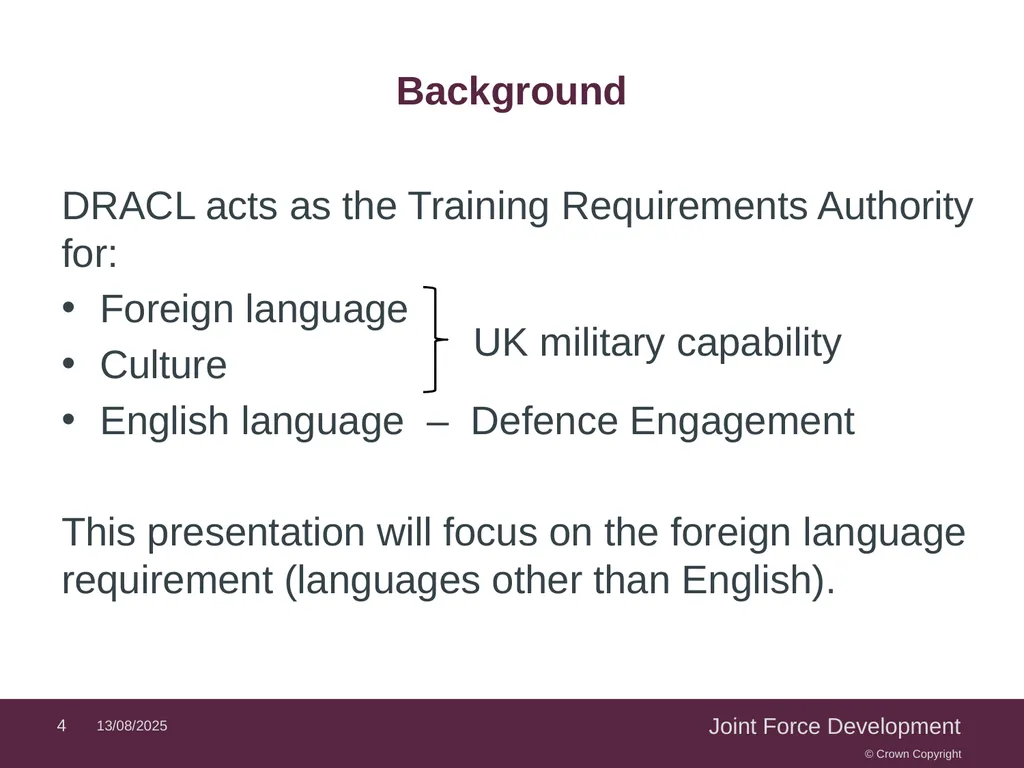
Background DRACL acts as the Training Requirements Authority for:
Foreign language
Culture
English language – Defence Engagement
This presentation will focus on the foreign language requirement (languages other than English). UK military capability<br>
05
Wider context – the cost to the UK of “language ignorance” Bilateral national trade analysis indicates the gross costs of language ignorance are high for the UK, despite English being a world language. 3.5% of national income in 2006 – £48bn – is a defensible estimate...
The Costs to the UK of Language Deficiencies as a Barrier to UK Engagement in Exporting: A Report to UK Trade & Investment – James Foreman-Peck and Yi Wang, Cardiff Business School, 2014 (https://assets.publishing.service.gov.uk/government/uploads/system/uploads/attachment_data/file/309899/Costs_to_UK_of_language_deficiencies_as_barrier_to_UK_engagement_in_exporting.pdf).<br>
06
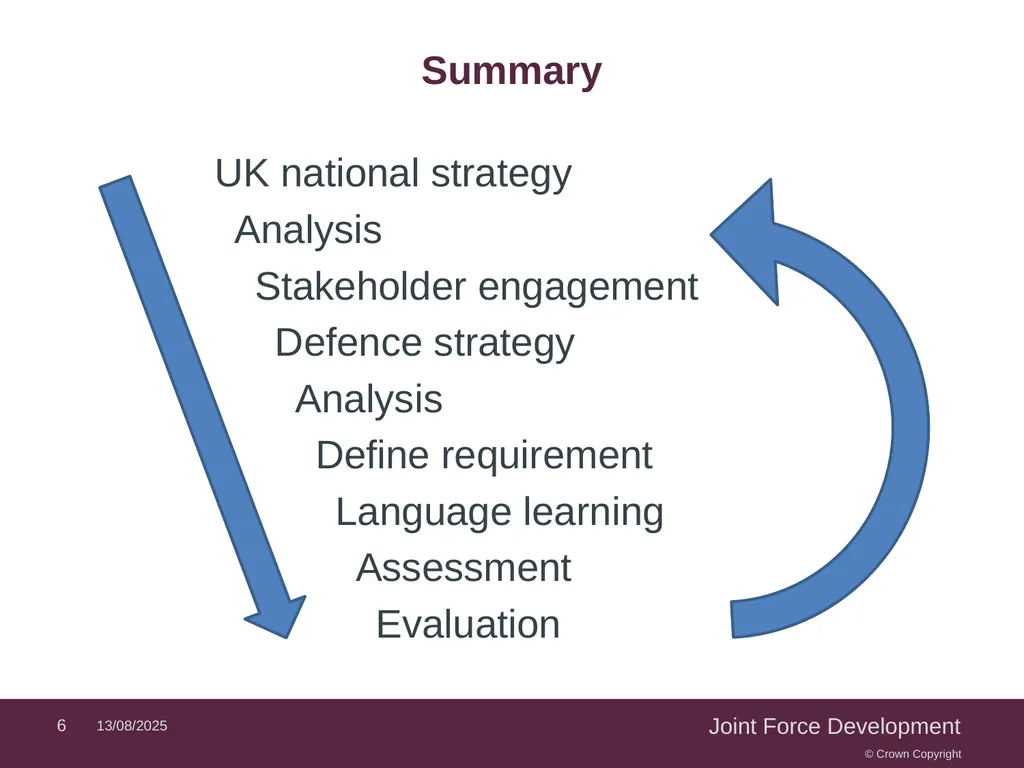
Summary UK national strategy
Analysis
Stakeholder engagement
Defence strategy
Analysis
Define requirement
Language learning
Assessment
Evaluation<br>
07
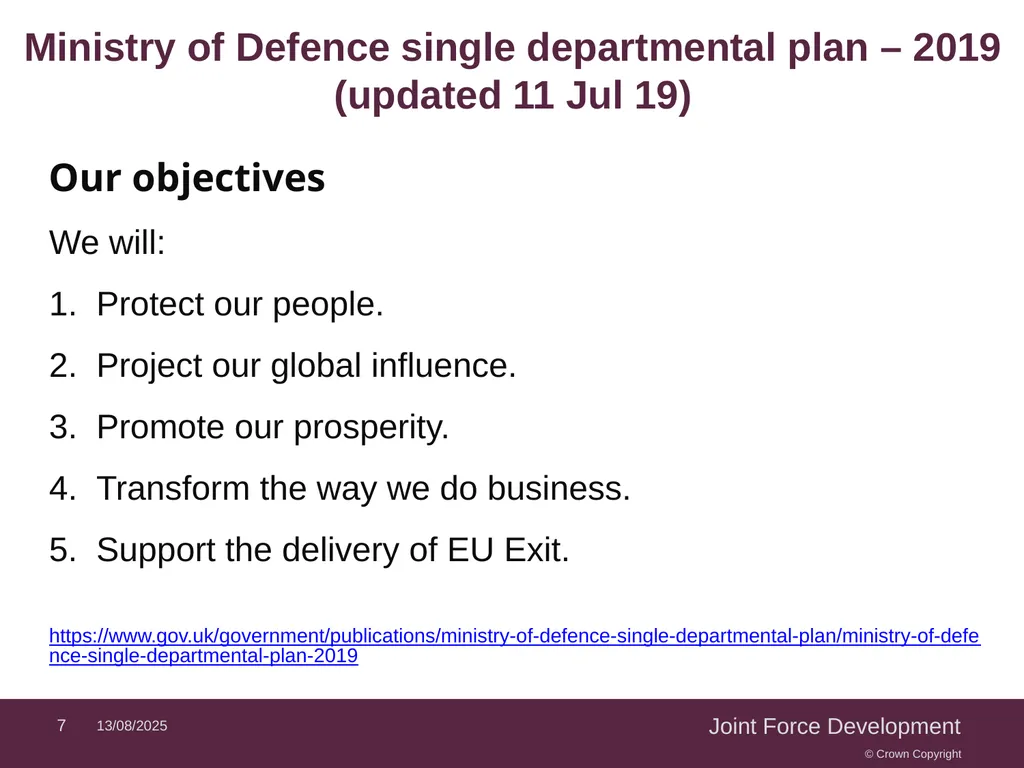
Ministry of Defence single departmental plan – 2019 (updated 11 Jul 19) Our objectives
We will:
Protect our people.
Project our global influence.
Promote our prosperity.
Transform the way we do business.
Support the delivery of EU Exit.
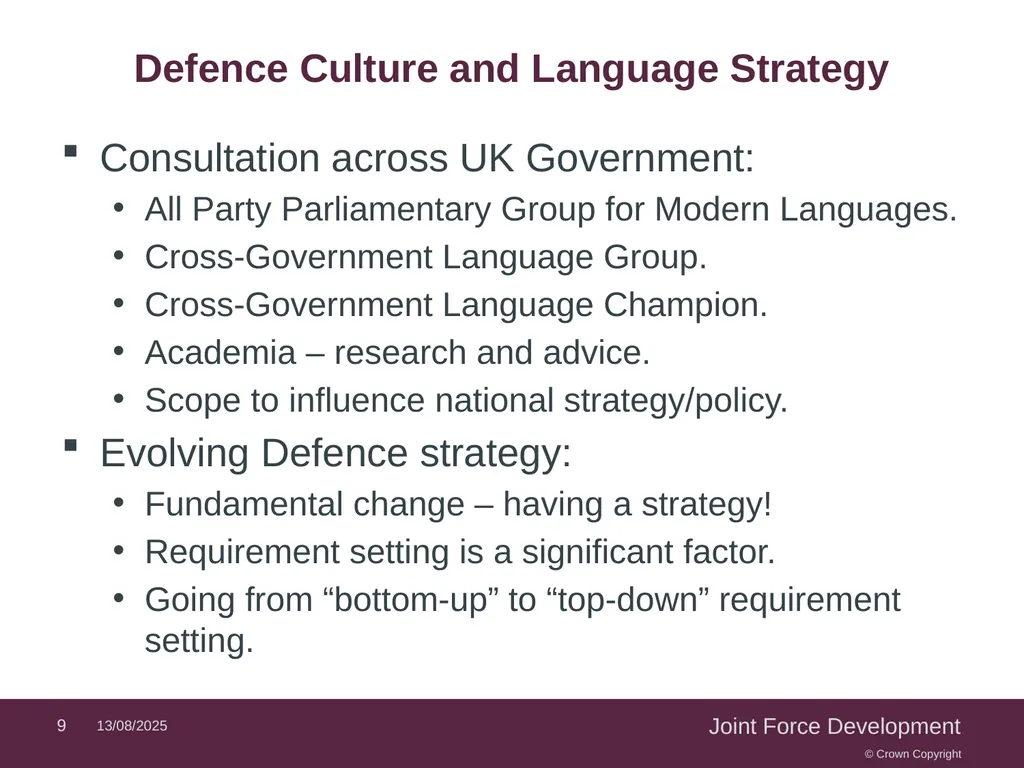
Defence Culture and Language Strategy Consultation across UK Government:
All Party Parliamentary Group for Modern Languages.
Cross-Government Language Group.
Cross-Government Language Champion.
Academia – research and advice.
Scope to influence national strategy/policy.
Evolving Defence strategy:
Fundamental change – having a strategy!
Requirement setting is a significant factor.
Going from “bottom-up” to “top-down” requirement setting.<br>
09
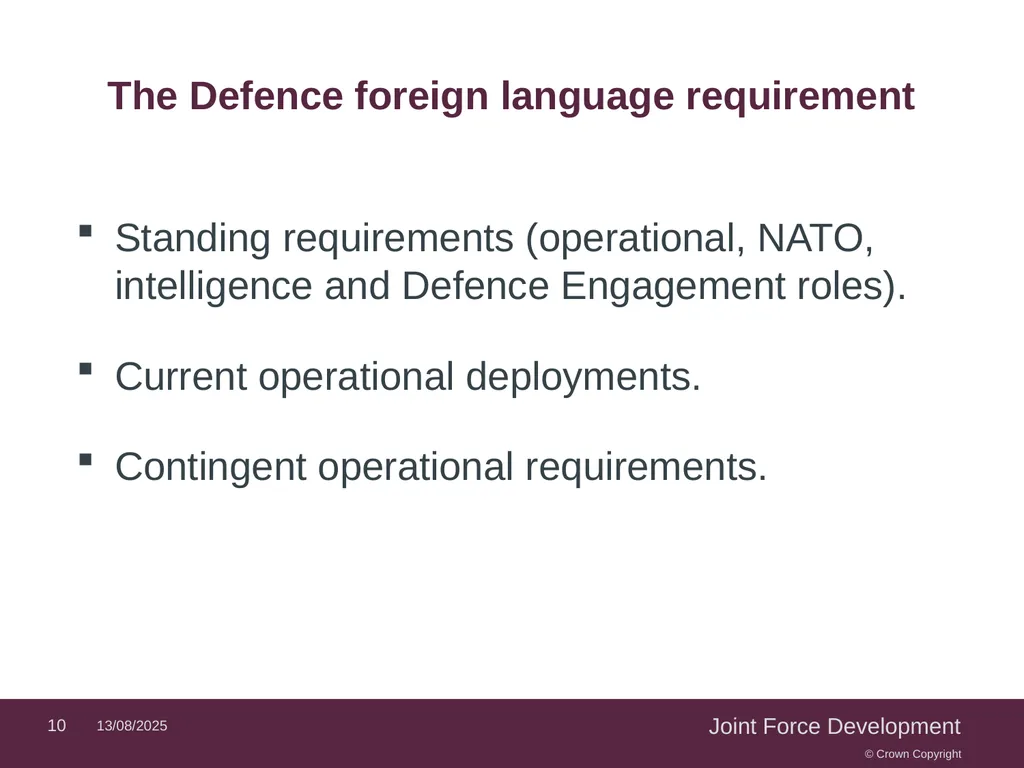
The Defence foreign language requirement Standing requirements (operational, NATO, intelligence and Defence Engagement roles).
Current operational deployments.
Contingent operational requirements.<br>
10
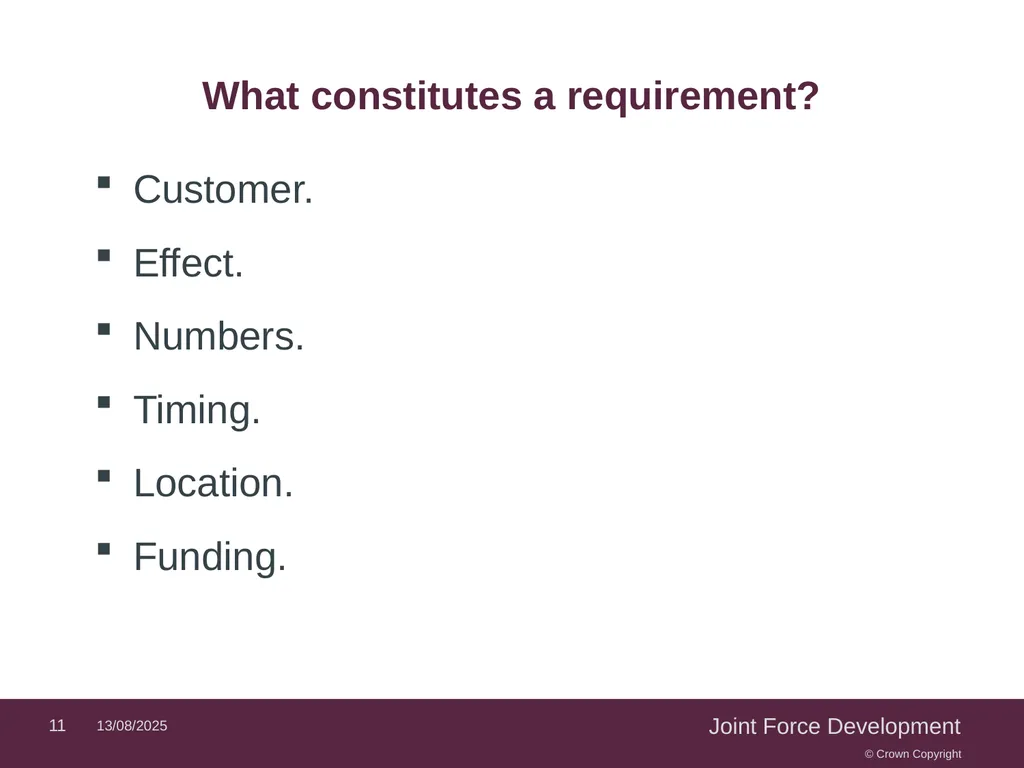
What constitutes a requirement? Customer.
Effect.
Numbers.
Timing.
Location.
Funding.<br>
11
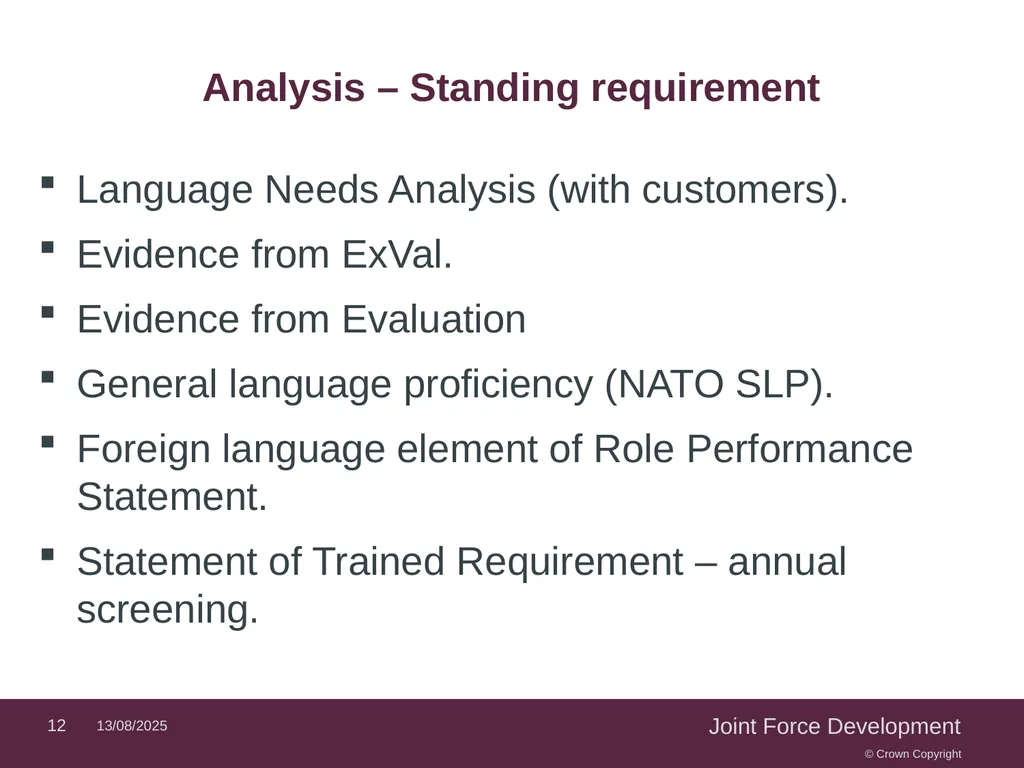
Analysis – Standing requirement Language Needs Analysis (with customers).
Evidence from ExVal.
Evidence from Evaluation
General language proficiency (NATO SLP).
Foreign language element of Role Performance Statement.
Statement of Trained Requirement – annual screening.<br>
12
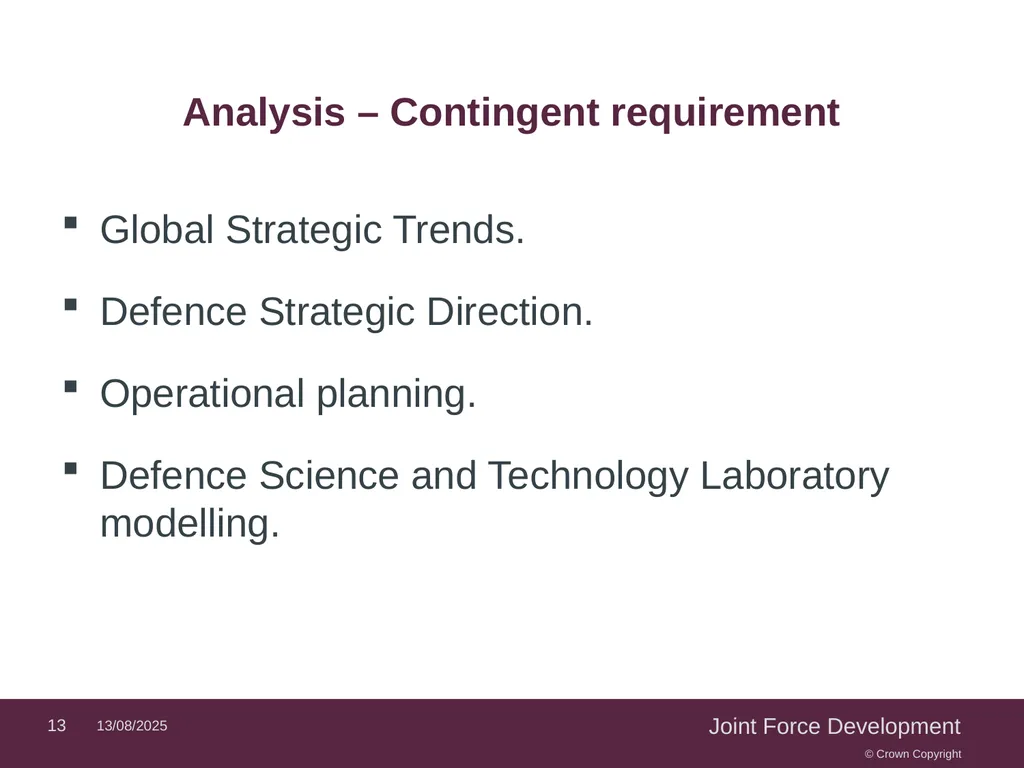
Analysis – Contingent requirement Global Strategic Trends.
Defence Strategic Direction.
Operational planning.
Defence Science and Technology Laboratory modelling.<br>
13
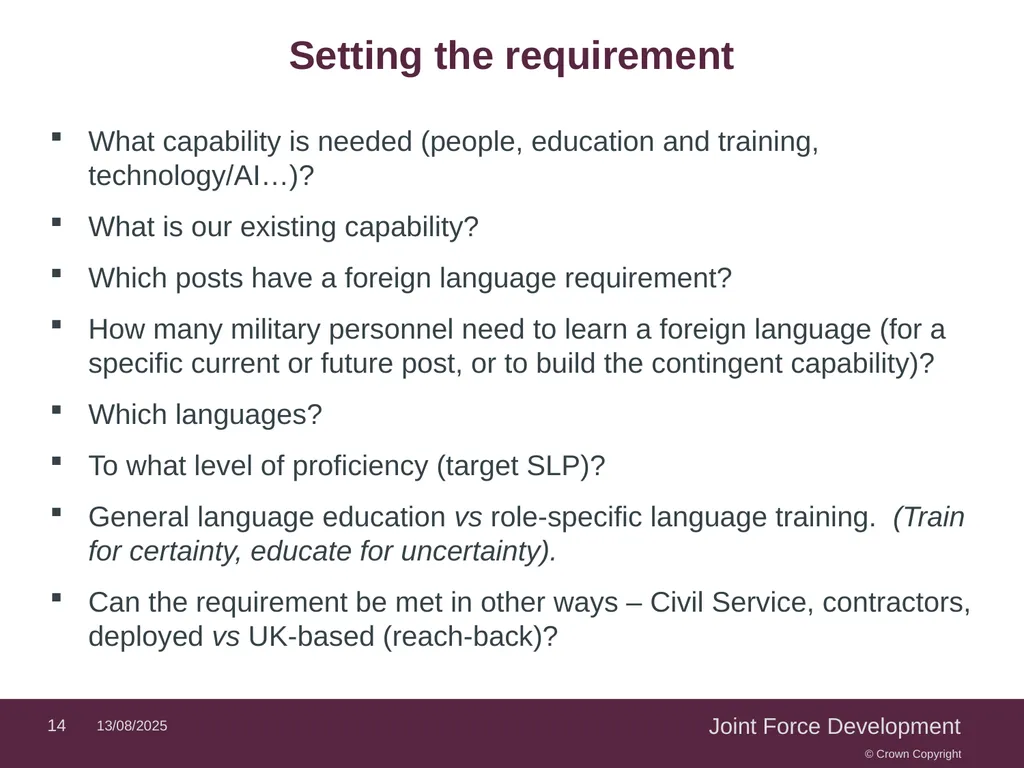
Setting the requirement What capability is needed (people, education and training, technology/AI…)?
What is our existing capability?
Which posts have a foreign language requirement?
How many military personnel need to learn a foreign language (for a specific current or future post, or to build the contingent capability)?
Which languages?
To what level of proficiency (target SLP)?
General language education vs role-specific language training. (Train for certainty, educate for uncertainty).
Can the requirement be met in other ways – Civil Service, contractors, deployed vs UK-based (reach-back)?<br>
14
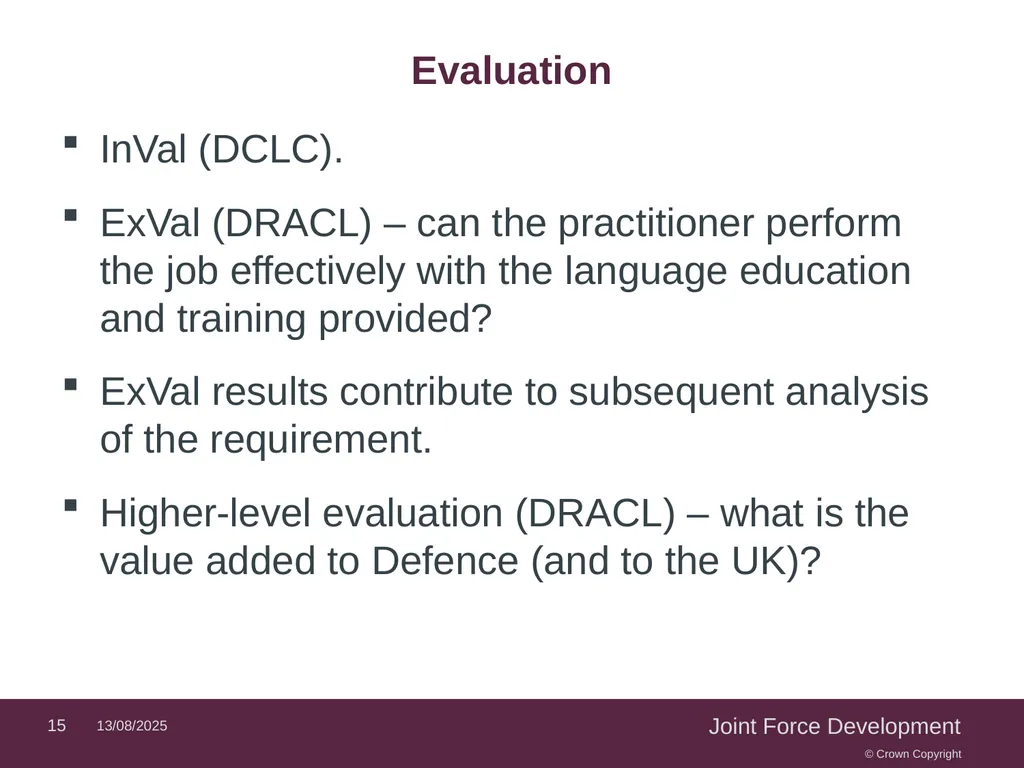
Evaluation InVal (DCLC).
ExVal (DRACL) – can the practitioner perform the job effectively with the language education and training provided?
ExVal results contribute to subsequent analysis of the requirement.
Higher-level evaluation (DRACL) – what is the value added to Defence (and to the UK)?<br>
15
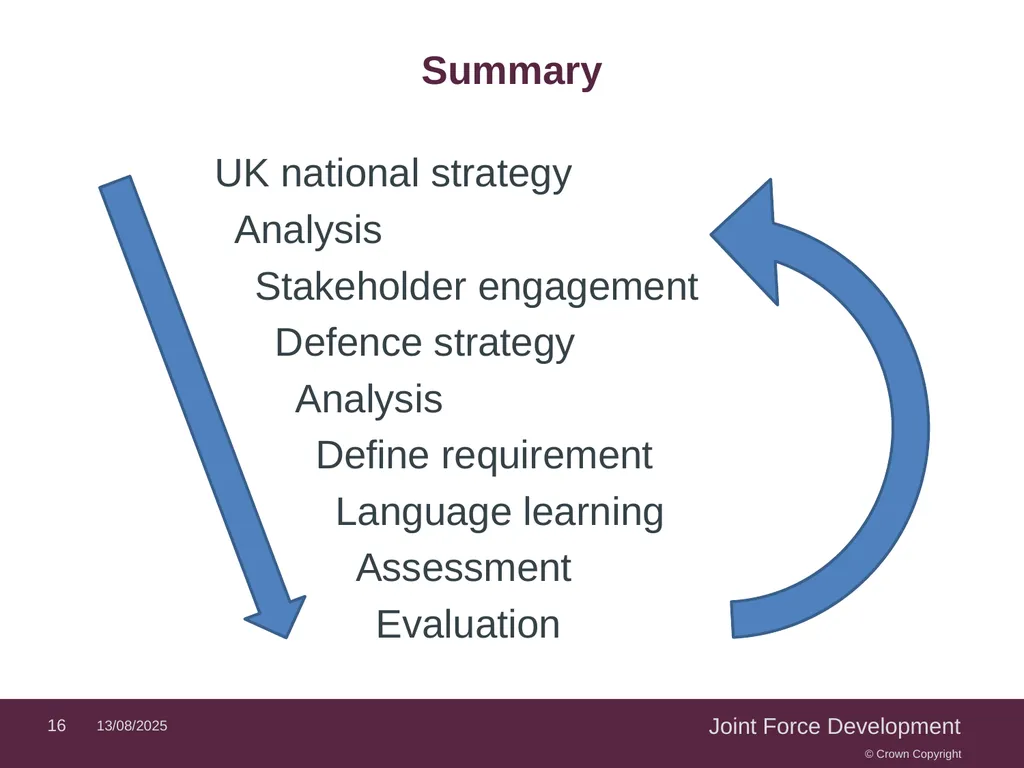
Summary UK national strategy
Analysis
Stakeholder engagement
Defence strategy
Analysis
Define requirement
Language learning
Assessment
Evaluation<br>
16
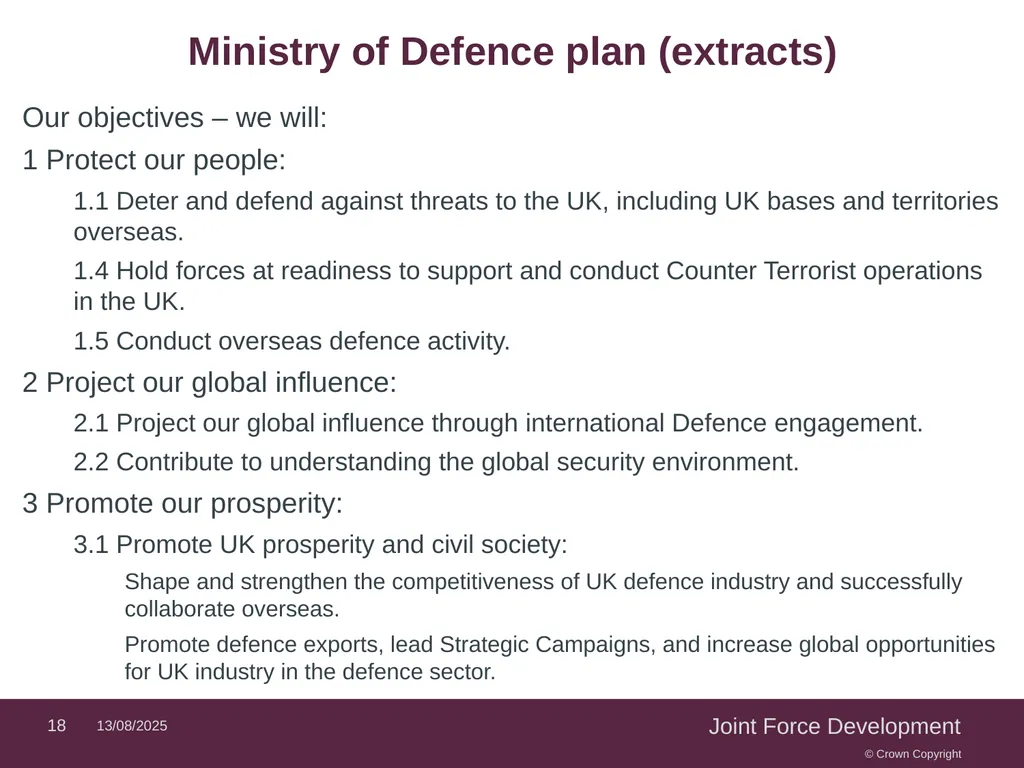
Ministry of Defence plan (extracts) Our objectives – we will:
1 Protect our people:
1.1 Deter and defend against threats to the UK, including UK bases and territories overseas.
1.4 Hold forces at readiness to support and conduct Counter Terrorist operations in the UK.
1.5 Conduct overseas defence activity.
2 Project our global influence:
2.1 Project our global influence through international Defence engagement.
2.2 Contribute to understanding the global security environment.
3 Promote our prosperity:
3.1 Promote UK prosperity and civil society:
Shape and strengthen the competitiveness of UK defence industry and successfully collaborate overseas.
Promote defence exports, lead Strategic Campaigns, and increase global opportunities for UK industry in the defence sector.<br>