
Chapter-4 PRINCIPLES OF SAFETY IN CONSTRUCTION
MY
Published · 64 slides · 0 views

1 / 1



Description
Chapter-4 PRINCIPLES OF SAFETY IN CONSTRUCTION PRINCIPLES OF SAFETY Constructing safe structures and providing safe working environment is a factor in successful construction business. Concern of safety starts from design stage and
Related Topics
Share
Embed code
Download this presentation From Below
"Chapter-4 PRINCIPLES OF SAFETY IN CONSTRUCTION" is the property of its rightful owner. Permission is granted to download and print the materials on this website for personal, non-commercial use only, and to display it on your personal computer provided you do not modify the materials and that you retain all copyright notices contained in the materials. By downloading content from our website, you accept the terms of this agreement.
Presentation Transcript
01
Chapter-4
PRINCIPLES OF SAFETY IN
CONSTRUCTION<br>
PRINCIPLES OF SAFETY IN
CONSTRUCTION<br>
02
PRINCIPLES OF SAFETY Constructing safe structures and providing safe working environment is a factor in successful construction business. Concern of safety starts from design stage and continues till the facility is delivered to the owner<br>
03
GENERAL PRINCIPLES OF SAFETY IN CONSTRUCTION Every large volume of construction project should have a safety department headed by a safety officer
Safety measures may be in cooperated as a clause in contract document
Previous safety record of a contractor is an important consideration in the pre qualification of contractor
Safety is a cost item developed without providing funds
0.2% of estimated cost of construction project is used for safety management
Safety education and training is the most important aspect of construction industry
Government needs to improve safety inspection and data collection
Contractor and trade unions in construction shall extend their concern to safety
Safety measures should start at planning and design stage itself.<br>
Safety measures may be in cooperated as a clause in contract document
Previous safety record of a contractor is an important consideration in the pre qualification of contractor
Safety is a cost item developed without providing funds
0.2% of estimated cost of construction project is used for safety management
Safety education and training is the most important aspect of construction industry
Government needs to improve safety inspection and data collection
Contractor and trade unions in construction shall extend their concern to safety
Safety measures should start at planning and design stage itself.<br>
04
Causes,effects and prevention of accidents Causes of accidents
Planning ,organisation
Defects in technical planning
Fixing unsuitable time limits
Assignment of work to incompetent contractors
Insufficient of defective supervision of the work
Lack of cooperation between different trades<br>
Planning ,organisation
Defects in technical planning
Fixing unsuitable time limits
Assignment of work to incompetent contractors
Insufficient of defective supervision of the work
Lack of cooperation between different trades<br>
05
Execution of works
Constructional defects
Use of unsuitable materials
Defective processing of materials
Equipment
Lack of equipment
Unsuitable equipment
Defects in equipment
Lack of safety devices or measures<br>
Constructional defects
Use of unsuitable materials
Defective processing of materials
Equipment
Lack of equipment
Unsuitable equipment
Defects in equipment
Lack of safety devices or measures<br>
06
Management and conduct of work
Inadequate preperation of work
Inadequate examination of equipment
Imprecise or inadequate instructions from supervisor
Unskilled or untrained operatives
Inadequate supervision
5.Workers behavior
Irresponsible acts
Unauthorised acts
Carelessness<br>
Inadequate preperation of work
Inadequate examination of equipment
Imprecise or inadequate instructions from supervisor
Unskilled or untrained operatives
Inadequate supervision
5.Workers behavior
Irresponsible acts
Unauthorised acts
Carelessness<br>
07
Effects of accidents Construction includes large number of methods-demolition,earthwork,digging shafts or tunnels,concreting,structural steel erections,drilling,piling,weldings and electrical fittings
All methods are hazardous and performed under normal working conditions by unskilled workers
Falls from scaffolds,ladders,roof and other heights ,failure of structure due to collapse,damage due to fire,other mishaps results in safety failures<br>
All methods are hazardous and performed under normal working conditions by unskilled workers
Falls from scaffolds,ladders,roof and other heights ,failure of structure due to collapse,damage due to fire,other mishaps results in safety failures<br>
08
PREVENTION OF ACCIDENTS First step in any accident prevention is to collect useful information about the accidents which have taken place in the organization
Evolve a proper accident monitoring system
Design of a system has proper orientation or prevention
Machinery or equipment must kept in safe condition
Slippery floors and dangerous stacking should be taken care of
Training should be given in safe operations of machines and handling of equipments to all new entrants
Arise safety consciousness among the employees<br>
Evolve a proper accident monitoring system
Design of a system has proper orientation or prevention
Machinery or equipment must kept in safe condition
Slippery floors and dangerous stacking should be taken care of
Training should be given in safe operations of machines and handling of equipments to all new entrants
Arise safety consciousness among the employees<br>
09
Safety practices in construction industry Safety education and training of construction managers,engineers, supervisors, and workers should be done
Safety audit of plant machinery,tools and instruments is to be institutionalized
Flammable chemicals,corrosive liquids,harmful solvents need special precuations in storage and handling<br>
Safety audit of plant machinery,tools and instruments is to be institutionalized
Flammable chemicals,corrosive liquids,harmful solvents need special precuations in storage and handling<br>
10
Site engineers /Supervisors role in safety He must ensure safe working environment
He must regularly inspect and take up maintainance of all machinery, tools and equipment used in the works
He must provide efficient first aid to injured persons
Site engineer should maintain suitable rescue equipment
He must clean all construction areas and storage yards
He must give training to workers and employees about precuations with respect to fire prevention,protection and fire fighting
He must provide personal protective equipment
He must inculcate “safety first” concept in all who concerened with construction
Supervisor/site engineers need to have competency to set up safety systems at work<br>
He must regularly inspect and take up maintainance of all machinery, tools and equipment used in the works
He must provide efficient first aid to injured persons
Site engineer should maintain suitable rescue equipment
He must clean all construction areas and storage yards
He must give training to workers and employees about precuations with respect to fire prevention,protection and fire fighting
He must provide personal protective equipment
He must inculcate “safety first” concept in all who concerened with construction
Supervisor/site engineers need to have competency to set up safety systems at work<br>
11
Safety through legislation Safety in construction is being taken care by bye-laws formed by municipalities within municipal limits, and provisions in contracts of Public Works Department, Military Engineering Service, State government, Port authorities etc
Large construction firms departmentally enforce safe work practices
A set of comprehensive regulations covering health,safety and welfare of workers employed in works of engineering construction by Director General,Factory advisory service,and Labour institutes,Government of India
Central and Power commission also filed a safety manual for project authorities
Central Public Works department also have their own safety code on the lines of ILO code
Occupational safety and health legislation aims to protect workers,from hazards which endanger their health or safety at work place and to provide compensations<br>
Large construction firms departmentally enforce safe work practices
A set of comprehensive regulations covering health,safety and welfare of workers employed in works of engineering construction by Director General,Factory advisory service,and Labour institutes,Government of India
Central and Power commission also filed a safety manual for project authorities
Central Public Works department also have their own safety code on the lines of ILO code
Occupational safety and health legislation aims to protect workers,from hazards which endanger their health or safety at work place and to provide compensations<br>
12
Precautions during handling of materials Manuals or training programs to guide persons in safe use of new materials.
All materials in bags, containers or bundles stored in tiers should be stacked, blocked, interlocked,is stable and secured against collapse.
Inflammable liquids and grease should be stored in no smoking area and properly separated from other stored materials.
Flammable liquids and lubricants should be handled and transported in safety containers and drums tightly capped.
Persons working in hoppers or high piles of loose materials should be equipped with life line and safety belts.<br>
All materials in bags, containers or bundles stored in tiers should be stacked, blocked, interlocked,is stable and secured against collapse.
Inflammable liquids and grease should be stored in no smoking area and properly separated from other stored materials.
Flammable liquids and lubricants should be handled and transported in safety containers and drums tightly capped.
Persons working in hoppers or high piles of loose materials should be equipped with life line and safety belts.<br>
13
Petrol or other flammable liquids with flash point below 1000 F should not be used for cleaning purpose.
At every work site first aid shall be issued to injured persons under guidance of medical officer.
Persons handling corrosive materials, adequate equipment should be provided.
Adequate ventilations shall be provided by suitable respirators to prevent inhalation of dust and fumes injurious to employees.
Workers working on asphaltic materials and stone breakers should be provided with protective foot wear.
Suitable face mask should be supplied for workers when lead paints are applied in form of spray.<br>
At every work site first aid shall be issued to injured persons under guidance of medical officer.
Persons handling corrosive materials, adequate equipment should be provided.
Adequate ventilations shall be provided by suitable respirators to prevent inhalation of dust and fumes injurious to employees.
Workers working on asphaltic materials and stone breakers should be provided with protective foot wear.
Suitable face mask should be supplied for workers when lead paints are applied in form of spray.<br>
14
OCCUPATIONAL HAZARDS Accidents may results in temporary or permanent or may be fatal.
Damage to eyes by welding operation by the use of laser, dust from power tool operations etc.
Ears may affected if exposed to high level of noise from heavy construction equipments.
Heavy machine operators who experience body vibrations are prone to high heart disease.
Number of men getting trapped and injured by certain types of machine . For eg. Gear wheels, moving parts of engine, revolving shafts, chain etc.<br>
Damage to eyes by welding operation by the use of laser, dust from power tool operations etc.
Ears may affected if exposed to high level of noise from heavy construction equipments.
Heavy machine operators who experience body vibrations are prone to high heart disease.
Number of men getting trapped and injured by certain types of machine . For eg. Gear wheels, moving parts of engine, revolving shafts, chain etc.<br>
15
SAFETY IN CONSTRUCTION INDUSTRY Every employee should be trained to safety by contractor.
No employee should be given new assignment without proper explanation of hazards with his fellow employees.
Adequate fire fighting equipments should be provided at crucial locations.
Employees under influence of intoxicating beverage should not be permitted.
Sufficient first aid shall be arranged to the injured under medical officer.
Employees working around moving machinery should not be permitted to wear loose garments.
Employees must use standard protection equipment for each job.
All materials in bags, containers or bundles stored in tries should be stacked, blocked and interlocked and limited in height so that it is stable and secure against sliding or collapse.<br>
No employee should be given new assignment without proper explanation of hazards with his fellow employees.
Adequate fire fighting equipments should be provided at crucial locations.
Employees under influence of intoxicating beverage should not be permitted.
Sufficient first aid shall be arranged to the injured under medical officer.
Employees working around moving machinery should not be permitted to wear loose garments.
Employees must use standard protection equipment for each job.
All materials in bags, containers or bundles stored in tries should be stacked, blocked and interlocked and limited in height so that it is stable and secure against sliding or collapse.<br>
16
Adequate ventilation should be provided at working place.
No person should be allowed to enter the wearing space if there is poisonous atmosphere without wearing suitable breathing apparatus and equipping with a life line.
To prevent drowning on sites adjacent to water suitable rescue equipment should be provided.
Workers employed on mixing asphaltic materials and stone breakers should be provided with protective foot wear.
Lead compounds should not be used in the form of spray in interior painting.<br>
No person should be allowed to enter the wearing space if there is poisonous atmosphere without wearing suitable breathing apparatus and equipping with a life line.
To prevent drowning on sites adjacent to water suitable rescue equipment should be provided.
Workers employed on mixing asphaltic materials and stone breakers should be provided with protective foot wear.
Lead compounds should not be used in the form of spray in interior painting.<br>
17
ENTREPRENEUR Entrepreneur is one who innovates and promotes a new venture rise to the occasion and assembles the other factors of production and sets the business going.<br>
18
ENTREPRENEURSHIP It is a purposeful activity in initiating, promoting and maintaining economic activities for the production and distribution of weath.
It involves the capacity to bear risk, to forecast prospects of an enterprise confidence of competence to meet unforeseen and adverse situations.<br>
It involves the capacity to bear risk, to forecast prospects of an enterprise confidence of competence to meet unforeseen and adverse situations.<br>
19
ENTREPRENEUR CONCEPTS Organizing, managing and assuming the risk of an enterprise.
Having complete picture of enterprise, taking bold steps to establish an enterprise, coordinating various factors of production.
Ability to evaluate business opportunities, gathering required resources, initiating appropriate timely action to achieve success.
Ability to innovate and becomes the major factor of production.
Decision regarding what, how, where, whom to produce.
Mobilizing other factors of production like land, labour, capital, organization and finally initiating production process.<br>
Having complete picture of enterprise, taking bold steps to establish an enterprise, coordinating various factors of production.
Ability to evaluate business opportunities, gathering required resources, initiating appropriate timely action to achieve success.
Ability to innovate and becomes the major factor of production.
Decision regarding what, how, where, whom to produce.
Mobilizing other factors of production like land, labour, capital, organization and finally initiating production process.<br>
20
ROLE OF AN ENTREPRENEUR An innovator introducing something new into the economy.
A person who finds a method of production not yet tested by experience in the branch of manufacture.
A producer who produces a product with which consumers are not familiar.
A dynamic person who selects new source of raw material, new market not yet unexploited.<br>
A person who finds a method of production not yet tested by experience in the branch of manufacture.
A producer who produces a product with which consumers are not familiar.
A dynamic person who selects new source of raw material, new market not yet unexploited.<br>
21
EXPECTATION OF AN ENTREPRENEUR He should undertake the venture with the spirit of service to society and not for profits.
Should correctly assess the actual need of society for products or services he wants to provide.
He should work hard to improve economic efficiency through better management of resources, finance and reducing overhead cost.
Suitable support to large scale industries and results in reduction of cost of certain products.
He should help human capital formation by producing men who thinks in terms of investing capital for productive activities.
He should be successful example for self employment to entrepreneurship.<br>
Should correctly assess the actual need of society for products or services he wants to provide.
He should work hard to improve economic efficiency through better management of resources, finance and reducing overhead cost.
Suitable support to large scale industries and results in reduction of cost of certain products.
He should help human capital formation by producing men who thinks in terms of investing capital for productive activities.
He should be successful example for self employment to entrepreneurship.<br>
22
He should plan and promote more labour intensive activities to reduce the problem of unemployment.
He should face challenges from his competitors and fully dedicate his services for the growth of enterprises.
He should be totally involved and committed to the venture he has taken and must be a prime source of innovation and creativity.
He should have thorough and operating knowledge of business.
He should have greater integrity and reliability to raise conventional investment money.<br>
He should face challenges from his competitors and fully dedicate his services for the growth of enterprises.
He should be totally involved and committed to the venture he has taken and must be a prime source of innovation and creativity.
He should have thorough and operating knowledge of business.
He should have greater integrity and reliability to raise conventional investment money.<br>
23
ENTREPRENEURSHIP IN CONSTRUCTION RELATED ACTIVITIES Consultancy services in structural design, interior design, landscaping etc.
Contract services in construction of buildings, public works etc.
Manufacturing building materials like building blocks, windows and doors with light weight materials.
Testing of building materials.
Structural safety services using non destructive test equipment.
Surveying works like preparation of layout, alignment of highways etc.
Technical valuation of properties.
Establish training institutes for training skilled labour in form work, bar bending etc.
Establish training institutes for training in computer aided design and drafting software.<br>
Contract services in construction of buildings, public works etc.
Manufacturing building materials like building blocks, windows and doors with light weight materials.
Testing of building materials.
Structural safety services using non destructive test equipment.
Surveying works like preparation of layout, alignment of highways etc.
Technical valuation of properties.
Establish training institutes for training skilled labour in form work, bar bending etc.
Establish training institutes for training in computer aided design and drafting software.<br>
24
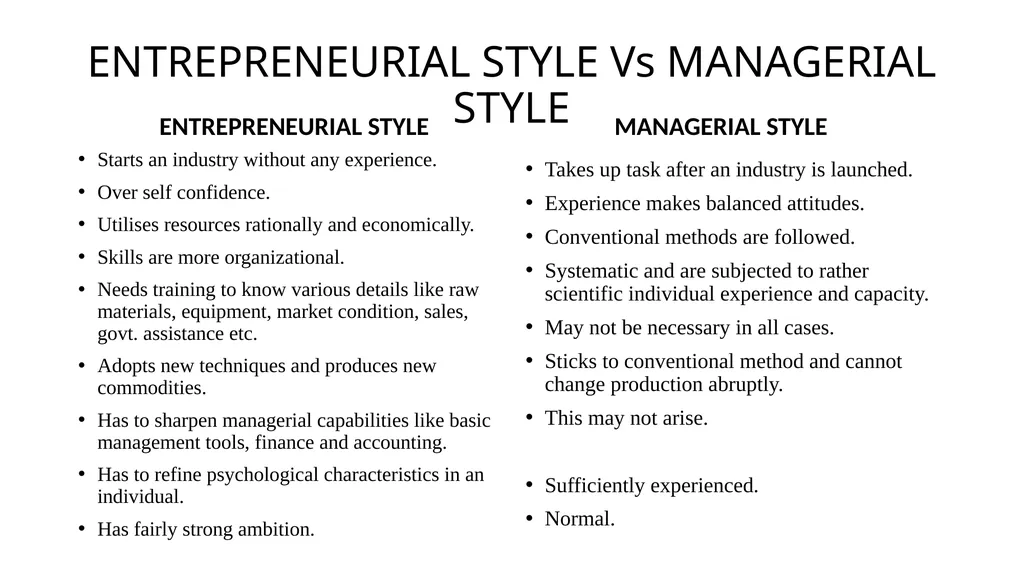
ENTREPRENEURIAL STYLE Vs MANAGERIAL STYLE ENTREPRENEURIAL STYLE Starts an industry without any experience.
Over self confidence.
Utilises resources rationally and economically.
Skills are more organizational.
Needs training to know various details like raw materials, equipment, market condition, sales, govt. assistance etc.
Adopts new techniques and produces new commodities.
Has to sharpen managerial capabilities like basic management tools, finance and accounting.
Has to refine psychological characteristics in an individual.
Has fairly strong ambition. MANAGERIAL STYLE Takes up task after an industry is launched.
Experience makes balanced attitudes.
Conventional methods are followed.
Systematic and are subjected to rather scientific individual experience and capacity.
May not be necessary in all cases.
Sticks to conventional method and cannot change production abruptly.
This may not arise.
Sufficiently experienced.
Normal.<br>
Over self confidence.
Utilises resources rationally and economically.
Skills are more organizational.
Needs training to know various details like raw materials, equipment, market condition, sales, govt. assistance etc.
Adopts new techniques and produces new commodities.
Has to sharpen managerial capabilities like basic management tools, finance and accounting.
Has to refine psychological characteristics in an individual.
Has fairly strong ambition. MANAGERIAL STYLE Takes up task after an industry is launched.
Experience makes balanced attitudes.
Conventional methods are followed.
Systematic and are subjected to rather scientific individual experience and capacity.
May not be necessary in all cases.
Sticks to conventional method and cannot change production abruptly.
This may not arise.
Sufficiently experienced.
Normal.<br>
25
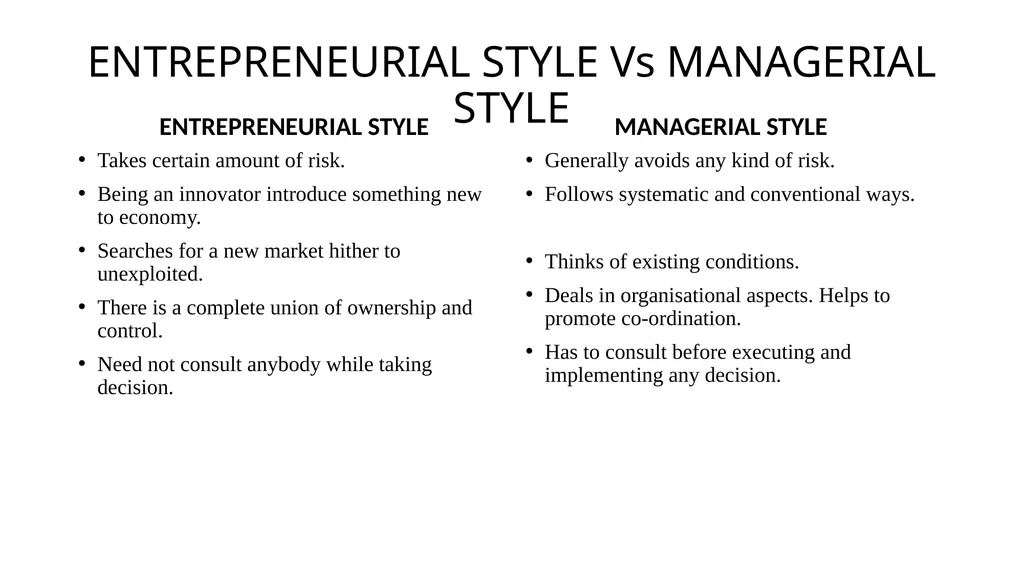
ENTREPRENEURIAL STYLE Vs MANAGERIAL STYLE ENTREPRENEURIAL STYLE Takes certain amount of risk.
Being an innovator introduce something new to economy.
Searches for a new market hither to unexploited.
There is a complete union of ownership and control.
Need not consult anybody while taking decision. MANAGERIAL STYLE Generally avoids any kind of risk.
Follows systematic and conventional ways.
Thinks of existing conditions.
Deals in organisational aspects. Helps to promote co-ordination.
Has to consult before executing and implementing any decision.<br>
Being an innovator introduce something new to economy.
Searches for a new market hither to unexploited.
There is a complete union of ownership and control.
Need not consult anybody while taking decision. MANAGERIAL STYLE Generally avoids any kind of risk.
Follows systematic and conventional ways.
Thinks of existing conditions.
Deals in organisational aspects. Helps to promote co-ordination.
Has to consult before executing and implementing any decision.<br>
26
TECHNOCRATS Technocrats are specialist in engineering subsystems dealing with mechanical, production engineering, civil and structural engineering, metallurgy,electrical and electronics engineering ,chemical engineering etc
It is conversant with application of scientific methods in using resources<br>
It is conversant with application of scientific methods in using resources<br>
27
CHARACHTERISTICS OF TECHNOCRATS Conversant with logical thinking and can deduce results from assorted data
Know to test the validity of data and quantify them
More interested in mechanisms than meanings, processes than purposes
Emphasis on quantifiable performances, optimum use of resources, than manpower and money
Asset in systematic thinking aids decision making in optimum use of resources and complex planning
Understand and manage financial problems, through formal education system
Weakness lies in handling of human, financial and market problems<br>
Know to test the validity of data and quantify them
More interested in mechanisms than meanings, processes than purposes
Emphasis on quantifiable performances, optimum use of resources, than manpower and money
Asset in systematic thinking aids decision making in optimum use of resources and complex planning
Understand and manage financial problems, through formal education system
Weakness lies in handling of human, financial and market problems<br>
28
MANAGERS Management is a function or process necessary for organization may be business or non-business
The responsible individual is a manager who exercises leadership by assuming authority, accepting responsibility, delegating power to act, establishing accountability by individuals
Management organizes, directs, and controls various activities of enterprise towards specific objectives by use of resources
Management combines all duties and functions for initiation of an enterprise, financing, establishment of all policies, provision of necessary equipment<br>
The responsible individual is a manager who exercises leadership by assuming authority, accepting responsibility, delegating power to act, establishing accountability by individuals
Management organizes, directs, and controls various activities of enterprise towards specific objectives by use of resources
Management combines all duties and functions for initiation of an enterprise, financing, establishment of all policies, provision of necessary equipment<br>
29
Management coordinates and gets things done through others
Management has scientific basis,management techniques are to measurement and factual determination
Management actively directs human efforts towards common goal<br>
Management has scientific basis,management techniques are to measurement and factual determination
Management actively directs human efforts towards common goal<br>
30
FUNCTIONS OF MANAGEMENT Determine and lay down objectives and maintain them, objectives should be clear, definite and realistic
Putting together bits of information gathered from different sources to get a picture of situation,
Planning involves analysis of a problem, thinking out forward solution to that problem, outlining the steps to reach objectives
Organizing creation of a structure of functions and duties by a group of people for attainment of objectives, and goals of enterprise
Staffing defines requirements regarding people for job to be done, selecting suitable persons for positions, training subordinates to fulfill the tasks<br>
Putting together bits of information gathered from different sources to get a picture of situation,
Planning involves analysis of a problem, thinking out forward solution to that problem, outlining the steps to reach objectives
Organizing creation of a structure of functions and duties by a group of people for attainment of objectives, and goals of enterprise
Staffing defines requirements regarding people for job to be done, selecting suitable persons for positions, training subordinates to fulfill the tasks<br>
31
Coordinating is the essence of management with high productivity depends on interest and willing cooperation of management and workers
Directing –directing, guiding,or counselling combines activities related to guiding, advising and supervising subordinates
Motivation-it is necessary to make the employees to work harmoniously to attain goals
Controlling-call attention to deviations of performance from plans point out trouble spots, and corrective action is taken, leads to finding of difficulties, overcoming difficulties, adjusting operations
Promoting Innovation:-permanent success promotion of innovation is needed, innovation is introduction of new philosophy, idea, policy or procedure<br>
Directing –directing, guiding,or counselling combines activities related to guiding, advising and supervising subordinates
Motivation-it is necessary to make the employees to work harmoniously to attain goals
Controlling-call attention to deviations of performance from plans point out trouble spots, and corrective action is taken, leads to finding of difficulties, overcoming difficulties, adjusting operations
Promoting Innovation:-permanent success promotion of innovation is needed, innovation is introduction of new philosophy, idea, policy or procedure<br>
32
Factors that make a successful entrepreneur Strong desire for independence and ability to stand alone
Drive and energy in organizing ability
A desire to diversify, expand and innovative
Technical and managerial knowledge
Above average intelligence
Capacity to take risk
Self confidence and long term involvement
Persistent problem solving and goal setting
Tolerance of ambiguity and uncertainty<br>
Drive and energy in organizing ability
A desire to diversify, expand and innovative
Technical and managerial knowledge
Above average intelligence
Capacity to take risk
Self confidence and long term involvement
Persistent problem solving and goal setting
Tolerance of ambiguity and uncertainty<br>
33
Factors that make a successful contractor Confidence,independence,individuality optimism
Thorough knowledge of various civil engineering works,ability to list the work into constructional activities,assessing their sequence and interdependence
Ability to organize,schedule and execute the activities
Good foresight in arranging resources like men,money,materials, machines and skilled management techniques
Need for achievement,profit oriented persistence,perseverance, determination,hardwork
Leadership qualities to get along with others ,responsive to suggestions and crticism<br>
Thorough knowledge of various civil engineering works,ability to list the work into constructional activities,assessing their sequence and interdependence
Ability to organize,schedule and execute the activities
Good foresight in arranging resources like men,money,materials, machines and skilled management techniques
Need for achievement,profit oriented persistence,perseverance, determination,hardwork
Leadership qualities to get along with others ,responsive to suggestions and crticism<br>
34
Requirements of an enterpreneur Accuracy –it depends on accurate thinking
Time sense and foresight-always think in terms of time,able to forecast with foresight,look into future
Alertness-keep in touch with the world,up and doing to satisfy wants,create fresh wants
Honesty-entrepreneur must be honest,use all ability to provide precisely he wants
Ability to cooperate-cooperate with large number of others, able to compromise, adjust, adapt, willing to admit his judgement may be wrong
Consistency and dependability-must be consistent to exercise firmness in dealings with others and able to satisfy co-workers loyal to him<br>
Time sense and foresight-always think in terms of time,able to forecast with foresight,look into future
Alertness-keep in touch with the world,up and doing to satisfy wants,create fresh wants
Honesty-entrepreneur must be honest,use all ability to provide precisely he wants
Ability to cooperate-cooperate with large number of others, able to compromise, adjust, adapt, willing to admit his judgement may be wrong
Consistency and dependability-must be consistent to exercise firmness in dealings with others and able to satisfy co-workers loyal to him<br>
35
Energy-a reasonable physical and nervous energy ,processes forcefulness to put across his ideas and suggestions belives to be right
Personal qualities-
better than average intelligence,
constructive imagination
,knowledge of human nature,
enthusiasm,
sense of humour
self confidence
self control
pleasing personality
concentration,
tolerance<br>
Personal qualities-
better than average intelligence,
constructive imagination
,knowledge of human nature,
enthusiasm,
sense of humour
self confidence
self control
pleasing personality
concentration,
tolerance<br>
36
ENTERPRENEUR MOTIVATION ADVANTAGES Higher industrial mobility and full utilization of resources
Production and employment at low cost
Exploitation of short run oppurtunities, economic scale, locational advantages, ancillary activities
Decentralized growth and deployment of purchasing power.
Extension of opportunities for innovative talents and techno managerial skills.
Intimate personal contacts and better industrial relations.
Reduction of monopoly and skilled work force.<br>
Production and employment at low cost
Exploitation of short run oppurtunities, economic scale, locational advantages, ancillary activities
Decentralized growth and deployment of purchasing power.
Extension of opportunities for innovative talents and techno managerial skills.
Intimate personal contacts and better industrial relations.
Reduction of monopoly and skilled work force.<br>
37
ENTERPRENEUR MOTIVATION DISADVANTAGES Lack of finance for initial investment.
Lack of requisite managerial skills.
Limited resources – low production.
Poor organization.
Lack of technical know how.
Ignorance of market condition.
Lack of quality control and research facilities.
Inefficient methods of production.<br>
Lack of requisite managerial skills.
Limited resources – low production.
Poor organization.
Lack of technical know how.
Ignorance of market condition.
Lack of quality control and research facilities.
Inefficient methods of production.<br>
38
PROFILE AND REQUIREMENTS OF ENTERPRENEUR Accuracy – Accurate thinking.
Time sense and foresight – Requirements should be thinked in terms of time, he must be able to forecast and foresight and look into future.
Alertness – He must keep in touch with the world, he must be up and doing to satisfy wants and also create fresh wants.
Honesty.
Ability to co-operate.
Consistency and dependability – Consistent mind will be able to exercise firmness in his dealings and dependable entrepreneur satisfies his co-workers.<br>
Time sense and foresight – Requirements should be thinked in terms of time, he must be able to forecast and foresight and look into future.
Alertness – He must keep in touch with the world, he must be up and doing to satisfy wants and also create fresh wants.
Honesty.
Ability to co-operate.
Consistency and dependability – Consistent mind will be able to exercise firmness in his dealings and dependable entrepreneur satisfies his co-workers.<br>
39
Energy – Reasonable physical and nervous energy is required and he should put across his ideas and suggestions which he believes to be right.
Personal qualities – Average intelligence, constructive imagination, knowledge of human nature, enthusiasm, sense of humor, self-confidence, self-control, pleasing personality, concentration, tolerance.<br>
Personal qualities – Average intelligence, constructive imagination, knowledge of human nature, enthusiasm, sense of humor, self-confidence, self-control, pleasing personality, concentration, tolerance.<br>
40
SMALL SCALE INDUSTRY Small scale industry sector to make and ever growing contribution to national economy like production, distribution, development of exports, expansion in employment opportunities, import situations etc.
Factors responsible for growth of small scale industries
Considerable cost advantage is achieved.
Reserved product lines for small scale industries, a policy taken by govt.
Study of economic viability and optimum utilization of capital resources.
Availability of larger credit from nationalised banks.
Procurement of imported and scarce raw materials along with existing facilities.<br>
Factors responsible for growth of small scale industries
Considerable cost advantage is achieved.
Reserved product lines for small scale industries, a policy taken by govt.
Study of economic viability and optimum utilization of capital resources.
Availability of larger credit from nationalised banks.
Procurement of imported and scarce raw materials along with existing facilities.<br>
41
SMALL SCALE INDUSTRY – ROLE IN ECONOMIC DEVELOPMENT Small scale industries is important towards poverty eradication, employment generation, rural development and creating regional balance in promotion.
Employment generation – provides huge number of employment opportunities.
Mobilisation of resources and entrepreneur skills – mobilise a good amount of savings and entrepreneur skill, improves social welfare of a country.
Equitable distribution of income – stimulate redistribution of wealth income and political power within societies.<br>
Employment generation – provides huge number of employment opportunities.
Mobilisation of resources and entrepreneur skills – mobilise a good amount of savings and entrepreneur skill, improves social welfare of a country.
Equitable distribution of income – stimulate redistribution of wealth income and political power within societies.<br>
42
Regional dispersal of industries – Utilises local resources and brings dispersion of industries in various parts of country, promotes balanced regional development.
Provides opportunities for development of technology.
Indigenisation – Makes use of indigenious organizational and management capabilities by drawing entrepreneurial talent and testing round for new venture.
Promotes exports.
Supports the growth of large industries – by providing components, accessories, semi finished goods.
Better industrial relations.<br>
Provides opportunities for development of technology.
Indigenisation – Makes use of indigenious organizational and management capabilities by drawing entrepreneurial talent and testing round for new venture.
Promotes exports.
Supports the growth of large industries – by providing components, accessories, semi finished goods.
Better industrial relations.<br>
43
REQUIREMENTS TO BECOME A LICENSED SURVEYOR Any construction, residential, industrial, shopping center, recreation places, restaurants in a town or a city shall be approved by municipalities or corporations.
Such proposals are submitted in form of drawings like site plan, proposed building, adjacent property boundaries, existing roads.
These drawings showing plans, section, elevation are certified by registered licensed building surveyor.
He should be thorough with town planning rules during the time of submission of drawings.
The number of licensed building surveyors shall depend upon nature of town or city, growth of town and determined by council.<br>
Such proposals are submitted in form of drawings like site plan, proposed building, adjacent property boundaries, existing roads.
These drawings showing plans, section, elevation are certified by registered licensed building surveyor.
He should be thorough with town planning rules during the time of submission of drawings.
The number of licensed building surveyors shall depend upon nature of town or city, growth of town and determined by council.<br>
44
The minimum qualification for a registered building surveyor shall be Diploma in Civil Engineering or Degree in Civil Engineering or corporate membership (Civil) of Institution of Engineers (India).
He shall submit application form with proof of qualification to municipal authorities and the registration fees according to rule.
The council shall verify requirements and approve registrations.
The council also conducts interviews and has got legal right to cancel license of surveyor.<br>
He shall submit application form with proof of qualification to municipal authorities and the registration fees according to rule.
The council shall verify requirements and approve registrations.
The council also conducts interviews and has got legal right to cancel license of surveyor.<br>
45
REQUIREMENTS TO BECOME A LICENSED CONTRACTOR Contractor may be an individual or a group of person registered as a firm.
They should form a company and shall submit technical and financial viabilities and experiences in construction field.
Depending upon financial abilities engineering department will register under different classes. ie; A class contractor, B class contractor.
Before submitting a tender registered contractor should submit a clearance certificate from income tax department.
After categorizing contactors, registration fee is paid to engineering department.
This enables contractor to enter into a contract agreement if tender is accepted by an engineer.<br>
They should form a company and shall submit technical and financial viabilities and experiences in construction field.
Depending upon financial abilities engineering department will register under different classes. ie; A class contractor, B class contractor.
Before submitting a tender registered contractor should submit a clearance certificate from income tax department.
After categorizing contactors, registration fee is paid to engineering department.
This enables contractor to enter into a contract agreement if tender is accepted by an engineer.<br>
46
Requirements of small scale buisness License:-
government issued permission to engage in an activity or to operate a business
Criteria for small scale industry in India
Industry employing less than 100 workers
Having fixed assets of less than 10lakh need not obtain any license
Confirm rules and regulations by state or local authority under factories act<br>
government issued permission to engage in an activity or to operate a business
Criteria for small scale industry in India
Industry employing less than 100 workers
Having fixed assets of less than 10lakh need not obtain any license
Confirm rules and regulations by state or local authority under factories act<br>
47
Agencies promoting small scale industry State financial corporations-grants loans for purchase of land,construction of factory,machine purchase and equipment.
State directorates of industries-extend assistance between Rs 10000/-and Rs 50000/- for construction of factory,purchase of machine,loans are repayable
Commercial banks-provide short term and medium term financial assistance.
Industrial Development Bank of India-offers
Bills rediscounting scheme
Refinance scheme
National Bank of Agricultural and Rural Development<br>
State directorates of industries-extend assistance between Rs 10000/-and Rs 50000/- for construction of factory,purchase of machine,loans are repayable
Commercial banks-provide short term and medium term financial assistance.
Industrial Development Bank of India-offers
Bills rediscounting scheme
Refinance scheme
National Bank of Agricultural and Rural Development<br>
48
QUALITY MANAGEMENT Quality management is the act of overseeing all activities and tasks that must be accomplished to maintain a desired level of excellence.
This includes the
determination of a quality policy,
creating and implementing quality planning
assurance, and quality control and quality improvement<br>
This includes the
determination of a quality policy,
creating and implementing quality planning
assurance, and quality control and quality improvement<br>
49
Elements of quality Leadership
Training
Incentives
Management
Myths
Traps
Tricks<br>
Training
Incentives
Management
Myths
Traps
Tricks<br>
50
ISO 9000 Quality is a product or service refers to totality of features and characteristics to satisfy customers needs
ISO 9000 series of quality systems use these standards as effective tool for business sucess<br>
ISO 9000 series of quality systems use these standards as effective tool for business sucess<br>
51
ISO 9000 includes integration of Statistical applications
Quality and relability engineering
Management techniques
Motivational aspects<br>
Quality and relability engineering
Management techniques
Motivational aspects<br>
52
TOTAL QUALITY MANAGEMENT-(TQM) It is a dynamic process involving all levels in organization to promote improvement in effectiveness and efficiency of all elements in business
TQM has to improve efficiency and effectiveness by
statistical thinking
Managing with facts
Detect and error prevention<br>
TQM has to improve efficiency and effectiveness by
statistical thinking
Managing with facts
Detect and error prevention<br>
53
Elements of TQM Customers satisfaction
Employees involvement
Morale of employees
Quality control circles and suggestion system
High revenue
Lower cost
Quality control
Control of production
Quality planning
Quality improvement
Quality implementation<br>
Employees involvement
Morale of employees
Quality control circles and suggestion system
High revenue
Lower cost
Quality control
Control of production
Quality planning
Quality improvement
Quality implementation<br>
54
Quality assurance system
Vendor control and quality in procurement
Customer relationship management
Total organization involvement
Quality education and training
Measurement information analysis
Strategic quality management
leadership<br>
Vendor control and quality in procurement
Customer relationship management
Total organization involvement
Quality education and training
Measurement information analysis
Strategic quality management
leadership<br>
55
Requirements of TQM Sound foundation: philosophy,policy,culture,leadership,commitment
Sound infrastructure:
Organisation systems,
procedures,
Mannuals
, customer involvement,
suppliers involvement,m
training and education,
total employee involvement
Use of specific tools and techniques<br>
Sound infrastructure:
Organisation systems,
procedures,
Mannuals
, customer involvement,
suppliers involvement,m
training and education,
total employee involvement
Use of specific tools and techniques<br>
56
Aims of TQM Conformance to customer requirements
Prevention of producing bad quality
Ideal of zero Defect as performance standard
Measurement of cost of quality<br>
Prevention of producing bad quality
Ideal of zero Defect as performance standard
Measurement of cost of quality<br>
57
Ways to TQM Adopting new philosophy of refusing any defects
Creating consistency of purpose of improvement
Improving production and service quality
Avoid dependence on mass inspection and adopting Statistical Quality Control
Insisting quantifiable evidence from suppliers
Train the employees about refresher cources
Providing proper tools to all employees
Avoid proper communication system
Encouraging productivity
Permenant commitment of top management towards quality
Respect towards work and quality
Adopt customer orientation
Aims “quality first and not short term profits”
Strictly using facts and data<br>
Creating consistency of purpose of improvement
Improving production and service quality
Avoid dependence on mass inspection and adopting Statistical Quality Control
Insisting quantifiable evidence from suppliers
Train the employees about refresher cources
Providing proper tools to all employees
Avoid proper communication system
Encouraging productivity
Permenant commitment of top management towards quality
Respect towards work and quality
Adopt customer orientation
Aims “quality first and not short term profits”
Strictly using facts and data<br>
58
Quality system It is the agreed company wide and plant wide operating work structure documented in effective way
Integrated technical procedures for guiding coordinated action of people, machines, information of company or plant to ensure customers satisfaction, economical costs of quality<br>
Integrated technical procedures for guiding coordinated action of people, machines, information of company or plant to ensure customers satisfaction, economical costs of quality<br>
59
Elements of Quality Systems Management responsibility:
define and document its quality policy to overall corporate policy and identify organizational forms and resources to manage the implementation of quality policy
Quality systems
Establish and maintain documented quality systems to ensure the product confirms to specified requirements
Ensure effective implementation of documented quality procedures and instructions<br>
define and document its quality policy to overall corporate policy and identify organizational forms and resources to manage the implementation of quality policy
Quality systems
Establish and maintain documented quality systems to ensure the product confirms to specified requirements
Ensure effective implementation of documented quality procedures and instructions<br>
60
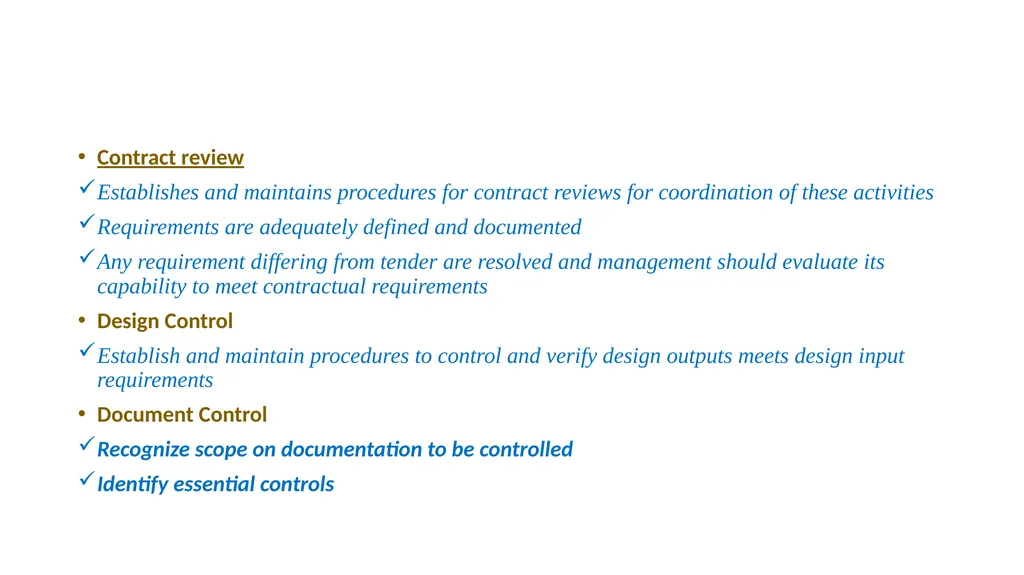
Contract review
Establishes and maintains procedures for contract reviews for coordination of these activities
Requirements are adequately defined and documented
Any requirement differing from tender are resolved and management should evaluate its capability to meet contractual requirements
Design Control
Establish and maintain procedures to control and verify design outputs meets design input requirements
Document Control
Recognize scope on documentation to be controlled
Identify essential controls<br>
Establishes and maintains procedures for contract reviews for coordination of these activities
Requirements are adequately defined and documented
Any requirement differing from tender are resolved and management should evaluate its capability to meet contractual requirements
Design Control
Establish and maintain procedures to control and verify design outputs meets design input requirements
Document Control
Recognize scope on documentation to be controlled
Identify essential controls<br>
61
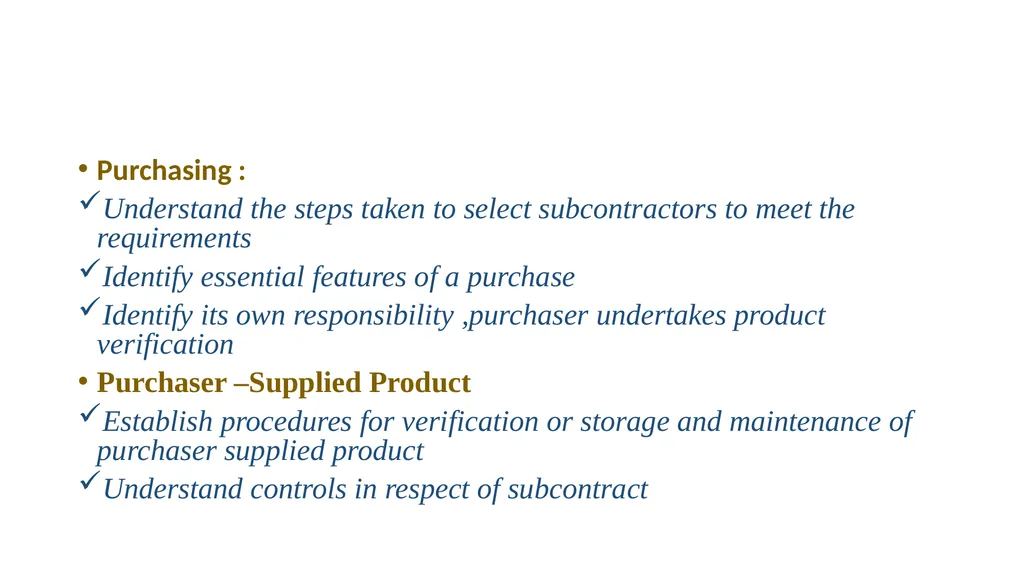
Purchasing :
Understand the steps taken to select subcontractors to meet the requirements
Identify essential features of a purchase
Identify its own responsibility ,purchaser undertakes product verification
Purchaser –Supplied Product
Establish procedures for verification or storage and maintenance of purchaser supplied product
Understand controls in respect of subcontract<br>
Understand the steps taken to select subcontractors to meet the requirements
Identify essential features of a purchase
Identify its own responsibility ,purchaser undertakes product verification
Purchaser –Supplied Product
Establish procedures for verification or storage and maintenance of purchaser supplied product
Understand controls in respect of subcontract<br>
62
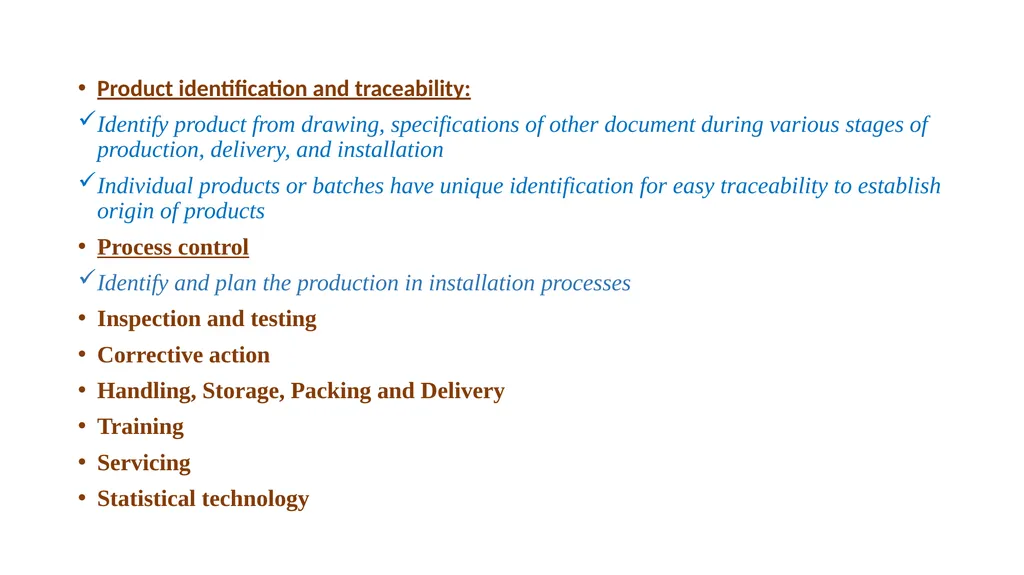
Product identification and traceability:
Identify product from drawing, specifications of other document during various stages of production, delivery, and installation
Individual products or batches have unique identification for easy traceability to establish origin of products
Process control
Identify and plan the production in installation processes
Inspection and testing
Corrective action
Handling, Storage, Packing and Delivery
Training
Servicing
Statistical technology<br>
Identify product from drawing, specifications of other document during various stages of production, delivery, and installation
Individual products or batches have unique identification for easy traceability to establish origin of products
Process control
Identify and plan the production in installation processes
Inspection and testing
Corrective action
Handling, Storage, Packing and Delivery
Training
Servicing
Statistical technology<br>
63
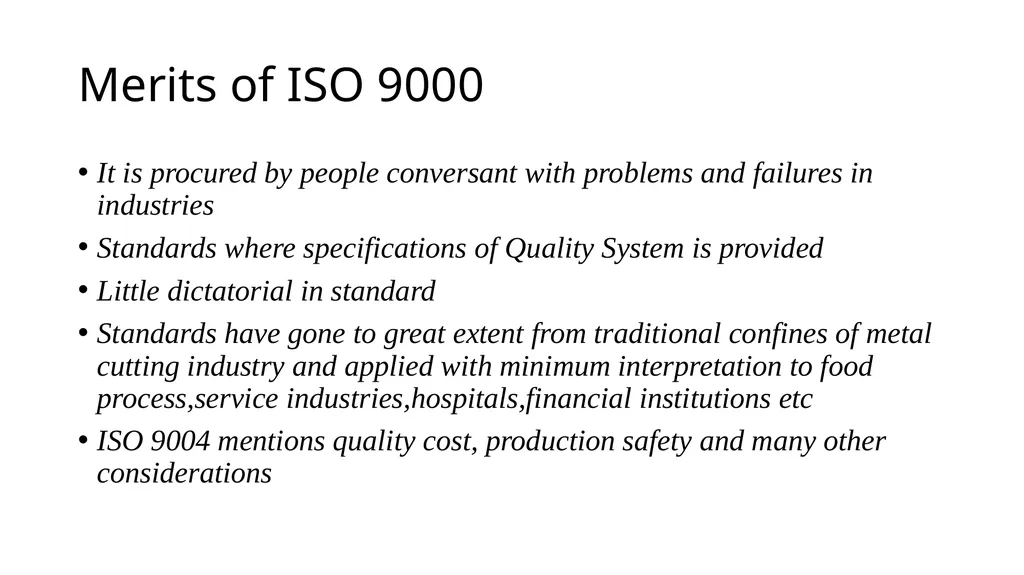
Merits of ISO 9000 It is procured by people conversant with problems and failures in industries
Standards where specifications of Quality System is provided
Little dictatorial in standard
Standards have gone to great extent from traditional confines of metal cutting industry and applied with minimum interpretation to food process,service industries,hospitals,financial institutions etc
ISO 9004 mentions quality cost, production safety and many other considerations<br>
Standards where specifications of Quality System is provided
Little dictatorial in standard
Standards have gone to great extent from traditional confines of metal cutting industry and applied with minimum interpretation to food process,service industries,hospitals,financial institutions etc
ISO 9004 mentions quality cost, production safety and many other considerations<br>
64
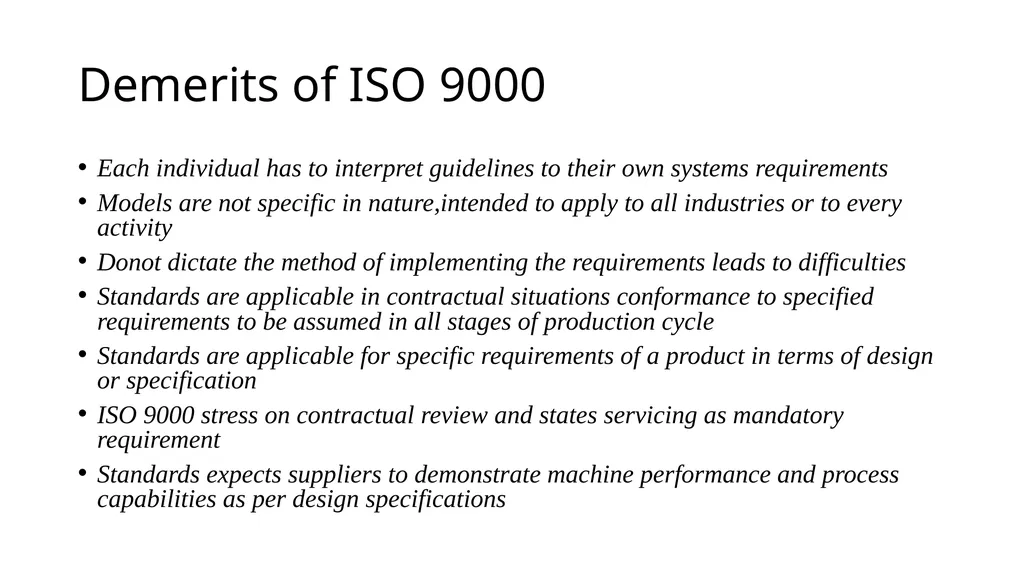
Demerits of ISO 9000 Each individual has to interpret guidelines to their own systems requirements
Models are not specific in nature,intended to apply to all industries or to every activity
Donot dictate the method of implementing the requirements leads to difficulties
Standards are applicable in contractual situations conformance to specified requirements to be assumed in all stages of production cycle
Standards are applicable for specific requirements of a product in terms of design or specification
ISO 9000 stress on contractual review and states servicing as mandatory requirement
Standards expects suppliers to demonstrate machine performance and process capabilities as per design specifications<br>
Models are not specific in nature,intended to apply to all industries or to every activity
Donot dictate the method of implementing the requirements leads to difficulties
Standards are applicable in contractual situations conformance to specified requirements to be assumed in all stages of production cycle
Standards are applicable for specific requirements of a product in terms of design or specification
ISO 9000 stress on contractual review and states servicing as mandatory requirement
Standards expects suppliers to demonstrate machine performance and process capabilities as per design specifications<br>