
Chapter 6: aid, debt, FDI, and economic
YM
Published · 31 slides · 0 views

1 / 1


Description
Chapter 6: aid, debt, FDI, and economic development What is foreign aid? Def- it is the Private public resource transfers from DCs to LDCs. It is the international transfer of public funds in the form of loans or grants either directly
Related Topics
Share
Embed code
Download this presentation From Below
"Chapter 6: aid, debt, FDI, and economic" is the property of its rightful owner. Permission is granted to download and print the materials on this website for personal, non-commercial use only, and to display it on your personal computer provided you do not modify the materials and that you retain all copyright notices contained in the materials. By downloading content from our website, you accept the terms of this agreement.
Presentation Transcript
01
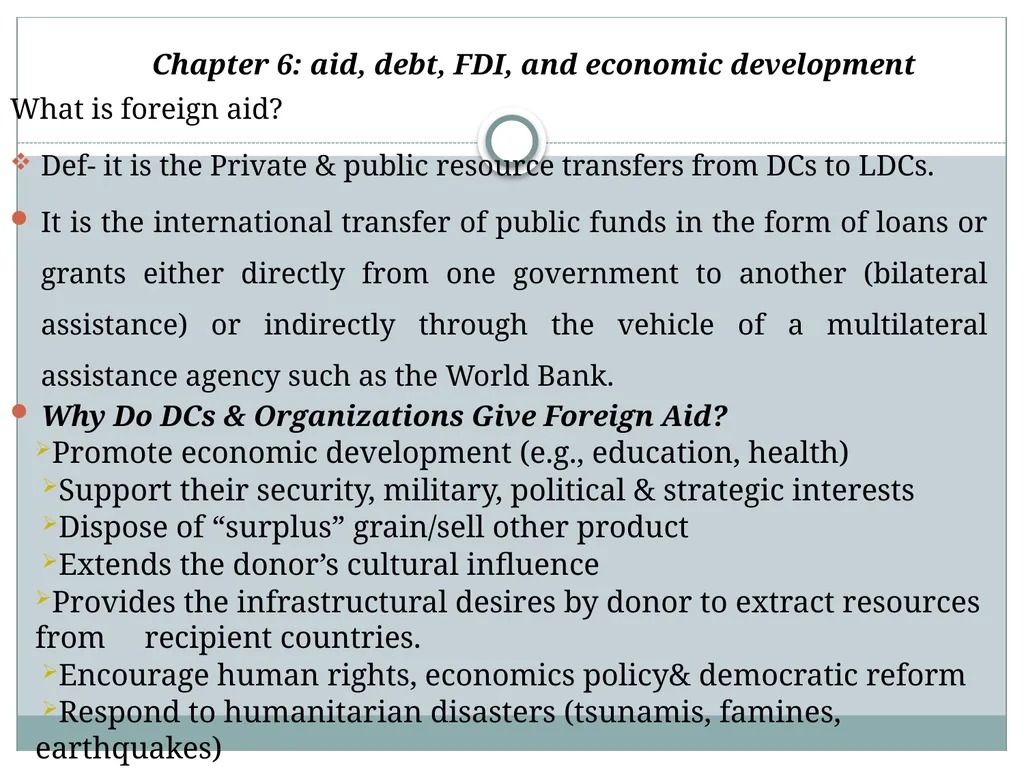
Chapter 6: aid, debt, FDI, and economic development What is foreign aid?
Def- it is the Private & public resource transfers from DCs to LDCs.
It is the international transfer of public funds in the form of loans or grants either directly from one government to another (bilateral assistance) or indirectly through the vehicle of a multilateral assistance agency such as the World Bank.
Why Do DCs & Organizations Give Foreign Aid?
Promote economic development (e.g., education, health)
Support their security, military, political & strategic interests
Dispose of “surplus” grain/sell other product
Extends the donor’s cultural influence
Provides the infrastructural desires by donor to extract resources from recipient countries.
Encourage human rights, economics policy& democratic reform
Respond to humanitarian disasters (tsunamis, famines, earthquakes)<br>
Def- it is the Private & public resource transfers from DCs to LDCs.
It is the international transfer of public funds in the form of loans or grants either directly from one government to another (bilateral assistance) or indirectly through the vehicle of a multilateral assistance agency such as the World Bank.
Why Do DCs & Organizations Give Foreign Aid?
Promote economic development (e.g., education, health)
Support their security, military, political & strategic interests
Dispose of “surplus” grain/sell other product
Extends the donor’s cultural influence
Provides the infrastructural desires by donor to extract resources from recipient countries.
Encourage human rights, economics policy& democratic reform
Respond to humanitarian disasters (tsunamis, famines, earthquakes)<br>
02
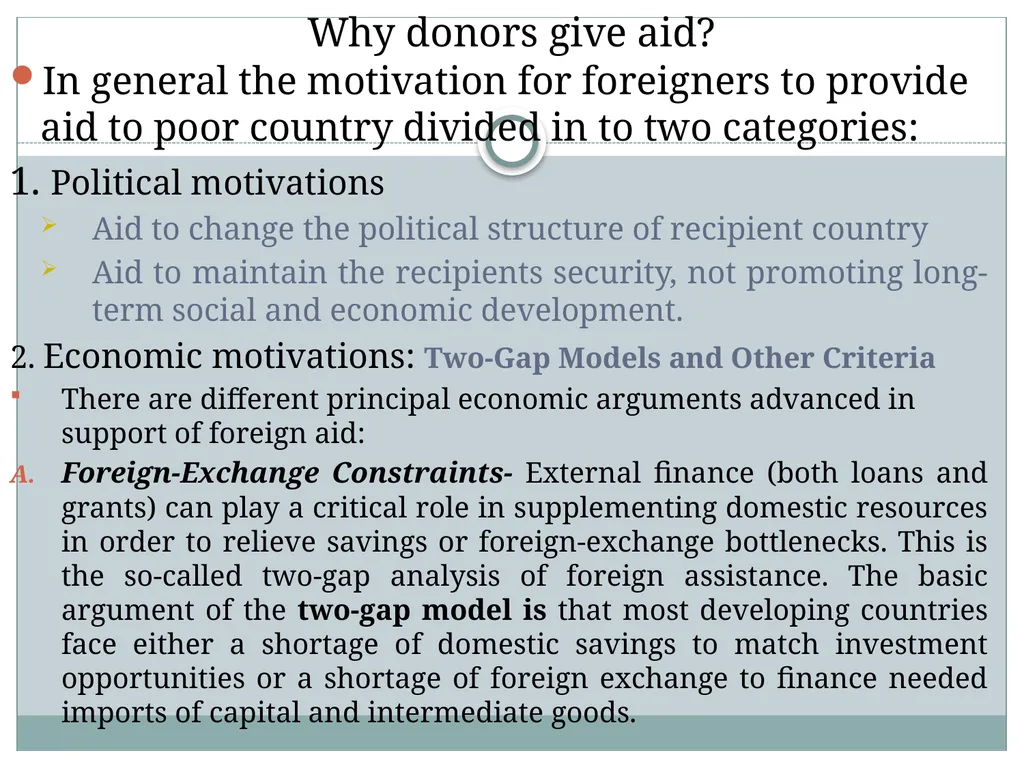
Why donors give aid? In general the motivation for foreigners to provide aid to poor country divided in to two categories:
1. Political motivations
Aid to change the political structure of recipient country
Aid to maintain the recipients security, not promoting long-term social and economic development.
2. Economic motivations: Two-Gap Models and Other Criteria
There are different principal economic arguments advanced in support of foreign aid:
Foreign-Exchange Constraints- External finance (both loans and grants) can play a critical role in supplementing domestic resources in order to relieve savings or foreign-exchange bottlenecks. This is the so-called two-gap analysis of foreign assistance. The basic argument of the two-gap model is that most developing countries face either a shortage of domestic savings to match investment opportunities or a shortage of foreign exchange to finance needed imports of capital and intermediate goods.<br>
1. Political motivations
Aid to change the political structure of recipient country
Aid to maintain the recipients security, not promoting long-term social and economic development.
2. Economic motivations: Two-Gap Models and Other Criteria
There are different principal economic arguments advanced in support of foreign aid:
Foreign-Exchange Constraints- External finance (both loans and grants) can play a critical role in supplementing domestic resources in order to relieve savings or foreign-exchange bottlenecks. This is the so-called two-gap analysis of foreign assistance. The basic argument of the two-gap model is that most developing countries face either a shortage of domestic savings to match investment opportunities or a shortage of foreign exchange to finance needed imports of capital and intermediate goods.<br>
03
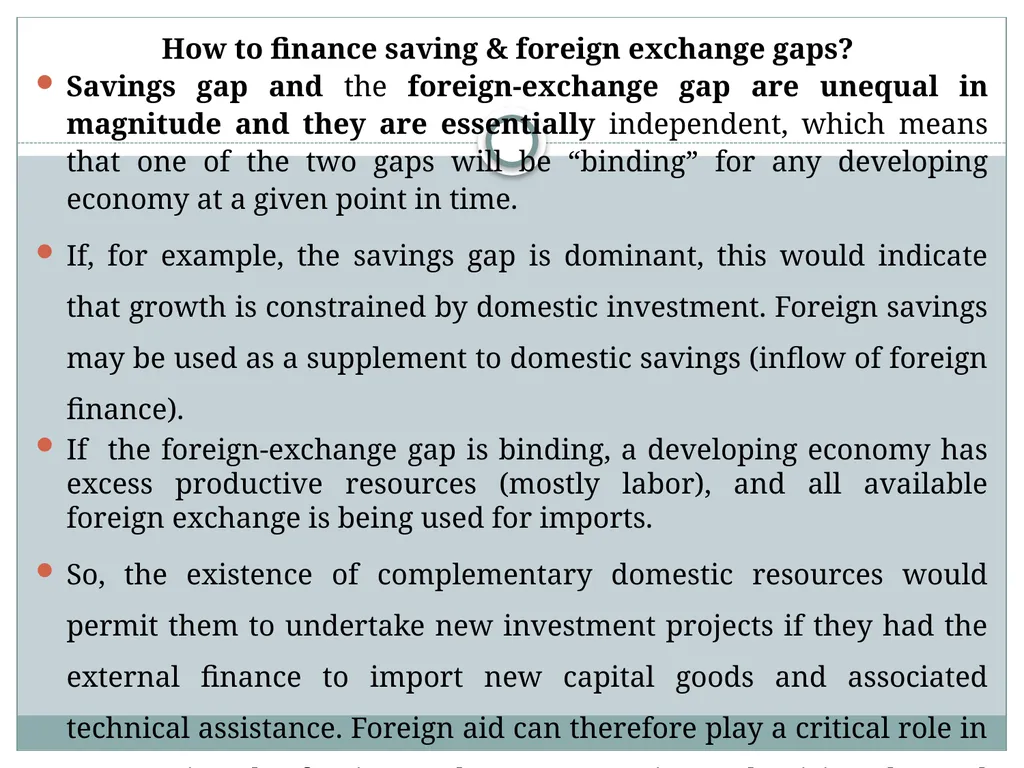
How to finance saving & foreign exchange gaps? Savings gap and the foreign-exchange gap are unequal in magnitude and they are essentially independent, which means that one of the two gaps will be “binding” for any developing economy at a given point in time.
If, for example, the savings gap is dominant, this would indicate that growth is constrained by domestic investment. Foreign savings may be used as a supplement to domestic savings (inflow of foreign finance).
If the foreign-exchange gap is binding, a developing economy has excess productive resources (mostly labor), and all available foreign exchange is being used for imports.
So, the existence of complementary domestic resources would permit them to undertake new investment projects if they had the external finance to import new capital goods and associated technical assistance. Foreign aid can therefore play a critical role in overcoming the foreign exchange constraint and raising the real rate of economic growth.<br>
If, for example, the savings gap is dominant, this would indicate that growth is constrained by domestic investment. Foreign savings may be used as a supplement to domestic savings (inflow of foreign finance).
If the foreign-exchange gap is binding, a developing economy has excess productive resources (mostly labor), and all available foreign exchange is being used for imports.
So, the existence of complementary domestic resources would permit them to undertake new investment projects if they had the external finance to import new capital goods and associated technical assistance. Foreign aid can therefore play a critical role in overcoming the foreign exchange constraint and raising the real rate of economic growth.<br>
04
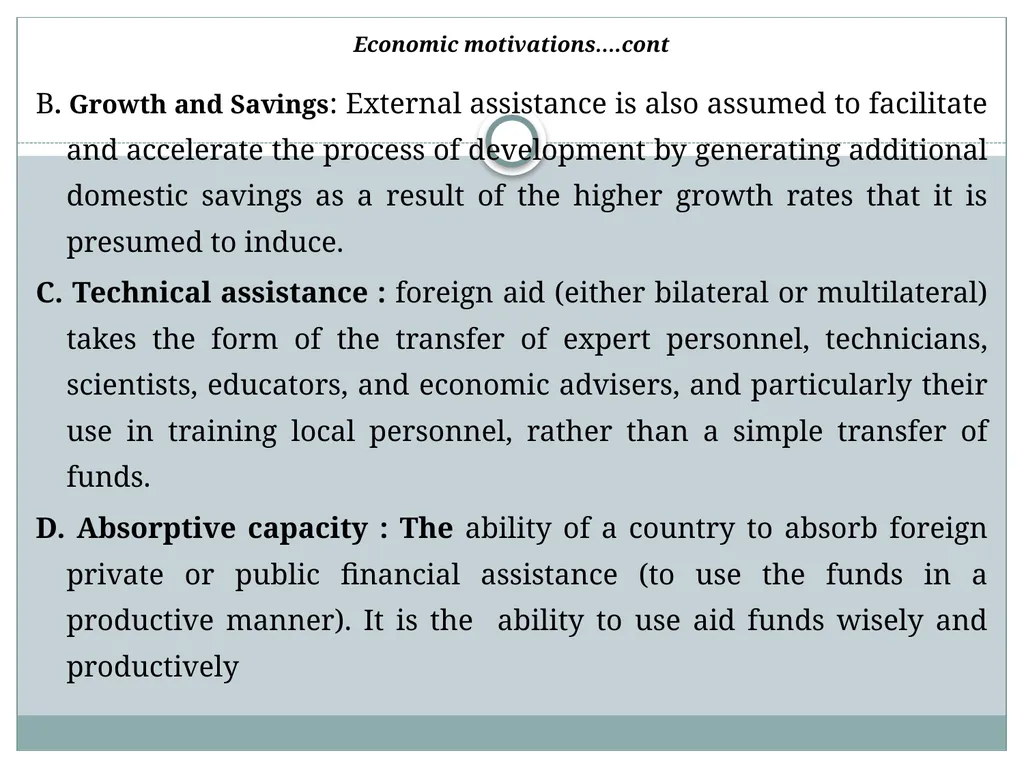
Economic motivations….cont B. Growth and Savings: External assistance is also assumed to facilitate and accelerate the process of development by generating additional domestic savings as a result of the higher growth rates that it is presumed to induce.
C. Technical assistance : foreign aid (either bilateral or multilateral) takes the form of the transfer of expert personnel, technicians, scientists, educators, and economic advisers, and particularly their use in training local personnel, rather than a simple transfer of funds.
D. Absorptive capacity : The ability of a country to absorb foreign private or public financial assistance (to use the funds in a productive manner). It is the ability to use aid funds wisely and productively<br>
C. Technical assistance : foreign aid (either bilateral or multilateral) takes the form of the transfer of expert personnel, technicians, scientists, educators, and economic advisers, and particularly their use in training local personnel, rather than a simple transfer of funds.
D. Absorptive capacity : The ability of a country to absorb foreign private or public financial assistance (to use the funds in a productive manner). It is the ability to use aid funds wisely and productively<br>
05
Economic motivations….cont E. Economic Motivations and Self-Interest: this types of aid provided when it accrue benefits to donor countries as a result of their aid programs.
Example: Tied aid- Foreign aid in the form of bilateral loans or grants that require the recipient country to use the funds to purchase goods or services from the donor country.
It limits the receiving nation’s freedom to shop around for low-cost and suitable capital and intermediate goods.<br>
Example: Tied aid- Foreign aid in the form of bilateral loans or grants that require the recipient country to use the funds to purchase goods or services from the donor country.
It limits the receiving nation’s freedom to shop around for low-cost and suitable capital and intermediate goods.<br>
06
Who Provides Foreign Aid & Why? Public sources: "Official Development Assistance" (ODA) Note: ODA only includes foreign funds that goes to poor LDCs for development & humanitarian assistance
Major multilateral donors (foreign aids from DCs to LDCs via an international organization)
UN Agencies--FAO, WFP, UNDP, IFAD, WHO, UNICEF
Non-UN Agencies--WB & IMF (big!), Euro. Development Fund
Regional Development Banks--Asian, African, Inter-American Dev. Bank
why? to promote development & economic reforms
Major bilateral donors (foreign aids from a DC to a governments. & NGOs in LDCs)
Western DCs (especially to former colonies)
OPEC countries (especially to Arab world)
Japan (especially to Asia)
Why? Promote security, economic/political reforms, dispose of agricultural surpluses (i.e., US)<br>
Major multilateral donors (foreign aids from DCs to LDCs via an international organization)
UN Agencies--FAO, WFP, UNDP, IFAD, WHO, UNICEF
Non-UN Agencies--WB & IMF (big!), Euro. Development Fund
Regional Development Banks--Asian, African, Inter-American Dev. Bank
why? to promote development & economic reforms
Major bilateral donors (foreign aids from a DC to a governments. & NGOs in LDCs)
Western DCs (especially to former colonies)
OPEC countries (especially to Arab world)
Japan (especially to Asia)
Why? Promote security, economic/political reforms, dispose of agricultural surpluses (i.e., US)<br>
07
Who Provides Foreign Aid & Why? 2. Private sources (foreign aids from orgs. & individuals to international organizations, & NGOs working in LDCs)
Foundations: Rockefeller, Ford, Kellogg, Gates
Churches: World Council of Churches, individual denominations
NGOs: Oxfam, CARE, CRS, Save the Children, Doctors Without Borders, World Vision, etc.
Why? Promote humanitarian concerns & development<br>
Foundations: Rockefeller, Ford, Kellogg, Gates
Churches: World Council of Churches, individual denominations
NGOs: Oxfam, CARE, CRS, Save the Children, Doctors Without Borders, World Vision, etc.
Why? Promote humanitarian concerns & development<br>
08
Foreign debt External debt: it is the accumulated total private and public foreign debt owed by a country.
The accumulation of external debt is a common phenomenon of developing countries at the stage of economic development where the supply of domestic savings is low, current account payments deficits are high, and imports of capital are needed to augment domestic resources.
What is the cost of accumulated debt?
The main cost associated with the accumulation of a large external debt is debt service.
Debt service is the payment of amortization (liquidation of the principal) and accumulated interest. As the size of the debt grows or as interest rates rise, debt service charges increase. Debt service payments must be made with foreign exchange. How to pay?
Debt service obligations can be met only through export earnings, curtailed imports, or further external borrowing.<br>
The accumulation of external debt is a common phenomenon of developing countries at the stage of economic development where the supply of domestic savings is low, current account payments deficits are high, and imports of capital are needed to augment domestic resources.
What is the cost of accumulated debt?
The main cost associated with the accumulation of a large external debt is debt service.
Debt service is the payment of amortization (liquidation of the principal) and accumulated interest. As the size of the debt grows or as interest rates rise, debt service charges increase. Debt service payments must be made with foreign exchange. How to pay?
Debt service obligations can be met only through export earnings, curtailed imports, or further external borrowing.<br>
09
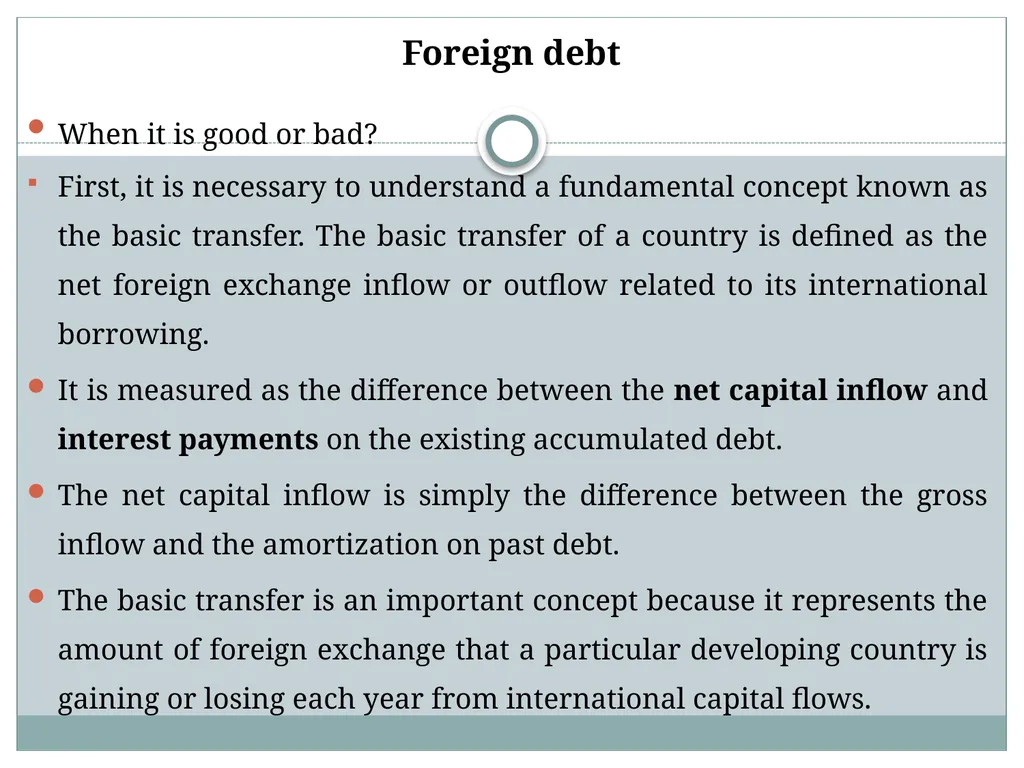
Foreign debt When it is good or bad?
First, it is necessary to understand a fundamental concept known as the basic transfer. The basic transfer of a country is defined as the net foreign exchange inflow or outflow related to its international borrowing.
It is measured as the difference between the net capital inflow and interest payments on the existing accumulated debt.
The net capital inflow is simply the difference between the gross inflow and the amortization on past debt.
The basic transfer is an important concept because it represents the amount of foreign exchange that a particular developing country is gaining or losing each year from international capital flows.<br>
First, it is necessary to understand a fundamental concept known as the basic transfer. The basic transfer of a country is defined as the net foreign exchange inflow or outflow related to its international borrowing.
It is measured as the difference between the net capital inflow and interest payments on the existing accumulated debt.
The net capital inflow is simply the difference between the gross inflow and the amortization on past debt.
The basic transfer is an important concept because it represents the amount of foreign exchange that a particular developing country is gaining or losing each year from international capital flows.<br>
10
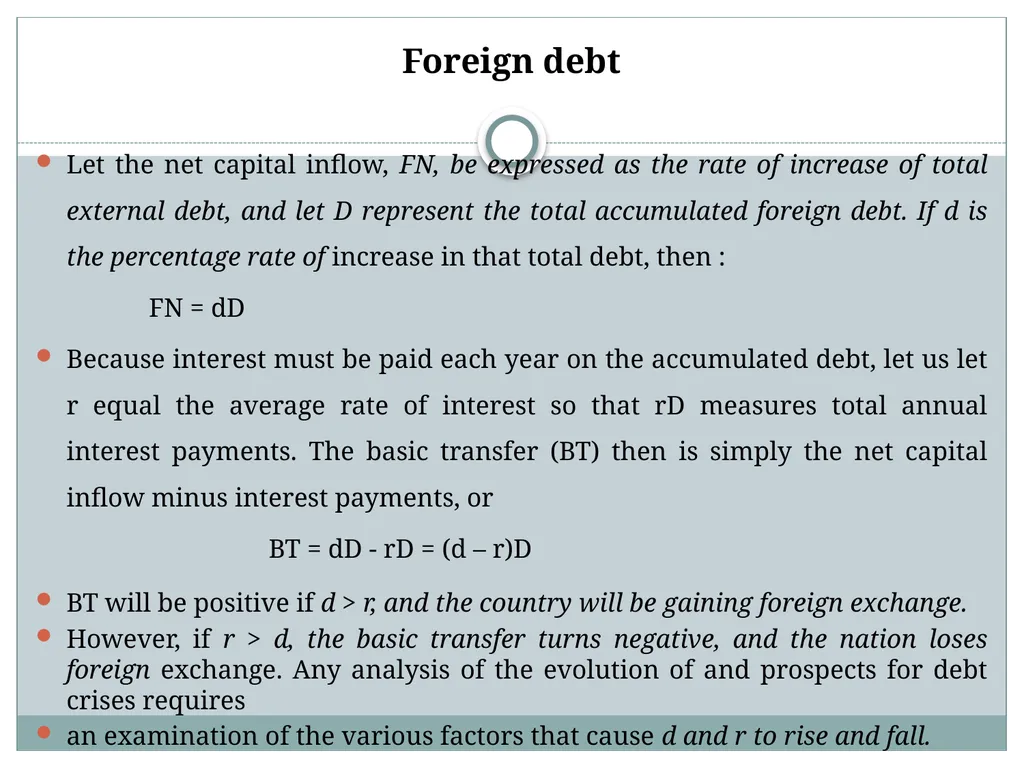
Foreign debt Let the net capital inflow, FN, be expressed as the rate of increase of total external debt, and let D represent the total accumulated foreign debt. If d is the percentage rate of increase in that total debt, then :
FN = dD
Because interest must be paid each year on the accumulated debt, let us let r equal the average rate of interest so that rD measures total annual interest payments. The basic transfer (BT) then is simply the net capital inflow minus interest payments, or
BT = dD - rD = (d – r)D
BT will be positive if d > r, and the country will be gaining foreign exchange.
However, if r > d, the basic transfer turns negative, and the nation loses foreign exchange. Any analysis of the evolution of and prospects for debt crises requires
an examination of the various factors that cause d and r to rise and fall.<br>
FN = dD
Because interest must be paid each year on the accumulated debt, let us let r equal the average rate of interest so that rD measures total annual interest payments. The basic transfer (BT) then is simply the net capital inflow minus interest payments, or
BT = dD - rD = (d – r)D
BT will be positive if d > r, and the country will be gaining foreign exchange.
However, if r > d, the basic transfer turns negative, and the nation loses foreign exchange. Any analysis of the evolution of and prospects for debt crises requires
an examination of the various factors that cause d and r to rise and fall.<br>
11
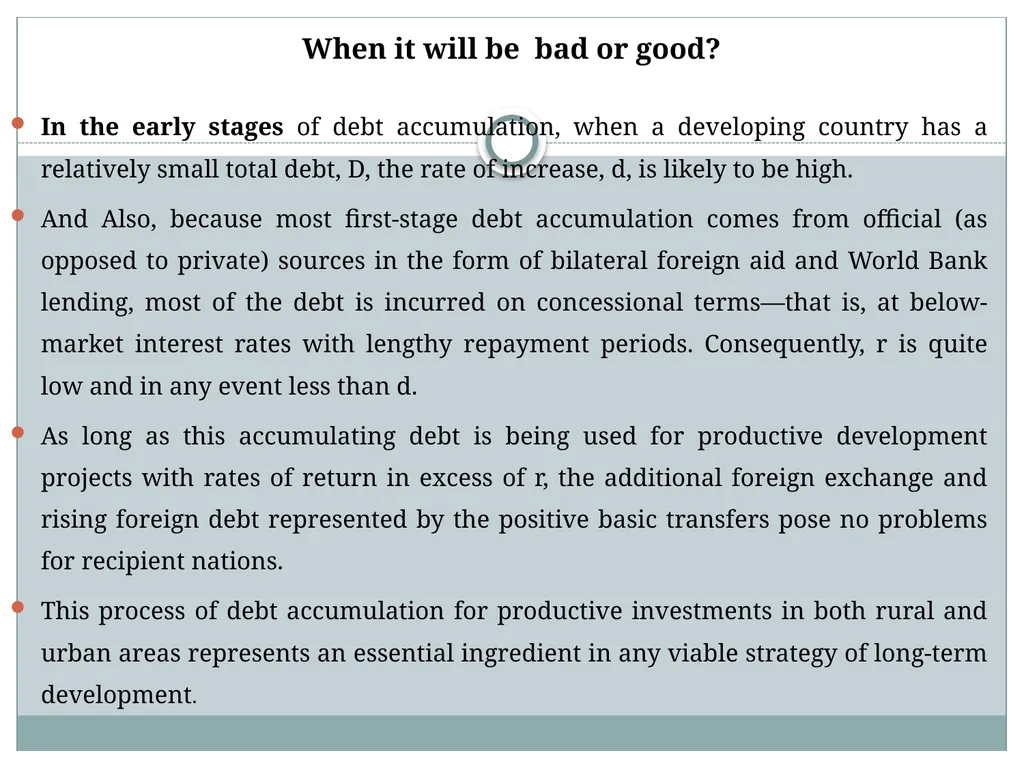
When it will be bad or good? In the early stages of debt accumulation, when a developing country has a relatively small total debt, D, the rate of increase, d, is likely to be high.
And Also, because most first-stage debt accumulation comes from official (as opposed to private) sources in the form of bilateral foreign aid and World Bank lending, most of the debt is incurred on concessional terms—that is, at below-market interest rates with lengthy repayment periods. Consequently, r is quite low and in any event less than d.
As long as this accumulating debt is being used for productive development projects with rates of return in excess of r, the additional foreign exchange and rising foreign debt represented by the positive basic transfers pose no problems for recipient nations.
This process of debt accumulation for productive investments in both rural and urban areas represents an essential ingredient in any viable strategy of long-term development.<br>
And Also, because most first-stage debt accumulation comes from official (as opposed to private) sources in the form of bilateral foreign aid and World Bank lending, most of the debt is incurred on concessional terms—that is, at below-market interest rates with lengthy repayment periods. Consequently, r is quite low and in any event less than d.
As long as this accumulating debt is being used for productive development projects with rates of return in excess of r, the additional foreign exchange and rising foreign debt represented by the positive basic transfers pose no problems for recipient nations.
This process of debt accumulation for productive investments in both rural and urban areas represents an essential ingredient in any viable strategy of long-term development.<br>
12
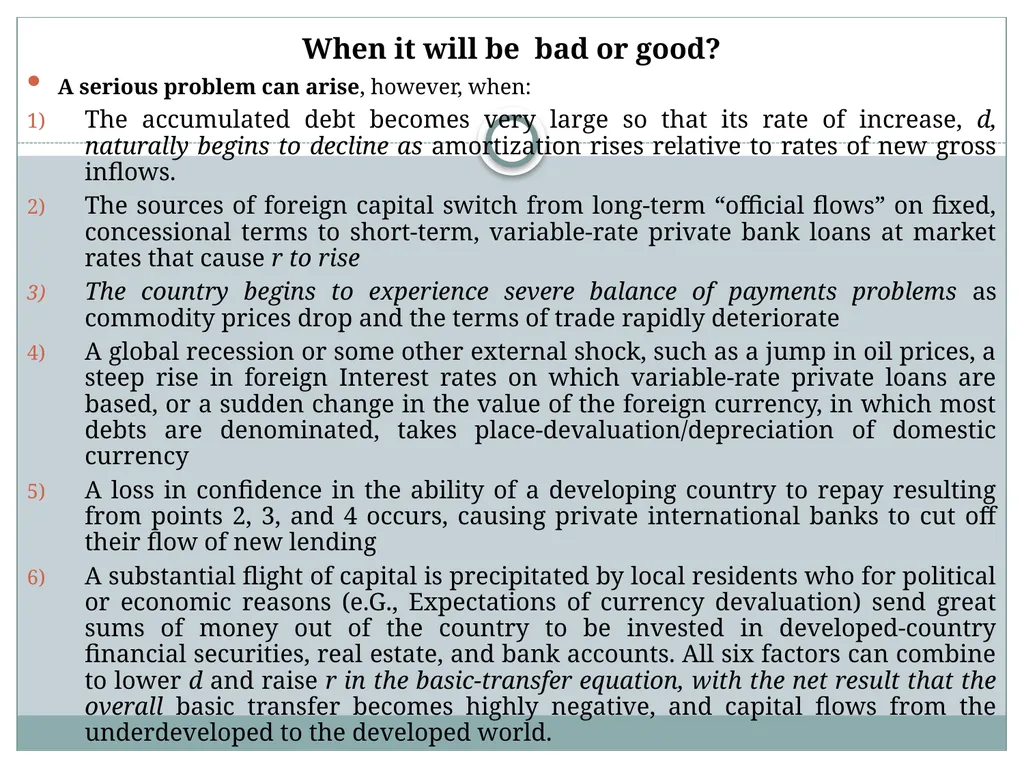
When it will be bad or good? A serious problem can arise, however, when:
The accumulated debt becomes very large so that its rate of increase, d, naturally begins to decline as amortization rises relative to rates of new gross inflows.
The sources of foreign capital switch from long-term “official flows” on fixed, concessional terms to short-term, variable-rate private bank loans at market rates that cause r to rise
The country begins to experience severe balance of payments problems as commodity prices drop and the terms of trade rapidly deteriorate
A global recession or some other external shock, such as a jump in oil prices, a steep rise in foreign Interest rates on which variable-rate private loans are based, or a sudden change in the value of the foreign currency, in which most debts are denominated, takes place-devaluation/depreciation of domestic currency
A loss in confidence in the ability of a developing country to repay resulting from points 2, 3, and 4 occurs, causing private international banks to cut off their flow of new lending
A substantial flight of capital is precipitated by local residents who for political or economic reasons (e.G., Expectations of currency devaluation) send great sums of money out of the country to be invested in developed-country financial securities, real estate, and bank accounts. All six factors can combine to lower d and raise r in the basic-transfer equation, with the net result that the overall basic transfer becomes highly negative, and capital flows from the underdeveloped to the developed world.<br>
The accumulated debt becomes very large so that its rate of increase, d, naturally begins to decline as amortization rises relative to rates of new gross inflows.
The sources of foreign capital switch from long-term “official flows” on fixed, concessional terms to short-term, variable-rate private bank loans at market rates that cause r to rise
The country begins to experience severe balance of payments problems as commodity prices drop and the terms of trade rapidly deteriorate
A global recession or some other external shock, such as a jump in oil prices, a steep rise in foreign Interest rates on which variable-rate private loans are based, or a sudden change in the value of the foreign currency, in which most debts are denominated, takes place-devaluation/depreciation of domestic currency
A loss in confidence in the ability of a developing country to repay resulting from points 2, 3, and 4 occurs, causing private international banks to cut off their flow of new lending
A substantial flight of capital is precipitated by local residents who for political or economic reasons (e.G., Expectations of currency devaluation) send great sums of money out of the country to be invested in developed-country financial securities, real estate, and bank accounts. All six factors can combine to lower d and raise r in the basic-transfer equation, with the net result that the overall basic transfer becomes highly negative, and capital flows from the underdeveloped to the developed world.<br>
13
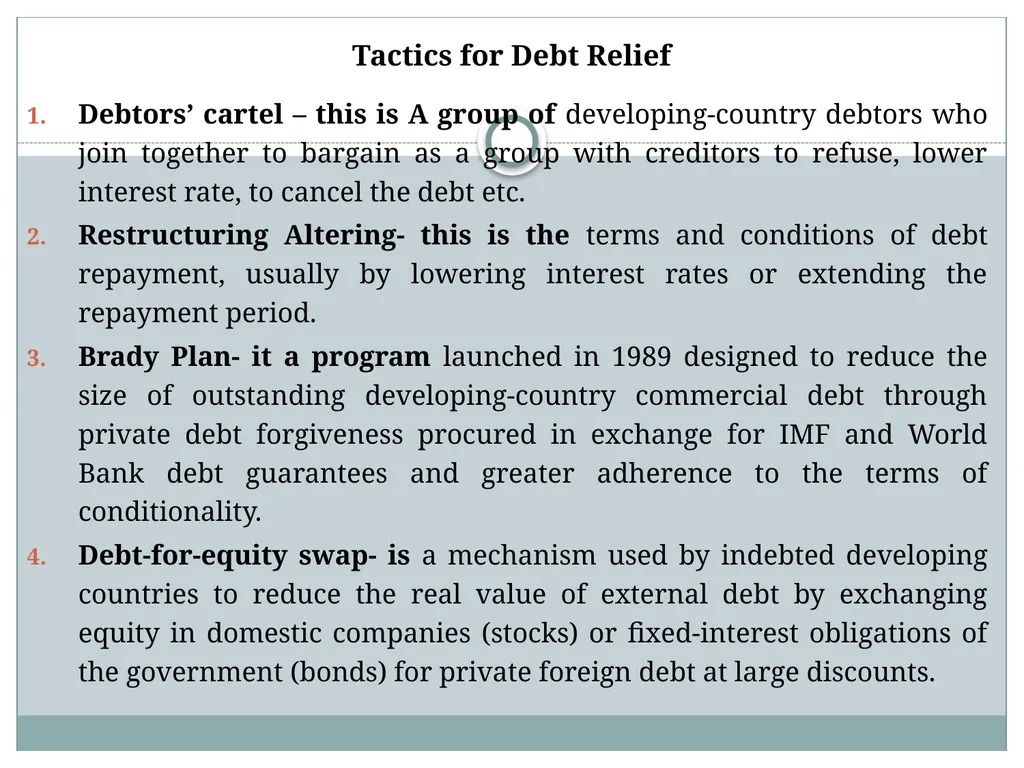
Tactics for Debt Relief Debtors’ cartel – this is A group of developing-country debtors who join together to bargain as a group with creditors to refuse, lower interest rate, to cancel the debt etc.
Restructuring Altering- this is the terms and conditions of debt repayment, usually by lowering interest rates or extending the repayment period.
Brady Plan- it a program launched in 1989 designed to reduce the size of outstanding developing-country commercial debt through private debt forgiveness procured in exchange for IMF and World Bank debt guarantees and greater adherence to the terms of conditionality.
Debt-for-equity swap- is a mechanism used by indebted developing countries to reduce the real value of external debt by exchanging equity in domestic companies (stocks) or fixed-interest obligations of the government (bonds) for private foreign debt at large discounts.<br>
Restructuring Altering- this is the terms and conditions of debt repayment, usually by lowering interest rates or extending the repayment period.
Brady Plan- it a program launched in 1989 designed to reduce the size of outstanding developing-country commercial debt through private debt forgiveness procured in exchange for IMF and World Bank debt guarantees and greater adherence to the terms of conditionality.
Debt-for-equity swap- is a mechanism used by indebted developing countries to reduce the real value of external debt by exchanging equity in domestic companies (stocks) or fixed-interest obligations of the government (bonds) for private foreign debt at large discounts.<br>
14
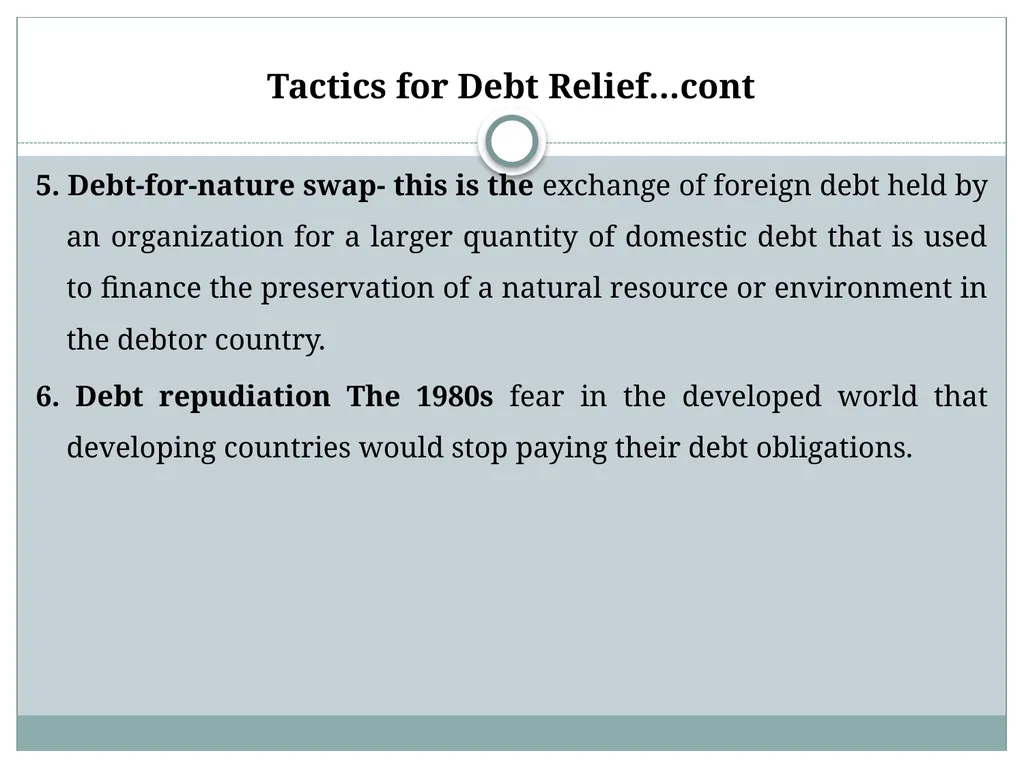
Tactics for Debt Relief…cont 5. Debt-for-nature swap- this is the exchange of foreign debt held by an organization for a larger quantity of domestic debt that is used to finance the preservation of a natural resource or environment in the debtor country.
6. Debt repudiation The 1980s fear in the developed world that developing countries would stop paying their debt obligations.<br>
6. Debt repudiation The 1980s fear in the developed world that developing countries would stop paying their debt obligations.<br>
15
Foreign direct investment and MNCs What is FDI?
It refers as cross-border investment by a resident entity in one economy with the objective of obtaining a lasting interest in an enterprise resident in another economy.
The lasting interest implies the existence of a long-term relationship between the direct investor and the enterprise and a significant degree of influence by the direct investor on the management of the enterprise. Ownership of at least 10% of the voting power, representing the influence by the investor, is the basic criterion used.
Broadly, foreign direct investment includes "mergers and acquisitions, building new facilities, reinvesting profits earned from overseas operations and intra company loans". In a narrow sense, foreign direct investment refers just to building new facilities.<br>
It refers as cross-border investment by a resident entity in one economy with the objective of obtaining a lasting interest in an enterprise resident in another economy.
The lasting interest implies the existence of a long-term relationship between the direct investor and the enterprise and a significant degree of influence by the direct investor on the management of the enterprise. Ownership of at least 10% of the voting power, representing the influence by the investor, is the basic criterion used.
Broadly, foreign direct investment includes "mergers and acquisitions, building new facilities, reinvesting profits earned from overseas operations and intra company loans". In a narrow sense, foreign direct investment refers just to building new facilities.<br>
16
Foreign direct investment and MNCs It can done in the form of:
Purchase of existing assets (enterprise)
Opening New investment
Participation in an international joint-venture
Shared ownership with local and/or other non-local partner
Foreign direct investment (FDI)-is the Overseas equity investments by multinational corporations.
(FDI) is a controlling ownership in a business enterprise in one country by an entity based in another country.
Foreign Direct Investment - When domestic/foreign firm directly invests in production or other facilities in a foreign country/ domestic country, and maintains effective control of their investment.
FDI differ from portfolio investment, which involves investment on stock markets ( such as, bonds, security, treasury bill etc).
Foreign Portfolio Investment – Investing in securities sold by a foreign/domestic firm or government<br>
Purchase of existing assets (enterprise)
Opening New investment
Participation in an international joint-venture
Shared ownership with local and/or other non-local partner
Foreign direct investment (FDI)-is the Overseas equity investments by multinational corporations.
(FDI) is a controlling ownership in a business enterprise in one country by an entity based in another country.
Foreign Direct Investment - When domestic/foreign firm directly invests in production or other facilities in a foreign country/ domestic country, and maintains effective control of their investment.
FDI differ from portfolio investment, which involves investment on stock markets ( such as, bonds, security, treasury bill etc).
Foreign Portfolio Investment – Investing in securities sold by a foreign/domestic firm or government<br>
17
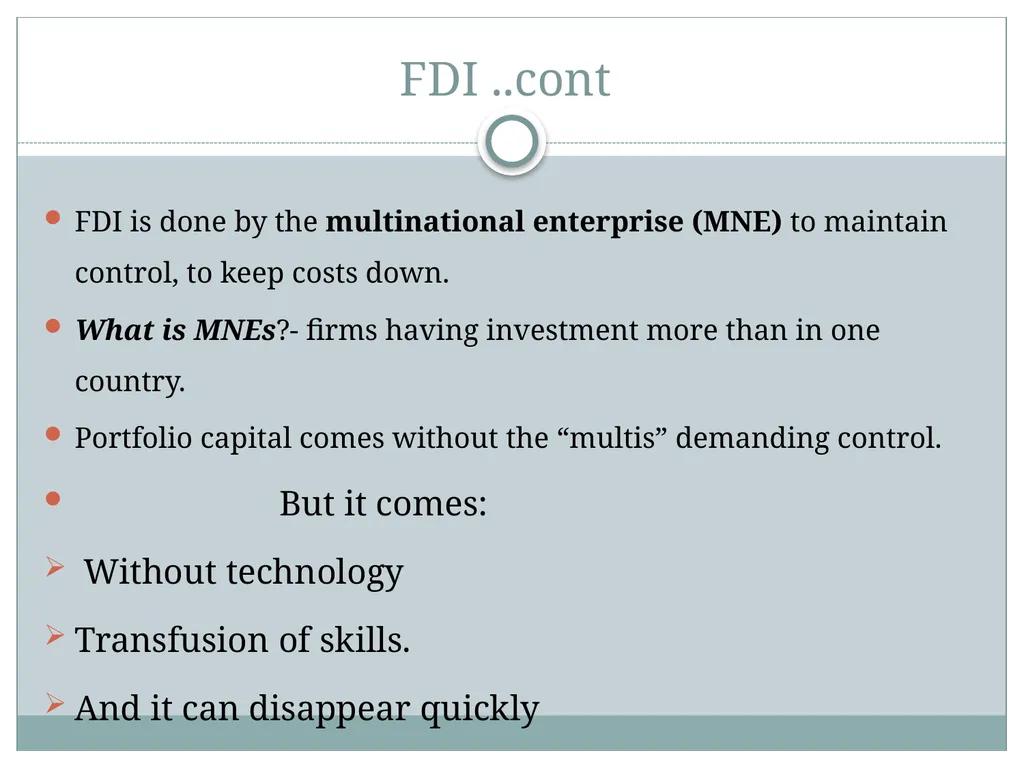
FDI ..cont FDI is done by the multinational enterprise (MNE) to maintain control, to keep costs down.
What is MNEs?- firms having investment more than in one country.
Portfolio capital comes without the “multis” demanding control.
But it comes:
Without technology
Transfusion of skills.
And it can disappear quickly<br>
What is MNEs?- firms having investment more than in one country.
Portfolio capital comes without the “multis” demanding control.
But it comes:
Without technology
Transfusion of skills.
And it can disappear quickly<br>
18
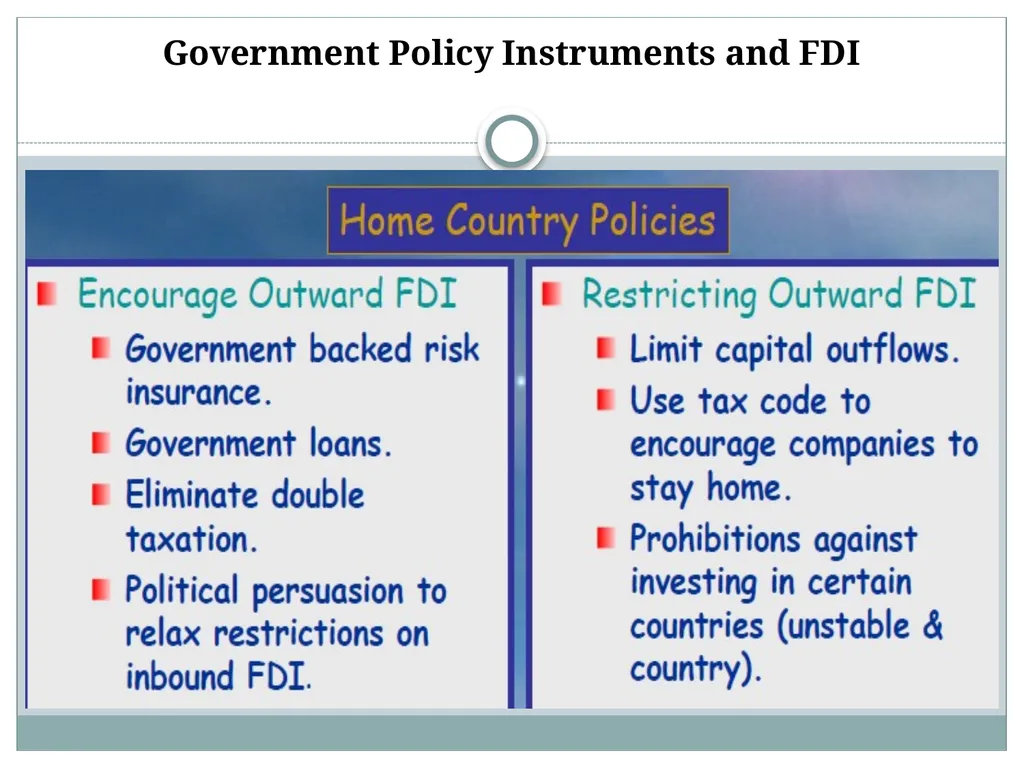
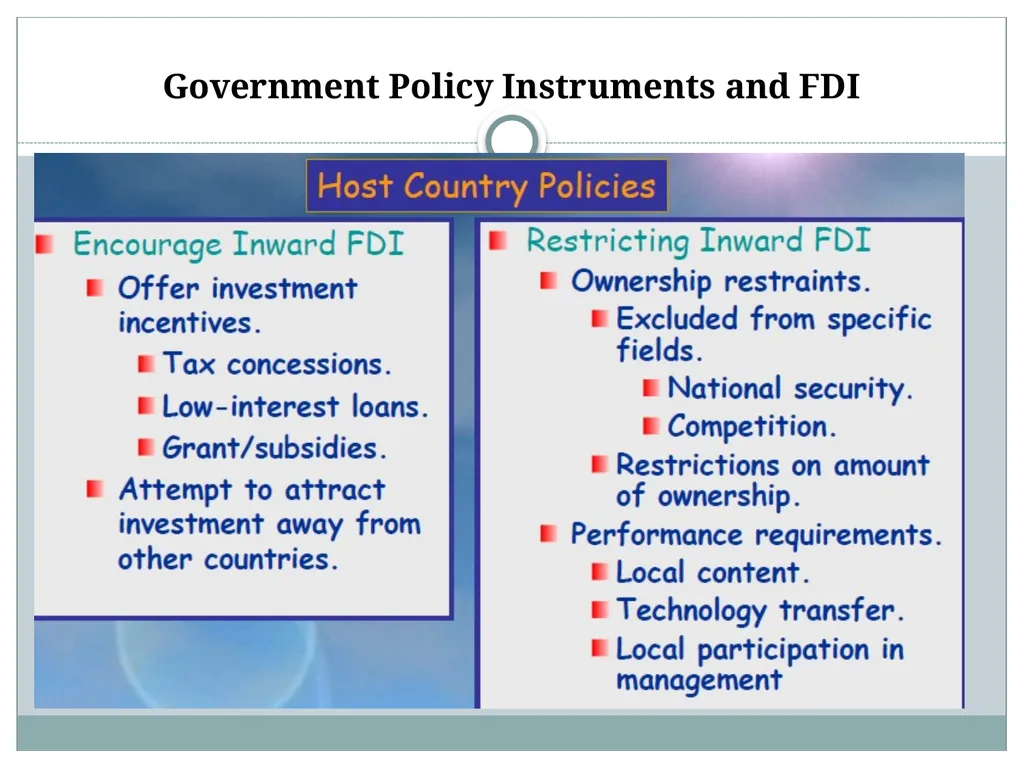
Government Policy Instruments and FDI<br>
19
Government Policy Instruments and FDI<br>
20
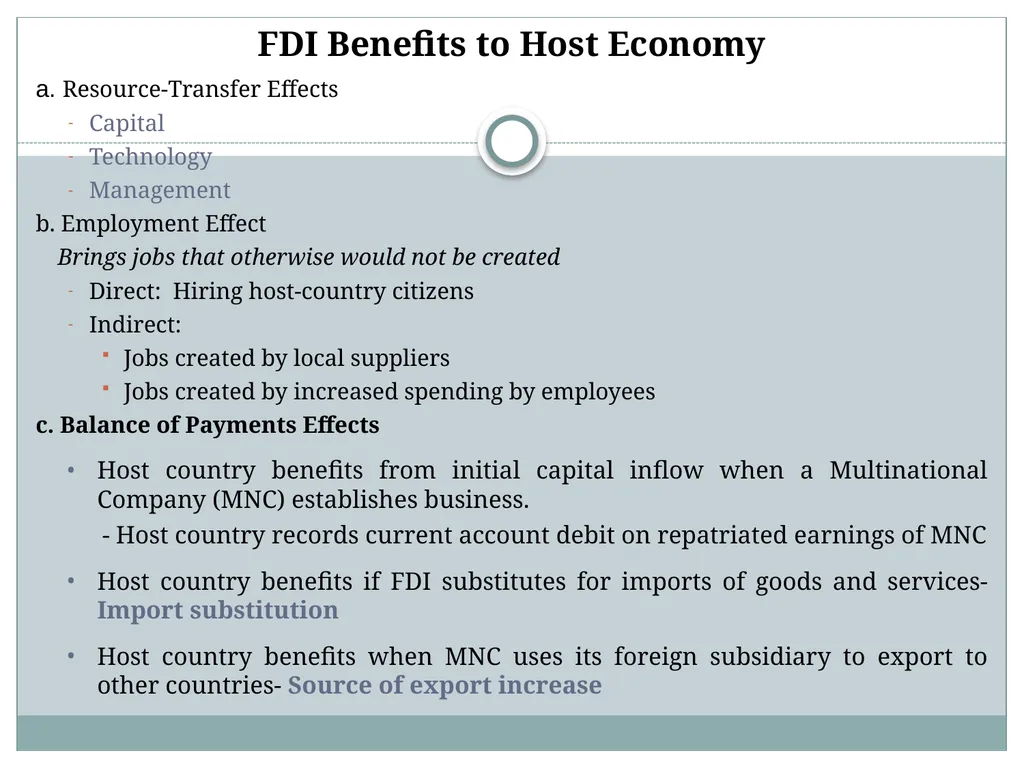
FDI Benefits to Host Economy a. Resource-Transfer Effects
Capital
Technology
Management
b. Employment Effect
Brings jobs that otherwise would not be created
Direct: Hiring host-country citizens
Indirect:
Jobs created by local suppliers
Jobs created by increased spending by employees
c. Balance of Payments Effects
Host country benefits from initial capital inflow when a Multinational Company (MNC) establishes business.
- Host country records current account debit on repatriated earnings of MNC
Host country benefits if FDI substitutes for imports of goods and services- Import substitution
Host country benefits when MNC uses its foreign subsidiary to export to other countries- Source of export increase<br>
Capital
Technology
Management
b. Employment Effect
Brings jobs that otherwise would not be created
Direct: Hiring host-country citizens
Indirect:
Jobs created by local suppliers
Jobs created by increased spending by employees
c. Balance of Payments Effects
Host country benefits from initial capital inflow when a Multinational Company (MNC) establishes business.
- Host country records current account debit on repatriated earnings of MNC
Host country benefits if FDI substitutes for imports of goods and services- Import substitution
Host country benefits when MNC uses its foreign subsidiary to export to other countries- Source of export increase<br>
21
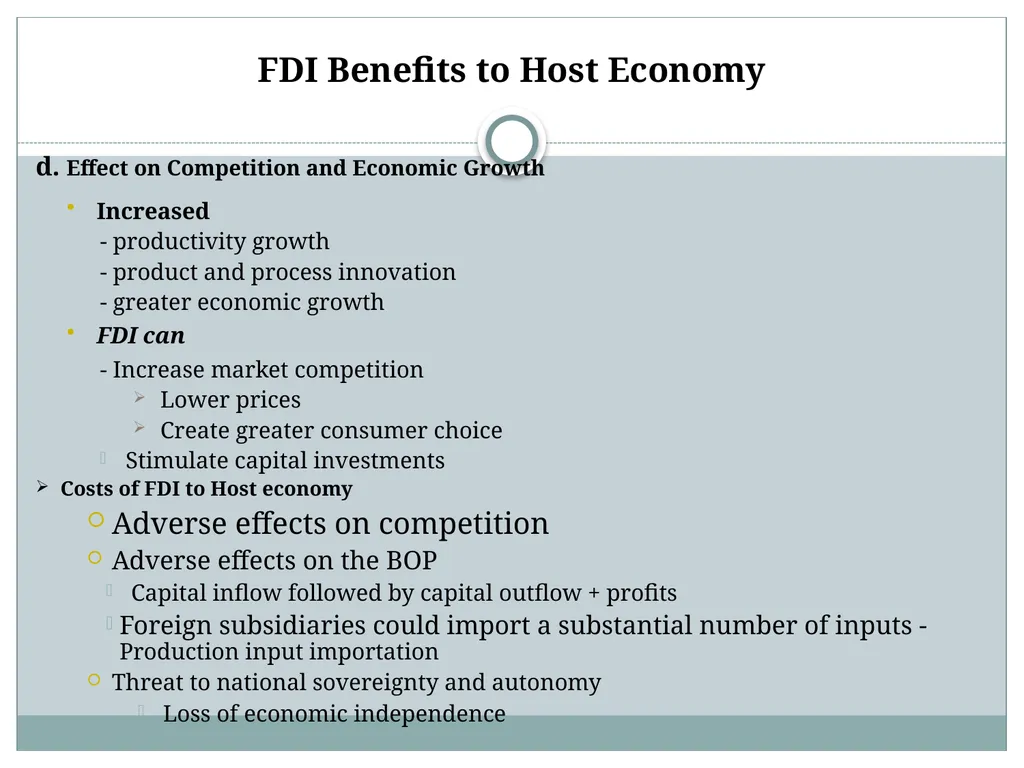
FDI Benefits to Host Economy d. Effect on Competition and Economic Growth
Increased
- productivity growth
- product and process innovation
- greater economic growth
FDI can
- Increase market competition
Lower prices
Create greater consumer choice
Stimulate capital investments
Costs of FDI to Host economy
Adverse effects on competition
Adverse effects on the BOP
Capital inflow followed by capital outflow + profits
Foreign subsidiaries could import a substantial number of inputs - Production input importation
Threat to national sovereignty and autonomy
Loss of economic independence<br>
Increased
- productivity growth
- product and process innovation
- greater economic growth
FDI can
- Increase market competition
Lower prices
Create greater consumer choice
Stimulate capital investments
Costs of FDI to Host economy
Adverse effects on competition
Adverse effects on the BOP
Capital inflow followed by capital outflow + profits
Foreign subsidiaries could import a substantial number of inputs - Production input importation
Threat to national sovereignty and autonomy
Loss of economic independence<br>
22
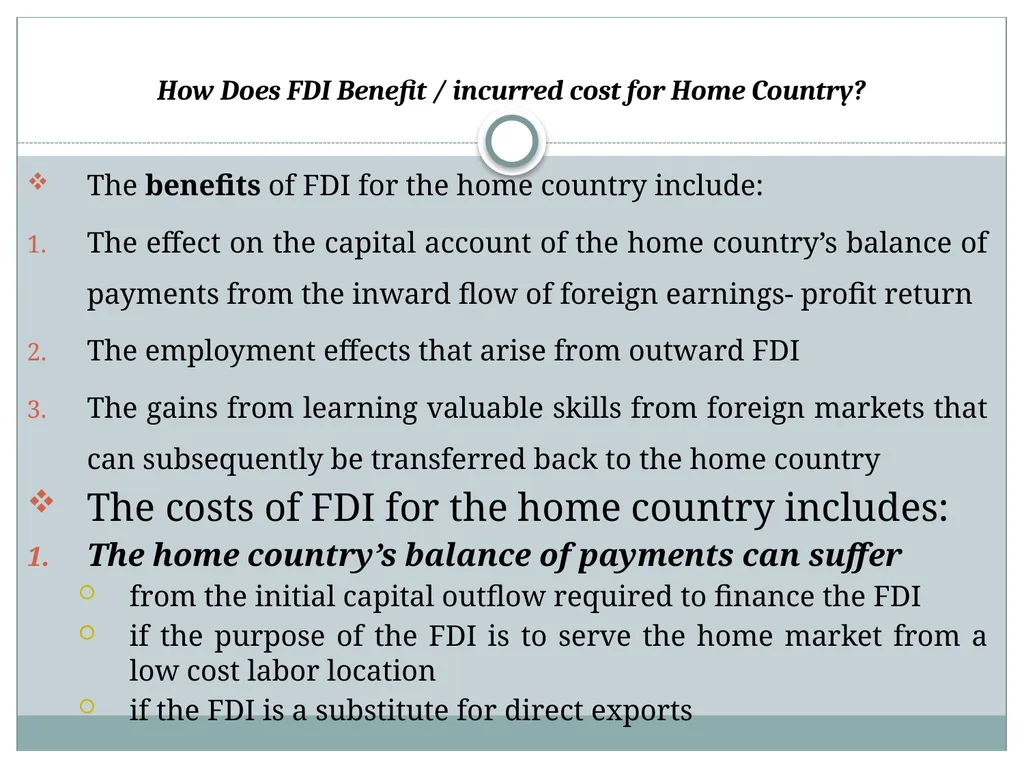
How Does FDI Benefit / incurred cost for Home Country? The benefits of FDI for the home country include:
The effect on the capital account of the home country’s balance of payments from the inward flow of foreign earnings- profit return
The employment effects that arise from outward FDI
The gains from learning valuable skills from foreign markets that can subsequently be transferred back to the home country
The costs of FDI for the home country includes:
The home country’s balance of payments can suffer
from the initial capital outflow required to finance the FDI
if the purpose of the FDI is to serve the home market from a low cost labor location
if the FDI is a substitute for direct exports<br>
The effect on the capital account of the home country’s balance of payments from the inward flow of foreign earnings- profit return
The employment effects that arise from outward FDI
The gains from learning valuable skills from foreign markets that can subsequently be transferred back to the home country
The costs of FDI for the home country includes:
The home country’s balance of payments can suffer
from the initial capital outflow required to finance the FDI
if the purpose of the FDI is to serve the home market from a low cost labor location
if the FDI is a substitute for direct exports<br>
23
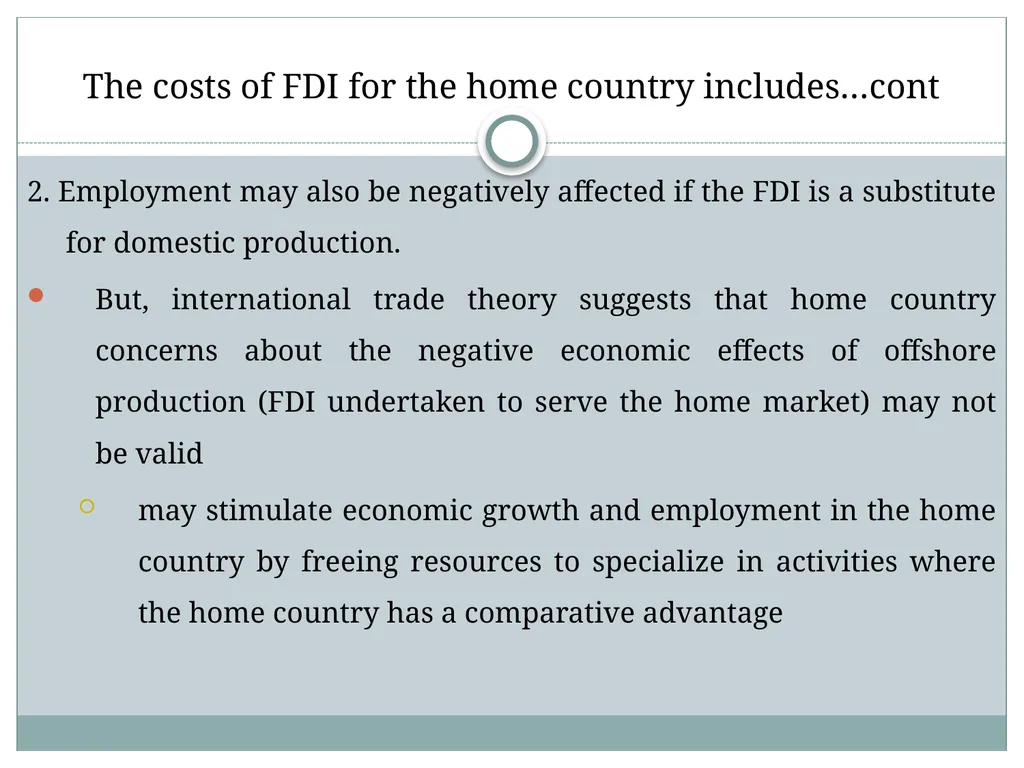
The costs of FDI for the home country includes…cont 2. Employment may also be negatively affected if the FDI is a substitute for domestic production.
But, international trade theory suggests that home country concerns about the negative economic effects of offshore production (FDI undertaken to serve the home market) may not be valid
may stimulate economic growth and employment in the home country by freeing resources to specialize in activities where the home country has a comparative advantage<br>
But, international trade theory suggests that home country concerns about the negative economic effects of offshore production (FDI undertaken to serve the home market) may not be valid
may stimulate economic growth and employment in the home country by freeing resources to specialize in activities where the home country has a comparative advantage<br>
24
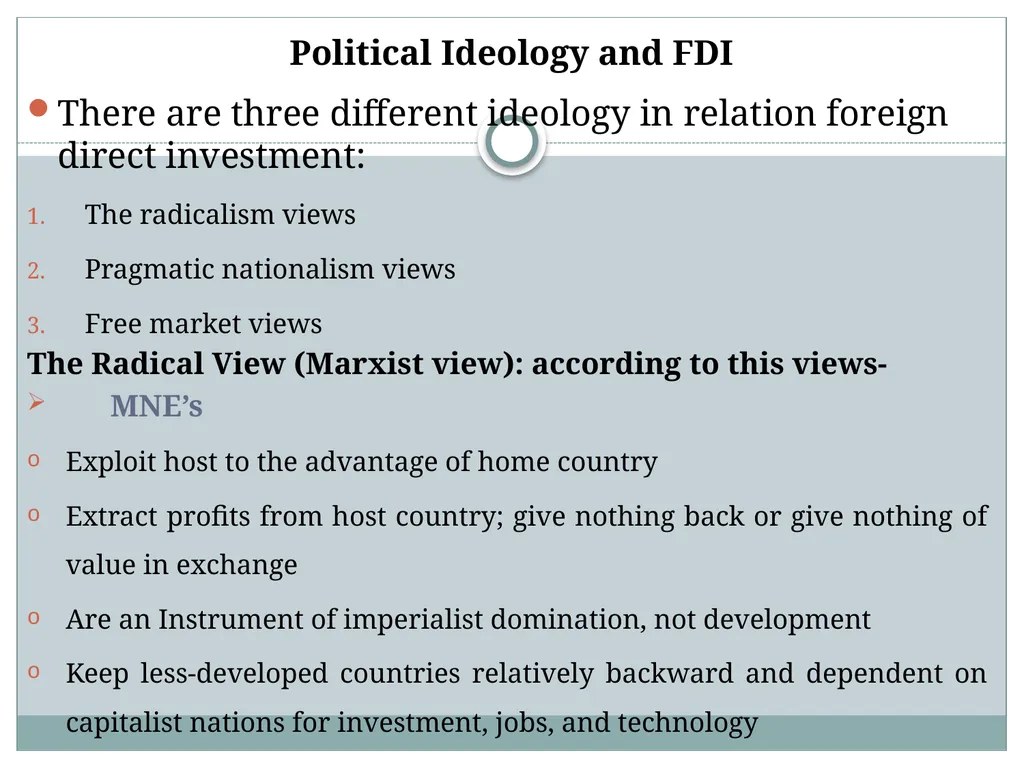
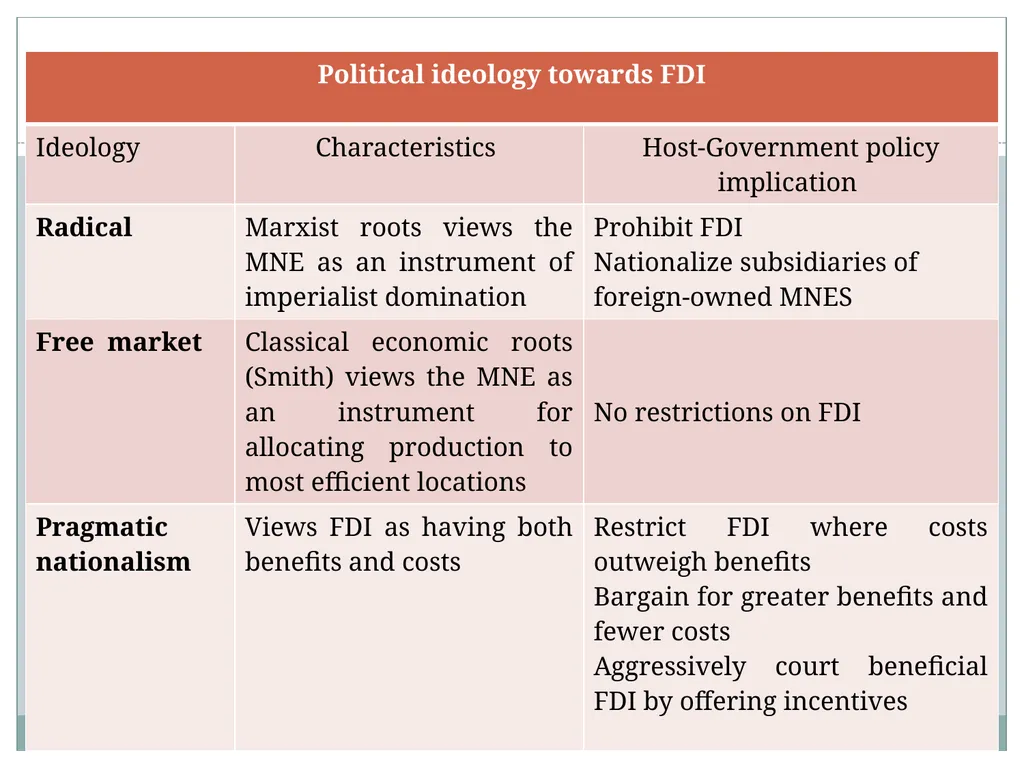
Political Ideology and FDI There are three different ideology in relation foreign direct investment:
The radicalism views
Pragmatic nationalism views
Free market views
The Radical View (Marxist view): according to this views-
MNE’s
Exploit host to the advantage of home country
Extract profits from host country; give nothing back or give nothing of value in exchange
Are an Instrument of imperialist domination, not development
Keep less-developed countries relatively backward and dependent on capitalist nations for investment, jobs, and technology<br>
The radicalism views
Pragmatic nationalism views
Free market views
The Radical View (Marxist view): according to this views-
MNE’s
Exploit host to the advantage of home country
Extract profits from host country; give nothing back or give nothing of value in exchange
Are an Instrument of imperialist domination, not development
Keep less-developed countries relatively backward and dependent on capitalist nations for investment, jobs, and technology<br>
25
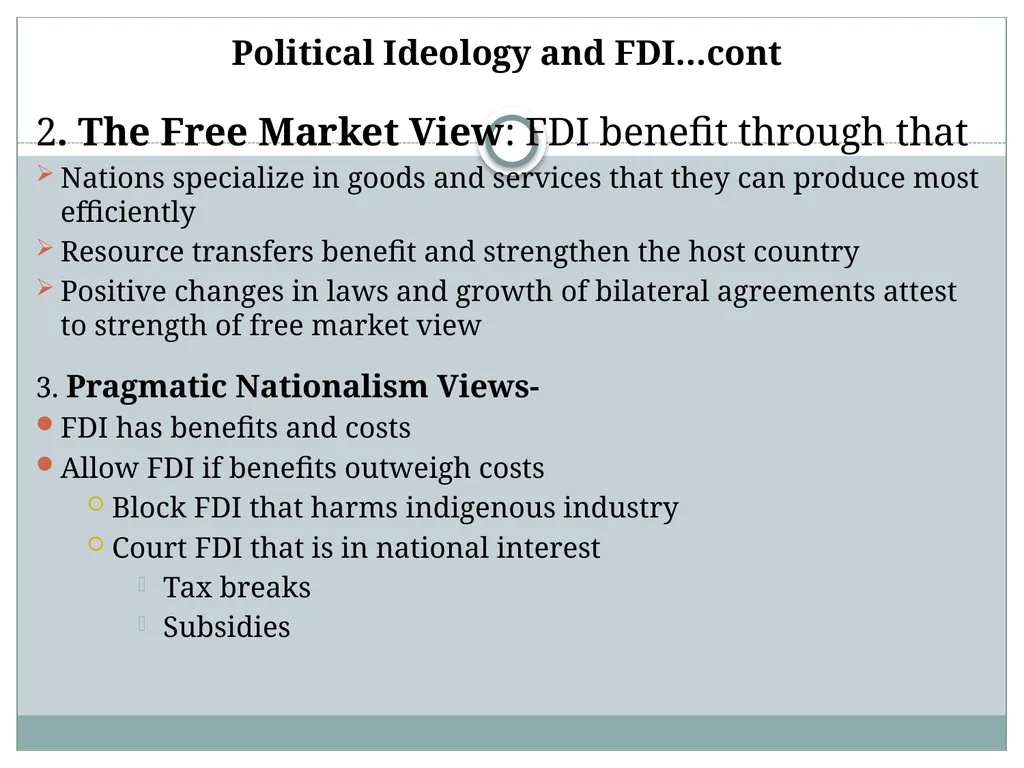
Political Ideology and FDI…cont 2. The Free Market View: FDI benefit through that
Nations specialize in goods and services that they can produce most efficiently
Resource transfers benefit and strengthen the host country
Positive changes in laws and growth of bilateral agreements attest to strength of free market view
3. Pragmatic Nationalism Views-
FDI has benefits and costs
Allow FDI if benefits outweigh costs
Block FDI that harms indigenous industry
Court FDI that is in national interest
Tax breaks
Subsidies<br>
Nations specialize in goods and services that they can produce most efficiently
Resource transfers benefit and strengthen the host country
Positive changes in laws and growth of bilateral agreements attest to strength of free market view
3. Pragmatic Nationalism Views-
FDI has benefits and costs
Allow FDI if benefits outweigh costs
Block FDI that harms indigenous industry
Court FDI that is in national interest
Tax breaks
Subsidies<br>
26
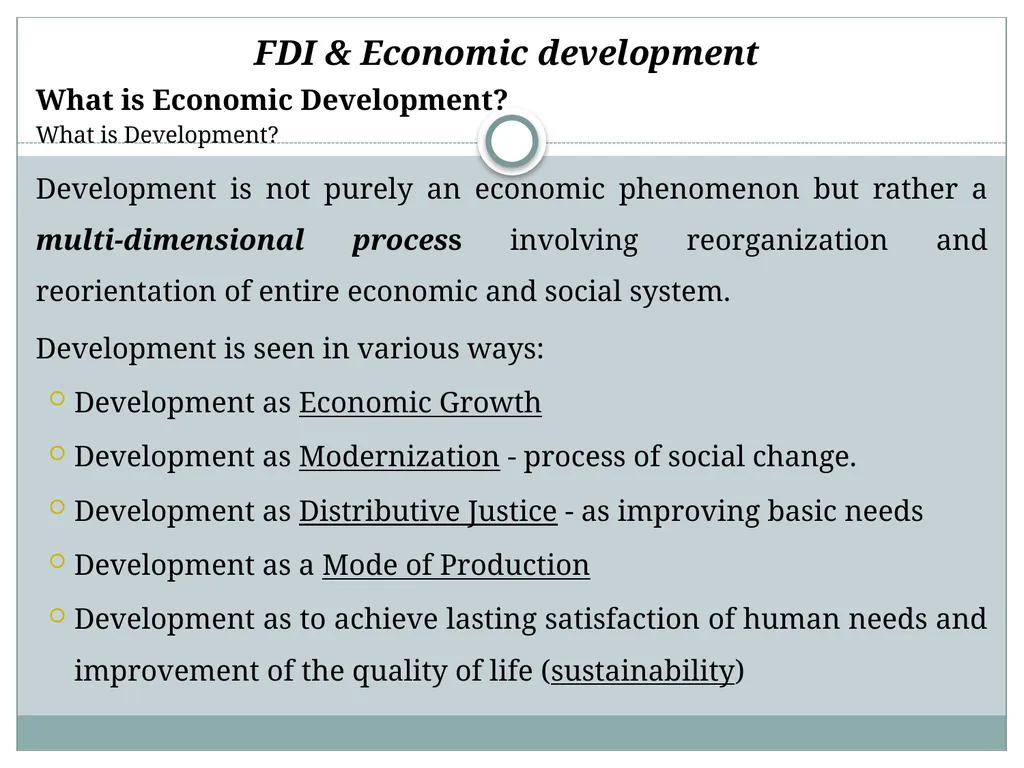
FDI & Economic development What is Economic Development?
What is Development?
Development is not purely an economic phenomenon but rather a multi-dimensional process involving reorganization and reorientation of entire economic and social system.
Development is seen in various ways:
Development as Economic Growth
Development as Modernization - process of social change.
Development as Distributive Justice - as improving basic needs
Development as a Mode of Production
Development as to achieve lasting satisfaction of human needs and improvement of the quality of life (sustainability)<br>
What is Development?
Development is not purely an economic phenomenon but rather a multi-dimensional process involving reorganization and reorientation of entire economic and social system.
Development is seen in various ways:
Development as Economic Growth
Development as Modernization - process of social change.
Development as Distributive Justice - as improving basic needs
Development as a Mode of Production
Development as to achieve lasting satisfaction of human needs and improvement of the quality of life (sustainability)<br>
27
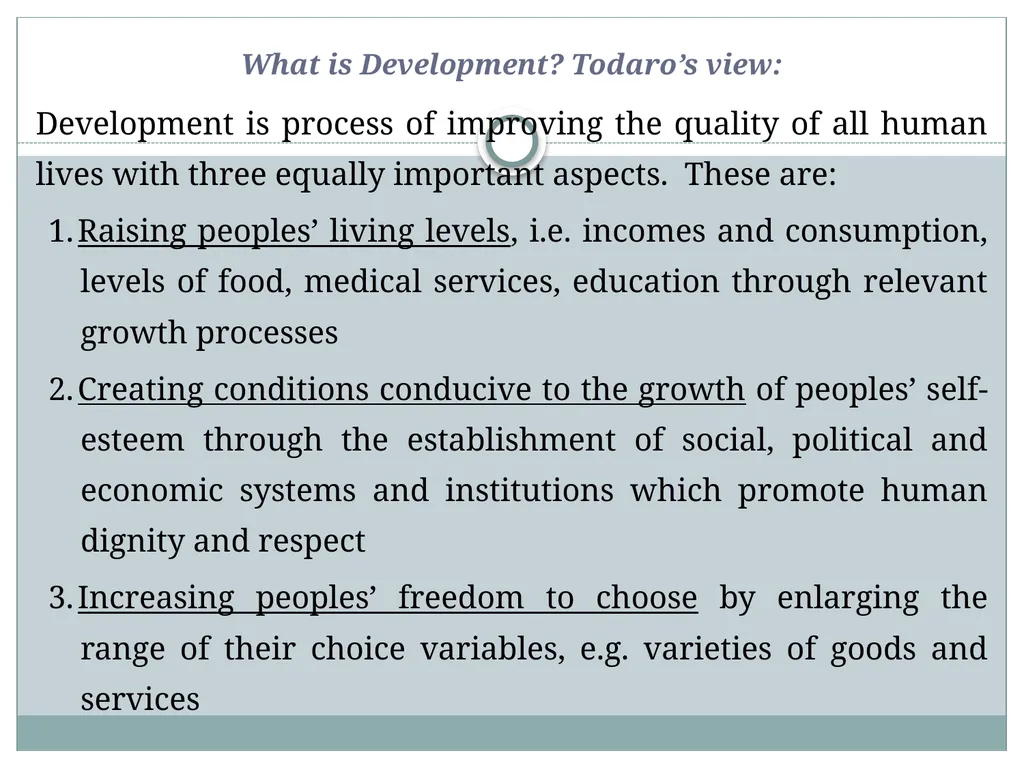
What is Development? Todaro’s view: Development is process of improving the quality of all human lives with three equally important aspects. These are:
1. Raising peoples’ living levels, i.e. incomes and consumption, levels of food, medical services, education through relevant growth processes
2. Creating conditions conducive to the growth of peoples’ self-esteem through the establishment of social, political and economic systems and institutions which promote human dignity and respect
3. Increasing peoples’ freedom to choose by enlarging the range of their choice variables, e.g. varieties of goods and services<br>
1. Raising peoples’ living levels, i.e. incomes and consumption, levels of food, medical services, education through relevant growth processes
2. Creating conditions conducive to the growth of peoples’ self-esteem through the establishment of social, political and economic systems and institutions which promote human dignity and respect
3. Increasing peoples’ freedom to choose by enlarging the range of their choice variables, e.g. varieties of goods and services<br>
28
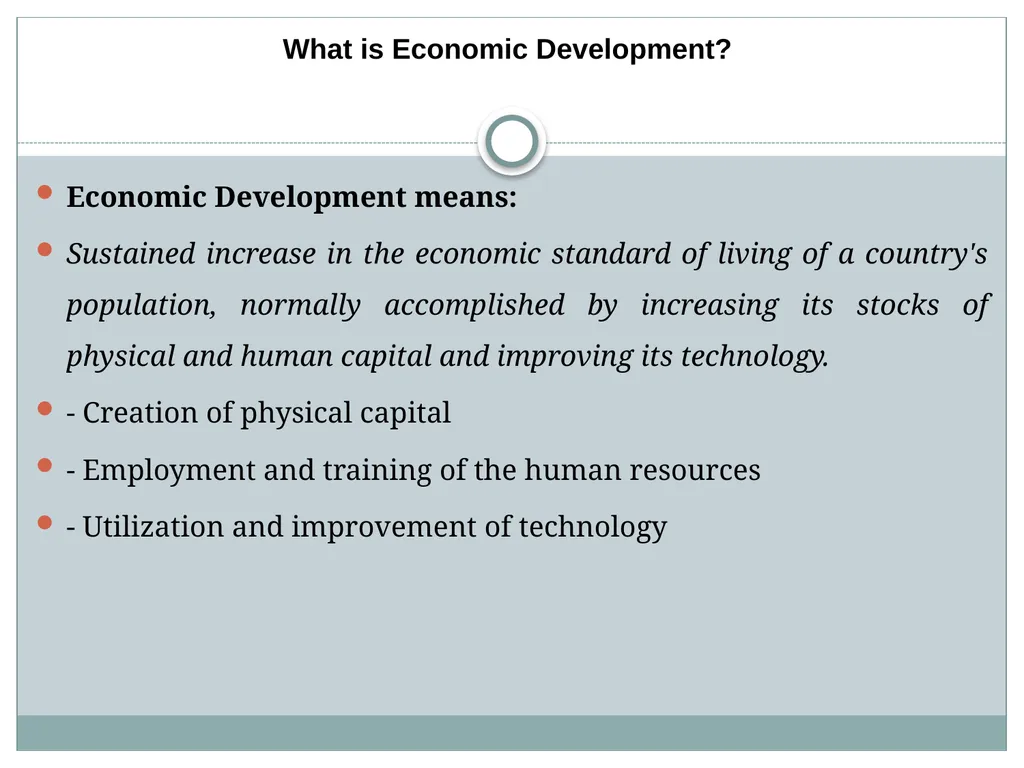
What is Economic Development? Economic Development means:
Sustained increase in the economic standard of living of a country's population, normally accomplished by increasing its stocks of physical and human capital and improving its technology.
- Creation of physical capital
- Employment and training of the human resources
- Utilization and improvement of technology<br>
Sustained increase in the economic standard of living of a country's population, normally accomplished by increasing its stocks of physical and human capital and improving its technology.
- Creation of physical capital
- Employment and training of the human resources
- Utilization and improvement of technology<br>
29
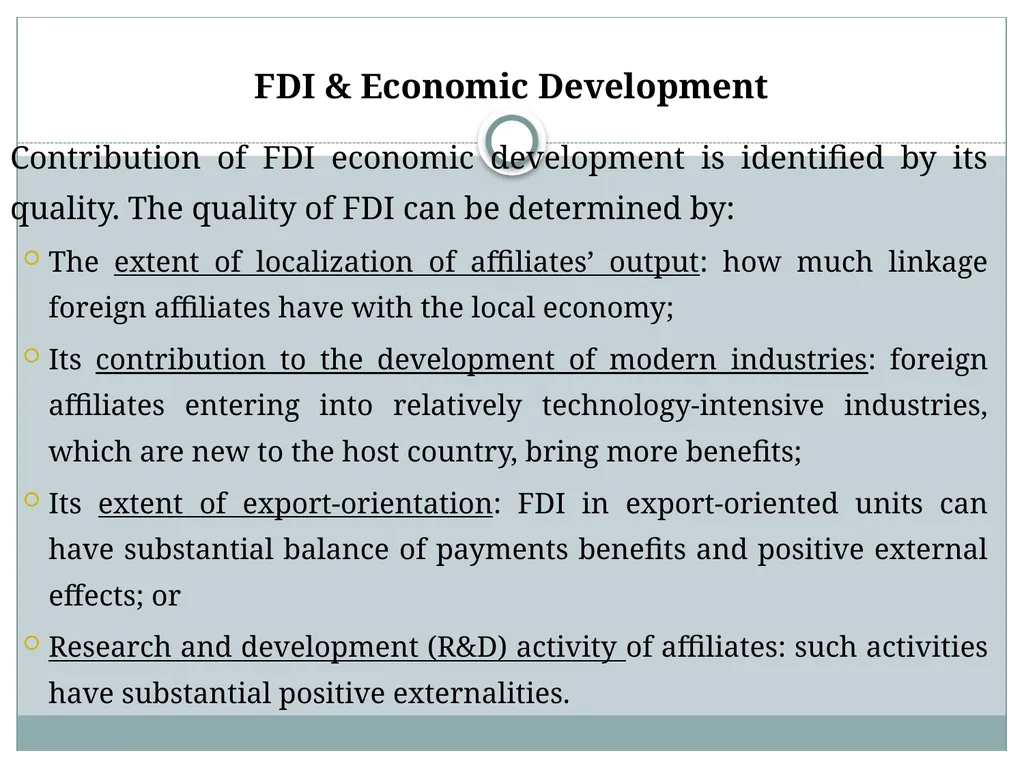
FDI & Economic Development Contribution of FDI economic development is identified by its quality. The quality of FDI can be determined by:
The extent of localization of affiliates’ output: how much linkage foreign affiliates have with the local economy;
Its contribution to the development of modern industries: foreign affiliates entering into relatively technology-intensive industries, which are new to the host country, bring more benefits;
Its extent of export-orientation: FDI in export-oriented units can have substantial balance of payments benefits and positive external effects; or
Research and development (R&D) activity of affiliates: such activities have substantial positive externalities.<br>
The extent of localization of affiliates’ output: how much linkage foreign affiliates have with the local economy;
Its contribution to the development of modern industries: foreign affiliates entering into relatively technology-intensive industries, which are new to the host country, bring more benefits;
Its extent of export-orientation: FDI in export-oriented units can have substantial balance of payments benefits and positive external effects; or
Research and development (R&D) activity of affiliates: such activities have substantial positive externalities.<br>
30
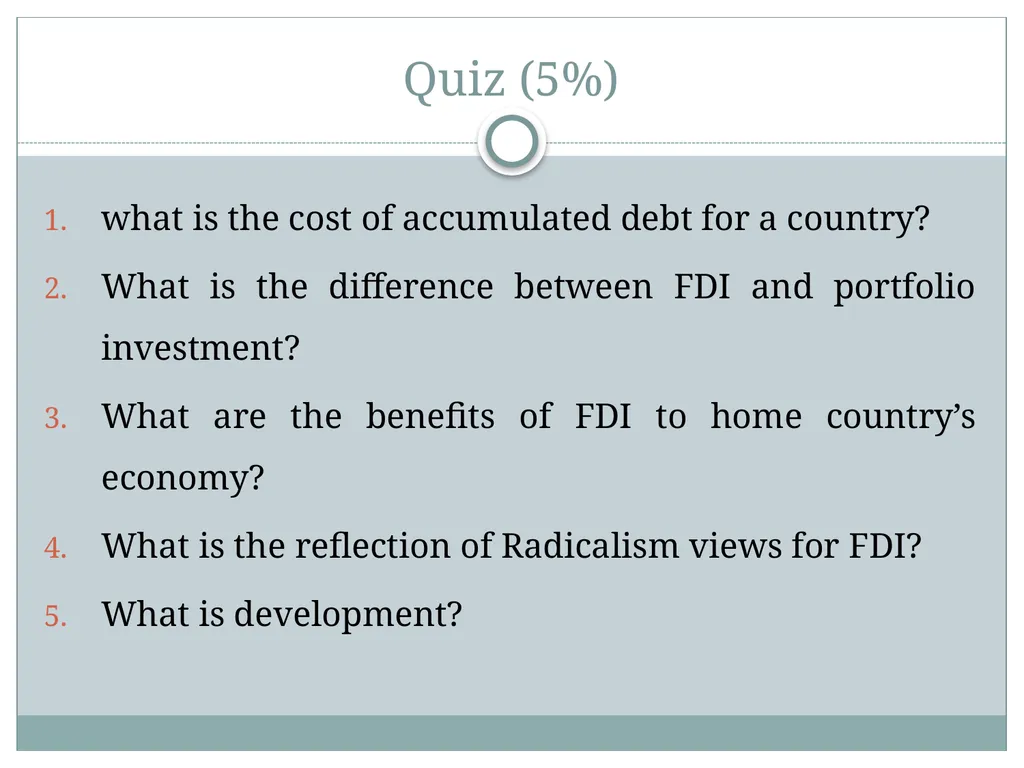
Quiz (5%) what is the cost of accumulated debt for a country?
What is the difference between FDI and portfolio investment?
What are the benefits of FDI to home country’s economy?
What is the reflection of Radicalism views for FDI?
What is development?<br>
What is the difference between FDI and portfolio investment?
What are the benefits of FDI to home country’s economy?
What is the reflection of Radicalism views for FDI?
What is development?<br>