
CHAPTER FIVE ANALYSIS OF FIRM STRUCTURE After











Description: CHAPTER FIVE ANALYSIS OF FIRM STRUCTURE After reading this chapter you must be able to Understand; Organization, Ownership and control of Firm Goal and Objectives of Firm Legal Forms of Business Structure conduct performance Measurement of
Related Topics
Download Presentation
"CHAPTER FIVE ANALYSIS OF FIRM STRUCTURE After" is the property of its rightful owner. Permission is granted to download and print the materials on this website for personal, non-commercial use only, and to display it on your personal computer provided you do not modify the materials and that you retain all copyright notices contained in the materials. By downloading content from our website, you accept the terms of this agreement.
Presentation Transcript
slide1. CHAPTER FIVE
ANALYSIS OF FIRM STRUCTURE After reading this chapter you must be able to Understand;
Organization, Ownership and control of Firm
Goal and Objectives of Firm
Legal Forms of Business
Structure conduct performance
Measurement of Market Performance and Market Structure.<br>
slide2. Different firms are in this world are established for different objectives, in different forms, in different organization, ownership, structure and management forms.
Organization is the group of people with common goal and working together for achievement of the organization objective.
An organization is coalition.It is a coalition of individuals.<br>
slide3. In a business organization the coalition of members include managers, workers, stockholders, suppliers, customers, lawyers, tax collectors, regulatory agencies etc.
In the governmental organizations the members include administrators, workers, appointed officials, elective officials, legislators, judges, clienteles, interest group leaders, etc.
In the voluntary charitable organization there are paid functionaries, volunteers, donors, donees, etc.<br>
slide4. However, the idea of an organizational goal and the conception of an organization as a coalition are implicitly contradictory. Why?
Basic to the idea of coalition is the expectation that the individual participates in the organization may have substantially different preference orderings (i.e. individual goals).<br>
slide5. 5.1.3 Ownership and Control of Firms
The traditional theory of the firm viewed control as being exercised solely by the individual owner, who was the sole claimant on profitability.
Starting in the 1930s, however, the management school argued that ownership through the holding of shares had become highly dispersed, particularly in large companies; that salaried managers who controlled firms operations held few shares. Because of this type of ownership of shares, they were only loosely motivated or constrained by owners to pursue profit maximization.<br>
slide7. Majority of the firms are share companies. But with regard to the extent of managerial shareholding, separation of ownership and control in large companies is different.
In this case, ownership is widely dispersed, and management control is therefore, largely independent of the owners.<br>
slide8. 5.2. Goals and Objectives of Firms 5.2.1.Goals of Firms
We have seen the potential conflict between the shareholders who own the company and the managers who direct it.
In addition to this, there is potential conflict of interests between different groups of managers charged with responsibilities for different parts and functions within the firm b/c a firm is a coalition of individuals who have their own personal goals.
In a business firm the individuals include managers, workers, shareholders, suppliers, customers, etc. Explicitly or implicitly, a process of bargaining occurs continuously. The bargaining process, however, does not eliminate all conflict within the managerial group.<br>
slide9. There are five main aims that well represent the organizational goals of the firm.
i. Production goal- The production department is largely concerned with matters of output and employment.
They desire primarily the way
Production side for stable employment,
Ease of scheduling,
Maintenance of adequate cost performance, and
Growth are all largely met by requiring that production does not fluctuate too much or fall below an acceptable level.
Even if sales are poor the production department will want an increase its inventories rather than a cut in output.<br>
slide10. ii. Inventory goal: All times a complete and convenient stock of inventory is largely met by keeping the level of inventory above a certain minimum figure.
The holding of inventories please/satisfy both sales and production department, but it creates conflicts with the interests of the financial managers who regard the holding of excessive inventories as unprofitable since it ties up valuable working capital.<br>
slide11. iii. Sales goal- The importance of sales for the stability and survival of the firm makes it an important goal for all firm members but practically for the sales staff, whose effectiveness is judged partly by their success in maintaining and expanding sales.
iv. Market Share goal - This may be an alternative to the sales goal, particularly if market growth is important. Management may adhere to maximizing market share more because of the comparative performance measurement element is contained in it.<br>
slide12. v. Profit goal: profit is an important performance measure for top management. In addition, Investment, dividends, and further resources for sub-units of the firm all require adequate profit.
It is clear that these goals may conflict irreconcilably when it comes to choosing price and output levels.
For example:
Sales goals may require a lower price, the profit goal is a higher one.
Both sales and production goals may favor high inventories, profit goal needs a lower level of inventories, and so on.
The question is how are these conflicts solved?<br>
slide13. Cyert and March identify four mechanisms to solve these conflicts.
Objectives are stated in terms of satisfying or aspiration levels.
At any one time only one objective will be operative
ii. Decision taking is sequential.
Performing different objectives at different times reduces substantially the perceived conflict between different objectives.
iii. Organizational slack exists:
If performance becomes inadequate in terms of a particular objective, it is generally possible for organizations to increase efficiency by utilizing slack resources.
iv. The use of standard operating procedures.
Many decisions are standardized and then operated by the department responsible for them. Acceptance of these standard procedures then avoids much latent conflict.<br>
slide14. 5.3 Legal Forms of Business The organizational form (legal forms of the business) may influence the choice of the goal or motive to be pursued by the firm.
For example, a small firm run by a sole proprietor may intend to pursue the motive of profit maximization but for a large corporation this objective may not have any validity.
For example, the managers of corporation may be interested in maximizing their own utility rather than the profits.<br>
slide15. 5.3.1 Types of Organizational Forms
In industrial economics a business firm can be identified based on the type of business it is doing, its size, the pattern of ownership and etc.
The pattern of ownership is commonly used to describe the type of organizational form for the firms.
According to this, we can classify firms as proprietorship, partnership and corporation.
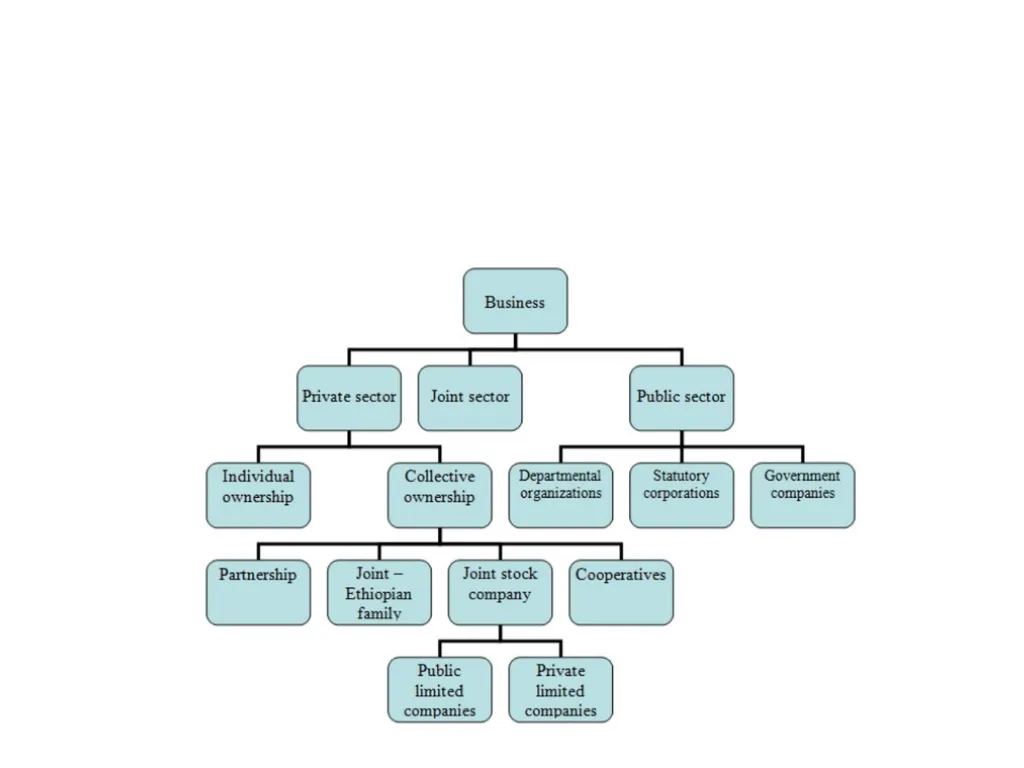
The legal organizational pattern of the firm based on their ownership is displayed as follows.<br>
slide17. All firms engaged in business can be first classified into three categories.
Private sector
Public sector and
Joint sector
In private sector ownership is exclusively in the hands of the private individuals, where as in the public sector, the government owns the firm.
In the joint sector, the government, the private entrepreneur and the public together share the ownership, management and control of the firm.<br>
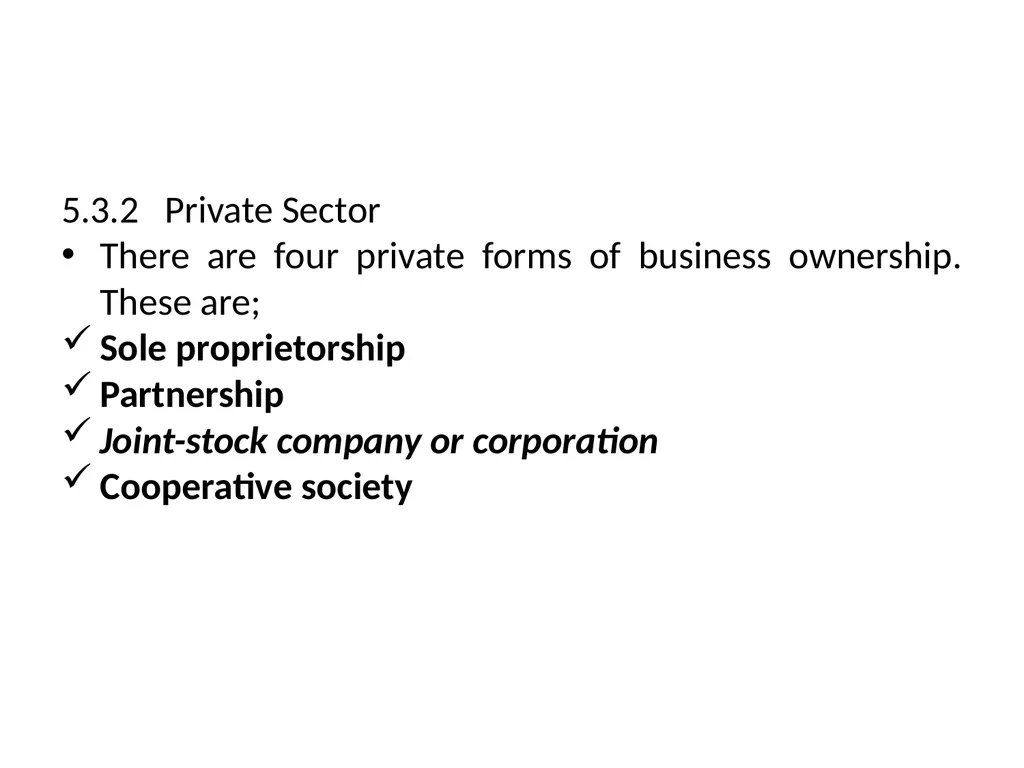
slide18. 5.3.2 Private Sector
There are four private forms of business ownership. These are;
Sole proprietorship
Partnership
Joint-stock company or corporation
Cooperative society<br>
slide19. i. Sole proprietorship Sole proprietorship is the simplest kind of business organization which is owned and controlled by a single individual. Alternatively, it is called one-man business.
The sole proprietor may have any number of persons working for him/her but they will be just paid employees or family members having no share in the ownership of the business.
In terms of numbers, this is the most common form of business organization and is found mainly in the retail trade, service industries, cottage and small industries and the professions.<br>
slide20. This form of ownership has its own advantages and disadvantages
Advantages of sole proprietorship
It is easy to establish
Incentive to earn more by exerting one’s own effort.
Independence of control over business
Decision-making is very fast
Secret of business can be maintained
Can bring efficiency because of direct contact to the owner
Flexible operation
Equal opportunity to everyone to use ones talents<br>
slide21. Disadvantages of Sole Proprietorship
There may be limitation both in resource mobilization and management.
Sole proprietor liable for all kinds of risks (unlimited liability)
The life of the firm is uncertain. After the death of the proprietor there is no guarantee whether the business will continue or not.
All qualities required for success in business are rarely found in one man.
Sole proprietorship is suitable when the markets are limited and highly localized and the commodity or service is provided according to individual requirements.<br>
slide22. ii. Partnerships' In this form of ownership the firm is owned or managed or controlled jointly by more than one person.
All of them agree to share the profits of the firm. Profits are shared by all members of the family according to their share or contribution in the business.
It is not necessary for the partners to own the capital jointly or to manage the firm jointly.
The contribution of the partners in running the business need not be the same.
The minimum number of partners is two and the upper limit is twenty in most cases.
Partnership is created by mutual consent and voluntary agreement.<br>
slide23. There are many members types of partnership depending upon their specific role in business. These are
Active partners who bring in capital and take active interest in the conduct of the business.
Sleeping partners who bring in capital, share profit gains but do not take active interest in the conduct of the business. There is a category of interest which is called secret partners being unknown to the public.
Nominal partners who just lend their names and credit to the firm without contributing any capital or without any active interest in the business. In the eyes of the law such partners are equally responsible for the liabilities of the firm.
Quasi-partner or estoppel-partner: A person who is not a partner actually, but acts as a partner. Such a partner does not share any personal liability of the firm.<br>
slide24. The advantages of the partnership are;
Ease of formation
Large financial resources
Combined managerial abilities and judgment
Flexibility and elasticity in operation
Combination of management and ownership
mutual cooperation,
Protection of minority (in the sense of partnership) interests secrecy in business and
Adequate credit availability because of unlimited liabilities of the partners.<br>
slide25. The main disadvantages are:
Unlimited liability of each partner
Risks from dishonest co-partners
Uncertain life
Lesser public confidence,
Non-transferability or restricted transferability of the partners' interest in the business, and
Liability of the partner even after his retirement from the firm.
Note: Like a sole-proprietorship the main motive of partnerships firm will be profit maximization. This is clear since the very basis of defining partnership is the sharing of the profit. Survival in business may be looked upon as an alternative goal for such a firm.<br>
slide26. iii. Joint-stock company or corporation A joint-stock company is a legal entity with a perpetual succession and a common seal.
It is a voluntary association of certain persons formed to carry out a particular purpose in common.
It is just like an artificial man created by the law whose life is independent of the lives of the members of its association.
The essential characteristics of a joint-stock company are the following.
Legal Entity:
A joint-stock company is created by law.
It is a legal entity distinct and independent of the existence of its members who own it.
It is the official seal and signatures that matter in the dealings of a joint-stock company.<br>
slide27. Corporate Existence:According to the law, the mode of incorporation and dissolution of the company and the rights of the members to transfer shares guarantee the existence of the company quite independent of the life & tenure of the members. It, therefore, enjoys perpetual succession.
Corporate finance: A joint-stock company raises its basic capital for investment in the form of shares. The shares are purchased by the public who become owners of the company.
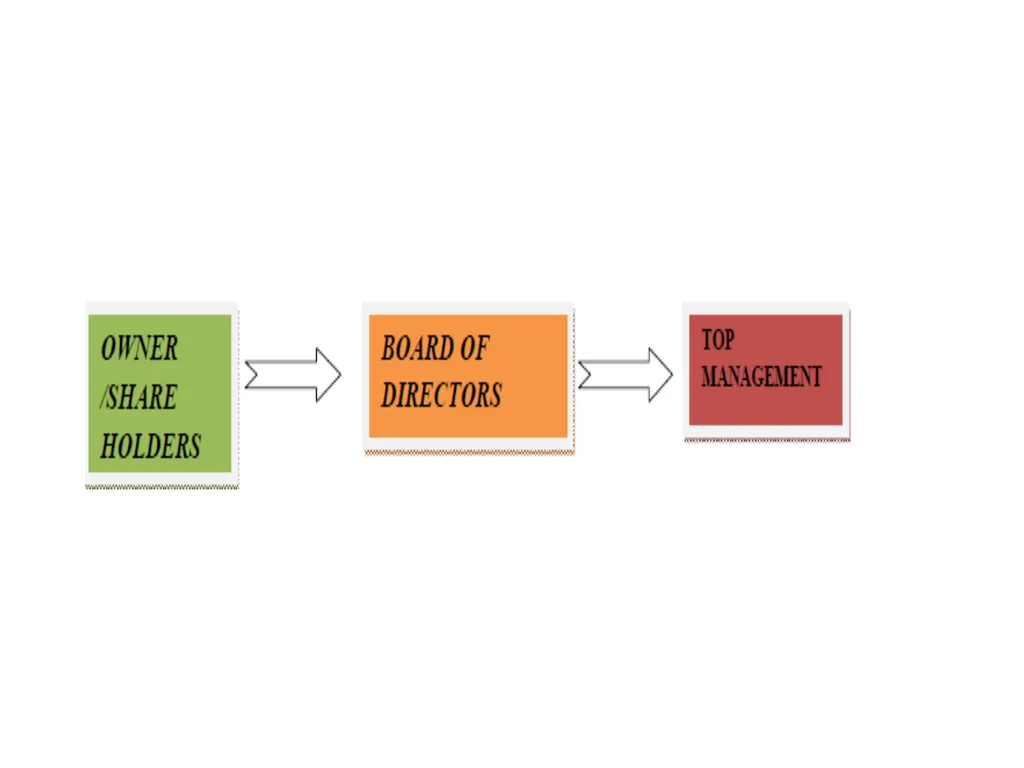
Centralized and Delegated Management: A joint-stock company can have a large number of shareholders. All of them cannot take active participation in the management of the company. Actual control and management is, therefore, delegated by the shareholders to their elected representatives called board of directors.<br>
slide28. Transferability of shares: - The shares of a joint-stock company are freely transferable. They can be sold and purchased just like a commodity, in the share or stock-exchange market.
Large number of members: The number of shareholders of a joint-stock company is quite large.
Limited Liability: -The responsibility or liability of the members of a joint-stock company is limited to the extent of the nominal value of the shares held by them. The liability of the company as a whole of course remains unlimited.
Statutory Regulations and Controls:- The law regulates the company or corporation for the benefit of the public in general
Publicity and compliance to various Legal Formalities: A joint stock company has to file a set of documents with the Registrar of companies and publish them for the information of the public such as Memorandum and Articles of Association, Balance Sheet and Profit, loss accounts and Annual Reports.<br>
slide29. All companies limited by shares may be classified, as a ' private limited' company and as a "public limited" company.
A Private limited company is one which by its Articles of Association
Restricts the right of the members to transfer shares.
Limits the number of members to fifty excluding past or present employees of the company and
Prohibits any invitation to the public to subscribe for its shares or debentures.
Minimum number of shareholders for a private limited company is two.
The public limited company is one which has no restrictions as mentioned in the case of a private company. It will have a minimum of seven shareholders and the upper limit is open for any number.<br>
slide30. There are advantages and disadvantages of the joint-stock companies.
The Advantages of the joint-stock company are:
Limited liability which reduces the risks in business from individual investor's point of view
Perpetual succession guarantees continuity of business for longer period.
Transferability of shares which secures freedom to withdraw from the business and to increase wealth through shares.
Financial strength because of the contribution of shares.
Centralized team, management through board of directors ensures better decision-making.
The scope for expansion improves due to better financial and managerial resources.
Better confidence from the creditors as a result of a better position of the company.<br>
slide31. The disadvantages of joint-stock company are:
Too much legal formalities right from the time of formation as well as in its day-to-day working.
Separation between ownership and management. This is a serious limitation b/c it lacks followup and control.
Few shareholders having greater number of shares at their credit may not care about minority shareholders.
Fraud is possible because of lack of control.
Speculation in the stock exchange market about the company may spoil its good will in the goods market.
Delays in the decision-making
If we weigh the advantages and the disadvantages of the joint-stock companies the balance tilts towards the advantages and that is why this system is gaining more and more popularity.<br>
slide32. iv. Cooperative society: A cooperative society is a form where people associate voluntarily for the furtherance of their common economic interest.
Some of the cooperatives societies are: consumers' cooperatives societies, producers' cooperatives societies, marketing cooperatives, cooperative credit societies, cooperative farming societies, and housing cooperatives.<br>
slide33. 5.3.3. Public Sector companies
The public sector plays a vital role in the socialistic and mixed economics mainly for three reasons:
To gain control of the commanding heights of the economy,
To promote critical development in terms of social gains or strategic value rather than primarily on consideration of profits, and
To provide commercial surplus with which to finance the economic development of the country.<br>
slide34. Some of the important types of government companies are the following
Departmental organizations- (like Post, Tele, Railways, Broadcasting, and Defense undertakings in the country).
Public corporations- these companies are established under the specific Acts of the parliament or state Legislature. They are called statutory corporations such as Airlines, Insurance Corporation, etc.
Government Companies- A government company is any company in which not less than fifty one percent of the share capital is owned by the government. It is organized under the existing provision of the companies Act like any other joint-stock company<br>
slide35. 5.3.4 Joint-Sector Companies
The concept of joint sector implies the participation of both the government and the private sector in the business.
Under this organization, a firm is owned and run jointly by the government and a private entrepreneur.
The public sector and the private one work together under the same roof and put a mutual check on each other.<br>
slide36. 5.4.Structure-conduct-performance
Theories on competitive and non-competitive markets hold that the less competition a firm faces, the greater its market power; the ability to set price above marginal cost.
Thus, market power (and hence price and profits) should be higher in industries with substantial entry barriers that reduce actual and potential competition.
Economists conduct empirical investigations to test two of the implications of these theories:
How much market power do particular firms (industries) exercise?
What are the major factors that determine market power?<br>
slide37. For many decades, economists have conducted structure-conduct-performance (SCP) studies that concentrate on the second question, which concerns the relationship between market performance and market structure.
Market performance is the success of a market in producing benefits for consumers (for example, a market is performing well if prices are near to marginal cost of production).
Market structure consists of those factors that determine the competitiveness of a market. Market structure affects market performance through the conduct or behavior of firms.<br>
slide38. 5.5 Measurement of Market Performance and Market structure 5.5.1 Measurement of Market Performance
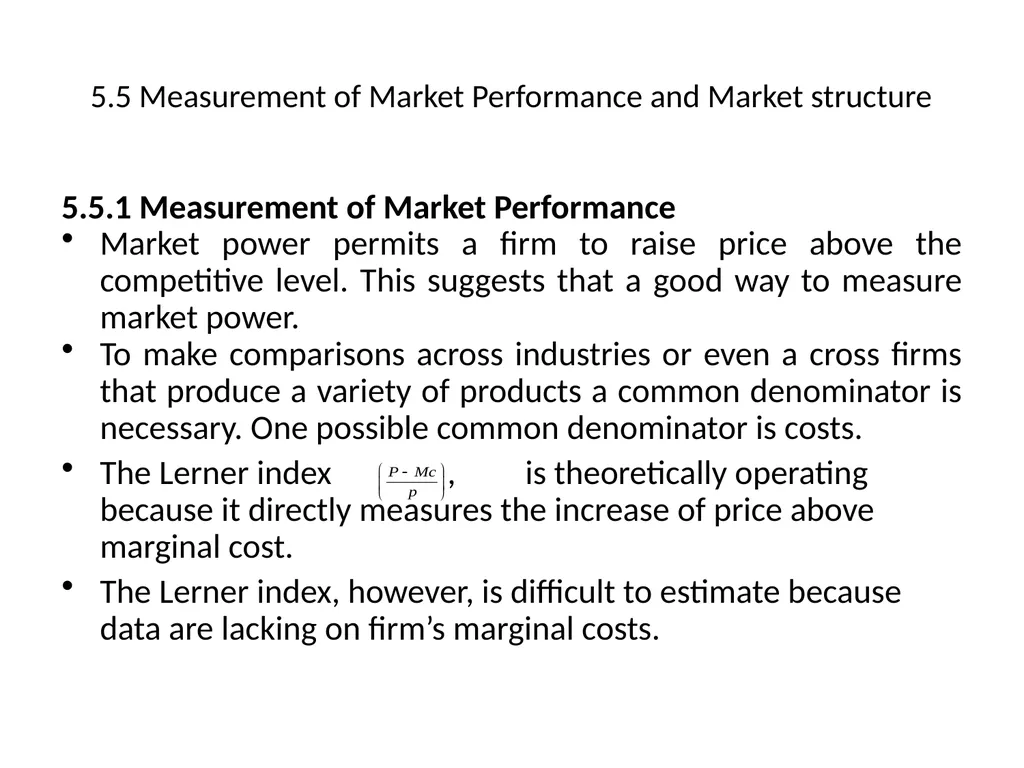
Market power permits a firm to raise price above the competitive level. This suggests that a good way to measure market power.
To make comparisons across industries or even a cross firms that produce a variety of products a common denominator is necessary. One possible common denominator is costs.
The Lerner index , is theoretically operating because it directly measures the increase of price above marginal cost.
The Lerner index, however, is difficult to estimate because data are lacking on firm’s marginal costs.<br>
slide39. In short, there are four different measures have been used as a proxy for the learner index in structure -conduct - performance (SCP) studies:
These are
Excess return on sales,
Profit rate,
Price-cost margin, and
Tobin’s q model.<br>
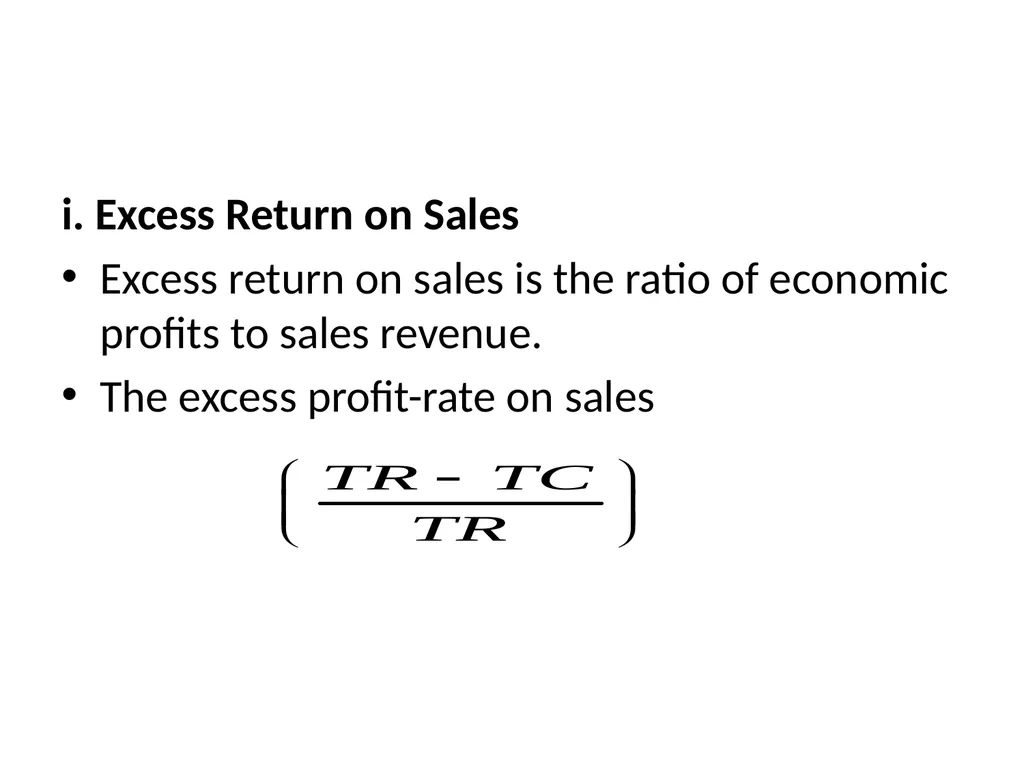
slide40. i. Excess Return on Sales
Excess return on sales is the ratio of economic profits to sales revenue.
The excess profit-rate on sales<br>
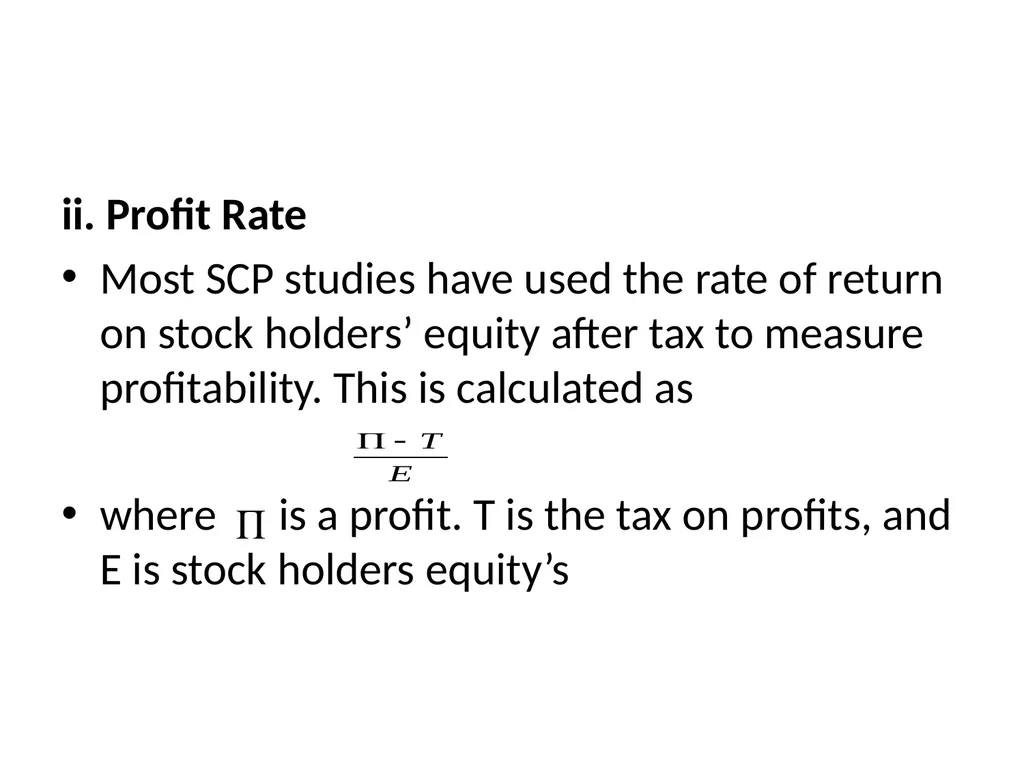
slide41. ii. Profit Rate
Most SCP studies have used the rate of return on stock holders’ equity after tax to measure profitability. This is calculated as
where is a profit. T is the tax on profits, and E is stock holders equity’s<br>
slide42. A disadvantage of the rate of return on equity, however, is its sensitivity to variations in the debt /equity ratio across firms, issuing both debt (banks) and equity (stocks) results in two groups having claims on the assets of the firm.<br>
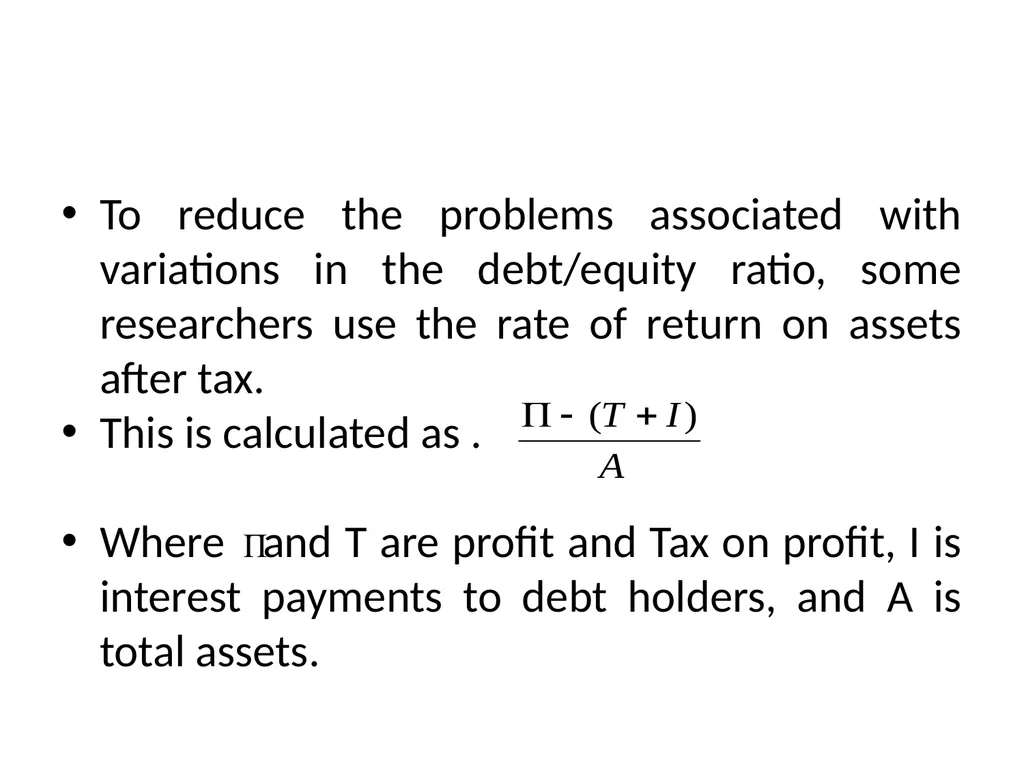
slide43. To reduce the problems associated with variations in the debt/equity ratio, some researchers use the rate of return on assets after tax.
This is calculated as .
Where and T are profit and Tax on profit, I is interest payments to debt holders, and A is total assets.<br>
slide44. Although, economic theory makes predictions about economic profits, reported profits are accounting profits. Using accounting data can lead to biased estimates of rates or return.
What do you think are the main differences between economic profits and accounting profits?<br>
slide45. In calculating the annual capital costs of a firm, problems arise with accounting data.
First: Capital should be valued its replacement cost but accounting data use book value, which is calculated using the historical value of an asset.
Example: consider an asset that was in expense at the time of its purchase but whose price has increased significantly.
In this case, the rate of return calculated using historical cost will be considerably greater than the rate of return using replacement cost, overestimating the profitability of investment in the industry.<br>
slide46. A second problem with accounting data is the calculation of depreciation w/h measures the decrease in economic value that occurs during the period the asset is used.
If, for example a machine that costs birr 1000 is assumed to last for five years, the annual depreciation would be birr 200 for the first five years. If the machine happens to last more than five years, there would be no further depreciation.<br>
slide47. 3rd problems with accounting data arise for expenditures on advertising,Research and development (R&D).
A successful advertising comparing in one year can affect demand in subsequent years if consumers remember the campaign.
Similarly, R&D expenditures in one year can affect demand or costs in future years.
Common accounting procedure is to deduct the entire costs of advertising or R&D in one year and then deduct nothing in subsequent years. If this practice is followed, the rate of return will be underestimated in the first year and over estimated in future years.<br>
slide48. Finally problem with accounting data arises from inflation.
iii. Price-cost margins
Another measure of performance used in numerous industrial organization studies is the price-cost margin.<br>
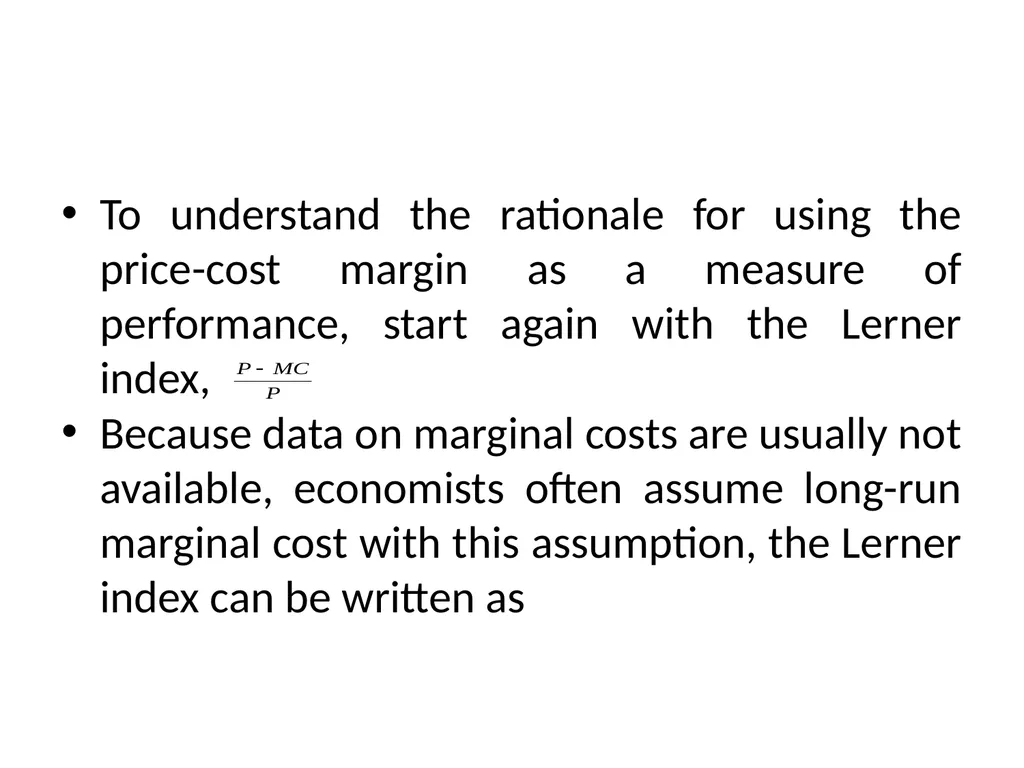
slide49. To understand the rationale for using the price-cost margin as a measure of performance, start again with the Lerner index,
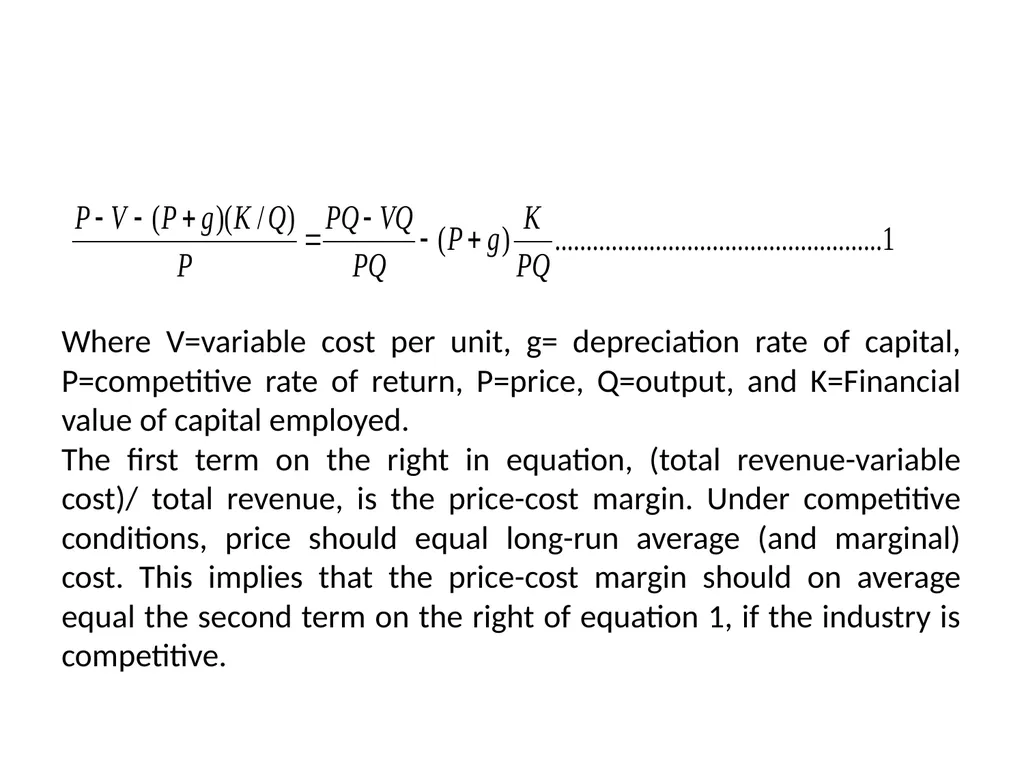
Because data on marginal costs are usually not available, economists often assume long-run marginal cost with this assumption, the Lerner index can be written as<br>
slide50. Where V=variable cost per unit, g= depreciation rate of capital, P=competitive rate of return, P=price, Q=output, and K=Financial value of capital employed.
The first term on the right in equation, (total revenue-variable cost)/ total revenue, is the price-cost margin. Under competitive conditions, price should equal long-run average (and marginal) cost. This implies that the price-cost margin should on average equal the second term on the right of equation 1, if the industry is competitive.<br>
slide51. iv. Tobin’s ‘Q’ of another measure of performance
Tobin’s q is the ratio of the market value of a firm’s assets (as measured by the market value of its outstanding stock and debt) to the replacement cost of the firm’s assets (Tobin 1969).<br>
slide52. 5.5.2.Measures of Market structure
Some of the common measures of market structure.
i. Industry Concentration.
Industry concentration is typically measured as a function of the market shares of some or all of the firms in a market.
The degree of seller concentration
The degree of buyer concentration
The degree of product differentiation
The condition of entry to or exit from the market
The degree of diversification of individual firms,
Technological, geographical and institutional factors present in the market
The extent to which firms one vertically integrated back to their sources of supply or forward to the final markets,<br>
Organization, Ownership and control of Firm
Goal and Objectives of Firm
Legal Forms of Business
Structure conduct performance
Measurement of Market Performance and Market Structure.<br>
slide2. Different firms are in this world are established for different objectives, in different forms, in different organization, ownership, structure and management forms.
Organization is the group of people with common goal and working together for achievement of the organization objective.
An organization is coalition.It is a coalition of individuals.<br>
slide3. In a business organization the coalition of members include managers, workers, stockholders, suppliers, customers, lawyers, tax collectors, regulatory agencies etc.
In the governmental organizations the members include administrators, workers, appointed officials, elective officials, legislators, judges, clienteles, interest group leaders, etc.
In the voluntary charitable organization there are paid functionaries, volunteers, donors, donees, etc.<br>
slide4. However, the idea of an organizational goal and the conception of an organization as a coalition are implicitly contradictory. Why?
Basic to the idea of coalition is the expectation that the individual participates in the organization may have substantially different preference orderings (i.e. individual goals).<br>
slide5. 5.1.3 Ownership and Control of Firms
The traditional theory of the firm viewed control as being exercised solely by the individual owner, who was the sole claimant on profitability.
Starting in the 1930s, however, the management school argued that ownership through the holding of shares had become highly dispersed, particularly in large companies; that salaried managers who controlled firms operations held few shares. Because of this type of ownership of shares, they were only loosely motivated or constrained by owners to pursue profit maximization.<br>
slide7. Majority of the firms are share companies. But with regard to the extent of managerial shareholding, separation of ownership and control in large companies is different.
In this case, ownership is widely dispersed, and management control is therefore, largely independent of the owners.<br>
slide8. 5.2. Goals and Objectives of Firms 5.2.1.Goals of Firms
We have seen the potential conflict between the shareholders who own the company and the managers who direct it.
In addition to this, there is potential conflict of interests between different groups of managers charged with responsibilities for different parts and functions within the firm b/c a firm is a coalition of individuals who have their own personal goals.
In a business firm the individuals include managers, workers, shareholders, suppliers, customers, etc. Explicitly or implicitly, a process of bargaining occurs continuously. The bargaining process, however, does not eliminate all conflict within the managerial group.<br>
slide9. There are five main aims that well represent the organizational goals of the firm.
i. Production goal- The production department is largely concerned with matters of output and employment.
They desire primarily the way
Production side for stable employment,
Ease of scheduling,
Maintenance of adequate cost performance, and
Growth are all largely met by requiring that production does not fluctuate too much or fall below an acceptable level.
Even if sales are poor the production department will want an increase its inventories rather than a cut in output.<br>
slide10. ii. Inventory goal: All times a complete and convenient stock of inventory is largely met by keeping the level of inventory above a certain minimum figure.
The holding of inventories please/satisfy both sales and production department, but it creates conflicts with the interests of the financial managers who regard the holding of excessive inventories as unprofitable since it ties up valuable working capital.<br>
slide11. iii. Sales goal- The importance of sales for the stability and survival of the firm makes it an important goal for all firm members but practically for the sales staff, whose effectiveness is judged partly by their success in maintaining and expanding sales.
iv. Market Share goal - This may be an alternative to the sales goal, particularly if market growth is important. Management may adhere to maximizing market share more because of the comparative performance measurement element is contained in it.<br>
slide12. v. Profit goal: profit is an important performance measure for top management. In addition, Investment, dividends, and further resources for sub-units of the firm all require adequate profit.
It is clear that these goals may conflict irreconcilably when it comes to choosing price and output levels.
For example:
Sales goals may require a lower price, the profit goal is a higher one.
Both sales and production goals may favor high inventories, profit goal needs a lower level of inventories, and so on.
The question is how are these conflicts solved?<br>
slide13. Cyert and March identify four mechanisms to solve these conflicts.
Objectives are stated in terms of satisfying or aspiration levels.
At any one time only one objective will be operative
ii. Decision taking is sequential.
Performing different objectives at different times reduces substantially the perceived conflict between different objectives.
iii. Organizational slack exists:
If performance becomes inadequate in terms of a particular objective, it is generally possible for organizations to increase efficiency by utilizing slack resources.
iv. The use of standard operating procedures.
Many decisions are standardized and then operated by the department responsible for them. Acceptance of these standard procedures then avoids much latent conflict.<br>
slide14. 5.3 Legal Forms of Business The organizational form (legal forms of the business) may influence the choice of the goal or motive to be pursued by the firm.
For example, a small firm run by a sole proprietor may intend to pursue the motive of profit maximization but for a large corporation this objective may not have any validity.
For example, the managers of corporation may be interested in maximizing their own utility rather than the profits.<br>
slide15. 5.3.1 Types of Organizational Forms
In industrial economics a business firm can be identified based on the type of business it is doing, its size, the pattern of ownership and etc.
The pattern of ownership is commonly used to describe the type of organizational form for the firms.
According to this, we can classify firms as proprietorship, partnership and corporation.
The legal organizational pattern of the firm based on their ownership is displayed as follows.<br>
slide17. All firms engaged in business can be first classified into three categories.
Private sector
Public sector and
Joint sector
In private sector ownership is exclusively in the hands of the private individuals, where as in the public sector, the government owns the firm.
In the joint sector, the government, the private entrepreneur and the public together share the ownership, management and control of the firm.<br>
slide18. 5.3.2 Private Sector
There are four private forms of business ownership. These are;
Sole proprietorship
Partnership
Joint-stock company or corporation
Cooperative society<br>
slide19. i. Sole proprietorship Sole proprietorship is the simplest kind of business organization which is owned and controlled by a single individual. Alternatively, it is called one-man business.
The sole proprietor may have any number of persons working for him/her but they will be just paid employees or family members having no share in the ownership of the business.
In terms of numbers, this is the most common form of business organization and is found mainly in the retail trade, service industries, cottage and small industries and the professions.<br>
slide20. This form of ownership has its own advantages and disadvantages
Advantages of sole proprietorship
It is easy to establish
Incentive to earn more by exerting one’s own effort.
Independence of control over business
Decision-making is very fast
Secret of business can be maintained
Can bring efficiency because of direct contact to the owner
Flexible operation
Equal opportunity to everyone to use ones talents<br>
slide21. Disadvantages of Sole Proprietorship
There may be limitation both in resource mobilization and management.
Sole proprietor liable for all kinds of risks (unlimited liability)
The life of the firm is uncertain. After the death of the proprietor there is no guarantee whether the business will continue or not.
All qualities required for success in business are rarely found in one man.
Sole proprietorship is suitable when the markets are limited and highly localized and the commodity or service is provided according to individual requirements.<br>
slide22. ii. Partnerships' In this form of ownership the firm is owned or managed or controlled jointly by more than one person.
All of them agree to share the profits of the firm. Profits are shared by all members of the family according to their share or contribution in the business.
It is not necessary for the partners to own the capital jointly or to manage the firm jointly.
The contribution of the partners in running the business need not be the same.
The minimum number of partners is two and the upper limit is twenty in most cases.
Partnership is created by mutual consent and voluntary agreement.<br>
slide23. There are many members types of partnership depending upon their specific role in business. These are
Active partners who bring in capital and take active interest in the conduct of the business.
Sleeping partners who bring in capital, share profit gains but do not take active interest in the conduct of the business. There is a category of interest which is called secret partners being unknown to the public.
Nominal partners who just lend their names and credit to the firm without contributing any capital or without any active interest in the business. In the eyes of the law such partners are equally responsible for the liabilities of the firm.
Quasi-partner or estoppel-partner: A person who is not a partner actually, but acts as a partner. Such a partner does not share any personal liability of the firm.<br>
slide24. The advantages of the partnership are;
Ease of formation
Large financial resources
Combined managerial abilities and judgment
Flexibility and elasticity in operation
Combination of management and ownership
mutual cooperation,
Protection of minority (in the sense of partnership) interests secrecy in business and
Adequate credit availability because of unlimited liabilities of the partners.<br>
slide25. The main disadvantages are:
Unlimited liability of each partner
Risks from dishonest co-partners
Uncertain life
Lesser public confidence,
Non-transferability or restricted transferability of the partners' interest in the business, and
Liability of the partner even after his retirement from the firm.
Note: Like a sole-proprietorship the main motive of partnerships firm will be profit maximization. This is clear since the very basis of defining partnership is the sharing of the profit. Survival in business may be looked upon as an alternative goal for such a firm.<br>
slide26. iii. Joint-stock company or corporation A joint-stock company is a legal entity with a perpetual succession and a common seal.
It is a voluntary association of certain persons formed to carry out a particular purpose in common.
It is just like an artificial man created by the law whose life is independent of the lives of the members of its association.
The essential characteristics of a joint-stock company are the following.
Legal Entity:
A joint-stock company is created by law.
It is a legal entity distinct and independent of the existence of its members who own it.
It is the official seal and signatures that matter in the dealings of a joint-stock company.<br>
slide27. Corporate Existence:According to the law, the mode of incorporation and dissolution of the company and the rights of the members to transfer shares guarantee the existence of the company quite independent of the life & tenure of the members. It, therefore, enjoys perpetual succession.
Corporate finance: A joint-stock company raises its basic capital for investment in the form of shares. The shares are purchased by the public who become owners of the company.
Centralized and Delegated Management: A joint-stock company can have a large number of shareholders. All of them cannot take active participation in the management of the company. Actual control and management is, therefore, delegated by the shareholders to their elected representatives called board of directors.<br>
slide28. Transferability of shares: - The shares of a joint-stock company are freely transferable. They can be sold and purchased just like a commodity, in the share or stock-exchange market.
Large number of members: The number of shareholders of a joint-stock company is quite large.
Limited Liability: -The responsibility or liability of the members of a joint-stock company is limited to the extent of the nominal value of the shares held by them. The liability of the company as a whole of course remains unlimited.
Statutory Regulations and Controls:- The law regulates the company or corporation for the benefit of the public in general
Publicity and compliance to various Legal Formalities: A joint stock company has to file a set of documents with the Registrar of companies and publish them for the information of the public such as Memorandum and Articles of Association, Balance Sheet and Profit, loss accounts and Annual Reports.<br>
slide29. All companies limited by shares may be classified, as a ' private limited' company and as a "public limited" company.
A Private limited company is one which by its Articles of Association
Restricts the right of the members to transfer shares.
Limits the number of members to fifty excluding past or present employees of the company and
Prohibits any invitation to the public to subscribe for its shares or debentures.
Minimum number of shareholders for a private limited company is two.
The public limited company is one which has no restrictions as mentioned in the case of a private company. It will have a minimum of seven shareholders and the upper limit is open for any number.<br>
slide30. There are advantages and disadvantages of the joint-stock companies.
The Advantages of the joint-stock company are:
Limited liability which reduces the risks in business from individual investor's point of view
Perpetual succession guarantees continuity of business for longer period.
Transferability of shares which secures freedom to withdraw from the business and to increase wealth through shares.
Financial strength because of the contribution of shares.
Centralized team, management through board of directors ensures better decision-making.
The scope for expansion improves due to better financial and managerial resources.
Better confidence from the creditors as a result of a better position of the company.<br>
slide31. The disadvantages of joint-stock company are:
Too much legal formalities right from the time of formation as well as in its day-to-day working.
Separation between ownership and management. This is a serious limitation b/c it lacks followup and control.
Few shareholders having greater number of shares at their credit may not care about minority shareholders.
Fraud is possible because of lack of control.
Speculation in the stock exchange market about the company may spoil its good will in the goods market.
Delays in the decision-making
If we weigh the advantages and the disadvantages of the joint-stock companies the balance tilts towards the advantages and that is why this system is gaining more and more popularity.<br>
slide32. iv. Cooperative society: A cooperative society is a form where people associate voluntarily for the furtherance of their common economic interest.
Some of the cooperatives societies are: consumers' cooperatives societies, producers' cooperatives societies, marketing cooperatives, cooperative credit societies, cooperative farming societies, and housing cooperatives.<br>
slide33. 5.3.3. Public Sector companies
The public sector plays a vital role in the socialistic and mixed economics mainly for three reasons:
To gain control of the commanding heights of the economy,
To promote critical development in terms of social gains or strategic value rather than primarily on consideration of profits, and
To provide commercial surplus with which to finance the economic development of the country.<br>
slide34. Some of the important types of government companies are the following
Departmental organizations- (like Post, Tele, Railways, Broadcasting, and Defense undertakings in the country).
Public corporations- these companies are established under the specific Acts of the parliament or state Legislature. They are called statutory corporations such as Airlines, Insurance Corporation, etc.
Government Companies- A government company is any company in which not less than fifty one percent of the share capital is owned by the government. It is organized under the existing provision of the companies Act like any other joint-stock company<br>
slide35. 5.3.4 Joint-Sector Companies
The concept of joint sector implies the participation of both the government and the private sector in the business.
Under this organization, a firm is owned and run jointly by the government and a private entrepreneur.
The public sector and the private one work together under the same roof and put a mutual check on each other.<br>
slide36. 5.4.Structure-conduct-performance
Theories on competitive and non-competitive markets hold that the less competition a firm faces, the greater its market power; the ability to set price above marginal cost.
Thus, market power (and hence price and profits) should be higher in industries with substantial entry barriers that reduce actual and potential competition.
Economists conduct empirical investigations to test two of the implications of these theories:
How much market power do particular firms (industries) exercise?
What are the major factors that determine market power?<br>
slide37. For many decades, economists have conducted structure-conduct-performance (SCP) studies that concentrate on the second question, which concerns the relationship between market performance and market structure.
Market performance is the success of a market in producing benefits for consumers (for example, a market is performing well if prices are near to marginal cost of production).
Market structure consists of those factors that determine the competitiveness of a market. Market structure affects market performance through the conduct or behavior of firms.<br>
slide38. 5.5 Measurement of Market Performance and Market structure 5.5.1 Measurement of Market Performance
Market power permits a firm to raise price above the competitive level. This suggests that a good way to measure market power.
To make comparisons across industries or even a cross firms that produce a variety of products a common denominator is necessary. One possible common denominator is costs.
The Lerner index , is theoretically operating because it directly measures the increase of price above marginal cost.
The Lerner index, however, is difficult to estimate because data are lacking on firm’s marginal costs.<br>
slide39. In short, there are four different measures have been used as a proxy for the learner index in structure -conduct - performance (SCP) studies:
These are
Excess return on sales,
Profit rate,
Price-cost margin, and
Tobin’s q model.<br>
slide40. i. Excess Return on Sales
Excess return on sales is the ratio of economic profits to sales revenue.
The excess profit-rate on sales<br>
slide41. ii. Profit Rate
Most SCP studies have used the rate of return on stock holders’ equity after tax to measure profitability. This is calculated as
where is a profit. T is the tax on profits, and E is stock holders equity’s<br>
slide42. A disadvantage of the rate of return on equity, however, is its sensitivity to variations in the debt /equity ratio across firms, issuing both debt (banks) and equity (stocks) results in two groups having claims on the assets of the firm.<br>
slide43. To reduce the problems associated with variations in the debt/equity ratio, some researchers use the rate of return on assets after tax.
This is calculated as .
Where and T are profit and Tax on profit, I is interest payments to debt holders, and A is total assets.<br>
slide44. Although, economic theory makes predictions about economic profits, reported profits are accounting profits. Using accounting data can lead to biased estimates of rates or return.
What do you think are the main differences between economic profits and accounting profits?<br>
slide45. In calculating the annual capital costs of a firm, problems arise with accounting data.
First: Capital should be valued its replacement cost but accounting data use book value, which is calculated using the historical value of an asset.
Example: consider an asset that was in expense at the time of its purchase but whose price has increased significantly.
In this case, the rate of return calculated using historical cost will be considerably greater than the rate of return using replacement cost, overestimating the profitability of investment in the industry.<br>
slide46. A second problem with accounting data is the calculation of depreciation w/h measures the decrease in economic value that occurs during the period the asset is used.
If, for example a machine that costs birr 1000 is assumed to last for five years, the annual depreciation would be birr 200 for the first five years. If the machine happens to last more than five years, there would be no further depreciation.<br>
slide47. 3rd problems with accounting data arise for expenditures on advertising,Research and development (R&D).
A successful advertising comparing in one year can affect demand in subsequent years if consumers remember the campaign.
Similarly, R&D expenditures in one year can affect demand or costs in future years.
Common accounting procedure is to deduct the entire costs of advertising or R&D in one year and then deduct nothing in subsequent years. If this practice is followed, the rate of return will be underestimated in the first year and over estimated in future years.<br>
slide48. Finally problem with accounting data arises from inflation.
iii. Price-cost margins
Another measure of performance used in numerous industrial organization studies is the price-cost margin.<br>
slide49. To understand the rationale for using the price-cost margin as a measure of performance, start again with the Lerner index,
Because data on marginal costs are usually not available, economists often assume long-run marginal cost with this assumption, the Lerner index can be written as<br>
slide50. Where V=variable cost per unit, g= depreciation rate of capital, P=competitive rate of return, P=price, Q=output, and K=Financial value of capital employed.
The first term on the right in equation, (total revenue-variable cost)/ total revenue, is the price-cost margin. Under competitive conditions, price should equal long-run average (and marginal) cost. This implies that the price-cost margin should on average equal the second term on the right of equation 1, if the industry is competitive.<br>
slide51. iv. Tobin’s ‘Q’ of another measure of performance
Tobin’s q is the ratio of the market value of a firm’s assets (as measured by the market value of its outstanding stock and debt) to the replacement cost of the firm’s assets (Tobin 1969).<br>
slide52. 5.5.2.Measures of Market structure
Some of the common measures of market structure.
i. Industry Concentration.
Industry concentration is typically measured as a function of the market shares of some or all of the firms in a market.
The degree of seller concentration
The degree of buyer concentration
The degree of product differentiation
The condition of entry to or exit from the market
The degree of diversification of individual firms,
Technological, geographical and institutional factors present in the market
The extent to which firms one vertically integrated back to their sources of supply or forward to the final markets,<br>