
Confidentiality By participating in this event,
GB
Published · 23 slides · 0 views

1 / 1
Description
Confidentiality By participating in this event, you are agreeing not to use the presented information for purposes unrelated to the event until approved by SRC; You may hear material that represents current research, some of which has not
Related Topics
Share
Embed code
Download this presentation From Below
"Confidentiality By participating in this event," is the property of its rightful owner. Permission is granted to download and print the materials on this website for personal, non-commercial use only, and to display it on your personal computer provided you do not modify the materials and that you retain all copyright notices contained in the materials. By downloading content from our website, you accept the terms of this agreement.
Presentation Transcript
01
Confidentiality By participating in this event, you are agreeing not to use the presented information for purposes unrelated to the event until approved by SRC;
You may hear material that represents current research, some of which has not been published or protected. This material is not for public disclosure and until potential IP rights have been protected, please treat all of the information presented as confidential information which is the property of the researcher and their university. SRC Select Disclosure 1<br>
You may hear material that represents current research, some of which has not been published or protected. This material is not for public disclosure and until potential IP rights have been protected, please treat all of the information presented as confidential information which is the property of the researcher and their university. SRC Select Disclosure 1<br>
02
2 SRC Task ID: 3173.001
Standardizing Boolean Transforms
to Improve Quality and Runtime
of CAD Tools Alan Mishchenko
Department of EECS
UC Berkeley SRC Select Disclosure<br>
Department of EECS
UC Berkeley SRC Select Disclosure<br>
03
3 Task Overview SRC task ID: 3173.001
Start date: January 1, 2023
Thrust area: CADT
Task leader:
Alan Mishchenko, Univ. of California/Berkeley
Industrial liaisons:
See next slide
Students:
Yukio Miyasaka (graduating in 2024) SRC Select Disclosure<br>
Start date: January 1, 2023
Thrust area: CADT
Task leader:
Alan Mishchenko, Univ. of California/Berkeley
Industrial liaisons:
See next slide
Students:
Yukio Miyasaka (graduating in 2024) SRC Select Disclosure<br>
04
4 Industrial Liaisons IBM
Victor Kravets
Gi-Joon Nam
Intel
Vivek Rajan
Michael Kishinevsky
Siemens
Attila Jurecska
Sagar Chaki
AMD
Aman Gayasen
Yuji Kukimoto
Texas Instruments
Devanathan Varadarajan
Venkatraman Ramakrishnan SRC Select Disclosure<br>
Victor Kravets
Gi-Joon Nam
Intel
Vivek Rajan
Michael Kishinevsky
Siemens
Attila Jurecska
Sagar Chaki
AMD
Aman Gayasen
Yuji Kukimoto
Texas Instruments
Devanathan Varadarajan
Venkatraman Ramakrishnan SRC Select Disclosure<br>
05
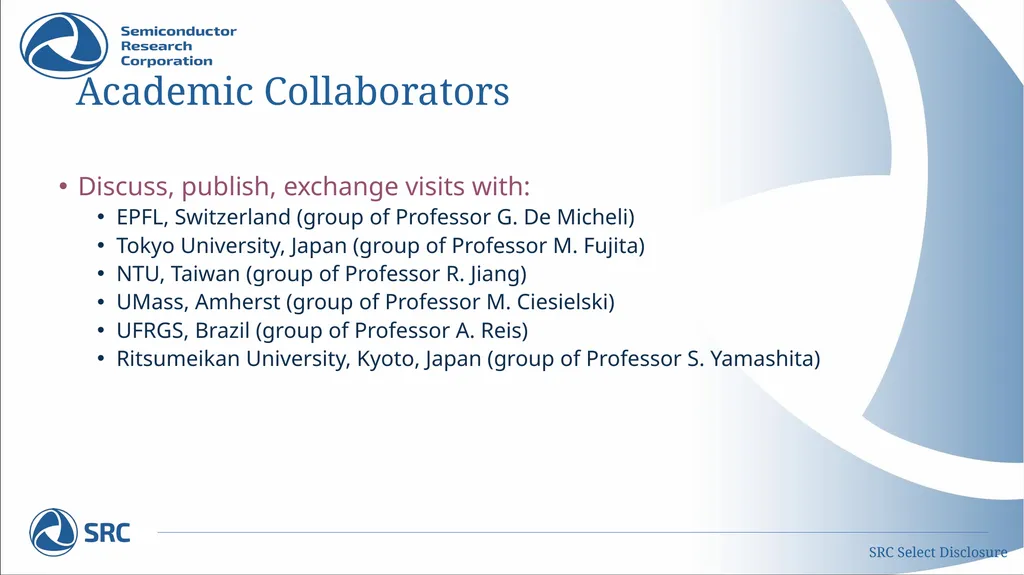
Academic Collaborators Discuss, publish, exchange visits with:
EPFL, Switzerland (group of Professor G. De Micheli)
Tokyo University, Japan (group of Professor M. Fujita)
NTU, Taiwan (group of Professor R. Jiang)
UMass, Amherst (group of Professor M. Ciesielski)
UFRGS, Brazil (group of Professor A. Reis)
Ritsumeikan University, Kyoto, Japan (group of Professor S. Yamashita) SRC Select Disclosure<br>
EPFL, Switzerland (group of Professor G. De Micheli)
Tokyo University, Japan (group of Professor M. Fujita)
NTU, Taiwan (group of Professor R. Jiang)
UMass, Amherst (group of Professor M. Ciesielski)
UFRGS, Brazil (group of Professor A. Reis)
Ritsumeikan University, Kyoto, Japan (group of Professor S. Yamashita) SRC Select Disclosure<br>
06
6 Anticipated Results This proposal addresses the need for powerful and scalable, yet versatile and reusable Boolean logic transforms and transform solvers, capable of solving complex synthesis and verification tasks, for any implementation technology, with predictable runtime that is close to linear in the design size. SRC Select Disclosure<br>
07
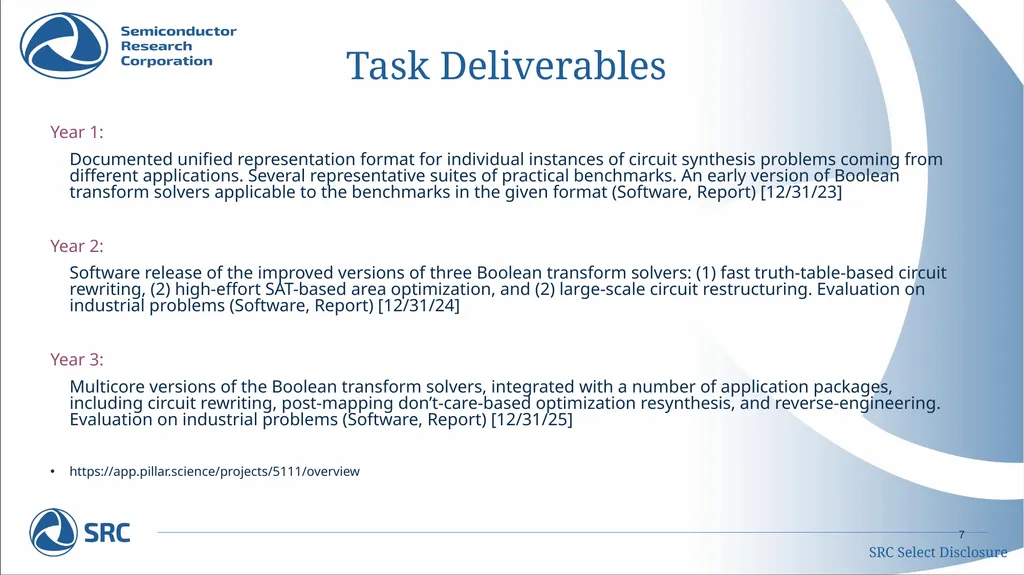
7 Task Deliverables Year 1:
Documented unified representation format for individual instances of circuit synthesis problems coming from different applications. Several representative suites of practical benchmarks. An early version of Boolean transform solvers applicable to the benchmarks in the given format (Software, Report) [12/31/23]
Year 2:
Software release of the improved versions of three Boolean transform solvers: (1) fast truth-table-based circuit rewriting, (2) high-effort SAT-based area optimization, and (2) large-scale circuit restructuring. Evaluation on industrial problems (Software, Report) [12/31/24]
Year 3:
Multicore versions of the Boolean transform solvers, integrated with a number of application packages, including circuit rewriting, post-mapping don’t-care-based optimization resynthesis, and reverse-engineering. Evaluation on industrial problems (Software, Report) [12/31/25]
https://app.pillar.science/projects/5111/overview SRC Select Disclosure<br>
Documented unified representation format for individual instances of circuit synthesis problems coming from different applications. Several representative suites of practical benchmarks. An early version of Boolean transform solvers applicable to the benchmarks in the given format (Software, Report) [12/31/23]
Year 2:
Software release of the improved versions of three Boolean transform solvers: (1) fast truth-table-based circuit rewriting, (2) high-effort SAT-based area optimization, and (2) large-scale circuit restructuring. Evaluation on industrial problems (Software, Report) [12/31/24]
Year 3:
Multicore versions of the Boolean transform solvers, integrated with a number of application packages, including circuit rewriting, post-mapping don’t-care-based optimization resynthesis, and reverse-engineering. Evaluation on industrial problems (Software, Report) [12/31/25]
https://app.pillar.science/projects/5111/overview SRC Select Disclosure<br>
08
8 Background Modern CAD tools transform digital designs expressed using hardware description languages into circuits realizable in FPGA, ASIC, or one of the novel implementation technologies. Another key task solved by the tools is verifying the results of synthesis. The efficiency of synthesis and verification depends not only on the design type and size, technology, and the runtime budget, but also on the generality and expressive power of the Boolean transforms used in the tools.
The Boolean transforms are understood in this proposal as operations solving individual instances of the central problem of logic synthesis: given a Boolean function and a set of divisors, find a small enough circuit to implement the function. (When there is no initial circuit, the divisors are the primary inputs.)
Boolean transforms (such as decomposition and resubstitution) are distinguished from synthesis engines (such as critical path resynthesis or post-mapping area optimization). Dedicated solvers realize Boolean transforms and are used to build synthesis engines integrated into modern CAD tools. Thus, standardizing Boolean transforms helps develop versatile transform solvers, which enable efficient next-generation tools for synthesis and verification. SRC Select Disclosure<br>
The Boolean transforms are understood in this proposal as operations solving individual instances of the central problem of logic synthesis: given a Boolean function and a set of divisors, find a small enough circuit to implement the function. (When there is no initial circuit, the divisors are the primary inputs.)
Boolean transforms (such as decomposition and resubstitution) are distinguished from synthesis engines (such as critical path resynthesis or post-mapping area optimization). Dedicated solvers realize Boolean transforms and are used to build synthesis engines integrated into modern CAD tools. Thus, standardizing Boolean transforms helps develop versatile transform solvers, which enable efficient next-generation tools for synthesis and verification. SRC Select Disclosure<br>
09
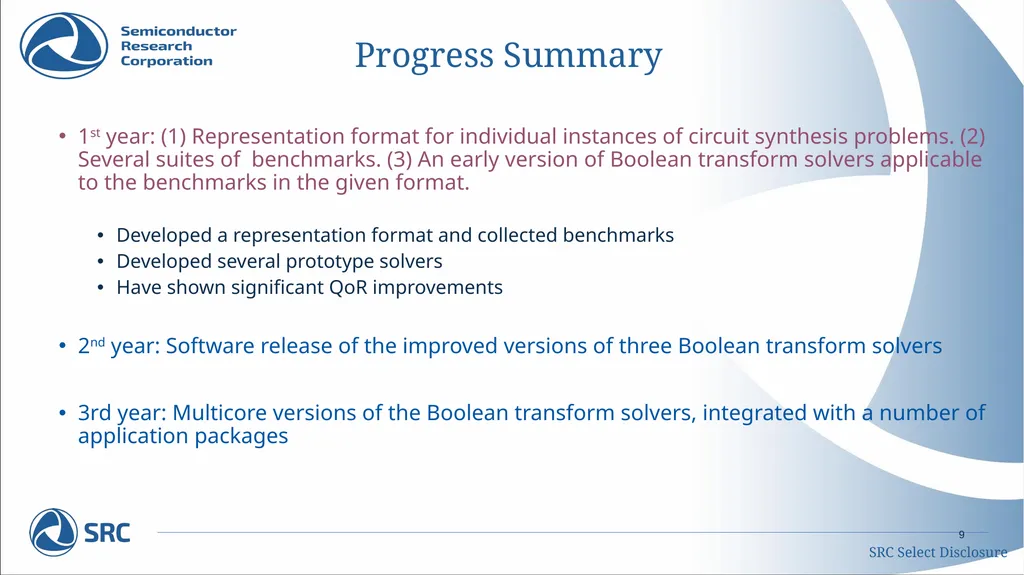
9 Progress Summary 1st year: (1) Representation format for individual instances of circuit synthesis problems. (2) Several suites of benchmarks. (3) An early version of Boolean transform solvers applicable to the benchmarks in the given format.
Developed a representation format and collected benchmarks
Developed several prototype solvers
Have shown significant QoR improvements
2nd year: Software release of the improved versions of three Boolean transform solvers
3rd year: Multicore versions of the Boolean transform solvers, integrated with a number of application packages SRC Select Disclosure<br>
Developed a representation format and collected benchmarks
Developed several prototype solvers
Have shown significant QoR improvements
2nd year: Software release of the improved versions of three Boolean transform solvers
3rd year: Multicore versions of the Boolean transform solvers, integrated with a number of application packages SRC Select Disclosure<br>
10
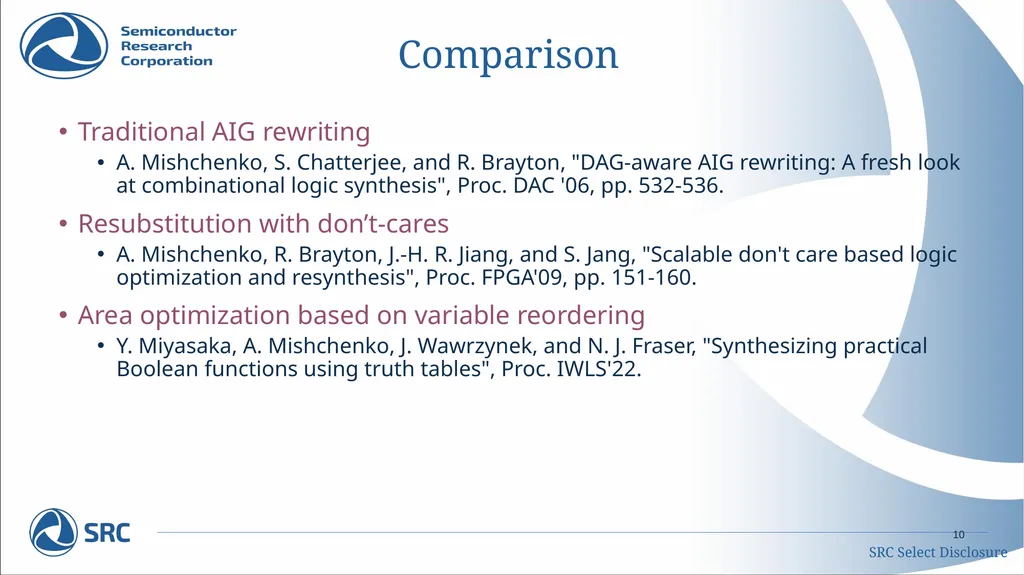
10 Comparison Traditional AIG rewriting
A. Mishchenko, S. Chatterjee, and R. Brayton, "DAG-aware AIG rewriting: A fresh look at combinational logic synthesis", Proc. DAC '06, pp. 532-536.
Resubstitution with don’t-cares
A. Mishchenko, R. Brayton, J.-H. R. Jiang, and S. Jang, "Scalable don't care based logic optimization and resynthesis", Proc. FPGA'09, pp. 151-160.
Area optimization based on variable reordering
Y. Miyasaka, A. Mishchenko, J. Wawrzynek, and N. J. Fraser, "Synthesizing practical Boolean functions using truth tables", Proc. IWLS'22. SRC Select Disclosure<br>
A. Mishchenko, S. Chatterjee, and R. Brayton, "DAG-aware AIG rewriting: A fresh look at combinational logic synthesis", Proc. DAC '06, pp. 532-536.
Resubstitution with don’t-cares
A. Mishchenko, R. Brayton, J.-H. R. Jiang, and S. Jang, "Scalable don't care based logic optimization and resynthesis", Proc. FPGA'09, pp. 151-160.
Area optimization based on variable reordering
Y. Miyasaka, A. Mishchenko, J. Wawrzynek, and N. J. Fraser, "Synthesizing practical Boolean functions using truth tables", Proc. IWLS'22. SRC Select Disclosure<br>
11
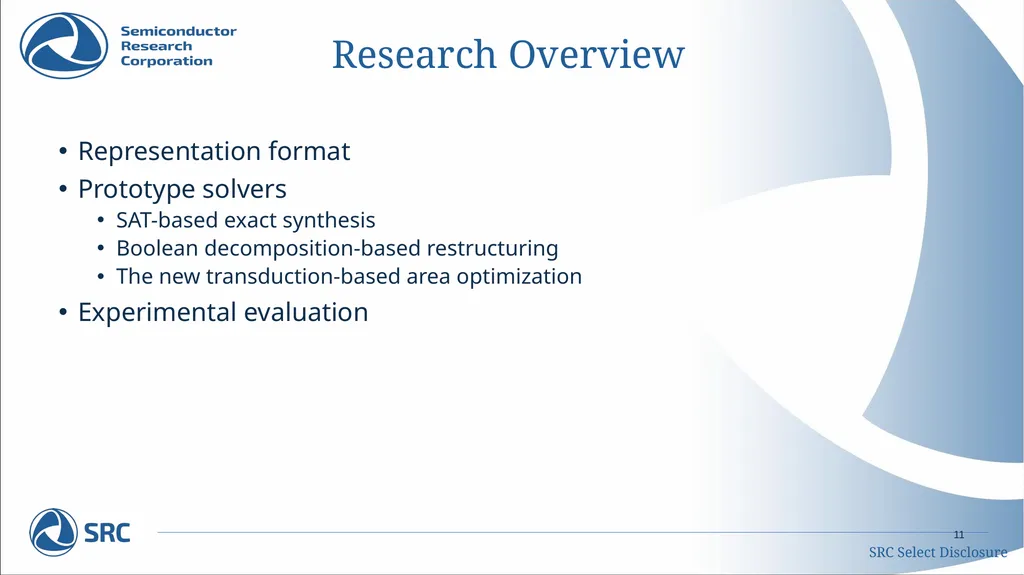
Research Overview 11 Representation format
Prototype solvers
SAT-based exact synthesis
Boolean decomposition-based restructuring
The new transduction-based area optimization
Experimental evaluation SRC Select Disclosure<br>
Prototype solvers
SAT-based exact synthesis
Boolean decomposition-based restructuring
The new transduction-based area optimization
Experimental evaluation SRC Select Disclosure<br>
12
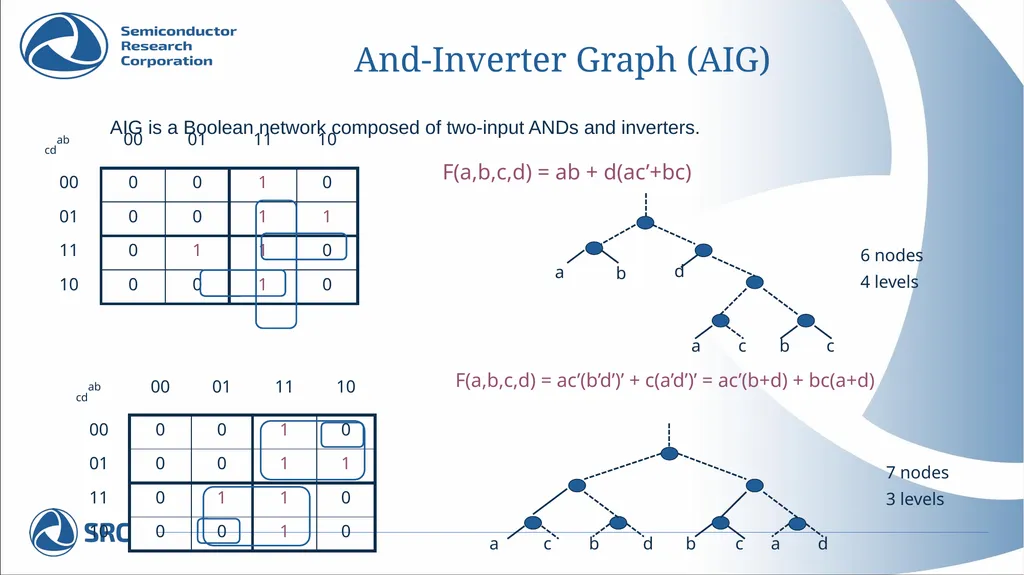
And-Inverter Graph (AIG) F(a,b,c,d) = ab + d(ac’+bc) F(a,b,c,d) = ac’(b’d’)’ + c(a’d’)’ = ac’(b+d) + bc(a+d) 6 nodes
4 levels 7 nodes
3 levels AIG is a Boolean network composed of two-input ANDs and inverters.<br>
4 levels 7 nodes
3 levels AIG is a Boolean network composed of two-input ANDs and inverters.<br>
13
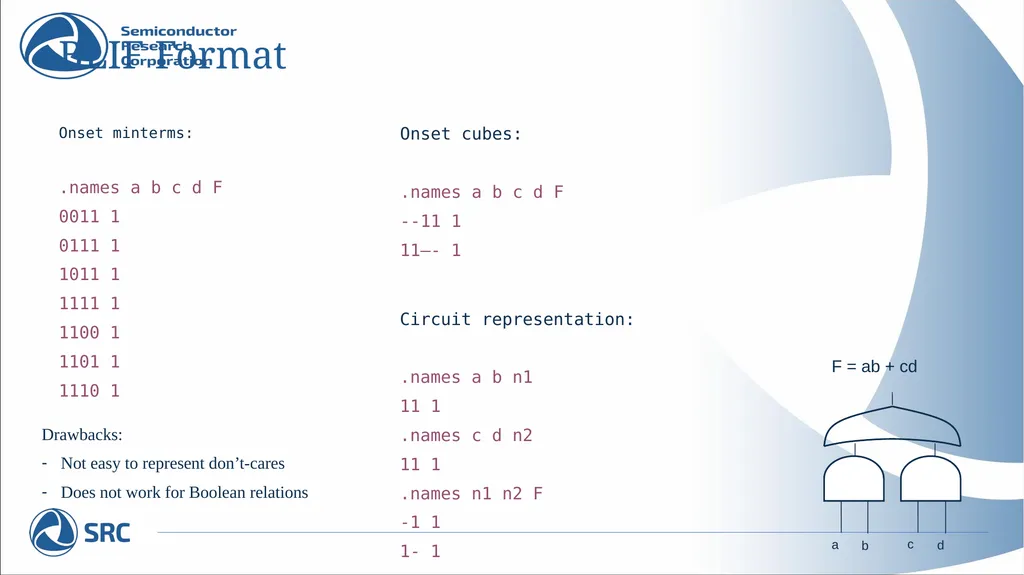
BLIF Format Onset minterms:
.names a b c d F
0011 1
0111 1
1011 1
1111 1
1100 1
1101 1
1110 1 Onset cubes:
.names a b c d F
--11 1
11–- 1 Circuit representation:
.names a b n1
11 1
.names c d n2
11 1
.names n1 n2 F
-1 1
1- 1 a b c d F = ab + cd Drawbacks:
Not easy to represent don’t-cares
Does not work for Boolean relations<br>
.names a b c d F
0011 1
0111 1
1011 1
1111 1
1100 1
1101 1
1110 1 Onset cubes:
.names a b c d F
--11 1
11–- 1 Circuit representation:
.names a b n1
11 1
.names c d n2
11 1
.names n1 n2 F
-1 1
1- 1 a b c d F = ab + cd Drawbacks:
Not easy to represent don’t-cares
Does not work for Boolean relations<br>
14
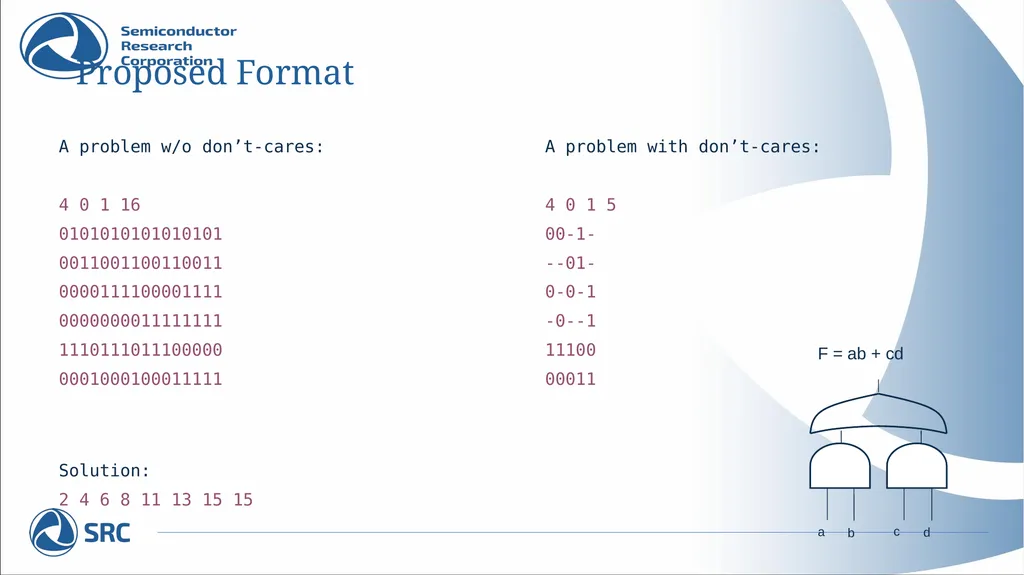
Proposed Format A problem w/o don’t-cares:
4 0 1 16
0101010101010101
0011001100110011
0000111100001111
0000000011111111
1110111011100000
0001000100011111
Solution:
2 4 6 8 11 13 15 15 A problem with don’t-cares:
4 0 1 5
00-1-
--01-
0-0-1
-0--1
11100
00011 a b c d F = ab + cd<br>
4 0 1 16
0101010101010101
0011001100110011
0000111100001111
0000000011111111
1110111011100000
0001000100011111
Solution:
2 4 6 8 11 13 15 15 A problem with don’t-cares:
4 0 1 5
00-1-
--01-
0-0-1
-0--1
11100
00011 a b c d F = ab + cd<br>
15
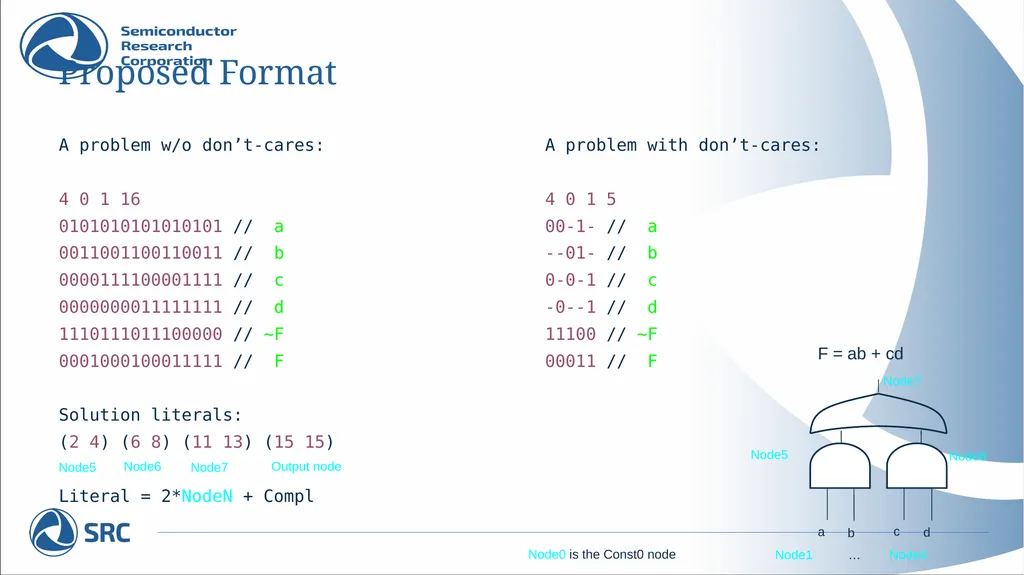
Proposed Format A problem w/o don’t-cares:
4 0 1 16
0101010101010101 // a
0011001100110011 // b
0000111100001111 // c
0000000011111111 // d
1110111011100000 // ~F
0001000100011111 // F
Solution literals:
(2 4) (6 8) (11 13) (15 15)
Literal = 2*NodeN + Compl A problem with don’t-cares:
4 0 1 5
00-1- // a
--01- // b
0-0-1 // c
-0--1 // d
11100 // ~F
00011 // F a b c d F = ab + cd Node0 is the Const0 node Node1 … Node4 Node5 Node6 Node7 Node5 Node6 Node7 Output node<br>
4 0 1 16
0101010101010101 // a
0011001100110011 // b
0000111100001111 // c
0000000011111111 // d
1110111011100000 // ~F
0001000100011111 // F
Solution literals:
(2 4) (6 8) (11 13) (15 15)
Literal = 2*NodeN + Compl A problem with don’t-cares:
4 0 1 5
00-1- // a
--01- // b
0-0-1 // c
-0--1 // d
11100 // ~F
00011 // F a b c d F = ab + cd Node0 is the Const0 node Node1 … Node4 Node5 Node6 Node7 Node5 Node6 Node7 Output node<br>
16
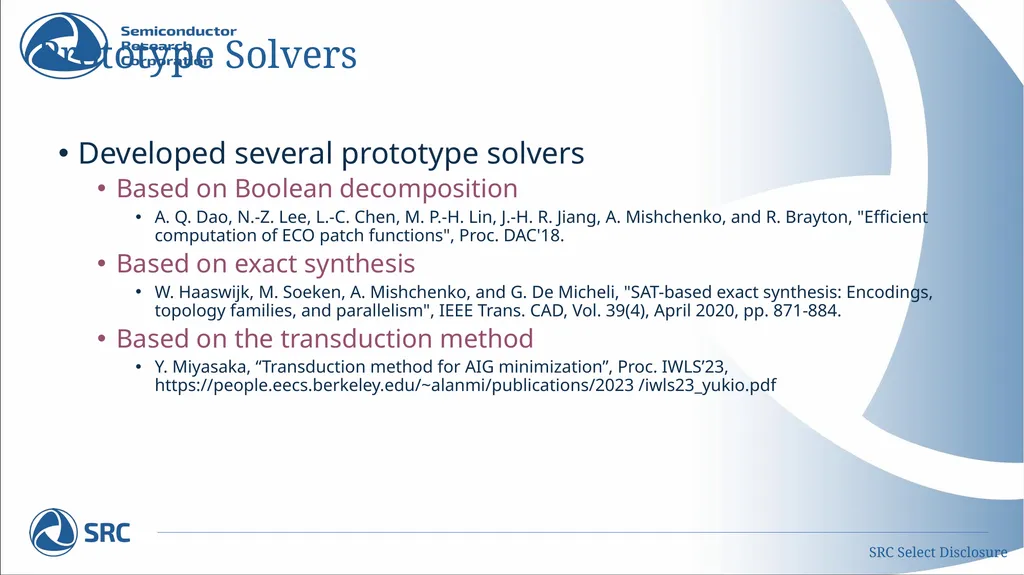
Prototype Solvers Developed several prototype solvers
Based on Boolean decomposition
A. Q. Dao, N.-Z. Lee, L.-C. Chen, M. P.-H. Lin, J.-H. R. Jiang, A. Mishchenko, and R. Brayton, "Efficient computation of ECO patch functions", Proc. DAC'18.
Based on exact synthesis
W. Haaswijk, M. Soeken, A. Mishchenko, and G. De Micheli, "SAT-based exact synthesis: Encodings, topology families, and parallelism", IEEE Trans. CAD, Vol. 39(4), April 2020, pp. 871-884.
Based on the transduction method
Y. Miyasaka, “Transduction method for AIG minimization”, Proc. IWLS’23, https://people.eecs.berkeley.edu/~alanmi/publications/2023 /iwls23_yukio.pdf SRC Select Disclosure<br>
Based on Boolean decomposition
A. Q. Dao, N.-Z. Lee, L.-C. Chen, M. P.-H. Lin, J.-H. R. Jiang, A. Mishchenko, and R. Brayton, "Efficient computation of ECO patch functions", Proc. DAC'18.
Based on exact synthesis
W. Haaswijk, M. Soeken, A. Mishchenko, and G. De Micheli, "SAT-based exact synthesis: Encodings, topology families, and parallelism", IEEE Trans. CAD, Vol. 39(4), April 2020, pp. 871-884.
Based on the transduction method
Y. Miyasaka, “Transduction method for AIG minimization”, Proc. IWLS’23, https://people.eecs.berkeley.edu/~alanmi/publications/2023 /iwls23_yukio.pdf SRC Select Disclosure<br>
17
Transduction:
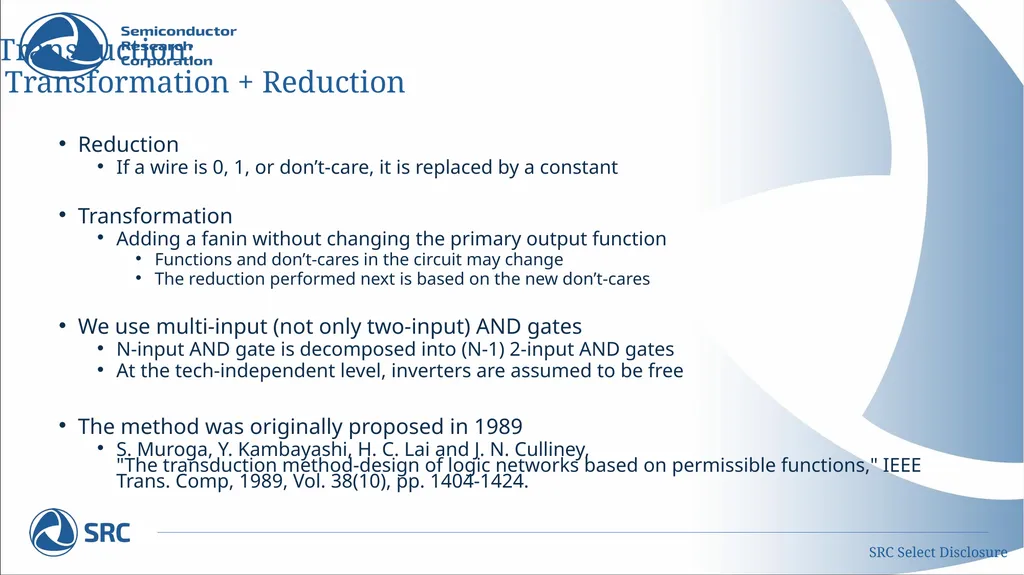
Transformation + Reduction Reduction
If a wire is 0, 1, or don’t-care, it is replaced by a constant
Transformation
Adding a fanin without changing the primary output function
Functions and don’t-cares in the circuit may change
The reduction performed next is based on the new don’t-cares
We use multi-input (not only two-input) AND gates
N-input AND gate is decomposed into (N-1) 2-input AND gates
At the tech-independent level, inverters are assumed to be free
The method was originally proposed in 1989
S. Muroga, Y. Kambayashi, H. C. Lai and J. N. Culliney, "The transduction method-design of logic networks based on permissible functions," IEEE Trans. Comp, 1989, Vol. 38(10), pp. 1404-1424. SRC Select Disclosure<br>
If a wire is 0, 1, or don’t-care, it is replaced by a constant
Transformation
Adding a fanin without changing the primary output function
Functions and don’t-cares in the circuit may change
The reduction performed next is based on the new don’t-cares
We use multi-input (not only two-input) AND gates
N-input AND gate is decomposed into (N-1) 2-input AND gates
At the tech-independent level, inverters are assumed to be free
The method was originally proposed in 1989
S. Muroga, Y. Kambayashi, H. C. Lai and J. N. Culliney, "The transduction method-design of logic networks based on permissible functions," IEEE Trans. Comp, 1989, Vol. 38(10), pp. 1404-1424. SRC Select Disclosure<br>
18
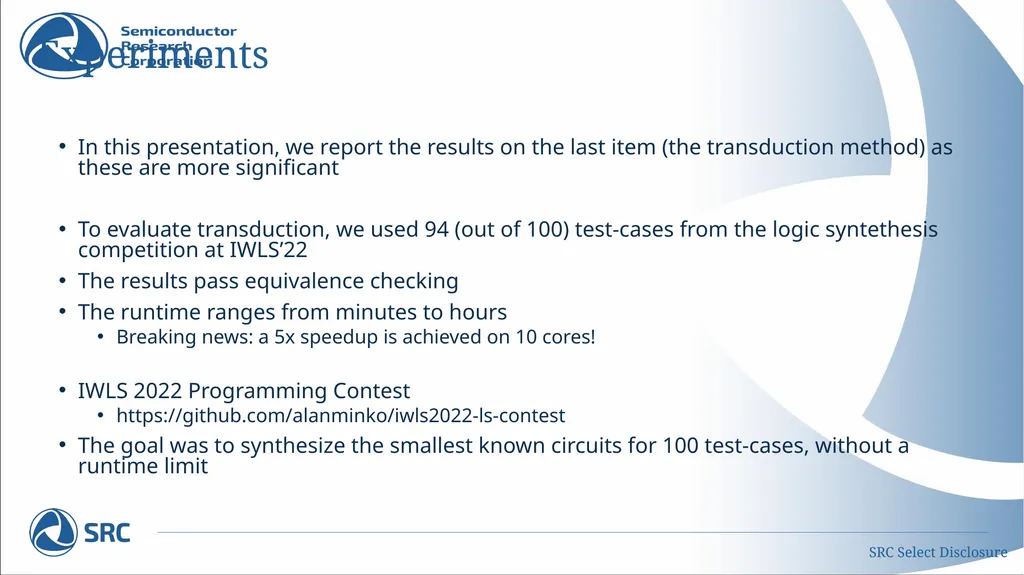
Experiments In this presentation, we report the results on the last item (the transduction method) as these are more significant
To evaluate transduction, we used 94 (out of 100) test-cases from the logic syntethesis competition at IWLS’22
The results pass equivalence checking
The runtime ranges from minutes to hours
Breaking news: a 5x speedup is achieved on 10 cores!
IWLS 2022 Programming Contest
https://github.com/alanminko/iwls2022-ls-contest
The goal was to synthesize the smallest known circuits for 100 test-cases, without a runtime limit SRC Select Disclosure<br>
To evaluate transduction, we used 94 (out of 100) test-cases from the logic syntethesis competition at IWLS’22
The results pass equivalence checking
The runtime ranges from minutes to hours
Breaking news: a 5x speedup is achieved on 10 cores!
IWLS 2022 Programming Contest
https://github.com/alanminko/iwls2022-ls-contest
The goal was to synthesize the smallest known circuits for 100 test-cases, without a runtime limit SRC Select Disclosure<br>
19
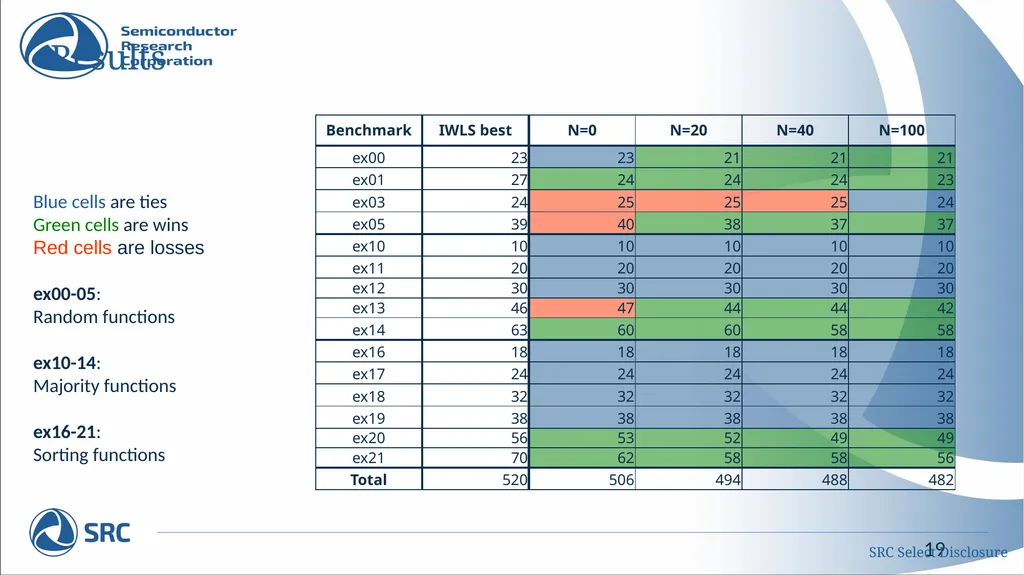
Results 19 Blue cells are ties
Green cells are wins
Red cells are losses
ex00-05:
Random functions
ex10-14:
Majority functions
ex16-21:
Sorting functions SRC Select Disclosure<br>
Green cells are wins
Red cells are losses
ex00-05:
Random functions
ex10-14:
Majority functions
ex16-21:
Sorting functions SRC Select Disclosure<br>
20
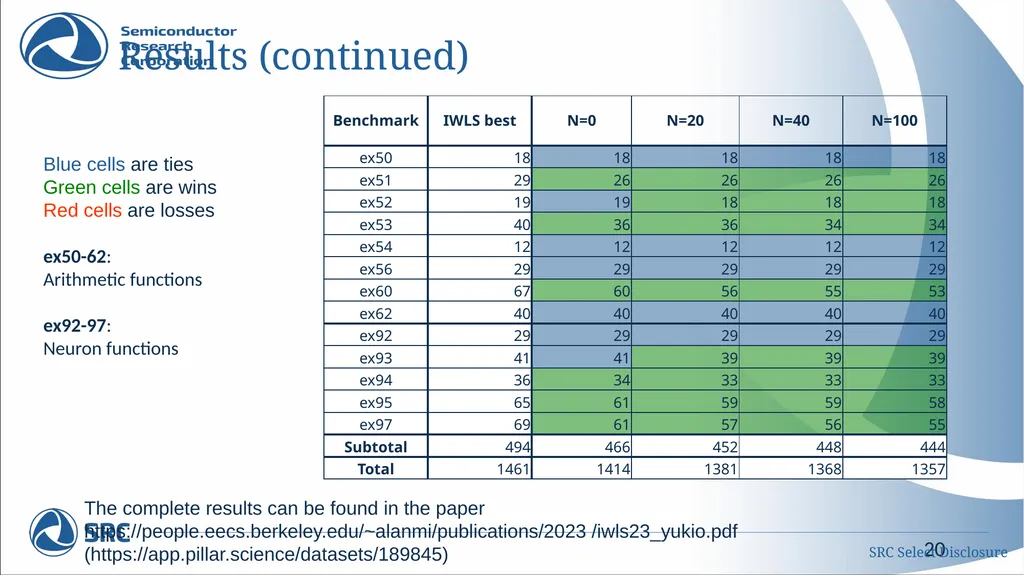
Results (continued) 20 Blue cells are ties
Green cells are wins
Red cells are losses
ex50-62:
Arithmetic functions
ex92-97:
Neuron functions The complete results can be found in the paper https://people.eecs.berkeley.edu/~alanmi/publications/2023 /iwls23_yukio.pdf (https://app.pillar.science/datasets/189845) SRC Select Disclosure<br>
Green cells are wins
Red cells are losses
ex50-62:
Arithmetic functions
ex92-97:
Neuron functions The complete results can be found in the paper https://people.eecs.berkeley.edu/~alanmi/publications/2023 /iwls23_yukio.pdf (https://app.pillar.science/datasets/189845) SRC Select Disclosure<br>
21
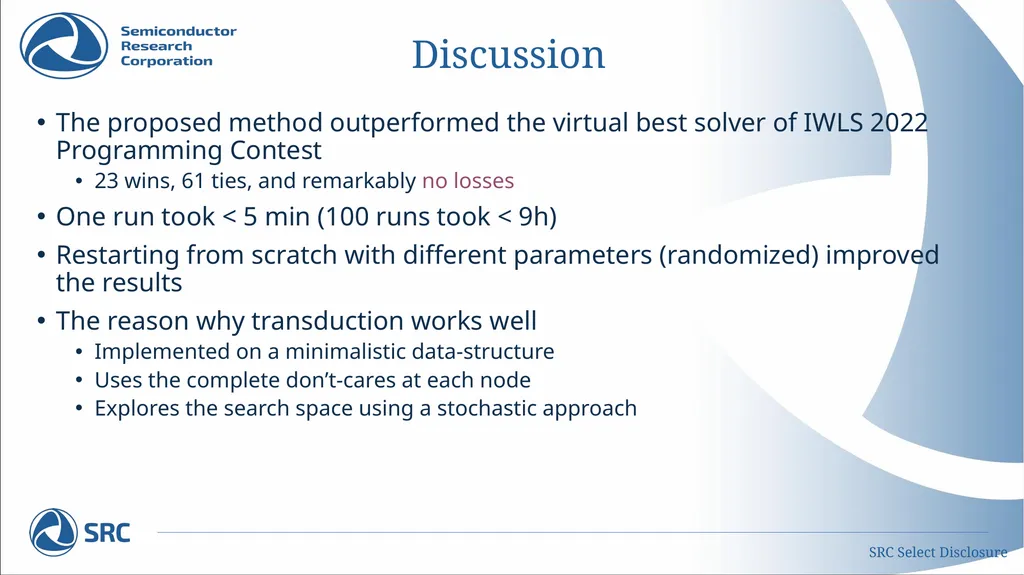
Discussion The proposed method outperformed the virtual best solver of IWLS 2022 Programming Contest
23 wins, 61 ties, and remarkably no losses
One run took < 5 min (100 runs took < 9h)
Restarting from scratch with different parameters (randomized) improved the results
The reason why transduction works well
Implemented on a minimalistic data-structure
Uses the complete don’t-cares at each node
Explores the search space using a stochastic approach SRC Select Disclosure<br>
23 wins, 61 ties, and remarkably no losses
One run took < 5 min (100 runs took < 9h)
Restarting from scratch with different parameters (randomized) improved the results
The reason why transduction works well
Implemented on a minimalistic data-structure
Uses the complete don’t-cares at each node
Explores the search space using a stochastic approach SRC Select Disclosure<br>
22
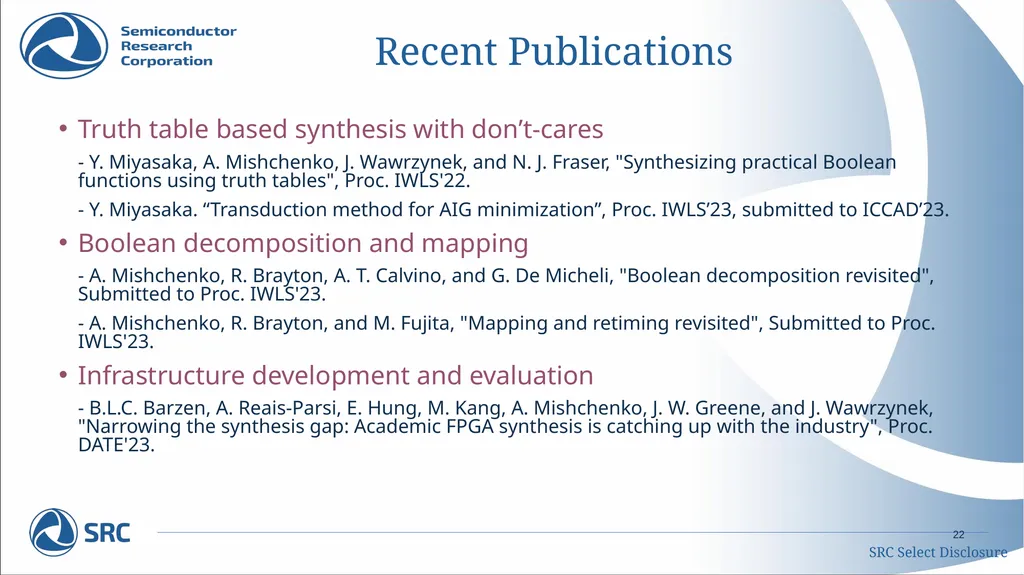
22 Recent Publications Truth table based synthesis with don’t-cares
- Y. Miyasaka, A. Mishchenko, J. Wawrzynek, and N. J. Fraser, "Synthesizing practical Boolean functions using truth tables", Proc. IWLS'22.
- Y. Miyasaka. “Transduction method for AIG minimization”, Proc. IWLS’23, submitted to ICCAD’23.
Boolean decomposition and mapping
- A. Mishchenko, R. Brayton, A. T. Calvino, and G. De Micheli, "Boolean decomposition revisited", Submitted to Proc. IWLS'23.
- A. Mishchenko, R. Brayton, and M. Fujita, "Mapping and retiming revisited", Submitted to Proc. IWLS'23.
Infrastructure development and evaluation
- B.L.C. Barzen, A. Reais-Parsi, E. Hung, M. Kang, A. Mishchenko, J. W. Greene, and J. Wawrzynek, "Narrowing the synthesis gap: Academic FPGA synthesis is catching up with the industry", Proc. DATE'23. SRC Select Disclosure<br>
- Y. Miyasaka, A. Mishchenko, J. Wawrzynek, and N. J. Fraser, "Synthesizing practical Boolean functions using truth tables", Proc. IWLS'22.
- Y. Miyasaka. “Transduction method for AIG minimization”, Proc. IWLS’23, submitted to ICCAD’23.
Boolean decomposition and mapping
- A. Mishchenko, R. Brayton, A. T. Calvino, and G. De Micheli, "Boolean decomposition revisited", Submitted to Proc. IWLS'23.
- A. Mishchenko, R. Brayton, and M. Fujita, "Mapping and retiming revisited", Submitted to Proc. IWLS'23.
Infrastructure development and evaluation
- B.L.C. Barzen, A. Reais-Parsi, E. Hung, M. Kang, A. Mishchenko, J. W. Greene, and J. Wawrzynek, "Narrowing the synthesis gap: Academic FPGA synthesis is catching up with the industry", Proc. DATE'23. SRC Select Disclosure<br>
23
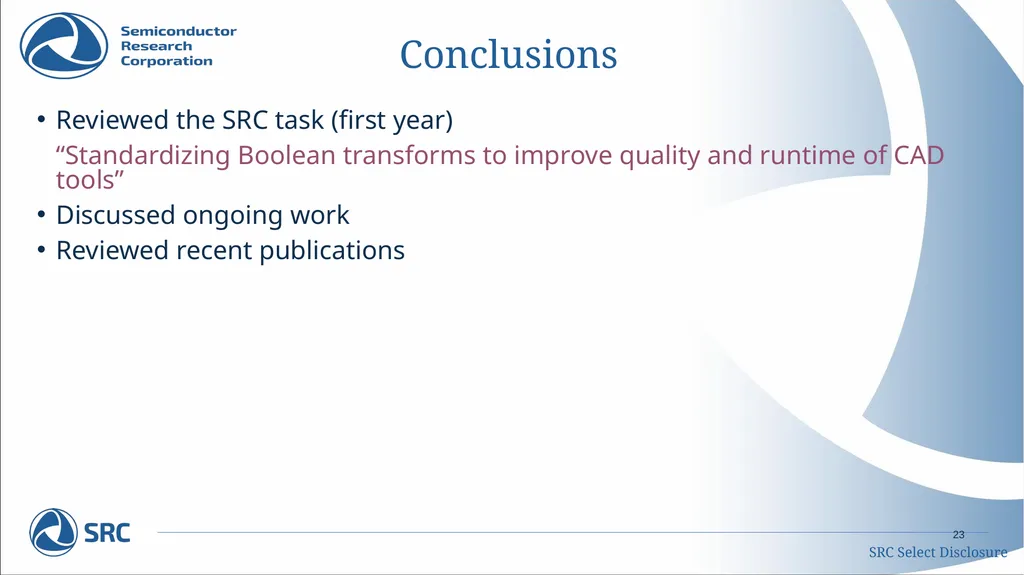
23 Conclusions Reviewed the SRC task (first year)
“Standardizing Boolean transforms to improve quality and runtime of CAD tools”
Discussed ongoing work
Reviewed recent publications SRC Select Disclosure<br>
“Standardizing Boolean transforms to improve quality and runtime of CAD tools”
Discussed ongoing work
Reviewed recent publications SRC Select Disclosure<br>