
Dan Jurafsky Lecture 1: Sentiment Lexicons and
CB
Published · 74 slides · 0 views

1 / 1



Description
Dan Jurafsky Lecture 1: Sentiment Lexicons and Sentiment Classification Computational Extraction of Social and Interactional Meaning SSLST, Summer 2011 IP notice: many slides for today from Chris Manning, William Cohen, Chris Potts and
Related Topics
Share
Embed code
Download this presentation From Below
"Dan Jurafsky Lecture 1: Sentiment Lexicons and" is the property of its rightful owner. Permission is granted to download and print the materials on this website for personal, non-commercial use only, and to display it on your personal computer provided you do not modify the materials and that you retain all copyright notices contained in the materials. By downloading content from our website, you accept the terms of this agreement.
Presentation Transcript
01
Dan Jurafsky
Lecture 1: Sentiment Lexicons and Sentiment Classification Computational Extraction of Social and Interactional Meaning SSLST, Summer 2011 IP notice: many slides for today from Chris Manning, William Cohen, Chris Potts and Janyce Wiebe, plus some from Marti Hearst and Marta Tatu<br>
Lecture 1: Sentiment Lexicons and Sentiment Classification Computational Extraction of Social and Interactional Meaning SSLST, Summer 2011 IP notice: many slides for today from Chris Manning, William Cohen, Chris Potts and Janyce Wiebe, plus some from Marti Hearst and Marta Tatu<br>
02
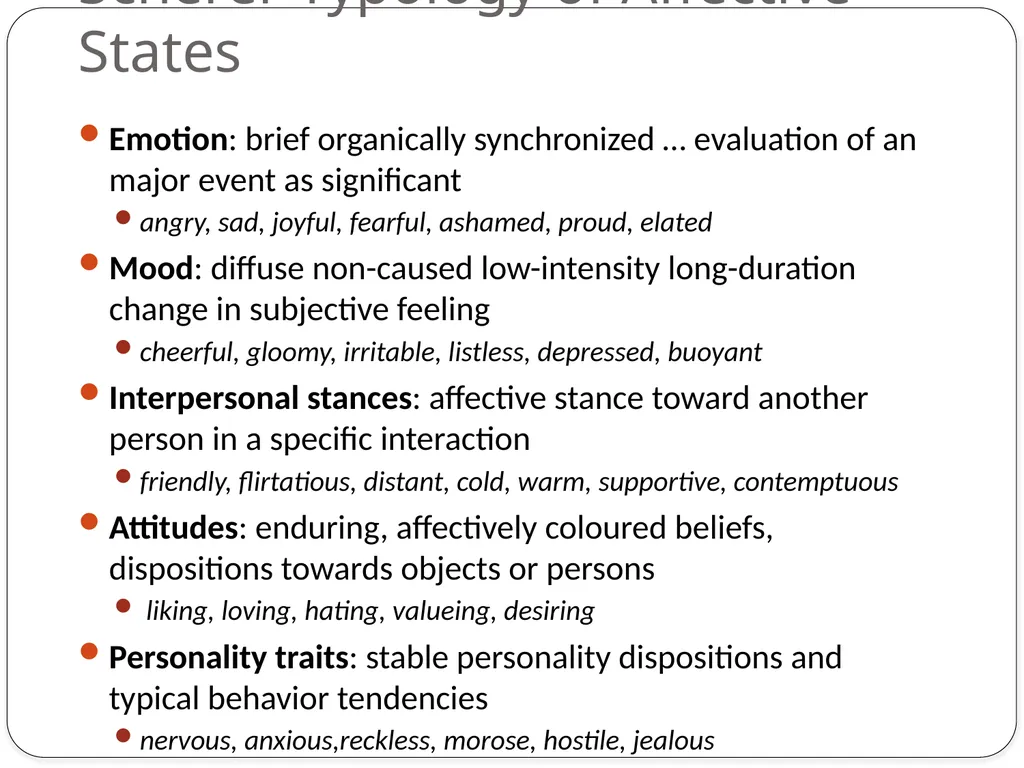
Scherer Typology of Affective States Emotion: brief organically synchronized … evaluation of an major event as significant
angry, sad, joyful, fearful, ashamed, proud, elated
Mood: diffuse non-caused low-intensity long-duration change in subjective feeling
cheerful, gloomy, irritable, listless, depressed, buoyant
Interpersonal stances: affective stance toward another person in a specific interaction
friendly, flirtatious, distant, cold, warm, supportive, contemptuous
Attitudes: enduring, affectively coloured beliefs, dispositions towards objects or persons
liking, loving, hating, valueing, desiring
Personality traits: stable personality dispositions and typical behavior tendencies
nervous, anxious,reckless, morose, hostile, jealous<br>
03
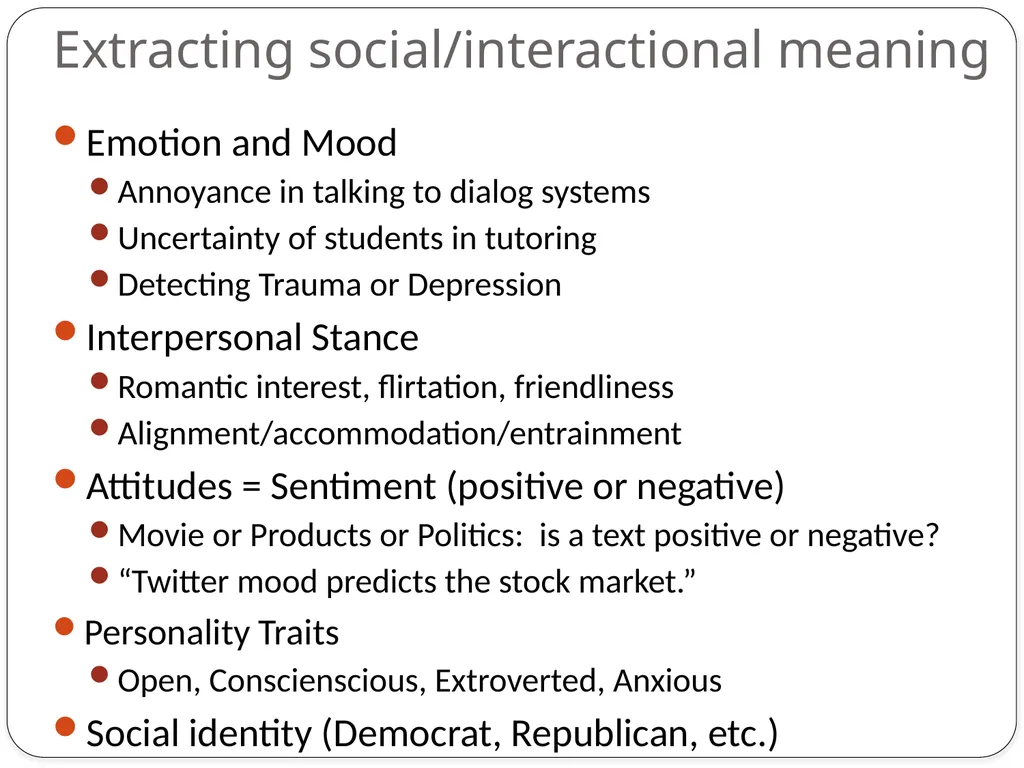
Extracting social/interactional meaning Emotion and Mood
Annoyance in talking to dialog systems
Uncertainty of students in tutoring
Detecting Trauma or Depression
Interpersonal Stance
Romantic interest, flirtation, friendliness
Alignment/accommodation/entrainment
Attitudes = Sentiment (positive or negative)
Movie or Products or Politics: is a text positive or negative?
“Twitter mood predicts the stock market.”
Personality Traits
Open, Conscienscious, Extroverted, Anxious
Social identity (Democrat, Republican, etc.)<br>
04
Overview of Course http://www.stanford.edu/~jurafsky/sslst11/<br>
05
Outline for Today Sentiment Analysis (Attitude Detection)
Sentiment Tasks and Datasets
Sentiment Classification Example: Movie Reviews
The Dirty Details: Naïve Bayes Text Classification
Sentiment Lexicons: Hand-built
Sentiment Lexicons: Automatic<br>
Sentiment Tasks and Datasets
Sentiment Classification Example: Movie Reviews
The Dirty Details: Naïve Bayes Text Classification
Sentiment Lexicons: Hand-built
Sentiment Lexicons: Automatic<br>
06
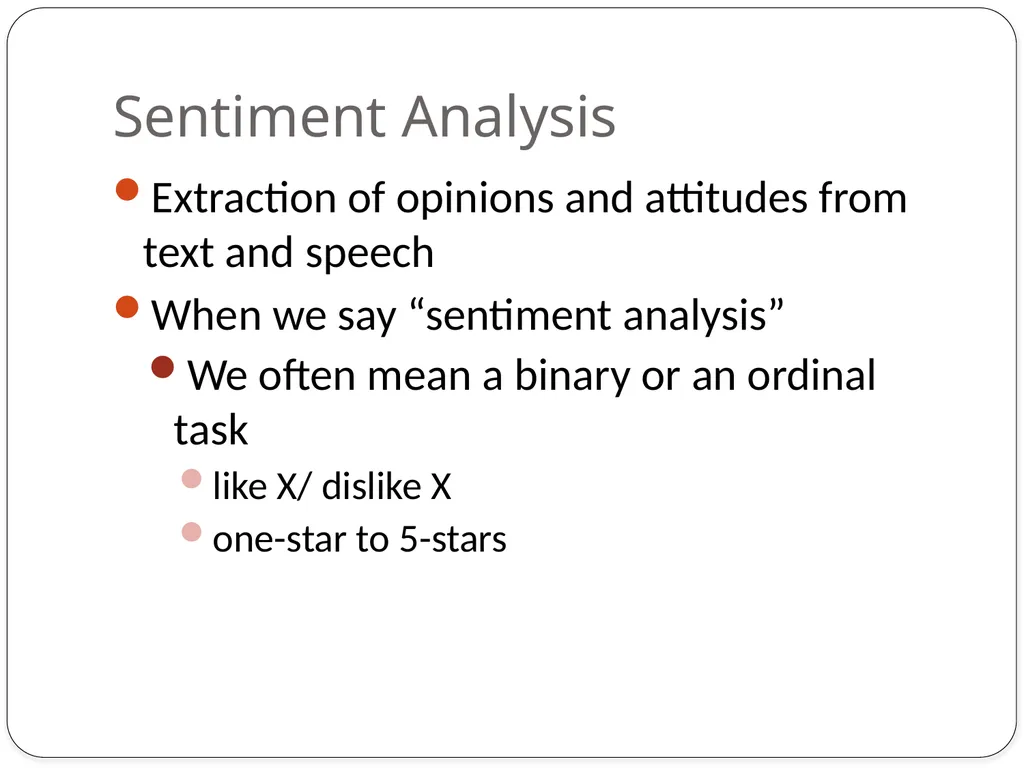
Sentiment Analysis Extraction of opinions and attitudes from text and speech
When we say “sentiment analysis”
We often mean a binary or an ordinal task
like X/ dislike X
one-star to 5-stars<br>
When we say “sentiment analysis”
We often mean a binary or an ordinal task
like X/ dislike X
one-star to 5-stars<br>
07
1: Sentiment Tasks and Datasets<br>
08
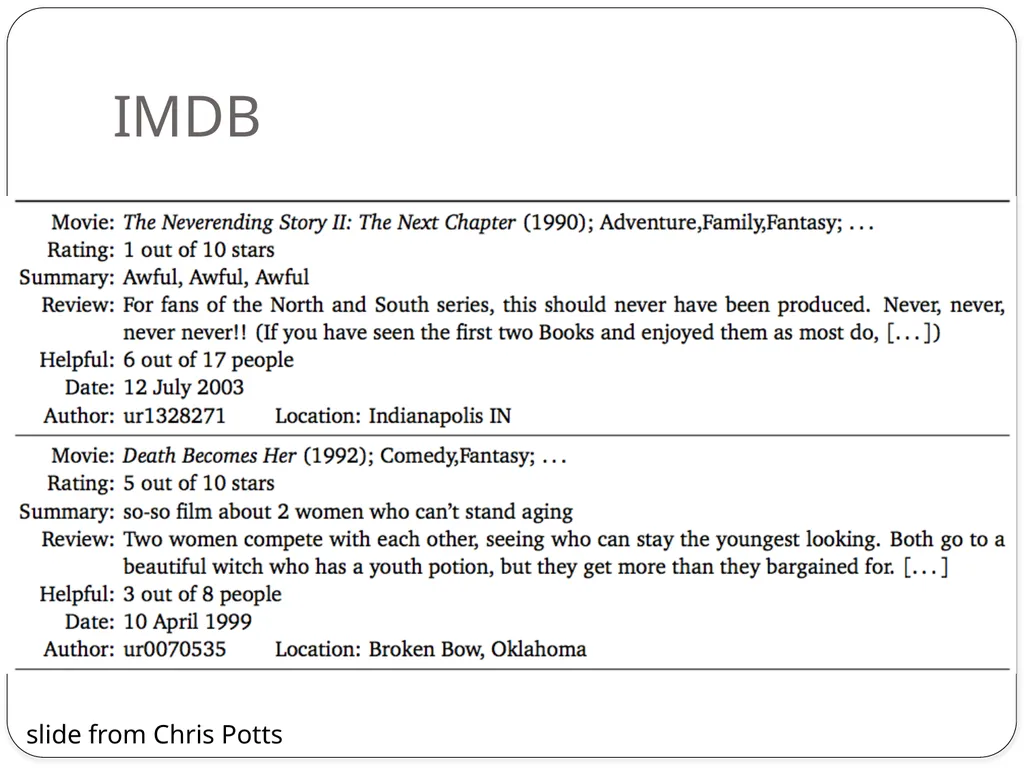
IMDB slide from Chris Potts<br>
09
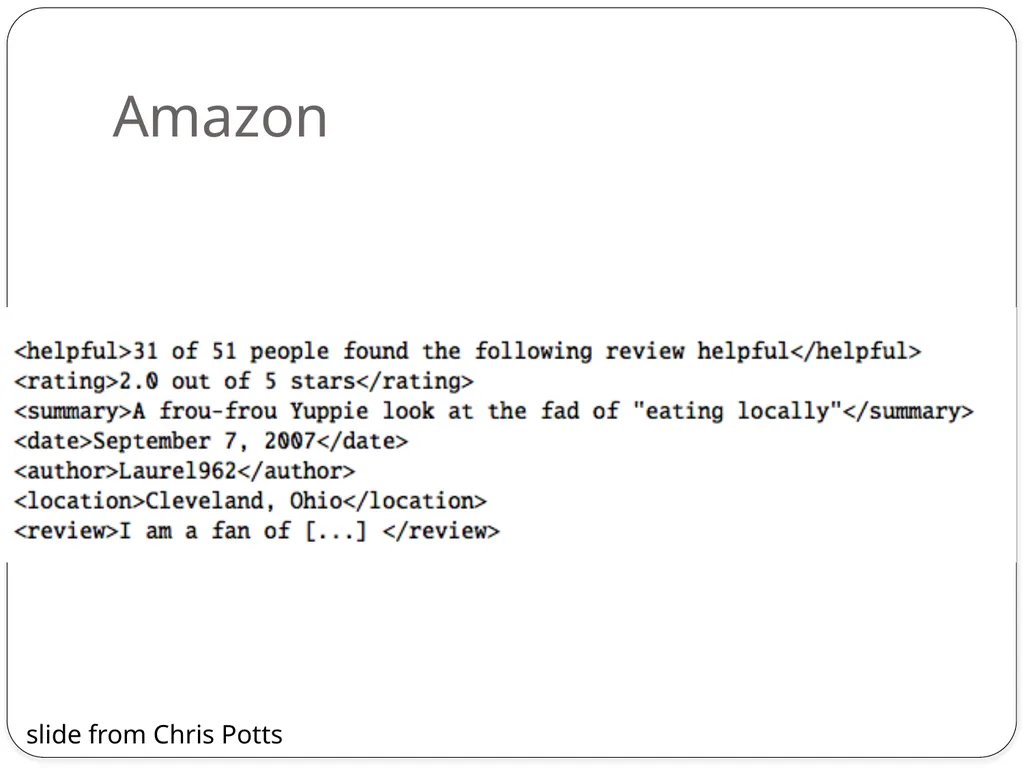
Amazon slide from Chris Potts<br>
10
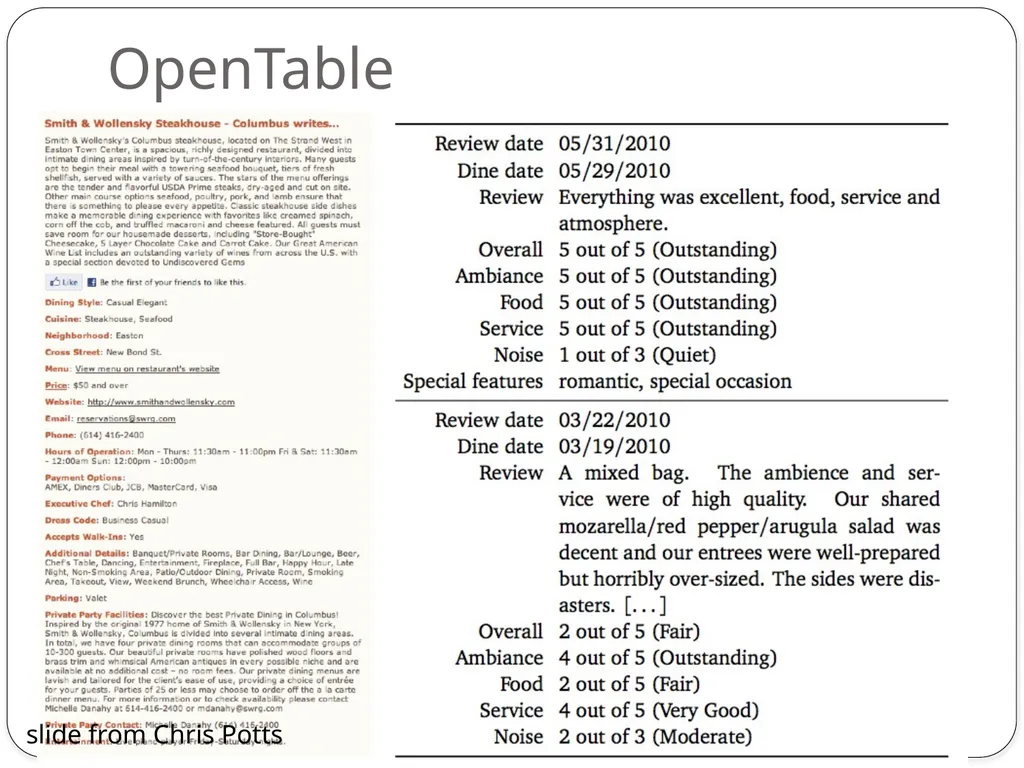
OpenTable slide from Chris Potts<br>
11
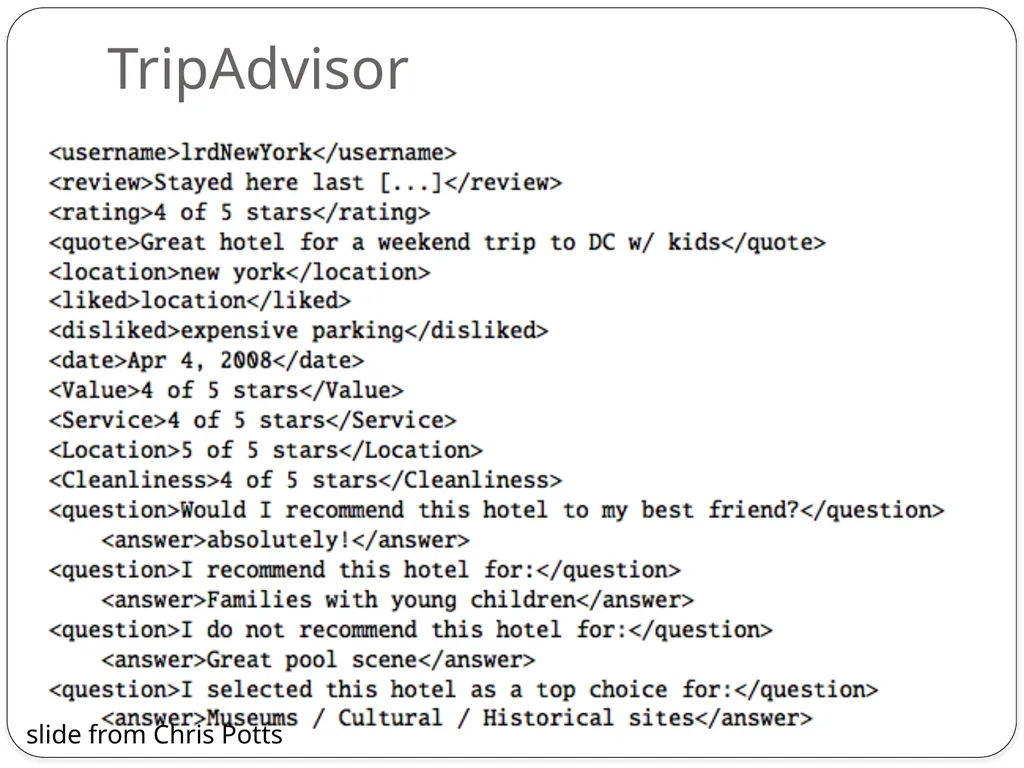
TripAdvisor slide from Chris Potts<br>
12
Richer sentiment on the web
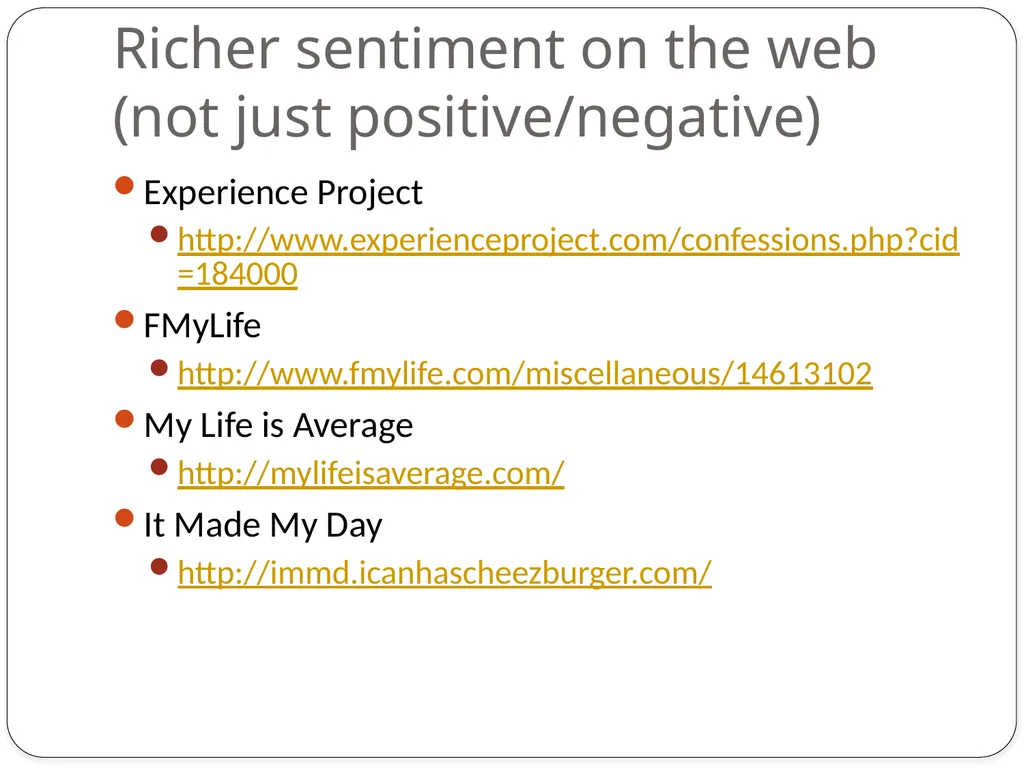
(not just positive/negative) Experience Project
http://www.experienceproject.com/confessions.php?cid=184000
FMyLife
http://www.fmylife.com/miscellaneous/14613102
My Life is Average
http://mylifeisaverage.com/
It Made My Day
http://immd.icanhascheezburger.com/<br>
http://www.experienceproject.com/confessions.php?cid=184000
FMyLife
http://www.fmylife.com/miscellaneous/14613102
My Life is Average
http://mylifeisaverage.com/
It Made My Day
http://immd.icanhascheezburger.com/<br>
13
2: Sentiment Classification Example: Movie Reviews Pang and Lee’s (2004) movie review data from IMDB
Polarity data 2.0:
http://www.cs.cornell.edu/people/pabo/movie-review-data<br>
Polarity data 2.0:
http://www.cs.cornell.edu/people/pabo/movie-review-data<br>
14
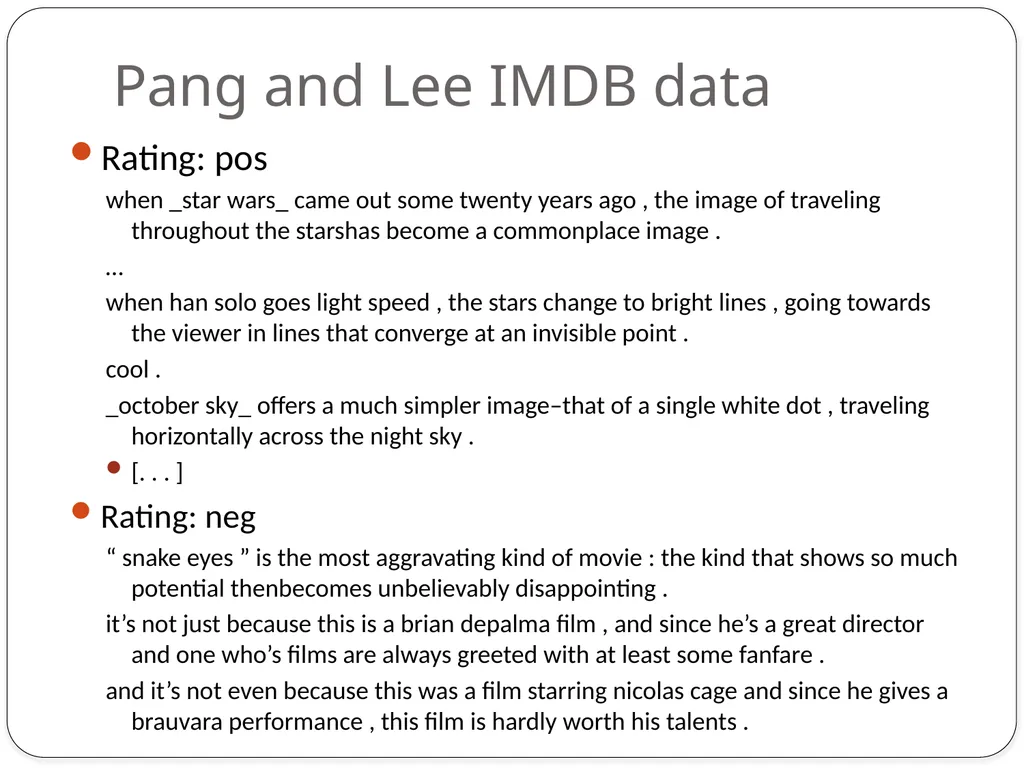
Pang and Lee IMDB data Rating: pos
when _star wars_ came out some twenty years ago , the image of traveling throughout the starshas become a commonplace image .
…
when han solo goes light speed , the stars change to bright lines , going towards the viewer in lines that converge at an invisible point .
cool .
_october sky_ offers a much simpler image–that of a single white dot , traveling horizontally across the night sky .
[. . . ]
Rating: neg
“ snake eyes ” is the most aggravating kind of movie : the kind that shows so much potential thenbecomes unbelievably disappointing .
it’s not just because this is a brian depalma film , and since he’s a great director and one who’s films are always greeted with at least some fanfare .
and it’s not even because this was a film starring nicolas cage and since he gives a brauvara performance , this film is hardly worth his talents .<br>
15
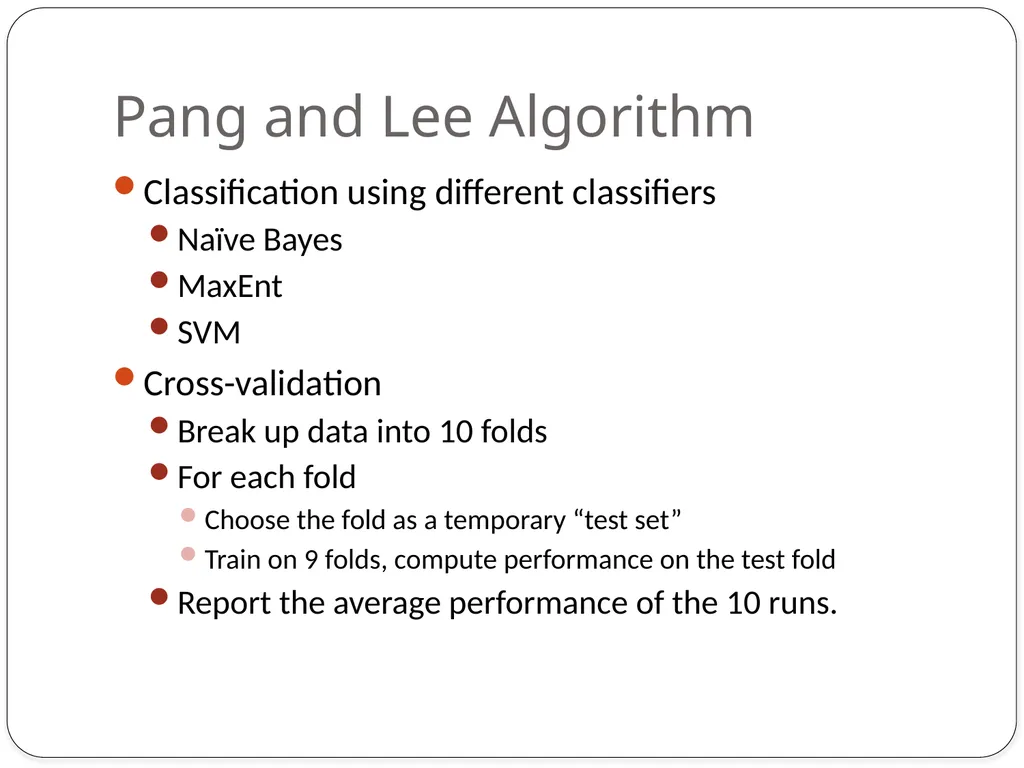
Pang and Lee Algorithm Classification using different classifiers
Naïve Bayes
MaxEnt
SVM
Cross-validation
Break up data into 10 folds
For each fold
Choose the fold as a temporary “test set”
Train on 9 folds, compute performance on the test fold
Report the average performance of the 10 runs.<br>
Naïve Bayes
MaxEnt
SVM
Cross-validation
Break up data into 10 folds
For each fold
Choose the fold as a temporary “test set”
Train on 9 folds, compute performance on the test fold
Report the average performance of the 10 runs.<br>
16
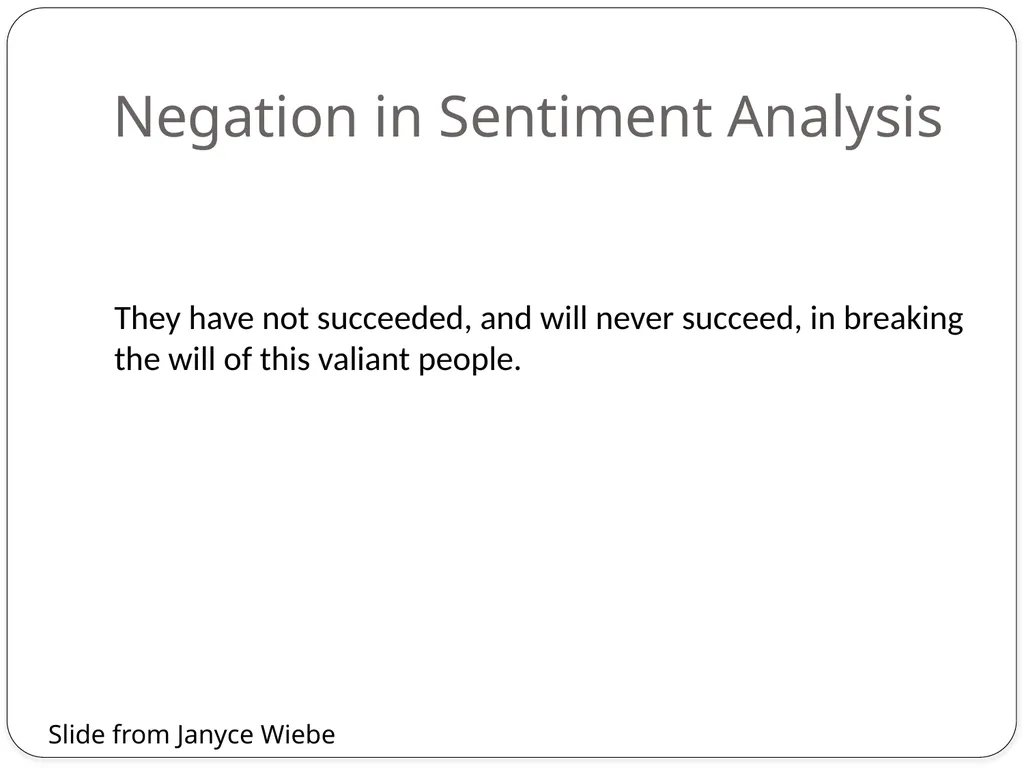
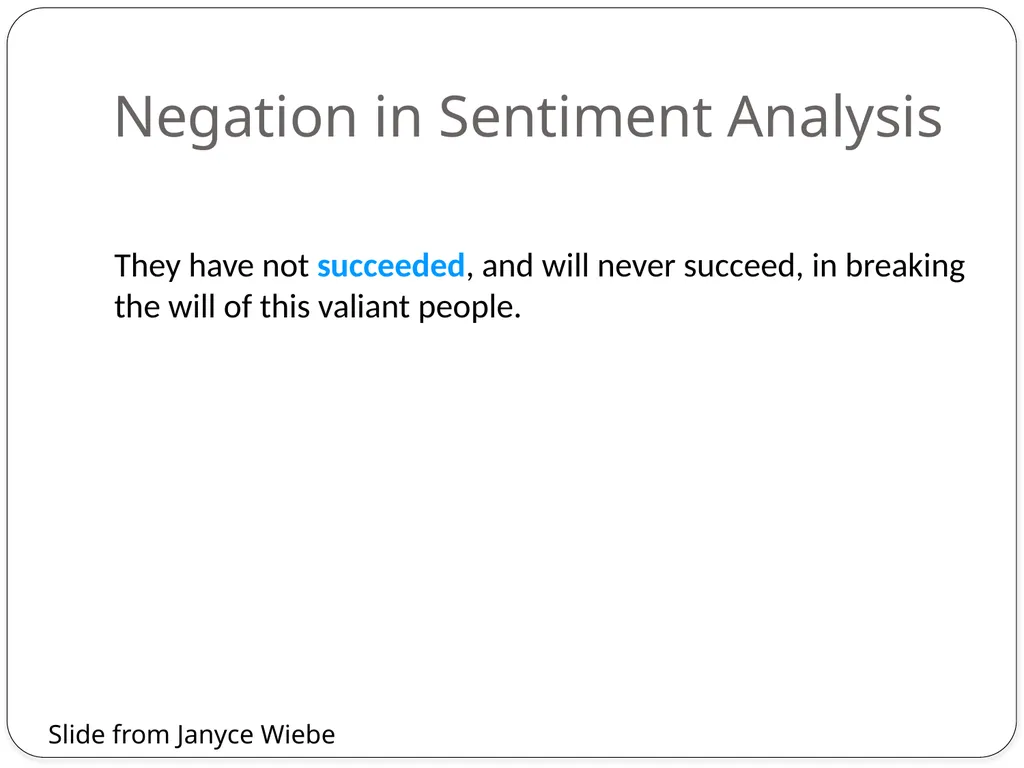
Negation in Sentiment Analysis They have not succeeded, and will never succeed, in breaking the will of this valiant people. Slide from Janyce Wiebe<br>
17
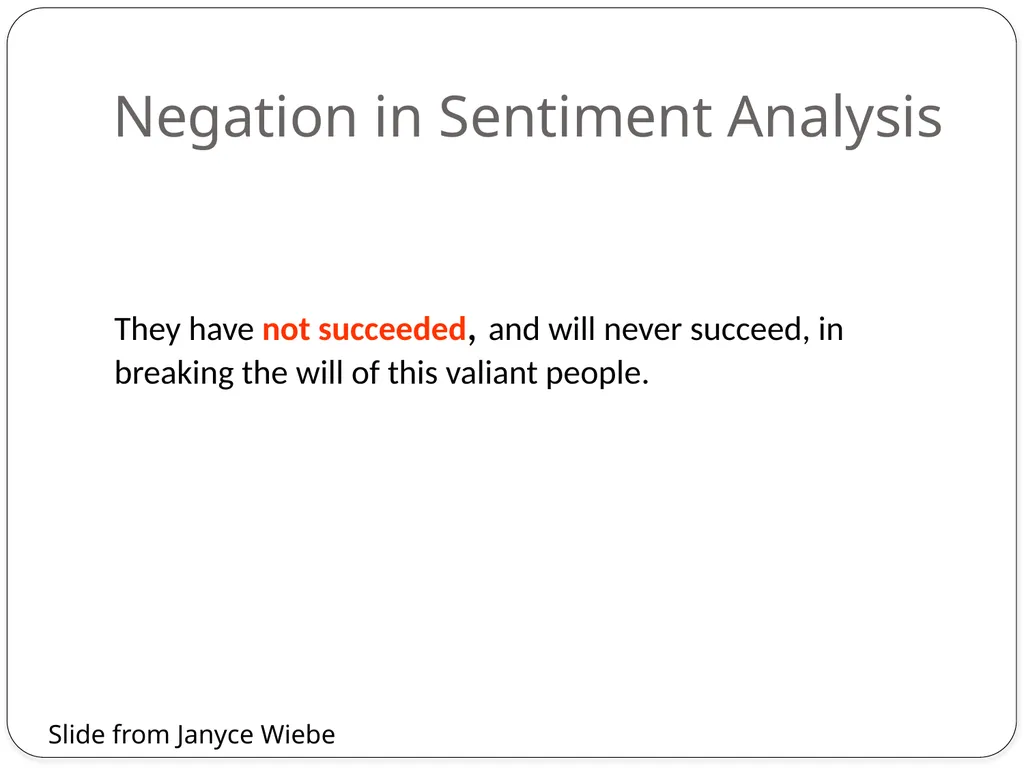
Negation in Sentiment Analysis They have not succeeded, and will never succeed, in breaking the will of this valiant people. Slide from Janyce Wiebe<br>
18
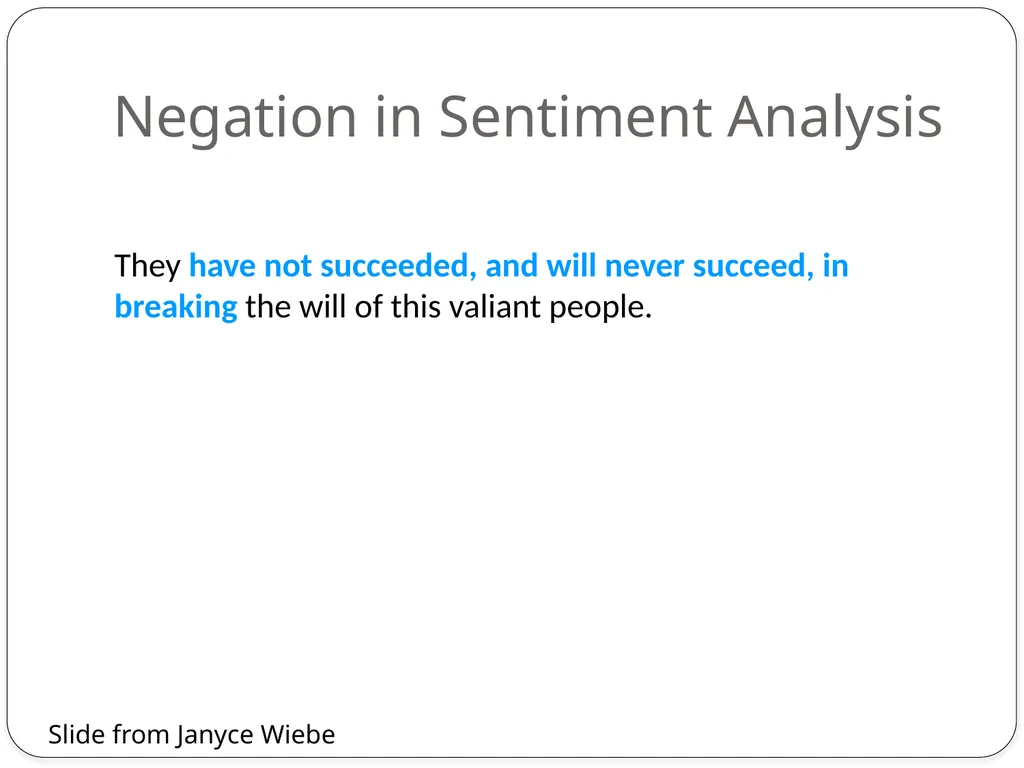
Negation in Sentiment Analysis They have not succeeded, and will never succeed, in breaking the will of this valiant people. Slide from Janyce Wiebe<br>
19
Negation in Sentiment Analysis They have not succeeded, and will never succeed, in breaking the will of this valiant people. Slide from Janyce Wiebe<br>
20
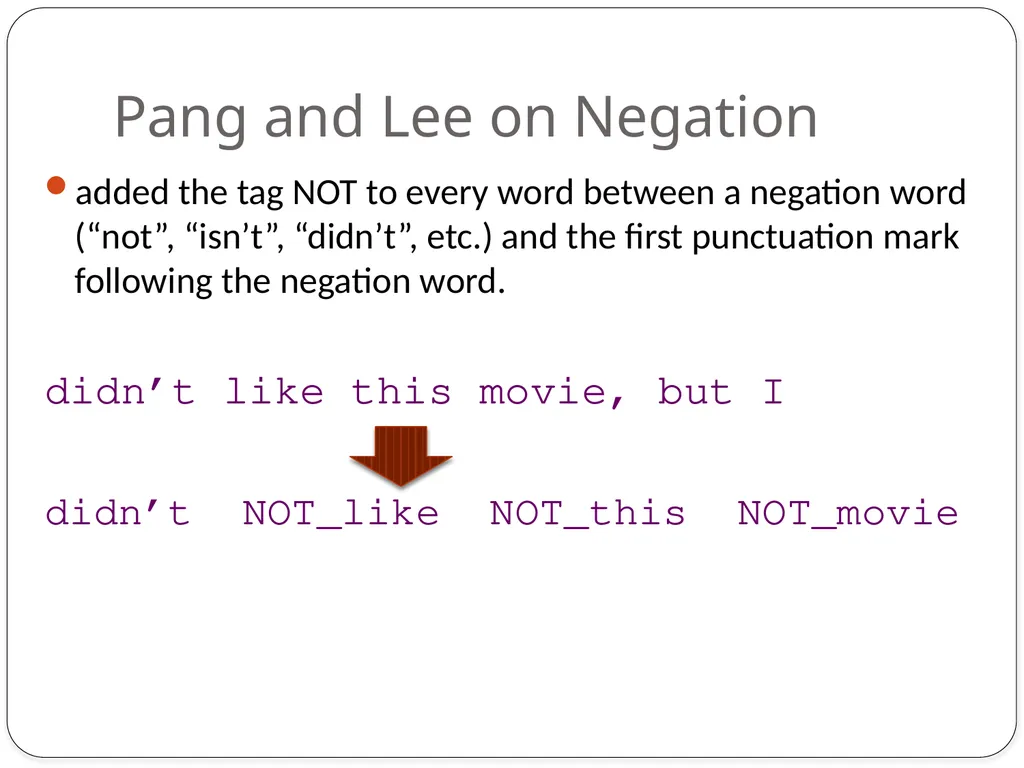
Pang and Lee on Negation added the tag NOT to every word between a negation word (“not”, “isn’t”, “didn’t”, etc.) and the first punctuation mark following the negation word.
didn’t like this movie, but I
didn’t NOT_like NOT_this NOT_movie<br>
didn’t like this movie, but I
didn’t NOT_like NOT_this NOT_movie<br>
21
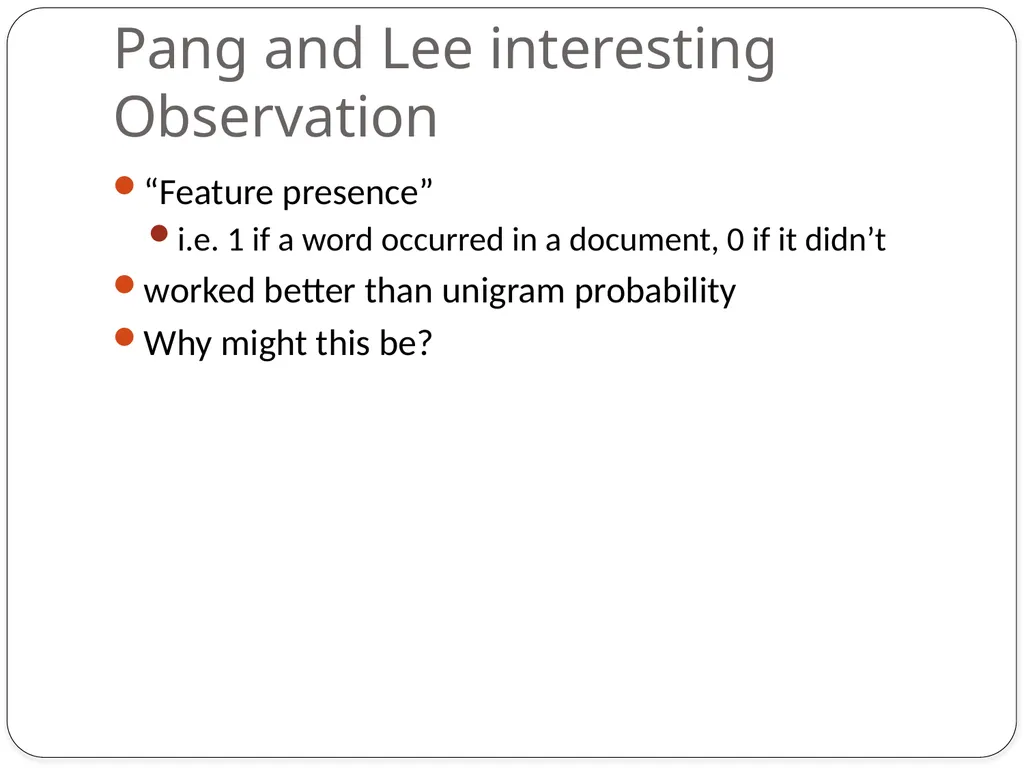
Pang and Lee interesting Observation “Feature presence”
i.e. 1 if a word occurred in a document, 0 if it didn’t
worked better than unigram probability
Why might this be?<br>
i.e. 1 if a word occurred in a document, 0 if it didn’t
worked better than unigram probability
Why might this be?<br>
22
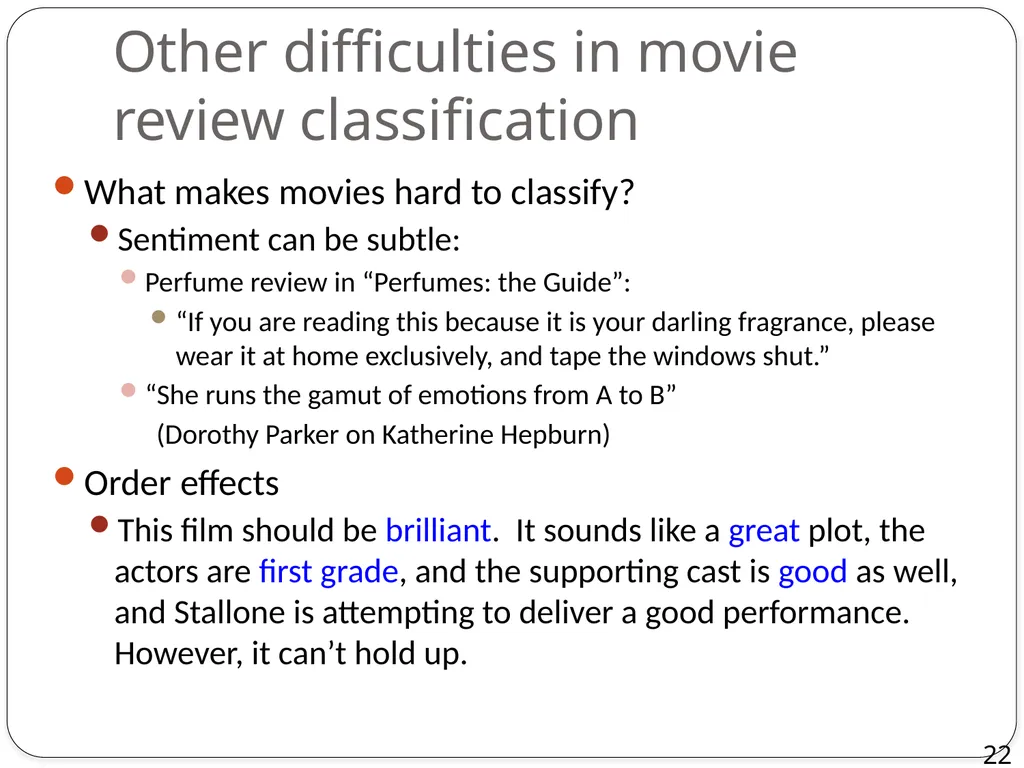
Other difficulties in movie review classification What makes movies hard to classify?
Sentiment can be subtle:
Perfume review in “Perfumes: the Guide”:
“If you are reading this because it is your darling fragrance, please wear it at home exclusively, and tape the windows shut.”
“She runs the gamut of emotions from A to B”
(Dorothy Parker on Katherine Hepburn)
Order effects
This film should be brilliant. It sounds like a great plot, the actors are first grade, and the supporting cast is good as well, and Stallone is attempting to deliver a good performance. However, it can’t hold up. 22<br>
23
3: Naïve Bayes text classification<br>
24
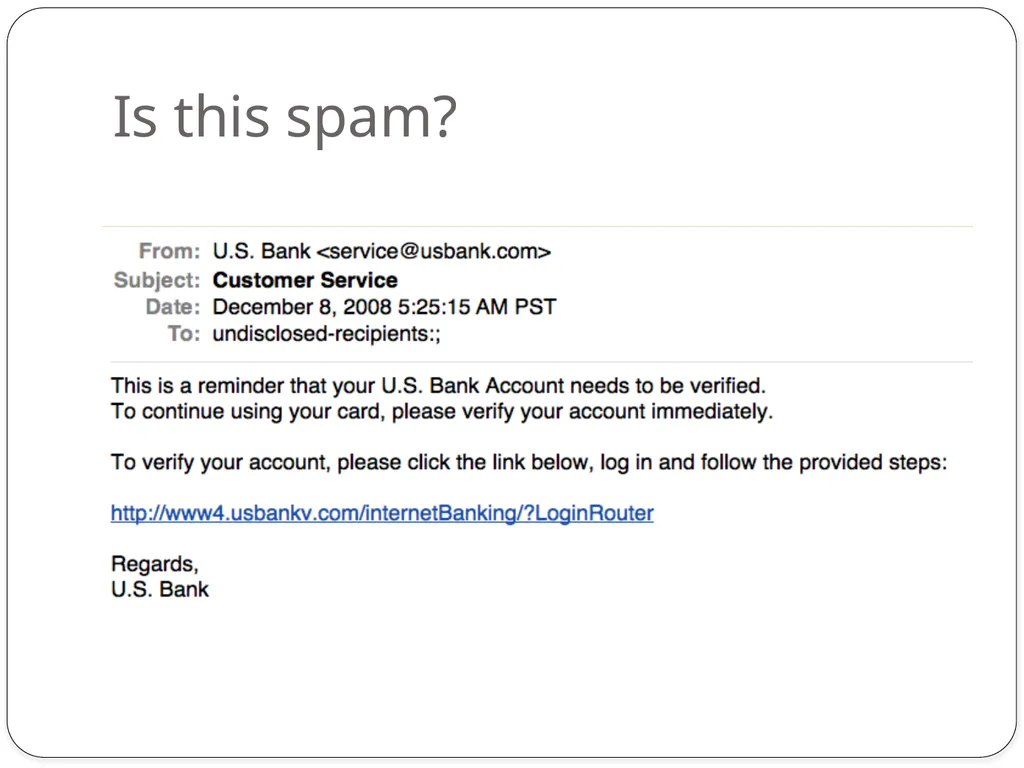
Is this spam?<br>
25
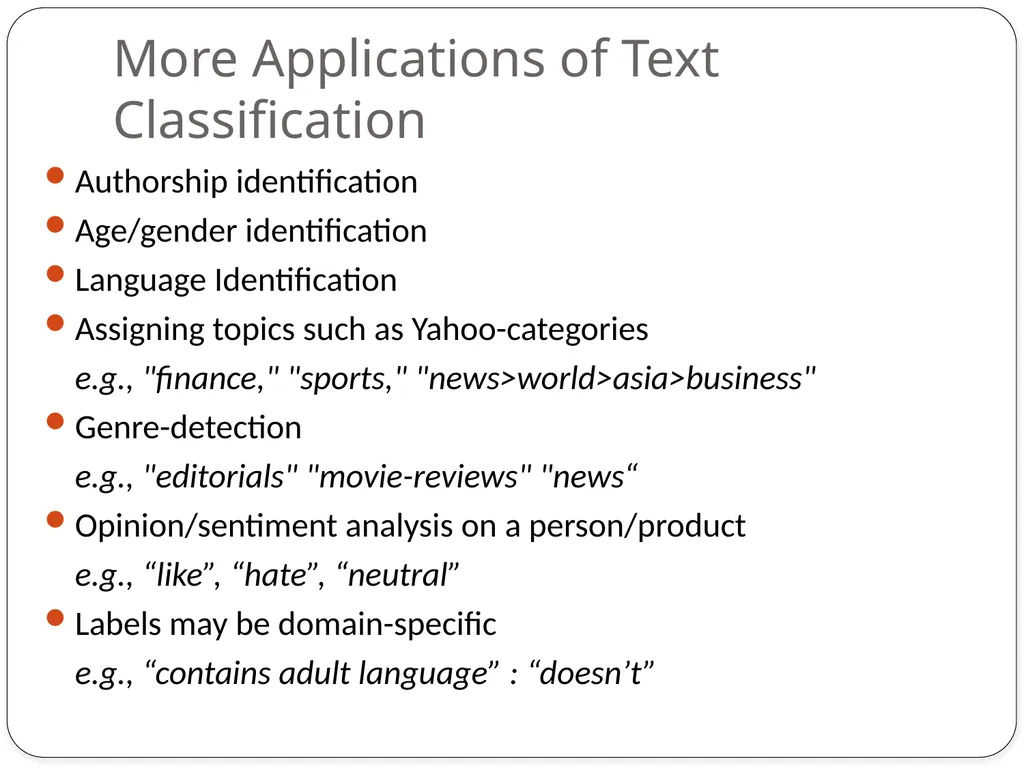
More Applications of Text Classification Authorship identification
Age/gender identification
Language Identification
Assigning topics such as Yahoo-categories
e.g., "finance," "sports," "news>world>asia>business"
Genre-detection
e.g., "editorials" "movie-reviews" "news“
Opinion/sentiment analysis on a person/product
e.g., “like”, “hate”, “neutral”
Labels may be domain-specific
e.g., “contains adult language” : “doesn’t”<br>
26
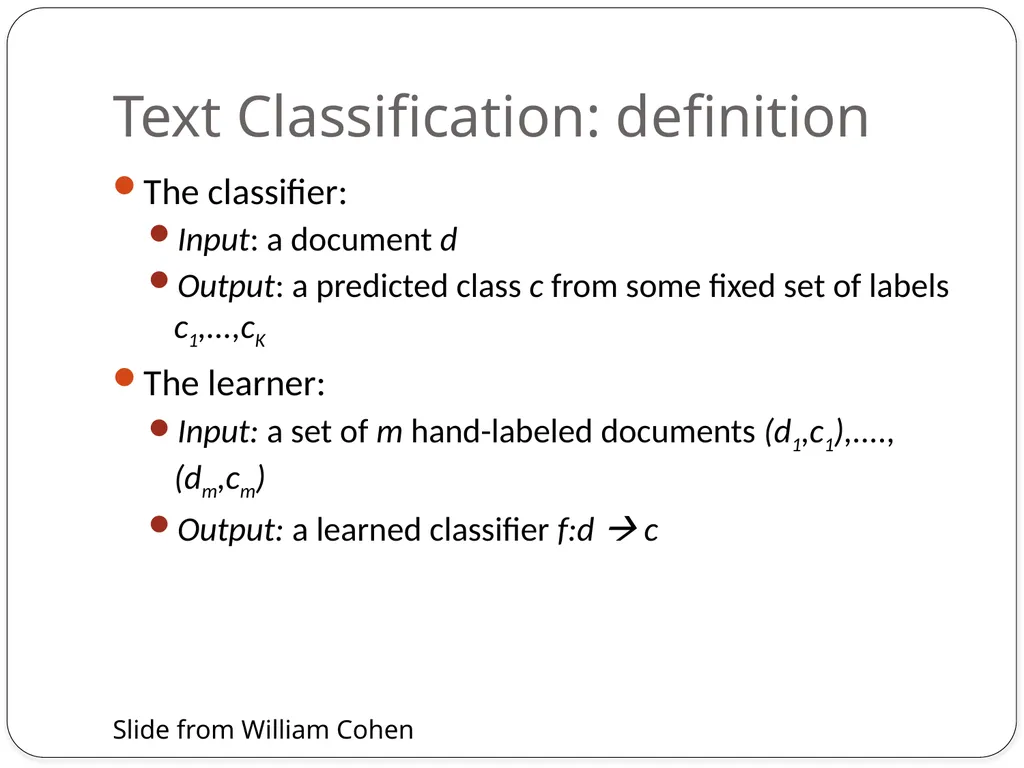
Text Classification: definition The classifier:
Input: a document d
Output: a predicted class c from some fixed set of labels c1,...,cK
The learner:
Input: a set of m hand-labeled documents (d1,c1),....,(dm,cm)
Output: a learned classifier f:d c Slide from William Cohen<br>
Input: a document d
Output: a predicted class c from some fixed set of labels c1,...,cK
The learner:
Input: a set of m hand-labeled documents (d1,c1),....,(dm,cm)
Output: a learned classifier f:d c Slide from William Cohen<br>
27
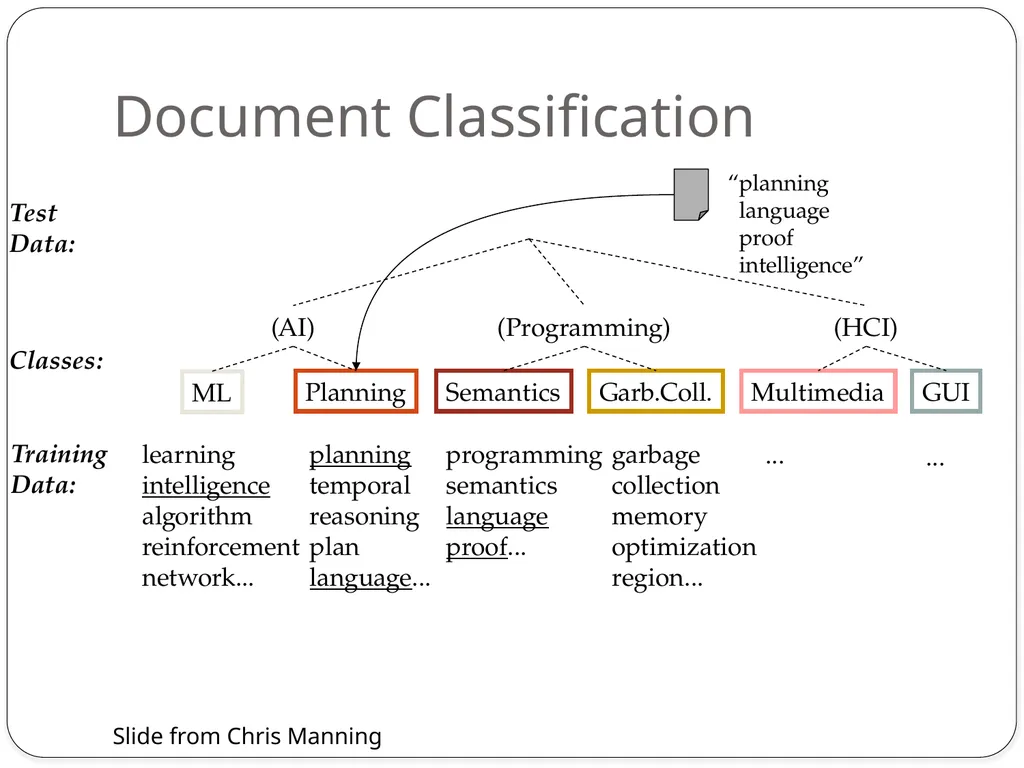
Multimedia GUI Garb.Coll. Semantics ML Planning planning
temporal
reasoning
plan
language... programming
semantics
language
proof... learning
intelligence
algorithm
reinforcement
network... garbage
collection
memory
optimization
region... “planning
language
proof
intelligence” Training
Data: Test
Data: Classes: (AI) Document Classification Slide from Chris Manning (Programming) (HCI) ... ...<br>
28
Classification Methods:
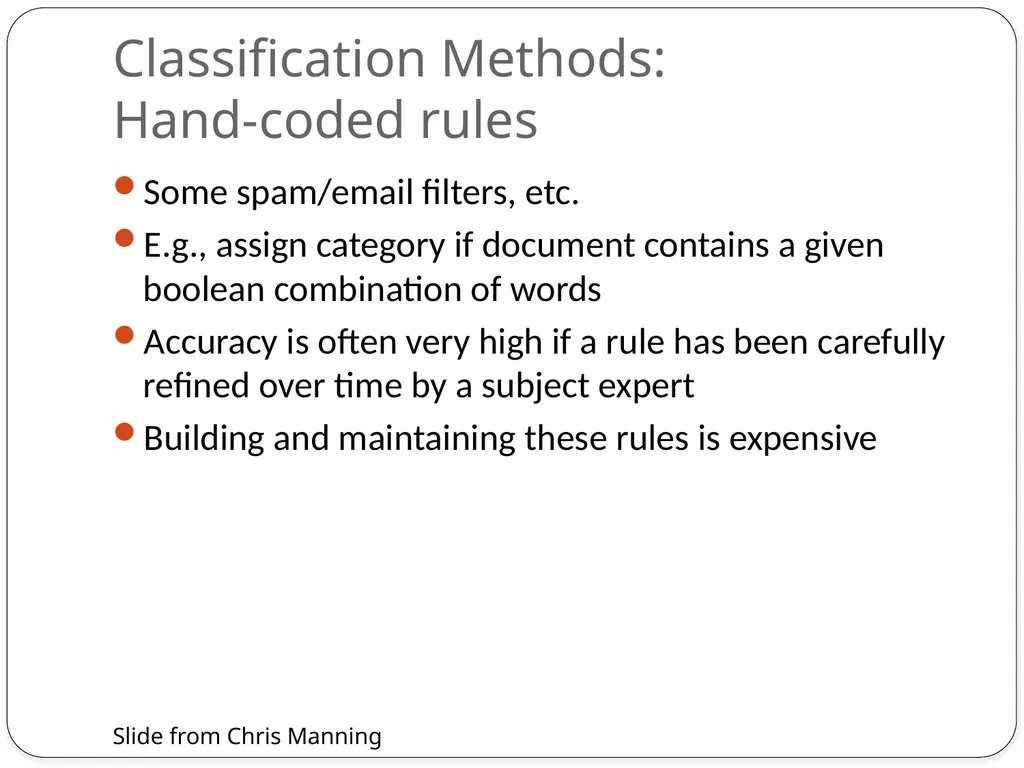
Hand-coded rules Some spam/email filters, etc.
E.g., assign category if document contains a given boolean combination of words
Accuracy is often very high if a rule has been carefully refined over time by a subject expert
Building and maintaining these rules is expensive Slide from Chris Manning<br>
E.g., assign category if document contains a given boolean combination of words
Accuracy is often very high if a rule has been carefully refined over time by a subject expert
Building and maintaining these rules is expensive Slide from Chris Manning<br>
29
Classification Methods:
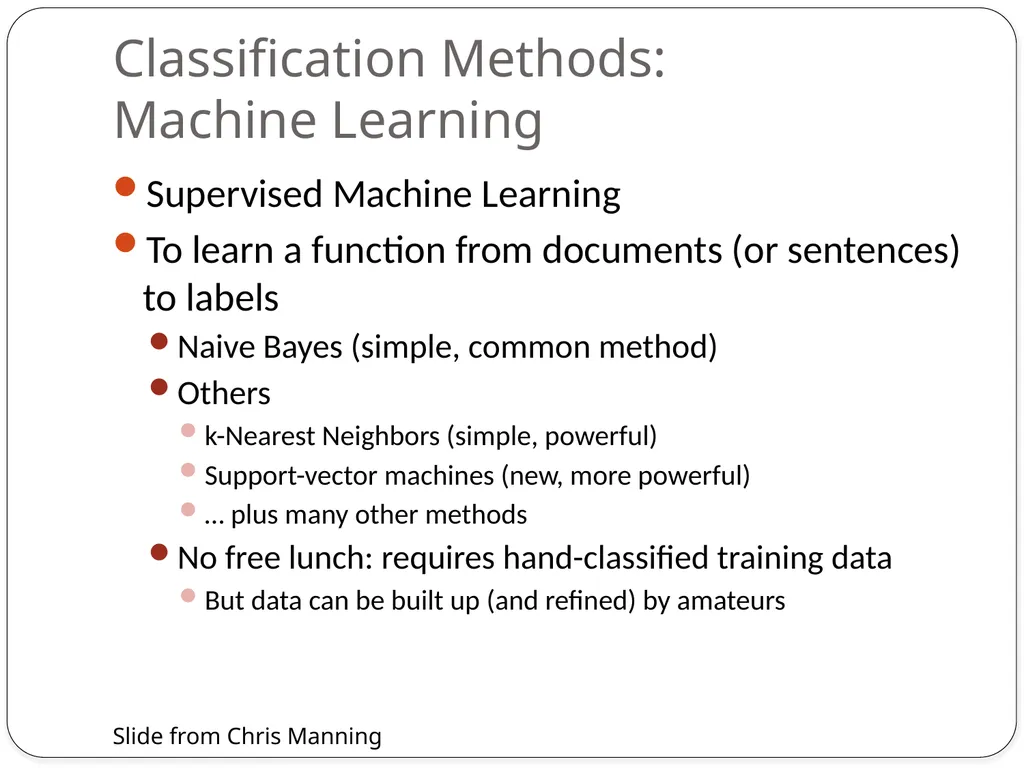
Machine Learning Supervised Machine Learning
To learn a function from documents (or sentences) to labels
Naive Bayes (simple, common method)
Others
k-Nearest Neighbors (simple, powerful)
Support-vector machines (new, more powerful)
… plus many other methods
No free lunch: requires hand-classified training data
But data can be built up (and refined) by amateurs Slide from Chris Manning<br>
30
Naïve Bayes Intuition<br>
31
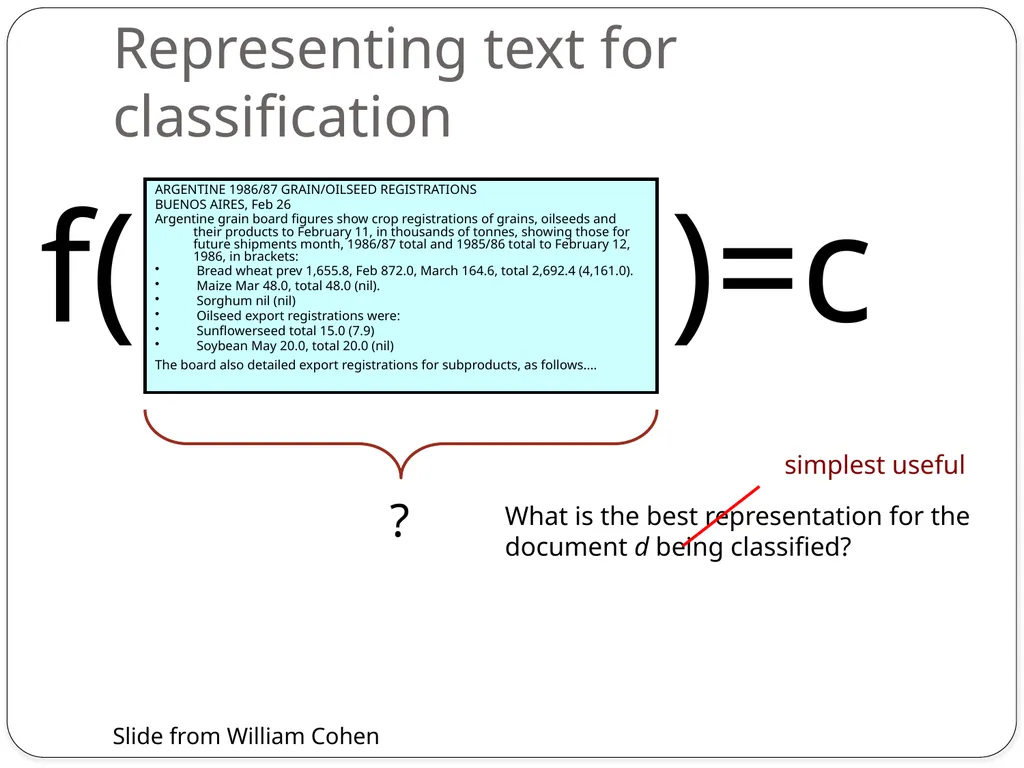
Representing text for classification Slide from William Cohen ARGENTINE 1986/87 GRAIN/OILSEED REGISTRATIONS
BUENOS AIRES, Feb 26
Argentine grain board figures show crop registrations of grains, oilseeds and their products to February 11, in thousands of tonnes, showing those for future shipments month, 1986/87 total and 1985/86 total to February 12, 1986, in brackets:
Bread wheat prev 1,655.8, Feb 872.0, March 164.6, total 2,692.4 (4,161.0).
Maize Mar 48.0, total 48.0 (nil).
Sorghum nil (nil)
Oilseed export registrations were:
Sunflowerseed total 15.0 (7.9)
Soybean May 20.0, total 20.0 (nil)
The board also detailed export registrations for subproducts, as follows.... f( )=c ? What is the best representation for the document d being classified? simplest useful<br>
32
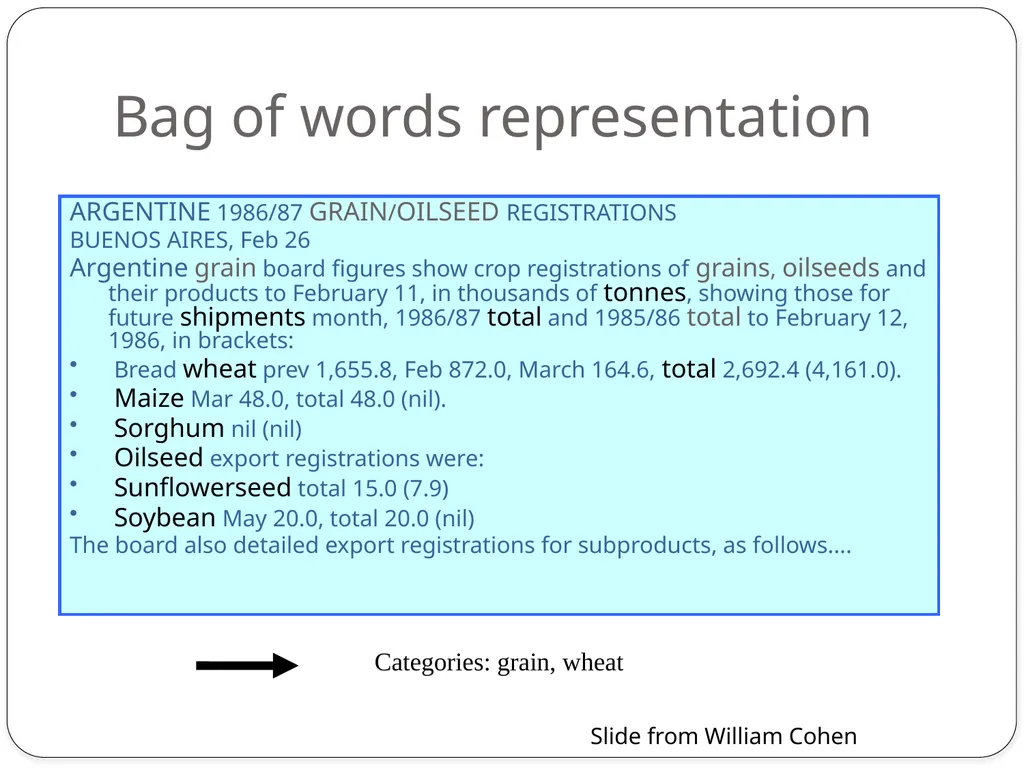
Bag of words representation Slide from William Cohen ARGENTINE 1986/87 GRAIN/OILSEED REGISTRATIONS
BUENOS AIRES, Feb 26
Argentine grain board figures show crop registrations of grains, oilseeds and their products to February 11, in thousands of tonnes, showing those for future shipments month, 1986/87 total and 1985/86 total to February 12, 1986, in brackets:
Bread wheat prev 1,655.8, Feb 872.0, March 164.6, total 2,692.4 (4,161.0).
Maize Mar 48.0, total 48.0 (nil).
Sorghum nil (nil)
Oilseed export registrations were:
Sunflowerseed total 15.0 (7.9)
Soybean May 20.0, total 20.0 (nil)
The board also detailed export registrations for subproducts, as follows.... Categories: grain, wheat<br>
33
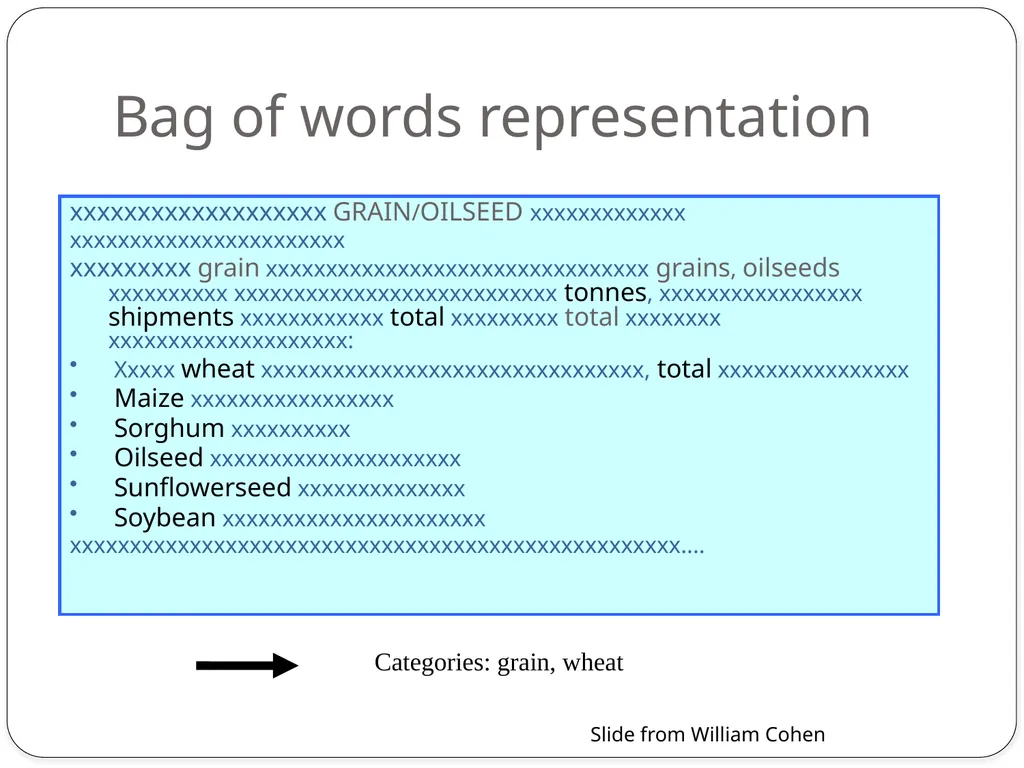
Bag of words representation Slide from William Cohen xxxxxxxxxxxxxxxxxxx GRAIN/OILSEED xxxxxxxxxxxxx
xxxxxxxxxxxxxxxxxxxxxxx
xxxxxxxxx grain xxxxxxxxxxxxxxxxxxxxxxxxxxxxxxxx grains, oilseeds xxxxxxxxxx xxxxxxxxxxxxxxxxxxxxxxxxxxx tonnes, xxxxxxxxxxxxxxxxx shipments xxxxxxxxxxxx total xxxxxxxxx total xxxxxxxx xxxxxxxxxxxxxxxxxxxx:
Xxxxx wheat xxxxxxxxxxxxxxxxxxxxxxxxxxxxxxxx, total xxxxxxxxxxxxxxxx
Maize xxxxxxxxxxxxxxxxx
Sorghum xxxxxxxxxx
Oilseed xxxxxxxxxxxxxxxxxxxxx
Sunflowerseed xxxxxxxxxxxxxx
Soybean xxxxxxxxxxxxxxxxxxxxxx
xxxxxxxxxxxxxxxxxxxxxxxxxxxxxxxxxxxxxxxxxxxxxxxxxxx.... Categories: grain, wheat<br>
34
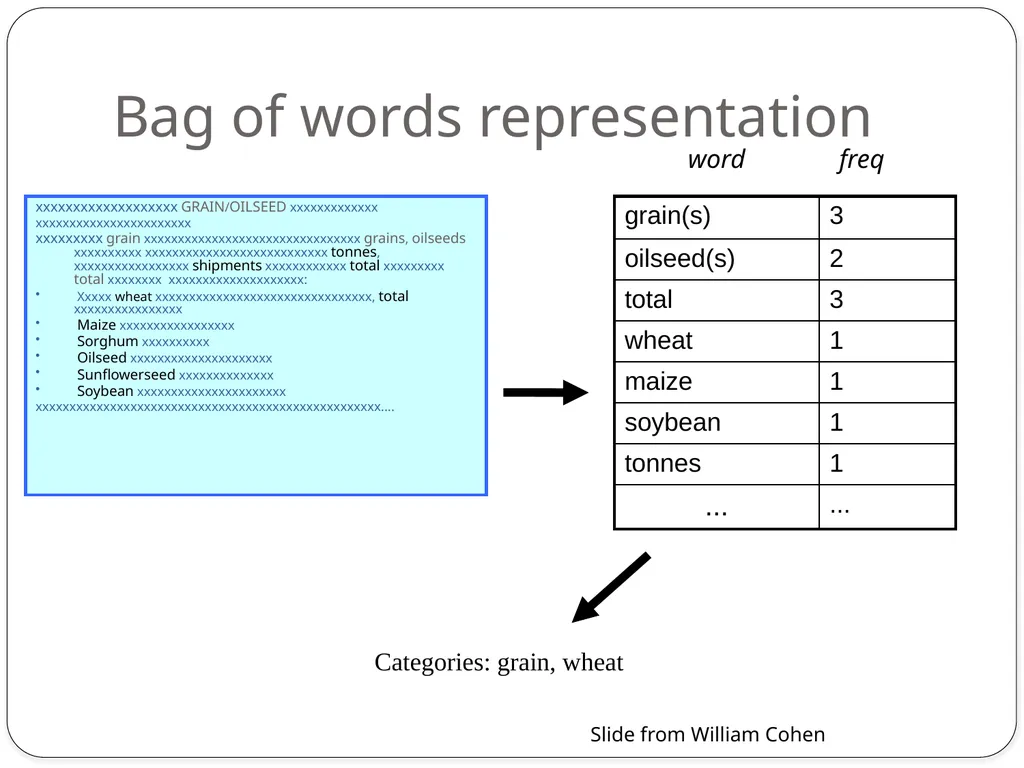
Bag of words representation Slide from William Cohen xxxxxxxxxxxxxxxxxxx GRAIN/OILSEED xxxxxxxxxxxxx
xxxxxxxxxxxxxxxxxxxxxxx
xxxxxxxxx grain xxxxxxxxxxxxxxxxxxxxxxxxxxxxxxxx grains, oilseeds xxxxxxxxxx xxxxxxxxxxxxxxxxxxxxxxxxxxx tonnes, xxxxxxxxxxxxxxxxx shipments xxxxxxxxxxxx total xxxxxxxxx total xxxxxxxx xxxxxxxxxxxxxxxxxxxx:
Xxxxx wheat xxxxxxxxxxxxxxxxxxxxxxxxxxxxxxxx, total xxxxxxxxxxxxxxxx
Maize xxxxxxxxxxxxxxxxx
Sorghum xxxxxxxxxx
Oilseed xxxxxxxxxxxxxxxxxxxxx
Sunflowerseed xxxxxxxxxxxxxx
Soybean xxxxxxxxxxxxxxxxxxxxxx
xxxxxxxxxxxxxxxxxxxxxxxxxxxxxxxxxxxxxxxxxxxxxxxxxxx.... Categories: grain, wheat word freq<br>
35
Formalizing Naïve Bayes<br>
36
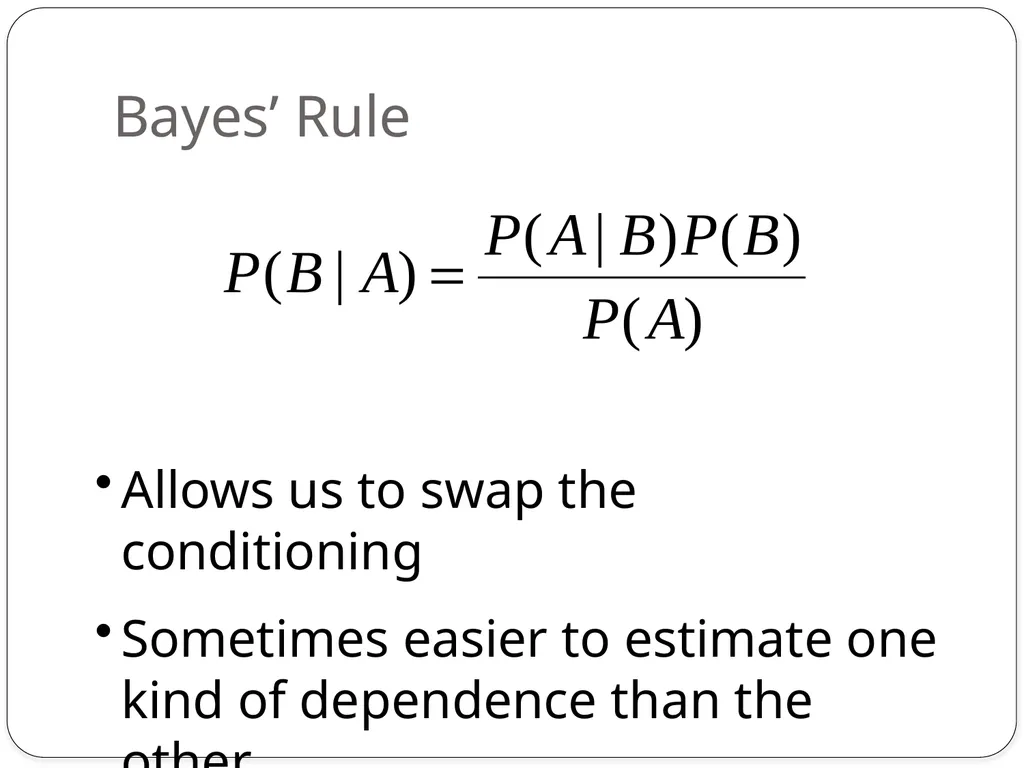
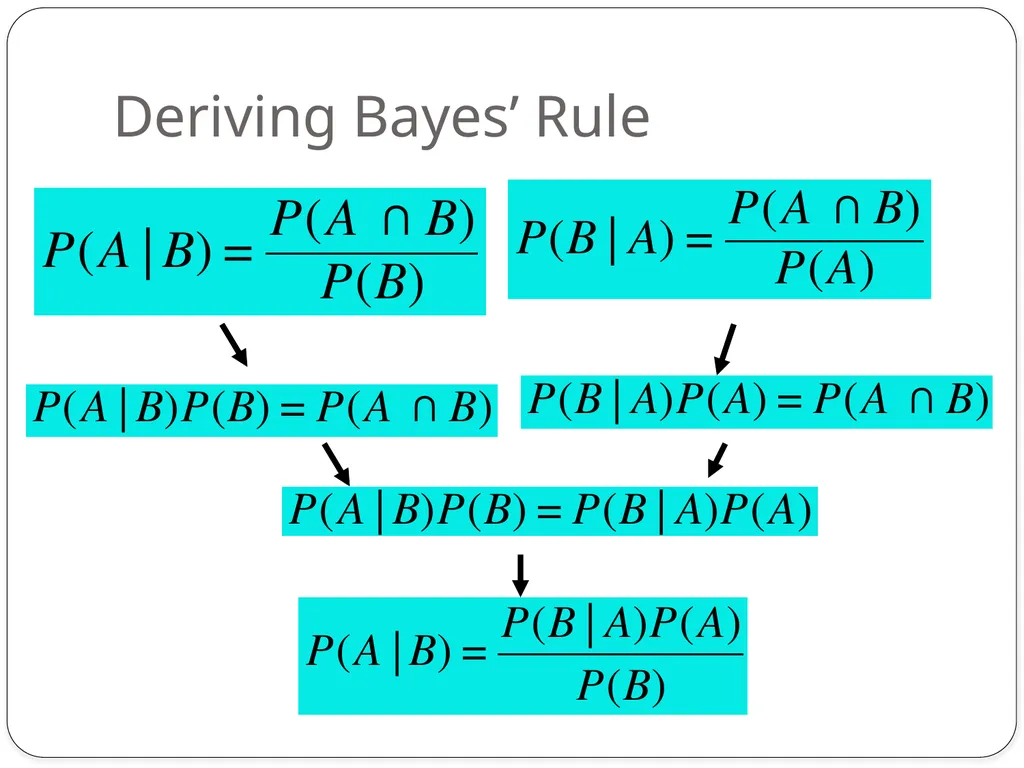
Bayes’ Rule Allows us to swap the conditioning
Sometimes easier to estimate one kind of dependence than the other<br>
Sometimes easier to estimate one kind of dependence than the other<br>
37
Deriving Bayes’ Rule<br>
38
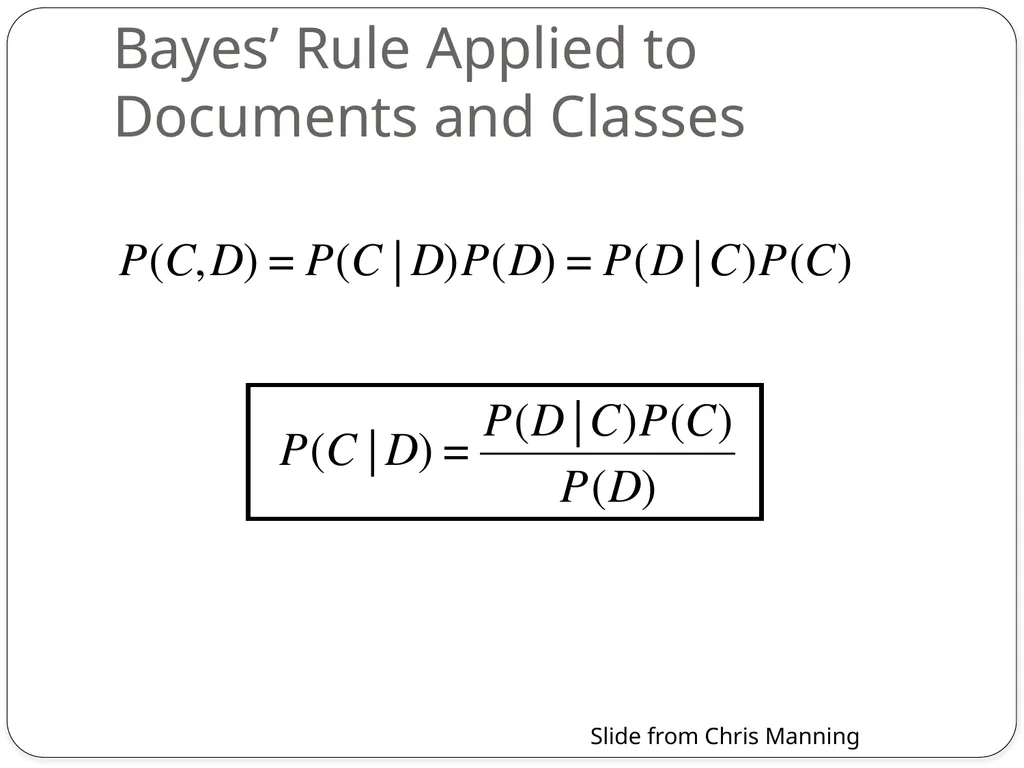
Bayes’ Rule Applied to Documents and Classes Slide from Chris Manning<br>
39
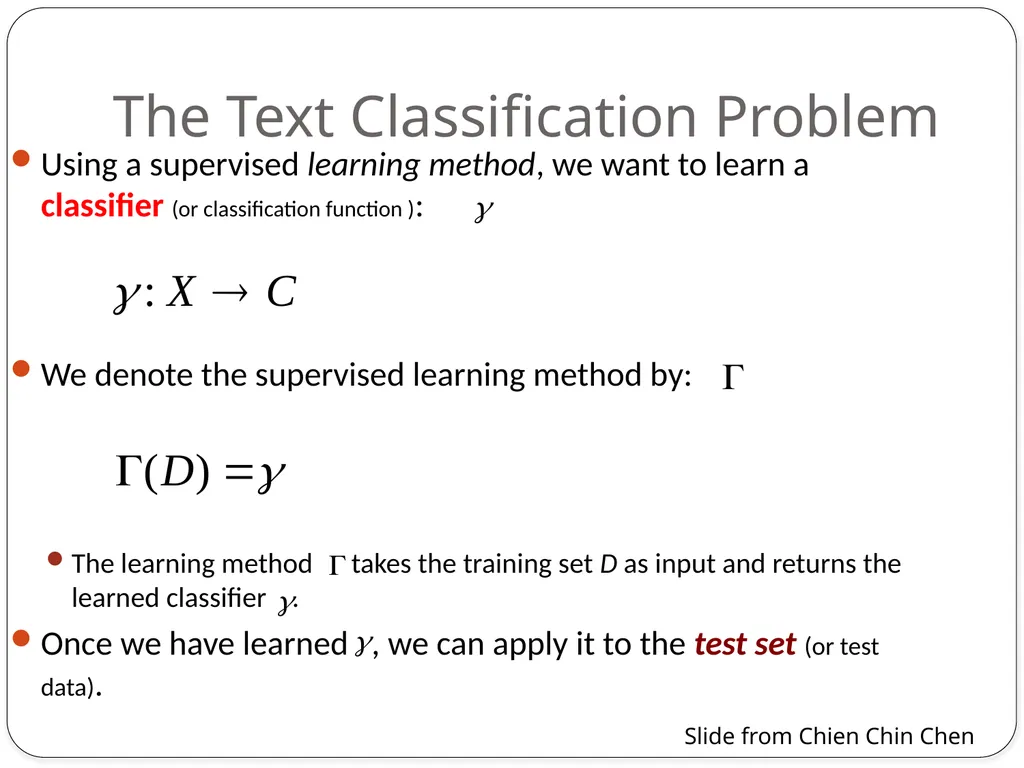
Using a supervised learning method, we want to learn a classifier (or classification function ):
We denote the supervised learning method by:
The learning method takes the training set D as input and returns the learned classifier .
Once we have learned , we can apply it to the test set (or test data). The Text Classification Problem Slide from Chien Chin Chen<br>
We denote the supervised learning method by:
The learning method takes the training set D as input and returns the learned classifier .
Once we have learned , we can apply it to the test set (or test data). The Text Classification Problem Slide from Chien Chin Chen<br>
40
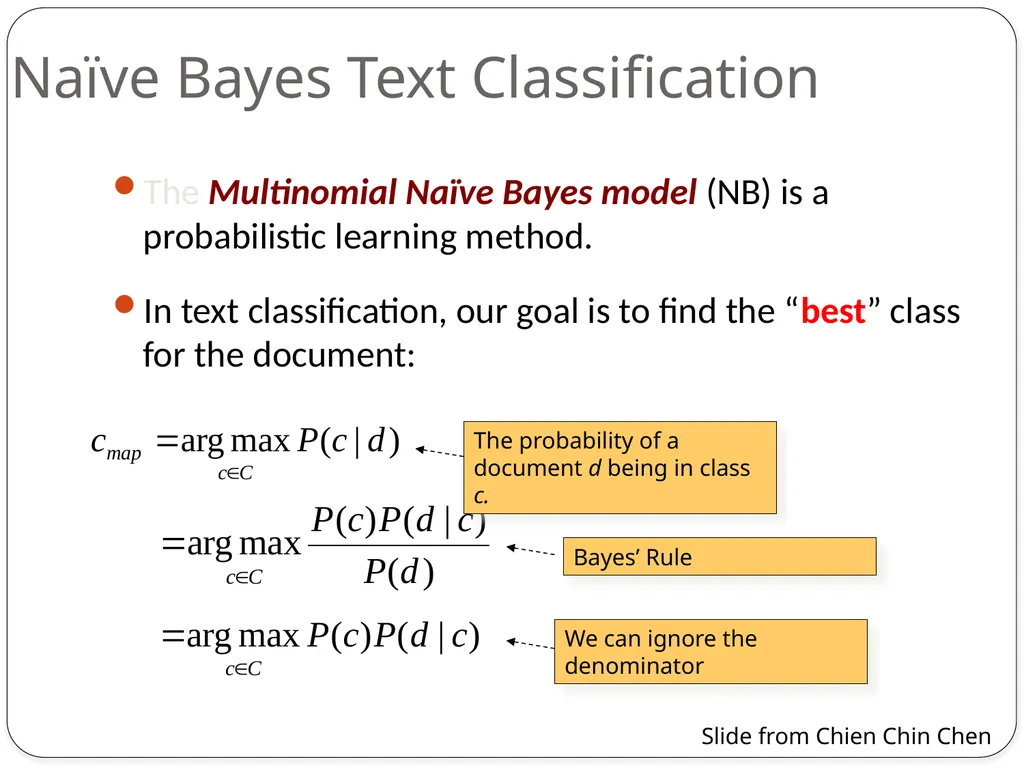
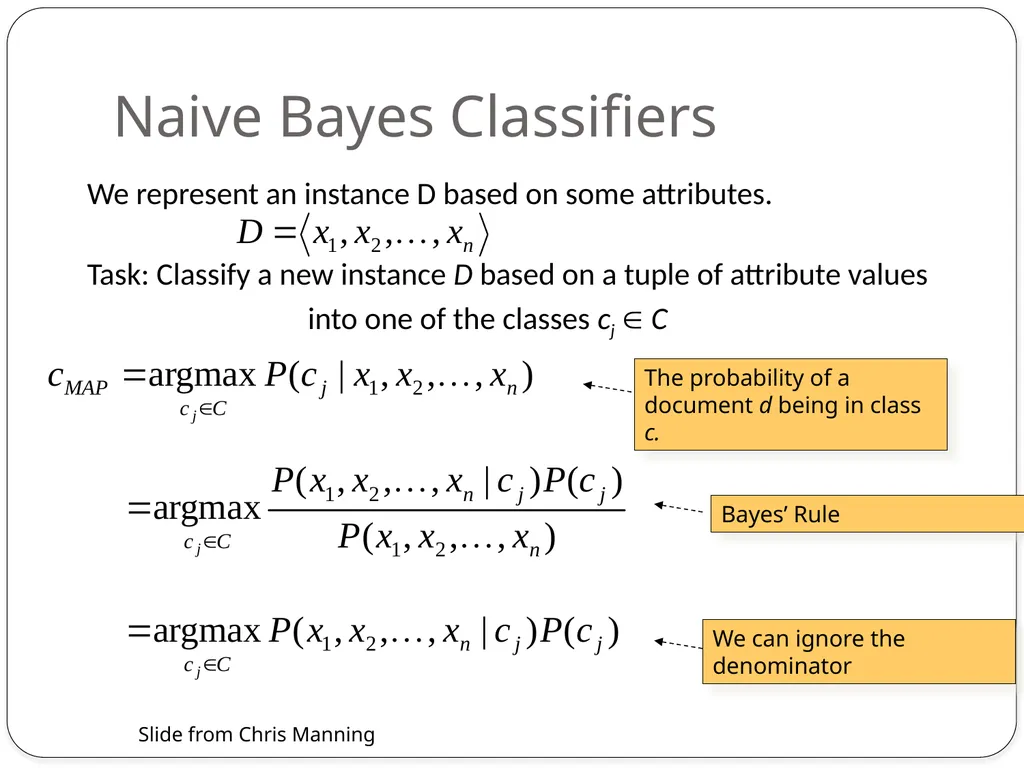
Naïve Bayes Text Classification The Multinomial Naïve Bayes model (NB) is a probabilistic learning method.
In text classification, our goal is to find the “best” class for the document: Slide from Chien Chin Chen The probability of a
document d being in class c. Bayes’ Rule We can ignore the denominator<br>
In text classification, our goal is to find the “best” class for the document: Slide from Chien Chin Chen The probability of a
document d being in class c. Bayes’ Rule We can ignore the denominator<br>
41
Naive Bayes Classifiers We represent an instance D based on some attributes.
Task: Classify a new instance D based on a tuple of attribute values into one of the classes cj C Slide from Chris Manning The probability of a
document d being in class c. Bayes’ Rule We can ignore the denominator<br>
Task: Classify a new instance D based on a tuple of attribute values into one of the classes cj C Slide from Chris Manning The probability of a
document d being in class c. Bayes’ Rule We can ignore the denominator<br>
42
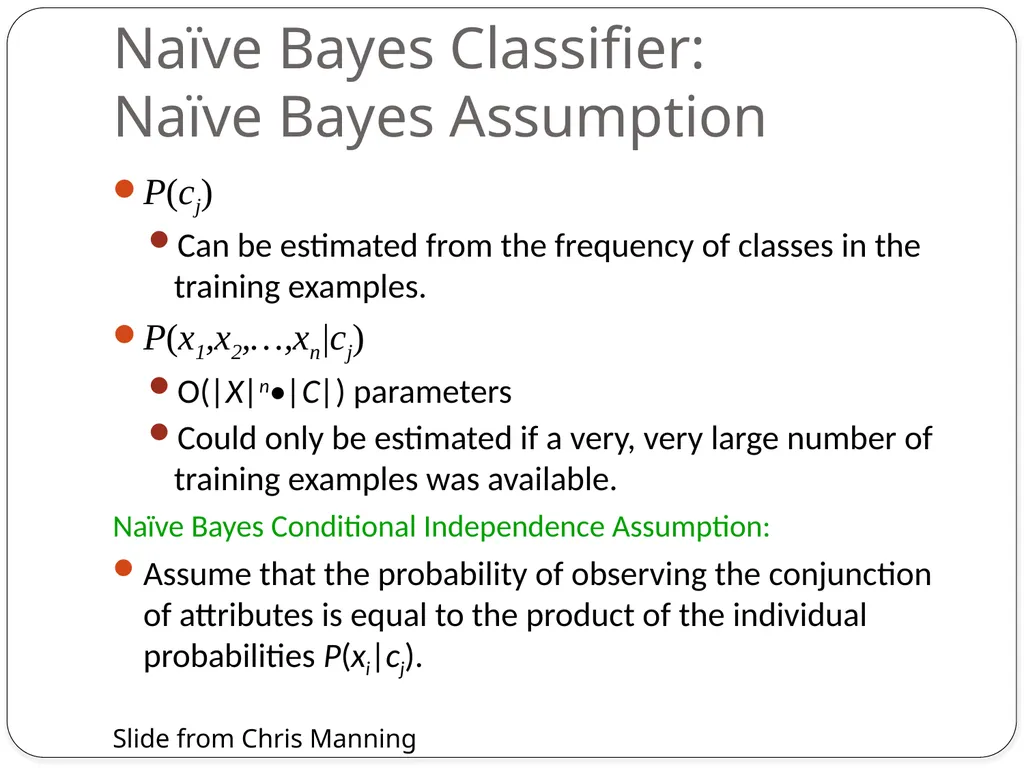
Naïve Bayes Classifier:
Naïve Bayes Assumption P(cj)
Can be estimated from the frequency of classes in the training examples.
P(x1,x2,…,xn|cj)
O(|X|n•|C|) parameters
Could only be estimated if a very, very large number of training examples was available.
Naïve Bayes Conditional Independence Assumption:
Assume that the probability of observing the conjunction of attributes is equal to the product of the individual probabilities P(xi|cj). Slide from Chris Manning<br>
43
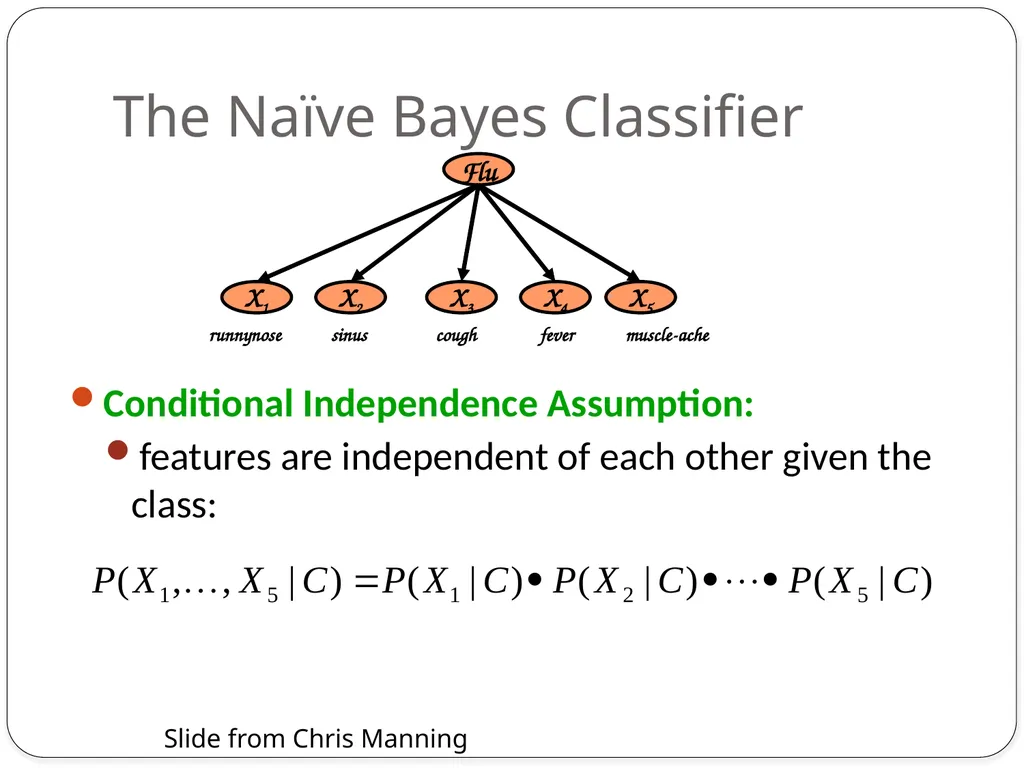
The Naïve Bayes Classifier Conditional Independence Assumption:
features are independent of each other given the class: Slide from Chris Manning<br>
features are independent of each other given the class: Slide from Chris Manning<br>
44
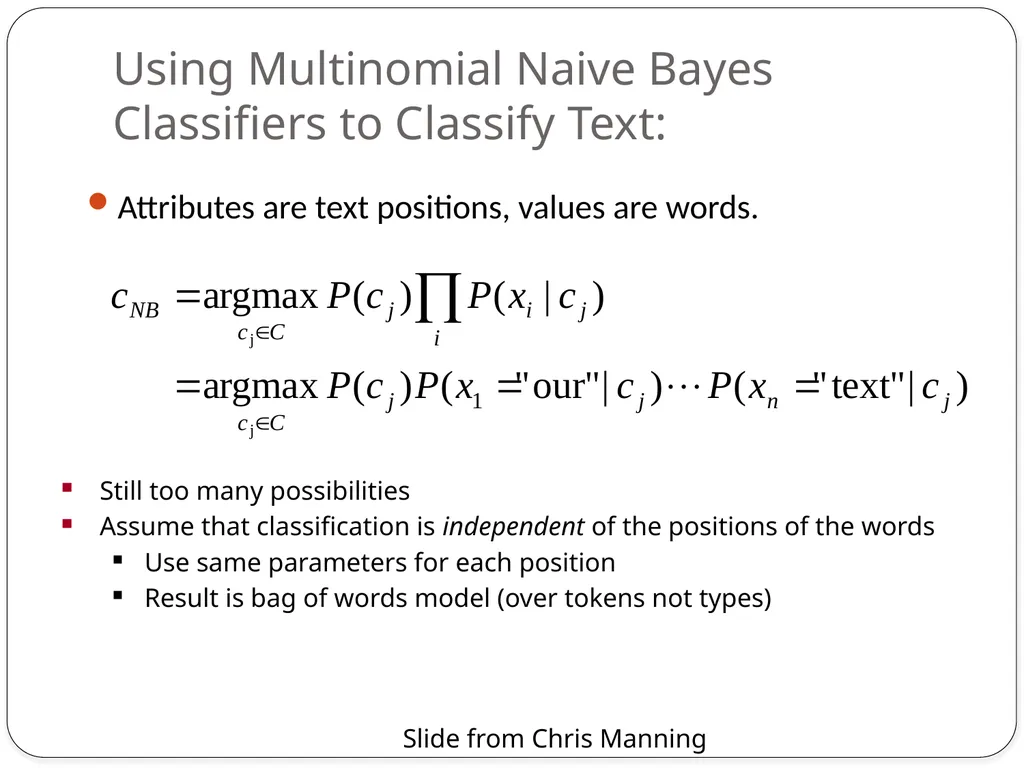
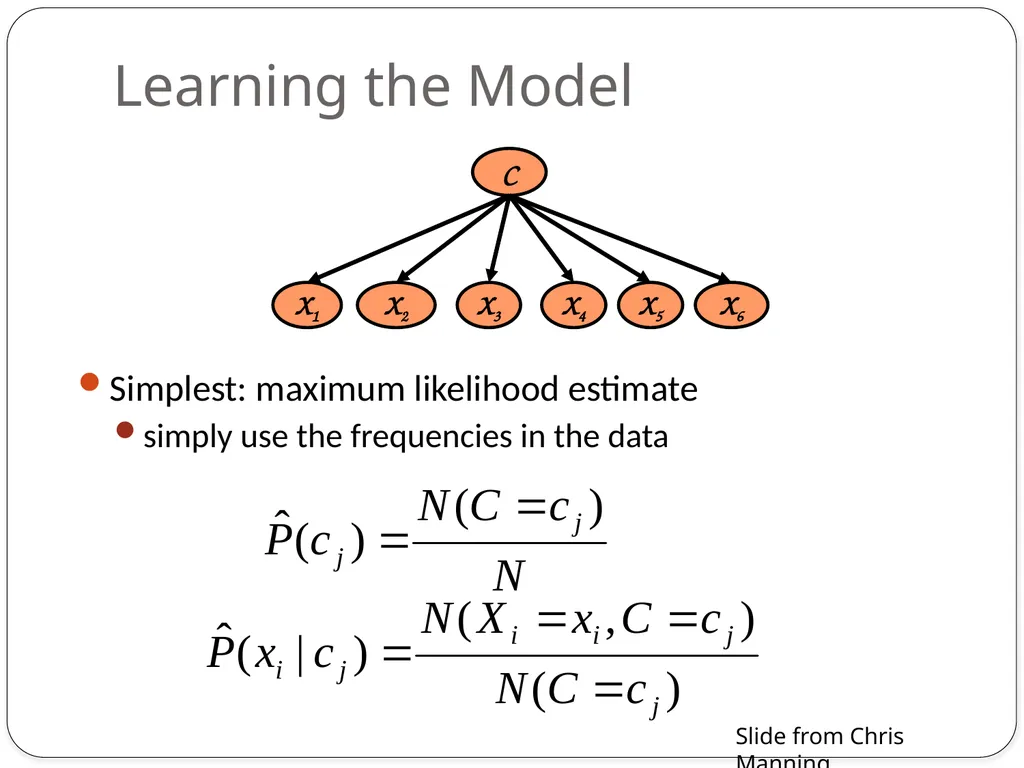
Using Multinomial Naive Bayes Classifiers to Classify Text: Attributes are text positions, values are words. Slide from Chris Manning Still too many possibilities
Assume that classification is independent of the positions of the words
Use same parameters for each position
Result is bag of words model (over tokens not types)<br>
Assume that classification is independent of the positions of the words
Use same parameters for each position
Result is bag of words model (over tokens not types)<br>
45
Learning the Model Simplest: maximum likelihood estimate
simply use the frequencies in the data Slide from Chris Manning<br>
simply use the frequencies in the data Slide from Chris Manning<br>
46
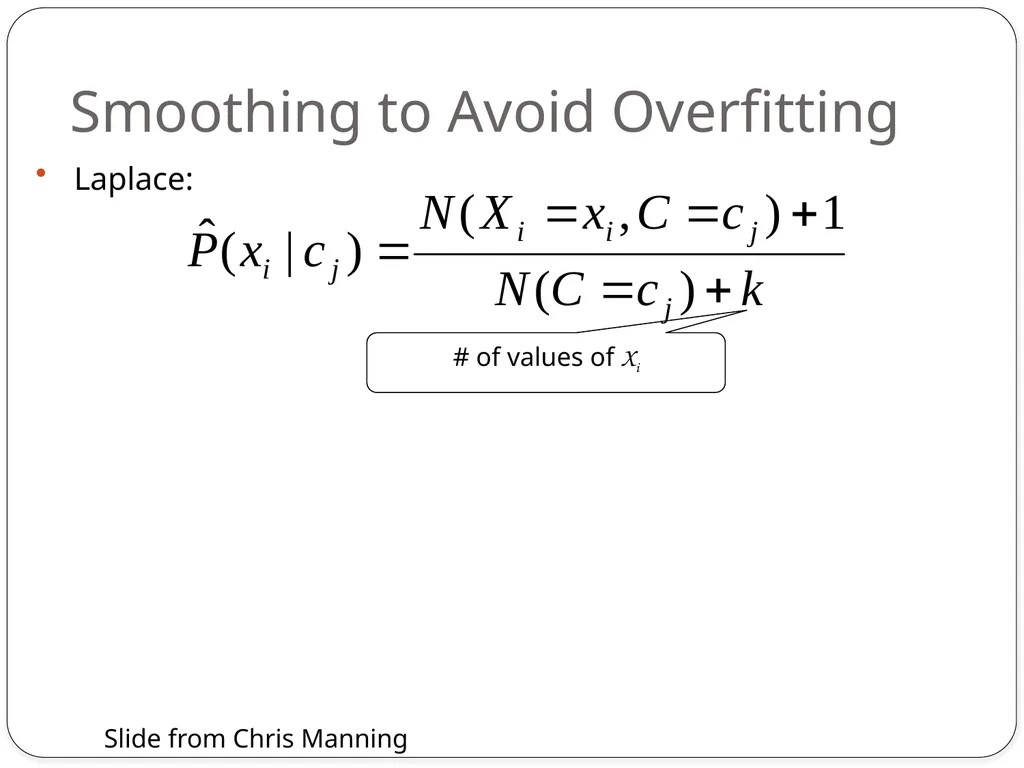
Smoothing to Avoid Overfitting Slide from Chris Manning # of values of Xi Laplace:<br>
47
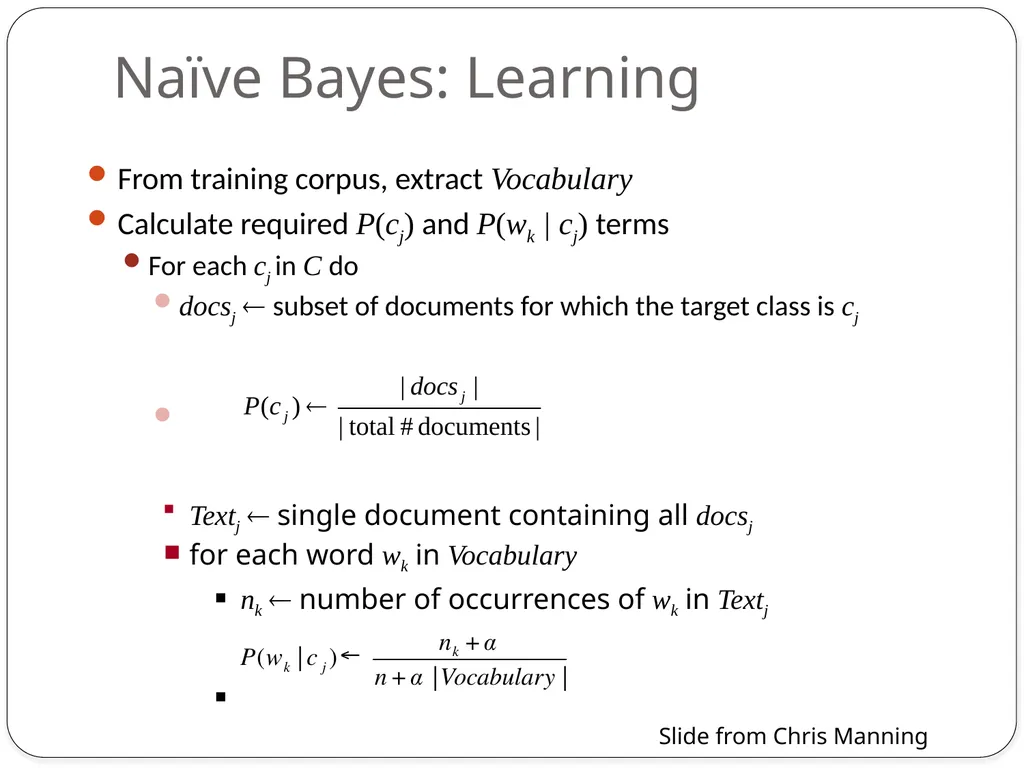
Textj single document containing all docsj
for each word wk in Vocabulary
nk number of occurrences of wk in Textj Naïve Bayes: Learning From training corpus, extract Vocabulary
Calculate required P(cj) and P(wk | cj) terms
For each cj in C do
docsj subset of documents for which the target class is cj Slide from Chris Manning<br>
for each word wk in Vocabulary
nk number of occurrences of wk in Textj Naïve Bayes: Learning From training corpus, extract Vocabulary
Calculate required P(cj) and P(wk | cj) terms
For each cj in C do
docsj subset of documents for which the target class is cj Slide from Chris Manning<br>
48
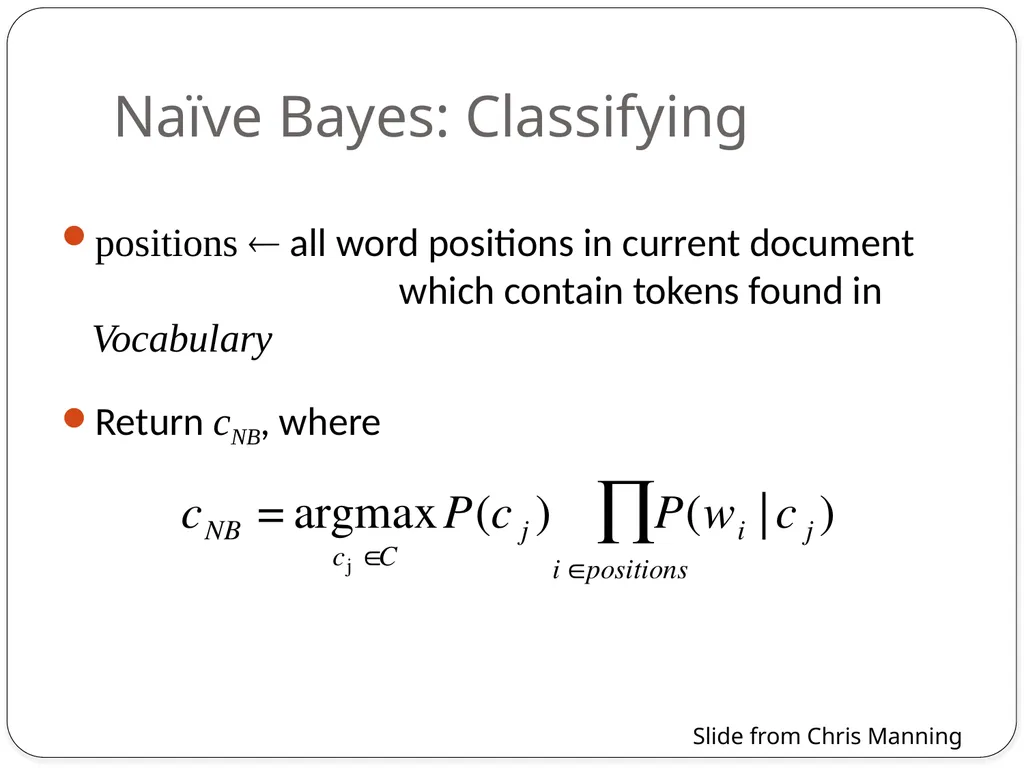
Naïve Bayes: Classifying positions all word positions in current document which contain tokens found in Vocabulary
Return cNB, where Slide from Chris Manning<br>
Return cNB, where Slide from Chris Manning<br>
49
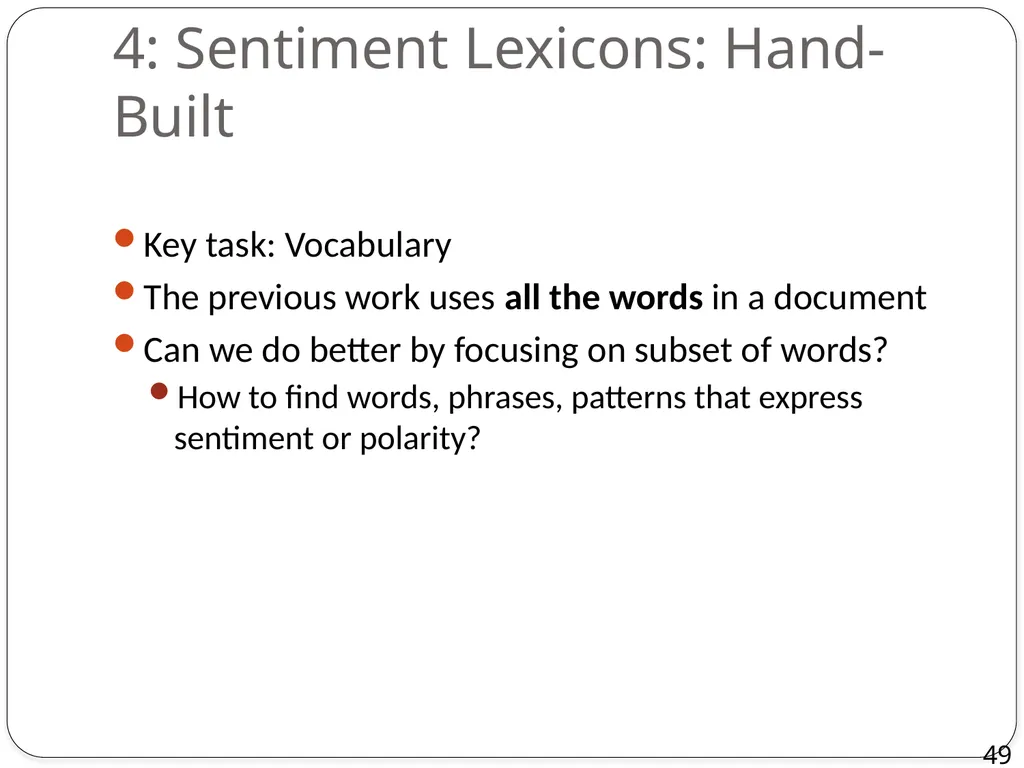
4: Sentiment Lexicons: Hand-Built Key task: Vocabulary
The previous work uses all the words in a document
Can we do better by focusing on subset of words?
How to find words, phrases, patterns that express sentiment or polarity? 49<br>
The previous work uses all the words in a document
Can we do better by focusing on subset of words?
How to find words, phrases, patterns that express sentiment or polarity? 49<br>
50
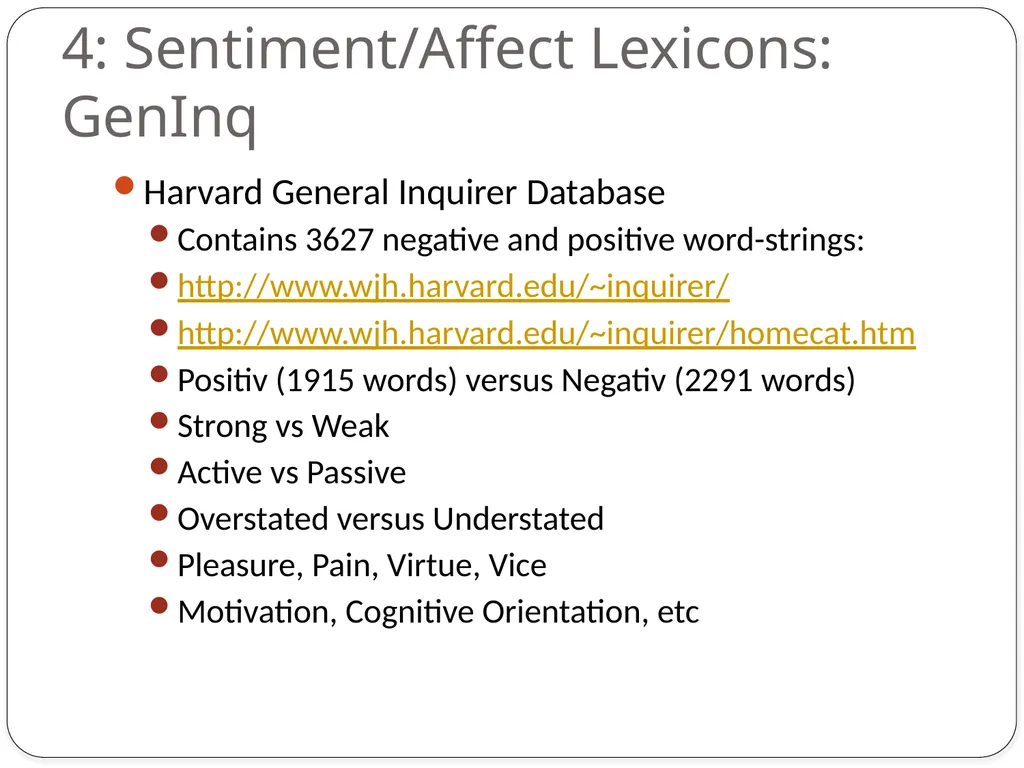
4: Sentiment/Affect Lexicons: GenInq Harvard General Inquirer Database
Contains 3627 negative and positive word-strings:
http://www.wjh.harvard.edu/~inquirer/
http://www.wjh.harvard.edu/~inquirer/homecat.htm
Positiv (1915 words) versus Negativ (2291 words)
Strong vs Weak
Active vs Passive
Overstated versus Understated
Pleasure, Pain, Virtue, Vice
Motivation, Cognitive Orientation, etc<br>
51
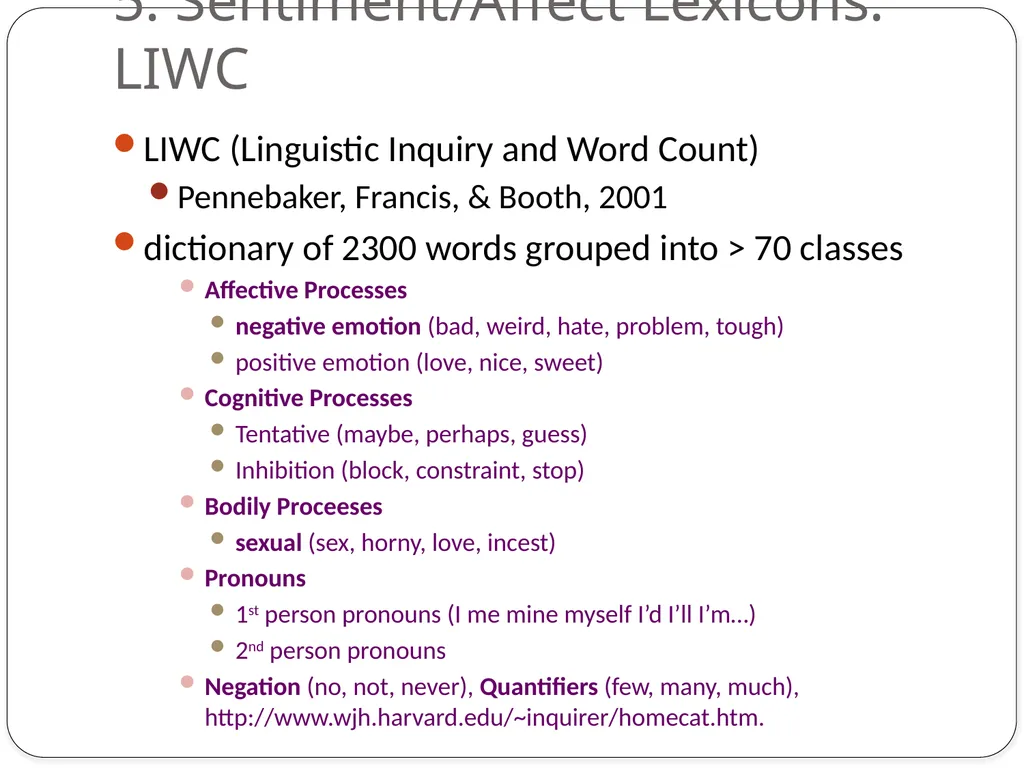
5: Sentiment/Affect Lexicons: LIWC LIWC (Linguistic Inquiry and Word Count)
Pennebaker, Francis, & Booth, 2001
dictionary of 2300 words grouped into > 70 classes
Affective Processes
negative emotion (bad, weird, hate, problem, tough)
positive emotion (love, nice, sweet)
Cognitive Processes
Tentative (maybe, perhaps, guess)
Inhibition (block, constraint, stop)
Bodily Proceeses
sexual (sex, horny, love, incest)
Pronouns
1st person pronouns (I me mine myself I’d I’ll I’m…)
2nd person pronouns
Negation (no, not, never), Quantifiers (few, many, much), http://www.wjh.harvard.edu/~inquirer/homecat.htm.<br>
52
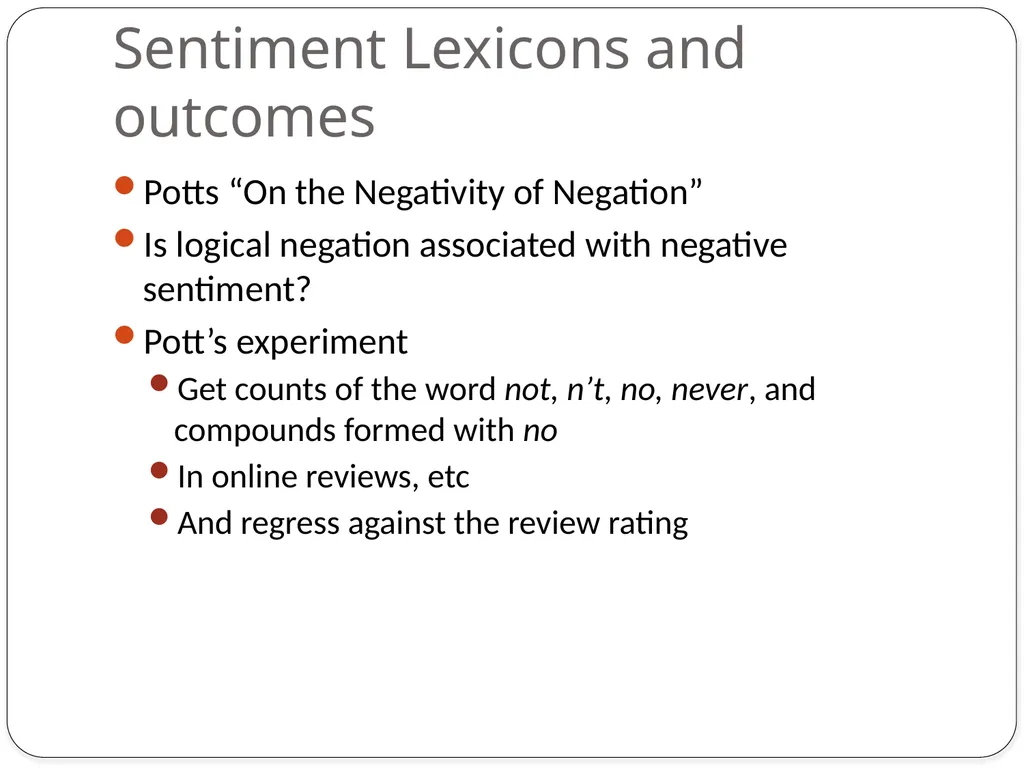
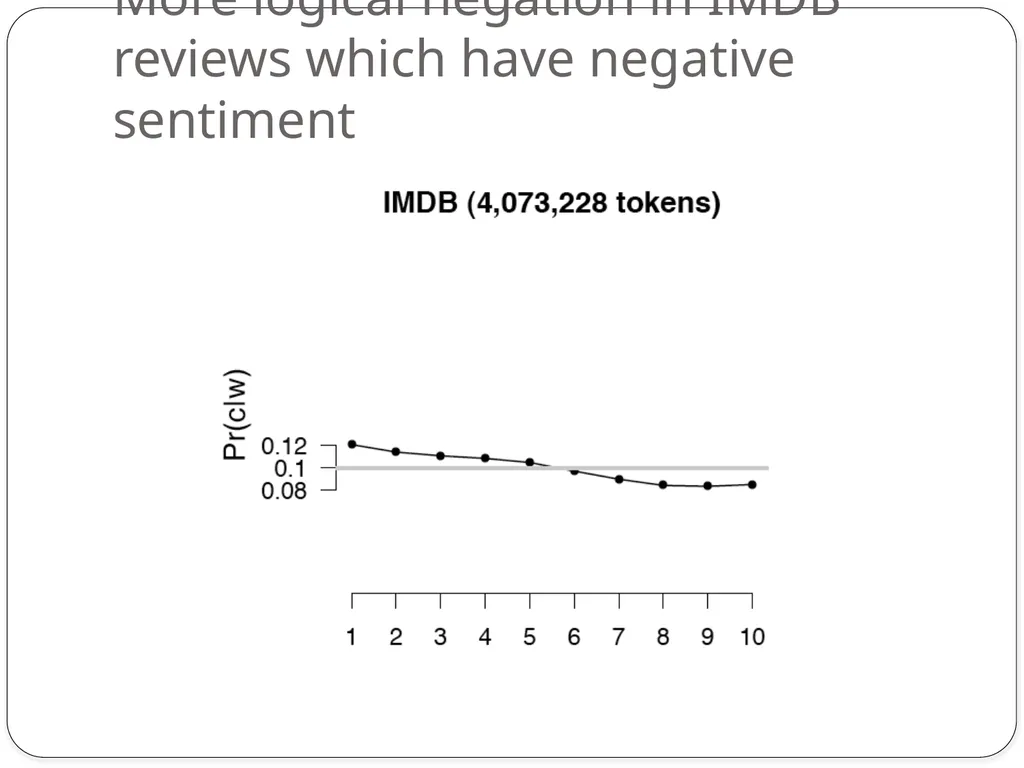
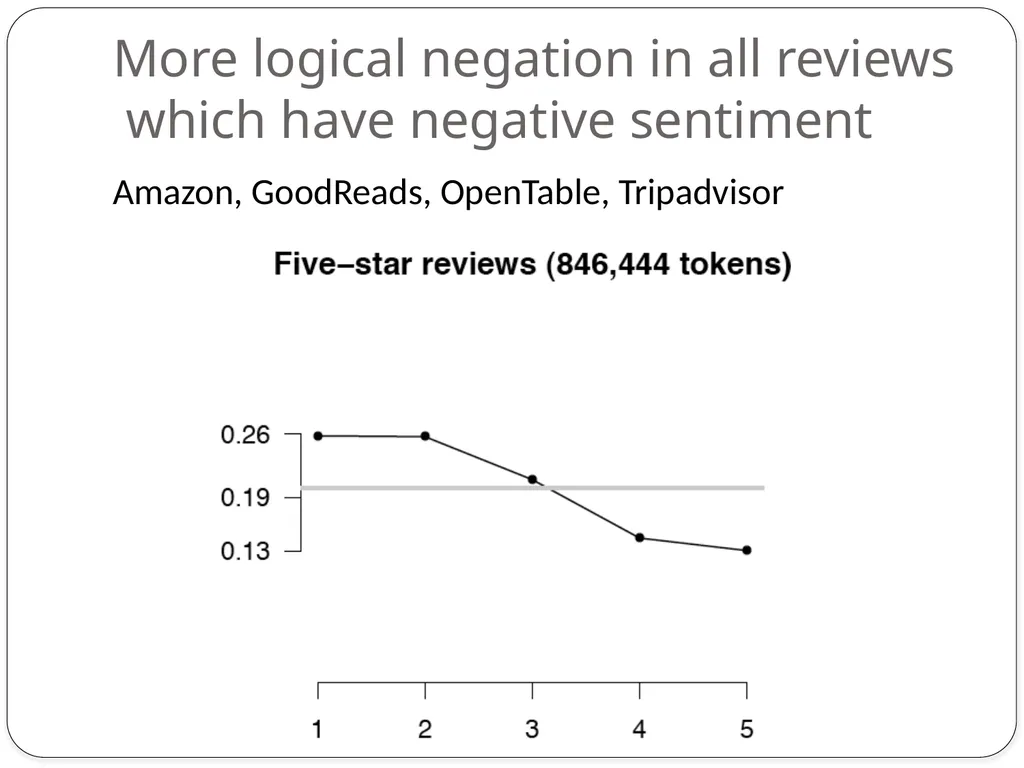
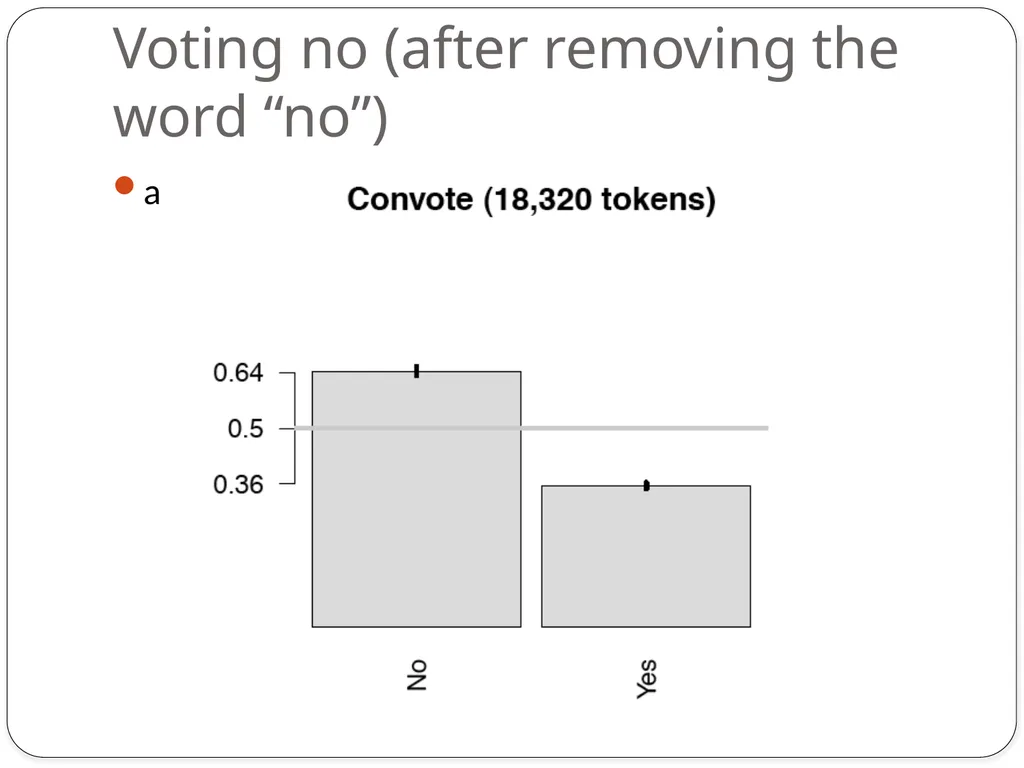
Sentiment Lexicons and outcomes Potts “On the Negativity of Negation”
Is logical negation associated with negative sentiment?
Pott’s experiment
Get counts of the word not, n’t, no, never, and compounds formed with no
In online reviews, etc
And regress against the review rating<br>
Is logical negation associated with negative sentiment?
Pott’s experiment
Get counts of the word not, n’t, no, never, and compounds formed with no
In online reviews, etc
And regress against the review rating<br>
53
More logical negation in IMDB reviews which have negative sentiment<br>
54
More logical negation in all reviews which have negative sentiment Amazon, GoodReads, OpenTable, Tripadvisor<br>
55
Voting no (after removing the word “no”) a<br>
56
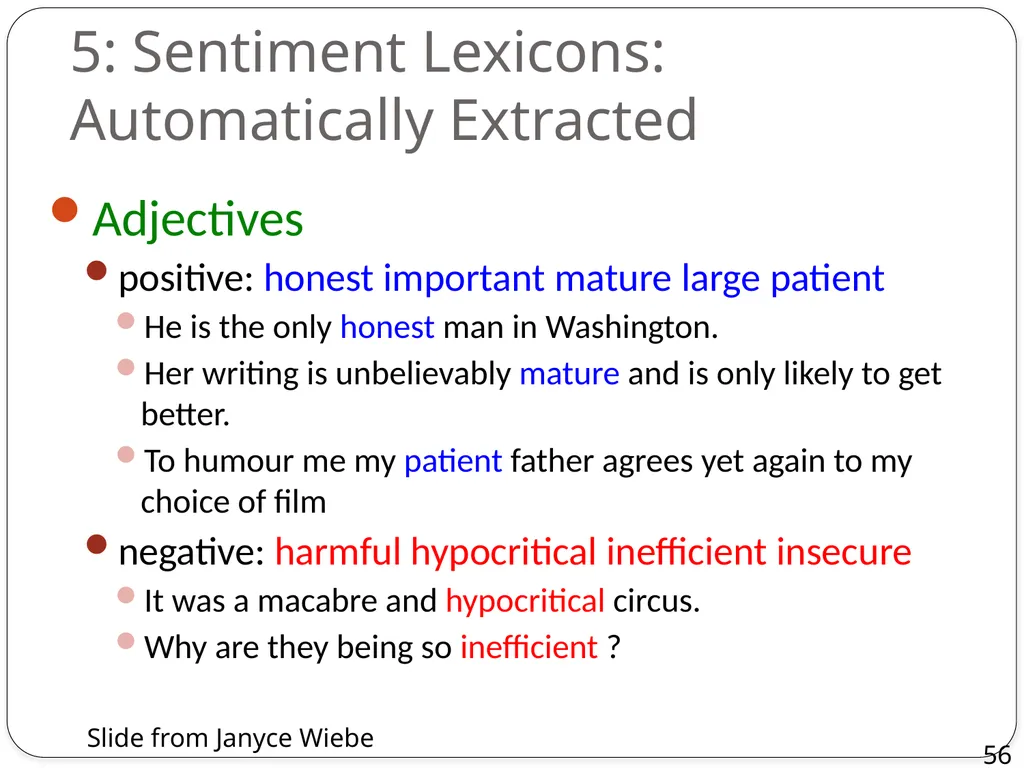
5: Sentiment Lexicons:
Automatically Extracted Adjectives
positive: honest important mature large patient
He is the only honest man in Washington.
Her writing is unbelievably mature and is only likely to get better.
To humour me my patient father agrees yet again to my choice of film
negative: harmful hypocritical inefficient insecure
It was a macabre and hypocritical circus.
Why are they being so inefficient ? Slide from Janyce Wiebe 56<br>
57
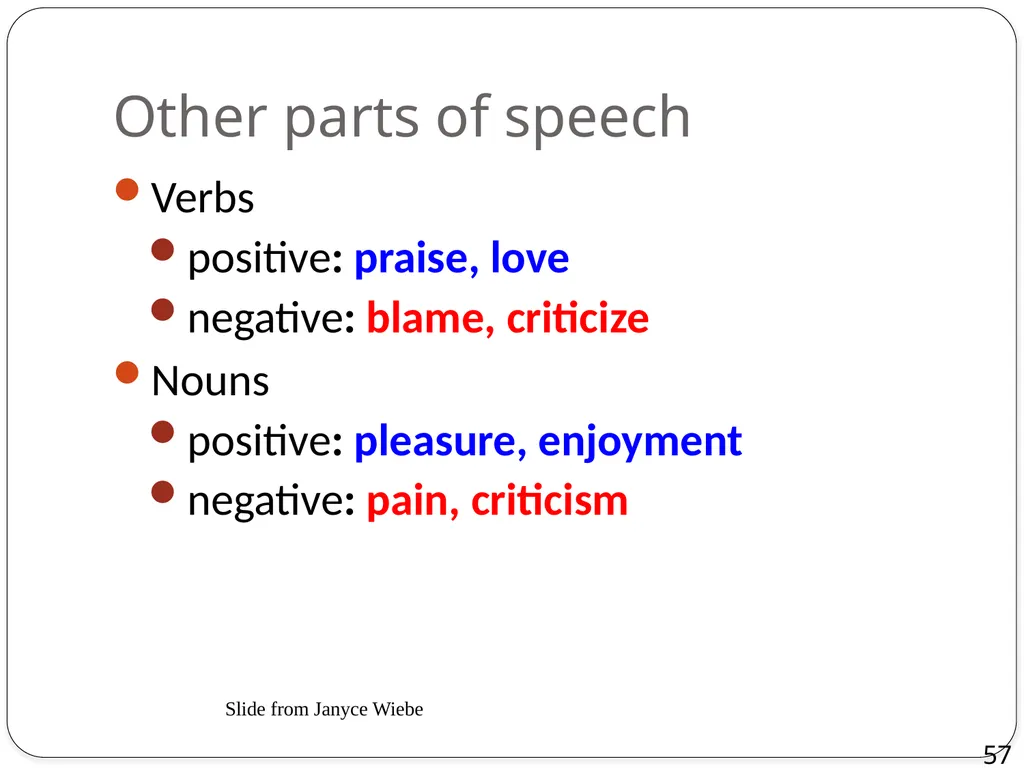
Other parts of speech Verbs
positive: praise, love
negative: blame, criticize
Nouns
positive: pleasure, enjoyment
negative: pain, criticism Slide from Janyce Wiebe 57<br>
positive: praise, love
negative: blame, criticize
Nouns
positive: pleasure, enjoyment
negative: pain, criticism Slide from Janyce Wiebe 57<br>
58
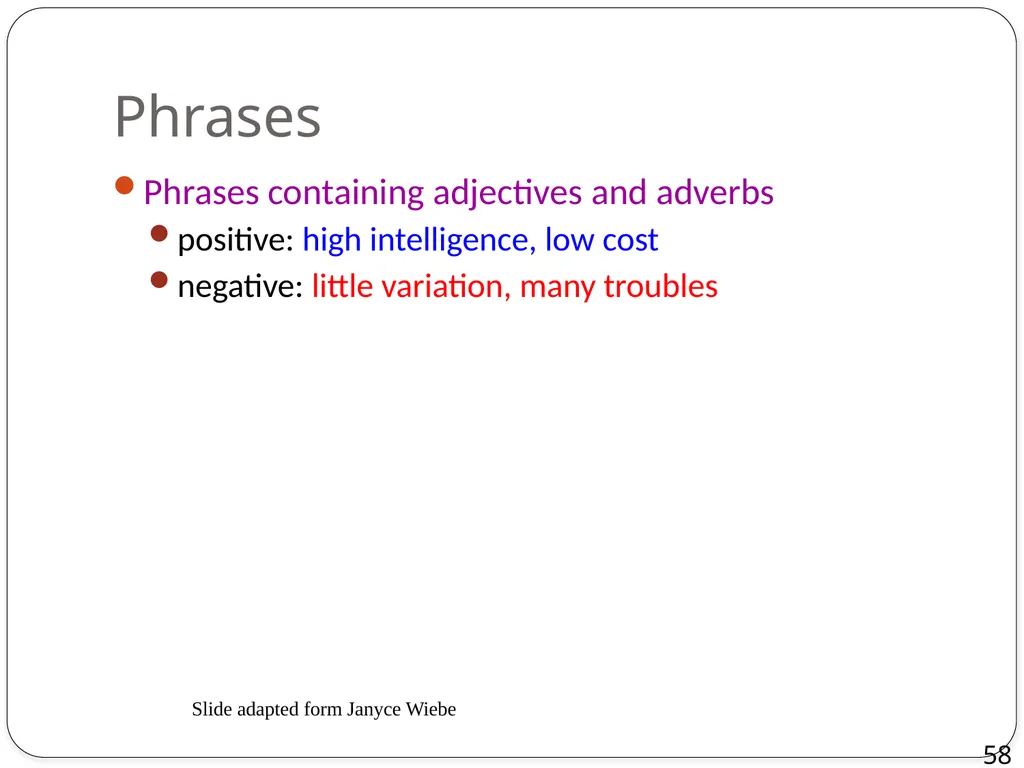
Phrases Phrases containing adjectives and adverbs
positive: high intelligence, low cost
negative: little variation, many troubles Slide adapted form Janyce Wiebe 58<br>
positive: high intelligence, low cost
negative: little variation, many troubles Slide adapted form Janyce Wiebe 58<br>
59
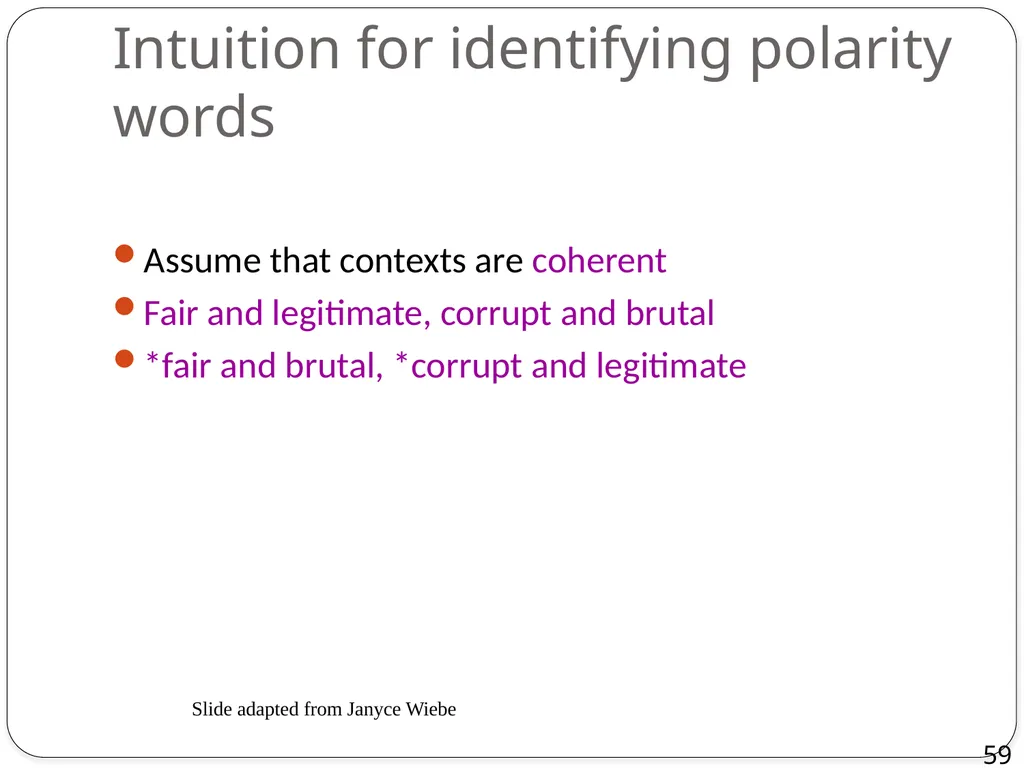
Intuition for identifying polarity words Assume that contexts are coherent
Fair and legitimate, corrupt and brutal
*fair and brutal, *corrupt and legitimate Slide adapted from Janyce Wiebe 59<br>
Fair and legitimate, corrupt and brutal
*fair and brutal, *corrupt and legitimate Slide adapted from Janyce Wiebe 59<br>
60
Hatzivassiloglou & McKeown 1997
Predicting the semantic orientation of adjectives Step 1
From 21-million word WSJ corpus
For every adjective with frequency > 20
Label for polarity
Total of 1336 adjectives
657 positive
679 negative 60<br>
From 21-million word WSJ corpus
For every adjective with frequency > 20
Label for polarity
Total of 1336 adjectives
657 positive
679 negative 60<br>
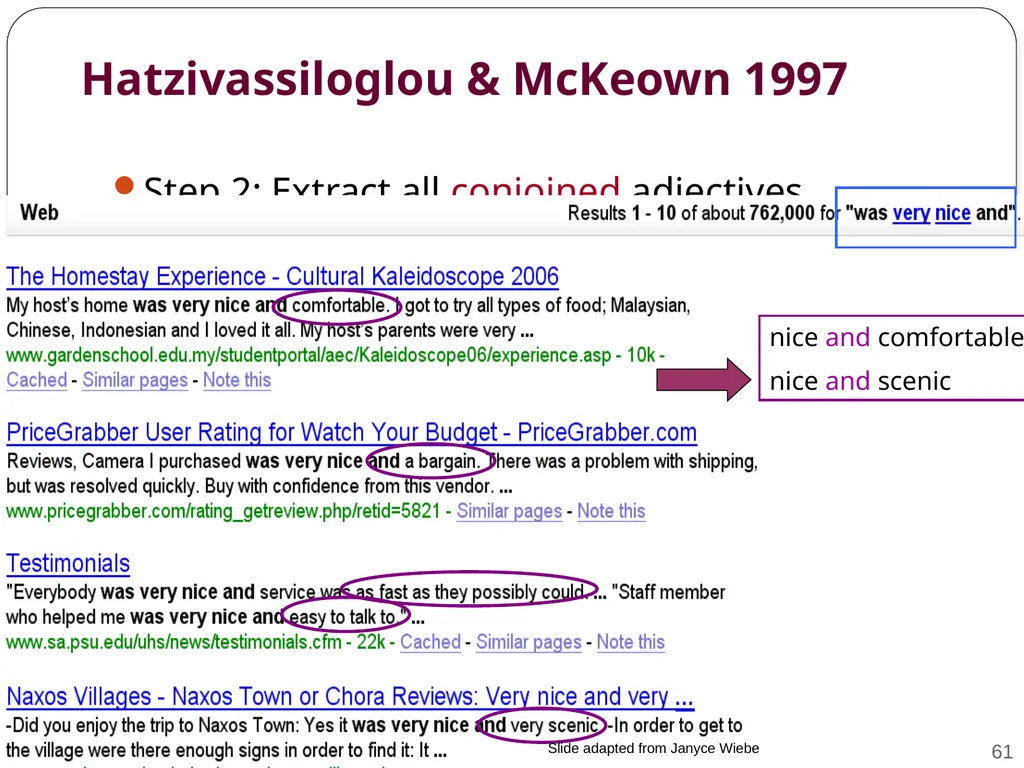
61
Step 2: Extract all conjoined adjectives ICWSM 2008 61 Hatzivassiloglou & McKeown 1997 Slide adapted from Janyce Wiebe 61 nice and comfortable
nice and scenic<br>
nice and scenic<br>
62
Hatzivassiloglou & McKeown 1997 3. A supervised learning algorithm builds a graph of adjectives linked by the same or different semantic orientation Slide adapted from Janyce Wiebe 62 nice handsome terrible comfortable painful expensive fun scenic<br>
63
Hatzivassiloglou & McKeown 1997 4. A clustering algorithm partitions the adjectives into two subsets Slide from Janyce Wiebe 63 nice handsome terrible comfortable painful expensive fun scenic slow +<br>
64
Hatzivassiloglou & McKeown 1997<br>
65
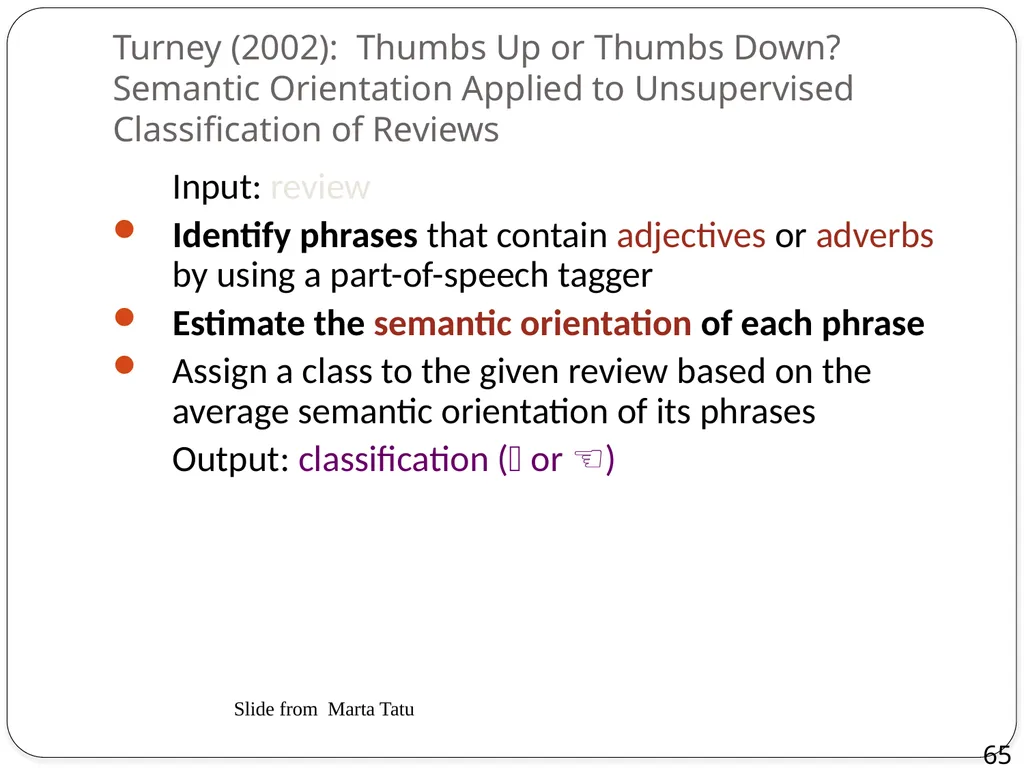
Turney (2002): Thumbs Up or Thumbs Down? Semantic Orientation Applied to Unsupervised Classification of Reviews Input: review
Identify phrases that contain adjectives or adverbs by using a part-of-speech tagger
Estimate the semantic orientation of each phrase
Assign a class to the given review based on the average semantic orientation of its phrases
Output: classification ( or ) Slide from Marta Tatu 65<br>
Identify phrases that contain adjectives or adverbs by using a part-of-speech tagger
Estimate the semantic orientation of each phrase
Assign a class to the given review based on the average semantic orientation of its phrases
Output: classification ( or ) Slide from Marta Tatu 65<br>
66
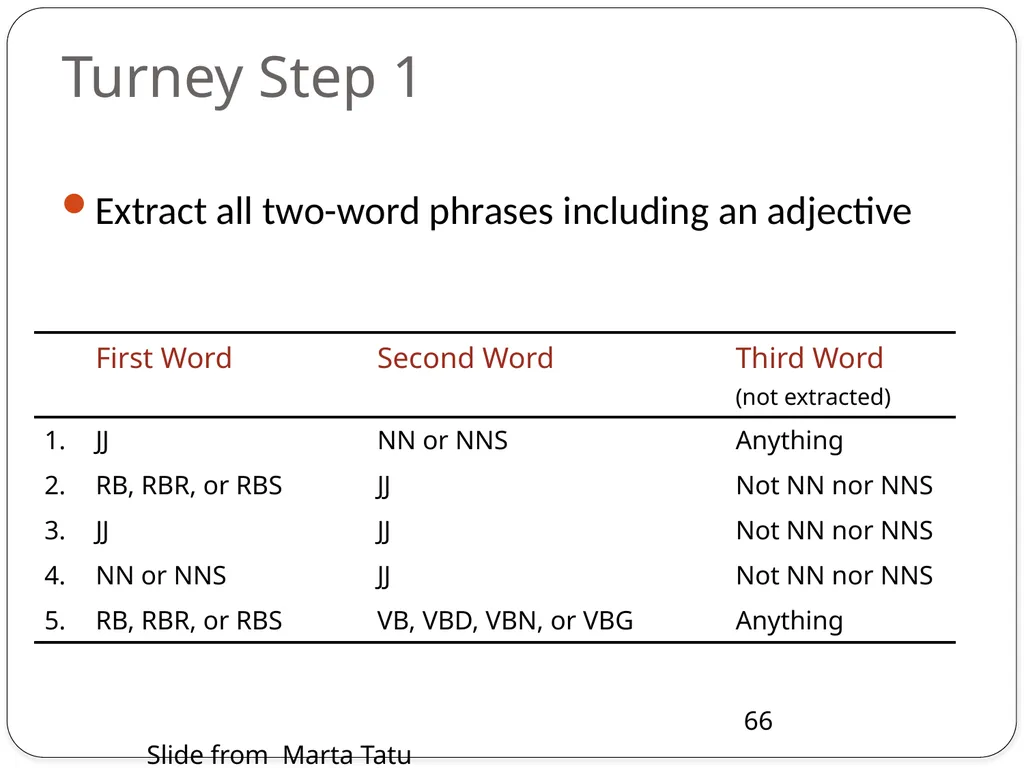
Turney Step 1 Extract all two-word phrases including an adjective Slide from Marta Tatu 66<br>
67
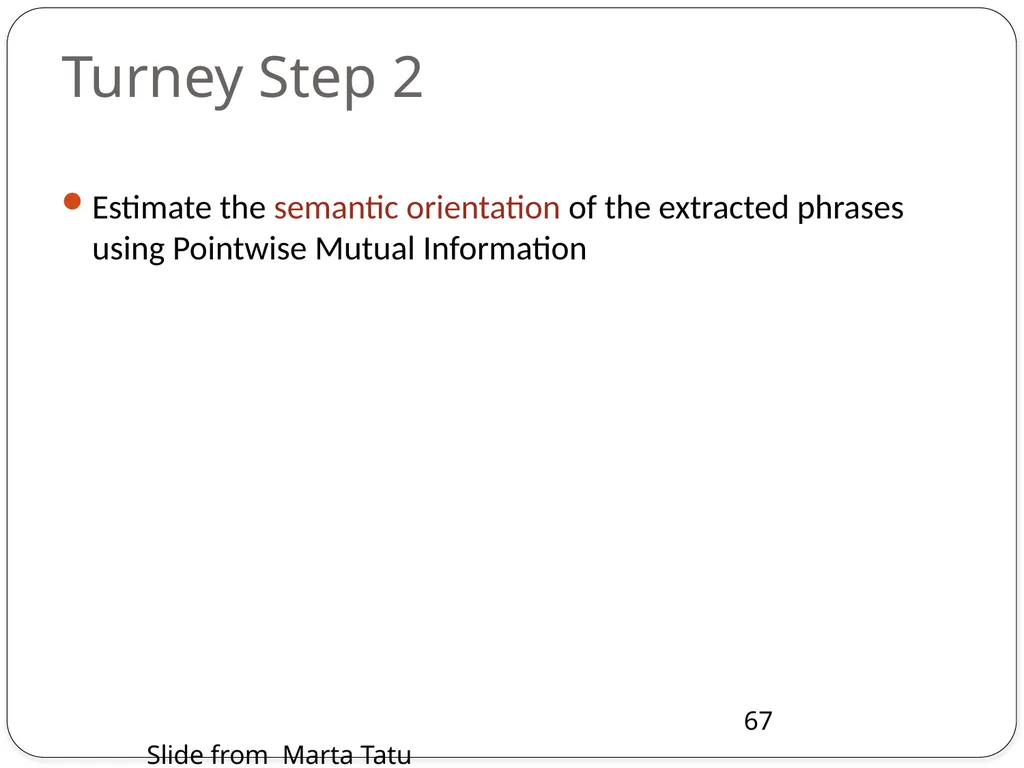
Turney Step 2 Estimate the semantic orientation of the extracted phrases using Pointwise Mutual Information Slide from Marta Tatu 67<br>
68
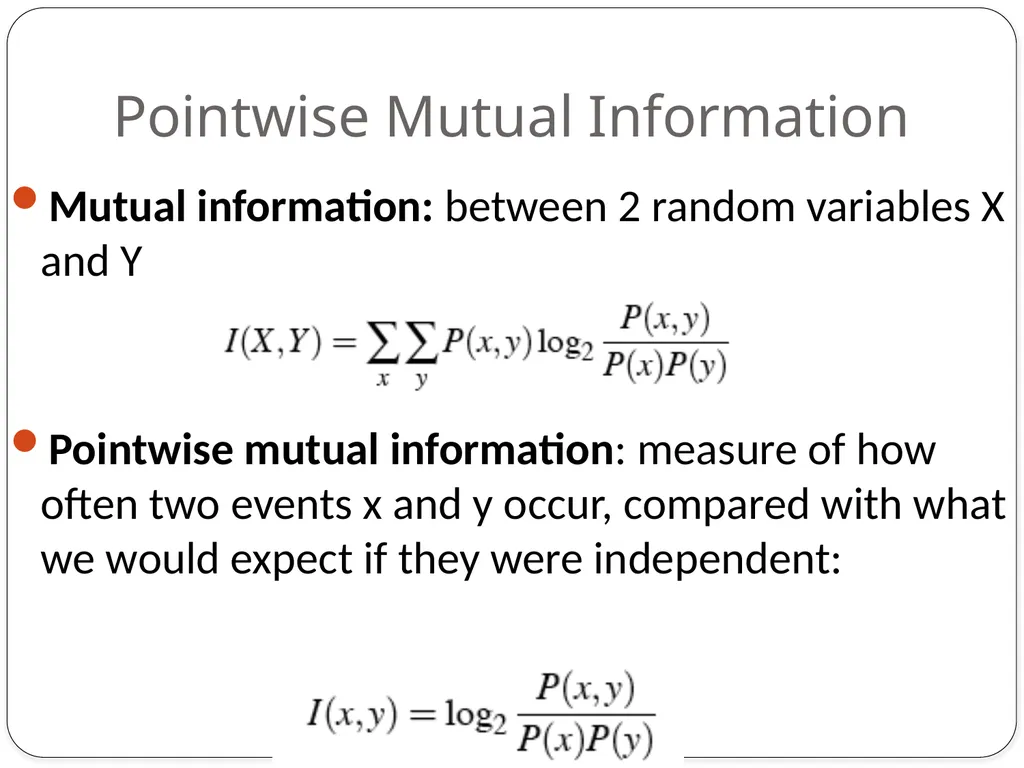
Pointwise Mutual Information Mutual information: between 2 random variables X and Y
Pointwise mutual information: measure of how often two events x and y occur, compared with what we would expect if they were independent:<br>
Pointwise mutual information: measure of how often two events x and y occur, compared with what we would expect if they were independent:<br>
69
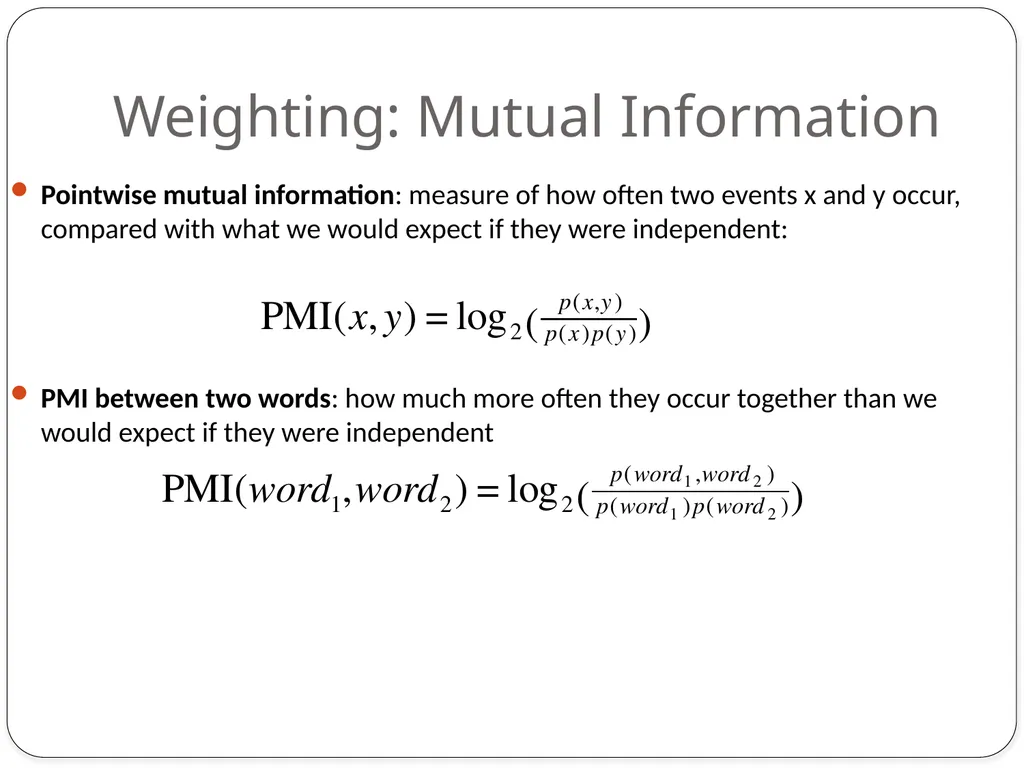
Weighting: Mutual Information Pointwise mutual information: measure of how often two events x and y occur, compared with what we would expect if they were independent:
PMI between two words: how much more often they occur together than we would expect if they were independent<br>
PMI between two words: how much more often they occur together than we would expect if they were independent<br>
70
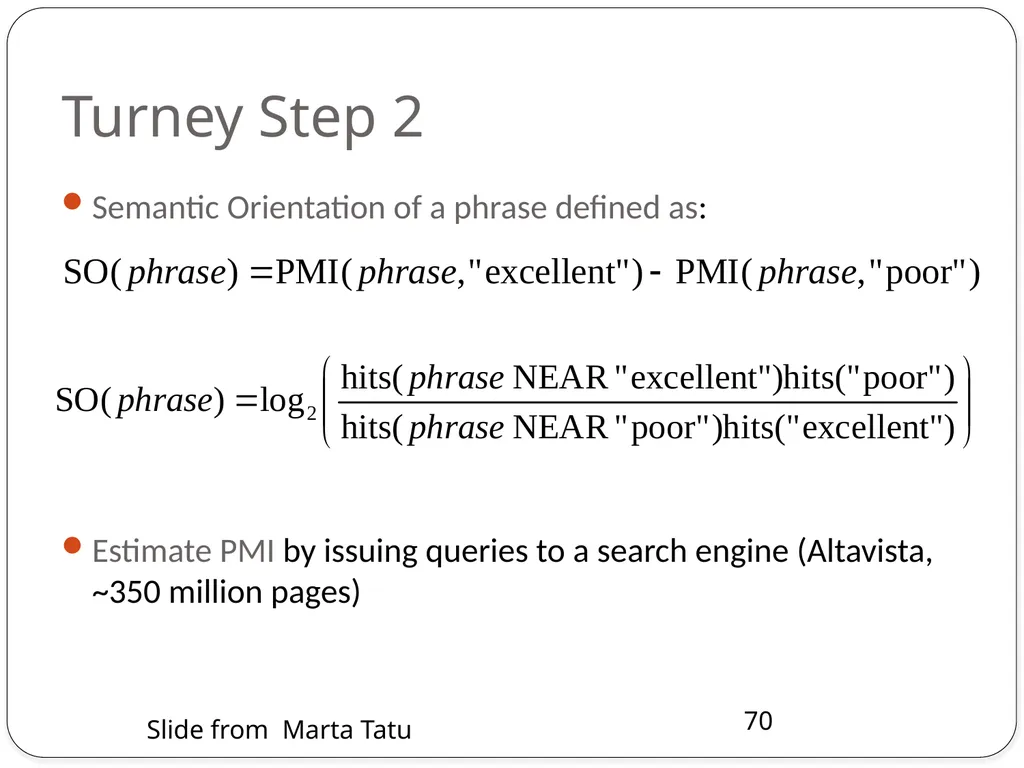
Turney Step 2 Semantic Orientation of a phrase defined as:
Estimate PMI by issuing queries to a search engine (Altavista, ~350 million pages) Slide from Marta Tatu 70<br>
Estimate PMI by issuing queries to a search engine (Altavista, ~350 million pages) Slide from Marta Tatu 70<br>
71
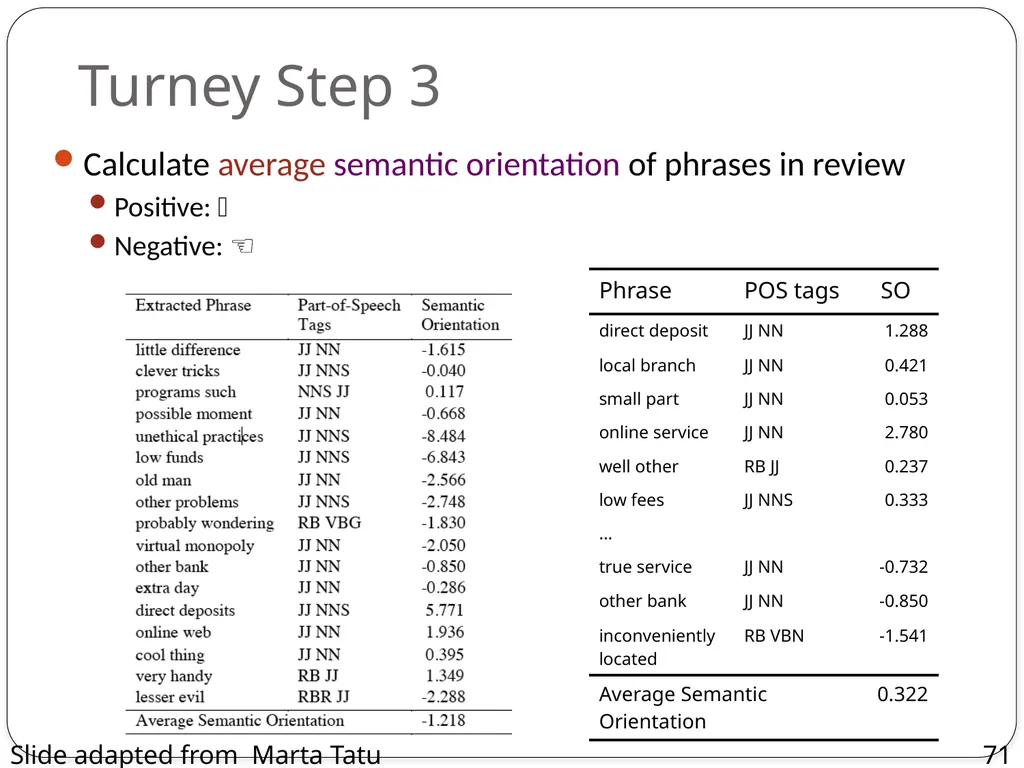
Turney Step 3 Calculate average semantic orientation of phrases in review
Positive:
Negative: Slide adapted from Marta Tatu 71<br>
Positive:
Negative: Slide adapted from Marta Tatu 71<br>
72
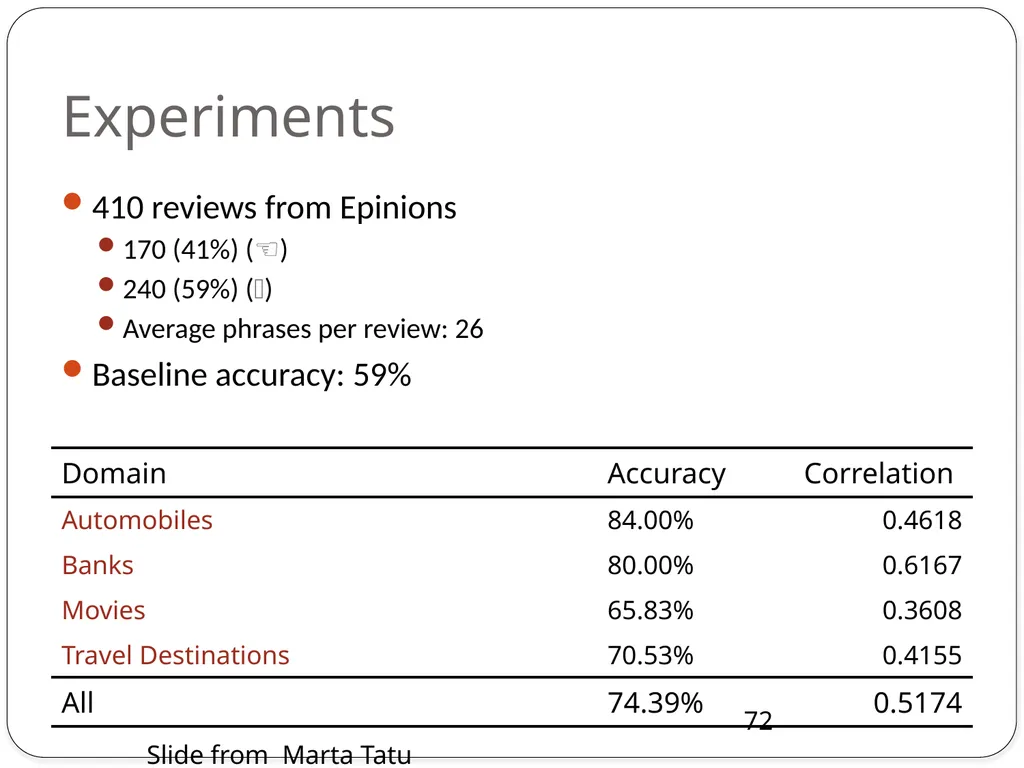
Experiments 410 reviews from Epinions
170 (41%) ()
240 (59%) ()
Average phrases per review: 26
Baseline accuracy: 59% Slide from Marta Tatu 72<br>
170 (41%) ()
240 (59%) ()
Average phrases per review: 26
Baseline accuracy: 59% Slide from Marta Tatu 72<br>
73
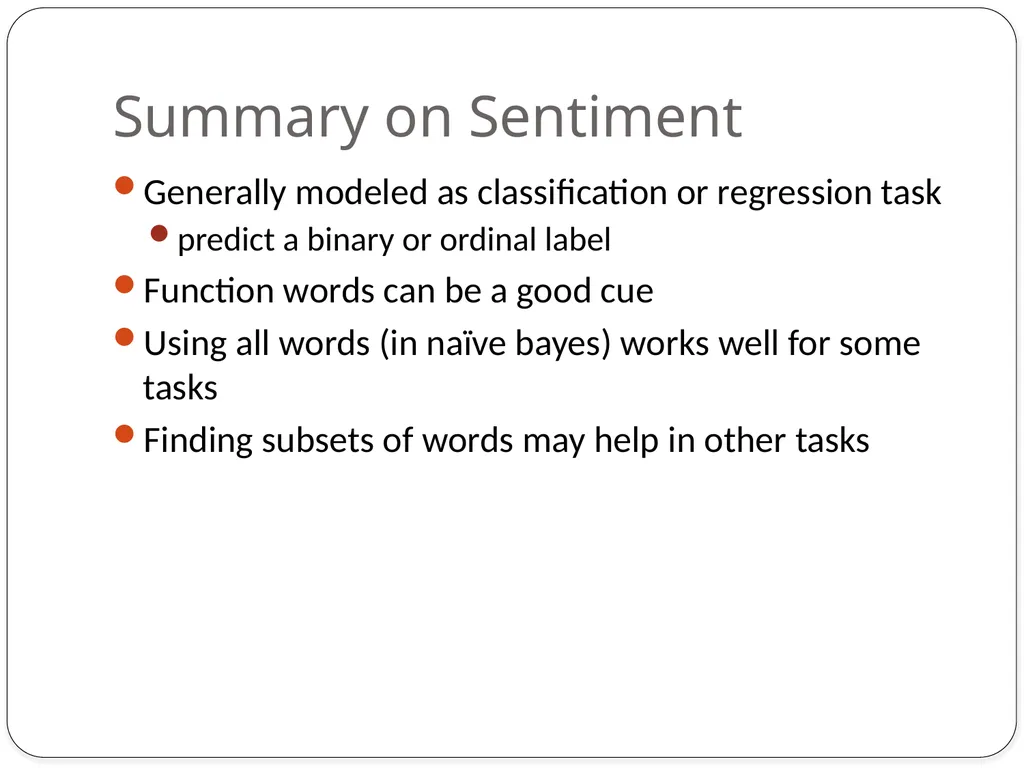
Summary on Sentiment Generally modeled as classification or regression task
predict a binary or ordinal label
Function words can be a good cue
Using all words (in naïve bayes) works well for some tasks
Finding subsets of words may help in other tasks<br>
predict a binary or ordinal label
Function words can be a good cue
Using all words (in naïve bayes) works well for some tasks
Finding subsets of words may help in other tasks<br>
74
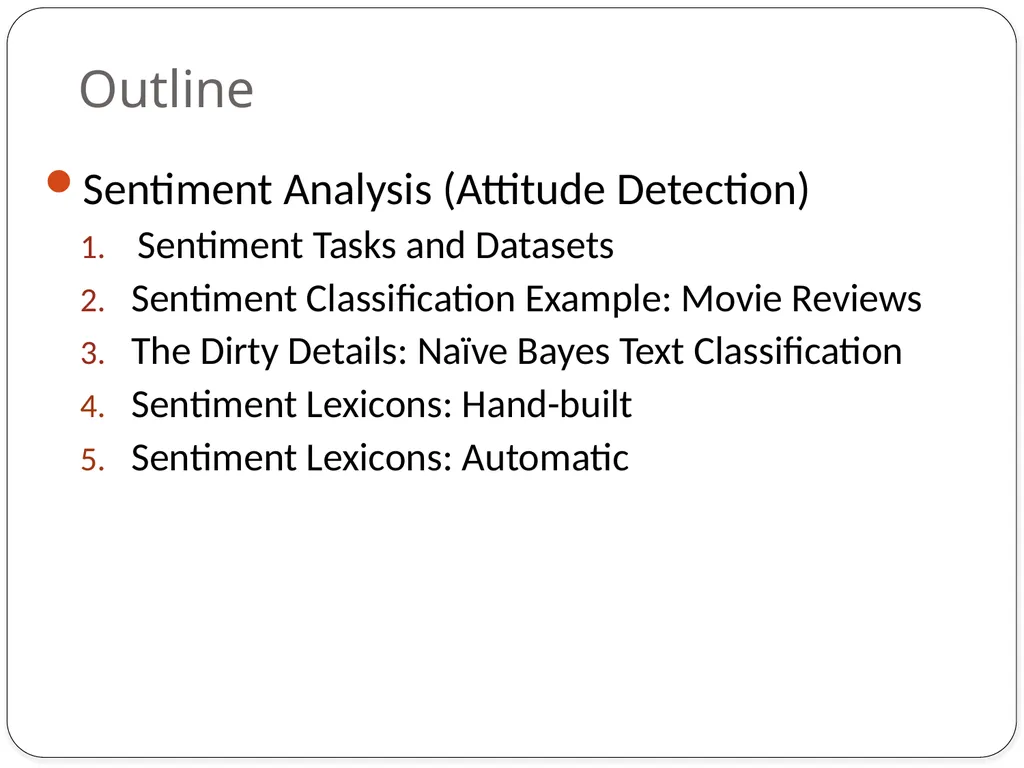
Outline Sentiment Analysis (Attitude Detection)
Sentiment Tasks and Datasets
Sentiment Classification Example: Movie Reviews
The Dirty Details: Naïve Bayes Text Classification
Sentiment Lexicons: Hand-built
Sentiment Lexicons: Automatic<br>
Sentiment Tasks and Datasets
Sentiment Classification Example: Movie Reviews
The Dirty Details: Naïve Bayes Text Classification
Sentiment Lexicons: Hand-built
Sentiment Lexicons: Automatic<br>