
Data Institute: Improving ADR Data Quality and
TF
Published · 58 slides · 0 views
1 / 1
Description
Data Institute: Improving ADR Data Quality and Accuracy Ellie Coombs The DART Team Disclosures Presenter(s) has no financial interest to disclose. This continuing education activity is managed and accredited by AffinityCEProfessional
Related Topics
Share
Embed code
Download this presentation From Below
"Data Institute: Improving ADR Data Quality and" is the property of its rightful owner. Permission is granted to download and print the materials on this website for personal, non-commercial use only, and to display it on your personal computer provided you do not modify the materials and that you retain all copyright notices contained in the materials. By downloading content from our website, you accept the terms of this agreement.
Presentation Transcript
01
Data Institute: Improving ADR Data Quality and Accuracy Ellie Coombs The DART Team<br>
02
Disclosures Presenter(s) has no financial interest to disclose.
This continuing education activity is managed and accredited by AffinityCE/Professional Education Services Group in cooperation with HRSA and LRG. PESG, HRSA, LRG and all accrediting organization do not support or endorse any product or service mentioned in this activity.
PESG, HRSA, and LRG staff as well as planners and reviewers have no relevant financial or nonfinancial interest to disclose.
Commercial Support was not received for this activity.<br>
This continuing education activity is managed and accredited by AffinityCE/Professional Education Services Group in cooperation with HRSA and LRG. PESG, HRSA, LRG and all accrediting organization do not support or endorse any product or service mentioned in this activity.
PESG, HRSA, and LRG staff as well as planners and reviewers have no relevant financial or nonfinancial interest to disclose.
Commercial Support was not received for this activity.<br>
03
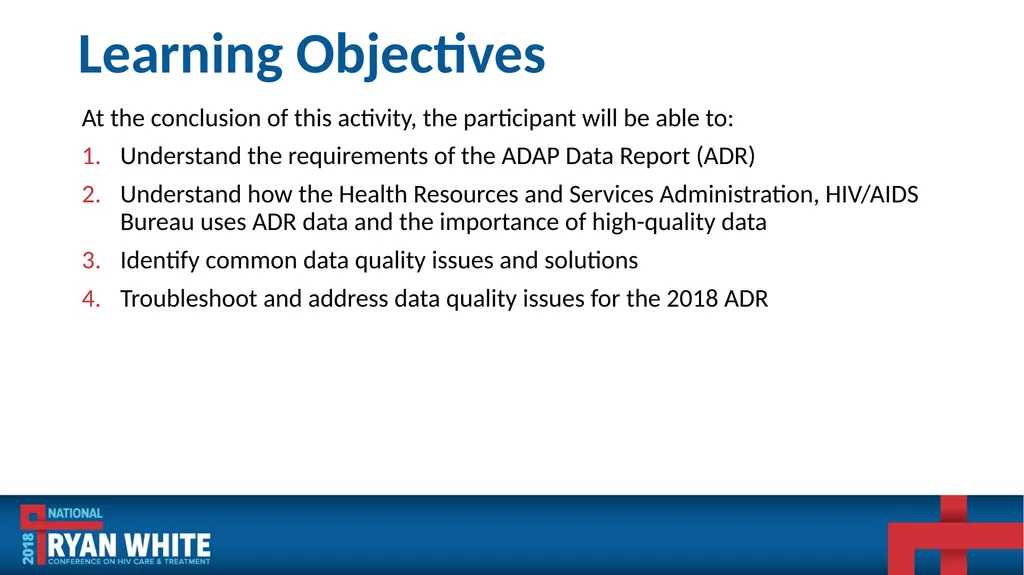
Learning Objectives At the conclusion of this activity, the participant will be able to:
Understand the requirements of the ADAP Data Report (ADR)
Understand how the Health Resources and Services Administration, HIV/AIDS Bureau uses ADR data and the importance of high-quality data
Identify common data quality issues and solutions
Troubleshoot and address data quality issues for the 2018 ADR<br>
Understand the requirements of the ADAP Data Report (ADR)
Understand how the Health Resources and Services Administration, HIV/AIDS Bureau uses ADR data and the importance of high-quality data
Identify common data quality issues and solutions
Troubleshoot and address data quality issues for the 2018 ADR<br>
04
Obtaining CME/CE Credit If you would like to receive continuing education credit for this activity, please visit:
http://ryanwhite.cds.pesgce.com<br>
http://ryanwhite.cds.pesgce.com<br>
05
Presenters Paul Mandsager: Health Resources and Services Administration, HIV/AIDS Bureau
Ellie Coombs: The DART Team, Provides technical assistance regarding the ADR
Organizes and presents ADR-related webinars
Conducts data quality outreach
Works with system vendors to improve reporting
Provides one-on-one technical assistance: Data.TA@caiglobal.org
Provides content for TargetHIV: https://targethiv.org/library/topics/adr
Samantha Penn and M. Thomas Blissett, Nevada Department of Health and Human Services
Ann Nakamura and Luna Woo, California Department of Public Health<br>
Ellie Coombs: The DART Team, Provides technical assistance regarding the ADR
Organizes and presents ADR-related webinars
Conducts data quality outreach
Works with system vendors to improve reporting
Provides one-on-one technical assistance: Data.TA@caiglobal.org
Provides content for TargetHIV: https://targethiv.org/library/topics/adr
Samantha Penn and M. Thomas Blissett, Nevada Department of Health and Human Services
Ann Nakamura and Luna Woo, California Department of Public Health<br>
06
Presentation Outline Overview and Progression of the ADR
Remaining Opportunities to Improve Data Quality
Tips and Solutions: Voices from the Field
Nevada Department of Health and Human Services
California Department of Public Health
Data Quality Exercise on Using the Upload Completeness Report (UCR)<br>
Remaining Opportunities to Improve Data Quality
Tips and Solutions: Voices from the Field
Nevada Department of Health and Human Services
California Department of Public Health
Data Quality Exercise on Using the Upload Completeness Report (UCR)<br>
07
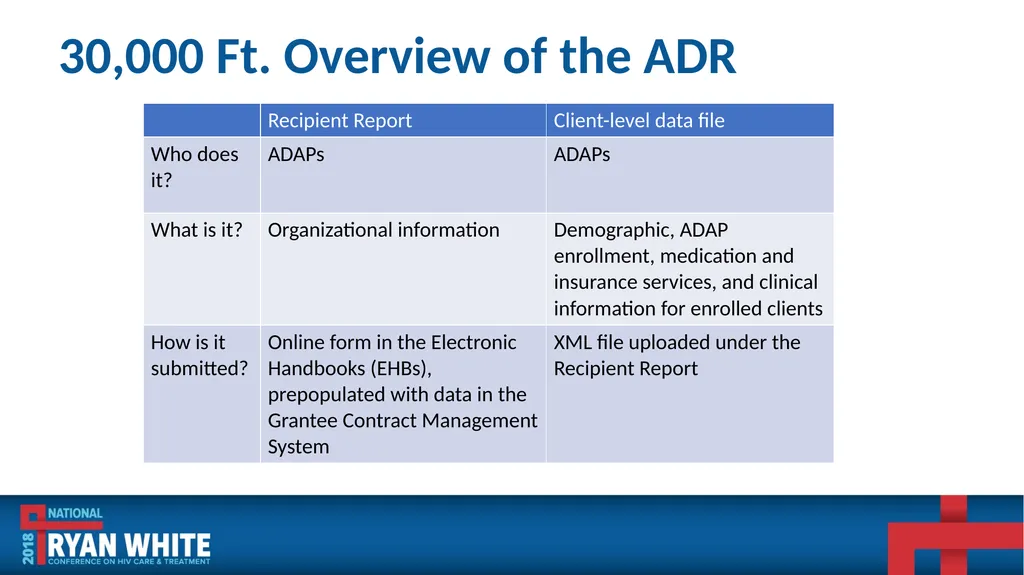
30,000 Ft. Overview of the ADR<br>
08
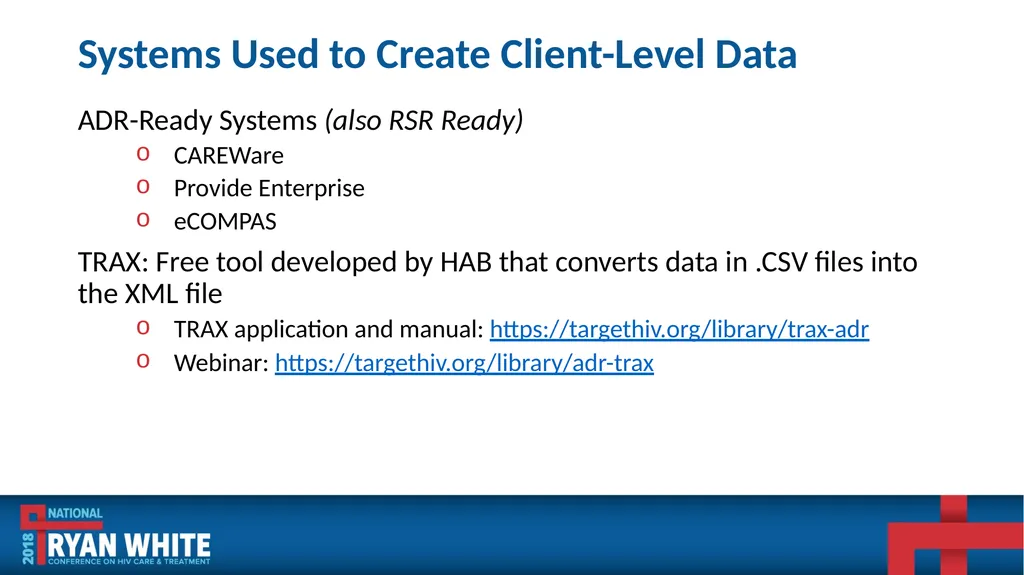
Systems Used to Create Client-Level Data ADR-Ready Systems (also RSR Ready)
CAREWare
Provide Enterprise
eCOMPAS
TRAX: Free tool developed by HAB that converts data in .CSV files into the XML file
TRAX application and manual: https://targethiv.org/library/trax-adr
Webinar: https://targethiv.org/library/adr-trax<br>
CAREWare
Provide Enterprise
eCOMPAS
TRAX: Free tool developed by HAB that converts data in .CSV files into the XML file
TRAX application and manual: https://targethiv.org/library/trax-adr
Webinar: https://targethiv.org/library/adr-trax<br>
09
Your program through the lens of poor data quality Why Data Quality Matters<br>
10
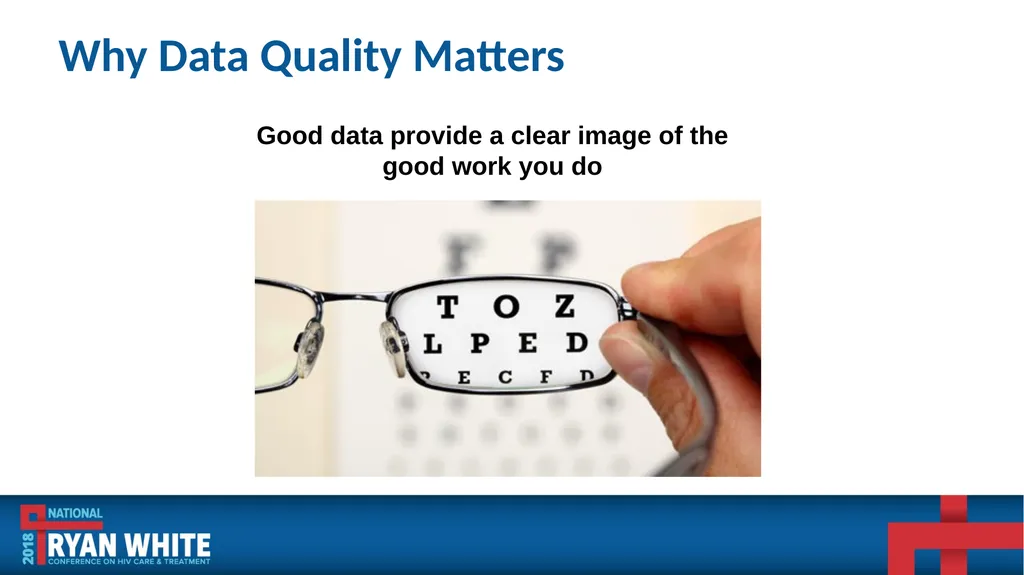
Good data provide a clear image of the good work you do Why Data Quality Matters<br>
11
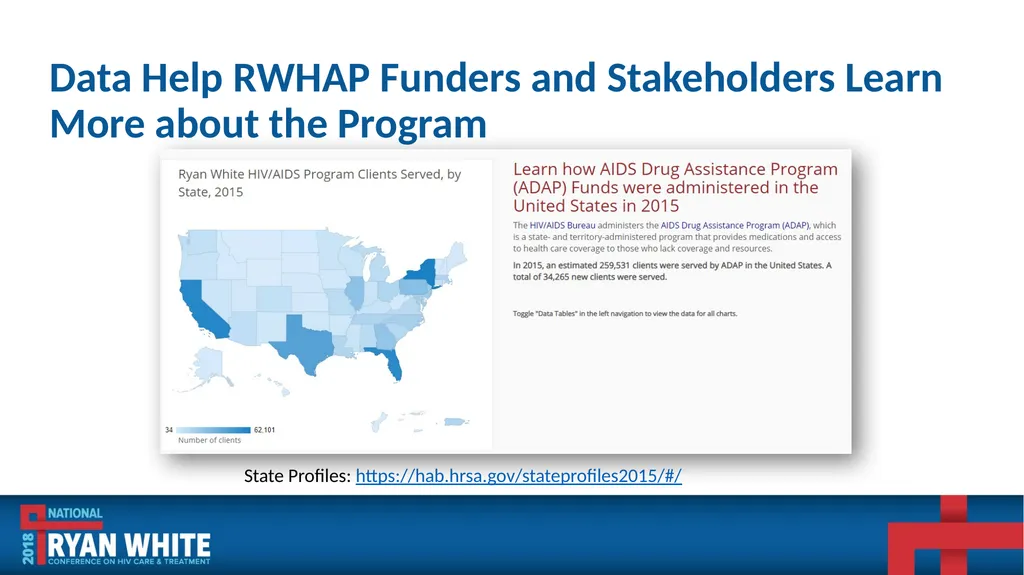
State Profiles: https://hab.hrsa.gov/stateprofiles2015/#/ Data Help RWHAP Funders and Stakeholders Learn More about the Program<br>
12
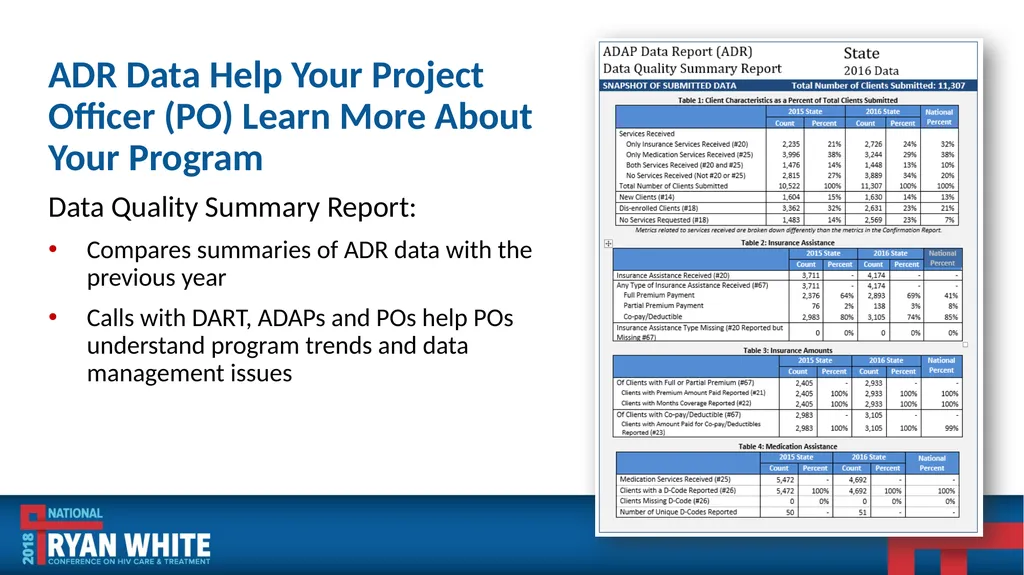
ADR Data Help Your Project Officer (PO) Learn More About Your Program
Data Quality Summary Report:
Compares summaries of ADR data with the previous year
Calls with DART, ADAPs and POs help POs understand program trends and data management issues<br>
Data Quality Summary Report:
Compares summaries of ADR data with the previous year
Calls with DART, ADAPs and POs help POs understand program trends and data management issues<br>
13
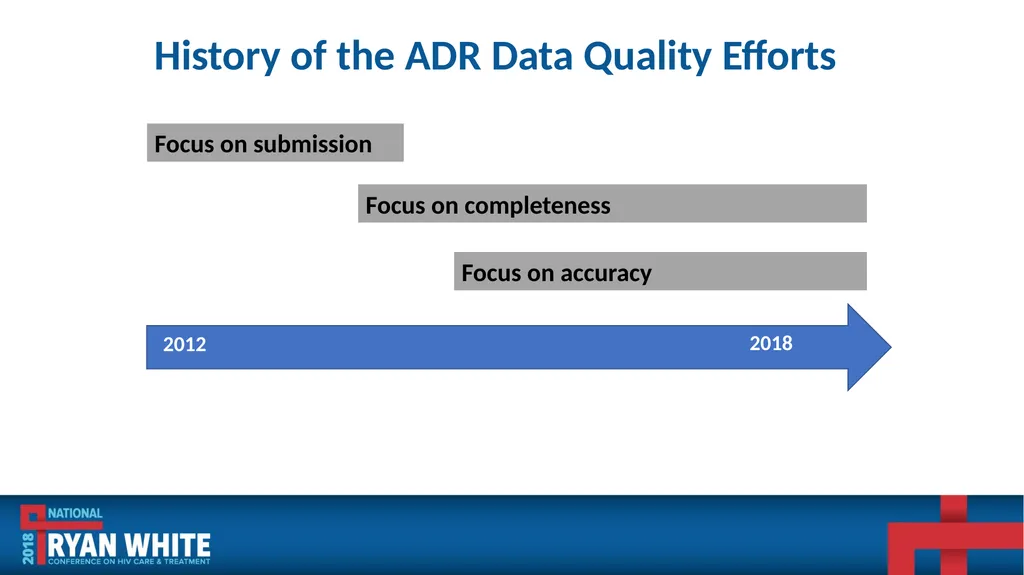
History of the ADR Data Quality Efforts<br>
14
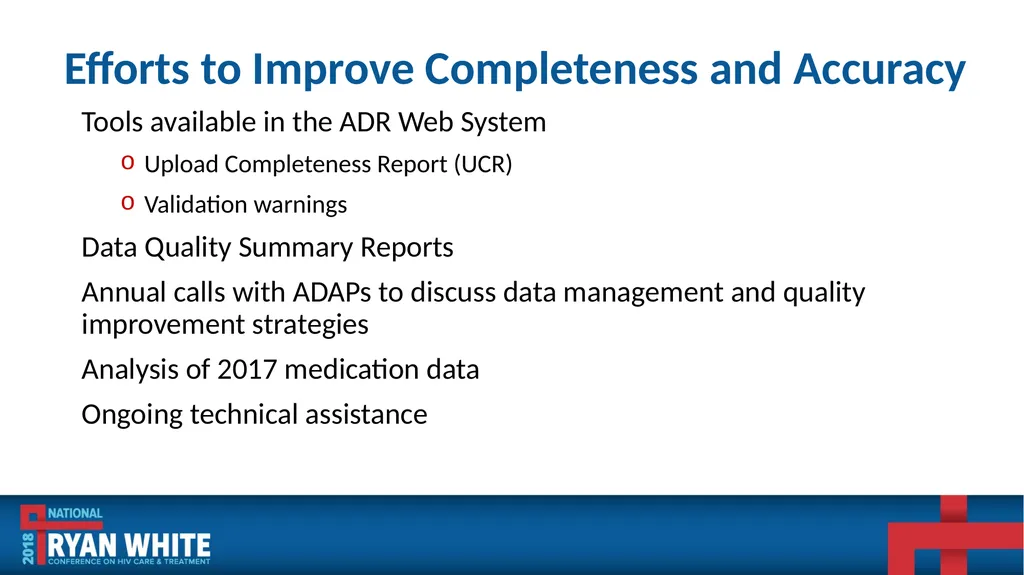
Efforts to Improve Completeness and Accuracy Tools available in the ADR Web System
Upload Completeness Report (UCR)
Validation warnings
Data Quality Summary Reports
Annual calls with ADAPs to discuss data management and quality improvement strategies
Analysis of 2017 medication data
Ongoing technical assistance<br>
Upload Completeness Report (UCR)
Validation warnings
Data Quality Summary Reports
Annual calls with ADAPs to discuss data management and quality improvement strategies
Analysis of 2017 medication data
Ongoing technical assistance<br>
15
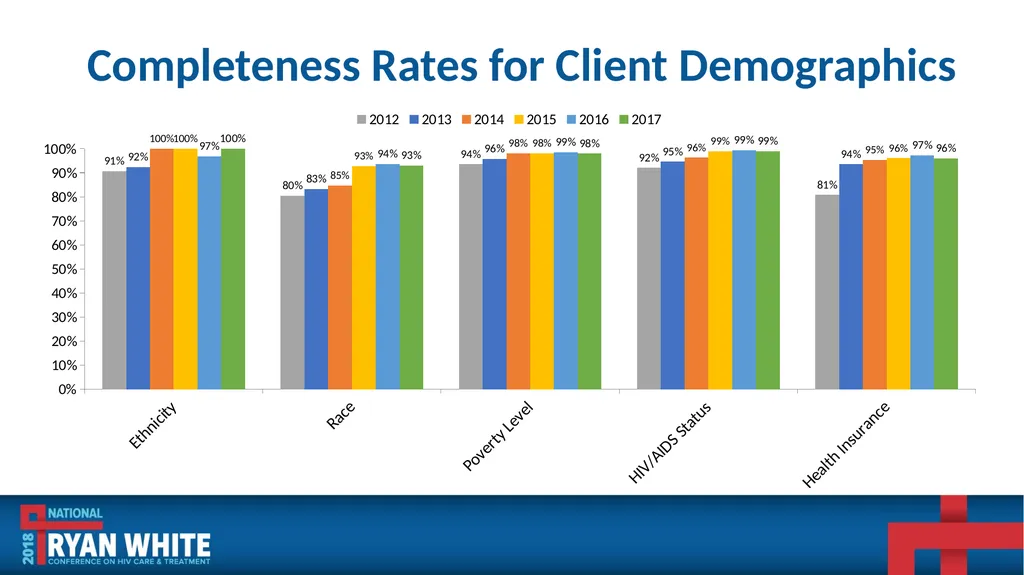
Completeness Rates for Client Demographics<br>
16
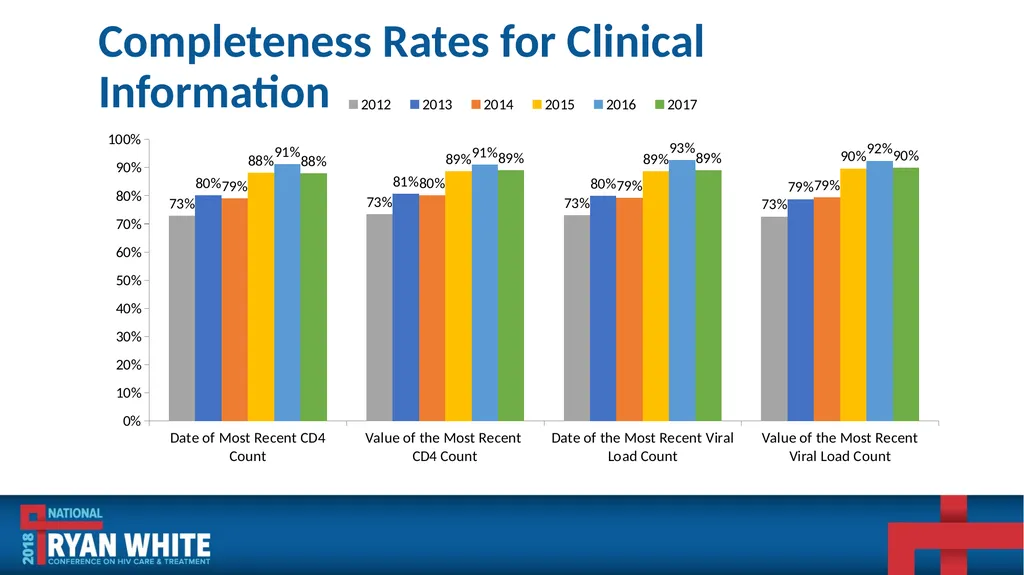
Completeness Rates for Clinical Information<br>
17
Presentation Outline Overview and Progression of the ADR
Remaining Opportunities to Improve Data Quality
Tips and Solutions: Voices from the Field
Data Quality Exercise on Using the Upload Completeness Report (UCR)<br>
Remaining Opportunities to Improve Data Quality
Tips and Solutions: Voices from the Field
Data Quality Exercise on Using the Upload Completeness Report (UCR)<br>
18
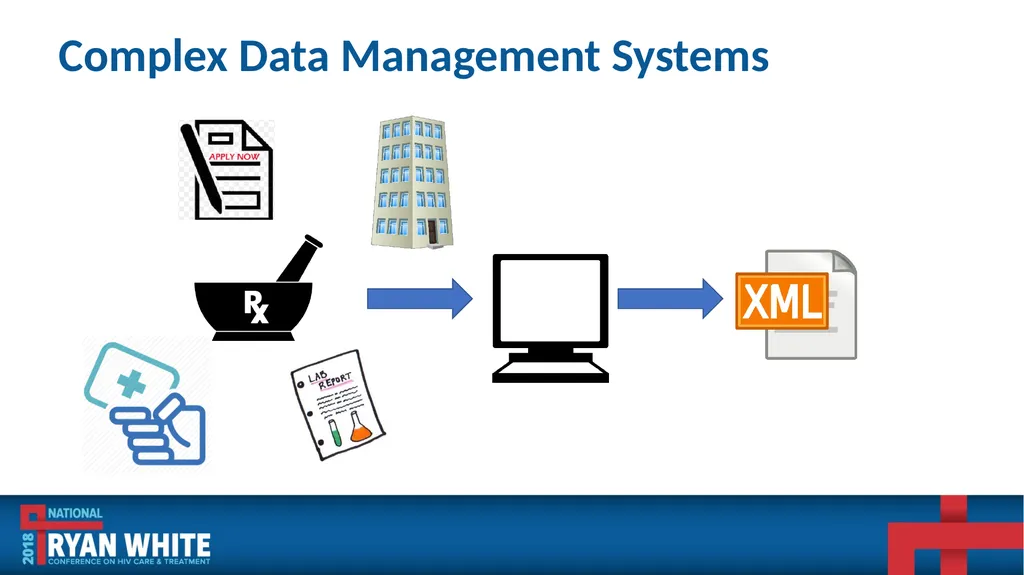
Complex Data Management Systems<br>
19
Complex Data Management Systems Most ADAPs only consolidate data annually for ADR submission, so they miss out on using their data outside the reporting period
Use your data throughout the year to:
Identify and resolve data quality issues
Inform program improvement activities
Ask yourself:
What information can help us improve the impact of our ADAP?
What systems and processes do we need to access this information?<br>
Use your data throughout the year to:
Identify and resolve data quality issues
Inform program improvement activities
Ask yourself:
What information can help us improve the impact of our ADAP?
What systems and processes do we need to access this information?<br>
20
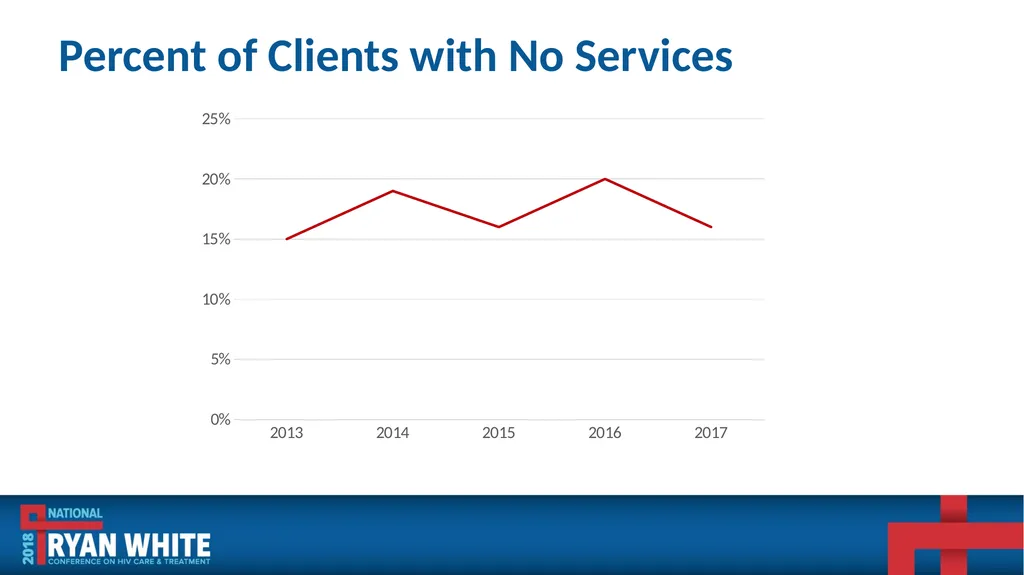
Percent of Clients with No Services<br>
21
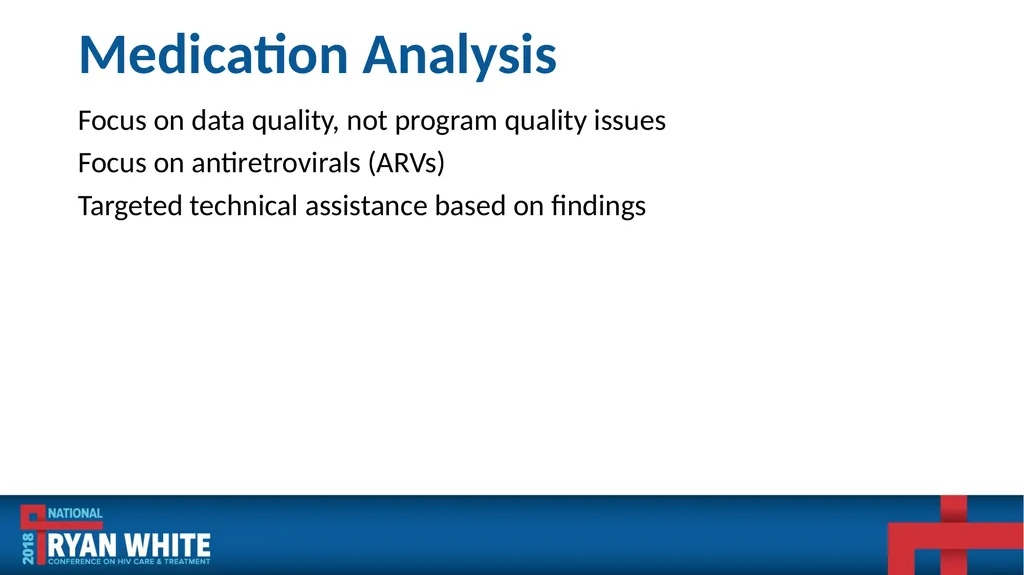
Medication Analysis Focus on data quality, not program quality issues
Focus on antiretrovirals (ARVs)
Targeted technical assistance based on findings<br>
Focus on antiretrovirals (ARVs)
Targeted technical assistance based on findings<br>
22
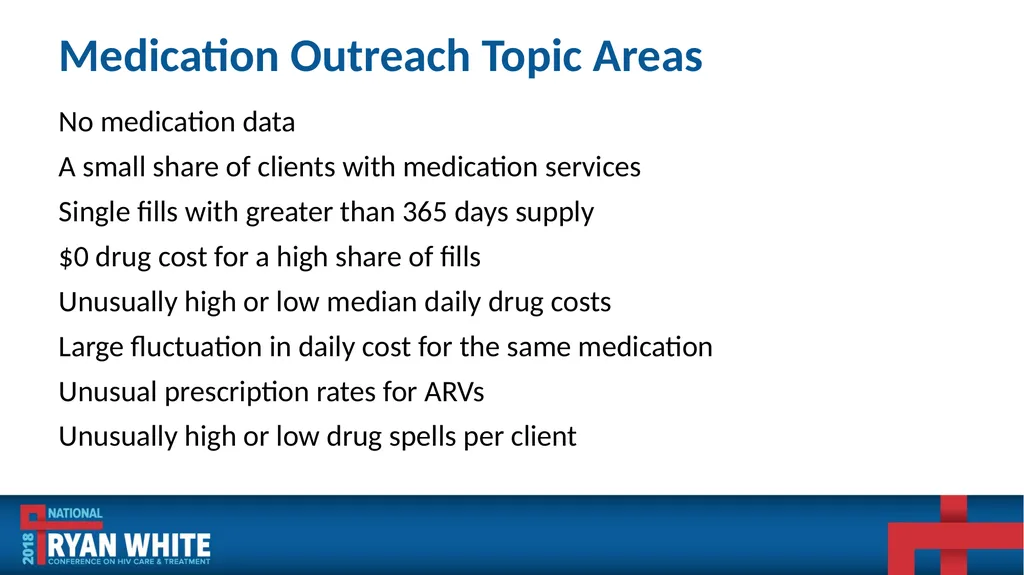
Medication Outreach Topic Areas No medication data
A small share of clients with medication services
Single fills with greater than 365 days supply
$0 drug cost for a high share of fills
Unusually high or low median daily drug costs
Large fluctuation in daily cost for the same medication
Unusual prescription rates for ARVs
Unusually high or low drug spells per client<br>
A small share of clients with medication services
Single fills with greater than 365 days supply
$0 drug cost for a high share of fills
Unusually high or low median daily drug costs
Large fluctuation in daily cost for the same medication
Unusual prescription rates for ARVs
Unusually high or low drug spells per client<br>
23
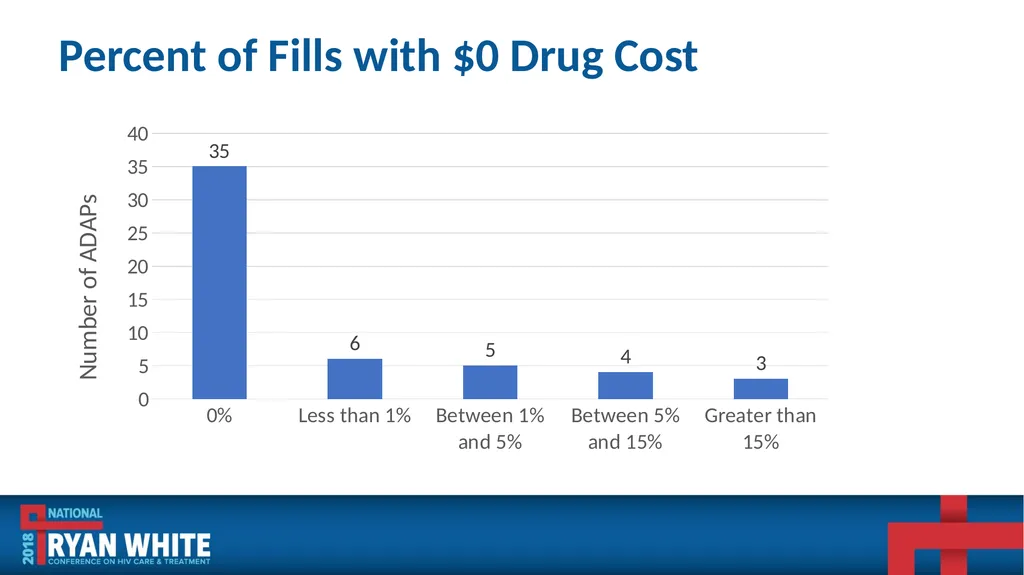
Percent of Fills with $0 Drug Cost<br>
24
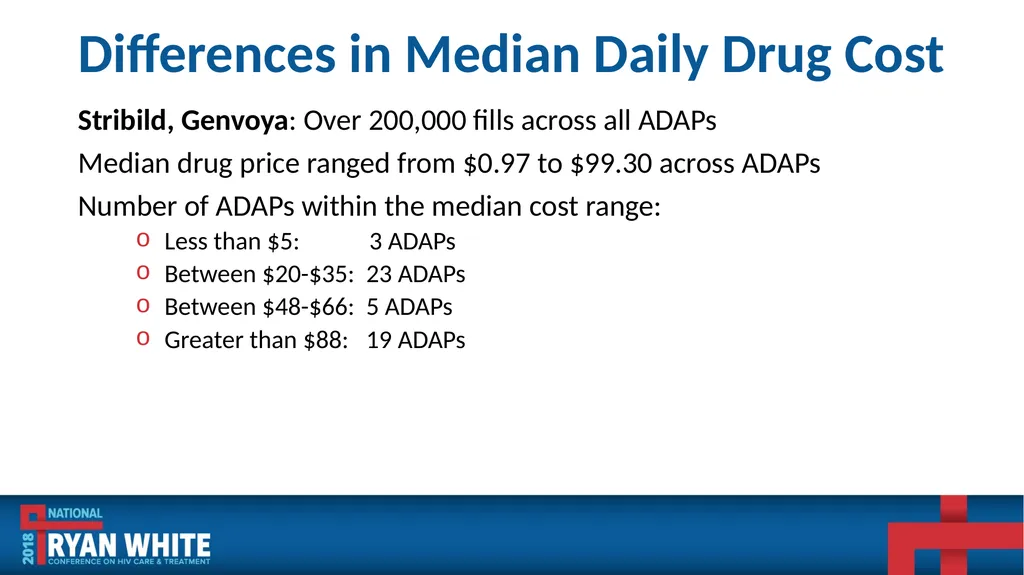
Differences in Median Daily Drug Cost Stribild, Genvoya: Over 200,000 fills across all ADAPs
Median drug price ranged from $0.97 to $99.30 across ADAPs
Number of ADAPs within the median cost range:
Less than $5: 3 ADAPs
Between $20-$35: 23 ADAPs
Between $48-$66: 5 ADAPs
Greater than $88: 19 ADAPs<br>
Median drug price ranged from $0.97 to $99.30 across ADAPs
Number of ADAPs within the median cost range:
Less than $5: 3 ADAPs
Between $20-$35: 23 ADAPs
Between $48-$66: 5 ADAPs
Greater than $88: 19 ADAPs<br>
25
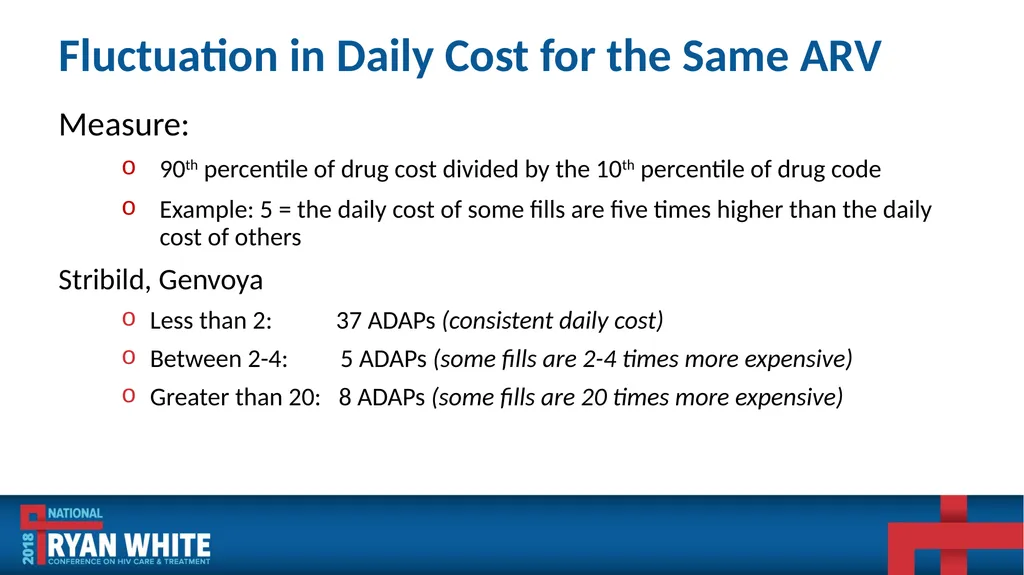
Fluctuation in Daily Cost for the Same ARV Measure:
90th percentile of drug cost divided by the 10th percentile of drug code
Example: 5 = the daily cost of some fills are five times higher than the daily cost of others
Stribild, Genvoya
Less than 2: 37 ADAPs (consistent daily cost)
Between 2-4: 5 ADAPs (some fills are 2-4 times more expensive)
Greater than 20: 8 ADAPs (some fills are 20 times more expensive)<br>
90th percentile of drug cost divided by the 10th percentile of drug code
Example: 5 = the daily cost of some fills are five times higher than the daily cost of others
Stribild, Genvoya
Less than 2: 37 ADAPs (consistent daily cost)
Between 2-4: 5 ADAPs (some fills are 2-4 times more expensive)
Greater than 20: 8 ADAPs (some fills are 20 times more expensive)<br>
26
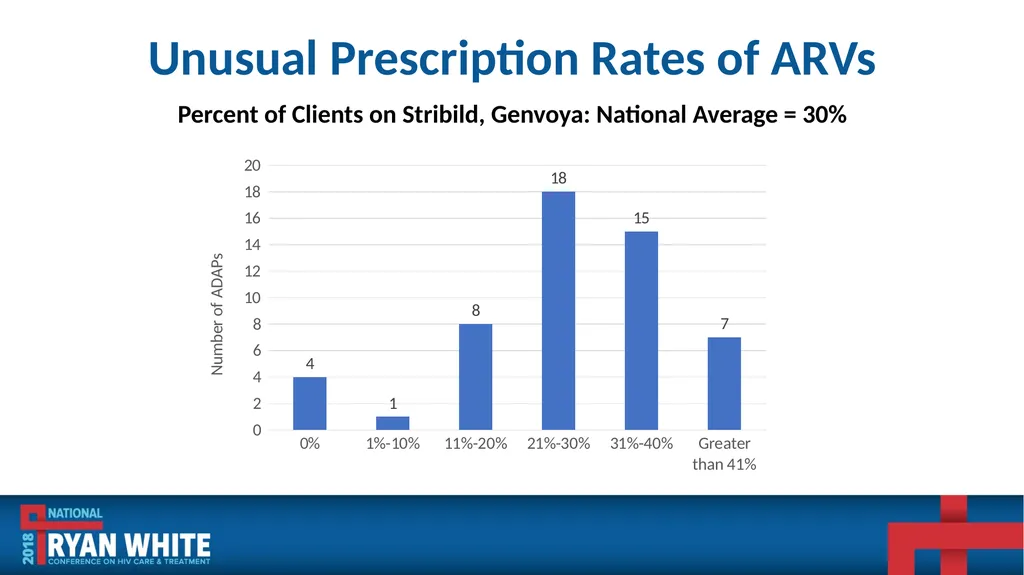
Percent of Clients on Stribild, Genvoya: National Average = 30% An Unusual Prescription Rates of ARVs<br>
27
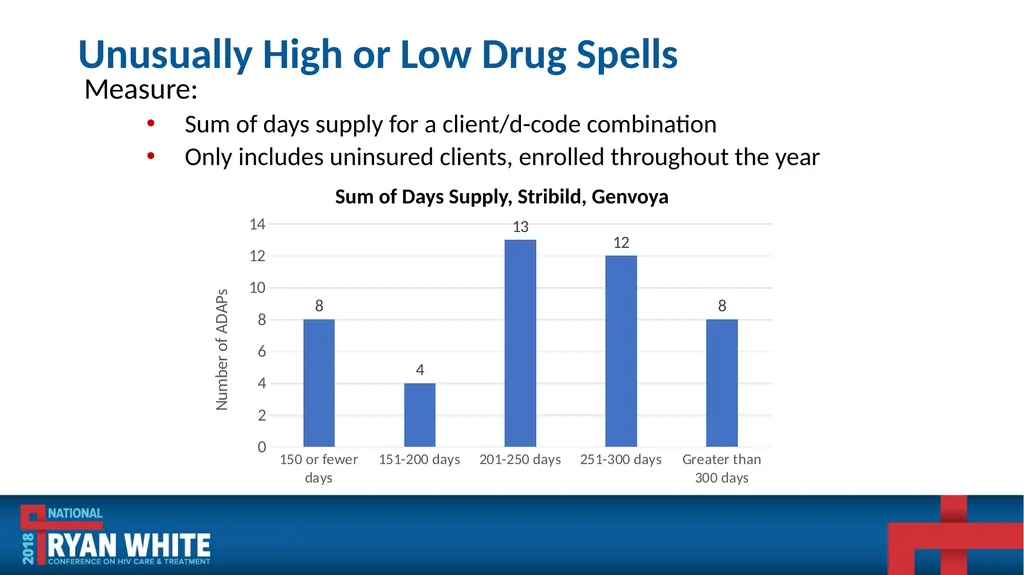
Sum of Days Supply, Stribild, Genvoya Measure:
Sum of days supply for a client/d-code combination
Only includes uninsured clients, enrolled throughout the year Unusually High or Low Drug Spells<br>
Sum of days supply for a client/d-code combination
Only includes uninsured clients, enrolled throughout the year Unusually High or Low Drug Spells<br>
28
Insurance Services Partial premium not being reported accurately. Examples of partial premium assistance:
Client enrolled in the Health Insurance Exchange and receives a subsidy
Client enrolled in employer-sponsored insurance, but the ADAP pays for the client cost share
$0 reported from some amounts
Clients get multiple types of premium assistance, but only one is reported<br>
Client enrolled in the Health Insurance Exchange and receives a subsidy
Client enrolled in employer-sponsored insurance, but the ADAP pays for the client cost share
$0 reported from some amounts
Clients get multiple types of premium assistance, but only one is reported<br>
29
Presentation Outline Overview and Progression of the ADR
Remaining Opportunities to Improve Data Quality
Tips and Solutions: Voices from the Field
Samantha Penn and M. Thomas Blissett, Nevada Department of Health and Human Services
Ann Nakamura and Luna Woo, California Department of Public Health
Data Quality Exercise on Using the Upload Completeness Report (UCR)<br>
Remaining Opportunities to Improve Data Quality
Tips and Solutions: Voices from the Field
Samantha Penn and M. Thomas Blissett, Nevada Department of Health and Human Services
Ann Nakamura and Luna Woo, California Department of Public Health
Data Quality Exercise on Using the Upload Completeness Report (UCR)<br>
30
Nevada ADAP Samantha Penn & M. Thomas Blissett<br>
31
Overview of the Nevada ADAP Universal Eligibility
One Statewide Provider (Access to Healthcare Network, AHN)
Medication Assistance Program
Premium Assistance
Copay Assistance
Access and Adherence Navigation (coming in 2019)<br>
One Statewide Provider (Access to Healthcare Network, AHN)
Medication Assistance Program
Premium Assistance
Copay Assistance
Access and Adherence Navigation (coming in 2019)<br>
32
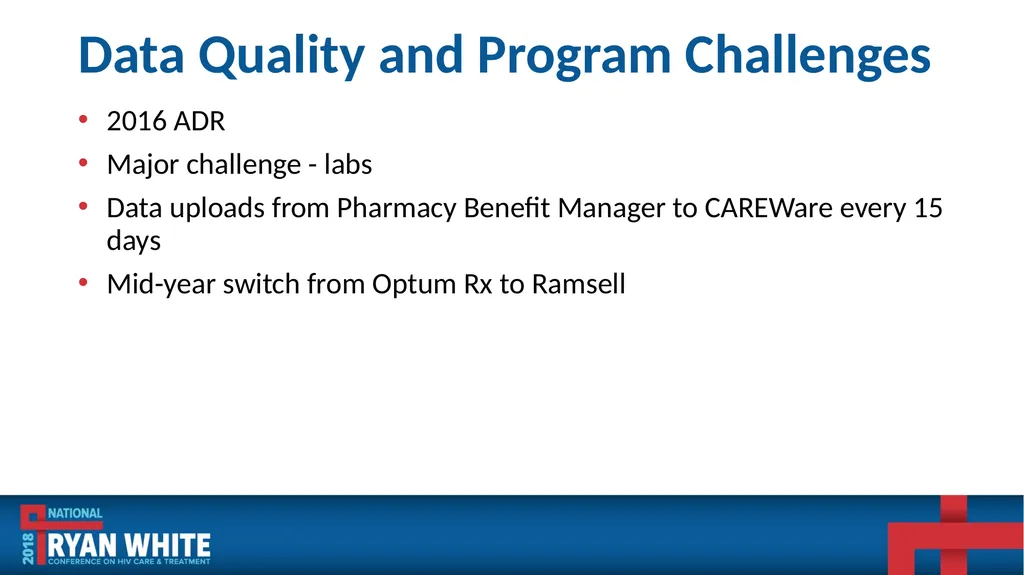
Data Quality and Program Challenges 2016 ADR
Major challenge - labs
Data uploads from Pharmacy Benefit Manager to CAREWare every 15 days
Mid-year switch from Optum Rx to Ramsell<br>
Major challenge - labs
Data uploads from Pharmacy Benefit Manager to CAREWare every 15 days
Mid-year switch from Optum Rx to Ramsell<br>
33
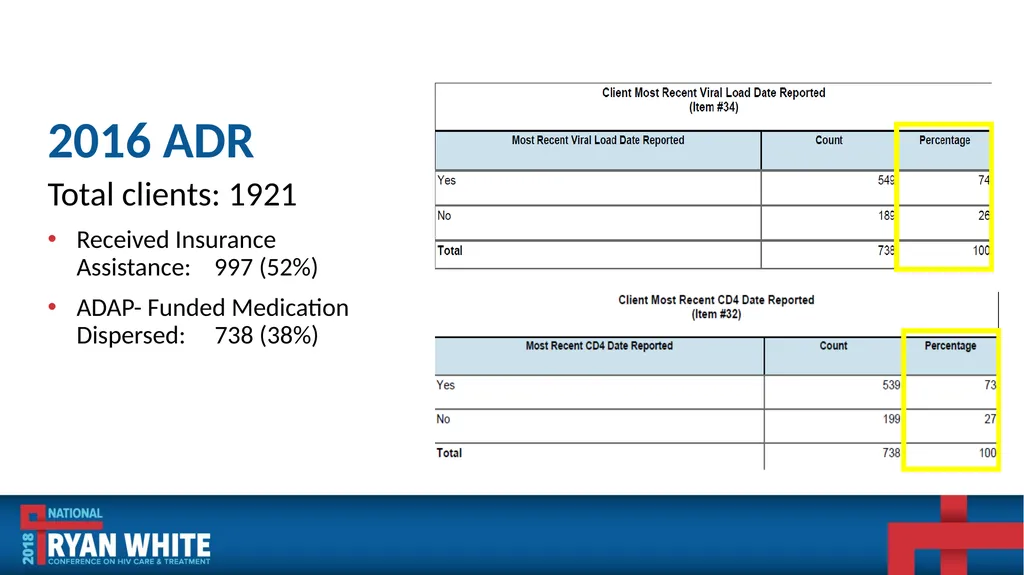
Total clients: 1921
Received Insurance Assistance: 997 (52%)
ADAP- Funded Medication Dispersed: 738 (38%) 2016 ADR<br>
Received Insurance Assistance: 997 (52%)
ADAP- Funded Medication Dispersed: 738 (38%) 2016 ADR<br>
34
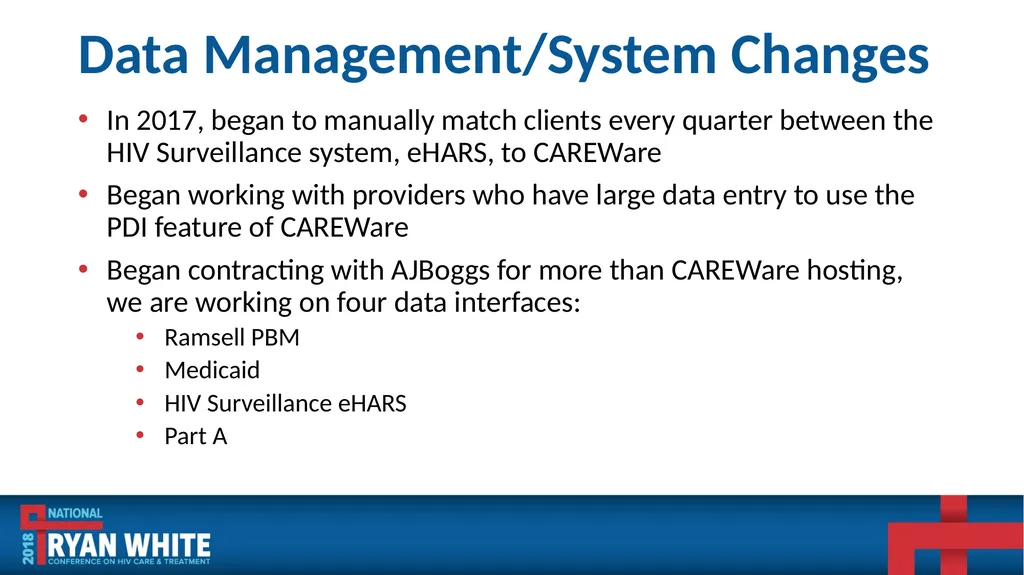
Data Management/System Changes In 2017, began to manually match clients every quarter between the HIV Surveillance system, eHARS, to CAREWare
Began working with providers who have large data entry to use the PDI feature of CAREWare
Began contracting with AJBoggs for more than CAREWare hosting, we are working on four data interfaces:
Ramsell PBM
Medicaid
HIV Surveillance eHARS
Part A<br>
Began working with providers who have large data entry to use the PDI feature of CAREWare
Began contracting with AJBoggs for more than CAREWare hosting, we are working on four data interfaces:
Ramsell PBM
Medicaid
HIV Surveillance eHARS
Part A<br>
35
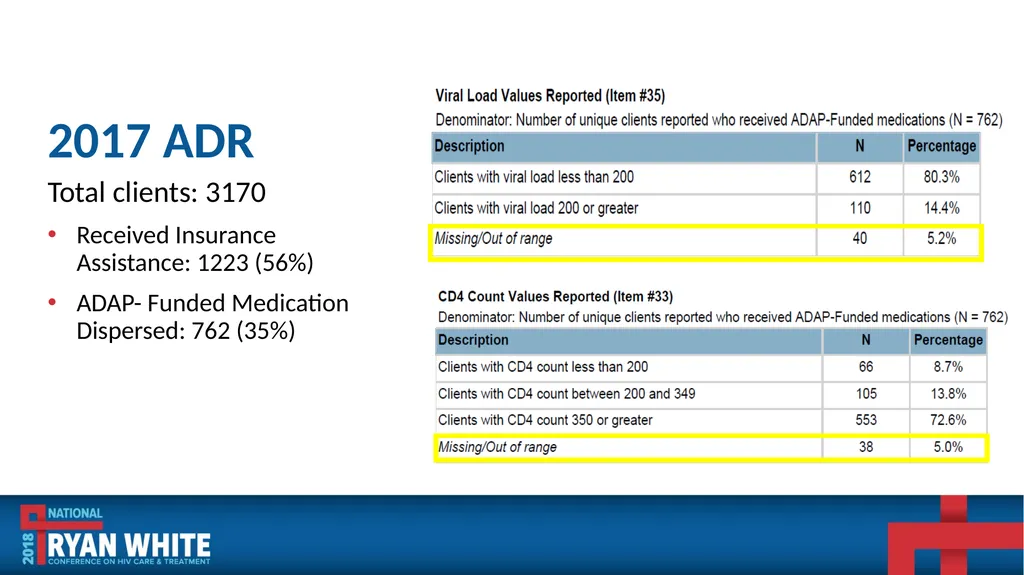
Total clients: 3170
Received Insurance Assistance: 1223 (56%)
ADAP- Funded Medication Dispersed: 762 (35%) 2017 ADR<br>
Received Insurance Assistance: 1223 (56%)
ADAP- Funded Medication Dispersed: 762 (35%) 2017 ADR<br>
36
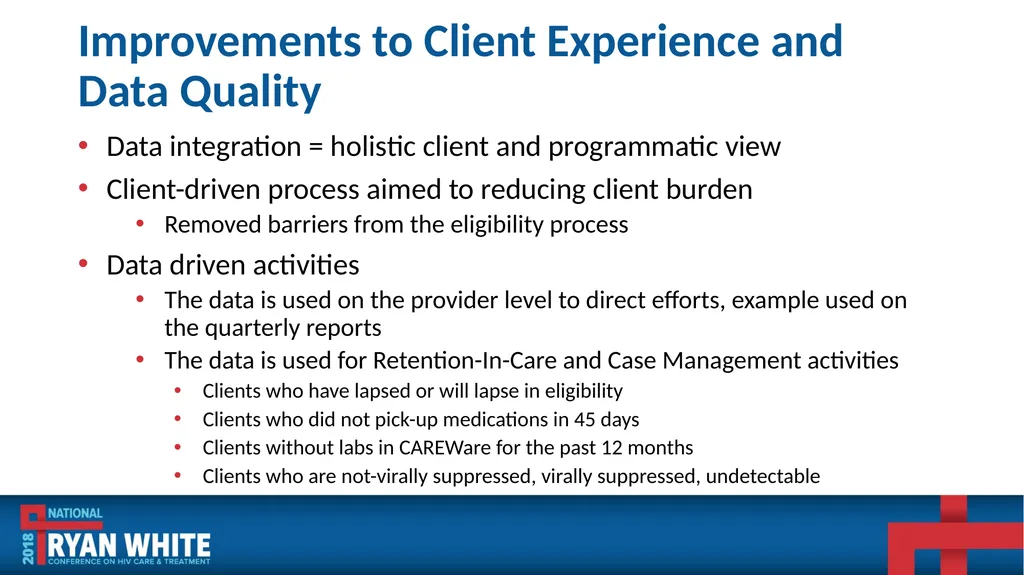
Improvements to Client Experience and Data Quality Data integration = holistic client and programmatic view
Client-driven process aimed to reducing client burden
Removed barriers from the eligibility process
Data driven activities
The data is used on the provider level to direct efforts, example used on the quarterly reports
The data is used for Retention-In-Care and Case Management activities
Clients who have lapsed or will lapse in eligibility
Clients who did not pick-up medications in 45 days
Clients without labs in CAREWare for the past 12 months
Clients who are not-virally suppressed, virally suppressed, undetectable<br>
Client-driven process aimed to reducing client burden
Removed barriers from the eligibility process
Data driven activities
The data is used on the provider level to direct efforts, example used on the quarterly reports
The data is used for Retention-In-Care and Case Management activities
Clients who have lapsed or will lapse in eligibility
Clients who did not pick-up medications in 45 days
Clients without labs in CAREWare for the past 12 months
Clients who are not-virally suppressed, virally suppressed, undetectable<br>
37
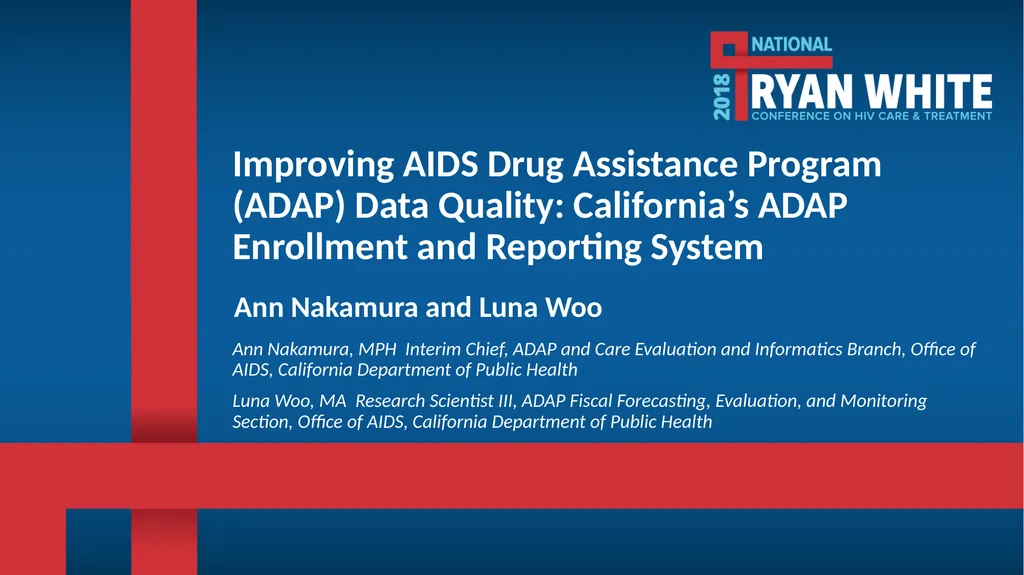
Improving AIDS Drug Assistance Program (ADAP) Data Quality: California’s ADAP Enrollment and Reporting System Ann Nakamura and Luna Woo Ann Nakamura, MPH Interim Chief, ADAP and Care Evaluation and Informatics Branch, Office of AIDS, California Department of Public Health
Luna Woo, MA Research Scientist III, ADAP Fiscal Forecasting, Evaluation, and Monitoring Section, Office of AIDS, California Department of Public Health<br>
Luna Woo, MA Research Scientist III, ADAP Fiscal Forecasting, Evaluation, and Monitoring Section, Office of AIDS, California Department of Public Health<br>
38
Part 1
System overview and strategies to ensure data quality and inform program activities Ann Nakamura, MPH
Interim Chief, ADAP and Care Evaluation and Informatics Branch<br>
Interim Chief, ADAP and Care Evaluation and Informatics Branch<br>
39
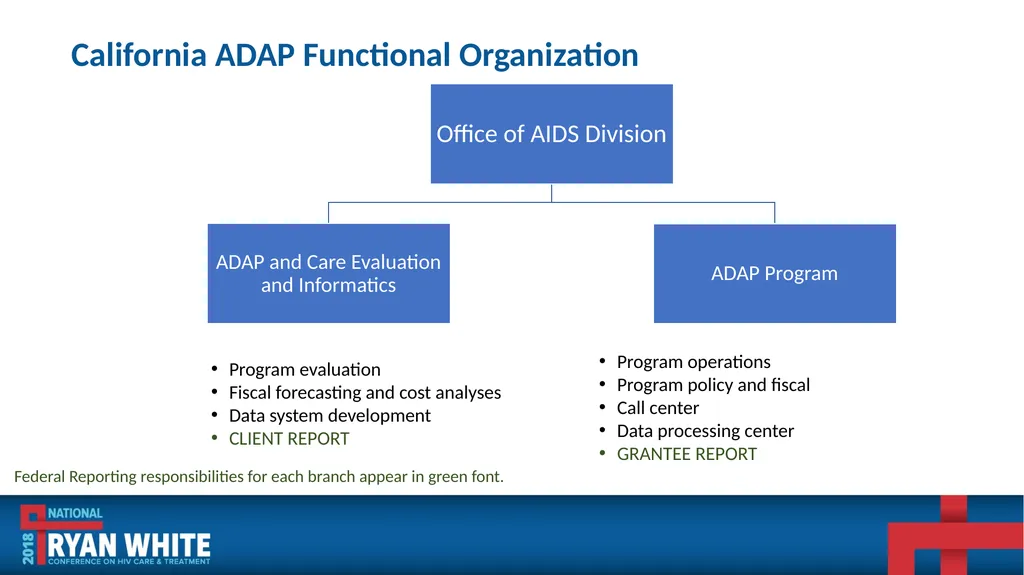
Federal Reporting responsibilities for each branch appear in green font. California ADAP Functional Organization<br>
40
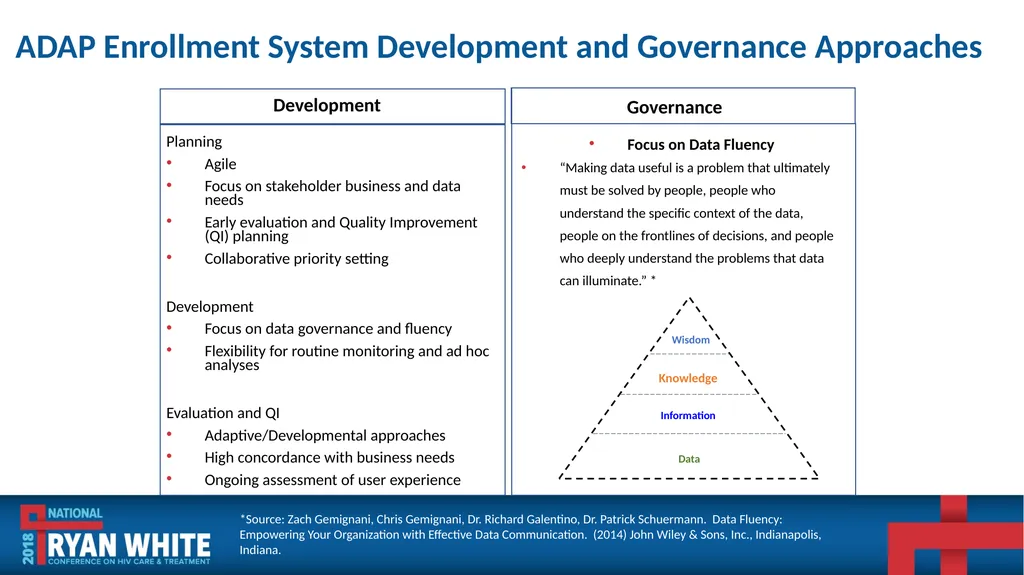
*Source: Zach Gemignani, Chris Gemignani, Dr. Richard Galentino, Dr. Patrick Schuermann. Data Fluency: Empowering Your Organization with Effective Data Communication. (2014) John Wiley & Sons, Inc., Indianapolis, Indiana. Focus on Data Fluency
“Making data useful is a problem that ultimately must be solved by people, people who understand the specific context of the data, people on the frontlines of decisions, and people who deeply understand the problems that data can illuminate.” * Governance Planning
Agile
Focus on stakeholder business and data needs
Early evaluation and Quality Improvement (QI) planning
Collaborative priority setting
Development
Focus on data governance and fluency
Flexibility for routine monitoring and ad hoc analyses
Evaluation and QI
Adaptive/Developmental approaches
High concordance with business needs
Ongoing assessment of user experience Development ADAP Enrollment System Development and Governance Approaches<br>
“Making data useful is a problem that ultimately must be solved by people, people who understand the specific context of the data, people on the frontlines of decisions, and people who deeply understand the problems that data can illuminate.” * Governance Planning
Agile
Focus on stakeholder business and data needs
Early evaluation and Quality Improvement (QI) planning
Collaborative priority setting
Development
Focus on data governance and fluency
Flexibility for routine monitoring and ad hoc analyses
Evaluation and QI
Adaptive/Developmental approaches
High concordance with business needs
Ongoing assessment of user experience Development ADAP Enrollment System Development and Governance Approaches<br>
41
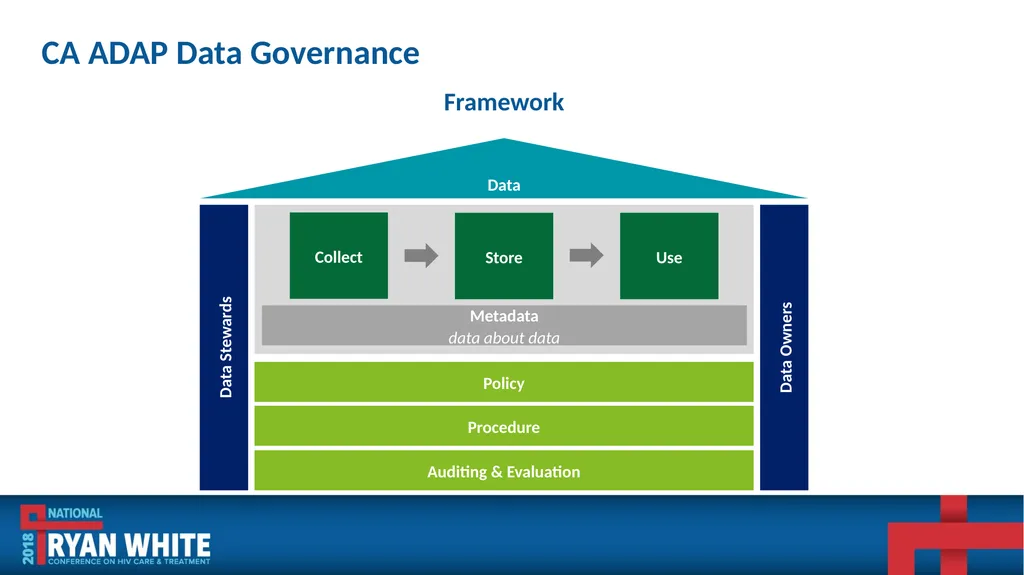
Framework CA ADAP Data Governance<br>
42
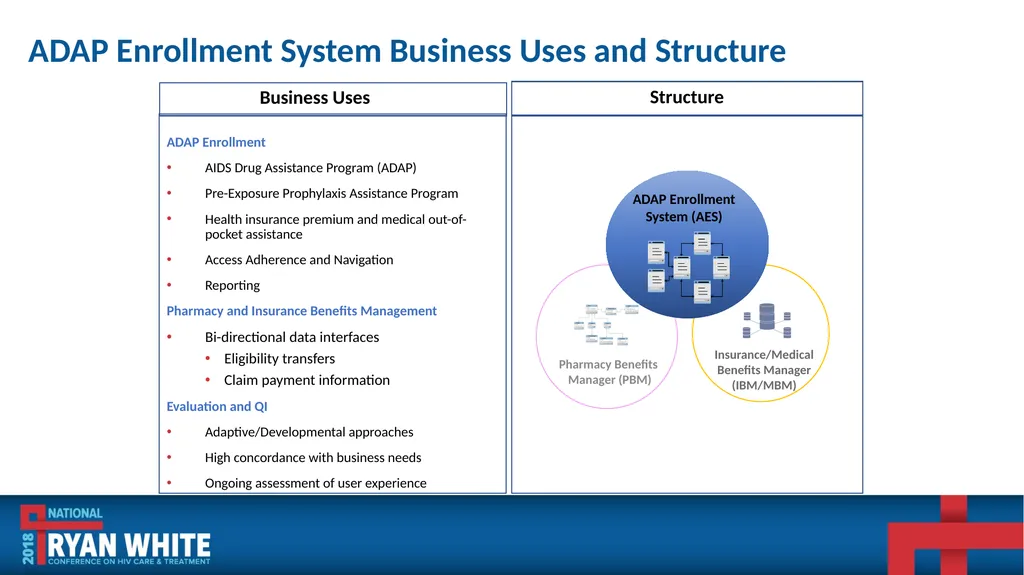
Insurance/Medical Benefits Manager (IBM/MBM) Pharmacy Benefits
Manager (PBM) ADAP Enrollment System (AES) Structure ADAP Enrollment
AIDS Drug Assistance Program (ADAP)
Pre-Exposure Prophylaxis Assistance Program
Health insurance premium and medical out-of-pocket assistance
Access Adherence and Navigation
Reporting
Pharmacy and Insurance Benefits Management
Bi-directional data interfaces
Eligibility transfers
Claim payment information
Evaluation and QI
Adaptive/Developmental approaches
High concordance with business needs
Ongoing assessment of user experience Business Uses ADAP Enrollment System Business Uses and Structure<br>
Manager (PBM) ADAP Enrollment System (AES) Structure ADAP Enrollment
AIDS Drug Assistance Program (ADAP)
Pre-Exposure Prophylaxis Assistance Program
Health insurance premium and medical out-of-pocket assistance
Access Adherence and Navigation
Reporting
Pharmacy and Insurance Benefits Management
Bi-directional data interfaces
Eligibility transfers
Claim payment information
Evaluation and QI
Adaptive/Developmental approaches
High concordance with business needs
Ongoing assessment of user experience Business Uses ADAP Enrollment System Business Uses and Structure<br>
43
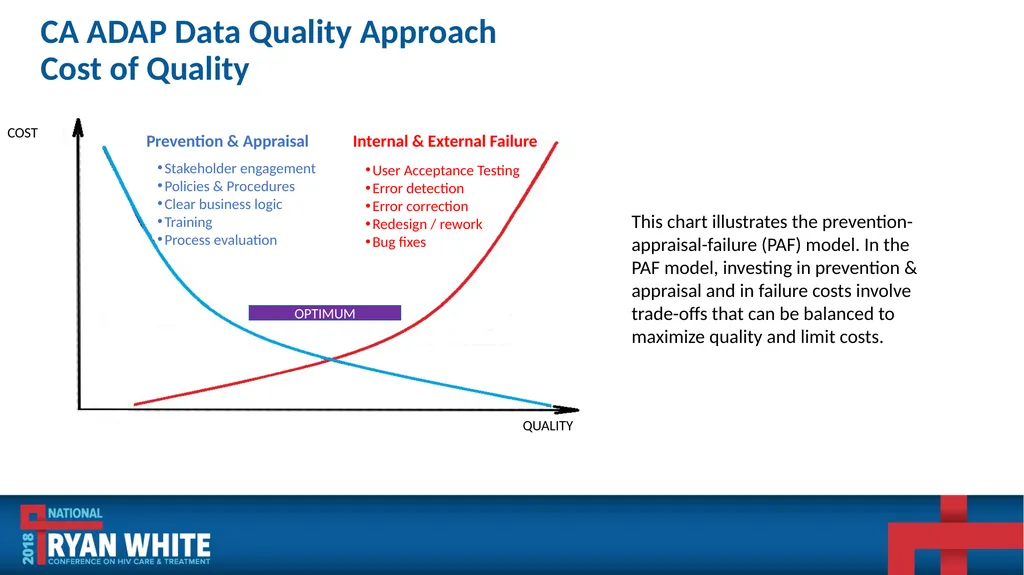
This chart illustrates the prevention-appraisal-failure (PAF) model. In the PAF model, investing in prevention & appraisal and in failure costs involve trade-offs that can be balanced to maximize quality and limit costs. CA ADAP Data Quality Approach
Cost of Quality<br>
44
Part 2
Ensuring data quality to support federal monitoring activities Luna Woo, MA
Research Scientist III, ADAP Fiscal Forecasting, Evaluation and Monitoring Section<br>
Research Scientist III, ADAP Fiscal Forecasting, Evaluation and Monitoring Section<br>
45
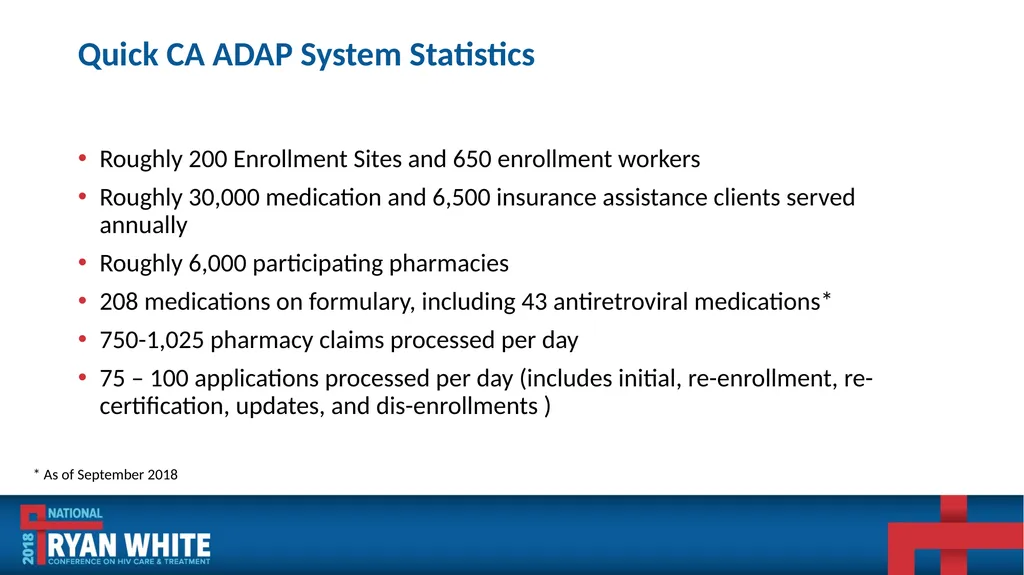
* As of September 2018 Roughly 200 Enrollment Sites and 650 enrollment workers
Roughly 30,000 medication and 6,500 insurance assistance clients served annually
Roughly 6,000 participating pharmacies
208 medications on formulary, including 43 antiretroviral medications*
750-1,025 pharmacy claims processed per day
75 – 100 applications processed per day (includes initial, re-enrollment, re-certification, updates, and dis-enrollments ) Quick CA ADAP System Statistics<br>
Roughly 30,000 medication and 6,500 insurance assistance clients served annually
Roughly 6,000 participating pharmacies
208 medications on formulary, including 43 antiretroviral medications*
750-1,025 pharmacy claims processed per day
75 – 100 applications processed per day (includes initial, re-enrollment, re-certification, updates, and dis-enrollments ) Quick CA ADAP System Statistics<br>
46
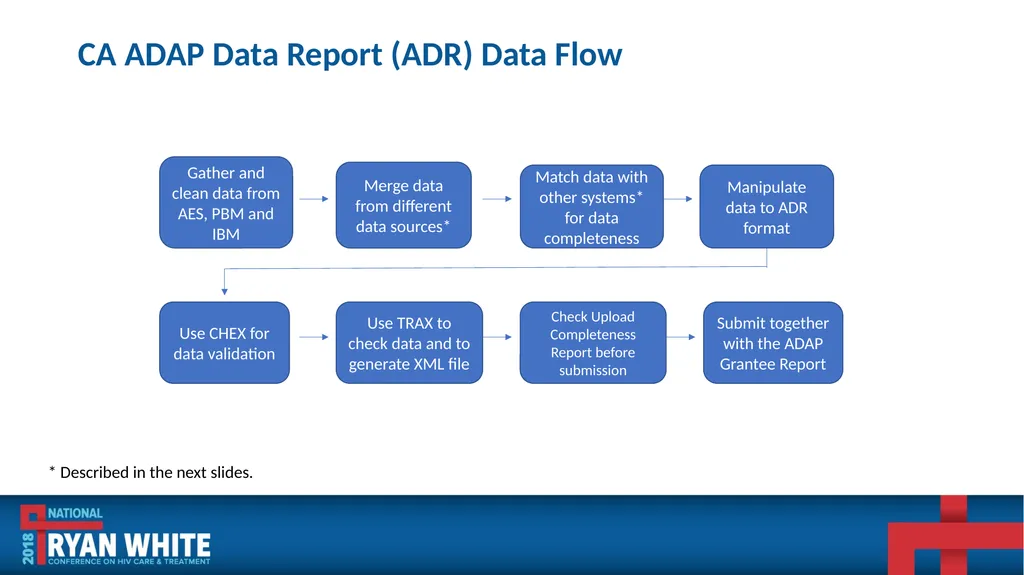
* Described in the next slides. Submit together with the ADAP Grantee Report Check Upload Completeness Report before submission Use TRAX to check data and to generate XML file Use CHEX for data validation Manipulate data to ADR format Match data with other systems* for data completeness Merge data from different data sources* Gather and clean data from AES, PBM and IBM CA ADAP Data Report (ADR) Data Flow<br>
47
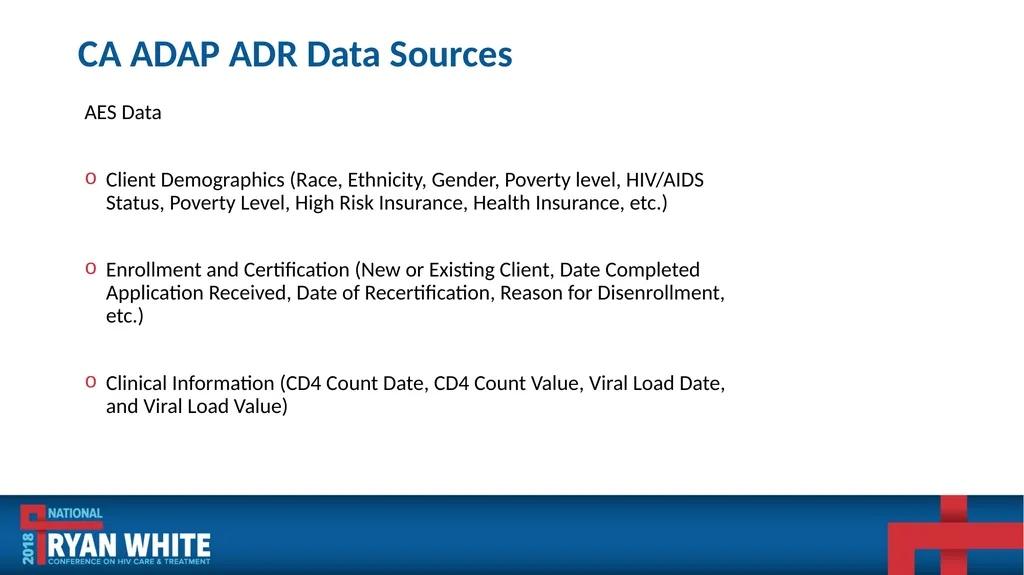
CA ADAP ADR Data Sources AES Data
Client Demographics (Race, Ethnicity, Gender, Poverty level, HIV/AIDS Status, Poverty Level, High Risk Insurance, Health Insurance, etc.)
Enrollment and Certification (New or Existing Client, Date Completed Application Received, Date of Recertification, Reason for Disenrollment, etc.)
Clinical Information (CD4 Count Date, CD4 Count Value, Viral Load Date, and Viral Load Value)<br>
Client Demographics (Race, Ethnicity, Gender, Poverty level, HIV/AIDS Status, Poverty Level, High Risk Insurance, Health Insurance, etc.)
Enrollment and Certification (New or Existing Client, Date Completed Application Received, Date of Recertification, Reason for Disenrollment, etc.)
Clinical Information (CD4 Count Date, CD4 Count Value, Viral Load Date, and Viral Load Value)<br>
48
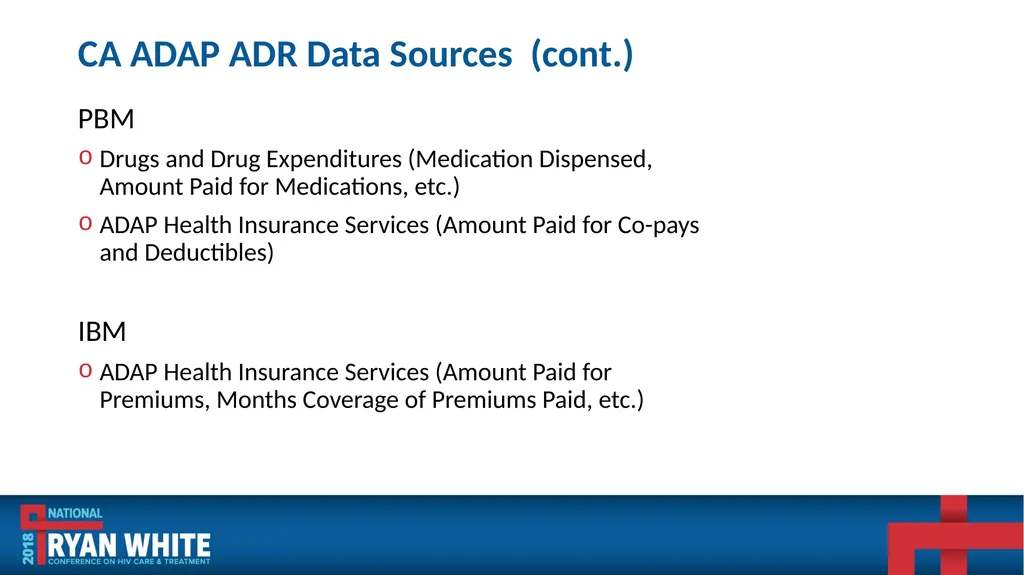
CA ADAP ADR Data Sources (cont.) PBM
Drugs and Drug Expenditures (Medication Dispensed, Amount Paid for Medications, etc.)
ADAP Health Insurance Services (Amount Paid for Co-pays and Deductibles)
IBM
ADAP Health Insurance Services (Amount Paid for Premiums, Months Coverage of Premiums Paid, etc.)<br>
Drugs and Drug Expenditures (Medication Dispensed, Amount Paid for Medications, etc.)
ADAP Health Insurance Services (Amount Paid for Co-pays and Deductibles)
IBM
ADAP Health Insurance Services (Amount Paid for Premiums, Months Coverage of Premiums Paid, etc.)<br>
49
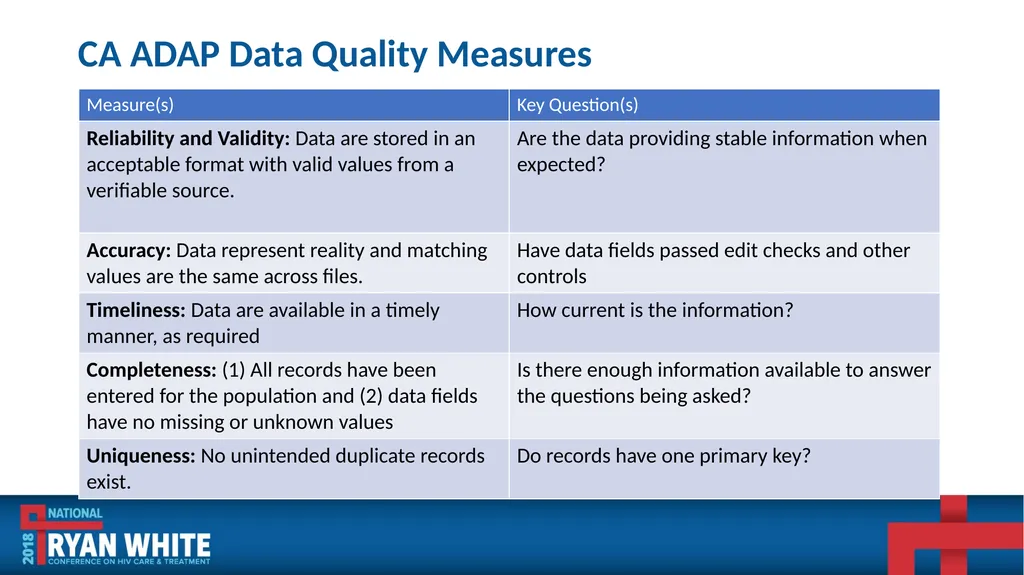
CA ADAP Data Quality Measures<br>
50
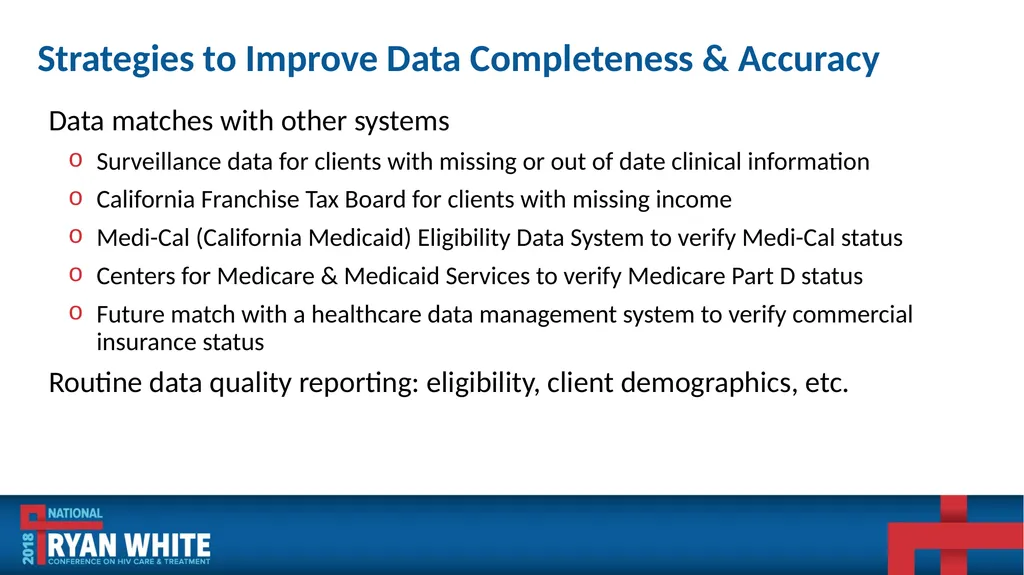
Strategies to Improve Data Completeness & Accuracy Data matches with other systems
Surveillance data for clients with missing or out of date clinical information
California Franchise Tax Board for clients with missing income
Medi-Cal (California Medicaid) Eligibility Data System to verify Medi-Cal status
Centers for Medicare & Medicaid Services to verify Medicare Part D status
Future match with a healthcare data management system to verify commercial insurance status
Routine data quality reporting: eligibility, client demographics, etc.<br>
Surveillance data for clients with missing or out of date clinical information
California Franchise Tax Board for clients with missing income
Medi-Cal (California Medicaid) Eligibility Data System to verify Medi-Cal status
Centers for Medicare & Medicaid Services to verify Medicare Part D status
Future match with a healthcare data management system to verify commercial insurance status
Routine data quality reporting: eligibility, client demographics, etc.<br>
51
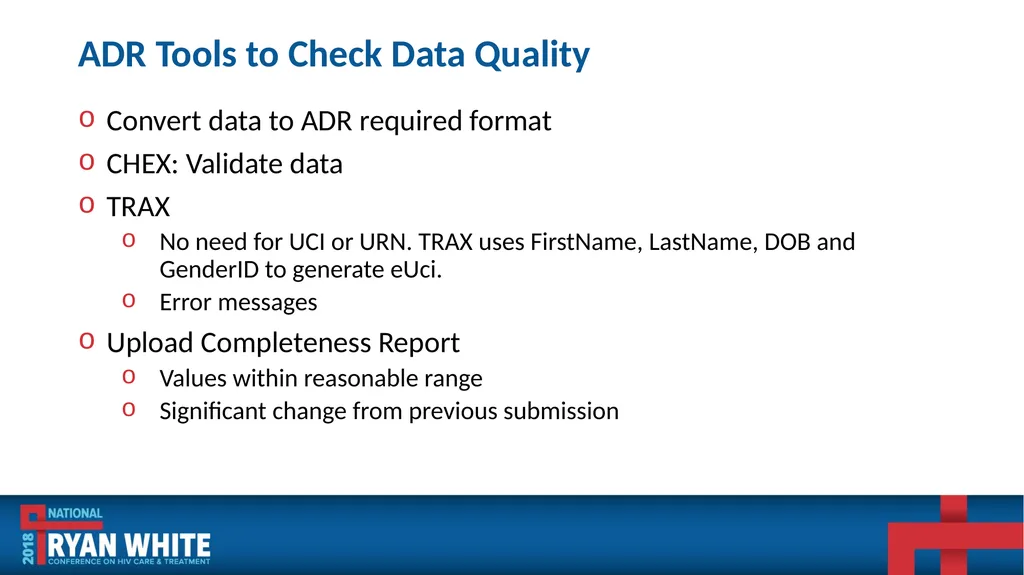
ADR Tools to Check Data Quality Convert data to ADR required format
CHEX: Validate data
TRAX
No need for UCI or URN. TRAX uses FirstName, LastName, DOB and GenderID to generate eUci.
Error messages
Upload Completeness Report
Values within reasonable range
Significant change from previous submission<br>
CHEX: Validate data
TRAX
No need for UCI or URN. TRAX uses FirstName, LastName, DOB and GenderID to generate eUci.
Error messages
Upload Completeness Report
Values within reasonable range
Significant change from previous submission<br>
52
Using Data to Inform State and Federal Program Activities Federal ADR requirements informed system design
More complete reporting of racial and ethnic subgroups
Capture of detailed insurance plan information and insurance source (individual vs. group coverage) for all clients
Timely identification of clients who have one or more break in service
Timely collection of disenrollment information<br>
More complete reporting of racial and ethnic subgroups
Capture of detailed insurance plan information and insurance source (individual vs. group coverage) for all clients
Timely identification of clients who have one or more break in service
Timely collection of disenrollment information<br>
53
Real-time reporting for State ADAP to use
Monitoring enrollment site activities
Prioritizing site visits
Providing technical assistance Using Data to Inform State and Federal Program Activities (Cont.)<br>
Monitoring enrollment site activities
Prioritizing site visits
Providing technical assistance Using Data to Inform State and Federal Program Activities (Cont.)<br>
54
Client interactions and enrollment worker activities stored centrally
More timely identification of issues with eligibility and claim adjudication
Task assignment features support program workload management
Automatic notifications to alert ADAP Advisors and Enrollment Workers when clients may lapse in care
Support communication with clients for eligibility and program updates Using Data to Inform State and Federal Program Activities (Cont.)<br>
More timely identification of issues with eligibility and claim adjudication
Task assignment features support program workload management
Automatic notifications to alert ADAP Advisors and Enrollment Workers when clients may lapse in care
Support communication with clients for eligibility and program updates Using Data to Inform State and Federal Program Activities (Cont.)<br>
55
Thank You For questions about the AES System Development, contact Ann Nakamura at Ann.Nakamura@cdph.ca.gov
For questions about data quality planning, implementation, and reporting, contact Luna Woo at Luna.Woo@cdph.ca.gov<br>
For questions about data quality planning, implementation, and reporting, contact Luna Woo at Luna.Woo@cdph.ca.gov<br>
56
Presentation Outline Overview and Progression of the ADR
Remaining Challenges
Tips and Solutions: Voices from the Field
Data Quality Exercise on Using the Upload Completeness Report (UCR)<br>
Remaining Challenges
Tips and Solutions: Voices from the Field
Data Quality Exercise on Using the Upload Completeness Report (UCR)<br>
57
Answer the Following UCR Questions Do you notice anything strange about the data?
What data-related issues could be behind this trend?
How could you spot this issue prior to ADR submission?
What can be done to improve the quality of the data?<br>
What data-related issues could be behind this trend?
How could you spot this issue prior to ADR submission?
What can be done to improve the quality of the data?<br>
58
TA Resources Access Check Your XML: https://careacttarget.org/sites/default/files/file-upload/resources/Using_Check_Your_XML_ADR_16MAR2016.pdf
The DART Team: Data.TA@caiglobal.org
TARGET Center website: https://careacttarget.org/category/topics/adap-data-report-adr
Ryan White HIV/AIDS Program Data Support
888.640.9356; RyanWhiteDataSupport@wrma.com
HRSA Contact Center
877.Go4.HRSA (877.464.4772); http://www.hrsa.gov/about/contact/ehbhelp.aspx
CAREWare helpdesk
877-294-3571; cwhelp@jprog.com
Sign up for the listserv!<br>
The DART Team: Data.TA@caiglobal.org
TARGET Center website: https://careacttarget.org/category/topics/adap-data-report-adr
Ryan White HIV/AIDS Program Data Support
888.640.9356; RyanWhiteDataSupport@wrma.com
HRSA Contact Center
877.Go4.HRSA (877.464.4772); http://www.hrsa.gov/about/contact/ehbhelp.aspx
CAREWare helpdesk
877-294-3571; cwhelp@jprog.com
Sign up for the listserv!<br>