Demand – Non age-based cohorts COVID-19 Vaccine
Description: Demand Non age-based cohorts COVID-19 Vaccine Delivery Programme Immunosuppressed Spring Booster : South West 10 August 2022 Key Messages Key Messages 10th August 2022 Reporting This weekly data report will focus on adult and 5-11
Related Topics
Download Presentation
"Demand – Non age-based cohorts COVID-19 Vaccine" is the property of its rightful owner. Permission is granted to download and print the materials on this website for personal, non-commercial use only, and to display it on your personal computer provided you do not modify the materials and that you retain all copyright notices contained in the materials. By downloading content from our website, you accept the terms of this agreement.
Presentation Transcript
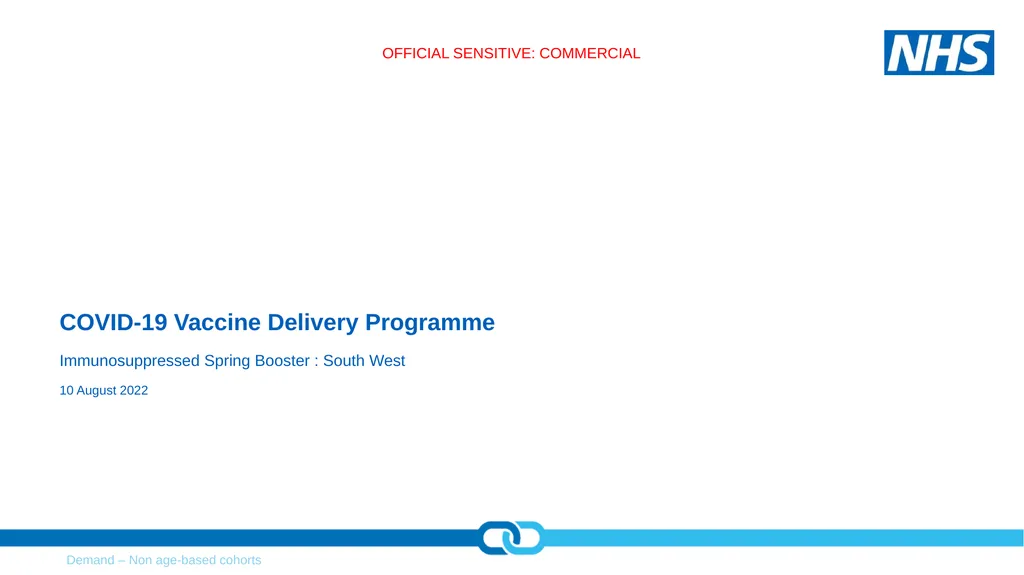
slide1. Demand – Non age-based cohorts COVID-19 Vaccine Delivery Programme Immunosuppressed Spring Booster : South West10 August 2022<br>
slide2. Key Messages<br>
slide3. Key Messages – 10th August 2022 Reporting
This weekly data report will focus on adult and 5-11 severely immunosuppressed, including system breakdown of adult severely immunosuppressed uptake.
Assurance
Thank you for your support. The findings have provided some interesting feedback.
Based on the assurance results, we are aiming to reach out to practices with lower uptake via our clinical colleagues to understand further what may be the barriers to enabling improved uptake.
Cohorting for Autumn
It is confirmed that a refreshed clinically at-risk cohort is anticipated for the end of September
Communications
We are awaiting further update from JCVI and are planning to develop appropriate messaging for immunosuppressed people to know who and when to receive their vaccinations.
Planning for Autumn Winter 2022
Activity is underway to ensure that there is supporting guidance Regions/Systems to share with vaccination sites and roving teams.
The supporting guidance will include top tips; case studies; communication and clinical toolkits.
This is all developed on what we have learnt from previous campaigns and the soft intelligence that is shared both through Regional calls and feedback received.<br>
slide4. Immunosuppressed Data<br>
slide5. The table below reports the weekly change in spring booster vaccinations. There has been a 1.06% (4,769) increase in the number of those receiving their spring booster vaccination
The Midlands has vaccinated an additional 1,049 individuals (1.15% increase), the South West 629 (1.15% increase), and the North East and Yorkshire 783 (1.08% increase)
Nationally NBS future bookings have decreased by -1,208 to 3,833, as we enter the holiday season Footnote: There are no RAG ratings. The colour coding Red : Green reflects the data range showing highest to lowest values
Month Eligibility includes those that have completed their primary course and their last vaccination was at least 3 months ago National Position – Adult Severely Immunosuppressed – Weekly Change Those eligible for a spring booster has reduced due to deceased patients being removed from the cohort<br>
slide6. Nationally, 20.97% (1,571) of individuals have received their first dose vaccination
The South East region has achieved the highest uptake with 30.04%, followed by the South West with 29.04% and the East of England with 22.24%
The North West region has the lowest uptake rate with 12.28% followed by London with 16.36%
The variance between the highest and lowest performing regions for first dose uptake is 17.77 percentage points Footnote: There are no RAG ratings. The colour coding Red : Green reflects the data range showing highest to lowest values
Month Eligibility includes those that have completed their primary course and their last vaccination was at least 3 months ago National Position – 5 to 11 Severely Immunosuppressed<br>
slide7. 38,128 (62.80%) of the Adult Severely Immunosuppressed population who are spring booster eligible (60,711) have received their vaccination in the South West
Somerset have achieved a vaccination uptake of 74.20% versus Devon with a vaccination uptake rate of 58.83%
Those eligible for a spring booster has reduced due to deceased patients being removed from the cohort The table below reports the weekly change in spring booster vaccinations. There has been a 1.15% (629) increase in the number of those receiving their spring boosters
The Gloucestershire has vaccinated an additional 115 individuals (1.68% increase) compared to the Devon system that has vaccinated an additional 68 individuals (0.65% increase) Footnote: There are no RAG ratings. The colour coding Red : Green reflects the data range showing highest to lowest values
Month Eligibility includes those that have completed their primary course and their last vaccination was at least 3 months ago South West Regional Position –Severely Immunosuppressed<br>
slide8. Assurance Returns Data<br>
slide9. Assurance Returns – National Overview Assurance survey was launched on 22 June, asking the GPs nationally to report on:
GP Dashboard Access, Invites and IS Population
PRIMIS Access, Invites and IS Population
The survey return deadline was 21 July and as of 9th August we received:
100% returns in North East and Yorkshire and North West
14% return in South West and 17% return in South East 151(23%) 509(77%) 822(70%) East of England 193(15%) 71(9%) London 350(30%) 1,079(85%) 69(13%) Midlands 738(80%) 183(20%) North East and Yorkshire 468(48%) 509(52%) North West 752(91%) South East 478(87%) South West 660 1,172 1,272 921 977 823 547 GP Returns GP No Returns London 5(83%) 1(17%) North West East of England 4(80%) 7(64%) 1(20%) 4(36%) Midlands 4(100%) North East and Yorkshire 3(100%) 1(17%) 6 5(83%) South East 1(14%) 6(86%) 3 South West 6 5 11 4 7 STP Returns STP No Returns Assurance survey was sent to 6,372 GPs nationally:
Midlands has 1,273 GPs, whereas South West has 547 GPs
Survey can be completed by GPs, PCNs and CCGs
As of 9th August we received returns from 2,398 GPs (38% return):
738 GPs returns across four STPs (80%) in North East and Yorkshire
509 GPs returns across six STPs (77%) in East of England Hampshire and the Isle of Wight provided partial verbal assurance North West London return is excluded<br>
slide10. Assurance Returns – Summary by Questions 41.2% Accessed 53.5% 46.5% 46.5% 38.4% 1,116 37.4% 922 Invited Population provided 1,284 1,115 988 898 GP Dashboard PRIMIS 1,283 (53.5%) and 1,115 (46.5%) accessed GP Dashboard and PRIMIS
1,114 (46.5%) and 921 (38.4%) invited patients using GP Dashboard and PRIMIS
987 (41.2%) and 897 (37.4%) provided GP Dashboard and PRIMIS population
9 GPs with 651 patients identified through Foundry are yet to confirm the final population of IS individuals 6,372 2,397(38%) 3,975(62%) National Completed No Return<br>
slide11. 73 Bristol, North Somerset and South Gloucestershire Cornwall and the Isles of Scilly Health and Social Care Partnership 69(78%) 121 Gloucestershire 71 Devon Bath and North East Somerset, Swindon and Wiltshire Dorset 55(100%) Somerset 88 76(100%) 73(100%) 71(100%) 121(100%) 63(100%) 19(22%) 76 55 63 Completed No Response South West – Assurance Returns by STPs<br>
slide12. 478(87%) 69(13%) South West 547 Completed No Response 38 returns GP Dashboard 7,512 PRIMIS 3,854 51 returns -3,658 GP Dashboard Access 80% 12% 9% 69 Yes Blank / NA No 78% GP Dashboard Invites 12% 10% 69 Yes No Blank / NA PRIMIS Access 13% 41% 46% 69 Blank / NA Yes No PRIMIS Invites 26% 51% 23% 69 Yes No Blank / NA South West Regional Position – Assurance Returns<br>
slide13. National Position – GP Dashboard Access Nationally 50.8% of 6,600 open and active GPs accessed GP Dashboard since 17 June (0.2% increase from previous week) :
East of England has the highest access rate of 80.7% (no increase from previous week)
London has the lowest access rate of 40.3% (no increase from previous week)
Variance between the highest and the lowest performing regions is 40.5 percentage points Nation East of England South East North West London North East and Yorkshire Midlands South West +0.3% No change No change +0.8% +0.4% +0.1% +0.1% +0.2% 1 Aug 2022 8 Aug 2022<br>
slide14. South West – GP Dashboard Access In South West 57.0% of 567 open and active GPs accessed GP Dashboard since 17 June (0.2% increase from previous week) :
Bristol, North Somerset and South Gloucestershire has the highest access rate of 96.2% (no change from previous week)
Somerset has the lowest access rate of 12.5% (no change from previous week)
Variance between the highest and the lowest performing regions is 83.7 percentage points Devon Bath and North East Somerset, Swindon and Wiltshire Bristol, North Somerset and South Gloucestershire Somerset Dorset Gloucestershire Cornwall and the Isles of Scilly Health & Social Care Partnership No change No change No change No change No change +1.4% No change 01 August 2022 08 August 2022<br>
slide15. FAQ<br>
slide16. FAQs and Lessons Learned Is there anything in the pipeline to facilitate vaccinations for STEM Cell recipients? There is a team currently seeking a solution to the issue pertaining to STEM Cell recipients as they are unable to receive the vaccine easily. The work is progressing well, and we will soon be in a position to advise on a process whereby these individuals will more easily be able to access the vaccinations they require via sites that have prescribing expertise. All feedback received in regards to this concern is being shared with the team who are building the process so that the challenges articulated can be used to inform the development. Is there a difference between Immunosuppressed and Severely Immunosuppressed? There are varying degrees of immunosuppression, either caused by the condition or the medication or therapy or combination thereof. It is an imprecise science.
Before COVID there were the Green Book Influenza definitions which are designed to capture most people who could be immunosuppressed. Then we had at risk from COVID groups.
October 2021 selected a smaller group of the most immunosuppressed for whom vaccination could be anticipated to produce little or reduced protection from COVID. They were offered a third dose of vaccine to improve / complete their primary course and were named by JCVI as severely immunosuppressed. This now broadly aligns with the group offered antiviral therapy should they get COVID (McInnes Report Group).
For boosters JCVI have reverted to a broader approach capturing most people who could be immunosuppressed, this mostly aligns with the Flu definitions. Essentially the severely immunosuppressed is a subset of the immunosuppressed which is a broad group of conditions and medications where the immune system does not work correctly due to disease therapy or medication. We are assuming that JCVI will continue to advise offering vaccine boosters to the whole of the group going forwards.<br>
slide17. FAQs and Lessons Learned What is the overarching rationale pertaining to dose numbering going forward? Numbering doses and considering 5th and 6th doses encourages people to think that they must have six to be fully protected. Ordinal numbers for vaccines are unhelpful going forwards. We are now in the position of offering reinforcing doses to those in most need, their effective is not additive so you don’t need to have the “right” number to be protected but to have had your slowly waning immunity reinforced, back to a full level of protection. No one considers themselves better protected from influenza because they have been vaccinated for 20 years rather than 10 years, they consider themselves protected because they had a vaccine ahead of the flu season. We need to move people away from the numbers and more to when was I last protected and what is the current threat presented.
This is achieved by booster doses, and the relevance for the immunosuppressed is not whether they have had five or six doses, but how long is it since they were last immunised. So, if you received a booster in Spring, then your next dose will come in Autumn irrespective of whether it is 4 or 5 or 6 or 12<br>
slide18. Actions and Risks<br>
slide19. Regional Action Plan: SW<br>
slide2. Key Messages<br>
slide3. Key Messages – 10th August 2022 Reporting
This weekly data report will focus on adult and 5-11 severely immunosuppressed, including system breakdown of adult severely immunosuppressed uptake.
Assurance
Thank you for your support. The findings have provided some interesting feedback.
Based on the assurance results, we are aiming to reach out to practices with lower uptake via our clinical colleagues to understand further what may be the barriers to enabling improved uptake.
Cohorting for Autumn
It is confirmed that a refreshed clinically at-risk cohort is anticipated for the end of September
Communications
We are awaiting further update from JCVI and are planning to develop appropriate messaging for immunosuppressed people to know who and when to receive their vaccinations.
Planning for Autumn Winter 2022
Activity is underway to ensure that there is supporting guidance Regions/Systems to share with vaccination sites and roving teams.
The supporting guidance will include top tips; case studies; communication and clinical toolkits.
This is all developed on what we have learnt from previous campaigns and the soft intelligence that is shared both through Regional calls and feedback received.<br>
slide4. Immunosuppressed Data<br>
slide5. The table below reports the weekly change in spring booster vaccinations. There has been a 1.06% (4,769) increase in the number of those receiving their spring booster vaccination
The Midlands has vaccinated an additional 1,049 individuals (1.15% increase), the South West 629 (1.15% increase), and the North East and Yorkshire 783 (1.08% increase)
Nationally NBS future bookings have decreased by -1,208 to 3,833, as we enter the holiday season Footnote: There are no RAG ratings. The colour coding Red : Green reflects the data range showing highest to lowest values
Month Eligibility includes those that have completed their primary course and their last vaccination was at least 3 months ago National Position – Adult Severely Immunosuppressed – Weekly Change Those eligible for a spring booster has reduced due to deceased patients being removed from the cohort<br>
slide6. Nationally, 20.97% (1,571) of individuals have received their first dose vaccination
The South East region has achieved the highest uptake with 30.04%, followed by the South West with 29.04% and the East of England with 22.24%
The North West region has the lowest uptake rate with 12.28% followed by London with 16.36%
The variance between the highest and lowest performing regions for first dose uptake is 17.77 percentage points Footnote: There are no RAG ratings. The colour coding Red : Green reflects the data range showing highest to lowest values
Month Eligibility includes those that have completed their primary course and their last vaccination was at least 3 months ago National Position – 5 to 11 Severely Immunosuppressed<br>
slide7. 38,128 (62.80%) of the Adult Severely Immunosuppressed population who are spring booster eligible (60,711) have received their vaccination in the South West
Somerset have achieved a vaccination uptake of 74.20% versus Devon with a vaccination uptake rate of 58.83%
Those eligible for a spring booster has reduced due to deceased patients being removed from the cohort The table below reports the weekly change in spring booster vaccinations. There has been a 1.15% (629) increase in the number of those receiving their spring boosters
The Gloucestershire has vaccinated an additional 115 individuals (1.68% increase) compared to the Devon system that has vaccinated an additional 68 individuals (0.65% increase) Footnote: There are no RAG ratings. The colour coding Red : Green reflects the data range showing highest to lowest values
Month Eligibility includes those that have completed their primary course and their last vaccination was at least 3 months ago South West Regional Position –Severely Immunosuppressed<br>
slide8. Assurance Returns Data<br>
slide9. Assurance Returns – National Overview Assurance survey was launched on 22 June, asking the GPs nationally to report on:
GP Dashboard Access, Invites and IS Population
PRIMIS Access, Invites and IS Population
The survey return deadline was 21 July and as of 9th August we received:
100% returns in North East and Yorkshire and North West
14% return in South West and 17% return in South East 151(23%) 509(77%) 822(70%) East of England 193(15%) 71(9%) London 350(30%) 1,079(85%) 69(13%) Midlands 738(80%) 183(20%) North East and Yorkshire 468(48%) 509(52%) North West 752(91%) South East 478(87%) South West 660 1,172 1,272 921 977 823 547 GP Returns GP No Returns London 5(83%) 1(17%) North West East of England 4(80%) 7(64%) 1(20%) 4(36%) Midlands 4(100%) North East and Yorkshire 3(100%) 1(17%) 6 5(83%) South East 1(14%) 6(86%) 3 South West 6 5 11 4 7 STP Returns STP No Returns Assurance survey was sent to 6,372 GPs nationally:
Midlands has 1,273 GPs, whereas South West has 547 GPs
Survey can be completed by GPs, PCNs and CCGs
As of 9th August we received returns from 2,398 GPs (38% return):
738 GPs returns across four STPs (80%) in North East and Yorkshire
509 GPs returns across six STPs (77%) in East of England Hampshire and the Isle of Wight provided partial verbal assurance North West London return is excluded<br>
slide10. Assurance Returns – Summary by Questions 41.2% Accessed 53.5% 46.5% 46.5% 38.4% 1,116 37.4% 922 Invited Population provided 1,284 1,115 988 898 GP Dashboard PRIMIS 1,283 (53.5%) and 1,115 (46.5%) accessed GP Dashboard and PRIMIS
1,114 (46.5%) and 921 (38.4%) invited patients using GP Dashboard and PRIMIS
987 (41.2%) and 897 (37.4%) provided GP Dashboard and PRIMIS population
9 GPs with 651 patients identified through Foundry are yet to confirm the final population of IS individuals 6,372 2,397(38%) 3,975(62%) National Completed No Return<br>
slide11. 73 Bristol, North Somerset and South Gloucestershire Cornwall and the Isles of Scilly Health and Social Care Partnership 69(78%) 121 Gloucestershire 71 Devon Bath and North East Somerset, Swindon and Wiltshire Dorset 55(100%) Somerset 88 76(100%) 73(100%) 71(100%) 121(100%) 63(100%) 19(22%) 76 55 63 Completed No Response South West – Assurance Returns by STPs<br>
slide12. 478(87%) 69(13%) South West 547 Completed No Response 38 returns GP Dashboard 7,512 PRIMIS 3,854 51 returns -3,658 GP Dashboard Access 80% 12% 9% 69 Yes Blank / NA No 78% GP Dashboard Invites 12% 10% 69 Yes No Blank / NA PRIMIS Access 13% 41% 46% 69 Blank / NA Yes No PRIMIS Invites 26% 51% 23% 69 Yes No Blank / NA South West Regional Position – Assurance Returns<br>
slide13. National Position – GP Dashboard Access Nationally 50.8% of 6,600 open and active GPs accessed GP Dashboard since 17 June (0.2% increase from previous week) :
East of England has the highest access rate of 80.7% (no increase from previous week)
London has the lowest access rate of 40.3% (no increase from previous week)
Variance between the highest and the lowest performing regions is 40.5 percentage points Nation East of England South East North West London North East and Yorkshire Midlands South West +0.3% No change No change +0.8% +0.4% +0.1% +0.1% +0.2% 1 Aug 2022 8 Aug 2022<br>
slide14. South West – GP Dashboard Access In South West 57.0% of 567 open and active GPs accessed GP Dashboard since 17 June (0.2% increase from previous week) :
Bristol, North Somerset and South Gloucestershire has the highest access rate of 96.2% (no change from previous week)
Somerset has the lowest access rate of 12.5% (no change from previous week)
Variance between the highest and the lowest performing regions is 83.7 percentage points Devon Bath and North East Somerset, Swindon and Wiltshire Bristol, North Somerset and South Gloucestershire Somerset Dorset Gloucestershire Cornwall and the Isles of Scilly Health & Social Care Partnership No change No change No change No change No change +1.4% No change 01 August 2022 08 August 2022<br>
slide15. FAQ<br>
slide16. FAQs and Lessons Learned Is there anything in the pipeline to facilitate vaccinations for STEM Cell recipients? There is a team currently seeking a solution to the issue pertaining to STEM Cell recipients as they are unable to receive the vaccine easily. The work is progressing well, and we will soon be in a position to advise on a process whereby these individuals will more easily be able to access the vaccinations they require via sites that have prescribing expertise. All feedback received in regards to this concern is being shared with the team who are building the process so that the challenges articulated can be used to inform the development. Is there a difference between Immunosuppressed and Severely Immunosuppressed? There are varying degrees of immunosuppression, either caused by the condition or the medication or therapy or combination thereof. It is an imprecise science.
Before COVID there were the Green Book Influenza definitions which are designed to capture most people who could be immunosuppressed. Then we had at risk from COVID groups.
October 2021 selected a smaller group of the most immunosuppressed for whom vaccination could be anticipated to produce little or reduced protection from COVID. They were offered a third dose of vaccine to improve / complete their primary course and were named by JCVI as severely immunosuppressed. This now broadly aligns with the group offered antiviral therapy should they get COVID (McInnes Report Group).
For boosters JCVI have reverted to a broader approach capturing most people who could be immunosuppressed, this mostly aligns with the Flu definitions. Essentially the severely immunosuppressed is a subset of the immunosuppressed which is a broad group of conditions and medications where the immune system does not work correctly due to disease therapy or medication. We are assuming that JCVI will continue to advise offering vaccine boosters to the whole of the group going forwards.<br>
slide17. FAQs and Lessons Learned What is the overarching rationale pertaining to dose numbering going forward? Numbering doses and considering 5th and 6th doses encourages people to think that they must have six to be fully protected. Ordinal numbers for vaccines are unhelpful going forwards. We are now in the position of offering reinforcing doses to those in most need, their effective is not additive so you don’t need to have the “right” number to be protected but to have had your slowly waning immunity reinforced, back to a full level of protection. No one considers themselves better protected from influenza because they have been vaccinated for 20 years rather than 10 years, they consider themselves protected because they had a vaccine ahead of the flu season. We need to move people away from the numbers and more to when was I last protected and what is the current threat presented.
This is achieved by booster doses, and the relevance for the immunosuppressed is not whether they have had five or six doses, but how long is it since they were last immunised. So, if you received a booster in Spring, then your next dose will come in Autumn irrespective of whether it is 4 or 5 or 6 or 12<br>
slide18. Actions and Risks<br>
slide19. Regional Action Plan: SW<br>