
Developing an action or project plan planning for
NS
Published · 56 slides · 0 views

1 / 1

Description
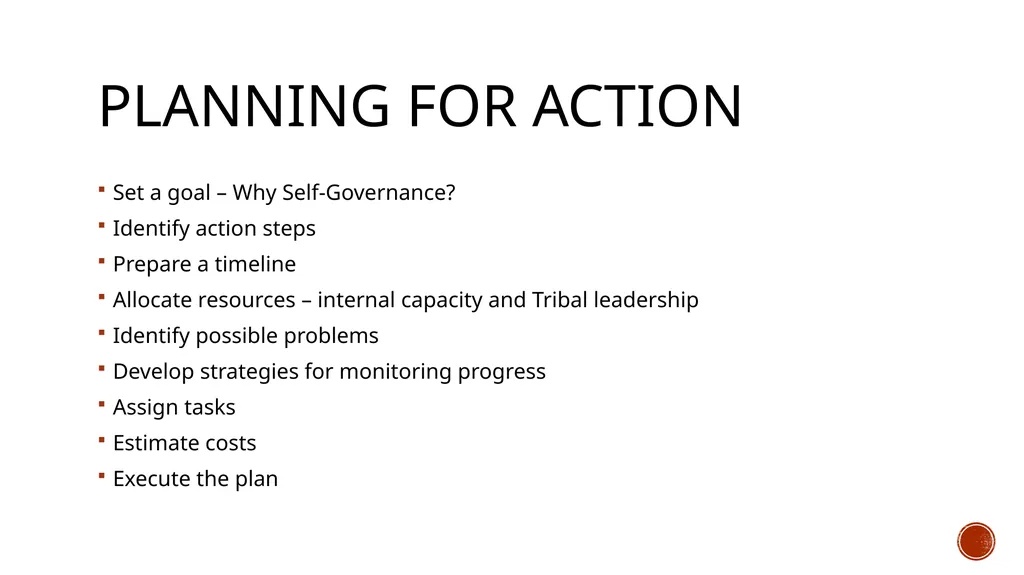
Developing an action or project plan planning for action Set a goal Why Self-Governance? Identify action steps Prepare a timeline Allocate resources internal capacity and Tribal leadership Identify possible problems Develop strategies
Related Topics
Share
Embed code
Download this presentation From Below
"Developing an action or project plan planning for" is the property of its rightful owner. Permission is granted to download and print the materials on this website for personal, non-commercial use only, and to display it on your personal computer provided you do not modify the materials and that you retain all copyright notices contained in the materials. By downloading content from our website, you accept the terms of this agreement.
Presentation Transcript
01
Developing an action or project plan<br>
02
planning for action Set a goal – Why Self-Governance?
Identify action steps
Prepare a timeline
Allocate resources – internal capacity and Tribal leadership
Identify possible problems
Develop strategies for monitoring progress
Assign tasks
Estimate costs
Execute the plan<br>
Identify action steps
Prepare a timeline
Allocate resources – internal capacity and Tribal leadership
Identify possible problems
Develop strategies for monitoring progress
Assign tasks
Estimate costs
Execute the plan<br>
03
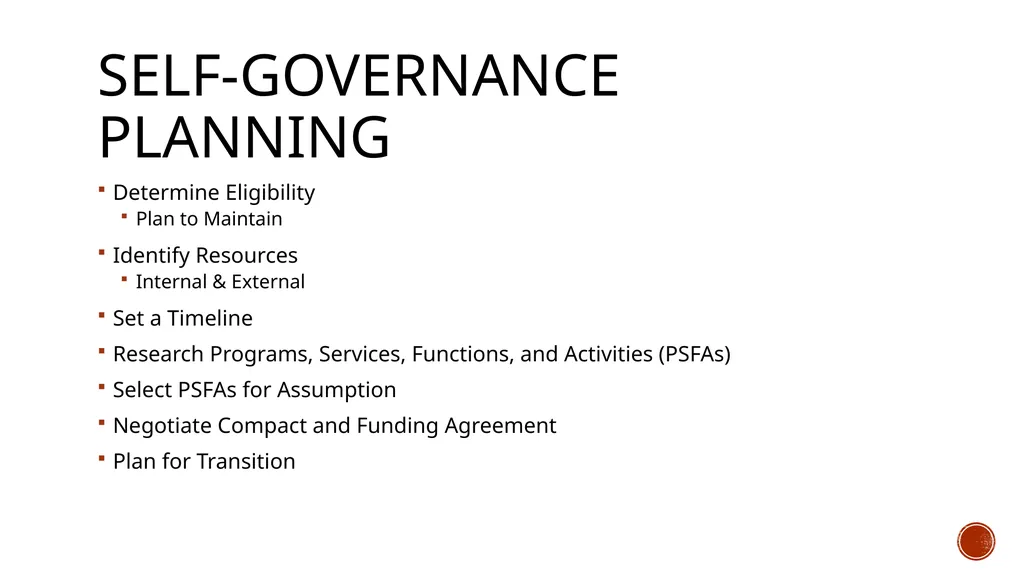
Self-Governance Planning Determine Eligibility
Plan to Maintain
Identify Resources
Internal & External
Set a Timeline
Research Programs, Services, Functions, and Activities (PSFAs)
Select PSFAs for Assumption
Negotiate Compact and Funding Agreement
Plan for Transition<br>
Plan to Maintain
Identify Resources
Internal & External
Set a Timeline
Research Programs, Services, Functions, and Activities (PSFAs)
Select PSFAs for Assumption
Negotiate Compact and Funding Agreement
Plan for Transition<br>
04
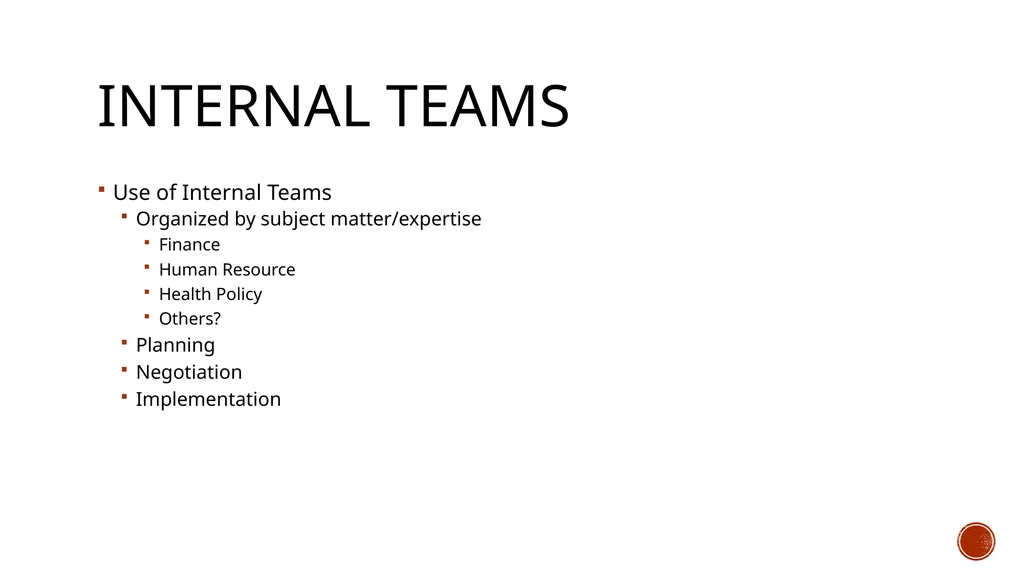
internal teams Use of Internal Teams
Organized by subject matter/expertise
Finance
Human Resource
Health Policy
Others?
Planning
Negotiation
Implementation<br>
Organized by subject matter/expertise
Finance
Human Resource
Health Policy
Others?
Planning
Negotiation
Implementation<br>
05
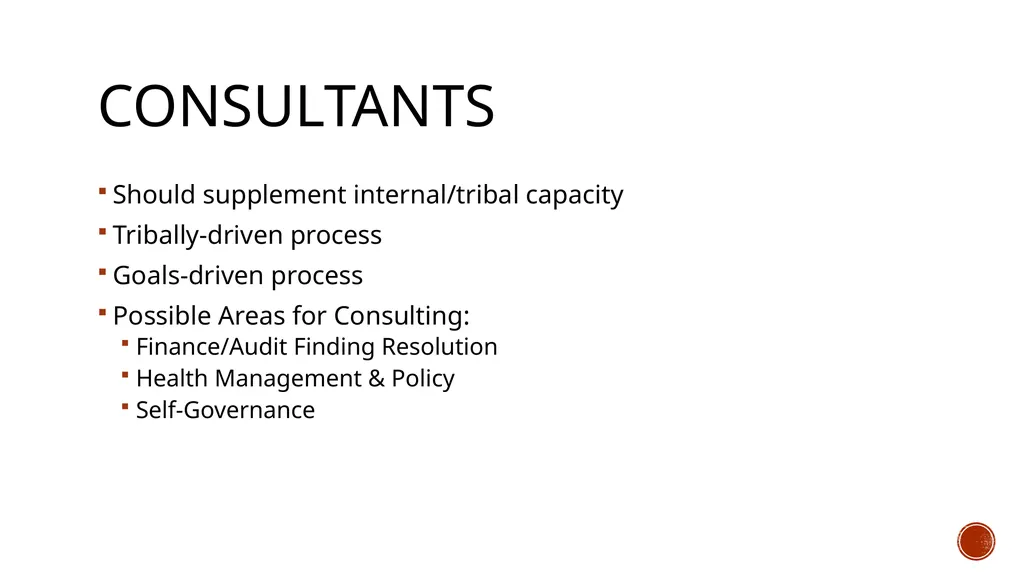
consultants Should supplement internal/tribal capacity
Tribally-driven process
Goals-driven process
Possible Areas for Consulting:
Finance/Audit Finding Resolution
Health Management & Policy
Self-Governance<br>
Tribally-driven process
Goals-driven process
Possible Areas for Consulting:
Finance/Audit Finding Resolution
Health Management & Policy
Self-Governance<br>
06
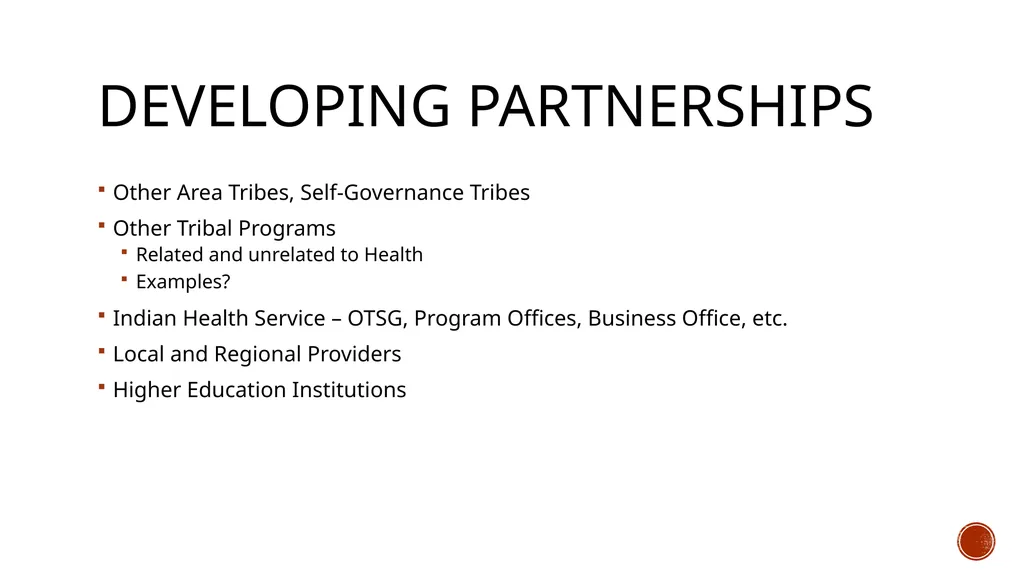
Developing partnerships Other Area Tribes, Self-Governance Tribes
Other Tribal Programs
Related and unrelated to Health
Examples?
Indian Health Service – OTSG, Program Offices, Business Office, etc.
Local and Regional Providers
Higher Education Institutions<br>
Other Tribal Programs
Related and unrelated to Health
Examples?
Indian Health Service – OTSG, Program Offices, Business Office, etc.
Local and Regional Providers
Higher Education Institutions<br>
07
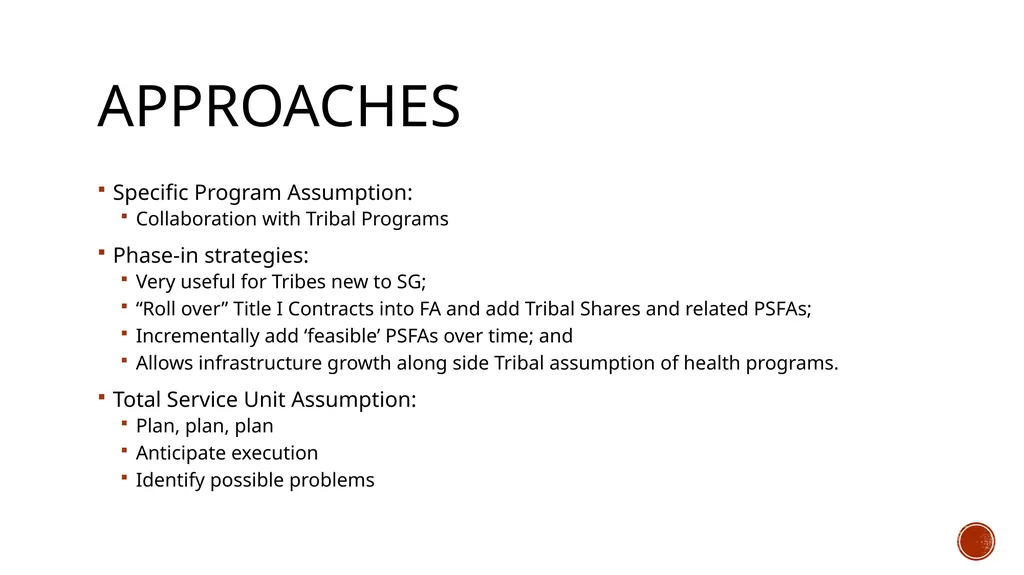
Approaches Specific Program Assumption:
Collaboration with Tribal Programs
Phase-in strategies:
Very useful for Tribes new to SG;
“Roll over” Title I Contracts into FA and add Tribal Shares and related PSFAs;
Incrementally add ‘feasible’ PSFAs over time; and
Allows infrastructure growth along side Tribal assumption of health programs.
Total Service Unit Assumption:
Plan, plan, plan
Anticipate execution
Identify possible problems<br>
Collaboration with Tribal Programs
Phase-in strategies:
Very useful for Tribes new to SG;
“Roll over” Title I Contracts into FA and add Tribal Shares and related PSFAs;
Incrementally add ‘feasible’ PSFAs over time; and
Allows infrastructure growth along side Tribal assumption of health programs.
Total Service Unit Assumption:
Plan, plan, plan
Anticipate execution
Identify possible problems<br>
08
Identifying programs, services, functions, and activities (psfas)<br>
09
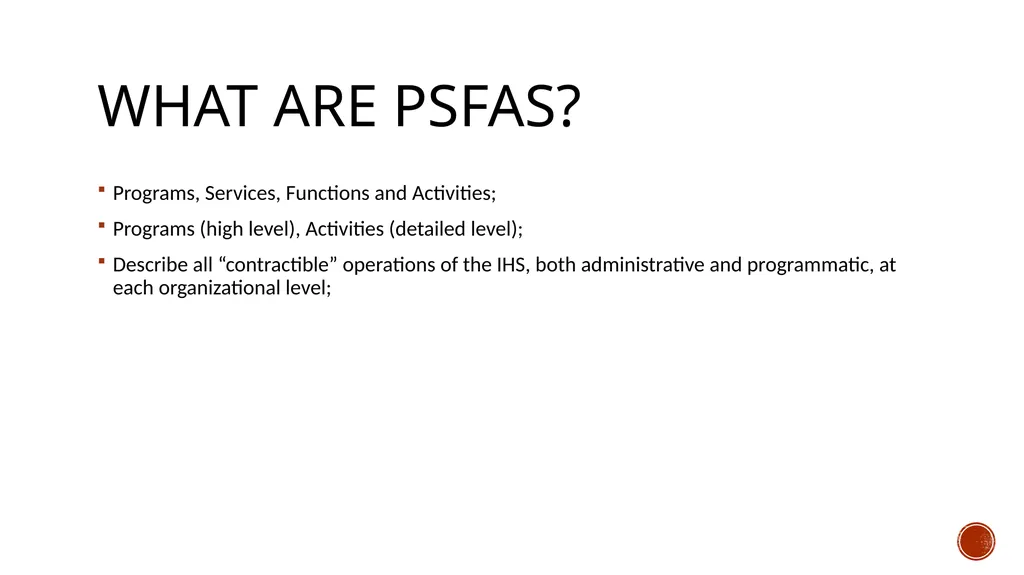
What are PSFAs? Programs, Services, Functions and Activities;
Programs (high level), Activities (detailed level);
Describe all “contractible” operations of the IHS, both administrative and programmatic, at each organizational level;<br>
Programs (high level), Activities (detailed level);
Describe all “contractible” operations of the IHS, both administrative and programmatic, at each organizational level;<br>
10
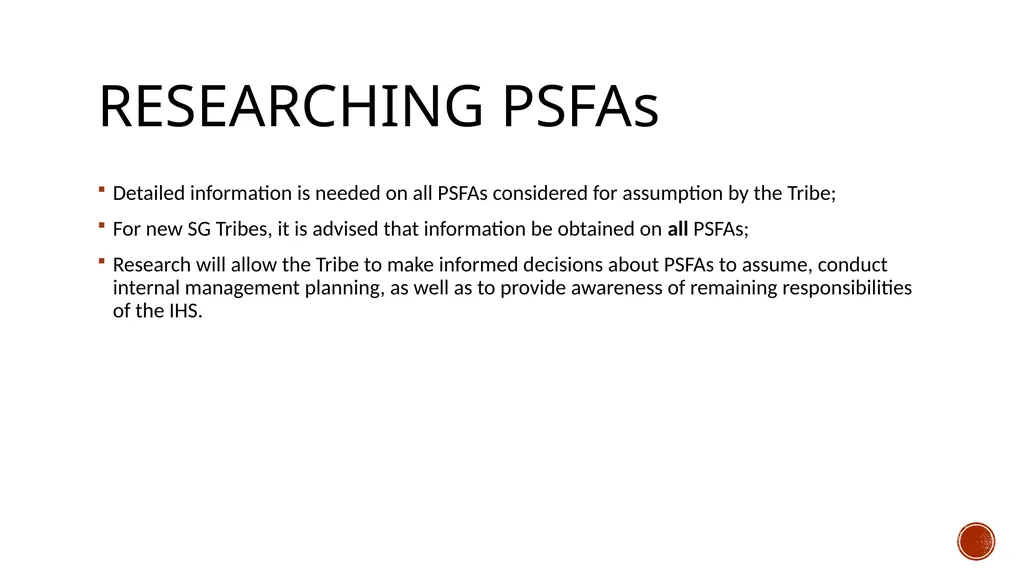
Researching psfas Detailed information is needed on all PSFAs considered for assumption by the Tribe;
For new SG Tribes, it is advised that information be obtained on all PSFAs;
Research will allow the Tribe to make informed decisions about PSFAs to assume, conduct internal management planning, as well as to provide awareness of remaining responsibilities of the IHS.<br>
For new SG Tribes, it is advised that information be obtained on all PSFAs;
Research will allow the Tribe to make informed decisions about PSFAs to assume, conduct internal management planning, as well as to provide awareness of remaining responsibilities of the IHS.<br>
11
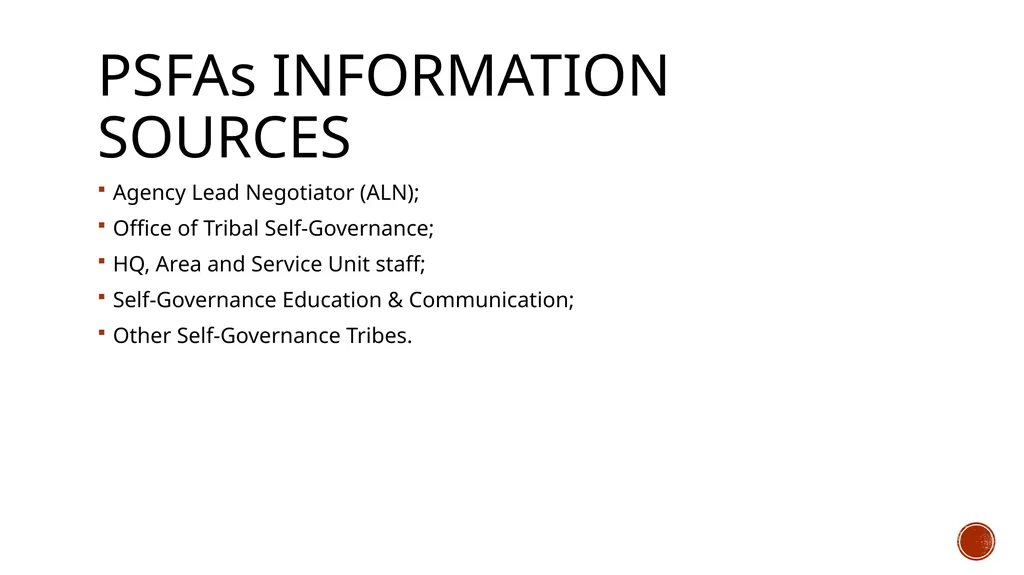
Psfas Information Sources Agency Lead Negotiator (ALN);
Office of Tribal Self-Governance;
HQ, Area and Service Unit staff;
Self-Governance Education & Communication;
Other Self-Governance Tribes.<br>
Office of Tribal Self-Governance;
HQ, Area and Service Unit staff;
Self-Governance Education & Communication;
Other Self-Governance Tribes.<br>
12
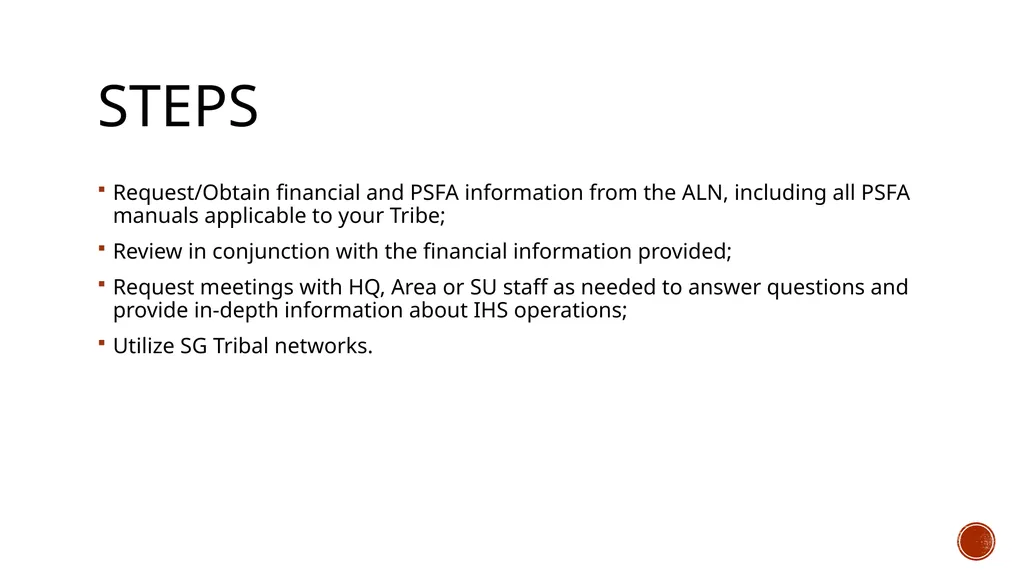
steps Request/Obtain financial and PSFA information from the ALN, including all PSFA manuals applicable to your Tribe;
Review in conjunction with the financial information provided;
Request meetings with HQ, Area or SU staff as needed to answer questions and provide in-depth information about IHS operations;
Utilize SG Tribal networks.<br>
Review in conjunction with the financial information provided;
Request meetings with HQ, Area or SU staff as needed to answer questions and provide in-depth information about IHS operations;
Utilize SG Tribal networks.<br>
13
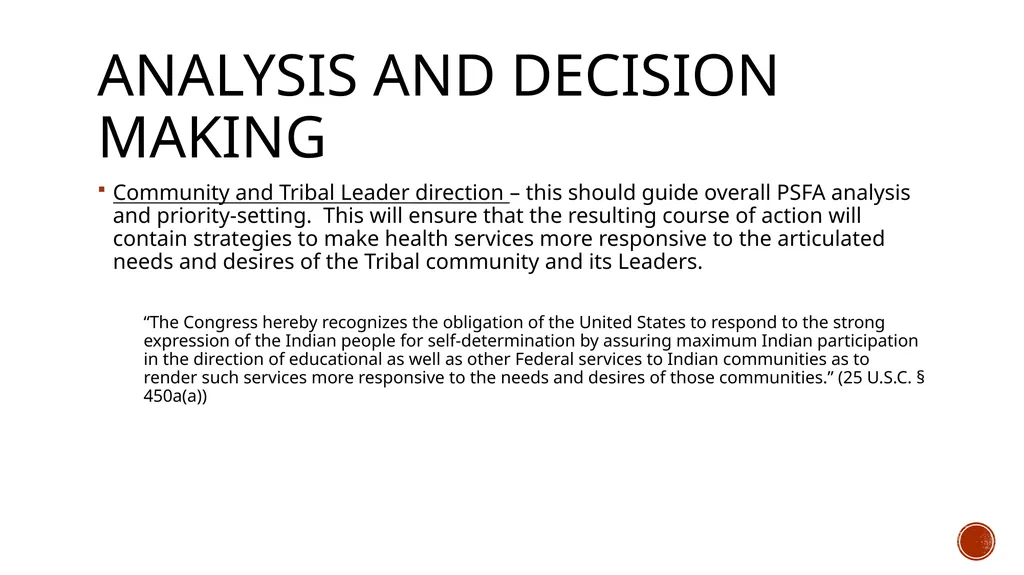
Analysis and decision making Community and Tribal Leader direction – this should guide overall PSFA analysis and priority-setting. This will ensure that the resulting course of action will contain strategies to make health services more responsive to the articulated needs and desires of the Tribal community and its Leaders.
“The Congress hereby recognizes the obligation of the United States to respond to the strong expression of the Indian people for self-determination by assuring maximum Indian participation in the direction of educational as well as other Federal services to Indian communities as to render such services more responsive to the needs and desires of those communities.” (25 U.S.C. § 450a(a))<br>
“The Congress hereby recognizes the obligation of the United States to respond to the strong expression of the Indian people for self-determination by assuring maximum Indian participation in the direction of educational as well as other Federal services to Indian communities as to render such services more responsive to the needs and desires of those communities.” (25 U.S.C. § 450a(a))<br>
14
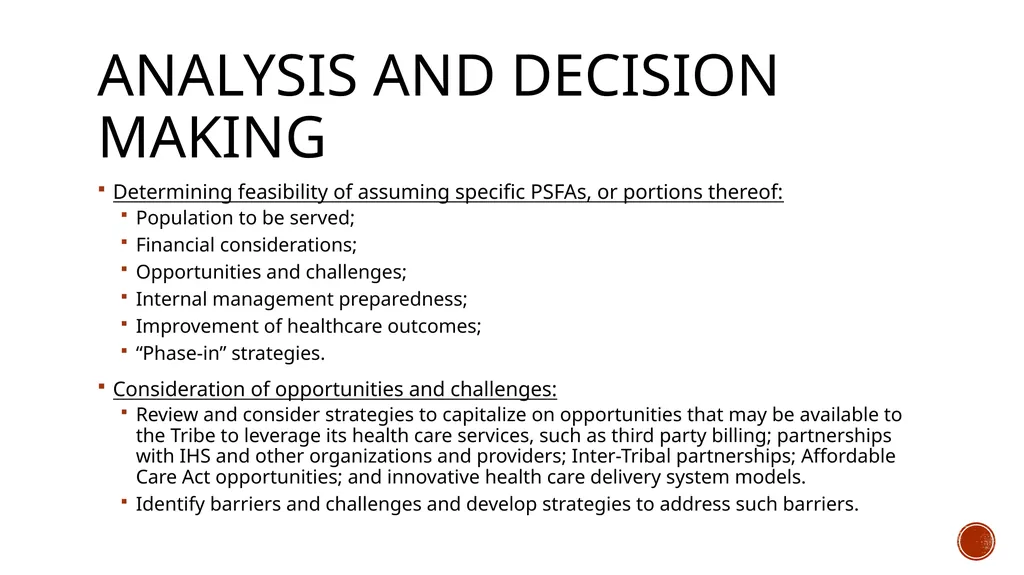
Analysis and decision making Determining feasibility of assuming specific PSFAs, or portions thereof:
Population to be served;
Financial considerations;
Opportunities and challenges;
Internal management preparedness;
Improvement of healthcare outcomes;
“Phase-in” strategies.
Consideration of opportunities and challenges:
Review and consider strategies to capitalize on opportunities that may be available to the Tribe to leverage its health care services, such as third party billing; partnerships with IHS and other organizations and providers; Inter-Tribal partnerships; Affordable Care Act opportunities; and innovative health care delivery system models.
Identify barriers and challenges and develop strategies to address such barriers.<br>
Population to be served;
Financial considerations;
Opportunities and challenges;
Internal management preparedness;
Improvement of healthcare outcomes;
“Phase-in” strategies.
Consideration of opportunities and challenges:
Review and consider strategies to capitalize on opportunities that may be available to the Tribe to leverage its health care services, such as third party billing; partnerships with IHS and other organizations and providers; Inter-Tribal partnerships; Affordable Care Act opportunities; and innovative health care delivery system models.
Identify barriers and challenges and develop strategies to address such barriers.<br>
15
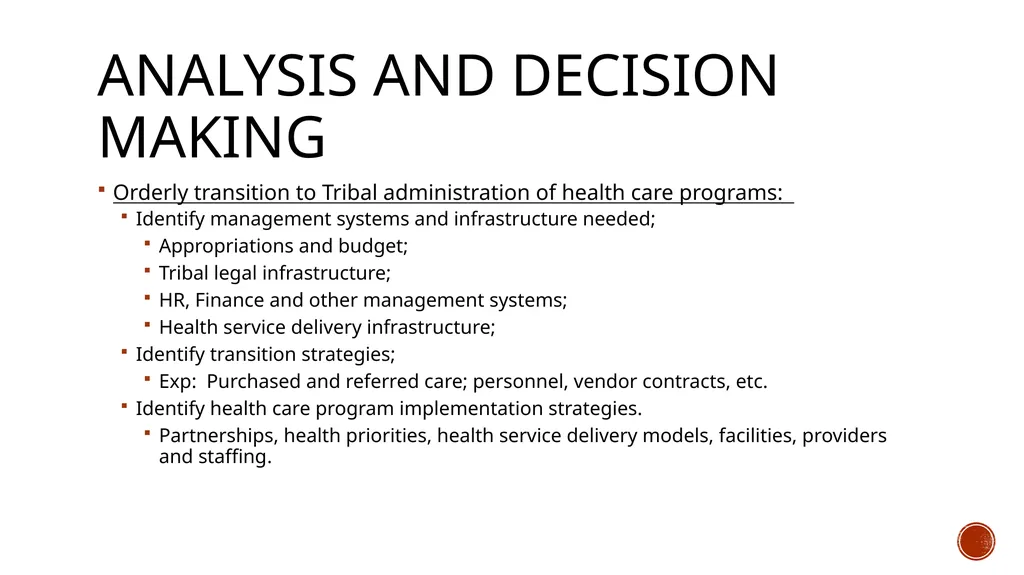
Analysis and decision making Orderly transition to Tribal administration of health care programs:
Identify management systems and infrastructure needed;
Appropriations and budget;
Tribal legal infrastructure;
HR, Finance and other management systems;
Health service delivery infrastructure;
Identify transition strategies;
Exp: Purchased and referred care; personnel, vendor contracts, etc.
Identify health care program implementation strategies.
Partnerships, health priorities, health service delivery models, facilities, providers and staffing.<br>
Identify management systems and infrastructure needed;
Appropriations and budget;
Tribal legal infrastructure;
HR, Finance and other management systems;
Health service delivery infrastructure;
Identify transition strategies;
Exp: Purchased and referred care; personnel, vendor contracts, etc.
Identify health care program implementation strategies.
Partnerships, health priorities, health service delivery models, facilities, providers and staffing.<br>
16
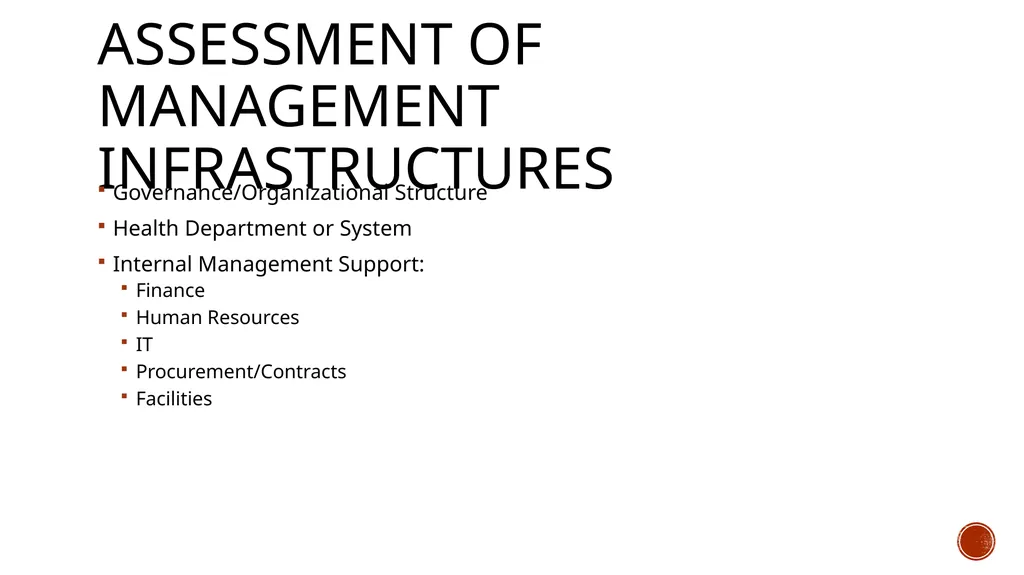
Assessment of management infrastructures Governance/Organizational Structure
Health Department or System
Internal Management Support:
Finance
Human Resources
IT
Procurement/Contracts
Facilities<br>
Health Department or System
Internal Management Support:
Finance
Human Resources
IT
Procurement/Contracts
Facilities<br>
17
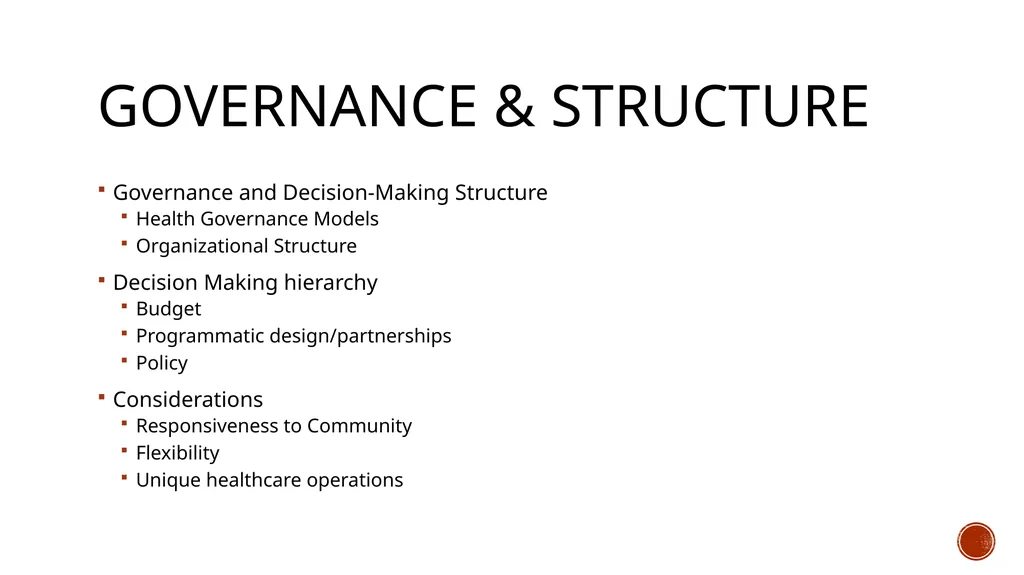
Governance & structure Governance and Decision-Making Structure
Health Governance Models
Organizational Structure
Decision Making hierarchy
Budget
Programmatic design/partnerships
Policy
Considerations
Responsiveness to Community
Flexibility
Unique healthcare operations<br>
Health Governance Models
Organizational Structure
Decision Making hierarchy
Budget
Programmatic design/partnerships
Policy
Considerations
Responsiveness to Community
Flexibility
Unique healthcare operations<br>
18
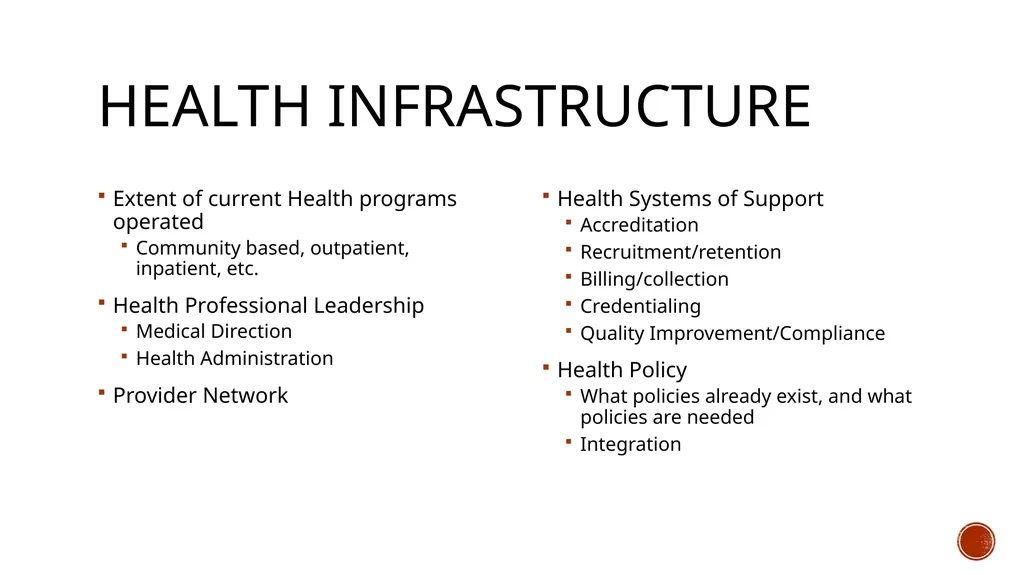
Health infrastructure Extent of current Health programs operated
Community based, outpatient, inpatient, etc.
Health Professional Leadership
Medical Direction
Health Administration
Provider Network Health Systems of Support
Accreditation
Recruitment/retention
Billing/collection
Credentialing
Quality Improvement/Compliance
Health Policy
What policies already exist, and what policies are needed
Integration<br>
Community based, outpatient, inpatient, etc.
Health Professional Leadership
Medical Direction
Health Administration
Provider Network Health Systems of Support
Accreditation
Recruitment/retention
Billing/collection
Credentialing
Quality Improvement/Compliance
Health Policy
What policies already exist, and what policies are needed
Integration<br>
19
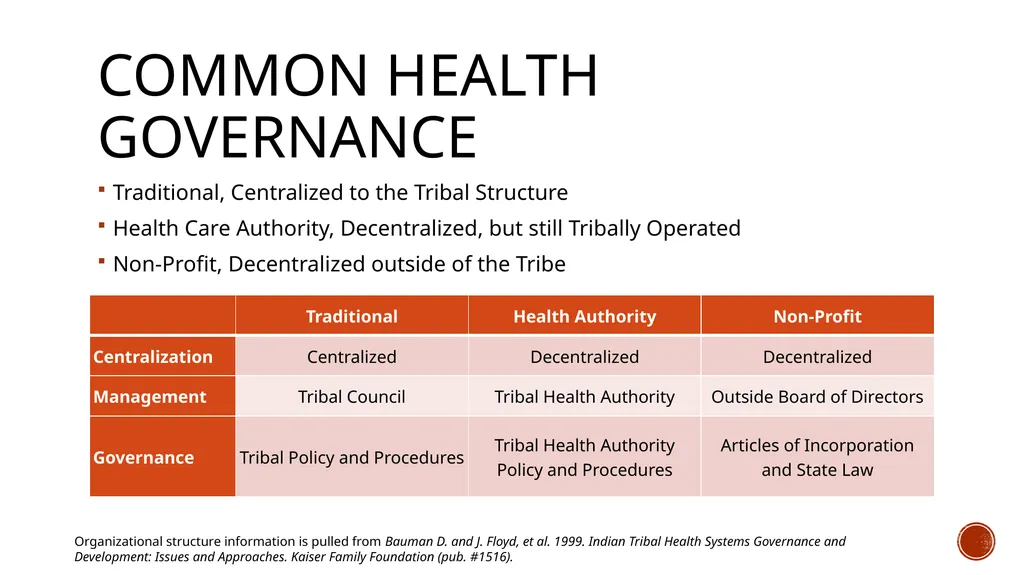
Common health governance Traditional, Centralized to the Tribal Structure
Health Care Authority, Decentralized, but still Tribally Operated
Non-Profit, Decentralized outside of the Tribe Organizational structure information is pulled from Bauman D. and J. Floyd, et al. 1999. Indian Tribal Health Systems Governance and Development: Issues and Approaches. Kaiser Family Foundation (pub. #1516).<br>
Health Care Authority, Decentralized, but still Tribally Operated
Non-Profit, Decentralized outside of the Tribe Organizational structure information is pulled from Bauman D. and J. Floyd, et al. 1999. Indian Tribal Health Systems Governance and Development: Issues and Approaches. Kaiser Family Foundation (pub. #1516).<br>
20
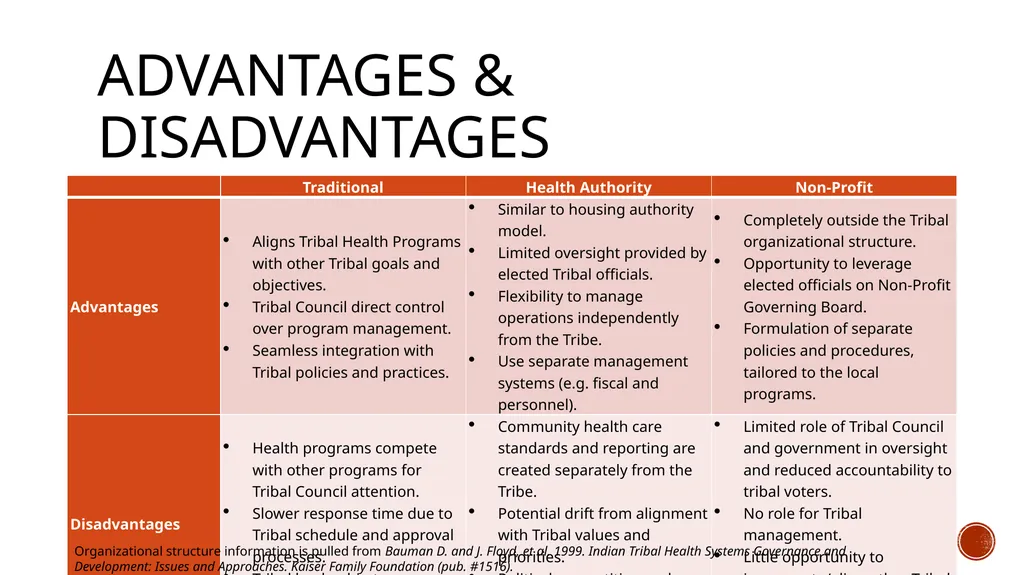
Advantages & disadvantages Organizational structure information is pulled from Bauman D. and J. Floyd, et al. 1999. Indian Tribal Health Systems Governance and Development: Issues and Approaches. Kaiser Family Foundation (pub. #1516).<br>
21
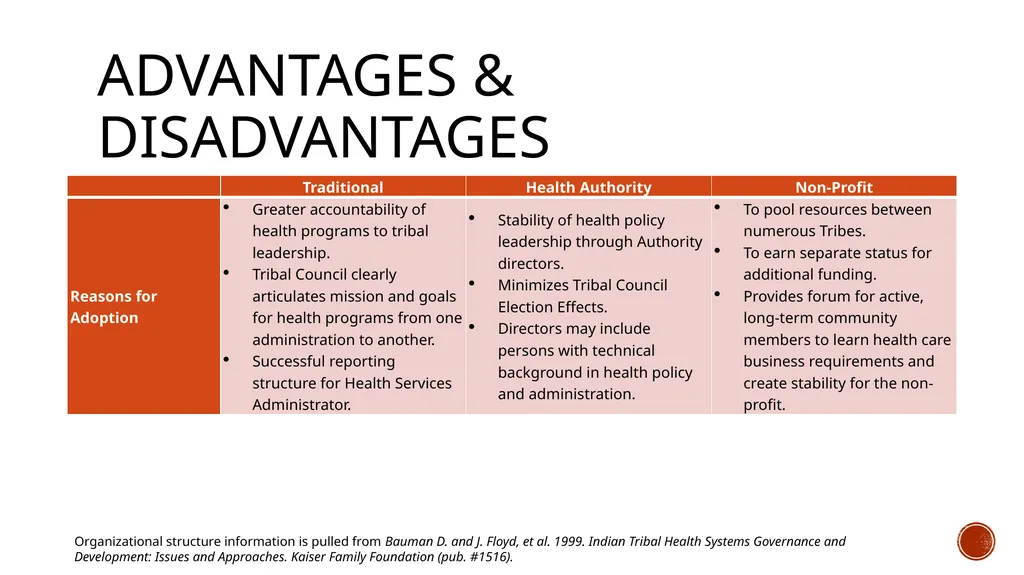
Advantages & disadvantages Organizational structure information is pulled from Bauman D. and J. Floyd, et al. 1999. Indian Tribal Health Systems Governance and Development: Issues and Approaches. Kaiser Family Foundation (pub. #1516).<br>
22
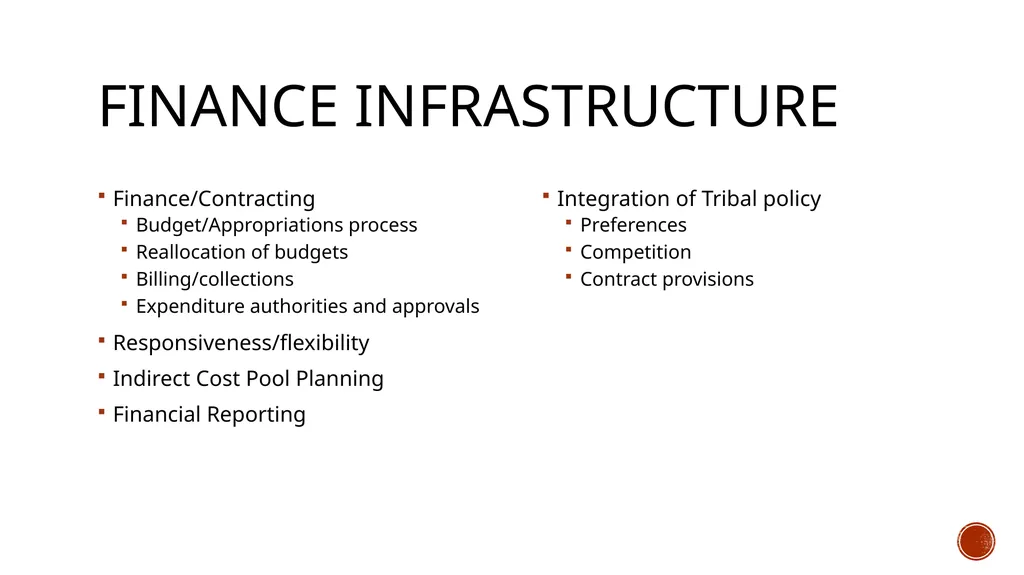
finance infrastructure Finance/Contracting
Budget/Appropriations process
Reallocation of budgets
Billing/collections
Expenditure authorities and approvals
Responsiveness/flexibility
Indirect Cost Pool Planning
Financial Reporting Integration of Tribal policy
Preferences
Competition
Contract provisions<br>
Budget/Appropriations process
Reallocation of budgets
Billing/collections
Expenditure authorities and approvals
Responsiveness/flexibility
Indirect Cost Pool Planning
Financial Reporting Integration of Tribal policy
Preferences
Competition
Contract provisions<br>
23
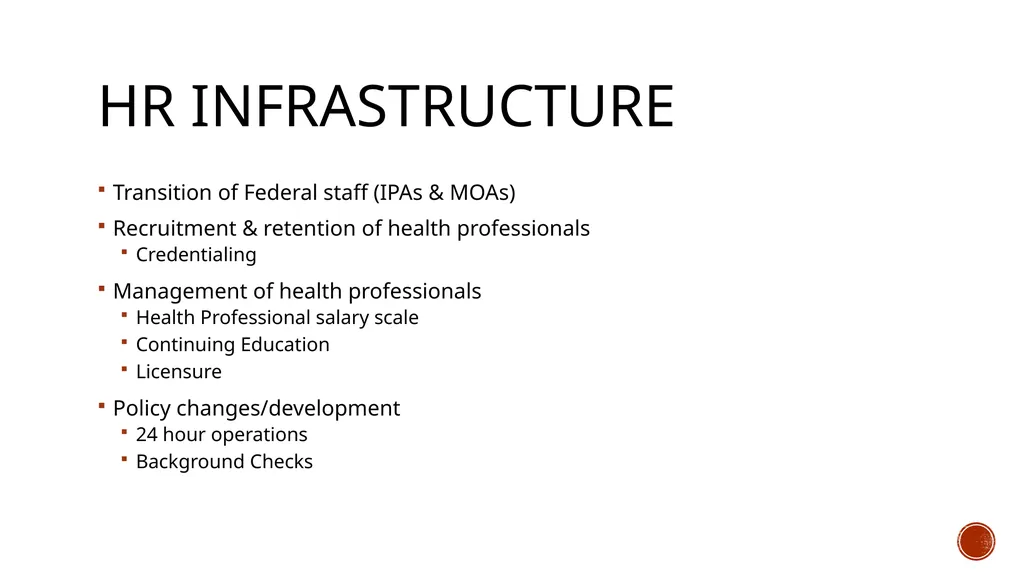
HR infrastructure Transition of Federal staff (IPAs & MOAs)
Recruitment & retention of health professionals
Credentialing
Management of health professionals
Health Professional salary scale
Continuing Education
Licensure
Policy changes/development
24 hour operations
Background Checks<br>
Recruitment & retention of health professionals
Credentialing
Management of health professionals
Health Professional salary scale
Continuing Education
Licensure
Policy changes/development
24 hour operations
Background Checks<br>
24
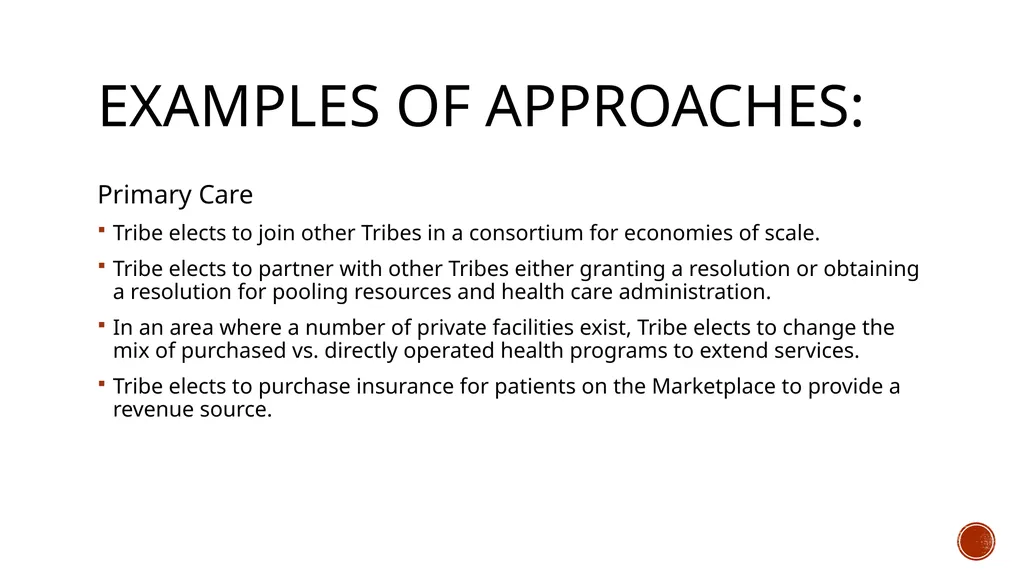
Examples of approaches: Primary Care
Tribe elects to join other Tribes in a consortium for economies of scale.
Tribe elects to partner with other Tribes either granting a resolution or obtaining a resolution for pooling resources and health care administration.
In an area where a number of private facilities exist, Tribe elects to change the mix of purchased vs. directly operated health programs to extend services.
Tribe elects to purchase insurance for patients on the Marketplace to provide a revenue source.<br>
Tribe elects to join other Tribes in a consortium for economies of scale.
Tribe elects to partner with other Tribes either granting a resolution or obtaining a resolution for pooling resources and health care administration.
In an area where a number of private facilities exist, Tribe elects to change the mix of purchased vs. directly operated health programs to extend services.
Tribe elects to purchase insurance for patients on the Marketplace to provide a revenue source.<br>
25
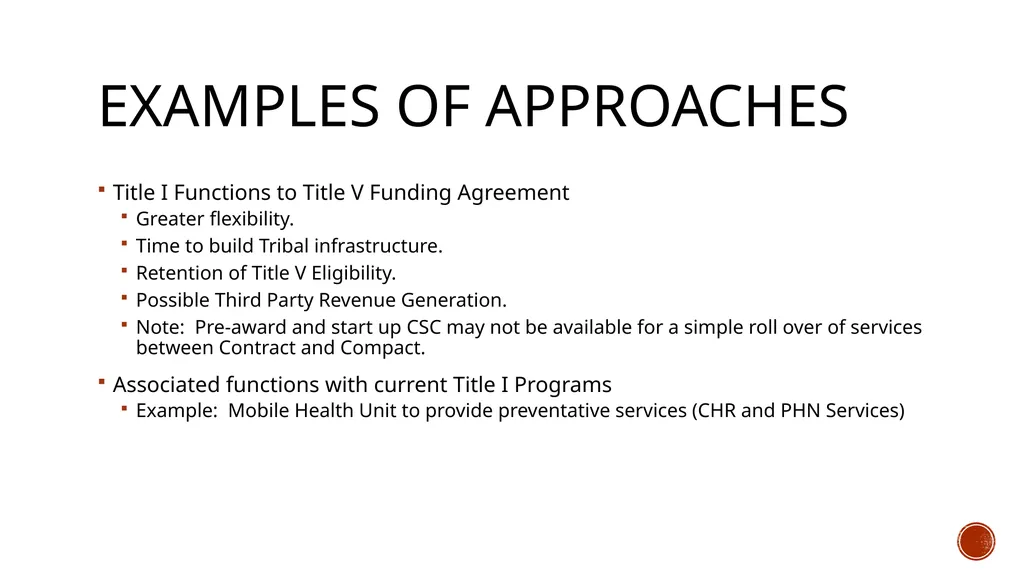
Examples of approaches Title I Functions to Title V Funding Agreement
Greater flexibility.
Time to build Tribal infrastructure.
Retention of Title V Eligibility.
Possible Third Party Revenue Generation.
Note: Pre-award and start up CSC may not be available for a simple roll over of services between Contract and Compact.
Associated functions with current Title I Programs
Example: Mobile Health Unit to provide preventative services (CHR and PHN Services)<br>
Greater flexibility.
Time to build Tribal infrastructure.
Retention of Title V Eligibility.
Possible Third Party Revenue Generation.
Note: Pre-award and start up CSC may not be available for a simple roll over of services between Contract and Compact.
Associated functions with current Title I Programs
Example: Mobile Health Unit to provide preventative services (CHR and PHN Services)<br>
26
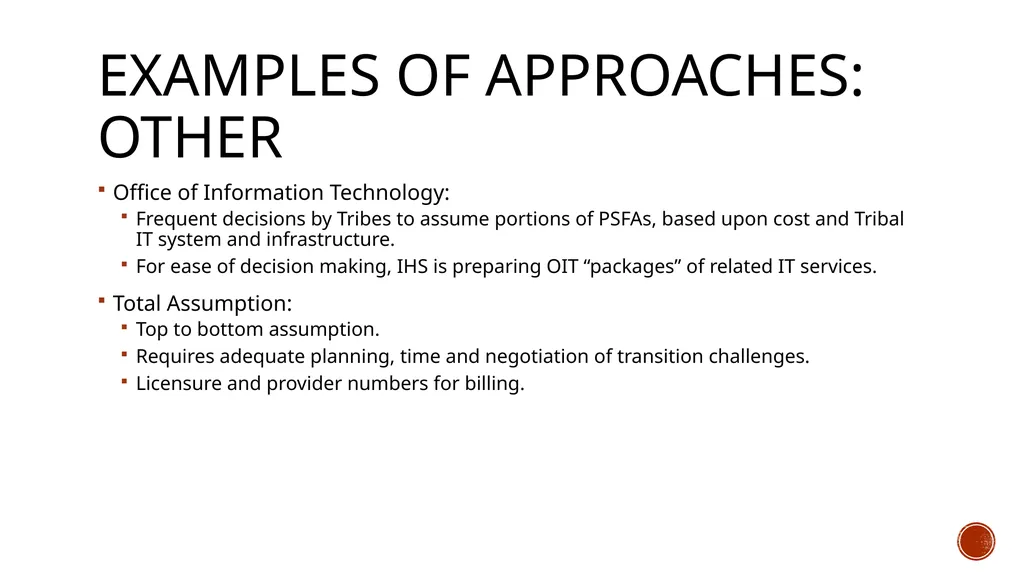
Examples of approaches: Other Office of Information Technology:
Frequent decisions by Tribes to assume portions of PSFAs, based upon cost and Tribal IT system and infrastructure.
For ease of decision making, IHS is preparing OIT “packages” of related IT services.
Total Assumption:
Top to bottom assumption.
Requires adequate planning, time and negotiation of transition challenges.
Licensure and provider numbers for billing.<br>
Frequent decisions by Tribes to assume portions of PSFAs, based upon cost and Tribal IT system and infrastructure.
For ease of decision making, IHS is preparing OIT “packages” of related IT services.
Total Assumption:
Top to bottom assumption.
Requires adequate planning, time and negotiation of transition challenges.
Licensure and provider numbers for billing.<br>
27
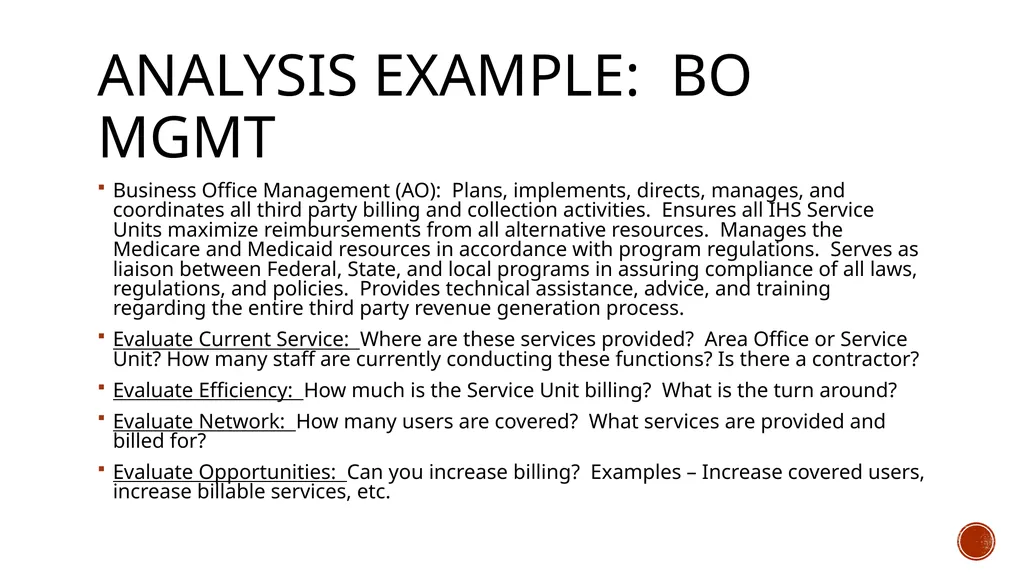
Analysis example: BO Mgmt Business Office Management (AO): Plans, implements, directs, manages, and coordinates all third party billing and collection activities. Ensures all IHS Service Units maximize reimbursements from all alternative resources. Manages the Medicare and Medicaid resources in accordance with program regulations. Serves as liaison between Federal, State, and local programs in assuring compliance of all laws, regulations, and policies. Provides technical assistance, advice, and training regarding the entire third party revenue generation process.
Evaluate Current Service: Where are these services provided? Area Office or Service Unit? How many staff are currently conducting these functions? Is there a contractor?
Evaluate Efficiency: How much is the Service Unit billing? What is the turn around?
Evaluate Network: How many users are covered? What services are provided and billed for?
Evaluate Opportunities: Can you increase billing? Examples – Increase covered users, increase billable services, etc.<br>
Evaluate Current Service: Where are these services provided? Area Office or Service Unit? How many staff are currently conducting these functions? Is there a contractor?
Evaluate Efficiency: How much is the Service Unit billing? What is the turn around?
Evaluate Network: How many users are covered? What services are provided and billed for?
Evaluate Opportunities: Can you increase billing? Examples – Increase covered users, increase billable services, etc.<br>
28
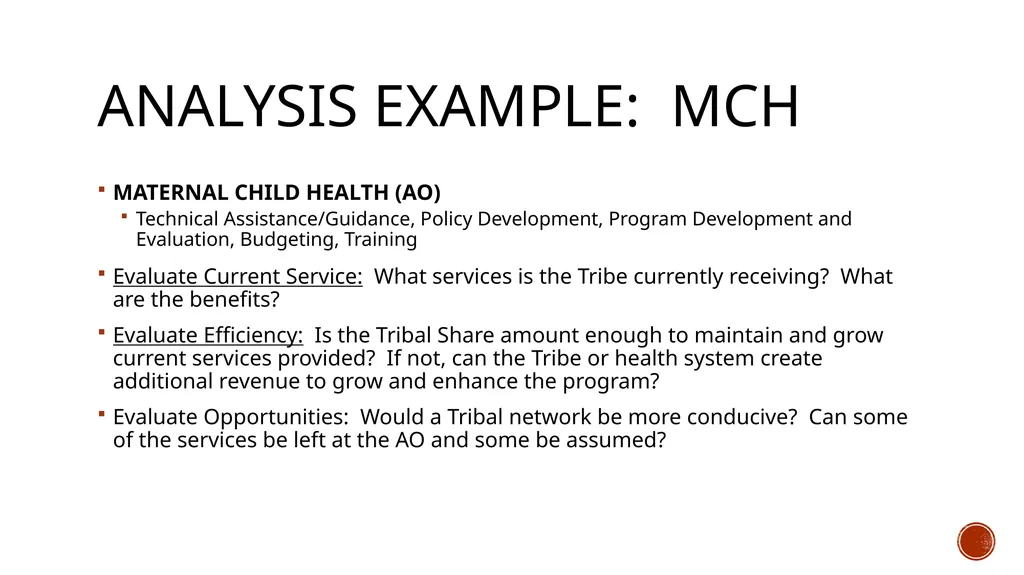
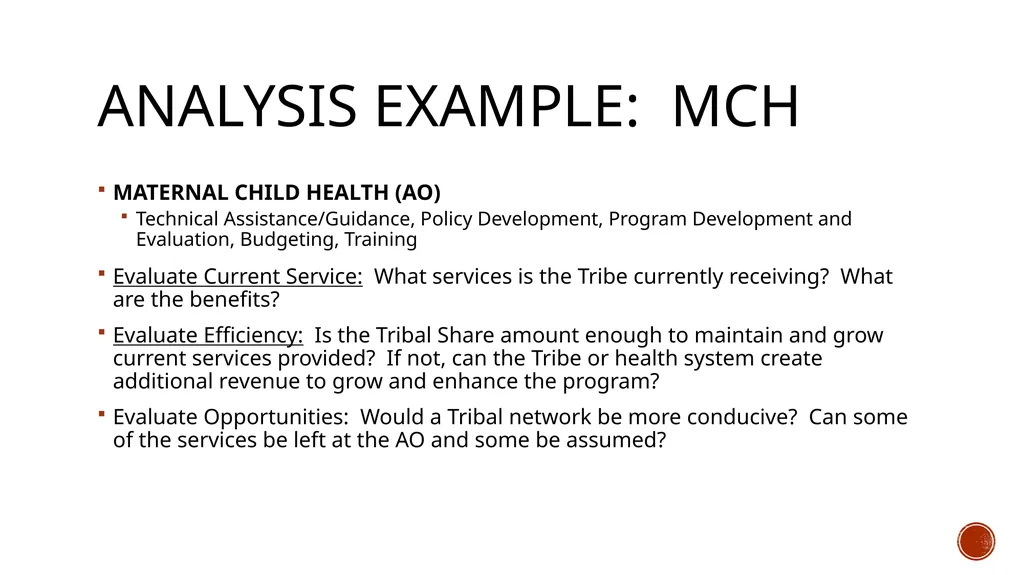
ANALYSIS Example: MCH MATERNAL CHILD HEALTH (AO)
Technical Assistance/Guidance, Policy Development, Program Development and Evaluation, Budgeting, Training
Evaluate Current Service: What services is the Tribe currently receiving? What are the benefits?
Evaluate Efficiency: Is the Tribal Share amount enough to maintain and grow current services provided? If not, can the Tribe or health system create additional revenue to grow and enhance the program?
Evaluate Opportunities: Would a Tribal network be more conducive? Can some of the services be left at the AO and some be assumed?<br>
Technical Assistance/Guidance, Policy Development, Program Development and Evaluation, Budgeting, Training
Evaluate Current Service: What services is the Tribe currently receiving? What are the benefits?
Evaluate Efficiency: Is the Tribal Share amount enough to maintain and grow current services provided? If not, can the Tribe or health system create additional revenue to grow and enhance the program?
Evaluate Opportunities: Would a Tribal network be more conducive? Can some of the services be left at the AO and some be assumed?<br>
29
Self-Governance Negotiations
Tribal Best Practices<br>
30
What are you negotiating? 25 U.S.C. § 458aaa-4(b)(1):
“Each funding agreement…shall, as determined by the Indian tribe, authorize the Indian tribe to plan, conduct, consolidate, administer…all programs services, functions and activities (or portions thereof)…without regard to the agency or office of the Indian Health Service within which the program, service, function, or activity (or portion thereof) is performed.”<br>
“Each funding agreement…shall, as determined by the Indian tribe, authorize the Indian tribe to plan, conduct, consolidate, administer…all programs services, functions and activities (or portions thereof)…without regard to the agency or office of the Indian Health Service within which the program, service, function, or activity (or portion thereof) is performed.”<br>
31
What are you negotiating? Compact & Funding Agreement
Funding Agreement
Programs, Services, Functions and Activities (PSFAs)
Programs (high level) Activities (detailed level); and
Describe all “contractible” operations of the IHS, both administrative and programmatic, at each organizational level
FTCA coverage
Tribal Shares Associated with PSFAs
Intergovernmental Personnel Agreements and Memorandum of Agreements
Transition Issues<br>
Funding Agreement
Programs, Services, Functions and Activities (PSFAs)
Programs (high level) Activities (detailed level); and
Describe all “contractible” operations of the IHS, both administrative and programmatic, at each organizational level
FTCA coverage
Tribal Shares Associated with PSFAs
Intergovernmental Personnel Agreements and Memorandum of Agreements
Transition Issues<br>
32
Selecting the Tribal Negotiation Team Elected Tribal Leaders;
Tribal Leader or Designee with decision making authority (Lead Negotiator);
Financial representation;
Legal representation;
SG expert/SG coordinator;
Health programmatic staff;
Others based upon Tribal priorities.<br>
Tribal Leader or Designee with decision making authority (Lead Negotiator);
Financial representation;
Legal representation;
SG expert/SG coordinator;
Health programmatic staff;
Others based upon Tribal priorities.<br>
33
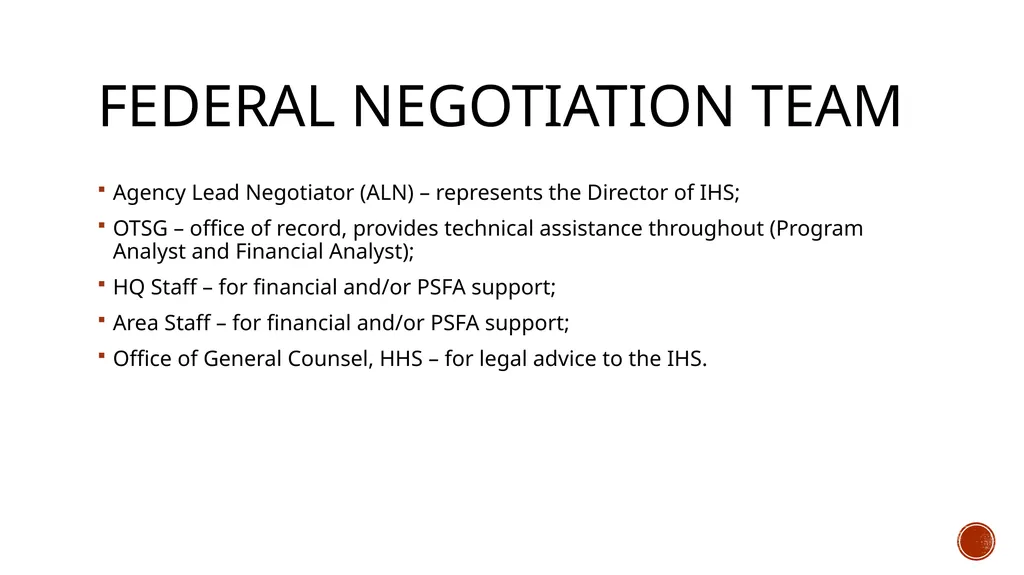
Federal Negotiation Team Agency Lead Negotiator (ALN) – represents the Director of IHS;
OTSG – office of record, provides technical assistance throughout (Program Analyst and Financial Analyst);
HQ Staff – for financial and/or PSFA support;
Area Staff – for financial and/or PSFA support;
Office of General Counsel, HHS – for legal advice to the IHS.<br>
OTSG – office of record, provides technical assistance throughout (Program Analyst and Financial Analyst);
HQ Staff – for financial and/or PSFA support;
Area Staff – for financial and/or PSFA support;
Office of General Counsel, HHS – for legal advice to the IHS.<br>
34
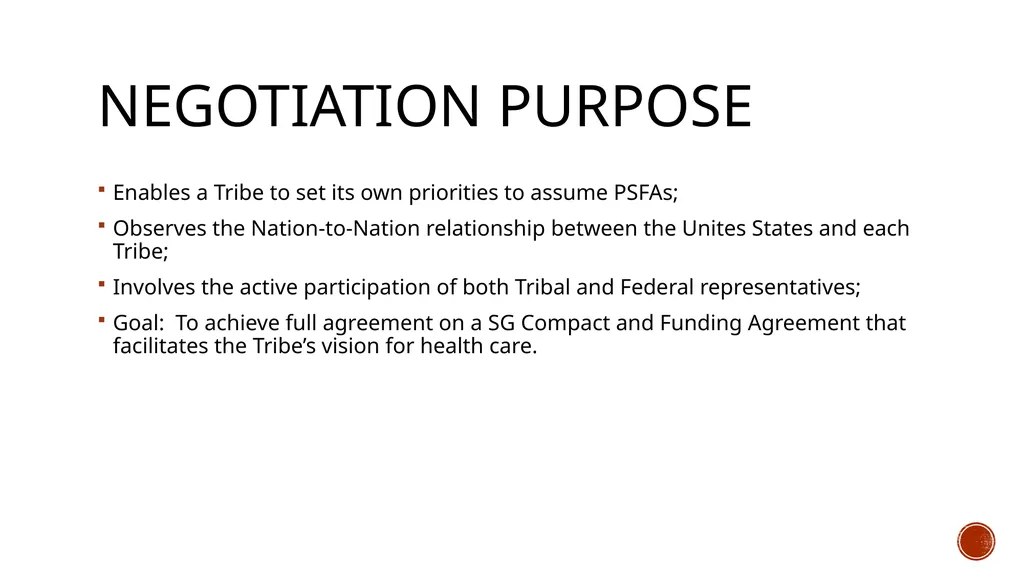
Negotiation Purpose Enables a Tribe to set its own priorities to assume PSFAs;
Observes the Nation-to-Nation relationship between the Unites States and each Tribe;
Involves the active participation of both Tribal and Federal representatives;
Goal: To achieve full agreement on a SG Compact and Funding Agreement that facilitates the Tribe’s vision for health care.<br>
Observes the Nation-to-Nation relationship between the Unites States and each Tribe;
Involves the active participation of both Tribal and Federal representatives;
Goal: To achieve full agreement on a SG Compact and Funding Agreement that facilitates the Tribe’s vision for health care.<br>
35
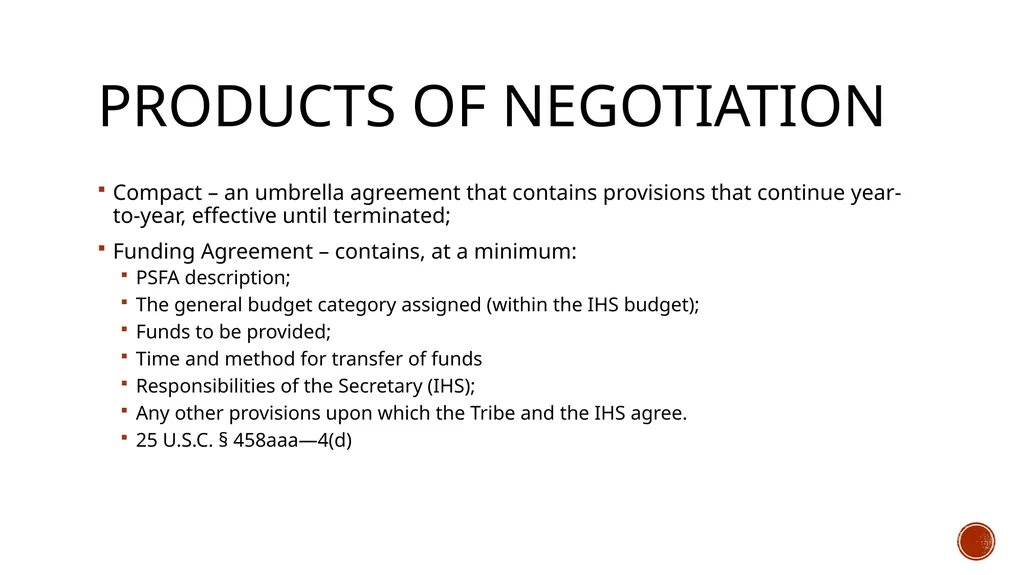
Products of Negotiation Compact – an umbrella agreement that contains provisions that continue year-to-year, effective until terminated;
Funding Agreement – contains, at a minimum:
PSFA description;
The general budget category assigned (within the IHS budget);
Funds to be provided;
Time and method for transfer of funds
Responsibilities of the Secretary (IHS);
Any other provisions upon which the Tribe and the IHS agree.
25 U.S.C. § 458aaa—4(d)<br>
Funding Agreement – contains, at a minimum:
PSFA description;
The general budget category assigned (within the IHS budget);
Funds to be provided;
Time and method for transfer of funds
Responsibilities of the Secretary (IHS);
Any other provisions upon which the Tribe and the IHS agree.
25 U.S.C. § 458aaa—4(d)<br>
36
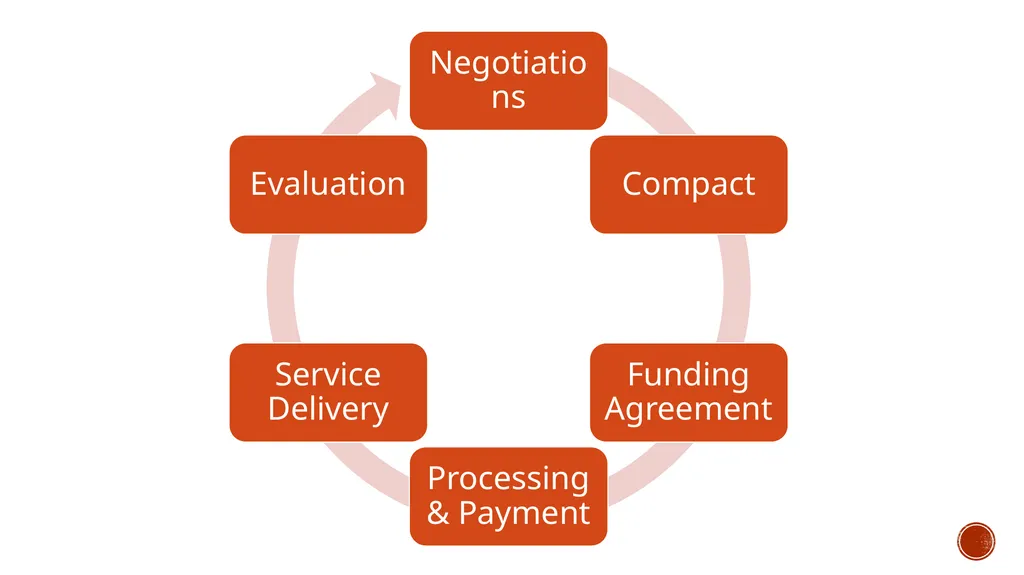
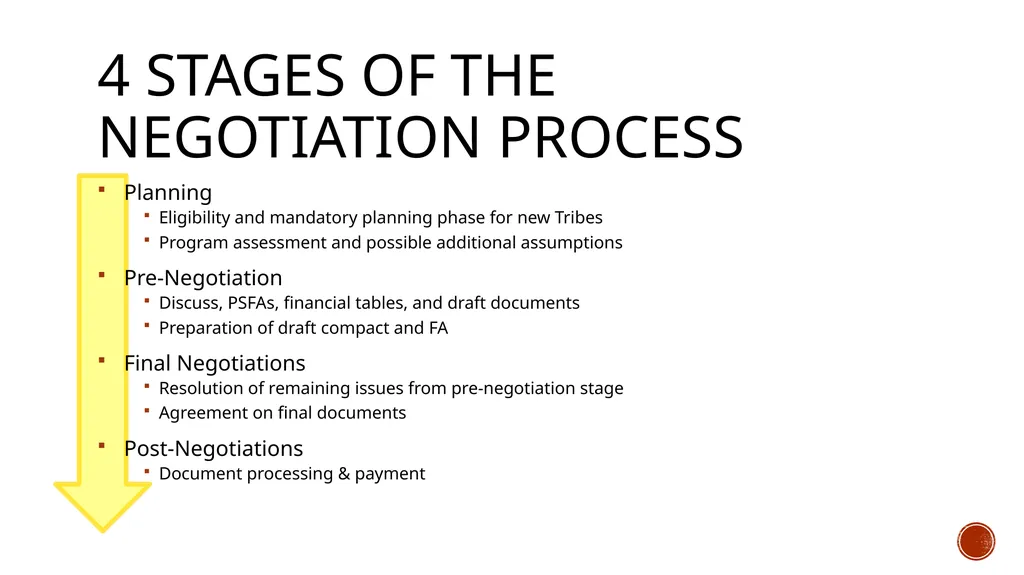
4 Stages of the Negotiation Process Planning
Eligibility and mandatory planning phase for new Tribes
Program assessment and possible additional assumptions
Pre-Negotiation
Discuss, PSFAs, financial tables, and draft documents
Preparation of draft compact and FA
Final Negotiations
Resolution of remaining issues from pre-negotiation stage
Agreement on final documents
Post-Negotiations
Document processing & payment<br>
Eligibility and mandatory planning phase for new Tribes
Program assessment and possible additional assumptions
Pre-Negotiation
Discuss, PSFAs, financial tables, and draft documents
Preparation of draft compact and FA
Final Negotiations
Resolution of remaining issues from pre-negotiation stage
Agreement on final documents
Post-Negotiations
Document processing & payment<br>
37
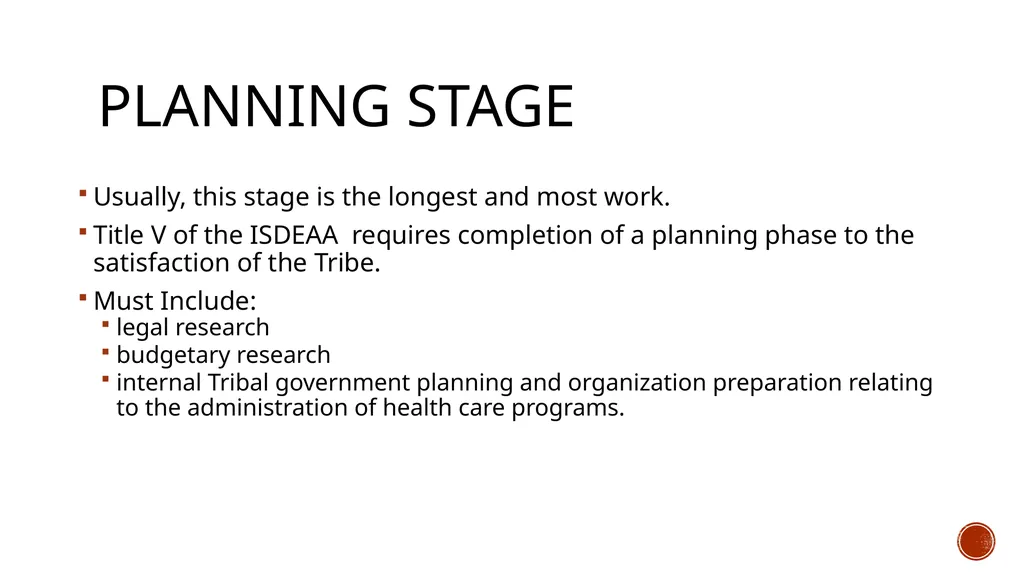
Planning stage Usually, this stage is the longest and most work.
Title V of the ISDEAA requires completion of a planning phase to the satisfaction of the Tribe.
Must Include:
legal research
budgetary research
internal Tribal government planning and organization preparation relating to the administration of health care programs.<br>
Title V of the ISDEAA requires completion of a planning phase to the satisfaction of the Tribe.
Must Include:
legal research
budgetary research
internal Tribal government planning and organization preparation relating to the administration of health care programs.<br>
38
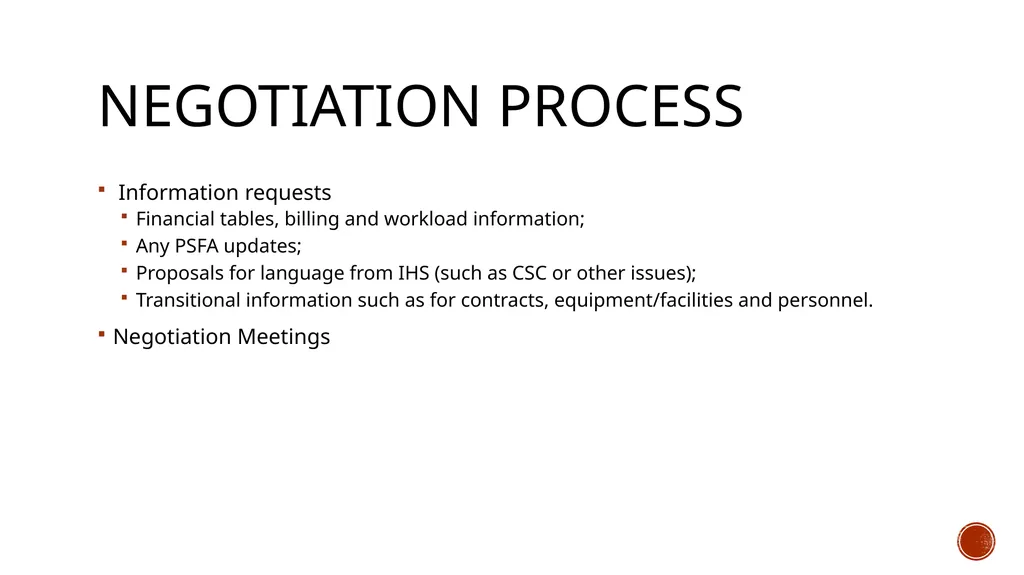
Negotiation Process Information requests
Financial tables, billing and workload information;
Any PSFA updates;
Proposals for language from IHS (such as CSC or other issues);
Transitional information such as for contracts, equipment/facilities and personnel.
Negotiation Meetings<br>
Financial tables, billing and workload information;
Any PSFA updates;
Proposals for language from IHS (such as CSC or other issues);
Transitional information such as for contracts, equipment/facilities and personnel.
Negotiation Meetings<br>
39
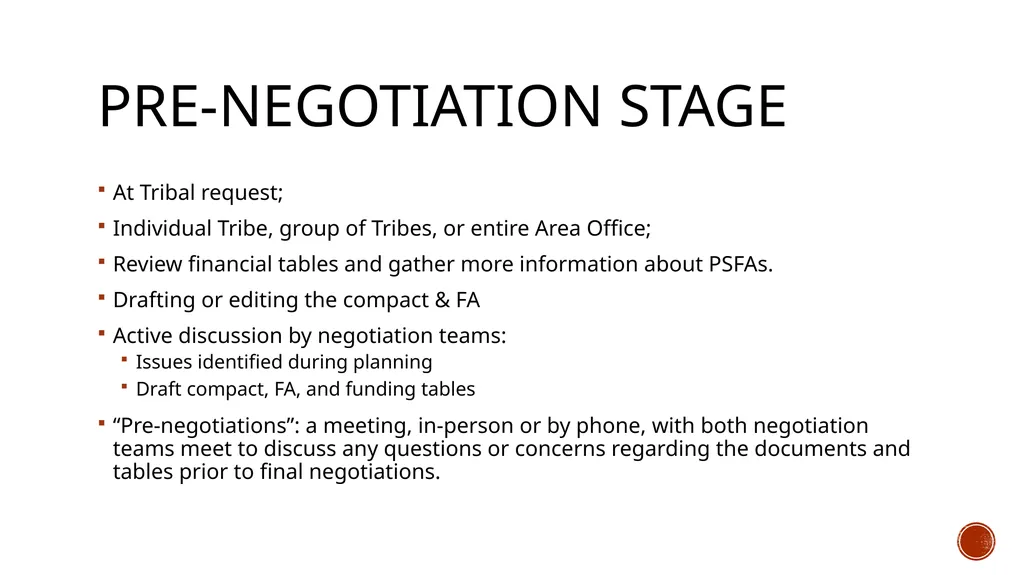
Pre-negotiation stage At Tribal request;
Individual Tribe, group of Tribes, or entire Area Office;
Review financial tables and gather more information about PSFAs.
Drafting or editing the compact & FA
Active discussion by negotiation teams:
Issues identified during planning
Draft compact, FA, and funding tables
“Pre-negotiations”: a meeting, in-person or by phone, with both negotiation teams meet to discuss any questions or concerns regarding the documents and tables prior to final negotiations.<br>
Individual Tribe, group of Tribes, or entire Area Office;
Review financial tables and gather more information about PSFAs.
Drafting or editing the compact & FA
Active discussion by negotiation teams:
Issues identified during planning
Draft compact, FA, and funding tables
“Pre-negotiations”: a meeting, in-person or by phone, with both negotiation teams meet to discuss any questions or concerns regarding the documents and tables prior to final negotiations.<br>
40
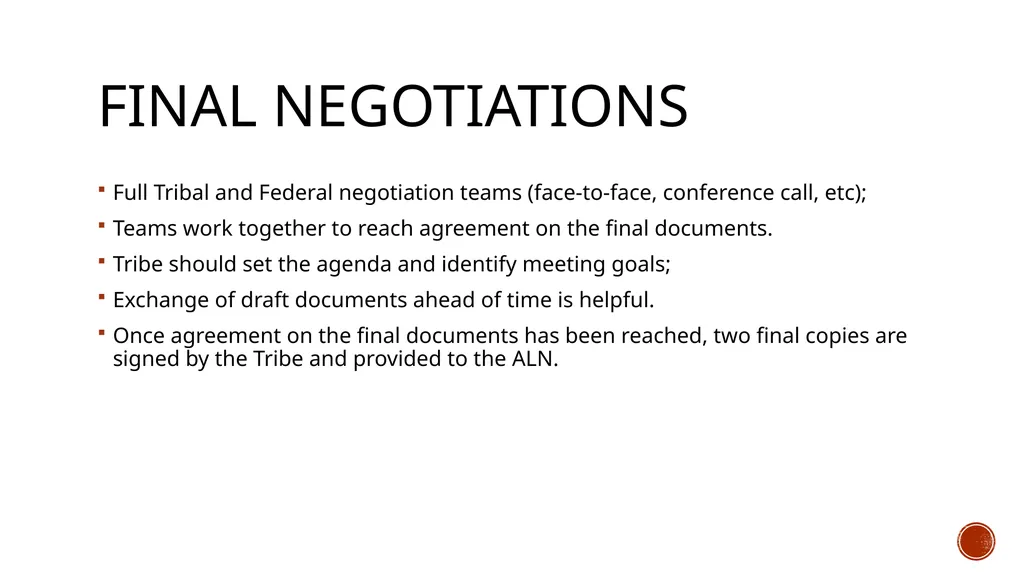
Final Negotiations Full Tribal and Federal negotiation teams (face-to-face, conference call, etc);
Teams work together to reach agreement on the final documents.
Tribe should set the agenda and identify meeting goals;
Exchange of draft documents ahead of time is helpful.
Once agreement on the final documents has been reached, two final copies are signed by the Tribe and provided to the ALN.<br>
Teams work together to reach agreement on the final documents.
Tribe should set the agenda and identify meeting goals;
Exchange of draft documents ahead of time is helpful.
Once agreement on the final documents has been reached, two final copies are signed by the Tribe and provided to the ALN.<br>
41
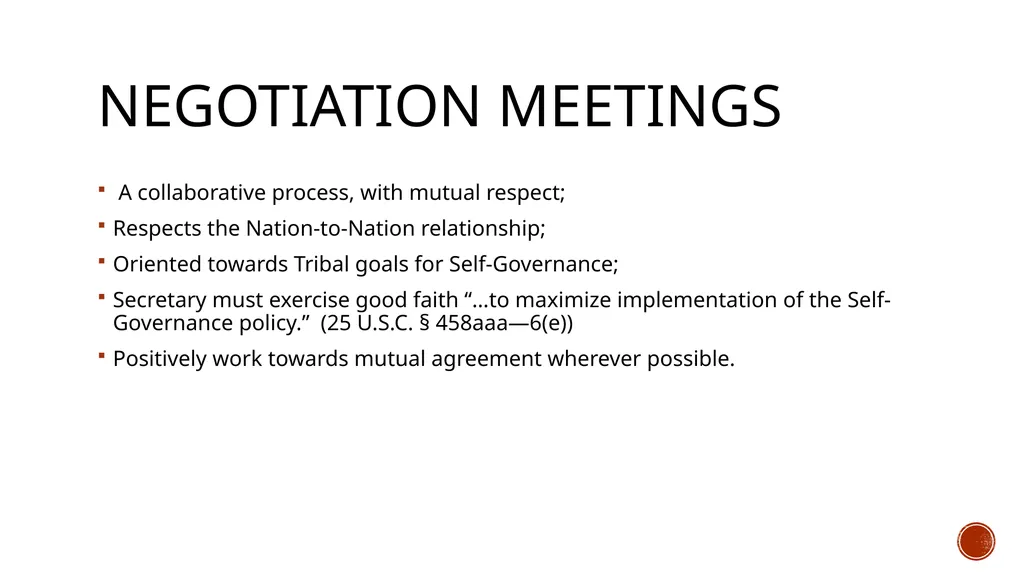
Negotiation Meetings A collaborative process, with mutual respect;
Respects the Nation-to-Nation relationship;
Oriented towards Tribal goals for Self-Governance;
Secretary must exercise good faith “…to maximize implementation of the Self-Governance policy.” (25 U.S.C. § 458aaa—6(e))
Positively work towards mutual agreement wherever possible.<br>
Respects the Nation-to-Nation relationship;
Oriented towards Tribal goals for Self-Governance;
Secretary must exercise good faith “…to maximize implementation of the Self-Governance policy.” (25 U.S.C. § 458aaa—6(e))
Positively work towards mutual agreement wherever possible.<br>
42
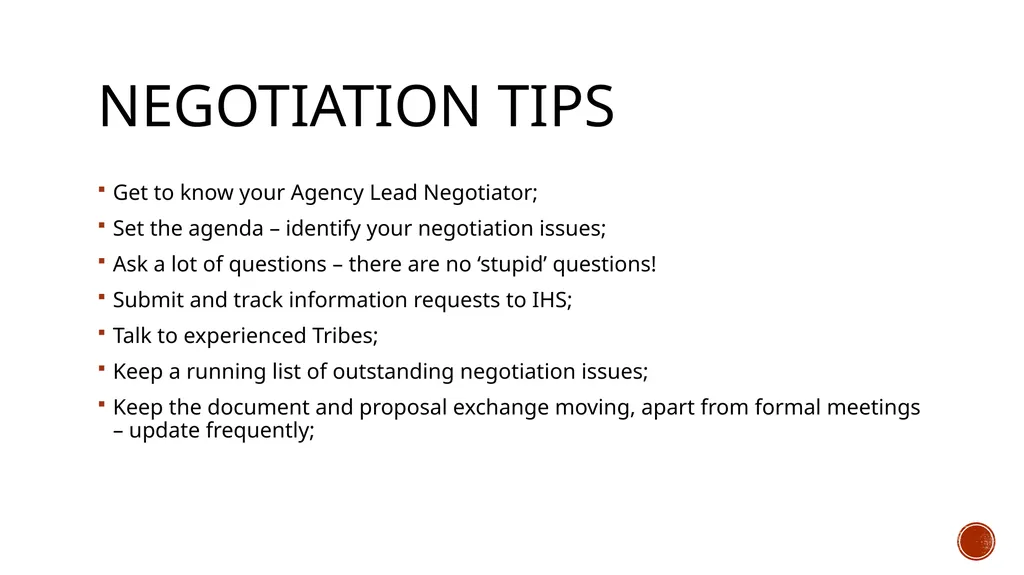
Negotiation Tips Get to know your Agency Lead Negotiator;
Set the agenda – identify your negotiation issues;
Ask a lot of questions – there are no ‘stupid’ questions!
Submit and track information requests to IHS;
Talk to experienced Tribes;
Keep a running list of outstanding negotiation issues;
Keep the document and proposal exchange moving, apart from formal meetings – update frequently;<br>
Set the agenda – identify your negotiation issues;
Ask a lot of questions – there are no ‘stupid’ questions!
Submit and track information requests to IHS;
Talk to experienced Tribes;
Keep a running list of outstanding negotiation issues;
Keep the document and proposal exchange moving, apart from formal meetings – update frequently;<br>
43
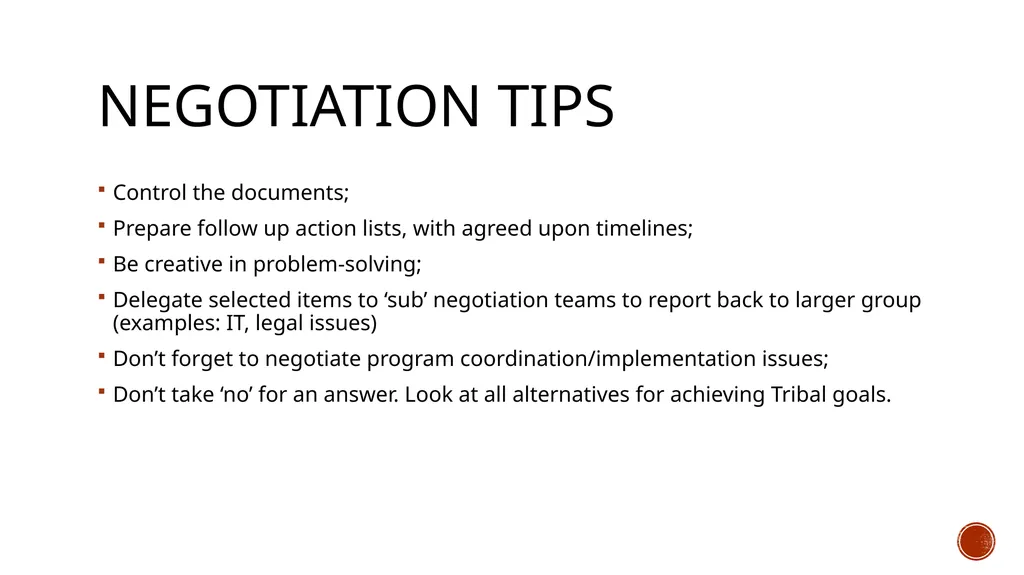
Negotiation Tips Control the documents;
Prepare follow up action lists, with agreed upon timelines;
Be creative in problem-solving;
Delegate selected items to ‘sub’ negotiation teams to report back to larger group (examples: IT, legal issues)
Don’t forget to negotiate program coordination/implementation issues;
Don’t take ‘no’ for an answer. Look at all alternatives for achieving Tribal goals.<br>
Prepare follow up action lists, with agreed upon timelines;
Be creative in problem-solving;
Delegate selected items to ‘sub’ negotiation teams to report back to larger group (examples: IT, legal issues)
Don’t forget to negotiate program coordination/implementation issues;
Don’t take ‘no’ for an answer. Look at all alternatives for achieving Tribal goals.<br>
44
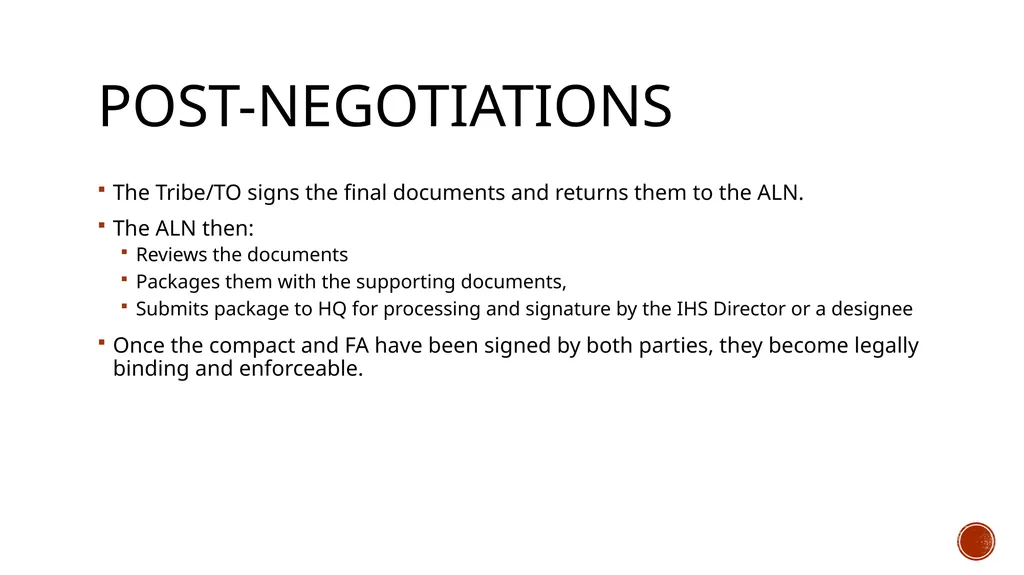
Post-Negotiations The Tribe/TO signs the final documents and returns them to the ALN.
The ALN then:
Reviews the documents
Packages them with the supporting documents,
Submits package to HQ for processing and signature by the IHS Director or a designee
Once the compact and FA have been signed by both parties, they become legally binding and enforceable.<br>
The ALN then:
Reviews the documents
Packages them with the supporting documents,
Submits package to HQ for processing and signature by the IHS Director or a designee
Once the compact and FA have been signed by both parties, they become legally binding and enforceable.<br>
45
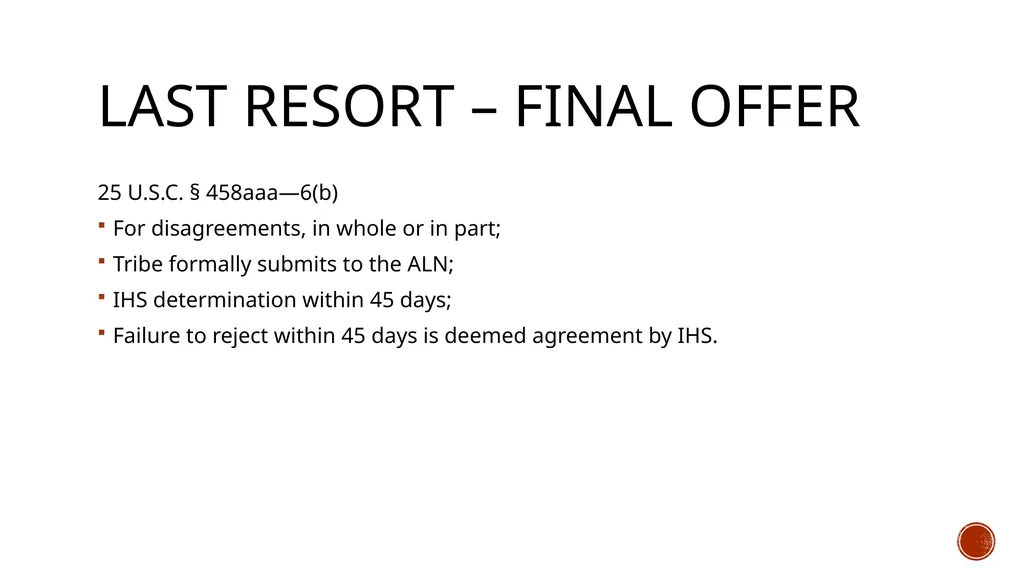
Last Resort – Final Offer 25 U.S.C. § 458aaa—6(b)
For disagreements, in whole or in part;
Tribe formally submits to the ALN;
IHS determination within 45 days;
Failure to reject within 45 days is deemed agreement by IHS.<br>
For disagreements, in whole or in part;
Tribe formally submits to the ALN;
IHS determination within 45 days;
Failure to reject within 45 days is deemed agreement by IHS.<br>
46
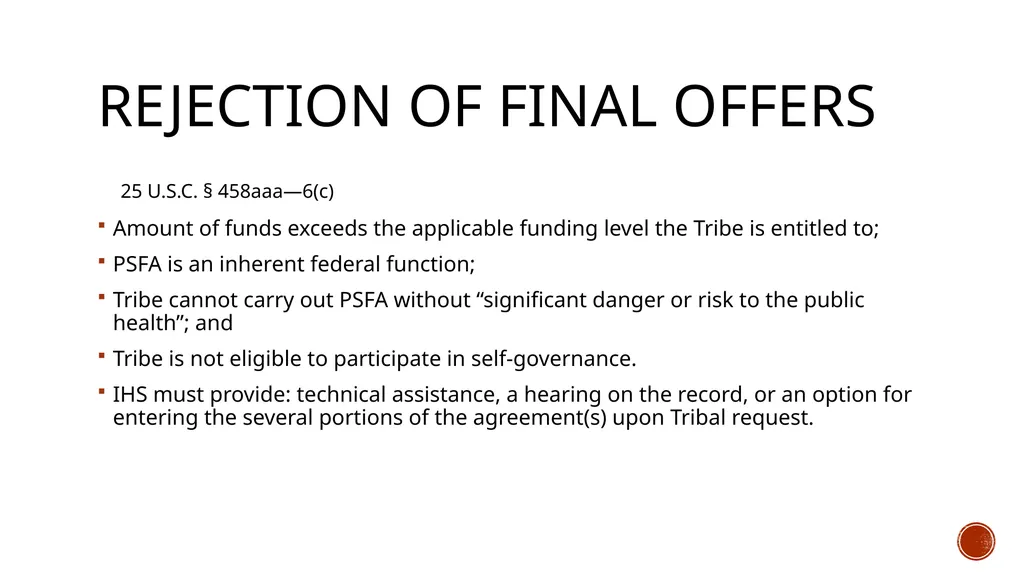
Rejection of Final Offers 25 U.S.C. § 458aaa—6(c)
Amount of funds exceeds the applicable funding level the Tribe is entitled to;
PSFA is an inherent federal function;
Tribe cannot carry out PSFA without “significant danger or risk to the public health”; and
Tribe is not eligible to participate in self-governance.
IHS must provide: technical assistance, a hearing on the record, or an option for entering the several portions of the agreement(s) upon Tribal request.<br>
Amount of funds exceeds the applicable funding level the Tribe is entitled to;
PSFA is an inherent federal function;
Tribe cannot carry out PSFA without “significant danger or risk to the public health”; and
Tribe is not eligible to participate in self-governance.
IHS must provide: technical assistance, a hearing on the record, or an option for entering the several portions of the agreement(s) upon Tribal request.<br>
47
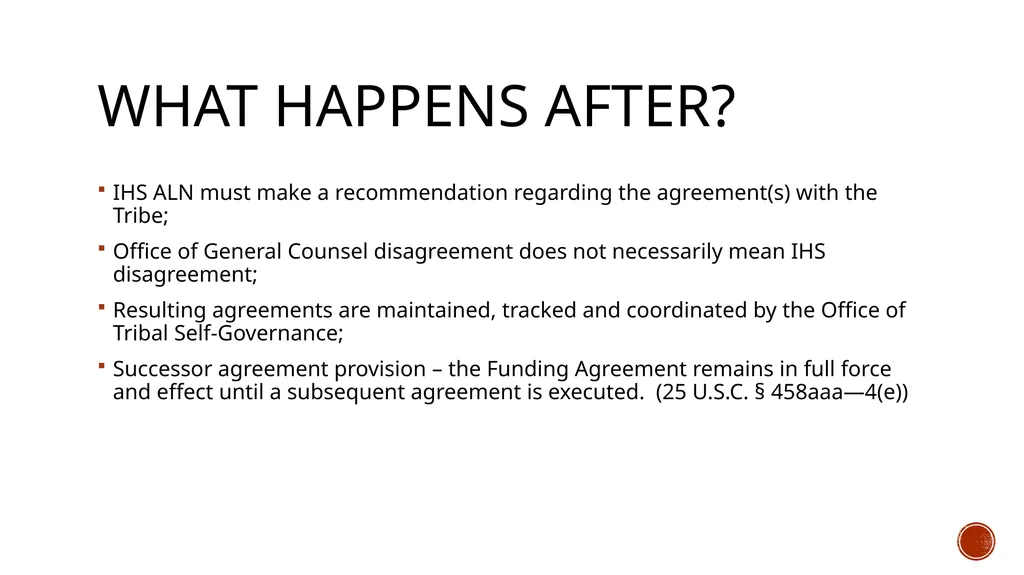
What Happens After? IHS ALN must make a recommendation regarding the agreement(s) with the Tribe;
Office of General Counsel disagreement does not necessarily mean IHS disagreement;
Resulting agreements are maintained, tracked and coordinated by the Office of Tribal Self-Governance;
Successor agreement provision – the Funding Agreement remains in full force and effect until a subsequent agreement is executed. (25 U.S.C. § 458aaa—4(e))<br>
Office of General Counsel disagreement does not necessarily mean IHS disagreement;
Resulting agreements are maintained, tracked and coordinated by the Office of Tribal Self-Governance;
Successor agreement provision – the Funding Agreement remains in full force and effect until a subsequent agreement is executed. (25 U.S.C. § 458aaa—4(e))<br>
48
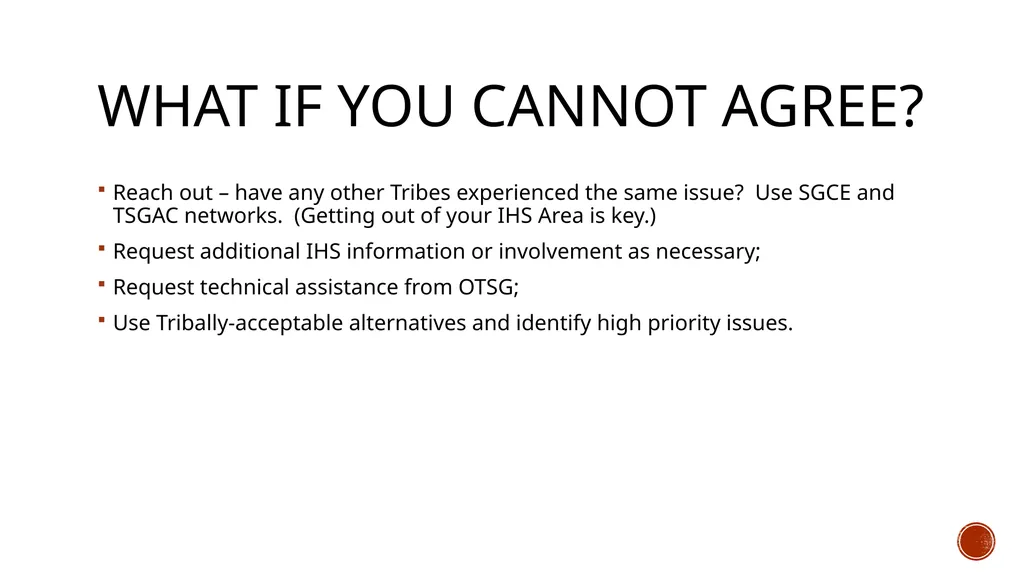
What if you Cannot Agree? Reach out – have any other Tribes experienced the same issue? Use SGCE and TSGAC networks. (Getting out of your IHS Area is key.)
Request additional IHS information or involvement as necessary;
Request technical assistance from OTSG;
Use Tribally-acceptable alternatives and identify high priority issues.<br>
Request additional IHS information or involvement as necessary;
Request technical assistance from OTSG;
Use Tribally-acceptable alternatives and identify high priority issues.<br>
49
Financial Tables: General Review & psfa Evaluation Examples<br>
50
which PSFAs DO YOU NEGOTIATE? Do they match your Self-Governance Goals? Community Health Needs? Tribal Leader direction?
Do you have the infrastructure to implement the PSFA? Is the funding adequate?
What would be the challenges?
Are there upfront costs?
Is there a plan for the transition?<br>
Do you have the infrastructure to implement the PSFA? Is the funding adequate?
What would be the challenges?
Are there upfront costs?
Is there a plan for the transition?<br>
51
Describing PSFAs in the FA How much detail must the PSFA description entail?
Ranges from very detailed, to broad program titles.
Considerations: Federal Tort Claims coverage, redesign authority, audit.
Inclusion of PSFA description of retained or inherent federal functions in FA.
Inclusion of PSFAs that are authorized under the Indian Health Care Improvement Act, but that IHS may not be conducting in your Area:
Example: Enhanced dental care, preventative health and wellness;
Example: Long-term Services and Supports;
Example: Home and community based services.<br>
Ranges from very detailed, to broad program titles.
Considerations: Federal Tort Claims coverage, redesign authority, audit.
Inclusion of PSFA description of retained or inherent federal functions in FA.
Inclusion of PSFAs that are authorized under the Indian Health Care Improvement Act, but that IHS may not be conducting in your Area:
Example: Enhanced dental care, preventative health and wellness;
Example: Long-term Services and Supports;
Example: Home and community based services.<br>
52
Analysis example: BO Mgmt Business Office Management (AO): Plans, implements, directs, manages, and coordinates all third party billing and collection activities. Ensures all IHS Service Units maximize reimbursements from all alternative resources. Manages the Medicare and Medicaid resources in accordance with program regulations. Serves as liaison between Federal, State, and local programs in assuring compliance of all laws, regulations, and policies. Provides technical assistance, advice, and training regarding the entire third party revenue generation process.
Evaluate Current Service: Where are these services provided? Area Office or Service Unit? How many staff are currently conducting these functions? Is there a contractor?
Evaluate Efficiency: How much is the Service Unit billing? What is the turn around?
Evaluate Network: How many users are covered? What services are provided and billed for?
Evaluate Opportunities: Can you increase billing? Examples – Increase covered users, increase billable services, etc.<br>
Evaluate Current Service: Where are these services provided? Area Office or Service Unit? How many staff are currently conducting these functions? Is there a contractor?
Evaluate Efficiency: How much is the Service Unit billing? What is the turn around?
Evaluate Network: How many users are covered? What services are provided and billed for?
Evaluate Opportunities: Can you increase billing? Examples – Increase covered users, increase billable services, etc.<br>
53
ANALYSIS Example: MCH MATERNAL CHILD HEALTH (AO)
Technical Assistance/Guidance, Policy Development, Program Development and Evaluation, Budgeting, Training
Evaluate Current Service: What services is the Tribe currently receiving? What are the benefits?
Evaluate Efficiency: Is the Tribal Share amount enough to maintain and grow current services provided? If not, can the Tribe or health system create additional revenue to grow and enhance the program?
Evaluate Opportunities: Would a Tribal network be more conducive? Can some of the services be left at the AO and some be assumed?<br>
Technical Assistance/Guidance, Policy Development, Program Development and Evaluation, Budgeting, Training
Evaluate Current Service: What services is the Tribe currently receiving? What are the benefits?
Evaluate Efficiency: Is the Tribal Share amount enough to maintain and grow current services provided? If not, can the Tribe or health system create additional revenue to grow and enhance the program?
Evaluate Opportunities: Would a Tribal network be more conducive? Can some of the services be left at the AO and some be assumed?<br>
54
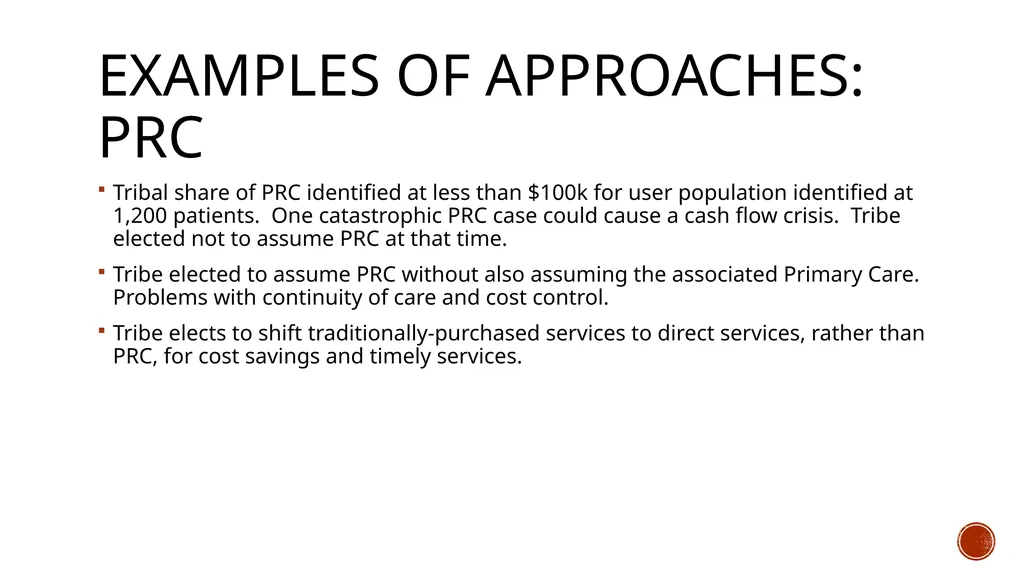
Examples of approaches: Prc Tribal share of PRC identified at less than $100k for user population identified at 1,200 patients. One catastrophic PRC case could cause a cash flow crisis. Tribe elected not to assume PRC at that time.
Tribe elected to assume PRC without also assuming the associated Primary Care. Problems with continuity of care and cost control.
Tribe elects to shift traditionally-purchased services to direct services, rather than PRC, for cost savings and timely services.<br>
Tribe elected to assume PRC without also assuming the associated Primary Care. Problems with continuity of care and cost control.
Tribe elects to shift traditionally-purchased services to direct services, rather than PRC, for cost savings and timely services.<br>
55
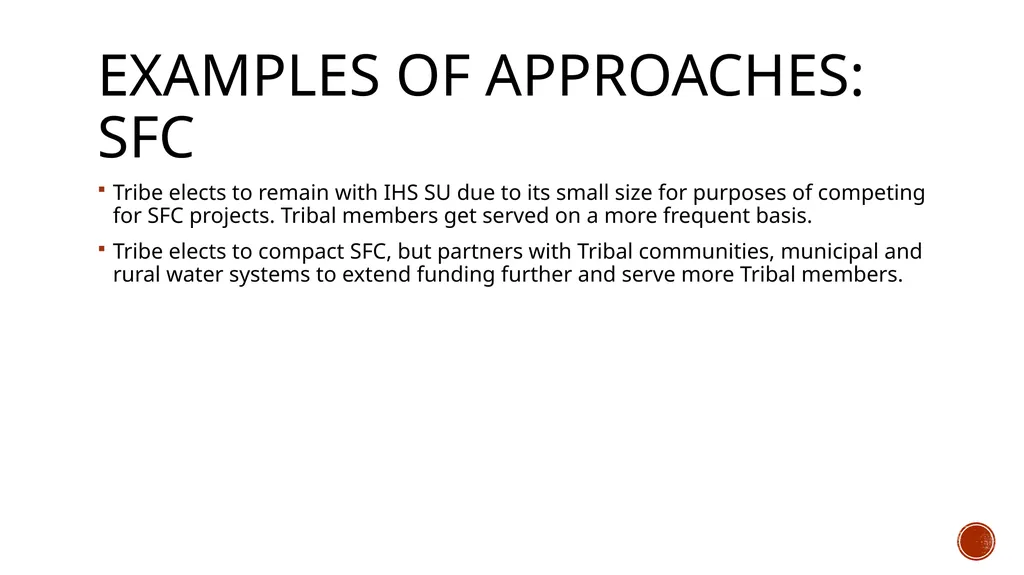
Examples of approaches: sfc Tribe elects to remain with IHS SU due to its small size for purposes of competing for SFC projects. Tribal members get served on a more frequent basis.
Tribe elects to compact SFC, but partners with Tribal communities, municipal and rural water systems to extend funding further and serve more Tribal members.<br>
Tribe elects to compact SFC, but partners with Tribal communities, municipal and rural water systems to extend funding further and serve more Tribal members.<br>