Directors’ & Officers’ & Charity Trustees’
Description: Directors Officers Charity Trustees Insurance The Insurance Institute of Manchester Tuesday 14th February 2017 Phil Duffy Learning Objectives:Agenda Why is DO insurance required ? Role, duties and responsibilities of DOs? What
Related Topics
Download Presentation
"Directors’ & Officers’ & Charity Trustees’" is the property of its rightful owner. Permission is granted to download and print the materials on this website for personal, non-commercial use only, and to display it on your personal computer provided you do not modify the materials and that you retain all copyright notices contained in the materials. By downloading content from our website, you accept the terms of this agreement.
Presentation Transcript
slide1. Directors’ & Officers’ & Charity Trustees’ InsuranceThe Insurance Institute of ManchesterTuesday 14th February 2017Phil Duffy<br>
slide2. Learning Objectives:Agenda Why is D&O insurance required ?
Role, duties and responsibilities of D&O’s?
What protection is available?
Structure of D&O policies, covers and where they may differ?
What organisations have D&O’s and those that don’t?
Charity Trustees – as above
Where claims may arise?
How change in legislation impacts of a D&O/CTI?
Questions?<br>
slide3. Why & Who? A brief history;
USA
UK<br>
slide4. Who are we talking about? Executive Directors
Non Executive Directors
Shadow Directors
De facto Directors
Officers
Managers
Employees (supervisory positions)<br>
slide5. Who are we talking about?<br>
slide6. What is their role in the Company? Company directors are responsible for the management of their companies.
They must act in a way most likely to promote the success of the business and benefit its shareholders. They have responsibilities to the company's employees, its trading partners and the state.
Duties?
There are 3 principle headings:
Fiduciary Duty
Duty of skill and care
Statutory duties<br>
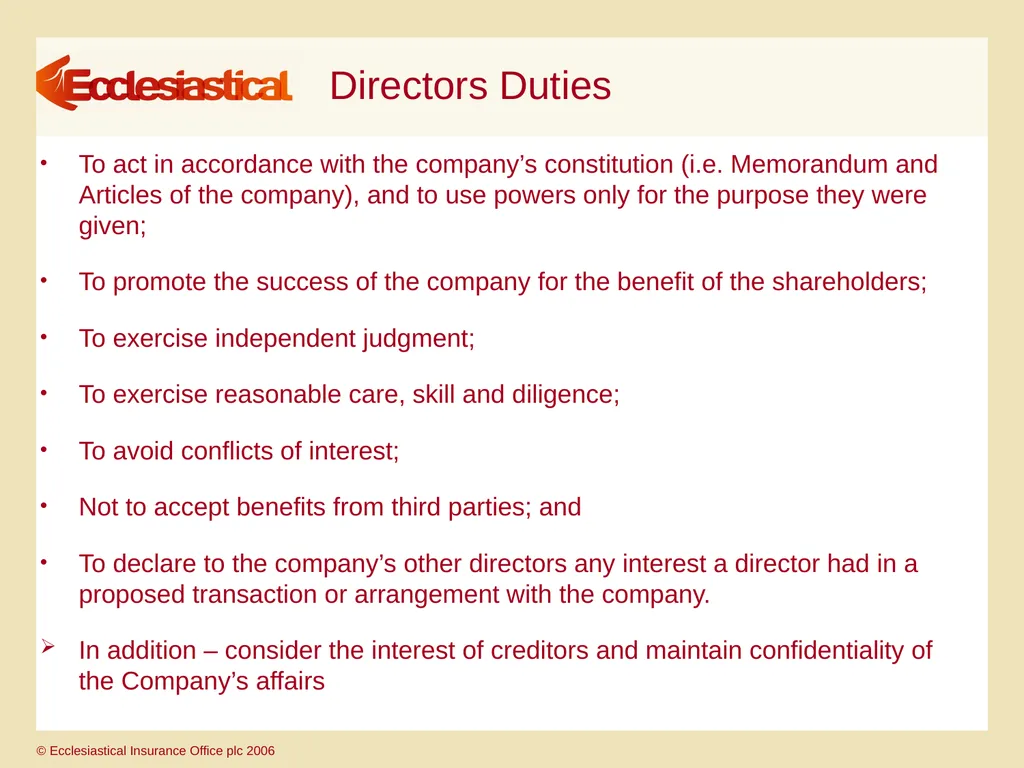
slide7. Directors Duties To act in accordance with the company’s constitution (i.e. Memorandum and Articles of the company), and to use powers only for the purpose they were given;
To promote the success of the company for the benefit of the shareholders;
To exercise independent judgment;
To exercise reasonable care, skill and diligence;
To avoid conflicts of interest;
Not to accept benefits from third parties; and
To declare to the company’s other directors any interest a director had in a proposed transaction or arrangement with the company.
In addition – consider the interest of creditors and maintain confidentiality of the Company’s affairs<br>
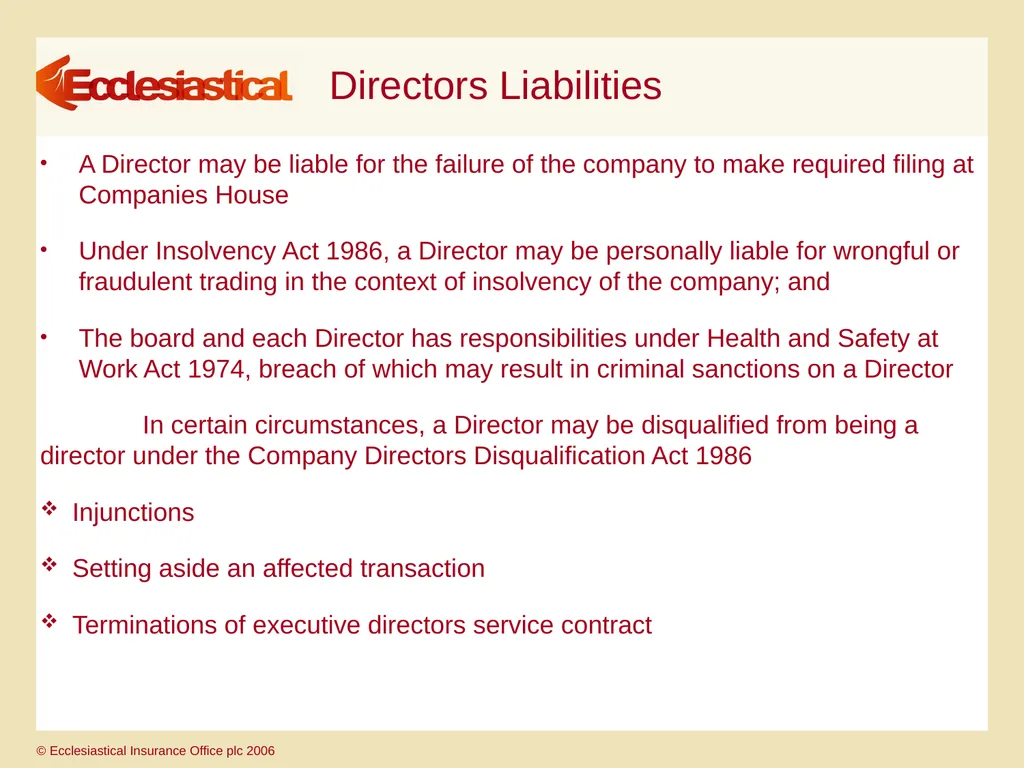
slide8. Directors Liabilities A Director may be liable for the failure of the company to make required filing at Companies House
Under Insolvency Act 1986, a Director may be personally liable for wrongful or fraudulent trading in the context of insolvency of the company; and
The board and each Director has responsibilities under Health and Safety at Work Act 1974, breach of which may result in criminal sanctions on a Director
In certain circumstances, a Director may be disqualified from being a director under the Company Directors Disqualification Act 1986
Injunctions
Setting aside an affected transaction
Terminations of executive directors service contract<br>
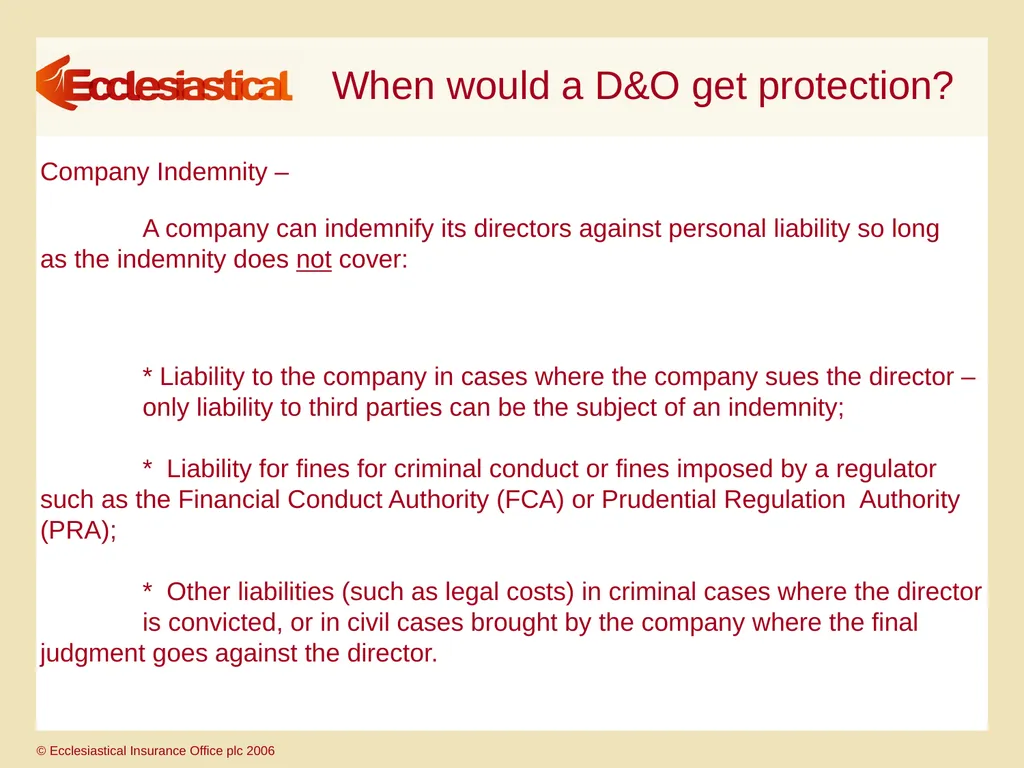
slide9. When would a D&O get protection? Company Indemnity –
A company can indemnify its directors against personal liability so long as the indemnity does not cover:
* Liability to the company in cases where the company sues the director – only liability to third parties can be the subject of an indemnity; * Liability for fines for criminal conduct or fines imposed by a regulator such as the Financial Conduct Authority (FCA) or Prudential Regulation Authority (PRA); * Other liabilities (such as legal costs) in criminal cases where the director is convicted, or in civil cases brought by the company where the final judgment goes against the director.<br>
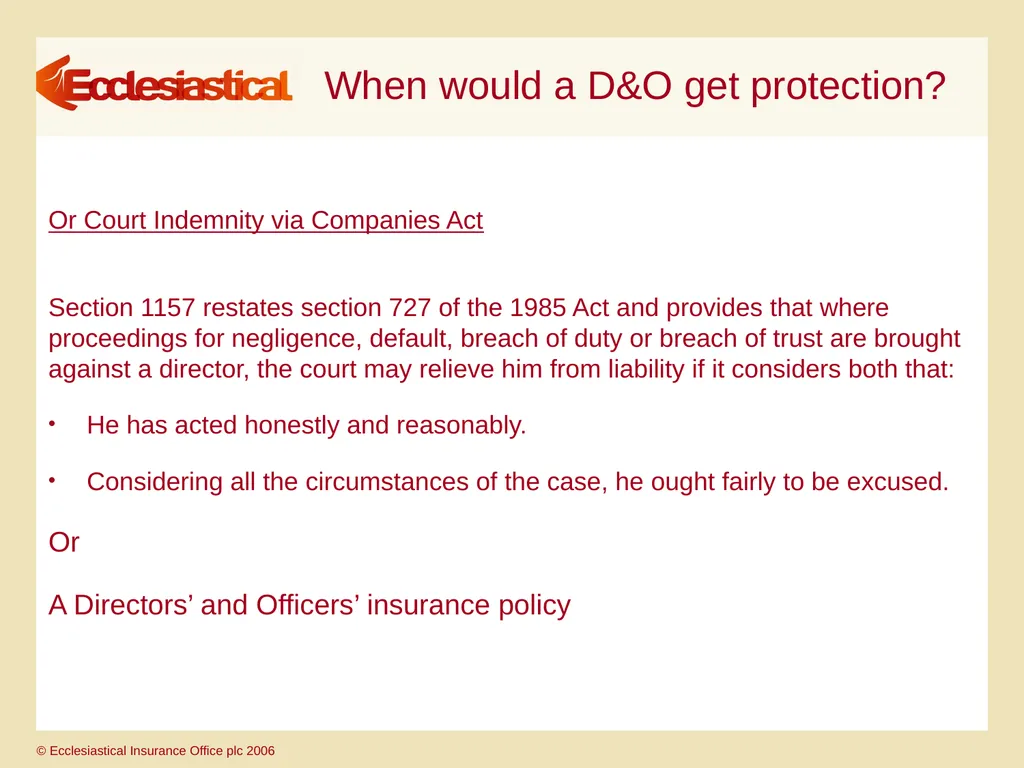
slide10. When would a D&O get protection? Or Court Indemnity via Companies Act
Section 1157 restates section 727 of the 1985 Act and provides that where proceedings for negligence, default, breach of duty or breach of trust are brought against a director, the court may relieve him from liability if it considers both that:
He has acted honestly and reasonably.
Considering all the circumstances of the case, he ought fairly to be excused.
Or
A Directors’ and Officers’ insurance policy<br>
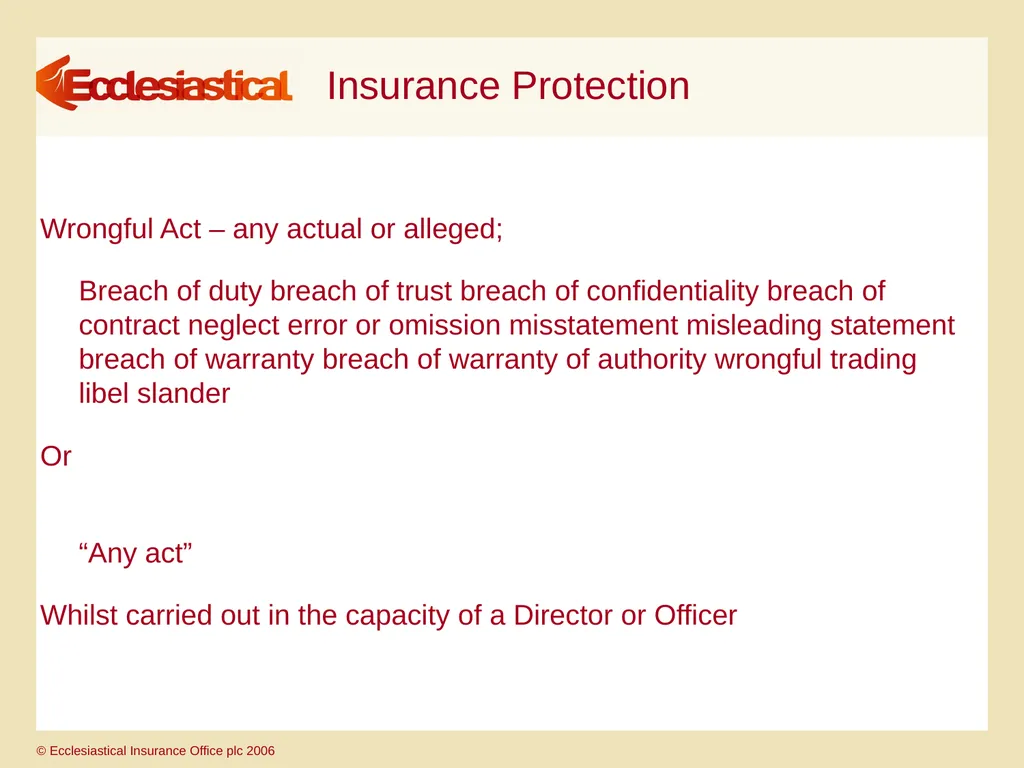
slide11. Insurance Protection Wrongful Act – any actual or alleged;
Breach of duty breach of trust breach of confidentiality breach of contract neglect error or omission misstatement misleading statement breach of warranty breach of warranty of authority wrongful trading libel slander
Or
“Any act”
Whilst carried out in the capacity of a Director or Officer<br>
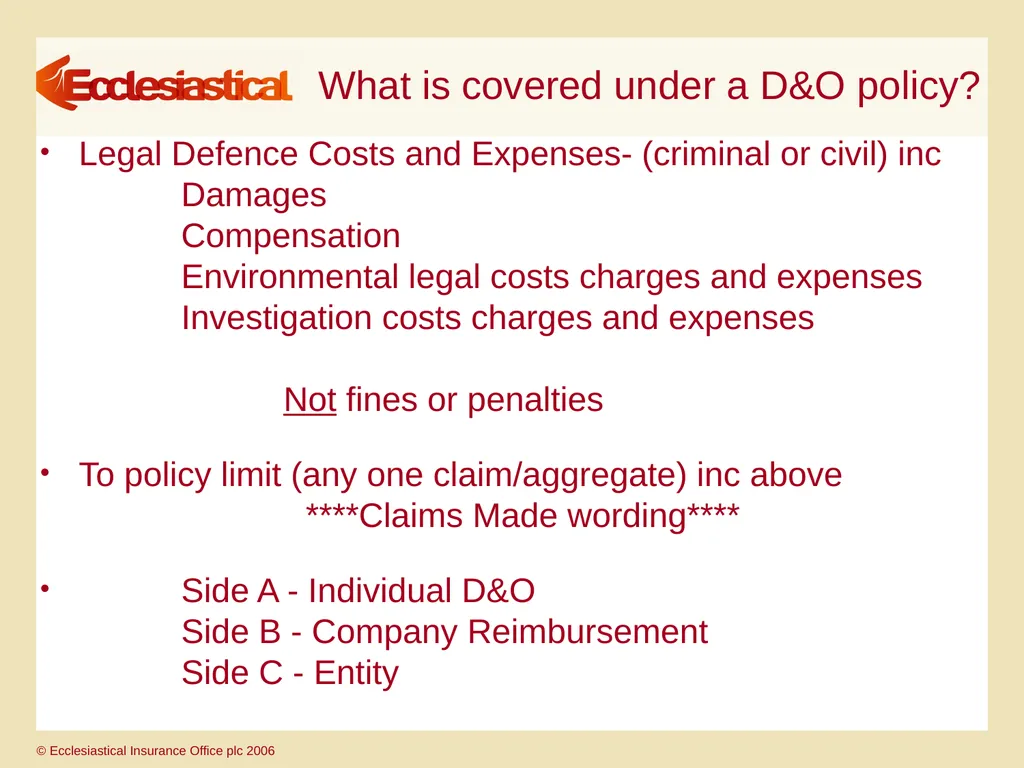
slide12. What is covered under a D&O policy? Legal Defence Costs and Expenses- (criminal or civil) inc Damages Compensation Environmental legal costs charges and expenses Investigation costs charges and expenses Not fines or penalties
To policy limit (any one claim/aggregate) inc above ****Claims Made wording****
Side A - Individual D&O Side B - Company Reimbursement Side C - Entity<br>
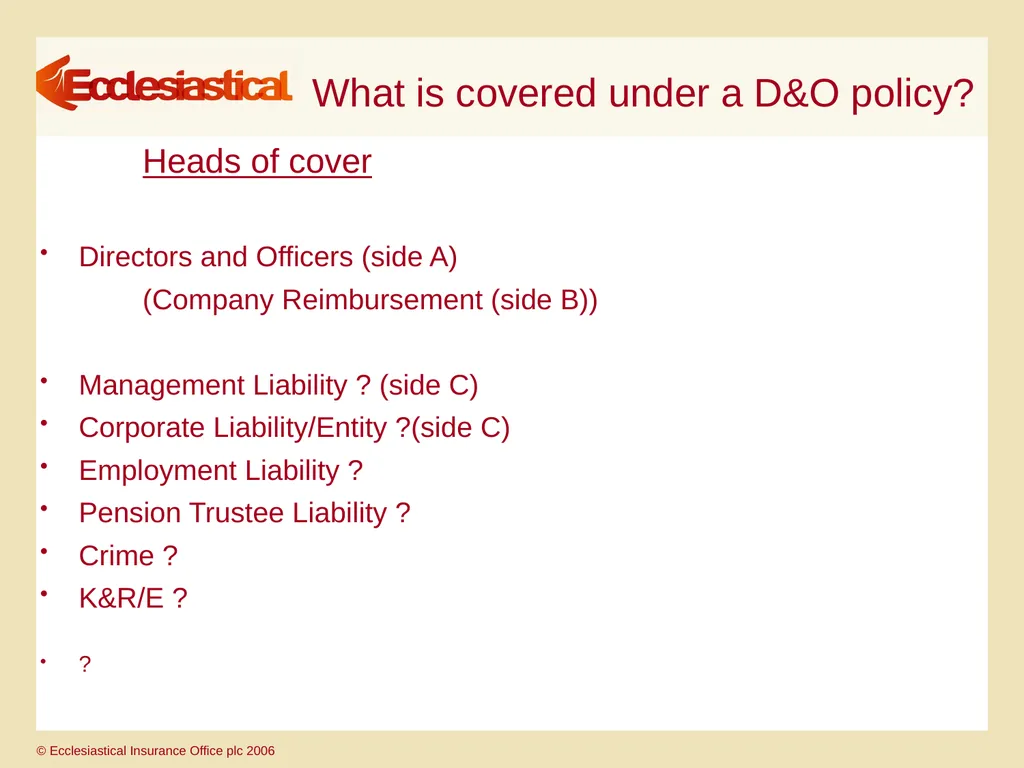
slide13. What is covered under a D&O policy? Heads of cover
Directors and Officers (side A)
(Company Reimbursement (side B))
Management Liability ? (side C)
Corporate Liability/Entity ?(side C)
Employment Liability ?
Pension Trustee Liability ?
Crime ?
K&R/E ?
?<br>
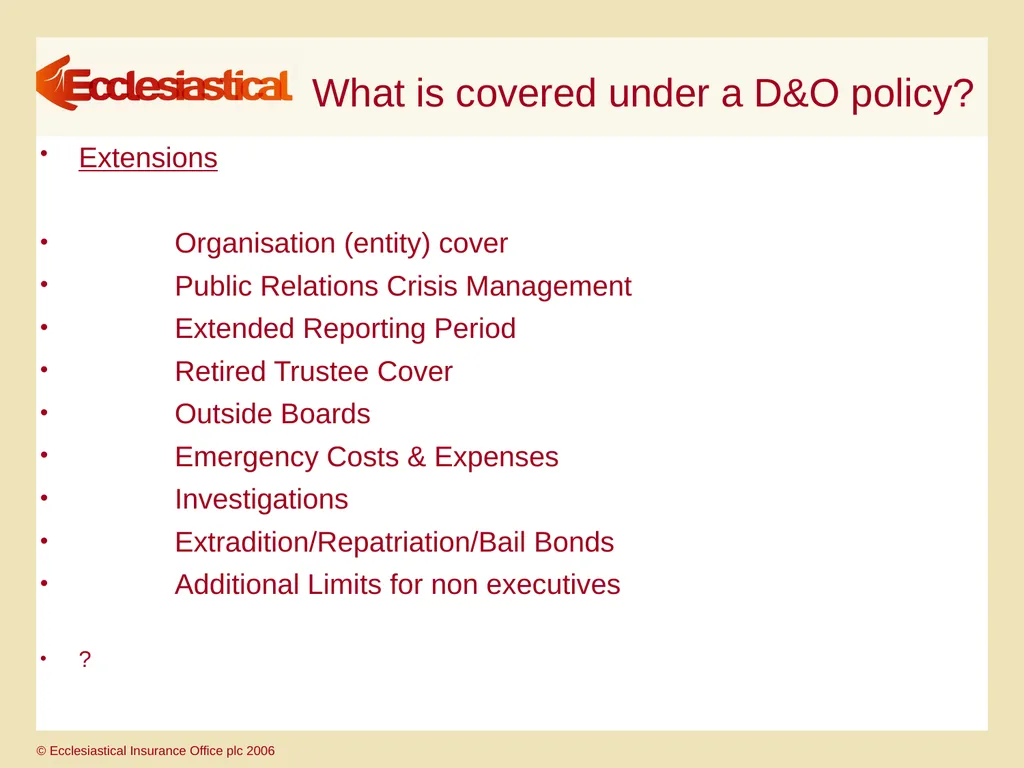
slide14. What is covered under a D&O policy? Extensions
Organisation (entity) cover
Public Relations Crisis Management
Extended Reporting Period
Retired Trustee Cover
Outside Boards
Emergency Costs & Expenses
Investigations
Extradition/Repatriation/Bail Bonds
Additional Limits for non executives
?<br>
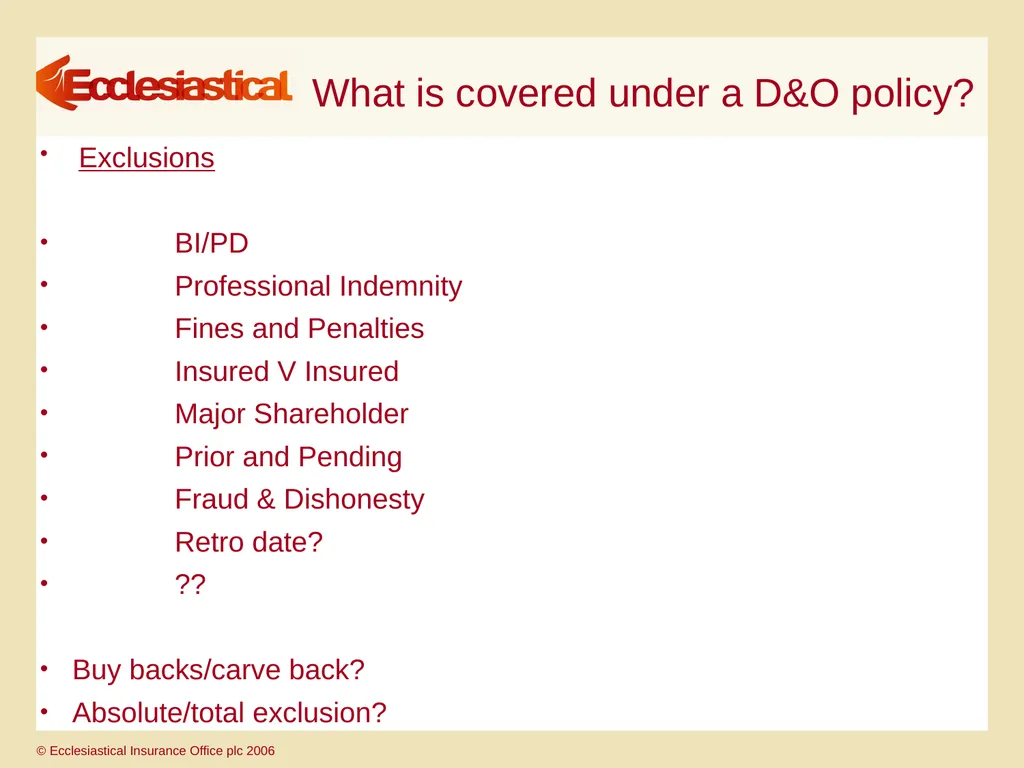
slide15. What is covered under a D&O policy? Exclusions
BI/PD
Professional Indemnity
Fines and Penalties
Insured V Insured
Major Shareholder
Prior and Pending
Fraud & Dishonesty
Retro date?
??
Buy backs/carve back?
Absolute/total exclusion?<br>
slide16. What other organisations have D&O’s? Other than PLC’s and Ltd Companies?
Charities,
Not For Profit,
Limited by Guarantee
CIC’s, CIO’s, Social Enterprises
But only if:
Incorporated
Not
Unincorporated<br>
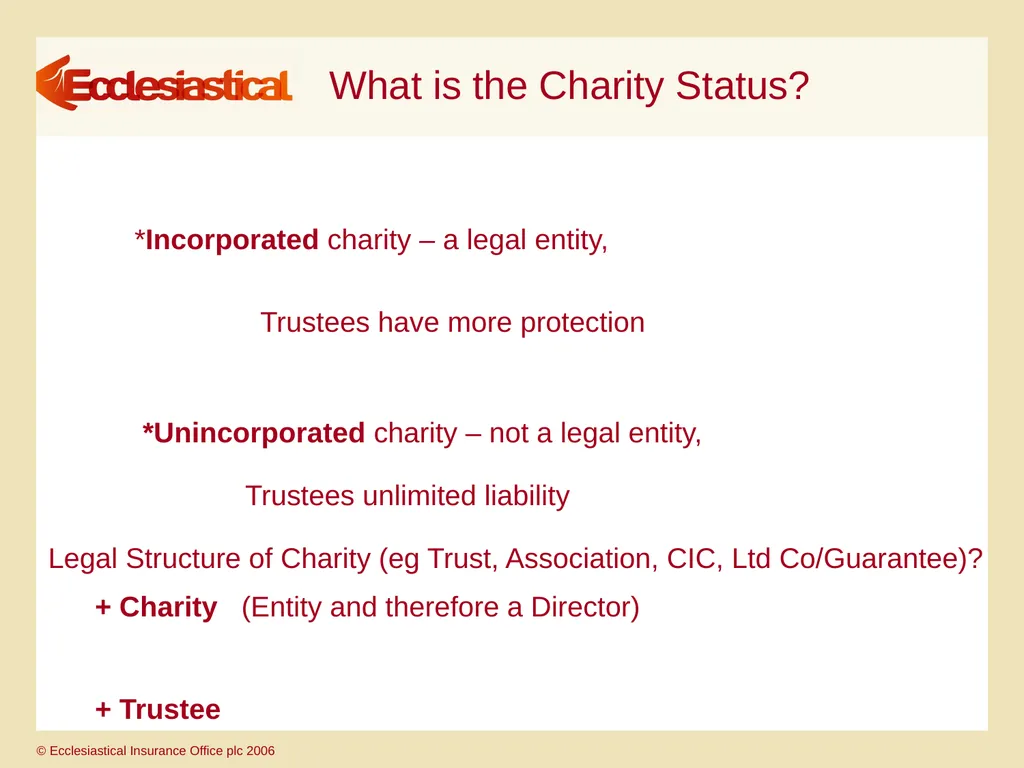
slide17. What is the Charity Status? *Incorporated charity – a legal entity,
Trustees have more protection
*Unincorporated charity – not a legal entity,
Trustees unlimited liability
Legal Structure of Charity (eg Trust, Association, CIC, Ltd Co/Guarantee)?
+ Charity (Entity and therefore a Director) + Trustee<br>
slide18. Who are we talking about?<br>
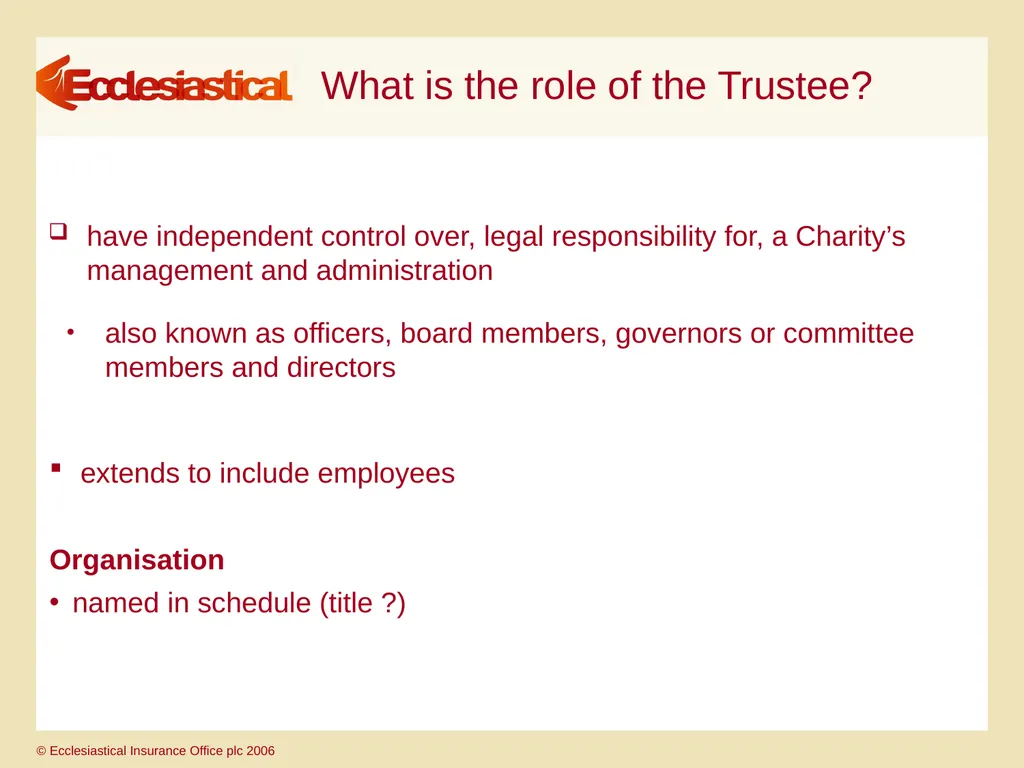
slide19. What is the role of the Trustee? have independent control over, legal responsibility for, a Charity’s management and administration
also known as officers, board members, governors or committee members and directors
extends to include employees
Organisation
named in schedule (title ?)<br>
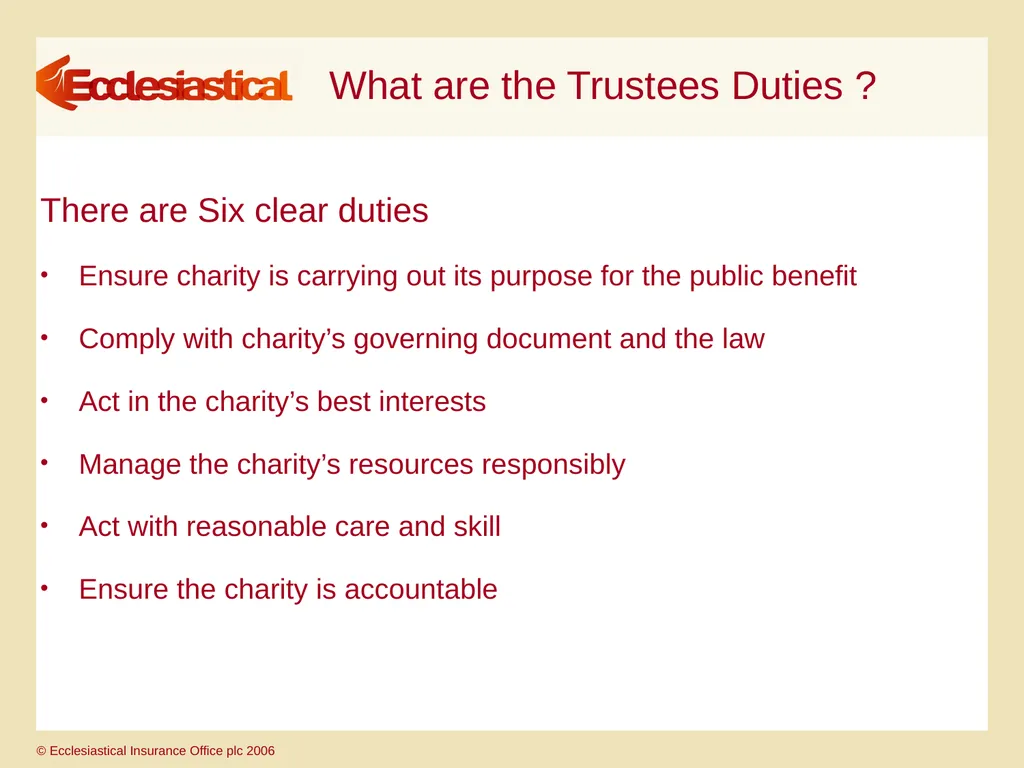
slide20. What are the Trustees Duties ? There are Six clear duties
Ensure charity is carrying out its purpose for the public benefit
Comply with charity’s governing document and the law
Act in the charity’s best interests
Manage the charity’s resources responsibly
Act with reasonable care and skill
Ensure the charity is accountable<br>
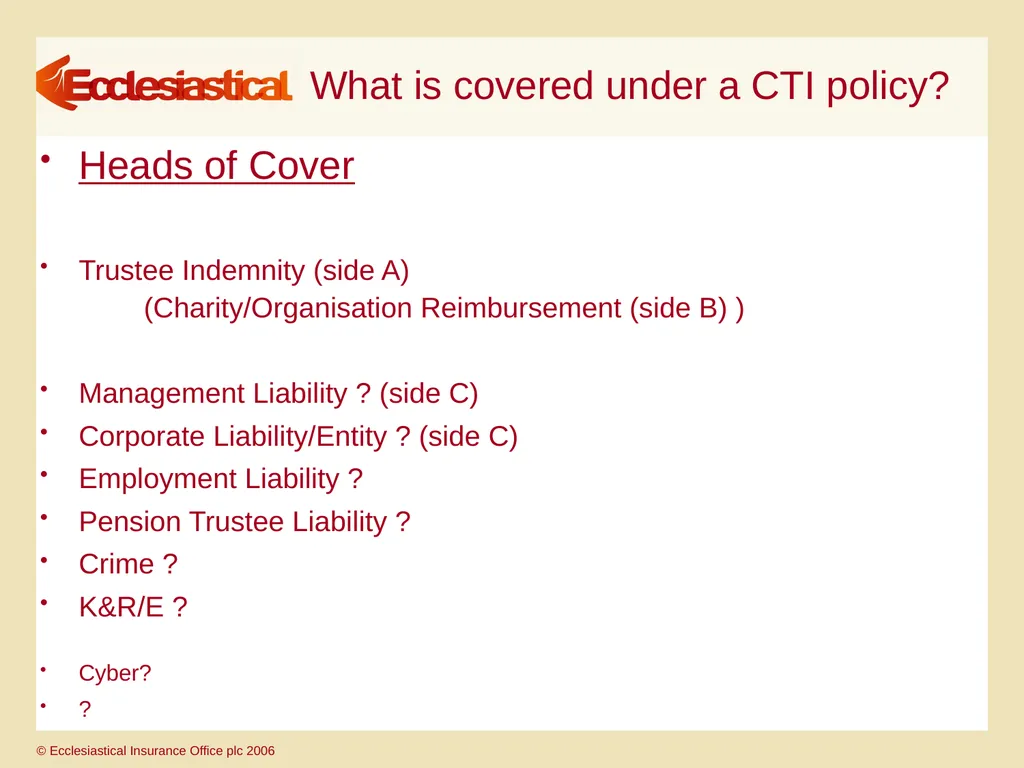
slide21. What is covered under a CTI policy? Heads of Cover
Trustee Indemnity (side A)
(Charity/Organisation Reimbursement (side B) )
Management Liability ? (side C)
Corporate Liability/Entity ? (side C)
Employment Liability ?
Pension Trustee Liability ?
Crime ?
K&R/E ?
Cyber?
?<br>
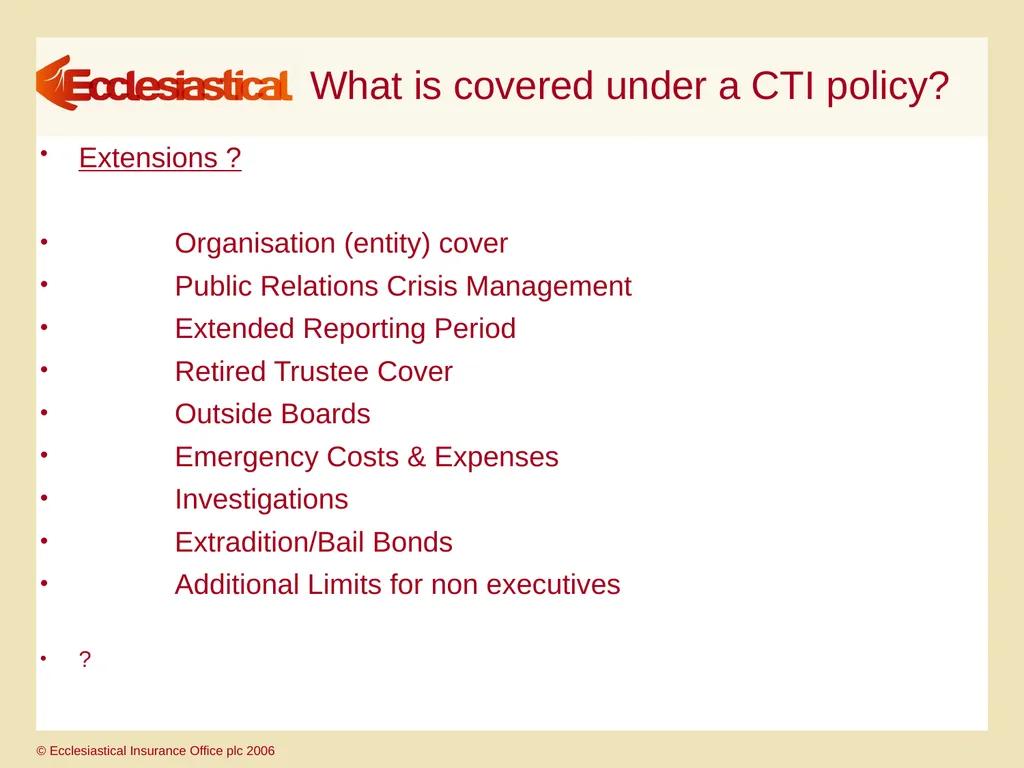
slide22. What is covered under a CTI policy? Extensions ?
Organisation (entity) cover
Public Relations Crisis Management
Extended Reporting Period
Retired Trustee Cover
Outside Boards
Emergency Costs & Expenses
Investigations
Extradition/Bail Bonds
Additional Limits for non executives
?<br>
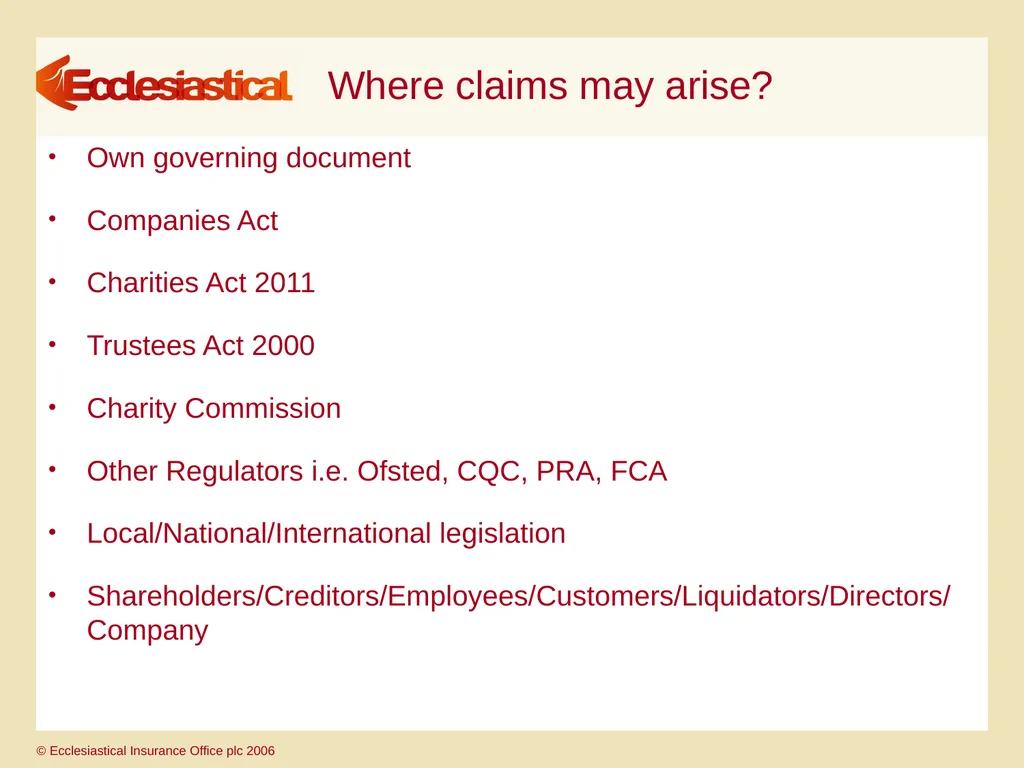
slide23. Where claims may arise? Own governing document
Companies Act
Charities Act 2011
Trustees Act 2000
Charity Commission
Other Regulators i.e. Ofsted, CQC, PRA, FCA
Local/National/International legislation
Shareholders/Creditors/Employees/Customers/Liquidators/Directors/Company<br>
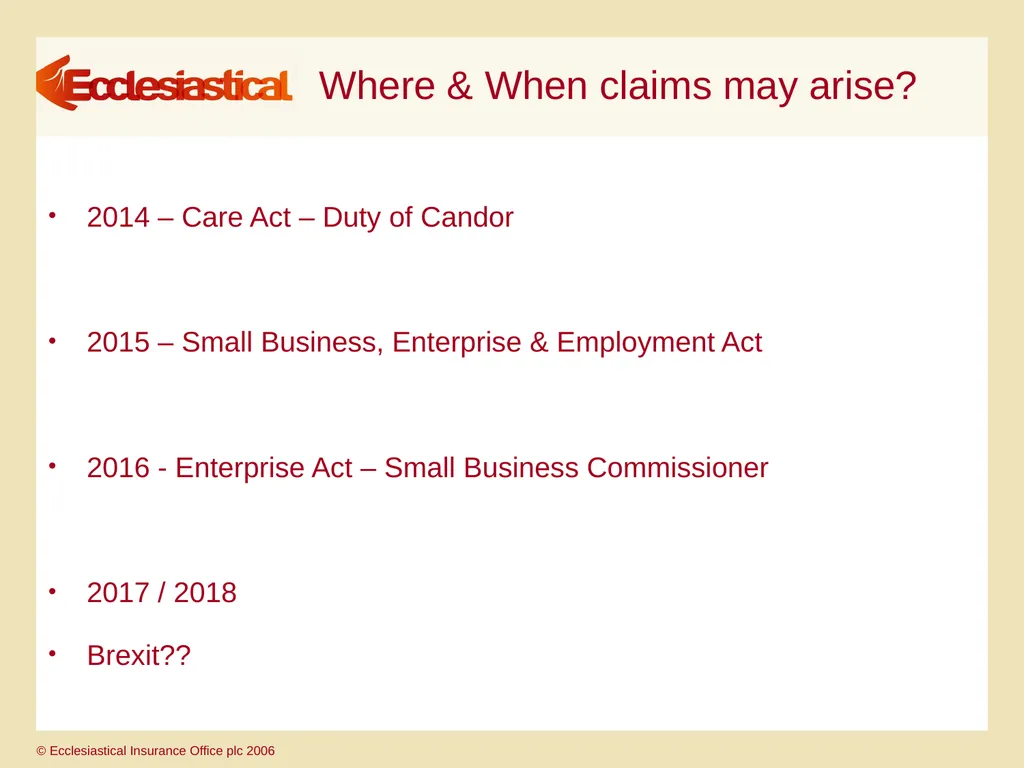
slide24. Where & When claims may arise? 2014 – Care Act – Duty of Candor
2015 – Small Business, Enterprise & Employment Act
2016 - Enterprise Act – Small Business Commissioner
2017 / 2018
Brexit??<br>
slide25. ?????????????????? Are Directors, Officers, Trustees, Organisations;
Ready?
Prepared??
Insured????
How ?<br>
slide26. Learning Objectives: Check list Why is D&O insurance required ?
Role, duties and responsibilities of D&O’s?
What protection is available?
Structure of D&O policies, covers and where they may differ?
What organisations have D&O’s and those that don’t?
Charity Trustees – as above
Where claims may arise?
How change in legislation impacts of a D&O/CTI?<br>

slide27. Questions ?<br>
slide2. Learning Objectives:Agenda Why is D&O insurance required ?
Role, duties and responsibilities of D&O’s?
What protection is available?
Structure of D&O policies, covers and where they may differ?
What organisations have D&O’s and those that don’t?
Charity Trustees – as above
Where claims may arise?
How change in legislation impacts of a D&O/CTI?
Questions?<br>
slide3. Why & Who? A brief history;
USA
UK<br>
slide4. Who are we talking about? Executive Directors
Non Executive Directors
Shadow Directors
De facto Directors
Officers
Managers
Employees (supervisory positions)<br>
slide5. Who are we talking about?<br>
slide6. What is their role in the Company? Company directors are responsible for the management of their companies.
They must act in a way most likely to promote the success of the business and benefit its shareholders. They have responsibilities to the company's employees, its trading partners and the state.
Duties?
There are 3 principle headings:
Fiduciary Duty
Duty of skill and care
Statutory duties<br>
slide7. Directors Duties To act in accordance with the company’s constitution (i.e. Memorandum and Articles of the company), and to use powers only for the purpose they were given;
To promote the success of the company for the benefit of the shareholders;
To exercise independent judgment;
To exercise reasonable care, skill and diligence;
To avoid conflicts of interest;
Not to accept benefits from third parties; and
To declare to the company’s other directors any interest a director had in a proposed transaction or arrangement with the company.
In addition – consider the interest of creditors and maintain confidentiality of the Company’s affairs<br>
slide8. Directors Liabilities A Director may be liable for the failure of the company to make required filing at Companies House
Under Insolvency Act 1986, a Director may be personally liable for wrongful or fraudulent trading in the context of insolvency of the company; and
The board and each Director has responsibilities under Health and Safety at Work Act 1974, breach of which may result in criminal sanctions on a Director
In certain circumstances, a Director may be disqualified from being a director under the Company Directors Disqualification Act 1986
Injunctions
Setting aside an affected transaction
Terminations of executive directors service contract<br>
slide9. When would a D&O get protection? Company Indemnity –
A company can indemnify its directors against personal liability so long as the indemnity does not cover:
* Liability to the company in cases where the company sues the director – only liability to third parties can be the subject of an indemnity; * Liability for fines for criminal conduct or fines imposed by a regulator such as the Financial Conduct Authority (FCA) or Prudential Regulation Authority (PRA); * Other liabilities (such as legal costs) in criminal cases where the director is convicted, or in civil cases brought by the company where the final judgment goes against the director.<br>
slide10. When would a D&O get protection? Or Court Indemnity via Companies Act
Section 1157 restates section 727 of the 1985 Act and provides that where proceedings for negligence, default, breach of duty or breach of trust are brought against a director, the court may relieve him from liability if it considers both that:
He has acted honestly and reasonably.
Considering all the circumstances of the case, he ought fairly to be excused.
Or
A Directors’ and Officers’ insurance policy<br>
slide11. Insurance Protection Wrongful Act – any actual or alleged;
Breach of duty breach of trust breach of confidentiality breach of contract neglect error or omission misstatement misleading statement breach of warranty breach of warranty of authority wrongful trading libel slander
Or
“Any act”
Whilst carried out in the capacity of a Director or Officer<br>
slide12. What is covered under a D&O policy? Legal Defence Costs and Expenses- (criminal or civil) inc Damages Compensation Environmental legal costs charges and expenses Investigation costs charges and expenses Not fines or penalties
To policy limit (any one claim/aggregate) inc above ****Claims Made wording****
Side A - Individual D&O Side B - Company Reimbursement Side C - Entity<br>
slide13. What is covered under a D&O policy? Heads of cover
Directors and Officers (side A)
(Company Reimbursement (side B))
Management Liability ? (side C)
Corporate Liability/Entity ?(side C)
Employment Liability ?
Pension Trustee Liability ?
Crime ?
K&R/E ?
?<br>
slide14. What is covered under a D&O policy? Extensions
Organisation (entity) cover
Public Relations Crisis Management
Extended Reporting Period
Retired Trustee Cover
Outside Boards
Emergency Costs & Expenses
Investigations
Extradition/Repatriation/Bail Bonds
Additional Limits for non executives
?<br>
slide15. What is covered under a D&O policy? Exclusions
BI/PD
Professional Indemnity
Fines and Penalties
Insured V Insured
Major Shareholder
Prior and Pending
Fraud & Dishonesty
Retro date?
??
Buy backs/carve back?
Absolute/total exclusion?<br>
slide16. What other organisations have D&O’s? Other than PLC’s and Ltd Companies?
Charities,
Not For Profit,
Limited by Guarantee
CIC’s, CIO’s, Social Enterprises
But only if:
Incorporated
Not
Unincorporated<br>
slide17. What is the Charity Status? *Incorporated charity – a legal entity,
Trustees have more protection
*Unincorporated charity – not a legal entity,
Trustees unlimited liability
Legal Structure of Charity (eg Trust, Association, CIC, Ltd Co/Guarantee)?
+ Charity (Entity and therefore a Director) + Trustee<br>
slide18. Who are we talking about?<br>
slide19. What is the role of the Trustee? have independent control over, legal responsibility for, a Charity’s management and administration
also known as officers, board members, governors or committee members and directors
extends to include employees
Organisation
named in schedule (title ?)<br>
slide20. What are the Trustees Duties ? There are Six clear duties
Ensure charity is carrying out its purpose for the public benefit
Comply with charity’s governing document and the law
Act in the charity’s best interests
Manage the charity’s resources responsibly
Act with reasonable care and skill
Ensure the charity is accountable<br>
slide21. What is covered under a CTI policy? Heads of Cover
Trustee Indemnity (side A)
(Charity/Organisation Reimbursement (side B) )
Management Liability ? (side C)
Corporate Liability/Entity ? (side C)
Employment Liability ?
Pension Trustee Liability ?
Crime ?
K&R/E ?
Cyber?
?<br>
slide22. What is covered under a CTI policy? Extensions ?
Organisation (entity) cover
Public Relations Crisis Management
Extended Reporting Period
Retired Trustee Cover
Outside Boards
Emergency Costs & Expenses
Investigations
Extradition/Bail Bonds
Additional Limits for non executives
?<br>
slide23. Where claims may arise? Own governing document
Companies Act
Charities Act 2011
Trustees Act 2000
Charity Commission
Other Regulators i.e. Ofsted, CQC, PRA, FCA
Local/National/International legislation
Shareholders/Creditors/Employees/Customers/Liquidators/Directors/Company<br>
slide24. Where & When claims may arise? 2014 – Care Act – Duty of Candor
2015 – Small Business, Enterprise & Employment Act
2016 - Enterprise Act – Small Business Commissioner
2017 / 2018
Brexit??<br>
slide25. ?????????????????? Are Directors, Officers, Trustees, Organisations;
Ready?
Prepared??
Insured????
How ?<br>
slide26. Learning Objectives: Check list Why is D&O insurance required ?
Role, duties and responsibilities of D&O’s?
What protection is available?
Structure of D&O policies, covers and where they may differ?
What organisations have D&O’s and those that don’t?
Charity Trustees – as above
Where claims may arise?
How change in legislation impacts of a D&O/CTI?<br>
slide27. Questions ?<br>