
E-way bill, e-invoice and automation GST Refresher
LO
Published · 64 slides · 0 views

1 / 1


Description
E-way bill, e-invoice and automation GST Refresher Course ICAI, Indore CA. Palkesh Asawa Part 1: E-way bills CA. Palkesh Asawa Curtain raiser why do we need e-way bills? CA. Palkesh Asawa Sale without invoice Multiple trips on same bill
Related Topics
Share
Embed code
Download this presentation From Below
"E-way bill, e-invoice and automation GST Refresher" is the property of its rightful owner. Permission is granted to download and print the materials on this website for personal, non-commercial use only, and to display it on your personal computer provided you do not modify the materials and that you retain all copyright notices contained in the materials. By downloading content from our website, you accept the terms of this agreement.
Presentation Transcript
01
E-way bill, e-invoice and automation GST Refresher Course ICAI, Indore CA. Palkesh Asawa<br>
02
Part – 1: E-way bills CA. Palkesh Asawa<br>
03
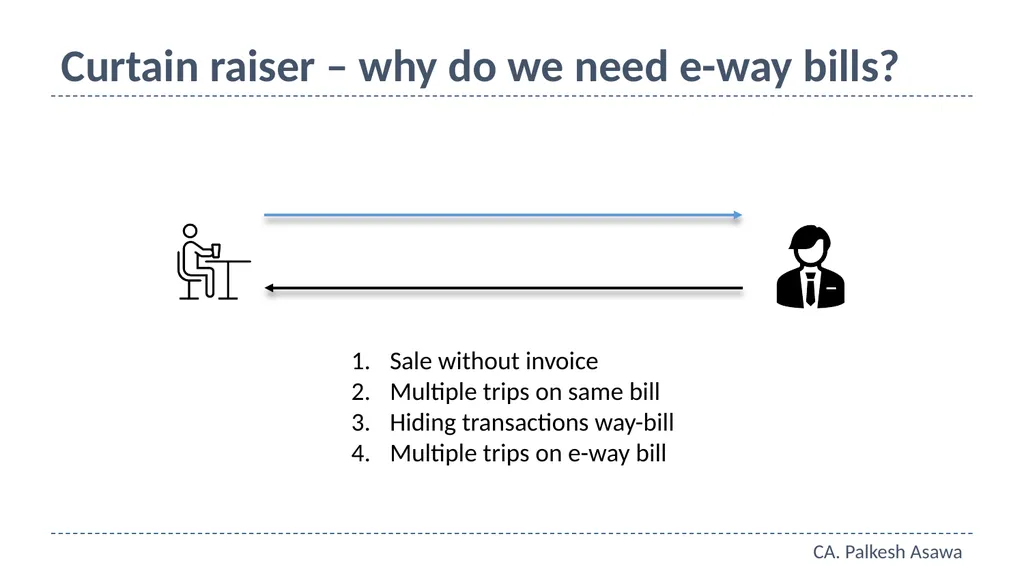
Curtain raiser – why do we need e-way bills? CA. Palkesh Asawa Sale without invoice
Multiple trips on same bill
Hiding transactions way-bill
Multiple trips on e-way bill<br>
Multiple trips on same bill
Hiding transactions way-bill
Multiple trips on e-way bill<br>
04
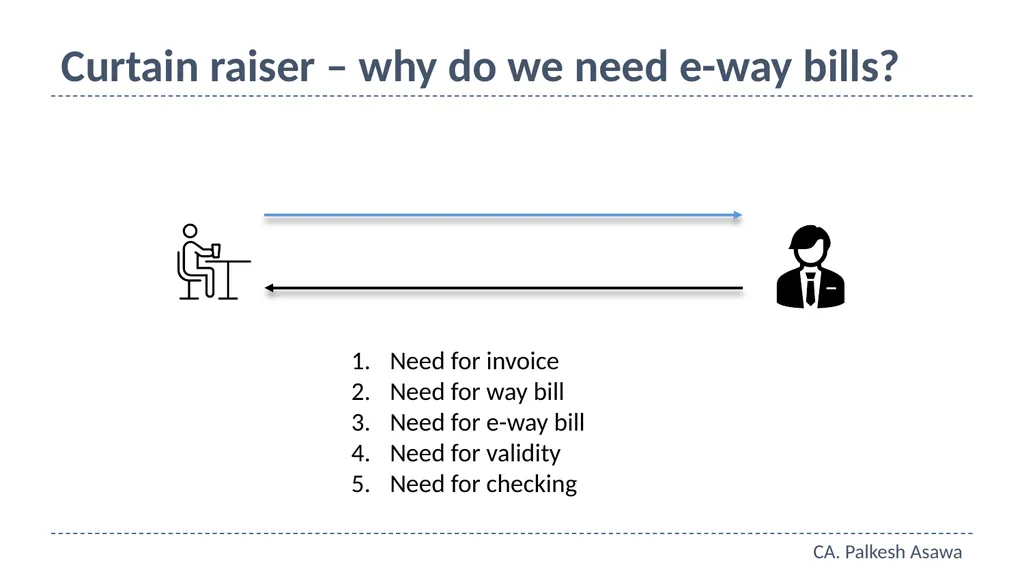
Curtain raiser – why do we need e-way bills? CA. Palkesh Asawa Need for invoice
Need for way bill
Need for e-way bill
Need for validity
Need for checking<br>
Need for way bill
Need for e-way bill
Need for validity
Need for checking<br>
05
Rule 138 (1) CA. Palkesh Asawa Every registered person who causes movement of goods of consignment value exceeding fifty thousand rupees-
(i) in relation to a supply; or
(ii) for reasons other than supply; or
(iii) due to inward supply from an unregistered person,
Shall, before commencement of such movement, furnish information relating to the said goods as specified in Part A of FORM GST EWB-01, electronically, on the common portal along with such other information as may be required on the common portal and a unique number will be generated on the said portal:<br>
(i) in relation to a supply; or
(ii) for reasons other than supply; or
(iii) due to inward supply from an unregistered person,
Shall, before commencement of such movement, furnish information relating to the said goods as specified in Part A of FORM GST EWB-01, electronically, on the common portal along with such other information as may be required on the common portal and a unique number will be generated on the said portal:<br>
06
Provisos to Rule 138 (1) CA. Palkesh Asawa Provided that the transporter, on an authorization received from the registered person, may furnish information in Part A of FORM GST EWB-01, electronically, on the common portal along with such other information as may be required on the common portal and a unique number will be generated on the said portal:
Provided further that where the goods to be transported are supplied through an ecommerce operator or a courier agency, on an authorization received from the consignor, the information in Part A of FORM GST EWB-01 may be furnished by such e-commerce operator or courier agency and a unique number will be generated on the said portal:<br>
Provided further that where the goods to be transported are supplied through an ecommerce operator or a courier agency, on an authorization received from the consignor, the information in Part A of FORM GST EWB-01 may be furnished by such e-commerce operator or courier agency and a unique number will be generated on the said portal:<br>
07
Provisos to Rule 138 (1) CA. Palkesh Asawa Provided also that where goods are sent by a principal located in one State or Union territory to a job worker located in any other State or Union territory, the e-way bill shall be generated either by the principal or the job worker, if registered, irrespective of the value of the consignment:
Provided also that where handicraft goods are transported from one State or Union territory to another State or Union territory by a person who has been exempted from the requirement of obtaining registration under clauses (i) and (ii) of section 24, the e-way bill shall be generated by the said person irrespective of the value of the consignment.<br>
Provided also that where handicraft goods are transported from one State or Union territory to another State or Union territory by a person who has been exempted from the requirement of obtaining registration under clauses (i) and (ii) of section 24, the e-way bill shall be generated by the said person irrespective of the value of the consignment.<br>
08
Explanations to Rule 138 (1) CA. Palkesh Asawa Explanation 1. – For the purposes of this rule, the expression “handicraft goods” has the meaning as assigned to it in the Government of India, Ministry of Finance, notification No. 56/2018-Central Tax, dated the 23rd October, 2018, published in the Gazette of India, Extraordinary, Part II, Section 3, Sub-section (i), vide number G.S.R 1056 (E), dated the 23rd October, 2018 as amended from time to time.
Explanation 2.- For the purposes of this rule, the consignment value of goods shall be the value, determined in accordance with the provisions of section 15, declared in an invoice, a bill of supply or a delivery challan, as the case may be, issued in respect of the said consignment and also includes the central tax, State or Union territory tax, integrated tax and cess charged, if any, in the document and shall exclude the value of exempt supply of goods where the invoice is issued in respect of both exempt and taxable supply of goods.<br>
Explanation 2.- For the purposes of this rule, the consignment value of goods shall be the value, determined in accordance with the provisions of section 15, declared in an invoice, a bill of supply or a delivery challan, as the case may be, issued in respect of the said consignment and also includes the central tax, State or Union territory tax, integrated tax and cess charged, if any, in the document and shall exclude the value of exempt supply of goods where the invoice is issued in respect of both exempt and taxable supply of goods.<br>
09
Explanations to Rule 138 (1) CA. Palkesh Asawa Explanation 1. – For the purposes of this rule, the expression “handicraft goods” has the meaning as assigned to it in the Government of India, Ministry of Finance, notification No. 56/2018-Central Tax, dated the 23rd October, 2018, published in the Gazette of India, Extraordinary, Part II, Section 3, Sub-section (i), vide number G.S.R 1056 (E), dated the 23rd October, 2018 as amended from time to time.
Explanation 2.- For the purposes of this rule, the consignment value of goods shall be the value, determined in accordance with the provisions of section 15, declared in an invoice, a bill of supply or a delivery challan, as the case may be, issued in respect of the said consignment and also includes the central tax, State or Union territory tax, integrated tax and cess charged, if any, in the document and shall exclude the value of exempt supply of goods where the invoice is issued in respect of both exempt and taxable supply of goods.<br>
Explanation 2.- For the purposes of this rule, the consignment value of goods shall be the value, determined in accordance with the provisions of section 15, declared in an invoice, a bill of supply or a delivery challan, as the case may be, issued in respect of the said consignment and also includes the central tax, State or Union territory tax, integrated tax and cess charged, if any, in the document and shall exclude the value of exempt supply of goods where the invoice is issued in respect of both exempt and taxable supply of goods.<br>
10
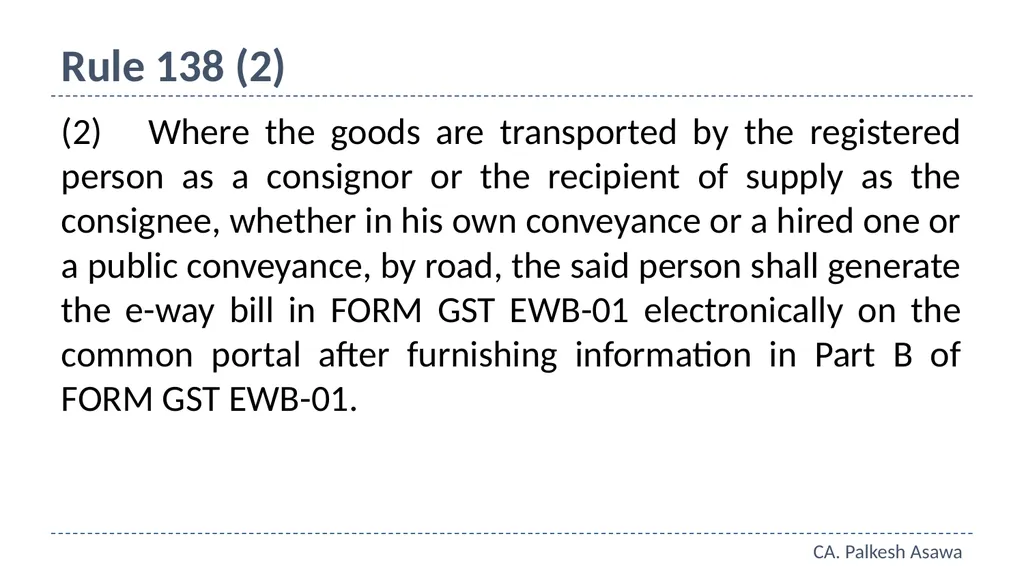
Rule 138 (2) CA. Palkesh Asawa (2) Where the goods are transported by the registered person as a consignor or the recipient of supply as the consignee, whether in his own conveyance or a hired one or a public conveyance, by road, the said person shall generate the e-way bill in FORM GST EWB-01 electronically on the common portal after furnishing information in Part B of FORM GST EWB-01.<br>
11
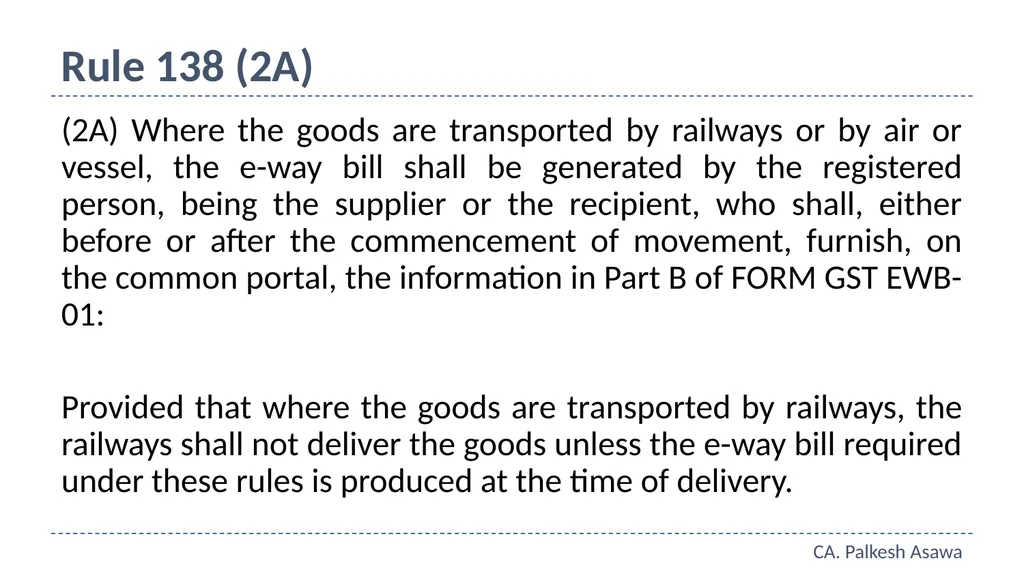
Rule 138 (2A) CA. Palkesh Asawa (2A) Where the goods are transported by railways or by air or vessel, the e-way bill shall be generated by the registered person, being the supplier or the recipient, who shall, either before or after the commencement of movement, furnish, on the common portal, the information in Part B of FORM GST EWB-01:
Provided that where the goods are transported by railways, the railways shall not deliver the goods unless the e-way bill required under these rules is produced at the time of delivery.<br>
Provided that where the goods are transported by railways, the railways shall not deliver the goods unless the e-way bill required under these rules is produced at the time of delivery.<br>
12
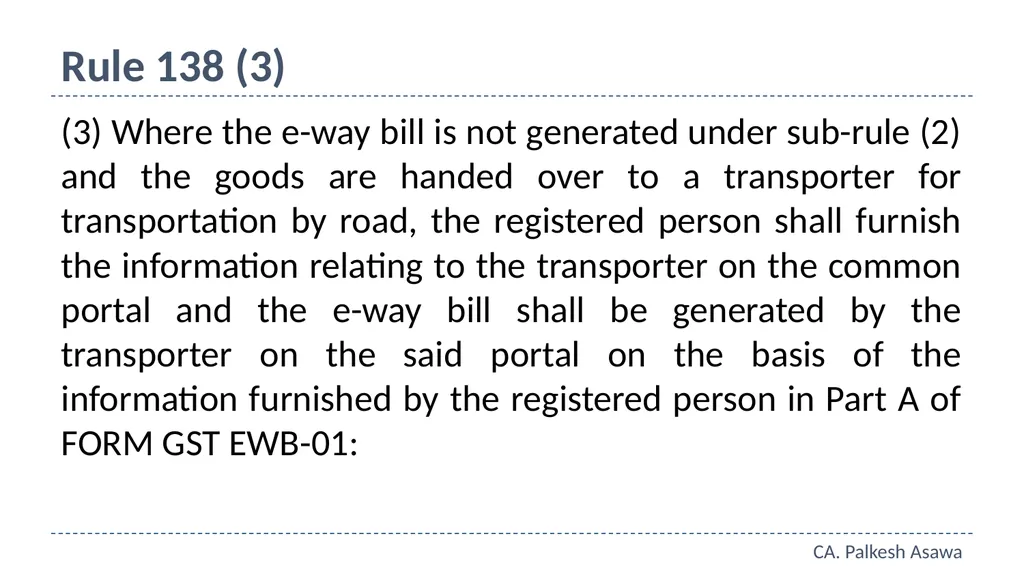
Rule 138 (3) CA. Palkesh Asawa (3) Where the e-way bill is not generated under sub-rule (2) and the goods are handed over to a transporter for transportation by road, the registered person shall furnish the information relating to the transporter on the common portal and the e-way bill shall be generated by the transporter on the said portal on the basis of the information furnished by the registered person in Part A of FORM GST EWB-01:<br>
13
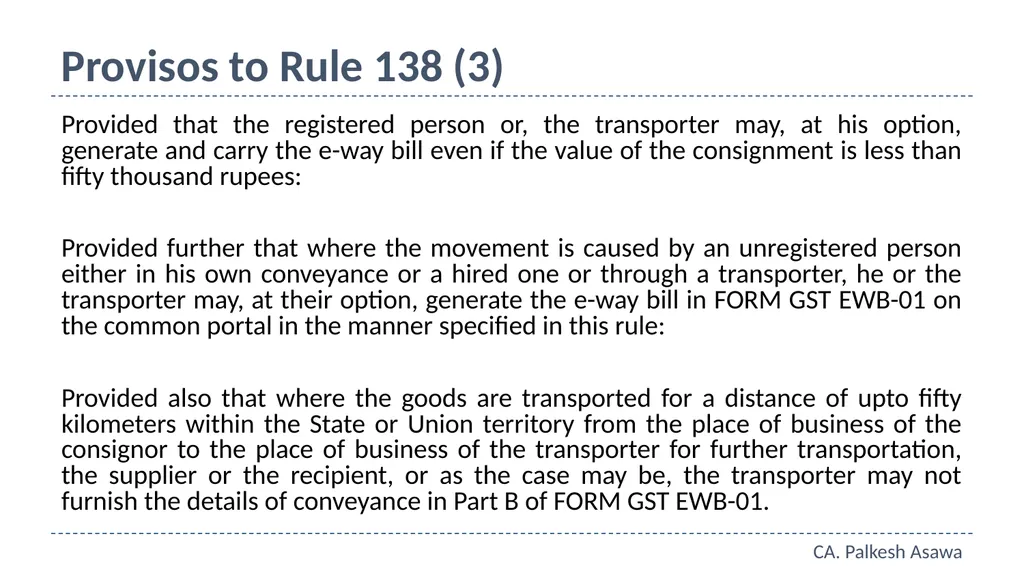
Provisos to Rule 138 (3) CA. Palkesh Asawa Provided that the registered person or, the transporter may, at his option, generate and carry the e-way bill even if the value of the consignment is less than fifty thousand rupees:
Provided further that where the movement is caused by an unregistered person either in his own conveyance or a hired one or through a transporter, he or the transporter may, at their option, generate the e-way bill in FORM GST EWB-01 on the common portal in the manner specified in this rule:
Provided also that where the goods are transported for a distance of upto fifty kilometers within the State or Union territory from the place of business of the consignor to the place of business of the transporter for further transportation, the supplier or the recipient, or as the case may be, the transporter may not furnish the details of conveyance in Part B of FORM GST EWB-01.<br>
Provided further that where the movement is caused by an unregistered person either in his own conveyance or a hired one or through a transporter, he or the transporter may, at their option, generate the e-way bill in FORM GST EWB-01 on the common portal in the manner specified in this rule:
Provided also that where the goods are transported for a distance of upto fifty kilometers within the State or Union territory from the place of business of the consignor to the place of business of the transporter for further transportation, the supplier or the recipient, or as the case may be, the transporter may not furnish the details of conveyance in Part B of FORM GST EWB-01.<br>
14
Explanations to Rule 138 (3) CA. Palkesh Asawa Explanation 1.– For the purposes of this sub-rule, where the goods are supplied by an unregistered supplier to a recipient who is registered, the movement shall be said to be caused by such recipient if the recipient is known at the time of commencement of the movement of goods.
Explanation 2.- The e-way bill shall not be valid for movement of goods by road unless the information in Part-B of FORM GST EWB-01 has been furnished except in the case of movements covered under the third proviso to sub-rule (3) and the proviso to sub-rule (5).<br>
Explanation 2.- The e-way bill shall not be valid for movement of goods by road unless the information in Part-B of FORM GST EWB-01 has been furnished except in the case of movements covered under the third proviso to sub-rule (3) and the proviso to sub-rule (5).<br>
15
Rule 138 (4) and 138(5) CA. Palkesh Asawa (4) Upon generation of the e-way bill on the common portal, a unique e-way bill number (EBN) shall be made available to the supplier, the recipient and the transporter on the common portal.
(5) Where the goods are transferred from one conveyance to another, the consignor or the recipient, who has provided information in Part A of the FORM GST EWB-01, or the transporter shall, before such transfer and further movement of goods, update the details of conveyance in the e-way bill on the common portal in Part B of FORM GST EWB-01:
Provided that where the goods are transported for a distance of upto fifty kilometers within the State or Union territory from the place of business of the transporter finally to the place of business of the consignee, the details of the conveyance may not be updated in the eway bill.<br>
(5) Where the goods are transferred from one conveyance to another, the consignor or the recipient, who has provided information in Part A of the FORM GST EWB-01, or the transporter shall, before such transfer and further movement of goods, update the details of conveyance in the e-way bill on the common portal in Part B of FORM GST EWB-01:
Provided that where the goods are transported for a distance of upto fifty kilometers within the State or Union territory from the place of business of the transporter finally to the place of business of the consignee, the details of the conveyance may not be updated in the eway bill.<br>
16
Rule 138(5A) CA. Palkesh Asawa (5A) The consignor or the recipient, who has furnished the information in Part A of FORM GST EWB-01, or the transporter, may assign the e-way bill number to another registered or enrolled transporter for updating the information in Part B of FORM GST EWB-01 for further movement of the consignment:
Provided that after the details of the conveyance have been updated by the transporter
in Part B of FORM GST EWB-01, the consignor or recipient, as the case may be, who has furnished the information in Part A of FORM GST EWB-01 shall not be allowed to assign the e-way bill number to another transporter.<br>
Provided that after the details of the conveyance have been updated by the transporter
in Part B of FORM GST EWB-01, the consignor or recipient, as the case may be, who has furnished the information in Part A of FORM GST EWB-01 shall not be allowed to assign the e-way bill number to another transporter.<br>
17
Rule 138(6) CA. Palkesh Asawa (6) After e-way bill has been generated in accordance with the provisions of sub-rule (1), where multiple consignments are intended to be transported in one conveyance, the transporter may indicate the serial number of e-way bills generated in respect of each such consignment electronically on the common portal and a consolidated e-way bill in FORM GST EWB-02 maybe generated by him on the said common portal prior to the movement of goods.<br>
18
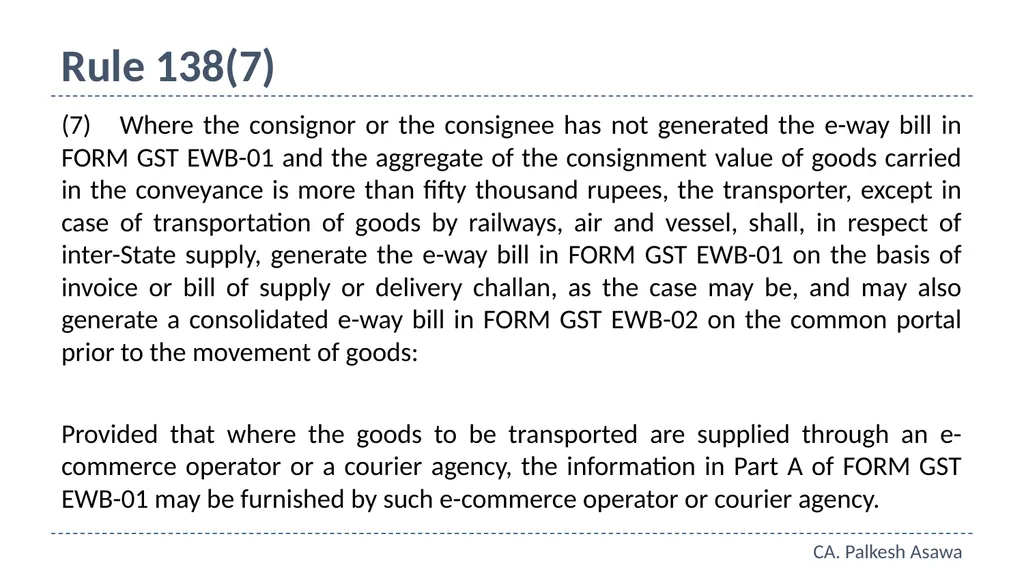
Rule 138(7) CA. Palkesh Asawa (7) Where the consignor or the consignee has not generated the e-way bill in FORM GST EWB-01 and the aggregate of the consignment value of goods carried in the conveyance is more than fifty thousand rupees, the transporter, except in case of transportation of goods by railways, air and vessel, shall, in respect of inter-State supply, generate the e-way bill in FORM GST EWB-01 on the basis of invoice or bill of supply or delivery challan, as the case may be, and may also generate a consolidated e-way bill in FORM GST EWB-02 on the common portal prior to the movement of goods:
Provided that where the goods to be transported are supplied through an e-commerce operator or a courier agency, the information in Part A of FORM GST EWB-01 may be furnished by such e-commerce operator or courier agency.<br>
Provided that where the goods to be transported are supplied through an e-commerce operator or a courier agency, the information in Part A of FORM GST EWB-01 may be furnished by such e-commerce operator or courier agency.<br>
19
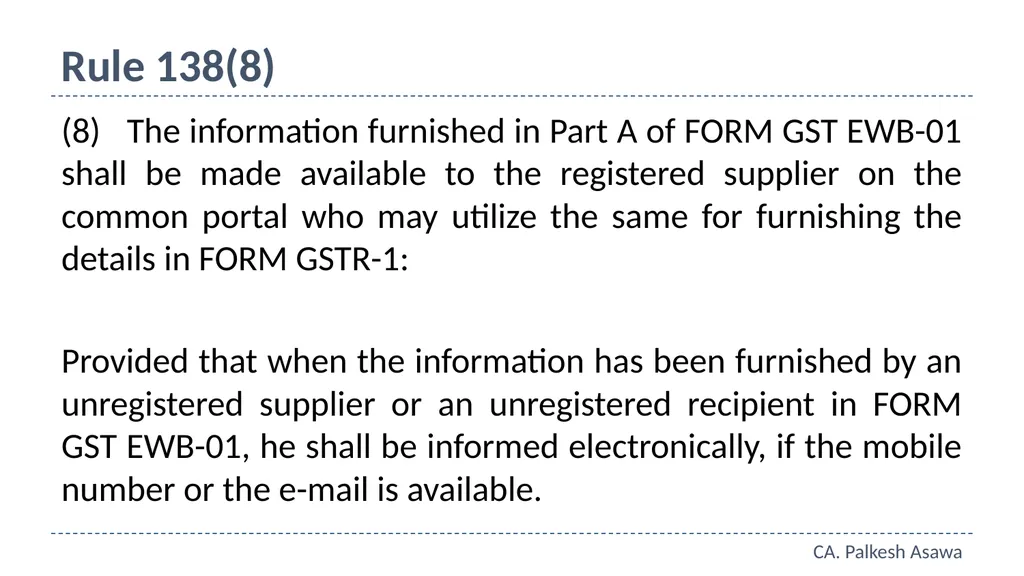
Rule 138(8) CA. Palkesh Asawa (8) The information furnished in Part A of FORM GST EWB-01 shall be made available to the registered supplier on the common portal who may utilize the same for furnishing the details in FORM GSTR-1:
Provided that when the information has been furnished by an unregistered supplier or an unregistered recipient in FORM GST EWB-01, he shall be informed electronically, if the mobile number or the e-mail is available.<br>
Provided that when the information has been furnished by an unregistered supplier or an unregistered recipient in FORM GST EWB-01, he shall be informed electronically, if the mobile number or the e-mail is available.<br>
20
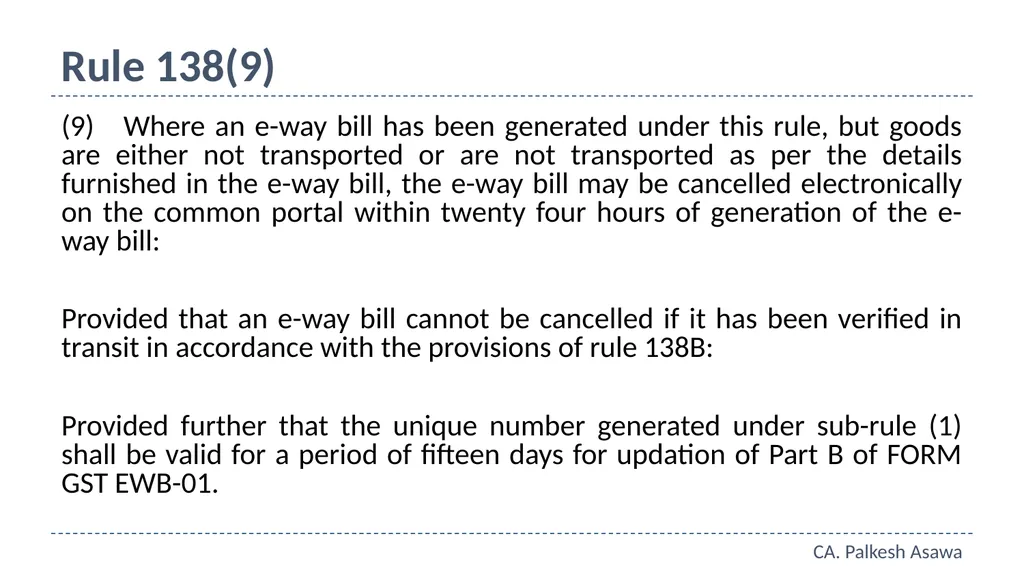
Rule 138(9) CA. Palkesh Asawa (9) Where an e-way bill has been generated under this rule, but goods are either not transported or are not transported as per the details furnished in the e-way bill, the e-way bill may be cancelled electronically on the common portal within twenty four hours of generation of the e-way bill:
Provided that an e-way bill cannot be cancelled if it has been verified in transit in accordance with the provisions of rule 138B:
Provided further that the unique number generated under sub-rule (1) shall be valid for a period of fifteen days for updation of Part B of FORM GST EWB-01.<br>
Provided that an e-way bill cannot be cancelled if it has been verified in transit in accordance with the provisions of rule 138B:
Provided further that the unique number generated under sub-rule (1) shall be valid for a period of fifteen days for updation of Part B of FORM GST EWB-01.<br>
21
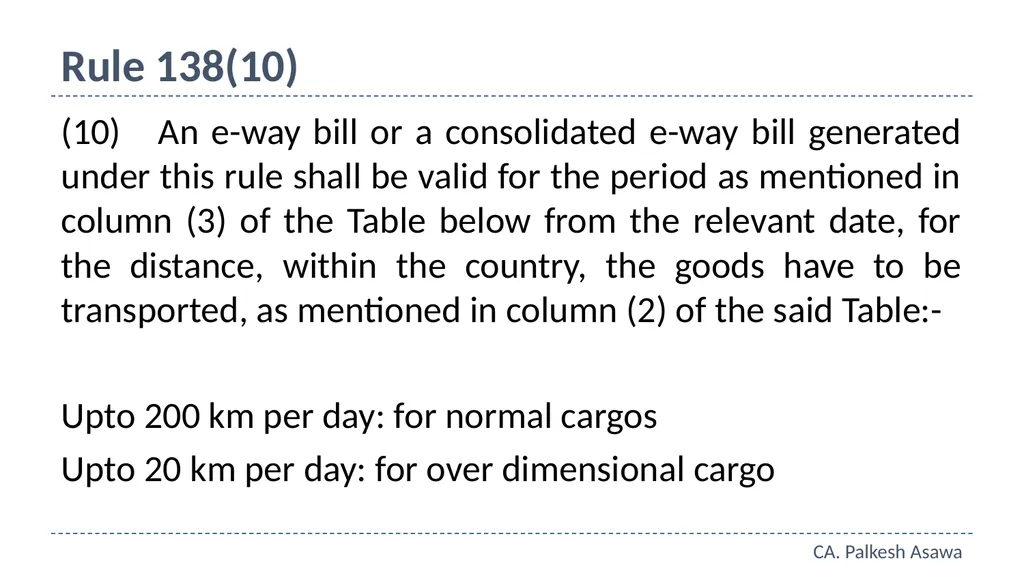
Rule 138(10) CA. Palkesh Asawa (10) An e-way bill or a consolidated e-way bill generated under this rule shall be valid for the period as mentioned in column (3) of the Table below from the relevant date, for the distance, within the country, the goods have to be transported, as mentioned in column (2) of the said Table:-
Upto 200 km per day: for normal cargos
Upto 20 km per day: for over dimensional cargo<br>
Upto 200 km per day: for normal cargos
Upto 20 km per day: for over dimensional cargo<br>
22
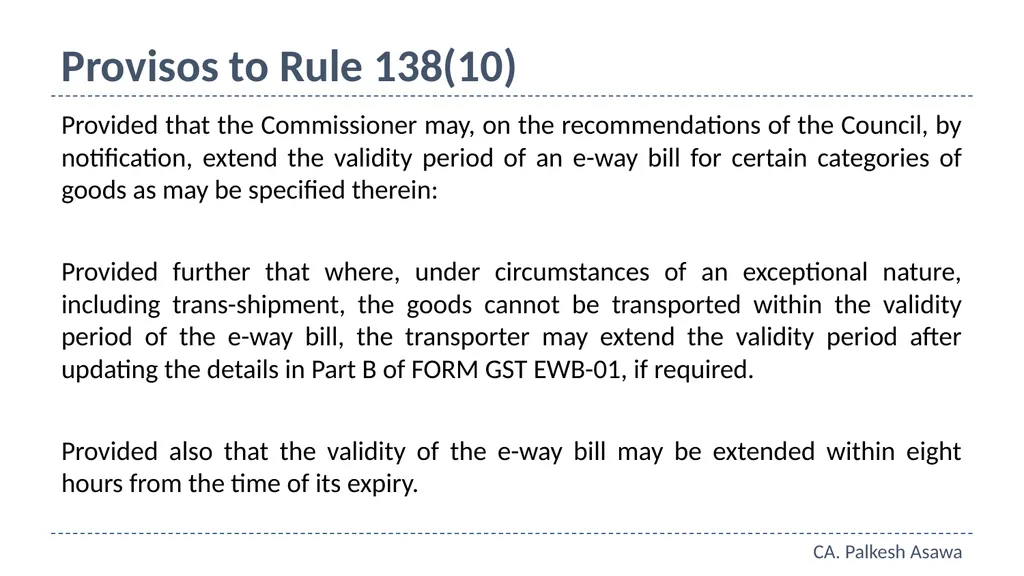
Provisos to Rule 138(10) CA. Palkesh Asawa Provided that the Commissioner may, on the recommendations of the Council, by notification, extend the validity period of an e-way bill for certain categories of goods as may be specified therein:
Provided further that where, under circumstances of an exceptional nature, including trans-shipment, the goods cannot be transported within the validity period of the e-way bill, the transporter may extend the validity period after updating the details in Part B of FORM GST EWB-01, if required.
Provided also that the validity of the e-way bill may be extended within eight hours from the time of its expiry.<br>
Provided further that where, under circumstances of an exceptional nature, including trans-shipment, the goods cannot be transported within the validity period of the e-way bill, the transporter may extend the validity period after updating the details in Part B of FORM GST EWB-01, if required.
Provided also that the validity of the e-way bill may be extended within eight hours from the time of its expiry.<br>
23
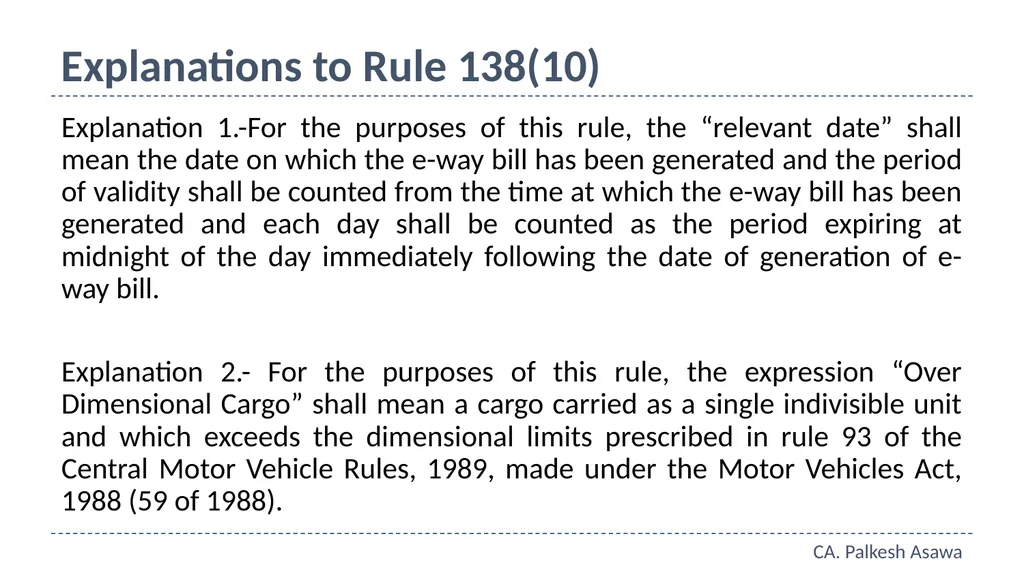
Explanations to Rule 138(10) CA. Palkesh Asawa Explanation 1.-For the purposes of this rule, the “relevant date” shall mean the date on which the e-way bill has been generated and the period of validity shall be counted from the time at which the e-way bill has been generated and each day shall be counted as the period expiring at midnight of the day immediately following the date of generation of e-way bill.
Explanation 2.- For the purposes of this rule, the expression “Over Dimensional Cargo” shall mean a cargo carried as a single indivisible unit and which exceeds the dimensional limits prescribed in rule 93 of the Central Motor Vehicle Rules, 1989, made under the Motor Vehicles Act, 1988 (59 of 1988).<br>
Explanation 2.- For the purposes of this rule, the expression “Over Dimensional Cargo” shall mean a cargo carried as a single indivisible unit and which exceeds the dimensional limits prescribed in rule 93 of the Central Motor Vehicle Rules, 1989, made under the Motor Vehicles Act, 1988 (59 of 1988).<br>
24
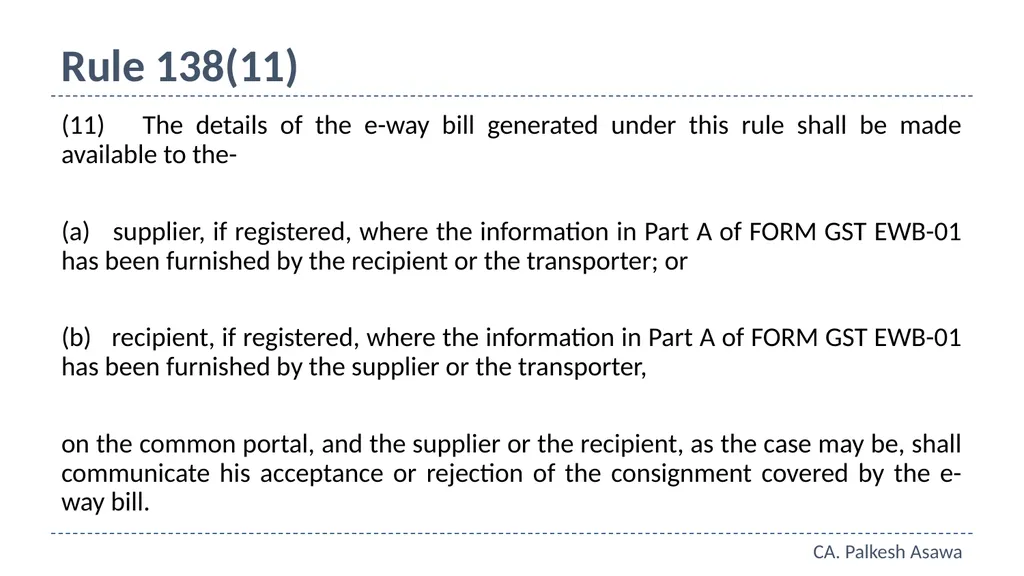
Rule 138(11) CA. Palkesh Asawa (11) The details of the e-way bill generated under this rule shall be made available to the-
(a) supplier, if registered, where the information in Part A of FORM GST EWB-01 has been furnished by the recipient or the transporter; or
(b) recipient, if registered, where the information in Part A of FORM GST EWB-01 has been furnished by the supplier or the transporter,
on the common portal, and the supplier or the recipient, as the case may be, shall communicate his acceptance or rejection of the consignment covered by the e-way bill.<br>
(a) supplier, if registered, where the information in Part A of FORM GST EWB-01 has been furnished by the recipient or the transporter; or
(b) recipient, if registered, where the information in Part A of FORM GST EWB-01 has been furnished by the supplier or the transporter,
on the common portal, and the supplier or the recipient, as the case may be, shall communicate his acceptance or rejection of the consignment covered by the e-way bill.<br>
25
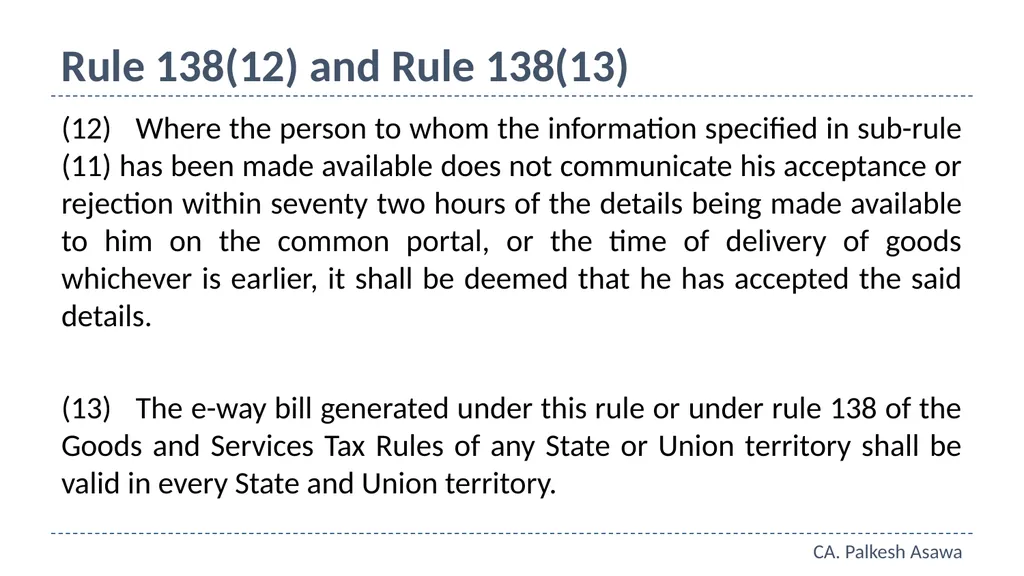
Rule 138(12) and Rule 138(13) CA. Palkesh Asawa (12) Where the person to whom the information specified in sub-rule (11) has been made available does not communicate his acceptance or rejection within seventy two hours of the details being made available to him on the common portal, or the time of delivery of goods whichever is earlier, it shall be deemed that he has accepted the said details.
(13) The e-way bill generated under this rule or under rule 138 of the Goods and Services Tax Rules of any State or Union territory shall be valid in every State and Union territory.<br>
(13) The e-way bill generated under this rule or under rule 138 of the Goods and Services Tax Rules of any State or Union territory shall be valid in every State and Union territory.<br>
26
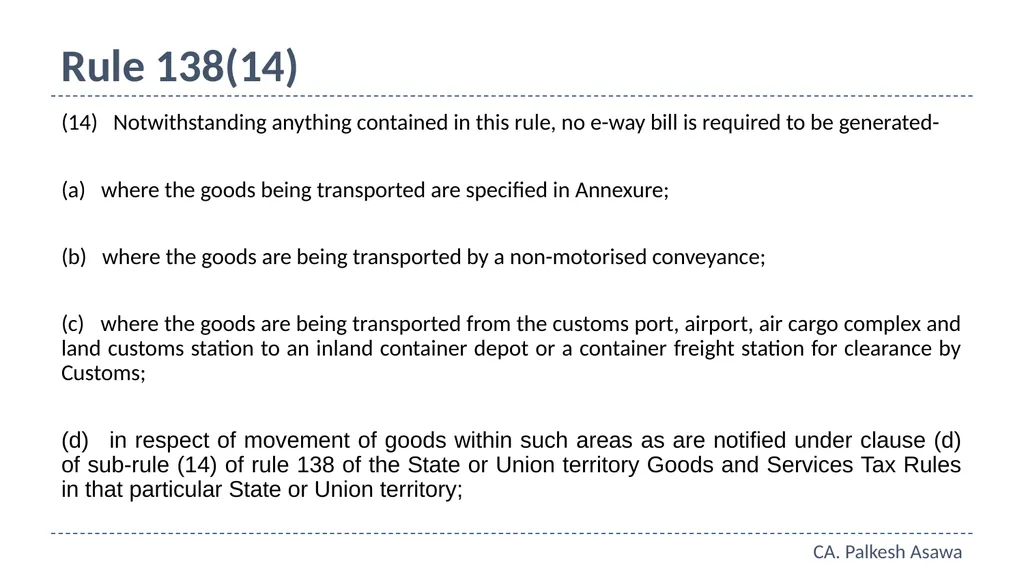
Rule 138(14) CA. Palkesh Asawa (14) Notwithstanding anything contained in this rule, no e-way bill is required to be generated-
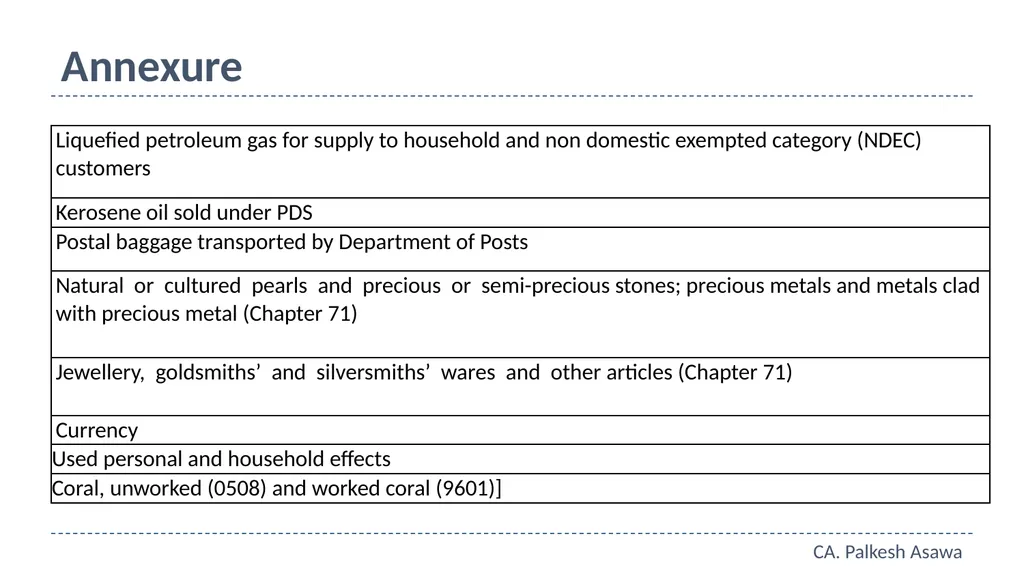
(a) where the goods being transported are specified in Annexure;
(b) where the goods are being transported by a non-motorised conveyance;
(c) where the goods are being transported from the customs port, airport, air cargo complex and land customs station to an inland container depot or a container freight station for clearance by Customs;
(d) in respect of movement of goods within such areas as are notified under clause (d) of sub-rule (14) of rule 138 of the State or Union territory Goods and Services Tax Rules in that particular State or Union territory;<br>
(a) where the goods being transported are specified in Annexure;
(b) where the goods are being transported by a non-motorised conveyance;
(c) where the goods are being transported from the customs port, airport, air cargo complex and land customs station to an inland container depot or a container freight station for clearance by Customs;
(d) in respect of movement of goods within such areas as are notified under clause (d) of sub-rule (14) of rule 138 of the State or Union territory Goods and Services Tax Rules in that particular State or Union territory;<br>
27
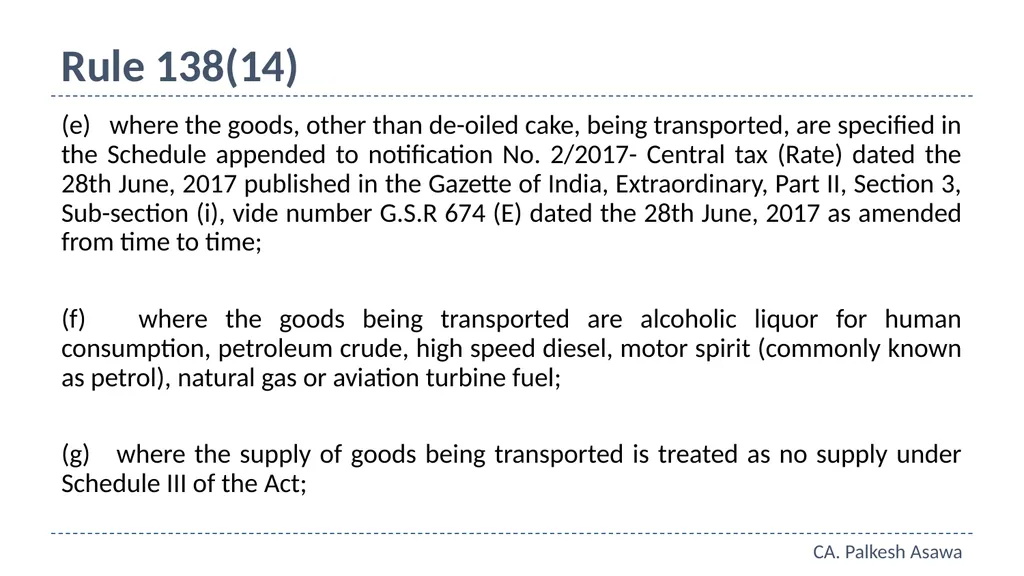
Rule 138(14) CA. Palkesh Asawa (e) where the goods, other than de-oiled cake, being transported, are specified in the Schedule appended to notification No. 2/2017- Central tax (Rate) dated the 28th June, 2017 published in the Gazette of India, Extraordinary, Part II, Section 3, Sub-section (i), vide number G.S.R 674 (E) dated the 28th June, 2017 as amended from time to time;
(f) where the goods being transported are alcoholic liquor for human consumption, petroleum crude, high speed diesel, motor spirit (commonly known as petrol), natural gas or aviation turbine fuel;
(g) where the supply of goods being transported is treated as no supply under Schedule III of the Act;<br>
(f) where the goods being transported are alcoholic liquor for human consumption, petroleum crude, high speed diesel, motor spirit (commonly known as petrol), natural gas or aviation turbine fuel;
(g) where the supply of goods being transported is treated as no supply under Schedule III of the Act;<br>
28
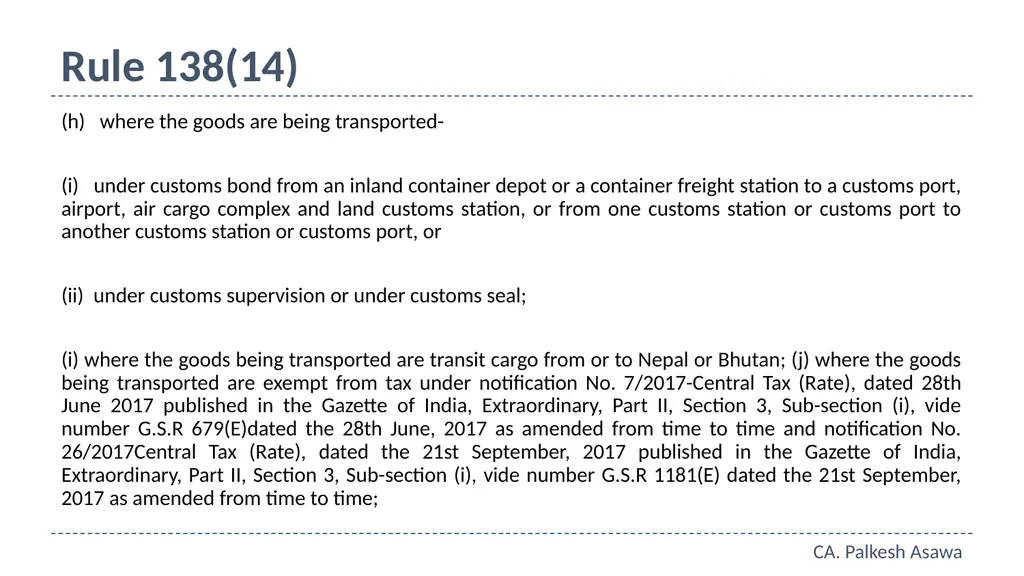
Rule 138(14) CA. Palkesh Asawa (h) where the goods are being transported-
(i) under customs bond from an inland container depot or a container freight station to a customs port, airport, air cargo complex and land customs station, or from one customs station or customs port to another customs station or customs port, or
(ii) under customs supervision or under customs seal;
(i) where the goods being transported are transit cargo from or to Nepal or Bhutan; (j) where the goods being transported are exempt from tax under notification No. 7/2017-Central Tax (Rate), dated 28th June 2017 published in the Gazette of India, Extraordinary, Part II, Section 3, Sub-section (i), vide number G.S.R 679(E)dated the 28th June, 2017 as amended from time to time and notification No. 26/2017Central Tax (Rate), dated the 21st September, 2017 published in the Gazette of India, Extraordinary, Part II, Section 3, Sub-section (i), vide number G.S.R 1181(E) dated the 21st September, 2017 as amended from time to time;<br>
(i) under customs bond from an inland container depot or a container freight station to a customs port, airport, air cargo complex and land customs station, or from one customs station or customs port to another customs station or customs port, or
(ii) under customs supervision or under customs seal;
(i) where the goods being transported are transit cargo from or to Nepal or Bhutan; (j) where the goods being transported are exempt from tax under notification No. 7/2017-Central Tax (Rate), dated 28th June 2017 published in the Gazette of India, Extraordinary, Part II, Section 3, Sub-section (i), vide number G.S.R 679(E)dated the 28th June, 2017 as amended from time to time and notification No. 26/2017Central Tax (Rate), dated the 21st September, 2017 published in the Gazette of India, Extraordinary, Part II, Section 3, Sub-section (i), vide number G.S.R 1181(E) dated the 21st September, 2017 as amended from time to time;<br>
29
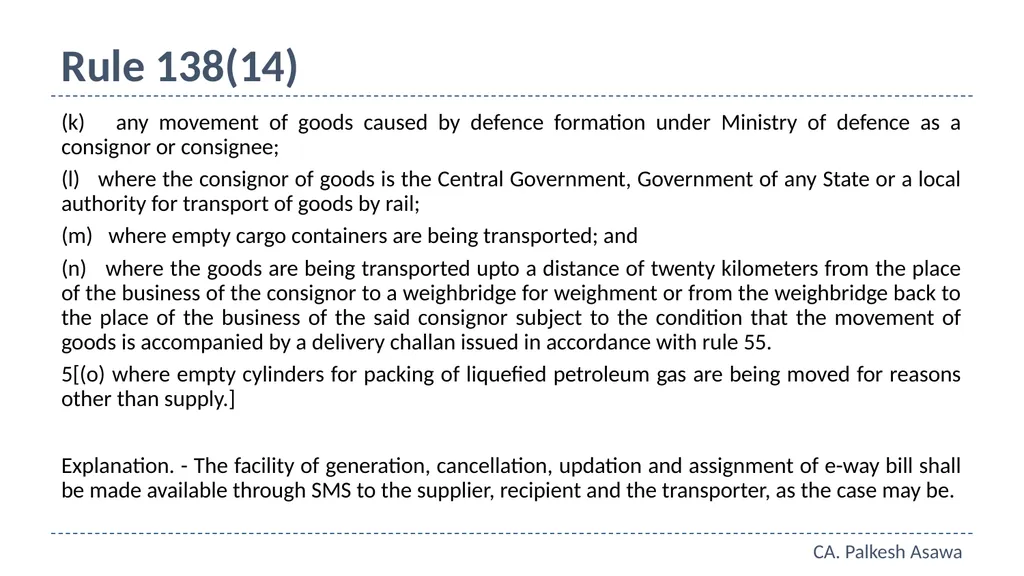
Rule 138(14) CA. Palkesh Asawa (k) any movement of goods caused by defence formation under Ministry of defence as a consignor or consignee;
(l) where the consignor of goods is the Central Government, Government of any State or a local authority for transport of goods by rail;
(m) where empty cargo containers are being transported; and
(n) where the goods are being transported upto a distance of twenty kilometers from the place of the business of the consignor to a weighbridge for weighment or from the weighbridge back to the place of the business of the said consignor subject to the condition that the movement of goods is accompanied by a delivery challan issued in accordance with rule 55.
5[(o) where empty cylinders for packing of liquefied petroleum gas are being moved for reasons other than supply.]
Explanation. - The facility of generation, cancellation, updation and assignment of e-way bill shall be made available through SMS to the supplier, recipient and the transporter, as the case may be.<br>
(l) where the consignor of goods is the Central Government, Government of any State or a local authority for transport of goods by rail;
(m) where empty cargo containers are being transported; and
(n) where the goods are being transported upto a distance of twenty kilometers from the place of the business of the consignor to a weighbridge for weighment or from the weighbridge back to the place of the business of the said consignor subject to the condition that the movement of goods is accompanied by a delivery challan issued in accordance with rule 55.
5[(o) where empty cylinders for packing of liquefied petroleum gas are being moved for reasons other than supply.]
Explanation. - The facility of generation, cancellation, updation and assignment of e-way bill shall be made available through SMS to the supplier, recipient and the transporter, as the case may be.<br>
30
Annexure CA. Palkesh Asawa<br>
31
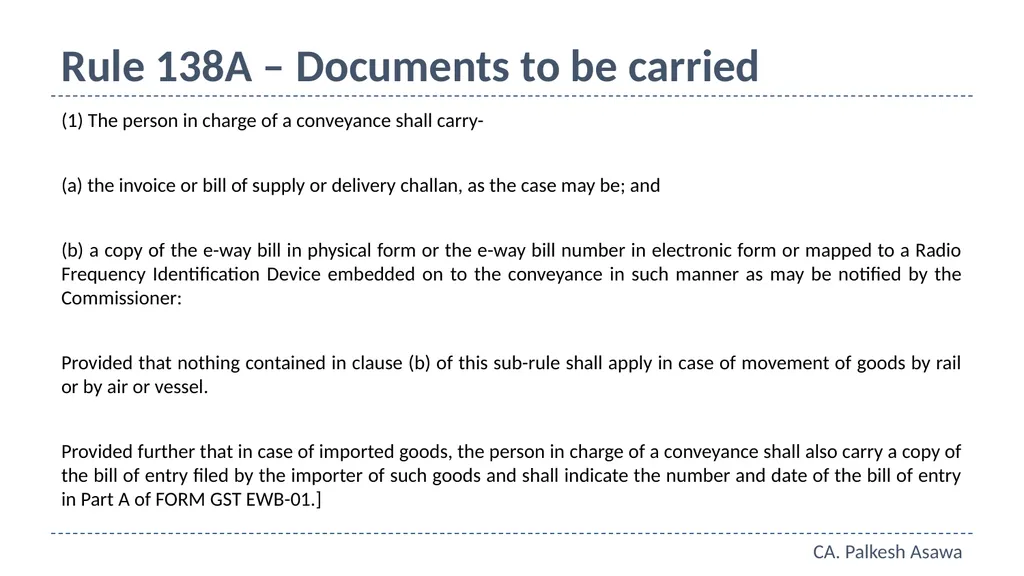
Rule 138A – Documents to be carried CA. Palkesh Asawa (1) The person in charge of a conveyance shall carry-
(a) the invoice or bill of supply or delivery challan, as the case may be; and
(b) a copy of the e-way bill in physical form or the e-way bill number in electronic form or mapped to a Radio Frequency Identification Device embedded on to the conveyance in such manner as may be notified by the Commissioner:
Provided that nothing contained in clause (b) of this sub-rule shall apply in case of movement of goods by rail or by air or vessel.
Provided further that in case of imported goods, the person in charge of a conveyance shall also carry a copy of the bill of entry filed by the importer of such goods and shall indicate the number and date of the bill of entry in Part A of FORM GST EWB-01.]<br>
(a) the invoice or bill of supply or delivery challan, as the case may be; and
(b) a copy of the e-way bill in physical form or the e-way bill number in electronic form or mapped to a Radio Frequency Identification Device embedded on to the conveyance in such manner as may be notified by the Commissioner:
Provided that nothing contained in clause (b) of this sub-rule shall apply in case of movement of goods by rail or by air or vessel.
Provided further that in case of imported goods, the person in charge of a conveyance shall also carry a copy of the bill of entry filed by the importer of such goods and shall indicate the number and date of the bill of entry in Part A of FORM GST EWB-01.]<br>
32
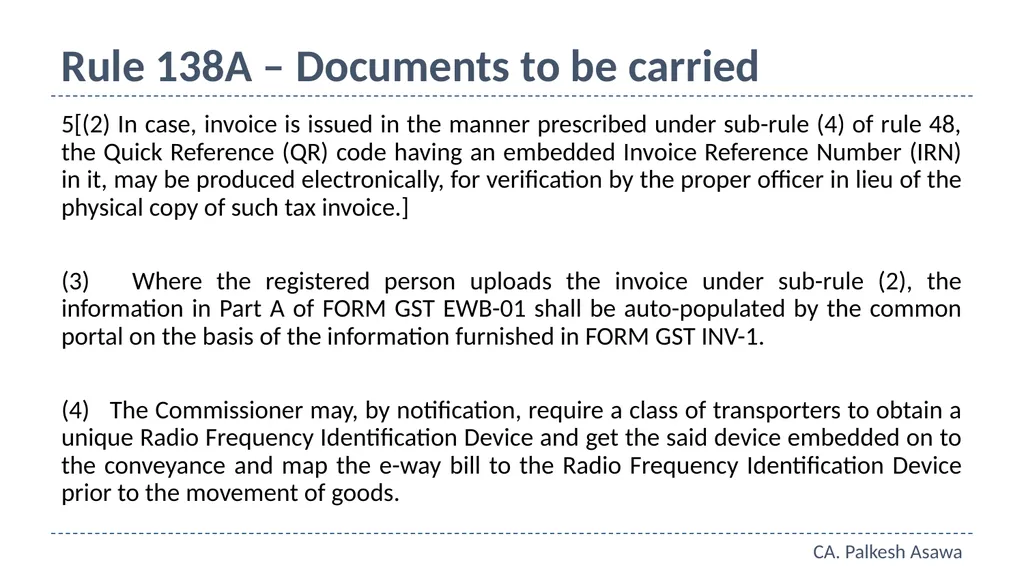
Rule 138A – Documents to be carried CA. Palkesh Asawa 5[(2) In case, invoice is issued in the manner prescribed under sub-rule (4) of rule 48, the Quick Reference (QR) code having an embedded Invoice Reference Number (IRN) in it, may be produced electronically, for verification by the proper officer in lieu of the physical copy of such tax invoice.]
(3) Where the registered person uploads the invoice under sub-rule (2), the information in Part A of FORM GST EWB-01 shall be auto-populated by the common portal on the basis of the information furnished in FORM GST INV-1.
(4) The Commissioner may, by notification, require a class of transporters to obtain a unique Radio Frequency Identification Device and get the said device embedded on to the conveyance and map the e-way bill to the Radio Frequency Identification Device prior to the movement of goods.<br>
(3) Where the registered person uploads the invoice under sub-rule (2), the information in Part A of FORM GST EWB-01 shall be auto-populated by the common portal on the basis of the information furnished in FORM GST INV-1.
(4) The Commissioner may, by notification, require a class of transporters to obtain a unique Radio Frequency Identification Device and get the said device embedded on to the conveyance and map the e-way bill to the Radio Frequency Identification Device prior to the movement of goods.<br>
33
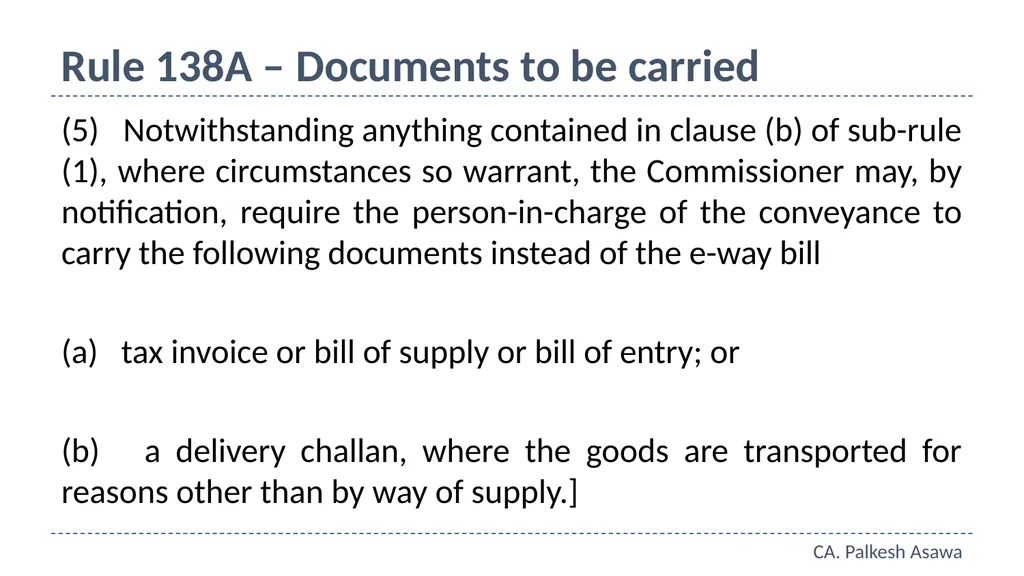
Rule 138A – Documents to be carried CA. Palkesh Asawa (5) Notwithstanding anything contained in clause (b) of sub-rule (1), where circumstances so warrant, the Commissioner may, by notification, require the person-in-charge of the conveyance to carry the following documents instead of the e-way bill
(a) tax invoice or bill of supply or bill of entry; or
(b) a delivery challan, where the goods are transported for reasons other than by way of supply.]<br>
(a) tax invoice or bill of supply or bill of entry; or
(b) a delivery challan, where the goods are transported for reasons other than by way of supply.]<br>
34
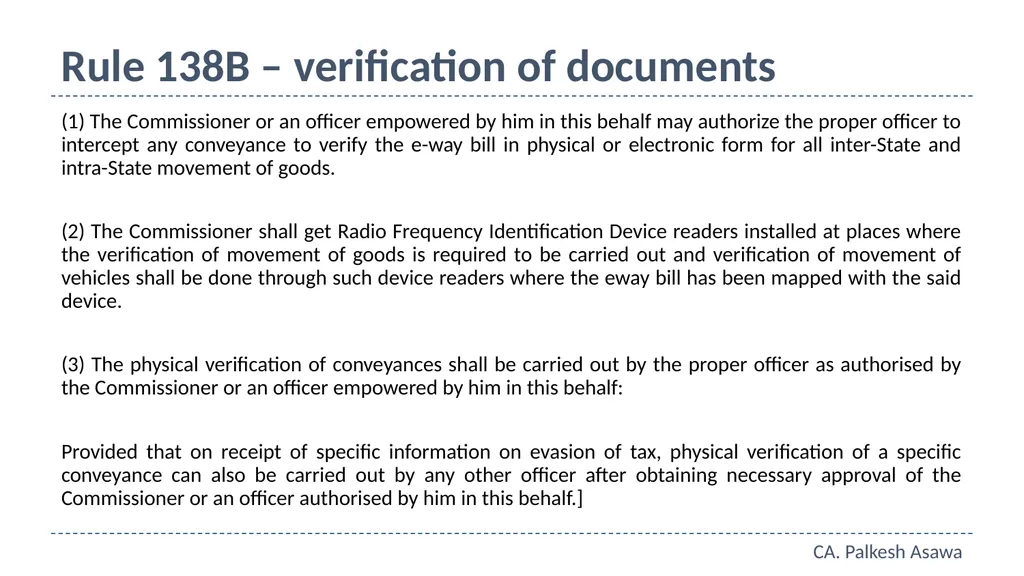
Rule 138B – verification of documents CA. Palkesh Asawa (1) The Commissioner or an officer empowered by him in this behalf may authorize the proper officer to intercept any conveyance to verify the e-way bill in physical or electronic form for all inter-State and intra-State movement of goods.
(2) The Commissioner shall get Radio Frequency Identification Device readers installed at places where the verification of movement of goods is required to be carried out and verification of movement of vehicles shall be done through such device readers where the eway bill has been mapped with the said device.
(3) The physical verification of conveyances shall be carried out by the proper officer as authorised by the Commissioner or an officer empowered by him in this behalf:
Provided that on receipt of specific information on evasion of tax, physical verification of a specific conveyance can also be carried out by any other officer after obtaining necessary approval of the Commissioner or an officer authorised by him in this behalf.]<br>
(2) The Commissioner shall get Radio Frequency Identification Device readers installed at places where the verification of movement of goods is required to be carried out and verification of movement of vehicles shall be done through such device readers where the eway bill has been mapped with the said device.
(3) The physical verification of conveyances shall be carried out by the proper officer as authorised by the Commissioner or an officer empowered by him in this behalf:
Provided that on receipt of specific information on evasion of tax, physical verification of a specific conveyance can also be carried out by any other officer after obtaining necessary approval of the Commissioner or an officer authorised by him in this behalf.]<br>
35
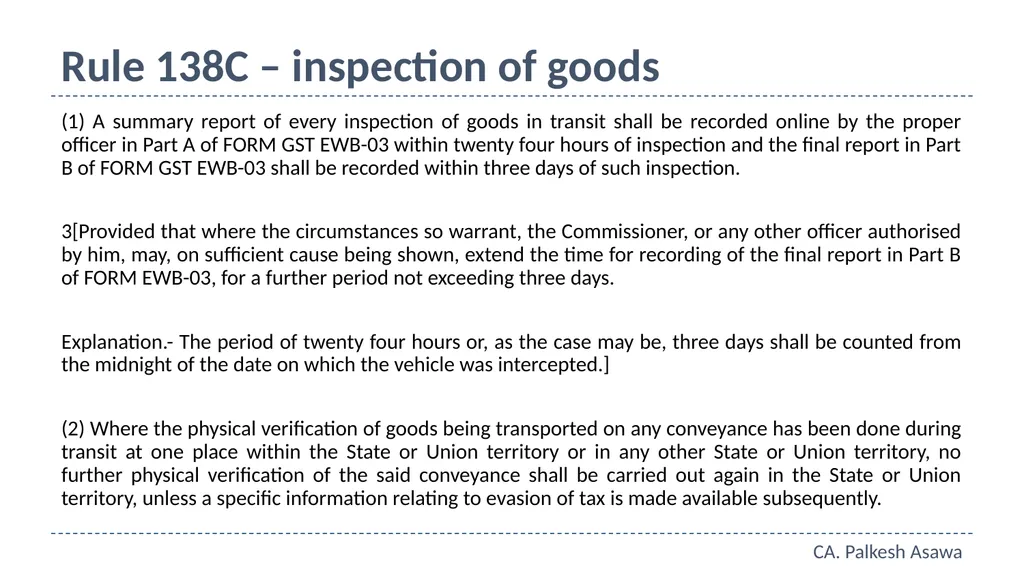
Rule 138C – inspection of goods CA. Palkesh Asawa (1) A summary report of every inspection of goods in transit shall be recorded online by the proper officer in Part A of FORM GST EWB-03 within twenty four hours of inspection and the final report in Part B of FORM GST EWB-03 shall be recorded within three days of such inspection.
3[Provided that where the circumstances so warrant, the Commissioner, or any other officer authorised by him, may, on sufficient cause being shown, extend the time for recording of the final report in Part B of FORM EWB-03, for a further period not exceeding three days.
Explanation.- The period of twenty four hours or, as the case may be, three days shall be counted from the midnight of the date on which the vehicle was intercepted.]
(2) Where the physical verification of goods being transported on any conveyance has been done during transit at one place within the State or Union territory or in any other State or Union territory, no further physical verification of the said conveyance shall be carried out again in the State or Union territory, unless a specific information relating to evasion of tax is made available subsequently.<br>
3[Provided that where the circumstances so warrant, the Commissioner, or any other officer authorised by him, may, on sufficient cause being shown, extend the time for recording of the final report in Part B of FORM EWB-03, for a further period not exceeding three days.
Explanation.- The period of twenty four hours or, as the case may be, three days shall be counted from the midnight of the date on which the vehicle was intercepted.]
(2) Where the physical verification of goods being transported on any conveyance has been done during transit at one place within the State or Union territory or in any other State or Union territory, no further physical verification of the said conveyance shall be carried out again in the State or Union territory, unless a specific information relating to evasion of tax is made available subsequently.<br>
36
Part – 2: Inspection of goods in transit CA. Palkesh Asawa<br>
37
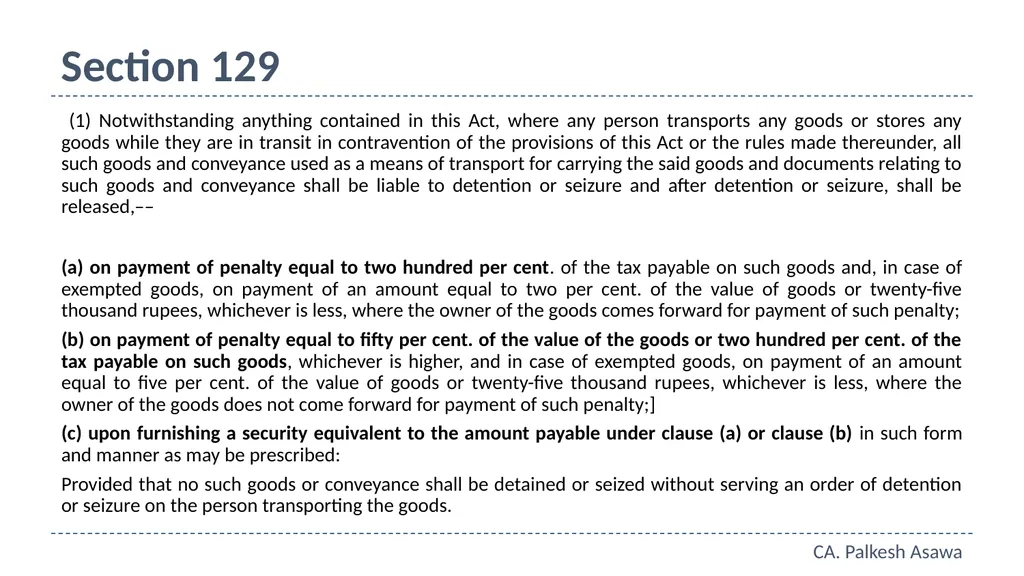
Section 129 CA. Palkesh Asawa (1) Notwithstanding anything contained in this Act, where any person transports any goods or stores any goods while they are in transit in contravention of the provisions of this Act or the rules made thereunder, all such goods and conveyance used as a means of transport for carrying the said goods and documents relating to such goods and conveyance shall be liable to detention or seizure and after detention or seizure, shall be released,––
(a) on payment of penalty equal to two hundred per cent. of the tax payable on such goods and, in case of exempted goods, on payment of an amount equal to two per cent. of the value of goods or twenty-five thousand rupees, whichever is less, where the owner of the goods comes forward for payment of such penalty;
(b) on payment of penalty equal to fifty per cent. of the value of the goods or two hundred per cent. of the tax payable on such goods, whichever is higher, and in case of exempted goods, on payment of an amount equal to five per cent. of the value of goods or twenty-five thousand rupees, whichever is less, where the owner of the goods does not come forward for payment of such penalty;]
(c) upon furnishing a security equivalent to the amount payable under clause (a) or clause (b) in such form and manner as may be prescribed:
Provided that no such goods or conveyance shall be detained or seized without serving an order of detention or seizure on the person transporting the goods.<br>
(a) on payment of penalty equal to two hundred per cent. of the tax payable on such goods and, in case of exempted goods, on payment of an amount equal to two per cent. of the value of goods or twenty-five thousand rupees, whichever is less, where the owner of the goods comes forward for payment of such penalty;
(b) on payment of penalty equal to fifty per cent. of the value of the goods or two hundred per cent. of the tax payable on such goods, whichever is higher, and in case of exempted goods, on payment of an amount equal to five per cent. of the value of goods or twenty-five thousand rupees, whichever is less, where the owner of the goods does not come forward for payment of such penalty;]
(c) upon furnishing a security equivalent to the amount payable under clause (a) or clause (b) in such form and manner as may be prescribed:
Provided that no such goods or conveyance shall be detained or seized without serving an order of detention or seizure on the person transporting the goods.<br>
38
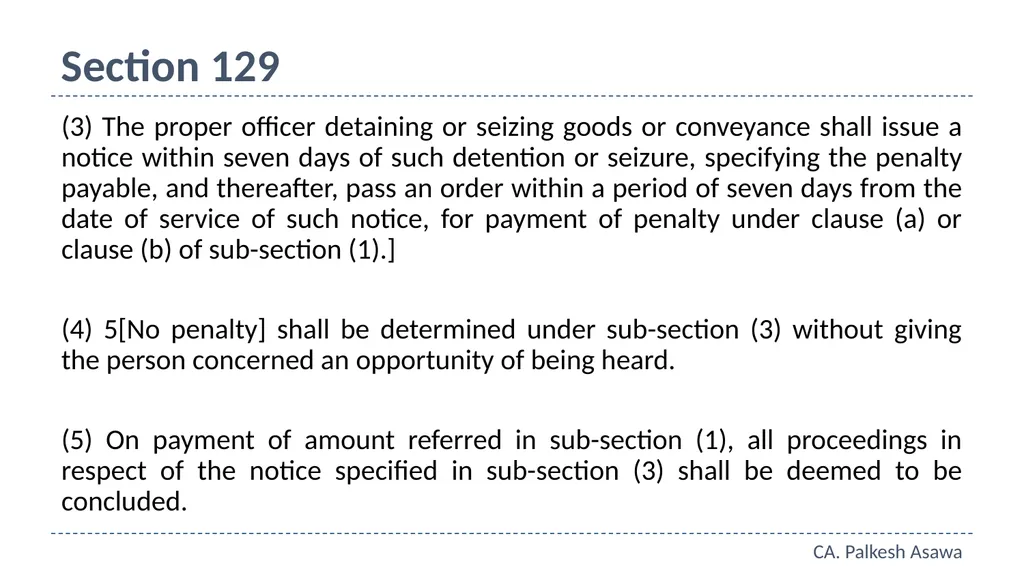
Section 129 CA. Palkesh Asawa (3) The proper officer detaining or seizing goods or conveyance shall issue a notice within seven days of such detention or seizure, specifying the penalty payable, and thereafter, pass an order within a period of seven days from the date of service of such notice, for payment of penalty under clause (a) or clause (b) of sub-section (1).]
(4) 5[No penalty] shall be determined under sub-section (3) without giving the person concerned an opportunity of being heard.
(5) On payment of amount referred in sub-section (1), all proceedings in respect of the notice specified in sub-section (3) shall be deemed to be concluded.<br>
(4) 5[No penalty] shall be determined under sub-section (3) without giving the person concerned an opportunity of being heard.
(5) On payment of amount referred in sub-section (1), all proceedings in respect of the notice specified in sub-section (3) shall be deemed to be concluded.<br>
39
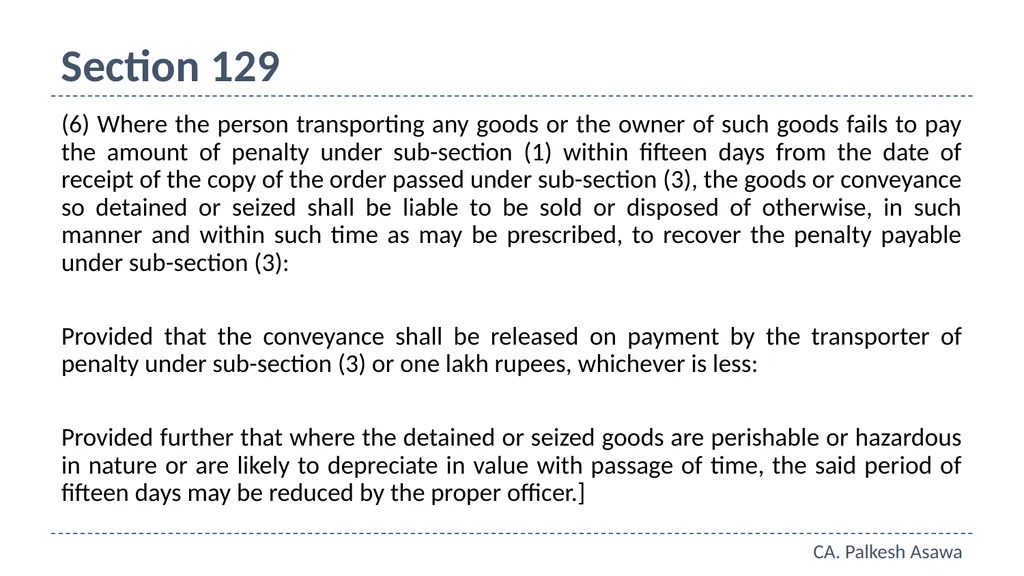
Section 129 CA. Palkesh Asawa (6) Where the person transporting any goods or the owner of such goods fails to pay the amount of penalty under sub-section (1) within fifteen days from the date of receipt of the copy of the order passed under sub-section (3), the goods or conveyance so detained or seized shall be liable to be sold or disposed of otherwise, in such manner and within such time as may be prescribed, to recover the penalty payable under sub-section (3):
Provided that the conveyance shall be released on payment by the transporter of penalty under sub-section (3) or one lakh rupees, whichever is less:
Provided further that where the detained or seized goods are perishable or hazardous in nature or are likely to depreciate in value with passage of time, the said period of fifteen days may be reduced by the proper officer.]<br>
Provided that the conveyance shall be released on payment by the transporter of penalty under sub-section (3) or one lakh rupees, whichever is less:
Provided further that where the detained or seized goods are perishable or hazardous in nature or are likely to depreciate in value with passage of time, the said period of fifteen days may be reduced by the proper officer.]<br>
40
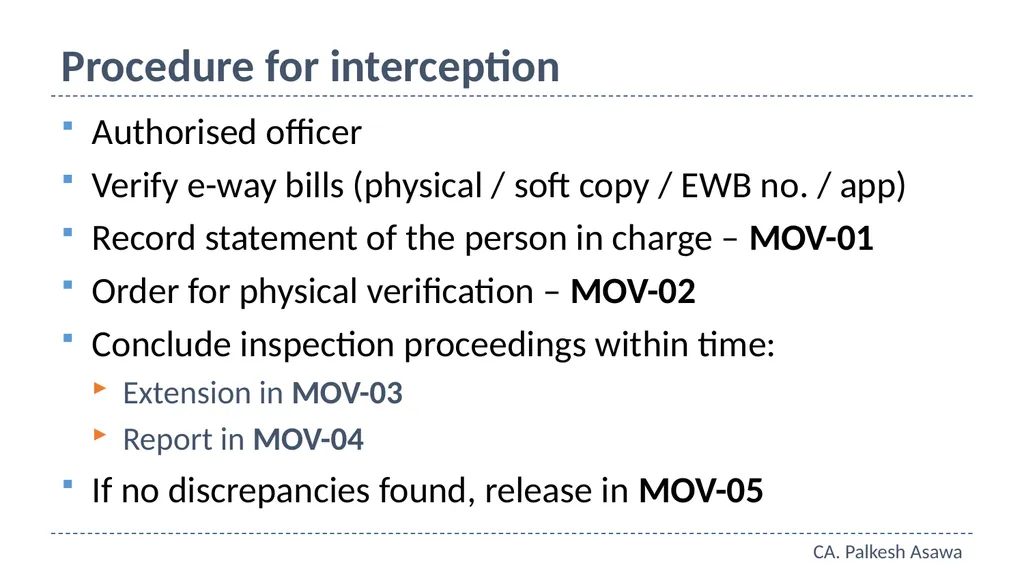
Procedure for interception CA. Palkesh Asawa Authorised officer
Verify e-way bills (physical / soft copy / EWB no. / app)
Record statement of the person in charge – MOV-01
Order for physical verification – MOV-02
Conclude inspection proceedings within time:
Extension in MOV-03
Report in MOV-04
If no discrepancies found, release in MOV-05<br>
Verify e-way bills (physical / soft copy / EWB no. / app)
Record statement of the person in charge – MOV-01
Order for physical verification – MOV-02
Conclude inspection proceedings within time:
Extension in MOV-03
Report in MOV-04
If no discrepancies found, release in MOV-05<br>
41
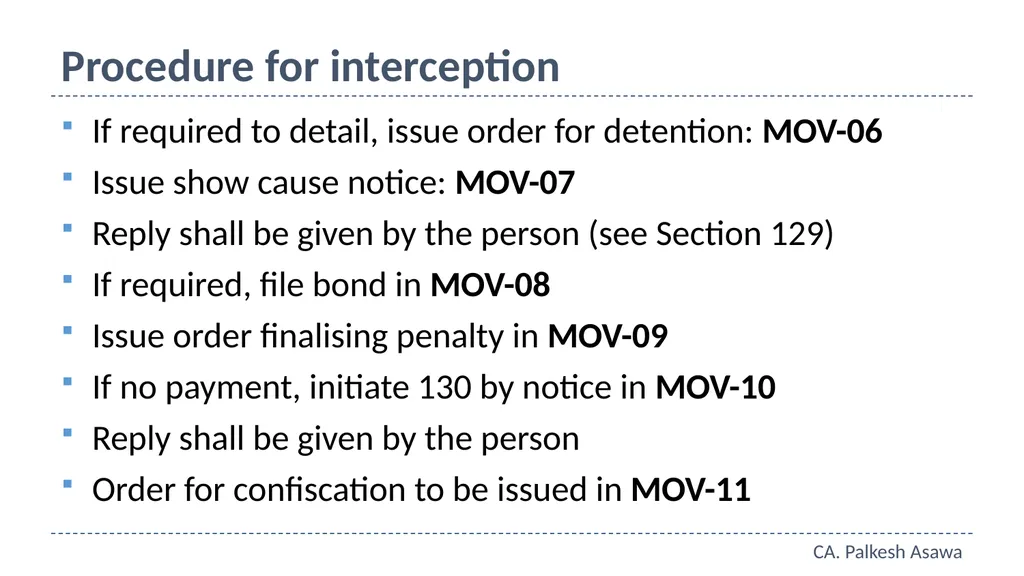
Procedure for interception CA. Palkesh Asawa If required to detail, issue order for detention: MOV-06
Issue show cause notice: MOV-07
Reply shall be given by the person (see Section 129)
If required, file bond in MOV-08
Issue order finalising penalty in MOV-09
If no payment, initiate 130 by notice in MOV-10
Reply shall be given by the person
Order for confiscation to be issued in MOV-11<br>
Issue show cause notice: MOV-07
Reply shall be given by the person (see Section 129)
If required, file bond in MOV-08
Issue order finalising penalty in MOV-09
If no payment, initiate 130 by notice in MOV-10
Reply shall be given by the person
Order for confiscation to be issued in MOV-11<br>
42
Part – 3: E-invoicing CA. Palkesh Asawa<br>
43
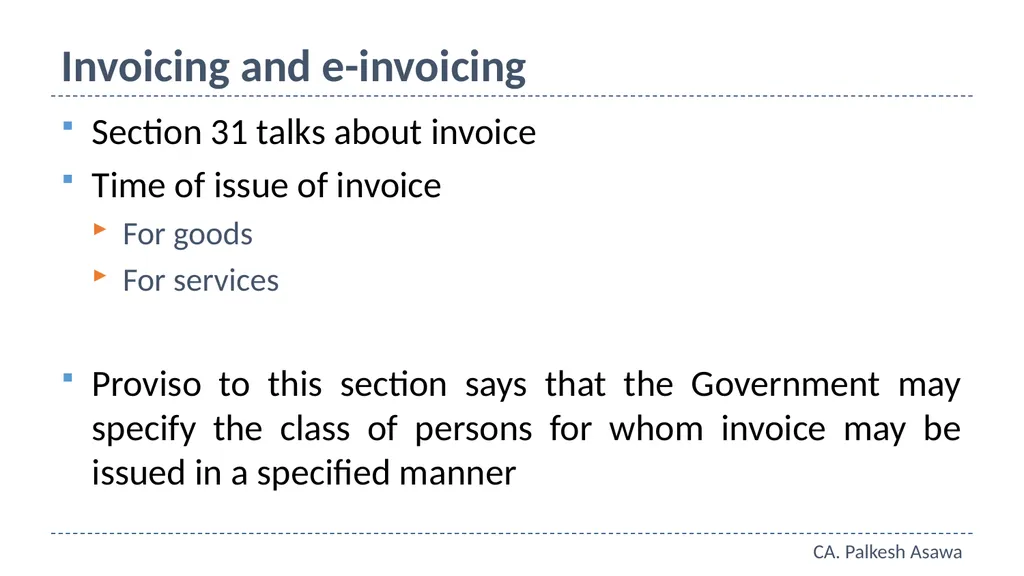
Invoicing and e-invoicing CA. Palkesh Asawa Section 31 talks about invoice
Time of issue of invoice
For goods
For services
Proviso to this section says that the Government may specify the class of persons for whom invoice may be issued in a specified manner<br>
Time of issue of invoice
For goods
For services
Proviso to this section says that the Government may specify the class of persons for whom invoice may be issued in a specified manner<br>
44
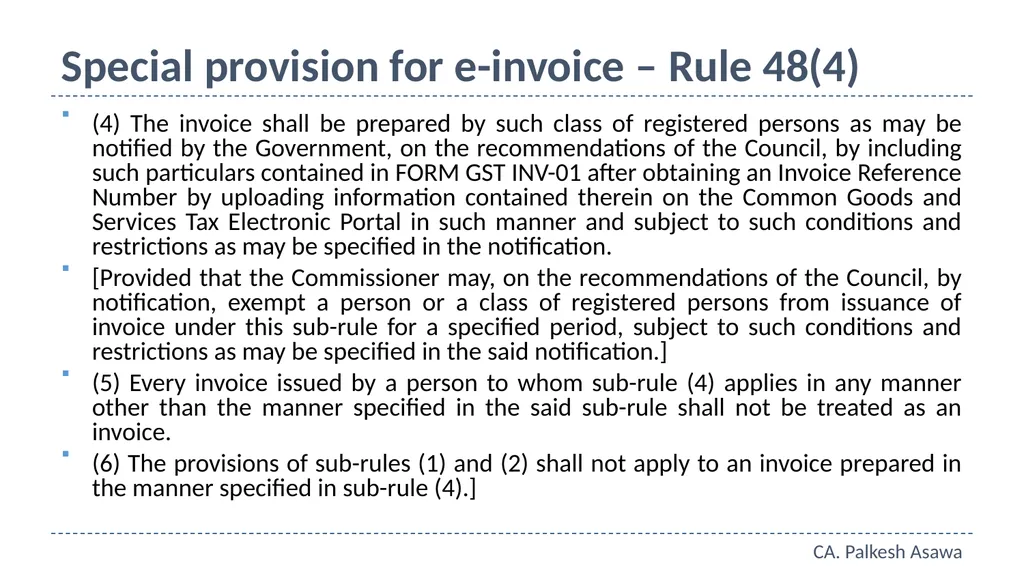
Special provision for e-invoice – Rule 48(4) CA. Palkesh Asawa (4) The invoice shall be prepared by such class of registered persons as may be notified by the Government, on the recommendations of the Council, by including such particulars contained in FORM GST INV-01 after obtaining an Invoice Reference Number by uploading information contained therein on the Common Goods and Services Tax Electronic Portal in such manner and subject to such conditions and restrictions as may be specified in the notification.
[Provided that the Commissioner may, on the recommendations of the Council, by notification, exempt a person or a class of registered persons from issuance of invoice under this sub-rule for a specified period, subject to such conditions and restrictions as may be specified in the said notification.]
(5) Every invoice issued by a person to whom sub-rule (4) applies in any manner other than the manner specified in the said sub-rule shall not be treated as an invoice.
(6) The provisions of sub-rules (1) and (2) shall not apply to an invoice prepared in the manner specified in sub-rule (4).]<br>
[Provided that the Commissioner may, on the recommendations of the Council, by notification, exempt a person or a class of registered persons from issuance of invoice under this sub-rule for a specified period, subject to such conditions and restrictions as may be specified in the said notification.]
(5) Every invoice issued by a person to whom sub-rule (4) applies in any manner other than the manner specified in the said sub-rule shall not be treated as an invoice.
(6) The provisions of sub-rules (1) and (2) shall not apply to an invoice prepared in the manner specified in sub-rule (4).]<br>
45
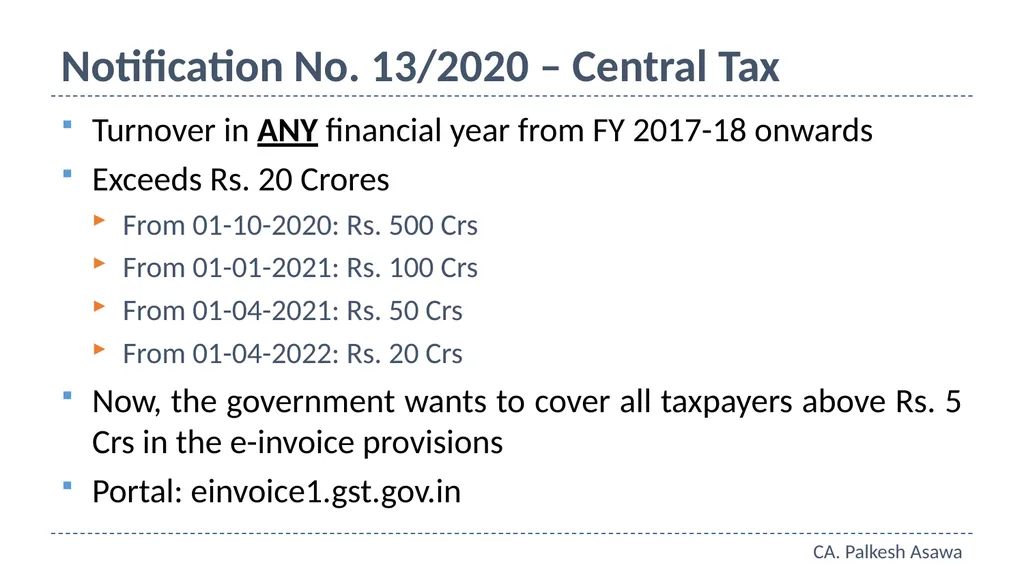
Notification No. 13/2020 – Central Tax CA. Palkesh Asawa Turnover in ANY financial year from FY 2017-18 onwards
Exceeds Rs. 20 Crores
From 01-10-2020: Rs. 500 Crs
From 01-01-2021: Rs. 100 Crs
From 01-04-2021: Rs. 50 Crs
From 01-04-2022: Rs. 20 Crs
Now, the government wants to cover all taxpayers above Rs. 5 Crs in the e-invoice provisions
Portal: einvoice1.gst.gov.in<br>
Exceeds Rs. 20 Crores
From 01-10-2020: Rs. 500 Crs
From 01-01-2021: Rs. 100 Crs
From 01-04-2021: Rs. 50 Crs
From 01-04-2022: Rs. 20 Crs
Now, the government wants to cover all taxpayers above Rs. 5 Crs in the e-invoice provisions
Portal: einvoice1.gst.gov.in<br>
46
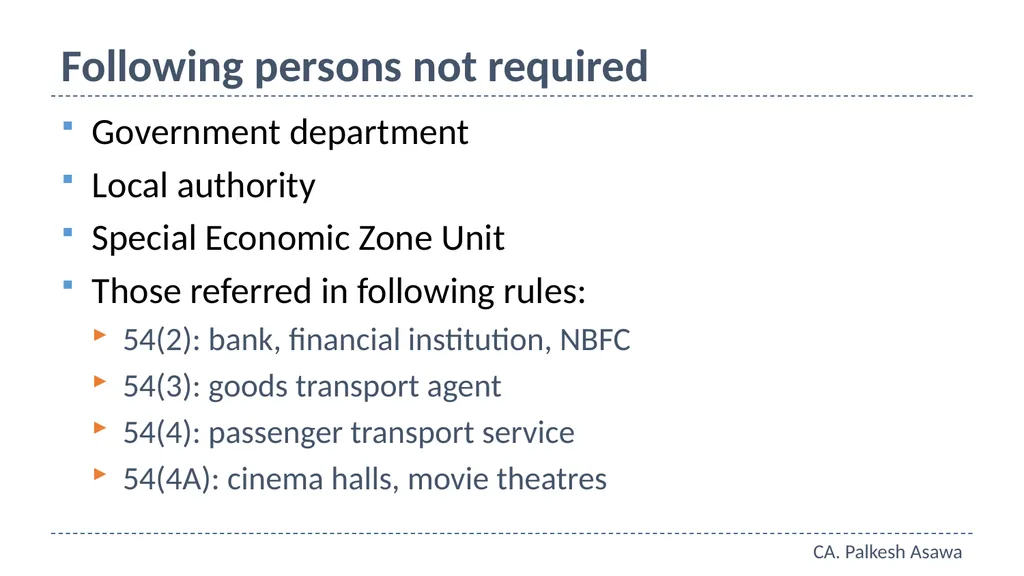
Following persons not required CA. Palkesh Asawa Government department
Local authority
Special Economic Zone Unit
Those referred in following rules:
54(2): bank, financial institution, NBFC
54(3): goods transport agent
54(4): passenger transport service
54(4A): cinema halls, movie theatres<br>
Local authority
Special Economic Zone Unit
Those referred in following rules:
54(2): bank, financial institution, NBFC
54(3): goods transport agent
54(4): passenger transport service
54(4A): cinema halls, movie theatres<br>
47
Critical Issues in E-Invoicing CA. Palkesh Asawa<br>
48
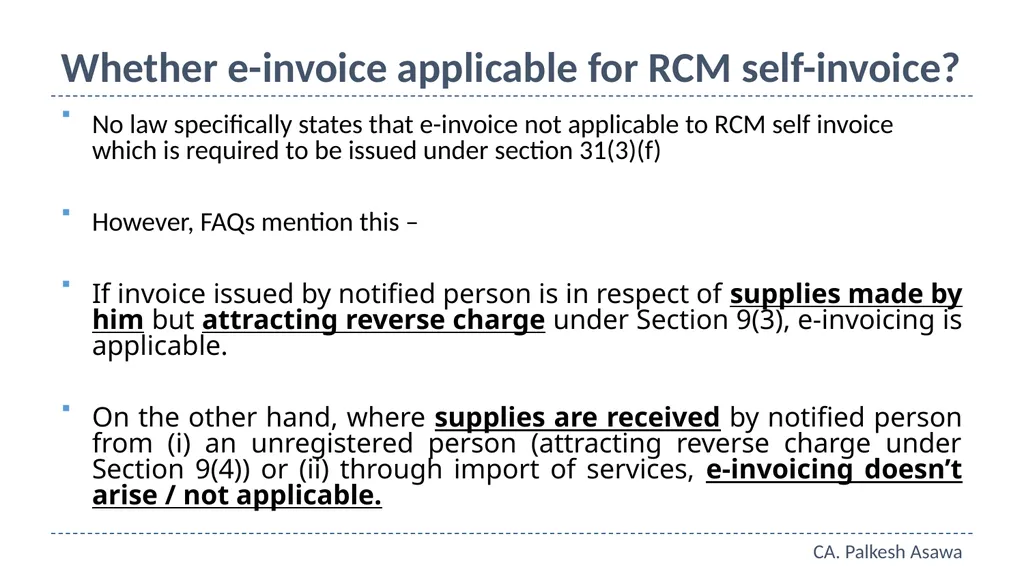
Whether e-invoice applicable for RCM self-invoice? CA. Palkesh Asawa No law specifically states that e-invoice not applicable to RCM self invoice which is required to be issued under section 31(3)(f)
However, FAQs mention this –
If invoice issued by notified person is in respect of supplies made by him but attracting reverse charge under Section 9(3), e-invoicing is applicable.
On the other hand, where supplies are received by notified person from (i) an unregistered person (attracting reverse charge under Section 9(4)) or (ii) through import of services, e-invoicing doesn’t arise / not applicable.<br>
However, FAQs mention this –
If invoice issued by notified person is in respect of supplies made by him but attracting reverse charge under Section 9(3), e-invoicing is applicable.
On the other hand, where supplies are received by notified person from (i) an unregistered person (attracting reverse charge under Section 9(4)) or (ii) through import of services, e-invoicing doesn’t arise / not applicable.<br>
49
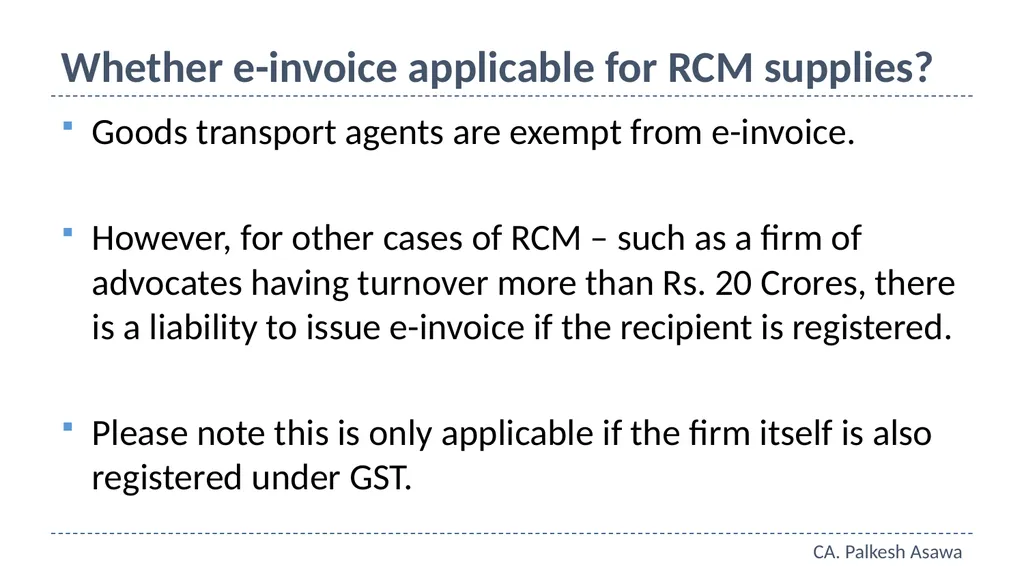
Whether e-invoice applicable for RCM supplies? CA. Palkesh Asawa Goods transport agents are exempt from e-invoice.
However, for other cases of RCM – such as a firm of advocates having turnover more than Rs. 20 Crores, there is a liability to issue e-invoice if the recipient is registered.
Please note this is only applicable if the firm itself is also registered under GST.<br>
However, for other cases of RCM – such as a firm of advocates having turnover more than Rs. 20 Crores, there is a liability to issue e-invoice if the recipient is registered.
Please note this is only applicable if the firm itself is also registered under GST.<br>
50
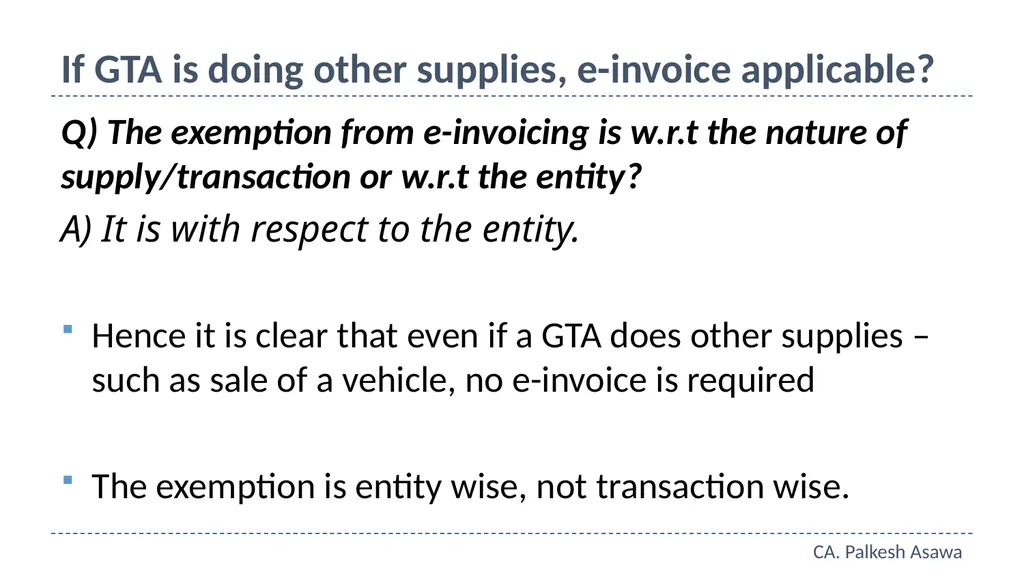
If GTA is doing other supplies, e-invoice applicable? CA. Palkesh Asawa Q) The exemption from e-invoicing is w.r.t the nature of supply/transaction or w.r.t the entity?
A) It is with respect to the entity.
Hence it is clear that even if a GTA does other supplies – such as sale of a vehicle, no e-invoice is required
The exemption is entity wise, not transaction wise.<br>
A) It is with respect to the entity.
Hence it is clear that even if a GTA does other supplies – such as sale of a vehicle, no e-invoice is required
The exemption is entity wise, not transaction wise.<br>
51
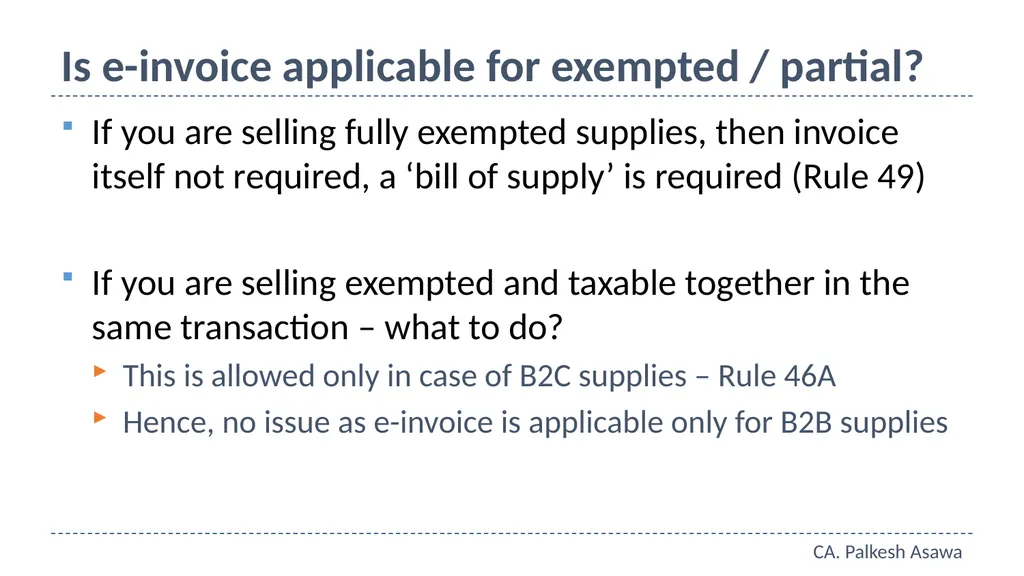
Is e-invoice applicable for exempted / partial? CA. Palkesh Asawa If you are selling fully exempted supplies, then invoice itself not required, a ‘bill of supply’ is required (Rule 49)
If you are selling exempted and taxable together in the same transaction – what to do?
This is allowed only in case of B2C supplies – Rule 46A
Hence, no issue as e-invoice is applicable only for B2B supplies<br>
If you are selling exempted and taxable together in the same transaction – what to do?
This is allowed only in case of B2C supplies – Rule 46A
Hence, no issue as e-invoice is applicable only for B2B supplies<br>
52
E-invoice or GSTR-1: what shall prevail? CA. Palkesh Asawa E-invoice once issued cannot be cancelled after 24 hours, if you then cancel the e-invoice and not upload in GSTR-1, can you get a notice? What shall prevail?
Reasonable justification should be there: what constitutes reasonable justification is up for debate
Reconciliation with e-invoices is highly recommended<br>
Reasonable justification should be there: what constitutes reasonable justification is up for debate
Reconciliation with e-invoices is highly recommended<br>
53
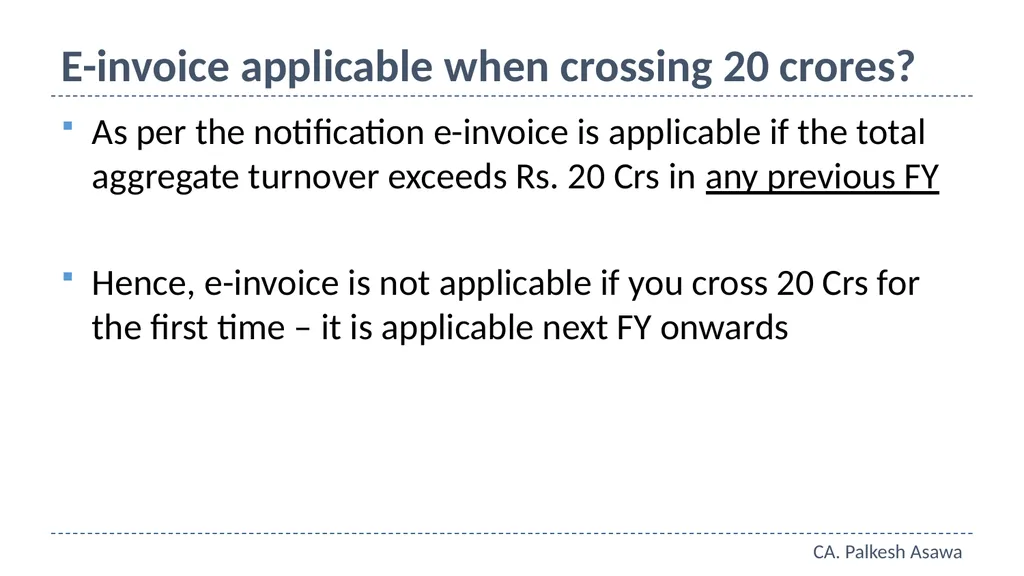
E-invoice applicable when crossing 20 crores? CA. Palkesh Asawa As per the notification e-invoice is applicable if the total aggregate turnover exceeds Rs. 20 Crs in any previous FY
Hence, e-invoice is not applicable if you cross 20 Crs for the first time – it is applicable next FY onwards<br>
Hence, e-invoice is not applicable if you cross 20 Crs for the first time – it is applicable next FY onwards<br>
54
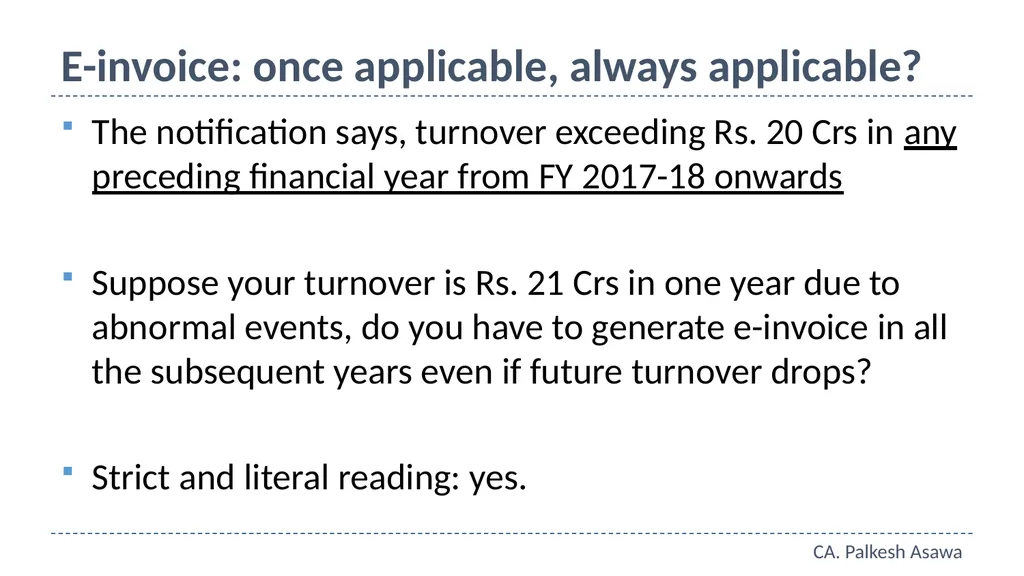
E-invoice: once applicable, always applicable? CA. Palkesh Asawa The notification says, turnover exceeding Rs. 20 Crs in any preceding financial year from FY 2017-18 onwards
Suppose your turnover is Rs. 21 Crs in one year due to abnormal events, do you have to generate e-invoice in all the subsequent years even if future turnover drops?
Strict and literal reading: yes.<br>
Suppose your turnover is Rs. 21 Crs in one year due to abnormal events, do you have to generate e-invoice in all the subsequent years even if future turnover drops?
Strict and literal reading: yes.<br>
55
Additions in turnover due to later demands? CA. Palkesh Asawa Suppose your turnover was Rs. 15 Crores and did not generate any e-invoice.
In a subsequent period, SCN was issued and demand confirmed, addition to turnover of Rs. 6 Crores
What happens to invoices issued earlier? Are they invalid since you were liable for e-invoices but did not generate?<br>
In a subsequent period, SCN was issued and demand confirmed, addition to turnover of Rs. 6 Crores
What happens to invoices issued earlier? Are they invalid since you were liable for e-invoices but did not generate?<br>
56
Liability of recipient in respect of e-invoicing CA. Palkesh Asawa Check status of e-invoice enablement for a taxpayer
Check list of taxpayers who are generating e-invoices
Take declarations from the supplier that they are liable / not liable to generate e-invoices
Worst case scenario: the recipient shall not get the ITC since the invoice for the supply is not a valid invoice
Indemnity clause may be considered by recipient<br>
Check list of taxpayers who are generating e-invoices
Take declarations from the supplier that they are liable / not liable to generate e-invoices
Worst case scenario: the recipient shall not get the ITC since the invoice for the supply is not a valid invoice
Indemnity clause may be considered by recipient<br>
57
Automation in GST CA. Palkesh Asawa<br>
58
Major factors to take into account CA. Palkesh Asawa Flow of events:
Electronic invoice
E-way bill
Auto population of invoices in GSTR-1
Preparation of data in GSTR-2B of the supplier
Auto-update of GSTR-3B return based on above returns
Hence many things are auto-generating in GST<br>
Electronic invoice
E-way bill
Auto population of invoices in GSTR-1
Preparation of data in GSTR-2B of the supplier
Auto-update of GSTR-3B return based on above returns
Hence many things are auto-generating in GST<br>
59
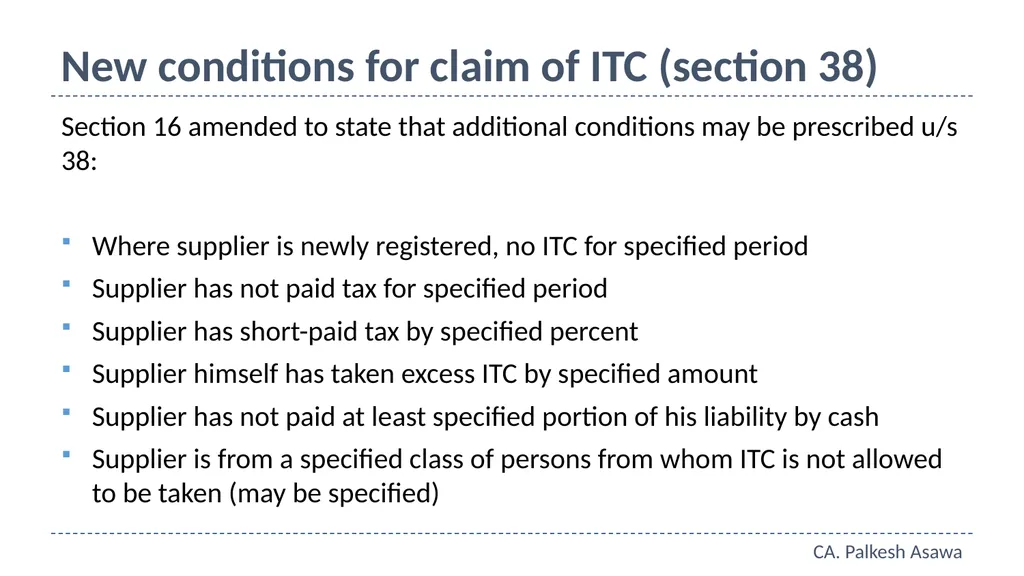
New conditions for claim of ITC (section 38) CA. Palkesh Asawa Section 16 amended to state that additional conditions may be prescribed u/s 38:
Where supplier is newly registered, no ITC for specified period
Supplier has not paid tax for specified period
Supplier has short-paid tax by specified percent
Supplier himself has taken excess ITC by specified amount
Supplier has not paid at least specified portion of his liability by cash
Supplier is from a specified class of persons from whom ITC is not allowed to be taken (may be specified)<br>
Where supplier is newly registered, no ITC for specified period
Supplier has not paid tax for specified period
Supplier has short-paid tax by specified percent
Supplier himself has taken excess ITC by specified amount
Supplier has not paid at least specified portion of his liability by cash
Supplier is from a specified class of persons from whom ITC is not allowed to be taken (may be specified)<br>
60
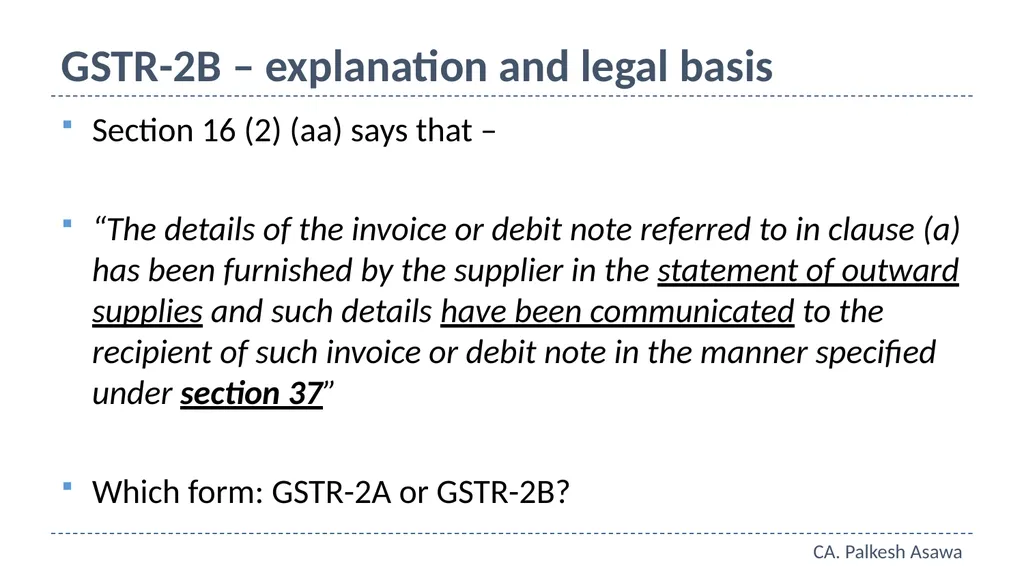
GSTR-2B – explanation and legal basis CA. Palkesh Asawa Section 16 (2) (aa) says that –
“The details of the invoice or debit note referred to in clause (a) has been furnished by the supplier in the statement of outward supplies and such details have been communicated to the recipient of such invoice or debit note in the manner specified under section 37”
Which form: GSTR-2A or GSTR-2B?<br>
“The details of the invoice or debit note referred to in clause (a) has been furnished by the supplier in the statement of outward supplies and such details have been communicated to the recipient of such invoice or debit note in the manner specified under section 37”
Which form: GSTR-2A or GSTR-2B?<br>
61
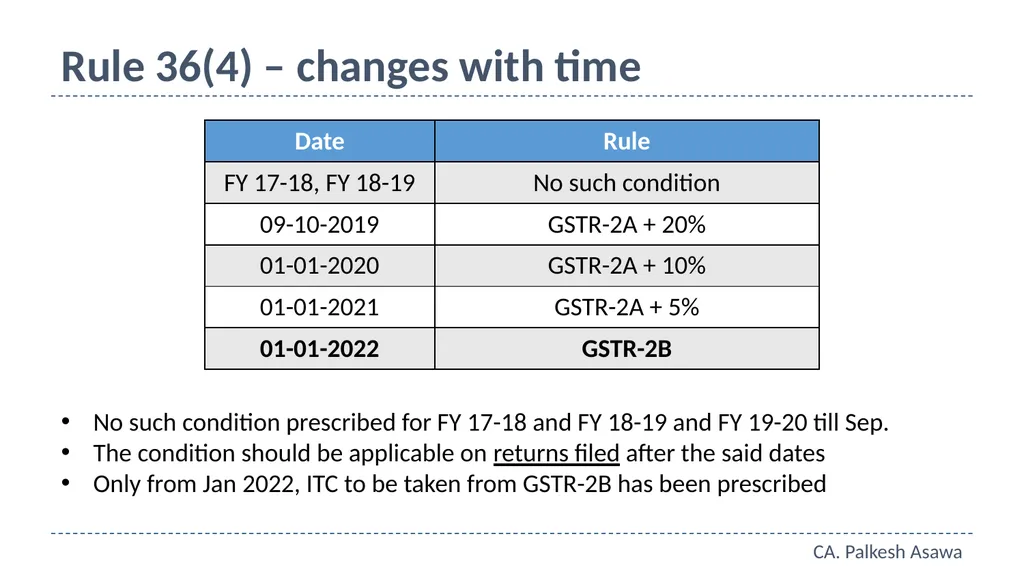
Rule 36(4) – changes with time CA. Palkesh Asawa No such condition prescribed for FY 17-18 and FY 18-19 and FY 19-20 till Sep.
The condition should be applicable on returns filed after the said dates
Only from Jan 2022, ITC to be taken from GSTR-2B has been prescribed<br>
The condition should be applicable on returns filed after the said dates
Only from Jan 2022, ITC to be taken from GSTR-2B has been prescribed<br>
62
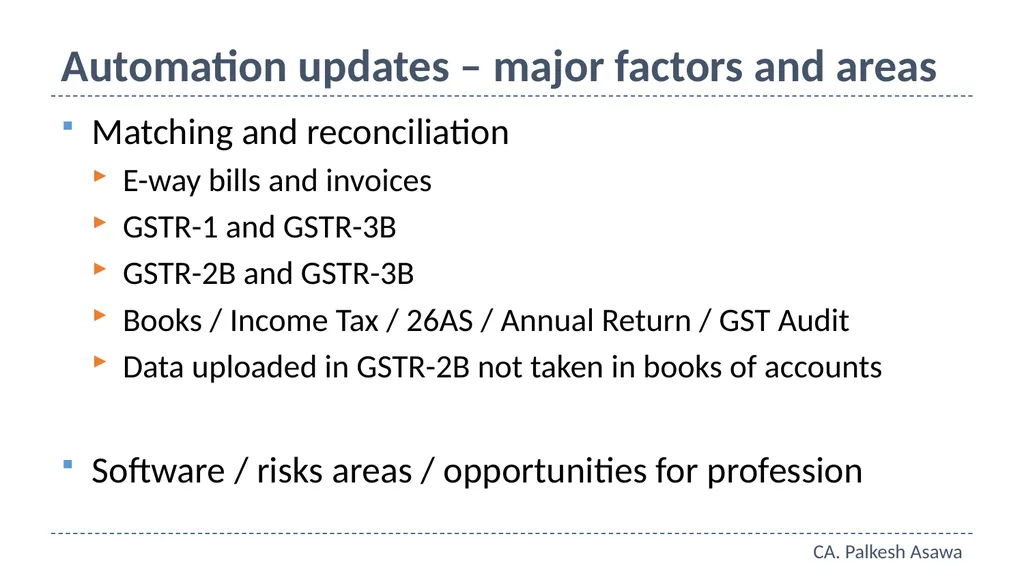
Automation updates – major factors and areas CA. Palkesh Asawa Matching and reconciliation
E-way bills and invoices
GSTR-1 and GSTR-3B
GSTR-2B and GSTR-3B
Books / Income Tax / 26AS / Annual Return / GST Audit
Data uploaded in GSTR-2B not taken in books of accounts
Software / risks areas / opportunities for profession<br>
E-way bills and invoices
GSTR-1 and GSTR-3B
GSTR-2B and GSTR-3B
Books / Income Tax / 26AS / Annual Return / GST Audit
Data uploaded in GSTR-2B not taken in books of accounts
Software / risks areas / opportunities for profession<br>
63
CA. Palkesh Asawa Any Questions?<br>
64
CA. Palkesh Asawa Thank you!
Contact: asawa.palkesh@gmail.com
Phone: 81081-56981<br>
Contact: asawa.palkesh@gmail.com
Phone: 81081-56981<br>