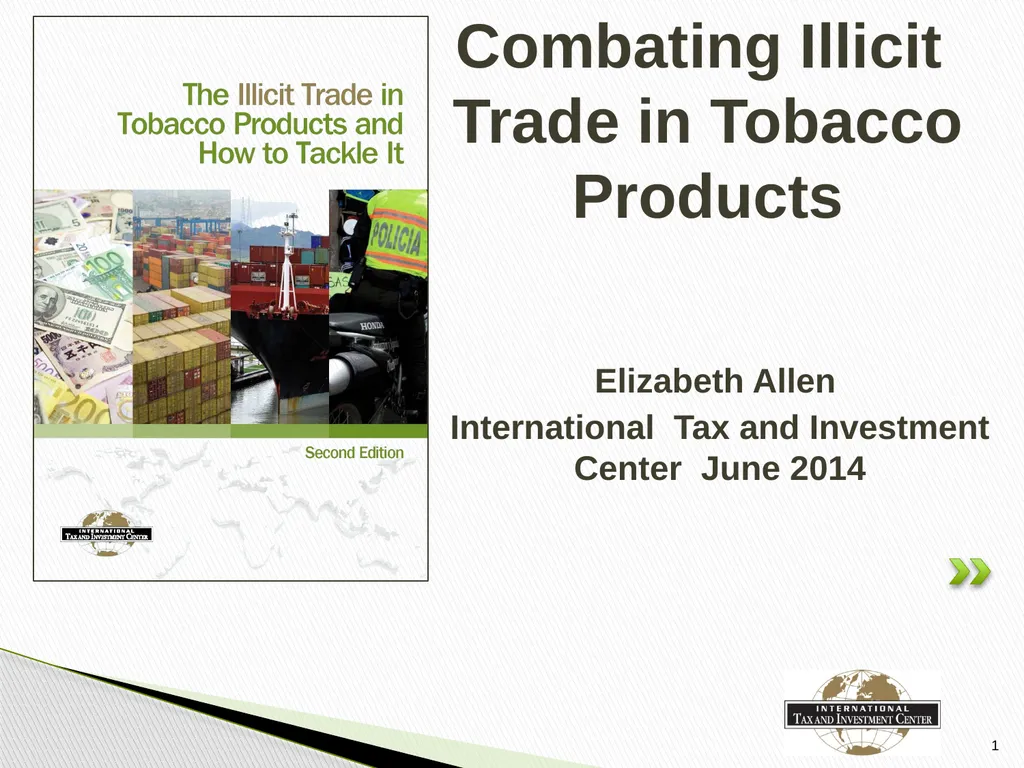
Elizabeth Allen International Tax and Investment
Description: Elizabeth Allen International Tax and Investment Center June 2014 1 Combating Illicit Trade in Tobacco Products 2 TRADE IN TOBACCO PRODUCTS WHO FCTC any practice or conduct prohibited by law and which relates to the production, shipment,
Related Topics
Download Presentation
"Elizabeth Allen International Tax and Investment" is the property of its rightful owner. Permission is granted to download and print the materials on this website for personal, non-commercial use only, and to display it on your personal computer provided you do not modify the materials and that you retain all copyright notices contained in the materials. By downloading content from our website, you accept the terms of this agreement.
Presentation Transcript
slide1. Elizabeth Allen
International Tax and Investment Center June 2014 1 Combating Illicit Trade in Tobacco Products<br>
slide2. 2 TRADE IN TOBACCO PRODUCTS<br>
slide3. WHO FCTC “any practice or conduct prohibited by law and which relates to the production, shipment, receipt, possession, distribution, sale or purchase including any practice or conduct intended to facilitate such activity.”
Main categories are:
Illicit Imports
Illegal Domestic Production 3 ILLICIT TRADE IN TOBACCO PRODUCTS<br>
slide4. SUPPLY
Economic drivers – profits for criminals:
Protectionist policy measures
Light and portable
Inadequate enforcement including control of “Free Zones” and porous borders
Corruption
Inadequate legislation and penalties
Time-consuming prosecution process
Not a political priority 4 WHY CIGARETTES?<br>
slide5. DEMAND
Affordability for consumers
Dramatic tax hikes
Reliable suppliers with well organized distribution in areas of economic and social deprivation
Restrictions on flavours, pack sizes etc.
Not seen as a “crime” – resentment
Sales to minors are illegal in most countries – forbidden fruit! 5 WHY CIGARETTES?<br>
slide6. Euromonitor International 2012
“Illicit trade in cigarettes is the biggest illegal trade in a legal product in terms of value and second only to illegal drugs in terms of revenue generated by smugglers”.“ 6 HOW BIG IS THE PROBLEM?<br>
slide7. KPMG Project Star estimates illicit cigarettes in the EU in 2012 at 11.1% - or 65.5 billion cigarettes - resulting in Euro 12.5 billion in lost tax revenues to Member States.
Euromonitor International 2012 estimates 600 billion cigarettes - 10% of all cigarettes consumed worldwide - are illicit. Governments lose between US$40 and 50 billion tax a year. 7 ESTIMATING THE SIZE OF THE PROBLEM AND REVENUE IMPACT<br>
slide8. Seizures may be only a small proportion but provide useful information on trends/routes etc.
Street prices of illicit goods indicate the effectiveness of enforcement.
Market and consumer research utilising robust methodologies relevant to the type of tobacco market
Econometric estimates repeated at regular intervals provide a baseline to indicate whether illicit trade is increasing or decreasing and a useful tool in persuading Ministers to fund essential resources. 8 MEASUREMENT<br>
slide9. From third countries – borders to the east and from middle and far east – especially “cheap/illicit whites”
Across uncontrolled borders between EU Member States (especially alcohol escaping from the bonded warehouse system)
Counterfeit
Off record factories within the EU
Counterfeit products from the Middle and Far East
Local Tax Evasion
Off record production either by poorly controlled excise taxpayers or through completely off record producers. 9 NATURE OF THE PROBLEM Illicit imports - smuggled across borders
“Cheap” or “illicit” whites - Products produced legally or “off record” in another country – sometimes specifically for smuggling
Genuine legal products
Counterfeit products
Illicit domestic production - evading local taxation
Off record production either by poorly controlled but licensed excise taxpayers or by completely off record producers<br>
slide10. STEEP TAX HIKES – Ireland, Malaysia, Turkey and Singapore
Relaxed customs controls in Free Zones
Corruption – Australia “Operation Heritage”
Ineffective domestic controls on manufacture , inputs to manufacture e.g. acetate tow and onward supply
Very small (1 to 2%) percentage of containers scanned/physically examined
Display bans provide legitimate retailers with opportunities to sell illicit goods to regular customers
Inadequate consultation
Gaps in legislation – e.g. requirement to destroy seized product and equipment 10 DRIVERS AND FACILITATORS<br>
slide11. Organized crime – money laundering
Terrorism – impact on global security
Undermines respect for the rule of law
Undermines public health and tobacco control initiatives
Has most impact on young people and on those in reduced economic circumstances
Lost Government revenues
Financial loss to legitimate industry and associated businesses 11 IMPACT ON SOCIETY<br>
slide12. Consumers of illicit products predominantly come from lower income groups who find the legal prices unaffordable or young people who are unable to buy the goods from a legal retail outlet.
Counterfeit cigarettes can contain cadmium levels five times higher and lead levels six times higher than in genuine cigarettes.
Customs officials at risk because of methods of concealment of illicit tobacco products.
Contents of some illicit products have contained pesticides, arsenic, rat poison and human faeces. 12 PUBLIC AWARENESS POINTS<br>
slide13. A COMPREHENSIVE STRATEGIC APPROACH :
Top level ongoing political commitment
Understand and monitor the size and nature of the problem.
A balanced tax policy and effective tax collection
Ensure that official controls on manufacturing and export controls, free zones and transit are appropriate and effective
Practice zero tolerance of corruption
Ensure legislation and regulations work and that penalties act as a deterrent
Raise awareness of the judiciary so that appropriate penalties are imposed
Educate the public – tackle demand as well as supply
Implement the ITP consistently (across nations) and effectively
Build/strengthen national and international partnerships
Robust enforcement
See – www.customs.hmrc.gov.uk. 13 HOW TO TACKLE IT?<br>
slide14. Producing, storing, operating on and transporting excise goods tax-unpaid MUST be regarded as a privilege not a right with appropriate licences controlled robustly and controls applied consistently on all players
Risk and intelligence based controls need to detect illicit “underground” production and distribution and undeclared production by licensed producers. 14 STRONG REVENUE /CUSTOMS CONTROLS ESSENTIAL<br>
slide15. Ensure legislation enables you to:
Destroy seized illicit products, raw materials, and manufacturing equipment quickly;
Seize the means of transport of illicit goods;
Control tobacco related activities in Free Zones;
Require all transporters of tax-unpaid goods to hold an appropriate excise licence; and
Impose robust supply chain controls and interventions across manufacturing, tax free movements and on wholesale/retail sales and include key manufacturing inputs e.g. acetate tow. 15 LEGISLATION<br>
slide16. ENFORCEMENT
A cross-government enforcement strategy. All national and local enforcement agencies need adequate powers, skilled and sufficient resources and tools to act effectively.
Ensure accuracy and easy interchange of data with partners.
Analyse trends, use risk assessment, intelligence and mutual assistance to target illicit movements and smugglers.
Effective channels for co-operation with WCO , Interpol and with other countries and legitimate industry.
A robust comprehensive anti-corruption strategy AND ACTION.
Enforcement authorities must be involved in policy discussions on tobacco regulation. 16 NATIONAL ENFORCEMENT<br>
slide17. Understanding the impact on the illicit market of any health-related policy initiatives
Regional programmes to tackle illicit tobacco Cross-government approach to illicit tobacco marketing & communications
to shift public behaviour and attitudes to illicit tobacco and reduce demand
drawing on expertise across the public sector
how/when to target common audiences
achieving wider reach through pooled resources
Help to keep tackling illicit tobacco on the local authority agenda 17 UK - Collaboration with public health organisations<br>
slide18. 18 PUBLIC AWARENESS<br>
slide19. Policy makers and regulators need to build a comprehensive understanding of the legal & illegal trade in tobacco products
Collecting & collating reliable and comprehensive data on the global size and scale of this trade is challenging
International “best practice” conventions, guidelines & standards on trade compliance & facilitation all encourage close public / private partnership 19 WORKING WITH TRADE<br>
slide20. Global supply chains are increasingly complex with highly complicated transport routes
Industry is always best placed to know trade practices and international marketplaces–tobacco is no exception
Ongoing dialogue between regulators and industry involved in the legal production, carriage, storage and distribution of tobacco products is highly desirable 20 WORKING WITH TRADE<br>
slide21. International instruments to streamline and harmonize supply chain and tax management can bring greater transparency to government & trade practices
Accurate collection & collation of trade and seizure data is vital for understanding the size and scale of illicit trade in tobacco products and designing appropriate ‘whole of government’ and industry responses 21 WORKING WITH TRADE<br>
slide22. Transparency and integrity essential on both sides
Consultation on policy/legislative change enables government to understand the full implications of proposals and industry to work with government to ensure changes support economic development
Collaboration in information sharing, designing auditable business processes, record keeping & technology development 22 HOW TO WORK WITH TRADE<br>
slide23. The illicit trade in Tobacco Products is a ‘global’ issue – but often addressed regionally or nationally
Trans National Criminal Networks know no borders or boundaries
Criminal networks often involved with other forms of transnational crime and money laundering
International exchange of information & intelligence across government agencies is critical to understanding & suppressing this trade 23 WORKING WITH PARTNERS INTERNATIONALLY<br>
slide24. How can speedy and accurate responses be ensured to queries from another authority?
How can data quality and security be assured for global exchanges of information critical to investigations and prosecutions?
How can a more comprehensive international approach and closer cooperation across borders and continents be achieved?
What are the current legal barriers to international data exchange and international investigations/prosecutions? And how can they be removed? 24 KEY ISSUES FOR IMPROVED INTERNATIONAL CO-OPERATION<br>
slide25. OTHER ISSUES What Customs procedures are needed for:
Free zone management of tobacco operations
Under-bond movements
Exports, including movements to point of export?
CONSISTENCY OF APPROACH WILL BE KEY TO SUCCESS WORLDWIDE<br>
slide26. 26 THANK YOU<br>
International Tax and Investment Center June 2014 1 Combating Illicit Trade in Tobacco Products<br>
slide2. 2 TRADE IN TOBACCO PRODUCTS<br>
slide3. WHO FCTC “any practice or conduct prohibited by law and which relates to the production, shipment, receipt, possession, distribution, sale or purchase including any practice or conduct intended to facilitate such activity.”
Main categories are:
Illicit Imports
Illegal Domestic Production 3 ILLICIT TRADE IN TOBACCO PRODUCTS<br>
slide4. SUPPLY
Economic drivers – profits for criminals:
Protectionist policy measures
Light and portable
Inadequate enforcement including control of “Free Zones” and porous borders
Corruption
Inadequate legislation and penalties
Time-consuming prosecution process
Not a political priority 4 WHY CIGARETTES?<br>
slide5. DEMAND
Affordability for consumers
Dramatic tax hikes
Reliable suppliers with well organized distribution in areas of economic and social deprivation
Restrictions on flavours, pack sizes etc.
Not seen as a “crime” – resentment
Sales to minors are illegal in most countries – forbidden fruit! 5 WHY CIGARETTES?<br>
slide6. Euromonitor International 2012
“Illicit trade in cigarettes is the biggest illegal trade in a legal product in terms of value and second only to illegal drugs in terms of revenue generated by smugglers”.“ 6 HOW BIG IS THE PROBLEM?<br>
slide7. KPMG Project Star estimates illicit cigarettes in the EU in 2012 at 11.1% - or 65.5 billion cigarettes - resulting in Euro 12.5 billion in lost tax revenues to Member States.
Euromonitor International 2012 estimates 600 billion cigarettes - 10% of all cigarettes consumed worldwide - are illicit. Governments lose between US$40 and 50 billion tax a year. 7 ESTIMATING THE SIZE OF THE PROBLEM AND REVENUE IMPACT<br>
slide8. Seizures may be only a small proportion but provide useful information on trends/routes etc.
Street prices of illicit goods indicate the effectiveness of enforcement.
Market and consumer research utilising robust methodologies relevant to the type of tobacco market
Econometric estimates repeated at regular intervals provide a baseline to indicate whether illicit trade is increasing or decreasing and a useful tool in persuading Ministers to fund essential resources. 8 MEASUREMENT<br>
slide9. From third countries – borders to the east and from middle and far east – especially “cheap/illicit whites”
Across uncontrolled borders between EU Member States (especially alcohol escaping from the bonded warehouse system)
Counterfeit
Off record factories within the EU
Counterfeit products from the Middle and Far East
Local Tax Evasion
Off record production either by poorly controlled excise taxpayers or through completely off record producers. 9 NATURE OF THE PROBLEM Illicit imports - smuggled across borders
“Cheap” or “illicit” whites - Products produced legally or “off record” in another country – sometimes specifically for smuggling
Genuine legal products
Counterfeit products
Illicit domestic production - evading local taxation
Off record production either by poorly controlled but licensed excise taxpayers or by completely off record producers<br>
slide10. STEEP TAX HIKES – Ireland, Malaysia, Turkey and Singapore
Relaxed customs controls in Free Zones
Corruption – Australia “Operation Heritage”
Ineffective domestic controls on manufacture , inputs to manufacture e.g. acetate tow and onward supply
Very small (1 to 2%) percentage of containers scanned/physically examined
Display bans provide legitimate retailers with opportunities to sell illicit goods to regular customers
Inadequate consultation
Gaps in legislation – e.g. requirement to destroy seized product and equipment 10 DRIVERS AND FACILITATORS<br>
slide11. Organized crime – money laundering
Terrorism – impact on global security
Undermines respect for the rule of law
Undermines public health and tobacco control initiatives
Has most impact on young people and on those in reduced economic circumstances
Lost Government revenues
Financial loss to legitimate industry and associated businesses 11 IMPACT ON SOCIETY<br>
slide12. Consumers of illicit products predominantly come from lower income groups who find the legal prices unaffordable or young people who are unable to buy the goods from a legal retail outlet.
Counterfeit cigarettes can contain cadmium levels five times higher and lead levels six times higher than in genuine cigarettes.
Customs officials at risk because of methods of concealment of illicit tobacco products.
Contents of some illicit products have contained pesticides, arsenic, rat poison and human faeces. 12 PUBLIC AWARENESS POINTS<br>
slide13. A COMPREHENSIVE STRATEGIC APPROACH :
Top level ongoing political commitment
Understand and monitor the size and nature of the problem.
A balanced tax policy and effective tax collection
Ensure that official controls on manufacturing and export controls, free zones and transit are appropriate and effective
Practice zero tolerance of corruption
Ensure legislation and regulations work and that penalties act as a deterrent
Raise awareness of the judiciary so that appropriate penalties are imposed
Educate the public – tackle demand as well as supply
Implement the ITP consistently (across nations) and effectively
Build/strengthen national and international partnerships
Robust enforcement
See – www.customs.hmrc.gov.uk. 13 HOW TO TACKLE IT?<br>
slide14. Producing, storing, operating on and transporting excise goods tax-unpaid MUST be regarded as a privilege not a right with appropriate licences controlled robustly and controls applied consistently on all players
Risk and intelligence based controls need to detect illicit “underground” production and distribution and undeclared production by licensed producers. 14 STRONG REVENUE /CUSTOMS CONTROLS ESSENTIAL<br>
slide15. Ensure legislation enables you to:
Destroy seized illicit products, raw materials, and manufacturing equipment quickly;
Seize the means of transport of illicit goods;
Control tobacco related activities in Free Zones;
Require all transporters of tax-unpaid goods to hold an appropriate excise licence; and
Impose robust supply chain controls and interventions across manufacturing, tax free movements and on wholesale/retail sales and include key manufacturing inputs e.g. acetate tow. 15 LEGISLATION<br>
slide16. ENFORCEMENT
A cross-government enforcement strategy. All national and local enforcement agencies need adequate powers, skilled and sufficient resources and tools to act effectively.
Ensure accuracy and easy interchange of data with partners.
Analyse trends, use risk assessment, intelligence and mutual assistance to target illicit movements and smugglers.
Effective channels for co-operation with WCO , Interpol and with other countries and legitimate industry.
A robust comprehensive anti-corruption strategy AND ACTION.
Enforcement authorities must be involved in policy discussions on tobacco regulation. 16 NATIONAL ENFORCEMENT<br>
slide17. Understanding the impact on the illicit market of any health-related policy initiatives
Regional programmes to tackle illicit tobacco Cross-government approach to illicit tobacco marketing & communications
to shift public behaviour and attitudes to illicit tobacco and reduce demand
drawing on expertise across the public sector
how/when to target common audiences
achieving wider reach through pooled resources
Help to keep tackling illicit tobacco on the local authority agenda 17 UK - Collaboration with public health organisations<br>
slide18. 18 PUBLIC AWARENESS<br>
slide19. Policy makers and regulators need to build a comprehensive understanding of the legal & illegal trade in tobacco products
Collecting & collating reliable and comprehensive data on the global size and scale of this trade is challenging
International “best practice” conventions, guidelines & standards on trade compliance & facilitation all encourage close public / private partnership 19 WORKING WITH TRADE<br>
slide20. Global supply chains are increasingly complex with highly complicated transport routes
Industry is always best placed to know trade practices and international marketplaces–tobacco is no exception
Ongoing dialogue between regulators and industry involved in the legal production, carriage, storage and distribution of tobacco products is highly desirable 20 WORKING WITH TRADE<br>
slide21. International instruments to streamline and harmonize supply chain and tax management can bring greater transparency to government & trade practices
Accurate collection & collation of trade and seizure data is vital for understanding the size and scale of illicit trade in tobacco products and designing appropriate ‘whole of government’ and industry responses 21 WORKING WITH TRADE<br>
slide22. Transparency and integrity essential on both sides
Consultation on policy/legislative change enables government to understand the full implications of proposals and industry to work with government to ensure changes support economic development
Collaboration in information sharing, designing auditable business processes, record keeping & technology development 22 HOW TO WORK WITH TRADE<br>
slide23. The illicit trade in Tobacco Products is a ‘global’ issue – but often addressed regionally or nationally
Trans National Criminal Networks know no borders or boundaries
Criminal networks often involved with other forms of transnational crime and money laundering
International exchange of information & intelligence across government agencies is critical to understanding & suppressing this trade 23 WORKING WITH PARTNERS INTERNATIONALLY<br>
slide24. How can speedy and accurate responses be ensured to queries from another authority?
How can data quality and security be assured for global exchanges of information critical to investigations and prosecutions?
How can a more comprehensive international approach and closer cooperation across borders and continents be achieved?
What are the current legal barriers to international data exchange and international investigations/prosecutions? And how can they be removed? 24 KEY ISSUES FOR IMPROVED INTERNATIONAL CO-OPERATION<br>
slide25. OTHER ISSUES What Customs procedures are needed for:
Free zone management of tobacco operations
Under-bond movements
Exports, including movements to point of export?
CONSISTENCY OF APPROACH WILL BE KEY TO SUCCESS WORLDWIDE<br>
slide26. 26 THANK YOU<br>