Employment Opportunities Best Practices: Bangladesh Perspective Mohammad Nurun Nabi Talukder Secretary Bangladesh Public Service Commission (BPSC) Bangladesh Profile Peoples Republic of Bangladesh attained independence on 26 March 1971
Related Topics
Share
Embed code
Download this presentation From Below
"Employment Opportunities & Best Practices:" is the property of its rightful owner. Permission is granted to
download and print the materials on this website for personal, non-commercial use only, and to display it
on your personal computer provided you do not modify the materials and that you retain all copyright
notices contained in the materials. By downloading content from our website, you accept the terms of this
agreement.
Presentation Transcript
01
Employment Opportunities & Best Practices: Bangladesh Perspective Mohammad Nurun Nabi Talukder
Secretary
Bangladesh Public Service Commission (BPSC)<br>
02
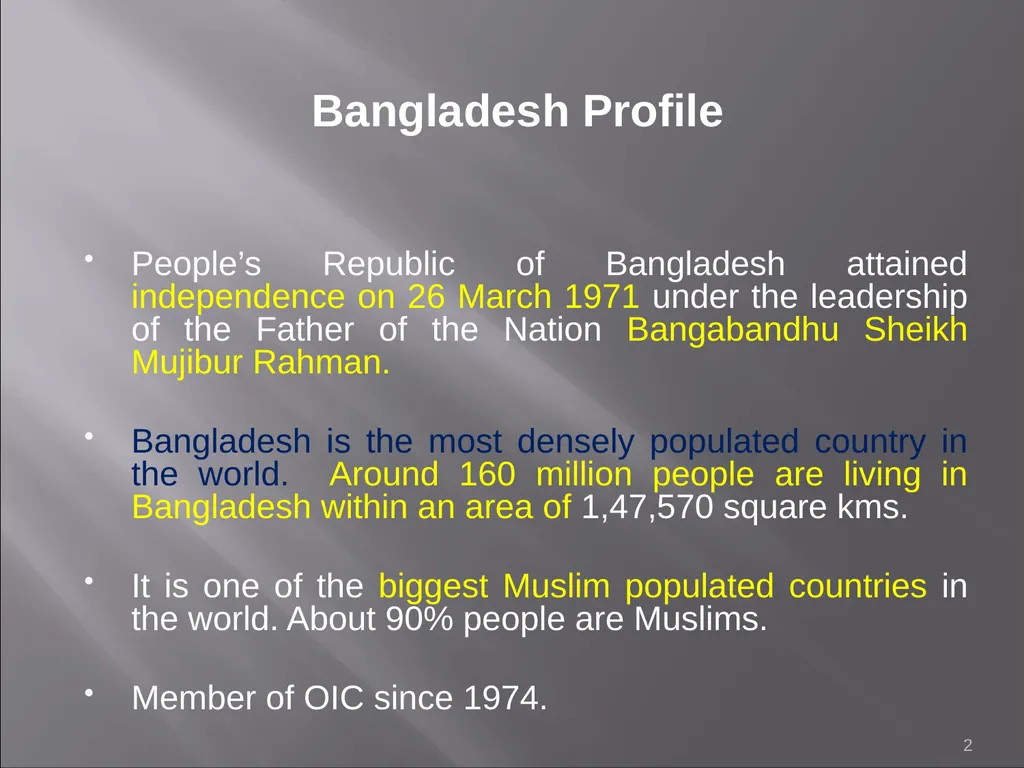
Bangladesh Profile People’s Republic of Bangladesh attained independence on 26 March 1971 under the leadership of the Father of the Nation Bangabandhu Sheikh Mujibur Rahman.
Bangladesh is the most densely populated country in the world. Around 160 million people are living in Bangladesh within an area of 1,47,570 square kms.
It is one of the biggest Muslim populated countries in the world. About 90% people are Muslims.
Member of OIC since 1974. 2<br>
03
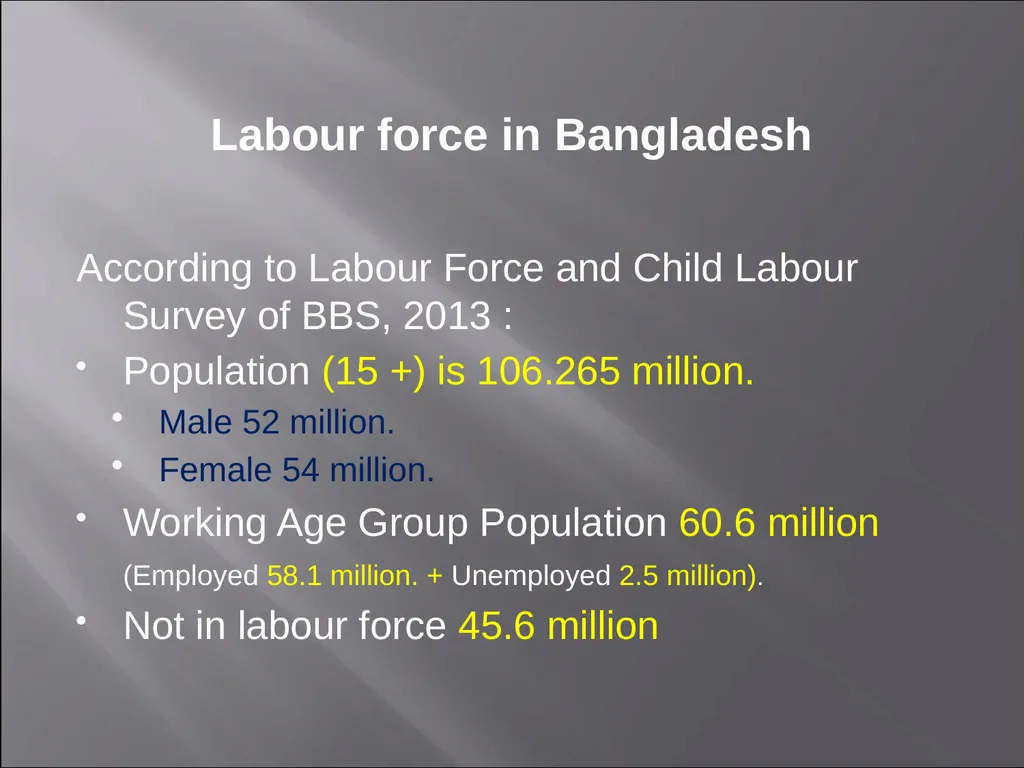
Labour force in Bangladesh According to Labour Force and Child Labour Survey of BBS, 2013 :
Population (15 +) is 106.265 million.
Male 52 million.
Female 54 million.
Working Age Group Population 60.6 million
(Employed 58.1 million. + Unemployed 2.5 million).
Not in labour force 45.6 million<br>
04
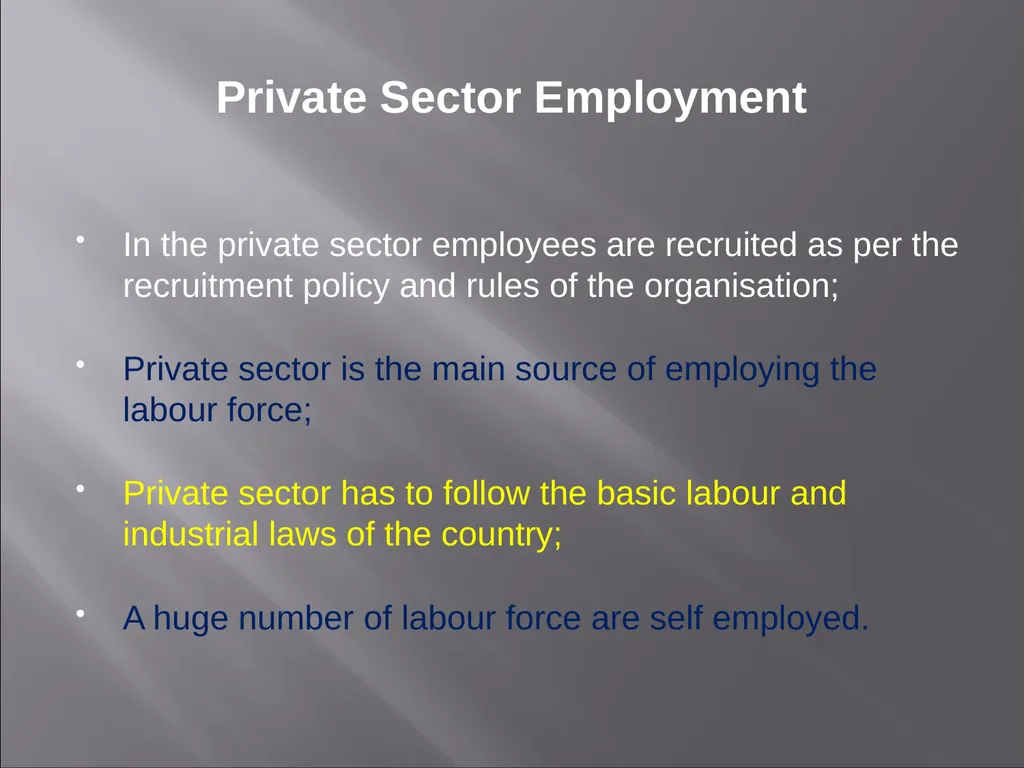
Private Sector Employment In the private sector employees are recruited as per the recruitment policy and rules of the organisation;
Private sector is the main source of employing the labour force;
Private sector has to follow the basic labour and industrial laws of the country;
A huge number of labour force are self employed.<br>
05
Public Sector Employment Bangladesh Public Service Commission (BPSC) is a key constitutional body to select suitable and qualified persons to the service of the republic.
It has been performing a major national role in promoting excellence in human resource planning of the government as well as in ensuring impartiality in civil service management.<br>
06
Unemployment in Bangladesh In 2013 unemployment rate was 4.3 %
Unemployment in the rural area 3.6 %
Unemployment in the urban area 5.8 %
Male unemployment rate is 3.0%
Female unemployment rate is 7.3%
Though unemployment rate in Bangladesh is comparatively low, the number of unemployed people, about 2.5 million , is a big figure.
Labour Force and Child Labour Survey of BBS, 2013<br>
07
Scope of Employment Government Service/Semi Govt./Autonomous Body
Agriculture Sector/Fishing
Overseas Employment
Private Job
Bank/Corporate Sector/Educational institute
Ready Made Garment Sector
General Business/Retail Shop/ Super Mall /Hotel/Restaurent
Medical/Hospital Service
Service Sector (Transport, ICT , Real State, Vocational Job )
Self Employment (Out sourcing, SME, Farming, Agriculture)
NGO/Non formal Development Sector<br>
08
Emerging Sector for Employment VET & ICT sectors are very much emerging for employment. These sectors include:
Software engineer; Programmar;
Hardware engineer;
Training Institute;
Out sourcing; Free lancer.
Overseas skilled employment;
If we can create employment opportunities for our workers and open investment avenues for entrepreneurs abroad our economy will boost up.<br>
09
Challenges of Employment in Bangladesh Low participation of women and merginalised group;
Due to lack of linkage between education and job market create employment mismatch
Lack of data for job seekers.
Improve the climate for FDI.
Lack of co-ordination among public and private employment providers.
Unregulated job market in the private and NGO sector.<br>
10
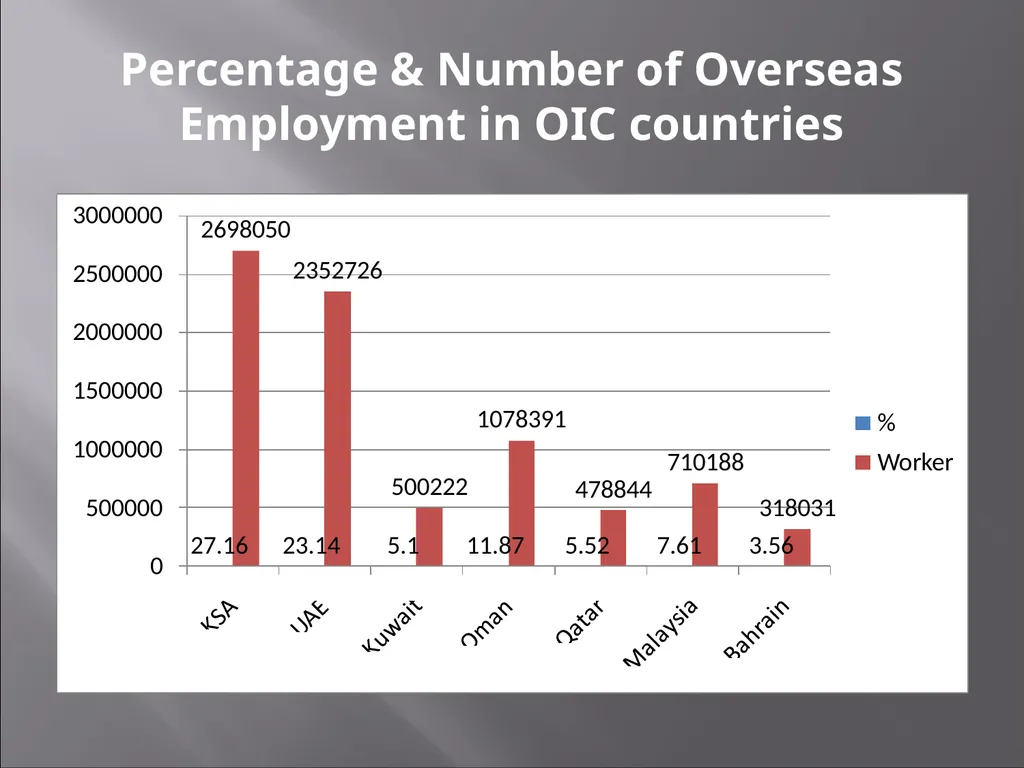
Percentage & Number of Overseas Employment in OIC countries<br>
11
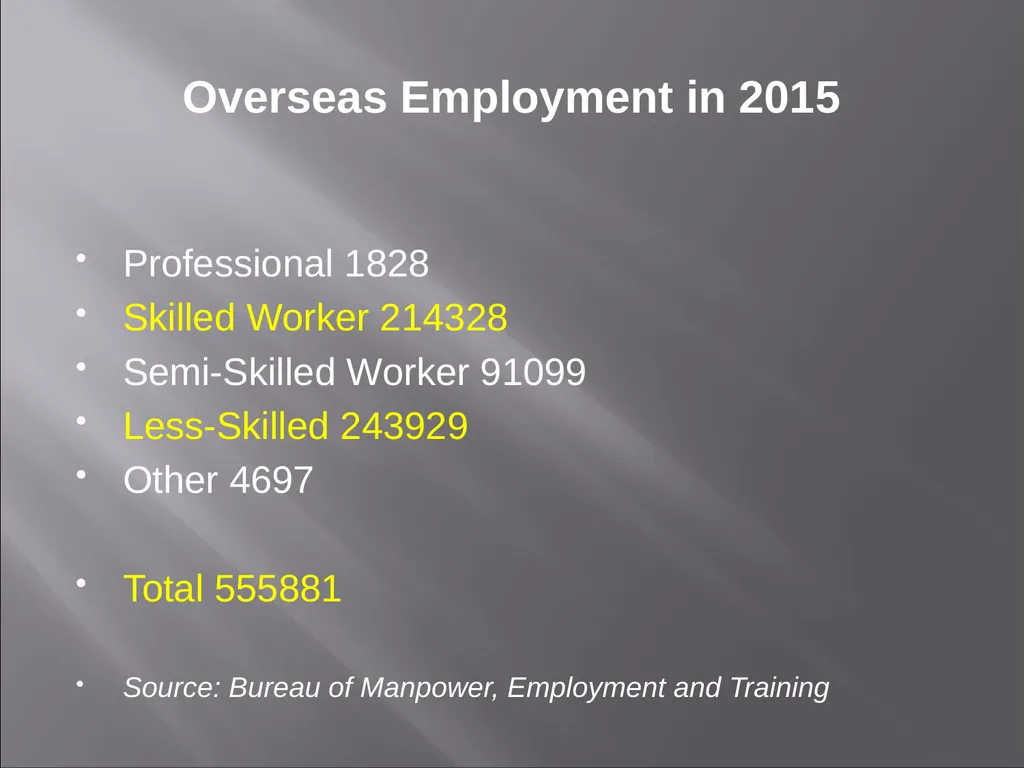
Overseas Employment in 2015 Professional 1828
Skilled Worker 214328
Semi-Skilled Worker 91099
Less-Skilled 243929
Other 4697
Total 555881
Source: Bureau of Manpower, Employment and Training<br>
12
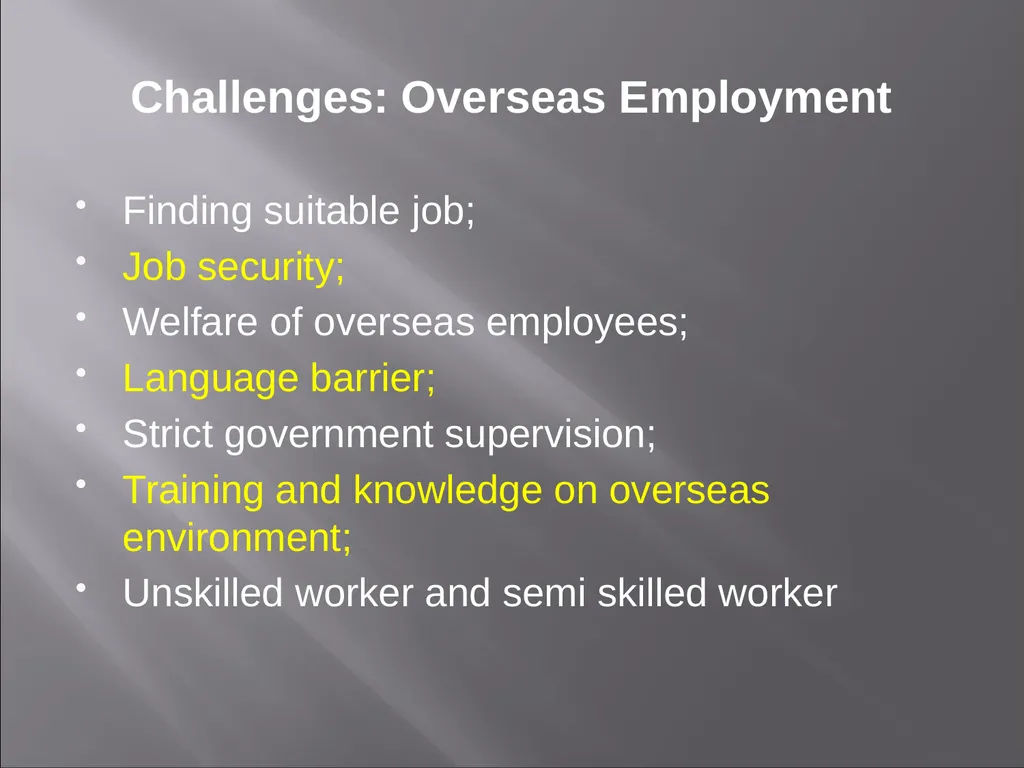
Challenges: Overseas Employment Finding suitable job;
Job security;
Welfare of overseas employees;
Language barrier;
Strict government supervision;
Training and knowledge on overseas environment;
Unskilled worker and semi skilled worker<br>
13
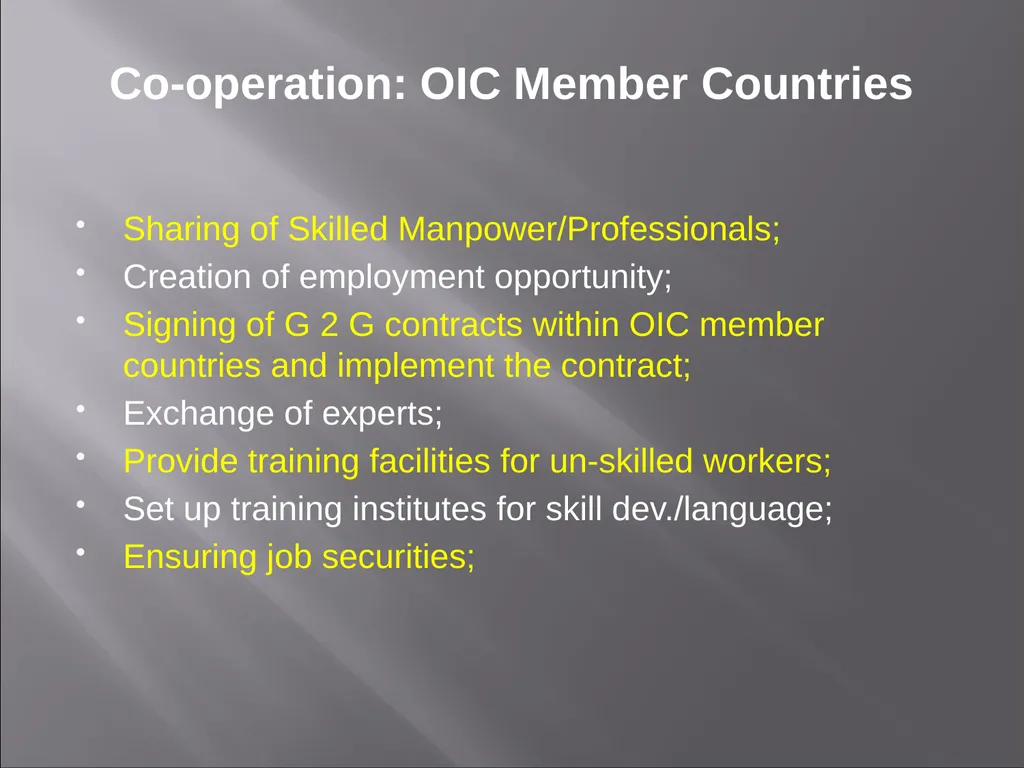
Co-operation: OIC Member Countries Sharing of Skilled Manpower/Professionals;
Creation of employment opportunity;
Signing of G 2 G contracts within OIC member countries and implement the contract;
Exchange of experts;
Provide training facilities for un-skilled workers;
Set up training institutes for skill dev./language;
Ensuring job securities;<br>
14
Best Practices: Bangladesh Emphasis on Vocational and Technical Education
Emphasis on ICT, Web portal, Call centres.
Government has created National Human Resource Development Fund (NHRDF)
Government has taken initiative to establish adequate number of vocational and technical institution for job oriented education.
Government has planned to establish some technical universities for creating high level skilled workforce.<br>
15
Best Practices for overseas workers Government has taken initiatives to provide training in countries having the most overseas employments with the help of Bangladesh, high commissions/embassies.
Government has emphasis to provide language training to overseas employees to overcome language barrier.
Multi Lingual Language training institutes are being established both public and private sectors.<br>
16
Bset Practices: FDI & Enterpreneurship SME Foundation is working for establishment of small and medium enterpreneurship.
BEPZA to provide special areas for potential investors for export oriented industries.
Government is going to establish 64 economic zones in 64 districts.
Special Economic Zone for some countries.
Joint collaboration projects (in the field of electricity and power generation).<br>
17
Best Practices: Job in the ICT & NGO Sector Government has set up digital centres in 4,547 union parishads, 321 municipalities, and 407 wards in 11 city corporations have already been set up.
Around 10,000 young ICT entrepreneurs have become self-reliant in the digital centres.
Bangladesh Association of Software and Information Services (BASIS) is working for creating skilled IT workforce, and creating employment.
Measures are taken for capacity building of IT industries under Public-Private Partnership (PPP) model.
NGO friendly environment creates huge job opportunity in BD.<br>
18
Best Practices to Reduce Time in Public Employment BPSC has been involved initiated online application facility for all the recruitments, printing of question papers on the same day of examination.
BPSC is arranging regular seminar and workshop to equip our officers.
BPSC is providing a unique ID for each educated young force to trace with his employment status.<br>
19
Role of Ministry of Expatriates’ Welfare and Overseas Employment Retain existing labour market including exploration of new labour market for workers;
Create skill manpower by providing training as per the demand of labour market;
Maintain contact and keep close coordination with International Organizations.
Maintain data of migrant workers, receiving countries and related matters;
Ensure rights and welfare of the migrant Bangladeshi workers;<br>
20
Role of Ministry of Labour and Employment To reduce unemployment & poverty through productive employment & human resource development
To create semi-skilled & Skilled manpower.
Enhance productivity of Factories by creating working friendly environment between workers & Employers.
Ensure welfare of workers in different industrial area.
To implement Labour-Laws.
To fix up minimum wages of labour.
Ensure justice through Labour Court.<br>
21
Role of Ministry of Foreign Affairs Maintenance of relations and dealings with other countries;
Coordination with the international organizations and world bodies;
Arrangement of agreements and treaties;
Diplomatic and consular representations abroad;
Welfare of Bangladeshi expatriates;
Maintenance of liaison with International Organizations and dealing in the matters relating to treaties and agreements with other countries and world bodies;
Consultation with concerned Ministries in all other relevant matters.<br>