
Ethics in a Global Context Module Six | Lesson One
Description: Ethics in a Global Context Module Six Lesson One Lesson One Introduction Lesson Overview Contestation of Ethics in a Global Context What are the problems with practicing ethical public relations in a global context? Conceptualization of
Related Topics
Download Presentation
"Ethics in a Global Context Module Six | Lesson One" is the property of its rightful owner. Permission is granted to download and print the materials on this website for personal, non-commercial use only, and to display it on your personal computer provided you do not modify the materials and that you retain all copyright notices contained in the materials. By downloading content from our website, you accept the terms of this agreement.
Presentation Transcript
slide1. Ethics in a Global Context Module Six | Lesson One<br>
slide2. Lesson One | Introduction Lesson Overview Contestation of Ethics in a Global Context
What are the problems with practicing ethical public relations in a global context?
Conceptualization of Ethics in a Global Context
What are the approaches to understanding ethical public relations in a global context?<br>
slide3. Lesson One | Introduction Global Public Relations “Public relations practice has globalized; it is time that we globalize our conceptualizations and reflect on the evidence and use our knowledge to ensure that public relations practice contributes even more toward the development of the world.” Sriramesh, K., & Verčič, D. (2007). Introduction to this special section: The impact of globalization on public relations. Public Relations Review, 33(4), 355–359. http://doi.org/10.1016/j.pubrev.2007.09.002<br>
slide4. Lesson One | Introduction Contesting Ethics “To be a truly great, global business, business leaders need to adopt a global standard of ethical practices.” George, B. (2008). Ethics must be global, not local. Retrieved from http://www.bloomberg.com/news/articles/2008-02-12/ethics-must-be-global-not-localbusinessweek-business-news-stock-market-and-financial-advice<br>
slide5. Lesson One | Introduction Possible Problems Who determines what the global standard is?
How do we determine what the global standard is?
Based on what principles?<br>
slide6. Lesson One | Introduction Discussion Question #1 In an article published by the Markkula Center for Applied Ethics (https://www.scu.edu/ethics/focus-areas/business-ethics/resources/business-ethics-in-china/), it is quoted that “The strategy should be to limit the output of Western experts to a minimum. Setting up a code of ethics, for example, should be primarily the job of the Chinese.”
When practicing public relations in a foreign market, who, how and what do you think should determine what standards of ethical practices should be put in place?<br>
slide7. Lesson One | Introduction Challenges of Ethics in a Global Context Polarization between local and global
Power in the development of global ethics
Defining global ethics
Defining global publics
Unequally shared global risk
Building a culturally sensitive universal framework of global ethics<br>
slide8. Lesson One | Introduction Examples of differences New Zealand practitioners have higher ethical standards than Israeli practitioners?
Why? Toledano, M., & Avidar, R. (2016). Public relations, ethics, and social media: A cross-national study of PR practitioners. Public Relations Review, 42(1), 161–169. http://doi.org/10.1016/j.pubrev.2015.11.012<br>
slide9. Lesson One | Introduction Discussion Question #2 What are some of the problems associated with setting a global standard of ethical standards? Or not setting one up at all?<br>
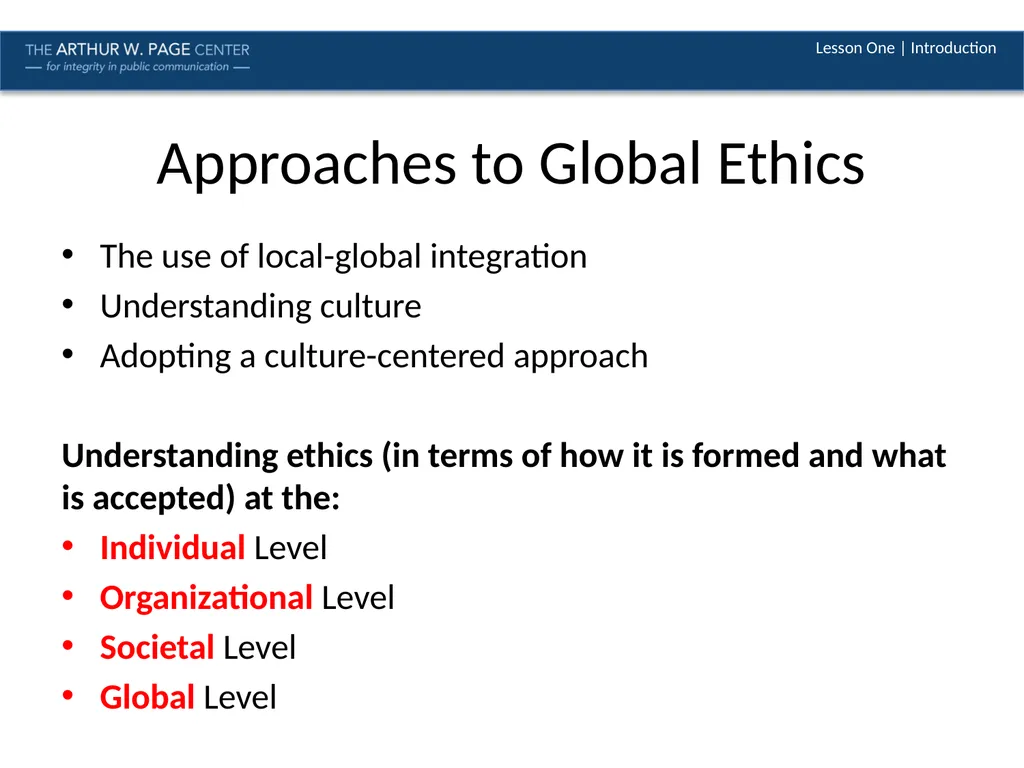
slide10. Lesson One | Introduction Approaches to Global Ethics The use of local-global integration
Understanding culture
Adopting a culture-centered approach
Understanding ethics (in terms of how it is formed and what is accepted) at the:
Individual Level
Organizational Level
Societal Level
Global Level<br>
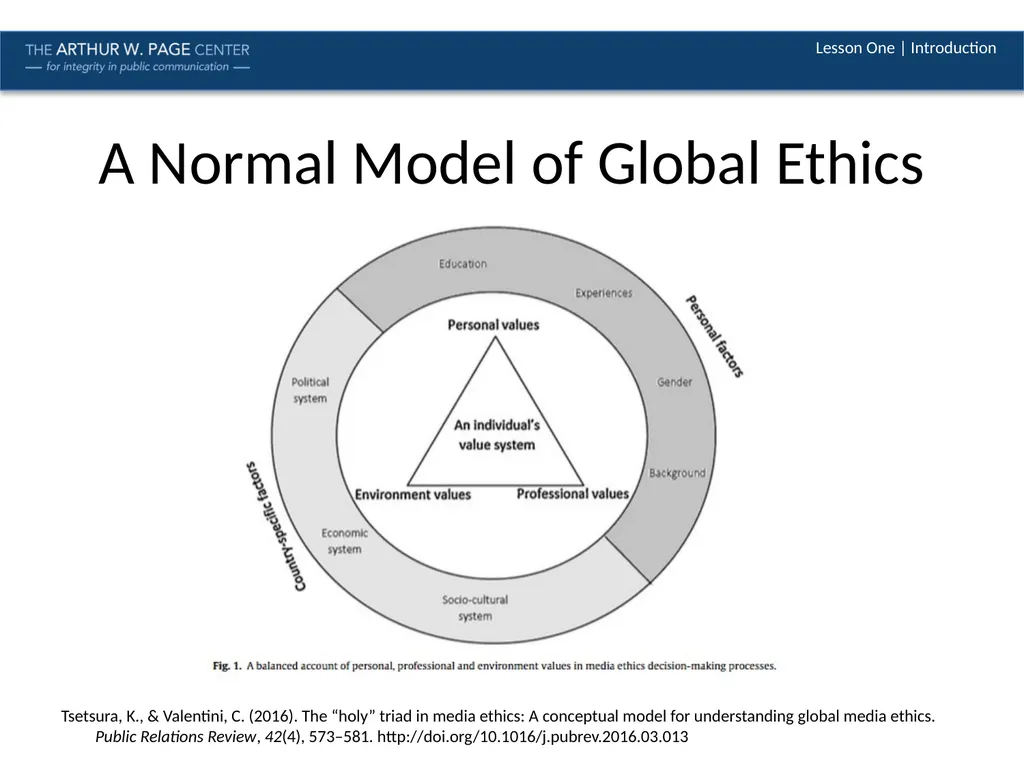
slide11. Lesson One | Introduction A Normal Model of Global Ethics Tsetsura, K., & Valentini, C. (2016). The “holy” triad in media ethics: A conceptual model for understanding global media ethics. Public Relations Review, 42(4), 573–581. http://doi.org/10.1016/j.pubrev.2016.03.013<br>
slide12. Lesson One | Introduction Discussion Question #3 Using the case study, explain how this model can be applied to understand what happened in the case.<br>
slide13. Lesson One | Introduction “An ethically defensible decision is one that you can live with and for which you are able to provide a reasonable, ethics-based rationale to observers.”
Parsons, P. (2008). Ethics in public relations: A guide to best practice (2nd ed.). London, UK: Kogan Page.
How do we ensure that we are ethical in the global context?<br>
slide2. Lesson One | Introduction Lesson Overview Contestation of Ethics in a Global Context
What are the problems with practicing ethical public relations in a global context?
Conceptualization of Ethics in a Global Context
What are the approaches to understanding ethical public relations in a global context?<br>
slide3. Lesson One | Introduction Global Public Relations “Public relations practice has globalized; it is time that we globalize our conceptualizations and reflect on the evidence and use our knowledge to ensure that public relations practice contributes even more toward the development of the world.” Sriramesh, K., & Verčič, D. (2007). Introduction to this special section: The impact of globalization on public relations. Public Relations Review, 33(4), 355–359. http://doi.org/10.1016/j.pubrev.2007.09.002<br>
slide4. Lesson One | Introduction Contesting Ethics “To be a truly great, global business, business leaders need to adopt a global standard of ethical practices.” George, B. (2008). Ethics must be global, not local. Retrieved from http://www.bloomberg.com/news/articles/2008-02-12/ethics-must-be-global-not-localbusinessweek-business-news-stock-market-and-financial-advice<br>
slide5. Lesson One | Introduction Possible Problems Who determines what the global standard is?
How do we determine what the global standard is?
Based on what principles?<br>
slide6. Lesson One | Introduction Discussion Question #1 In an article published by the Markkula Center for Applied Ethics (https://www.scu.edu/ethics/focus-areas/business-ethics/resources/business-ethics-in-china/), it is quoted that “The strategy should be to limit the output of Western experts to a minimum. Setting up a code of ethics, for example, should be primarily the job of the Chinese.”
When practicing public relations in a foreign market, who, how and what do you think should determine what standards of ethical practices should be put in place?<br>
slide7. Lesson One | Introduction Challenges of Ethics in a Global Context Polarization between local and global
Power in the development of global ethics
Defining global ethics
Defining global publics
Unequally shared global risk
Building a culturally sensitive universal framework of global ethics<br>
slide8. Lesson One | Introduction Examples of differences New Zealand practitioners have higher ethical standards than Israeli practitioners?
Why? Toledano, M., & Avidar, R. (2016). Public relations, ethics, and social media: A cross-national study of PR practitioners. Public Relations Review, 42(1), 161–169. http://doi.org/10.1016/j.pubrev.2015.11.012<br>
slide9. Lesson One | Introduction Discussion Question #2 What are some of the problems associated with setting a global standard of ethical standards? Or not setting one up at all?<br>
slide10. Lesson One | Introduction Approaches to Global Ethics The use of local-global integration
Understanding culture
Adopting a culture-centered approach
Understanding ethics (in terms of how it is formed and what is accepted) at the:
Individual Level
Organizational Level
Societal Level
Global Level<br>
slide11. Lesson One | Introduction A Normal Model of Global Ethics Tsetsura, K., & Valentini, C. (2016). The “holy” triad in media ethics: A conceptual model for understanding global media ethics. Public Relations Review, 42(4), 573–581. http://doi.org/10.1016/j.pubrev.2016.03.013<br>
slide12. Lesson One | Introduction Discussion Question #3 Using the case study, explain how this model can be applied to understand what happened in the case.<br>
slide13. Lesson One | Introduction “An ethically defensible decision is one that you can live with and for which you are able to provide a reasonable, ethics-based rationale to observers.”
Parsons, P. (2008). Ethics in public relations: A guide to best practice (2nd ed.). London, UK: Kogan Page.
How do we ensure that we are ethical in the global context?<br>