
Ethics in Crisis Management Module Nine | Lesson
Description: Ethics in Crisis Management Module Nine Lesson two Overview: Access To Information During A Crisis Significant Choice Ethical Framework Challenge of Information Uncertainty in Crises Communication Ambiguity in Crises Ethics Of Withholding
Related Topics
Download Presentation
"Ethics in Crisis Management Module Nine | Lesson" is the property of its rightful owner. Permission is granted to download and print the materials on this website for personal, non-commercial use only, and to display it on your personal computer provided you do not modify the materials and that you retain all copyright notices contained in the materials. By downloading content from our website, you accept the terms of this agreement.
Presentation Transcript
slide1. Ethics in Crisis Management Module Nine | Lesson two<br>
slide2. Overview: Access To Information During A Crisis Significant Choice Ethical Framework
Challenge of Information Uncertainty in Crises
Communication Ambiguity in Crises
Ethics Of Withholding Information
A Dialogic Approach In Addressing The Public’s Concerns Lesson Two<br>
slide3. Significant Choice Ethical Framework choice based on the best information available when the decision must be made
choice making that is voluntary, free from physical or mental coercion
when a group has vital information the public needs, that information must be disseminated as completely and accurately as possible Lesson Two<br>
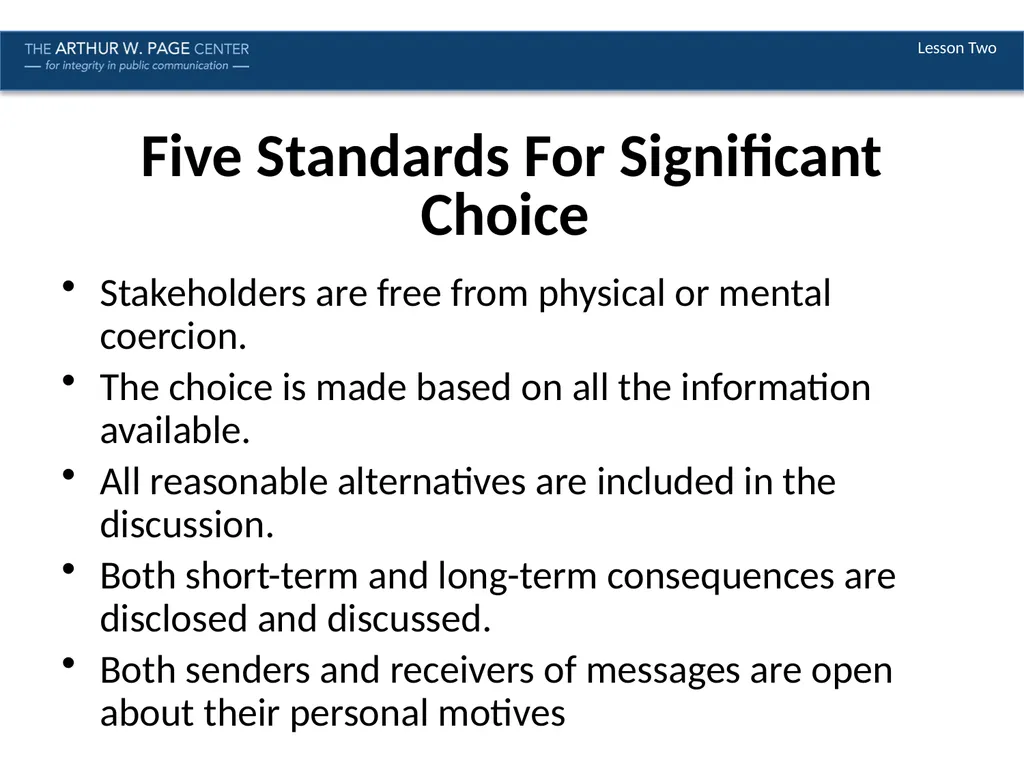
slide4. Five Standards For Significant Choice Stakeholders are free from physical or mental coercion.
The choice is made based on all the information available.
All reasonable alternatives are included in the discussion.
Both short-term and long-term consequences are disclosed and discussed.
Both senders and receivers of messages are open about their personal motives Lesson Two<br>
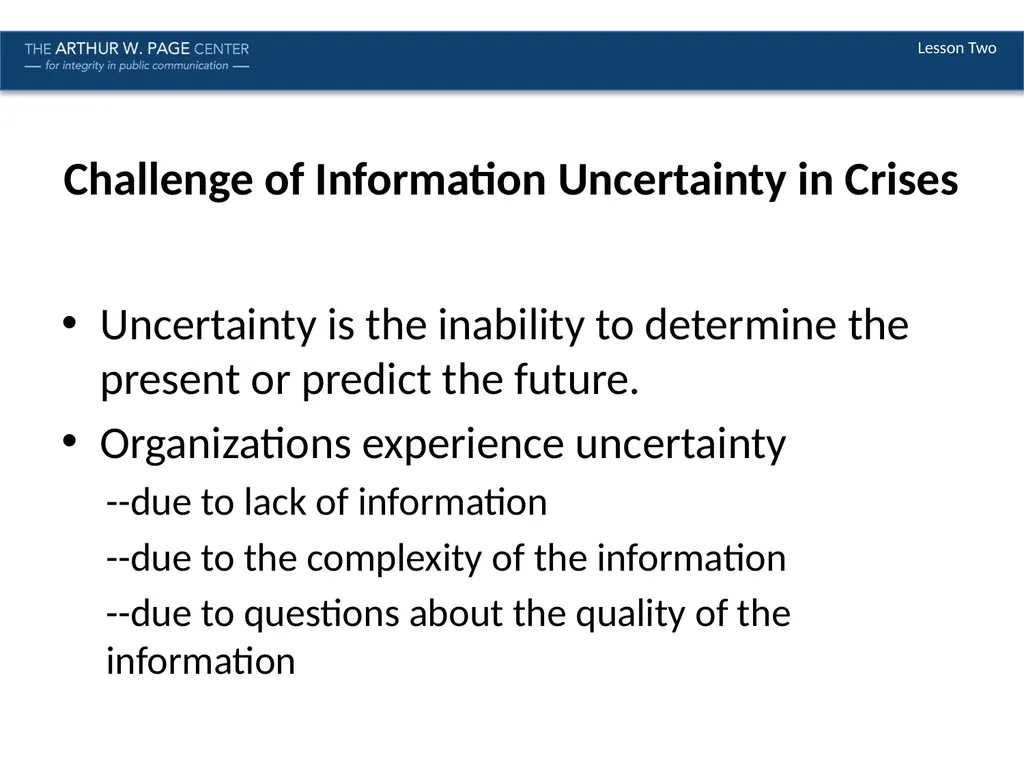
slide5. Challenge of Information Uncertainty in Crises Uncertainty is the inability to determine the present or predict the future.
Organizations experience uncertainty
--due to lack of information
--due to the complexity of the information
--due to questions about the quality of the information Lesson Two<br>
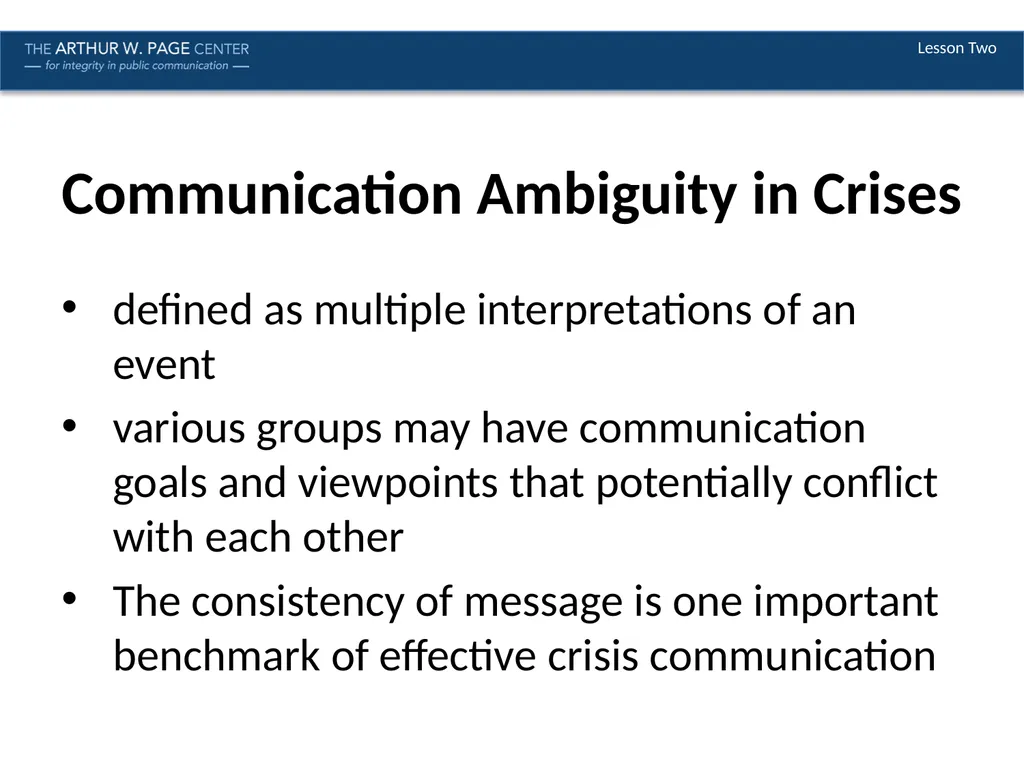
slide6. Communication Ambiguity in Crises defined as multiple interpretations of an event
various groups may have communication goals and viewpoints that potentially conflict with each other
The consistency of message is one important benchmark of effective crisis communication Lesson Two<br>
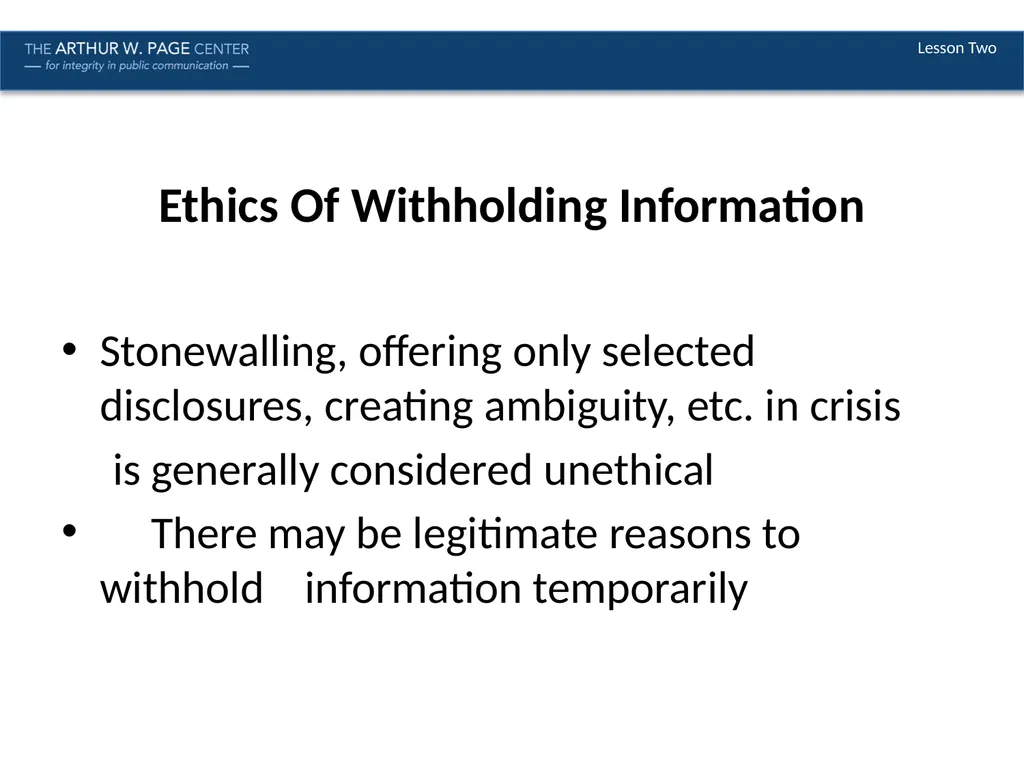
slide7. Ethics Of Withholding Information Stonewalling, offering only selected disclosures, creating ambiguity, etc. in crisis
is generally considered unethical
There may be legitimate reasons to withhold information temporarily Lesson Two<br>
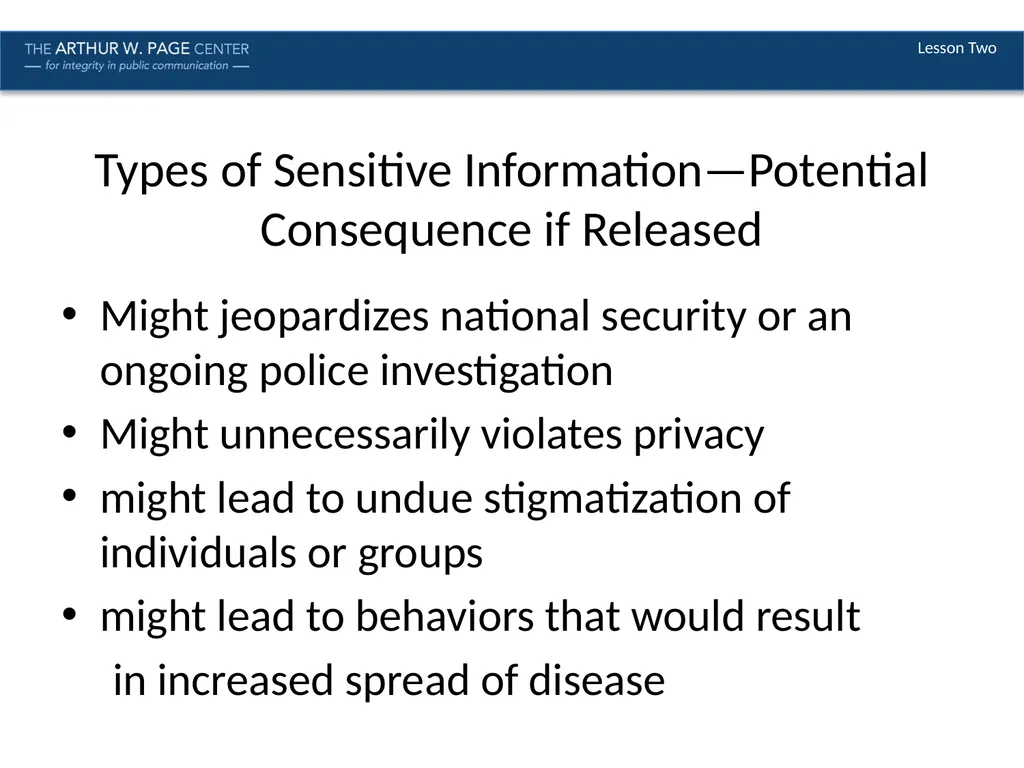
slide8. Types of Sensitive Information—Potential Consequence if Released Might jeopardizes national security or an ongoing police investigation
Might unnecessarily violates privacy
might lead to undue stigmatization of individuals or groups
might lead to behaviors that would result
in increased spread of disease Lesson Two<br>
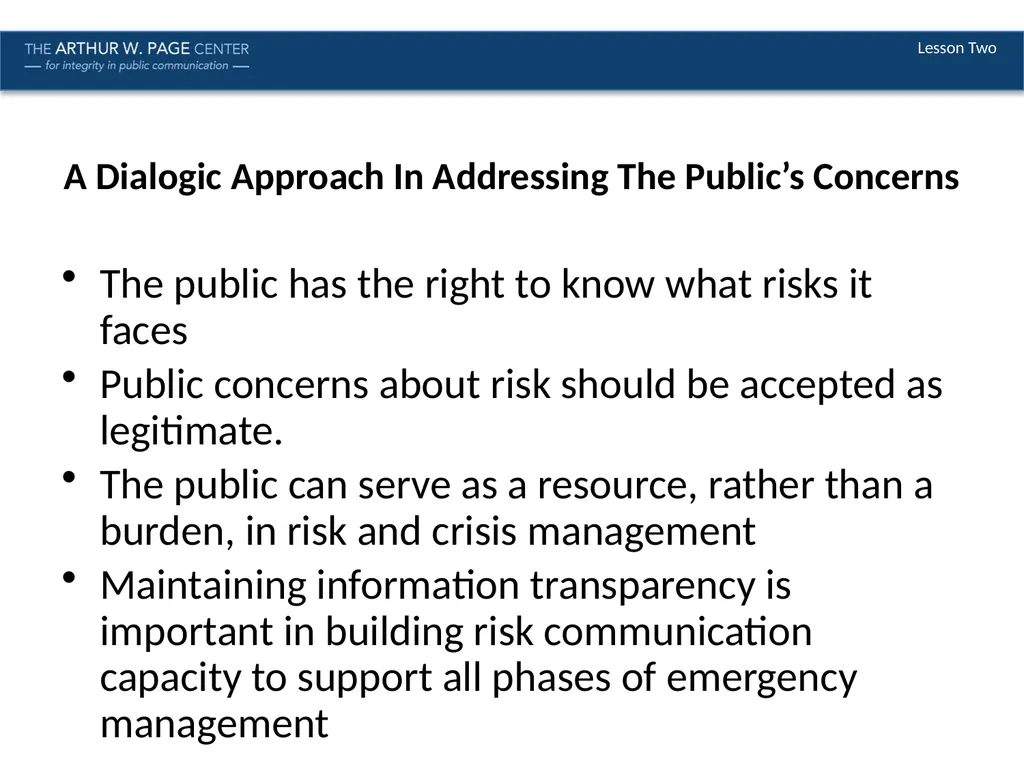
slide9. A Dialogic Approach In Addressing The Public’s Concerns The public has the right to know what risks it faces
Public concerns about risk should be accepted as legitimate.
The public can serve as a resource, rather than a burden, in risk and crisis management
Maintaining information transparency is important in building risk communication capacity to support all phases of emergency management Lesson Two<br>
slide2. Overview: Access To Information During A Crisis Significant Choice Ethical Framework
Challenge of Information Uncertainty in Crises
Communication Ambiguity in Crises
Ethics Of Withholding Information
A Dialogic Approach In Addressing The Public’s Concerns Lesson Two<br>
slide3. Significant Choice Ethical Framework choice based on the best information available when the decision must be made
choice making that is voluntary, free from physical or mental coercion
when a group has vital information the public needs, that information must be disseminated as completely and accurately as possible Lesson Two<br>
slide4. Five Standards For Significant Choice Stakeholders are free from physical or mental coercion.
The choice is made based on all the information available.
All reasonable alternatives are included in the discussion.
Both short-term and long-term consequences are disclosed and discussed.
Both senders and receivers of messages are open about their personal motives Lesson Two<br>
slide5. Challenge of Information Uncertainty in Crises Uncertainty is the inability to determine the present or predict the future.
Organizations experience uncertainty
--due to lack of information
--due to the complexity of the information
--due to questions about the quality of the information Lesson Two<br>
slide6. Communication Ambiguity in Crises defined as multiple interpretations of an event
various groups may have communication goals and viewpoints that potentially conflict with each other
The consistency of message is one important benchmark of effective crisis communication Lesson Two<br>
slide7. Ethics Of Withholding Information Stonewalling, offering only selected disclosures, creating ambiguity, etc. in crisis
is generally considered unethical
There may be legitimate reasons to withhold information temporarily Lesson Two<br>
slide8. Types of Sensitive Information—Potential Consequence if Released Might jeopardizes national security or an ongoing police investigation
Might unnecessarily violates privacy
might lead to undue stigmatization of individuals or groups
might lead to behaviors that would result
in increased spread of disease Lesson Two<br>
slide9. A Dialogic Approach In Addressing The Public’s Concerns The public has the right to know what risks it faces
Public concerns about risk should be accepted as legitimate.
The public can serve as a resource, rather than a burden, in risk and crisis management
Maintaining information transparency is important in building risk communication capacity to support all phases of emergency management Lesson Two<br>