Foreign Investment in India Foreign capital is

Published  . 0 views
↓ Download
Foreign Investment in India Foreign capital is
1 / 1
Foreign Investment in India Foreign capital is - slide 1 of 22 Foreign Investment in India Foreign capital is - slide 2 of 22 Foreign Investment in India Foreign capital is - slide 3 of 22 Foreign Investment in India Foreign capital is - slide 4 of 22 Foreign Investment in India Foreign capital is - slide 5 of 22 Foreign Investment in India Foreign capital is - slide 6 of 22 Foreign Investment in India Foreign capital is - slide 7 of 22 Foreign Investment in India Foreign capital is - slide 8 of 22 Foreign Investment in India Foreign capital is - slide 9 of 22 Foreign Investment in India Foreign capital is - slide 10 of 22 Foreign Investment in India Foreign capital is - slide 11 of 22 Foreign Investment in India Foreign capital is - slide 12 of 22 Foreign Investment in India Foreign capital is - slide 13 of 22 Foreign Investment in India Foreign capital is - slide 14 of 22 Foreign Investment in India Foreign capital is - slide 15 of 22 Foreign Investment in India Foreign capital is - slide 16 of 22 Foreign Investment in India Foreign capital is - slide 17 of 22 Foreign Investment in India Foreign capital is - slide 18 of 22 Foreign Investment in India Foreign capital is - slide 19 of 22 Foreign Investment in India Foreign capital is - slide 20 of 22 Foreign Investment in India Foreign capital is - slide 21 of 22 Foreign Investment in India Foreign capital is - slide 22 of 22
Description: Foreign Investment in India Foreign capital is needed for a developing country to increase the rate of investment and for capital accumulation for further economic growth. For developed country it is needed to support sustainable

Related Topics

Download Presentation

"Foreign Investment in India Foreign capital is" is the property of its rightful owner. Permission is granted to download and print the materials on this website for personal, non-commercial use only, and to display it on your personal computer provided you do not modify the materials and that you retain all copyright notices contained in the materials. By downloading content from our website, you accept the terms of this agreement.

Presentation Transcript

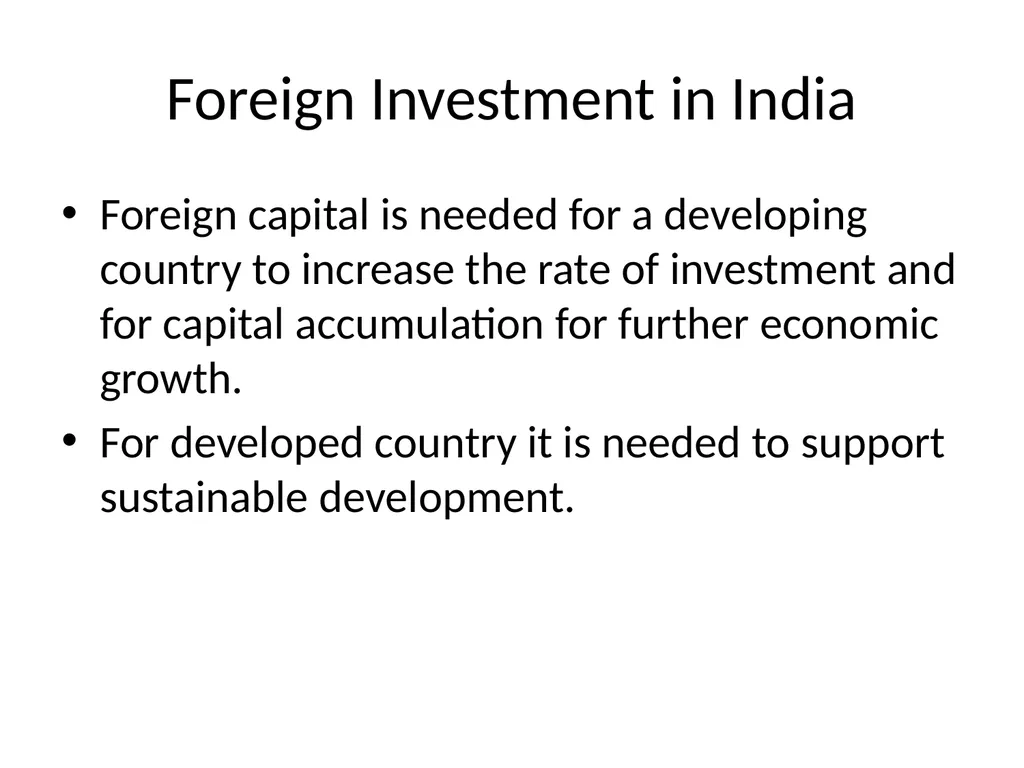
slide1. Foreign Investment in India Foreign capital is needed for a developing country to increase the rate of investment and for capital accumulation for further economic growth.
For developed country it is needed to support sustainable development.<br>
slide2. Forms of foreign capital Foreign Direct Investment
Foreign Portfolio Investment
Depository Receipts
Debt Capital<br>
slide3. Foreign Direct Investment It is the investment made by foreign individual or a firm in one country into business located in another country. Generally, FDI takes place when an investor establishes foreign business operations or acquires foreign business assets, including establishing ownership or controlling interest in a foreign company.<br>
slide4. Foreign Portfolio Investment It is the entry of funds into a country where foreigners deposit money in a country’s bank or make purchases in the country’s stock and bond markets.<br>
slide5. Depository Receipts These are a negotiable certificate issued by a bank representing share in a foreign company traded on a local stock exchange.
These are in the form of American and Global
ADR is a negotiable certificate issued by a US bank representing shares in a foreign stock is traded on US exchange.
ADRs are denominated in US$ with the underlying security held by a US financial institution overseas.<br>
slide6. Global Depository Receipt are negotiable instrument issued by Depository Bank against the domestic shares of the issuing company.
GDRs are listed and traded on one or more international exchanges, except USA.<br>
slide7. Debt Foreign capital These are loans from friendly governments, or multilateral institutions like IMF
External commercial borrowing
Remittances
Foreign Currency deposits of non-resident citizens of the country.<br>
slide8. Foreign Direct Investment FDI can be made in a variety of ways, including the opening of a subsidiary or associate company in a foreign country, acquiring a controlling interest in an existing foreign company or by means of a merger or joint venture with a foreign company.
Thus FDI is calculated to include all kinds of capital contributions such as the purchase of stocks as well as the reinvestment of earnings by a wholly owned company incorporated abroad and the lending of firms to a foreign subsidiary or branch.<br>
slide9. Types of FDI Greenfield Investments and Mergers and Acquisitions
Horizontal and vertical investment
Inward or outward investment
According to WTO<br>
slide10. Greenfield Investment A Greenfield investment refers to a type of FDI where a company establishes a wholly new operation in a foreign country. It can be a new production or an expansion of the existing production facilities of the host country.
Due to this there are increased employment opportunities, relatively high wages, R & D and capacity enhancement.<br>
slide11. Acquiring or Merging It is acquiring control of existing entities though cross-border mergers and acquisitions. It occurs when a transfer of existing assets from local firms takes place
They represents about 77% of all flows in developed countries and about 33% of all flows in developing countries<br>
slide12. Horizontal and Vertical Investment Horizontal investment refers to FDI in the same industry abroad as the foreign investor company.
Vertical Direct Investment can be of two kinds
Backward – investments into industry that provides inputs into a firm’s domestic production eg. Mining
Forward – investment in an industry that utilises the outputs from a firm’s domestic production.<br>
slide13. Inward or outward investment An inward investment involves an external or foreign entity either investing in or purchasing the goods of a local economy.
An Outward direct investment is a business strategy in which a domestic firm expands its operations to a foreign country.<br>
slide14. Categories according to WTO Equity capital
Reinvested earnings
Other capital<br>
slide15. Equity capital It is the value of MNC’s investment in shares of an enterprise in a foreign country.
It includes mergers and acquisitions and Greenfield investment.<br>
slide16. Reinvested earnings These are the retained profit of the firm in which MNC has invested
Other capital
Short and long term lending and borrowing between the MNC and affiliate.<br>
slide17. Benefits of FDI Increased investment
Fdi provides additional capital.
It does not increase the external debt.

2. Transfer of new technology
3. Contribution to balance of payments
By contributing towards debt servicing repayments
- by boosting export markets and produce foreign exchange revenues<br>
slide18. 4. Social development
-by raising wages and income
5. Infrastructure
Greenfield investment can stimulate new infrastructure development and technologies in host economies.
6. Stimulate domestic enterprises
7. Import substitution<br>
slide19. 8. Stimulate exports and generate inward flow of earnings which help in trade balance.
9. Competition…..in the domestic market
10. Human capital formation
11. Revenues
12. Sectoral development
13. Better allocation
14. Growth
15. Better management techniques and practicesS<br>
slide20. Drawbacks of FDI to host countries Competition…..drives out local competitors
Balance of Payments
The earnings of MNCs and imports affect the capital account of the balance of payment of the host country.
3. Trade balance….negative trade balance if MNCs import a high percent of components.<br>
slide21. 4. Dependency
5. Diversion
6. Sovereignty and Autonomy
7. Social impact- FDI benefits only a small percentage of people who are educated and wealthy. Widens the gap.
8. Cultural Impact – Investment may occur for non-traditional goods or on sophisticated goods<br>
slide22. 9. Local, Small and rural business
10. Inappropriate techniques<br>