Game Theory: introduction and applications to
Description: Game Theory: introduction and applications to computer networks Introduction Giovanni Neglia INRIA EPI Maestro 9 January 2013 Part of the slides are based on a previous course with D. Figueiredo (UFRJ) and H. Zhang (Suffolk University)
Related Topics
Download Presentation
"Game Theory: introduction and applications to" is the property of its rightful owner. Permission is granted to download and print the materials on this website for personal, non-commercial use only, and to display it on your personal computer provided you do not modify the materials and that you retain all copyright notices contained in the materials. By downloading content from our website, you accept the terms of this agreement.
Presentation Transcript
slide1. Game Theory: introduction
and applications to computer networks Introduction
Giovanni Neglia
INRIA – EPI Maestro
9 January 2013
Part of the slides are based on a previous course
with D. Figueiredo (UFRJ) and H. Zhang (Suffolk University)<br>
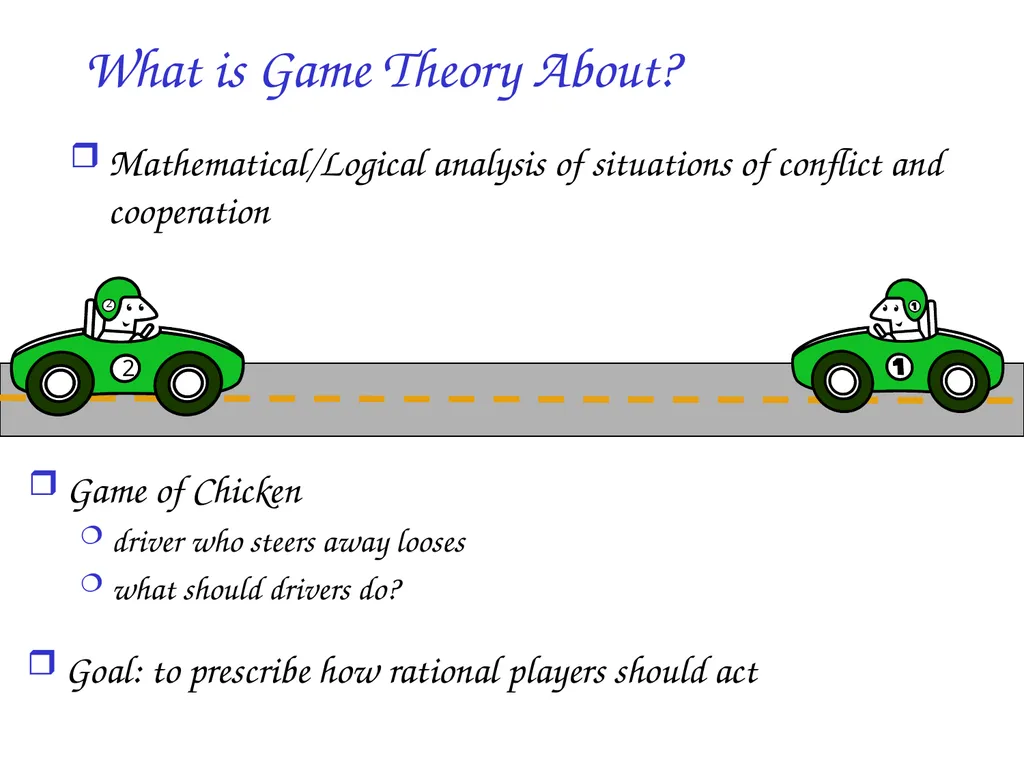
slide2. What is Game Theory About? Mathematical/Logical analysis of situations of conflict and cooperation Goal: to prescribe how rational players should act Game of Chicken
driver who steers away looses
what should drivers do?<br>
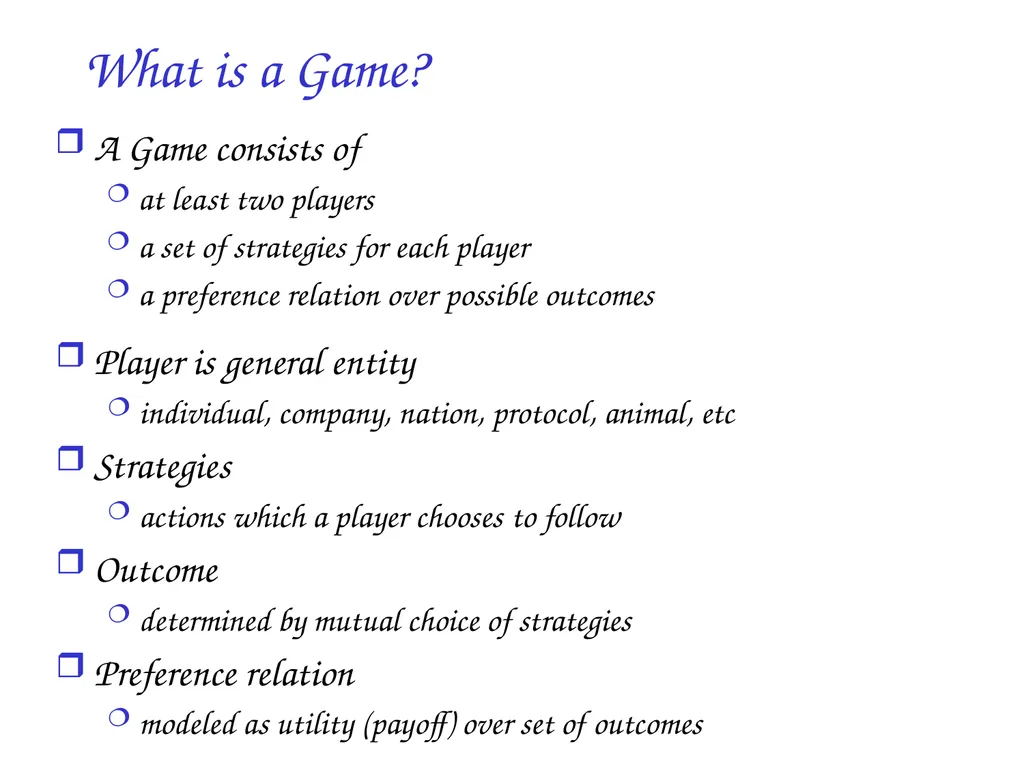
slide3. What is a Game? A Game consists of
at least two players
a set of strategies for each player
a preference relation over possible outcomes Player is general entity
individual, company, nation, protocol, animal, etc
Strategies
actions which a player chooses to follow
Outcome
determined by mutual choice of strategies
Preference relation
modeled as utility (payoff) over set of outcomes<br>
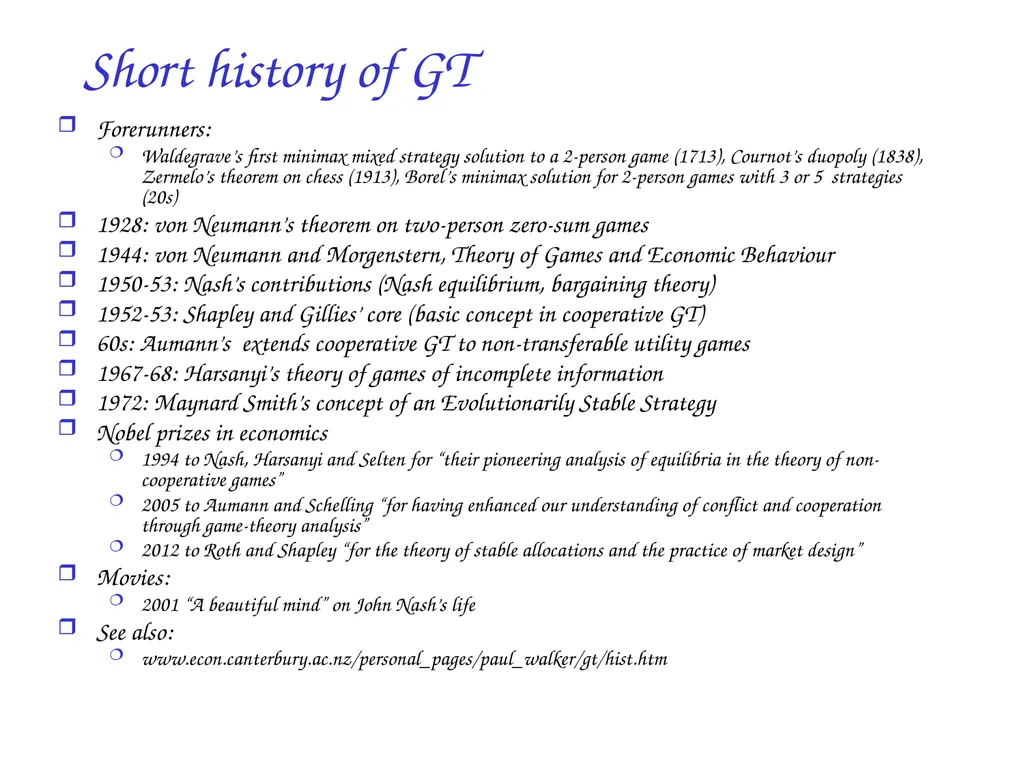
slide4. Short history of GT Forerunners:
Waldegrave’s first minimax mixed strategy solution to a 2-person game (1713), Cournot’s duopoly (1838), Zermelo’s theorem on chess (1913), Borel’s minimax solution for 2-person games with 3 or 5 strategies (20s)
1928: von Neumann’s theorem on two-person zero-sum games
1944: von Neumann and Morgenstern, Theory of Games and Economic Behaviour
1950-53: Nash’s contributions (Nash equilibrium, bargaining theory)
1952-53: Shapley and Gillies’ core (basic concept in cooperative GT)
60s: Aumann’s extends cooperative GT to non-transferable utility games
1967-68: Harsanyi’s theory of games of incomplete information
1972: Maynard Smith’s concept of an Evolutionarily Stable Strategy
Nobel prizes in economics
1994 to Nash, Harsanyi and Selten for “their pioneering analysis of equilibria in the theory of non-cooperative games”
2005 to Aumann and Schelling “for having enhanced our understanding of conflict and cooperation through game-theory analysis”
2012 to Roth and Shapley “for the theory of stable allocations and the practice of market design”
Movies:
2001 “A beautiful mind” on John Nash’s life
See also:
www.econ.canterbury.ac.nz/personal_pages/paul_walker/gt/hist.htm<br>
slide5. Applications of Game Theory Economy
Politics (vote, coalitions)
Biology (Darwin’s principle, evolutionary GT)
Anthropology
War
Management-labor arbitration
Philosophy (morality and free will)
National Football league draft<br>
slide6. Applications of Game Theory “Recently” applied to computer networks
Nagle, RFC 970, 1985
“datagram networks as a multi-player game”
wider interest starting around 2000
Which are the strategies available?
Network elements follow protocol!!!<br>
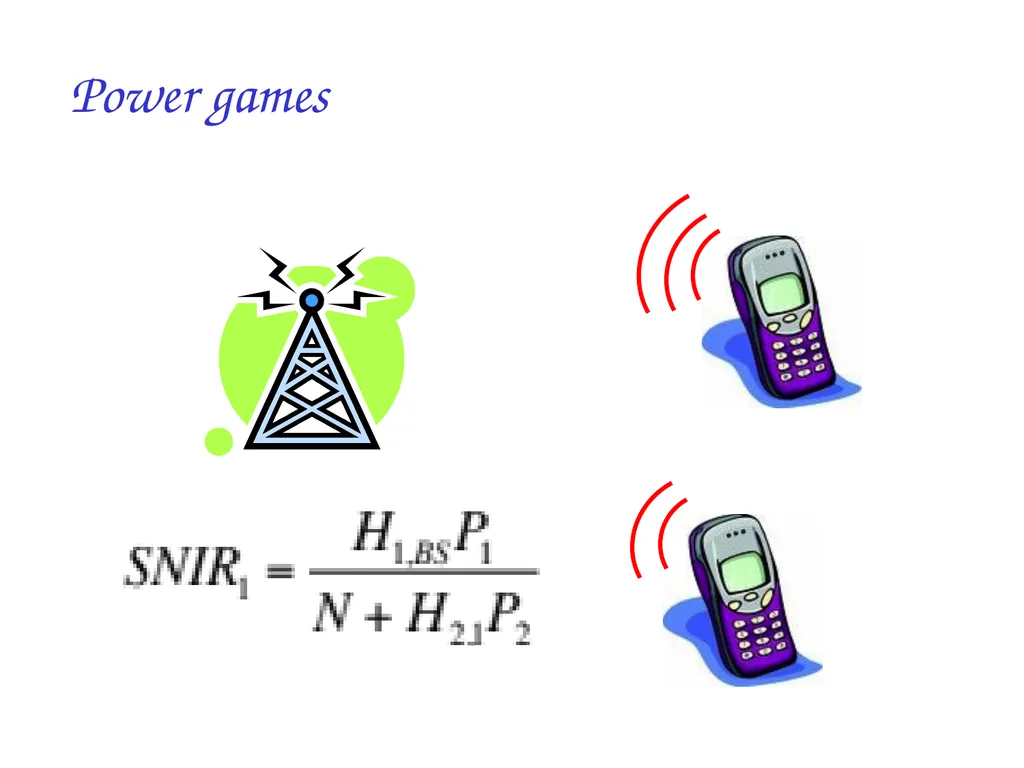
slide7. Power games<br>
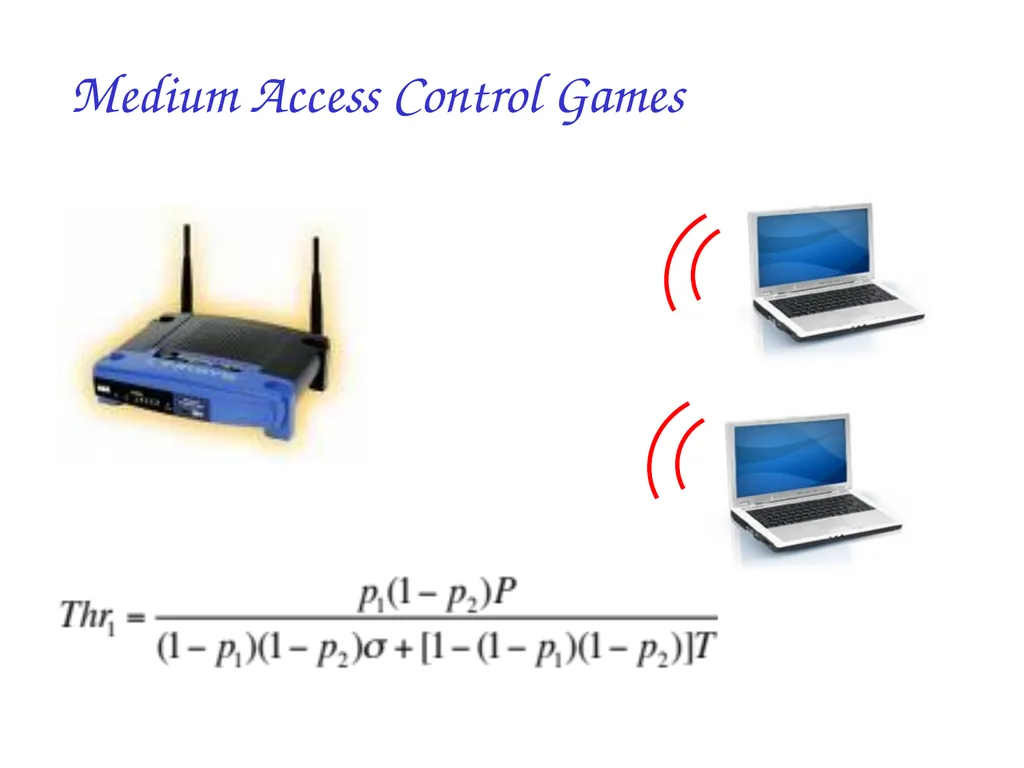
slide8. Medium Access Control Games<br>
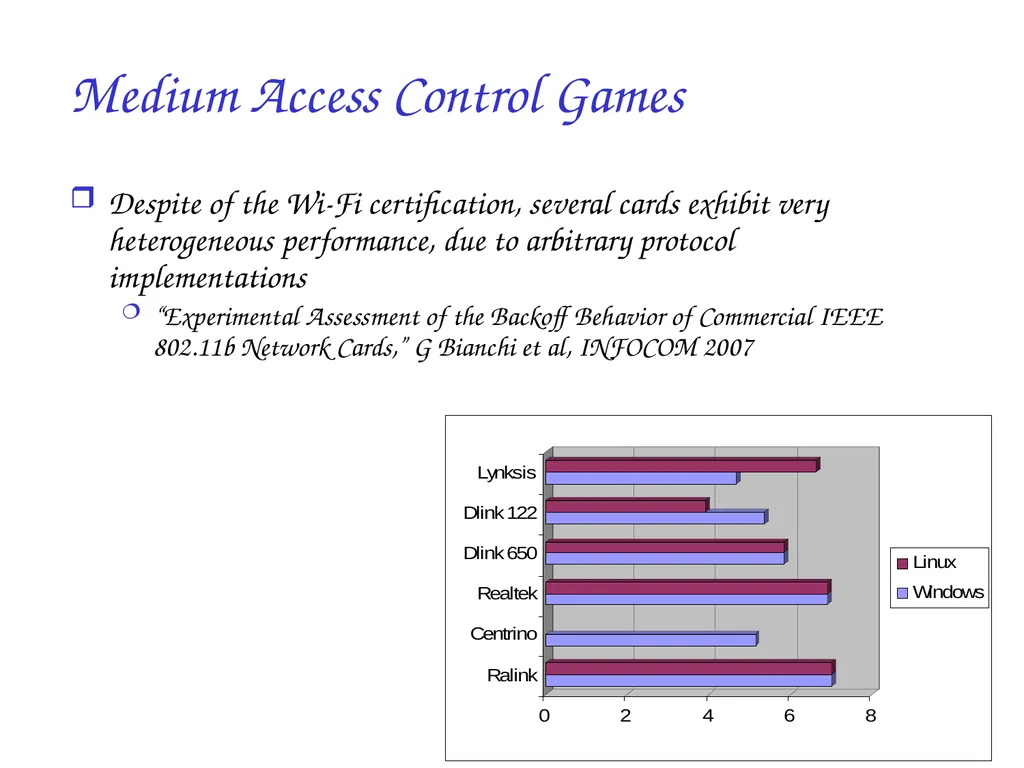
slide9. Medium Access Control Games Despite of the Wi-Fi certification, several cards exhibit very heterogeneous performance, due to arbitrary protocol implementations
“Experimental Assessment of the Backoff Behavior of Commercial IEEE 802.11b Network Cards,” G Bianchi et al, INFOCOM 2007<br>
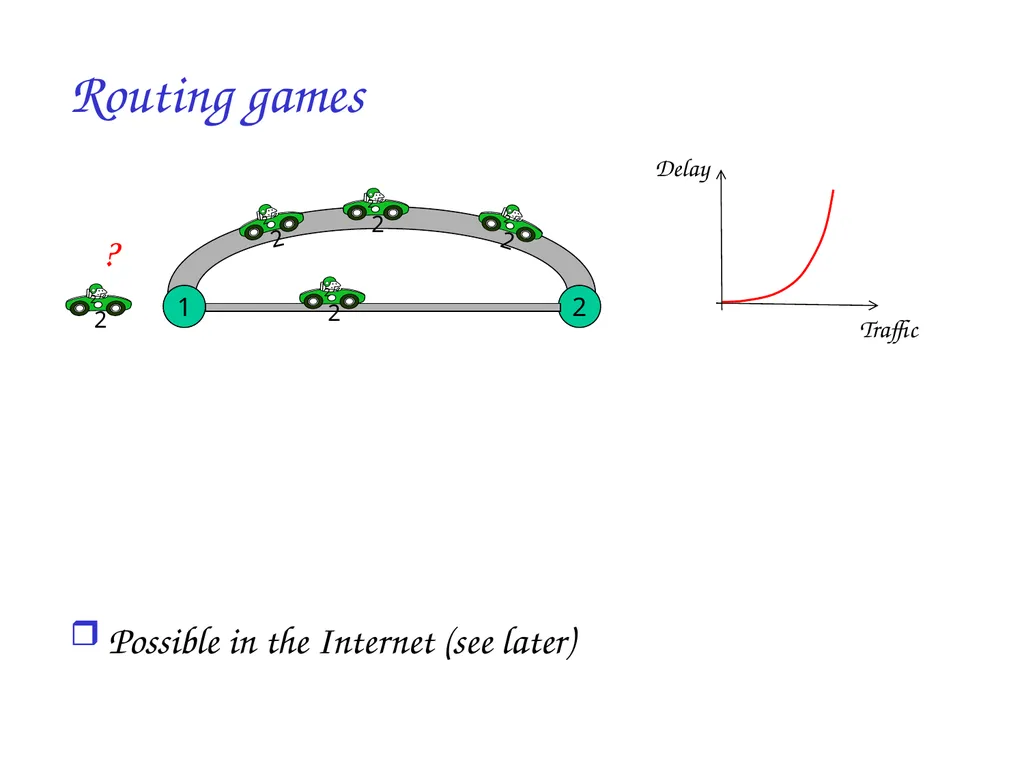
slide10. Routing games Possible in the Internet (see later) 1 2 ? Traffic Delay<br>
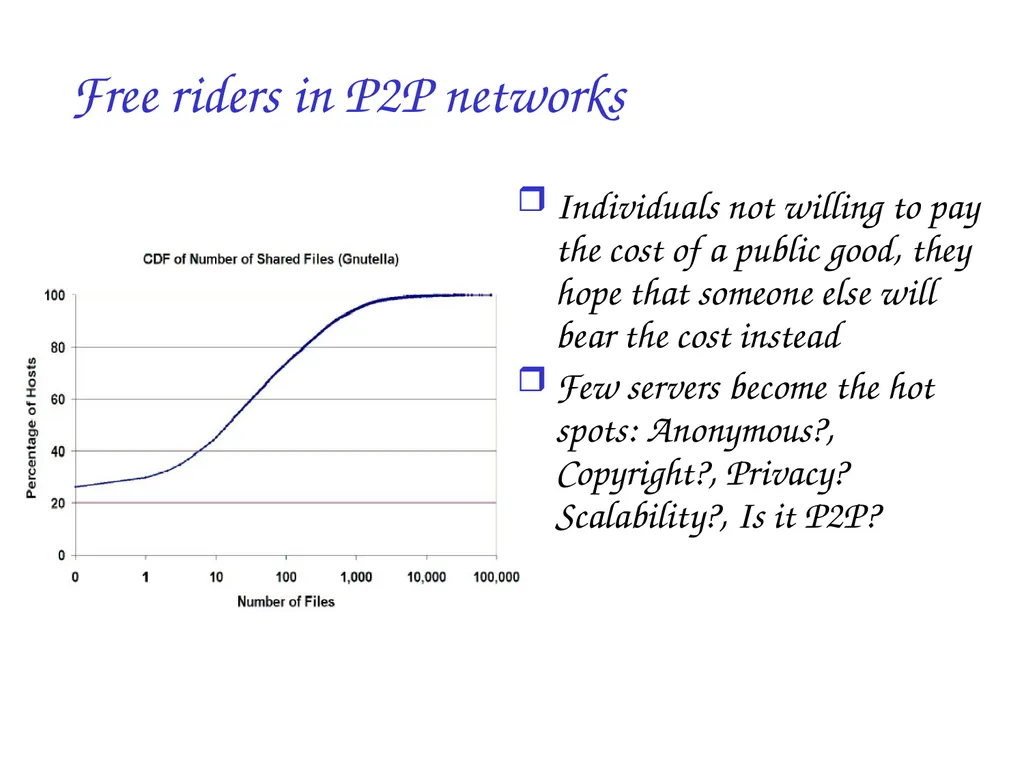
slide11. Free riders in P2P networks Individuals not willing to pay the cost of a public good, they hope that someone else will bear the cost instead
Few servers become the hot spots: Anonymous?, Copyright?, Privacy? Scalability?, Is it P2P?<br>
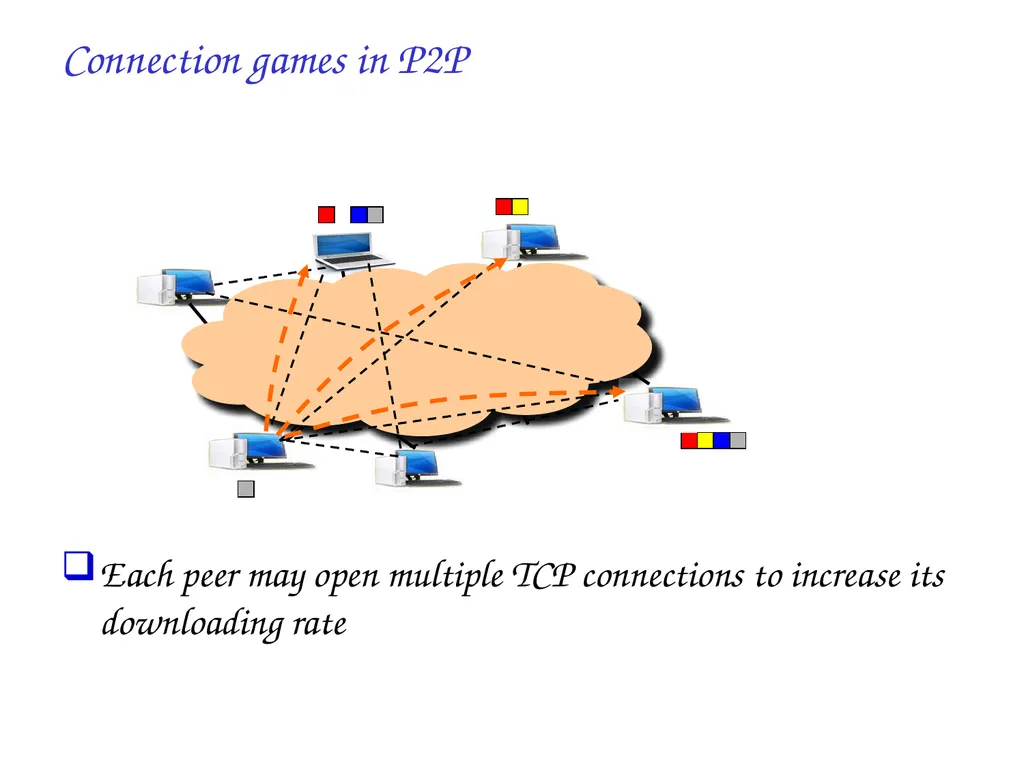
slide12. Connection games in P2P Each peer may open multiple TCP connections to increase its downloading rate<br>
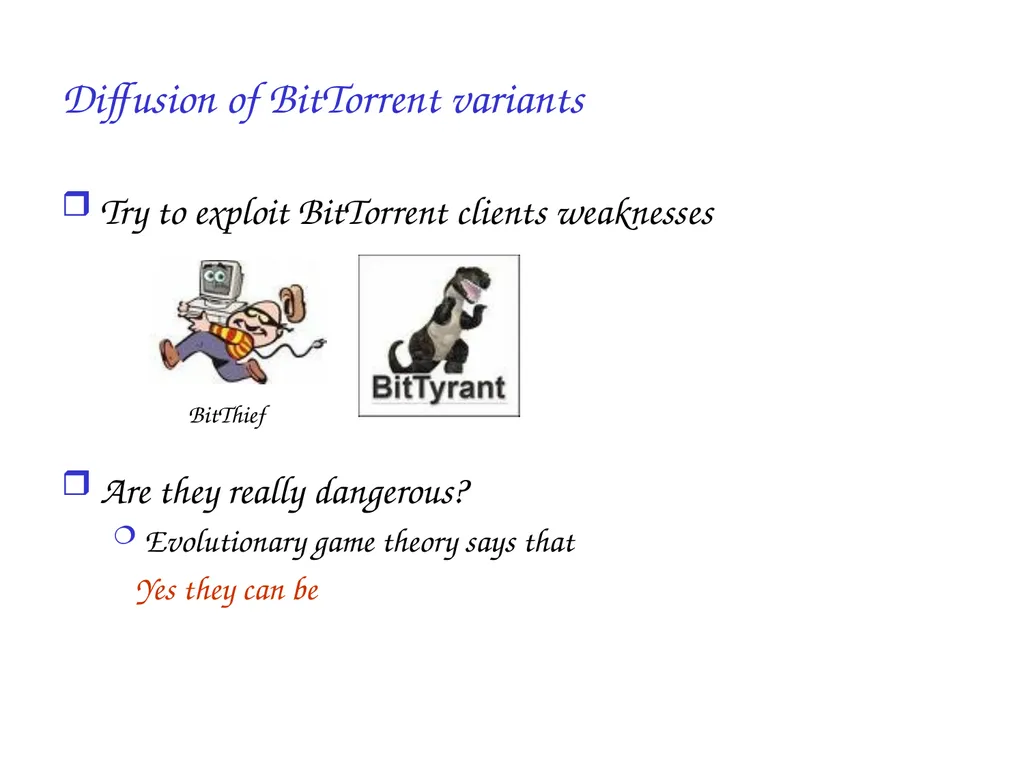
slide13. Diffusion of BitTorrent variants Try to exploit BitTorrent clients weaknesses
Are they really dangerous?
Evolutionary game theory says that
Yes they can be BitThief<br>
slide14. Space for GT in Networks User behaviors (to share or not to share)
Client variants
Protocols do not specify everything…
power level to use
number of connections to open
…and/or are not easy to enforce
how control a P2P network
not-compliant WiFi implementation
…and software easy to modify<br>
slide15. Limitations of Game Theory Real-world conflicts are complex
models can at best capture important aspects
Players are considered rational
determine what is best for them given that others are doing the same
Men are not, but computers are more
No unique prescription
not clear what players should do But it can provide intuitions, suggestions and partial prescriptions
the best mathematical tool we have<br>
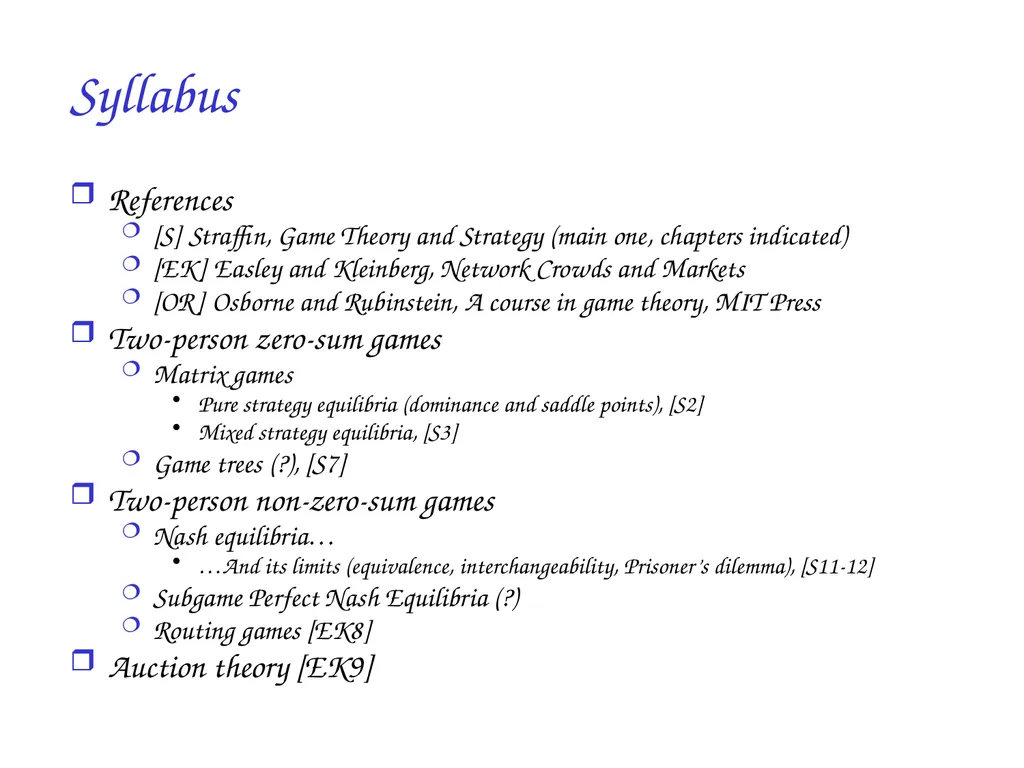
slide16. Syllabus References
[S] Straffin, Game Theory and Strategy (main one, chapters indicated)
[EK] Easley and Kleinberg, Network Crowds and Markets
[OR] Osborne and Rubinstein, A course in game theory, MIT Press
Two-person zero-sum games
Matrix games
Pure strategy equilibria (dominance and saddle points), [S2]
Mixed strategy equilibria, [S3]
Game trees (?), [S7]
Two-person non-zero-sum games
Nash equilibria…
…And its limits (equivalence, interchangeability, Prisoner’s dilemma), [S11-12]
Subgame Perfect Nash Equilibria (?)
Routing games [EK8]
Auction theory [EK9]<br>
slide17. Game Theory: introduction
and applications to computer networks Two-person zero-sum games
Giovanni Neglia
INRIA – EPI Maestro
Slides are based on a previous course
with D. Figueiredo (UFRJ) and H. Zhang (Suffolk University)<br>
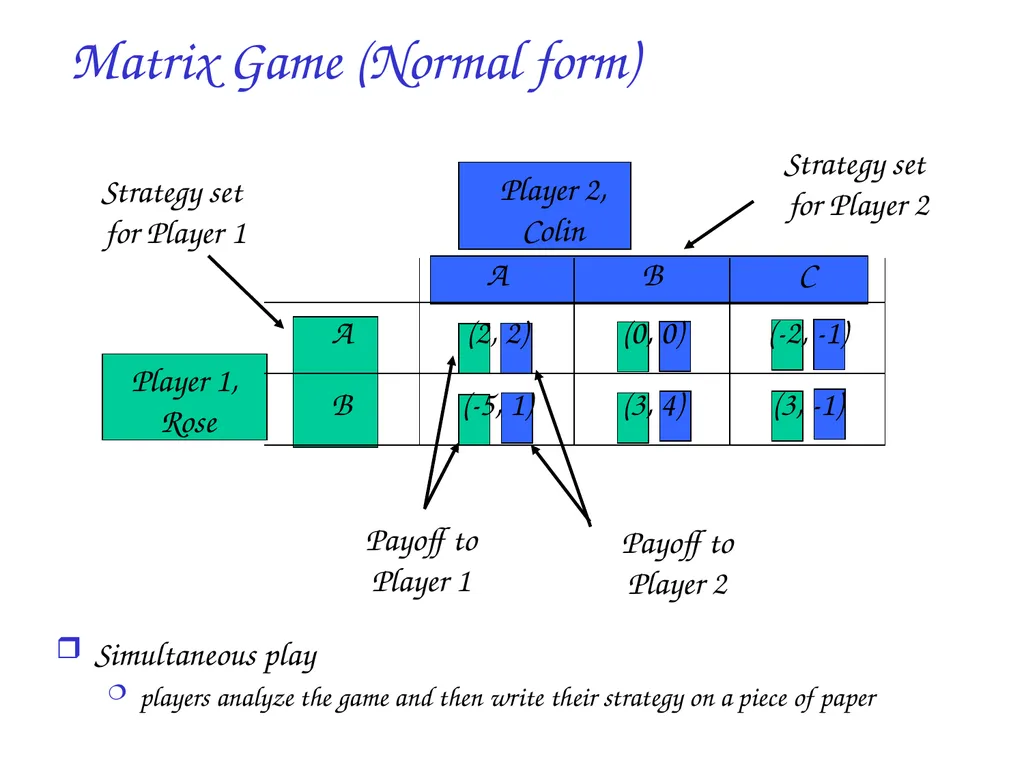
slide18. Matrix Game (Normal form) Simultaneous play
players analyze the game and then write their strategy on a piece of paper Player 1,
Rose Player 2,
Colin Strategy set
for Player 1 Strategy set
for Player 2 Payoff to
Player 1 Payoff to
Player 2<br>
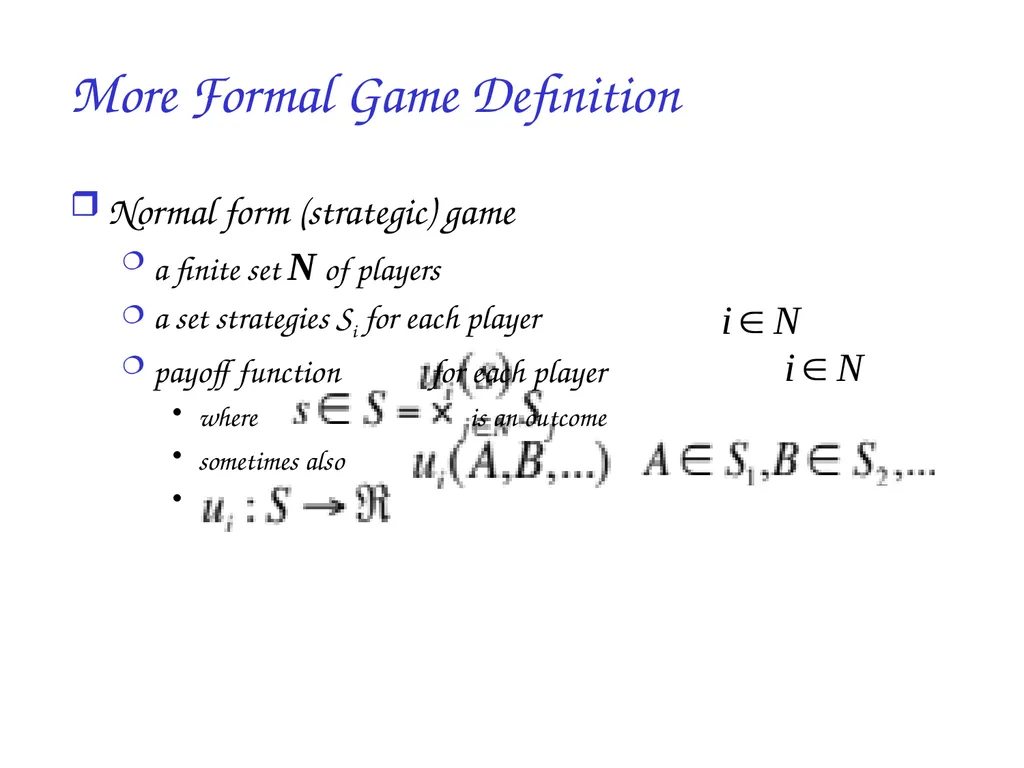
slide19. More Formal Game Definition Normal form (strategic) game
a finite set N of players
a set strategies Si for each player
payoff function for each player
where is an outcome
sometimes also<br>
slide20. Two-person Zero-sum Games One of the first games studied
most well understood type of game
Players interest are strictly opposed
what one player gains the other loses
game matrix has single entry (gain to player 1)
A “strong” solution concept<br>
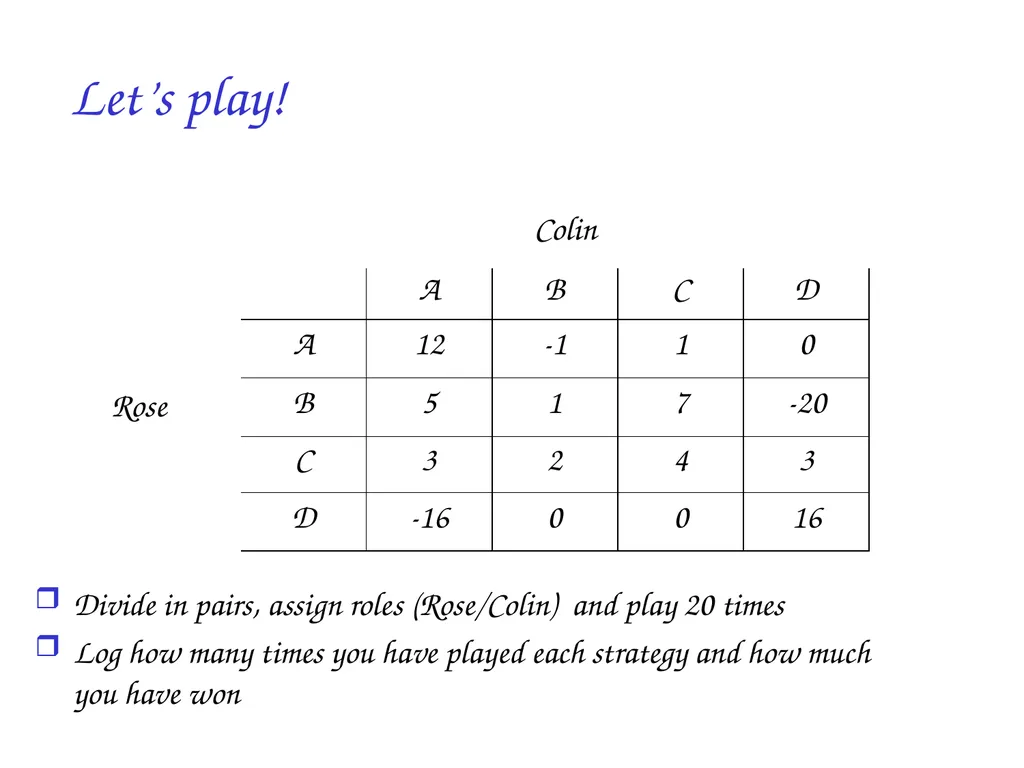
slide21. Let’s play! Divide in pairs, assign roles (Rose/Colin) and play 20 times
Log how many times you have played each strategy and how much you have won Rose Colin<br>
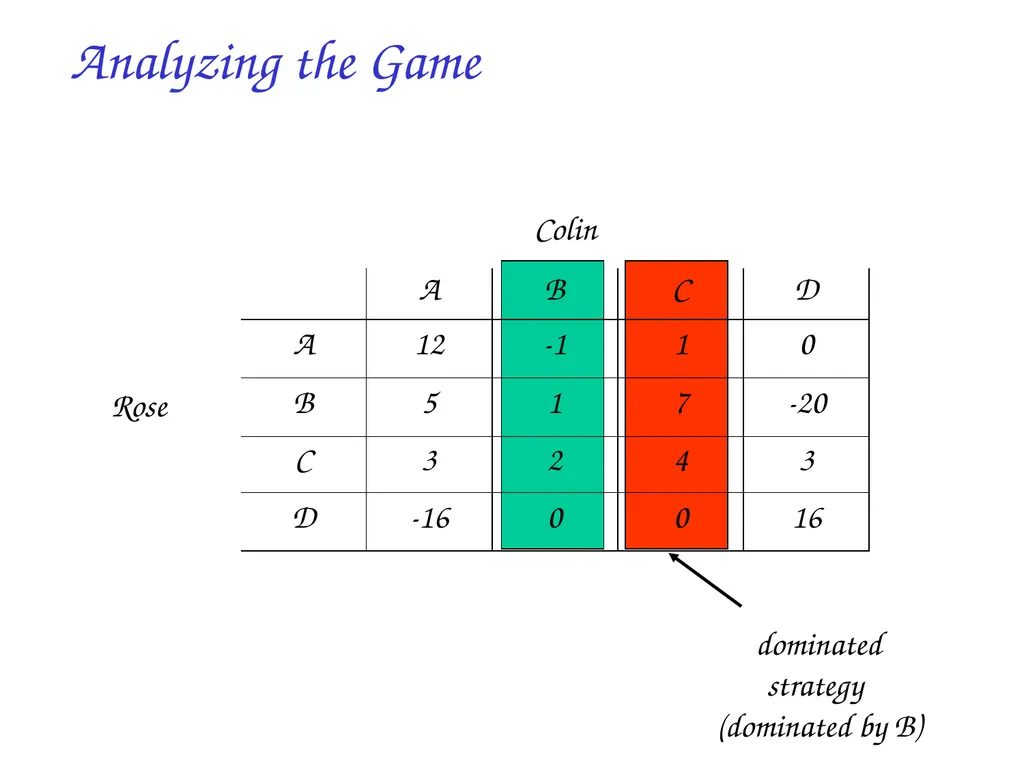
slide22. Analyzing the Game Rose Colin dominated
strategy
(dominated by B)<br>
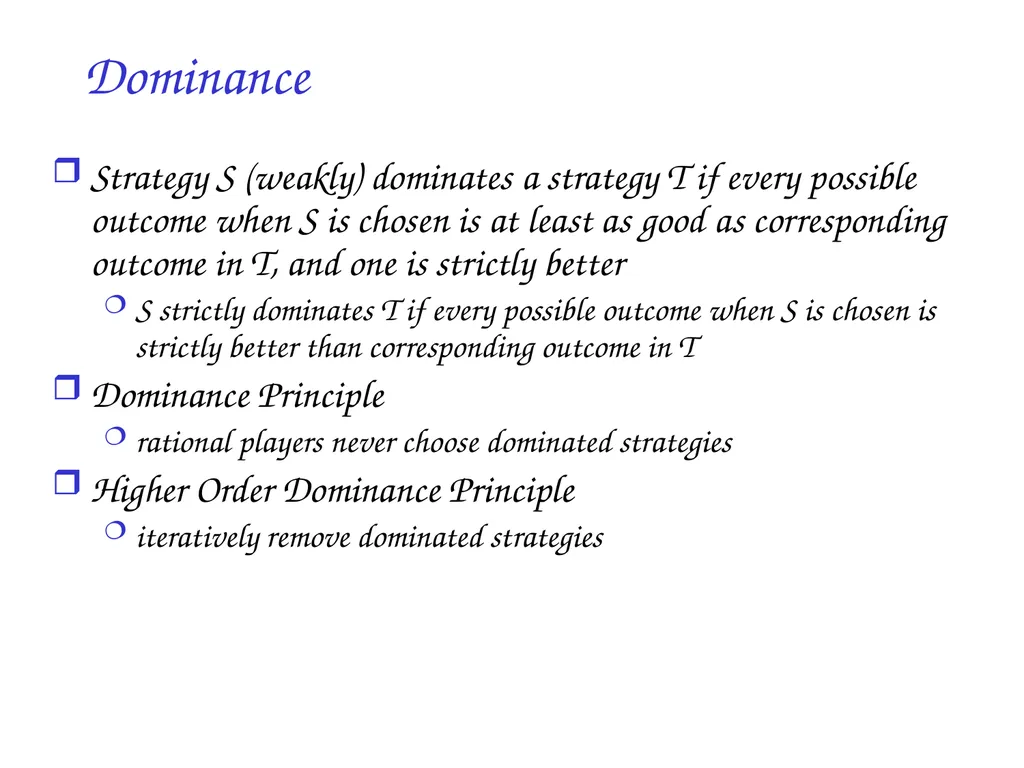
slide23. Dominance Strategy S (weakly) dominates a strategy T if every possible outcome when S is chosen is at least as good as corresponding outcome in T, and one is strictly better
S strictly dominates T if every possible outcome when S is chosen is strictly better than corresponding outcome in T
Dominance Principle
rational players never choose dominated strategies
Higher Order Dominance Principle
iteratively remove dominated strategies<br>
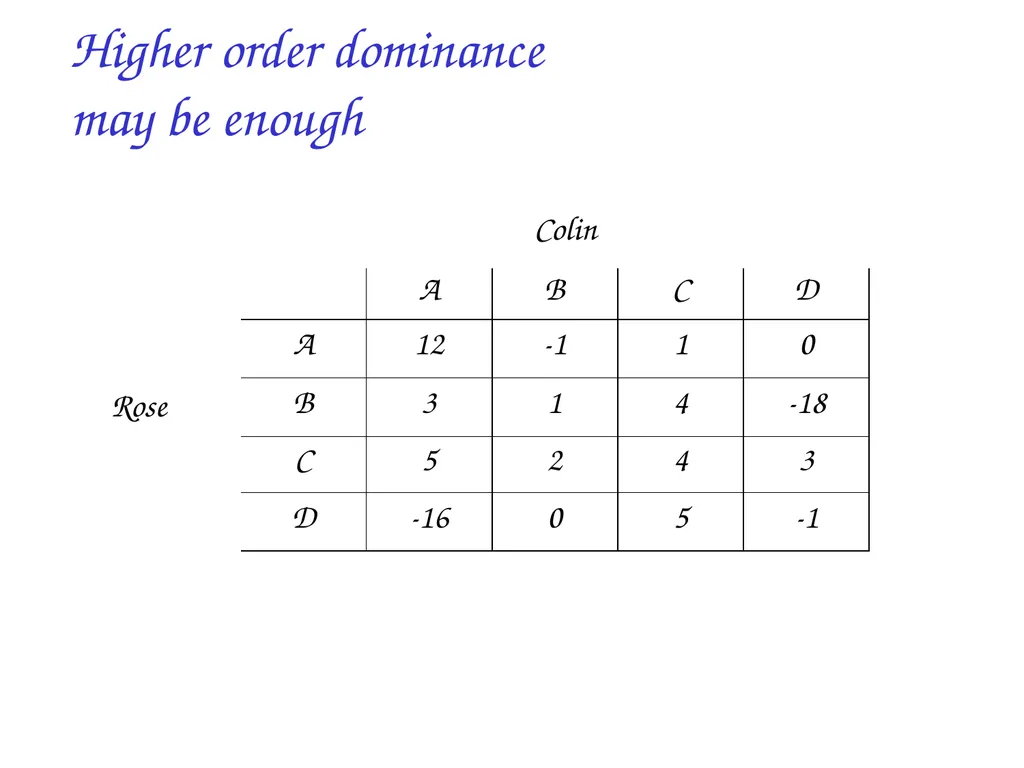
slide24. Higher order dominance may be enough Rose Colin<br>
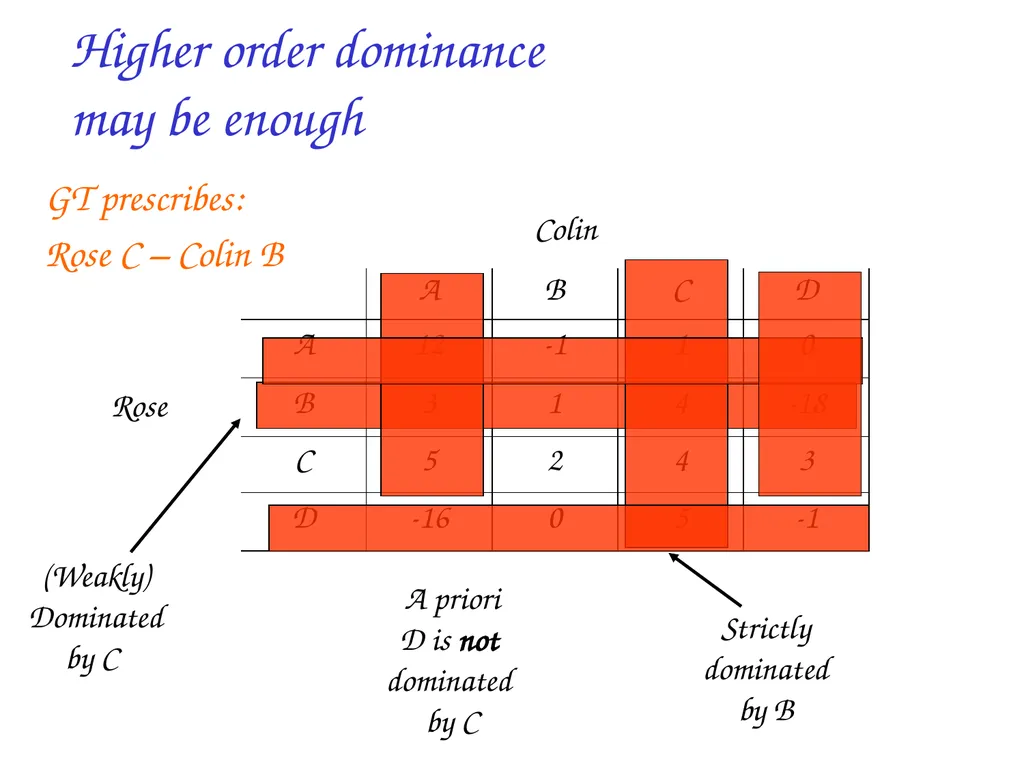
slide25. Higher order dominance may be enough Rose Colin (Weakly)
Dominated
by C Strictly
dominated
by B GT prescribes:
Rose C – Colin B A priori
D is not
dominated
by C<br>
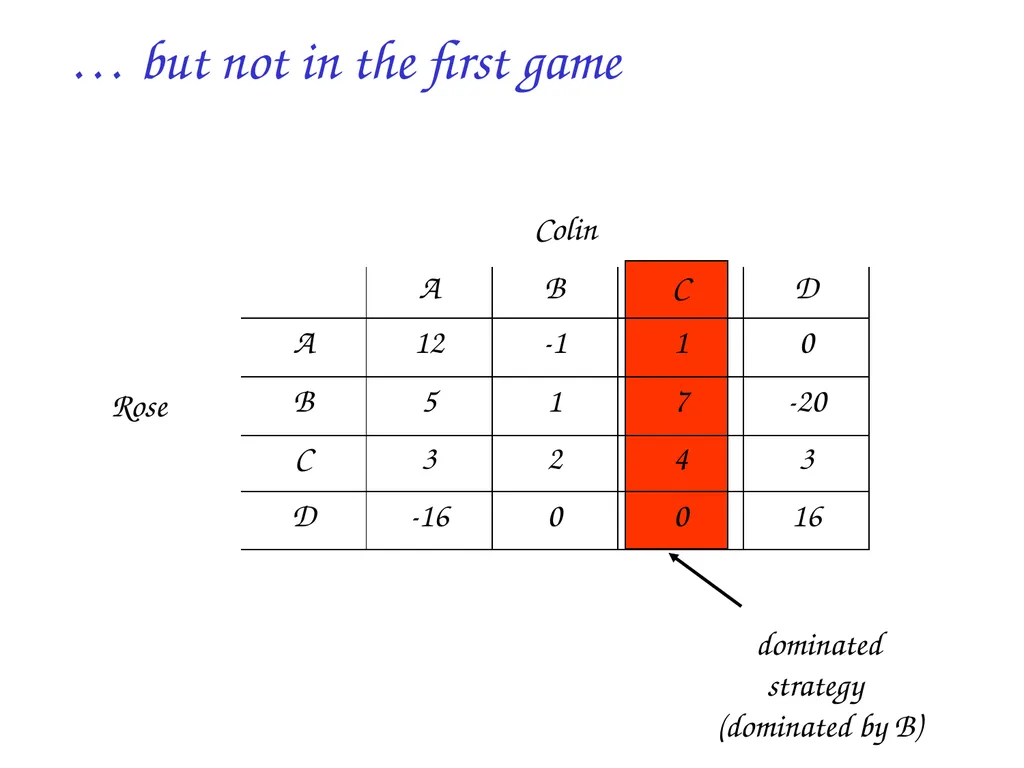
slide26. … but not in the first game Rose Colin dominated
strategy
(dominated by B)<br>
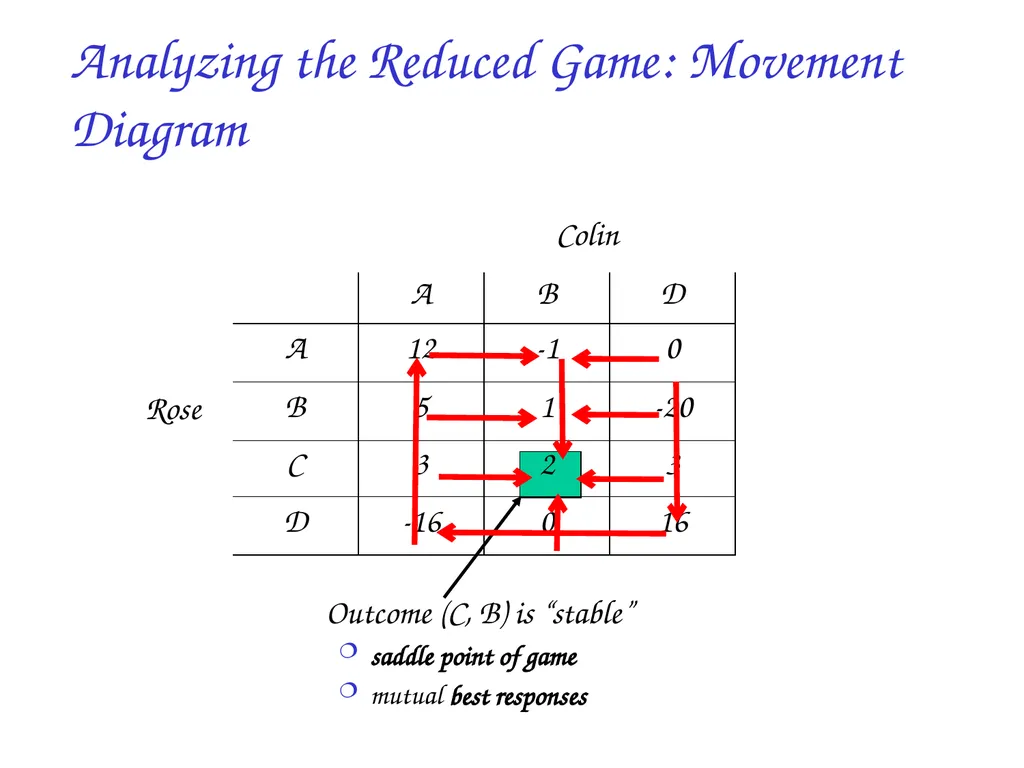
slide27. Analyzing the Reduced Game: Movement Diagram Rose Colin Outcome (C, B) is “stable”
saddle point of game
mutual best responses<br>
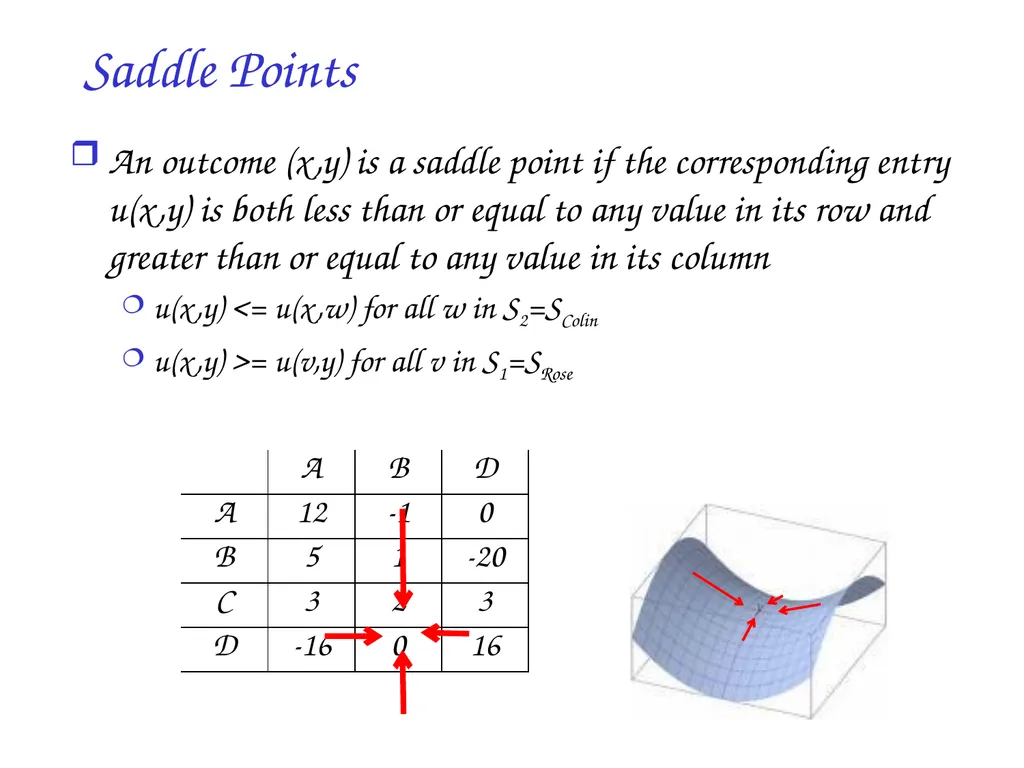
slide28. Saddle Points An outcome (x,y) is a saddle point if the corresponding entry u(x,y) is both less than or equal to any value in its row and greater than or equal to any value in its column
u(x,y) <= u(x,w) for all w in S2=SColin
u(x,y) >= u(v,y) for all v in S1=SRose<br>
slide29. Saddle Points Principle Players should choose outcomes that are saddle points of the game
Because it is an equilibrium…
… but not only<br>

and applications to computer networks Introduction
Giovanni Neglia
INRIA – EPI Maestro
9 January 2013
Part of the slides are based on a previous course
with D. Figueiredo (UFRJ) and H. Zhang (Suffolk University)<br>
slide2. What is Game Theory About? Mathematical/Logical analysis of situations of conflict and cooperation Goal: to prescribe how rational players should act Game of Chicken
driver who steers away looses
what should drivers do?<br>
slide3. What is a Game? A Game consists of
at least two players
a set of strategies for each player
a preference relation over possible outcomes Player is general entity
individual, company, nation, protocol, animal, etc
Strategies
actions which a player chooses to follow
Outcome
determined by mutual choice of strategies
Preference relation
modeled as utility (payoff) over set of outcomes<br>
slide4. Short history of GT Forerunners:
Waldegrave’s first minimax mixed strategy solution to a 2-person game (1713), Cournot’s duopoly (1838), Zermelo’s theorem on chess (1913), Borel’s minimax solution for 2-person games with 3 or 5 strategies (20s)
1928: von Neumann’s theorem on two-person zero-sum games
1944: von Neumann and Morgenstern, Theory of Games and Economic Behaviour
1950-53: Nash’s contributions (Nash equilibrium, bargaining theory)
1952-53: Shapley and Gillies’ core (basic concept in cooperative GT)
60s: Aumann’s extends cooperative GT to non-transferable utility games
1967-68: Harsanyi’s theory of games of incomplete information
1972: Maynard Smith’s concept of an Evolutionarily Stable Strategy
Nobel prizes in economics
1994 to Nash, Harsanyi and Selten for “their pioneering analysis of equilibria in the theory of non-cooperative games”
2005 to Aumann and Schelling “for having enhanced our understanding of conflict and cooperation through game-theory analysis”
2012 to Roth and Shapley “for the theory of stable allocations and the practice of market design”
Movies:
2001 “A beautiful mind” on John Nash’s life
See also:
www.econ.canterbury.ac.nz/personal_pages/paul_walker/gt/hist.htm<br>
slide5. Applications of Game Theory Economy
Politics (vote, coalitions)
Biology (Darwin’s principle, evolutionary GT)
Anthropology
War
Management-labor arbitration
Philosophy (morality and free will)
National Football league draft<br>
slide6. Applications of Game Theory “Recently” applied to computer networks
Nagle, RFC 970, 1985
“datagram networks as a multi-player game”
wider interest starting around 2000
Which are the strategies available?
Network elements follow protocol!!!<br>
slide7. Power games<br>
slide8. Medium Access Control Games<br>
slide9. Medium Access Control Games Despite of the Wi-Fi certification, several cards exhibit very heterogeneous performance, due to arbitrary protocol implementations
“Experimental Assessment of the Backoff Behavior of Commercial IEEE 802.11b Network Cards,” G Bianchi et al, INFOCOM 2007<br>
slide10. Routing games Possible in the Internet (see later) 1 2 ? Traffic Delay<br>
slide11. Free riders in P2P networks Individuals not willing to pay the cost of a public good, they hope that someone else will bear the cost instead
Few servers become the hot spots: Anonymous?, Copyright?, Privacy? Scalability?, Is it P2P?<br>
slide12. Connection games in P2P Each peer may open multiple TCP connections to increase its downloading rate<br>
slide13. Diffusion of BitTorrent variants Try to exploit BitTorrent clients weaknesses
Are they really dangerous?
Evolutionary game theory says that
Yes they can be BitThief<br>
slide14. Space for GT in Networks User behaviors (to share or not to share)
Client variants
Protocols do not specify everything…
power level to use
number of connections to open
…and/or are not easy to enforce
how control a P2P network
not-compliant WiFi implementation
…and software easy to modify<br>
slide15. Limitations of Game Theory Real-world conflicts are complex
models can at best capture important aspects
Players are considered rational
determine what is best for them given that others are doing the same
Men are not, but computers are more
No unique prescription
not clear what players should do But it can provide intuitions, suggestions and partial prescriptions
the best mathematical tool we have<br>
slide16. Syllabus References
[S] Straffin, Game Theory and Strategy (main one, chapters indicated)
[EK] Easley and Kleinberg, Network Crowds and Markets
[OR] Osborne and Rubinstein, A course in game theory, MIT Press
Two-person zero-sum games
Matrix games
Pure strategy equilibria (dominance and saddle points), [S2]
Mixed strategy equilibria, [S3]
Game trees (?), [S7]
Two-person non-zero-sum games
Nash equilibria…
…And its limits (equivalence, interchangeability, Prisoner’s dilemma), [S11-12]
Subgame Perfect Nash Equilibria (?)
Routing games [EK8]
Auction theory [EK9]<br>
slide17. Game Theory: introduction
and applications to computer networks Two-person zero-sum games
Giovanni Neglia
INRIA – EPI Maestro
Slides are based on a previous course
with D. Figueiredo (UFRJ) and H. Zhang (Suffolk University)<br>
slide18. Matrix Game (Normal form) Simultaneous play
players analyze the game and then write their strategy on a piece of paper Player 1,
Rose Player 2,
Colin Strategy set
for Player 1 Strategy set
for Player 2 Payoff to
Player 1 Payoff to
Player 2<br>
slide19. More Formal Game Definition Normal form (strategic) game
a finite set N of players
a set strategies Si for each player
payoff function for each player
where is an outcome
sometimes also<br>
slide20. Two-person Zero-sum Games One of the first games studied
most well understood type of game
Players interest are strictly opposed
what one player gains the other loses
game matrix has single entry (gain to player 1)
A “strong” solution concept<br>
slide21. Let’s play! Divide in pairs, assign roles (Rose/Colin) and play 20 times
Log how many times you have played each strategy and how much you have won Rose Colin<br>
slide22. Analyzing the Game Rose Colin dominated
strategy
(dominated by B)<br>
slide23. Dominance Strategy S (weakly) dominates a strategy T if every possible outcome when S is chosen is at least as good as corresponding outcome in T, and one is strictly better
S strictly dominates T if every possible outcome when S is chosen is strictly better than corresponding outcome in T
Dominance Principle
rational players never choose dominated strategies
Higher Order Dominance Principle
iteratively remove dominated strategies<br>
slide24. Higher order dominance may be enough Rose Colin<br>
slide25. Higher order dominance may be enough Rose Colin (Weakly)
Dominated
by C Strictly
dominated
by B GT prescribes:
Rose C – Colin B A priori
D is not
dominated
by C<br>
slide26. … but not in the first game Rose Colin dominated
strategy
(dominated by B)<br>
slide27. Analyzing the Reduced Game: Movement Diagram Rose Colin Outcome (C, B) is “stable”
saddle point of game
mutual best responses<br>
slide28. Saddle Points An outcome (x,y) is a saddle point if the corresponding entry u(x,y) is both less than or equal to any value in its row and greater than or equal to any value in its column
u(x,y) <= u(x,w) for all w in S2=SColin
u(x,y) >= u(v,y) for all v in S1=SRose<br>
slide29. Saddle Points Principle Players should choose outcomes that are saddle points of the game
Because it is an equilibrium…
… but not only<br>