
GENERAL INFORMATION ABOUT POLAND BUSINESS IN
TG
Published · 19 slides · 0 views

1 / 1

Description
GENERAL INFORMATION ABOUT POLAND BUSINESS IN POLAND Project Welcome to the business land, LT-PL-2S-190 FACTS ABOUT poland Area: 312 679 sq. km. Neighbors: Germany (land border 467 km) Czech Republic (border 796 km) Slovakia (border
Related Topics
Share
Embed code
Download this presentation From Below
"GENERAL INFORMATION ABOUT POLAND BUSINESS IN" is the property of its rightful owner. Permission is granted to download and print the materials on this website for personal, non-commercial use only, and to display it on your personal computer provided you do not modify the materials and that you retain all copyright notices contained in the materials. By downloading content from our website, you accept the terms of this agreement.
Presentation Transcript
01
GENERAL INFORMATION ABOUT POLAND BUSINESS IN POLAND Project “Welcome to the business land“,
LT-PL-2S-190<br>
LT-PL-2S-190<br>
02
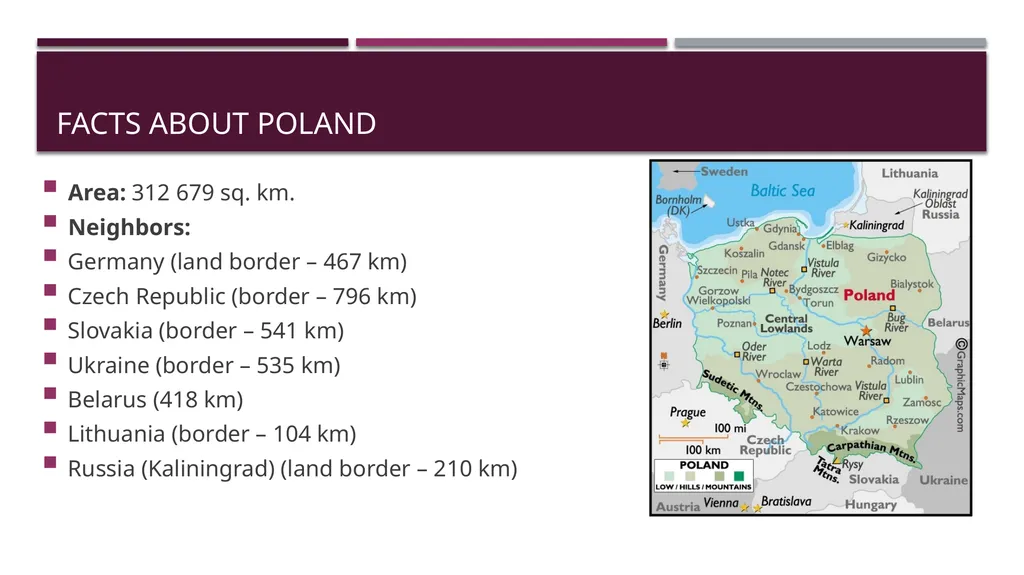
FACTS ABOUT poland Area: 312 679 sq. km.
Neighbors:
Germany (land border – 467 km)
Czech Republic (border – 796 km)
Slovakia (border – 541 km)
Ukraine (border – 535 km)
Belarus (418 km)
Lithuania (border – 104 km)
Russia (Kaliningrad) (land border – 210 km)<br>
Neighbors:
Germany (land border – 467 km)
Czech Republic (border – 796 km)
Slovakia (border – 541 km)
Ukraine (border – 535 km)
Belarus (418 km)
Lithuania (border – 104 km)
Russia (Kaliningrad) (land border – 210 km)<br>
03
Facts about lithuania Language: Official language– Polish
Religion: Poland is considered to be very religious country: majority 87.58% consider themselves Roman Catholic.
Currency: Polish złoty (PLN)
Political system: Poland is a representative democracy, with a president as a head of state, whose current constitution dates from 1997. Poland ranks in the top 20 percent of the most peaceful countries in the world, according to the Global Peace Index. The government structure centers on the Council of Ministers, led by a prime minister. The president appoints the cabinet according to the proposals of the prime minister, typically from the majority coalition in the Sejm. The president is elected by popular vote every five years.<br>
Religion: Poland is considered to be very religious country: majority 87.58% consider themselves Roman Catholic.
Currency: Polish złoty (PLN)
Political system: Poland is a representative democracy, with a president as a head of state, whose current constitution dates from 1997. Poland ranks in the top 20 percent of the most peaceful countries in the world, according to the Global Peace Index. The government structure centers on the Council of Ministers, led by a prime minister. The president appoints the cabinet according to the proposals of the prime minister, typically from the majority coalition in the Sejm. The president is elected by popular vote every five years.<br>
04
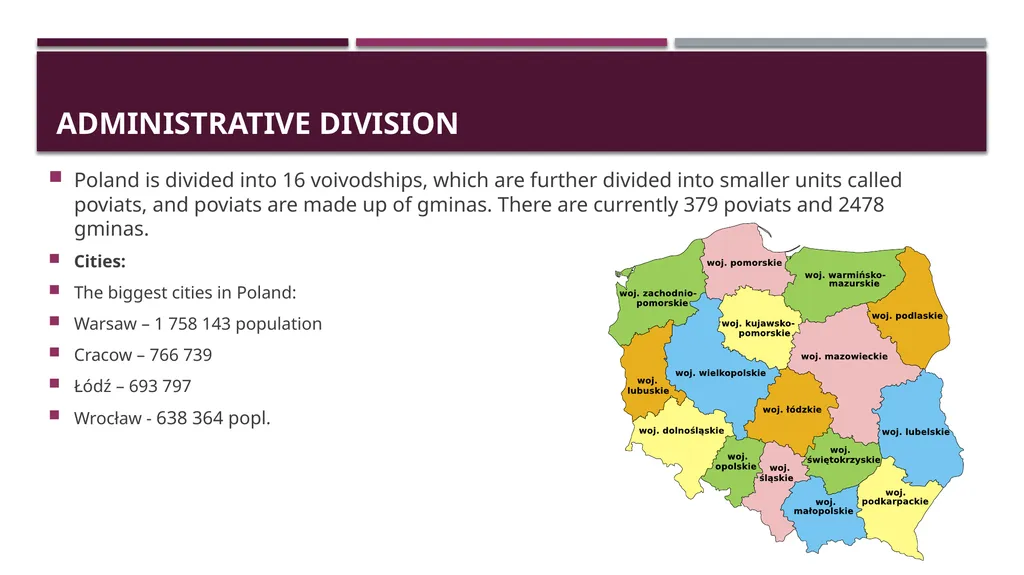
Administrative division Poland is divided into 16 voivodships, which are further divided into smaller units called poviats, and poviats are made up of gminas. There are currently 379 poviats and 2478 gminas.
Cities:
The biggest cities in Poland:
Warsaw – 1 758 143 population
Cracow – 766 739
Łódź – 693 797
Wrocław - 638 364 popl.<br>
Cities:
The biggest cities in Poland:
Warsaw – 1 758 143 population
Cracow – 766 739
Łódź – 693 797
Wrocław - 638 364 popl.<br>
05
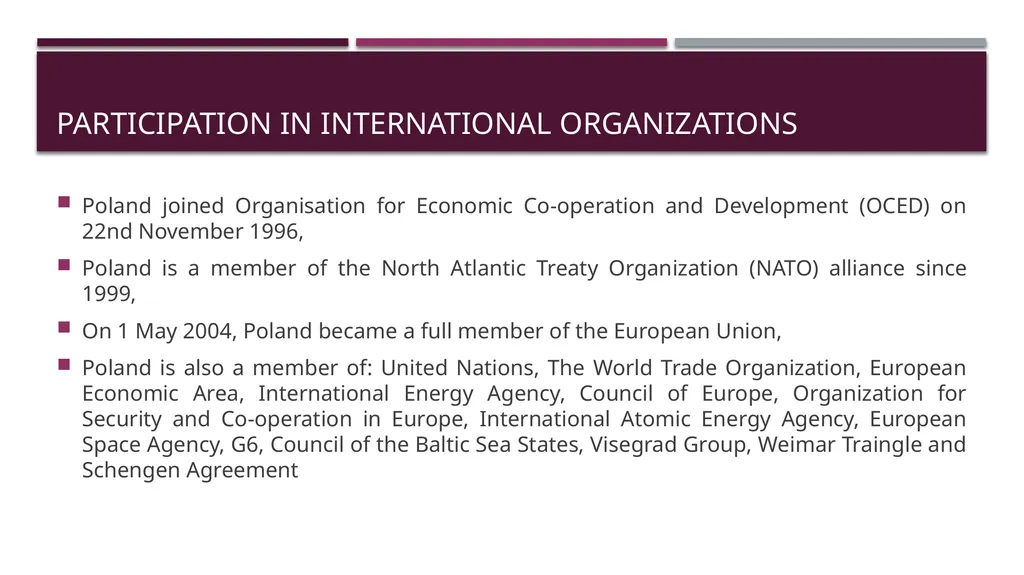
Participation in international organizations Poland joined Organisation for Economic Co-operation and Development (OCED) on 22nd November 1996,
Poland is a member of the North Atlantic Treaty Organization (NATO) alliance since 1999,
On 1 May 2004, Poland became a full member of the European Union,
Poland is also a member of: United Nations, The World Trade Organization, European Economic Area, International Energy Agency, Council of Europe, Organization for Security and Co-operation in Europe, International Atomic Energy Agency, European Space Agency, G6, Council of the Baltic Sea States, Visegrad Group, Weimar Traingle and Schengen Agreement<br>
Poland is a member of the North Atlantic Treaty Organization (NATO) alliance since 1999,
On 1 May 2004, Poland became a full member of the European Union,
Poland is also a member of: United Nations, The World Trade Organization, European Economic Area, International Energy Agency, Council of Europe, Organization for Security and Co-operation in Europe, International Atomic Energy Agency, European Space Agency, G6, Council of the Baltic Sea States, Visegrad Group, Weimar Traingle and Schengen Agreement<br>
06
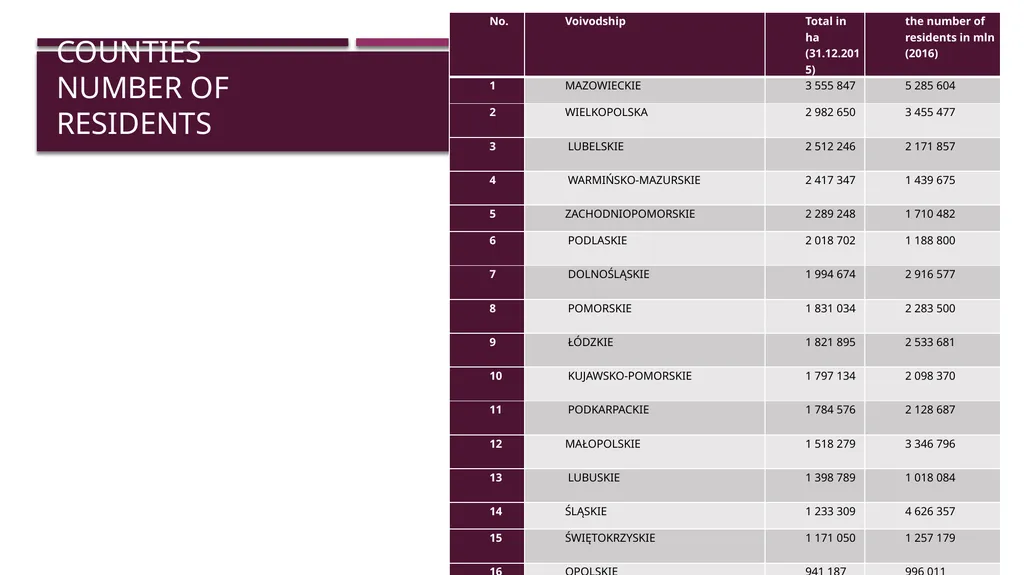
counties
number of residents<br>
07
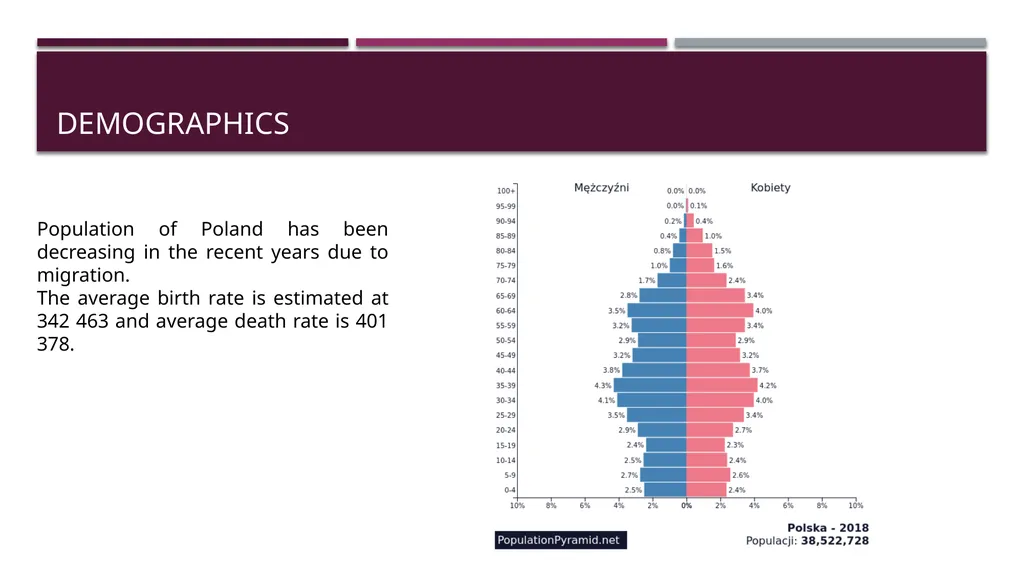
demographics Population of Poland has been decreasing in the recent years due to migration.
The average birth rate is estimated at 342 463 and average death rate is 401 378.<br>
08
International immigration of residents High level of emigration for temporary stay after 2004 (when Poland joined EU) to European Union countries (UK, Germany, Ireland, Netherlands, Italy):
mostly young people
repeated, circular migration<br>
mostly young people
repeated, circular migration<br>
09
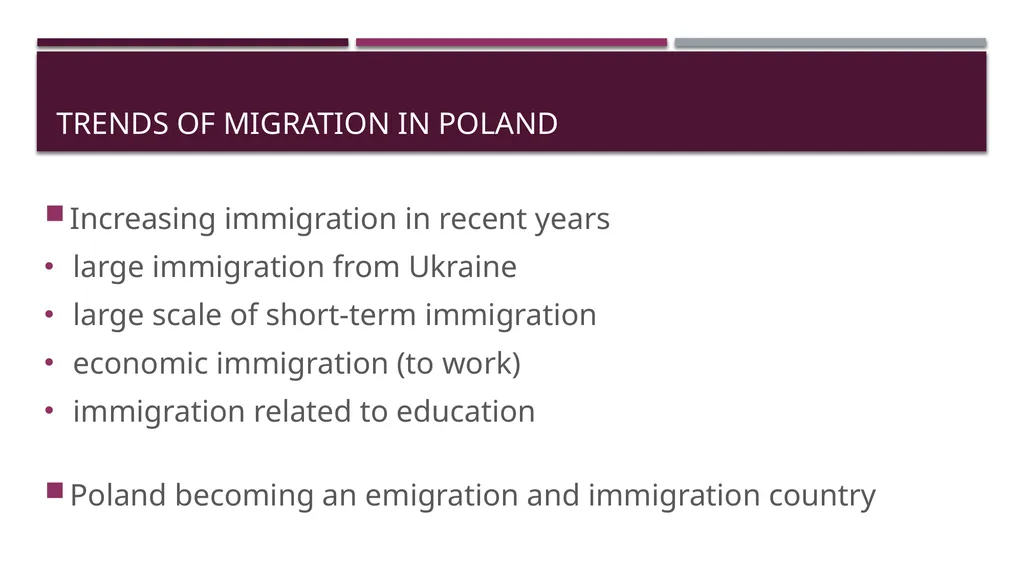
Trends of migration in poland Increasing immigration in recent years
large immigration from Ukraine
large scale of short-term immigration
economic immigration (to work)
immigration related to education
Poland becoming an emigration and immigration country<br>
large immigration from Ukraine
large scale of short-term immigration
economic immigration (to work)
immigration related to education
Poland becoming an emigration and immigration country<br>
10
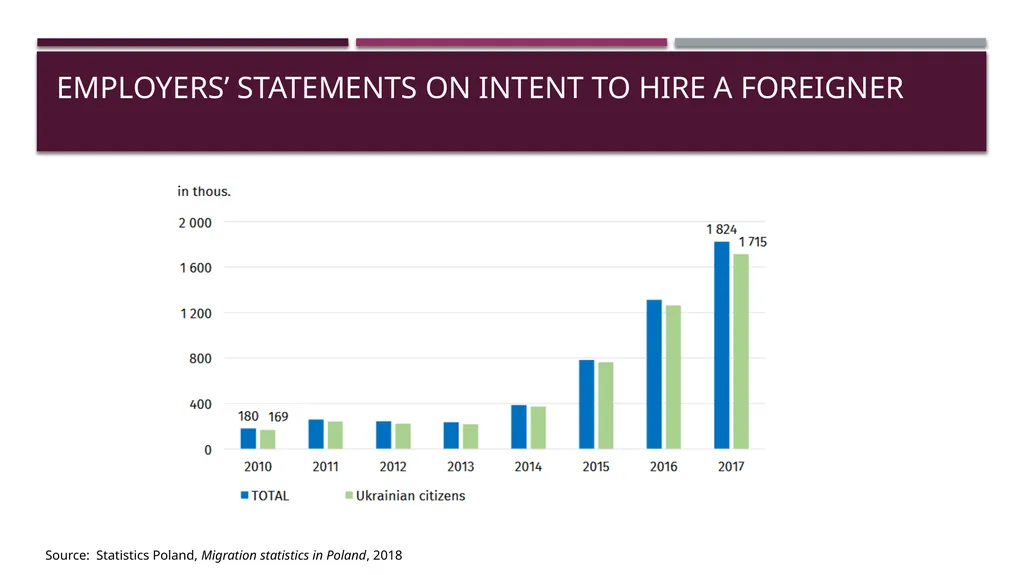
Employers’ statements on intent to hire a foreigner Source: Statistics Poland, Migration statistics in Poland, 2018<br>
11
Accessibility - Infrastructure Poland has a convenient location – it is located in the center of Europe, at the intersection of main communication routes – it is like a bridge between Western and Eastern Europe. This is a great advantage for potential investors – they have an easy access not only to the Polish internal market (approximately 38 million people) but also to the markets in other European countries (over 0.5 billion people).
Another advantage are benefits which come from participation of Poland in different global organizations like the European Union, United Nations or NATO. Poland is therefore potentially politically stable and has a significant position on the international arena.
From an economic point of view Poland is also trustworthy, the economy was not as affected by the global crisis as the economies of other European countries, but has additionally strengthened its position in the CEE and Europeas a wholeduring the crisis.<br>
Another advantage are benefits which come from participation of Poland in different global organizations like the European Union, United Nations or NATO. Poland is therefore potentially politically stable and has a significant position on the international arena.
From an economic point of view Poland is also trustworthy, the economy was not as affected by the global crisis as the economies of other European countries, but has additionally strengthened its position in the CEE and Europeas a wholeduring the crisis.<br>
12
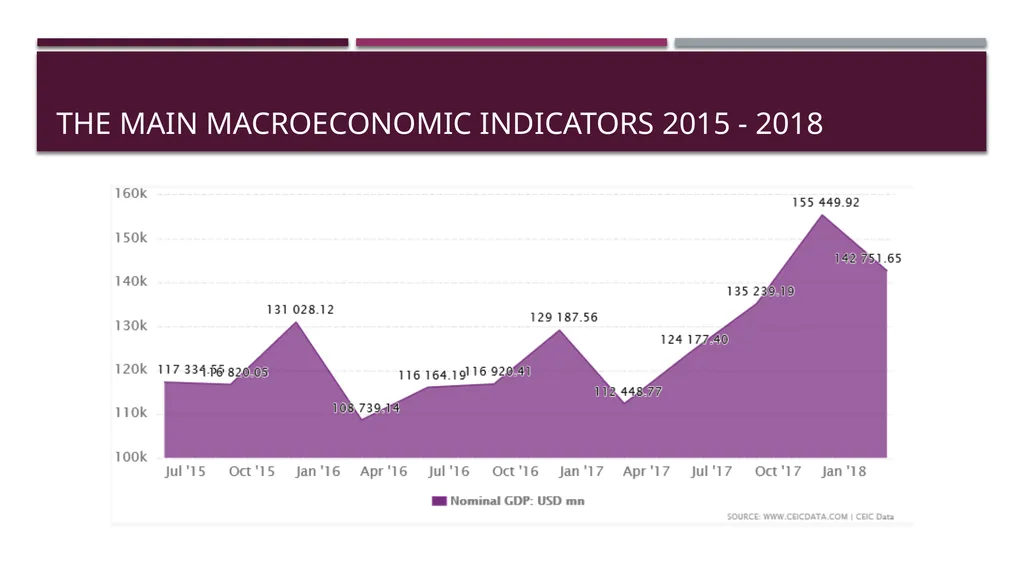
The main macroeconomic indicators 2015 - 2018 Poland's Nominal GDP reached 142.8 USD bn in Mar 2018, compared with 155.4 USD bn in the previous quarter. Nominal GDP in Poland is updated quarterly, available from Mar 1995 to Mar 2018, with an average number of 85.2 USD bn. The data reached an all-time high of 155.4 USD bn in Dec 2017 and a record low of 31.4 USD bn in Mar 1995. CEIC converts quarterly Nominal GDP into USD. Central Statistical Office provides Nominal GDP in local currency based on ESA 2010. The National Bank of Poland average market exchange rate is used for currency conversions. Nominal GDP prior to Q1 2002 is based on ESA 1995.
In the latest reports, Poland's GDP expanded 5.0 % YoY in Mar 2018. Its GDP deflator (implicit price deflator) increased 1.1 % in Mar 2018. Poland's GDP Per Capita reached 13,645.5 USD in Dec 2017. Its Gross Savings Rate was measured at 18.6 % in Mar 2018.<br>
In the latest reports, Poland's GDP expanded 5.0 % YoY in Mar 2018. Its GDP deflator (implicit price deflator) increased 1.1 % in Mar 2018. Poland's GDP Per Capita reached 13,645.5 USD in Dec 2017. Its Gross Savings Rate was measured at 18.6 % in Mar 2018.<br>
13
The main macroeconomic indicators 2015 - 2018<br>
14
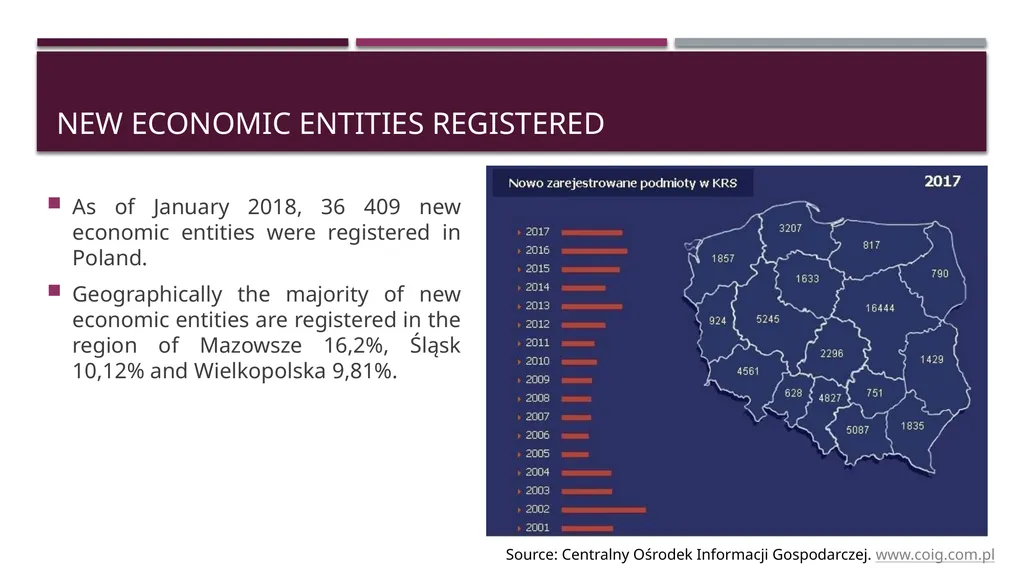
New economic entities registered As of January 2018, 36 409 new economic entities were registered in Poland.
Geographically the majority of new economic entities are registered in the region of Mazowsze 16,2%, Śląsk 10,12% and Wielkopolska 9,81%. Source: Centralny Ośrodek Informacji Gospodarczej. www.coig.com.pl<br>
Geographically the majority of new economic entities are registered in the region of Mazowsze 16,2%, Śląsk 10,12% and Wielkopolska 9,81%. Source: Centralny Ośrodek Informacji Gospodarczej. www.coig.com.pl<br>
15
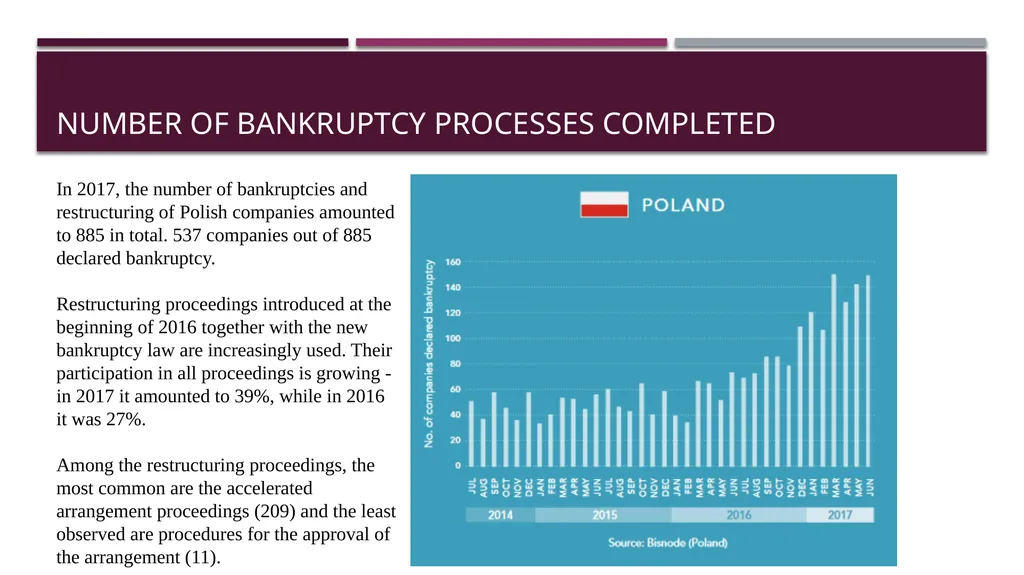
Number of bankruptcy processes completed In 2017, the number of bankruptcies and restructuring of Polish companies amounted to 885 in total. 537 companies out of 885 declared bankruptcy.
Restructuring proceedings introduced at the beginning of 2016 together with the new bankruptcy law are increasingly used. Their participation in all proceedings is growing - in 2017 it amounted to 39%, while in 2016 it was 27%.
Among the restructuring proceedings, the most common are the accelerated arrangement proceedings (209) and the least observed are procedures for the approval of the arrangement (11).<br>
Restructuring proceedings introduced at the beginning of 2016 together with the new bankruptcy law are increasingly used. Their participation in all proceedings is growing - in 2017 it amounted to 39%, while in 2016 it was 27%.
Among the restructuring proceedings, the most common are the accelerated arrangement proceedings (209) and the least observed are procedures for the approval of the arrangement (11).<br>
16
Attractive sectors Information and communication technology sector is one of the highly prioritised and most promising sectors in Lithuania. Over 31,500 IT professionals in Lithuania are working in this sector. Modern technologies (such as EDGE technology, 4G mobile communications infrastructure and mobile WiMAX 4G Internet), the fastest public Wi-Fi in Europe and the greatest fibre-optic (FFTH) Internet network penetration in Europe – all these factors make Lithuania especially attractive for offshore services.
Lithuania’s engineering industry has been constantly growing and expanding by approximately 15% every year since 2009. This industry is highly competitive in terms of cost and quality and it is well-integrated into the global supply chains. Products developed by the Lithuanian engineers are often adapted by such international companies and organisations as NASA, Boeing, U.S. Army, BMW, Volkswagen, Hitachi, Siemens and Mitsubishi.
Biotechnology research takes place in Lithuania, and the developed techniques and products are applied in the fields of medicine, pharmacy, chemistry, agriculture, environment, etc. Lithuania’s biotechnology products are recognised worldwide, as 90% of them are exported to over 100 countries. The main export markets include the USA, Japan, Israel, Germany and the United Kingdom. The sector grows on average by 25% annually.<br>
Lithuania’s engineering industry has been constantly growing and expanding by approximately 15% every year since 2009. This industry is highly competitive in terms of cost and quality and it is well-integrated into the global supply chains. Products developed by the Lithuanian engineers are often adapted by such international companies and organisations as NASA, Boeing, U.S. Army, BMW, Volkswagen, Hitachi, Siemens and Mitsubishi.
Biotechnology research takes place in Lithuania, and the developed techniques and products are applied in the fields of medicine, pharmacy, chemistry, agriculture, environment, etc. Lithuania’s biotechnology products are recognised worldwide, as 90% of them are exported to over 100 countries. The main export markets include the USA, Japan, Israel, Germany and the United Kingdom. The sector grows on average by 25% annually.<br>
17
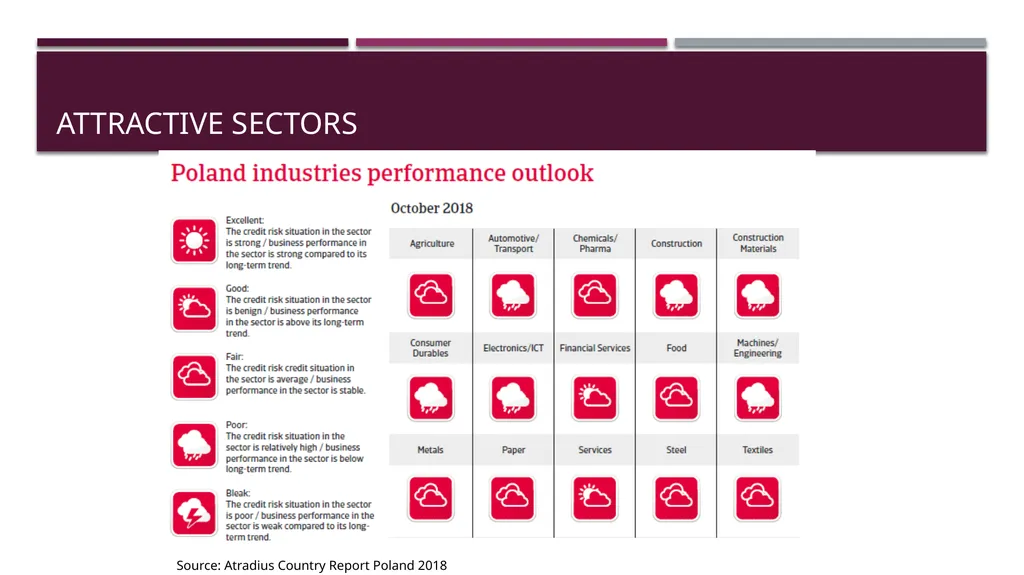
Attractive sectors Source: Atradius Country Report Poland 2018<br>
18
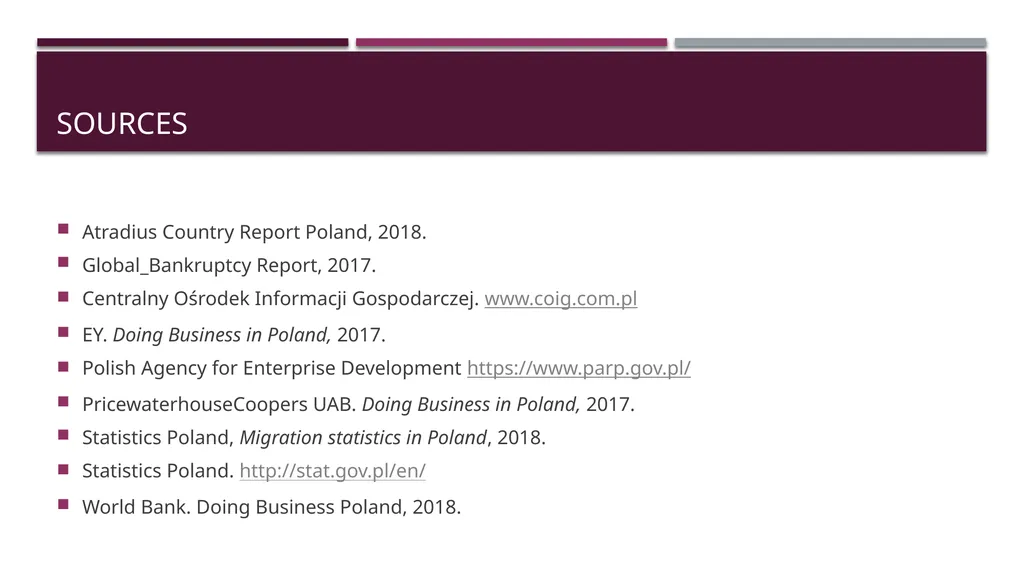
sources Atradius Country Report Poland, 2018.
Global_Bankruptcy Report, 2017.
Centralny Ośrodek Informacji Gospodarczej. www.coig.com.pl
EY. Doing Business in Poland, 2017.
Polish Agency for Enterprise Development https://www.parp.gov.pl/
PricewaterhouseCoopers UAB. Doing Business in Poland, 2017.
Statistics Poland, Migration statistics in Poland, 2018.
Statistics Poland. http://stat.gov.pl/en/
World Bank. Doing Business Poland, 2018.<br>
Global_Bankruptcy Report, 2017.
Centralny Ośrodek Informacji Gospodarczej. www.coig.com.pl
EY. Doing Business in Poland, 2017.
Polish Agency for Enterprise Development https://www.parp.gov.pl/
PricewaterhouseCoopers UAB. Doing Business in Poland, 2017.
Statistics Poland, Migration statistics in Poland, 2018.
Statistics Poland. http://stat.gov.pl/en/
World Bank. Doing Business Poland, 2018.<br>
19
About the project
The project “Welcome to the business land“ (LT-PL-2S-190) is aimed at showing the border region youth that Business can be simple, if you have a good idea, some support from professionals and general knowledge on business processes. During its implementation, it is planned to organize business leader’s competition and International Economic Forum and to activate partnership of project beneficiaries and social partners (schools, business companies, professional development centers).
This training material has been produced with the financial assistance of the European Union. The contents of this training material are the sole responsibility of PI PVC and “Euroregion Niemen” Association and can under no circumstances be regarded as reflecting the position of the European Union.
Total projects size is 49 973, 25 EUR. Out of them co-funding of European Regional Development Fund is 42 477,25 EUR. www.bonusLT-PL.eu This project is Partly financed from the European Regional Development Fund
Interreg V-A Lithuania-Poland cooperation programme<br>
The project “Welcome to the business land“ (LT-PL-2S-190) is aimed at showing the border region youth that Business can be simple, if you have a good idea, some support from professionals and general knowledge on business processes. During its implementation, it is planned to organize business leader’s competition and International Economic Forum and to activate partnership of project beneficiaries and social partners (schools, business companies, professional development centers).
This training material has been produced with the financial assistance of the European Union. The contents of this training material are the sole responsibility of PI PVC and “Euroregion Niemen” Association and can under no circumstances be regarded as reflecting the position of the European Union.
Total projects size is 49 973, 25 EUR. Out of them co-funding of European Regional Development Fund is 42 477,25 EUR. www.bonusLT-PL.eu This project is Partly financed from the European Regional Development Fund
Interreg V-A Lithuania-Poland cooperation programme<br>