General Instructions Our translation workshops are structured as follows: 1. Present students with the Image Board, play the audio recording and show the poem text in the original Ukrainian 2. Invite guesses as to what the poem is about;
"General Instructions Our translation workshops are" is the property of its rightful owner. Permission is granted to
download and print the materials on this website for personal, non-commercial use only, and to display it
on your personal computer provided you do not modify the materials and that you retain all copyright
notices contained in the materials. By downloading content from our website, you accept the terms of this
agreement.
Presentation Transcript
01
General Instructions
Our translation workshops are structured as follows:
1.
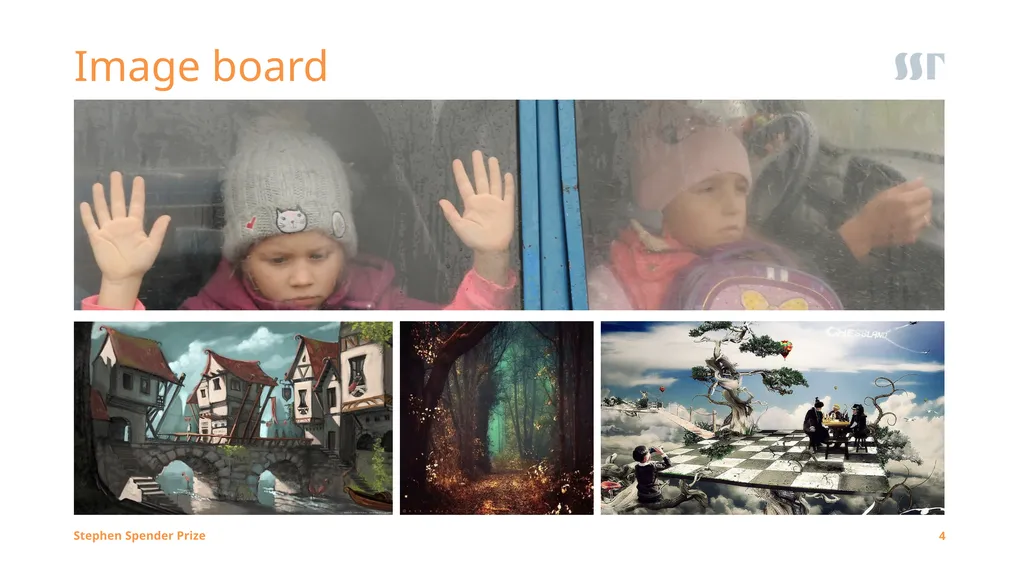
Present students with the Image Board, play the audio recording and show the poem text in the original Ukrainian
2.
Invite guesses as to what the poem is about; ask students to come up with a few words that describe their sense of what the mood of each poem is
3.
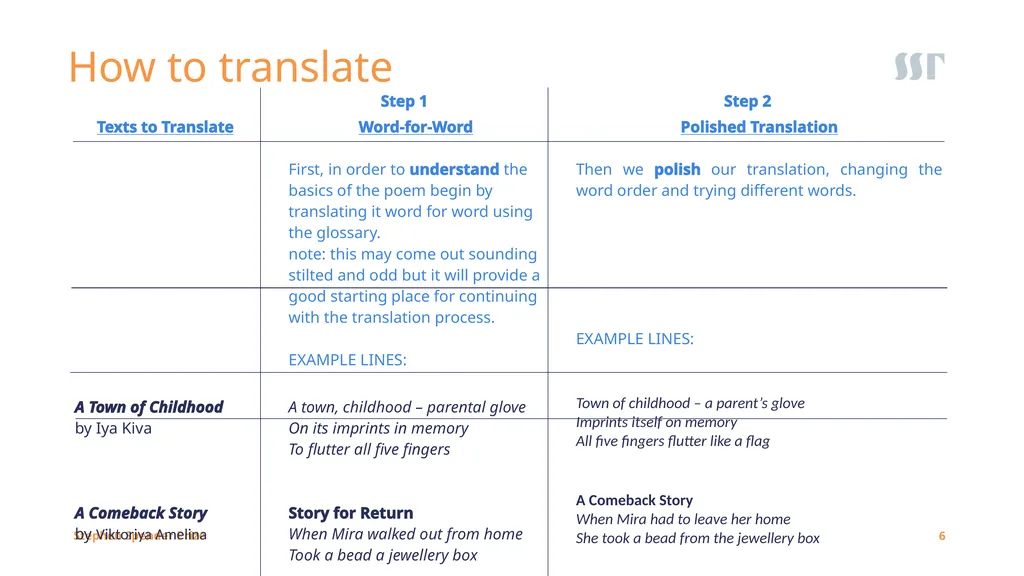
Students should use the glossary to complete a word-for-word translation of the poem before attempting a polished version
4.
Once they have completed their own translations, as a group, discuss the poem’s main themes and any translation challenges they faced
5.
Using the poem(s) as a starting point, encourage students to draw further on their creativity in the extension activities. Welcome 1<br>
02
This workshop will focus on two poems whose themes are related. Your students can choose one or both to produce translations of.
Iya Kiva, who wrote Town of Childhood is a poet, translator and critic originally from Donetsk. She is a member of PEN Ukraine and one of the most vibrant and moving voices to emerge from Ukrainian literature over the past decade. Ever since Iya was forced to leave her home in 2014, when Russia occupied Donetsk, she has written extensively on current events, reflecting poignantly on home and a sense of belonging, identity and loss. Kiva’s work has been widely translated into many languages. This poem written in 2020, is richly laced with metaphor, and as such deals powerfully with these subjects. Though the poem is short, the inventive strangeness of the language will present an exciting challenge for any translator (‘milk of silence’, ‘rye bread of loneliness’).
Viktoriya Amelina is a well known and prolific poet and writer based in Lviv and is one of the prominent voices speaking out during the current conflict. She is an active volunteer with the Truth Hounds team documenting Russian war crimes. A Comeback Story is a very touching, narrative poem with a powerful message. The poem tells the story of four different children fleeing from war and what they take with them to remember home. Like Kiva, Amelina does not shirk from writing about painful subject matter, but manages to do so with a light touch, employing the language of fairy tale to explore darker issues of exile and loss. Notes on two poems Town of Childhood (2020) by Iya Kiva A Comeback Story (2022) by Viktoriya Amelina 2<br>
03
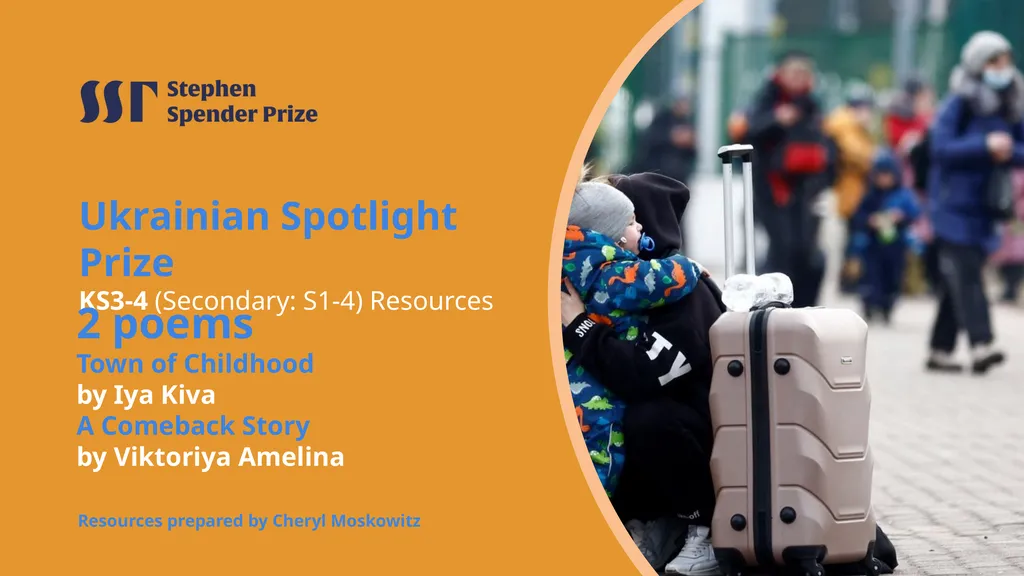
Ukrainian Spotlight Prize KS3-4 (Secondary: S1-4) Resources 2 poems
Town of Childhood by Iya Kiva
A Comeback Story
by Viktoriya Amelina Resources prepared by Cheryl Moskowitz<br>
04
Image board 4<br>
05
Listen to the poet reading their poem and think about the different sounds you hear. Remember, you don’t have to understand Ukrainian to answer the following questions:
How would you describe the mood of the poem?
Is your ear drawn to any particular sounds in the words or the voice of the poem? How do these sounds make you feel?
Can you identify places in the poem where there is rhyme or repetition of certain sounds? Listen to the poem Town of Childhood (2020) by Iya Kiva 5<br>
06
How to translate 6<br>
07
Town of Childhood by Iya Kiva 7<br>
08
A Comeback Story by Viktoriya Amelina 8<br>
09
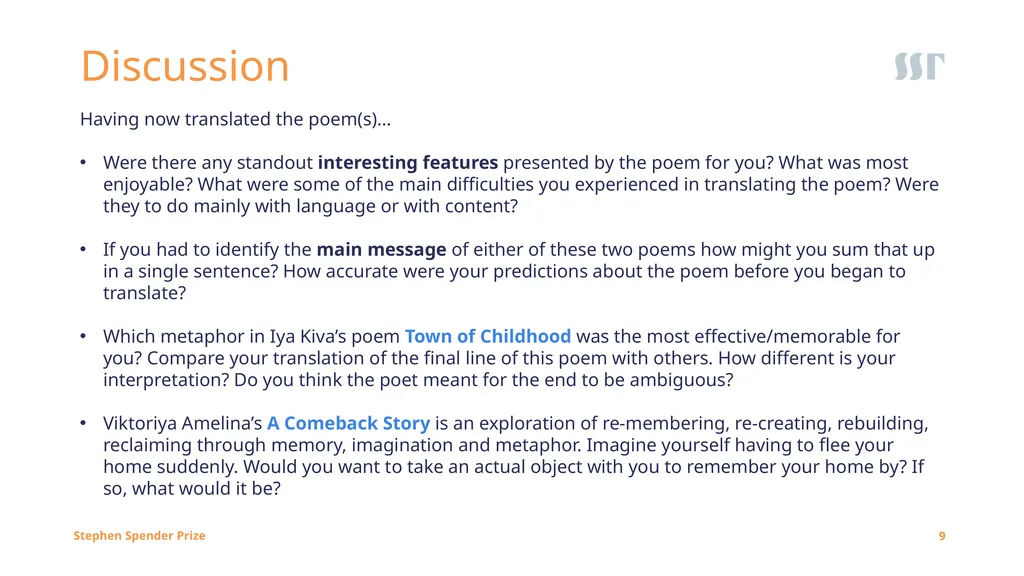
Having now translated the poem(s)…
Were there any standout interesting features presented by the poem for you? What was most enjoyable? What were some of the main difficulties you experienced in translating the poem? Were they to do mainly with language or with content?
If you had to identify the main message of either of these two poems how might you sum that up in a single sentence? How accurate were your predictions about the poem before you began to translate?
Which metaphor in Iya Kiva’s poem Town of Childhood was the most effective/memorable for you? Compare your translation of the final line of this poem with others. How different is your interpretation? Do you think the poet meant for the end to be ambiguous?
Viktoriya Amelina’s A Comeback Story is an exploration of re-membering, re-creating, rebuilding, reclaiming through memory, imagination and metaphor. Imagine yourself having to flee your home suddenly. Would you want to take an actual object with you to remember your home by? If so, what would it be? Discussion 9<br>
10
1.
Amelina’s poem was written in 2022 and very much with Ukraine in mind and to do with its people affected by the current war. What would happen if you relocated the poem to the UK or another place that is not currently experiencing conflict? Can you think of other reasons a person might be in danger and have to flee their home? Domestic violence perhaps. Racism. Try conceiving the poem in a different context and see what might have to change?
2.
Using the poem and its framing of four different stories as your starting point, write a new original poem. What stories could you tell? Would you keep the same general format and layout or change it?
3.
We can convey the same central messages by using different forms: song, illustration, dance, performance... How might you communicate the message of either of these two poems in a different form? Extension Activities 10<br>
11
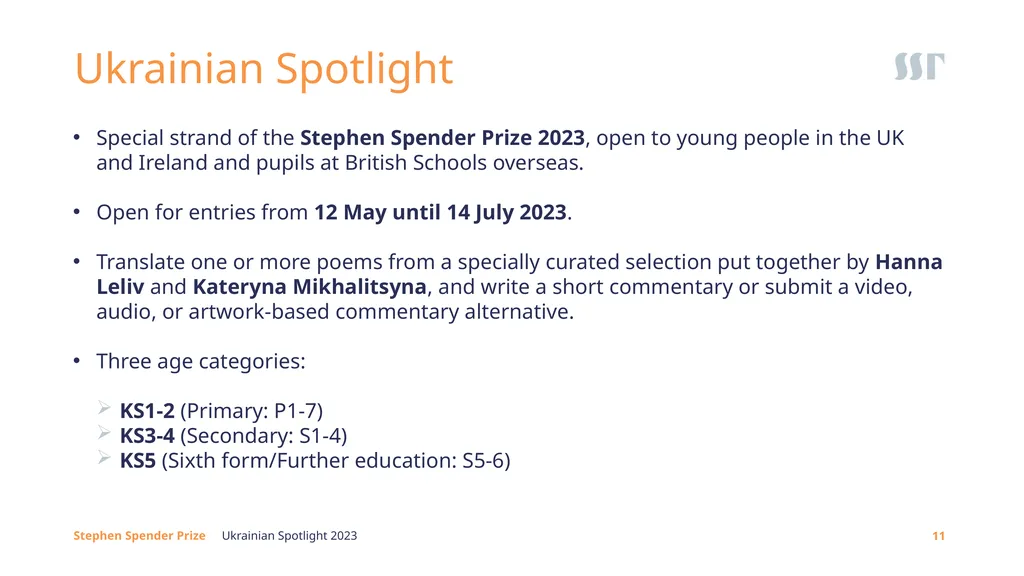
Special strand of the Stephen Spender Prize 2023, open to young people in the UK and Ireland and pupils at British Schools overseas.
Open for entries from 12 May until 14 July 2023.
Translate one or more poems from a specially curated selection put together by Hanna Leliv and Kateryna Mikhalitsyna, and write a short commentary or submit a video, audio, or artwork-based commentary alternative.
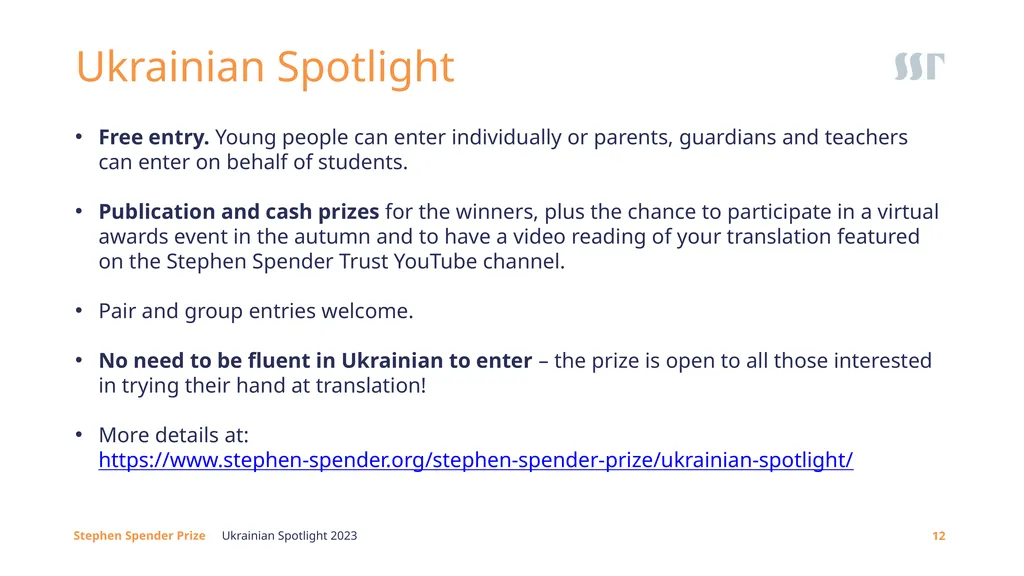
Free entry. Young people can enter individually or parents, guardians and teachers can enter on behalf of students.
Publication and cash prizes for the winners, plus the chance to participate in a virtual awards event in the autumn and to have a video reading of your translation featured on the Stephen Spender Trust YouTube channel.
Pair and group entries welcome.
No need to be fluent in Ukrainian to enter – the prize is open to all those interested in trying their hand at translation!
More details at: https://www.stephen-spender.org/stephen-spender-prize/ukrainian-spotlight/ Ukrainian Spotlight 12 Ukrainian Spotlight 2023<br>