Hospital Community Benefit: Policy, Practice and
Description: Hospital Community Benefit: Policy, Practice and Potential Jessica Curtis, JD Director, Hospital Accountability Project jcurtiscommunitycatalyst.org; 617-275-2859 Background 2014 Key community benefit policy concepts Current practice and
Related Topics
Download Presentation
"Hospital Community Benefit: Policy, Practice and" is the property of its rightful owner. Permission is granted to download and print the materials on this website for personal, non-commercial use only, and to display it on your personal computer provided you do not modify the materials and that you retain all copyright notices contained in the materials. By downloading content from our website, you accept the terms of this agreement.
Presentation Transcript
slide1. Hospital Community Benefit: Policy, Practice and Potential Jessica Curtis, JD
Director, Hospital Accountability Project
jcurtis@communitycatalyst.org;
617-275-2859<br>
slide2. Background © 2014 Key community benefit policy concepts
Current practice and considerations
How communities are engaging and partnering with hospitals—or aim to!<br>
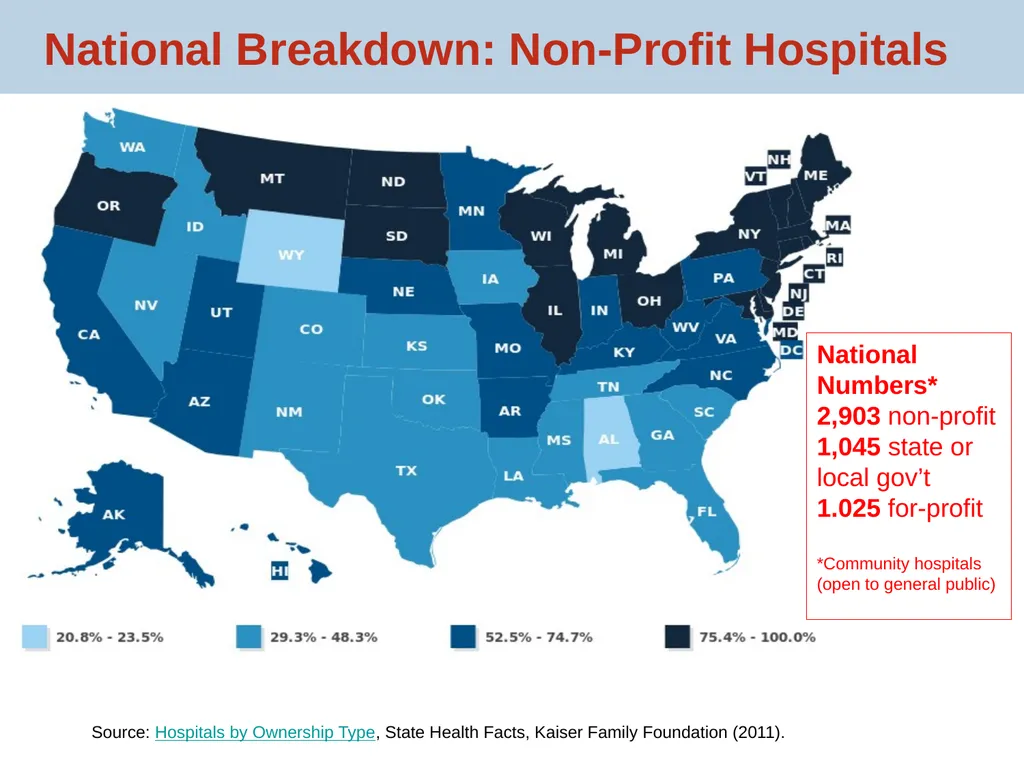
slide3. National Breakdown: Non-Profit Hospitals Source: Hospitals by Ownership Type, State Health Facts, Kaiser Family Foundation (2011). National Numbers*
2,903 non-profit
1,045 state or local gov’t
1.025 for-profit
*Community hospitals (open to general public)<br>
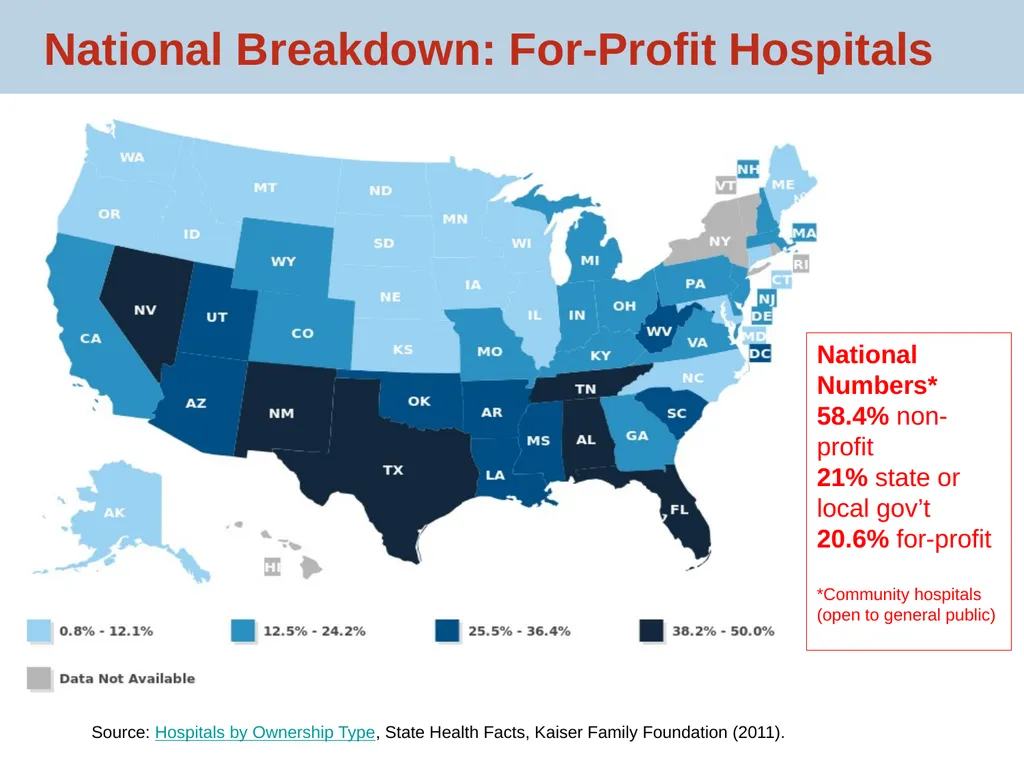
slide4. National Breakdown: For-Profit Hospitals Source: Hospitals by Ownership Type, State Health Facts, Kaiser Family Foundation (2011). National Numbers*
58.4% non-profit
21% state or local gov’t
20.6% for-profit
*Community hospitals (open to general public)<br>
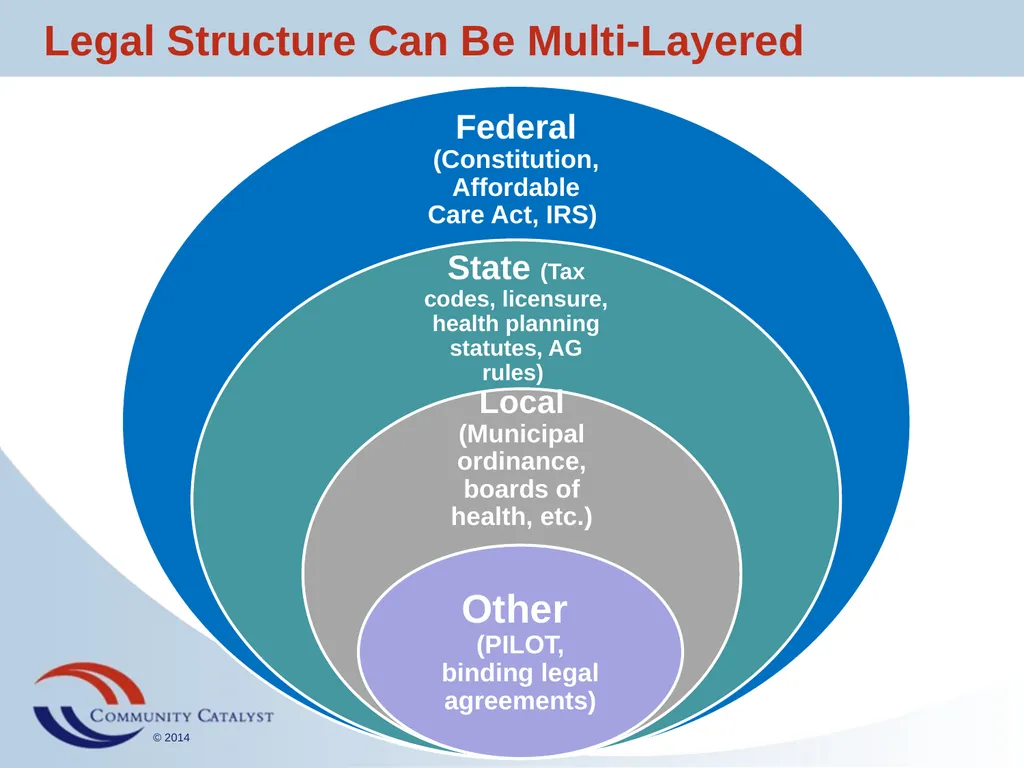
slide5. Legal Structure Can Be Multi-Layered © 2014<br>
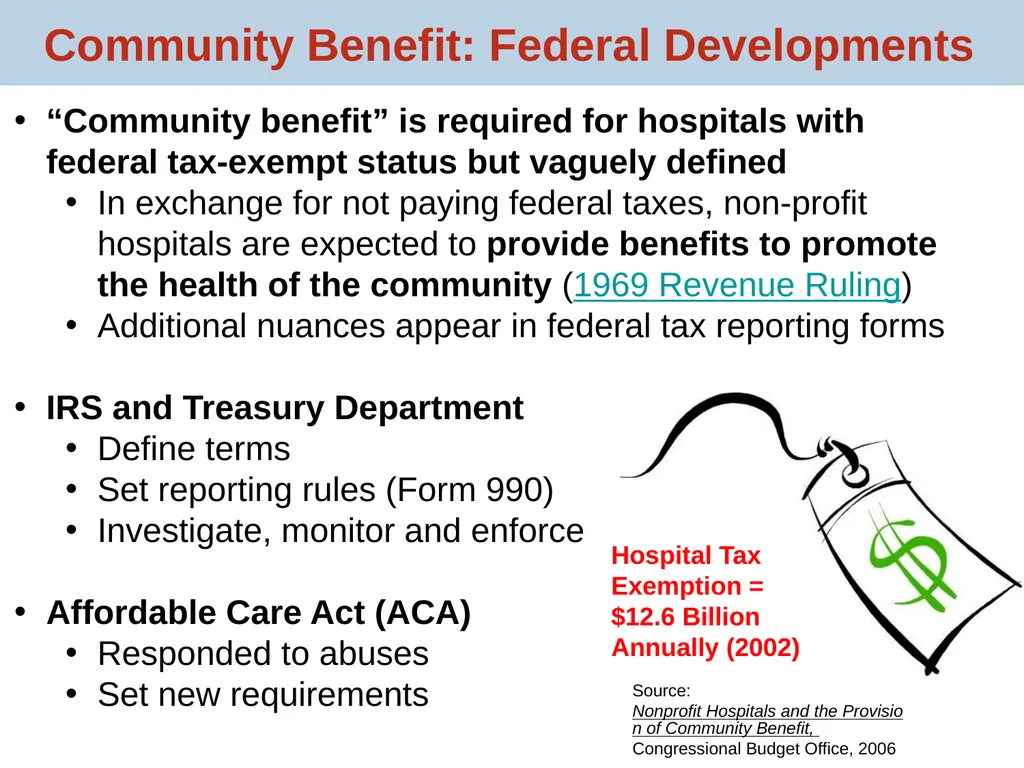
slide6. Community Benefit: Federal Developments “Community benefit” is required for hospitals with federal tax-exempt status but vaguely defined
In exchange for not paying federal taxes, non-profit hospitals are expected to provide benefits to promote the health of the community (1969 Revenue Ruling)
Additional nuances appear in federal tax reporting forms
IRS and Treasury Department
Define terms
Set reporting rules (Form 990)
Investigate, monitor and enforce
Affordable Care Act (ACA)
Responded to abuses
Set new requirements Hospital Tax Exemption = $12.6 Billion Annually (2002) Source: Nonprofit Hospitals and the Provision of Community Benefit, Congressional Budget Office, 2006<br>
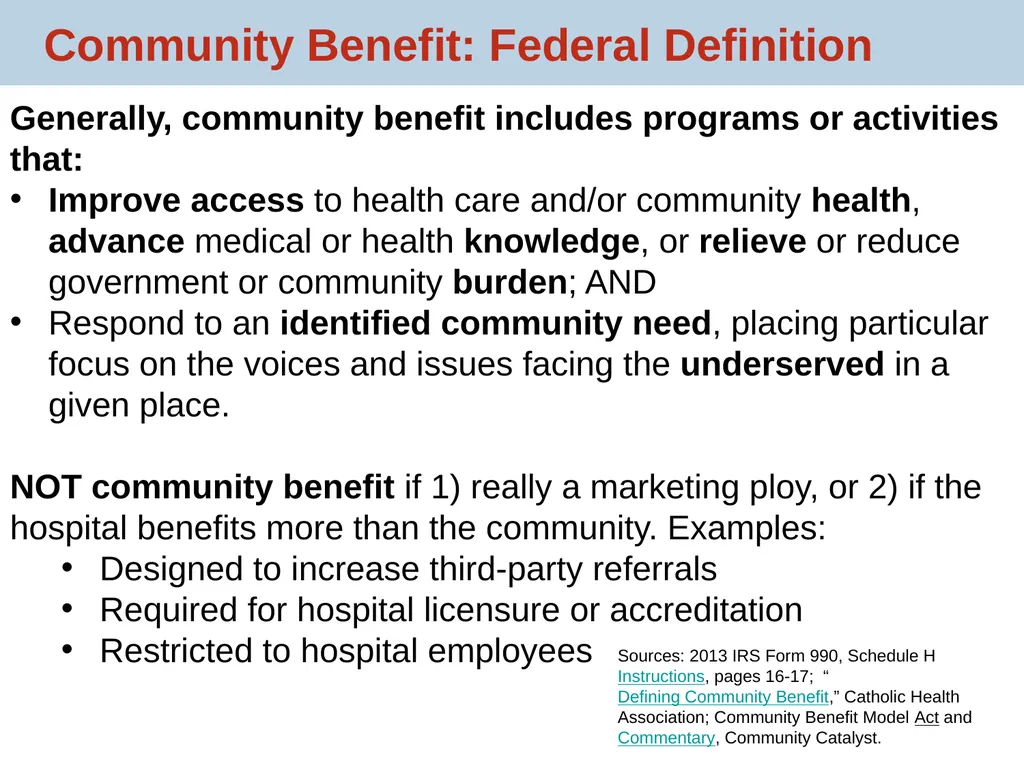
slide7. Community Benefit: Federal Definition Generally, community benefit includes programs or activities that:
Improve access to health care and/or community health, advance medical or health knowledge, or relieve or reduce government or community burden; AND
Respond to an identified community need, placing particular focus on the voices and issues facing the underserved in a given place.
NOT community benefit if 1) really a marketing ploy, or 2) if the hospital benefits more than the community. Examples:
Designed to increase third-party referrals
Required for hospital licensure or accreditation
Restricted to hospital employees Sources: 2013 IRS Form 990, Schedule H Instructions, pages 16-17; “Defining Community Benefit,” Catholic Health Association; Community Benefit Model Act and Commentary, Community Catalyst.<br>
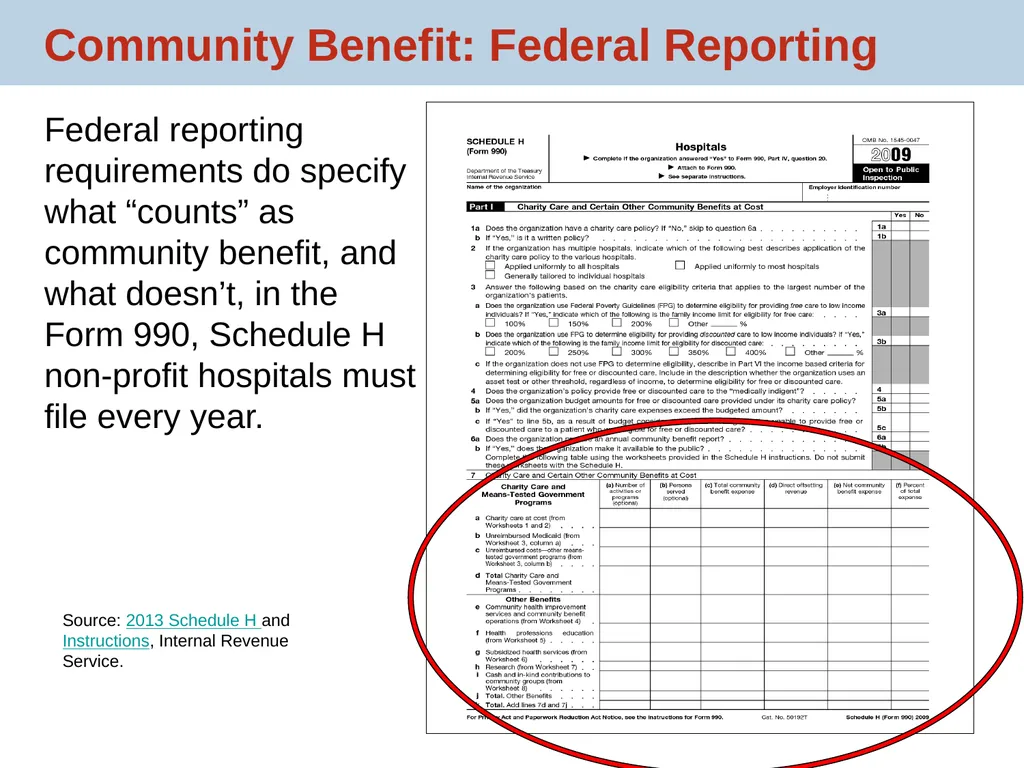
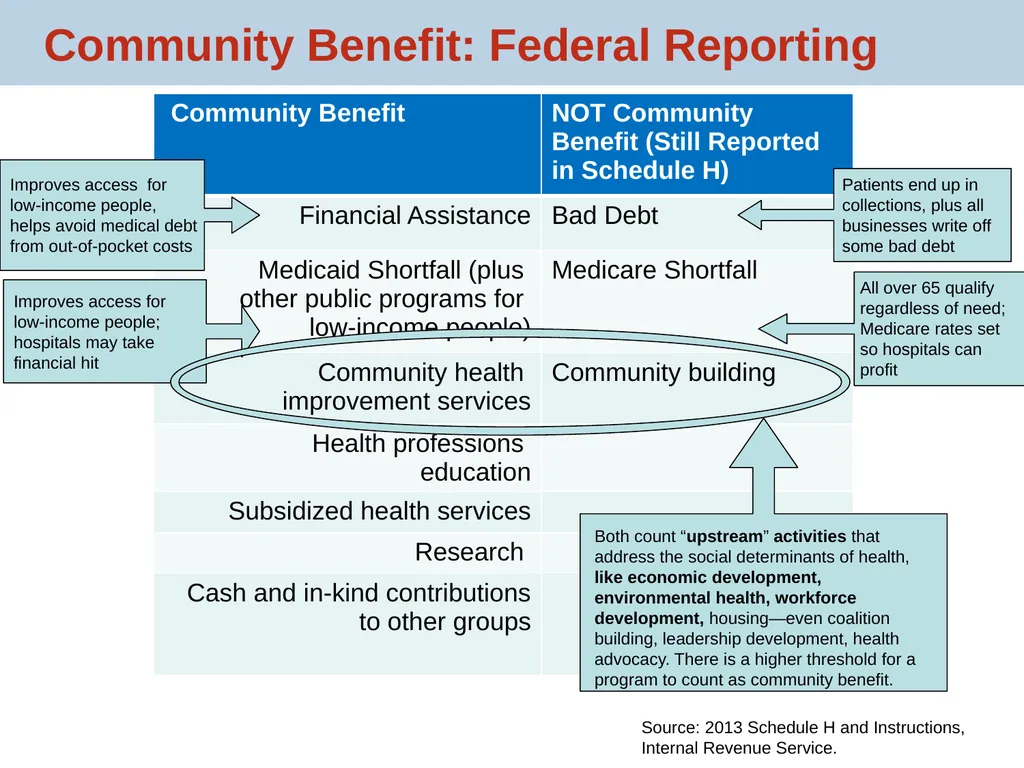
slide8. Community Benefit: Federal Reporting Federal reporting requirements do specify what “counts” as community benefit, and what doesn’t, in the Form 990, Schedule H non-profit hospitals must file every year. Source: 2013 Schedule H and Instructions, Internal Revenue Service.<br>
slide9. Community Benefit: Federal Reporting Source: 2013 Schedule H and Instructions, Internal Revenue Service. Patients end up in collections, plus all businesses write off some bad debt All over 65 qualify regardless of need; Medicare rates set so hospitals can profit Improves access for low-income people, helps avoid medical debt from out-of-pocket costs Improves access for low-income people; hospitals may take financial hit Both count “upstream” activities that address the social determinants of health, like economic development, environmental health, workforce development, housing—even coalition building, leadership development, health advocacy. There is a higher threshold for a program to count as community benefit.<br>
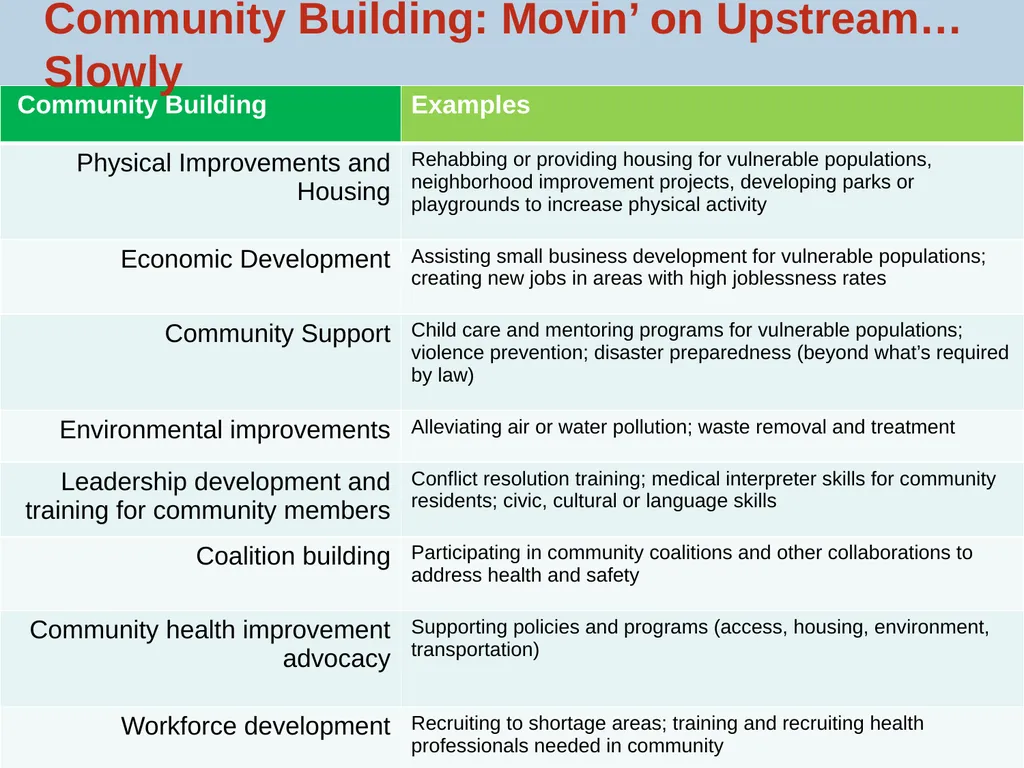
slide10. Community Building: Movin’ on Upstream…Slowly<br>
slide11. Under the Affordable Care Act, all non-profit hospitals must have: The Affordable Care Act changes the requirements for federal tax-exempt status for hospitals. Written, well-publicized financial assistance policy
Fair charges for patient care
Fair debt collection practices
Regularly assess the health needs of their communities, with input from community and public health leaders, and develop implementation plans to address needs<br>
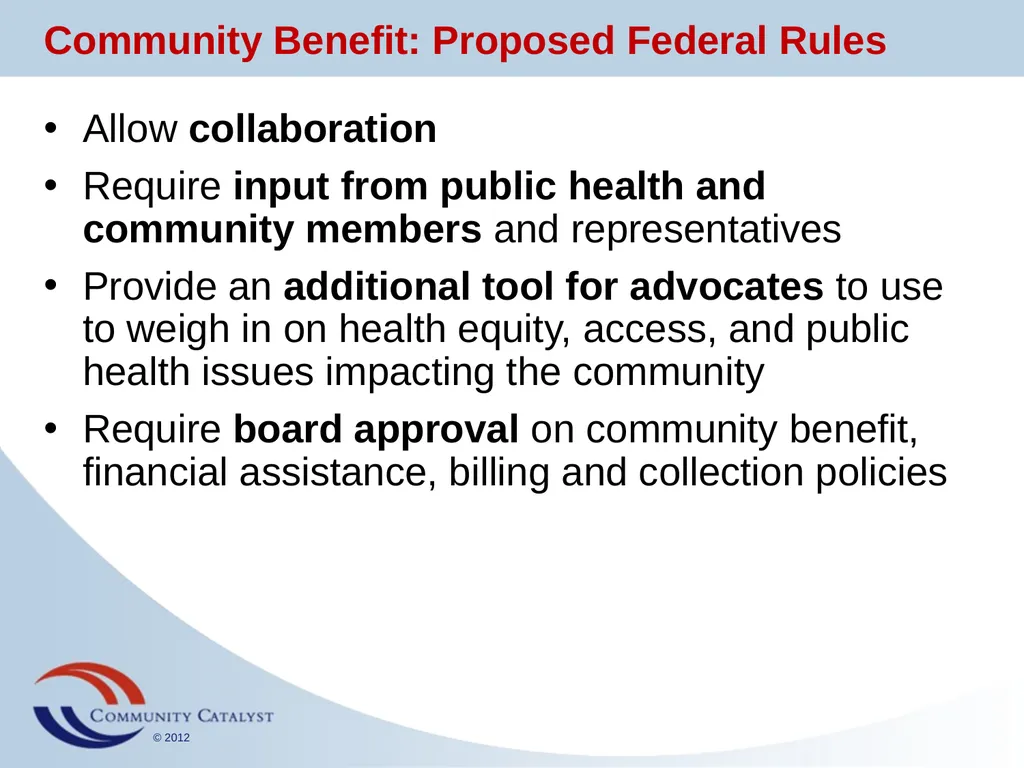
slide12. Allow collaboration
Require input from public health and community members and representatives
Provide an additional tool for advocates to use to weigh in on health equity, access, and public health issues impacting the community
Require board approval on community benefit, financial assistance, billing and collection policies Community Benefit: Proposed Federal Rules © 2012<br>
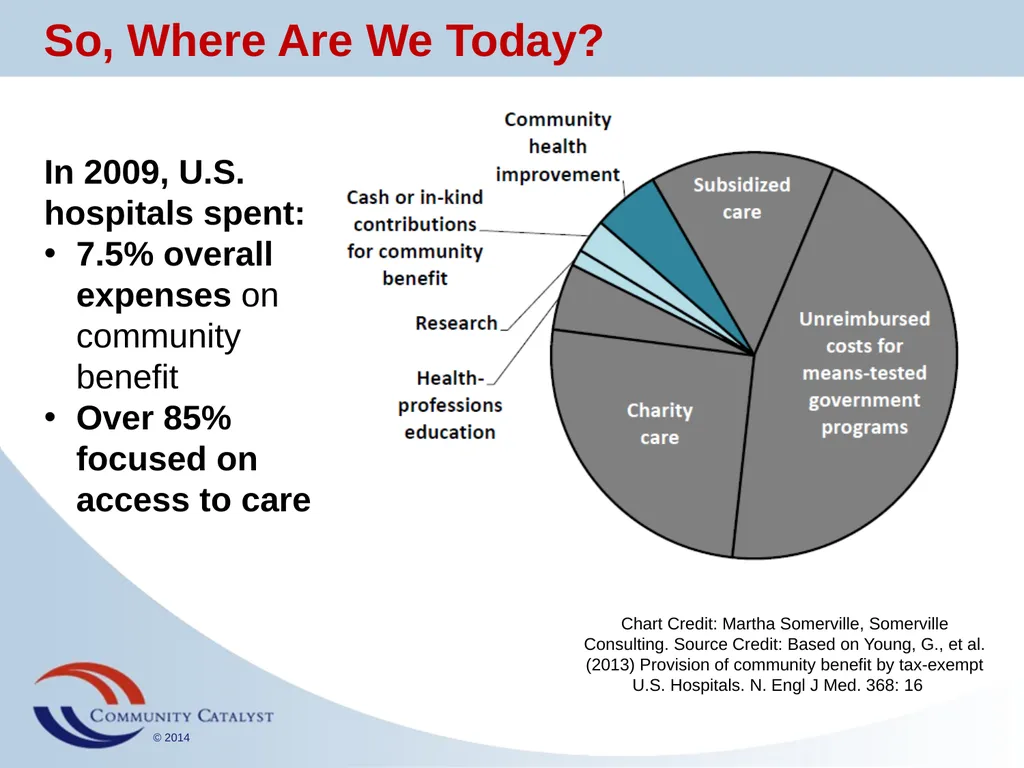
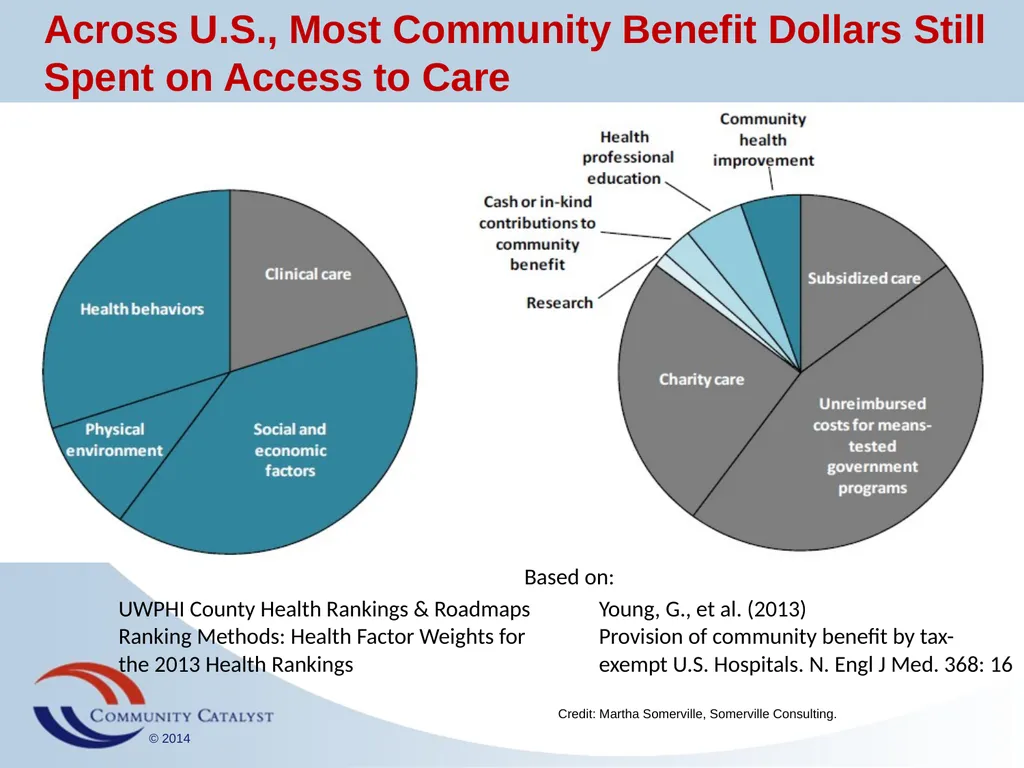
slide13. So, Where Are We Today? © 2014 Chart Credit: Martha Somerville, Somerville Consulting. Source Credit: Based on Young, G., et al. (2013) Provision of community benefit by tax-exempt U.S. Hospitals. N. Engl J Med. 368: 16 In 2009, U.S. hospitals spent:
7.5% overall expenses on community benefit
Over 85% focused on access to care<br>
slide14. Across U.S., Most Community Benefit Dollars Still Spent on Access to Care © 2014 Credit: Martha Somerville, Somerville Consulting.<br>
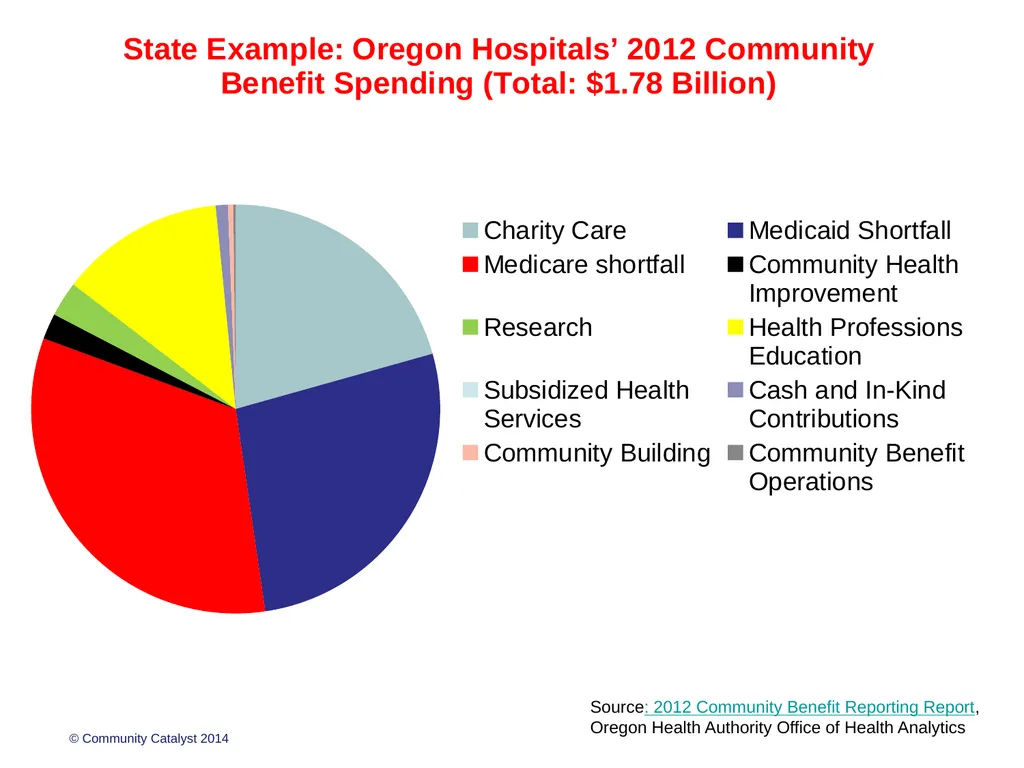
slide15. © Community Catalyst 2014 Source: 2012 Community Benefit Reporting Report, Oregon Health Authority Office of Health Analytics<br>
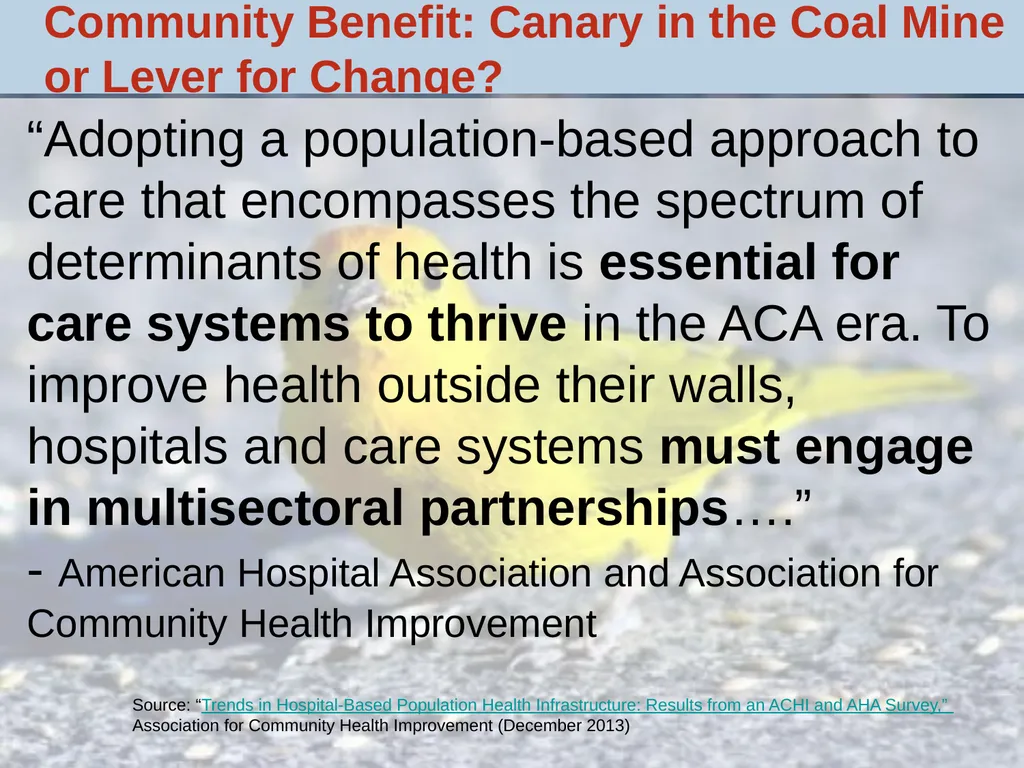
slide16. Community Benefit: Canary in the Coal Mine or Lever for Change? © 2014 Source: “Trends in Hospital-Based Population Health Infrastructure: Results from an ACHI and AHA Survey,” Association for Community Health Improvement (December 2013) “Adopting a population-based approach to care that encompasses the spectrum of determinants of health is essential for care systems to thrive in the ACA era. To improve health outside their walls, hospitals and care systems must engage in multisectoral partnerships….”
- American Hospital Association and Association for Community Health Improvement<br>
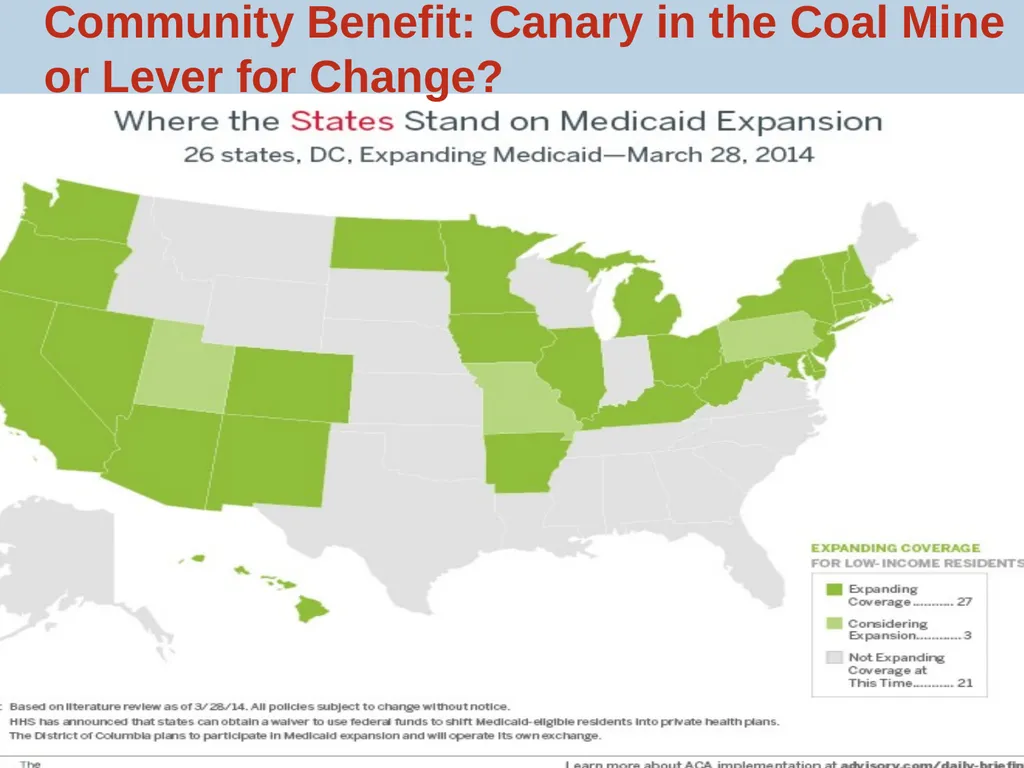
slide17. Community Benefit: Canary in the Coal Mine or Lever for Change? © 2014<br>
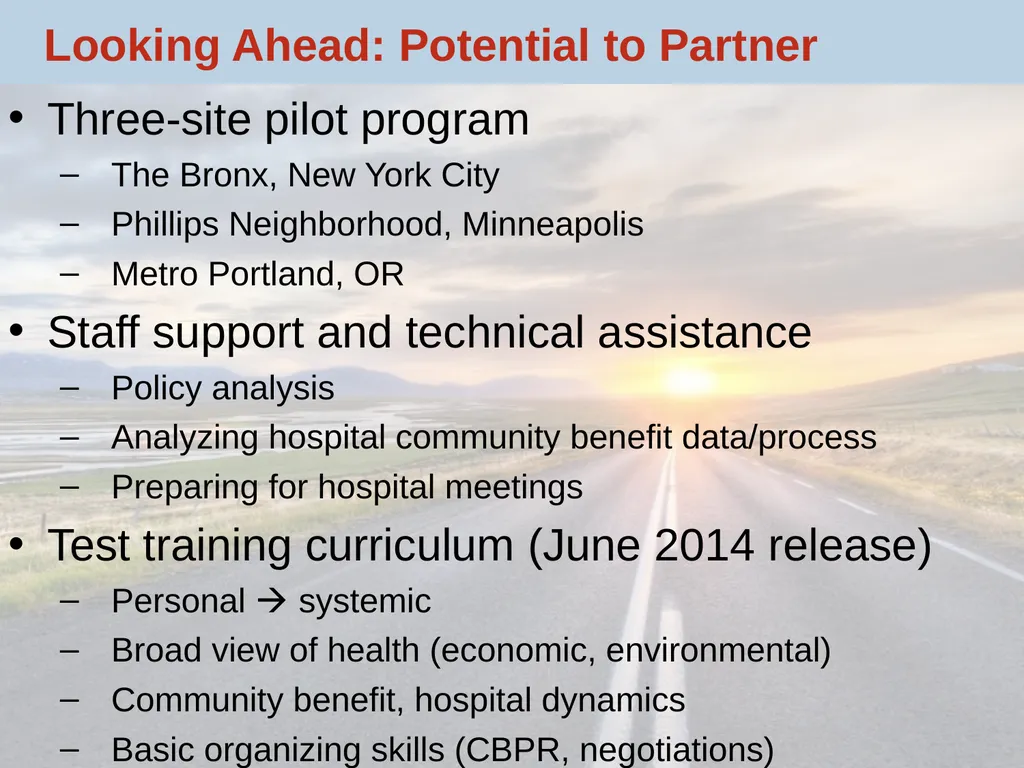
slide18. Looking Ahead: Potential to Partner © 2014 Three-site pilot program
The Bronx, New York City
Phillips Neighborhood, Minneapolis
Metro Portland, OR
Staff support and technical assistance
Policy analysis
Analyzing hospital community benefit data/process
Preparing for hospital meetings
Test training curriculum (June 2014 release)
Personal systemic
Broad view of health (economic, environmental)
Community benefit, hospital dynamics
Basic organizing skills (CBPR, negotiations)<br>
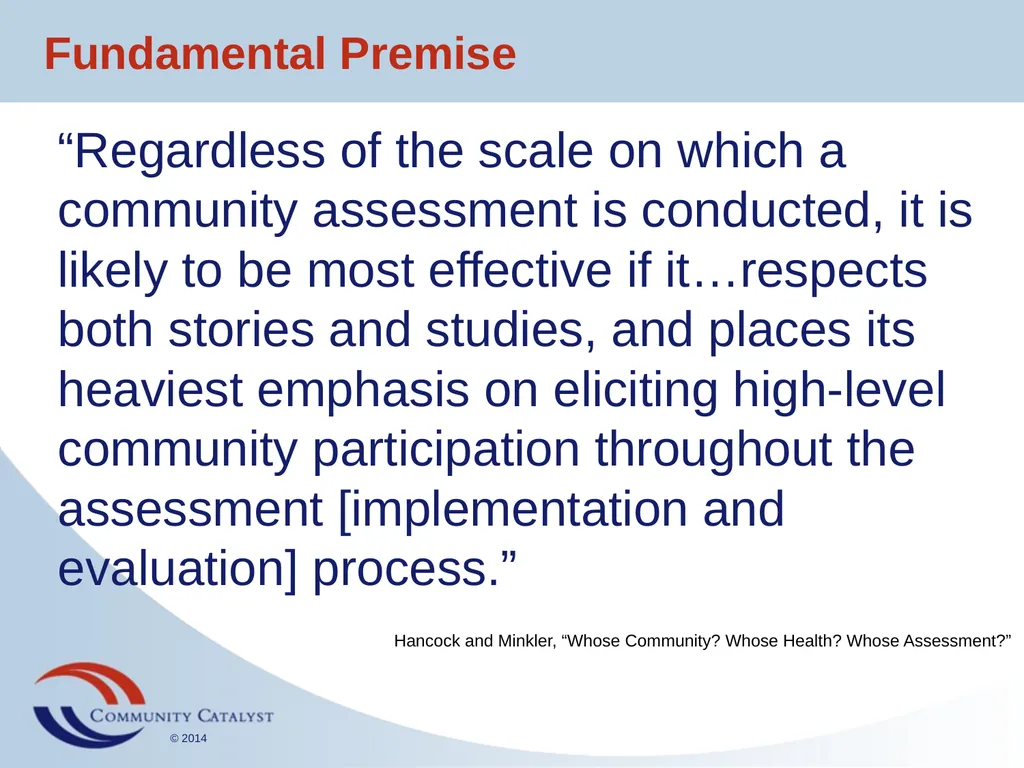
slide19. Fundamental Premise “Regardless of the scale on which a community assessment is conducted, it is likely to be most effective if it…respects both stories and studies, and places its heaviest emphasis on eliciting high-level community participation throughout the assessment [implementation and evaluation] process.” © 2014 Hancock and Minkler, “Whose Community? Whose Health? Whose Assessment?”<br>
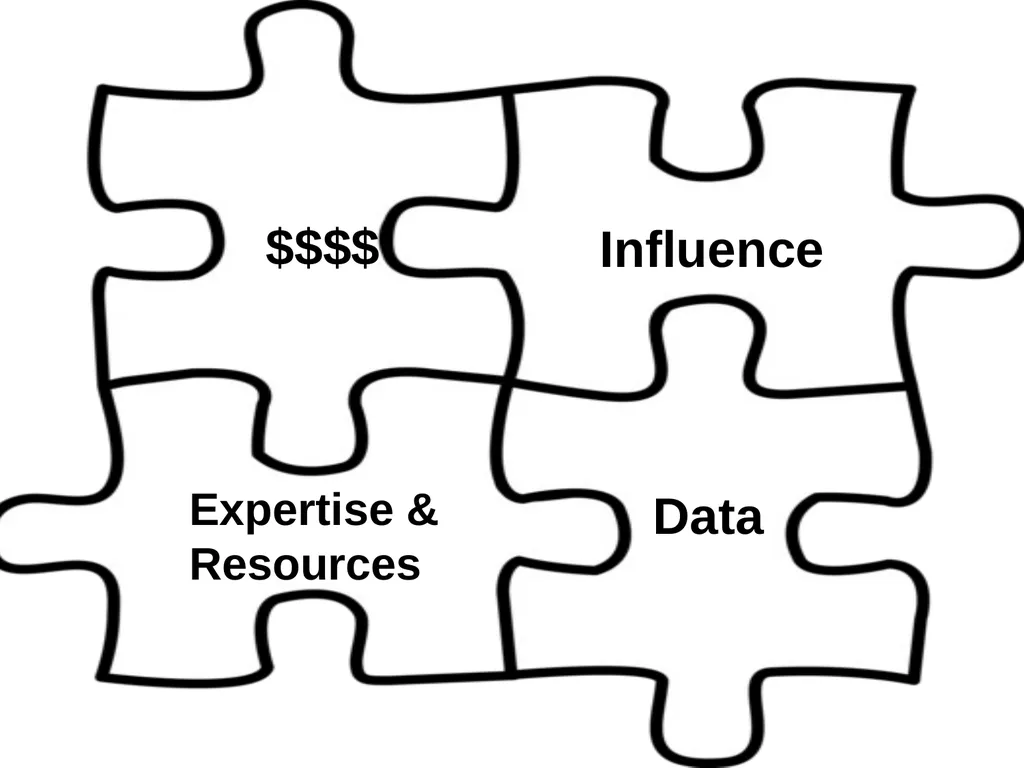
slide20. $$$$ Expertise & Resources Data Influence<br>
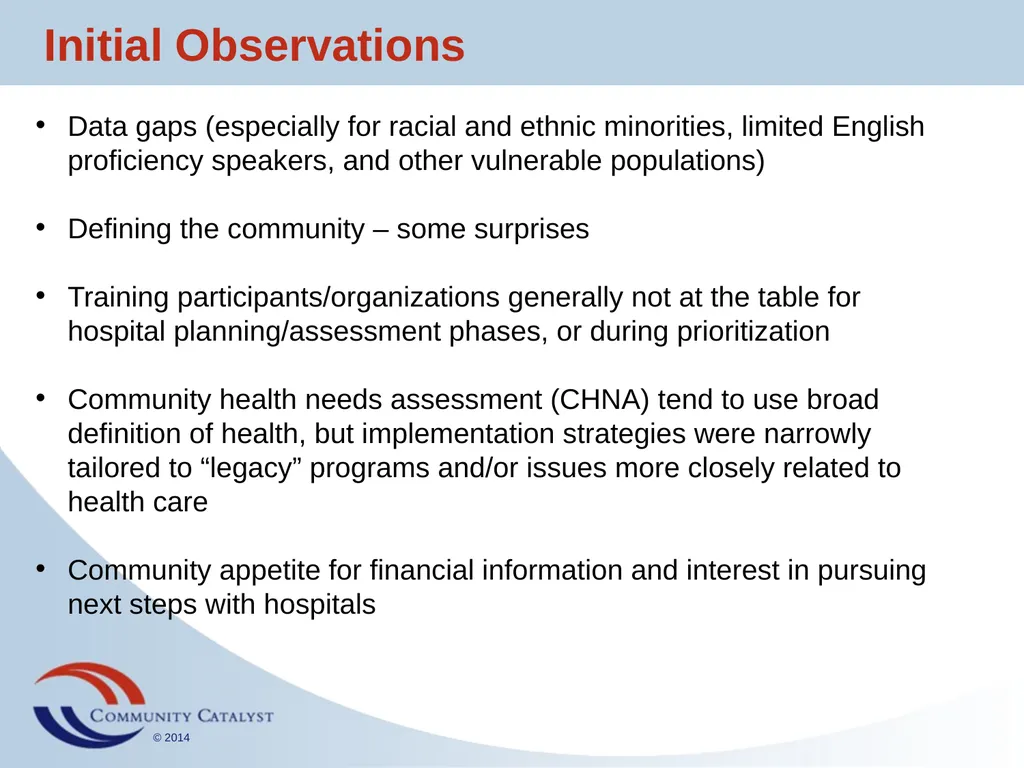
slide21. Initial Observations © 2014 Data gaps (especially for racial and ethnic minorities, limited English proficiency speakers, and other vulnerable populations)
Defining the community – some surprises
Training participants/organizations generally not at the table for hospital planning/assessment phases, or during prioritization
Community health needs assessment (CHNA) tend to use broad definition of health, but implementation strategies were narrowly tailored to “legacy” programs and/or issues more closely related to health care
Community appetite for financial information and interest in pursuing next steps with hospitals<br>
slide22. Questions © 2014 Is all the data we need or want publicly available? Are there any findings that surprise us? Things we want hospitals to improve? Shared interests?
Whose voices and perspectives did the hospital seek? Whose are missing?
How were community needs prioritized? Who decided and with what criteria?
Are there missing pieces or relationships that we can bring to bear?
How is the hospital moving forward? How can we be part of that?<br>

Director, Hospital Accountability Project
jcurtis@communitycatalyst.org;
617-275-2859<br>
slide2. Background © 2014 Key community benefit policy concepts
Current practice and considerations
How communities are engaging and partnering with hospitals—or aim to!<br>
slide3. National Breakdown: Non-Profit Hospitals Source: Hospitals by Ownership Type, State Health Facts, Kaiser Family Foundation (2011). National Numbers*
2,903 non-profit
1,045 state or local gov’t
1.025 for-profit
*Community hospitals (open to general public)<br>
slide4. National Breakdown: For-Profit Hospitals Source: Hospitals by Ownership Type, State Health Facts, Kaiser Family Foundation (2011). National Numbers*
58.4% non-profit
21% state or local gov’t
20.6% for-profit
*Community hospitals (open to general public)<br>
slide5. Legal Structure Can Be Multi-Layered © 2014<br>
slide6. Community Benefit: Federal Developments “Community benefit” is required for hospitals with federal tax-exempt status but vaguely defined
In exchange for not paying federal taxes, non-profit hospitals are expected to provide benefits to promote the health of the community (1969 Revenue Ruling)
Additional nuances appear in federal tax reporting forms
IRS and Treasury Department
Define terms
Set reporting rules (Form 990)
Investigate, monitor and enforce
Affordable Care Act (ACA)
Responded to abuses
Set new requirements Hospital Tax Exemption = $12.6 Billion Annually (2002) Source: Nonprofit Hospitals and the Provision of Community Benefit, Congressional Budget Office, 2006<br>
slide7. Community Benefit: Federal Definition Generally, community benefit includes programs or activities that:
Improve access to health care and/or community health, advance medical or health knowledge, or relieve or reduce government or community burden; AND
Respond to an identified community need, placing particular focus on the voices and issues facing the underserved in a given place.
NOT community benefit if 1) really a marketing ploy, or 2) if the hospital benefits more than the community. Examples:
Designed to increase third-party referrals
Required for hospital licensure or accreditation
Restricted to hospital employees Sources: 2013 IRS Form 990, Schedule H Instructions, pages 16-17; “Defining Community Benefit,” Catholic Health Association; Community Benefit Model Act and Commentary, Community Catalyst.<br>
slide8. Community Benefit: Federal Reporting Federal reporting requirements do specify what “counts” as community benefit, and what doesn’t, in the Form 990, Schedule H non-profit hospitals must file every year. Source: 2013 Schedule H and Instructions, Internal Revenue Service.<br>
slide9. Community Benefit: Federal Reporting Source: 2013 Schedule H and Instructions, Internal Revenue Service. Patients end up in collections, plus all businesses write off some bad debt All over 65 qualify regardless of need; Medicare rates set so hospitals can profit Improves access for low-income people, helps avoid medical debt from out-of-pocket costs Improves access for low-income people; hospitals may take financial hit Both count “upstream” activities that address the social determinants of health, like economic development, environmental health, workforce development, housing—even coalition building, leadership development, health advocacy. There is a higher threshold for a program to count as community benefit.<br>
slide10. Community Building: Movin’ on Upstream…Slowly<br>
slide11. Under the Affordable Care Act, all non-profit hospitals must have: The Affordable Care Act changes the requirements for federal tax-exempt status for hospitals. Written, well-publicized financial assistance policy
Fair charges for patient care
Fair debt collection practices
Regularly assess the health needs of their communities, with input from community and public health leaders, and develop implementation plans to address needs<br>
slide12. Allow collaboration
Require input from public health and community members and representatives
Provide an additional tool for advocates to use to weigh in on health equity, access, and public health issues impacting the community
Require board approval on community benefit, financial assistance, billing and collection policies Community Benefit: Proposed Federal Rules © 2012<br>
slide13. So, Where Are We Today? © 2014 Chart Credit: Martha Somerville, Somerville Consulting. Source Credit: Based on Young, G., et al. (2013) Provision of community benefit by tax-exempt U.S. Hospitals. N. Engl J Med. 368: 16 In 2009, U.S. hospitals spent:
7.5% overall expenses on community benefit
Over 85% focused on access to care<br>
slide14. Across U.S., Most Community Benefit Dollars Still Spent on Access to Care © 2014 Credit: Martha Somerville, Somerville Consulting.<br>
slide15. © Community Catalyst 2014 Source: 2012 Community Benefit Reporting Report, Oregon Health Authority Office of Health Analytics<br>
slide16. Community Benefit: Canary in the Coal Mine or Lever for Change? © 2014 Source: “Trends in Hospital-Based Population Health Infrastructure: Results from an ACHI and AHA Survey,” Association for Community Health Improvement (December 2013) “Adopting a population-based approach to care that encompasses the spectrum of determinants of health is essential for care systems to thrive in the ACA era. To improve health outside their walls, hospitals and care systems must engage in multisectoral partnerships….”
- American Hospital Association and Association for Community Health Improvement<br>
slide17. Community Benefit: Canary in the Coal Mine or Lever for Change? © 2014<br>
slide18. Looking Ahead: Potential to Partner © 2014 Three-site pilot program
The Bronx, New York City
Phillips Neighborhood, Minneapolis
Metro Portland, OR
Staff support and technical assistance
Policy analysis
Analyzing hospital community benefit data/process
Preparing for hospital meetings
Test training curriculum (June 2014 release)
Personal systemic
Broad view of health (economic, environmental)
Community benefit, hospital dynamics
Basic organizing skills (CBPR, negotiations)<br>
slide19. Fundamental Premise “Regardless of the scale on which a community assessment is conducted, it is likely to be most effective if it…respects both stories and studies, and places its heaviest emphasis on eliciting high-level community participation throughout the assessment [implementation and evaluation] process.” © 2014 Hancock and Minkler, “Whose Community? Whose Health? Whose Assessment?”<br>
slide20. $$$$ Expertise & Resources Data Influence<br>
slide21. Initial Observations © 2014 Data gaps (especially for racial and ethnic minorities, limited English proficiency speakers, and other vulnerable populations)
Defining the community – some surprises
Training participants/organizations generally not at the table for hospital planning/assessment phases, or during prioritization
Community health needs assessment (CHNA) tend to use broad definition of health, but implementation strategies were narrowly tailored to “legacy” programs and/or issues more closely related to health care
Community appetite for financial information and interest in pursuing next steps with hospitals<br>
slide22. Questions © 2014 Is all the data we need or want publicly available? Are there any findings that surprise us? Things we want hospitals to improve? Shared interests?
Whose voices and perspectives did the hospital seek? Whose are missing?
How were community needs prioritized? Who decided and with what criteria?
Are there missing pieces or relationships that we can bring to bear?
How is the hospital moving forward? How can we be part of that?<br>