
Independent Living Research Utilization
OM
Published · 40 slides · 0 views
1 / 1


Description
Independent Living Research Utilization Disability, Diversity and Intersectionality in Centers for Independent Living Day 1 Review Facilitator: Stan Holbrook August 21, 2019 Atlanta, Georgia Creating a Welcoming and Supportive CIL for
Related Topics
Share
Embed code
Download this presentation From Below
"Independent Living Research Utilization" is the property of its rightful owner. Permission is granted to download and print the materials on this website for personal, non-commercial use only, and to display it on your personal computer provided you do not modify the materials and that you retain all copyright notices contained in the materials. By downloading content from our website, you accept the terms of this agreement.
Presentation Transcript
01
Independent Living Research Utilization<br>
02
Disability, Diversity and Intersectionality in
Centers for Independent Living
Day 1 Review
Facilitator:
Stan Holbrook
August 21, 2019
Atlanta, Georgia<br>
03
Creating a Welcoming and Supportive CIL for Diverse Populations
Kim Gibson and Liz Sherwin<br>
04
Kim Gibson
disABILITY LINK<br>
05
disABILITY LINK Welcoming Environment Voice message at door welcoming to office.
Gender neutral bathrooms (labeled as such).
Messages at front door/window such as “Black Lives Matter,” “Women’s Rights are Human Rights,” “Love is Love” (welcoming and inclusive message even before opening the door!)
Pictures, posters, photos, flags, art, messages displayed that reflect all types of diversity including race, income, religion, age, sexual preferences to convey a message that help all people feel at home. Also women’s rights, worker’s rights, Native American rights, veteran’s rights, immigrant rights, electoral rights, LGBTQIA+++ rights, civil rights, religious/spiritual freedom, environmental rights.<br>
Gender neutral bathrooms (labeled as such).
Messages at front door/window such as “Black Lives Matter,” “Women’s Rights are Human Rights,” “Love is Love” (welcoming and inclusive message even before opening the door!)
Pictures, posters, photos, flags, art, messages displayed that reflect all types of diversity including race, income, religion, age, sexual preferences to convey a message that help all people feel at home. Also women’s rights, worker’s rights, Native American rights, veteran’s rights, immigrant rights, electoral rights, LGBTQIA+++ rights, civil rights, religious/spiritual freedom, environmental rights.<br>
06
Environment from the Door to the Staff to the Office Door greeter welcoming individuals.
Training of staff.
Signage on door.
Reached out to local authority to place a cross light for individuals.
Message board with iPod for anything posted for individuals to hear
Large print available. All areas are kept accessible including desks.
Computers for public use have adjustable tables and programs for accessibility such as Jaws.
Scent-free materials used.
Greeter at desk to invite people in and assist to different locations.
Often staffed with volunteers or interns.<br>
Training of staff.
Signage on door.
Reached out to local authority to place a cross light for individuals.
Message board with iPod for anything posted for individuals to hear
Large print available. All areas are kept accessible including desks.
Computers for public use have adjustable tables and programs for accessibility such as Jaws.
Scent-free materials used.
Greeter at desk to invite people in and assist to different locations.
Often staffed with volunteers or interns.<br>
07
Create a Feeling of Value of All –
disABILITY LINK Learning Experiences
Programs set for different groups to learn such as Tech Tuesday for all. Tech Wednesday focuses on the deaf population.
Providing materials in different format.
Zoom technology allows for captioning.
Use of microphone at all events.
Engagement with the consumer, staff, board and community
Asking all what is their interest.
Peer support classes often led by board members–Hearing Voices Network led by board member, Respect Institute.<br>
Programs set for different groups to learn such as Tech Tuesday for all. Tech Wednesday focuses on the deaf population.
Providing materials in different format.
Zoom technology allows for captioning.
Use of microphone at all events.
Engagement with the consumer, staff, board and community
Asking all what is their interest.
Peer support classes often led by board members–Hearing Voices Network led by board member, Respect Institute.<br>
08
Equipment and Materials –
disABILITY LINK Using visuals to convey the messages.
Using different communications devices
UbiDuo communications software
Provides communication equality between people who are deaf, hard of hearing, and hearing. On demand interpreters for different languages.
Kept at front desk for anyone to sign out and use. Most useful to have on hand right from the start.<br>
Using different communications devices
UbiDuo communications software
Provides communication equality between people who are deaf, hard of hearing, and hearing. On demand interpreters for different languages.
Kept at front desk for anyone to sign out and use. Most useful to have on hand right from the start.<br>
09
Special Considerations –
disABILITY LINK Are we representing the groups that are in our service area?
Regular self-assessments
Pre and post surveys
Online feedback forms
Outcome surveys
Listening to the staff and consumers.
Being pro-active rather than reactive.
Adjusting to what works and making changes.<br>
Regular self-assessments
Pre and post surveys
Online feedback forms
Outcome surveys
Listening to the staff and consumers.
Being pro-active rather than reactive.
Adjusting to what works and making changes.<br>
10
Community Engagement – disABILITY LINK Participation in social justice events.
MLK Parade
Pride Parade
Collaborations with different groups.
Black Lives Matter
NAACP
Latino, Korean, Muslim, Jewish, etc.
LGBTQIAP
Reaching out to meet the needs of rural populations.
Community outreach and participation using health fairs, support groups, VR, Senior Centers, Churches, international days, etc.
Use of partnerships for meeting spaces.<br>
MLK Parade
Pride Parade
Collaborations with different groups.
Black Lives Matter
NAACP
Latino, Korean, Muslim, Jewish, etc.
LGBTQIAP
Reaching out to meet the needs of rural populations.
Community outreach and participation using health fairs, support groups, VR, Senior Centers, Churches, international days, etc.
Use of partnerships for meeting spaces.<br>
11
Technology for Rural Outreach – disABILITY LINK Zoom technology –
Video conferencing that can be accessed on any phone/computer. Does not necessarily have to have video.
Use for all classes – Sign-in sheet lists that it is being used and we state this at the beginning of all classes.
Allows for individuals to participate and feel part of the group.
Has captioning ability.<br>
Video conferencing that can be accessed on any phone/computer. Does not necessarily have to have video.
Use for all classes – Sign-in sheet lists that it is being used and we state this at the beginning of all classes.
Allows for individuals to participate and feel part of the group.
Has captioning ability.<br>
12
Technology for Rural Outreach – disABILITY LINK, cont’d. Other Technology –
Use of Access interpreting that allows for on-demand interpreting as well as scheduled interpreting.
All staff trained and can be accessed on computer, phone, iPad.
Use of LanguageLine for a variety of languages. https://www.languageline.com/interpreting/phone
Use of peer supporters.<br>
Use of Access interpreting that allows for on-demand interpreting as well as scheduled interpreting.
All staff trained and can be accessed on computer, phone, iPad.
Use of LanguageLine for a variety of languages. https://www.languageline.com/interpreting/phone
Use of peer supporters.<br>
13
Hiring, Recruiting, and Supporting Staff and Board – disABILITY LINK Hiring of staff reflective of the community.
Recruitment of board reflective of community.
Community assessment.
Requires changing policies to reflect diversity.
Supporting staff and board through training.
Weekly trainings held.
Peer support for all new employees – (curriculum addresses issues of diversity in peer support).
Board training required before being considered to be on the board.<br>
Recruitment of board reflective of community.
Community assessment.
Requires changing policies to reflect diversity.
Supporting staff and board through training.
Weekly trainings held.
Peer support for all new employees – (curriculum addresses issues of diversity in peer support).
Board training required before being considered to be on the board.<br>
14
Supporting Staff and Board Commitment to DDI – disABILITY LINK Cultural diversity training provided:
In our peer support trainings.
In staff meetings.
Workshop presentations.
Outreach into the communities.
Creating partnerships and passion from staff.
Having staff taking ownership of programs.
Staff are empowered to bring ideas and then develop the classes within that perspective. Workshop proposals sheets are completed.<br>
In our peer support trainings.
In staff meetings.
Workshop presentations.
Outreach into the communities.
Creating partnerships and passion from staff.
Having staff taking ownership of programs.
Staff are empowered to bring ideas and then develop the classes within that perspective. Workshop proposals sheets are completed.<br>
15
Supporting Staff and Board Commitment to DDI cont’d. Creating a culture within a culture.
Taking inventory of where you are and where you want to be:
Developing a Strategic Plan.
Looking at our annual reports and comparing to our population.
Encouraging staff to bring forth ideas and address individual needs and goals they are passionate about.
Commitment to support consumers from unique perspectives.
Collaborating and using peer supporters to reach out to different groups.<br>
Taking inventory of where you are and where you want to be:
Developing a Strategic Plan.
Looking at our annual reports and comparing to our population.
Encouraging staff to bring forth ideas and address individual needs and goals they are passionate about.
Commitment to support consumers from unique perspectives.
Collaborating and using peer supporters to reach out to different groups.<br>
16
Creating a Welcoming and Supportive CIL for Diverse Populations
Liz Sherwin
IICIL<br>
17
The community that you serve has to feel that you are a part of them….People know me, see me, and trust me. It’s the same with the rest of the staff. Those are the kinds of things that validate us because we are part of the community and that’s how we are able to provide that level of service.
~ Liz Sherwin, Executive Director
Illinois Iowa Center for Independent Living (Illinois/Iowa) 17<br>
18
What is often different in rural areas are
Higher rates of disability.
The logistics, distances to negotiate.
Fragmented healthcare delivery system.
Stretched and diminishing rural workforce.
Certain target populations (e.g. farm workers).
Fewer or no resources and options of all kinds.
“…rural people with disabilities participate in their communities less and have few opportunities to take advantage of community resources, even at the smallest scale” (Sage, Myers, & Ravesloot, 2017). Acknowledging What Is Different in Rural Areas<br>
Higher rates of disability.
The logistics, distances to negotiate.
Fragmented healthcare delivery system.
Stretched and diminishing rural workforce.
Certain target populations (e.g. farm workers).
Fewer or no resources and options of all kinds.
“…rural people with disabilities participate in their communities less and have few opportunities to take advantage of community resources, even at the smallest scale” (Sage, Myers, & Ravesloot, 2017). Acknowledging What Is Different in Rural Areas<br>
19
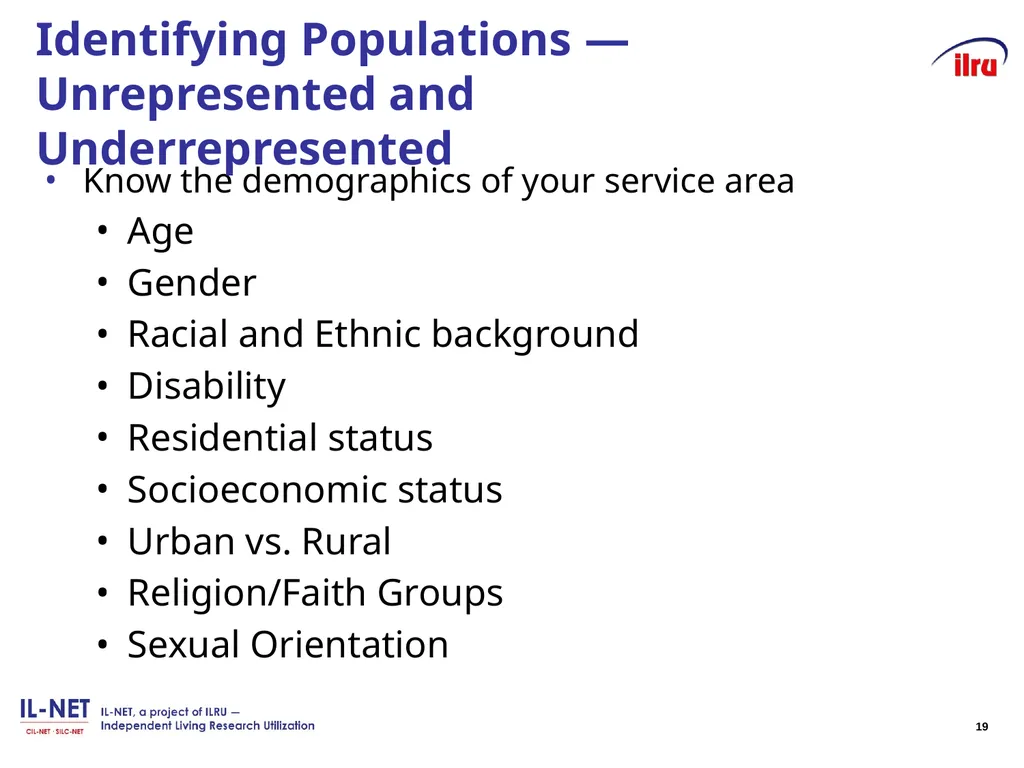
Know the demographics of your service area
Age
Gender
Racial and Ethnic background
Disability
Residential status
Socioeconomic status
Urban vs. Rural
Religion/Faith Groups
Sexual Orientation Identifying Populations — Unrepresented and Underrepresented<br>
Age
Gender
Racial and Ethnic background
Disability
Residential status
Socioeconomic status
Urban vs. Rural
Religion/Faith Groups
Sexual Orientation Identifying Populations — Unrepresented and Underrepresented<br>
20
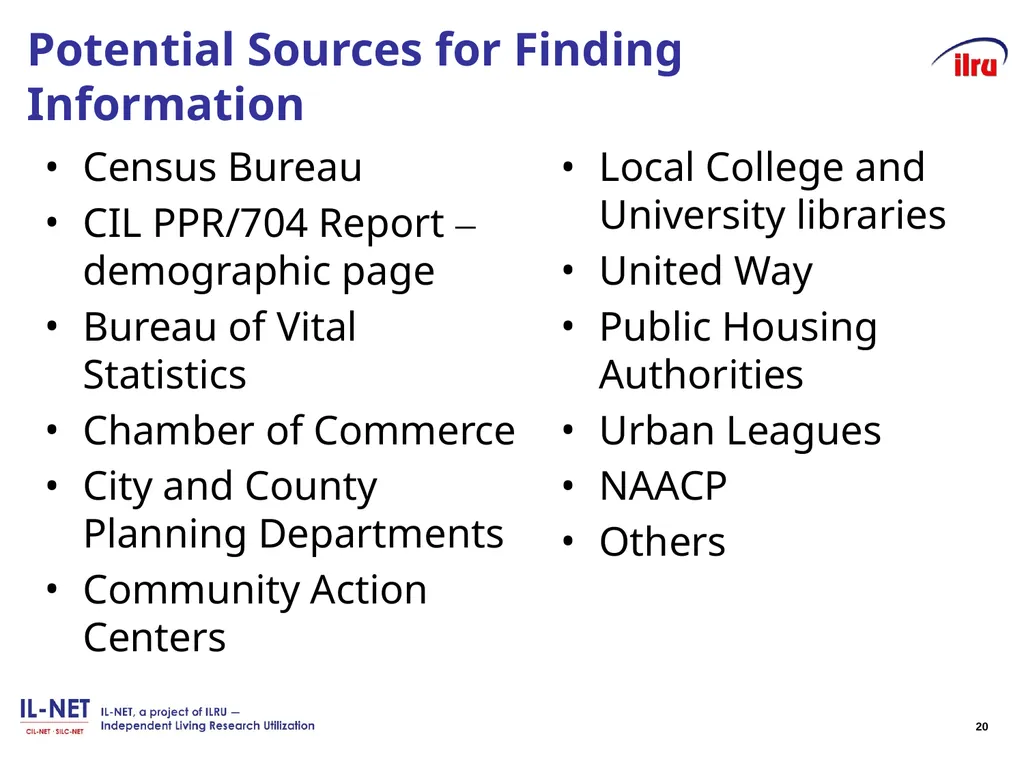
Potential Sources for Finding Information Census Bureau
CIL PPR/704 Report ‒ demographic page
Bureau of Vital Statistics
Chamber of Commerce
City and County Planning Departments
Community Action Centers Local College and University libraries
United Way
Public Housing Authorities
Urban Leagues
NAACP
Others<br>
CIL PPR/704 Report ‒ demographic page
Bureau of Vital Statistics
Chamber of Commerce
City and County Planning Departments
Community Action Centers Local College and University libraries
United Way
Public Housing Authorities
Urban Leagues
NAACP
Others<br>
21
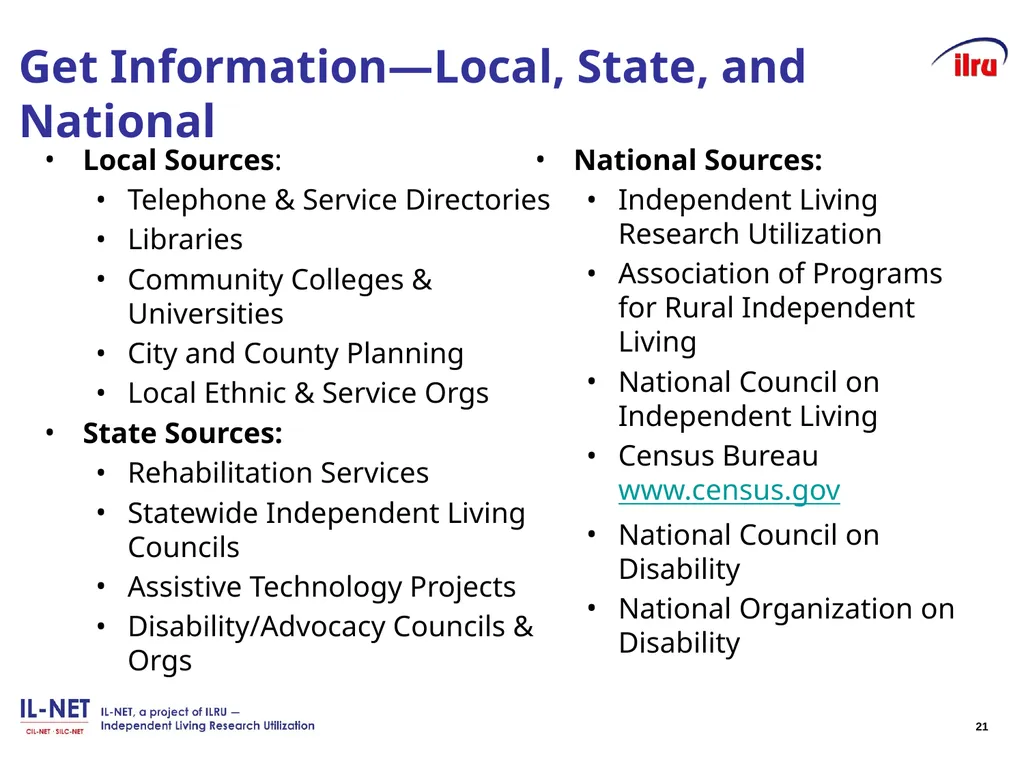
Get Information—Local, State, and National Local Sources:
Telephone & Service Directories
Libraries
Community Colleges & Universities
City and County Planning
Local Ethnic & Service Orgs
State Sources:
Rehabilitation Services
Statewide Independent Living Councils
Assistive Technology Projects
Disability/Advocacy Councils & Orgs National Sources:
Independent Living Research Utilization
Association of Programs for Rural Independent Living
National Council on Independent Living
Census Bureau www.census.gov
National Council on Disability
National Organization on Disability<br>
Telephone & Service Directories
Libraries
Community Colleges & Universities
City and County Planning
Local Ethnic & Service Orgs
State Sources:
Rehabilitation Services
Statewide Independent Living Councils
Assistive Technology Projects
Disability/Advocacy Councils & Orgs National Sources:
Independent Living Research Utilization
Association of Programs for Rural Independent Living
National Council on Independent Living
Census Bureau www.census.gov
National Council on Disability
National Organization on Disability<br>
22
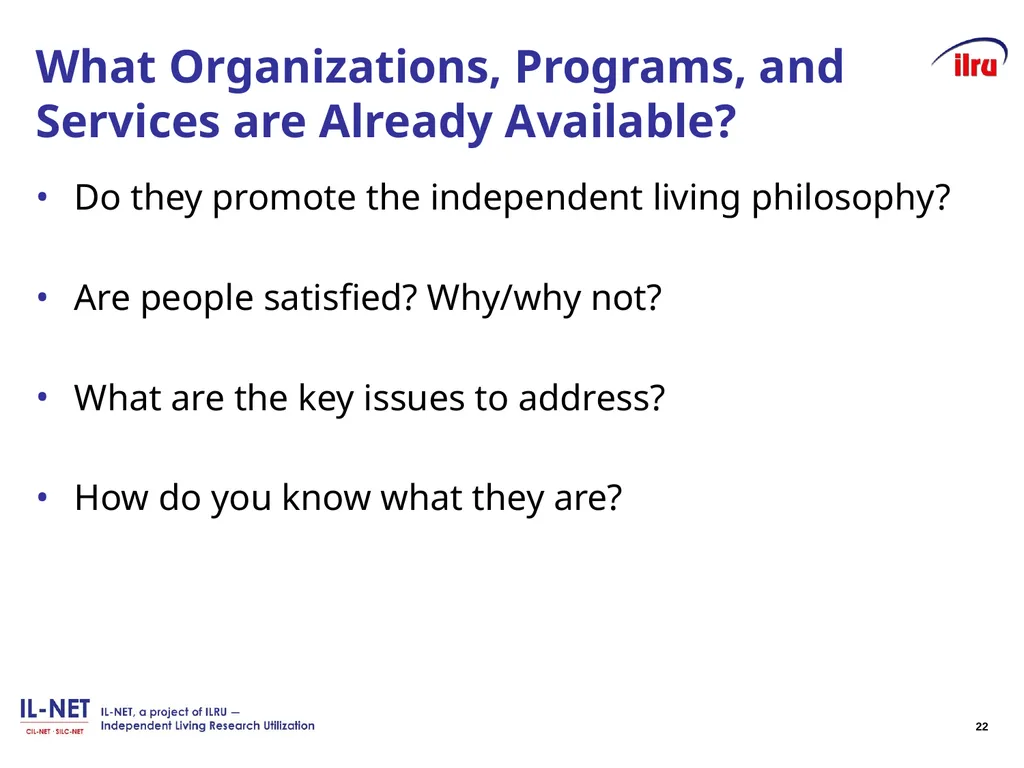
Do they promote the independent living philosophy?
Are people satisfied? Why/why not?
What are the key issues to address?
How do you know what they are? What Organizations, Programs, and Services are Already Available?<br>
Are people satisfied? Why/why not?
What are the key issues to address?
How do you know what they are? What Organizations, Programs, and Services are Already Available?<br>
23
Who is not being served and why? What are the barriers?
What local organizations might support CIL activities?
How do we demonstrate community support for those needs?
How can CILs adjust their programs to meet those needs?
Examples of effective outreach successes.<br>
What local organizations might support CIL activities?
How do we demonstrate community support for those needs?
How can CILs adjust their programs to meet those needs?
Examples of effective outreach successes.<br>
24
Not all cultures understand or accept the IL philosophy.
One cannot make assumptions about groups.
Collect information in a way that is open.
Respect cultural language, traditions, beliefs and spiritual perspective of the target population.
Consider the social and economic climate.
Do not stereotype cultures.
Know the issues and priorities.
Know the leaders and key players. Know and Respect Cultural Differences<br>
One cannot make assumptions about groups.
Collect information in a way that is open.
Respect cultural language, traditions, beliefs and spiritual perspective of the target population.
Consider the social and economic climate.
Do not stereotype cultures.
Know the issues and priorities.
Know the leaders and key players. Know and Respect Cultural Differences<br>
25
Identify bilingual and bicultural partners.
Gather reliable information:
Conduct focus groups.
Conduct interviews.
Conduct mail or telephone surveys.
Assess CIL information and referral data.
Develop a list of issues or information.
Use target group to train staff and board. Know Your Communities<br>
Gather reliable information:
Conduct focus groups.
Conduct interviews.
Conduct mail or telephone surveys.
Assess CIL information and referral data.
Develop a list of issues or information.
Use target group to train staff and board. Know Your Communities<br>
26
Work with organizations that serve targeted populations. (examples: MLK Community Center – ACTIVE Club; Rock Island NAACP)
Understand their programs.
Make sure CIL services are complementary.
Recruit board and staff that reflect community.
Assure board and staff are community leaders. Build Partnerships<br>
Understand their programs.
Make sure CIL services are complementary.
Recruit board and staff that reflect community.
Assure board and staff are community leaders. Build Partnerships<br>
27
Incorporate community issues into your Strategic Plan. (examples; NPC 11 – Clean-up; NAACP – Expungement Workshops)
Develop a public relations campaign.
Create outreach materials targeting needs of specific groups. Marketing and Public Relations<br>
Develop a public relations campaign.
Create outreach materials targeting needs of specific groups. Marketing and Public Relations<br>
28
Write at a reading level that is easy to understand.
Avoid acronyms and “professional phrases” that are not easily understood.
Use language that can be understood.
Accessible in a variety of formats: Braille, large print, tape and disk.
Qualified persons should edit and proof. Accessible Materials to All<br>
Avoid acronyms and “professional phrases” that are not easily understood.
Use language that can be understood.
Accessible in a variety of formats: Braille, large print, tape and disk.
Qualified persons should edit and proof. Accessible Materials to All<br>
29
Get feedback.
Make staff available to communicate.
Develop process to address language and cultural issues. Monitor the Effectiveness of your Public Relations<br>
Make staff available to communicate.
Develop process to address language and cultural issues. Monitor the Effectiveness of your Public Relations<br>
30
Getting Information Out Train Board and staff – Program Strategy Team.
Designate a lead person.
Maintain current list of media contacts.
Develop relationships with local media.
Respond to issues in editorials and opinion pages.
Create a media package.
Build a public and community history.
Information should be accurate and cost-effective.<br>
Designate a lead person.
Maintain current list of media contacts.
Develop relationships with local media.
Respond to issues in editorials and opinion pages.
Create a media package.
Build a public and community history.
Information should be accurate and cost-effective.<br>
31
Enhancing Your Public Relation Strategies Create opportunities through radio, TV, and newspapers on a regular basis.
Utilize existing mailings.
Develop partnerships (local college interns).
Respond to hot issues.<br>
Utilize existing mailings.
Develop partnerships (local college interns).
Respond to hot issues.<br>
32
Create Opportunities Regular information magazines.
Public television programs.
Column in a local newspaper or newsletter.
Use your own calendars and newsletters.<br>
Public television programs.
Column in a local newspaper or newsletter.
Use your own calendars and newsletters.<br>
33
Getting the Word Out Network with other agencies.
Provide website updates and e-alerts.
Produce disability issues program on public TV or radio.
Locate good, generic videos.
Write a grant to produce a video.
Expand partnerships by getting consumers on Boards and Commissions.
Set up videoconferences with others.
Use list serves and group emails.
Contact an advertising club for donated time.<br>
Provide website updates and e-alerts.
Produce disability issues program on public TV or radio.
Locate good, generic videos.
Write a grant to produce a video.
Expand partnerships by getting consumers on Boards and Commissions.
Set up videoconferences with others.
Use list serves and group emails.
Contact an advertising club for donated time.<br>
34
Implementation and Evaluation Implement an outreach action plan.
Target a specific group or community.
Assign a team with a leader.
Collect and review information about the group.
Develop a timeline.
Develop a budget if needed.
Implement.
Example:
Identify a community or group (Don’t bite off more than you can chew!)<br>
Target a specific group or community.
Assign a team with a leader.
Collect and review information about the group.
Develop a timeline.
Develop a budget if needed.
Implement.
Example:
Identify a community or group (Don’t bite off more than you can chew!)<br>
35
Evaluating Outreach Effectiveness Formative Evaluation.
Series of activities to improve outreach.
Have an expert review and comment on your plan.
Make changes in the plan based on new data.
Try a small scale outreach effort.
Revise according to feedback.<br>
Series of activities to improve outreach.
Have an expert review and comment on your plan.
Make changes in the plan based on new data.
Try a small scale outreach effort.
Revise according to feedback.<br>
36
How successful was the outreach design?
Takes place during and after implementation.
Gather an outreach evaluation (one page).
Make changes based on feedback and interviews. Process Evaluation<br>
Takes place during and after implementation.
Gather an outreach evaluation (one page).
Make changes based on feedback and interviews. Process Evaluation<br>
37
Outcome Evaluation Measure the impact and people who have benefited.
Review data collected in the Program Performance Reports (PPRs).
Calculate a cost benefit analysis.
Evaluate success based on satisfaction level of new persons reached.<br>
Review data collected in the Program Performance Reports (PPRs).
Calculate a cost benefit analysis.
Evaluate success based on satisfaction level of new persons reached.<br>
38
Analysis Who do we provide outreach to?
What do we know about the population?
Where do we start implementing it?
When should this process be started/completed?
How will we evaluate or know if we succeeded?
When completed: What outcomes will be measured?
What are the cost benefits?
What is the satisfaction level of consumers?<br>
What do we know about the population?
Where do we start implementing it?
When should this process be started/completed?
How will we evaluate or know if we succeeded?
When completed: What outcomes will be measured?
What are the cost benefits?
What is the satisfaction level of consumers?<br>
39
Contact Kim Gibson
Kgibson@disabilitylink.org
Liz Sherwin
liz@iicil.com<br>
Kgibson@disabilitylink.org
Liz Sherwin
liz@iicil.com<br>
40
Small Group Activity QUESTION to discuss at your table: What can you do at your center to create a welcoming and supportive CIL for diverse populations?<br>
41
CIL-NET Attribution This project is supported by grant number 90ILTA0001 from the U.S. Administration for Community Living, Department of Health and Human Services, Washington, D.C. 20201. Grantees undertaking projects under government sponsorship are encouraged to express freely their findings and conclusions. Points of view or opinions do not, therefore, necessarily represent official Administration for Community Living policy.<br>