04
Session Outcomes At the end of the session, an audience member would be able to:
Identify the steps needed to utilize both audit and information security departments in an audit
Design a plan for their next IT security audit
Implement their next IT security audit in a more efficient manner<br>
05
Topics Areas of discussion include:
Using Infosec resources to complement audit resources
Handling the politics of both groups working together
Audit planning
Technical interpretation and advisement
Vulnerability and penetration testing
Benefits of this relationship will be explored in-depth<br>
06
About the Speaker Paul Lepkowski
Enterprise Information Security Lead Engineer
Rochester Institute of Technology (RIT)
Certifications: CISSP, GIAC-GPEN
Experience:
19 years in both network engineering and security
Worked in both university and corporate environments
Specializations
Network and systems security
Vulnerability assessment
Penetration testing
Private Information (PI) protection
Professional Organizations
ISSA
Rochester Infragard – Vice President
IEEE
Audit Role
Provide technical assistance regarding all aspects of IT audits to RIT Internal Audit<br>
07
Special Acknowledgment Elisa Cockburn, CPA
Senior Internal Auditor
RIT’s Institute Audit, Compliance, and Advisement
Specializes in accounting and information systems auditing
MBA in MIS
Member of Association of Colleges and University Auditors (ACUA), Institute of Internal Auditors (IIA), and Information Systems Control and Audit Association (ISACA)<br>
08
About RIT Rochester Institute of Technology
Founded in 1829
Rochester, NY
17,500 active students
11th largest private university in US
3,600 faculty and staff
Undergraduate and graduate level Information Security programs<br>
09
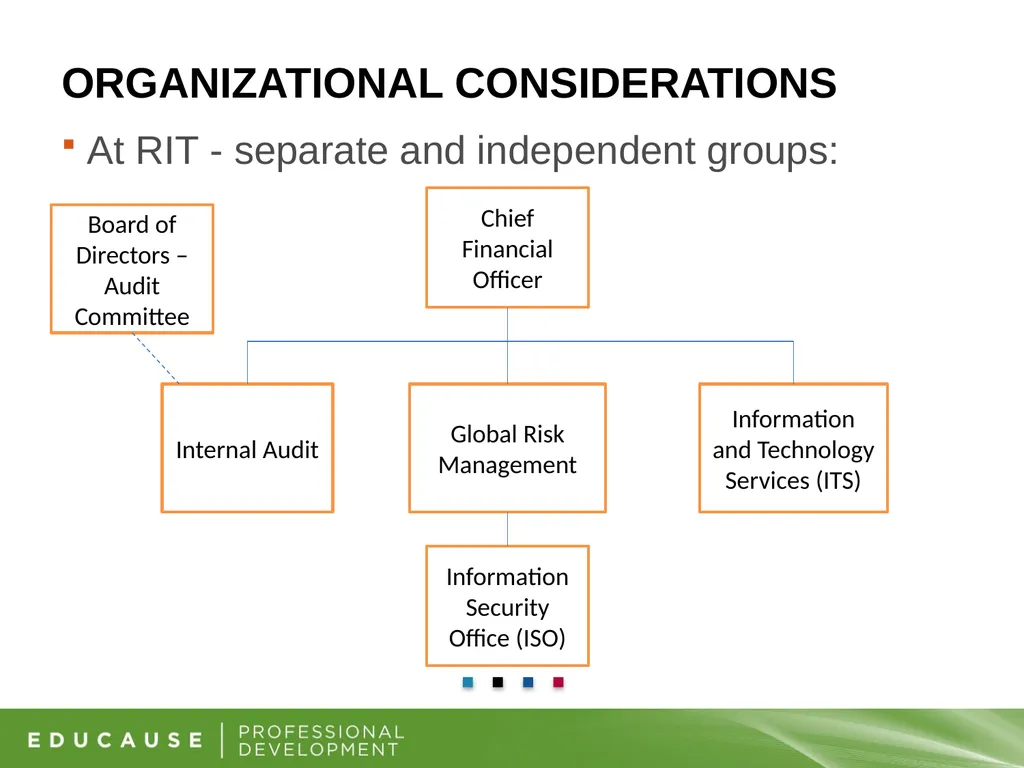
Organizational Considerations At RIT - separate and independent groups: Board of Directors – Audit Committee Chief Financial Officer Internal Audit Global Risk Management Information and Technology Services (ITS) Information Security Office (ISO)<br>
10
The Problem Often the internal audit department does not have the time, technical expertise, or budget to properly handle IT security audits.
Audit groups consist of a small group of people and some part-time auditors
Audit needs to be as cost effective and efficient as possible
Audit needs specialized technical expertise for IT security audits<br>
11
The Problem (Con’t) Finding people with both audit and highly technical skill sets can be challenging
Funding for external auditors is limited
At a high tech university, assistance is especially needed for:
Planning
Interviewing
Gathering data
Interpreting data
Reporting<br>
12
The Problem (Con’t) The Institute of Internal Auditors (IIA) International Professional Practices Framework (IPPF) requires the following:
1100 – Independence and Objectivity - The internal audit activity must be independent, and internal auditors must be objective in performing their work.
1210.A1 – Proficiency – The chief audit executive must obtain competent advice and assistance if the internal auditors lack the knowledge, skills, or other competencies needed to perform all or part of the engagement.<br>
13
A Solution (for RIT anyways) The Information Security Office can provide assistance to fill in these gaps.
Both departments can be used for a successful audit given the close synergies of audit and security.
External auditors may be used on a limited basis for cost efficiency.
Synergetic work with ISO and Internal Audit complies with the international standards for the internal audit profession when they both are independent organizations<br>
14
Planning the Audit Risk assessments
Where to audit?
Previous incidents or high risk areas with known issues
ISO can provide valuable information especially with types of incidents, knowledge of the environment and technology
Politics
Make sure groups being audited understand that you have the best interests of the university in mind for the audit
Audits could be used to help an IT group move forward with processes and justification for projects and/or much needed hardware/software<br>
15
Planning the Audit (Con’t) Setting expectations
Scope
Timelines
Plan resource time (estimated number of hours for both audit and ISO personnel)
Roles and responsibilities
Internal Audit runs the audit
ISO assists with all phases of the audit and acts in an advisory role
ISO is a member of the audit team
ISO is technical resource (i.e. vulnerability scanning, pen testing, etc.)<br>
16
Planning the Audit (Con’t) Internal or external?
Gaps in expertise or specialties needed?
Workload and cost considerations
RFP’s for external assistance
Non-disclosure
In place between Internal Audit and ISO
Include co-ops, student employees, external auditors
Handling work papers and sensitive documents
Audit is the authoritative source for work papers<br>
17
Planning the Audit (Con’t) Audit format
Define the audit steps
Use frameworks such as COBIT, ISO 27001, ITIL
Use best practices such as NIST, DISA STIGs, PCI, others
Time estimates for all steps
Define procedures that will be done by each office
Interviews – Internal Audit and ISO
Vulnerability scans, pen testing – ISO
Code reviews – external auditor
Tools needed<br>
18
Fieldwork Interviewing
Audit and ISO both take notes and compare
Gather screenshots for supporting data
Standards checklists (internal standards)
Configuration review
Gather configuration files
Show me “xyz” settings
Testing
Vulnerability scanning
Penetration testing
Configuration scanning and reporting<br>
19
Analysis Benchmarking other universities and the industry
Prioritization
Risk
Impact
Probability
Ease of remediation
Technical interpretation
Consensus between ISO and Internal Audit<br>
20
Presentation Findings – major issues
Discussion topics – low risk issues
Periodic status reports to the group being audited so there are no surprises
Both Internal Audit and ISO in the final presentation<br>
21
Impact and Lessons Learned This effort has had a very positive impact on the university.
It clearly shows the benefits that a teamwork based approach has provided the university.
Cost savings in both people time and external consulting time were substantial (estimated to be $50,000+ per audit).
It also builds trust amongst the groups.
Achieved greater alignment between Risk Management, ISO, and Internal Audit departments.
Helps to “jump start” the audit process since ISO is already familiar with the environment and allows the audit to get to greater level of depth quickly.<br>
22
Impact and Lessons Learned (Con’t) Audits can help the IT groups to obtain funding and resources that they need to fill gaps
Acquired expertise stays in house
Integration with external consultants can work well especially with clearly defined tasks (i.e. code review)
Allows easy follow-up on audit issues and audit responses<br>