
International Panel on Social Progress First draft
JO
Published · 52 slides · 0 views
1 / 1


Description
International Panel on Social Progress First draft of the report Key messages and recommendations 92016 IPSP - First Draft 1 List of chapters Introductory Chapters Chapter 1) Social Trends and New Geographies Chapter 2) Social Progress...
Related Topics
Share
Embed code
Download this presentation From Below
"International Panel on Social Progress First draft" is the property of its rightful owner. Permission is granted to download and print the materials on this website for personal, non-commercial use only, and to display it on your personal computer provided you do not modify the materials and that you retain all copyright notices contained in the materials. By downloading content from our website, you accept the terms of this agreement.
Presentation Transcript
01
International Panel on Social Progress
First draft of the report
Key messages and recommendations 9/2016 IPSP - First Draft 1<br>
02
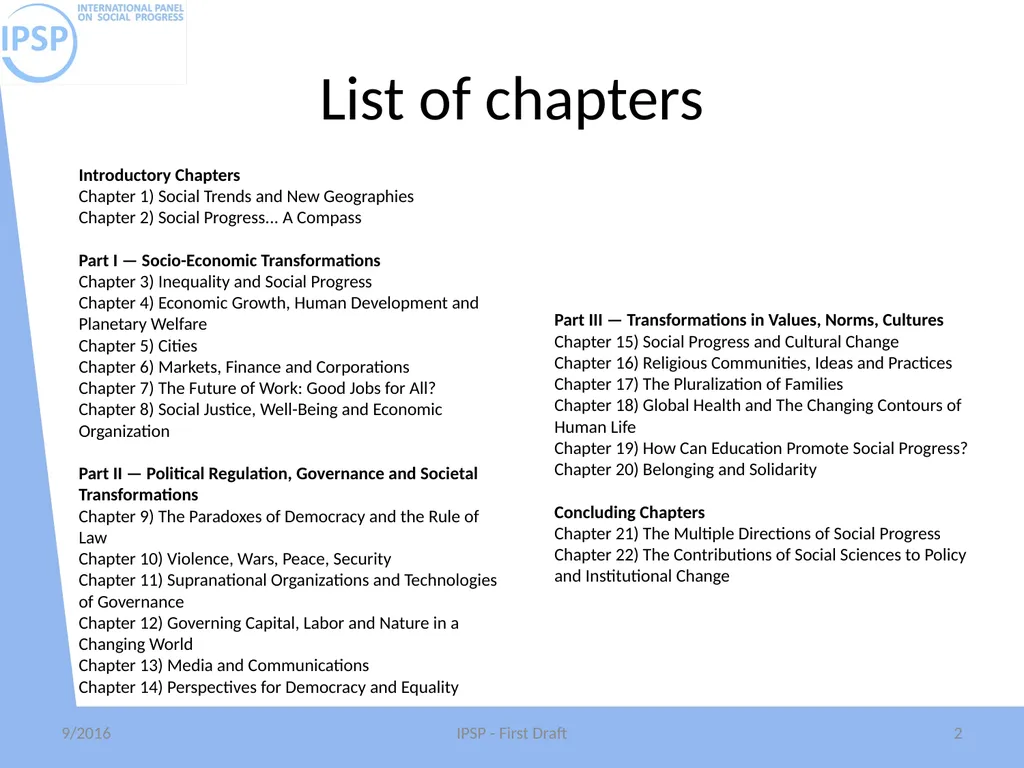
List of chapters Introductory Chapters
Chapter 1) Social Trends and New Geographies
Chapter 2) Social Progress... A Compass
Part I — Socio-Economic Transformations
Chapter 3) Inequality and Social Progress
Chapter 4) Economic Growth, Human Development and Planetary Welfare
Chapter 5) Cities
Chapter 6) Markets, Finance and Corporations
Chapter 7) The Future of Work: Good Jobs for All?
Chapter 8) Social Justice, Well-Being and Economic Organization
Part II — Political Regulation, Governance and Societal Transformations
Chapter 9) The Paradoxes of Democracy and the Rule of Law
Chapter 10) Violence, Wars, Peace, Security
Chapter 11) Supranational Organizations and Technologies of Governance
Chapter 12) Governing Capital, Labor and Nature in a Changing World
Chapter 13) Media and Communications
Chapter 14) Perspectives for Democracy and Equality 9/2016 IPSP - First Draft 2 Part III — Transformations in Values, Norms, Cultures
Chapter 15) Social Progress and Cultural Change
Chapter 16) Religious Communities, Ideas and Practices
Chapter 17) The Pluralization of Families
Chapter 18) Global Health and The Changing Contours of Human Life
Chapter 19) How Can Education Promote Social Progress?
Chapter 20) Belonging and Solidarity
Concluding Chapters
Chapter 21) The Multiple Directions of Social Progress
Chapter 22) The Contributions of Social Sciences to Policy and Institutional Change<br>
03
9/2016 IPSP - First Draft 3 Chapter 1 Introduction
On a peak of possibilities – facing an abyss?
Recent social transformations
New spatial configurations
Democracy and capitalism
Production and reproduction
Demographic change, consumption and sustainability
Looking ahead: actors for social progress<br>
On a peak of possibilities – facing an abyss?
Recent social transformations
New spatial configurations
Democracy and capitalism
Production and reproduction
Demographic change, consumption and sustainability
Looking ahead: actors for social progress<br>
04
9/2016 IPSP - First Draft 4 Ch 1 Our main arguments: The trends we analyse point in two directions: regress and progress.
The outcome of this tension is shaped by collective actions and institutions.
The interconnectedness of local, state/national and global levels is crucial for understanding both collective actions and institutions.<br>
The outcome of this tension is shaped by collective actions and institutions.
The interconnectedness of local, state/national and global levels is crucial for understanding both collective actions and institutions.<br>
05
Chapter 2: Social Progress…a Compass We set out the main normative dimensions that should be used in assessing whether societies have made social progress.
We identify dimensions that are of basic or non-derivative importance.
Recognizing a multiplicity of values and principles is important to being respectful of the variety of reasonable views about what matters and to reflect all aspects of the phenomena in question. 8/27/2015 IPSP - General information 5<br>
We identify dimensions that are of basic or non-derivative importance.
Recognizing a multiplicity of values and principles is important to being respectful of the variety of reasonable views about what matters and to reflect all aspects of the phenomena in question. 8/27/2015 IPSP - General information 5<br>
06
Overview Cross-cutting:
Principle of equal dignity
Respect for pluralism
Basic values:
Well-being, freedom, non-alienation, solidarity, social relations, esteem, cultural goods, environmental values 8/27/2015 IPSP - General information 6<br>
Principle of equal dignity
Respect for pluralism
Basic values:
Well-being, freedom, non-alienation, solidarity, social relations, esteem, cultural goods, environmental values 8/27/2015 IPSP - General information 6<br>
07
Overview (cont.) Basic principles (general):
Basic rights, distributive justice, beneficence
Principles applicable to specific institutions/actors:
Applicable to governments (e.g. rule of law, democracy).
Applicable to civil society (e.g. toleration).
Applicable to global institutions (global justice).
Arising from individuals’ obligations to each other. 8/27/2015 IPSP - General information<br>
Basic rights, distributive justice, beneficence
Principles applicable to specific institutions/actors:
Applicable to governments (e.g. rule of law, democracy).
Applicable to civil society (e.g. toleration).
Applicable to global institutions (global justice).
Arising from individuals’ obligations to each other. 8/27/2015 IPSP - General information<br>
08
From values and principles to report cards Which values/principles are most relevant for the specific issue at hand?
At what level should they be evaluated?
Who are the relevant actors?
How to move from abstract values and principles towards a more specific set of indicators? 8/27/2015 IPSP - General information<br>
At what level should they be evaluated?
Who are the relevant actors?
How to move from abstract values and principles towards a more specific set of indicators? 8/27/2015 IPSP - General information<br>
09
Ch 3: Inequalities
Key messages 9/2016 IPSP - First Draft 9 Inequality reduces well-being (intrinsic and instrumental)
Many inequalities to consider (focus on economic inequality)
Data still a huge problem
Decreasing global inequality, rising within country inequality in 80s and 90s, heterogeneity since 2000
Heterogeneous drivers of inequality change
Deep drivers of economic inequality make change difficult
Self-sustaining path dependency, deep-seated social stratification (e.g. by gender, race, ethnicity, caste) and durable norms
Strong link btw. economic & political inequality including presence/absence of social movements<br>
Many inequalities to consider (focus on economic inequality)
Data still a huge problem
Decreasing global inequality, rising within country inequality in 80s and 90s, heterogeneity since 2000
Heterogeneous drivers of inequality change
Deep drivers of economic inequality make change difficult
Self-sustaining path dependency, deep-seated social stratification (e.g. by gender, race, ethnicity, caste) and durable norms
Strong link btw. economic & political inequality including presence/absence of social movements<br>
10
9/2016 IPSP - First Draft 10 Key policy message(s): „it depends“ Policies can affect inequality pre-market (e.g. education, land), in markets (e.g. anti-trust laws), and post-market (e.g. redistribution)
Common objectives, but priorities have to be country-specific
New model of the welfare state necessary?
Political economy matters (e.g. size and strength of middle class, democracy, political coalitions, collective actions)
Limited scope for international policies (e.g. tax avoidance, evasion; financial sector regulation; carbon pricing)<br>
Common objectives, but priorities have to be country-specific
New model of the welfare state necessary?
Political economy matters (e.g. size and strength of middle class, democracy, political coalitions, collective actions)
Limited scope for international policies (e.g. tax avoidance, evasion; financial sector regulation; carbon pricing)<br>
11
Chapter 4: Growth, human development and planetary welfare 9/2016 IPSP - First Draft 11 Economic growth may be viewed as a double edged sword. On the one hand, it may be viewed as a narrative of liberation, lifting people out of poverty. On the other, it may be viewed as one of alienation, increasing inequality and associated with environmental degradation.
Welfare is an overarching goal for policymakers. It is multi-dimensional in the sense that it includes poverty, inequality, the environment and other public goods such as health and education. It is normative in the sense that there are multiple perspectives on what matters to society (happiness, capabilities to function, etc.).
Economic growth is important in that it positively impacts welfare along some dimensions and negatively along others. The challenge for policymakers is to mitigate the negative effects while preserving the positive effects. Economic growth in recent decades has decreased inequality at the level of the world citizens, but has led to increasing inequality within countries.
Climate change and other environmental damages impact the poor disproportionately, and may also increase inequality within and between countries.<br>
Welfare is an overarching goal for policymakers. It is multi-dimensional in the sense that it includes poverty, inequality, the environment and other public goods such as health and education. It is normative in the sense that there are multiple perspectives on what matters to society (happiness, capabilities to function, etc.).
Economic growth is important in that it positively impacts welfare along some dimensions and negatively along others. The challenge for policymakers is to mitigate the negative effects while preserving the positive effects. Economic growth in recent decades has decreased inequality at the level of the world citizens, but has led to increasing inequality within countries.
Climate change and other environmental damages impact the poor disproportionately, and may also increase inequality within and between countries.<br>
12
9/2016 IPSP - First Draft 12 Chapter 4: Growth, human development and planetary welfare Well-designed and implemented regulation of environmental and other externalities leads to increasing welfare, without necessarily impeding economic growth. Environmental regulation creates assets for society.
Governing the global commons requires institutions that enable and facilitate collective action at international, national and sub-national levels.
An integrated perspective on capitalism allows for an evaluation of its costs and benefits, but also provides pathways for the transformation of contemporary capitalism, maintaining its driving forces, but addressing inequalities and protecting natural resources.<br>
Governing the global commons requires institutions that enable and facilitate collective action at international, national and sub-national levels.
An integrated perspective on capitalism allows for an evaluation of its costs and benefits, but also provides pathways for the transformation of contemporary capitalism, maintaining its driving forces, but addressing inequalities and protecting natural resources.<br>
13
9/2016 IPSP - First Draft 13 Ch 4, Key Recommendations Public policy needs to be formulated for the purpose of achieving social objectives. These social objectives involve intra- and inter- generational synergies and trade-offs.
Economic growth is not a social objective in itself, but it can promote social objectives and help to overcome trade-offs. It can also exacerbate conflicts among social objectives.
Economic growth has led to increasing welfare. However, the quality of growth matters.
To achieve the desired social objectives, appropriate policy instruments are needed.<br>
Economic growth is not a social objective in itself, but it can promote social objectives and help to overcome trade-offs. It can also exacerbate conflicts among social objectives.
Economic growth has led to increasing welfare. However, the quality of growth matters.
To achieve the desired social objectives, appropriate policy instruments are needed.<br>
14
Ch 5: Cities 9/2016 IPSP - First Draft 14 1. Cities are complex but incomplete systems.
This has given them long lives…and obsolete infrastructures.
And it has made cities spaces that can accommodate all social classes
2. Increasingly we need to distinguish between density and urbanity. Much density is large scale privatized enclaves –e.g. office parks
3. The civic and commerce have historically marked cities. It is also the urban way of handling conflict, with the old bazaar a good illustration.
4. Today’s large cities are experiencing the limits of these long standing features especially in large cities due to excessive inequality, expulsions of the modest classes to make room for luxury zones, the rise of militarized policing<br>
This has given them long lives…and obsolete infrastructures.
And it has made cities spaces that can accommodate all social classes
2. Increasingly we need to distinguish between density and urbanity. Much density is large scale privatized enclaves –e.g. office parks
3. The civic and commerce have historically marked cities. It is also the urban way of handling conflict, with the old bazaar a good illustration.
4. Today’s large cities are experiencing the limits of these long standing features especially in large cities due to excessive inequality, expulsions of the modest classes to make room for luxury zones, the rise of militarized policing<br>
15
Ch 5, Recommendations 9/2016 IPSP - First Draft 15 Cities need far more support from national governments because much that used to be non-urban is becoming urbanized.
We need some foundational changes in urban management and governance to address social justice, climate change, and the making of new urban ecologies.
Key will be that city leaderships and urban residents need to come together to address the fact that the urban condition is ascendant partly because of a) deep economic transformations, b) the rise of digital technologies, and c) (often overlooked) massive expulsions of people from rural areas due to to the spread of mining, plantations, water grabs..<br>
We need some foundational changes in urban management and governance to address social justice, climate change, and the making of new urban ecologies.
Key will be that city leaderships and urban residents need to come together to address the fact that the urban condition is ascendant partly because of a) deep economic transformations, b) the rise of digital technologies, and c) (often overlooked) massive expulsions of people from rural areas due to to the spread of mining, plantations, water grabs..<br>
16
Chapter 6 Markets, Finance and Corporations: Does capitalism have a future? 9/2016 IPSP - First Draft 16 KEY MESSAGES
Global economy is dominated by large, shareholder orientated corporations which (inter alia) drive investment toward profit maximizing and away from social progress and toward financialized mechanisms to enhance share value
Capitalism plays and has played a paradoxical role in relation to social progress: sometimes as driver, but mostly as a regressive force mainly due to global inequality.
Social progress requires access to public resources and protection of those resources
Innovation and access to key products which affect human welfare are stymied by intellectual property rights, (copyrights and patents) which create excessive rents for (usually) large corporations<br>
Global economy is dominated by large, shareholder orientated corporations which (inter alia) drive investment toward profit maximizing and away from social progress and toward financialized mechanisms to enhance share value
Capitalism plays and has played a paradoxical role in relation to social progress: sometimes as driver, but mostly as a regressive force mainly due to global inequality.
Social progress requires access to public resources and protection of those resources
Innovation and access to key products which affect human welfare are stymied by intellectual property rights, (copyrights and patents) which create excessive rents for (usually) large corporations<br>
17
Key Policy Recommendations 9/2016 IPSP - First Draft 17 Reform of Companies:
True stakeholding: Reduce shareholder control to only representation on stakeholder board (and no further voting rights) and,
delink executive pay from share performance and instead link to social progress outcomes
Reform of Finance:
Effective and humane sovereign debt resolution
End tax-havens
Reform of Markets:
Control of liquidity and speculation in financial markets
Protection of local, solidarity-based market arrangements
Address ability of firms to sue governments through investor to state dispute settlement clauses common in bilateral investment treaties
Reform of Innovation:
Reform patent regime
Reform tax regime to encourage innovation ie to reorient taxes from labor to the environment<br>
True stakeholding: Reduce shareholder control to only representation on stakeholder board (and no further voting rights) and,
delink executive pay from share performance and instead link to social progress outcomes
Reform of Finance:
Effective and humane sovereign debt resolution
End tax-havens
Reform of Markets:
Control of liquidity and speculation in financial markets
Protection of local, solidarity-based market arrangements
Address ability of firms to sue governments through investor to state dispute settlement clauses common in bilateral investment treaties
Reform of Innovation:
Reform patent regime
Reform tax regime to encourage innovation ie to reorient taxes from labor to the environment<br>
18
Ch 7: The future of work – good jobs for all? Main findings 9/2016 IPSP - First Draft 18 The world of work is changing dynamically: This is driven by technology, globalization and demography (including migration flows) and has huge negative and positive consequences
Labor market implications are heterogenuous, i.e. job types and job quality by region, sector, occupation – contribution to patterns of inequality
Institutions and policies matter as they shape the functioning of labor markets, i.e. (progressive) political decisions can influence further developments
Policy conclusions at a global scale are feasible, but they are necessarily quite abstract -> we need to contextualize them and find ways to design and deliver reforms and policies that work, via legislation, collective bargaining, firm-level practices…<br>
Labor market implications are heterogenuous, i.e. job types and job quality by region, sector, occupation – contribution to patterns of inequality
Institutions and policies matter as they shape the functioning of labor markets, i.e. (progressive) political decisions can influence further developments
Policy conclusions at a global scale are feasible, but they are necessarily quite abstract -> we need to contextualize them and find ways to design and deliver reforms and policies that work, via legislation, collective bargaining, firm-level practices…<br>
19
Ch 7, Policy issues 9/2016 IPSP - First Draft 19 Invest into skill formation to ensure employability for all
Develop appropriate systems protection against labor market risks, finding working combinations of employment protection, unemployment benefits and active labour market policies
Promote the quality of the working environment (working conditions such as remuration, working time, health)
Design and implement effective policies to make the most out of diversity and ensure non-discrimination<br>
Develop appropriate systems protection against labor market risks, finding working combinations of employment protection, unemployment benefits and active labour market policies
Promote the quality of the working environment (working conditions such as remuration, working time, health)
Design and implement effective policies to make the most out of diversity and ensure non-discrimination<br>
20
Ch 8 Social justice, well-being and economic organisation 9/2016 IPSP - First Draft 20 Social justice and wellbeing are linked with technological innovation
Average material wellbeing depends on innovation.
Social justice concerns the distribution of wellbeing and fairness in access to resources.
Non-material components of wellbeing and social justice matter.
Globalization challenges the way socio-economic institutions regulate social justice and wellbeing
Previous phase of globalization: Capitalism and democracy successful in Western nations for both wellbeing and social justice.
Current phase of globalization: Opportunities for the South, though wellbeing & social justice are not guaranteed. This threatens equality in the North.
Dangers from “malaise of globalisation” (Polanyi, 1944). Need to create a new balance between efficiency and social justice within new models of social states.<br>
Average material wellbeing depends on innovation.
Social justice concerns the distribution of wellbeing and fairness in access to resources.
Non-material components of wellbeing and social justice matter.
Globalization challenges the way socio-economic institutions regulate social justice and wellbeing
Previous phase of globalization: Capitalism and democracy successful in Western nations for both wellbeing and social justice.
Current phase of globalization: Opportunities for the South, though wellbeing & social justice are not guaranteed. This threatens equality in the North.
Dangers from “malaise of globalisation” (Polanyi, 1944). Need to create a new balance between efficiency and social justice within new models of social states.<br>
21
Ch 8, Recommendations 1) Social equality as development strategy
a) Wage compression; b) Quality universal services; c) Income support not linked to formal employment; d) Increased fiscal capacity
2) Rethink governance of corporations
a) Ownership; b) Stakeholders inclusion; c) Engagement of civil society and consumers.
3) Basic global taxation system
a) Tax global capital mobility; b) Tax activities that generate global externalities)
4) Global system of redistribution
a) Universal global basic income; b) Migration fund; c) First elements of global citizenship 9/2016 IPSP - First Draft 21<br>
a) Wage compression; b) Quality universal services; c) Income support not linked to formal employment; d) Increased fiscal capacity
2) Rethink governance of corporations
a) Ownership; b) Stakeholders inclusion; c) Engagement of civil society and consumers.
3) Basic global taxation system
a) Tax global capital mobility; b) Tax activities that generate global externalities)
4) Global system of redistribution
a) Universal global basic income; b) Migration fund; c) First elements of global citizenship 9/2016 IPSP - First Draft 21<br>
22
Ch 9: Paradoxes of democracy and the rule of law 9/2016 IPSP - First Draft 22 Needs to adapt thinking about democracy and rule of law to three main shifts in power:
Shifts from politics to the market
Shifts from nation state to different territorialities
Shifts from parties/parliamentary to social movements’ forms of accountability<br>
Shifts from politics to the market
Shifts from nation state to different territorialities
Shifts from parties/parliamentary to social movements’ forms of accountability<br>
23
9/2016 IPSP - First Draft 23 Taking into account those shifts, there is the need to re-thinking democracy and the rule of law by:
Increasing political capacity to steer the markets (e.g., re-regulating the global financial market, reasserting labour and social rights; developing conceptions of the commons and ‘commonification’)
Broadening the conception of citizenship rights and democratic accountability (e.g., recognizing rights including political rights, at sub-national and supranational levels; creating channels of accountability at global level)
Allowing for expression of citizens beyond representative democracy (e.g. empowering grassroots citizens’ initiatives in the process of deepening democracy; protecting and creating spaces for dissent; creating opportunities for social accountability ‘from below’; galvanizing the opportunities opened by new technologies) Challenges and opportunities: What needs to be done?<br>
Increasing political capacity to steer the markets (e.g., re-regulating the global financial market, reasserting labour and social rights; developing conceptions of the commons and ‘commonification’)
Broadening the conception of citizenship rights and democratic accountability (e.g., recognizing rights including political rights, at sub-national and supranational levels; creating channels of accountability at global level)
Allowing for expression of citizens beyond representative democracy (e.g. empowering grassroots citizens’ initiatives in the process of deepening democracy; protecting and creating spaces for dissent; creating opportunities for social accountability ‘from below’; galvanizing the opportunities opened by new technologies) Challenges and opportunities: What needs to be done?<br>
24
9/2016 IPSP - First Draft 24 Chapter 10: Violence, wars, peace, security
In all cases, looking for trends, noting variations, possible explanations Armed Conflict, Terrorism
One-Sided Violence, Genocide, Minorities at Risk
Homicide and Suicide
Sexual and gender-based violence
Armaments
International Peace and Security
Disarmament
Peacemaking and Mediation
Prevention of Genocide and Violent Conflict
Peacekeeping, R2P and Civilian Protection
Peacebuilding<br>
One-Sided Violence, Genocide, Minorities at Risk
Homicide and Suicide
Sexual and gender-based violence
Armaments
International Peace and Security
Disarmament
Peacemaking and Mediation
Prevention of Genocide and Violent Conflict
Peacekeeping, R2P and Civilian Protection
Peacebuilding<br>
25
9/2016 IPSP - First Draft 25 Recommendations, Ch. 10 Participatory and transparent institutions,
Nationally and internationally
Functional and legitimate states
Inclusive, human rights-based, nonviolent social movements
Responsible social media
Reduced gender, social, economic inequality<br>
Nationally and internationally
Functional and legitimate states
Inclusive, human rights-based, nonviolent social movements
Responsible social media
Reduced gender, social, economic inequality<br>
26
Ch 11 International Organizations
and the Technologies of Governance Contributions: International organizations have been instrumental in advancing social progress in key areas such as human rights, migration, health, and protection of the environment. This contribution has been made possible by the emergence of an ecosystem of organizations, that adopt different institutional forms and use varied tools of governance.
However there are Challenges…
We come to know global phenomena in terms of the economic, legal, or technical frames that international organizations apply. These frames may make other ways of knowing invisible, contribute to a culture of elitism that gives greater recognition to the practices of more powerful interests, and further marginalize members of groups that do not have access to resources and technical expertise, and thus may hinder social change.
While considering more robust accountability, participation, and other reform agendas for international organizations, one should guard against implicit biases (such as asymmetrical relationships of global and local processes and financial interests) stemming from their structures and colonial origins 9/2016 IPSP - First Draft 26<br>
However there are Challenges…
We come to know global phenomena in terms of the economic, legal, or technical frames that international organizations apply. These frames may make other ways of knowing invisible, contribute to a culture of elitism that gives greater recognition to the practices of more powerful interests, and further marginalize members of groups that do not have access to resources and technical expertise, and thus may hinder social change.
While considering more robust accountability, participation, and other reform agendas for international organizations, one should guard against implicit biases (such as asymmetrical relationships of global and local processes and financial interests) stemming from their structures and colonial origins 9/2016 IPSP - First Draft 26<br>
27
Ch 11 Recommendations *Disclaimer: Chapter 11 is also working to uncover the implicit biases of international organizations; thus, our recommendations are not only within the existing ecosystem of international organizations but also about it, and perhaps beyond it.
Systematize engagement and participation between local and global organizations in their institutional processes
Decouple financial support for international organizations from specific national and private interest-based agendas
And
in addition, pursue innovative models and structures of funding and financing for international organizations 9/2016 IPSP - First Draft 27<br>
Systematize engagement and participation between local and global organizations in their institutional processes
Decouple financial support for international organizations from specific national and private interest-based agendas
And
in addition, pursue innovative models and structures of funding and financing for international organizations 9/2016 IPSP - First Draft 27<br>
28
Ch 12: Governing Capital, Labor and Nature in a Changing World 9/2016 IPSP - First Draft 28 More governance does not mean a better world
No necessary association between scale of governance and any normative priority: e.g.
Global is not necessarily more efficient (or better informed)
Local is not necessarily more accountable
More strongly foreground trade-offs between accountability, equity/justice, and efficiency<br>
No necessary association between scale of governance and any normative priority: e.g.
Global is not necessarily more efficient (or better informed)
Local is not necessarily more accountable
More strongly foreground trade-offs between accountability, equity/justice, and efficiency<br>
29
Action toolkit 9/2016 IPSP - First Draft 29 For social scientists: complicate governance solutions (especially global governance)
Governance is no substitute for politics
Address governance externalities more seriously
Acknowledge different levels / scales of governance
Diversify methods of governance
Enable mobility between levels of governance
(These will serve as broad guidelines for recommendations in each of our five fields)<br>
Governance is no substitute for politics
Address governance externalities more seriously
Acknowledge different levels / scales of governance
Diversify methods of governance
Enable mobility between levels of governance
(These will serve as broad guidelines for recommendations in each of our five fields)<br>
30
9/2016 IPSP - First Draft 30 Ch 13 Media and Communications RECOMMENDATIONS The standard measure of ‘Social Progress’ (SPI) must recognise effective media access as a core component of social progress (measuring distribution of opportunities for effective access and use; recognising right to communicate and right to privacy as personal rights).
More generally, media and communications (including new digital platforms and systems of data exchange) should be recognised as a public good, requiring protection both at the level of infrastructure and lived culture in order to sustain the conditions for social progress
Because they are a public good, media and communications need to be the subject of appropriate governance which must be participatory, involving both popular participation and transparency.<br>
More generally, media and communications (including new digital platforms and systems of data exchange) should be recognised as a public good, requiring protection both at the level of infrastructure and lived culture in order to sustain the conditions for social progress
Because they are a public good, media and communications need to be the subject of appropriate governance which must be participatory, involving both popular participation and transparency.<br>
31
9/2016 IPSP - First Draft 31 Propose to the developers of the SPI adjustments that recognise the importance of opportunities to effective access to, and use of, ‘media’, and related communication rights
Argue to regulatory bodies and policy-makers (including corporate quasi-regulators) that (a) the governance of media and communications infrastructures must involve the public (ie be more participatory) and (b) must involve in their scope the design and ongoing control of platforms, and the opportunities they provide for inclusive participation.
Regulators and policymakers in particular to be urged to consider protections in relation to surveillance and data extraction, both governmental and corporate.
For a general public audience, to open a discussion in which the matters of inclusion, affordability, and diversity in media and communications are given priority over markets and profit. Ch 13 Media and Communications ACTION PLAN<br>
Argue to regulatory bodies and policy-makers (including corporate quasi-regulators) that (a) the governance of media and communications infrastructures must involve the public (ie be more participatory) and (b) must involve in their scope the design and ongoing control of platforms, and the opportunities they provide for inclusive participation.
Regulators and policymakers in particular to be urged to consider protections in relation to surveillance and data extraction, both governmental and corporate.
For a general public audience, to open a discussion in which the matters of inclusion, affordability, and diversity in media and communications are given priority over markets and profit. Ch 13 Media and Communications ACTION PLAN<br>
32
Ch. 14 Core Messages 9/2016 IPSP - First Draft 32 Democracy is guided by the principle of public equality (political and social equality)
Challenges to public equality in the representation and participation of individuals on account of:
Social and economic inequality (ch 9), race/ethnicity, religion, gender, future generations
Challenges to public equality from globalisation and science and technology
These challenges have fuelled populism<br>
Challenges to public equality in the representation and participation of individuals on account of:
Social and economic inequality (ch 9), race/ethnicity, religion, gender, future generations
Challenges to public equality from globalisation and science and technology
These challenges have fuelled populism<br>
33
Ch. 14 Policy Recommendations 9/2016 IPSP - First Draft 33 Need to improve, though a reflective process, realisation of public equality so that individuals can exercise their civil and political rights on an equal basis
Policy responses to sources of political inequality in the political forms of representation and participation:
Self-government rights, special representation rights, campaign finance, participatory budgeting
Policy responses to socially constructed sources of political inequality:
Special rights, basic income, support for civil associations (ch 9)
Policy response to international sources of inequality:
Inter-national governance to reflect diversity of interests<br>
Policy responses to sources of political inequality in the political forms of representation and participation:
Self-government rights, special representation rights, campaign finance, participatory budgeting
Policy responses to socially constructed sources of political inequality:
Special rights, basic income, support for civil associations (ch 9)
Policy response to international sources of inequality:
Inter-national governance to reflect diversity of interests<br>
34
9/2016 IPSP - First Draft 34 Chapter 15 – Key Messages The Challenge:
Non-Western or minority cultures are often assumed to be an obstacle to social progress, implying people must choose “your culture or your rights”.
The Remedy: Rethink false assumptions
1. Individualization
Disembedded individualization can lead to alienation and narcissism; social progress requires solidaristic individualization<br>
Non-Western or minority cultures are often assumed to be an obstacle to social progress, implying people must choose “your culture or your rights”.
The Remedy: Rethink false assumptions
1. Individualization
Disembedded individualization can lead to alienation and narcissism; social progress requires solidaristic individualization<br>
35
9/2016 IPSP - First Draft 35 Chapter 15 – Key Messages 2. Ethnic Identities vs Civic Loyalties
Mobilization around `primordial’ identities can help build inclusive public spaces and relationships.
3. New Relationships of Place and Identity
When people move, they do not lose their identity, but seek to reconstruct them, so that cultures are not tied exclusively to territory.
4. Multiple Modernities
There are multiple cultural pathways to social progress, with the potential for practical convergence on goals of justice despite disagreement regarding underlying worldviews.<br>
Mobilization around `primordial’ identities can help build inclusive public spaces and relationships.
3. New Relationships of Place and Identity
When people move, they do not lose their identity, but seek to reconstruct them, so that cultures are not tied exclusively to territory.
4. Multiple Modernities
There are multiple cultural pathways to social progress, with the potential for practical convergence on goals of justice despite disagreement regarding underlying worldviews.<br>
36
Chapter 16: Religions and social progress: Critical assessments and creative partnerships Messages:
Religion is a persistent element in human societies.
“Religion” is not one thing, but a multidimensional and pliable reality which must be understood in particular contexts.
Religious ideas and collectivities have capacities for questioning and disrupting the status quo, for both good and ill.
Mutual lack of knowledge between secular experts and religious communities hinders change.
Well-judged partnerships among religious and secular change agents are powerful. 9/2016 IPSP - First Draft 36<br>
Religion is a persistent element in human societies.
“Religion” is not one thing, but a multidimensional and pliable reality which must be understood in particular contexts.
Religious ideas and collectivities have capacities for questioning and disrupting the status quo, for both good and ill.
Mutual lack of knowledge between secular experts and religious communities hinders change.
Well-judged partnerships among religious and secular change agents are powerful. 9/2016 IPSP - First Draft 36<br>
37
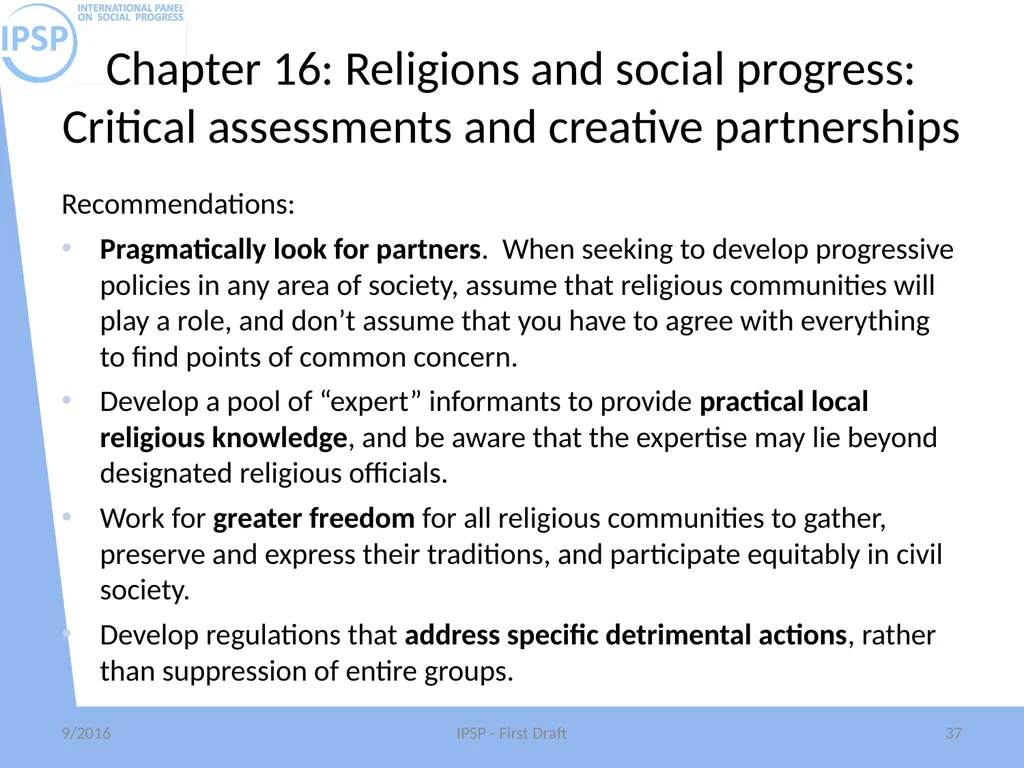
Recommendations:
Pragmatically look for partners. When seeking to develop progressive policies in any area of society, assume that religious communities will play a role, and don’t assume that you have to agree with everything to find points of common concern.
Develop a pool of “expert” informants to provide practical local religious knowledge, and be aware that the expertise may lie beyond designated religious officials.
Work for greater freedom for all religious communities to gather, preserve and express their traditions, and participate equitably in civil society.
Develop regulations that address specific detrimental actions, rather than suppression of entire groups. 9/2016 IPSP - First Draft 37 Chapter 16: Religions and social progress: Critical assessments and creative partnerships<br>
Pragmatically look for partners. When seeking to develop progressive policies in any area of society, assume that religious communities will play a role, and don’t assume that you have to agree with everything to find points of common concern.
Develop a pool of “expert” informants to provide practical local religious knowledge, and be aware that the expertise may lie beyond designated religious officials.
Work for greater freedom for all religious communities to gather, preserve and express their traditions, and participate equitably in civil society.
Develop regulations that address specific detrimental actions, rather than suppression of entire groups. 9/2016 IPSP - First Draft 37 Chapter 16: Religions and social progress: Critical assessments and creative partnerships<br>
38
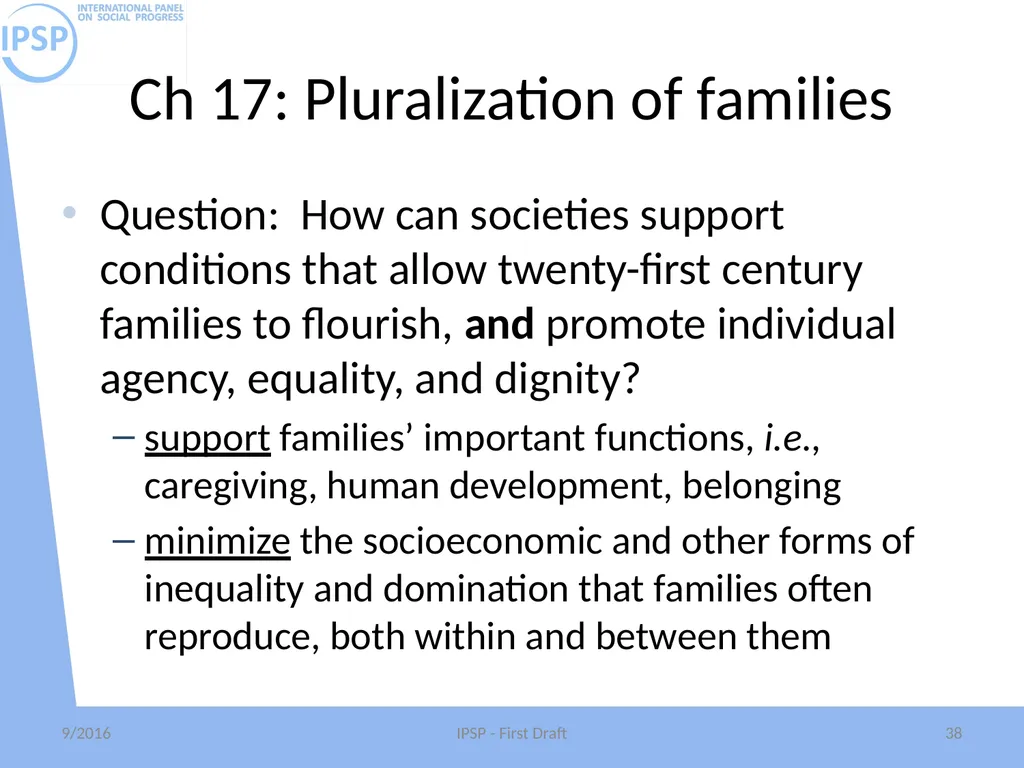
Ch 17: Pluralization of families Question: How can societies support conditions that allow twenty-first century families to flourish, and promote individual agency, equality, and dignity?
support families’ important functions, i.e., caregiving, human development, belonging
minimize the socioeconomic and other forms of inequality and domination that families often reproduce, both within and between them 9/2016 IPSP - First Draft 38<br>
support families’ important functions, i.e., caregiving, human development, belonging
minimize the socioeconomic and other forms of inequality and domination that families often reproduce, both within and between them 9/2016 IPSP - First Draft 38<br>
39
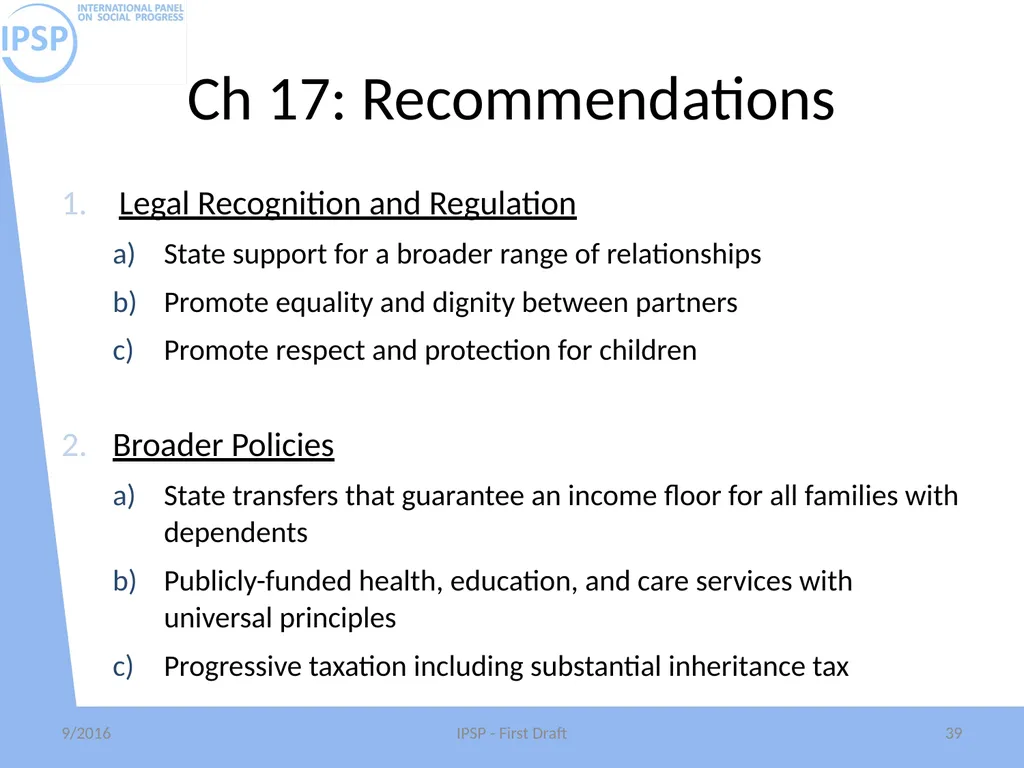
Ch 17: Recommendations Legal Recognition and Regulation
State support for a broader range of relationships
Promote equality and dignity between partners
Promote respect and protection for children
Broader Policies
State transfers that guarantee an income floor for all families with dependents
Publicly-funded health, education, and care services with universal principles
Progressive taxation including substantial inheritance tax 9/2016 IPSP - First Draft 39<br>
State support for a broader range of relationships
Promote equality and dignity between partners
Promote respect and protection for children
Broader Policies
State transfers that guarantee an income floor for all families with dependents
Publicly-funded health, education, and care services with universal principles
Progressive taxation including substantial inheritance tax 9/2016 IPSP - First Draft 39<br>
40
Ch 18 Global health and the changing contours of human life, Key Messages 9/2016 IPSP - First Draft 40 There has been unprecedented and significant progress in reducing premature death, extending life, and relieving the burden of disease.
Even the poorest countries have seen huge reductions in child mortality, and life expectancy is increasing in most of the world. Broader choices are available for individuals (reproduction, enhancement, dying).
Serious inequalities remain both within and between countries. The population health agenda is unfinished.
Political, military, economic, environmental and socio-epidemiological risks may portend an end to decades of progress<br>
Even the poorest countries have seen huge reductions in child mortality, and life expectancy is increasing in most of the world. Broader choices are available for individuals (reproduction, enhancement, dying).
Serious inequalities remain both within and between countries. The population health agenda is unfinished.
Political, military, economic, environmental and socio-epidemiological risks may portend an end to decades of progress<br>
41
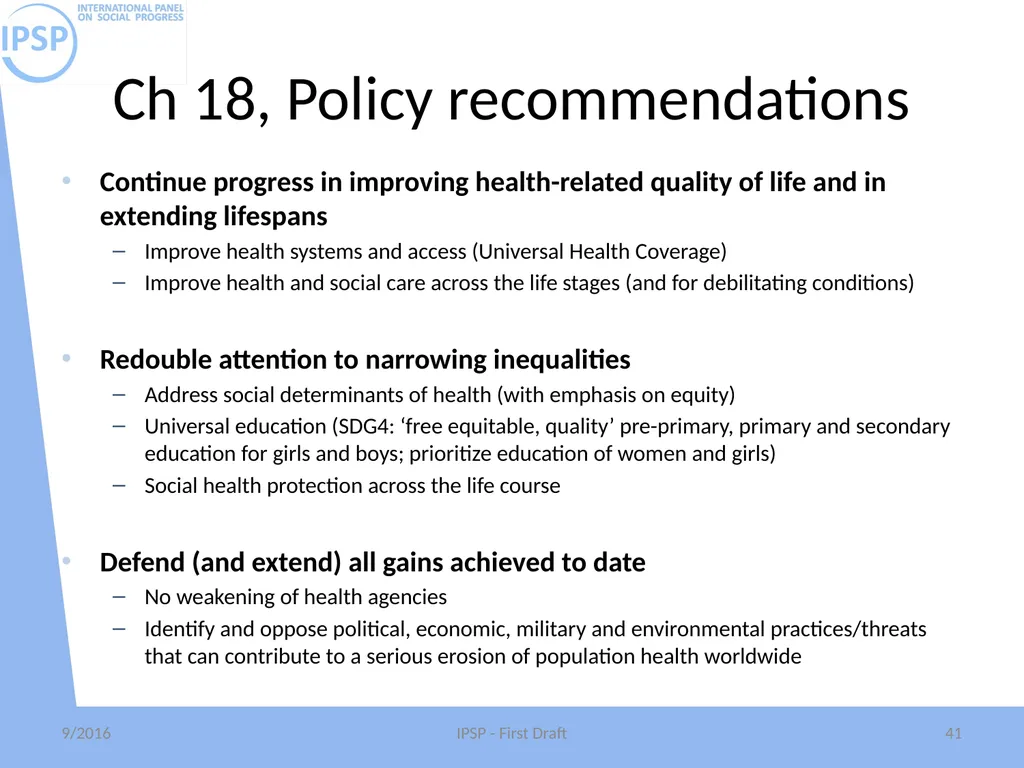
Ch 18, Policy recommendations 9/2016 IPSP - First Draft 41 Continue progress in improving health-related quality of life and in extending lifespans
Improve health systems and access (Universal Health Coverage)
Improve health and social care across the life stages (and for debilitating conditions)
Redouble attention to narrowing inequalities
Address social determinants of health (with emphasis on equity)
Universal education (SDG4: ‘free equitable, quality’ pre-primary, primary and secondary education for girls and boys; prioritize education of women and girls)
Social health protection across the life course
Defend (and extend) all gains achieved to date
No weakening of health agencies
Identify and oppose political, economic, military and environmental practices/threats that can contribute to a serious erosion of population health worldwide<br>
Improve health systems and access (Universal Health Coverage)
Improve health and social care across the life stages (and for debilitating conditions)
Redouble attention to narrowing inequalities
Address social determinants of health (with emphasis on equity)
Universal education (SDG4: ‘free equitable, quality’ pre-primary, primary and secondary education for girls and boys; prioritize education of women and girls)
Social health protection across the life course
Defend (and extend) all gains achieved to date
No weakening of health agencies
Identify and oppose political, economic, military and environmental practices/threats that can contribute to a serious erosion of population health worldwide<br>
42
9/2016 IPSP - First Draft 42 Chapter 19: How can education promote social progress? Education should have four distinct goals to promote social progress:
CIVIC GOAL: Education develops civic skills, and this is valuable for the individual, to allow for meaningful participation in civil society and political life, and for sustainable development, to benefit from an informed and engaged citizenship.
ECONOMIC GOAL: Education develops productive skills, and this is valuable for the individual, to advance in the labor market and for society, to improve and maintain prosperity and compete in a globalized economy.
HUMANISTIC GOAL: Education develops human talents and interests, and this is valuable for the individual, allowing for personal flourishing, and for society, since the expansion of knowledge and human achievement are valuable for their own sake.
EQUITY GOAL: Education can be a vehicle for equity and greater social inclusion, or when absent, poorly delivered or unfairly distributed, a vehicle for injustice and greater social exclusion.<br>
CIVIC GOAL: Education develops civic skills, and this is valuable for the individual, to allow for meaningful participation in civil society and political life, and for sustainable development, to benefit from an informed and engaged citizenship.
ECONOMIC GOAL: Education develops productive skills, and this is valuable for the individual, to advance in the labor market and for society, to improve and maintain prosperity and compete in a globalized economy.
HUMANISTIC GOAL: Education develops human talents and interests, and this is valuable for the individual, allowing for personal flourishing, and for society, since the expansion of knowledge and human achievement are valuable for their own sake.
EQUITY GOAL: Education can be a vehicle for equity and greater social inclusion, or when absent, poorly delivered or unfairly distributed, a vehicle for injustice and greater social exclusion.<br>
43
9/2016 IPSP - First Draft 43 Chapter 19: How can education promote social progress? Recommendations
Taking into account the four goals, apply a balanced approach to educational reform, including teacher education. This means putting more emphasis on the civic and humanistic goals e.g.,
reform curricula that include capacity building for collective actions and enabling individual empowerment– civic goal;
give space for the humanity subjects in the curriculum – humanistic goal;
close gaps in access to, experiences in, and outcomes of education – equity goal;
align education provision with the needs of the formal and informal economy – economic goal
Make more research informed policy
taking into account different methodological approaches focusing all four goals – beyond PISA and university rankings – and combine global and local research perspectives
Promote governance structures that are flexible, participatory, and accountable considering the political and social context<br>
Taking into account the four goals, apply a balanced approach to educational reform, including teacher education. This means putting more emphasis on the civic and humanistic goals e.g.,
reform curricula that include capacity building for collective actions and enabling individual empowerment– civic goal;
give space for the humanity subjects in the curriculum – humanistic goal;
close gaps in access to, experiences in, and outcomes of education – equity goal;
align education provision with the needs of the formal and informal economy – economic goal
Make more research informed policy
taking into account different methodological approaches focusing all four goals – beyond PISA and university rankings – and combine global and local research perspectives
Promote governance structures that are flexible, participatory, and accountable considering the political and social context<br>
44
Ch 20 This chapter contains an analytical elaboration of the theoretical issues at stake in the concept of belonging and then proceeds with an extensive empirical report on how these questions of belonging have surfaced in different parts of the world.
The analysis views belonging from three different conceptual angles –-belonging as identity, as solidarity, and as consisting in an unalienated life.
The first is discussed in purely descriptive terms : how, despite each individual possessing multiple identities, we nevertheless often allow ourselves to be mobilized into a form of (identity) politics on the basis of one or other of them in relatively (if not permanently) fixed terms.? This fixity is understood in terms of pre-commitments that bind one to certain commitments in the future, whether they are religious, ethnic, national… 9/2016 IPSP - First Draft 44<br>
The analysis views belonging from three different conceptual angles –-belonging as identity, as solidarity, and as consisting in an unalienated life.
The first is discussed in purely descriptive terms : how, despite each individual possessing multiple identities, we nevertheless often allow ourselves to be mobilized into a form of (identity) politics on the basis of one or other of them in relatively (if not permanently) fixed terms.? This fixity is understood in terms of pre-commitments that bind one to certain commitments in the future, whether they are religious, ethnic, national… 9/2016 IPSP - First Draft 44<br>
45
Ch 20 The other two forms of belonging are discussed in normative terms, as social ideals with broad political and economic implications. Belonging as solidarity is at its most challenging when the solidarity is between individuals from different groups rather than within a group. What constitutes this more ambitious form of solidarity is the possibility of engaging with opposed points of view from within their motivational psychology.
The theoretical section finally argues that the unalienated life is properly seen as an ideal that is even more fundamental than the ideals of liberty and equality, in the sense that liberty and equality are not self-standing goals but goals in the service of achieving a social life of unalienated relations. So understood, not only might some of the tension that now exists between the ideals of liberty and equality be resolved, but the pursuit of equality would not be a mere form of social engineering. 9/2016 IPSP - First Draft 45<br>
The theoretical section finally argues that the unalienated life is properly seen as an ideal that is even more fundamental than the ideals of liberty and equality, in the sense that liberty and equality are not self-standing goals but goals in the service of achieving a social life of unalienated relations. So understood, not only might some of the tension that now exists between the ideals of liberty and equality be resolved, but the pursuit of equality would not be a mere form of social engineering. 9/2016 IPSP - First Draft 45<br>
46
Ch 20 The regional accounts survey a wide range of identity politics in different parts of the world, as well as the challenges that these pose for cross-cultural solidarities and a variety of social and economic sources of alienation. Abstracting away from the (important and diverse) details of the particular regions, they yield some general and tentative conclusions about the prospects and possibilities for belonging
A good general question by which these may be approached is to ask:
How might we conceive the ideal of belonging in terms of our overall theme of social progress? As we see it, progress in the realm of belonging occurs when it becomes less fixed and more inclusive. 9/2016 IPSP - First Draft 46<br>
A good general question by which these may be approached is to ask:
How might we conceive the ideal of belonging in terms of our overall theme of social progress? As we see it, progress in the realm of belonging occurs when it becomes less fixed and more inclusive. 9/2016 IPSP - First Draft 46<br>
47
Ch 20 In terms of the three aspects of belonging (identity, solidarity, and the unalienated life), this would amount to overcoming identities in the narrow sense and this emerges as a result of increasingly unalienated social relations and the cultivation of greater solidarities over different groups rather than within groups.
How such progress is made may emerge from a variety of conditions and may be variably pursued. But our regional surveys suggest that, central to these various possibilities is the need to stress and to integrate two different agencies in any large scale effort towards these ends: on the one hand the role of the state and the policies and reforms it can enact and on the other the element of democratic mobilization. The latter has two functions. Movements can put pressure on the state to enact the requisite policies, but movements can also themselves be locations of public education through democratic collective deliberation, which if sustained over time, helps to create solidarities that transcend particular identities of language, ethnicity, religion etc towards a common register of concepts and ideals. 9/2016 IPSP - First Draft 47<br>
How such progress is made may emerge from a variety of conditions and may be variably pursued. But our regional surveys suggest that, central to these various possibilities is the need to stress and to integrate two different agencies in any large scale effort towards these ends: on the one hand the role of the state and the policies and reforms it can enact and on the other the element of democratic mobilization. The latter has two functions. Movements can put pressure on the state to enact the requisite policies, but movements can also themselves be locations of public education through democratic collective deliberation, which if sustained over time, helps to create solidarities that transcend particular identities of language, ethnicity, religion etc towards a common register of concepts and ideals. 9/2016 IPSP - First Draft 47<br>
48
Ch 20 The regional surveys threw up a range of more specific conclusions, Here is a brief selection.
The reports from Canada and Sri Lanka propose startlingly different policies, the former weighing in in favour of recognition of communitarian identities that should be dialogically brought together, the Sri Lankan report stressing a more top-down state intervention that discourages such communitarian differences for a more civic form of popular participation. One report on Europe traverses the vexed forms of exclusion that owe to language, in particular how deliberative democracy may be blocked by language constraints --first by lack of knowledge of the language of debate and then further by lack of access to the conceptual register of debate. The report on Islamic nations is a historical account of how Islamic identities and ideologies formed into an ethical register, despite seemingly politically articulated goals. 9/2016 IPSP - First Draft 48<br>
The reports from Canada and Sri Lanka propose startlingly different policies, the former weighing in in favour of recognition of communitarian identities that should be dialogically brought together, the Sri Lankan report stressing a more top-down state intervention that discourages such communitarian differences for a more civic form of popular participation. One report on Europe traverses the vexed forms of exclusion that owe to language, in particular how deliberative democracy may be blocked by language constraints --first by lack of knowledge of the language of debate and then further by lack of access to the conceptual register of debate. The report on Islamic nations is a historical account of how Islamic identities and ideologies formed into an ethical register, despite seemingly politically articulated goals. 9/2016 IPSP - First Draft 48<br>
49
Chapter 21 Key Points 9/2016 IPSP - First Draft 49 Social progress represents a broad gradient for multiple directions of change requiring more collective deliberation and commitment.
Social progress and democratic processes are in danger of reversal.
Current patterns of capitalist development are contributing to inequalities that both violate principles of economic justice and impede cooperative solutions to pressing social problems.
Scientific knowledge in general and social sciences in particular are conduits of power that can impede social progress.
Misaligned incentives, lack of accountability and propensities to lock-in can make patterns of technological innovation an obstacle to social progress.<br>
Social progress and democratic processes are in danger of reversal.
Current patterns of capitalist development are contributing to inequalities that both violate principles of economic justice and impede cooperative solutions to pressing social problems.
Scientific knowledge in general and social sciences in particular are conduits of power that can impede social progress.
Misaligned incentives, lack of accountability and propensities to lock-in can make patterns of technological innovation an obstacle to social progress.<br>
50
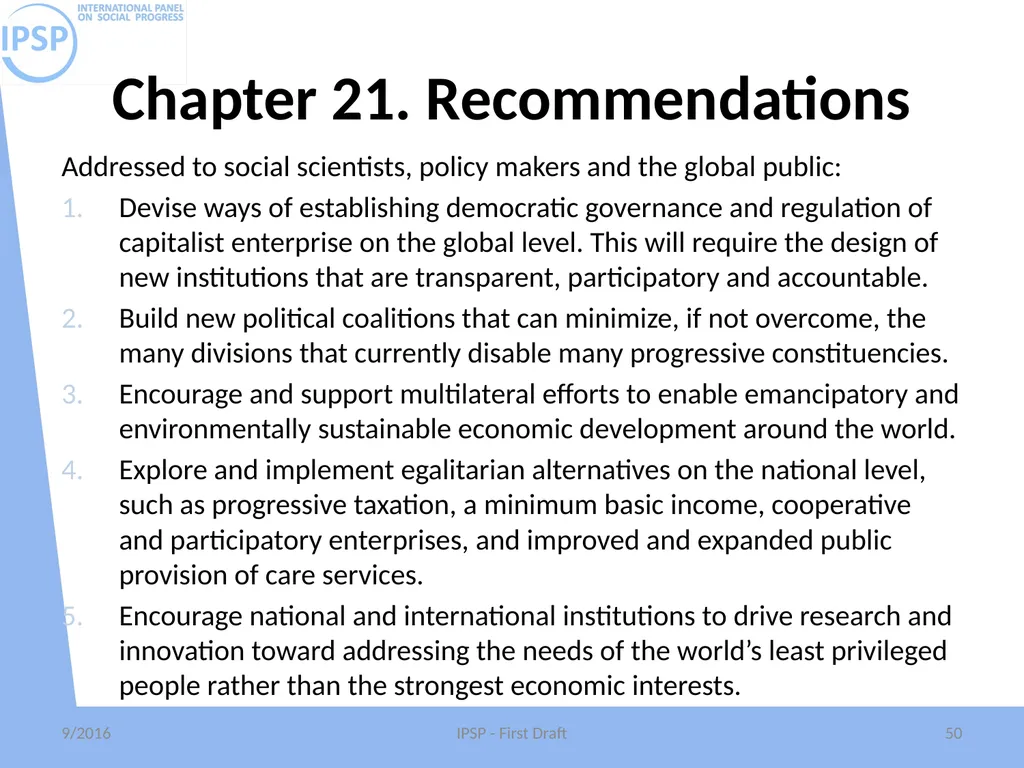
Chapter 21. Recommendations Addressed to social scientists, policy makers and the global public:
Devise ways of establishing democratic governance and regulation of capitalist enterprise on the global level. This will require the design of new institutions that are transparent, participatory and accountable.
Build new political coalitions that can minimize, if not overcome, the many divisions that currently disable many progressive constituencies.
Encourage and support multilateral efforts to enable emancipatory and environmentally sustainable economic development around the world.
Explore and implement egalitarian alternatives on the national level, such as progressive taxation, a minimum basic income, cooperative and participatory enterprises, and improved and expanded public provision of care services.
Encourage national and international institutions to drive research and innovation toward addressing the needs of the world’s least privileged people rather than the strongest economic interests. 9/2016 IPSP - First Draft 50<br>
Devise ways of establishing democratic governance and regulation of capitalist enterprise on the global level. This will require the design of new institutions that are transparent, participatory and accountable.
Build new political coalitions that can minimize, if not overcome, the many divisions that currently disable many progressive constituencies.
Encourage and support multilateral efforts to enable emancipatory and environmentally sustainable economic development around the world.
Explore and implement egalitarian alternatives on the national level, such as progressive taxation, a minimum basic income, cooperative and participatory enterprises, and improved and expanded public provision of care services.
Encourage national and international institutions to drive research and innovation toward addressing the needs of the world’s least privileged people rather than the strongest economic interests. 9/2016 IPSP - First Draft 50<br>
51
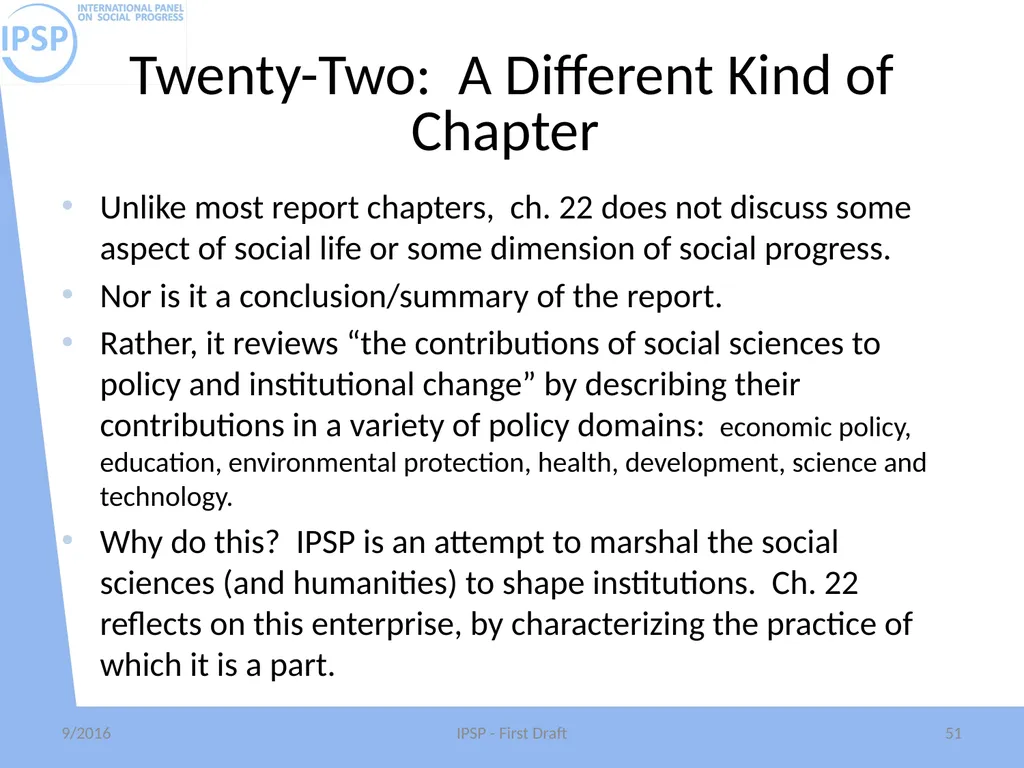
Twenty-Two: A Different Kind of Chapter 9/2016 IPSP - First Draft 51 Unlike most report chapters, ch. 22 does not discuss some aspect of social life or some dimension of social progress.
Nor is it a conclusion/summary of the report.
Rather, it reviews “the contributions of social sciences to policy and institutional change” by describing their contributions in a variety of policy domains: economic policy, education, environmental protection, health, development, science and technology.
Why do this? IPSP is an attempt to marshal the social sciences (and humanities) to shape institutions. Ch. 22 reflects on this enterprise, by characterizing the practice of which it is a part.<br>
Nor is it a conclusion/summary of the report.
Rather, it reviews “the contributions of social sciences to policy and institutional change” by describing their contributions in a variety of policy domains: economic policy, education, environmental protection, health, development, science and technology.
Why do this? IPSP is an attempt to marshal the social sciences (and humanities) to shape institutions. Ch. 22 reflects on this enterprise, by characterizing the practice of which it is a part.<br>
52
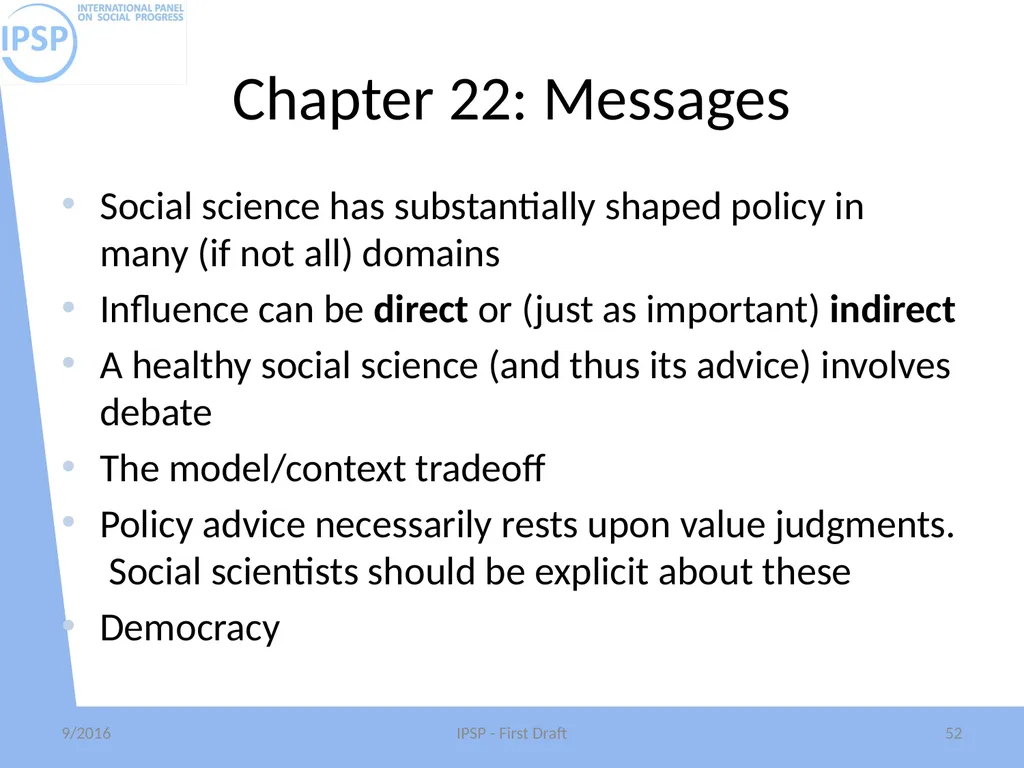
9/2016 IPSP - First Draft 52 Chapter 22: Messages Social science has substantially shaped policy in many (if not all) domains
Influence can be direct or (just as important) indirect
A healthy social science (and thus its advice) involves debate
The model/context tradeoff
Policy advice necessarily rests upon value judgments. Social scientists should be explicit about these
Democracy<br>
Influence can be direct or (just as important) indirect
A healthy social science (and thus its advice) involves debate
The model/context tradeoff
Policy advice necessarily rests upon value judgments. Social scientists should be explicit about these
Democracy<br>