
Issues in Participating Fund Management Guide :
CS
Published · 30 slides · 0 views

1 / 1


Description
Issues in Participating Fund Management Guide : Sanchit Maini Presented By : 1. Anurag Goyal 2. Nitin Agarwal 3. Sumit Dutta 4. Tablesh Pandey 35th India Fellowship Webinar Date: 16 July 2021 www.actuariesindia.org Introduction of Guide:
Related Topics
Share
Embed code
Download this presentation From Below
"Issues in Participating Fund Management Guide :" is the property of its rightful owner. Permission is granted to download and print the materials on this website for personal, non-commercial use only, and to display it on your personal computer provided you do not modify the materials and that you retain all copyright notices contained in the materials. By downloading content from our website, you accept the terms of this agreement.
Presentation Transcript
01
Issues in Participating Fund Management Guide : Sanchit Maini
Presented By :
1. Anurag Goyal
2. Nitin Agarwal
3. Sumit Dutta
4. Tablesh Pandey 35th India Fellowship Webinar
Date: 16 July 2021<br>
Presented By :
1. Anurag Goyal
2. Nitin Agarwal
3. Sumit Dutta
4. Tablesh Pandey 35th India Fellowship Webinar
Date: 16 July 2021<br>
02
www.actuariesindia.org Introduction of Guide: Sanchit Maini Sanchit is an actuary and risk manager having worked in the insurance industry for over 20 years across various firms and actuarial consulting. His experience covers risk management, financial management and reporting, product development and propositions, business planning and market entry. His work experience spans various markets across Asia, the UK, US and France.
Sanchit is currently Chief Financial and Operational Risk Officer covering risk management for Prudential’s Asia and Africa businesses.
Sanchit is a Fellow of the Institute of Actuaries of Australia, India and Singapore (FIAA, FIAI, FSAS) and a Chartered Enterprise Risk Actuary (CERA).<br>
Sanchit is currently Chief Financial and Operational Risk Officer covering risk management for Prudential’s Asia and Africa businesses.
Sanchit is a Fellow of the Institute of Actuaries of Australia, India and Singapore (FIAA, FIAI, FSAS) and a Chartered Enterprise Risk Actuary (CERA).<br>
03
www.actuariesindia.org Background Questions
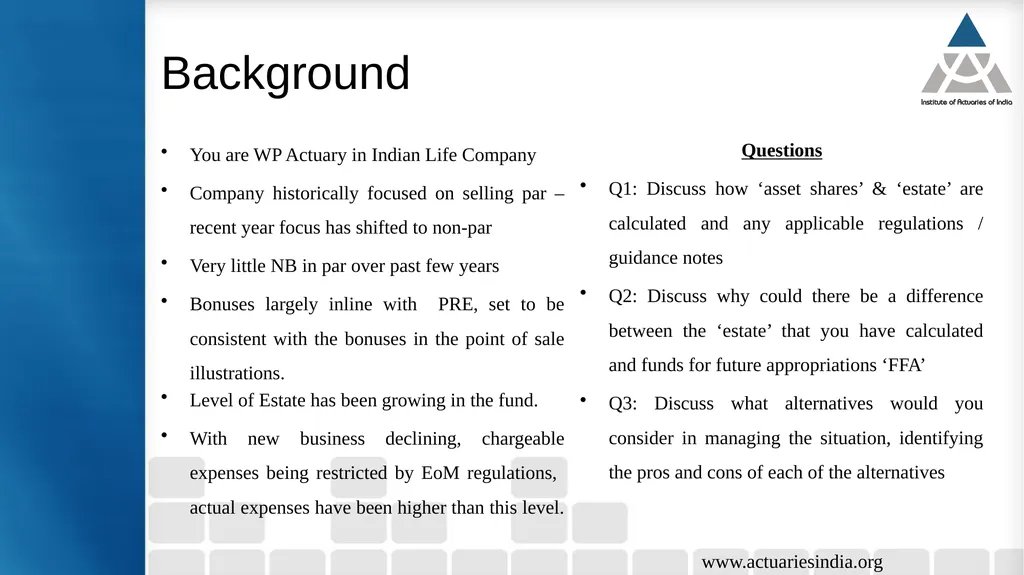
Q1: Discuss how ‘asset shares’ & ‘estate’ are calculated and any applicable regulations / guidance notes
Q2: Discuss why could there be a difference between the ‘estate’ that you have calculated and funds for future appropriations ‘FFA’
Q3: Discuss what alternatives would you consider in managing the situation, identifying the pros and cons of each of the alternatives You are WP Actuary in Indian Life Company
Company historically focused on selling par – recent year focus has shifted to non-par
Very little NB in par over past few years
Bonuses largely inline with PRE, set to be consistent with the bonuses in the point of sale illustrations.
Level of Estate has been growing in the fund.
With new business declining, chargeable expenses being restricted by EoM regulations, actual expenses have been higher than this level.<br>
Q1: Discuss how ‘asset shares’ & ‘estate’ are calculated and any applicable regulations / guidance notes
Q2: Discuss why could there be a difference between the ‘estate’ that you have calculated and funds for future appropriations ‘FFA’
Q3: Discuss what alternatives would you consider in managing the situation, identifying the pros and cons of each of the alternatives You are WP Actuary in Indian Life Company
Company historically focused on selling par – recent year focus has shifted to non-par
Very little NB in par over past few years
Bonuses largely inline with PRE, set to be consistent with the bonuses in the point of sale illustrations.
Level of Estate has been growing in the fund.
With new business declining, chargeable expenses being restricted by EoM regulations, actual expenses have been higher than this level.<br>
04
www.actuariesindia.org Agenda Calculation of Asset Shares & Estate
Applicable regulations and Professional Guidance
Key similarities and differences between Estate and FFA
Alternatives available to insurer with advantages and disadvantages<br>
Applicable regulations and Professional Guidance
Key similarities and differences between Estate and FFA
Alternatives available to insurer with advantages and disadvantages<br>
05
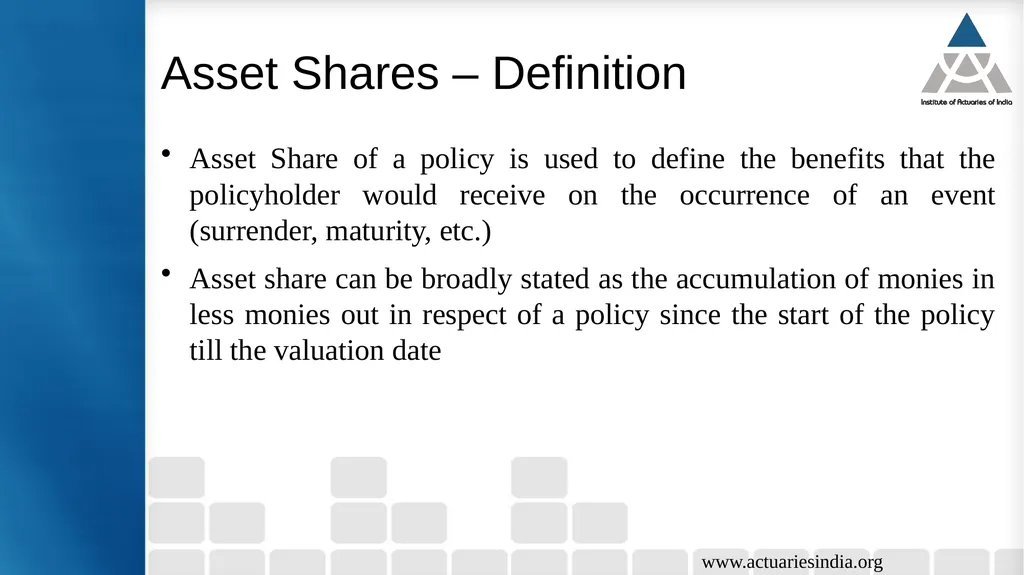
www.actuariesindia.org Asset Shares – Definition Asset Share of a policy is used to define the benefits that the policyholder would receive on the occurrence of an event (surrender, maturity, etc.)
Asset share can be broadly stated as the accumulation of monies in less monies out in respect of a policy since the start of the policy till the valuation date<br>
Asset share can be broadly stated as the accumulation of monies in less monies out in respect of a policy since the start of the policy till the valuation date<br>
06
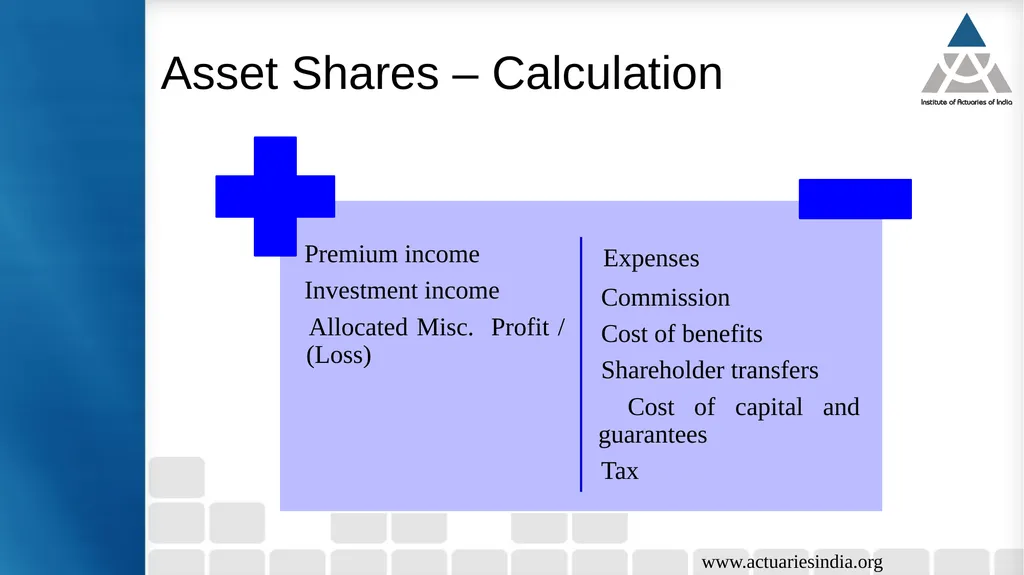
www.actuariesindia.org Asset Shares – Calculation<br>
07
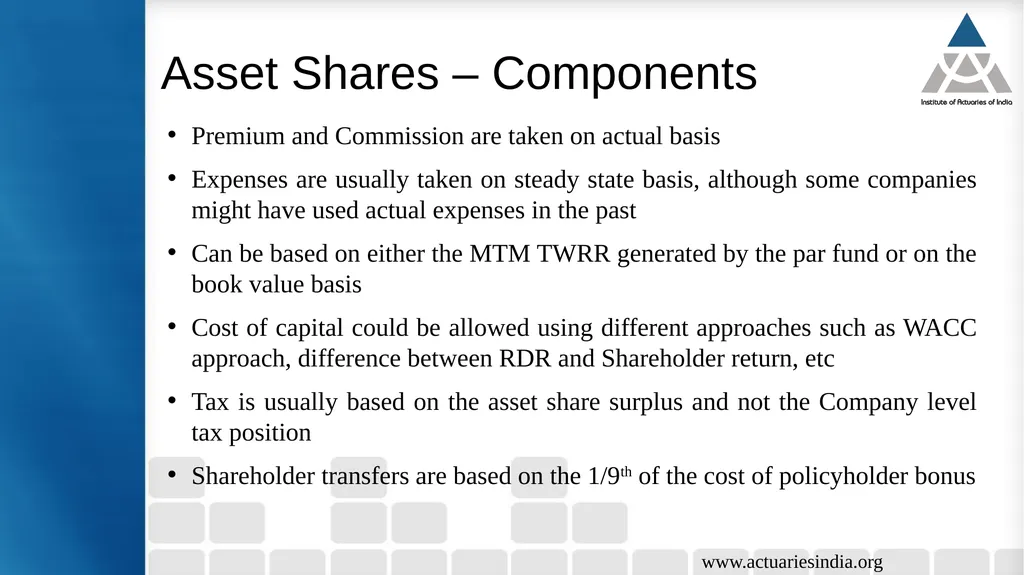
www.actuariesindia.org Asset Shares – Components Premium and Commission are taken on actual basis
Expenses are usually taken on steady state basis, although some companies might have used actual expenses in the past
Can be based on either the MTM TWRR generated by the par fund or on the book value basis
Cost of capital could be allowed using different approaches such as WACC approach, difference between RDR and Shareholder return, etc
Tax is usually based on the asset share surplus and not the Company level tax position
Shareholder transfers are based on the 1/9th of the cost of policyholder bonus<br>
Expenses are usually taken on steady state basis, although some companies might have used actual expenses in the past
Can be based on either the MTM TWRR generated by the par fund or on the book value basis
Cost of capital could be allowed using different approaches such as WACC approach, difference between RDR and Shareholder return, etc
Tax is usually based on the asset share surplus and not the Company level tax position
Shareholder transfers are based on the 1/9th of the cost of policyholder bonus<br>
08
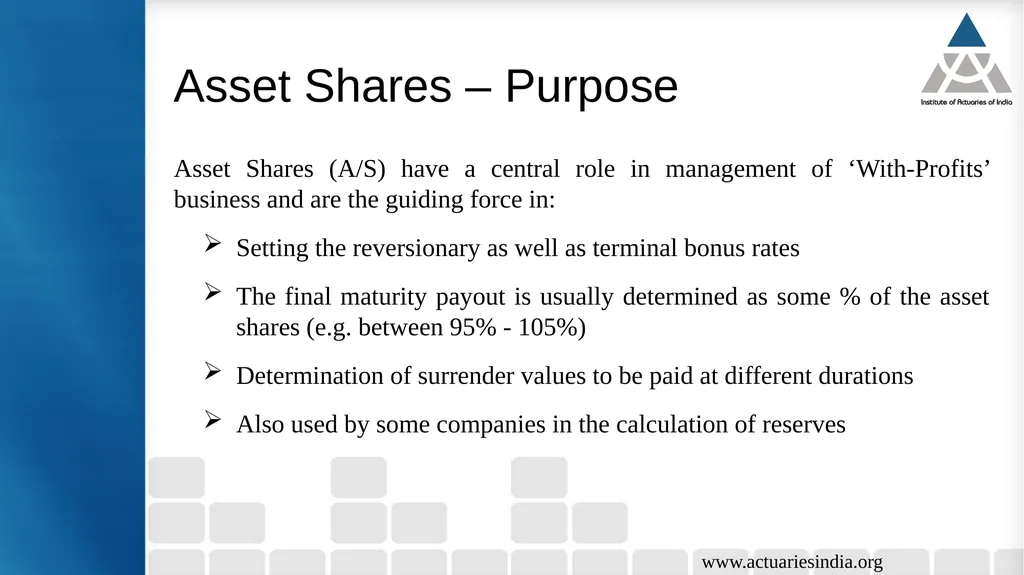
www.actuariesindia.org Asset Shares – Purpose Asset Shares (A/S) have a central role in management of ‘With-Profits’ business and are the guiding force in:
Setting the reversionary as well as terminal bonus rates
The final maturity payout is usually determined as some % of the asset shares (e.g. between 95% - 105%)
Determination of surrender values to be paid at different durations
Also used by some companies in the calculation of reserves<br>
Setting the reversionary as well as terminal bonus rates
The final maturity payout is usually determined as some % of the asset shares (e.g. between 95% - 105%)
Determination of surrender values to be paid at different durations
Also used by some companies in the calculation of reserves<br>
09
Applicable Regulations Clause 34(iv) of Non Linked Product Regulations 2019
The insurer shall ensure maintenance of the Assets Share.
The detailed working of the asset share, the expenses allowed for in the asset share, the investment income earned on the fund and other associated elements which are represented in the asset share shall be determined by the Appointed Actuary. www.actuariesindia.org<br>
The insurer shall ensure maintenance of the Assets Share.
The detailed working of the asset share, the expenses allowed for in the asset share, the investment income earned on the fund and other associated elements which are represented in the asset share shall be determined by the Appointed Actuary. www.actuariesindia.org<br>
10
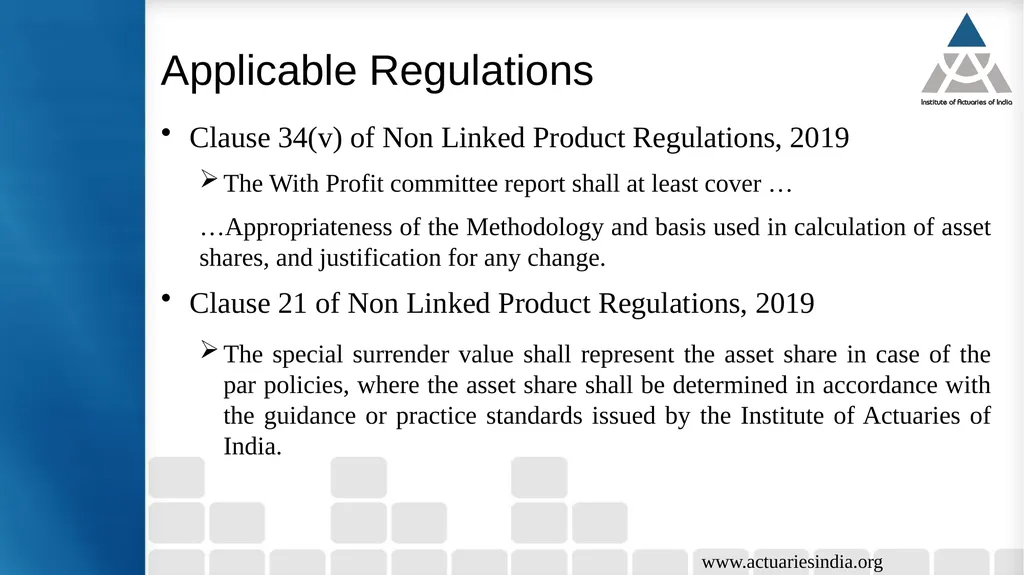
Applicable Regulations Clause 34(v) of Non Linked Product Regulations, 2019
The With Profit committee report shall at least cover …
…Appropriateness of the Methodology and basis used in calculation of asset shares, and justification for any change.
Clause 21 of Non Linked Product Regulations, 2019
The special surrender value shall represent the asset share in case of the par policies, where the asset share shall be determined in accordance with the guidance or practice standards issued by the Institute of Actuaries of India. www.actuariesindia.org<br>
The With Profit committee report shall at least cover …
…Appropriateness of the Methodology and basis used in calculation of asset shares, and justification for any change.
Clause 21 of Non Linked Product Regulations, 2019
The special surrender value shall represent the asset share in case of the par policies, where the asset share shall be determined in accordance with the guidance or practice standards issued by the Institute of Actuaries of India. www.actuariesindia.org<br>
11
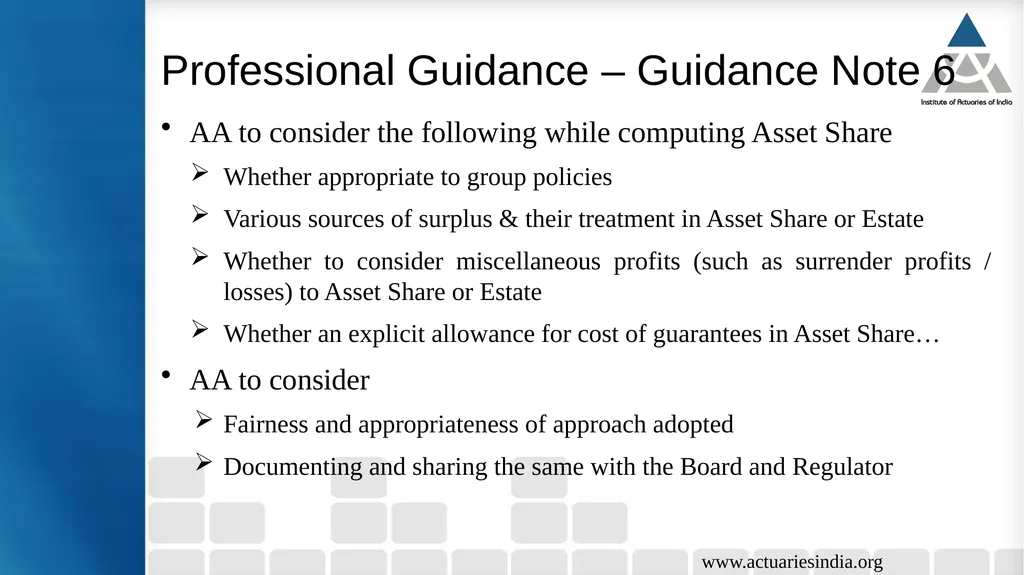
Professional Guidance – Guidance Note 6 AA to consider the following while computing Asset Share
Whether appropriate to group policies
Various sources of surplus & their treatment in Asset Share or Estate
Whether to consider miscellaneous profits (such as surrender profits / losses) to Asset Share or Estate
Whether an explicit allowance for cost of guarantees in Asset Share…
AA to consider
Fairness and appropriateness of approach adopted
Documenting and sharing the same with the Board and Regulator www.actuariesindia.org<br>
Whether appropriate to group policies
Various sources of surplus & their treatment in Asset Share or Estate
Whether to consider miscellaneous profits (such as surrender profits / losses) to Asset Share or Estate
Whether an explicit allowance for cost of guarantees in Asset Share…
AA to consider
Fairness and appropriateness of approach adopted
Documenting and sharing the same with the Board and Regulator www.actuariesindia.org<br>
12
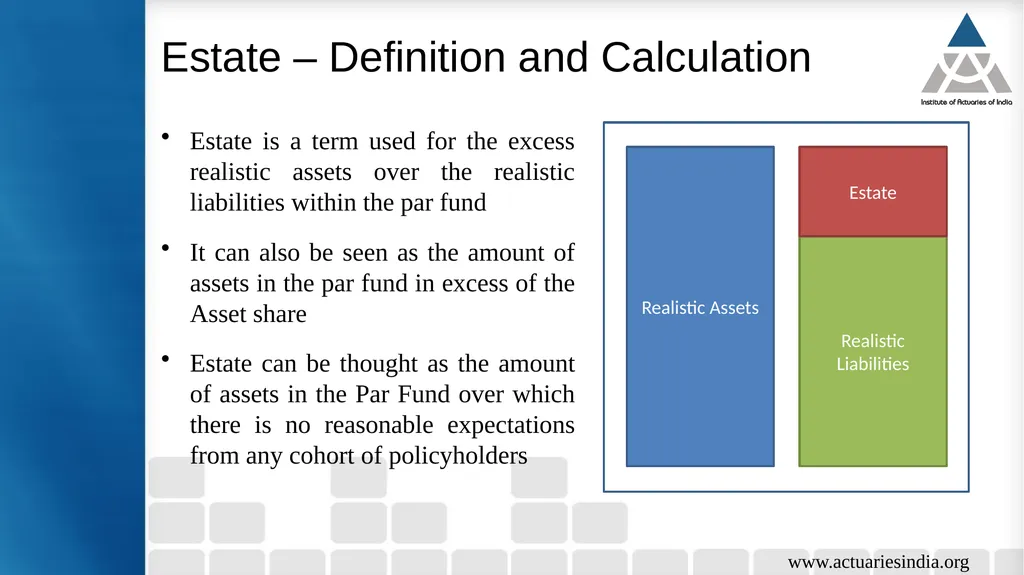
Estate – Definition and Calculation Estate is a term used for the excess realistic assets over the realistic liabilities within the par fund
It can also be seen as the amount of assets in the par fund in excess of the Asset share
Estate can be thought as the amount of assets in the Par Fund over which there is no reasonable expectations from any cohort of policyholders www.actuariesindia.org Realistic Liabilities Estate Realistic Assets<br>
It can also be seen as the amount of assets in the par fund in excess of the Asset share
Estate can be thought as the amount of assets in the Par Fund over which there is no reasonable expectations from any cohort of policyholders www.actuariesindia.org Realistic Liabilities Estate Realistic Assets<br>
13
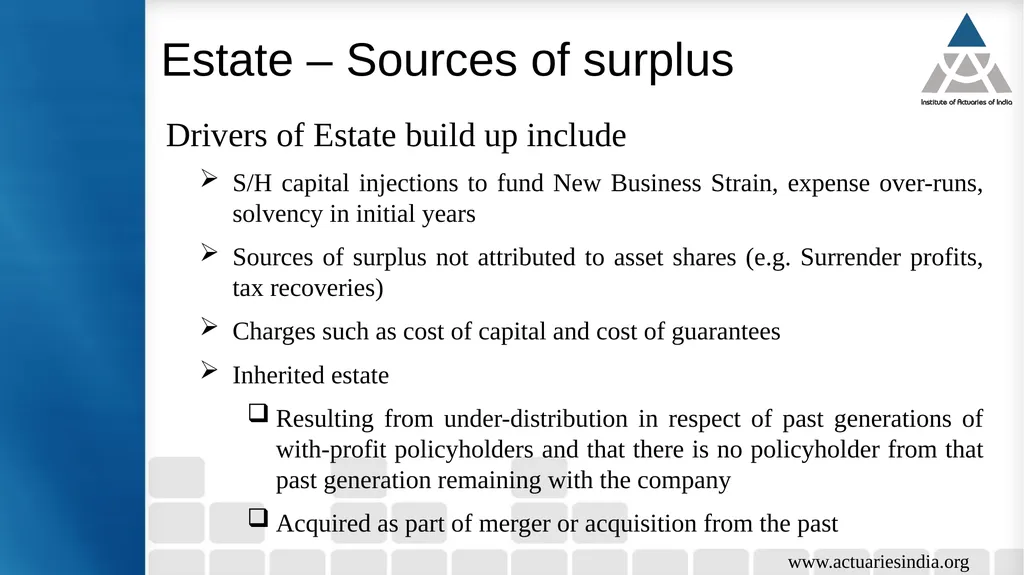
Estate – Sources of surplus Drivers of Estate build up include
S/H capital injections to fund New Business Strain, expense over-runs, solvency in initial years
Sources of surplus not attributed to asset shares (e.g. Surrender profits, tax recoveries)
Charges such as cost of capital and cost of guarantees
Inherited estate
Resulting from under-distribution in respect of past generations of with-profit policyholders and that there is no policyholder from that past generation remaining with the company
Acquired as part of merger or acquisition from the past www.actuariesindia.org<br>
S/H capital injections to fund New Business Strain, expense over-runs, solvency in initial years
Sources of surplus not attributed to asset shares (e.g. Surrender profits, tax recoveries)
Charges such as cost of capital and cost of guarantees
Inherited estate
Resulting from under-distribution in respect of past generations of with-profit policyholders and that there is no policyholder from that past generation remaining with the company
Acquired as part of merger or acquisition from the past www.actuariesindia.org<br>
14
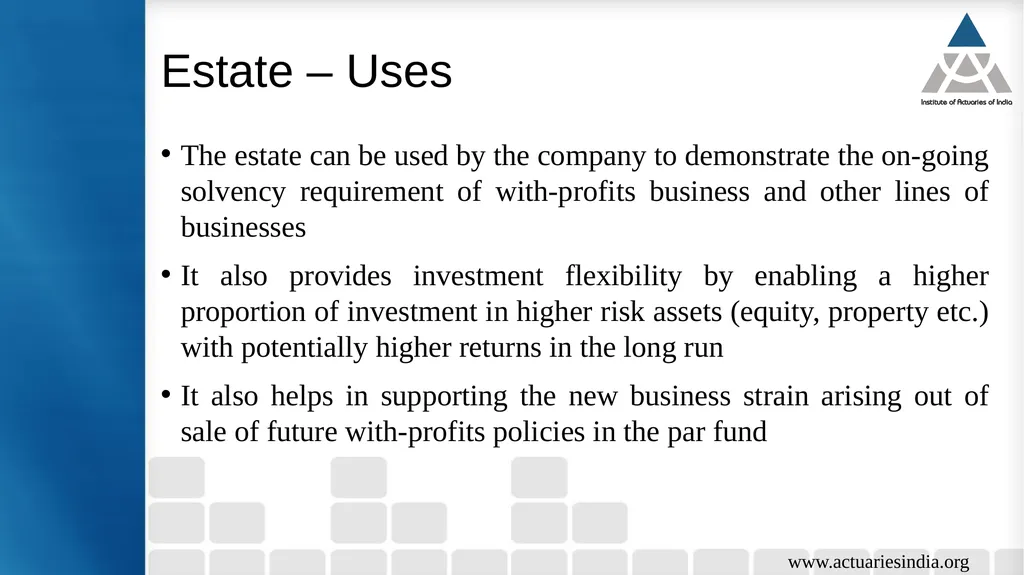
Estate – Uses The estate can be used by the company to demonstrate the on-going solvency requirement of with-profits business and other lines of businesses
It also provides investment flexibility by enabling a higher proportion of investment in higher risk assets (equity, property etc.) with potentially higher returns in the long run
It also helps in supporting the new business strain arising out of sale of future with-profits policies in the par fund www.actuariesindia.org<br>
It also provides investment flexibility by enabling a higher proportion of investment in higher risk assets (equity, property etc.) with potentially higher returns in the long run
It also helps in supporting the new business strain arising out of sale of future with-profits policies in the par fund www.actuariesindia.org<br>
15
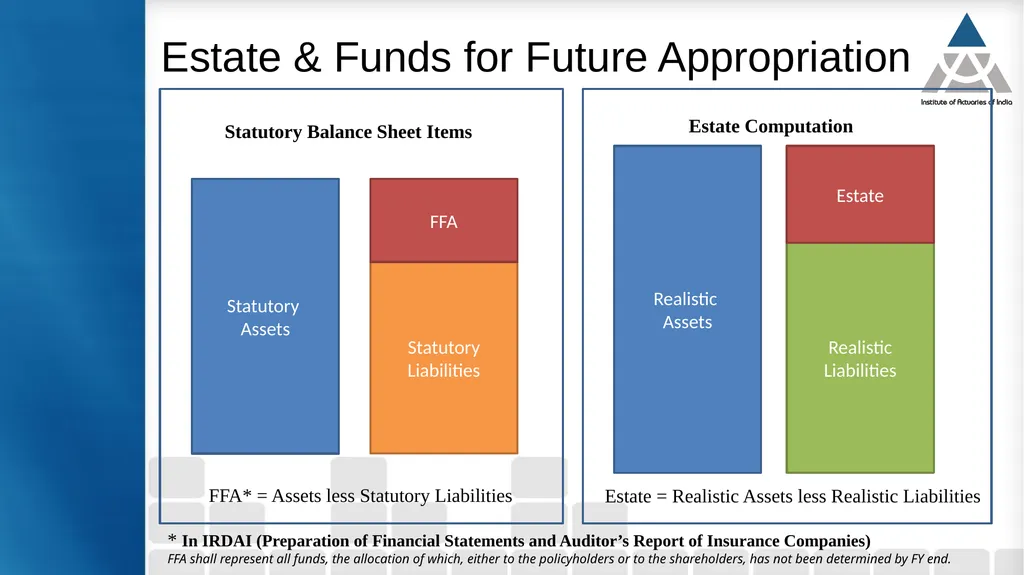
Estate & Funds for Future Appropriation Statutory Liabilities FFA Statutory
Assets Statutory Balance Sheet Items Realistic Liabilities Estate Realistic
Assets Estate Computation FFA* = Assets less Statutory Liabilities Estate = Realistic Assets less Realistic Liabilities * In IRDAI (Preparation of Financial Statements and Auditor’s Report of Insurance Companies)
FFA shall represent all funds, the allocation of which, either to the policyholders or to the shareholders, has not been determined by FY end.<br>
Assets Statutory Balance Sheet Items Realistic Liabilities Estate Realistic
Assets Estate Computation FFA* = Assets less Statutory Liabilities Estate = Realistic Assets less Realistic Liabilities * In IRDAI (Preparation of Financial Statements and Auditor’s Report of Insurance Companies)
FFA shall represent all funds, the allocation of which, either to the policyholders or to the shareholders, has not been determined by FY end.<br>
16
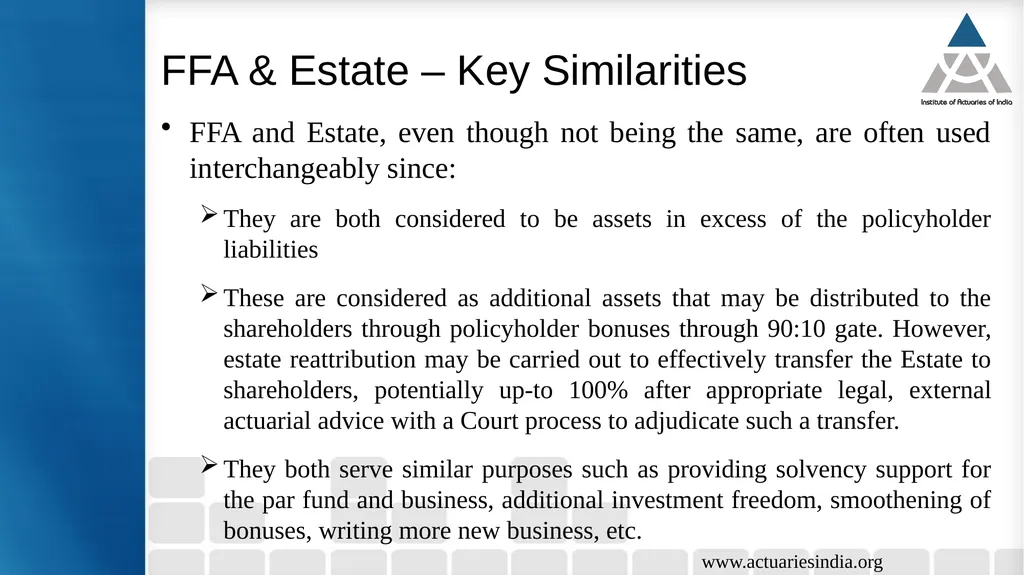
FFA & Estate – Key Similarities FFA and Estate, even though not being the same, are often used interchangeably since:
They are both considered to be assets in excess of the policyholder liabilities
These are considered as additional assets that may be distributed to the shareholders through policyholder bonuses through 90:10 gate. However, estate reattribution may be carried out to effectively transfer the Estate to shareholders, potentially up-to 100% after appropriate legal, external actuarial advice with a Court process to adjudicate such a transfer.
They both serve similar purposes such as providing solvency support for the par fund and business, additional investment freedom, smoothening of bonuses, writing more new business, etc. www.actuariesindia.org<br>
They are both considered to be assets in excess of the policyholder liabilities
These are considered as additional assets that may be distributed to the shareholders through policyholder bonuses through 90:10 gate. However, estate reattribution may be carried out to effectively transfer the Estate to shareholders, potentially up-to 100% after appropriate legal, external actuarial advice with a Court process to adjudicate such a transfer.
They both serve similar purposes such as providing solvency support for the par fund and business, additional investment freedom, smoothening of bonuses, writing more new business, etc. www.actuariesindia.org<br>
17
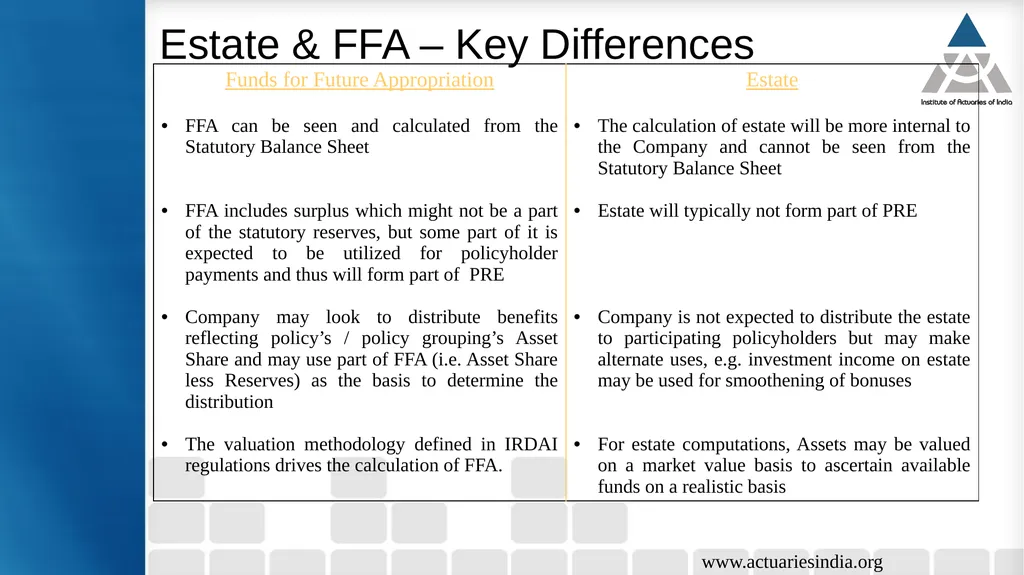
Estate & FFA – Key Differences www.actuariesindia.org<br>
18
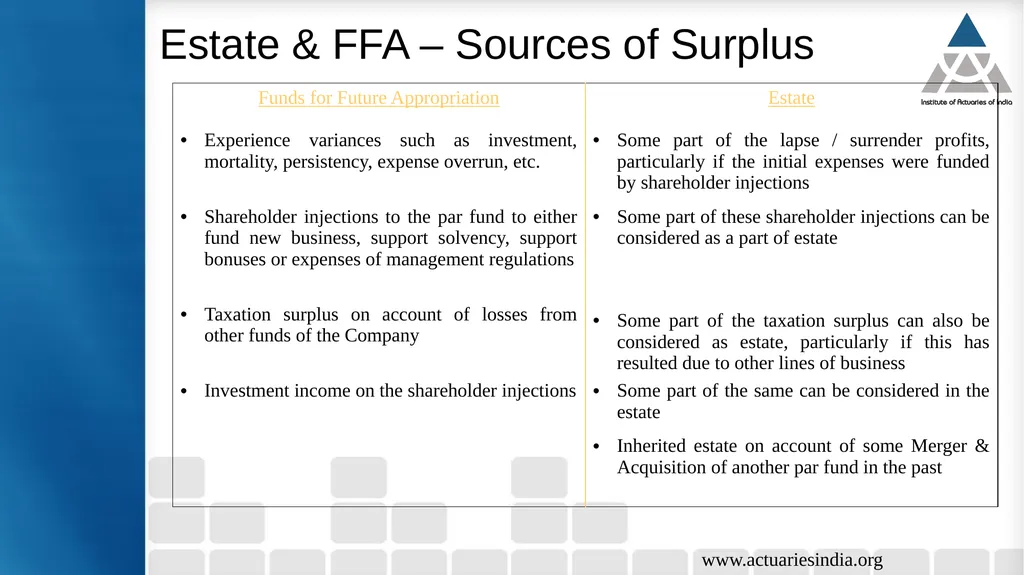
Estate & FFA – Sources of Surplus www.actuariesindia.org<br>
19
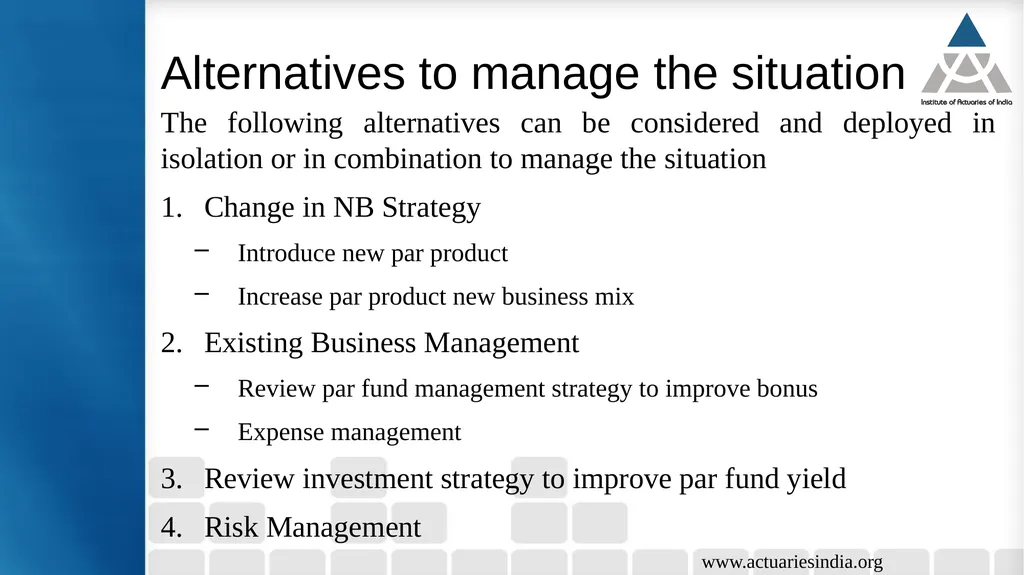
www.actuariesindia.org Alternatives to manage the situation The following alternatives can be considered and deployed in isolation or in combination to manage the situation
Change in NB Strategy
Introduce new par product
Increase par product new business mix
Existing Business Management
Review par fund management strategy to improve bonus
Expense management
Review investment strategy to improve par fund yield
Risk Management<br>
Change in NB Strategy
Introduce new par product
Increase par product new business mix
Existing Business Management
Review par fund management strategy to improve bonus
Expense management
Review investment strategy to improve par fund yield
Risk Management<br>
20
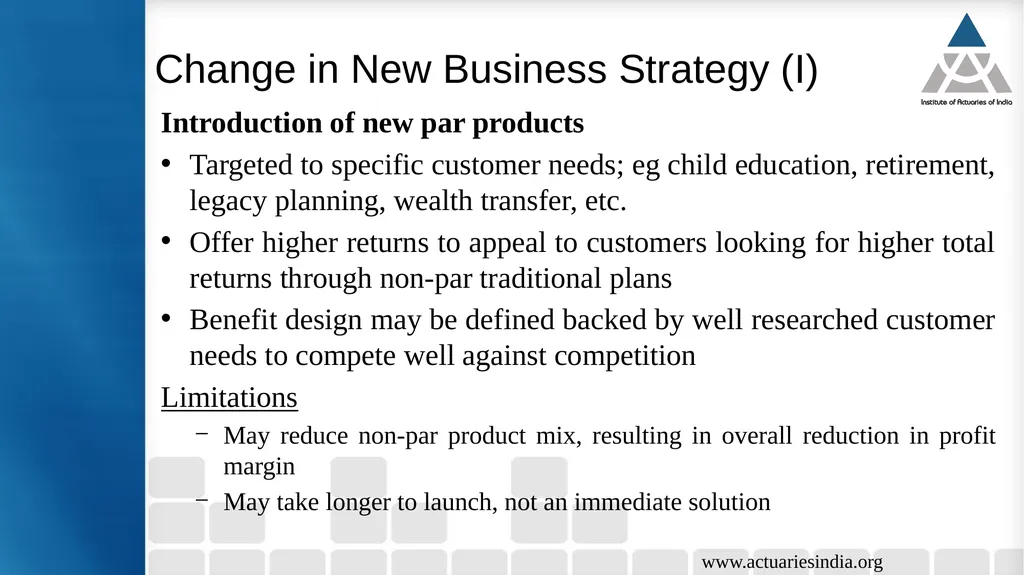
www.actuariesindia.org Change in New Business Strategy (I) Introduction of new par products
Targeted to specific customer needs; eg child education, retirement, legacy planning, wealth transfer, etc.
Offer higher returns to appeal to customers looking for higher total returns through non-par traditional plans
Benefit design may be defined backed by well researched customer needs to compete well against competition
Limitations
May reduce non-par product mix, resulting in overall reduction in profit margin
May take longer to launch, not an immediate solution<br>
Targeted to specific customer needs; eg child education, retirement, legacy planning, wealth transfer, etc.
Offer higher returns to appeal to customers looking for higher total returns through non-par traditional plans
Benefit design may be defined backed by well researched customer needs to compete well against competition
Limitations
May reduce non-par product mix, resulting in overall reduction in profit margin
May take longer to launch, not an immediate solution<br>
21
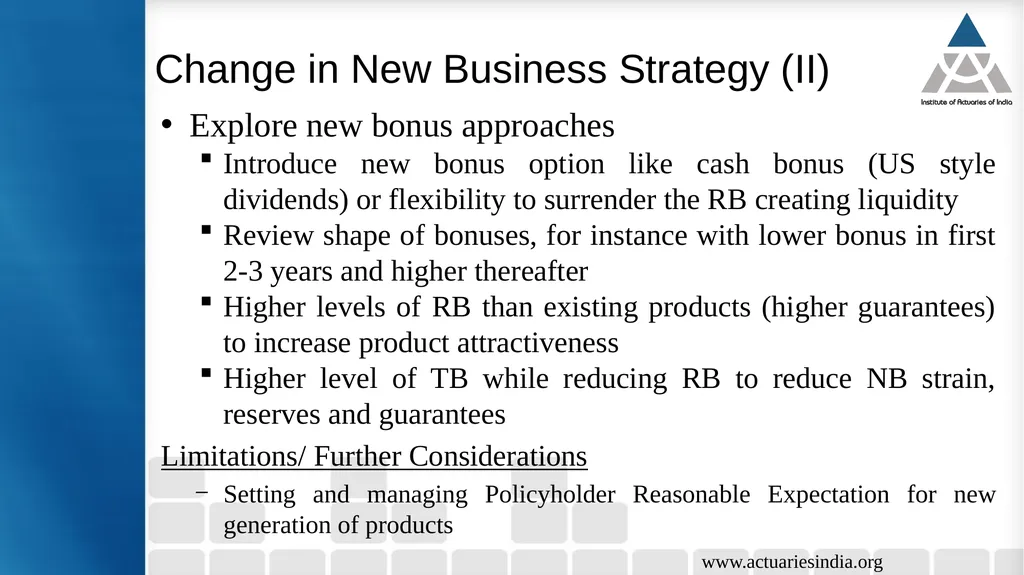
www.actuariesindia.org Change in New Business Strategy (II) Explore new bonus approaches
Introduce new bonus option like cash bonus (US style dividends) or flexibility to surrender the RB creating liquidity
Review shape of bonuses, for instance with lower bonus in first 2-3 years and higher thereafter
Higher levels of RB than existing products (higher guarantees) to increase product attractiveness
Higher level of TB while reducing RB to reduce NB strain, reserves and guarantees
Limitations/ Further Considerations
Setting and managing Policyholder Reasonable Expectation for new generation of products<br>
Introduce new bonus option like cash bonus (US style dividends) or flexibility to surrender the RB creating liquidity
Review shape of bonuses, for instance with lower bonus in first 2-3 years and higher thereafter
Higher levels of RB than existing products (higher guarantees) to increase product attractiveness
Higher level of TB while reducing RB to reduce NB strain, reserves and guarantees
Limitations/ Further Considerations
Setting and managing Policyholder Reasonable Expectation for new generation of products<br>
22
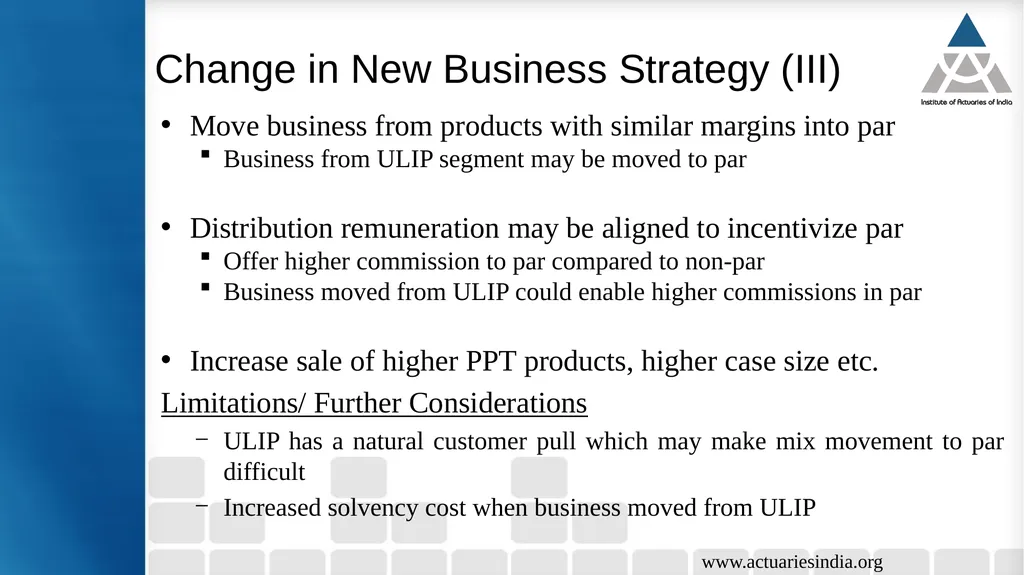
www.actuariesindia.org Change in New Business Strategy (III) Move business from products with similar margins into par
Business from ULIP segment may be moved to par
Distribution remuneration may be aligned to incentivize par
Offer higher commission to par compared to non-par
Business moved from ULIP could enable higher commissions in par
Increase sale of higher PPT products, higher case size etc.
Limitations/ Further Considerations
ULIP has a natural customer pull which may make mix movement to par difficult
Increased solvency cost when business moved from ULIP<br>
Business from ULIP segment may be moved to par
Distribution remuneration may be aligned to incentivize par
Offer higher commission to par compared to non-par
Business moved from ULIP could enable higher commissions in par
Increase sale of higher PPT products, higher case size etc.
Limitations/ Further Considerations
ULIP has a natural customer pull which may make mix movement to par difficult
Increased solvency cost when business moved from ULIP<br>
23
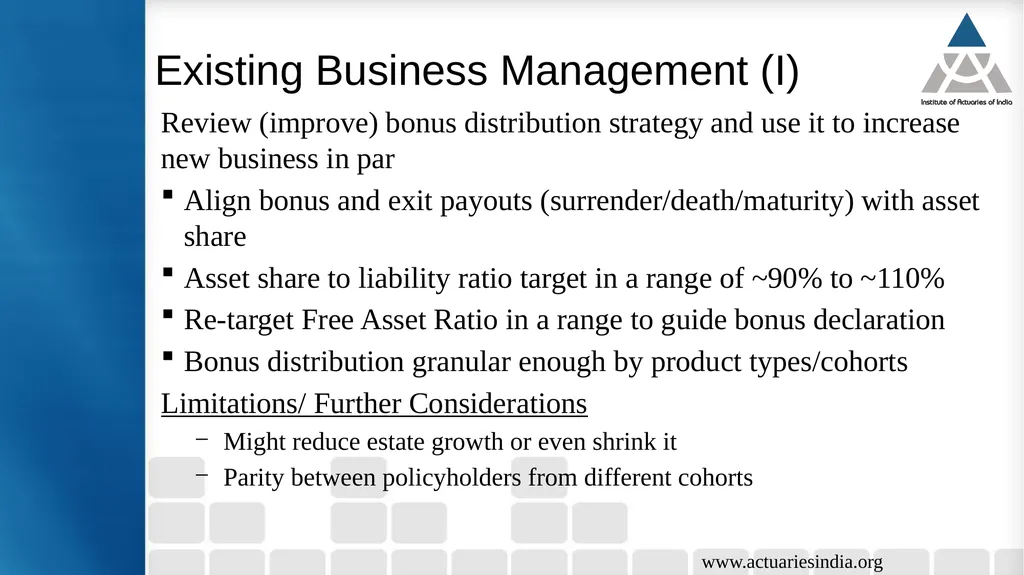
www.actuariesindia.org Existing Business Management (I) Review (improve) bonus distribution strategy and use it to increase new business in par
Align bonus and exit payouts (surrender/death/maturity) with asset share
Asset share to liability ratio target in a range of ~90% to ~110%
Re-target Free Asset Ratio in a range to guide bonus declaration
Bonus distribution granular enough by product types/cohorts
Limitations/ Further Considerations
Might reduce estate growth or even shrink it
Parity between policyholders from different cohorts<br>
Align bonus and exit payouts (surrender/death/maturity) with asset share
Asset share to liability ratio target in a range of ~90% to ~110%
Re-target Free Asset Ratio in a range to guide bonus declaration
Bonus distribution granular enough by product types/cohorts
Limitations/ Further Considerations
Might reduce estate growth or even shrink it
Parity between policyholders from different cohorts<br>
24
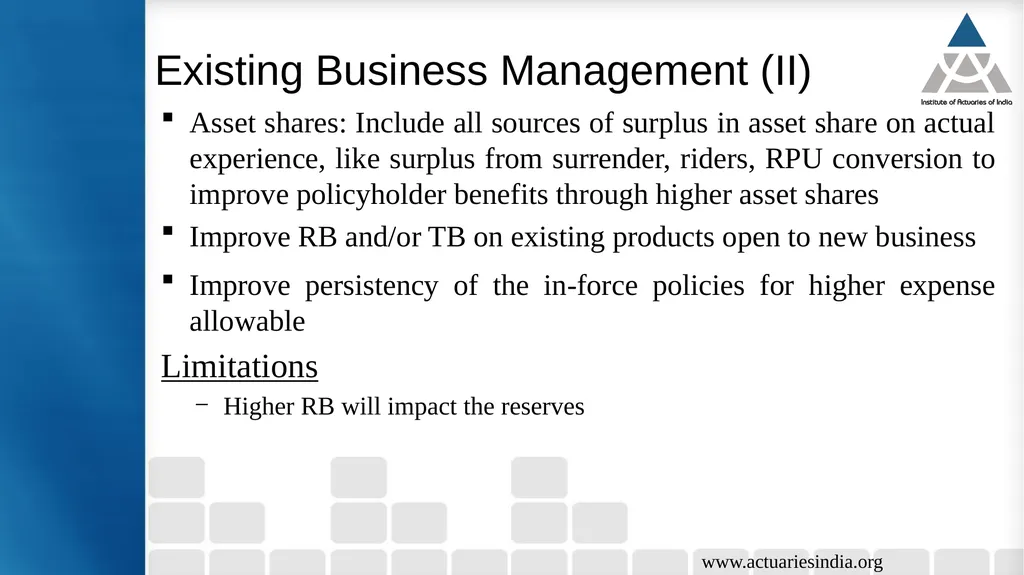
www.actuariesindia.org Existing Business Management (II) Asset shares: Include all sources of surplus in asset share on actual experience, like surplus from surrender, riders, RPU conversion to improve policyholder benefits through higher asset shares
Improve RB and/or TB on existing products open to new business
Improve persistency of the in-force policies for higher expense allowable
Limitations
Higher RB will impact the reserves<br>
Improve RB and/or TB on existing products open to new business
Improve persistency of the in-force policies for higher expense allowable
Limitations
Higher RB will impact the reserves<br>
25
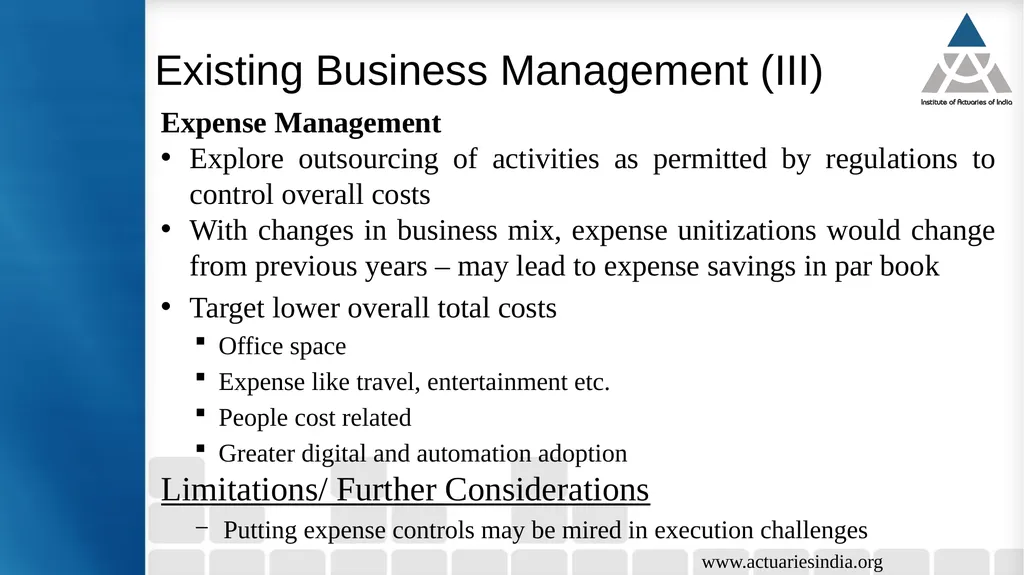
www.actuariesindia.org Existing Business Management (III) Expense Management
Explore outsourcing of activities as permitted by regulations to control overall costs
With changes in business mix, expense unitizations would change from previous years – may lead to expense savings in par book
Target lower overall total costs
Office space
Expense like travel, entertainment etc.
People cost related
Greater digital and automation adoption
Limitations/ Further Considerations
Putting expense controls may be mired in execution challenges<br>
Explore outsourcing of activities as permitted by regulations to control overall costs
With changes in business mix, expense unitizations would change from previous years – may lead to expense savings in par book
Target lower overall total costs
Office space
Expense like travel, entertainment etc.
People cost related
Greater digital and automation adoption
Limitations/ Further Considerations
Putting expense controls may be mired in execution challenges<br>
26
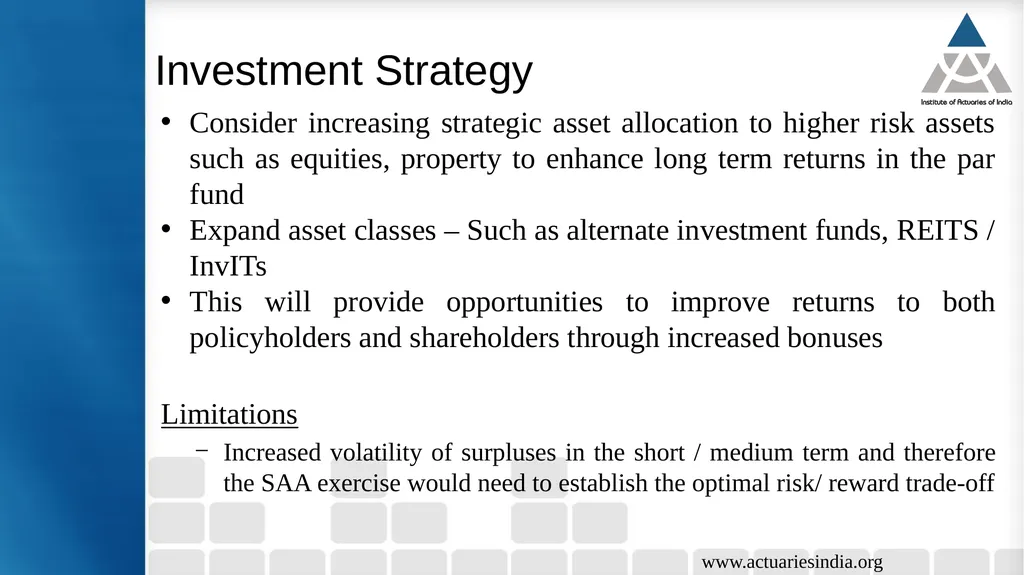
www.actuariesindia.org Investment Strategy Consider increasing strategic asset allocation to higher risk assets such as equities, property to enhance long term returns in the par fund
Expand asset classes – Such as alternate investment funds, REITS / InvITs
This will provide opportunities to improve returns to both policyholders and shareholders through increased bonuses
Limitations
Increased volatility of surpluses in the short / medium term and therefore the SAA exercise would need to establish the optimal risk/ reward trade-off<br>
Expand asset classes – Such as alternate investment funds, REITS / InvITs
This will provide opportunities to improve returns to both policyholders and shareholders through increased bonuses
Limitations
Increased volatility of surpluses in the short / medium term and therefore the SAA exercise would need to establish the optimal risk/ reward trade-off<br>
27
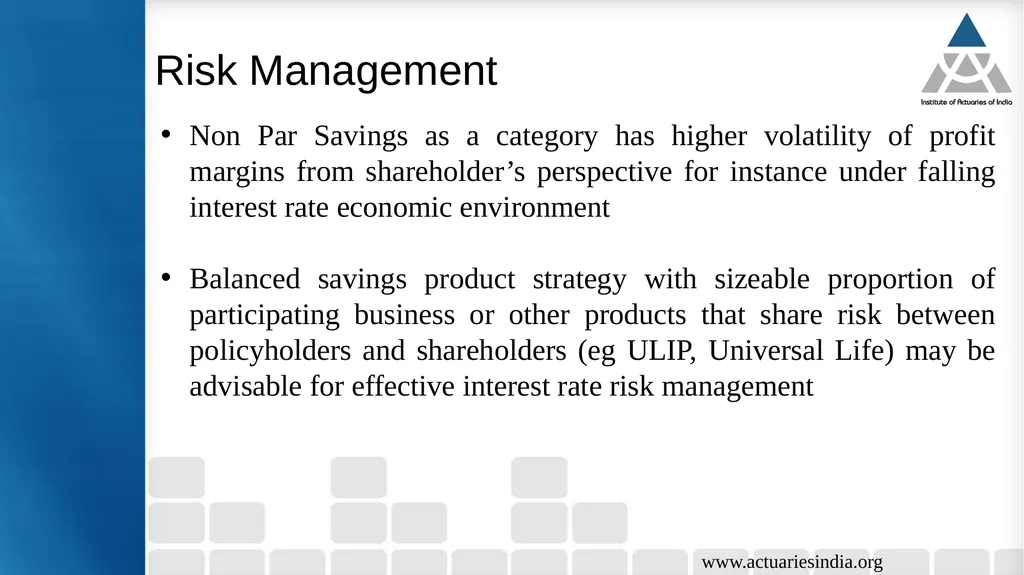
www.actuariesindia.org Risk Management Non Par Savings as a category has higher volatility of profit margins from shareholder’s perspective for instance under falling interest rate economic environment
Balanced savings product strategy with sizeable proportion of participating business or other products that share risk between policyholders and shareholders (eg ULIP, Universal Life) may be advisable for effective interest rate risk management<br>
Balanced savings product strategy with sizeable proportion of participating business or other products that share risk between policyholders and shareholders (eg ULIP, Universal Life) may be advisable for effective interest rate risk management<br>
28
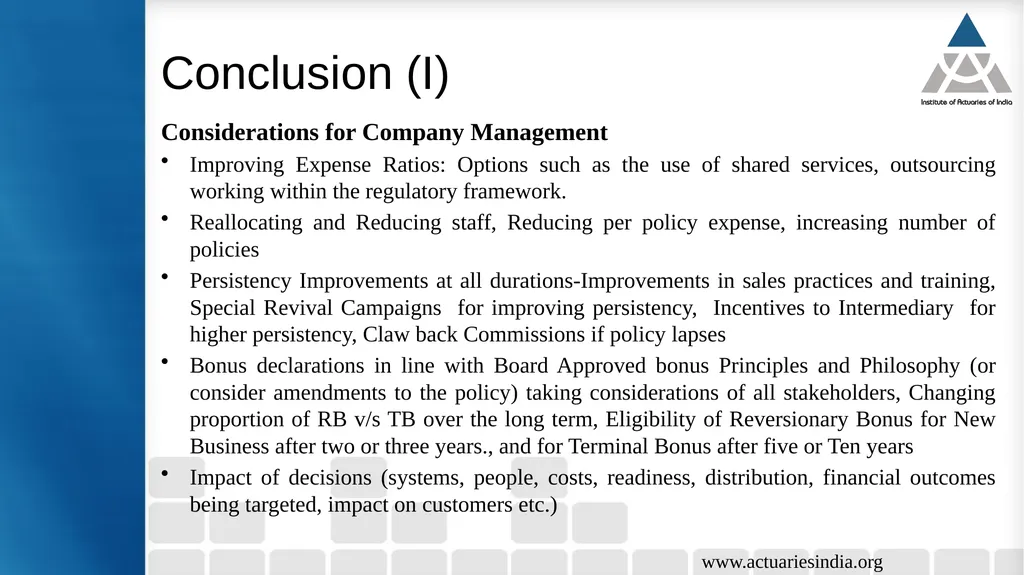
www.actuariesindia.org Conclusion (I) Considerations for Company Management
Improving Expense Ratios: Options such as the use of shared services, outsourcing working within the regulatory framework.
Reallocating and Reducing staff, Reducing per policy expense, increasing number of policies
Persistency Improvements at all durations-Improvements in sales practices and training, Special Revival Campaigns for improving persistency, Incentives to Intermediary for higher persistency, Claw back Commissions if policy lapses
Bonus declarations in line with Board Approved bonus Principles and Philosophy (or consider amendments to the policy) taking considerations of all stakeholders, Changing proportion of RB v/s TB over the long term, Eligibility of Reversionary Bonus for New Business after two or three years., and for Terminal Bonus after five or Ten years
Impact of decisions (systems, people, costs, readiness, distribution, financial outcomes being targeted, impact on customers etc.)<br>
Improving Expense Ratios: Options such as the use of shared services, outsourcing working within the regulatory framework.
Reallocating and Reducing staff, Reducing per policy expense, increasing number of policies
Persistency Improvements at all durations-Improvements in sales practices and training, Special Revival Campaigns for improving persistency, Incentives to Intermediary for higher persistency, Claw back Commissions if policy lapses
Bonus declarations in line with Board Approved bonus Principles and Philosophy (or consider amendments to the policy) taking considerations of all stakeholders, Changing proportion of RB v/s TB over the long term, Eligibility of Reversionary Bonus for New Business after two or three years., and for Terminal Bonus after five or Ten years
Impact of decisions (systems, people, costs, readiness, distribution, financial outcomes being targeted, impact on customers etc.)<br>
29
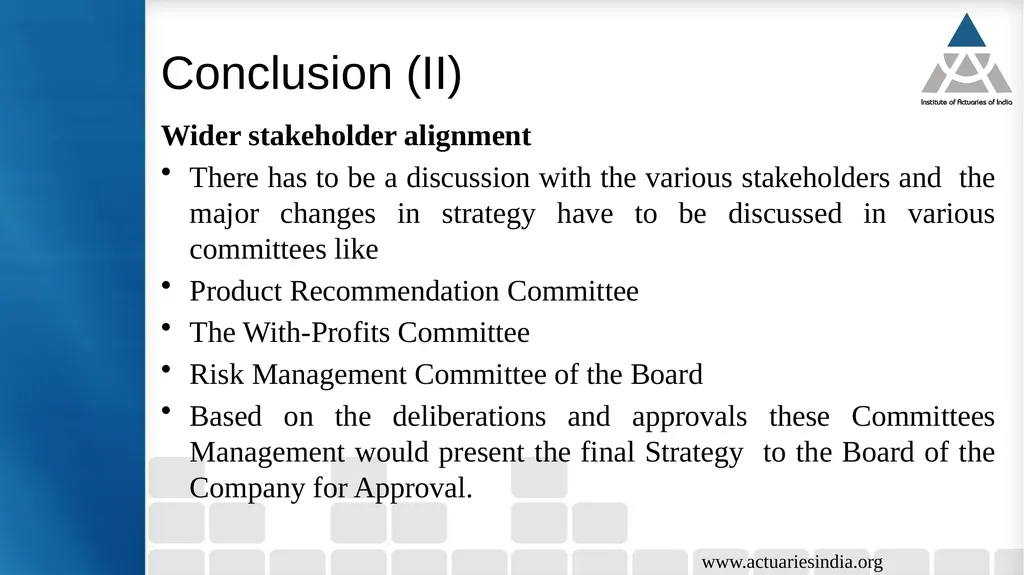
www.actuariesindia.org Conclusion (II) Wider stakeholder alignment
There has to be a discussion with the various stakeholders and the major changes in strategy have to be discussed in various committees like
Product Recommendation Committee
The With-Profits Committee
Risk Management Committee of the Board
Based on the deliberations and approvals these Committees Management would present the final Strategy to the Board of the Company for Approval.<br>
There has to be a discussion with the various stakeholders and the major changes in strategy have to be discussed in various committees like
Product Recommendation Committee
The With-Profits Committee
Risk Management Committee of the Board
Based on the deliberations and approvals these Committees Management would present the final Strategy to the Board of the Company for Approval.<br>
30
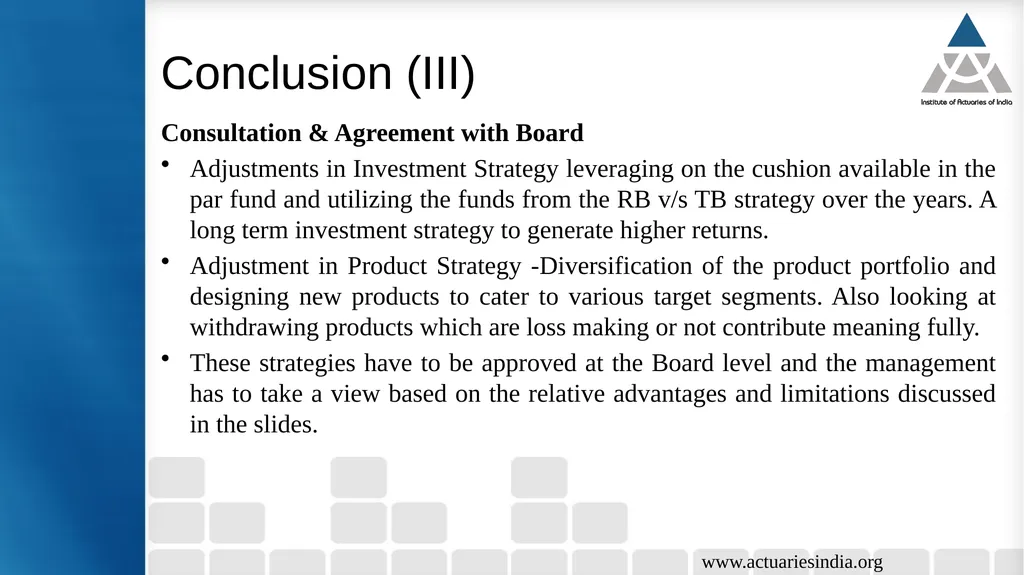
www.actuariesindia.org Conclusion (III) Consultation & Agreement with Board
Adjustments in Investment Strategy leveraging on the cushion available in the par fund and utilizing the funds from the RB v/s TB strategy over the years. A long term investment strategy to generate higher returns.
Adjustment in Product Strategy -Diversification of the product portfolio and designing new products to cater to various target segments. Also looking at withdrawing products which are loss making or not contribute meaning fully.
These strategies have to be approved at the Board level and the management has to take a view based on the relative advantages and limitations discussed in the slides.<br>
Adjustments in Investment Strategy leveraging on the cushion available in the par fund and utilizing the funds from the RB v/s TB strategy over the years. A long term investment strategy to generate higher returns.
Adjustment in Product Strategy -Diversification of the product portfolio and designing new products to cater to various target segments. Also looking at withdrawing products which are loss making or not contribute meaning fully.
These strategies have to be approved at the Board level and the management has to take a view based on the relative advantages and limitations discussed in the slides.<br>