
Lesson 1: What was the Weimar Constitution? What


Description: Lesson 1: What was the Weimar Constitution? What were its strengths and weaknesses?. THE KEY POINTS Ebert needed a new set of rules about how Weimar Germany should be run this set of rules is called a constitution. Erbert wanted a
Related Topics
Download Presentation
"Lesson 1: What was the Weimar Constitution? What" is the property of its rightful owner. Permission is granted to download and print the materials on this website for personal, non-commercial use only, and to display it on your personal computer provided you do not modify the materials and that you retain all copyright notices contained in the materials. By downloading content from our website, you accept the terms of this agreement.
Presentation Transcript
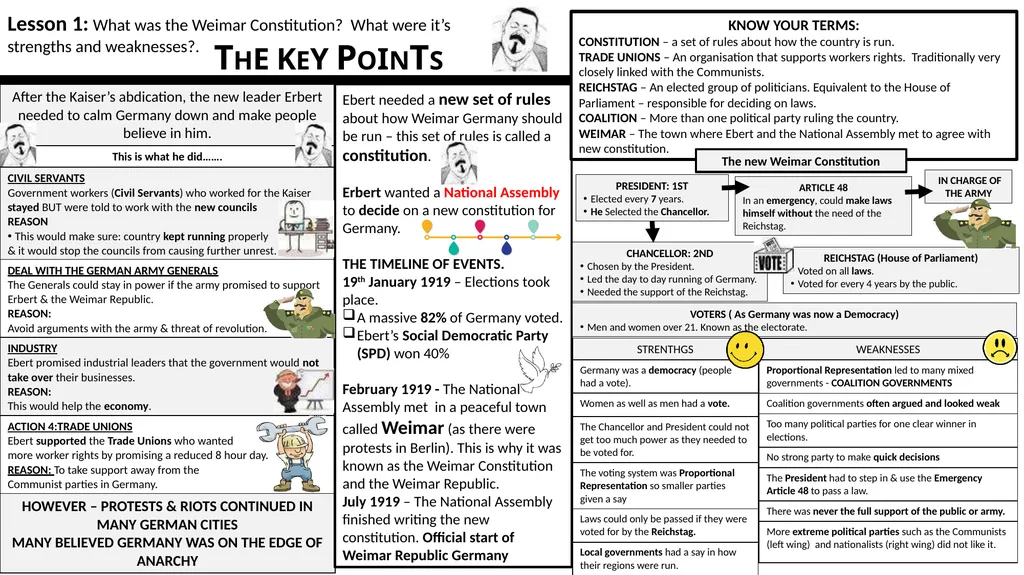
slide1. Lesson 1: What was the Weimar Constitution? What were it’s strengths and weaknesses?. THE KEY POINTS Ebert needed a new set of rules about how Weimar Germany should be run – this set of rules is called a constitution.
Erbert wanted a National Assembly to decide on a new constitution for Germany.
THE TIMELINE OF EVENTS.
19th January 1919 – Elections took place.
A massive 82% of Germany voted.
Ebert’s Social Democratic Party (SPD) won 40%
February 1919 - The National Assembly met in a peaceful town called Weimar (as there were protests in Berlin). This is why it was known as the Weimar Constitution and the Weimar Republic.
July 1919 – The National Assembly finished writing the new constitution. Official start of Weimar Republic Germany KNOW YOUR TERMS:
CONSTITUTION – a set of rules about how the country is run.
TRADE UNIONS – An organisation that supports workers rights. Traditionally very closely linked with the Communists.
REICHSTAG – An elected group of politicians. Equivalent to the House of Parliament – responsible for deciding on laws.
COALITION – More than one political party ruling the country.
WEIMAR – The town where Ebert and the National Assembly met to agree with new constitution. The new Weimar Constitution PRESIDENT: 1ST
Elected every 7 years.
He Selected the Chancellor. CHANCELLOR: 2ND
Chosen by the President.
Led the day to day running of Germany.
Needed the support of the Reichstag. ARTICLE 48
In an emergency, could make laws himself without the need of the Reichstag. REICHSTAG (House of Parliament)
Voted on all laws.
Voted for every 4 years by the public. IN CHARGE OF THE ARMY VOTERS ( As Germany was now a Democracy)
Men and women over 21. Known as the electorate.<br>
slide2. The Treaty of Versailles on 28th July 1919, Germany was linked to defeat, humiliation, bitterness and weakness The German people felt betrayed and let down by their government. It caused great fury and anger from the German people. This lesson you will learn:
What the Treaty of Versailles was.
How the Treaty of Versailles punished Germany.
Why there was opposition towards it.
What the impact of the Treaty of Versailles was. Germany and Ebert signed the Armistice on 11th November 1918……WHY?
They had no other choice.
Money and troops were running out.
The protests and unrest in all major towns.
The USA were now fighting against them.
The Germans were being pushed back by the allies.
Their Kaiser had abdicated which left nobody in full control. What was the Treaty of Versailles of 1919?
A set of rules given to Germany as a punishment for the First World War.
Who decided on Germany’s punishment?
Britain, France and the USA. Germany were not allowed to take part in the discussions.
Why was it called the Treaty of Versailles?
The allied leaders (UK, France and USA) met at the Palace of Versailles (in the Hall of Mirrors) near Paris, to agree on the treaty. What were the key terms of the Treaty of Versailles?
Land Army Money Blame Lesson 2: THE KEY POINTS<br>
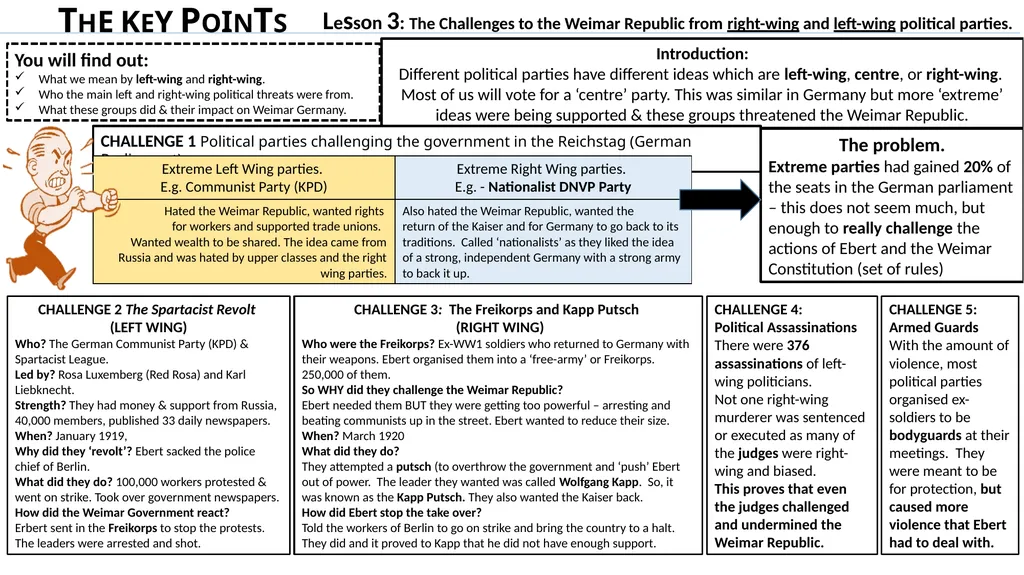
slide3. Lesson 3: The Challenges to the Weimar Republic from right-wing and left-wing political parties. THE KEY POINTS You will find out:
What we mean by left-wing and right-wing.
Who the main left and right-wing political threats were from.
What these groups did & their impact on Weimar Germany. Introduction:
Different political parties have different ideas which are left-wing, centre, or right-wing. Most of us will vote for a ‘centre’ party. This was similar in Germany but more ‘extreme’ ideas were being supported & these groups threatened the Weimar Republic. CHALLENGE 1 Political parties challenging the government in the Reichstag (German Parliament). The problem.
Extreme parties had gained 20% of the seats in the German parliament – this does not seem much, but enough to really challenge the actions of Ebert and the Weimar Constitution (set of rules) CHALLENGE 2 The Spartacist Revolt
(LEFT WING)
Who? The German Communist Party (KPD) & Spartacist League.
Led by? Rosa Luxemberg (Red Rosa) and Karl Liebknecht.
Strength? They had money & support from Russia, 40,000 members, published 33 daily newspapers.
When? January 1919,
Why did they ‘revolt’? Ebert sacked the police chief of Berlin.
What did they do? 100,000 workers protested & went on strike. Took over government newspapers. How did the Weimar Government react?
Erbert sent in the Freikorps to stop the protests. The leaders were arrested and shot. CHALLENGE 3: The Freikorps and Kapp Putsch
(RIGHT WING)
Who were the Freikorps? Ex-WW1 soldiers who returned to Germany with their weapons. Ebert organised them into a ‘free-army’ or Freikorps. 250,000 of them.
So WHY did they challenge the Weimar Republic?
Ebert needed them BUT they were getting too powerful – arresting and beating communists up in the street. Ebert wanted to reduce their size.
When? March 1920
What did they do?
They attempted a putsch (to overthrow the government and ‘push’ Ebert out of power. The leader they wanted was called Wolfgang Kapp. So, it was known as the Kapp Putsch. They also wanted the Kaiser back.
How did Ebert stop the take over?
Told the workers of Berlin to go on strike and bring the country to a halt. They did and it proved to Kapp that he did not have enough support. CHALLENGE 4:
Political Assassinations
There were 376 assassinations of left-wing politicians.
Not one right-wing murderer was sentenced or executed as many of the judges were right-wing and biased.
This proves that even the judges challenged and undermined the Weimar Republic. CHALLENGE 5:
Armed Guards
With the amount of violence, most political parties organised ex-soldiers to be bodyguards at their meetings. They were meant to be for protection, but caused more violence that Ebert had to deal with.<br>
slide4. Lesson 4: The Challenges of 1923 Hyperinflation and the French occupation of the Ruhr in Germany. THE KEY POINTS You will find out:
Why the French occupation of the Ruhr in Germany was another challenge to the Weimar government.
What the hyperinflation was and how it also challenged Weimar Germany. Weimar Germany has already faced threats from:
The reputation of the Weimar politicians as ‘November Criminals’ for signing the armistice.)
The terms of the Treaty of Versailles. Right and left wing threats from within the Reichstag (German parliament)
The Spartacist Revolt
The attempted Kapp Putsch by the Freikorps .
Ongoing political assassinations Two more challenges came in 1923. TWO
The economy suffered from hyperinflation ONE
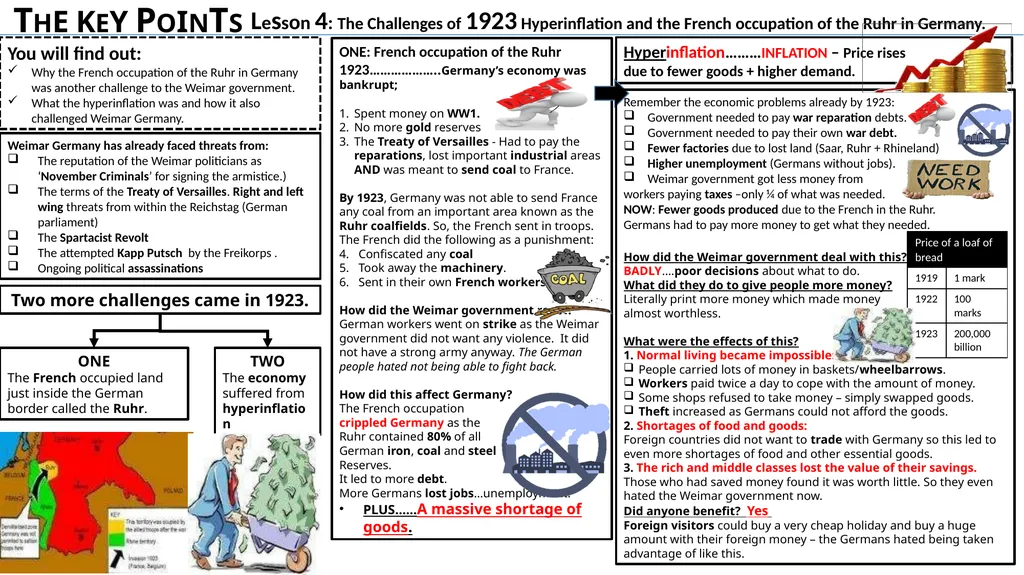
The French occupied land just inside the German border called the Ruhr. ONE: French occupation of the Ruhr 1923………………..Germany’s economy was bankrupt;
Spent money on WW1.
No more gold reserves
The Treaty of Versailles - Had to pay the reparations, lost important industrial areas AND was meant to send coal to France.
By 1923, Germany was not able to send France any coal from an important area known as the Ruhr coalfields. So, the French sent in troops. The French did the following as a punishment:
Confiscated any coal
Took away the machinery.
Sent in their own French workers.
How did the Weimar government react?
German workers went on strike as the Weimar government did not want any violence. It did not have a strong army anyway. The German people hated not being able to fight back.
How did this affect Germany?
The French occupation
crippled Germany as the
Ruhr contained 80% of all
German iron, coal and steel
Reserves.
It led to more debt.
More Germans lost jobs…unemployment.
PLUS……A massive shortage of goods. Hyperinflation………INFLATION – Price rises
due to fewer goods + higher demand. Remember the economic problems already by 1923:
Government needed to pay war reparation debts.
Government needed to pay their own war debt.
Fewer factories due to lost land (Saar, Ruhr + Rhineland)
Higher unemployment (Germans without jobs).
Weimar government got less money from
workers paying taxes –only ¼ of what was needed.
NOW: Fewer goods produced due to the French in the Ruhr.
Germans had to pay more money to get what they needed.
How did the Weimar government deal with this?
BADLY….poor decisions about what to do.
What did they do to give people more money?
Literally print more money which made money
almost worthless.
What were the effects of this?
1. Normal living became impossible:
People carried lots of money in baskets/wheelbarrows.
Workers paid twice a day to cope with the amount of money.
Some shops refused to take money – simply swapped goods.
Theft increased as Germans could not afford the goods.
2. Shortages of food and goods:
Foreign countries did not want to trade with Germany so this led to even more shortages of food and other essential goods.
3. The rich and middle classes lost the value of their savings.
Those who had saved money found it was worth little. So they even hated the Weimar government now.
Did anyone benefit? Yes
Foreign visitors could buy a very cheap holiday and buy a huge amount with their foreign money – the Germans hated being taken advantage of like this.<br>
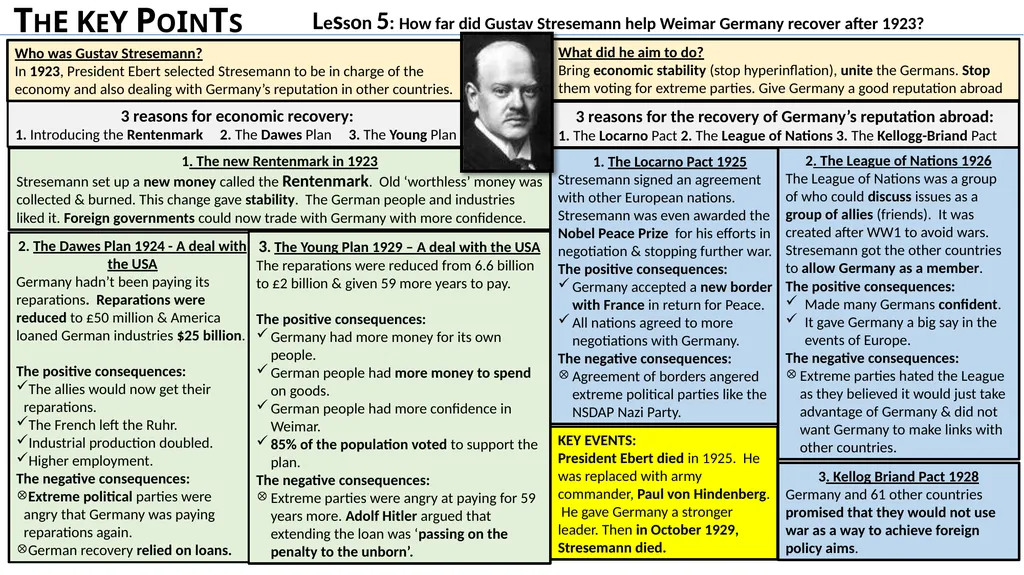
slide5. Lesson 5: How far did Gustav Stresemann help Weimar Germany recover after 1923? THE KEY POINTS Who was Gustav Stresemann?
In 1923, President Ebert selected Stresemann to be in charge of the economy and also dealing with Germany’s reputation in other countries. What did he aim to do?
Bring economic stability (stop hyperinflation), unite the Germans. Stop them voting for extreme parties. Give Germany a good reputation abroad 3 reasons for economic recovery:
1. Introducing the Rentenmark 2. The Dawes Plan 3. The Young Plan 3 reasons for the recovery of Germany’s reputation abroad:
1. The Locarno Pact 2. The League of Nations 3. The Kellogg-Briand Pact 1. The new Rentenmark in 1923
Stresemann set up a new money called the Rentenmark. Old ‘worthless’ money was collected & burned. This change gave stability. The German people and industries liked it. Foreign governments could now trade with Germany with more confidence. 2. The Dawes Plan 1924 - A deal with the USA
Germany hadn’t been paying its reparations. Reparations were reduced to £50 million & America loaned German industries $25 billion.
The positive consequences:
The allies would now get their reparations.
The French left the Ruhr.
Industrial production doubled.
Higher employment.
The negative consequences:
Extreme political parties were angry that Germany was paying reparations again.
German recovery relied on loans. 1. The Locarno Pact 1925
Stresemann signed an agreement with other European nations. Stresemann was even awarded the Nobel Peace Prize for his efforts in negotiation & stopping further war.
The positive consequences:
Germany accepted a new border with France in return for Peace.
All nations agreed to more negotiations with Germany.
The negative consequences:
Agreement of borders angered extreme political parties like the NSDAP Nazi Party. 2. The League of Nations 1926
The League of Nations was a group of who could discuss issues as a group of allies (friends). It was created after WW1 to avoid wars. Stresemann got the other countries to allow Germany as a member.
The positive consequences:
Made many Germans confident.
It gave Germany a big say in the events of Europe.
The negative consequences:
Extreme parties hated the League as they believed it would just take advantage of Germany & did not want Germany to make links with other countries. 3. Kellog Briand Pact 1928
Germany and 61 other countries promised that they would not use war as a way to achieve foreign policy aims. KEY EVENTS:
President Ebert died in 1925. He was replaced with army commander, Paul von Hindenberg. He gave Germany a stronger leader. Then in October 1929, Stresemann died. 3. The Young Plan 1929 – A deal with the USA
The reparations were reduced from 6.6 billion to £2 billion & given 59 more years to pay.
The positive consequences:
Germany had more money for its own people.
German people had more money to spend on goods.
German people had more confidence in Weimar.
85% of the population voted to support the plan.
The negative consequences:
Extreme parties were angry at paying for 59 years more. Adolf Hitler argued that extending the loan was ‘passing on the penalty to the unborn’.<br>
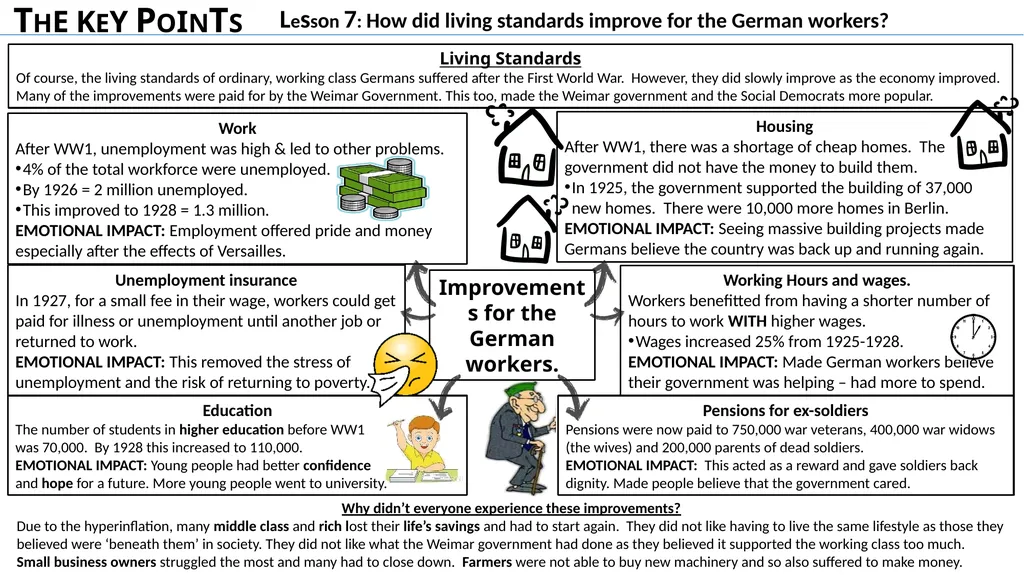
slide6. Lesson 7: How did living standards improve for the German workers? THE KEY POINTS Living Standards
Of course, the living standards of ordinary, working class Germans suffered after the First World War. However, they did slowly improve as the economy improved. Many of the improvements were paid for by the Weimar Government. This too, made the Weimar government and the Social Democrats more popular. Work
After WW1, unemployment was high & led to other problems.
4% of the total workforce were unemployed.
By 1926 = 2 million unemployed.
This improved to 1928 = 1.3 million.
EMOTIONAL IMPACT: Employment offered pride and money especially after the effects of Versailles. Unemployment insurance
In 1927, for a small fee in their wage, workers could get paid for illness or unemployment until another job or returned to work.
EMOTIONAL IMPACT: This removed the stress of unemployment and the risk of returning to poverty. Working Hours and wages.
Workers benefitted from having a shorter number of hours to work WITH higher wages.
Wages increased 25% from 1925-1928.
EMOTIONAL IMPACT: Made German workers believe their government was helping – had more to spend. Housing
After WW1, there was a shortage of cheap homes. The government did not have the money to build them.
In 1925, the government supported the building of 37,000 new homes. There were 10,000 more homes in Berlin.
EMOTIONAL IMPACT: Seeing massive building projects made Germans believe the country was back up and running again. Pensions for ex-soldiers
Pensions were now paid to 750,000 war veterans, 400,000 war widows (the wives) and 200,000 parents of dead soldiers.
EMOTIONAL IMPACT: This acted as a reward and gave soldiers back dignity. Made people believe that the government cared. Why didn’t everyone experience these improvements?
Due to the hyperinflation, many middle class and rich lost their life’s savings and had to start again. They did not like having to live the same lifestyle as those they believed were ‘beneath them’ in society. They did not like what the Weimar government had done as they believed it supported the working class too much. Small business owners struggled the most and many had to close down. Farmers were not able to buy new machinery and so also suffered to make money. Education
The number of students in higher education before WW1 was 70,000. By 1928 this increased to 110,000.
EMOTIONAL IMPACT: Young people had better confidence and hope for a future. More young people went to university. Improvements for the German workers.<br>
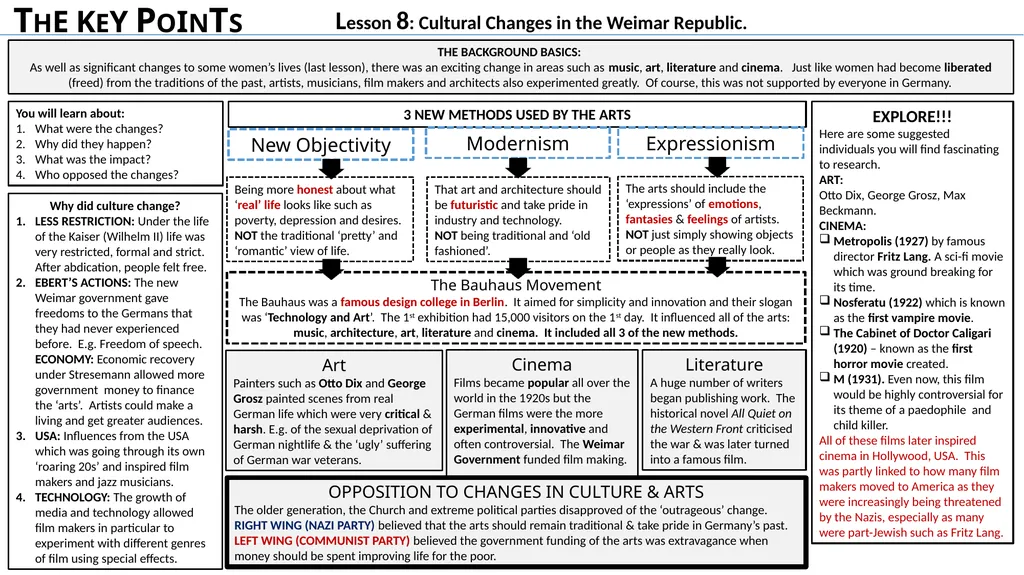
slide7. Lesson 8: Cultural Changes in the Weimar Republic. THE KEY POINTS THE BACKGROUND BASICS:
As well as significant changes to some women’s lives (last lesson), there was an exciting change in areas such as music, art, literature and cinema. Just like women had become liberated (freed) from the traditions of the past, artists, musicians, film makers and architects also experimented greatly. Of course, this was not supported by everyone in Germany. You will learn about:
What were the changes?
Why did they happen?
What was the impact?
Who opposed the changes? EXPLORE!!!
Here are some suggested individuals you will find fascinating to research.
ART:
Otto Dix, George Grosz, Max Beckmann.
CINEMA:
Metropolis (1927) by famous director Fritz Lang. A sci-fi movie which was ground breaking for its time.
Nosferatu (1922) which is known as the first vampire movie.
The Cabinet of Doctor Caligari (1920) – known as the first horror movie created.
M (1931). Even now, this film would be highly controversial for its theme of a paedophile and child killer.
All of these films later inspired cinema in Hollywood, USA. This was partly linked to how many film makers moved to America as they were increasingly being threatened by the Nazis, especially as many were part-Jewish such as Fritz Lang. Why did culture change?
LESS RESTRICTION: Under the life of the Kaiser (Wilhelm II) life was very restricted, formal and strict. After abdication, people felt free.
EBERT’S ACTIONS: The new Weimar government gave freedoms to the Germans that they had never experienced before. E.g. Freedom of speech. ECONOMY: Economic recovery under Stresemann allowed more government money to finance the ‘arts’. Artists could make a living and get greater audiences.
USA: Influences from the USA which was going through its own ‘roaring 20s’ and inspired film makers and jazz musicians.
TECHNOLOGY: The growth of media and technology allowed film makers in particular to experiment with different genres of film using special effects. 3 NEW METHODS USED BY THE ARTS New Objectivity Modernism Expressionism Being more honest about what ‘real’ life looks like such as poverty, depression and desires.
NOT the traditional ‘pretty’ and ‘romantic’ view of life. That art and architecture should be futuristic and take pride in industry and technology.
NOT being traditional and ‘old fashioned’. The arts should include the ‘expressions’ of emotions, fantasies & feelings of artists.
NOT just simply showing objects or people as they really look. The Bauhaus Movement
The Bauhaus was a famous design college in Berlin. It aimed for simplicity and innovation and their slogan was ‘Technology and Art’. The 1st exhibition had 15,000 visitors on the 1st day. It influenced all of the arts: music, architecture, art, literature and cinema. It included all 3 of the new methods. Art
Painters such as Otto Dix and George Grosz painted scenes from real German life which were very critical & harsh. E.g. of the sexual deprivation of German nightlife & the ‘ugly’ suffering of German war veterans. Cinema
Films became popular all over the world in the 1920s but the German films were the more experimental, innovative and often controversial. The Weimar Government funded film making. OPPOSITION TO CHANGES IN CULTURE & ARTS
The older generation, the Church and extreme political parties disapproved of the ‘outrageous’ change.
RIGHT WING (NAZI PARTY) believed that the arts should remain traditional & take pride in Germany’s past.
LEFT WING (COMMUNIST PARTY) believed the government funding of the arts was extravagance when money should be spent improving life for the poor. Literature
A huge number of writers began publishing work. The historical novel All Quiet on the Western Front criticised the war & was later turned into a famous film.<br>
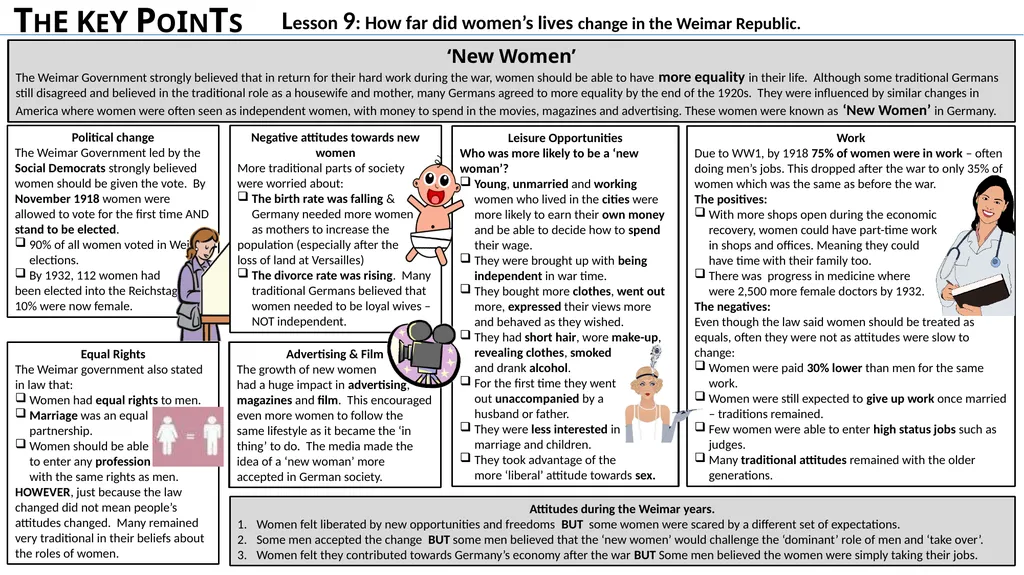
slide8. Lesson 9: How far did women’s lives change in the Weimar Republic. THE KEY POINTS ‘New Women’
The Weimar Government strongly believed that in return for their hard work during the war, women should be able to have more equality in their life. Although some traditional Germans still disagreed and believed in the traditional role as a housewife and mother, many Germans agreed to more equality by the end of the 1920s. They were influenced by similar changes in America where women were often seen as independent women, with money to spend in the movies, magazines and advertising. These women were known as ‘New Women’ in Germany. Political change
The Weimar Government led by the Social Democrats strongly believed women should be given the vote. By November 1918 women were allowed to vote for the first time AND stand to be elected.
90% of all women voted in Weimar elections.
By 1932, 112 women had
been elected into the Reichstag
10% were now female. Equal Rights
The Weimar government also stated in law that:
Women had equal rights to men.
Marriage was an equal partnership.
Women should be able to enter any profession with the same rights as men.
HOWEVER, just because the law changed did not mean people’s attitudes changed. Many remained very traditional in their beliefs about the roles of women. Work
Due to WW1, by 1918 75% of women were in work – often doing men’s jobs. This dropped after the war to only 35% of women which was the same as before the war.
The positives:
With more shops open during the economic recovery, women could have part-time work in shops and offices. Meaning they could have time with their family too.
There was progress in medicine where there were 2,500 more female doctors by 1932.
The negatives:
Even though the law said women should be treated as equals, often they were not as attitudes were slow to change:
Women were paid 30% lower than men for the same work.
Women were still expected to give up work once married – traditions remained.
Few women were able to enter high status jobs such as judges.
Many traditional attitudes remained with the older generations. Leisure Opportunities
Who was more likely to be a ‘new woman’?
Young, unmarried and working women who lived in the cities were more likely to earn their own money and be able to decide how to spend their wage.
They were brought up with being independent in war time.
They bought more clothes, went out more, expressed their views more and behaved as they wished.
They had short hair, wore make-up, revealing clothes, smoked and drank alcohol.
For the first time they went out unaccompanied by a husband or father.
They were less interested in marriage and children.
They took advantage of the more ‘liberal’ attitude towards sex. Advertising & Film
The growth of new women had a huge impact in advertising, magazines and film. This encouraged even more women to follow the same lifestyle as it became the ‘in thing’ to do. The media made the idea of a ‘new woman’ more accepted in German society. Negative attitudes towards new women
More traditional parts of society were worried about:
The birth rate was falling & Germany needed more women
as mothers to increase the population (especially after the
loss of land at Versailles)
The divorce rate was rising. Many traditional Germans believed that women needed to be loyal wives – NOT independent. Attitudes during the Weimar years.
Women felt liberated by new opportunities and freedoms BUT some women were scared by a different set of expectations.
Some men accepted the change BUT some men believed that the ‘new women’ would challenge the ‘dominant’ role of men and ‘take over’.
Women felt they contributed towards Germany’s economy after the war BUT Some men believed the women were simply taking their jobs.<br>
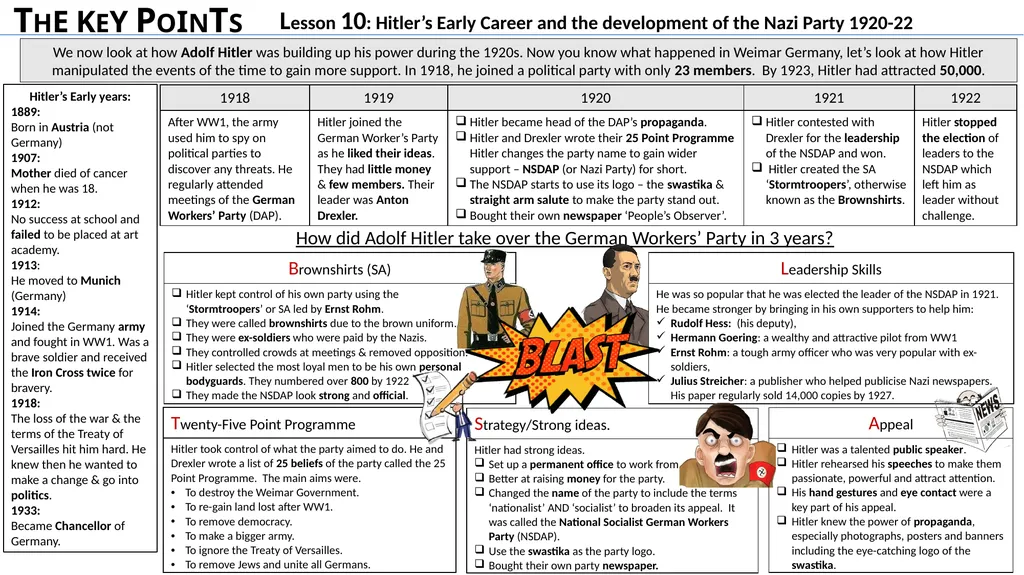
slide9. Lesson 10: Hitler’s Early Career and the development of the Nazi Party 1920-22 THE KEY POINTS We now look at how Adolf Hitler was building up his power during the 1920s. Now you know what happened in Weimar Germany, let’s look at how Hitler manipulated the events of the time to gain more support. In 1918, he joined a political party with only 23 members. By 1923, Hitler had attracted 50,000. Hitler’s Early years:
1889:
Born in Austria (not Germany)
1907:
Mother died of cancer when he was 18.
1912:
No success at school and failed to be placed at art academy.
1913:
He moved to Munich (Germany)
1914:
Joined the Germany army and fought in WW1. Was a brave soldier and received the Iron Cross twice for bravery.
1918:
The loss of the war & the terms of the Treaty of Versailles hit him hard. He knew then he wanted to make a change & go into politics.
1933:
Became Chancellor of Germany. How did Adolf Hitler take over the German Workers’ Party in 3 years?<br>
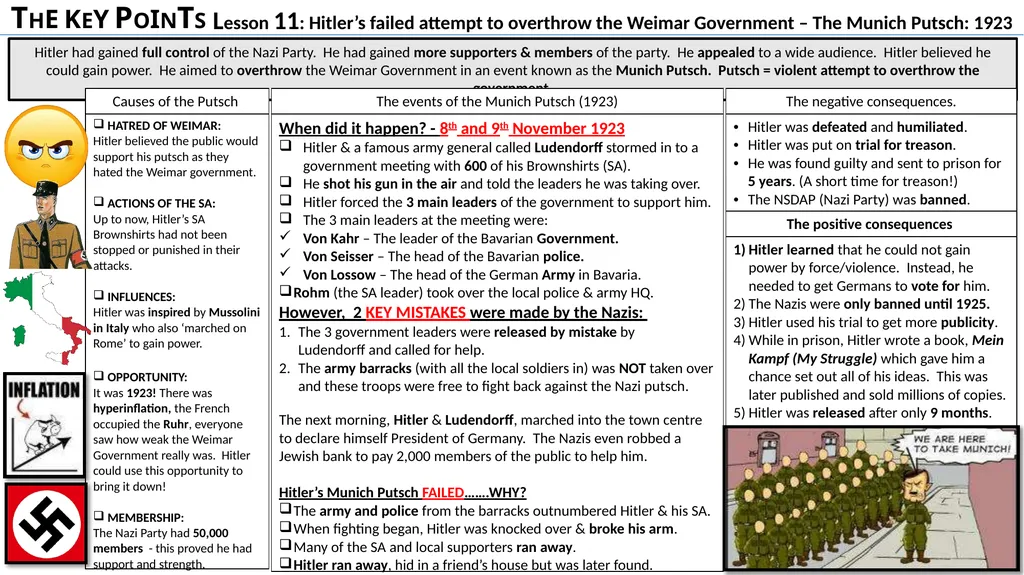
slide10. Lesson 11: Hitler’s failed attempt to overthrow the Weimar Government – The Munich Putsch: 1923 THE KEY POINTS Hitler had gained full control of the Nazi Party. He had gained more supporters & members of the party. He appealed to a wide audience. Hitler believed he could gain power. He aimed to overthrow the Weimar Government in an event known as the Munich Putsch. Putsch = violent attempt to overthrow the government.<br>
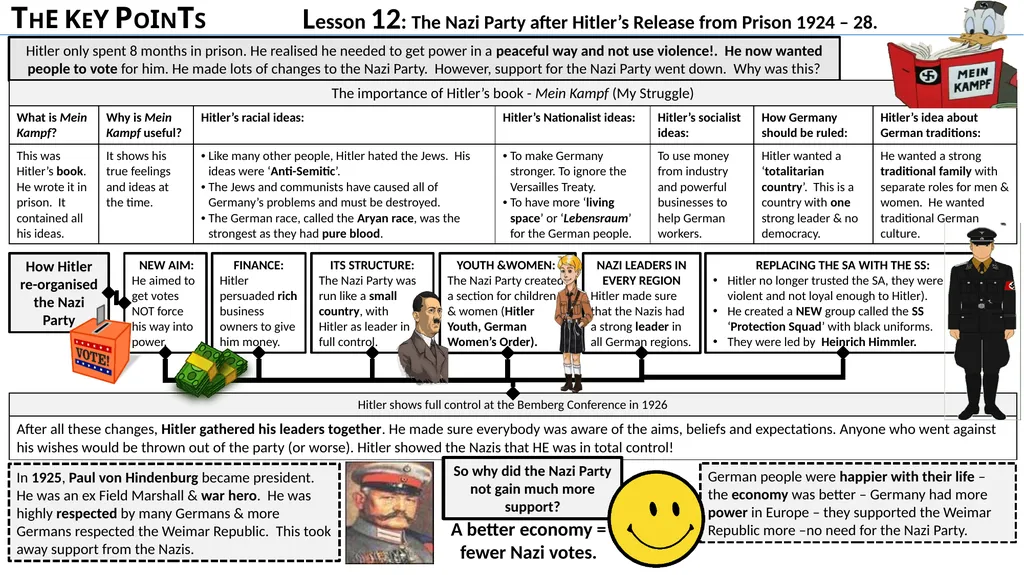
slide11. Lesson 12: The Nazi Party after Hitler’s Release from Prison 1924 – 28. THE KEY POINTS Hitler only spent 8 months in prison. He realised he needed to get power in a peaceful way and not use violence!. He now wanted people to vote for him. He made lots of changes to the Nazi Party. However, support for the Nazi Party went down. Why was this? NEW AIM:
He aimed to get votes NOT force his way into power. NAZI LEADERS IN EVERY REGION
Hitler made sure that the Nazis had a strong leader in all German regions. FINANCE:
Hitler persuaded rich business owners to give him money. REPLACING THE SA WITH THE SS:
Hitler no longer trusted the SA, they were violent and not loyal enough to Hitler).
He created a NEW group called the SS ‘Protection Squad’ with black uniforms.
They were led by Heinrich Himmler. How Hitler re-organised the Nazi Party ITS STRUCTURE:
The Nazi Party was run like a small country, with Hitler as leader in full control. YOUTH &WOMEN:
The Nazi Party created a section for children & women (Hitler Youth, German Women’s Order). So why did the Nazi Party not gain much more support? In 1925, Paul von Hindenburg became president. He was an ex Field Marshall & war hero. He was highly respected by many Germans & more Germans respected the Weimar Republic. This took away support from the Nazis. German people were happier with their life – the economy was better – Germany had more power in Europe – they supported the Weimar Republic more –no need for the Nazi Party. A better economy = fewer Nazi votes.<br>
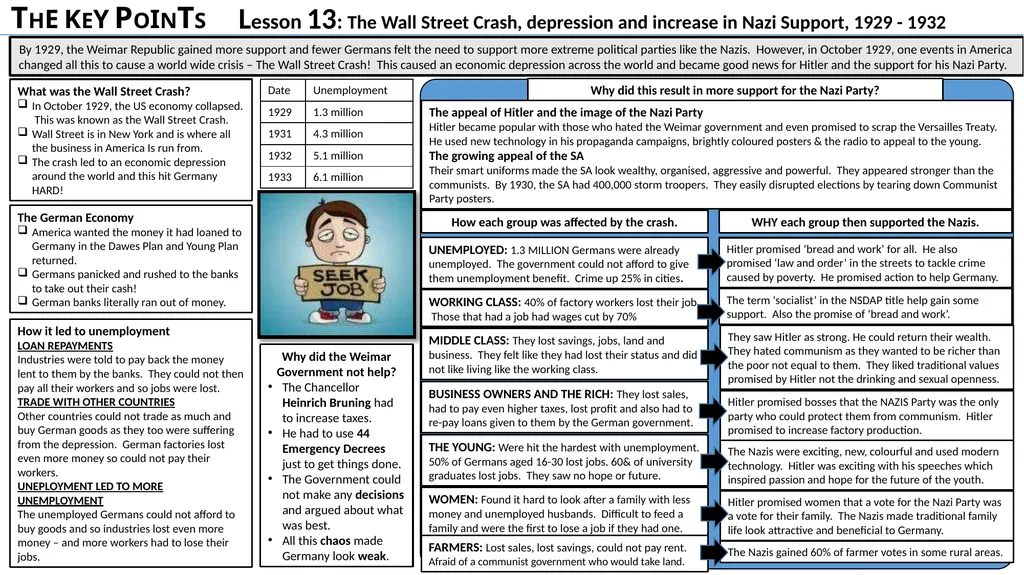
slide12. Lesson 13: The Wall Street Crash, depression and increase in Nazi Support, 1929 - 1932 THE KEY POINTS By 1929, the Weimar Republic gained more support and fewer Germans felt the need to support more extreme political parties like the Nazis. However, in October 1929, one events in America changed all this to cause a world wide crisis – The Wall Street Crash! This caused an economic depression across the world and became good news for Hitler and the support for his Nazi Party. What was the Wall Street Crash?
In October 1929, the US economy collapsed. This was known as the Wall Street Crash.
Wall Street is in New York and is where all the business in America Is run from.
The crash led to an economic depression around the world and this hit Germany HARD! The German Economy
America wanted the money it had loaned to Germany in the Dawes Plan and Young Plan returned.
Germans panicked and rushed to the banks to take out their cash!
German banks literally ran out of money. How it led to unemployment
LOAN REPAYMENTS
Industries were told to pay back the money lent to them by the banks. They could not then pay all their workers and so jobs were lost.
TRADE WITH OTHER COUNTRIES
Other countries could not trade as much and buy German goods as they too were suffering from the depression. German factories lost even more money so could not pay their workers.
UNEPLOYMENT LED TO MORE UNEMPLOYMENT
The unemployed Germans could not afford to buy goods and so industries lost even more money – and more workers had to lose their jobs. Why did the Weimar Government not help?
The Chancellor Heinrich Bruning had to increase taxes.
He had to use 44 Emergency Decrees just to get things done.
The Government could not make any decisions and argued about what was best.
All this chaos made Germany look weak. Why did this result in more support for the Nazi Party? The appeal of Hitler and the image of the Nazi Party
Hitler became popular with those who hated the Weimar government and even promised to scrap the Versailles Treaty. He used new technology in his propaganda campaigns, brightly coloured posters & the radio to appeal to the young.
The growing appeal of the SA
Their smart uniforms made the SA look wealthy, organised, aggressive and powerful. They appeared stronger than the communists. By 1930, the SA had 400,000 storm troopers. They easily disrupted elections by tearing down Communist Party posters. How each group was affected by the crash. WHY each group then supported the Nazis. UNEMPLOYED: 1.3 MILLION Germans were already unemployed. The government could not afford to give them unemployment benefit. Crime up 25% in cities. WORKING CLASS: 40% of factory workers lost their job. Those that had a job had wages cut by 70% MIDDLE CLASS: They lost savings, jobs, land and business. They felt like they had lost their status and did not like living like the working class. BUSINESS OWNERS AND THE RICH: They lost sales, had to pay even higher taxes, lost profit and also had to re-pay loans given to them by the German government. THE YOUNG: Were hit the hardest with unemployment. 50% of Germans aged 16-30 lost jobs. 60& of university graduates lost jobs. They saw no hope or future. WOMEN: Found it hard to look after a family with less money and unemployed husbands. Difficult to feed a family and were the first to lose a job if they had one. Hitler promised ‘bread and work’ for all. He also promised ‘law and order’ in the streets to tackle crime caused by poverty. He promised action to help Germany. The term ‘socialist’ in the NSDAP title help gain some support. Also the promise of ‘bread and work’. They saw Hitler as strong. He could return their wealth. They hated communism as they wanted to be richer than the poor not equal to them. They liked traditional values promised by Hitler not the drinking and sexual openness. Hitler promised bosses that the NAZIS Party was the only party who could protect them from communism. Hitler promised to increase factory production. The Nazis were exciting, new, colourful and used modern technology. Hitler was exciting with his speeches which inspired passion and hope for the future of the youth. Hitler promised women that a vote for the Nazi Party was a vote for their family. The Nazis made traditional family life look attractive and beneficial to Germany. FARMERS: Lost sales, lost savings, could not pay rent. Afraid of a communist government who would take land. The Nazis gained 60% of farmer votes in some rural areas.<br>
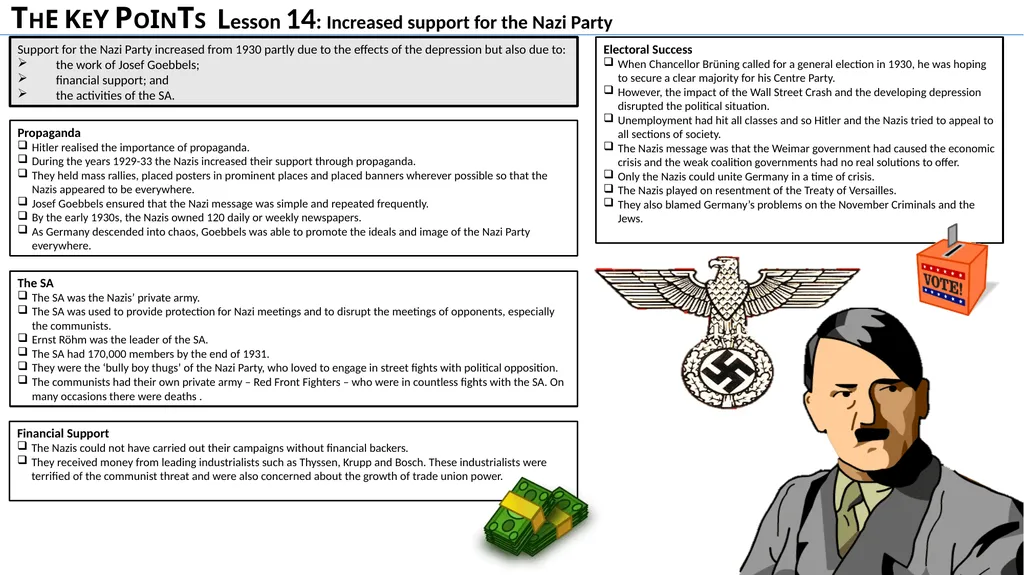
slide13. THE KEY POINTS Lesson 14: Increased support for the Nazi Party Support for the Nazi Party increased from 1930 partly due to the effects of the depression but also due to:
the work of Josef Goebbels;
financial support; and
the activities of the SA. Electoral Success
When Chancellor Brüning called for a general election in 1930, he was hoping to secure a clear majority for his Centre Party.
However, the impact of the Wall Street Crash and the developing depression disrupted the political situation.
Unemployment had hit all classes and so Hitler and the Nazis tried to appeal to all sections of society.
The Nazis message was that the Weimar government had caused the economic crisis and the weak coalition governments had no real solutions to offer.
Only the Nazis could unite Germany in a time of crisis.
The Nazis played on resentment of the Treaty of Versailles.
They also blamed Germany’s problems on the November Criminals and the Jews. Propaganda
Hitler realised the importance of propaganda.
During the years 1929-33 the Nazis increased their support through propaganda.
They held mass rallies, placed posters in prominent places and placed banners wherever possible so that the Nazis appeared to be everywhere.
Josef Goebbels ensured that the Nazi message was simple and repeated frequently.
By the early 1930s, the Nazis owned 120 daily or weekly newspapers.
As Germany descended into chaos, Goebbels was able to promote the ideals and image of the Nazi Party everywhere. Financial Support
The Nazis could not have carried out their campaigns without financial backers.
They received money from leading industrialists such as Thyssen, Krupp and Bosch. These industrialists were terrified of the communist threat and were also concerned about the growth of trade union power. The SA
The SA was the Nazis’ private army.
The SA was used to provide protection for Nazi meetings and to disrupt the meetings of opponents, especially the communists.
Ernst Röhm was the leader of the SA.
The SA had 170,000 members by the end of 1931.
They were the ‘bully boy thugs’ of the Nazi Party, who loved to engage in street fights with political opposition.
The communists had their own private army – Red Front Fighters – who were in countless fights with the SA. On many occasions there were deaths .<br>
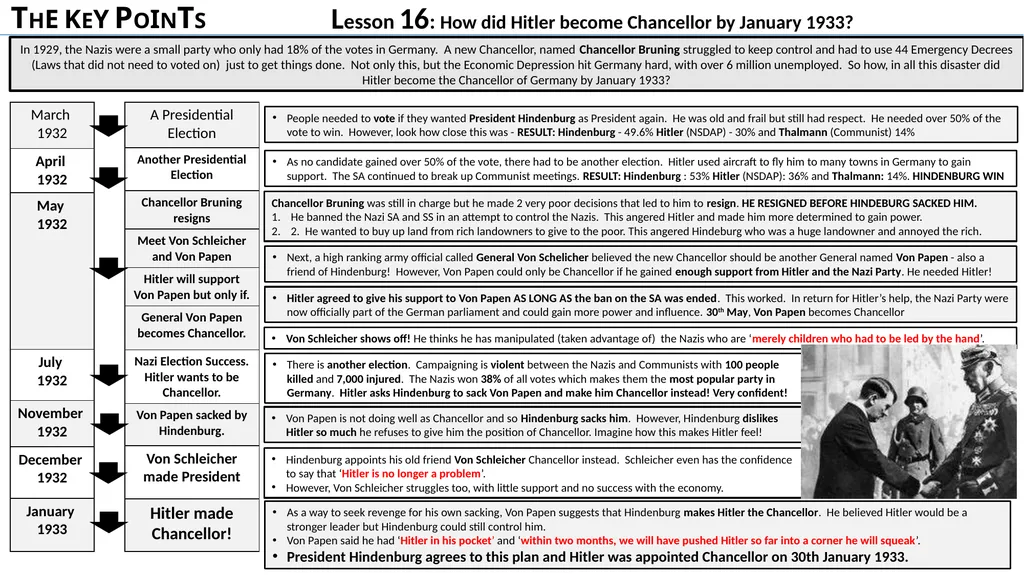
slide14. Lesson 16: How did Hitler become Chancellor by January 1933? THE KEY POINTS In 1929, the Nazis were a small party who only had 18% of the votes in Germany. A new Chancellor, named Chancellor Bruning struggled to keep control and had to use 44 Emergency Decrees (Laws that did not need to voted on) just to get things done. Not only this, but the Economic Depression hit Germany hard, with over 6 million unemployed. So how, in all this disaster did Hitler become the Chancellor of Germany by January 1933? People needed to vote if they wanted President Hindenburg as President again. He was old and frail but still had respect. He needed over 50% of the vote to win. However, look how close this was - RESULT: Hindenburg - 49.6% Hitler (NSDAP) - 30% and Thalmann (Communist) 14% As no candidate gained over 50% of the vote, there had to be another election. Hitler used aircraft to fly him to many towns in Germany to gain support. The SA continued to break up Communist meetings. RESULT: Hindenburg : 53% Hitler (NSDAP): 36% and Thalmann: 14%. HINDENBURG WIN Chancellor Bruning was still in charge but he made 2 very poor decisions that led to him to resign. HE RESIGNED BEFORE HINDEBURG SACKED HIM.
He banned the Nazi SA and SS in an attempt to control the Nazis. This angered Hitler and made him more determined to gain power.
2. He wanted to buy up land from rich landowners to give to the poor. This angered Hindeburg who was a huge landowner and annoyed the rich. Next, a high ranking army official called General Von Schelicher believed the new Chancellor should be another General named Von Papen - also a friend of Hindenburg! However, Von Papen could only be Chancellor if he gained enough support from Hitler and the Nazi Party. He needed Hitler! Hitler agreed to give his support to Von Papen AS LONG AS the ban on the SA was ended. This worked. In return for Hitler’s help, the Nazi Party were now officially part of the German parliament and could gain more power and influence. 30th May, Von Papen becomes Chancellor Von Schleicher shows off! He thinks he has manipulated (taken advantage of) the Nazis who are ‘merely children who had to be led by the hand’. There is another election. Campaigning is violent between the Nazis and Communists with 100 people killed and 7,000 injured. The Nazis won 38% of all votes which makes them the most popular party in Germany. Hitler asks Hindenburg to sack Von Papen and make him Chancellor instead! Very confident! Von Papen is not doing well as Chancellor and so Hindenburg sacks him. However, Hindenburg dislikes Hitler so much he refuses to give him the position of Chancellor. Imagine how this makes Hitler feel! As a way to seek revenge for his own sacking, Von Papen suggests that Hindenburg makes Hitler the Chancellor. He believed Hitler would be a stronger leader but Hindenburg could still control him.
Von Papen said he had ‘Hitler in his pocket’ and ‘within two months, we will have pushed Hitler so far into a corner he will squeak’.
President Hindenburg agrees to this plan and Hitler was appointed Chancellor on 30th January 1933. Hindenburg appoints his old friend Von Schleicher Chancellor instead. Schleicher even has the confidence to say that ‘Hitler is no longer a problem’.
However, Von Schleicher struggles too, with little support and no success with the economy.<br>
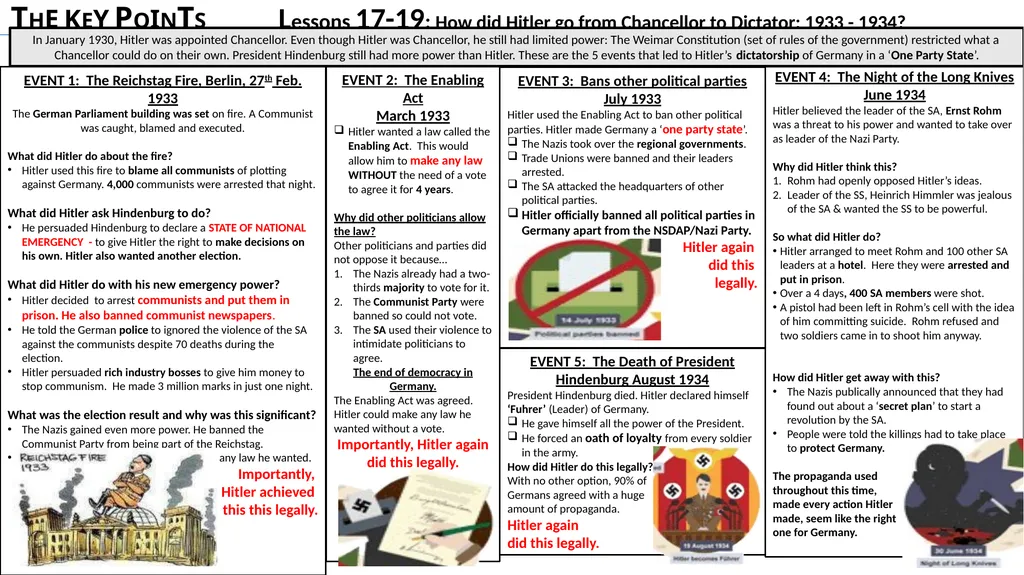
slide15. Lessons 17-19: How did Hitler go from Chancellor to Dictator: 1933 - 1934? THE KEY POINTS EVENT 1: The Reichstag Fire, Berlin, 27th Feb. 1933
The German Parliament building was set on fire. A Communist was caught, blamed and executed.
What did Hitler do about the fire?
Hitler used this fire to blame all communists of plotting against Germany. 4,000 communists were arrested that night.
What did Hitler ask Hindenburg to do?
He persuaded Hindenburg to declare a STATE OF NATIONAL EMERGENCY - to give Hitler the right to make decisions on his own. Hitler also wanted another election.
What did Hitler do with his new emergency power?
Hitler decided to arrest communists and put them in prison. He also banned communist newspapers.
He told the German police to ignored the violence of the SA against the communists despite 70 deaths during the election.
Hitler persuaded rich industry bosses to give him money to stop communism. He made 3 million marks in just one night.
What was the election result and why was this significant?
The Nazis gained even more power. He banned the Communist Party from being part of the Reichstag.
He had enough Nazi politicians to vote in any law he wanted.
Importantly,
Hitler achieved
this this legally. EVENT 2: The Enabling Act
March 1933
Hitler wanted a law called the Enabling Act. This would allow him to make any law WITHOUT the need of a vote to agree it for 4 years.
Why did other politicians allow the law?
Other politicians and parties did not oppose it because…
The Nazis already had a two-thirds majority to vote for it.
The Communist Party were banned so could not vote.
The SA used their violence to intimidate politicians to agree.
The end of democracy in Germany.
The Enabling Act was agreed. Hitler could make any law he wanted without a vote.
Importantly, Hitler again did this legally. EVENT 4: The Night of the Long Knives June 1934
Hitler believed the leader of the SA, Ernst Rohm was a threat to his power and wanted to take over as leader of the Nazi Party.
Why did Hitler think this?
Rohm had openly opposed Hitler’s ideas.
Leader of the SS, Heinrich Himmler was jealous of the SA & wanted the SS to be powerful.
So what did Hitler do?
Hitler arranged to meet Rohm and 100 other SA leaders at a hotel. Here they were arrested and put in prison.
Over a 4 days, 400 SA members were shot.
A pistol had been left in Rohm’s cell with the idea of him committing suicide. Rohm refused and two soldiers came in to shoot him anyway.
How did Hitler get away with this?
The Nazis publically announced that they had found out about a ‘secret plan’ to start a revolution by the SA.
People were told the killings had to take place to protect Germany.
The propaganda used
throughout this time,
made every action Hitler
made, seem like the right
one for Germany. EVENT 5: The Death of President Hindenburg August 1934
President Hindenburg died. Hitler declared himself ‘Fuhrer’ (Leader) of Germany.
He gave himself all the power of the President.
He forced an oath of loyalty from every soldier in the army.
How did Hitler do this legally?
With no other option, 90% of
Germans agreed with a huge
amount of propaganda.
Hitler again
did this legally. EVENT 3: Bans other political parties July 1933
Hitler used the Enabling Act to ban other political parties. Hitler made Germany a ‘one party state’.
The Nazis took over the regional governments.
Trade Unions were banned and their leaders arrested.
The SA attacked the headquarters of other political parties.
Hitler officially banned all political parties in Germany apart from the NSDAP/Nazi Party.
Hitler again
did this
legally. In January 1930, Hitler was appointed Chancellor. Even though Hitler was Chancellor, he still had limited power: The Weimar Constitution (set of rules of the government) restricted what a Chancellor could do on their own. President Hindenburg still had more power than Hitler. These are the 5 events that led to Hitler’s dictatorship of Germany in a ‘One Party State’.<br>
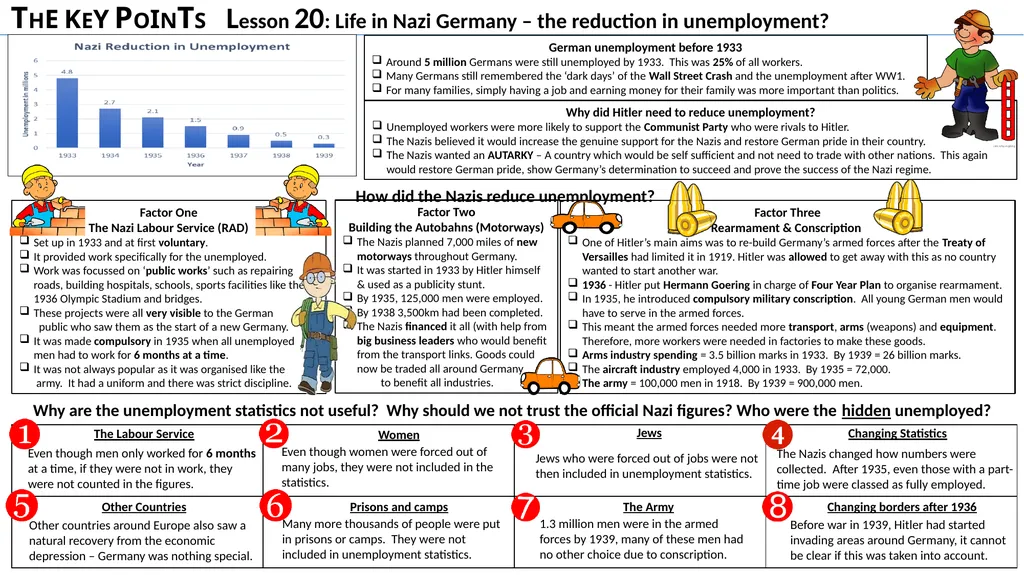
slide16. Lesson 20: Life in Nazi Germany – the reduction in unemployment? THE KEY POINTS German unemployment before 1933
Around 5 million Germans were still unemployed by 1933. This was 25% of all workers.
Many Germans still remembered the ‘dark days’ of the Wall Street Crash and the unemployment after WW1.
For many families, simply having a job and earning money for their family was more important than politics. Why did Hitler need to reduce unemployment?
Unemployed workers were more likely to support the Communist Party who were rivals to Hitler.
The Nazis believed it would increase the genuine support for the Nazis and restore German pride in their country.
The Nazis wanted an AUTARKY – A country which would be self sufficient and not need to trade with other nations. This again would restore German pride, show Germany’s determination to succeed and prove the success of the Nazi regime. Factor One
The Nazi Labour Service (RAD)
Set up in 1933 and at first voluntary.
It provided work specifically for the unemployed.
Work was focussed on ‘public works’ such as repairing roads, building hospitals, schools, sports facilities like the 1936 Olympic Stadium and bridges.
These projects were all very visible to the German public who saw them as the start of a new Germany.
It was made compulsory in 1935 when all unemployed men had to work for 6 months at a time.
It was not always popular as it was organised like the army. It had a uniform and there was strict discipline. Factor Two
Building the Autobahns (Motorways)
The Nazis planned 7,000 miles of new motorways throughout Germany.
It was started in 1933 by Hitler himself & used as a publicity stunt.
By 1935, 125,000 men were employed.
By 1938 3,500km had been completed.
The Nazis financed it all (with help from big business leaders who would benefit from the transport links. Goods could now be traded all around Germany to benefit all industries. Factor Three
Rearmament & Conscription
One of Hitler’s main aims was to re-build Germany’s armed forces after the Treaty of Versailles had limited it in 1919. Hitler was allowed to get away with this as no country wanted to start another war.
1936 - Hitler put Hermann Goering in charge of Four Year Plan to organise rearmament.
In 1935, he introduced compulsory military conscription. All young German men would have to serve in the armed forces.
This meant the armed forces needed more transport, arms (weapons) and equipment. Therefore, more workers were needed in factories to make these goods.
Arms industry spending = 3.5 billion marks in 1933. By 1939 = 26 billion marks.
The aircraft industry employed 4,000 in 1933. By 1935 = 72,000.
The army = 100,000 men in 1918. By 1939 = 900,000 men. How did the Nazis reduce unemployment? Why are the unemployment statistics not useful? Why should we not trust the official Nazi figures? Who were the hidden unemployed? The Labour Service Jews Changing Statistics Other Countries Prisons and camps The Army Changing borders after 1936 Even though men only worked for 6 months at a time, if they were not in work, they were not counted in the figures. Even though women were forced out of many jobs, they were not included in the statistics. Jews who were forced out of jobs were not then included in unemployment statistics. Women The Nazis changed how numbers were collected. After 1935, even those with a part-time job were classed as fully employed. Other countries around Europe also saw a natural recovery from the economic depression – Germany was nothing special. Many more thousands of people were put in prisons or camps. They were not included in unemployment statistics. 1.3 million men were in the armed forces by 1939, many of these men had no other choice due to conscription. Before war in 1939, Hitler had started invading areas around Germany, it cannot be clear if this was taken into account.<br>
Erbert wanted a National Assembly to decide on a new constitution for Germany.
THE TIMELINE OF EVENTS.
19th January 1919 – Elections took place.
A massive 82% of Germany voted.
Ebert’s Social Democratic Party (SPD) won 40%
February 1919 - The National Assembly met in a peaceful town called Weimar (as there were protests in Berlin). This is why it was known as the Weimar Constitution and the Weimar Republic.
July 1919 – The National Assembly finished writing the new constitution. Official start of Weimar Republic Germany KNOW YOUR TERMS:
CONSTITUTION – a set of rules about how the country is run.
TRADE UNIONS – An organisation that supports workers rights. Traditionally very closely linked with the Communists.
REICHSTAG – An elected group of politicians. Equivalent to the House of Parliament – responsible for deciding on laws.
COALITION – More than one political party ruling the country.
WEIMAR – The town where Ebert and the National Assembly met to agree with new constitution. The new Weimar Constitution PRESIDENT: 1ST
Elected every 7 years.
He Selected the Chancellor. CHANCELLOR: 2ND
Chosen by the President.
Led the day to day running of Germany.
Needed the support of the Reichstag. ARTICLE 48
In an emergency, could make laws himself without the need of the Reichstag. REICHSTAG (House of Parliament)
Voted on all laws.
Voted for every 4 years by the public. IN CHARGE OF THE ARMY VOTERS ( As Germany was now a Democracy)
Men and women over 21. Known as the electorate.<br>
slide2. The Treaty of Versailles on 28th July 1919, Germany was linked to defeat, humiliation, bitterness and weakness The German people felt betrayed and let down by their government. It caused great fury and anger from the German people. This lesson you will learn:
What the Treaty of Versailles was.
How the Treaty of Versailles punished Germany.
Why there was opposition towards it.
What the impact of the Treaty of Versailles was. Germany and Ebert signed the Armistice on 11th November 1918……WHY?
They had no other choice.
Money and troops were running out.
The protests and unrest in all major towns.
The USA were now fighting against them.
The Germans were being pushed back by the allies.
Their Kaiser had abdicated which left nobody in full control. What was the Treaty of Versailles of 1919?
A set of rules given to Germany as a punishment for the First World War.
Who decided on Germany’s punishment?
Britain, France and the USA. Germany were not allowed to take part in the discussions.
Why was it called the Treaty of Versailles?
The allied leaders (UK, France and USA) met at the Palace of Versailles (in the Hall of Mirrors) near Paris, to agree on the treaty. What were the key terms of the Treaty of Versailles?
Land Army Money Blame Lesson 2: THE KEY POINTS<br>
slide3. Lesson 3: The Challenges to the Weimar Republic from right-wing and left-wing political parties. THE KEY POINTS You will find out:
What we mean by left-wing and right-wing.
Who the main left and right-wing political threats were from.
What these groups did & their impact on Weimar Germany. Introduction:
Different political parties have different ideas which are left-wing, centre, or right-wing. Most of us will vote for a ‘centre’ party. This was similar in Germany but more ‘extreme’ ideas were being supported & these groups threatened the Weimar Republic. CHALLENGE 1 Political parties challenging the government in the Reichstag (German Parliament). The problem.
Extreme parties had gained 20% of the seats in the German parliament – this does not seem much, but enough to really challenge the actions of Ebert and the Weimar Constitution (set of rules) CHALLENGE 2 The Spartacist Revolt
(LEFT WING)
Who? The German Communist Party (KPD) & Spartacist League.
Led by? Rosa Luxemberg (Red Rosa) and Karl Liebknecht.
Strength? They had money & support from Russia, 40,000 members, published 33 daily newspapers.
When? January 1919,
Why did they ‘revolt’? Ebert sacked the police chief of Berlin.
What did they do? 100,000 workers protested & went on strike. Took over government newspapers. How did the Weimar Government react?
Erbert sent in the Freikorps to stop the protests. The leaders were arrested and shot. CHALLENGE 3: The Freikorps and Kapp Putsch
(RIGHT WING)
Who were the Freikorps? Ex-WW1 soldiers who returned to Germany with their weapons. Ebert organised them into a ‘free-army’ or Freikorps. 250,000 of them.
So WHY did they challenge the Weimar Republic?
Ebert needed them BUT they were getting too powerful – arresting and beating communists up in the street. Ebert wanted to reduce their size.
When? March 1920
What did they do?
They attempted a putsch (to overthrow the government and ‘push’ Ebert out of power. The leader they wanted was called Wolfgang Kapp. So, it was known as the Kapp Putsch. They also wanted the Kaiser back.
How did Ebert stop the take over?
Told the workers of Berlin to go on strike and bring the country to a halt. They did and it proved to Kapp that he did not have enough support. CHALLENGE 4:
Political Assassinations
There were 376 assassinations of left-wing politicians.
Not one right-wing murderer was sentenced or executed as many of the judges were right-wing and biased.
This proves that even the judges challenged and undermined the Weimar Republic. CHALLENGE 5:
Armed Guards
With the amount of violence, most political parties organised ex-soldiers to be bodyguards at their meetings. They were meant to be for protection, but caused more violence that Ebert had to deal with.<br>
slide4. Lesson 4: The Challenges of 1923 Hyperinflation and the French occupation of the Ruhr in Germany. THE KEY POINTS You will find out:
Why the French occupation of the Ruhr in Germany was another challenge to the Weimar government.
What the hyperinflation was and how it also challenged Weimar Germany. Weimar Germany has already faced threats from:
The reputation of the Weimar politicians as ‘November Criminals’ for signing the armistice.)
The terms of the Treaty of Versailles. Right and left wing threats from within the Reichstag (German parliament)
The Spartacist Revolt
The attempted Kapp Putsch by the Freikorps .
Ongoing political assassinations Two more challenges came in 1923. TWO
The economy suffered from hyperinflation ONE
The French occupied land just inside the German border called the Ruhr. ONE: French occupation of the Ruhr 1923………………..Germany’s economy was bankrupt;
Spent money on WW1.
No more gold reserves
The Treaty of Versailles - Had to pay the reparations, lost important industrial areas AND was meant to send coal to France.
By 1923, Germany was not able to send France any coal from an important area known as the Ruhr coalfields. So, the French sent in troops. The French did the following as a punishment:
Confiscated any coal
Took away the machinery.
Sent in their own French workers.
How did the Weimar government react?
German workers went on strike as the Weimar government did not want any violence. It did not have a strong army anyway. The German people hated not being able to fight back.
How did this affect Germany?
The French occupation
crippled Germany as the
Ruhr contained 80% of all
German iron, coal and steel
Reserves.
It led to more debt.
More Germans lost jobs…unemployment.
PLUS……A massive shortage of goods. Hyperinflation………INFLATION – Price rises
due to fewer goods + higher demand. Remember the economic problems already by 1923:
Government needed to pay war reparation debts.
Government needed to pay their own war debt.
Fewer factories due to lost land (Saar, Ruhr + Rhineland)
Higher unemployment (Germans without jobs).
Weimar government got less money from
workers paying taxes –only ¼ of what was needed.
NOW: Fewer goods produced due to the French in the Ruhr.
Germans had to pay more money to get what they needed.
How did the Weimar government deal with this?
BADLY….poor decisions about what to do.
What did they do to give people more money?
Literally print more money which made money
almost worthless.
What were the effects of this?
1. Normal living became impossible:
People carried lots of money in baskets/wheelbarrows.
Workers paid twice a day to cope with the amount of money.
Some shops refused to take money – simply swapped goods.
Theft increased as Germans could not afford the goods.
2. Shortages of food and goods:
Foreign countries did not want to trade with Germany so this led to even more shortages of food and other essential goods.
3. The rich and middle classes lost the value of their savings.
Those who had saved money found it was worth little. So they even hated the Weimar government now.
Did anyone benefit? Yes
Foreign visitors could buy a very cheap holiday and buy a huge amount with their foreign money – the Germans hated being taken advantage of like this.<br>
slide5. Lesson 5: How far did Gustav Stresemann help Weimar Germany recover after 1923? THE KEY POINTS Who was Gustav Stresemann?
In 1923, President Ebert selected Stresemann to be in charge of the economy and also dealing with Germany’s reputation in other countries. What did he aim to do?
Bring economic stability (stop hyperinflation), unite the Germans. Stop them voting for extreme parties. Give Germany a good reputation abroad 3 reasons for economic recovery:
1. Introducing the Rentenmark 2. The Dawes Plan 3. The Young Plan 3 reasons for the recovery of Germany’s reputation abroad:
1. The Locarno Pact 2. The League of Nations 3. The Kellogg-Briand Pact 1. The new Rentenmark in 1923
Stresemann set up a new money called the Rentenmark. Old ‘worthless’ money was collected & burned. This change gave stability. The German people and industries liked it. Foreign governments could now trade with Germany with more confidence. 2. The Dawes Plan 1924 - A deal with the USA
Germany hadn’t been paying its reparations. Reparations were reduced to £50 million & America loaned German industries $25 billion.
The positive consequences:
The allies would now get their reparations.
The French left the Ruhr.
Industrial production doubled.
Higher employment.
The negative consequences:
Extreme political parties were angry that Germany was paying reparations again.
German recovery relied on loans. 1. The Locarno Pact 1925
Stresemann signed an agreement with other European nations. Stresemann was even awarded the Nobel Peace Prize for his efforts in negotiation & stopping further war.
The positive consequences:
Germany accepted a new border with France in return for Peace.
All nations agreed to more negotiations with Germany.
The negative consequences:
Agreement of borders angered extreme political parties like the NSDAP Nazi Party. 2. The League of Nations 1926
The League of Nations was a group of who could discuss issues as a group of allies (friends). It was created after WW1 to avoid wars. Stresemann got the other countries to allow Germany as a member.
The positive consequences:
Made many Germans confident.
It gave Germany a big say in the events of Europe.
The negative consequences:
Extreme parties hated the League as they believed it would just take advantage of Germany & did not want Germany to make links with other countries. 3. Kellog Briand Pact 1928
Germany and 61 other countries promised that they would not use war as a way to achieve foreign policy aims. KEY EVENTS:
President Ebert died in 1925. He was replaced with army commander, Paul von Hindenberg. He gave Germany a stronger leader. Then in October 1929, Stresemann died. 3. The Young Plan 1929 – A deal with the USA
The reparations were reduced from 6.6 billion to £2 billion & given 59 more years to pay.
The positive consequences:
Germany had more money for its own people.
German people had more money to spend on goods.
German people had more confidence in Weimar.
85% of the population voted to support the plan.
The negative consequences:
Extreme parties were angry at paying for 59 years more. Adolf Hitler argued that extending the loan was ‘passing on the penalty to the unborn’.<br>
slide6. Lesson 7: How did living standards improve for the German workers? THE KEY POINTS Living Standards
Of course, the living standards of ordinary, working class Germans suffered after the First World War. However, they did slowly improve as the economy improved. Many of the improvements were paid for by the Weimar Government. This too, made the Weimar government and the Social Democrats more popular. Work
After WW1, unemployment was high & led to other problems.
4% of the total workforce were unemployed.
By 1926 = 2 million unemployed.
This improved to 1928 = 1.3 million.
EMOTIONAL IMPACT: Employment offered pride and money especially after the effects of Versailles. Unemployment insurance
In 1927, for a small fee in their wage, workers could get paid for illness or unemployment until another job or returned to work.
EMOTIONAL IMPACT: This removed the stress of unemployment and the risk of returning to poverty. Working Hours and wages.
Workers benefitted from having a shorter number of hours to work WITH higher wages.
Wages increased 25% from 1925-1928.
EMOTIONAL IMPACT: Made German workers believe their government was helping – had more to spend. Housing
After WW1, there was a shortage of cheap homes. The government did not have the money to build them.
In 1925, the government supported the building of 37,000 new homes. There were 10,000 more homes in Berlin.
EMOTIONAL IMPACT: Seeing massive building projects made Germans believe the country was back up and running again. Pensions for ex-soldiers
Pensions were now paid to 750,000 war veterans, 400,000 war widows (the wives) and 200,000 parents of dead soldiers.
EMOTIONAL IMPACT: This acted as a reward and gave soldiers back dignity. Made people believe that the government cared. Why didn’t everyone experience these improvements?
Due to the hyperinflation, many middle class and rich lost their life’s savings and had to start again. They did not like having to live the same lifestyle as those they believed were ‘beneath them’ in society. They did not like what the Weimar government had done as they believed it supported the working class too much. Small business owners struggled the most and many had to close down. Farmers were not able to buy new machinery and so also suffered to make money. Education
The number of students in higher education before WW1 was 70,000. By 1928 this increased to 110,000.
EMOTIONAL IMPACT: Young people had better confidence and hope for a future. More young people went to university. Improvements for the German workers.<br>
slide7. Lesson 8: Cultural Changes in the Weimar Republic. THE KEY POINTS THE BACKGROUND BASICS:
As well as significant changes to some women’s lives (last lesson), there was an exciting change in areas such as music, art, literature and cinema. Just like women had become liberated (freed) from the traditions of the past, artists, musicians, film makers and architects also experimented greatly. Of course, this was not supported by everyone in Germany. You will learn about:
What were the changes?
Why did they happen?
What was the impact?
Who opposed the changes? EXPLORE!!!
Here are some suggested individuals you will find fascinating to research.
ART:
Otto Dix, George Grosz, Max Beckmann.
CINEMA:
Metropolis (1927) by famous director Fritz Lang. A sci-fi movie which was ground breaking for its time.
Nosferatu (1922) which is known as the first vampire movie.
The Cabinet of Doctor Caligari (1920) – known as the first horror movie created.
M (1931). Even now, this film would be highly controversial for its theme of a paedophile and child killer.
All of these films later inspired cinema in Hollywood, USA. This was partly linked to how many film makers moved to America as they were increasingly being threatened by the Nazis, especially as many were part-Jewish such as Fritz Lang. Why did culture change?
LESS RESTRICTION: Under the life of the Kaiser (Wilhelm II) life was very restricted, formal and strict. After abdication, people felt free.
EBERT’S ACTIONS: The new Weimar government gave freedoms to the Germans that they had never experienced before. E.g. Freedom of speech. ECONOMY: Economic recovery under Stresemann allowed more government money to finance the ‘arts’. Artists could make a living and get greater audiences.
USA: Influences from the USA which was going through its own ‘roaring 20s’ and inspired film makers and jazz musicians.
TECHNOLOGY: The growth of media and technology allowed film makers in particular to experiment with different genres of film using special effects. 3 NEW METHODS USED BY THE ARTS New Objectivity Modernism Expressionism Being more honest about what ‘real’ life looks like such as poverty, depression and desires.
NOT the traditional ‘pretty’ and ‘romantic’ view of life. That art and architecture should be futuristic and take pride in industry and technology.
NOT being traditional and ‘old fashioned’. The arts should include the ‘expressions’ of emotions, fantasies & feelings of artists.
NOT just simply showing objects or people as they really look. The Bauhaus Movement
The Bauhaus was a famous design college in Berlin. It aimed for simplicity and innovation and their slogan was ‘Technology and Art’. The 1st exhibition had 15,000 visitors on the 1st day. It influenced all of the arts: music, architecture, art, literature and cinema. It included all 3 of the new methods. Art
Painters such as Otto Dix and George Grosz painted scenes from real German life which were very critical & harsh. E.g. of the sexual deprivation of German nightlife & the ‘ugly’ suffering of German war veterans. Cinema
Films became popular all over the world in the 1920s but the German films were the more experimental, innovative and often controversial. The Weimar Government funded film making. OPPOSITION TO CHANGES IN CULTURE & ARTS
The older generation, the Church and extreme political parties disapproved of the ‘outrageous’ change.
RIGHT WING (NAZI PARTY) believed that the arts should remain traditional & take pride in Germany’s past.
LEFT WING (COMMUNIST PARTY) believed the government funding of the arts was extravagance when money should be spent improving life for the poor. Literature
A huge number of writers began publishing work. The historical novel All Quiet on the Western Front criticised the war & was later turned into a famous film.<br>
slide8. Lesson 9: How far did women’s lives change in the Weimar Republic. THE KEY POINTS ‘New Women’
The Weimar Government strongly believed that in return for their hard work during the war, women should be able to have more equality in their life. Although some traditional Germans still disagreed and believed in the traditional role as a housewife and mother, many Germans agreed to more equality by the end of the 1920s. They were influenced by similar changes in America where women were often seen as independent women, with money to spend in the movies, magazines and advertising. These women were known as ‘New Women’ in Germany. Political change
The Weimar Government led by the Social Democrats strongly believed women should be given the vote. By November 1918 women were allowed to vote for the first time AND stand to be elected.
90% of all women voted in Weimar elections.
By 1932, 112 women had
been elected into the Reichstag
10% were now female. Equal Rights
The Weimar government also stated in law that:
Women had equal rights to men.
Marriage was an equal partnership.
Women should be able to enter any profession with the same rights as men.
HOWEVER, just because the law changed did not mean people’s attitudes changed. Many remained very traditional in their beliefs about the roles of women. Work
Due to WW1, by 1918 75% of women were in work – often doing men’s jobs. This dropped after the war to only 35% of women which was the same as before the war.
The positives:
With more shops open during the economic recovery, women could have part-time work in shops and offices. Meaning they could have time with their family too.
There was progress in medicine where there were 2,500 more female doctors by 1932.
The negatives:
Even though the law said women should be treated as equals, often they were not as attitudes were slow to change:
Women were paid 30% lower than men for the same work.
Women were still expected to give up work once married – traditions remained.
Few women were able to enter high status jobs such as judges.
Many traditional attitudes remained with the older generations. Leisure Opportunities
Who was more likely to be a ‘new woman’?
Young, unmarried and working women who lived in the cities were more likely to earn their own money and be able to decide how to spend their wage.
They were brought up with being independent in war time.
They bought more clothes, went out more, expressed their views more and behaved as they wished.
They had short hair, wore make-up, revealing clothes, smoked and drank alcohol.
For the first time they went out unaccompanied by a husband or father.
They were less interested in marriage and children.
They took advantage of the more ‘liberal’ attitude towards sex. Advertising & Film
The growth of new women had a huge impact in advertising, magazines and film. This encouraged even more women to follow the same lifestyle as it became the ‘in thing’ to do. The media made the idea of a ‘new woman’ more accepted in German society. Negative attitudes towards new women
More traditional parts of society were worried about:
The birth rate was falling & Germany needed more women
as mothers to increase the population (especially after the
loss of land at Versailles)
The divorce rate was rising. Many traditional Germans believed that women needed to be loyal wives – NOT independent. Attitudes during the Weimar years.
Women felt liberated by new opportunities and freedoms BUT some women were scared by a different set of expectations.
Some men accepted the change BUT some men believed that the ‘new women’ would challenge the ‘dominant’ role of men and ‘take over’.
Women felt they contributed towards Germany’s economy after the war BUT Some men believed the women were simply taking their jobs.<br>
slide9. Lesson 10: Hitler’s Early Career and the development of the Nazi Party 1920-22 THE KEY POINTS We now look at how Adolf Hitler was building up his power during the 1920s. Now you know what happened in Weimar Germany, let’s look at how Hitler manipulated the events of the time to gain more support. In 1918, he joined a political party with only 23 members. By 1923, Hitler had attracted 50,000. Hitler’s Early years:
1889:
Born in Austria (not Germany)
1907:
Mother died of cancer when he was 18.
1912:
No success at school and failed to be placed at art academy.
1913:
He moved to Munich (Germany)
1914:
Joined the Germany army and fought in WW1. Was a brave soldier and received the Iron Cross twice for bravery.
1918:
The loss of the war & the terms of the Treaty of Versailles hit him hard. He knew then he wanted to make a change & go into politics.
1933:
Became Chancellor of Germany. How did Adolf Hitler take over the German Workers’ Party in 3 years?<br>
slide10. Lesson 11: Hitler’s failed attempt to overthrow the Weimar Government – The Munich Putsch: 1923 THE KEY POINTS Hitler had gained full control of the Nazi Party. He had gained more supporters & members of the party. He appealed to a wide audience. Hitler believed he could gain power. He aimed to overthrow the Weimar Government in an event known as the Munich Putsch. Putsch = violent attempt to overthrow the government.<br>
slide11. Lesson 12: The Nazi Party after Hitler’s Release from Prison 1924 – 28. THE KEY POINTS Hitler only spent 8 months in prison. He realised he needed to get power in a peaceful way and not use violence!. He now wanted people to vote for him. He made lots of changes to the Nazi Party. However, support for the Nazi Party went down. Why was this? NEW AIM:
He aimed to get votes NOT force his way into power. NAZI LEADERS IN EVERY REGION
Hitler made sure that the Nazis had a strong leader in all German regions. FINANCE:
Hitler persuaded rich business owners to give him money. REPLACING THE SA WITH THE SS:
Hitler no longer trusted the SA, they were violent and not loyal enough to Hitler).
He created a NEW group called the SS ‘Protection Squad’ with black uniforms.
They were led by Heinrich Himmler. How Hitler re-organised the Nazi Party ITS STRUCTURE:
The Nazi Party was run like a small country, with Hitler as leader in full control. YOUTH &WOMEN:
The Nazi Party created a section for children & women (Hitler Youth, German Women’s Order). So why did the Nazi Party not gain much more support? In 1925, Paul von Hindenburg became president. He was an ex Field Marshall & war hero. He was highly respected by many Germans & more Germans respected the Weimar Republic. This took away support from the Nazis. German people were happier with their life – the economy was better – Germany had more power in Europe – they supported the Weimar Republic more –no need for the Nazi Party. A better economy = fewer Nazi votes.<br>
slide12. Lesson 13: The Wall Street Crash, depression and increase in Nazi Support, 1929 - 1932 THE KEY POINTS By 1929, the Weimar Republic gained more support and fewer Germans felt the need to support more extreme political parties like the Nazis. However, in October 1929, one events in America changed all this to cause a world wide crisis – The Wall Street Crash! This caused an economic depression across the world and became good news for Hitler and the support for his Nazi Party. What was the Wall Street Crash?
In October 1929, the US economy collapsed. This was known as the Wall Street Crash.
Wall Street is in New York and is where all the business in America Is run from.
The crash led to an economic depression around the world and this hit Germany HARD! The German Economy
America wanted the money it had loaned to Germany in the Dawes Plan and Young Plan returned.
Germans panicked and rushed to the banks to take out their cash!
German banks literally ran out of money. How it led to unemployment
LOAN REPAYMENTS
Industries were told to pay back the money lent to them by the banks. They could not then pay all their workers and so jobs were lost.
TRADE WITH OTHER COUNTRIES
Other countries could not trade as much and buy German goods as they too were suffering from the depression. German factories lost even more money so could not pay their workers.
UNEPLOYMENT LED TO MORE UNEMPLOYMENT
The unemployed Germans could not afford to buy goods and so industries lost even more money – and more workers had to lose their jobs. Why did the Weimar Government not help?
The Chancellor Heinrich Bruning had to increase taxes.
He had to use 44 Emergency Decrees just to get things done.
The Government could not make any decisions and argued about what was best.
All this chaos made Germany look weak. Why did this result in more support for the Nazi Party? The appeal of Hitler and the image of the Nazi Party
Hitler became popular with those who hated the Weimar government and even promised to scrap the Versailles Treaty. He used new technology in his propaganda campaigns, brightly coloured posters & the radio to appeal to the young.
The growing appeal of the SA
Their smart uniforms made the SA look wealthy, organised, aggressive and powerful. They appeared stronger than the communists. By 1930, the SA had 400,000 storm troopers. They easily disrupted elections by tearing down Communist Party posters. How each group was affected by the crash. WHY each group then supported the Nazis. UNEMPLOYED: 1.3 MILLION Germans were already unemployed. The government could not afford to give them unemployment benefit. Crime up 25% in cities. WORKING CLASS: 40% of factory workers lost their job. Those that had a job had wages cut by 70% MIDDLE CLASS: They lost savings, jobs, land and business. They felt like they had lost their status and did not like living like the working class. BUSINESS OWNERS AND THE RICH: They lost sales, had to pay even higher taxes, lost profit and also had to re-pay loans given to them by the German government. THE YOUNG: Were hit the hardest with unemployment. 50% of Germans aged 16-30 lost jobs. 60& of university graduates lost jobs. They saw no hope or future. WOMEN: Found it hard to look after a family with less money and unemployed husbands. Difficult to feed a family and were the first to lose a job if they had one. Hitler promised ‘bread and work’ for all. He also promised ‘law and order’ in the streets to tackle crime caused by poverty. He promised action to help Germany. The term ‘socialist’ in the NSDAP title help gain some support. Also the promise of ‘bread and work’. They saw Hitler as strong. He could return their wealth. They hated communism as they wanted to be richer than the poor not equal to them. They liked traditional values promised by Hitler not the drinking and sexual openness. Hitler promised bosses that the NAZIS Party was the only party who could protect them from communism. Hitler promised to increase factory production. The Nazis were exciting, new, colourful and used modern technology. Hitler was exciting with his speeches which inspired passion and hope for the future of the youth. Hitler promised women that a vote for the Nazi Party was a vote for their family. The Nazis made traditional family life look attractive and beneficial to Germany. FARMERS: Lost sales, lost savings, could not pay rent. Afraid of a communist government who would take land. The Nazis gained 60% of farmer votes in some rural areas.<br>
slide13. THE KEY POINTS Lesson 14: Increased support for the Nazi Party Support for the Nazi Party increased from 1930 partly due to the effects of the depression but also due to:
the work of Josef Goebbels;
financial support; and
the activities of the SA. Electoral Success
When Chancellor Brüning called for a general election in 1930, he was hoping to secure a clear majority for his Centre Party.
However, the impact of the Wall Street Crash and the developing depression disrupted the political situation.
Unemployment had hit all classes and so Hitler and the Nazis tried to appeal to all sections of society.
The Nazis message was that the Weimar government had caused the economic crisis and the weak coalition governments had no real solutions to offer.
Only the Nazis could unite Germany in a time of crisis.
The Nazis played on resentment of the Treaty of Versailles.
They also blamed Germany’s problems on the November Criminals and the Jews. Propaganda
Hitler realised the importance of propaganda.
During the years 1929-33 the Nazis increased their support through propaganda.
They held mass rallies, placed posters in prominent places and placed banners wherever possible so that the Nazis appeared to be everywhere.
Josef Goebbels ensured that the Nazi message was simple and repeated frequently.
By the early 1930s, the Nazis owned 120 daily or weekly newspapers.
As Germany descended into chaos, Goebbels was able to promote the ideals and image of the Nazi Party everywhere. Financial Support
The Nazis could not have carried out their campaigns without financial backers.
They received money from leading industrialists such as Thyssen, Krupp and Bosch. These industrialists were terrified of the communist threat and were also concerned about the growth of trade union power. The SA
The SA was the Nazis’ private army.
The SA was used to provide protection for Nazi meetings and to disrupt the meetings of opponents, especially the communists.
Ernst Röhm was the leader of the SA.
The SA had 170,000 members by the end of 1931.
They were the ‘bully boy thugs’ of the Nazi Party, who loved to engage in street fights with political opposition.
The communists had their own private army – Red Front Fighters – who were in countless fights with the SA. On many occasions there were deaths .<br>
slide14. Lesson 16: How did Hitler become Chancellor by January 1933? THE KEY POINTS In 1929, the Nazis were a small party who only had 18% of the votes in Germany. A new Chancellor, named Chancellor Bruning struggled to keep control and had to use 44 Emergency Decrees (Laws that did not need to voted on) just to get things done. Not only this, but the Economic Depression hit Germany hard, with over 6 million unemployed. So how, in all this disaster did Hitler become the Chancellor of Germany by January 1933? People needed to vote if they wanted President Hindenburg as President again. He was old and frail but still had respect. He needed over 50% of the vote to win. However, look how close this was - RESULT: Hindenburg - 49.6% Hitler (NSDAP) - 30% and Thalmann (Communist) 14% As no candidate gained over 50% of the vote, there had to be another election. Hitler used aircraft to fly him to many towns in Germany to gain support. The SA continued to break up Communist meetings. RESULT: Hindenburg : 53% Hitler (NSDAP): 36% and Thalmann: 14%. HINDENBURG WIN Chancellor Bruning was still in charge but he made 2 very poor decisions that led to him to resign. HE RESIGNED BEFORE HINDEBURG SACKED HIM.
He banned the Nazi SA and SS in an attempt to control the Nazis. This angered Hitler and made him more determined to gain power.
2. He wanted to buy up land from rich landowners to give to the poor. This angered Hindeburg who was a huge landowner and annoyed the rich. Next, a high ranking army official called General Von Schelicher believed the new Chancellor should be another General named Von Papen - also a friend of Hindenburg! However, Von Papen could only be Chancellor if he gained enough support from Hitler and the Nazi Party. He needed Hitler! Hitler agreed to give his support to Von Papen AS LONG AS the ban on the SA was ended. This worked. In return for Hitler’s help, the Nazi Party were now officially part of the German parliament and could gain more power and influence. 30th May, Von Papen becomes Chancellor Von Schleicher shows off! He thinks he has manipulated (taken advantage of) the Nazis who are ‘merely children who had to be led by the hand’. There is another election. Campaigning is violent between the Nazis and Communists with 100 people killed and 7,000 injured. The Nazis won 38% of all votes which makes them the most popular party in Germany. Hitler asks Hindenburg to sack Von Papen and make him Chancellor instead! Very confident! Von Papen is not doing well as Chancellor and so Hindenburg sacks him. However, Hindenburg dislikes Hitler so much he refuses to give him the position of Chancellor. Imagine how this makes Hitler feel! As a way to seek revenge for his own sacking, Von Papen suggests that Hindenburg makes Hitler the Chancellor. He believed Hitler would be a stronger leader but Hindenburg could still control him.
Von Papen said he had ‘Hitler in his pocket’ and ‘within two months, we will have pushed Hitler so far into a corner he will squeak’.
President Hindenburg agrees to this plan and Hitler was appointed Chancellor on 30th January 1933. Hindenburg appoints his old friend Von Schleicher Chancellor instead. Schleicher even has the confidence to say that ‘Hitler is no longer a problem’.
However, Von Schleicher struggles too, with little support and no success with the economy.<br>
slide15. Lessons 17-19: How did Hitler go from Chancellor to Dictator: 1933 - 1934? THE KEY POINTS EVENT 1: The Reichstag Fire, Berlin, 27th Feb. 1933
The German Parliament building was set on fire. A Communist was caught, blamed and executed.
What did Hitler do about the fire?
Hitler used this fire to blame all communists of plotting against Germany. 4,000 communists were arrested that night.
What did Hitler ask Hindenburg to do?
He persuaded Hindenburg to declare a STATE OF NATIONAL EMERGENCY - to give Hitler the right to make decisions on his own. Hitler also wanted another election.
What did Hitler do with his new emergency power?
Hitler decided to arrest communists and put them in prison. He also banned communist newspapers.
He told the German police to ignored the violence of the SA against the communists despite 70 deaths during the election.
Hitler persuaded rich industry bosses to give him money to stop communism. He made 3 million marks in just one night.
What was the election result and why was this significant?
The Nazis gained even more power. He banned the Communist Party from being part of the Reichstag.
He had enough Nazi politicians to vote in any law he wanted.
Importantly,
Hitler achieved
this this legally. EVENT 2: The Enabling Act
March 1933
Hitler wanted a law called the Enabling Act. This would allow him to make any law WITHOUT the need of a vote to agree it for 4 years.
Why did other politicians allow the law?
Other politicians and parties did not oppose it because…
The Nazis already had a two-thirds majority to vote for it.
The Communist Party were banned so could not vote.
The SA used their violence to intimidate politicians to agree.
The end of democracy in Germany.
The Enabling Act was agreed. Hitler could make any law he wanted without a vote.
Importantly, Hitler again did this legally. EVENT 4: The Night of the Long Knives June 1934
Hitler believed the leader of the SA, Ernst Rohm was a threat to his power and wanted to take over as leader of the Nazi Party.
Why did Hitler think this?
Rohm had openly opposed Hitler’s ideas.
Leader of the SS, Heinrich Himmler was jealous of the SA & wanted the SS to be powerful.
So what did Hitler do?
Hitler arranged to meet Rohm and 100 other SA leaders at a hotel. Here they were arrested and put in prison.
Over a 4 days, 400 SA members were shot.
A pistol had been left in Rohm’s cell with the idea of him committing suicide. Rohm refused and two soldiers came in to shoot him anyway.
How did Hitler get away with this?
The Nazis publically announced that they had found out about a ‘secret plan’ to start a revolution by the SA.
People were told the killings had to take place to protect Germany.
The propaganda used
throughout this time,
made every action Hitler
made, seem like the right
one for Germany. EVENT 5: The Death of President Hindenburg August 1934
President Hindenburg died. Hitler declared himself ‘Fuhrer’ (Leader) of Germany.
He gave himself all the power of the President.
He forced an oath of loyalty from every soldier in the army.
How did Hitler do this legally?
With no other option, 90% of
Germans agreed with a huge
amount of propaganda.
Hitler again
did this legally. EVENT 3: Bans other political parties July 1933
Hitler used the Enabling Act to ban other political parties. Hitler made Germany a ‘one party state’.
The Nazis took over the regional governments.
Trade Unions were banned and their leaders arrested.
The SA attacked the headquarters of other political parties.
Hitler officially banned all political parties in Germany apart from the NSDAP/Nazi Party.
Hitler again
did this
legally. In January 1930, Hitler was appointed Chancellor. Even though Hitler was Chancellor, he still had limited power: The Weimar Constitution (set of rules of the government) restricted what a Chancellor could do on their own. President Hindenburg still had more power than Hitler. These are the 5 events that led to Hitler’s dictatorship of Germany in a ‘One Party State’.<br>
slide16. Lesson 20: Life in Nazi Germany – the reduction in unemployment? THE KEY POINTS German unemployment before 1933
Around 5 million Germans were still unemployed by 1933. This was 25% of all workers.
Many Germans still remembered the ‘dark days’ of the Wall Street Crash and the unemployment after WW1.
For many families, simply having a job and earning money for their family was more important than politics. Why did Hitler need to reduce unemployment?
Unemployed workers were more likely to support the Communist Party who were rivals to Hitler.
The Nazis believed it would increase the genuine support for the Nazis and restore German pride in their country.
The Nazis wanted an AUTARKY – A country which would be self sufficient and not need to trade with other nations. This again would restore German pride, show Germany’s determination to succeed and prove the success of the Nazi regime. Factor One
The Nazi Labour Service (RAD)
Set up in 1933 and at first voluntary.
It provided work specifically for the unemployed.
Work was focussed on ‘public works’ such as repairing roads, building hospitals, schools, sports facilities like the 1936 Olympic Stadium and bridges.
These projects were all very visible to the German public who saw them as the start of a new Germany.
It was made compulsory in 1935 when all unemployed men had to work for 6 months at a time.
It was not always popular as it was organised like the army. It had a uniform and there was strict discipline. Factor Two
Building the Autobahns (Motorways)
The Nazis planned 7,000 miles of new motorways throughout Germany.
It was started in 1933 by Hitler himself & used as a publicity stunt.
By 1935, 125,000 men were employed.
By 1938 3,500km had been completed.
The Nazis financed it all (with help from big business leaders who would benefit from the transport links. Goods could now be traded all around Germany to benefit all industries. Factor Three
Rearmament & Conscription
One of Hitler’s main aims was to re-build Germany’s armed forces after the Treaty of Versailles had limited it in 1919. Hitler was allowed to get away with this as no country wanted to start another war.
1936 - Hitler put Hermann Goering in charge of Four Year Plan to organise rearmament.
In 1935, he introduced compulsory military conscription. All young German men would have to serve in the armed forces.
This meant the armed forces needed more transport, arms (weapons) and equipment. Therefore, more workers were needed in factories to make these goods.
Arms industry spending = 3.5 billion marks in 1933. By 1939 = 26 billion marks.
The aircraft industry employed 4,000 in 1933. By 1935 = 72,000.
The army = 100,000 men in 1918. By 1939 = 900,000 men. How did the Nazis reduce unemployment? Why are the unemployment statistics not useful? Why should we not trust the official Nazi figures? Who were the hidden unemployed? The Labour Service Jews Changing Statistics Other Countries Prisons and camps The Army Changing borders after 1936 Even though men only worked for 6 months at a time, if they were not in work, they were not counted in the figures. Even though women were forced out of many jobs, they were not included in the statistics. Jews who were forced out of jobs were not then included in unemployment statistics. Women The Nazis changed how numbers were collected. After 1935, even those with a part-time job were classed as fully employed. Other countries around Europe also saw a natural recovery from the economic depression – Germany was nothing special. Many more thousands of people were put in prisons or camps. They were not included in unemployment statistics. 1.3 million men were in the armed forces by 1939, many of these men had no other choice due to conscription. Before war in 1939, Hitler had started invading areas around Germany, it cannot be clear if this was taken into account.<br>