
Lesson 3 Chapter 3 Trends in global sourcing Prof.





Description: Lesson 3 Chapter 3 Trends in global sourcing Prof. C. Ioele Learning objectives Current trends in global sourcing Leading textile and apparel importers and exporters Differences between old and new market environments Textile complex and
Related Topics
Download Presentation
"Lesson 3 Chapter 3 Trends in global sourcing Prof." is the property of its rightful owner. Permission is granted to download and print the materials on this website for personal, non-commercial use only, and to display it on your personal computer provided you do not modify the materials and that you retain all copyright notices contained in the materials. By downloading content from our website, you accept the terms of this agreement.
Presentation Transcript
slide1. Lesson 3
Chapter 3
Trends in global sourcing
Prof. C. Ioele<br>
slide2. Learning objectives
Current trends in global sourcing
Leading textile and apparel importers and exporters
Differences between old and new market environments
Textile complex and soft goods industry
North American Industry Classification System to analyze business activities within the industry
Impact of global sourcing on manufacturing, wholesale, and retail 2 Global Sourcing in the Textile and Apparel Industry<br>
slide3. Recall the definition of SOURCING and GLOBAL SOURCING from Lesson1 Sourcing: a set of business processes and activities by which businesses acquire and deliver components or fully finished products or services from outside of the organization, with the objective of:
Finding, evaluating, and engaging suppliers for appropriate goods and services to achieve long-term competitive advantages. Sourcing is a B2B activity
Global sourcing: same as sourcing, in a global marketplace Global Sourcing in the Textile and Apparel Industry 3<br>
slide4. Watch..the «old Silk road» https://www.youtube.com/watch?v=vn3e37VWc0k
The Silk Road and Ancient Trade: the first “World Wide Web“
Of history Global Sourcing in the Textile and Apparel Industry 4<br>
slide5. Watch..the «new Silk road» https://www.youtube.com/watch?v=EvXROXiIpvQ
China's trillion-dollar plan to dominate global trade Global Sourcing in the Textile and Apparel Industry 5<br>
slide6. New market environment
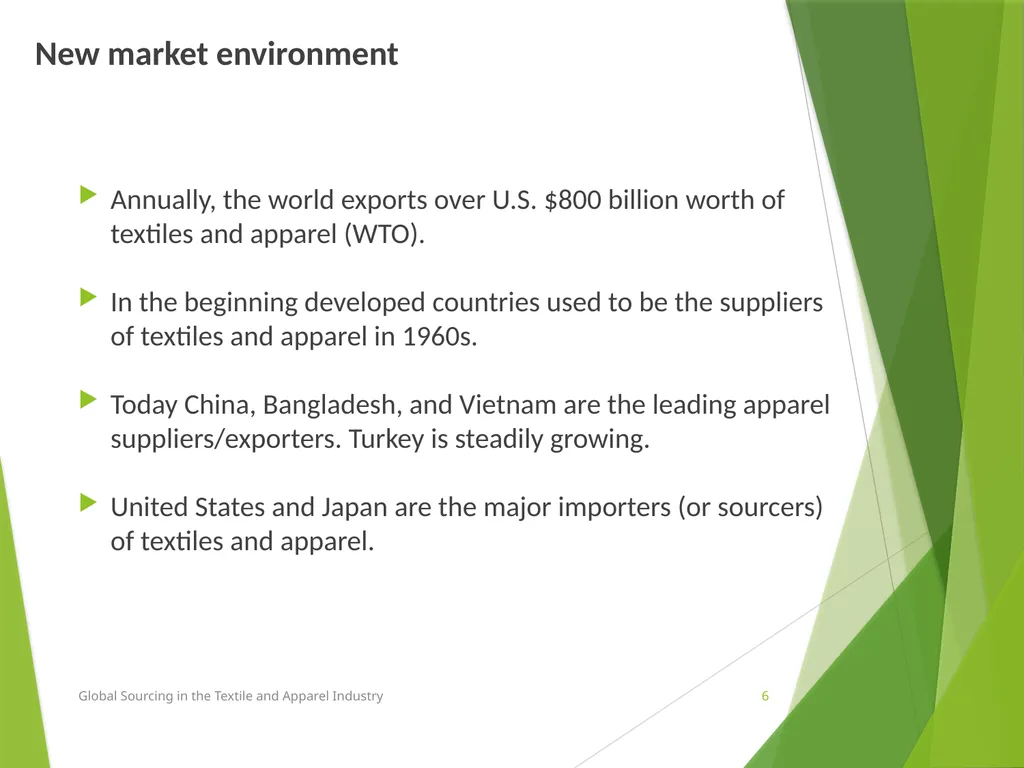
Annually, the world exports over U.S. $800 billion worth of textiles and apparel (WTO).
In the beginning developed countries used to be the suppliers of textiles and apparel in 1960s.
Today China, Bangladesh, and Vietnam are the leading apparel suppliers/exporters. Turkey is steadily growing.
United States and Japan are the major importers (or sourcers) of textiles and apparel. 6 Global Sourcing in the Textile and Apparel Industry<br>
slide7. Watch.. https://www.youtube.com/watch?v=aKWURy4vXjM
TOP 10 TEXTILE MANUFACTURING COUNTRIES (1963-2019) - Top Textile manufacturing countries 2019 Global Sourcing in the Textile and Apparel Industry 7<br>
slide8. Watch.. https://www.youtube.com/watch?v=1xkeaGpIyS0
World's Top 10 Exporting Countries [1960-2019] Global Sourcing in the Textile and Apparel Industry 8<br>
slide9. New market environment
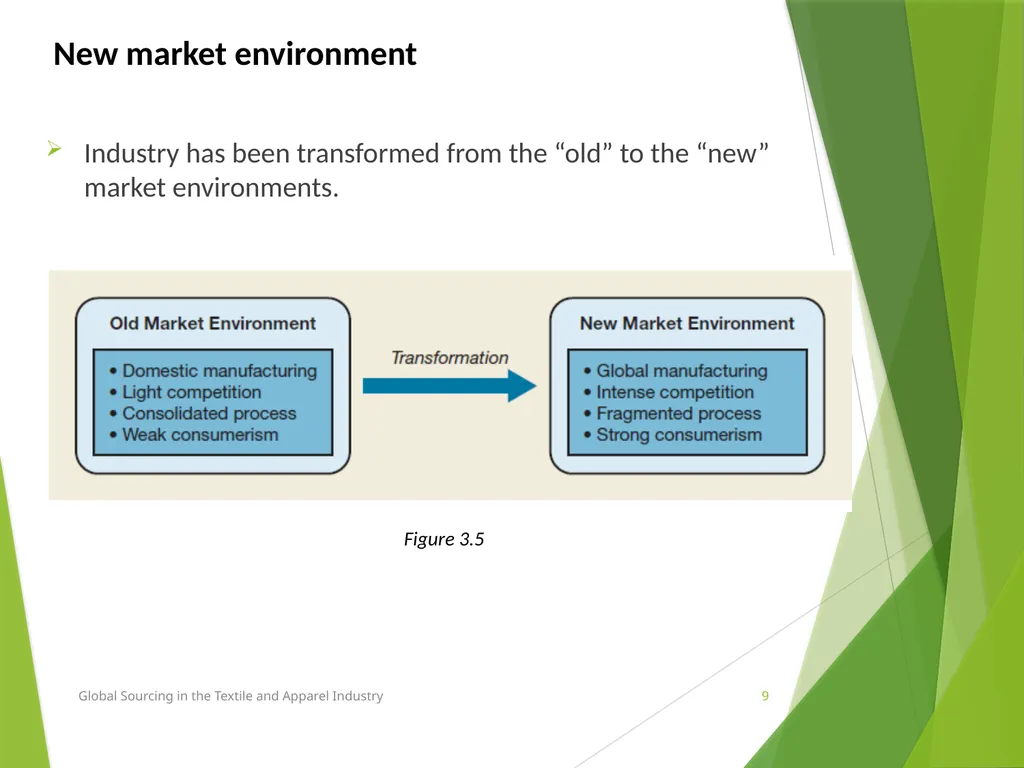
Industry has been transformed from the “old” to the “new” market environments. 9 Figure 3.5 Global Sourcing in the Textile and Apparel Industry<br>
slide10. Nature of global sourcing
Textile complex vs. soft goods industry
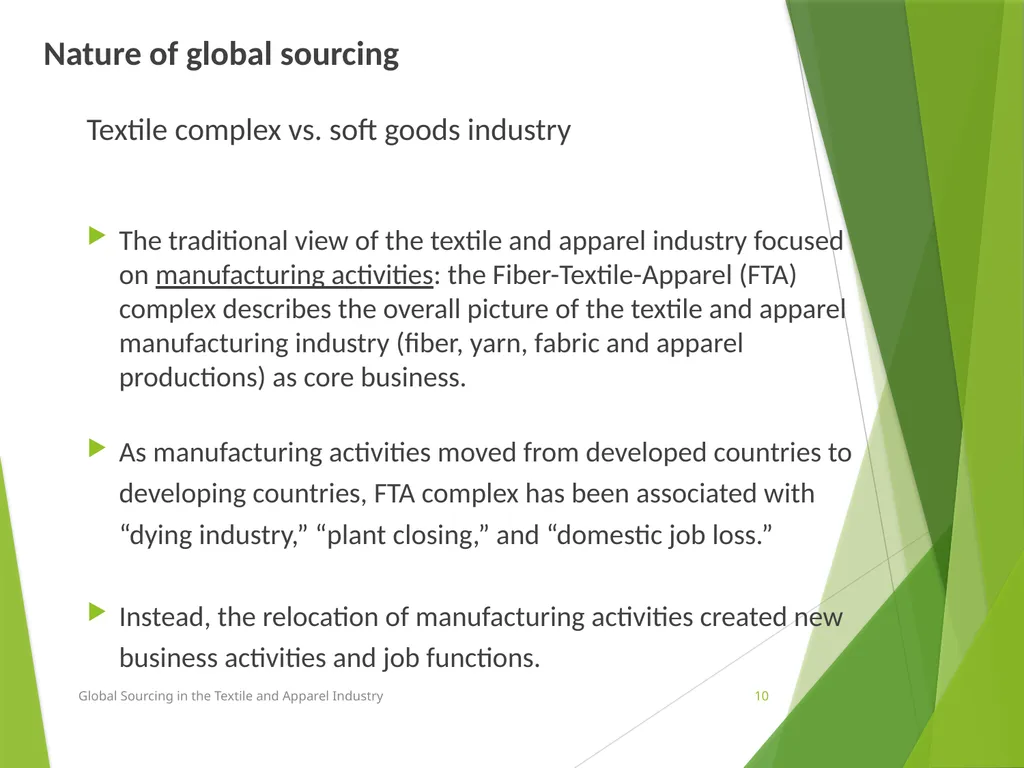
The traditional view of the textile and apparel industry focused on manufacturing activities: the Fiber-Textile-Apparel (FTA) complex describes the overall picture of the textile and apparel manufacturing industry (fiber, yarn, fabric and apparel productions) as core business.
As manufacturing activities moved from developed countries to developing countries, FTA complex has been associated with “dying industry,” “plant closing,” and “domestic job loss.”
Instead, the relocation of manufacturing activities created new business activities and job functions. 10 Global Sourcing in the Textile and Apparel Industry<br>
slide11. Nature of global sourcing
Business types
Textile complex vs. soft goods industry
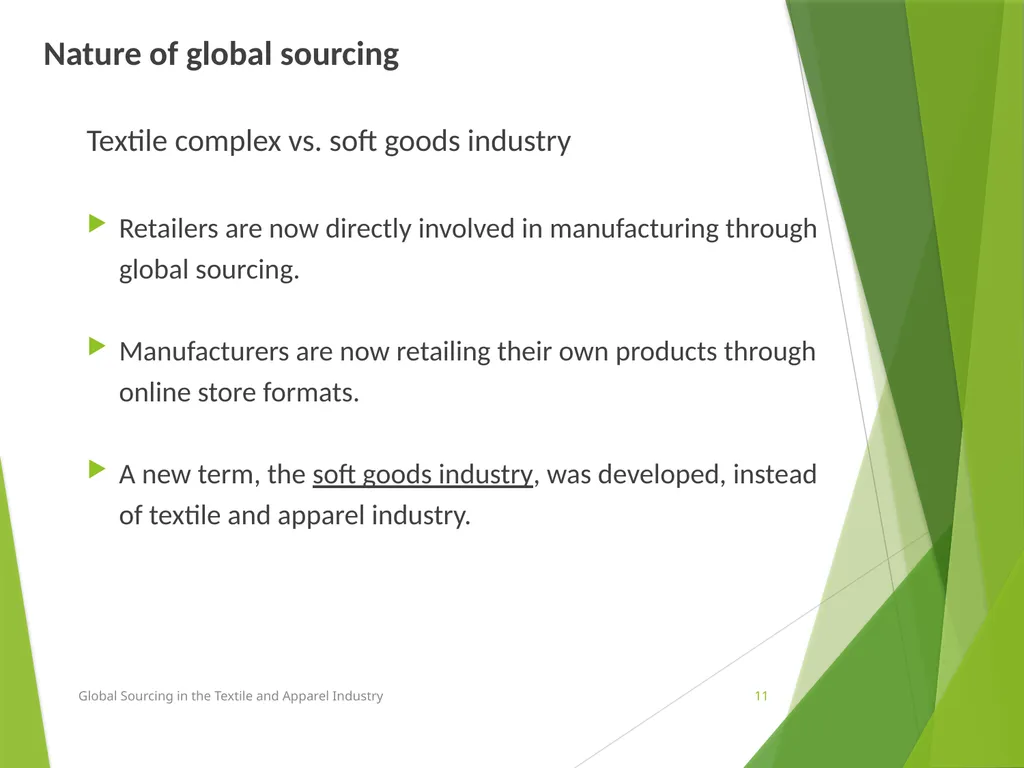
Retailers are now directly involved in manufacturing through global sourcing.
Manufacturers are now retailing their own products through online store formats.
A new term, the soft goods industry, was developed, instead of textile and apparel industry. 11 Global Sourcing in the Textile and Apparel Industry<br>
slide12. Watch.. https://www.youtube.com/watch?v=GpzRI-mcvg8
Sustainable clothing Global Sourcing in the Textile and Apparel Industry 12<br>
slide13. Answer.. Do you know what we mean by TEXTILES? Global Sourcing in the Textile and Apparel Industry 13<br>
slide14. Textiles All the products that the FTA (Fiber- Textile-Apparel) complex produces—fibers, yarns, fabrics, apparel, and so on. Global Sourcing in the Textile and Apparel Industry 14<br>
slide15. Answer.. Do you know what we mean by SOFTGOODS? Global Sourcing in the Textile and Apparel Industry 15<br>
slide16. Softgoods Nondurable goods that are usually made with textiles. Global Sourcing in the Textile and Apparel Industry 16<br>
slide17. Answer.. Do you know what we mean by SOFTGOODS CHAIN? Global Sourcing in the Textile and Apparel Industry 17<br>
slide18. Softgoods chain The total textile and apparel production-distribution chain, including retailing. Global Sourcing in the Textile and Apparel Industry 18<br>
slide19. Answer.. Do you know what we mean by SOFTGOODS INDUSTRY? Global Sourcing in the Textile and Apparel Industry 19<br>
slide20. Softgoods industry New business activities, such as importing, exporting, and other distribution-related business practices. Global Sourcing in the Textile and Apparel Industry 20<br>
slide21. Watch.. https://www.youtube.com/watch?v=qvEnjKgBSCQ
Apparel, Clothing and Textiles Industry: Globalization, Outsourcing, Retailing and E-commerce Trends Global Sourcing in the Textile and Apparel Industry 21<br>
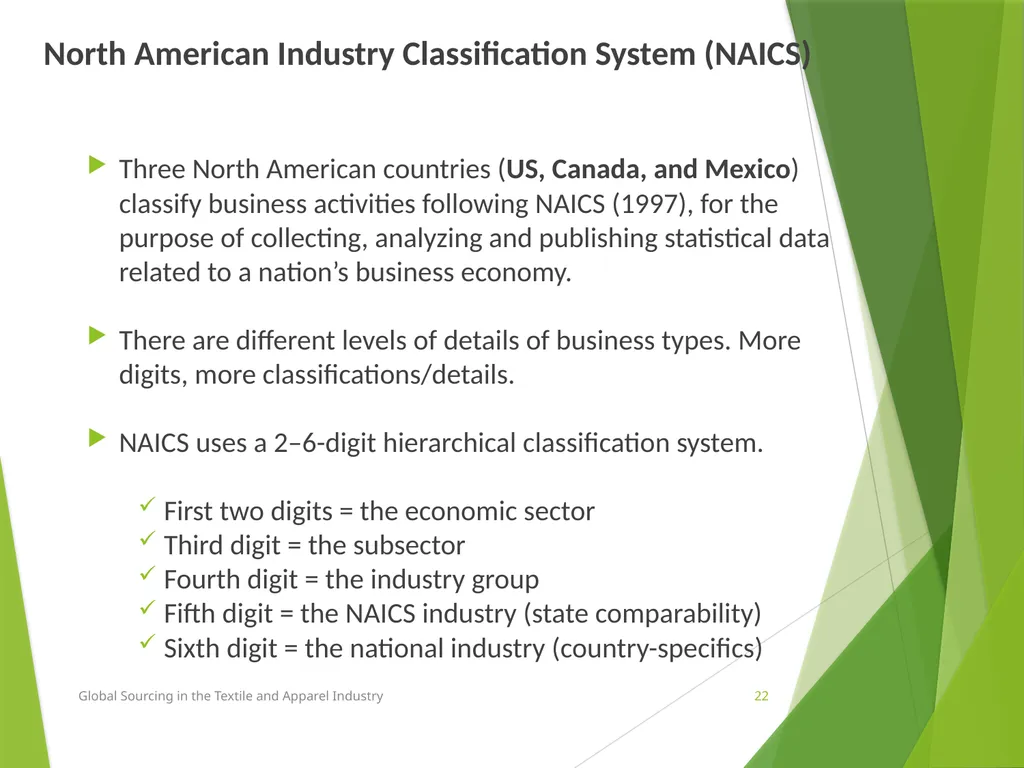
slide22. North American Industry Classification System (NAICS)
Three North American countries (US, Canada, and Mexico) classify business activities following NAICS (1997), for the purpose of collecting, analyzing and publishing statistical data related to a nation’s business economy.
There are different levels of details of business types. More digits, more classifications/details.
NAICS uses a 2–6-digit hierarchical classification system.
First two digits = the economic sector
Third digit = the subsector
Fourth digit = the industry group
Fifth digit = the NAICS industry (state comparability)
Sixth digit = the national industry (country-specifics) 22 Global Sourcing in the Textile and Apparel Industry<br>
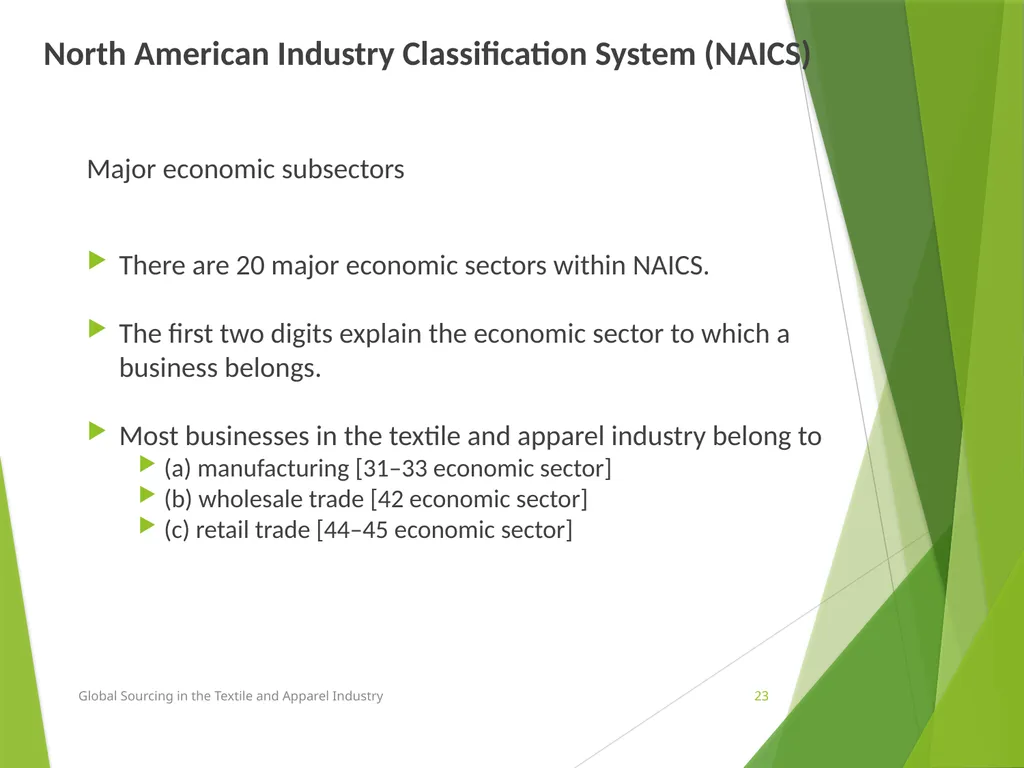
slide23. North American Industry Classification System (NAICS)
Major economic subsectors
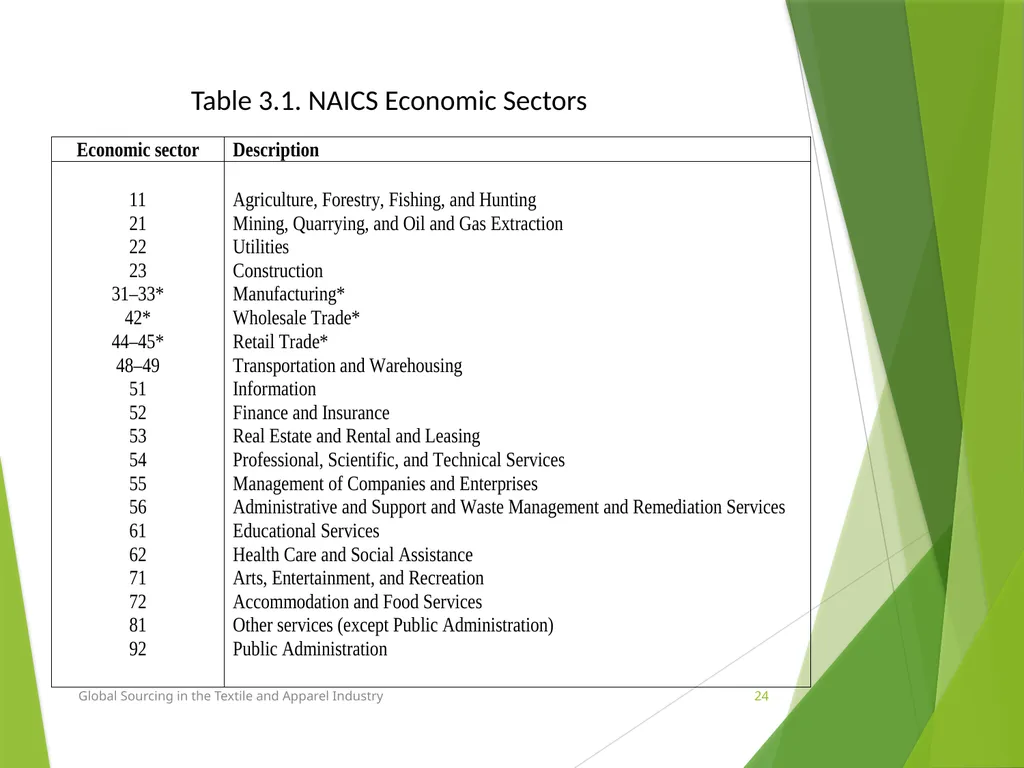
There are 20 major economic sectors within NAICS.
The first two digits explain the economic sector to which a business belongs.
Most businesses in the textile and apparel industry belong to
(a) manufacturing [31–33 economic sector]
(b) wholesale trade [42 economic sector]
(c) retail trade [44–45 economic sector] 23 Global Sourcing in the Textile and Apparel Industry<br>
slide24. 24 Table 3.1. NAICS Economic Sectors Global Sourcing in the Textile and Apparel Industry<br>
slide25. North American Industry Classification System
Major economic subsectors
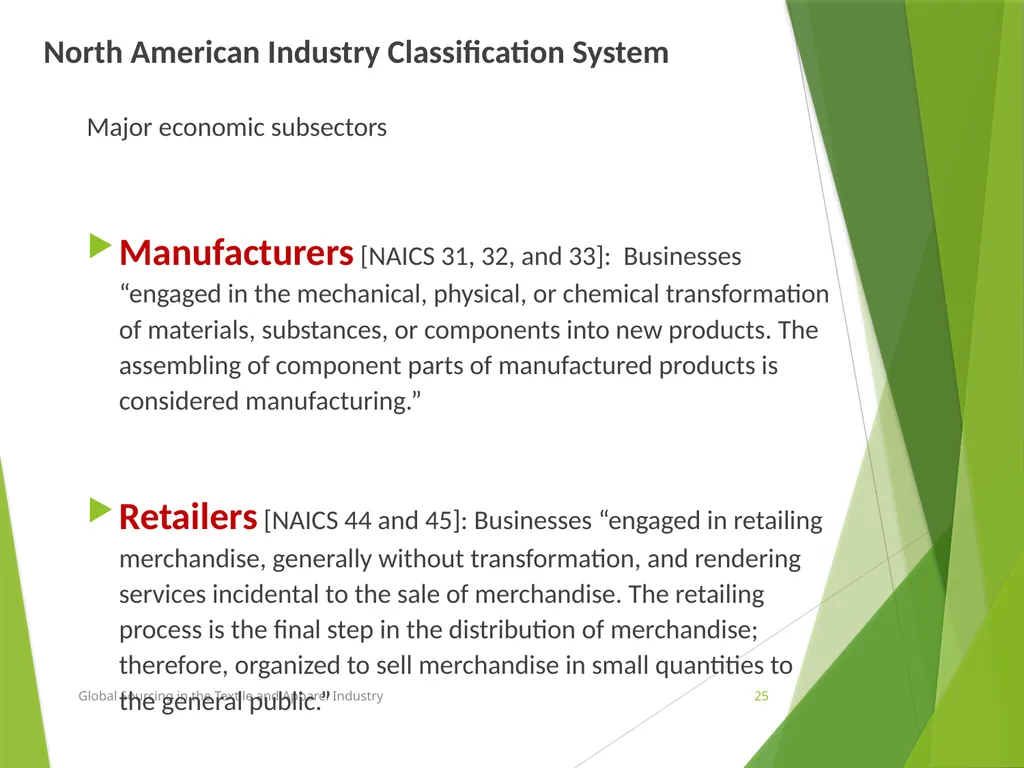
Manufacturers [NAICS 31, 32, and 33]: Businesses “engaged in the mechanical, physical, or chemical transformation of materials, substances, or components into new products. The assembling of component parts of manufactured products is considered manufacturing.”
Retailers [NAICS 44 and 45]: Businesses “engaged in retailing merchandise, generally without transformation, and rendering services incidental to the sale of merchandise. The retailing process is the final step in the distribution of merchandise; therefore, organized to sell merchandise in small quantities to the general public.” 25 Global Sourcing in the Textile and Apparel Industry<br>
slide26. North American Industry Classification System
Major economic subsectors
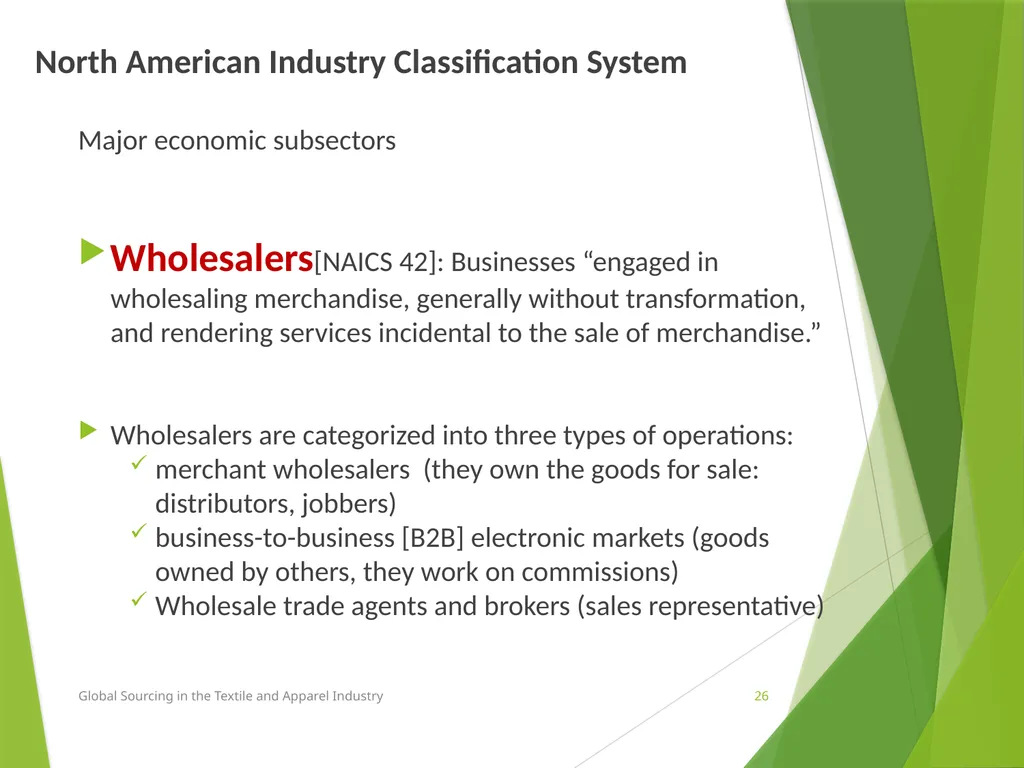
Wholesalers[NAICS 42]: Businesses “engaged in wholesaling merchandise, generally without transformation, and rendering services incidental to the sale of merchandise.”
Wholesalers are categorized into three types of operations:
merchant wholesalers (they own the goods for sale: distributors, jobbers)
business-to-business [B2B] electronic markets (goods owned by others, they work on commissions)
Wholesale trade agents and brokers (sales representative) 26 Global Sourcing in the Textile and Apparel Industry<br>
slide27. Watch.. https://www.youtube.com/watch?v=JzLoo8cFJBI
Retailers, Wholesalers and Distributors Global Sourcing in the Textile and Apparel Industry 27<br>
slide28. North American Industry Classification System
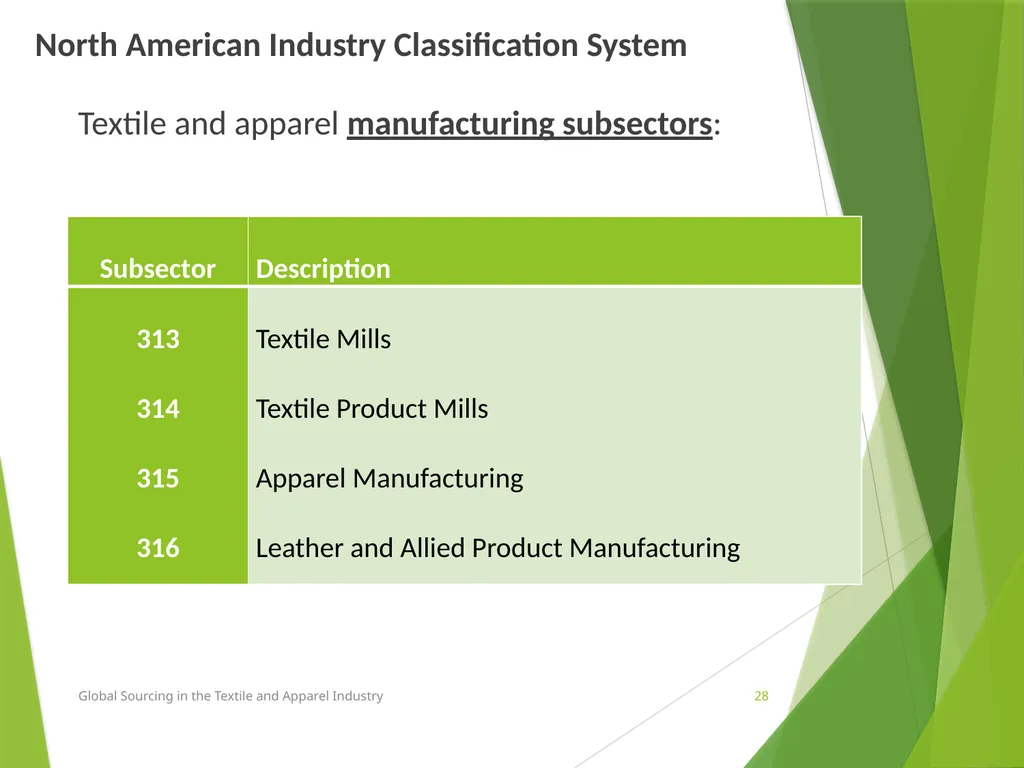
Textile and apparel manufacturing subsectors: 28 Global Sourcing in the Textile and Apparel Industry<br>
slide29. North American Industry Classification System
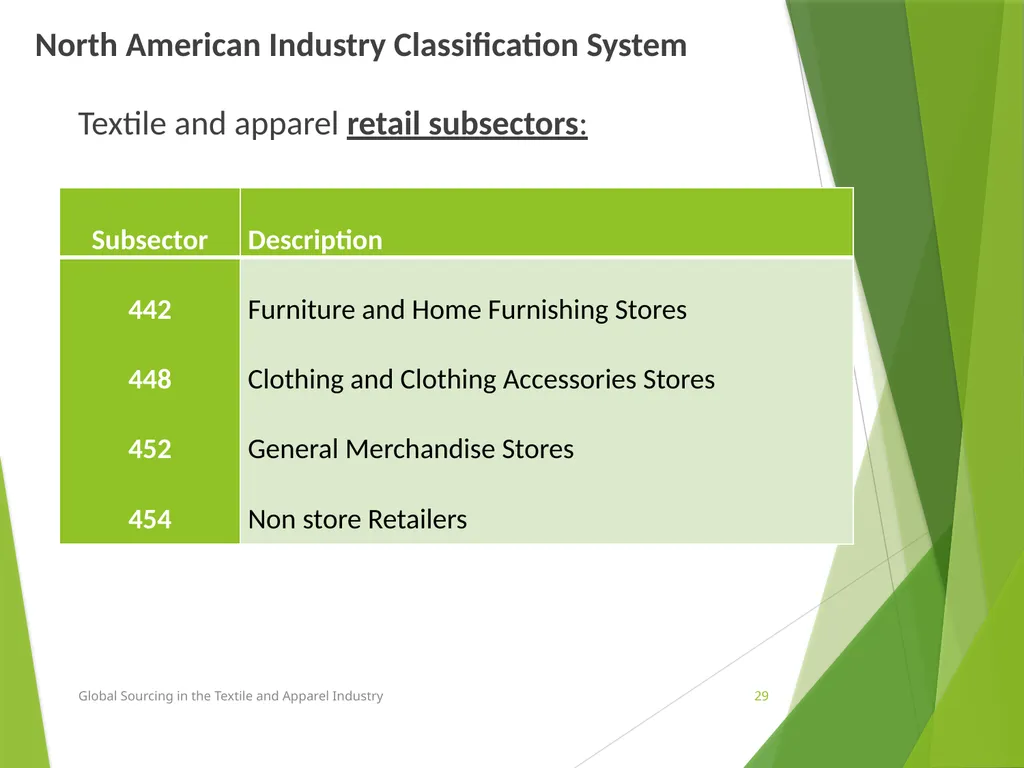
Textile and apparel retail subsectors: 29 Global Sourcing in the Textile and Apparel Industry<br>
slide30. North American Industry Classification System
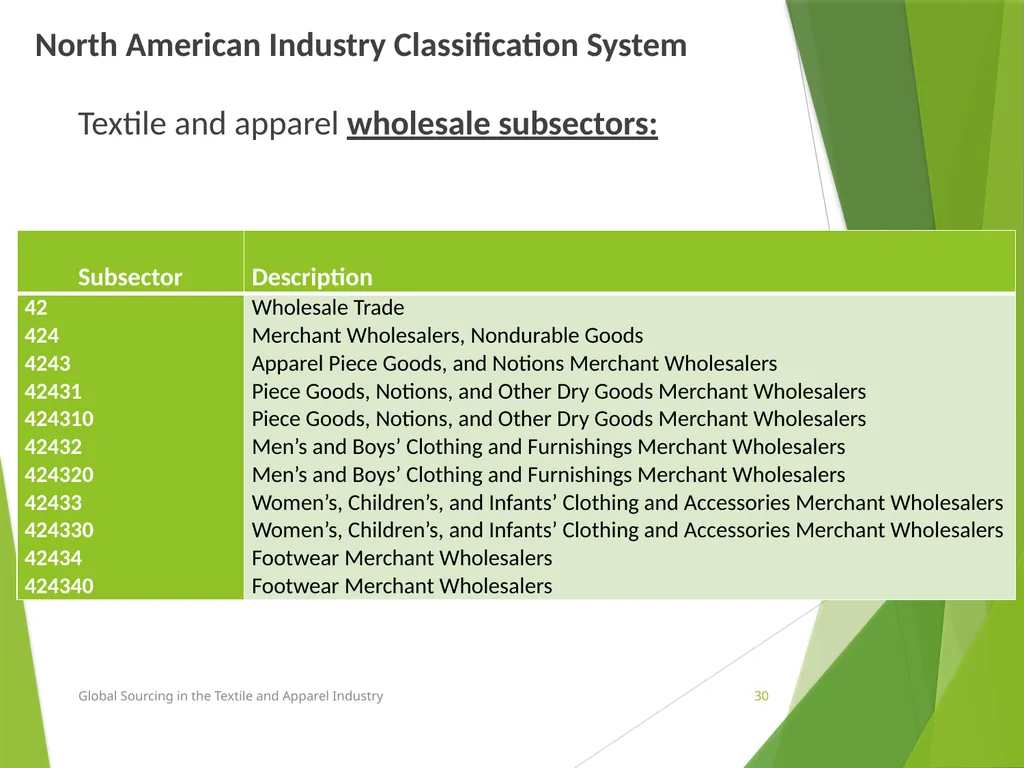
Textile and apparel wholesale subsectors: 30 Global Sourcing in the Textile and Apparel Industry<br>
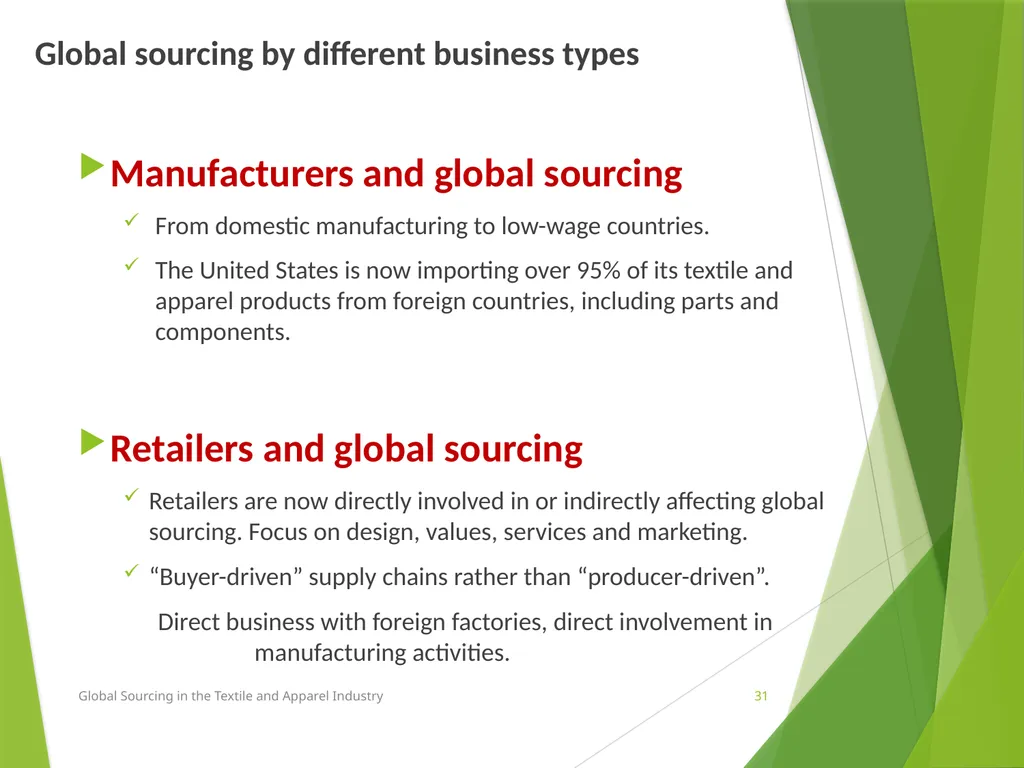
slide31. Global sourcing by different business types
Manufacturers and global sourcing
From domestic manufacturing to low-wage countries.
The United States is now importing over 95% of its textile and apparel products from foreign countries, including parts and components.
Retailers and global sourcing
Retailers are now directly involved in or indirectly affecting global sourcing. Focus on design, values, services and marketing.
“Buyer-driven” supply chains rather than “producer-driven”.
Direct business with foreign factories, direct involvement in manufacturing activities. 31 Global Sourcing in the Textile and Apparel Industry<br>
slide32. Global sourcing by different business types
Wholesalers and global sourcing
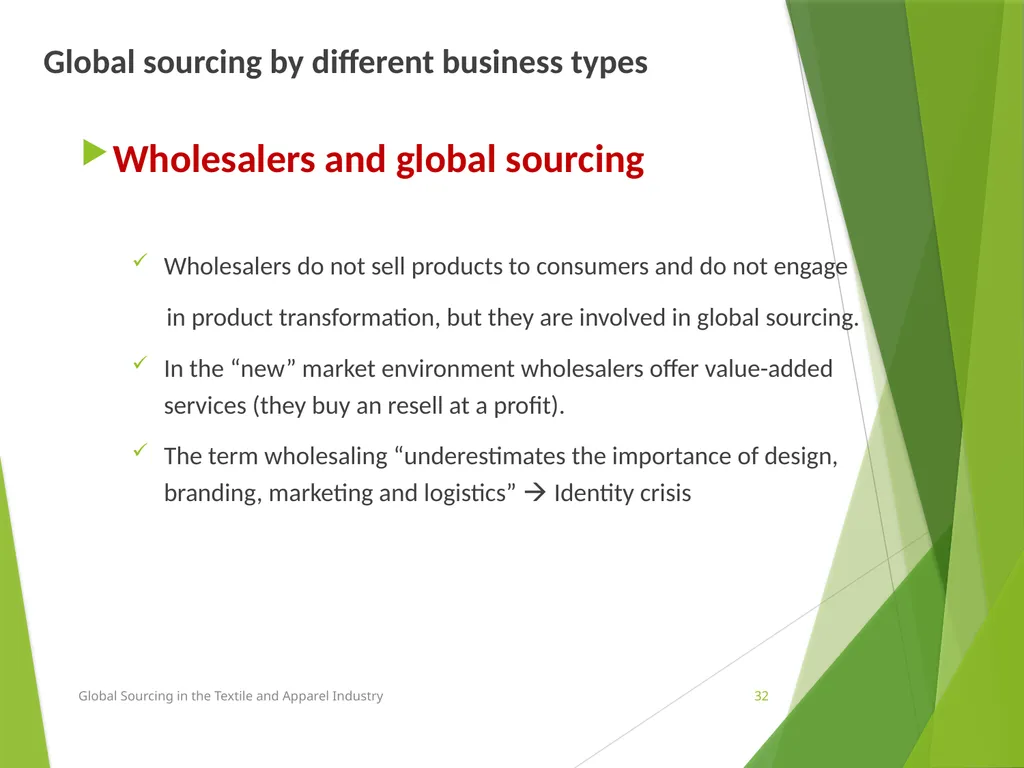
Wholesalers do not sell products to consumers and do not engage
in product transformation, but they are involved in global sourcing.
In the “new” market environment wholesalers offer value-added services (they buy an resell at a profit).
The term wholesaling “underestimates the importance of design, branding, marketing and logistics” Identity crisis 32 Global Sourcing in the Textile and Apparel Industry<br>
slide33. Global sourcing by different business types
Import intermediaries and global sourcing
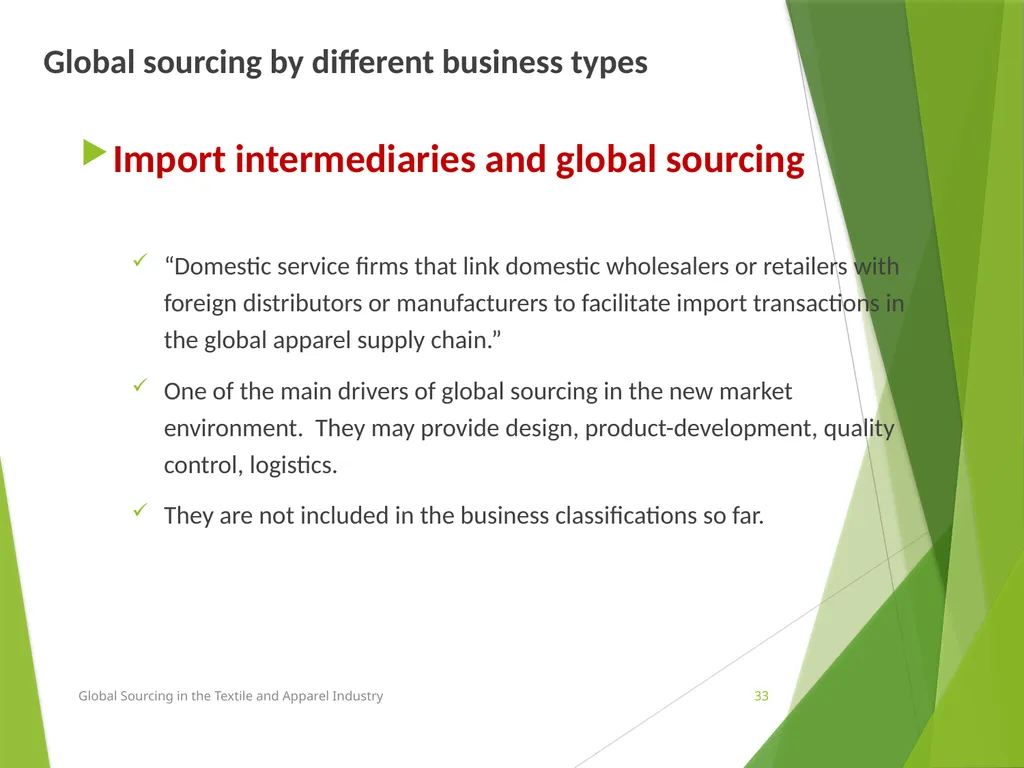
“Domestic service firms that link domestic wholesalers or retailers with foreign distributors or manufacturers to facilitate import transactions in the global apparel supply chain.”
One of the main drivers of global sourcing in the new market environment. They may provide design, product-development, quality control, logistics.
They are not included in the business classifications so far. 33 Global Sourcing in the Textile and Apparel Industry<br>
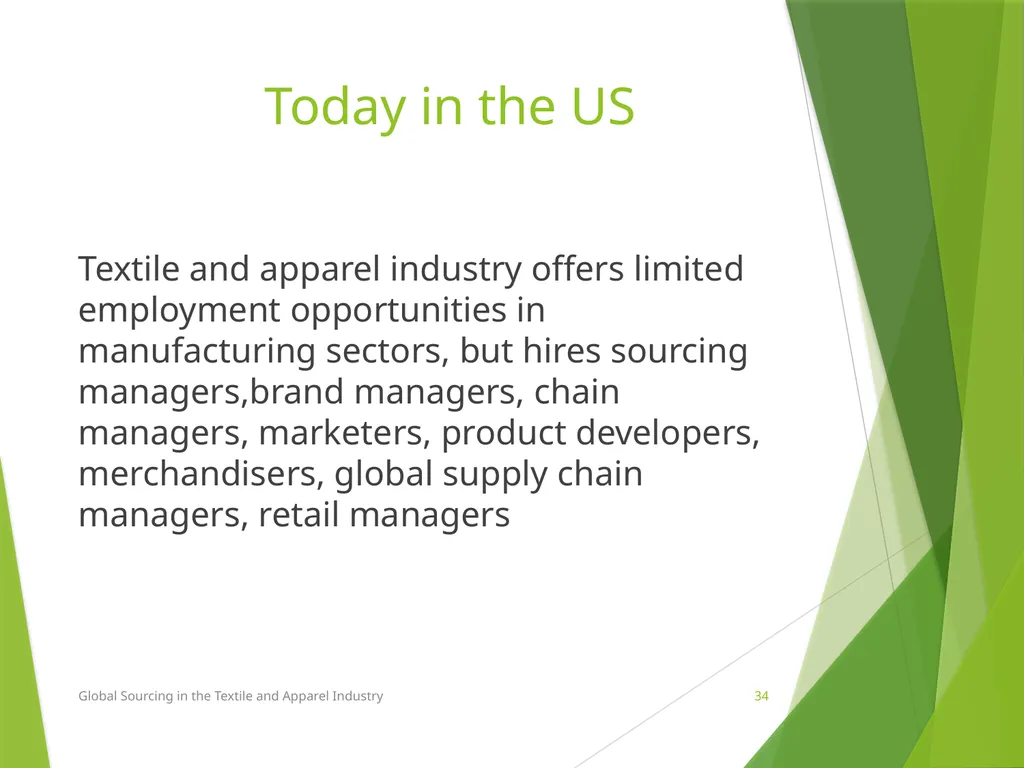
slide34. Today in the US Textile and apparel industry offers limited employment opportunities in manufacturing sectors, but hires sourcing managers,brand managers, chain managers, marketers, product developers, merchandisers, global supply chain managers, retail managers Global Sourcing in the Textile and Apparel Industry 34<br>
slide35. Watch.. https://www.youtube.com/watch?v=ErwIlvQ_RVk
America vs China: why the trade war won't end soon | The Economist Global Sourcing in the Textile and Apparel Industry 35<br>
slide36. For the next class Read Ch. 4 (see pages on syllabus)
Homework on textile and apparel (see instructions in MySRISA) Global Sourcing in the Textile and Apparel Industry 36<br>
slide37. Learning objectives
Current trends in global sourcing
Leading textile and apparel importers and exporters
Differences between old and new market environments
Textile complex and soft goods industry
North American Industry Classification System to analyze business activities within the industry
Impact of global sourcing on manufacturing, wholesale, and retail 37 Global Sourcing in the Textile and Apparel Industry<br>
slide2. Learning objectives
Current trends in global sourcing
Leading textile and apparel importers and exporters
Differences between old and new market environments
Textile complex and soft goods industry
North American Industry Classification System to analyze business activities within the industry
Impact of global sourcing on manufacturing, wholesale, and retail 2 Global Sourcing in the Textile and Apparel Industry<br>
slide3. Recall the definition of SOURCING and GLOBAL SOURCING from Lesson1 Sourcing: a set of business processes and activities by which businesses acquire and deliver components or fully finished products or services from outside of the organization, with the objective of:
Finding, evaluating, and engaging suppliers for appropriate goods and services to achieve long-term competitive advantages. Sourcing is a B2B activity
Global sourcing: same as sourcing, in a global marketplace Global Sourcing in the Textile and Apparel Industry 3<br>
slide4. Watch..the «old Silk road» https://www.youtube.com/watch?v=vn3e37VWc0k
The Silk Road and Ancient Trade: the first “World Wide Web“
Of history Global Sourcing in the Textile and Apparel Industry 4<br>
slide5. Watch..the «new Silk road» https://www.youtube.com/watch?v=EvXROXiIpvQ
China's trillion-dollar plan to dominate global trade Global Sourcing in the Textile and Apparel Industry 5<br>
slide6. New market environment
Annually, the world exports over U.S. $800 billion worth of textiles and apparel (WTO).
In the beginning developed countries used to be the suppliers of textiles and apparel in 1960s.
Today China, Bangladesh, and Vietnam are the leading apparel suppliers/exporters. Turkey is steadily growing.
United States and Japan are the major importers (or sourcers) of textiles and apparel. 6 Global Sourcing in the Textile and Apparel Industry<br>
slide7. Watch.. https://www.youtube.com/watch?v=aKWURy4vXjM
TOP 10 TEXTILE MANUFACTURING COUNTRIES (1963-2019) - Top Textile manufacturing countries 2019 Global Sourcing in the Textile and Apparel Industry 7<br>
slide8. Watch.. https://www.youtube.com/watch?v=1xkeaGpIyS0
World's Top 10 Exporting Countries [1960-2019] Global Sourcing in the Textile and Apparel Industry 8<br>
slide9. New market environment
Industry has been transformed from the “old” to the “new” market environments. 9 Figure 3.5 Global Sourcing in the Textile and Apparel Industry<br>
slide10. Nature of global sourcing
Textile complex vs. soft goods industry
The traditional view of the textile and apparel industry focused on manufacturing activities: the Fiber-Textile-Apparel (FTA) complex describes the overall picture of the textile and apparel manufacturing industry (fiber, yarn, fabric and apparel productions) as core business.
As manufacturing activities moved from developed countries to developing countries, FTA complex has been associated with “dying industry,” “plant closing,” and “domestic job loss.”
Instead, the relocation of manufacturing activities created new business activities and job functions. 10 Global Sourcing in the Textile and Apparel Industry<br>
slide11. Nature of global sourcing
Business types
Textile complex vs. soft goods industry
Retailers are now directly involved in manufacturing through global sourcing.
Manufacturers are now retailing their own products through online store formats.
A new term, the soft goods industry, was developed, instead of textile and apparel industry. 11 Global Sourcing in the Textile and Apparel Industry<br>
slide12. Watch.. https://www.youtube.com/watch?v=GpzRI-mcvg8
Sustainable clothing Global Sourcing in the Textile and Apparel Industry 12<br>
slide13. Answer.. Do you know what we mean by TEXTILES? Global Sourcing in the Textile and Apparel Industry 13<br>
slide14. Textiles All the products that the FTA (Fiber- Textile-Apparel) complex produces—fibers, yarns, fabrics, apparel, and so on. Global Sourcing in the Textile and Apparel Industry 14<br>
slide15. Answer.. Do you know what we mean by SOFTGOODS? Global Sourcing in the Textile and Apparel Industry 15<br>
slide16. Softgoods Nondurable goods that are usually made with textiles. Global Sourcing in the Textile and Apparel Industry 16<br>
slide17. Answer.. Do you know what we mean by SOFTGOODS CHAIN? Global Sourcing in the Textile and Apparel Industry 17<br>
slide18. Softgoods chain The total textile and apparel production-distribution chain, including retailing. Global Sourcing in the Textile and Apparel Industry 18<br>
slide19. Answer.. Do you know what we mean by SOFTGOODS INDUSTRY? Global Sourcing in the Textile and Apparel Industry 19<br>
slide20. Softgoods industry New business activities, such as importing, exporting, and other distribution-related business practices. Global Sourcing in the Textile and Apparel Industry 20<br>
slide21. Watch.. https://www.youtube.com/watch?v=qvEnjKgBSCQ
Apparel, Clothing and Textiles Industry: Globalization, Outsourcing, Retailing and E-commerce Trends Global Sourcing in the Textile and Apparel Industry 21<br>
slide22. North American Industry Classification System (NAICS)
Three North American countries (US, Canada, and Mexico) classify business activities following NAICS (1997), for the purpose of collecting, analyzing and publishing statistical data related to a nation’s business economy.
There are different levels of details of business types. More digits, more classifications/details.
NAICS uses a 2–6-digit hierarchical classification system.
First two digits = the economic sector
Third digit = the subsector
Fourth digit = the industry group
Fifth digit = the NAICS industry (state comparability)
Sixth digit = the national industry (country-specifics) 22 Global Sourcing in the Textile and Apparel Industry<br>
slide23. North American Industry Classification System (NAICS)
Major economic subsectors
There are 20 major economic sectors within NAICS.
The first two digits explain the economic sector to which a business belongs.
Most businesses in the textile and apparel industry belong to
(a) manufacturing [31–33 economic sector]
(b) wholesale trade [42 economic sector]
(c) retail trade [44–45 economic sector] 23 Global Sourcing in the Textile and Apparel Industry<br>
slide24. 24 Table 3.1. NAICS Economic Sectors Global Sourcing in the Textile and Apparel Industry<br>
slide25. North American Industry Classification System
Major economic subsectors
Manufacturers [NAICS 31, 32, and 33]: Businesses “engaged in the mechanical, physical, or chemical transformation of materials, substances, or components into new products. The assembling of component parts of manufactured products is considered manufacturing.”
Retailers [NAICS 44 and 45]: Businesses “engaged in retailing merchandise, generally without transformation, and rendering services incidental to the sale of merchandise. The retailing process is the final step in the distribution of merchandise; therefore, organized to sell merchandise in small quantities to the general public.” 25 Global Sourcing in the Textile and Apparel Industry<br>
slide26. North American Industry Classification System
Major economic subsectors
Wholesalers[NAICS 42]: Businesses “engaged in wholesaling merchandise, generally without transformation, and rendering services incidental to the sale of merchandise.”
Wholesalers are categorized into three types of operations:
merchant wholesalers (they own the goods for sale: distributors, jobbers)
business-to-business [B2B] electronic markets (goods owned by others, they work on commissions)
Wholesale trade agents and brokers (sales representative) 26 Global Sourcing in the Textile and Apparel Industry<br>
slide27. Watch.. https://www.youtube.com/watch?v=JzLoo8cFJBI
Retailers, Wholesalers and Distributors Global Sourcing in the Textile and Apparel Industry 27<br>
slide28. North American Industry Classification System
Textile and apparel manufacturing subsectors: 28 Global Sourcing in the Textile and Apparel Industry<br>
slide29. North American Industry Classification System
Textile and apparel retail subsectors: 29 Global Sourcing in the Textile and Apparel Industry<br>
slide30. North American Industry Classification System
Textile and apparel wholesale subsectors: 30 Global Sourcing in the Textile and Apparel Industry<br>
slide31. Global sourcing by different business types
Manufacturers and global sourcing
From domestic manufacturing to low-wage countries.
The United States is now importing over 95% of its textile and apparel products from foreign countries, including parts and components.
Retailers and global sourcing
Retailers are now directly involved in or indirectly affecting global sourcing. Focus on design, values, services and marketing.
“Buyer-driven” supply chains rather than “producer-driven”.
Direct business with foreign factories, direct involvement in manufacturing activities. 31 Global Sourcing in the Textile and Apparel Industry<br>
slide32. Global sourcing by different business types
Wholesalers and global sourcing
Wholesalers do not sell products to consumers and do not engage
in product transformation, but they are involved in global sourcing.
In the “new” market environment wholesalers offer value-added services (they buy an resell at a profit).
The term wholesaling “underestimates the importance of design, branding, marketing and logistics” Identity crisis 32 Global Sourcing in the Textile and Apparel Industry<br>
slide33. Global sourcing by different business types
Import intermediaries and global sourcing
“Domestic service firms that link domestic wholesalers or retailers with foreign distributors or manufacturers to facilitate import transactions in the global apparel supply chain.”
One of the main drivers of global sourcing in the new market environment. They may provide design, product-development, quality control, logistics.
They are not included in the business classifications so far. 33 Global Sourcing in the Textile and Apparel Industry<br>
slide34. Today in the US Textile and apparel industry offers limited employment opportunities in manufacturing sectors, but hires sourcing managers,brand managers, chain managers, marketers, product developers, merchandisers, global supply chain managers, retail managers Global Sourcing in the Textile and Apparel Industry 34<br>
slide35. Watch.. https://www.youtube.com/watch?v=ErwIlvQ_RVk
America vs China: why the trade war won't end soon | The Economist Global Sourcing in the Textile and Apparel Industry 35<br>
slide36. For the next class Read Ch. 4 (see pages on syllabus)
Homework on textile and apparel (see instructions in MySRISA) Global Sourcing in the Textile and Apparel Industry 36<br>
slide37. Learning objectives
Current trends in global sourcing
Leading textile and apparel importers and exporters
Differences between old and new market environments
Textile complex and soft goods industry
North American Industry Classification System to analyze business activities within the industry
Impact of global sourcing on manufacturing, wholesale, and retail 37 Global Sourcing in the Textile and Apparel Industry<br>