
Macroeconomic context for Budget 2025 EVENT ESRI
TG
Published · 23 slides · 0 views

1 / 1
Description
Macroeconomic context for Budget 2025 EVENT ESRI Budget Perspectives Conference DATE June 13th 2024 AUTHORs Kieran McQuinn and Lea Hauser 2 Overview GDP declined in 2023 while the underlying economy measured by MDD is growing at a
Related Topics
Share
Embed code
Download this presentation From Below
"Macroeconomic context for Budget 2025 EVENT ESRI" is the property of its rightful owner. Permission is granted to download and print the materials on this website for personal, non-commercial use only, and to display it on your personal computer provided you do not modify the materials and that you retain all copyright notices contained in the materials. By downloading content from our website, you accept the terms of this agreement.
Presentation Transcript
01
Macroeconomic context for Budget 2025 EVENT
ESRI Budget Perspectives Conference
DATE
June 13th 2024
AUTHORs
Kieran McQuinn and
Lea Hauser<br>
ESRI Budget Perspectives Conference
DATE
June 13th 2024
AUTHORs
Kieran McQuinn and
Lea Hauser<br>
02
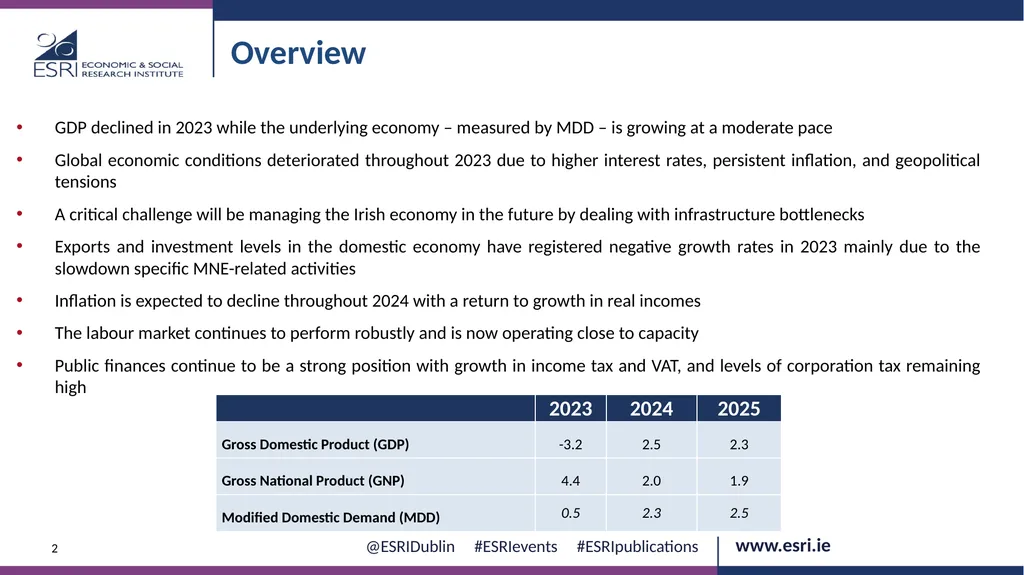
2 Overview GDP declined in 2023 while the underlying economy – measured by MDD – is growing at a moderate pace
Global economic conditions deteriorated throughout 2023 due to higher interest rates, persistent inflation, and geopolitical tensions
A critical challenge will be managing the Irish economy in the future by dealing with infrastructure bottlenecks
Exports and investment levels in the domestic economy have registered negative growth rates in 2023 mainly due to the slowdown specific MNE-related activities
Inflation is expected to decline throughout 2024 with a return to growth in real incomes
The labour market continues to perform robustly and is now operating close to capacity
Public finances continue to be a strong position with growth in income tax and VAT, and levels of corporation tax remaining high<br>
Global economic conditions deteriorated throughout 2023 due to higher interest rates, persistent inflation, and geopolitical tensions
A critical challenge will be managing the Irish economy in the future by dealing with infrastructure bottlenecks
Exports and investment levels in the domestic economy have registered negative growth rates in 2023 mainly due to the slowdown specific MNE-related activities
Inflation is expected to decline throughout 2024 with a return to growth in real incomes
The labour market continues to perform robustly and is now operating close to capacity
Public finances continue to be a strong position with growth in income tax and VAT, and levels of corporation tax remaining high<br>
03
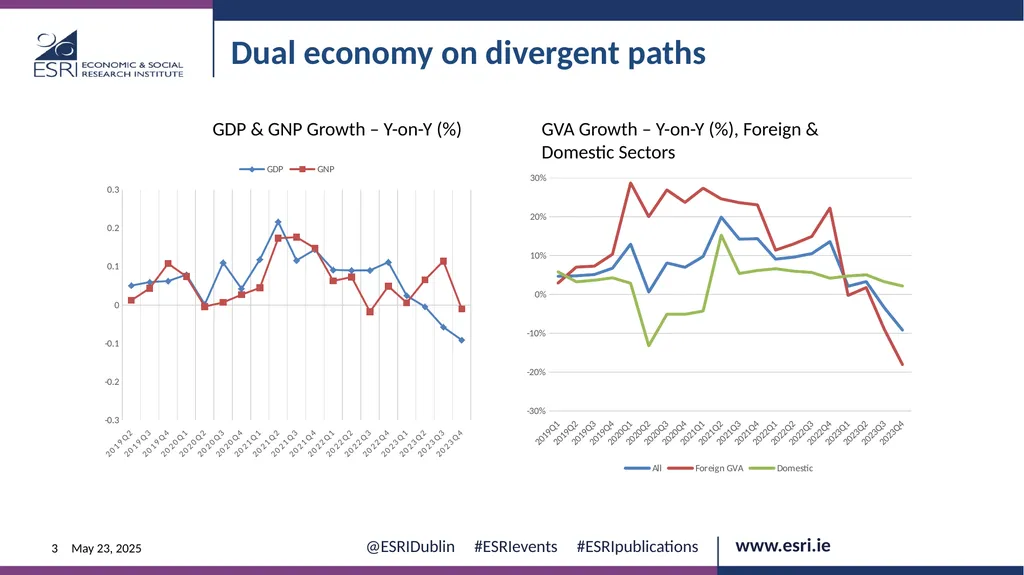
3 12 June 2024 Dual economy on divergent paths GDP & GNP Growth – Y-on-Y (%) GVA Growth – Y-on-Y (%), Foreign & Domestic Sectors<br>
04
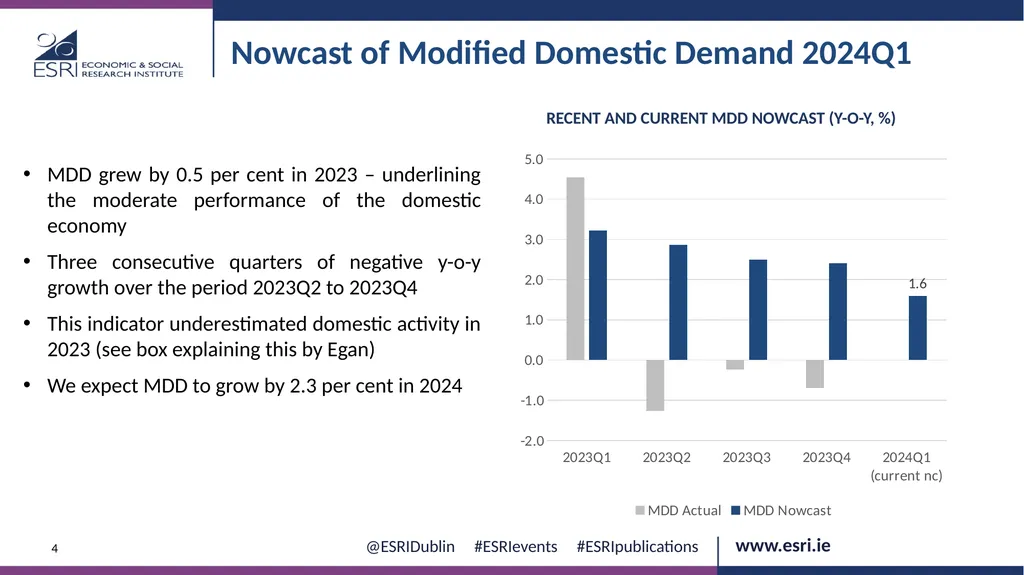
4 Nowcast of Modified Domestic Demand 2024Q1 MDD grew by 0.5 per cent in 2023 – underlining the moderate performance of the domestic economy
Three consecutive quarters of negative y-o-y growth over the period 2023Q2 to 2023Q4
This indicator underestimated domestic activity in 2023 (see box explaining this by Egan)
We expect MDD to grow by 2.3 per cent in 2024 Recent and Current MDD Nowcast (Y-o-y, %)<br>
Three consecutive quarters of negative y-o-y growth over the period 2023Q2 to 2023Q4
This indicator underestimated domestic activity in 2023 (see box explaining this by Egan)
We expect MDD to grow by 2.3 per cent in 2024 Recent and Current MDD Nowcast (Y-o-y, %)<br>
05
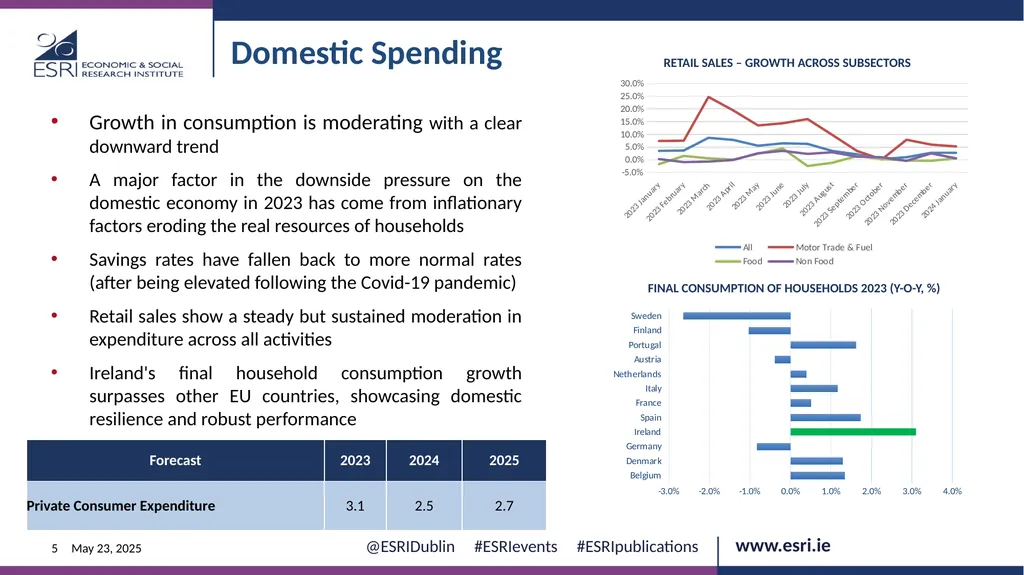
5 12 June 2024 Domestic Spending Growth in consumption is moderating with a clear downward trend
A major factor in the downside pressure on the domestic economy in 2023 has come from inflationary factors eroding the real resources of households
Savings rates have fallen back to more normal rates (after being elevated following the Covid-19 pandemic)
Retail sales show a steady but sustained moderation in expenditure across all activities
Ireland's final household consumption growth surpasses other EU countries, showcasing domestic resilience and robust performance Retail Sales – Growth across Subsectors Final Consumption of Households 2023 (y-o-y, %)<br>
A major factor in the downside pressure on the domestic economy in 2023 has come from inflationary factors eroding the real resources of households
Savings rates have fallen back to more normal rates (after being elevated following the Covid-19 pandemic)
Retail sales show a steady but sustained moderation in expenditure across all activities
Ireland's final household consumption growth surpasses other EU countries, showcasing domestic resilience and robust performance Retail Sales – Growth across Subsectors Final Consumption of Households 2023 (y-o-y, %)<br>
06
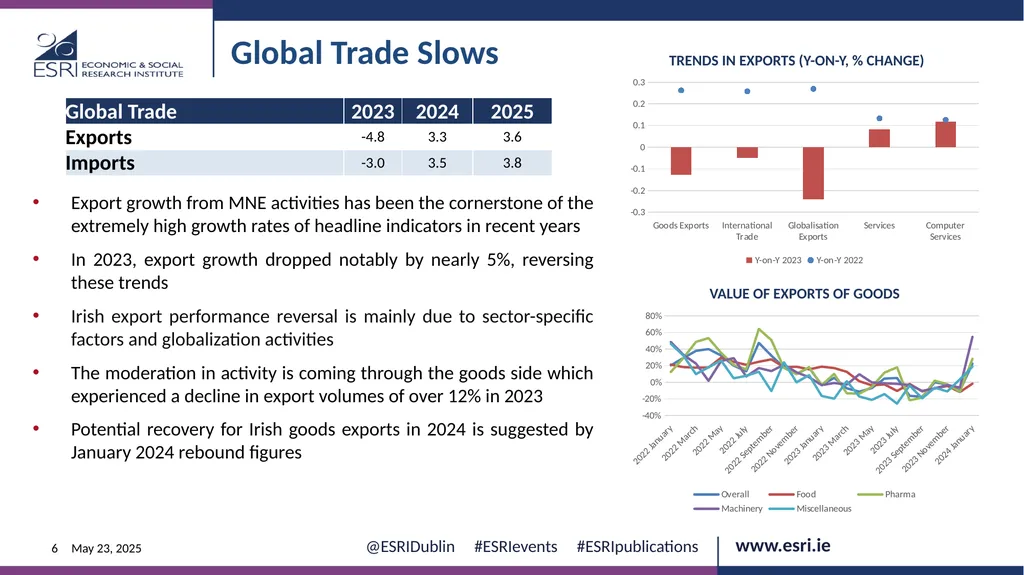
6 12 June 2024 Global Trade Slows Export growth from MNE activities has been the cornerstone of the extremely high growth rates of headline indicators in recent years
In 2023, export growth dropped notably by nearly 5%, reversing these trends
Irish export performance reversal is mainly due to sector-specific factors and globalization activities
The moderation in activity is coming through the goods side which experienced a decline in export volumes of over 12% in 2023
Potential recovery for Irish goods exports in 2024 is suggested by January 2024 rebound figures Trends in Exports (Y-on-Y, % Change) Value of Exports of goods<br>
In 2023, export growth dropped notably by nearly 5%, reversing these trends
Irish export performance reversal is mainly due to sector-specific factors and globalization activities
The moderation in activity is coming through the goods side which experienced a decline in export volumes of over 12% in 2023
Potential recovery for Irish goods exports in 2024 is suggested by January 2024 rebound figures Trends in Exports (Y-on-Y, % Change) Value of Exports of goods<br>
07
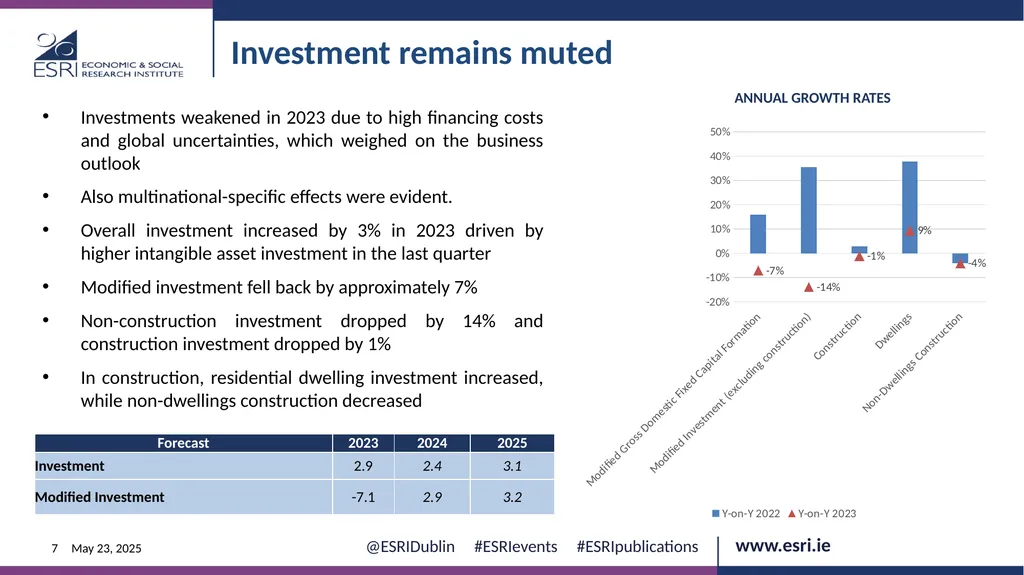
7 12 June 2024 Investment remains muted Annual Growth Rates Investments weakened in 2023 due to high financing costs and global uncertainties, which weighed on the business outlook
Also multinational-specific effects were evident.
Overall investment increased by 3% in 2023 driven by higher intangible asset investment in the last quarter
Modified investment fell back by approximately 7%
Non-construction investment dropped by 14% and construction investment dropped by 1%
In construction, residential dwelling investment increased, while non-dwellings construction decreased<br>
Also multinational-specific effects were evident.
Overall investment increased by 3% in 2023 driven by higher intangible asset investment in the last quarter
Modified investment fell back by approximately 7%
Non-construction investment dropped by 14% and construction investment dropped by 1%
In construction, residential dwelling investment increased, while non-dwellings construction decreased<br>
08
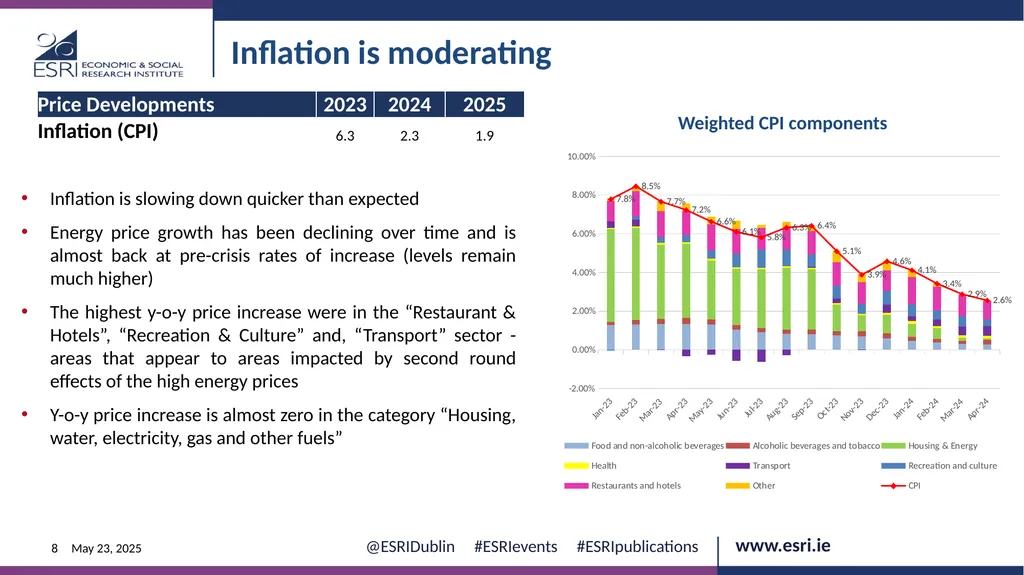
8 12 June 2024 Inflation is moderating Inflation is slowing down quicker than expected
Energy price growth has been declining over time and is almost back at pre-crisis rates of increase (levels remain much higher)
The highest y-o-y price increase were in the “Restaurant & Hotels”, “Recreation & Culture” and, “Transport” sector - areas that appear to areas impacted by second round effects of the high energy prices
Y-o-y price increase is almost zero in the category “Housing, water, electricity, gas and other fuels” Weighted CPI components<br>
Energy price growth has been declining over time and is almost back at pre-crisis rates of increase (levels remain much higher)
The highest y-o-y price increase were in the “Restaurant & Hotels”, “Recreation & Culture” and, “Transport” sector - areas that appear to areas impacted by second round effects of the high energy prices
Y-o-y price increase is almost zero in the category “Housing, water, electricity, gas and other fuels” Weighted CPI components<br>
09
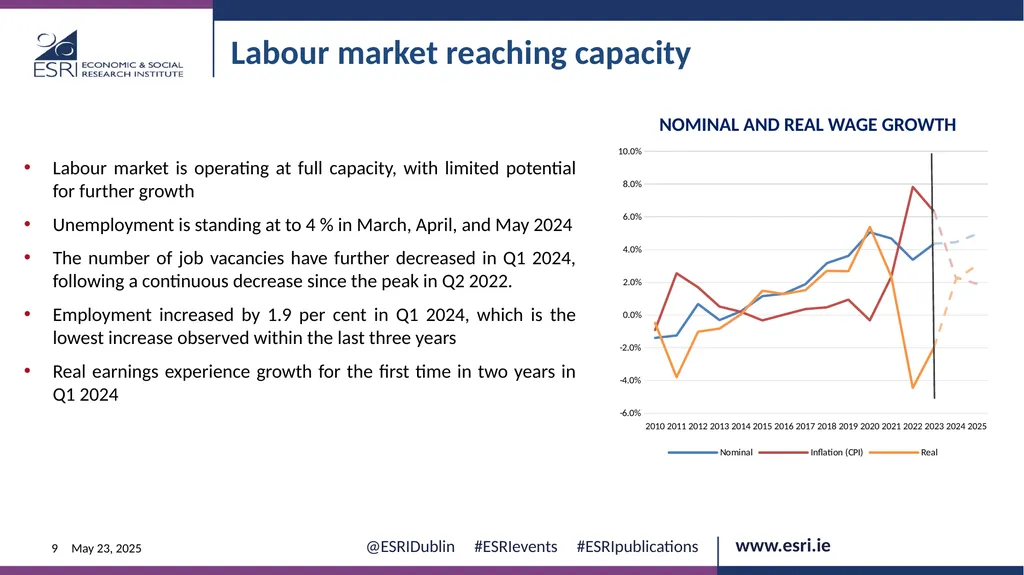
9 12 June 2024 Labour market reaching capacity Labour market is operating at full capacity, with limited potential for further growth
Unemployment is standing at to 4 % in March, April, and May 2024
The number of job vacancies have further decreased in Q1 2024, following a continuous decrease since the peak in Q2 2022.
Employment increased by 1.9 per cent in Q1 2024, which is the lowest increase observed within the last three years
Real earnings experience growth for the first time in two years in Q1 2024 Nominal and Real Wage Growth<br>
Unemployment is standing at to 4 % in March, April, and May 2024
The number of job vacancies have further decreased in Q1 2024, following a continuous decrease since the peak in Q2 2022.
Employment increased by 1.9 per cent in Q1 2024, which is the lowest increase observed within the last three years
Real earnings experience growth for the first time in two years in Q1 2024 Nominal and Real Wage Growth<br>
10
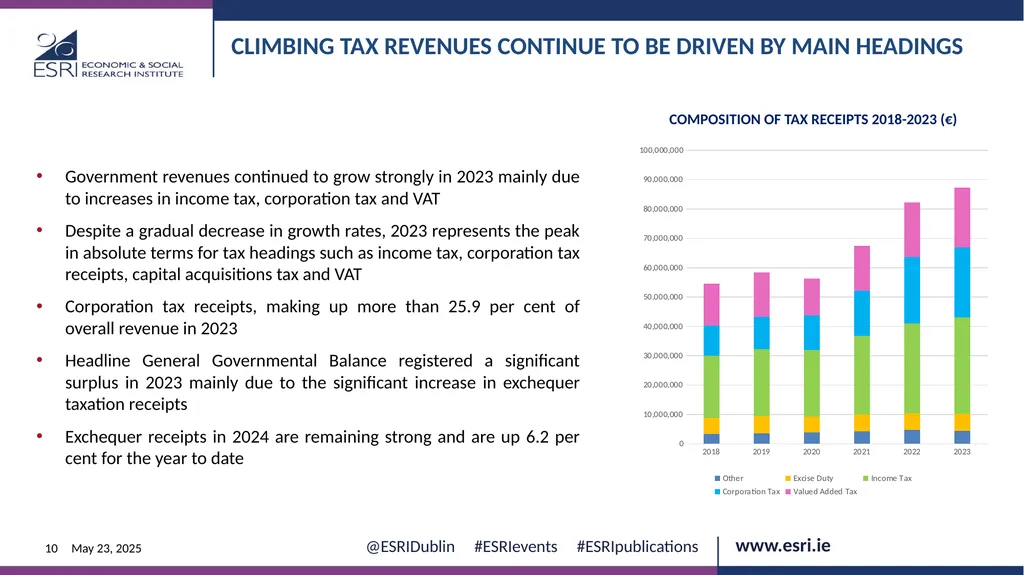
10 12 June 2024 CLIMBING TAX REVENUES CONTINUE TO BE DRIVEN BY MAIN HEADINGS Government revenues continued to grow strongly in 2023 mainly due to increases in income tax, corporation tax and VAT
Despite a gradual decrease in growth rates, 2023 represents the peak in absolute terms for tax headings such as income tax, corporation tax receipts, capital acquisitions tax and VAT
Corporation tax receipts, making up more than 25.9 per cent of overall revenue in 2023
Headline General Governmental Balance registered a significant surplus in 2023 mainly due to the significant increase in exchequer taxation receipts
Exchequer receipts in 2024 are remaining strong and are up 6.2 per cent for the year to date Composition of tax receipts 2018-2023 (€)<br>
Despite a gradual decrease in growth rates, 2023 represents the peak in absolute terms for tax headings such as income tax, corporation tax receipts, capital acquisitions tax and VAT
Corporation tax receipts, making up more than 25.9 per cent of overall revenue in 2023
Headline General Governmental Balance registered a significant surplus in 2023 mainly due to the significant increase in exchequer taxation receipts
Exchequer receipts in 2024 are remaining strong and are up 6.2 per cent for the year to date Composition of tax receipts 2018-2023 (€)<br>
11
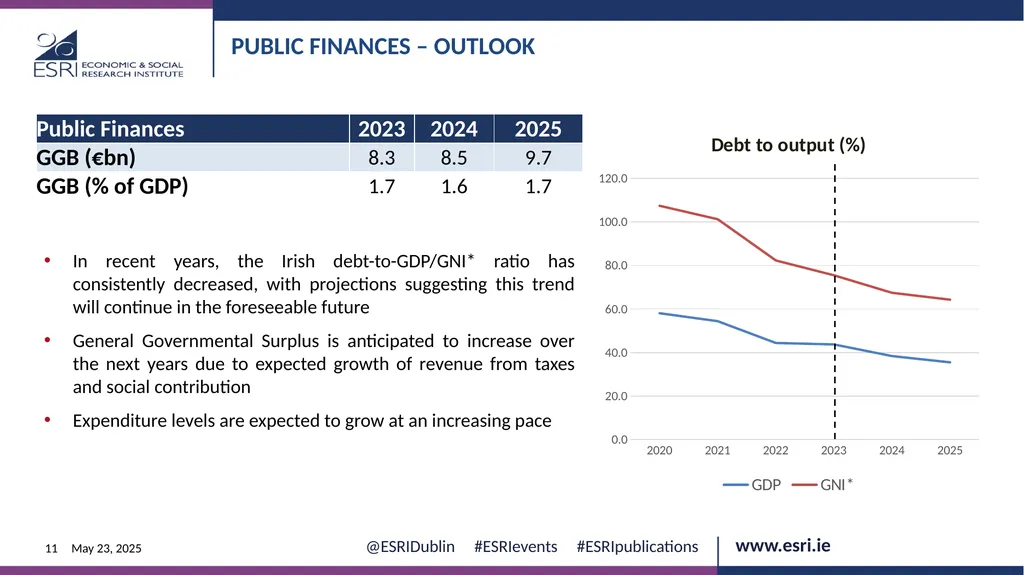
11 12 June 2024 PUBLIC FINANCES – OUTLOOK In recent years, the Irish debt-to-GDP/GNI* ratio has consistently decreased, with projections suggesting this trend will continue in the foreseeable future
General Governmental Surplus is anticipated to increase over the next years due to expected growth of revenue from taxes and social contribution
Expenditure levels are expected to grow at an increasing pace<br>
General Governmental Surplus is anticipated to increase over the next years due to expected growth of revenue from taxes and social contribution
Expenditure levels are expected to grow at an increasing pace<br>
12
12 12 June 2024 Risks:
Underinvestment in the economy<br>
Underinvestment in the economy<br>
13
13 12 June 2024 Importance of investment in the economy Review of the National Development Plan (Barret and Curtis (2024))
Examines the challenges in
Meeting the investment targets outlined in the most recent NDP (2018).
A key question is the investment share in the economy?
Given the significant role played by multi-nationals in the Irish economy,
Both estimates of overall output levels and headline investment levels
are subject to considerable distortions.
Consequently, this makes it acutely difficult to generate
A representative estimate of the investment share in an Irish context.<br>
Examines the challenges in
Meeting the investment targets outlined in the most recent NDP (2018).
A key question is the investment share in the economy?
Given the significant role played by multi-nationals in the Irish economy,
Both estimates of overall output levels and headline investment levels
are subject to considerable distortions.
Consequently, this makes it acutely difficult to generate
A representative estimate of the investment share in an Irish context.<br>
14
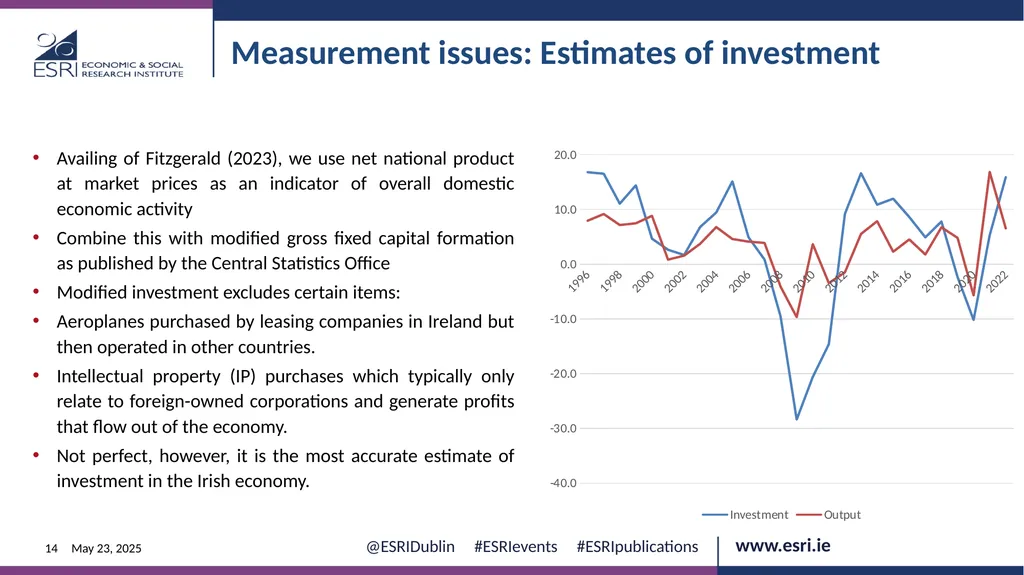
14 12 June 2024 Measurement issues: Estimates of investment Availing of Fitzgerald (2023), we use net national product at market prices as an indicator of overall domestic economic activity
Combine this with modified gross fixed capital formation as published by the Central Statistics Office
Modified investment excludes certain items:
Aeroplanes purchased by leasing companies in Ireland but then operated in other countries.
Intellectual property (IP) purchases which typically only relate to foreign-owned corporations and generate profits that flow out of the economy.
Not perfect, however, it is the most accurate estimate of investment in the Irish economy.<br>
Combine this with modified gross fixed capital formation as published by the Central Statistics Office
Modified investment excludes certain items:
Aeroplanes purchased by leasing companies in Ireland but then operated in other countries.
Intellectual property (IP) purchases which typically only relate to foreign-owned corporations and generate profits that flow out of the economy.
Not perfect, however, it is the most accurate estimate of investment in the Irish economy.<br>
15
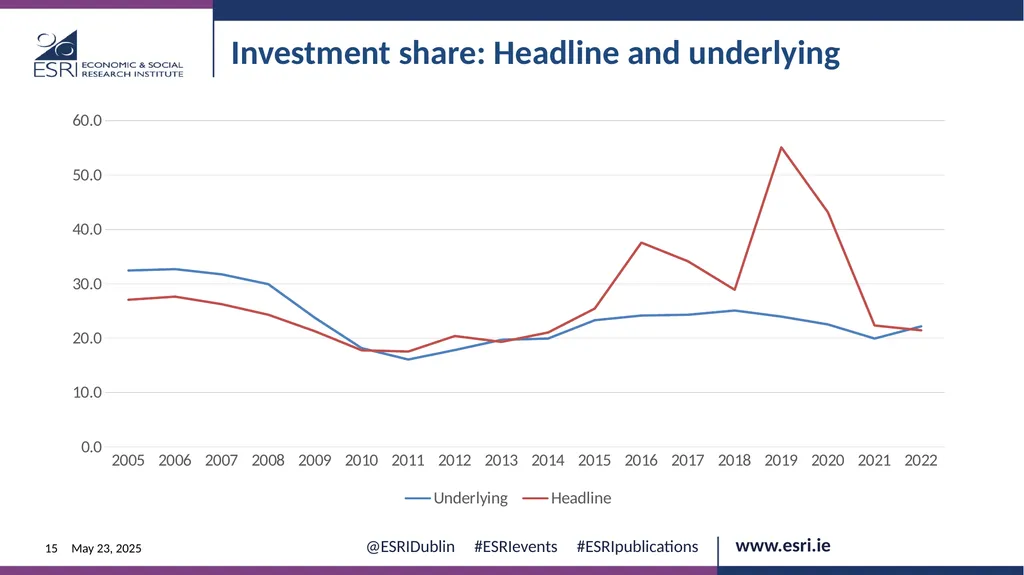
15 12 June 2024 Investment share: Headline and underlying<br>
16
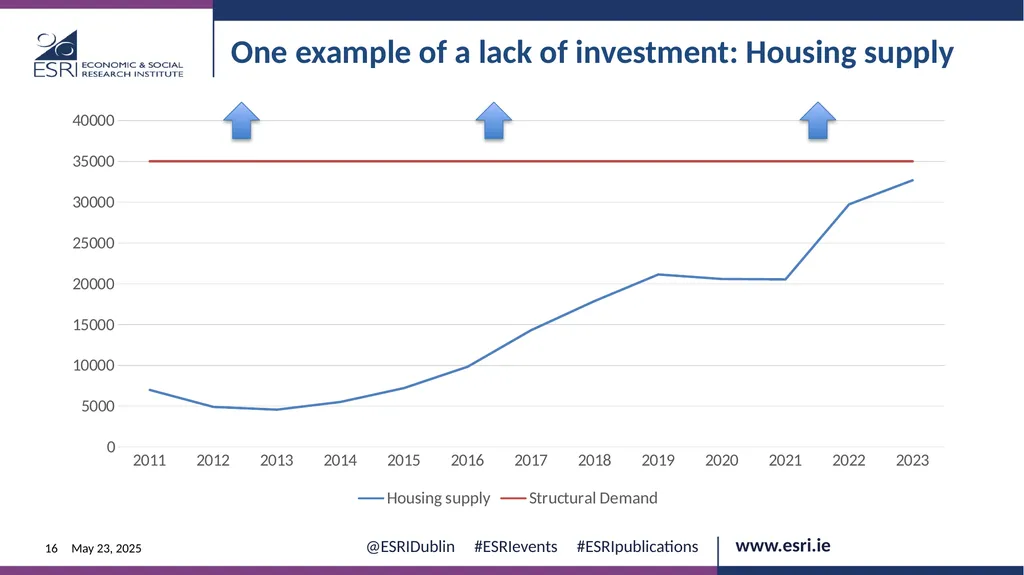
16 12 June 2024 One example of a lack of investment: Housing supply<br>
17
17 12 June 2024 Risks:
Credit conditions and house prices?<br>
Credit conditions and house prices?<br>
18
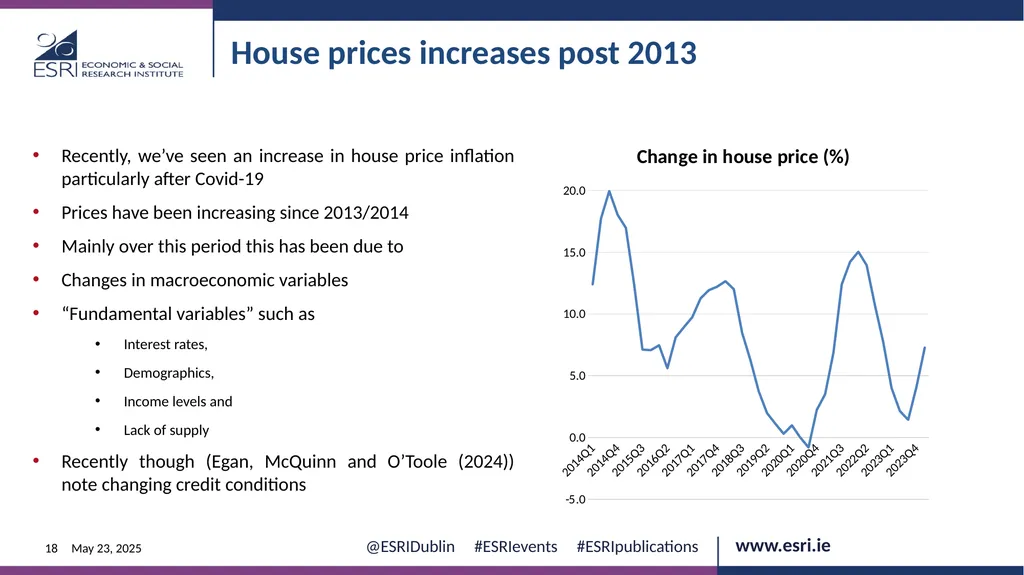
18 12 June 2024 House prices increases post 2013 Recently, we’ve seen an increase in house price inflation particularly after Covid-19
Prices have been increasing since 2013/2014
Mainly over this period this has been due to
Changes in macroeconomic variables
“Fundamental variables” such as
Interest rates,
Demographics,
Income levels and
Lack of supply
Recently though (Egan, McQuinn and O’Toole (2024)) note changing credit conditions<br>
Prices have been increasing since 2013/2014
Mainly over this period this has been due to
Changes in macroeconomic variables
“Fundamental variables” such as
Interest rates,
Demographics,
Income levels and
Lack of supply
Recently though (Egan, McQuinn and O’Toole (2024)) note changing credit conditions<br>
19
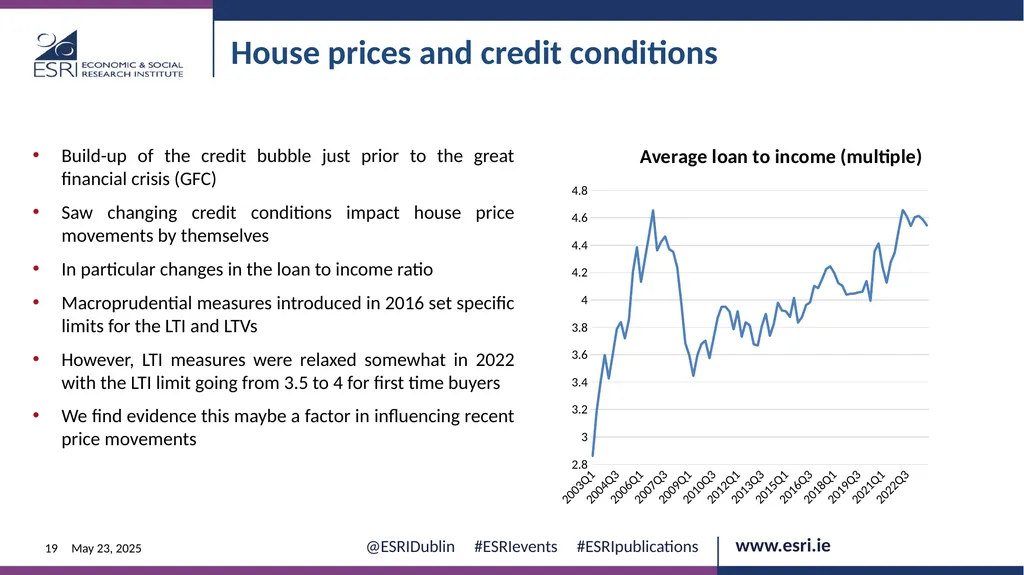
19 12 June 2024 House prices and credit conditions Build-up of the credit bubble just prior to the great financial crisis (GFC)
Saw changing credit conditions impact house price movements by themselves
In particular changes in the loan to income ratio
Macroprudential measures introduced in 2016 set specific limits for the LTI and LTVs
However, LTI measures were relaxed somewhat in 2022 with the LTI limit going from 3.5 to 4 for first time buyers
We find evidence this maybe a factor in influencing recent price movements<br>
Saw changing credit conditions impact house price movements by themselves
In particular changes in the loan to income ratio
Macroprudential measures introduced in 2016 set specific limits for the LTI and LTVs
However, LTI measures were relaxed somewhat in 2022 with the LTI limit going from 3.5 to 4 for first time buyers
We find evidence this maybe a factor in influencing recent price movements<br>
20
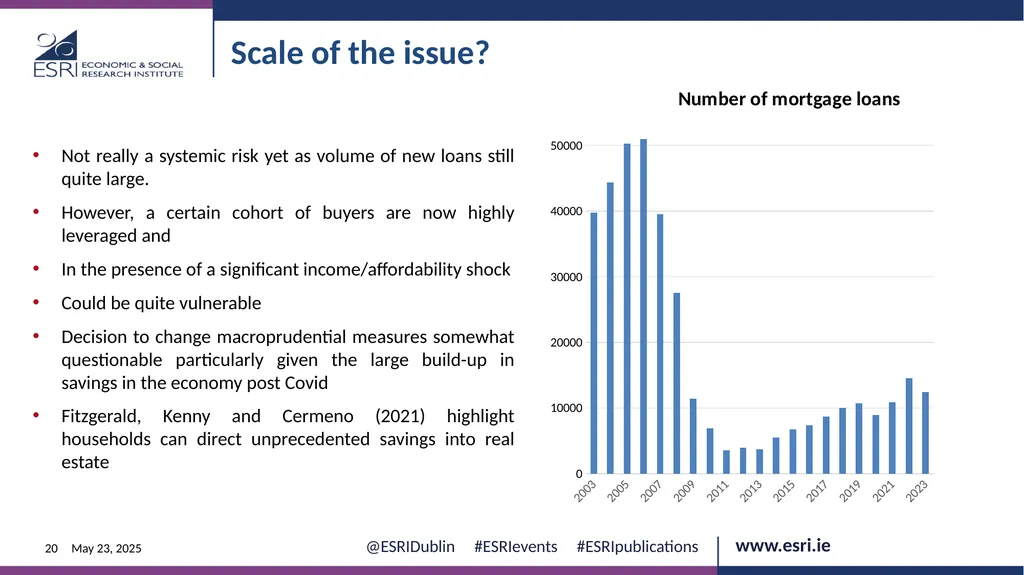
20 12 June 2024 Scale of the issue? Not really a systemic risk yet as volume of new loans still quite large.
However, a certain cohort of buyers are now highly leveraged and
In the presence of a significant income/affordability shock
Could be quite vulnerable
Decision to change macroprudential measures somewhat questionable particularly given the large build-up in savings in the economy post Covid
Fitzgerald, Kenny and Cermeno (2021) highlight households can direct unprecedented savings into real estate<br>
However, a certain cohort of buyers are now highly leveraged and
In the presence of a significant income/affordability shock
Could be quite vulnerable
Decision to change macroprudential measures somewhat questionable particularly given the large build-up in savings in the economy post Covid
Fitzgerald, Kenny and Cermeno (2021) highlight households can direct unprecedented savings into real estate<br>
21
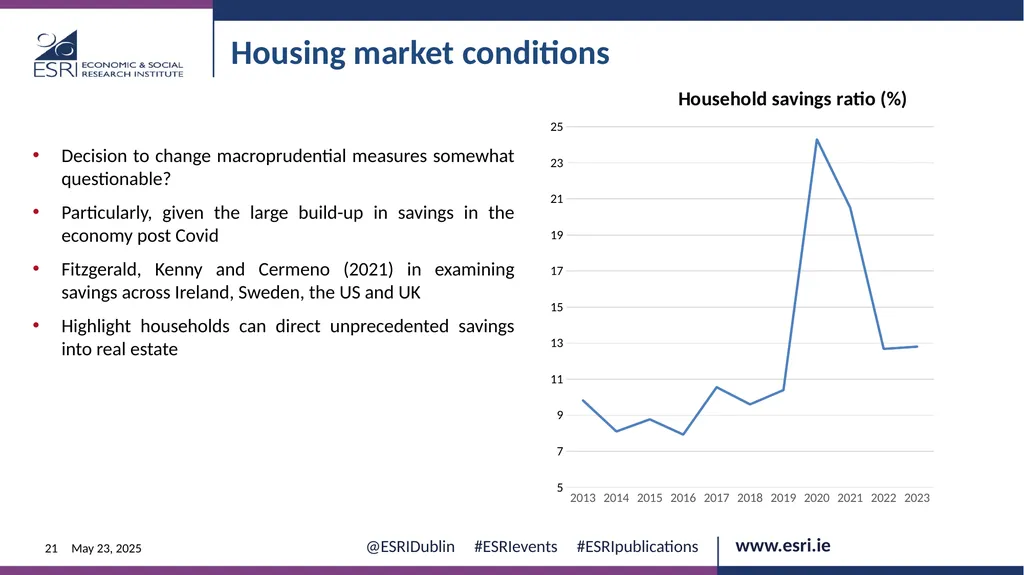
21 12 June 2024 Housing market conditions Decision to change macroprudential measures somewhat questionable?
Particularly, given the large build-up in savings in the economy post Covid
Fitzgerald, Kenny and Cermeno (2021) in examining savings across Ireland, Sweden, the US and UK
Highlight households can direct unprecedented savings into real estate<br>
Particularly, given the large build-up in savings in the economy post Covid
Fitzgerald, Kenny and Cermeno (2021) in examining savings across Ireland, Sweden, the US and UK
Highlight households can direct unprecedented savings into real estate<br>
22
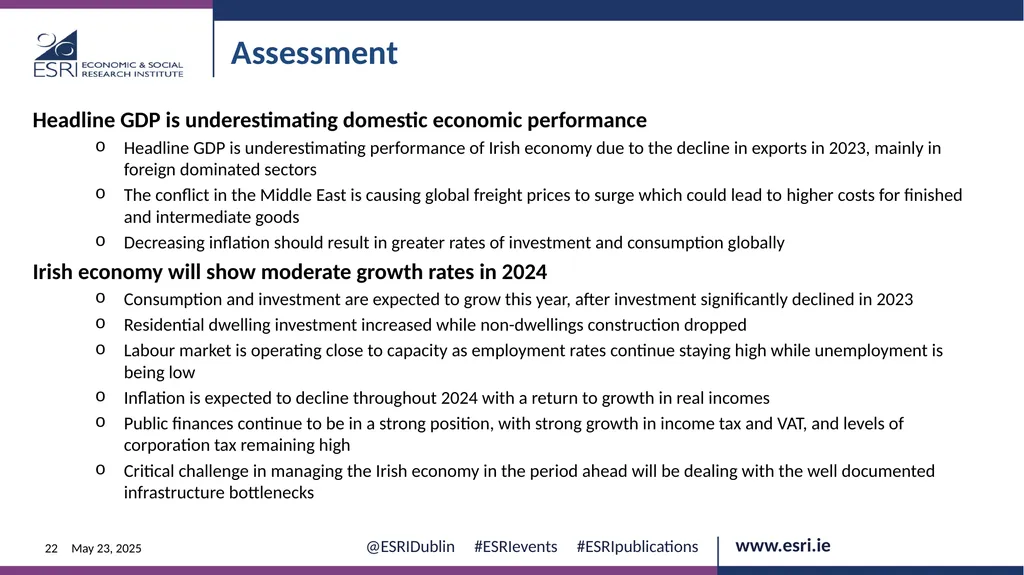
22 12 June 2024 Assessment Headline GDP is underestimating domestic economic performance
Headline GDP is underestimating performance of Irish economy due to the decline in exports in 2023, mainly in foreign dominated sectors
The conflict in the Middle East is causing global freight prices to surge which could lead to higher costs for finished and intermediate goods
Decreasing inflation should result in greater rates of investment and consumption globally
Irish economy will show moderate growth rates in 2024
Consumption and investment are expected to grow this year, after investment significantly declined in 2023
Residential dwelling investment increased while non-dwellings construction dropped
Labour market is operating close to capacity as employment rates continue staying high while unemployment is being low
Inflation is expected to decline throughout 2024 with a return to growth in real incomes
Public finances continue to be in a strong position, with strong growth in income tax and VAT, and levels of corporation tax remaining high
Critical challenge in managing the Irish economy in the period ahead will be dealing with the well documented infrastructure bottlenecks<br>
Headline GDP is underestimating performance of Irish economy due to the decline in exports in 2023, mainly in foreign dominated sectors
The conflict in the Middle East is causing global freight prices to surge which could lead to higher costs for finished and intermediate goods
Decreasing inflation should result in greater rates of investment and consumption globally
Irish economy will show moderate growth rates in 2024
Consumption and investment are expected to grow this year, after investment significantly declined in 2023
Residential dwelling investment increased while non-dwellings construction dropped
Labour market is operating close to capacity as employment rates continue staying high while unemployment is being low
Inflation is expected to decline throughout 2024 with a return to growth in real incomes
Public finances continue to be in a strong position, with strong growth in income tax and VAT, and levels of corporation tax remaining high
Critical challenge in managing the Irish economy in the period ahead will be dealing with the well documented infrastructure bottlenecks<br>
23
23 12 June 2024 Thank you<br>