
National Incident Management System (NIMS)


Description: National Incident Management System (NIMS) Implementation Objectives October 18 2018 National Incident Management System (NIMS) Overview NIMS provides a consistent and common nationwide approach and vocabulary to enable the whole
Related Topics
Download Presentation
"National Incident Management System (NIMS)" is the property of its rightful owner. Permission is granted to download and print the materials on this website for personal, non-commercial use only, and to display it on your personal computer provided you do not modify the materials and that you retain all copyright notices contained in the materials. By downloading content from our website, you accept the terms of this agreement.
Presentation Transcript
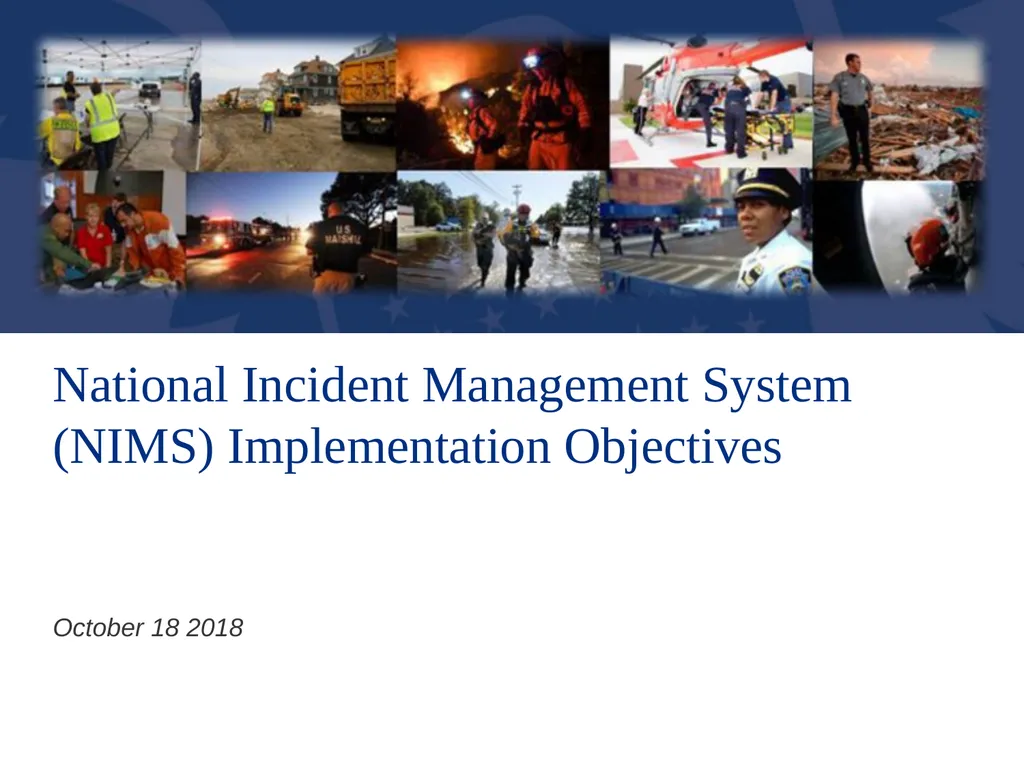
slide1. National Incident Management System (NIMS) Implementation Objectives October 18 2018<br>
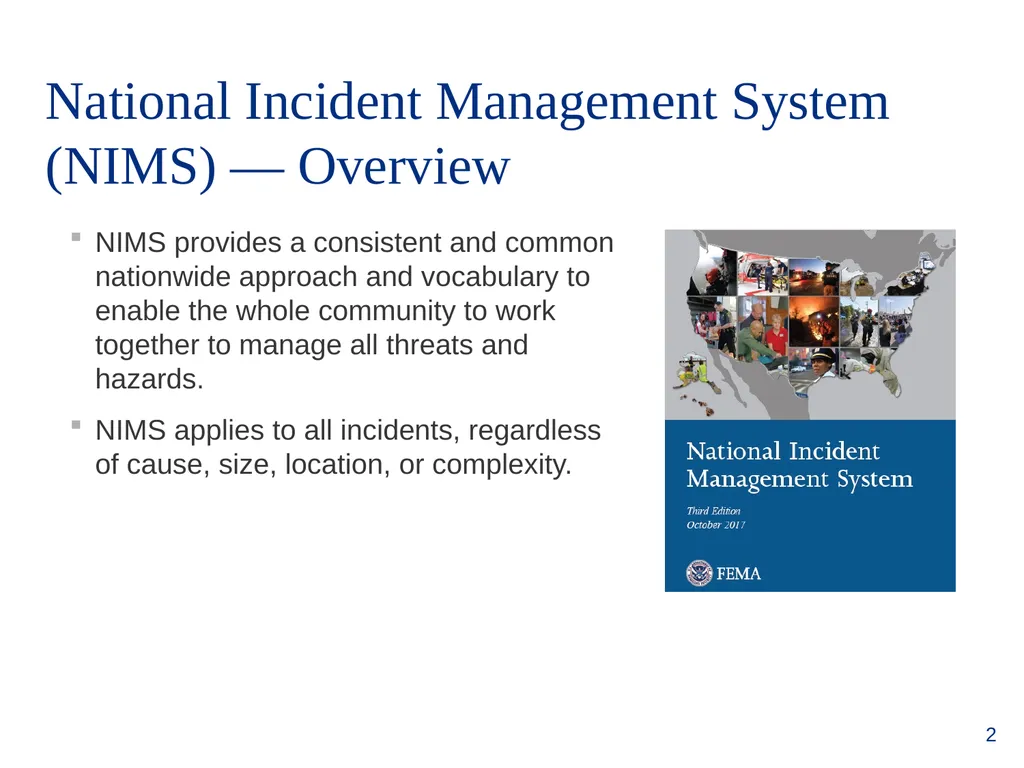
slide2. National Incident Management System (NIMS) — Overview NIMS provides a consistent and common nationwide approach and vocabulary to enable the whole community to work together to manage all threats and hazards.
NIMS applies to all incidents, regardless of cause, size, location, or complexity.<br>
slide3. NIMS Refresh — Highlights NIMS strengthens guidance for effective incident management by:
Reflecting and incorporating lessons learned from exercises, real-world incidents and policy updates;
Clarifying the process and terminology for qualifying, certifying, and credentialing incident personnel, building a foundation for the development of a national qualification system;
Clarifying that NIMS is more than just the Incident Command System (ICS) and that it applies to incident personnel from the Incident Command Post all the way to the National Response Coordination Center (NRCC);
Describing common functions and terminology for staff in Emergency Operations Centers (EOC), while remaining flexible to allow for differing missions, authorities, and resources of EOCs across the nation;
Explaining the relationship among ICS, EOCs, and senior leaders/policy groups.<br>
slide4. NIMS Principles Unity of Effort
Coordinating activities among various organizational representatives to achieve common objectives
Enables organizations with jurisdictional authority or functional responsibilities to support each other while allowing each participating agency to maintain its own authority and accountability
Flexibility
Allows NIMS to be scalable from routine, local incidents through those requiring interstate mutual aid up to those requiring Federal assistance
Enables NIMS to be applicable to incidents that vary widely in terms of hazard, geography, demographics, climate, cultural, and organizational authorities
NIMS components are adaptable to any type of event or incident
Standardization
Supports interoperability among multiple organizations in incident response.
Defines standard organizational structures, standard practices, and common terminology<br>
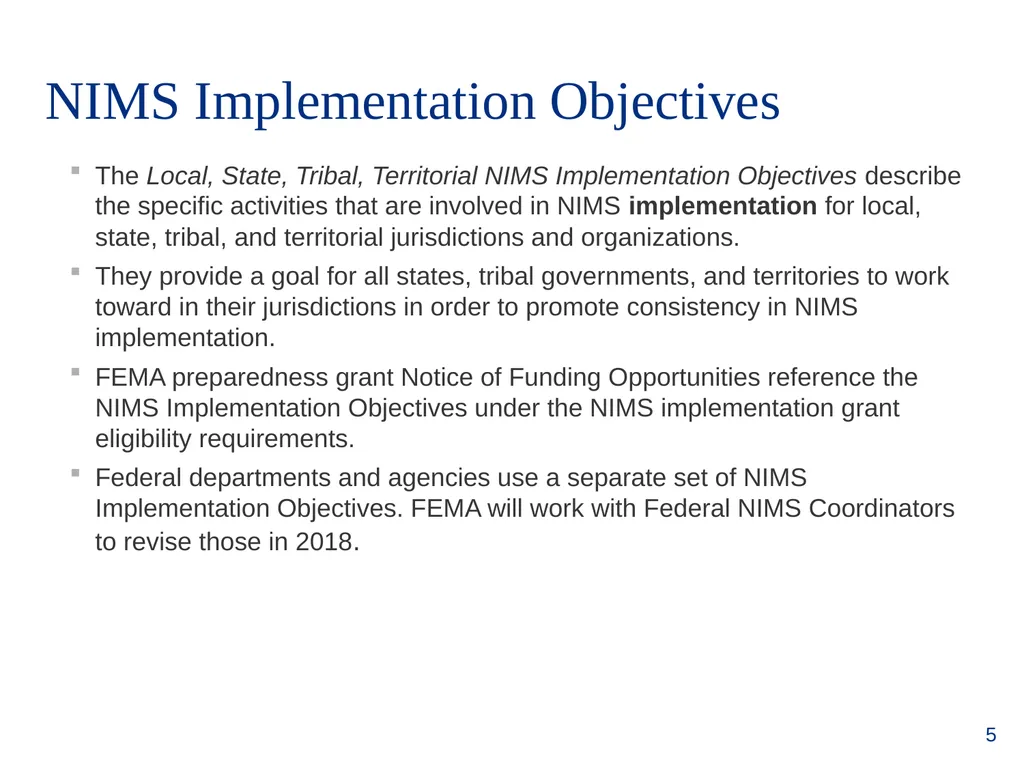
slide5. NIMS Implementation Objectives The Local, State, Tribal, Territorial NIMS Implementation Objectives describe the specific activities that are involved in NIMS implementation for local, state, tribal, and territorial jurisdictions and organizations.
They provide a goal for all states, tribal governments, and territories to work toward in their jurisdictions in order to promote consistency in NIMS implementation.
FEMA preparedness grant Notice of Funding Opportunities reference the NIMS Implementation Objectives under the NIMS implementation grant eligibility requirements.
Federal departments and agencies use a separate set of NIMS Implementation Objectives. FEMA will work with Federal NIMS Coordinators to revise those in 2018.<br>
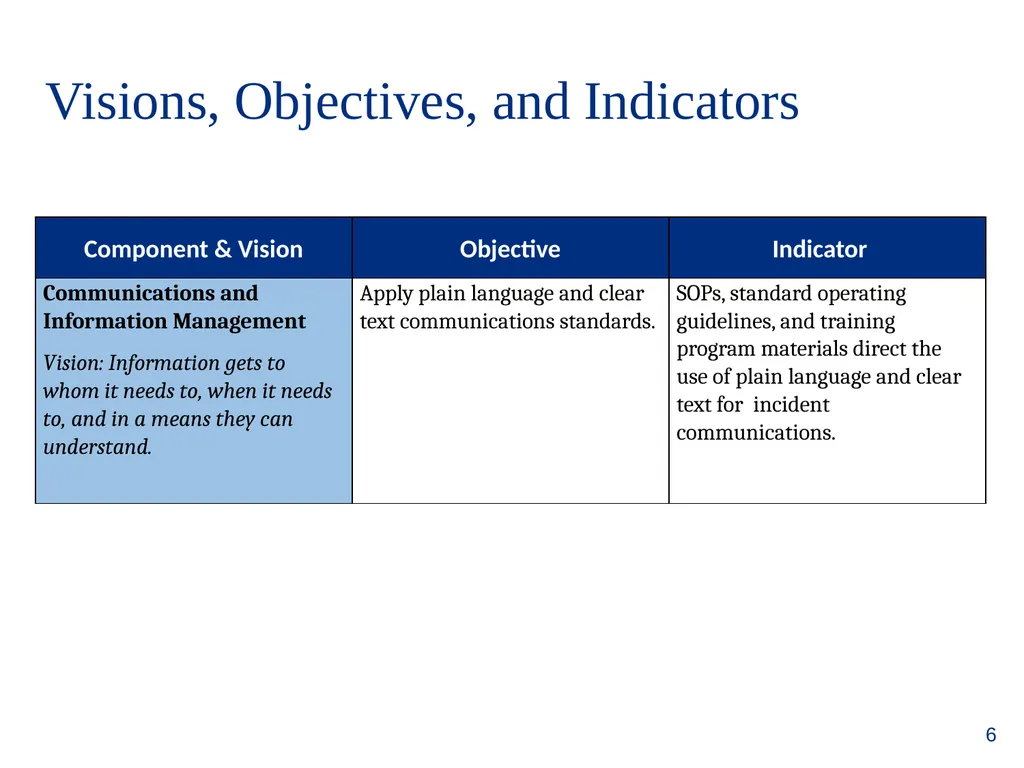
slide6. Visions, Objectives, and Indicators<br>
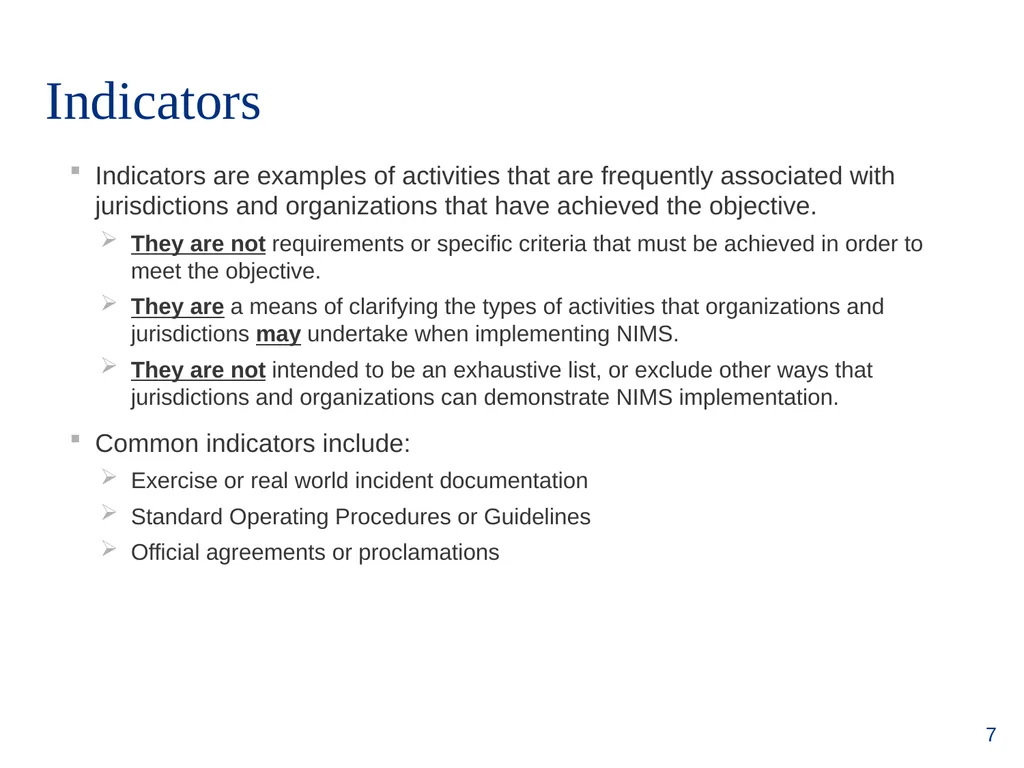
slide7. Indicators Indicators are examples of activities that are frequently associated with jurisdictions and organizations that have achieved the objective.
They are not requirements or specific criteria that must be achieved in order to meet the objective.
They are a means of clarifying the types of activities that organizations and jurisdictions may undertake when implementing NIMS.
They are not intended to be an exhaustive list, or exclude other ways that jurisdictions and organizations can demonstrate NIMS implementation.
Common indicators include:
Exercise or real world incident documentation
Standard Operating Procedures or Guidelines
Official agreements or proclamations<br>
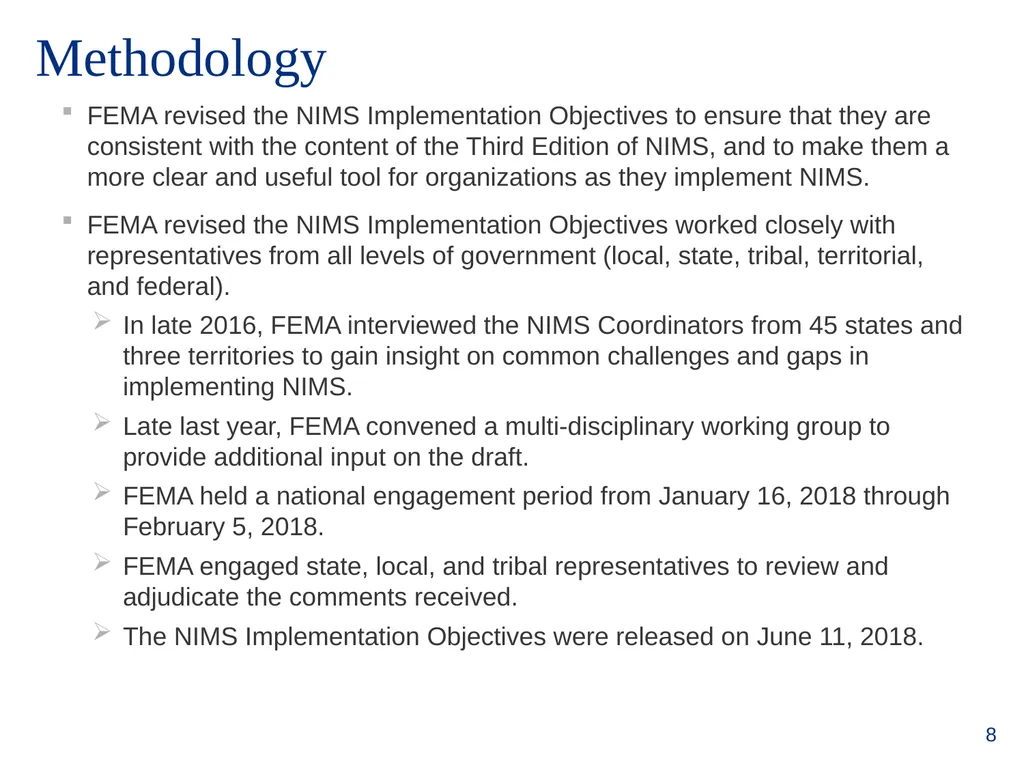
slide8. Methodology FEMA revised the NIMS Implementation Objectives to ensure that they are consistent with the content of the Third Edition of NIMS, and to make them a more clear and useful tool for organizations as they implement NIMS.
FEMA revised the NIMS Implementation Objectives worked closely with representatives from all levels of government (local, state, tribal, territorial, and federal).
In late 2016, FEMA interviewed the NIMS Coordinators from 45 states and three territories to gain insight on common challenges and gaps in implementing NIMS.
Late last year, FEMA convened a multi-disciplinary working group to provide additional input on the draft.
FEMA held a national engagement period from January 16, 2018 through February 5, 2018.
FEMA engaged state, local, and tribal representatives to review and adjudicate the comments received.
The NIMS Implementation Objectives were released on June 11, 2018.<br>
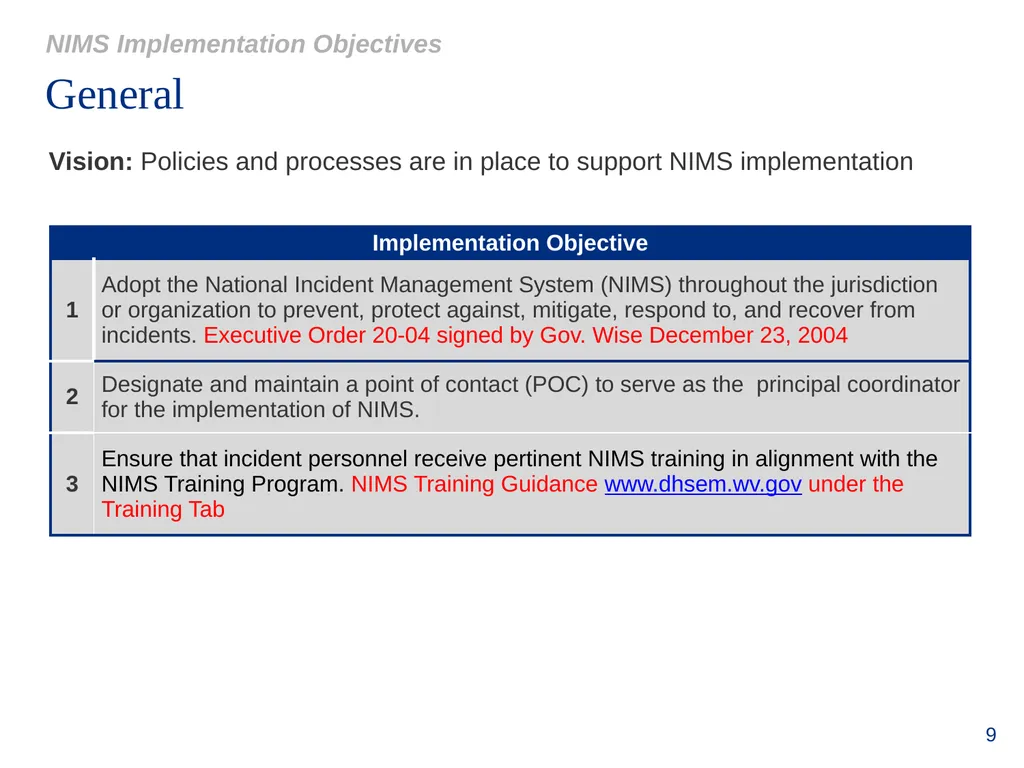
slide9. General NIMS Implementation Objectives Vision: Policies and processes are in place to support NIMS implementation<br>
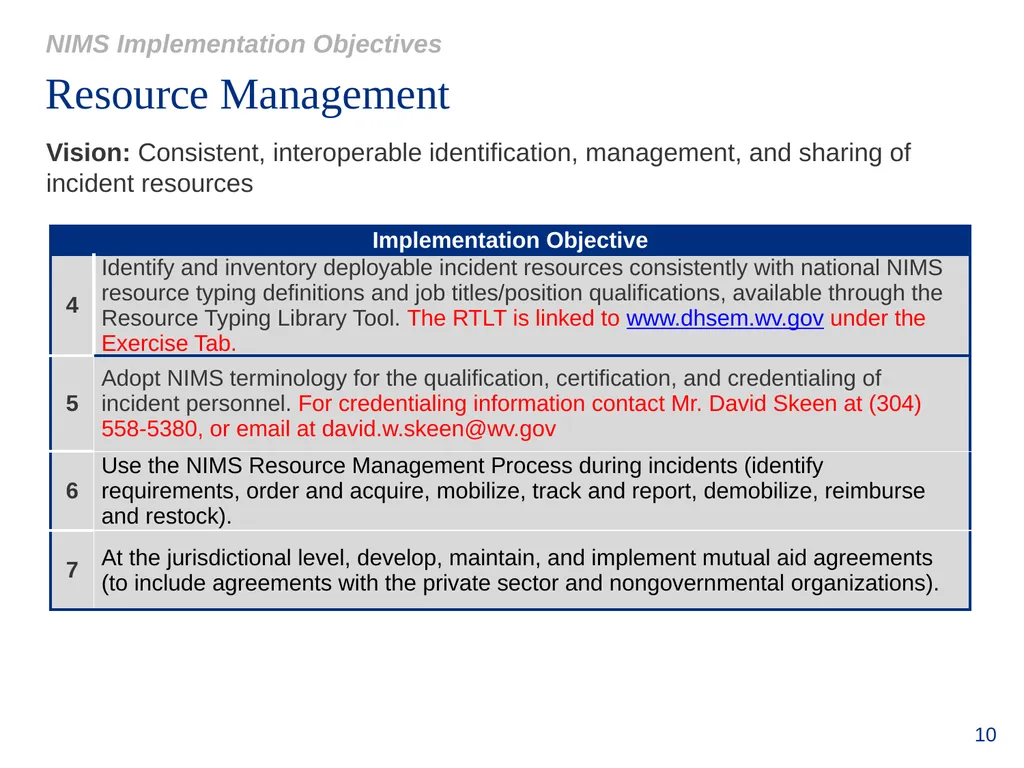
slide10. Resource Management Vision: Consistent, interoperable identification, management, and sharing of incident resources NIMS Implementation Objectives<br>
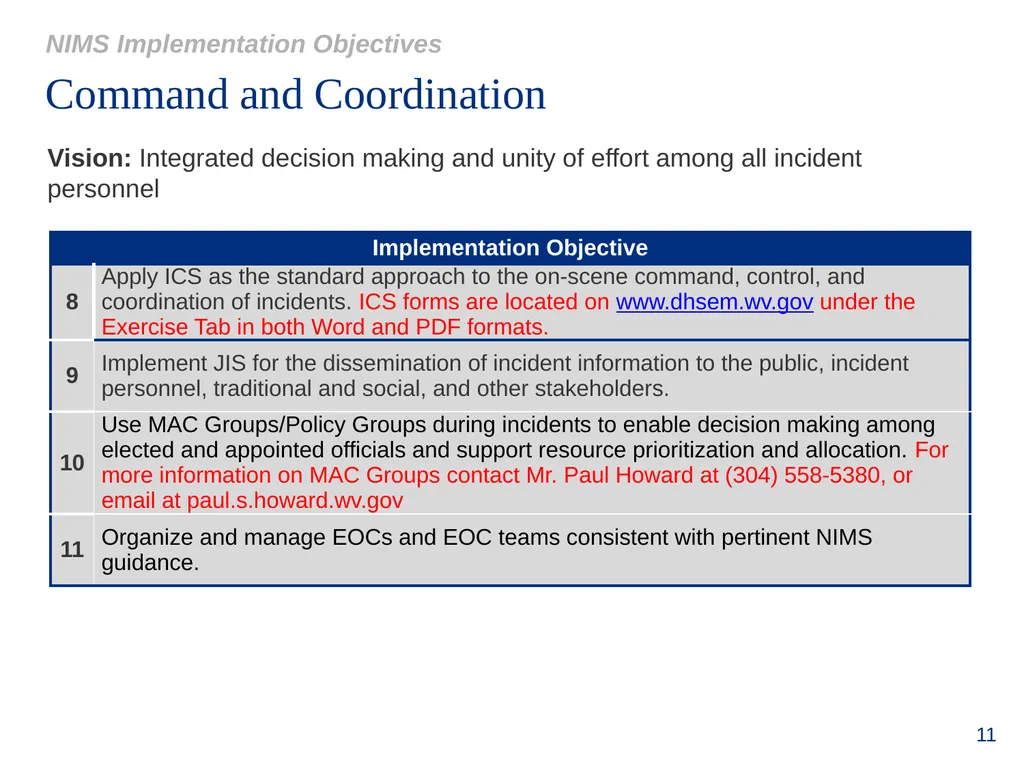
slide11. Command and Coordination NIMS Implementation Objectives Vision: Integrated decision making and unity of effort among all incident personnel<br>
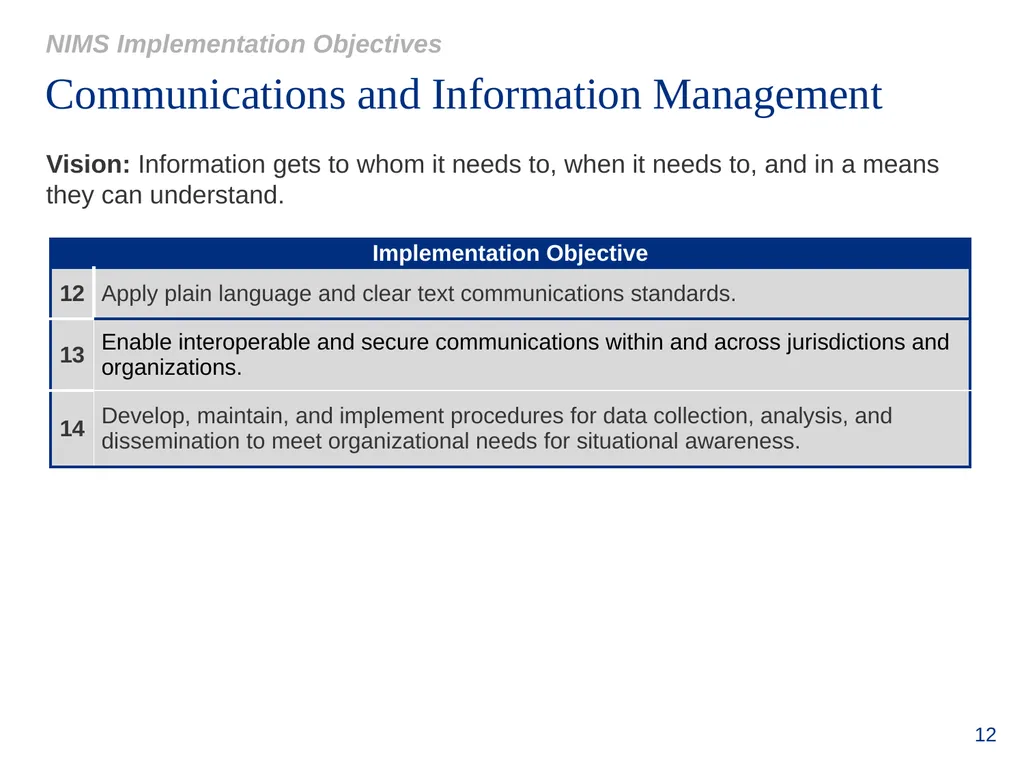
slide12. Communications and Information Management NIMS Implementation Objectives Vision: Information gets to whom it needs to, when it needs to, and in a means they can understand.<br>
slide13. Questions?<br>
slide14. Thank you for your participation! To download all NIMS documents, please visit: www.fema.gov/national-incident-management-system. For NIMS questions please contact the State NIMS Coordinator at (304) 558-5380 or Email at charles.w.bennett@wv.gov<br>
slide2. National Incident Management System (NIMS) — Overview NIMS provides a consistent and common nationwide approach and vocabulary to enable the whole community to work together to manage all threats and hazards.
NIMS applies to all incidents, regardless of cause, size, location, or complexity.<br>
slide3. NIMS Refresh — Highlights NIMS strengthens guidance for effective incident management by:
Reflecting and incorporating lessons learned from exercises, real-world incidents and policy updates;
Clarifying the process and terminology for qualifying, certifying, and credentialing incident personnel, building a foundation for the development of a national qualification system;
Clarifying that NIMS is more than just the Incident Command System (ICS) and that it applies to incident personnel from the Incident Command Post all the way to the National Response Coordination Center (NRCC);
Describing common functions and terminology for staff in Emergency Operations Centers (EOC), while remaining flexible to allow for differing missions, authorities, and resources of EOCs across the nation;
Explaining the relationship among ICS, EOCs, and senior leaders/policy groups.<br>
slide4. NIMS Principles Unity of Effort
Coordinating activities among various organizational representatives to achieve common objectives
Enables organizations with jurisdictional authority or functional responsibilities to support each other while allowing each participating agency to maintain its own authority and accountability
Flexibility
Allows NIMS to be scalable from routine, local incidents through those requiring interstate mutual aid up to those requiring Federal assistance
Enables NIMS to be applicable to incidents that vary widely in terms of hazard, geography, demographics, climate, cultural, and organizational authorities
NIMS components are adaptable to any type of event or incident
Standardization
Supports interoperability among multiple organizations in incident response.
Defines standard organizational structures, standard practices, and common terminology<br>
slide5. NIMS Implementation Objectives The Local, State, Tribal, Territorial NIMS Implementation Objectives describe the specific activities that are involved in NIMS implementation for local, state, tribal, and territorial jurisdictions and organizations.
They provide a goal for all states, tribal governments, and territories to work toward in their jurisdictions in order to promote consistency in NIMS implementation.
FEMA preparedness grant Notice of Funding Opportunities reference the NIMS Implementation Objectives under the NIMS implementation grant eligibility requirements.
Federal departments and agencies use a separate set of NIMS Implementation Objectives. FEMA will work with Federal NIMS Coordinators to revise those in 2018.<br>
slide6. Visions, Objectives, and Indicators<br>
slide7. Indicators Indicators are examples of activities that are frequently associated with jurisdictions and organizations that have achieved the objective.
They are not requirements or specific criteria that must be achieved in order to meet the objective.
They are a means of clarifying the types of activities that organizations and jurisdictions may undertake when implementing NIMS.
They are not intended to be an exhaustive list, or exclude other ways that jurisdictions and organizations can demonstrate NIMS implementation.
Common indicators include:
Exercise or real world incident documentation
Standard Operating Procedures or Guidelines
Official agreements or proclamations<br>
slide8. Methodology FEMA revised the NIMS Implementation Objectives to ensure that they are consistent with the content of the Third Edition of NIMS, and to make them a more clear and useful tool for organizations as they implement NIMS.
FEMA revised the NIMS Implementation Objectives worked closely with representatives from all levels of government (local, state, tribal, territorial, and federal).
In late 2016, FEMA interviewed the NIMS Coordinators from 45 states and three territories to gain insight on common challenges and gaps in implementing NIMS.
Late last year, FEMA convened a multi-disciplinary working group to provide additional input on the draft.
FEMA held a national engagement period from January 16, 2018 through February 5, 2018.
FEMA engaged state, local, and tribal representatives to review and adjudicate the comments received.
The NIMS Implementation Objectives were released on June 11, 2018.<br>
slide9. General NIMS Implementation Objectives Vision: Policies and processes are in place to support NIMS implementation<br>
slide10. Resource Management Vision: Consistent, interoperable identification, management, and sharing of incident resources NIMS Implementation Objectives<br>
slide11. Command and Coordination NIMS Implementation Objectives Vision: Integrated decision making and unity of effort among all incident personnel<br>
slide12. Communications and Information Management NIMS Implementation Objectives Vision: Information gets to whom it needs to, when it needs to, and in a means they can understand.<br>
slide13. Questions?<br>
slide14. Thank you for your participation! To download all NIMS documents, please visit: www.fema.gov/national-incident-management-system. For NIMS questions please contact the State NIMS Coordinator at (304) 558-5380 or Email at charles.w.bennett@wv.gov<br>