
Nebraska State Patrol Concealed Handgun Permit
PT
Published · 191 slides · 0 views

1 / 1
Description
Nebraska State Patrol Concealed Handgun Permit (CHP) Course Revised 9.2.2023 What is CHP? C: Concealed H: Handgun P: Permit Definition: Carrying a handgun in a public area concealed or hidden on a person or within a persons proximity.
Related Topics
Share
Embed code
Download this presentation From Below
"Nebraska State Patrol Concealed Handgun Permit" is the property of its rightful owner. Permission is granted to download and print the materials on this website for personal, non-commercial use only, and to display it on your personal computer provided you do not modify the materials and that you retain all copyright notices contained in the materials. By downloading content from our website, you accept the terms of this agreement.
Presentation Transcript
01
Nebraska State Patrol
Concealed Handgun Permit (CHP) Course Revised 9.2.2023<br>
Concealed Handgun Permit (CHP) Course Revised 9.2.2023<br>
02
What is CHP? C: Concealed
H: Handgun
P: Permit Definition:
Carrying a handgun in a public area concealed or hidden on a person or within a person’s proximity.<br>
H: Handgun
P: Permit Definition:
Carrying a handgun in a public area concealed or hidden on a person or within a person’s proximity.<br>
03
Overview of Class Lesson 1: Basic Firearm Knowledge and Firearms Preparedness/Conflict Resolution
Lesson 2: Knowledge and Safe Handling of Handgun Ammunition
Lesson 3: Storage of Firearms & Ammunition/Prevention of Accidental Injuries
Lesson 4: Shooting Fundamentals/Concealed Carry Techniques
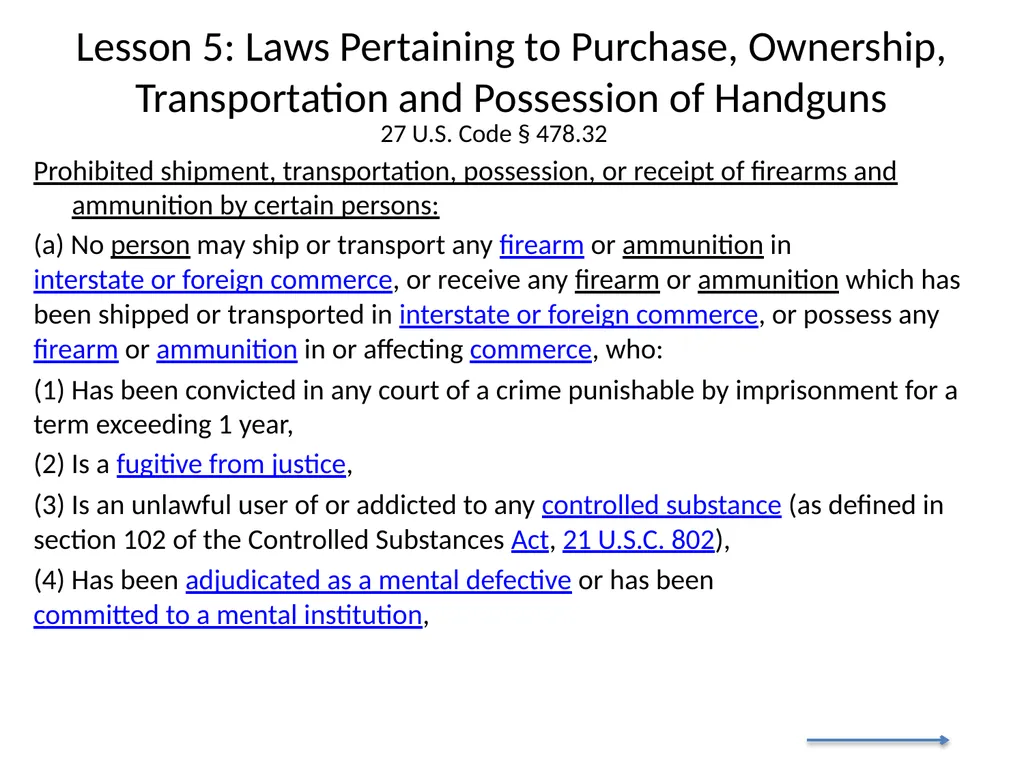
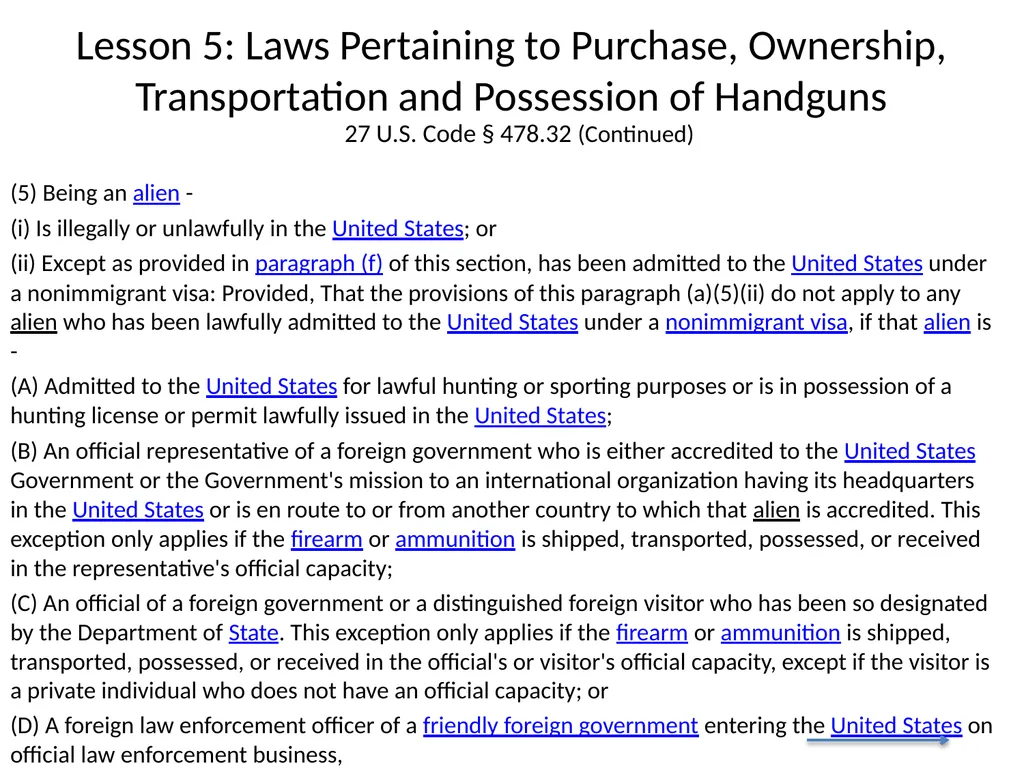
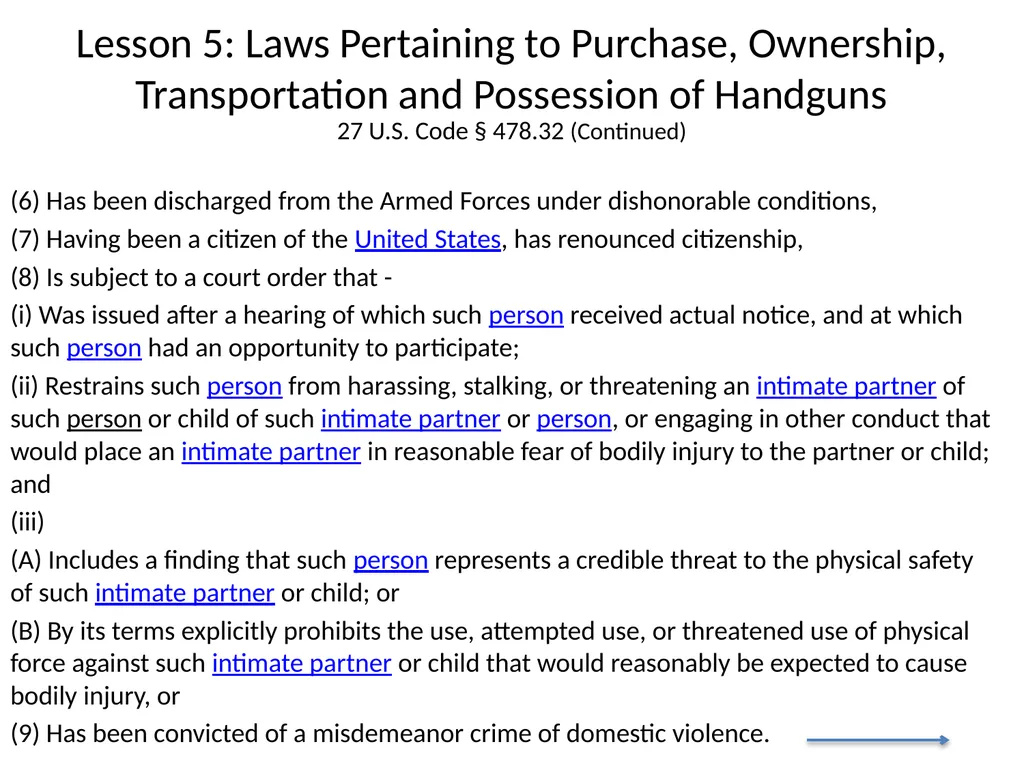
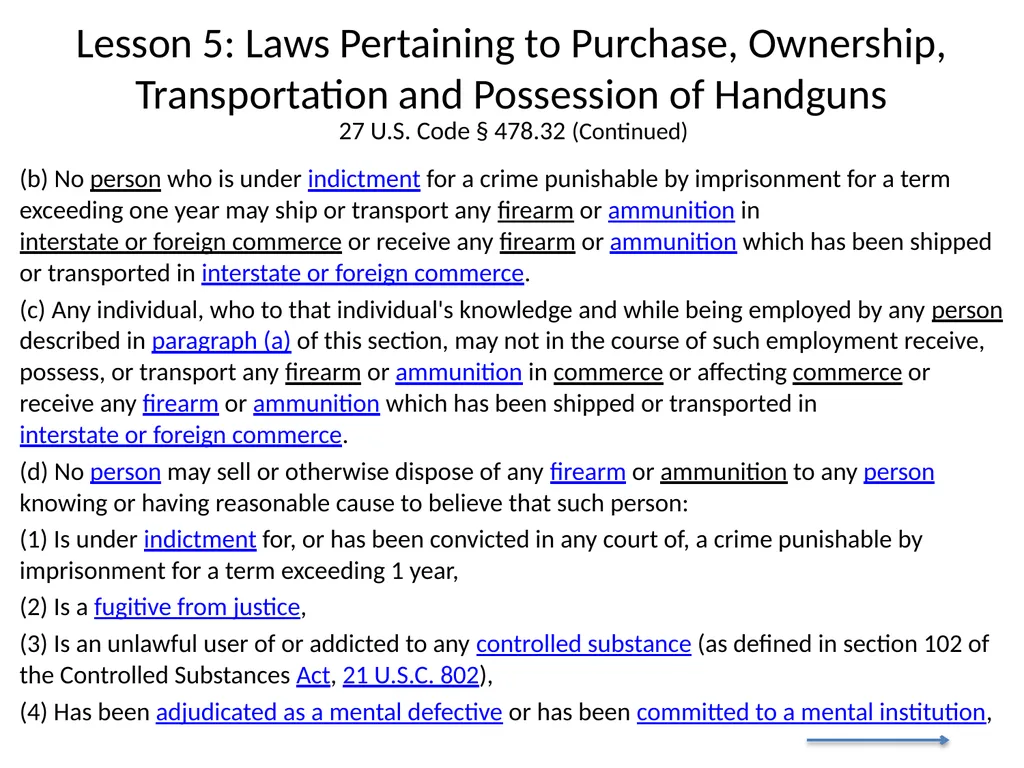
Lesson 5: Laws Pertaining to Purchase, Ownership, Transportation and Possession of Handguns
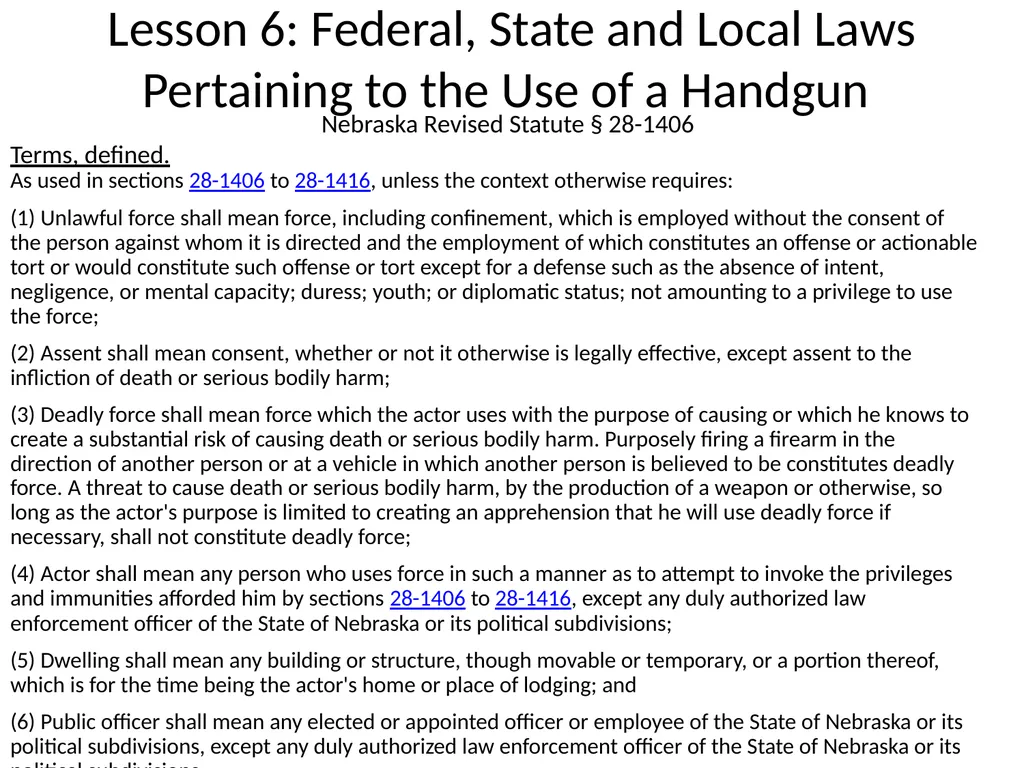
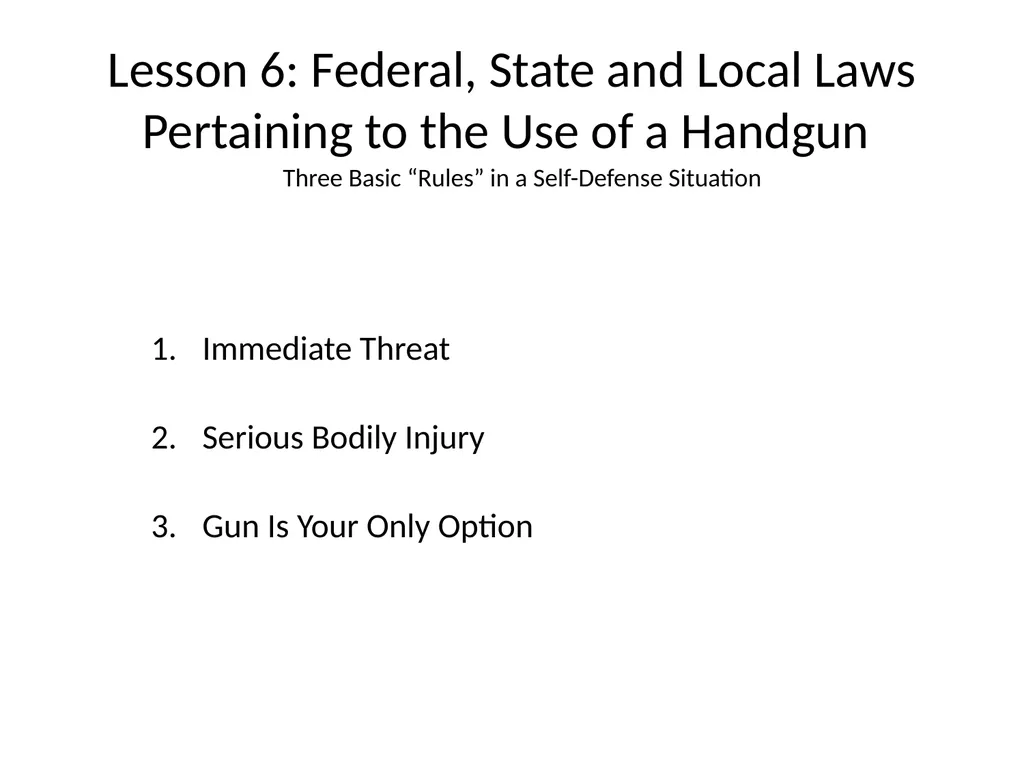
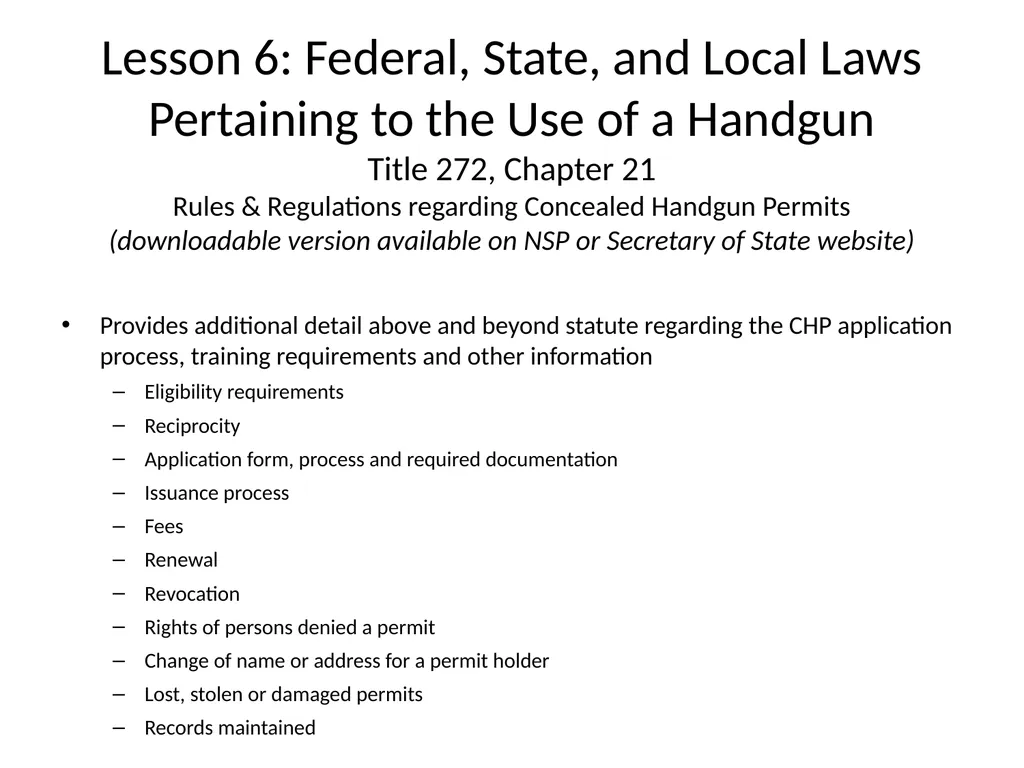
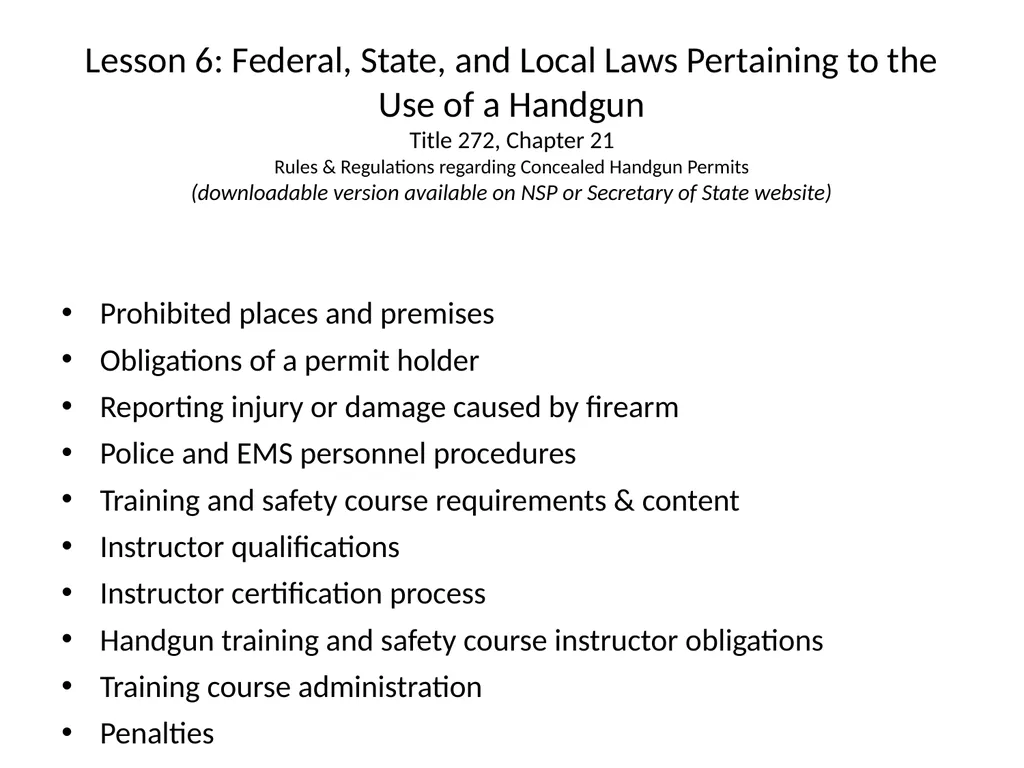
Lesson 6: Federal, State and Local Laws Pertaining to the Use of a Handgun
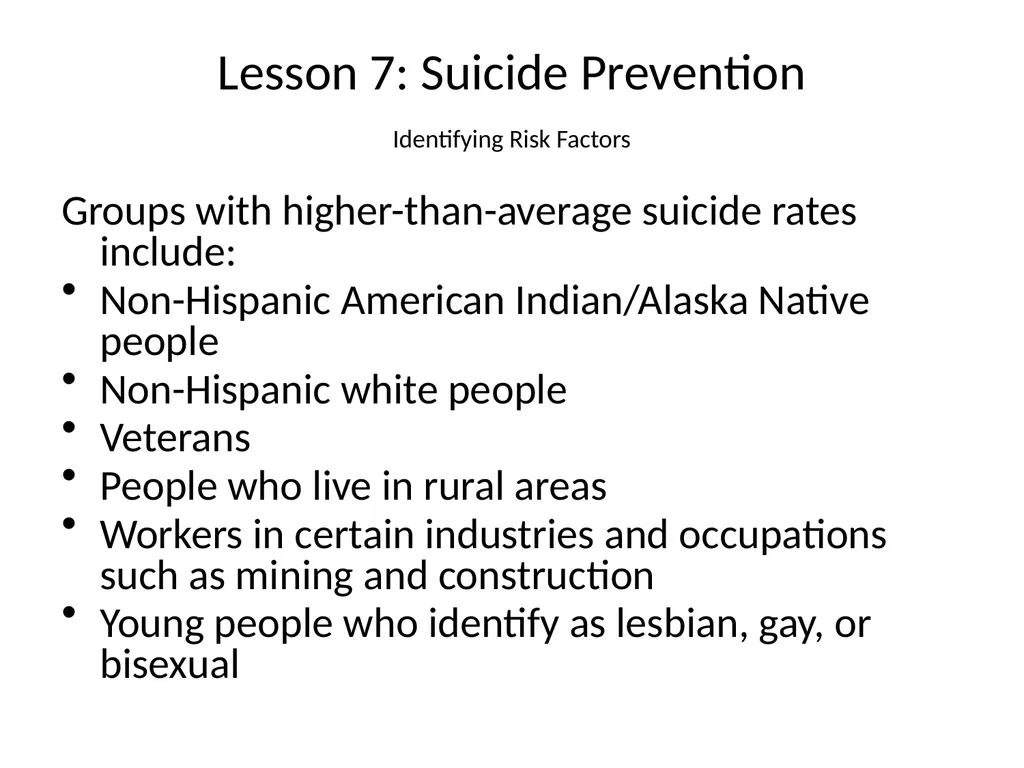
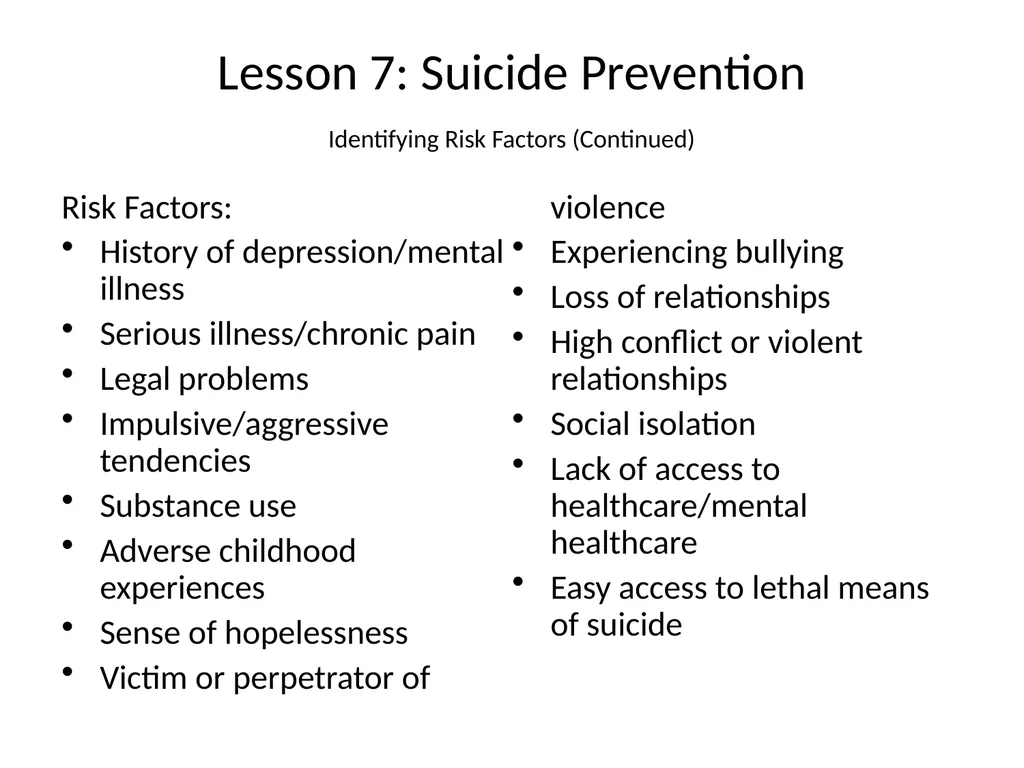
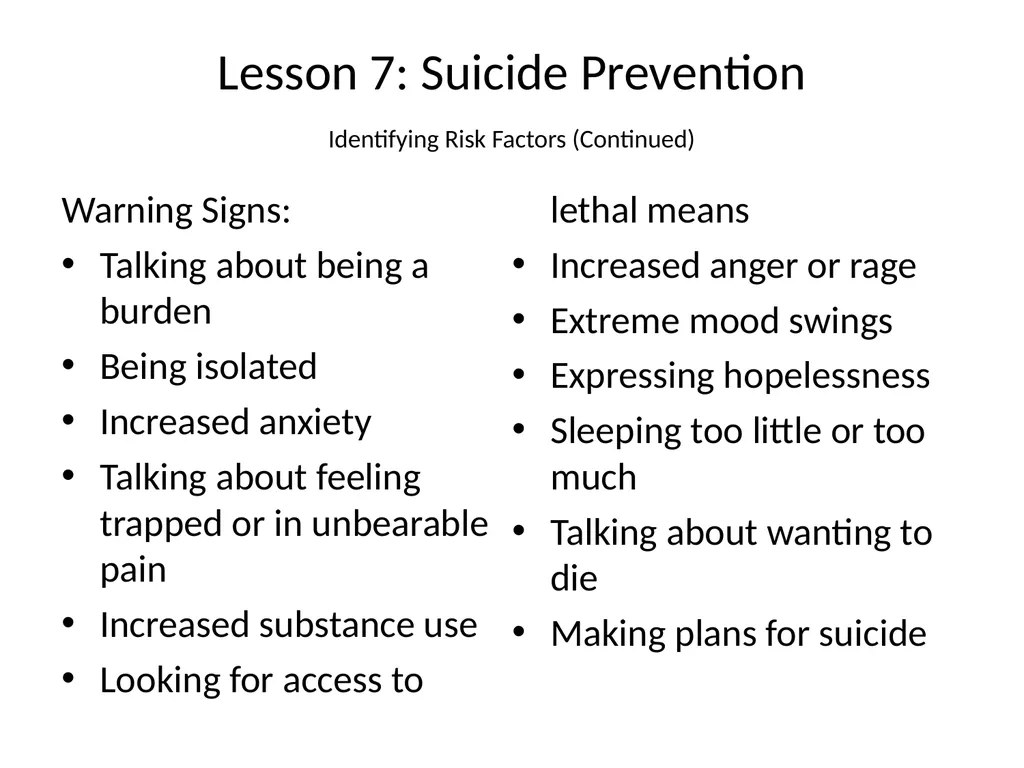
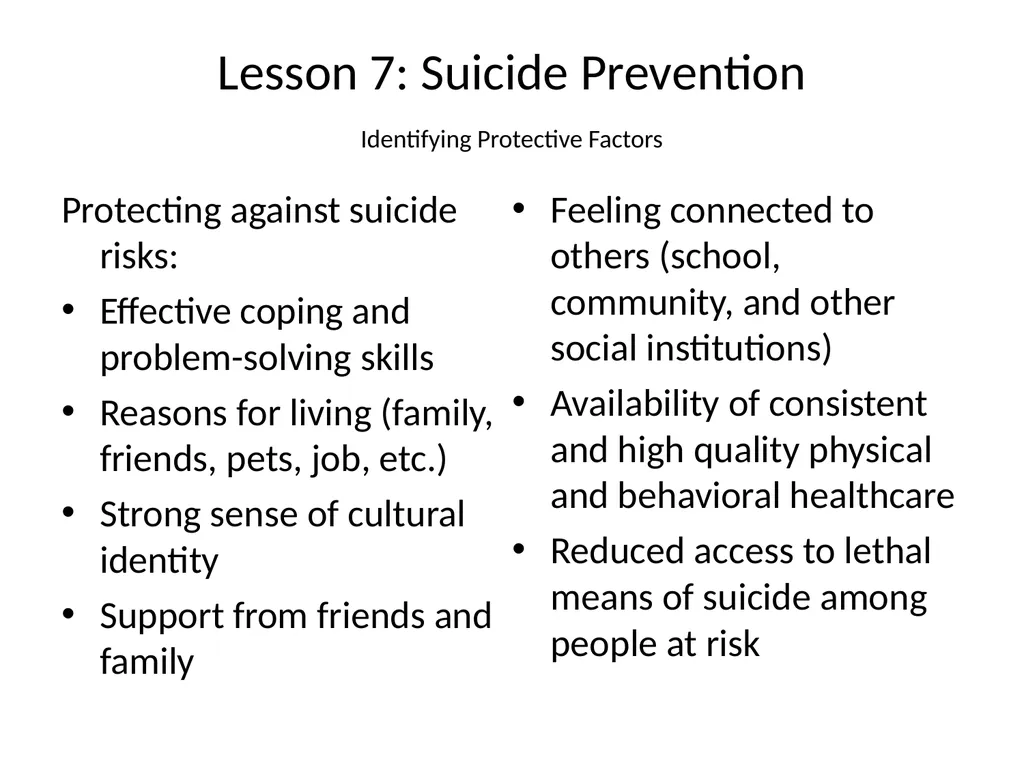
Lesson 7: Suicide Prevention<br>
Lesson 2: Knowledge and Safe Handling of Handgun Ammunition
Lesson 3: Storage of Firearms & Ammunition/Prevention of Accidental Injuries
Lesson 4: Shooting Fundamentals/Concealed Carry Techniques
Lesson 5: Laws Pertaining to Purchase, Ownership, Transportation and Possession of Handguns
Lesson 6: Federal, State and Local Laws Pertaining to the Use of a Handgun
Lesson 7: Suicide Prevention<br>
04
Lesson 1: Basic Firearm Knowledge and Firearms Preparedness At the end of this lesson, students will be able to:
Identify the four levels of awareness
Describe how to avoid conflict
Describe how to avoid criminal attacks
List the four basic firearm safety rules
Describe the parts of a revolver and pistol
Identify the two types of safety mechanisms Objectives<br>
Identify the four levels of awareness
Describe how to avoid conflict
Describe how to avoid criminal attacks
List the four basic firearm safety rules
Describe the parts of a revolver and pistol
Identify the two types of safety mechanisms Objectives<br>
05
Lesson 1: Basic Firearm Knowledge and Firearms Preparedness One of the most important ways to keep you and your family safe is maintaining an awareness of the environment around you, whether at home or on the street
This awareness can help you avoid confrontation or help evade criminal attacks
You should always try to avoid confrontation and USE DEADLY FORCE AS A LAST RESORT Situational Awareness<br>
This awareness can help you avoid confrontation or help evade criminal attacks
You should always try to avoid confrontation and USE DEADLY FORCE AS A LAST RESORT Situational Awareness<br>
06
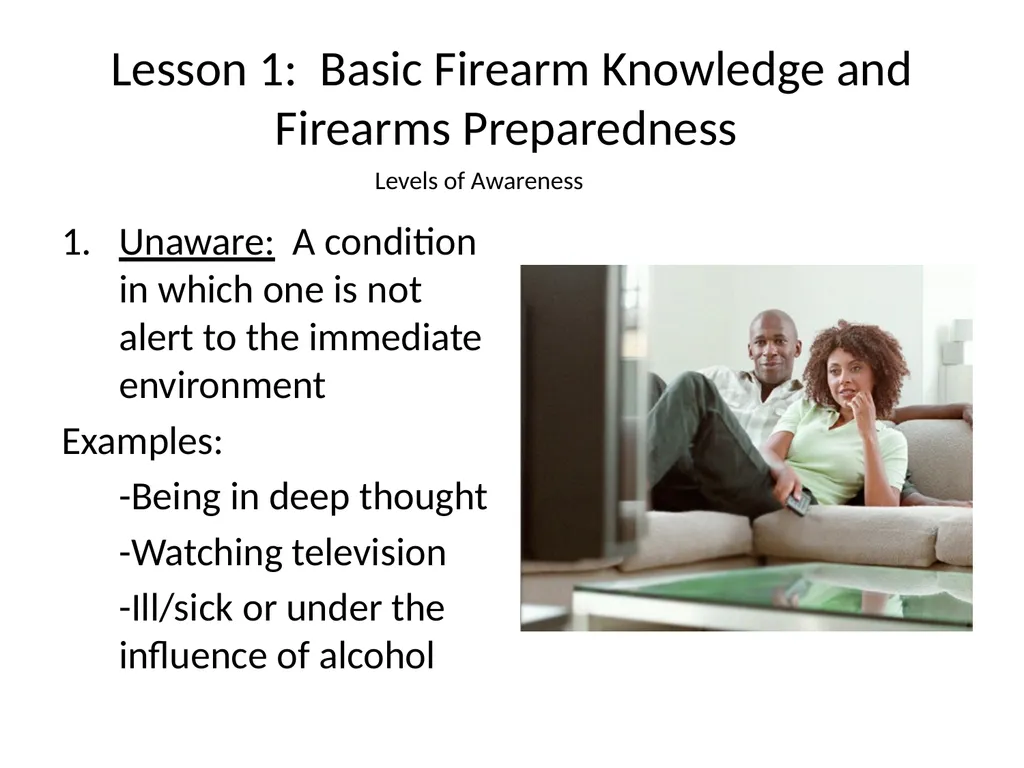
Lesson 1: Basic Firearm Knowledge and Firearms Preparedness Unaware: A condition in which one is not alert to the immediate environment
Examples:
-Being in deep thought
-Watching television
-Ill/sick or under the influence of alcohol Levels of Awareness<br>
Examples:
-Being in deep thought
-Watching television
-Ill/sick or under the influence of alcohol Levels of Awareness<br>
07
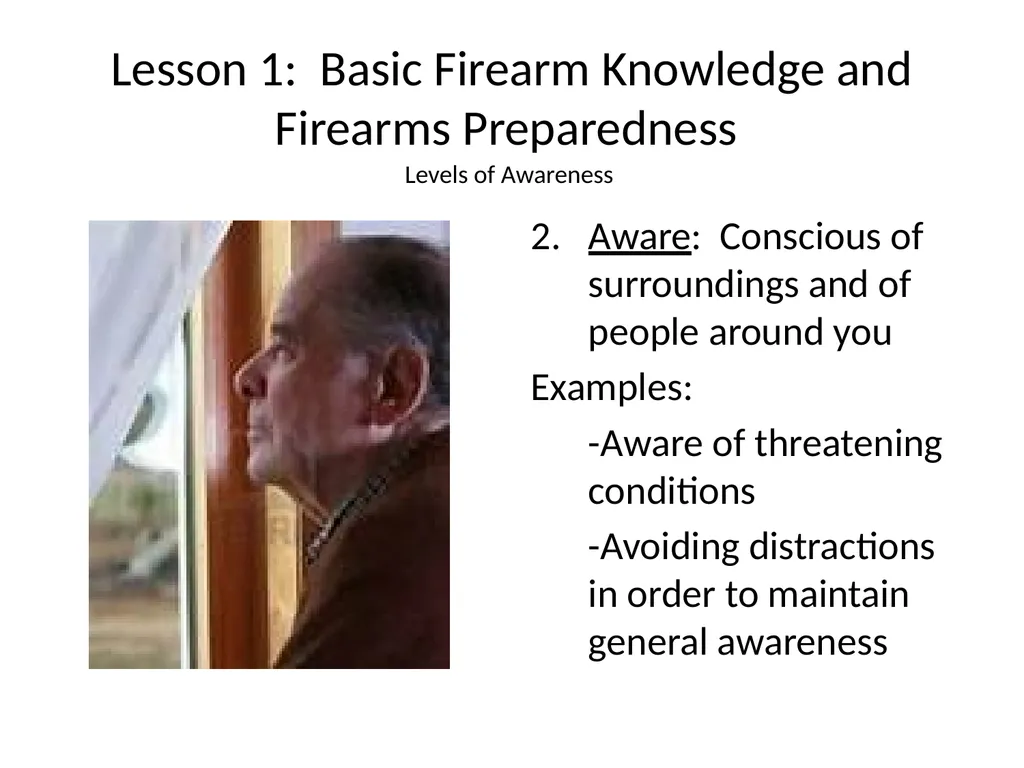
Lesson 1: Basic Firearm Knowledge and Firearms Preparedness Aware: Conscious of surroundings and of people around you
Examples:
-Aware of threatening conditions
-Avoiding distractions in order to maintain general awareness Levels of Awareness<br>
Examples:
-Aware of threatening conditions
-Avoiding distractions in order to maintain general awareness Levels of Awareness<br>
08
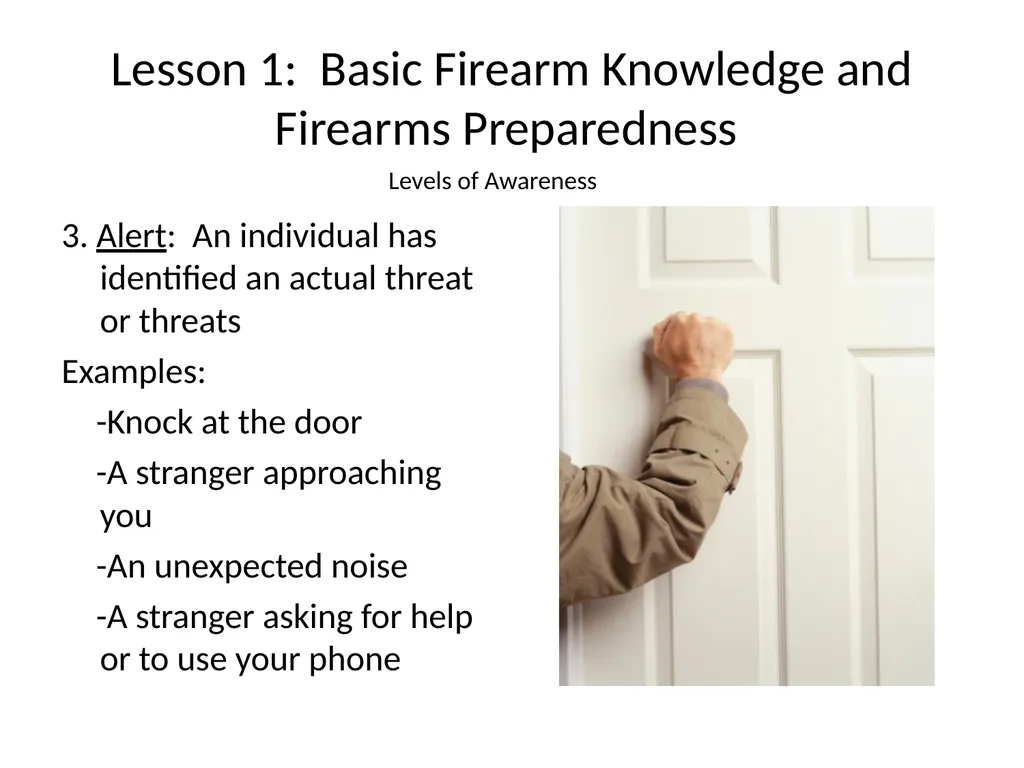
Lesson 1: Basic Firearm Knowledge and Firearms Preparedness 3. Alert: An individual has identified an actual threat or threats
Examples:
-Knock at the door
-A stranger approaching you
-An unexpected noise
-A stranger asking for help or to use your phone Levels of Awareness<br>
Examples:
-Knock at the door
-A stranger approaching you
-An unexpected noise
-A stranger asking for help or to use your phone Levels of Awareness<br>
09
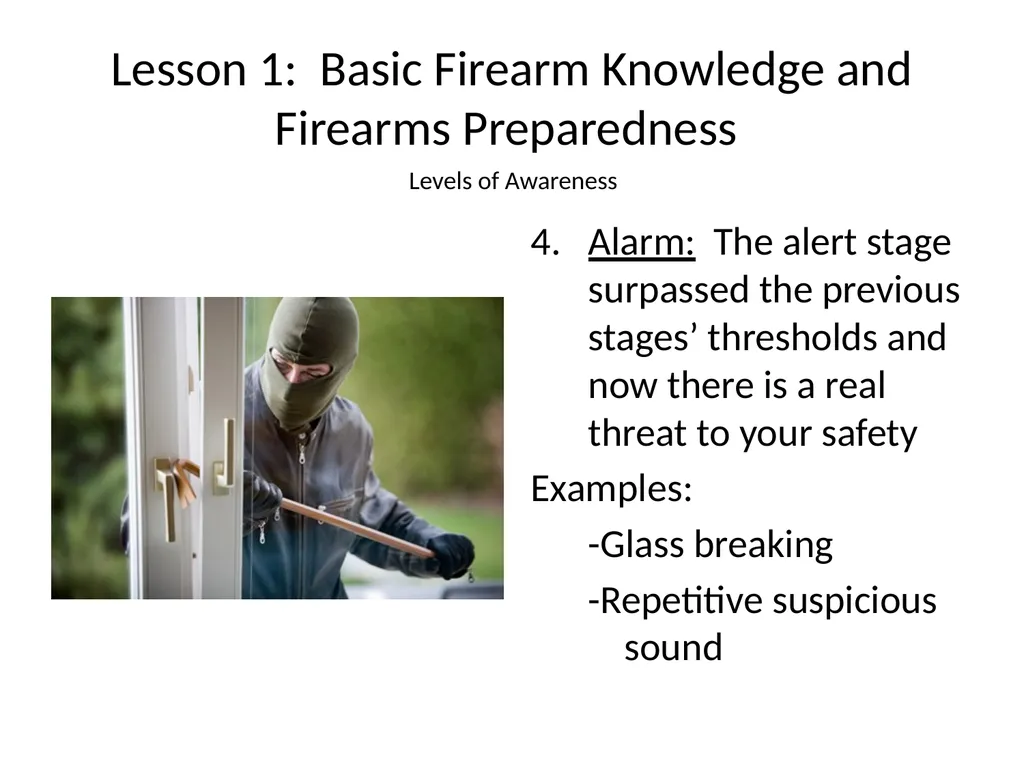
Lesson 1: Basic Firearm Knowledge and Firearms Preparedness Alarm: The alert stage surpassed the previous stages’ thresholds and now there is a real threat to your safety
Examples:
-Glass breaking
-Repetitive suspicious sound Levels of Awareness<br>
Examples:
-Glass breaking
-Repetitive suspicious sound Levels of Awareness<br>
10
Lesson 1: Basic Firearm Knowledge and Firearms Preparedness Maintaining a level of awareness will help you deter many conflicts; however, some conflicts cannot be avoided
Don’t participate in heated arguments, especially if alcohol is involved
Do not brandish your weapon! Brandishing your weapon is illegal in many states and is unnecessary in many situations. If you brandish your weapon first, you could be mistaken as the attacker.
Avoid “sketchy” areas of town
Listen to your instincts Conflict Resolution<br>
Don’t participate in heated arguments, especially if alcohol is involved
Do not brandish your weapon! Brandishing your weapon is illegal in many states and is unnecessary in many situations. If you brandish your weapon first, you could be mistaken as the attacker.
Avoid “sketchy” areas of town
Listen to your instincts Conflict Resolution<br>
11
Lesson 1: Basic Firearm Knowledge and Firearms Preparedness
Conflict Resolution Strategies De-escalate the situation
Lower your voice
Be mindful of aggressive posture (clenched fists, fighting stance)
Increase physical distance
Avoid verbal personal attacks, ignore those directed at you
Be prepared to agree to disagree
Accept that there doesn’t have to be a “winner”
Walk away<br>
Lower your voice
Be mindful of aggressive posture (clenched fists, fighting stance)
Increase physical distance
Avoid verbal personal attacks, ignore those directed at you
Be prepared to agree to disagree
Accept that there doesn’t have to be a “winner”
Walk away<br>
12
Lesson 1: Basic Firearm Knowledge and Firearms Preparedness Developing a defensive mindset is key to avoiding criminal attacks
A defensive mindset includes:
Developing standards, mental techniques and attitude that maximize the effectiveness of your response to an assault
Shooting a criminal is not a pleasant experience, even when justified, so avoid criminal attacks if necessary (even if you must give up personal property to avoid it) Avoiding Criminal Attacks<br>
A defensive mindset includes:
Developing standards, mental techniques and attitude that maximize the effectiveness of your response to an assault
Shooting a criminal is not a pleasant experience, even when justified, so avoid criminal attacks if necessary (even if you must give up personal property to avoid it) Avoiding Criminal Attacks<br>
13
Lesson 1: Basic Firearm Knowledge and Firearms Preparedness Questions to consider:
Am I prepared to take the life of another human being to save my own or my family’s?
Does my religion permit the taking of a life in self-defense?
Do my personal moral standards permit the taking of a life in self-defense?
Am I prepared to tolerate the judgment of my family, friends, and neighbors if I must defend myself with lethal force? Levels of Awareness<br>
Am I prepared to take the life of another human being to save my own or my family’s?
Does my religion permit the taking of a life in self-defense?
Do my personal moral standards permit the taking of a life in self-defense?
Am I prepared to tolerate the judgment of my family, friends, and neighbors if I must defend myself with lethal force? Levels of Awareness<br>
14
Lesson 1: Basic Firearm Knowledge and Firearms Preparedness Always treat all firearms as if they are loaded
Never point the weapon at anything you are not willing to destroy
Always keep your finger off of the trigger and outside of the trigger guard until ready to shoot
Always be aware of your target and beyond Basic Firearm Safety Rules<br>
Never point the weapon at anything you are not willing to destroy
Always keep your finger off of the trigger and outside of the trigger guard until ready to shoot
Always be aware of your target and beyond Basic Firearm Safety Rules<br>
15
Lesson 1: Basic Firearm Knowledge and Firearms Preparedness Three main parts of a pistol:
Frame
Barrel
Slide Nomenclature and Functions of a Handgun<br>
Frame
Barrel
Slide Nomenclature and Functions of a Handgun<br>
16
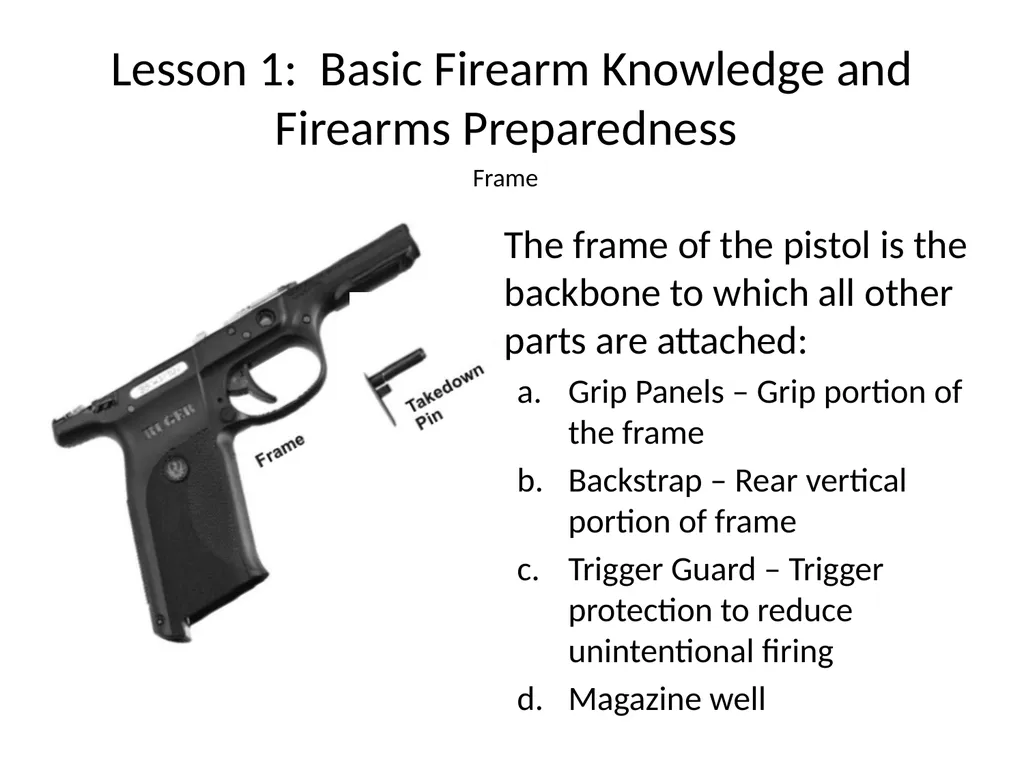
The frame of the pistol is the backbone to which all other parts are attached:
Grip Panels – Grip portion of the frame
Backstrap – Rear vertical portion of frame
Trigger Guard – Trigger protection to reduce unintentional firing
Magazine well Frame Lesson 1: Basic Firearm Knowledge and Firearms Preparedness<br>
Grip Panels – Grip portion of the frame
Backstrap – Rear vertical portion of frame
Trigger Guard – Trigger protection to reduce unintentional firing
Magazine well Frame Lesson 1: Basic Firearm Knowledge and Firearms Preparedness<br>
17
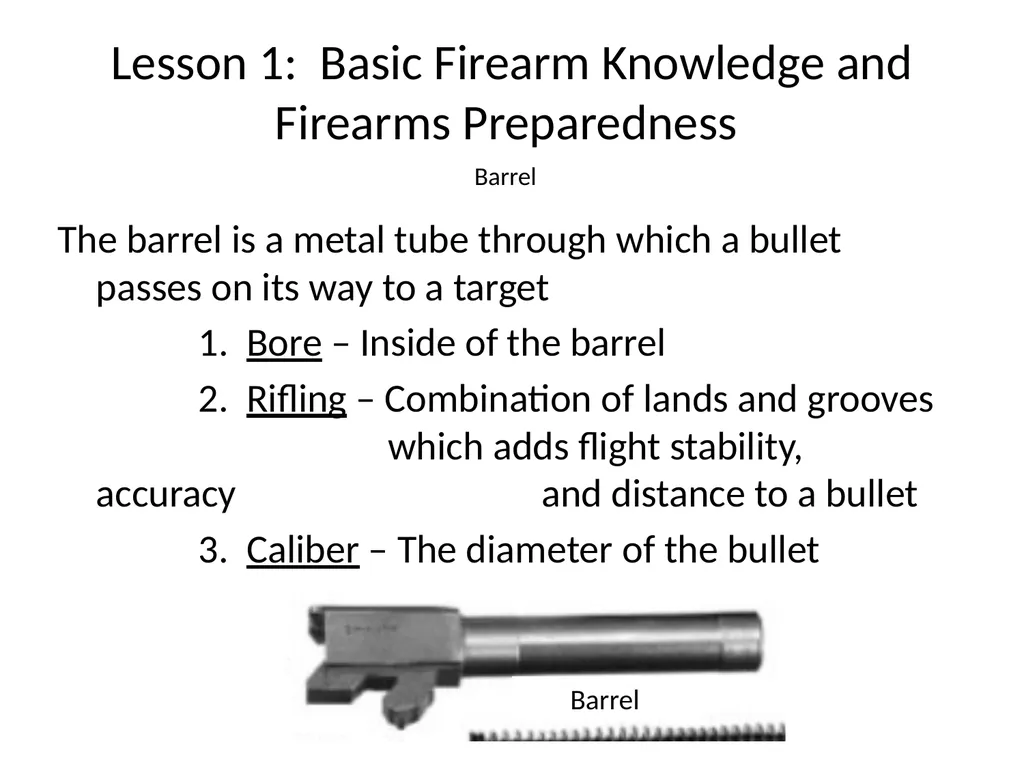
Lesson 1: Basic Firearm Knowledge and Firearms Preparedness The barrel is a metal tube through which a bullet passes on its way to a target
1. Bore – Inside of the barrel
2. Rifling – Combination of lands and grooves which adds flight stability, accuracy and distance to a bullet
3. Caliber – The diameter of the bullet Barrel Barrel<br>
1. Bore – Inside of the barrel
2. Rifling – Combination of lands and grooves which adds flight stability, accuracy and distance to a bullet
3. Caliber – The diameter of the bullet Barrel Barrel<br>
18
Lesson 1: Basic Firearm Knowledge and Firearms Preparedness The action is a group of moving parts used to load, fire, and unload the pistol
The parts of the action differ between revolvers and semi-automatic pistols Two types of revolver actions:
1. Single action
2. Double action
Four types of semi-auto actions:
1. Single action
2. Double/Single action
3. Double action only
4. Striker fired Action<br>
The parts of the action differ between revolvers and semi-automatic pistols Two types of revolver actions:
1. Single action
2. Double action
Four types of semi-auto actions:
1. Single action
2. Double/Single action
3. Double action only
4. Striker fired Action<br>
19
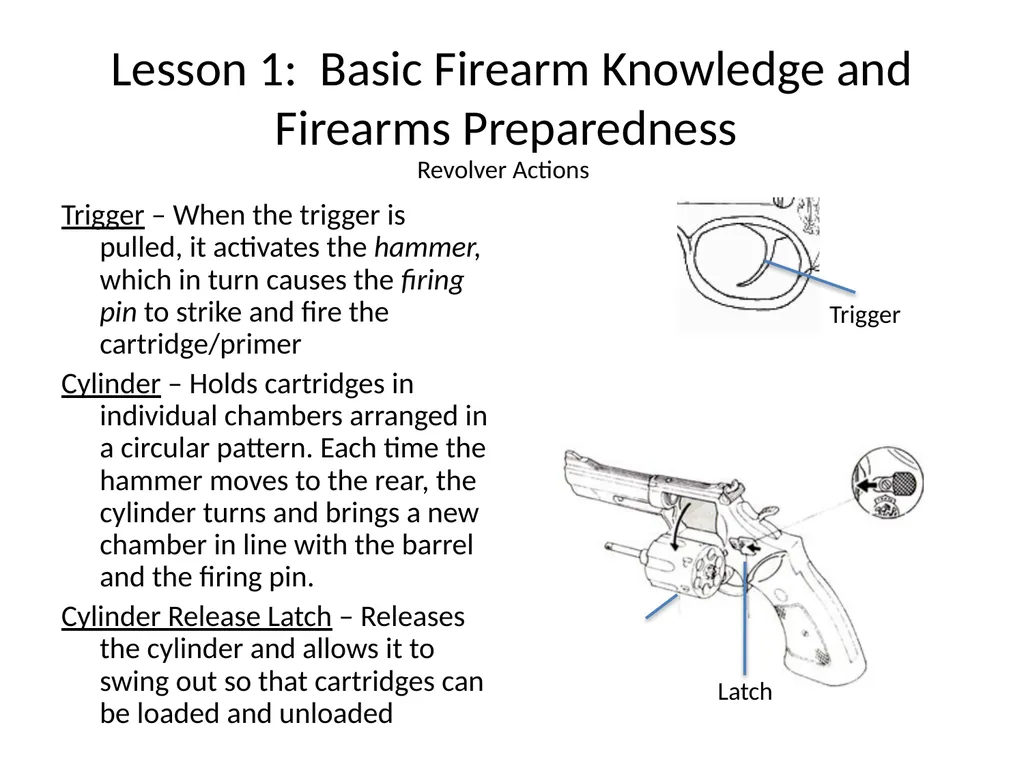
Lesson 1: Basic Firearm Knowledge and Firearms Preparedness Trigger – When the trigger is pulled, it activates the hammer, which in turn causes the firing pin to strike and fire the cartridge/primer
Cylinder – Holds cartridges in individual chambers arranged in a circular pattern. Each time the hammer moves to the rear, the cylinder turns and brings a new chamber in line with the barrel and the firing pin.
Cylinder Release Latch – Releases the cylinder and allows it to swing out so that cartridges can be loaded and unloaded Revolver Actions Trigger Cylinder Latch<br>
Cylinder – Holds cartridges in individual chambers arranged in a circular pattern. Each time the hammer moves to the rear, the cylinder turns and brings a new chamber in line with the barrel and the firing pin.
Cylinder Release Latch – Releases the cylinder and allows it to swing out so that cartridges can be loaded and unloaded Revolver Actions Trigger Cylinder Latch<br>
20
Lesson 1: Basic Firearm Knowledge and Firearms Preparedness Single action – Trigger performs only one action; releases the hammer, firing the pistol
Double action – Trigger performs two tasks; cocks and releases the hammer, firing the pistol Two Types of Revolver Actions<br>
Double action – Trigger performs two tasks; cocks and releases the hammer, firing the pistol Two Types of Revolver Actions<br>
21
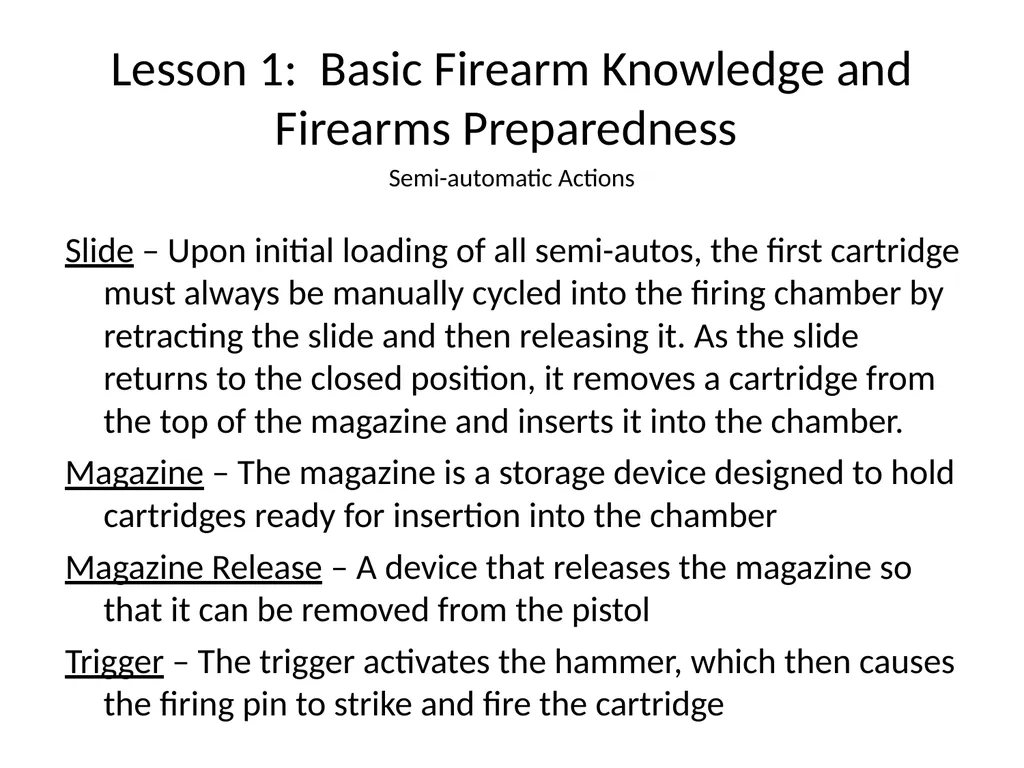
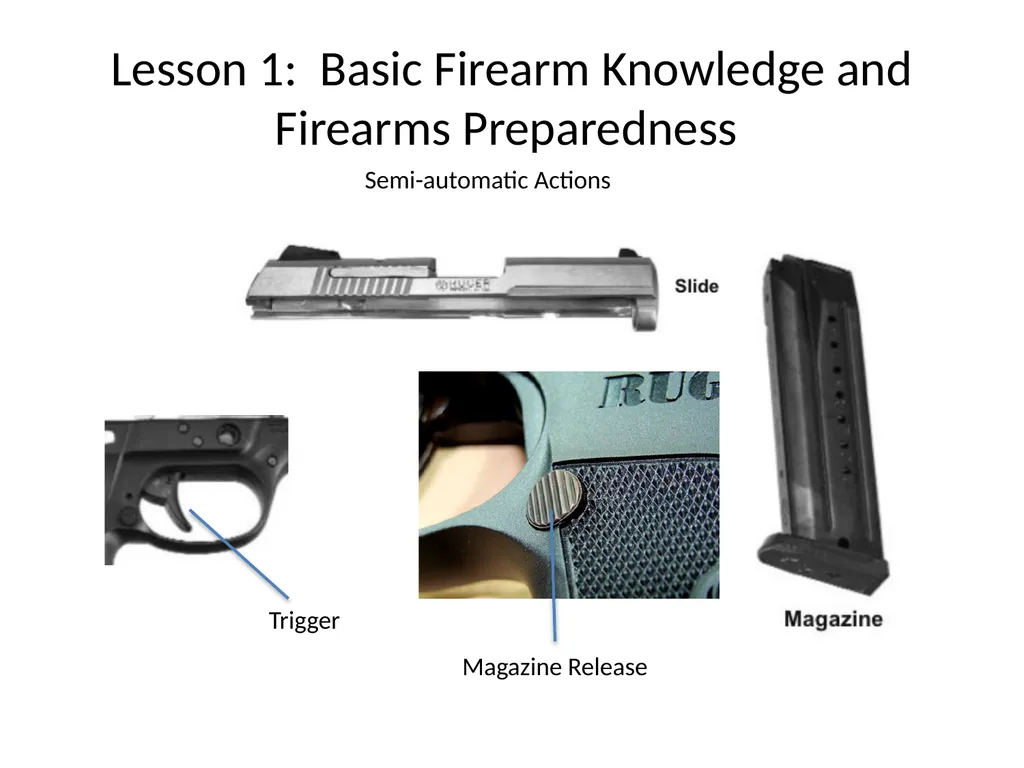
Lesson 1: Basic Firearm Knowledge and Firearms Preparedness Slide – Upon initial loading of all semi-autos, the first cartridge must always be manually cycled into the firing chamber by retracting the slide and then releasing it. As the slide returns to the closed position, it removes a cartridge from the top of the magazine and inserts it into the chamber.
Magazine – The magazine is a storage device designed to hold cartridges ready for insertion into the chamber
Magazine Release – A device that releases the magazine so that it can be removed from the pistol
Trigger – The trigger activates the hammer, which then causes the firing pin to strike and fire the cartridge Semi-automatic Actions<br>
Magazine – The magazine is a storage device designed to hold cartridges ready for insertion into the chamber
Magazine Release – A device that releases the magazine so that it can be removed from the pistol
Trigger – The trigger activates the hammer, which then causes the firing pin to strike and fire the cartridge Semi-automatic Actions<br>
22
Lesson 1: Basic Firearm Knowledge and Firearms Preparedness Semi-automatic Actions Trigger Magazine Release<br>
23
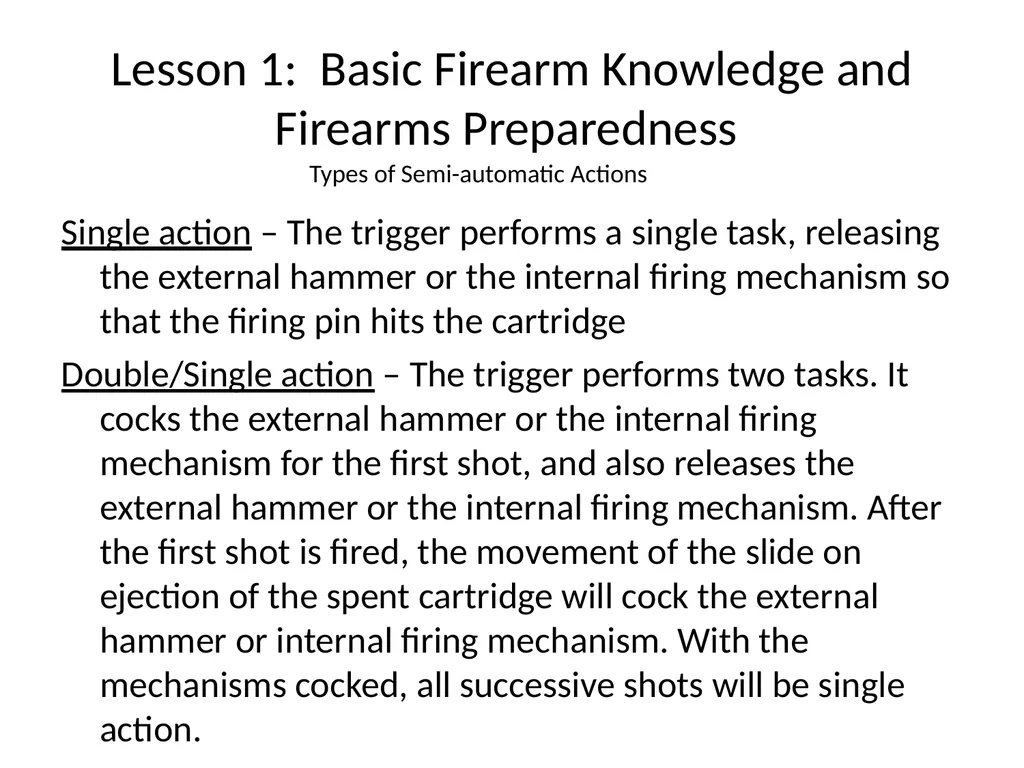
Lesson 1: Basic Firearm Knowledge and Firearms Preparedness Single action – The trigger performs a single task, releasing the external hammer or the internal firing mechanism so that the firing pin hits the cartridge
Double/Single action – The trigger performs two tasks. It cocks the external hammer or the internal firing mechanism for the first shot, and also releases the external hammer or the internal firing mechanism. After the first shot is fired, the movement of the slide on ejection of the spent cartridge will cock the external hammer or internal firing mechanism. With the mechanisms cocked, all successive shots will be single action. Types of Semi-automatic Actions<br>
Double/Single action – The trigger performs two tasks. It cocks the external hammer or the internal firing mechanism for the first shot, and also releases the external hammer or the internal firing mechanism. After the first shot is fired, the movement of the slide on ejection of the spent cartridge will cock the external hammer or internal firing mechanism. With the mechanisms cocked, all successive shots will be single action. Types of Semi-automatic Actions<br>
24
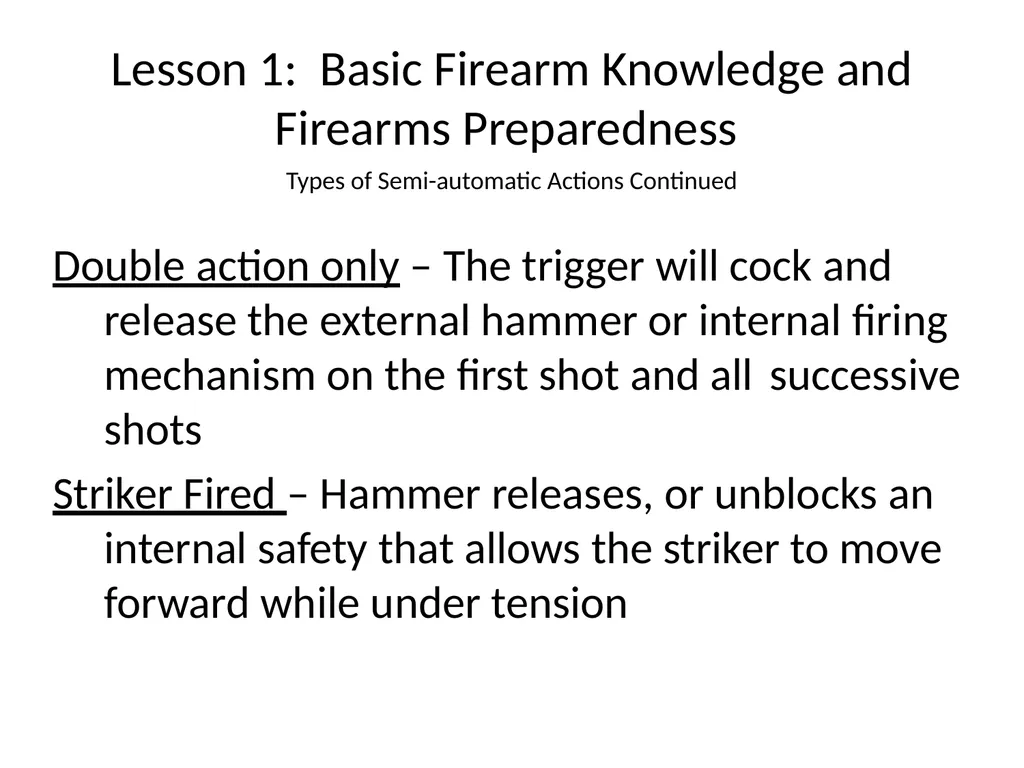
Lesson 1: Basic Firearm Knowledge and Firearms Preparedness Double action only – The trigger will cock and release the external hammer or internal firing mechanism on the first shot and all successive shots
Striker Fired – Hammer releases, or unblocks an internal safety that allows the striker to move forward while under tension Types of Semi-automatic Actions Continued<br>
Striker Fired – Hammer releases, or unblocks an internal safety that allows the striker to move forward while under tension Types of Semi-automatic Actions Continued<br>
25
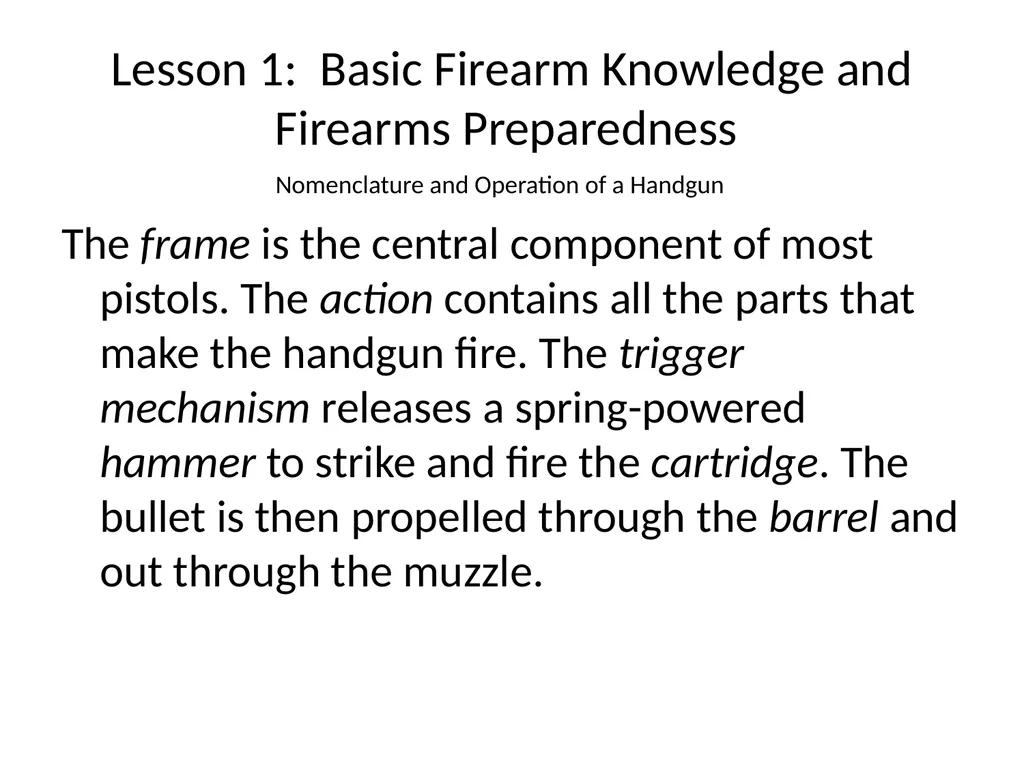
Lesson 1: Basic Firearm Knowledge and Firearms Preparedness The frame is the central component of most pistols. The action contains all the parts that make the handgun fire. The trigger mechanism releases a spring-powered hammer to strike and fire the cartridge. The bullet is then propelled through the barrel and out through the muzzle. Nomenclature and Operation of a Handgun<br>
26
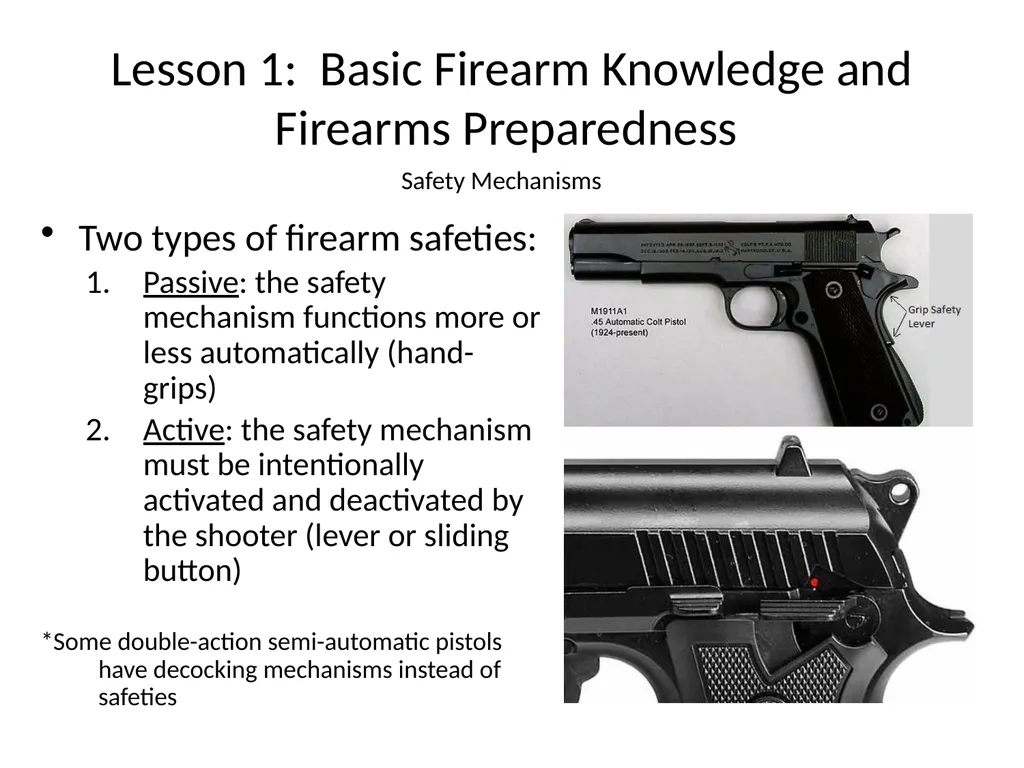
Lesson 1: Basic Firearm Knowledge and Firearms Preparedness Two types of firearm safeties:
Passive: the safety mechanism functions more or less automatically (hand-grips)
Active: the safety mechanism must be intentionally activated and deactivated by the shooter (lever or sliding button)
*Some double-action semi-automatic pistols have decocking mechanisms instead of safeties Safety Mechanisms<br>
Passive: the safety mechanism functions more or less automatically (hand-grips)
Active: the safety mechanism must be intentionally activated and deactivated by the shooter (lever or sliding button)
*Some double-action semi-automatic pistols have decocking mechanisms instead of safeties Safety Mechanisms<br>
27
Lesson 1: Basic Firearm Knowledge and Firearms Preparedness Summary After learning basic firearm knowledge and firearms preparedness, the student is able to:
Identify the four levels of awareness
Describe how to avoid conflict
Describe how to avoid criminal attacks
List the four basic firearm safety rules
Describe the parts of a revolver and pistol
Identify the two types of safety mechanisms<br>
Identify the four levels of awareness
Describe how to avoid conflict
Describe how to avoid criminal attacks
List the four basic firearm safety rules
Describe the parts of a revolver and pistol
Identify the two types of safety mechanisms<br>
28
Lesson 2: Knowledge and Safe Handling of Handgun Ammunition<br>
29
Lesson 2: Knowledge and Safe Handling of Handgun Ammunition At the end of this lesson, students will be able to:
List the five components of a cartridge/ammunition
Describe the firing sequence of a handgun
Safely load/unload a handgun
State why using new ammunition is preferred over reloaded ammunition
Explain the difference between a misfire and squib load
Identify the risks of lead contamination Objectives<br>
List the five components of a cartridge/ammunition
Describe the firing sequence of a handgun
Safely load/unload a handgun
State why using new ammunition is preferred over reloaded ammunition
Explain the difference between a misfire and squib load
Identify the risks of lead contamination Objectives<br>
30
Lesson 2: Knowledge and Safe Handling of Handgun Ammunition Note: “Cartridges” are commonly and incorrectly referred to as “bullets”
Two types of cartridges:
Rimfire cartridge - the priming compound is contained in the inside rim of the case head
Center-fire cartridge – the priming compound is contained in a metal cup, called primer, located in the center of the case head Ammunition<br>
Two types of cartridges:
Rimfire cartridge - the priming compound is contained in the inside rim of the case head
Center-fire cartridge – the priming compound is contained in a metal cup, called primer, located in the center of the case head Ammunition<br>
31
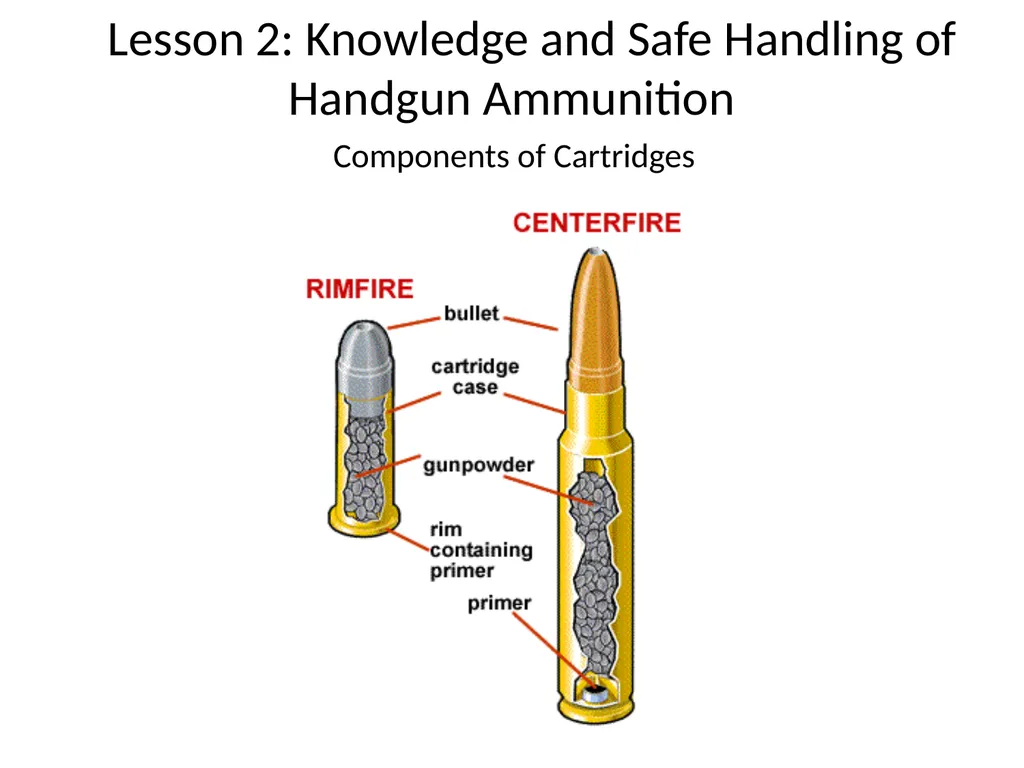
Lesson 2: Knowledge and Safe Handling of Handgun Ammunition Components of Cartridges<br>
32
Case – Metal cylinder that is closed on one end and contains other components such as primer, powder, and bullet
Primer – An impact sensitive chemical compound used for ignition
Rimfire – The primer is contained in the inside rim of the case’s base
Centerfire – The primer is contained in a small metal cup, and is located in the center of the case’s base
Powder Charge – A fast burning chemical compound used as a propellant, and is contained inside the body of the case
Bullet – A projectile, usually made of lead and sometimes covered with a layer of copper or other metal, and is located at the mouth of the case
Rim Containing Primer – The primer is contained on the outside rim of the cartridge Lesson 2: Knowledge and Safe Handling of Handgun Ammunition Components of Cartridges<br>
Primer – An impact sensitive chemical compound used for ignition
Rimfire – The primer is contained in the inside rim of the case’s base
Centerfire – The primer is contained in a small metal cup, and is located in the center of the case’s base
Powder Charge – A fast burning chemical compound used as a propellant, and is contained inside the body of the case
Bullet – A projectile, usually made of lead and sometimes covered with a layer of copper or other metal, and is located at the mouth of the case
Rim Containing Primer – The primer is contained on the outside rim of the cartridge Lesson 2: Knowledge and Safe Handling of Handgun Ammunition Components of Cartridges<br>
33
Lesson 2: Knowledge and Safe Handling of Handgun Ammunition Pulling the trigger of the pistol will cause the firing pin to hit and ignite the primer
The flame generated by the primer ignites the powder in the cartridge
The powder burns very rapidly and produces a high volume of gas
These expanding gases push the bullet out of the cartridge case and propel it out of the pistol barrel at a high rate of speed, 500-4000 FPS Firing Sequence<br>
The flame generated by the primer ignites the powder in the cartridge
The powder burns very rapidly and produces a high volume of gas
These expanding gases push the bullet out of the cartridge case and propel it out of the pistol barrel at a high rate of speed, 500-4000 FPS Firing Sequence<br>
34
Lesson 2: Knowledge and Safe Handling of Handgun Ammunition Loading:
Point the muzzle in a safe direction
Open the action; be sure the barrel is unobstructed
Put the safety on if the gun can be loaded with the safety on
Load the ammunition
Close the action
Put on the safety if you weren’t previously able to Loading a handgun<br>
Point the muzzle in a safe direction
Open the action; be sure the barrel is unobstructed
Put the safety on if the gun can be loaded with the safety on
Load the ammunition
Close the action
Put on the safety if you weren’t previously able to Loading a handgun<br>
35
Lesson 2: Knowledge and Safe Handling of Handgun Ammunition Unloading:
Point the muzzle in a safe direction
Make sure the safety is on
Keep your finger outside the trigger guard
Open the action
Remove the ammunition by first detaching the magazine or ejecting cartridges or shells
Count shells or cartridges to make sure the gun is empty
Check both the chamber and the magazine Unloading a handgun<br>
Point the muzzle in a safe direction
Make sure the safety is on
Keep your finger outside the trigger guard
Open the action
Remove the ammunition by first detaching the magazine or ejecting cartridges or shells
Count shells or cartridges to make sure the gun is empty
Check both the chamber and the magazine Unloading a handgun<br>
36
Lesson 2: Knowledge and Safe Handling of Handgun Ammunition Factory New:
Consists of a new case
Chance of imperfections is extremely minimal
Even in new ammunition, check for corrosion or other imperfections Reloaded:
Loaded in used case
Chance of imperfections are higher being loaded in used case
Check for primers Factory New vs. Reloaded Ammunition<br>
Consists of a new case
Chance of imperfections is extremely minimal
Even in new ammunition, check for corrosion or other imperfections Reloaded:
Loaded in used case
Chance of imperfections are higher being loaded in used case
Check for primers Factory New vs. Reloaded Ammunition<br>
37
Lesson 2: Knowledge and Safe Handling of Handgun Ammunition Inspect your ammunition for safety flaws and imperfections
Understand range capabilities of ammunition
Be sure of your target, your target’s environment, the background and beyond
Be sure to use the proper caliber ammunition with gun to be fired
Example: 9mm Parabellum 9x19mm
Example: 9mm Kurtz 9x17mm/9mm browning sort= .380 ACP
5. Know the difference between defensive ammunition and practice ammunition Inspection of Ammunition<br>
Understand range capabilities of ammunition
Be sure of your target, your target’s environment, the background and beyond
Be sure to use the proper caliber ammunition with gun to be fired
Example: 9mm Parabellum 9x19mm
Example: 9mm Kurtz 9x17mm/9mm browning sort= .380 ACP
5. Know the difference between defensive ammunition and practice ammunition Inspection of Ammunition<br>
38
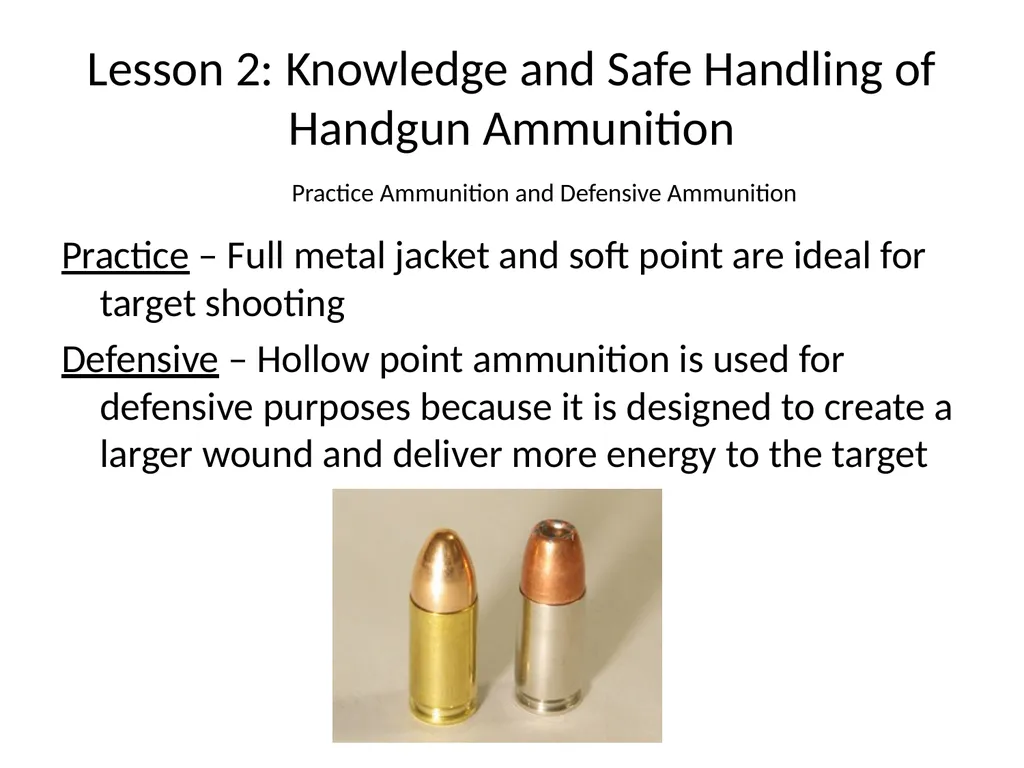
Lesson 2: Knowledge and Safe Handling of Handgun Ammunition Practice – Full metal jacket and soft point are ideal for target shooting
Defensive – Hollow point ammunition is used for defensive purposes because it is designed to create a larger wound and deliver more energy to the target Practice Ammunition and Defensive Ammunition<br>
Defensive – Hollow point ammunition is used for defensive purposes because it is designed to create a larger wound and deliver more energy to the target Practice Ammunition and Defensive Ammunition<br>
39
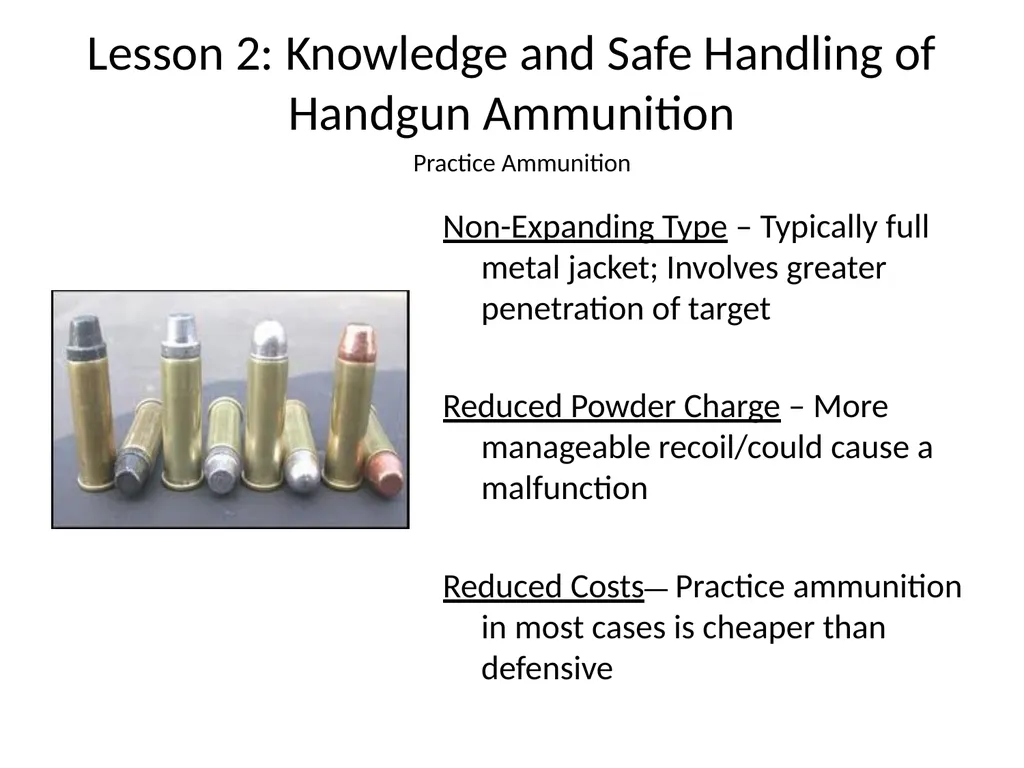
Lesson 2: Knowledge and Safe Handling of Handgun Ammunition Non-Expanding Type – Typically full metal jacket; Involves greater penetration of target
Reduced Powder Charge – More manageable recoil/could cause a malfunction
Reduced Costs Practice ammunition in most cases is cheaper than defensive Practice Ammunition<br>
Reduced Powder Charge – More manageable recoil/could cause a malfunction
Reduced Costs Practice ammunition in most cases is cheaper than defensive Practice Ammunition<br>
40
Lesson 2: Knowledge and Safe Handling of Handgun Ammunition Reliability – The ability of a firearm to consistently chamber, fire, extract, and eject a load without malfunctioning
Controllability – The ability to fire multiple rounds and still manage recoil and maintain accuracy
Stopping Power – The ability of a cartridge to quickly incapacitate an assailant or otherwise cause an assailant to stop their attack
Accuracy – Ability of the gun and ammunition combination to shoot to the point of aim indicated by the sights
Muzzle Flash – When in excess will impair night vision and illuminate your position
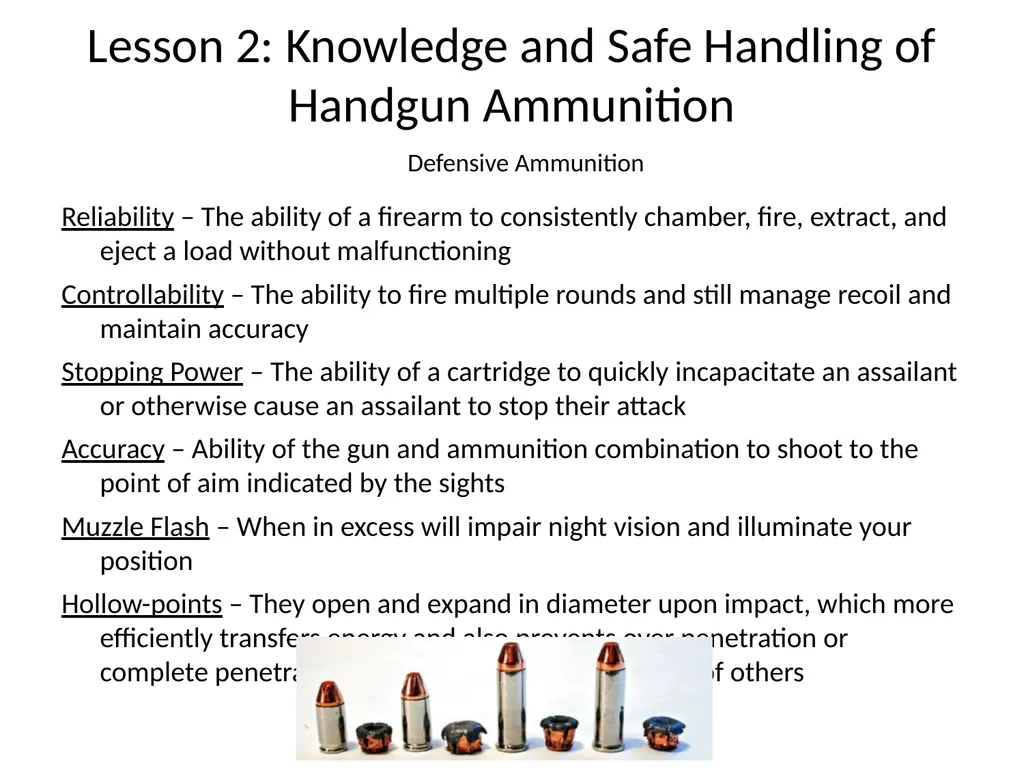
Hollow-points – They open and expand in diameter upon impact, which more efficiently transfers energy and also prevents over penetration or complete penetration that could endanger the lives of others Defensive Ammunition<br>
Controllability – The ability to fire multiple rounds and still manage recoil and maintain accuracy
Stopping Power – The ability of a cartridge to quickly incapacitate an assailant or otherwise cause an assailant to stop their attack
Accuracy – Ability of the gun and ammunition combination to shoot to the point of aim indicated by the sights
Muzzle Flash – When in excess will impair night vision and illuminate your position
Hollow-points – They open and expand in diameter upon impact, which more efficiently transfers energy and also prevents over penetration or complete penetration that could endanger the lives of others Defensive Ammunition<br>
41
Lesson 2: Knowledge and Safe Handling of Handgun Ammunition Misfire – Failure of the cartridge to fire after the primer has been struck by the firing pin
Hangfire – A perceptible delay in the ignition of a cartridge after the primer has been struck by the firing pin
Squib load – Development of less than normal pressure or velocity after ignition of the cartridge. There is an unusual difference in recoil or noise. Ammunition Malfunction Resolutions<br>
Hangfire – A perceptible delay in the ignition of a cartridge after the primer has been struck by the firing pin
Squib load – Development of less than normal pressure or velocity after ignition of the cartridge. There is an unusual difference in recoil or noise. Ammunition Malfunction Resolutions<br>
42
Lesson 2: Knowledge and Safe Handling of Handgun Ammunition Misfire and Hangfire – Keep the pistol pointed in a safe direction; a hangfire might exist and the cartridge could still fire. Don’t attempt to open the action of the pistol to remove the cartridge for at least 30 seconds.
Squib Load – Keep the muzzle pointed in a safe direction; wait 30 seconds and then unload the gun. Check to make sure the chamber is empty and the barrel is free from obstructions. Also check the barrel for deformities. Ammunition Malfunction<br>
Squib Load – Keep the muzzle pointed in a safe direction; wait 30 seconds and then unload the gun. Check to make sure the chamber is empty and the barrel is free from obstructions. Also check the barrel for deformities. Ammunition Malfunction<br>
43
Lesson 2: Knowledge and Safe Handling of Handgun Ammunition Lead contamination is commonly overlooked by shooters. Shooters often only worry about their hearing and eyesight, not lead contamination.
After discharging your firearm, lead particles can disperse into the air and contaminate your clothing, hands and the environment around you. Lead Contamination<br>
After discharging your firearm, lead particles can disperse into the air and contaminate your clothing, hands and the environment around you. Lead Contamination<br>
44
Lesson 2: Knowledge and Safe Handling of Handgun Ammunition Hazards of lead poisoning
Abdominal Pain
Confusion
Headache
Anemia
Irritability
Coma or Death How to avoid contamination
Do not eat or drink at the range
Do not shoot indoors without proper ventilation
Clean up at the range
Take off your shoes at the door of your house
Do the laundry
Take a shower Lead Contamination<br>
Abdominal Pain
Confusion
Headache
Anemia
Irritability
Coma or Death How to avoid contamination
Do not eat or drink at the range
Do not shoot indoors without proper ventilation
Clean up at the range
Take off your shoes at the door of your house
Do the laundry
Take a shower Lead Contamination<br>
45
Lesson 2: Knowledge and Safe Handling of Handgun Ammunition After learning safe handling of handgun ammunition, the student is able to:
List the five components of a cartridge/ammunition
Describe the process of loading and unloading a semi-automatic pistol and revolver
State why using new ammunition is preferred over reloaded ammunition
Explain the difference between a misfire and squib load
Identify the risks of lead contamination Summary<br>
List the five components of a cartridge/ammunition
Describe the process of loading and unloading a semi-automatic pistol and revolver
State why using new ammunition is preferred over reloaded ammunition
Explain the difference between a misfire and squib load
Identify the risks of lead contamination Summary<br>
46
Lesson 3: Storage of Firearms & Ammunition/Prevention of Accidental Injuries<br>
47
Lesson 3: Storage of Firearms & Ammunition/Prevention of Accidental Injuries At the end of this lesson, students will be able to:
State the importance of using safes to store firearms when not in use
Describe the pros and cons of various handgun locking devices
Describe the guidelines of storing ammunition and firearms
List the three main reasons for properly cleaning and maintaining your gun
Describe the Nebraska State Law as it pertains to unlawful possession of firearms and unlawful transfer of a firearm to a juvenile Objectives<br>
State the importance of using safes to store firearms when not in use
Describe the pros and cons of various handgun locking devices
Describe the guidelines of storing ammunition and firearms
List the three main reasons for properly cleaning and maintaining your gun
Describe the Nebraska State Law as it pertains to unlawful possession of firearms and unlawful transfer of a firearm to a juvenile Objectives<br>
48
Lesson 3: Storage of Firearms & Ammunition/Prevention of Accidental Injuries Storing firearms safely is a key responsibility as a gun owner
Store guns and ammunition in places that are not accessible to unauthorized persons
Store guns and ammunition separately
Store guns and ammunition in a cool, dry place Storing Firearms Properly<br>
Store guns and ammunition in places that are not accessible to unauthorized persons
Store guns and ammunition separately
Store guns and ammunition in a cool, dry place Storing Firearms Properly<br>
49
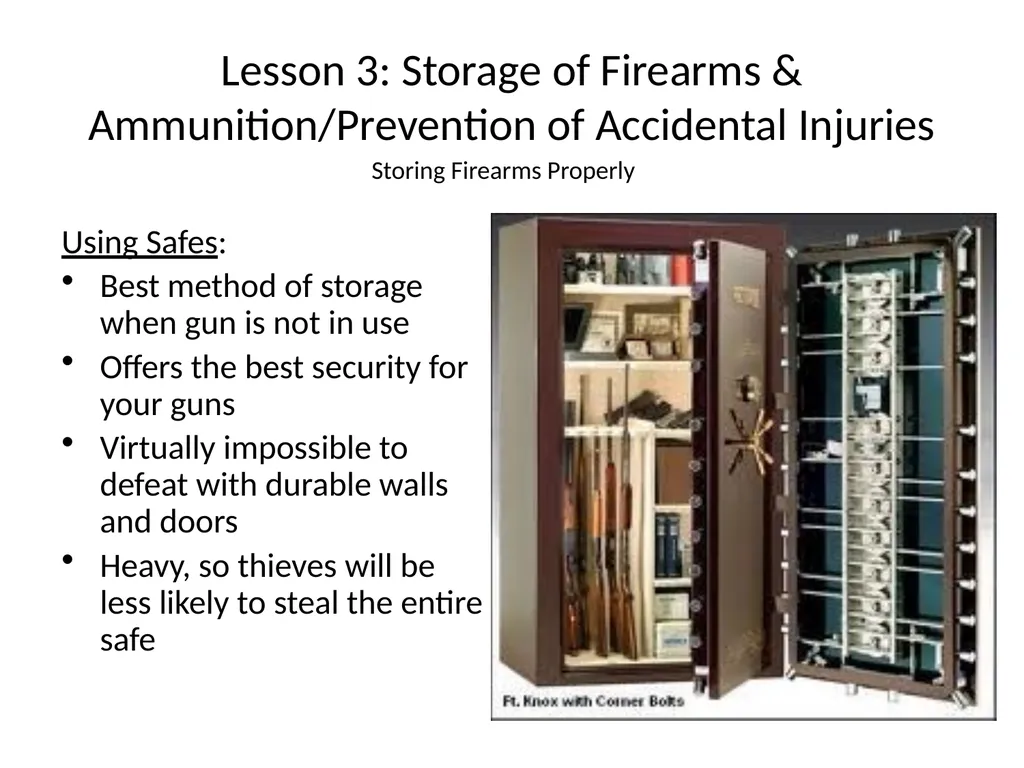
Lesson 3: Storage of Firearms & Ammunition/Prevention of Accidental Injuries Using Safes:
Best method of storage when gun is not in use
Offers the best security for your guns
Virtually impossible to defeat with durable walls and doors
Heavy, so thieves will be less likely to steal the entire safe Storing Firearms Properly<br>
Best method of storage when gun is not in use
Offers the best security for your guns
Virtually impossible to defeat with durable walls and doors
Heavy, so thieves will be less likely to steal the entire safe Storing Firearms Properly<br>
50
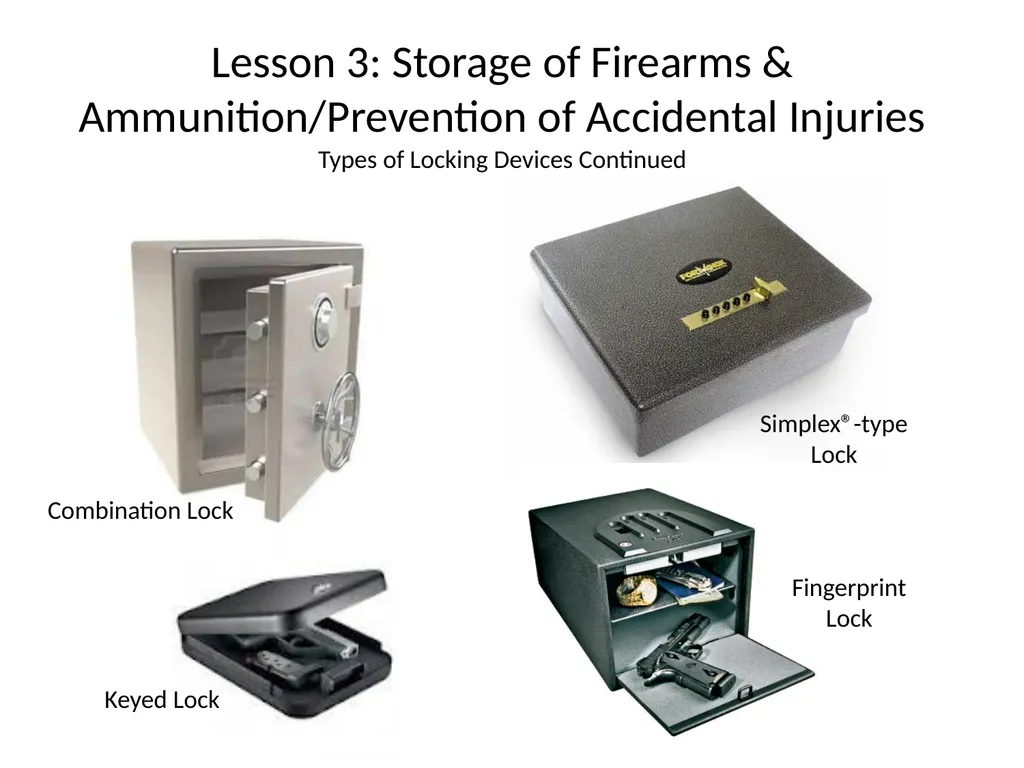
Lesson 3: Storage of Firearms & Ammunition/Prevention of Accidental Injuries Keyed Lock: a padlock or keyed drawer
-offers a decent level of security (pro)
-difficult to access in the dark or in a panic (con)
Combination Lock: simple triple-rotary-tumbler; typically found on a gun safe; similar to a mechanism on a bank vault
-very secure and easy to use (pro)
-under stress you may forget the combination; virtually impossible to operate in the dark (con) Types of Locking Devices<br>
-offers a decent level of security (pro)
-difficult to access in the dark or in a panic (con)
Combination Lock: simple triple-rotary-tumbler; typically found on a gun safe; similar to a mechanism on a bank vault
-very secure and easy to use (pro)
-under stress you may forget the combination; virtually impossible to operate in the dark (con) Types of Locking Devices<br>
51
Lesson 3: Storage of Firearms & Ammunition/Prevention of Accidental Injuries Simplex®-type Locks: consists of multiple buttons that are pushed in a certain order, which will then open the device
-highly secure, quick access, can be used in the dark, incorrect attempts block any further attempts (pros)
-if electronic, the device will be inaccessible if power fails (con)
Fingerprint Lock: uses biometrics and a fingerprint reader to open the device
-highly secure, can’t break in by knowing a code or having a key (pros)
-many unresolved issues and failure to distinguish fingerprints (cons) Types of Locking Devices<br>
-highly secure, quick access, can be used in the dark, incorrect attempts block any further attempts (pros)
-if electronic, the device will be inaccessible if power fails (con)
Fingerprint Lock: uses biometrics and a fingerprint reader to open the device
-highly secure, can’t break in by knowing a code or having a key (pros)
-many unresolved issues and failure to distinguish fingerprints (cons) Types of Locking Devices<br>
52
Keyed Lock Combination Lock Simplex®-type Lock Fingerprint Lock Lesson 3: Storage of Firearms & Ammunition/Prevention of Accidental Injuries Types of Locking Devices Continued<br>
53
Lesson 3: Storage of Firearms & Ammunition/Prevention of Accidental Injuries Store guns and ammunition so that they are not accessible to unauthorized persons
Store guns and ammunition separately
Store guns and ammunition in a cool, dry place
Always keep ammunition in original factory box or carton
Do not expose ammunition to water or solvents, petroleum products, bore cleaner, ammonia or other chemicals (This can cause deterioration of the powder and priming compound, and may result in a cartridge malfunction) Ammunition and Firearm Storage Guidelines<br>
Store guns and ammunition separately
Store guns and ammunition in a cool, dry place
Always keep ammunition in original factory box or carton
Do not expose ammunition to water or solvents, petroleum products, bore cleaner, ammonia or other chemicals (This can cause deterioration of the powder and priming compound, and may result in a cartridge malfunction) Ammunition and Firearm Storage Guidelines<br>
54
Lesson 3: Storage of Firearms & Ammunition/Prevention of Accidental Injuries Store guns so they are inaccessible to children
Teach children these safety rules in case they come into contact with a firearm inside or outside the home:
STOP!
DON’T TOUCH
LEAVE THE AREA
TELL AN ADULT Preventing Accidental Injuries to Children<br>
Teach children these safety rules in case they come into contact with a firearm inside or outside the home:
STOP!
DON’T TOUCH
LEAVE THE AREA
TELL AN ADULT Preventing Accidental Injuries to Children<br>
55
Lesson 3: Storage of Firearms & Ammunition/Prevention of Accidental Injuries Nebraska State Statute 28-1204 states it is illegal for any person under the age of 18 to possess a handgun, unless a member of the armed forces or under direct supervision of a parent, guardian or adult instructor
Violation of this law will result in a Class I misdemeanor Unlawful Possession of a Firearm<br>
Violation of this law will result in a Class I misdemeanor Unlawful Possession of a Firearm<br>
56
Lesson 3: Storage of Firearms & Ammunition/Prevention of Accidental Injuries Nebraska State Statute 28-1204.01 states any person who knowingly and intentionally does or attempts to sell, provide, loan, deliver, or in any other way transfer the possession of a firearm to a juvenile commits the unlawful transfer of a firearm to a juvenile (unless you are related to the juvenile and have received prior permission from their legal guardian; for lawful sporting purposes; or under direct adult supervision in an educational program).
-Violation of this law will result in a Class III felony. Unlawful Transfer of a Firearm to a Juvenile<br>
-Violation of this law will result in a Class III felony. Unlawful Transfer of a Firearm to a Juvenile<br>
57
Lesson 3: Storage of Firearms & Ammunition/Prevention of Accidental Injuries Preventive maintenance of your firearm is imperative because any stoppage while discharging your firearm can be fatal
Prevents corrosion and wear on your firearm
Proper care (including regular cleaning, inspection and lubrication, and periodic gunsmith check-ups) will:
Ensure gun function reliability
More accurate shooting
Longer lasting firearm Proper Cleaning and Care of Your Firearm<br>
Prevents corrosion and wear on your firearm
Proper care (including regular cleaning, inspection and lubrication, and periodic gunsmith check-ups) will:
Ensure gun function reliability
More accurate shooting
Longer lasting firearm Proper Cleaning and Care of Your Firearm<br>
58
Lesson 3: Storage of Firearms & Ammunition/Prevention of Accidental Injuries After discussing storage of firearms/ammunition and prevention of accidental injuries, the student is be able to:
State the importance of using safes to store firearms when not in use
Describe the pros and cons of various handgun locking devices
Describe the guidelines of storing ammunition and firearms
List the three main reasons for properly cleaning and maintaining your gun
Describe the Nebraska State Law as it pertains to unlawful possession of firearms and unlawful transfer of a firearm to a juvenile Summary<br>
State the importance of using safes to store firearms when not in use
Describe the pros and cons of various handgun locking devices
Describe the guidelines of storing ammunition and firearms
List the three main reasons for properly cleaning and maintaining your gun
Describe the Nebraska State Law as it pertains to unlawful possession of firearms and unlawful transfer of a firearm to a juvenile Summary<br>
59
Lesson 4: Shooting Fundamentals/Concealed Carry Techniques<br>
60
Lesson 4: Shooting Fundamentals/ Concealed Carry Techniques At the end of this lesson, students will be able to:
Describe the two common types of gripping the handgun
Describe the steps to take to ensure proper sight alignment
Identify the most important shooting fundamentals
Identify the method used to minimize gun movement
Describe proper follow through method to ensure accuracy
List the four main types of concealed carry techniques Objectives<br>
Describe the two common types of gripping the handgun
Describe the steps to take to ensure proper sight alignment
Identify the most important shooting fundamentals
Identify the method used to minimize gun movement
Describe proper follow through method to ensure accuracy
List the four main types of concealed carry techniques Objectives<br>
61
Lesson 4: Shooting Fundamentals/ Concealed Carry Techniques Five Common Characteristics:
Consistency – having consistent positioning will increase accuracy
Balance – creates a stable shooting platform that can absorb recoil
Support – helps minimize gun movement while aiming
Natural Aiming Area (NAA) – natural alignment of the shooter and the gun in any position
Comfort – stances should be comfortable; uncomfortable stances will decrease effective shooting Shooting Stance<br>
Consistency – having consistent positioning will increase accuracy
Balance – creates a stable shooting platform that can absorb recoil
Support – helps minimize gun movement while aiming
Natural Aiming Area (NAA) – natural alignment of the shooter and the gun in any position
Comfort – stances should be comfortable; uncomfortable stances will decrease effective shooting Shooting Stance<br>
62
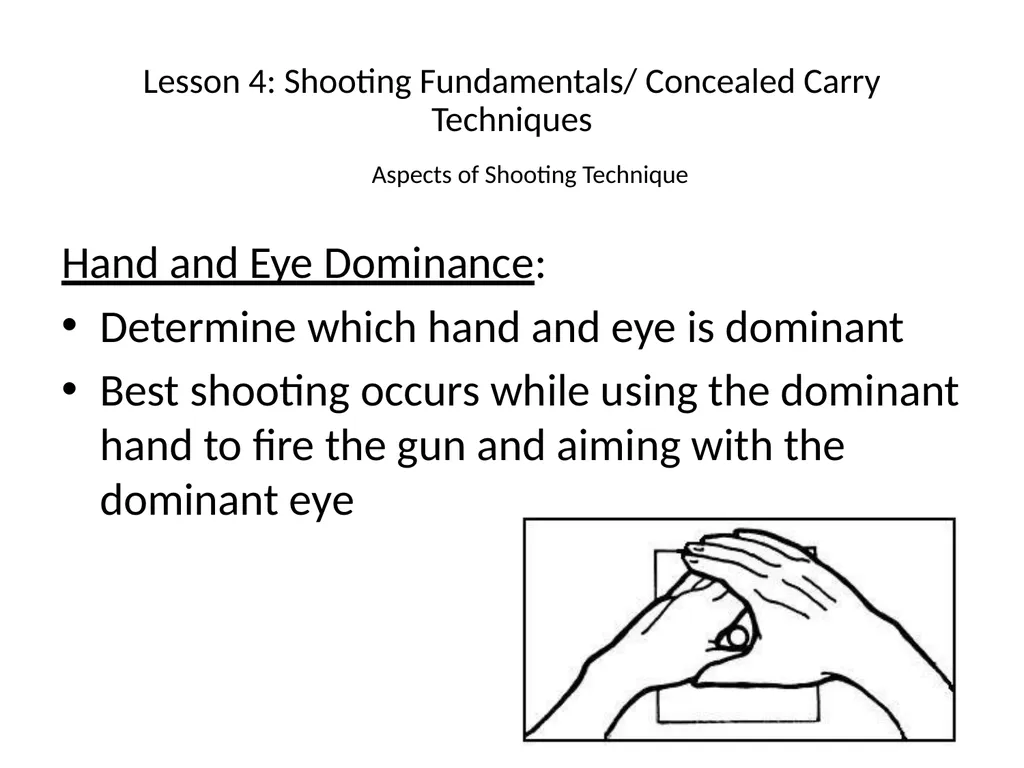
Lesson 4: Shooting Fundamentals/ Concealed Carry Techniques Hand and Eye Dominance:
Determine which hand and eye is dominant
Best shooting occurs while using the dominant hand to fire the gun and aiming with the dominant eye Aspects of Shooting Technique<br>
Determine which hand and eye is dominant
Best shooting occurs while using the dominant hand to fire the gun and aiming with the dominant eye Aspects of Shooting Technique<br>
63
Lesson 4: Shooting Fundamentals/ Concealed Carry Techniques Hand Grip – Operating the weapon repeatedly without changing grip
Aiming – Process of aligning a firearm with a target so a bullet will strike the target desired
Breath Control – Control breathing to minimize body and firearm movement
Hold Control – Holding the body and gun as still as possible when shooting
Trigger Control – The ability to apply increasing pressure on the trigger and allow the hammer to fall without disturbing sight alignment
Follow Through – Stabilizing recoil, maintaining grip and stance, regaining front sight focus, resetting the trigger and preparing for follow up shot if a threat persists
Stance – Creating a balanced base (feet spread apart) and using a two-handed grip (in most cases) to properly and accurately fire a gun Basic Shooting Fundamentals<br>
Aiming – Process of aligning a firearm with a target so a bullet will strike the target desired
Breath Control – Control breathing to minimize body and firearm movement
Hold Control – Holding the body and gun as still as possible when shooting
Trigger Control – The ability to apply increasing pressure on the trigger and allow the hammer to fall without disturbing sight alignment
Follow Through – Stabilizing recoil, maintaining grip and stance, regaining front sight focus, resetting the trigger and preparing for follow up shot if a threat persists
Stance – Creating a balanced base (feet spread apart) and using a two-handed grip (in most cases) to properly and accurately fire a gun Basic Shooting Fundamentals<br>
64
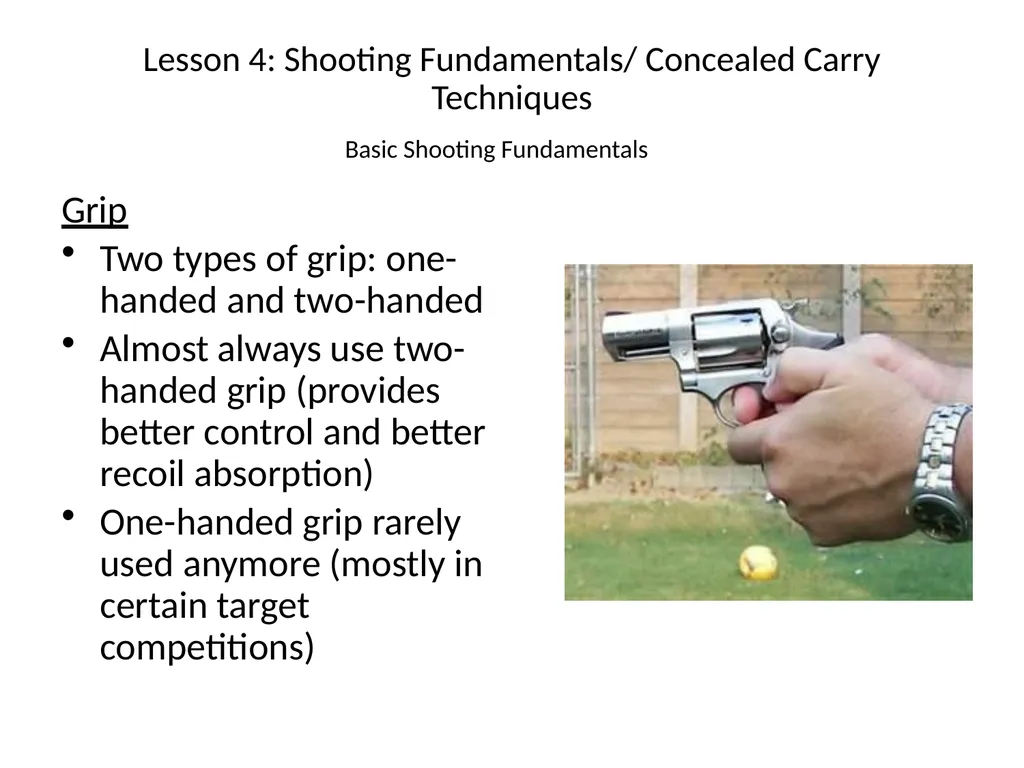
Lesson 4: Shooting Fundamentals/ Concealed Carry Techniques Grip
Two types of grip: one-handed and two-handed
Almost always use two-handed grip (provides better control and better recoil absorption)
One-handed grip rarely used anymore (mostly in certain target competitions) Basic Shooting Fundamentals<br>
Two types of grip: one-handed and two-handed
Almost always use two-handed grip (provides better control and better recoil absorption)
One-handed grip rarely used anymore (mostly in certain target competitions) Basic Shooting Fundamentals<br>
65
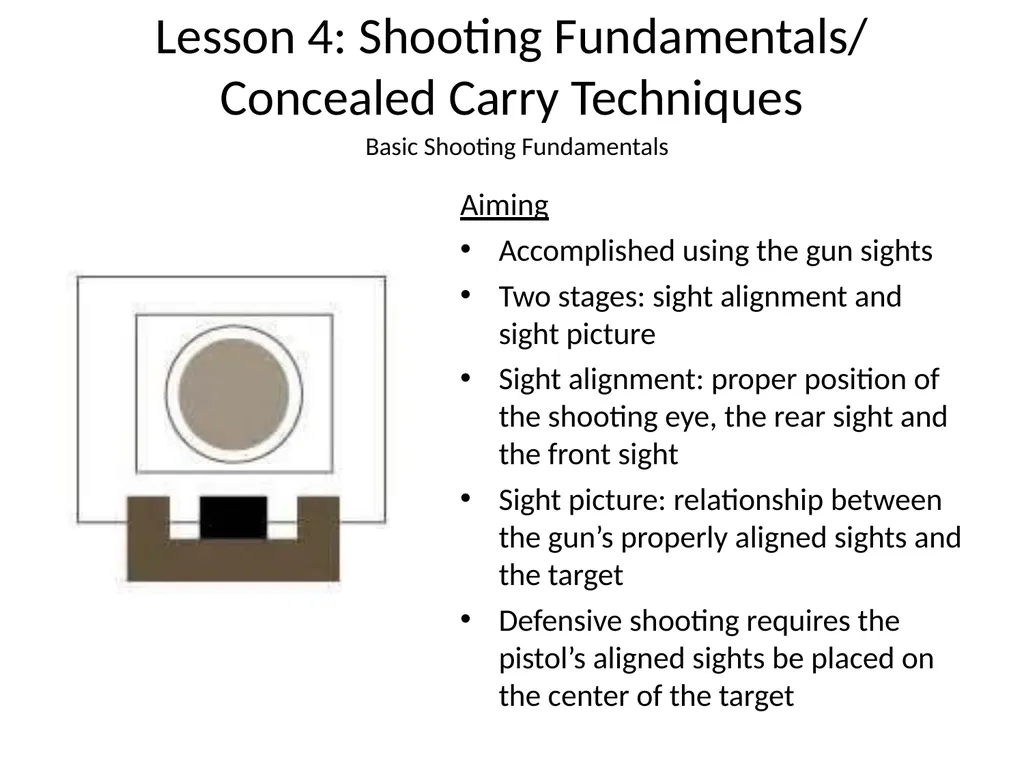
Lesson 4: Shooting Fundamentals/ Concealed Carry Techniques Aiming
Accomplished using the gun sights
Two stages: sight alignment and sight picture
Sight alignment: proper position of the shooting eye, the rear sight and the front sight
Sight picture: relationship between the gun’s properly aligned sights and the target
Defensive shooting requires the pistol’s aligned sights be placed on the center of the target Basic Shooting Fundamentals<br>
Accomplished using the gun sights
Two stages: sight alignment and sight picture
Sight alignment: proper position of the shooting eye, the rear sight and the front sight
Sight picture: relationship between the gun’s properly aligned sights and the target
Defensive shooting requires the pistol’s aligned sights be placed on the center of the target Basic Shooting Fundamentals<br>
66
Lesson 4: Shooting Fundamentals/ Concealed Carry Techniques Breath Control
Ribcage expands with each breath and your shoulders slightly rise
Take a few normal breaths, expelling half the air out of the lungs, the hold the breath for the few seconds required to fire the shot
Breath control in defensive situations requires you to stop breathing while the shot is being fired Basic Shooting Fundamentals<br>
Ribcage expands with each breath and your shoulders slightly rise
Take a few normal breaths, expelling half the air out of the lungs, the hold the breath for the few seconds required to fire the shot
Breath control in defensive situations requires you to stop breathing while the shot is being fired Basic Shooting Fundamentals<br>
67
Lesson 4: Shooting Fundamentals/ Concealed Carry Techniques Hold Control
Maximum gun control is accomplished when the firearm is held motionless
Achieved through proper grip, and a well-balanced stable shooting position with an aligned target
Common mistake with novice shooters is not allowing the arm and shoulder muscles to rest Basic Shooting Fundamentals<br>
Maximum gun control is accomplished when the firearm is held motionless
Achieved through proper grip, and a well-balanced stable shooting position with an aligned target
Common mistake with novice shooters is not allowing the arm and shoulder muscles to rest Basic Shooting Fundamentals<br>
68
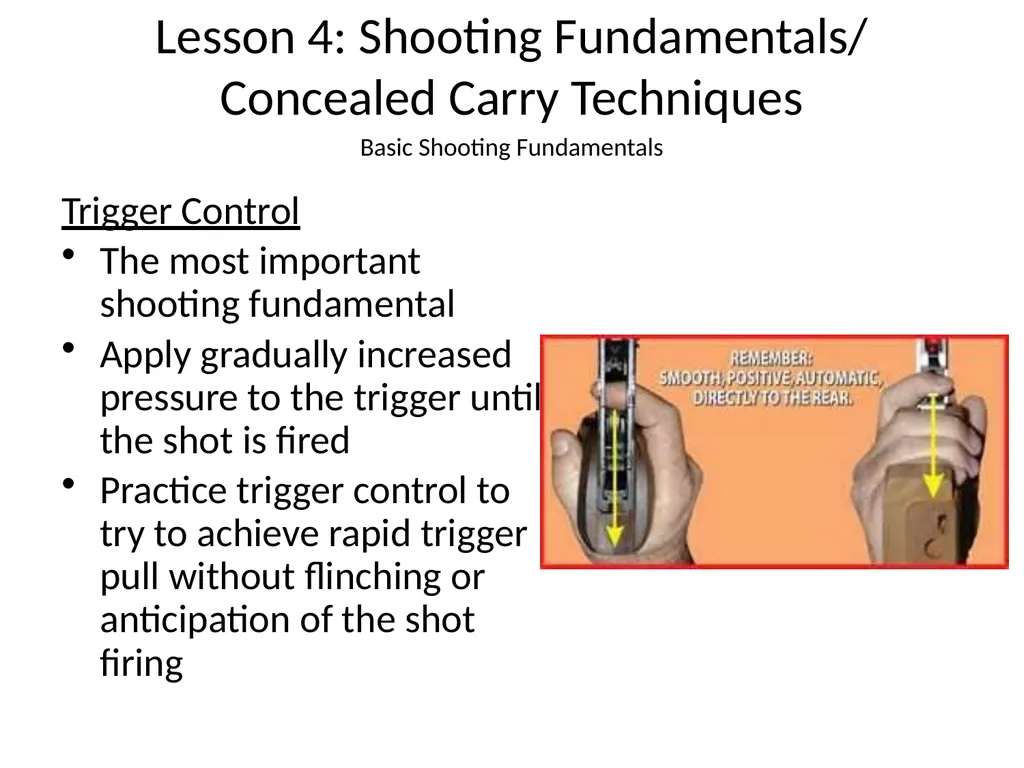
Lesson 4: Shooting Fundamentals/ Concealed Carry Techniques Trigger Control
The most important shooting fundamental
Apply gradually increased pressure to the trigger until the shot is fired
Practice trigger control to try to achieve rapid trigger pull without flinching or anticipation of the shot firing Basic Shooting Fundamentals<br>
The most important shooting fundamental
Apply gradually increased pressure to the trigger until the shot is fired
Practice trigger control to try to achieve rapid trigger pull without flinching or anticipation of the shot firing Basic Shooting Fundamentals<br>
69
Lesson 4: Shooting Fundamentals/ Concealed Carry Techniques Follow-Through
Integrating all fundamentals together before, during and immediately after the shot is fired
Proper follow-through minimizes gun movement as the shot is fired
Allows for proper set up of next shots
Only lasts a split second
Trigger finger pressure is relaxed, but remains in contact with the trigger Basic Shooting Fundamentals<br>
Integrating all fundamentals together before, during and immediately after the shot is fired
Proper follow-through minimizes gun movement as the shot is fired
Allows for proper set up of next shots
Only lasts a split second
Trigger finger pressure is relaxed, but remains in contact with the trigger Basic Shooting Fundamentals<br>
70
Lesson 4: Shooting Fundamentals/ Concealed Carry Techniques Stance
Provides a balanced base to ensure accurate shooting and helps absorb recoil
Three main standing shooting positions: 1. Isosceles
2. Weaver
3. Modified Isosceles Basic Shooting Fundamentals<br>
Provides a balanced base to ensure accurate shooting and helps absorb recoil
Three main standing shooting positions: 1. Isosceles
2. Weaver
3. Modified Isosceles Basic Shooting Fundamentals<br>
71
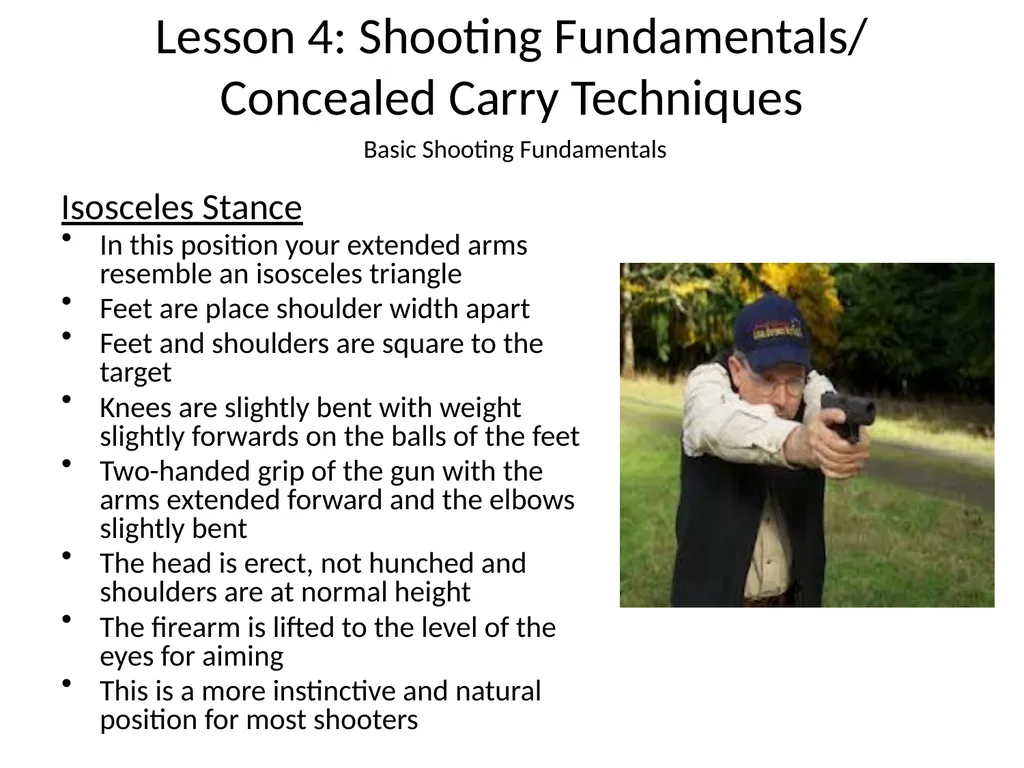
Lesson 4: Shooting Fundamentals/ Concealed Carry Techniques Isosceles Stance
In this position your extended arms resemble an isosceles triangle
Feet are place shoulder width apart
Feet and shoulders are square to the target
Knees are slightly bent with weight slightly forwards on the balls of the feet
Two-handed grip of the gun with the arms extended forward and the elbows slightly bent
The head is erect, not hunched and shoulders are at normal height
The firearm is lifted to the level of the eyes for aiming
This is a more instinctive and natural position for most shooters Basic Shooting Fundamentals<br>
In this position your extended arms resemble an isosceles triangle
Feet are place shoulder width apart
Feet and shoulders are square to the target
Knees are slightly bent with weight slightly forwards on the balls of the feet
Two-handed grip of the gun with the arms extended forward and the elbows slightly bent
The head is erect, not hunched and shoulders are at normal height
The firearm is lifted to the level of the eyes for aiming
This is a more instinctive and natural position for most shooters Basic Shooting Fundamentals<br>
72
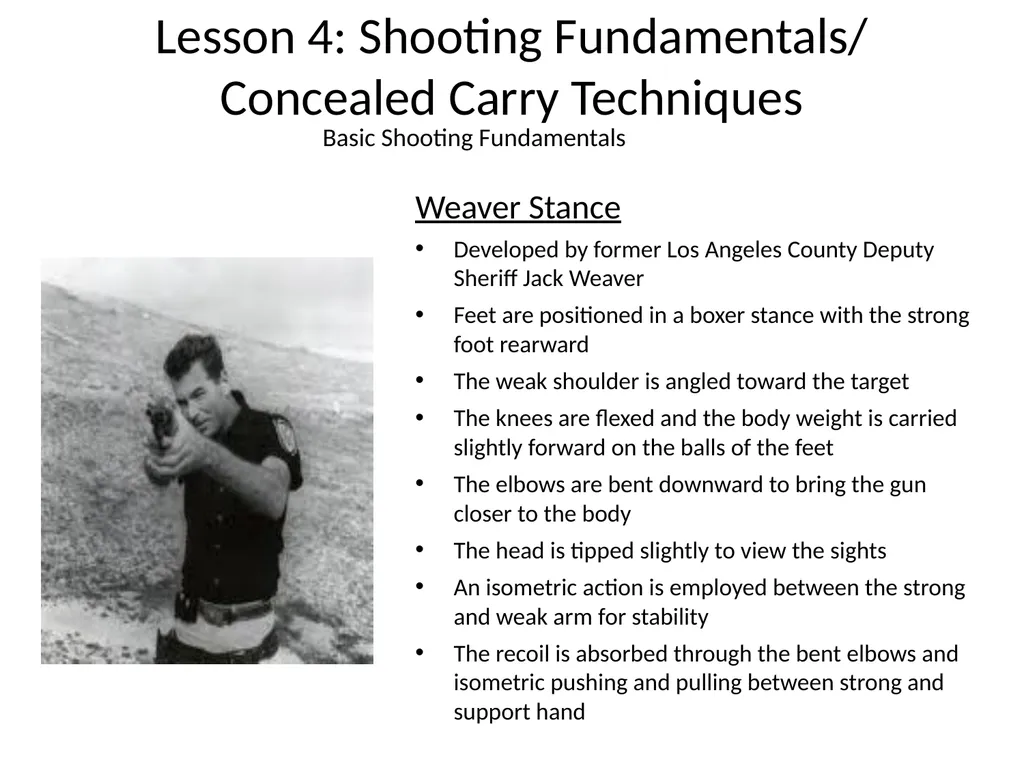
Lesson 4: Shooting Fundamentals/ Concealed Carry Techniques Weaver Stance
Developed by former Los Angeles County Deputy Sheriff Jack Weaver
Feet are positioned in a boxer stance with the strong foot rearward
The weak shoulder is angled toward the target
The knees are flexed and the body weight is carried slightly forward on the balls of the feet
The elbows are bent downward to bring the gun closer to the body
The head is tipped slightly to view the sights
An isometric action is employed between the strong and weak arm for stability
The recoil is absorbed through the bent elbows and isometric pushing and pulling between strong and support hand Basic Shooting Fundamentals<br>
Developed by former Los Angeles County Deputy Sheriff Jack Weaver
Feet are positioned in a boxer stance with the strong foot rearward
The weak shoulder is angled toward the target
The knees are flexed and the body weight is carried slightly forward on the balls of the feet
The elbows are bent downward to bring the gun closer to the body
The head is tipped slightly to view the sights
An isometric action is employed between the strong and weak arm for stability
The recoil is absorbed through the bent elbows and isometric pushing and pulling between strong and support hand Basic Shooting Fundamentals<br>
73
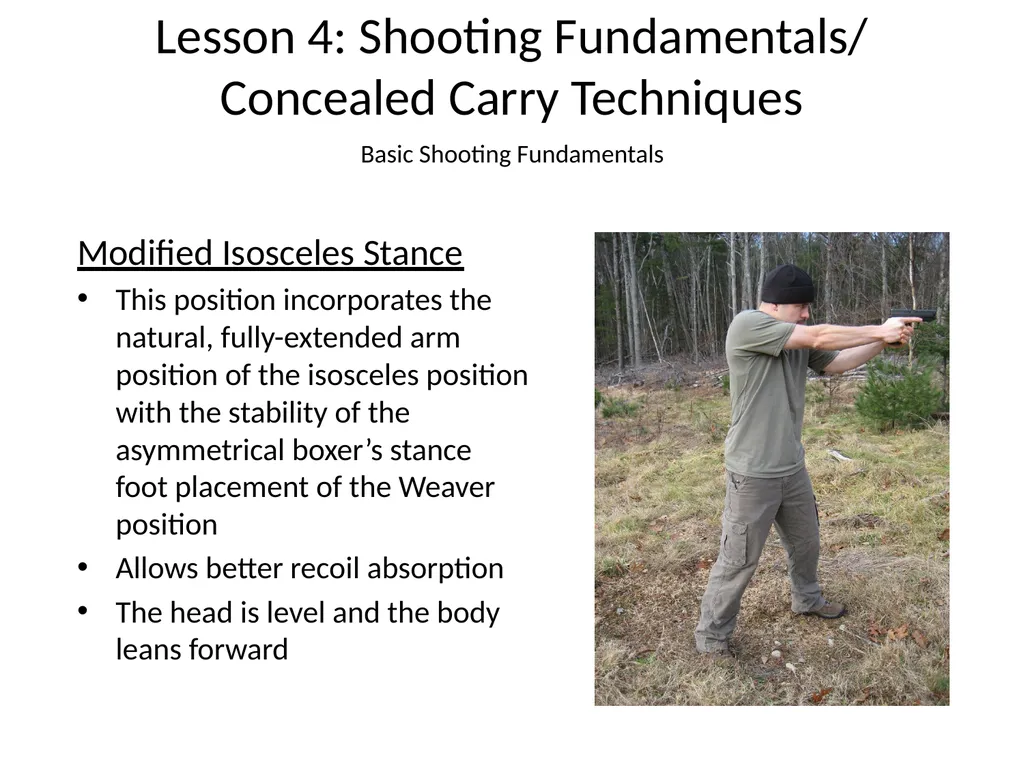
Lesson 4: Shooting Fundamentals/ Concealed Carry Techniques Modified Isosceles Stance
This position incorporates the natural, fully-extended arm position of the isosceles position with the stability of the asymmetrical boxer’s stance foot placement of the Weaver position
Allows better recoil absorption
The head is level and the body leans forward Basic Shooting Fundamentals<br>
This position incorporates the natural, fully-extended arm position of the isosceles position with the stability of the asymmetrical boxer’s stance foot placement of the Weaver position
Allows better recoil absorption
The head is level and the body leans forward Basic Shooting Fundamentals<br>
74
Lesson 4: Shooting Fundamentals/ Concealed Carry Techniques Purpose of a holster: A holster is used to provide a convenient carrying device for your weapon, leaving your hands free yet also keeping your firearm easily accessible
Different Types of Holsters:
Ankle holster
Shoulder holster
Belt holster
Pocket holster Choosing a Holster<br>
Different Types of Holsters:
Ankle holster
Shoulder holster
Belt holster
Pocket holster Choosing a Holster<br>
75
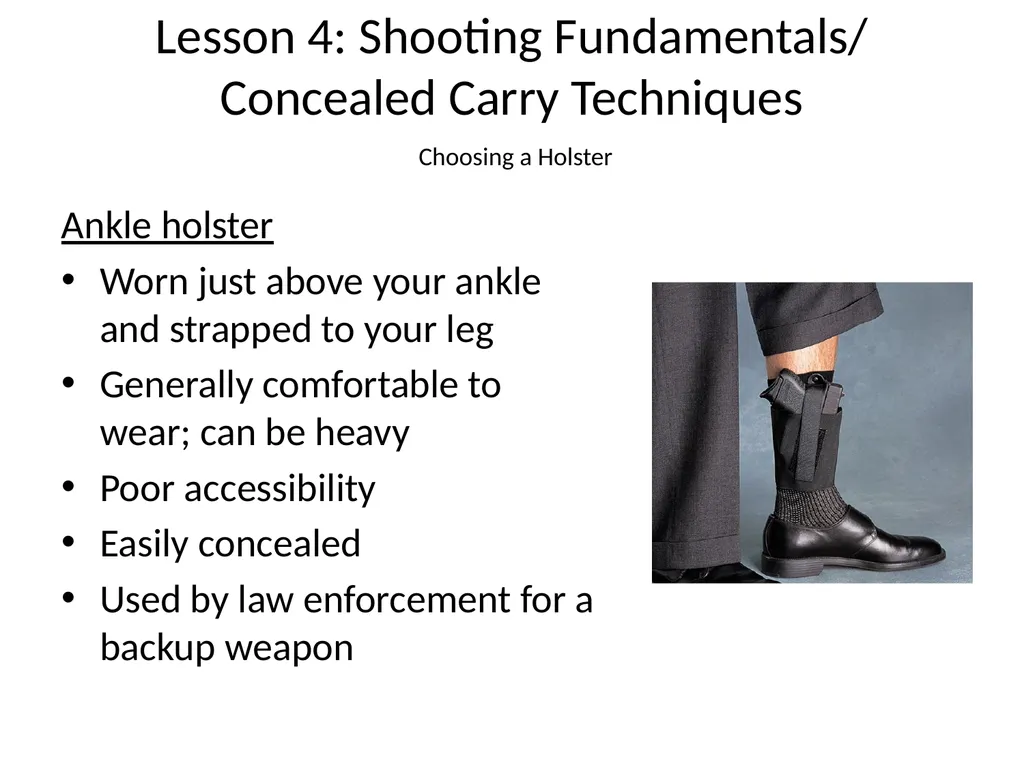
Lesson 4: Shooting Fundamentals/ Concealed Carry Techniques Ankle holster
Worn just above your ankle and strapped to your leg
Generally comfortable to wear; can be heavy
Poor accessibility
Easily concealed
Used by law enforcement for a backup weapon Choosing a Holster<br>
Worn just above your ankle and strapped to your leg
Generally comfortable to wear; can be heavy
Poor accessibility
Easily concealed
Used by law enforcement for a backup weapon Choosing a Holster<br>
76
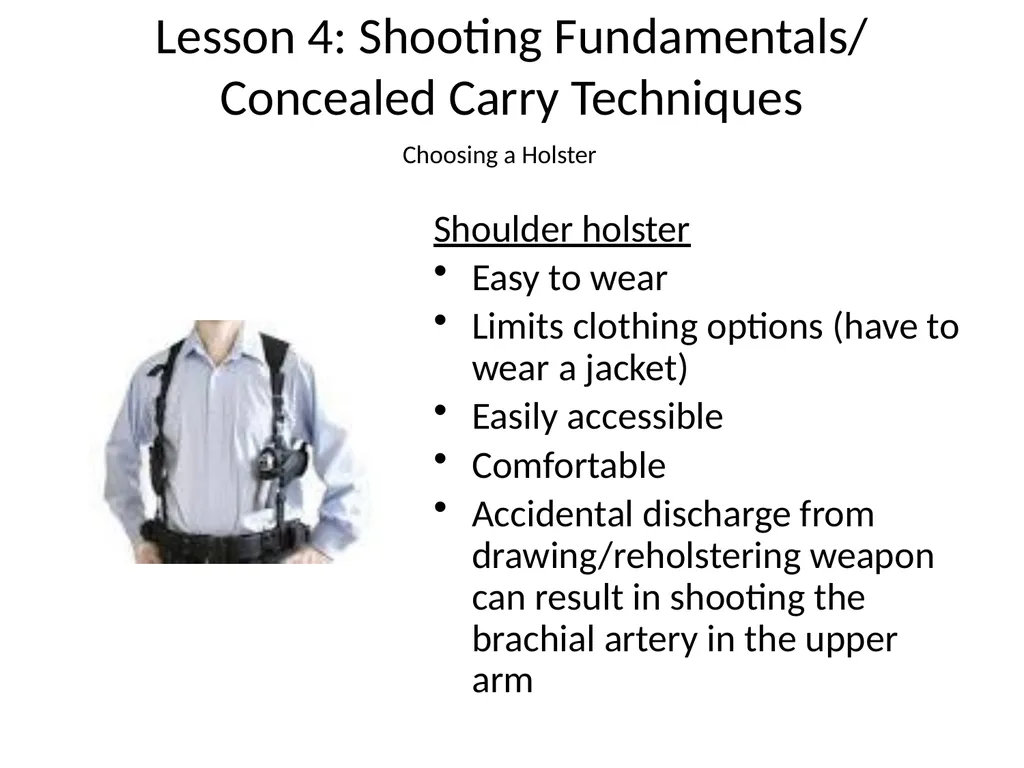
Lesson 4: Shooting Fundamentals/ Concealed Carry Techniques Shoulder holster
Easy to wear
Limits clothing options (have to wear a jacket)
Easily accessible
Comfortable
Accidental discharge from drawing/reholstering weapon can result in shooting the brachial artery in the upper arm Choosing a Holster<br>
Easy to wear
Limits clothing options (have to wear a jacket)
Easily accessible
Comfortable
Accidental discharge from drawing/reholstering weapon can result in shooting the brachial artery in the upper arm Choosing a Holster<br>
77
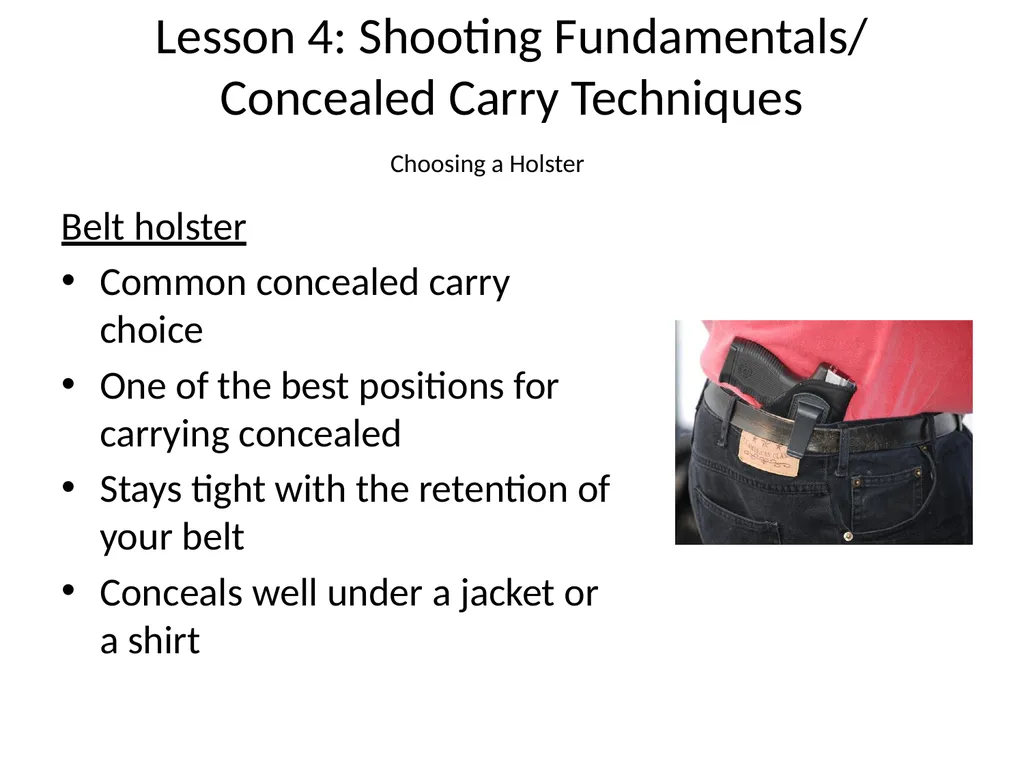
Lesson 4: Shooting Fundamentals/ Concealed Carry Techniques Belt holster
Common concealed carry choice
One of the best positions for carrying concealed
Stays tight with the retention of your belt
Conceals well under a jacket or a shirt Choosing a Holster<br>
Common concealed carry choice
One of the best positions for carrying concealed
Stays tight with the retention of your belt
Conceals well under a jacket or a shirt Choosing a Holster<br>
78
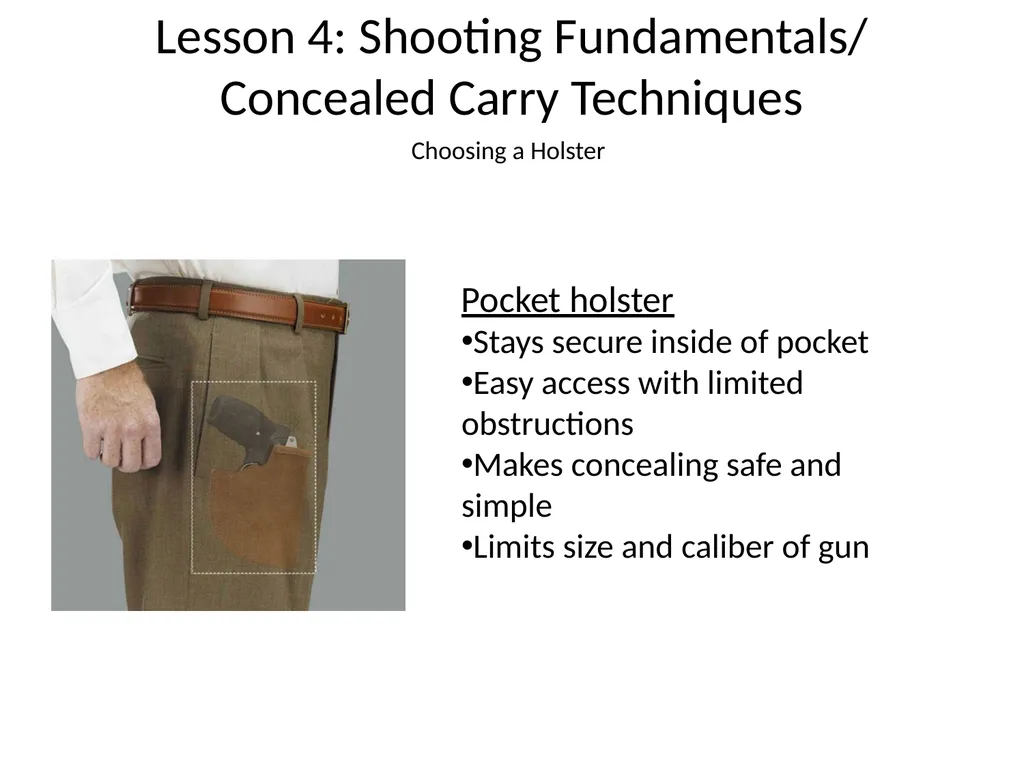
Lesson 4: Shooting Fundamentals/ Concealed Carry Techniques Choosing a Holster Pocket holster
Stays secure inside of pocket
Easy access with limited obstructions
Makes concealing safe and simple
Limits size and caliber of gun<br>
Stays secure inside of pocket
Easy access with limited obstructions
Makes concealing safe and simple
Limits size and caliber of gun<br>
79
Lesson 4: Shooting Fundamentals/ Concealed Carry Techniques The firearm should be in a holster or gun case
A handgun transported in a vehicle should be kept in a secure location at all times
The permit holder is responsible for their firearm at all times Safe Concealment Considerations<br>
A handgun transported in a vehicle should be kept in a secure location at all times
The permit holder is responsible for their firearm at all times Safe Concealment Considerations<br>
80
Lesson 4: Shooting Fundamentals/ Concealed Carry Techniques 1. Fully comply with the range officer’s instructions
2. Follow the four safety rules at all times:
Treat all firearms as if they are loaded
Always keep your finger off the trigger until your sights are on target and you have made the decision to fire
Never point a firearm at anything you are not willing to destroy
Before the decision to fire, be sure of your target, your target’s environment and any other safety hazards
3. Wear eye and ear protection at all times during practice shooting Rules to Follow on the Shooting Range<br>
2. Follow the four safety rules at all times:
Treat all firearms as if they are loaded
Always keep your finger off the trigger until your sights are on target and you have made the decision to fire
Never point a firearm at anything you are not willing to destroy
Before the decision to fire, be sure of your target, your target’s environment and any other safety hazards
3. Wear eye and ear protection at all times during practice shooting Rules to Follow on the Shooting Range<br>
81
Lesson 4: Shooting Fundamentals/ Concealed Carry Techniques 4. Always practice safe handling and presentation of a firearm to another person
5. There are three range/combat positions for a firearm:
In the holster or carrying case
At the ready position
On target
Follow these steps if you experience a malfunction:
Failure to Fire (faulty ammo, magazine not fully seated, etc.)
Failure to Eject (stove pipe, partial ejection)
Feedway Stoppage (double feed, extractor gummed or broken guide rods, extractor does not get a good grip on the spent cartridge, chamber remains blocked)
Failure to go into Battery (bad chamber design, weak guide spring, extremely dirty guide rails or guide rod) Rules to Follow on the Shooting Range Continued<br>
5. There are three range/combat positions for a firearm:
In the holster or carrying case
At the ready position
On target
Follow these steps if you experience a malfunction:
Failure to Fire (faulty ammo, magazine not fully seated, etc.)
Failure to Eject (stove pipe, partial ejection)
Feedway Stoppage (double feed, extractor gummed or broken guide rods, extractor does not get a good grip on the spent cartridge, chamber remains blocked)
Failure to go into Battery (bad chamber design, weak guide spring, extremely dirty guide rails or guide rod) Rules to Follow on the Shooting Range Continued<br>
82
Lesson 4: Shooting Fundamentals/ Concealed Carry Techniques Summary After learning shooting fundamentals and concealed carry techniques, the student is able to:
Describe the two common types of shooting stances
Describe the steps to take to ensure proper sight alignment
Identify the most important shooting fundamentals
Identify the method used to minimize gun movement due to body movement
Describe proper follow through method to ensure accurate shooting
List the four main types of concealed carry techniques<br>
Describe the two common types of shooting stances
Describe the steps to take to ensure proper sight alignment
Identify the most important shooting fundamentals
Identify the method used to minimize gun movement due to body movement
Describe proper follow through method to ensure accurate shooting
List the four main types of concealed carry techniques<br>
83
Lesson 5 State and Federal Laws Pertaining to Purchase, Ownership, Transportation and Possession of Handguns<br>
84
Lesson 5: Laws Pertaining to Purchase, Ownership, Transportation and Possession of Handguns At the end of this lesson, students will be able to:
Identify the Nebraska State Laws as they pertain to purchase, ownership, transportation and possession of handguns
List the type of vehicle that cannot possess a firearm without being unloaded and properly contained
Describe the procedure for contact with law enforcement and emergency personnel in relation to CHP
List the two required documents when carrying a concealed handgun
Identify locations where CHP are not allowed Objectives<br>
Identify the Nebraska State Laws as they pertain to purchase, ownership, transportation and possession of handguns
List the type of vehicle that cannot possess a firearm without being unloaded and properly contained
Describe the procedure for contact with law enforcement and emergency personnel in relation to CHP
List the two required documents when carrying a concealed handgun
Identify locations where CHP are not allowed Objectives<br>
85
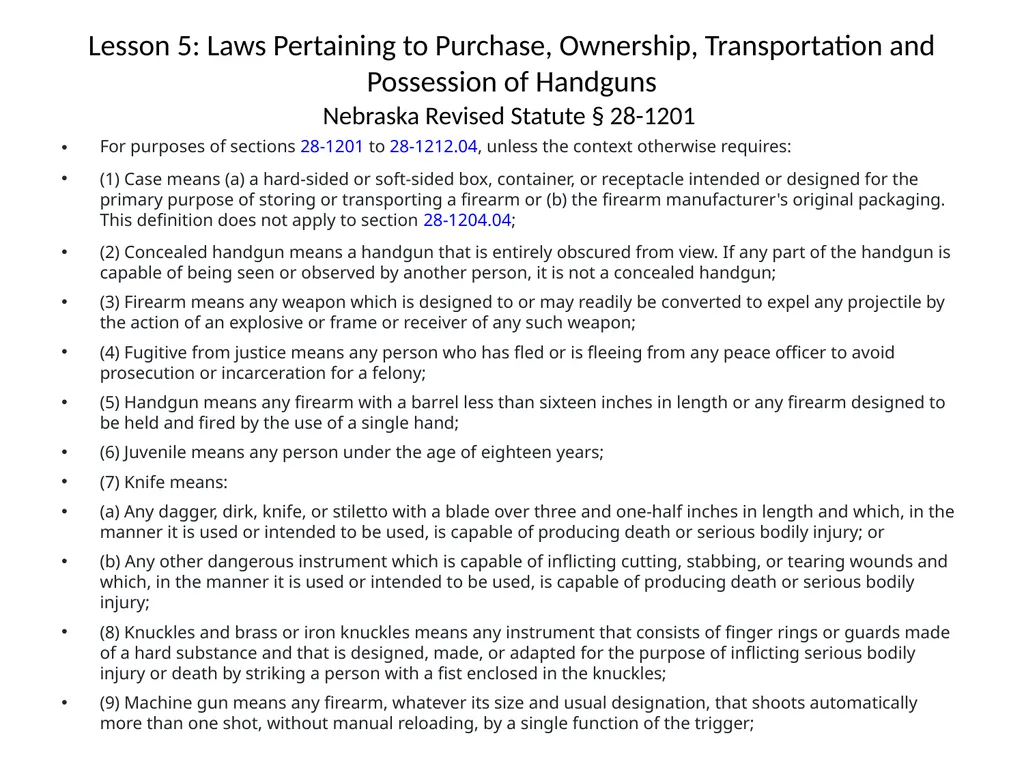
Lesson 5: Laws Pertaining to Purchase, Ownership, Transportation and Possession of Handguns For purposes of sections 28-1201 to 28-1212.04, unless the context otherwise requires:
(1) Case means (a) a hard-sided or soft-sided box, container, or receptacle intended or designed for the primary purpose of storing or transporting a firearm or (b) the firearm manufacturer's original packaging. This definition does not apply to section 28-1204.04;
(2) Concealed handgun means a handgun that is entirely obscured from view. If any part of the handgun is capable of being seen or observed by another person, it is not a concealed handgun;
(3) Firearm means any weapon which is designed to or may readily be converted to expel any projectile by the action of an explosive or frame or receiver of any such weapon;
(4) Fugitive from justice means any person who has fled or is fleeing from any peace officer to avoid prosecution or incarceration for a felony;
(5) Handgun means any firearm with a barrel less than sixteen inches in length or any firearm designed to be held and fired by the use of a single hand;
(6) Juvenile means any person under the age of eighteen years;
(7) Knife means:
(a) Any dagger, dirk, knife, or stiletto with a blade over three and one-half inches in length and which, in the manner it is used or intended to be used, is capable of producing death or serious bodily injury; or
(b) Any other dangerous instrument which is capable of inflicting cutting, stabbing, or tearing wounds and which, in the manner it is used or intended to be used, is capable of producing death or serious bodily injury;
(8) Knuckles and brass or iron knuckles means any instrument that consists of finger rings or guards made of a hard substance and that is designed, made, or adapted for the purpose of inflicting serious bodily injury or death by striking a person with a fist enclosed in the knuckles;
(9) Machine gun means any firearm, whatever its size and usual designation, that shoots automatically more than one shot, without manual reloading, by a single function of the trigger; Nebraska Revised Statute § 28-1201<br>
(1) Case means (a) a hard-sided or soft-sided box, container, or receptacle intended or designed for the primary purpose of storing or transporting a firearm or (b) the firearm manufacturer's original packaging. This definition does not apply to section 28-1204.04;
(2) Concealed handgun means a handgun that is entirely obscured from view. If any part of the handgun is capable of being seen or observed by another person, it is not a concealed handgun;
(3) Firearm means any weapon which is designed to or may readily be converted to expel any projectile by the action of an explosive or frame or receiver of any such weapon;
(4) Fugitive from justice means any person who has fled or is fleeing from any peace officer to avoid prosecution or incarceration for a felony;
(5) Handgun means any firearm with a barrel less than sixteen inches in length or any firearm designed to be held and fired by the use of a single hand;
(6) Juvenile means any person under the age of eighteen years;
(7) Knife means:
(a) Any dagger, dirk, knife, or stiletto with a blade over three and one-half inches in length and which, in the manner it is used or intended to be used, is capable of producing death or serious bodily injury; or
(b) Any other dangerous instrument which is capable of inflicting cutting, stabbing, or tearing wounds and which, in the manner it is used or intended to be used, is capable of producing death or serious bodily injury;
(8) Knuckles and brass or iron knuckles means any instrument that consists of finger rings or guards made of a hard substance and that is designed, made, or adapted for the purpose of inflicting serious bodily injury or death by striking a person with a fist enclosed in the knuckles;
(9) Machine gun means any firearm, whatever its size and usual designation, that shoots automatically more than one shot, without manual reloading, by a single function of the trigger; Nebraska Revised Statute § 28-1201<br>
86
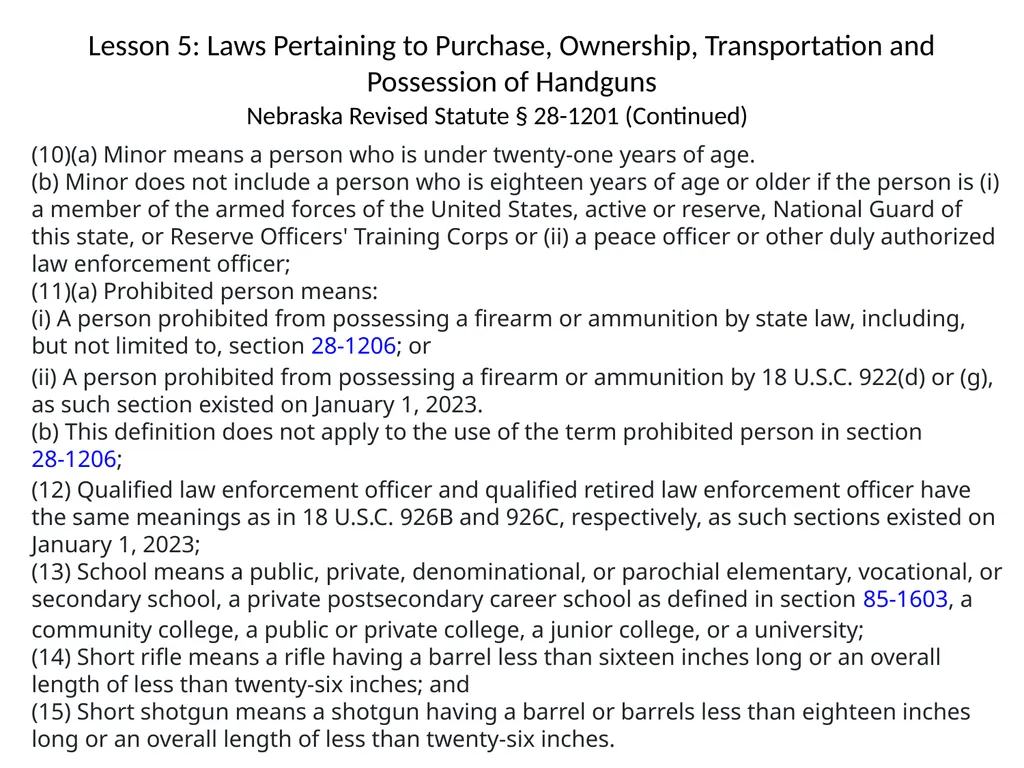
Lesson 5: Laws Pertaining to Purchase, Ownership, Transportation and Possession of Handguns Nebraska Revised Statute § 28-1201 (Continued) (10)(a) Minor means a person who is under twenty-one years of age.
(b) Minor does not include a person who is eighteen years of age or older if the person is (i) a member of the armed forces of the United States, active or reserve, National Guard of this state, or Reserve Officers' Training Corps or (ii) a peace officer or other duly authorized law enforcement officer;
(11)(a) Prohibited person means:
(i) A person prohibited from possessing a firearm or ammunition by state law, including, but not limited to, section 28-1206; or
(ii) A person prohibited from possessing a firearm or ammunition by 18 U.S.C. 922(d) or (g), as such section existed on January 1, 2023.
(b) This definition does not apply to the use of the term prohibited person in section 28-1206;
(12) Qualified law enforcement officer and qualified retired law enforcement officer have the same meanings as in 18 U.S.C. 926B and 926C, respectively, as such sections existed on January 1, 2023;
(13) School means a public, private, denominational, or parochial elementary, vocational, or secondary school, a private postsecondary career school as defined in section 85-1603, a community college, a public or private college, a junior college, or a university;
(14) Short rifle means a rifle having a barrel less than sixteen inches long or an overall length of less than twenty-six inches; and
(15) Short shotgun means a shotgun having a barrel or barrels less than eighteen inches long or an overall length of less than twenty-six inches.<br>
(b) Minor does not include a person who is eighteen years of age or older if the person is (i) a member of the armed forces of the United States, active or reserve, National Guard of this state, or Reserve Officers' Training Corps or (ii) a peace officer or other duly authorized law enforcement officer;
(11)(a) Prohibited person means:
(i) A person prohibited from possessing a firearm or ammunition by state law, including, but not limited to, section 28-1206; or
(ii) A person prohibited from possessing a firearm or ammunition by 18 U.S.C. 922(d) or (g), as such section existed on January 1, 2023.
(b) This definition does not apply to the use of the term prohibited person in section 28-1206;
(12) Qualified law enforcement officer and qualified retired law enforcement officer have the same meanings as in 18 U.S.C. 926B and 926C, respectively, as such sections existed on January 1, 2023;
(13) School means a public, private, denominational, or parochial elementary, vocational, or secondary school, a private postsecondary career school as defined in section 85-1603, a community college, a public or private college, a junior college, or a university;
(14) Short rifle means a rifle having a barrel less than sixteen inches long or an overall length of less than twenty-six inches; and
(15) Short shotgun means a shotgun having a barrel or barrels less than eighteen inches long or an overall length of less than twenty-six inches.<br>
87
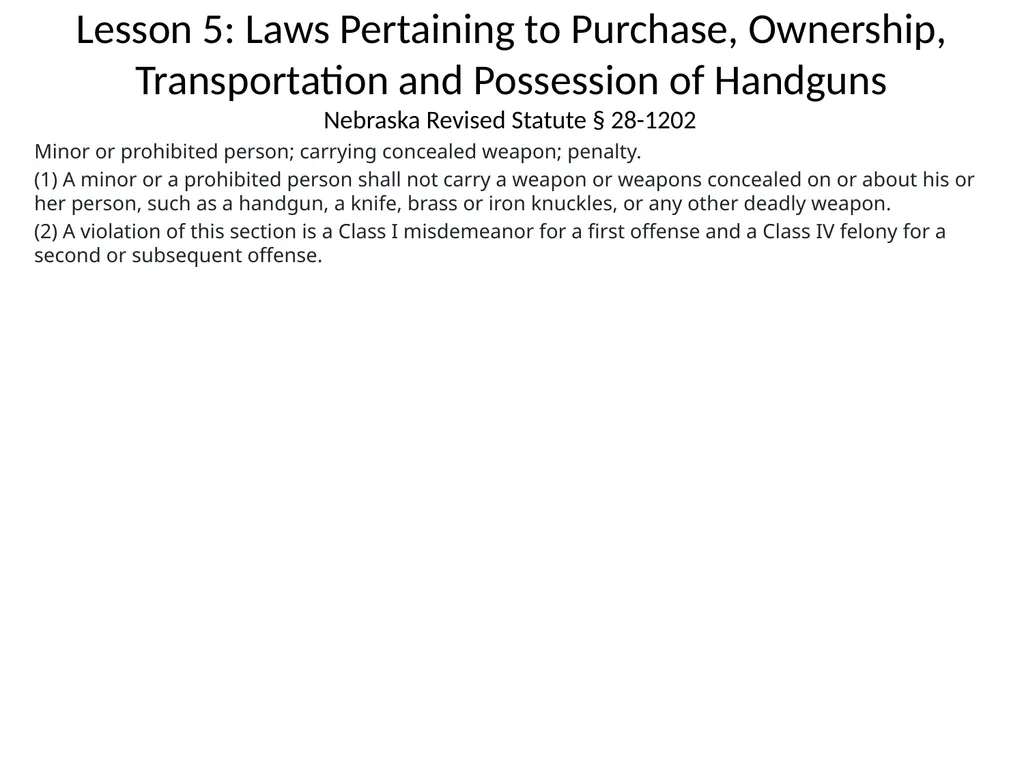
Lesson 5: Laws Pertaining to Purchase, Ownership, Transportation and Possession of Handguns Minor or prohibited person; carrying concealed weapon; penalty.
(1) A minor or a prohibited person shall not carry a weapon or weapons concealed on or about his or her person, such as a handgun, a knife, brass or iron knuckles, or any other deadly weapon.
(2) A violation of this section is a Class I misdemeanor for a first offense and a Class IV felony for a second or subsequent offense. Nebraska Revised Statute § 28-1202<br>
(1) A minor or a prohibited person shall not carry a weapon or weapons concealed on or about his or her person, such as a handgun, a knife, brass or iron knuckles, or any other deadly weapon.
(2) A violation of this section is a Class I misdemeanor for a first offense and a Class IV felony for a second or subsequent offense. Nebraska Revised Statute § 28-1202<br>
88
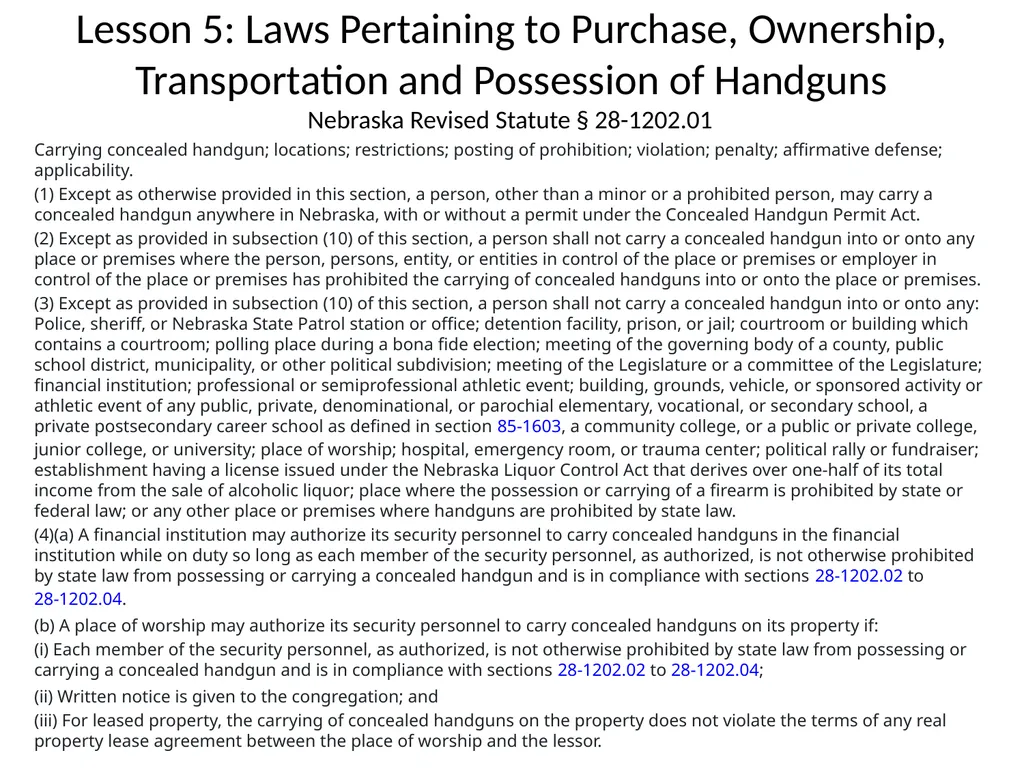
Lesson 5: Laws Pertaining to Purchase, Ownership, Transportation and Possession of Handguns Carrying concealed handgun; locations; restrictions; posting of prohibition; violation; penalty; affirmative defense; applicability.
(1) Except as otherwise provided in this section, a person, other than a minor or a prohibited person, may carry a concealed handgun anywhere in Nebraska, with or without a permit under the Concealed Handgun Permit Act.
(2) Except as provided in subsection (10) of this section, a person shall not carry a concealed handgun into or onto any place or premises where the person, persons, entity, or entities in control of the place or premises or employer in control of the place or premises has prohibited the carrying of concealed handguns into or onto the place or premises.
(3) Except as provided in subsection (10) of this section, a person shall not carry a concealed handgun into or onto any: Police, sheriff, or Nebraska State Patrol station or office; detention facility, prison, or jail; courtroom or building which contains a courtroom; polling place during a bona fide election; meeting of the governing body of a county, public school district, municipality, or other political subdivision; meeting of the Legislature or a committee of the Legislature; financial institution; professional or semiprofessional athletic event; building, grounds, vehicle, or sponsored activity or athletic event of any public, private, denominational, or parochial elementary, vocational, or secondary school, a private postsecondary career school as defined in section 85-1603, a community college, or a public or private college, junior college, or university; place of worship; hospital, emergency room, or trauma center; political rally or fundraiser; establishment having a license issued under the Nebraska Liquor Control Act that derives over one-half of its total income from the sale of alcoholic liquor; place where the possession or carrying of a firearm is prohibited by state or federal law; or any other place or premises where handguns are prohibited by state law.
(4)(a) A financial institution may authorize its security personnel to carry concealed handguns in the financial institution while on duty so long as each member of the security personnel, as authorized, is not otherwise prohibited by state law from possessing or carrying a concealed handgun and is in compliance with sections 28-1202.02 to 28-1202.04.
(b) A place of worship may authorize its security personnel to carry concealed handguns on its property if:
(i) Each member of the security personnel, as authorized, is not otherwise prohibited by state law from possessing or carrying a concealed handgun and is in compliance with sections 28-1202.02 to 28-1202.04;
(ii) Written notice is given to the congregation; and
(iii) For leased property, the carrying of concealed handguns on the property does not violate the terms of any real property lease agreement between the place of worship and the lessor. Nebraska Revised Statute § 28-1202.01<br>
(1) Except as otherwise provided in this section, a person, other than a minor or a prohibited person, may carry a concealed handgun anywhere in Nebraska, with or without a permit under the Concealed Handgun Permit Act.
(2) Except as provided in subsection (10) of this section, a person shall not carry a concealed handgun into or onto any place or premises where the person, persons, entity, or entities in control of the place or premises or employer in control of the place or premises has prohibited the carrying of concealed handguns into or onto the place or premises.
(3) Except as provided in subsection (10) of this section, a person shall not carry a concealed handgun into or onto any: Police, sheriff, or Nebraska State Patrol station or office; detention facility, prison, or jail; courtroom or building which contains a courtroom; polling place during a bona fide election; meeting of the governing body of a county, public school district, municipality, or other political subdivision; meeting of the Legislature or a committee of the Legislature; financial institution; professional or semiprofessional athletic event; building, grounds, vehicle, or sponsored activity or athletic event of any public, private, denominational, or parochial elementary, vocational, or secondary school, a private postsecondary career school as defined in section 85-1603, a community college, or a public or private college, junior college, or university; place of worship; hospital, emergency room, or trauma center; political rally or fundraiser; establishment having a license issued under the Nebraska Liquor Control Act that derives over one-half of its total income from the sale of alcoholic liquor; place where the possession or carrying of a firearm is prohibited by state or federal law; or any other place or premises where handguns are prohibited by state law.
(4)(a) A financial institution may authorize its security personnel to carry concealed handguns in the financial institution while on duty so long as each member of the security personnel, as authorized, is not otherwise prohibited by state law from possessing or carrying a concealed handgun and is in compliance with sections 28-1202.02 to 28-1202.04.
(b) A place of worship may authorize its security personnel to carry concealed handguns on its property if:
(i) Each member of the security personnel, as authorized, is not otherwise prohibited by state law from possessing or carrying a concealed handgun and is in compliance with sections 28-1202.02 to 28-1202.04;
(ii) Written notice is given to the congregation; and
(iii) For leased property, the carrying of concealed handguns on the property does not violate the terms of any real property lease agreement between the place of worship and the lessor. Nebraska Revised Statute § 28-1202.01<br>
89
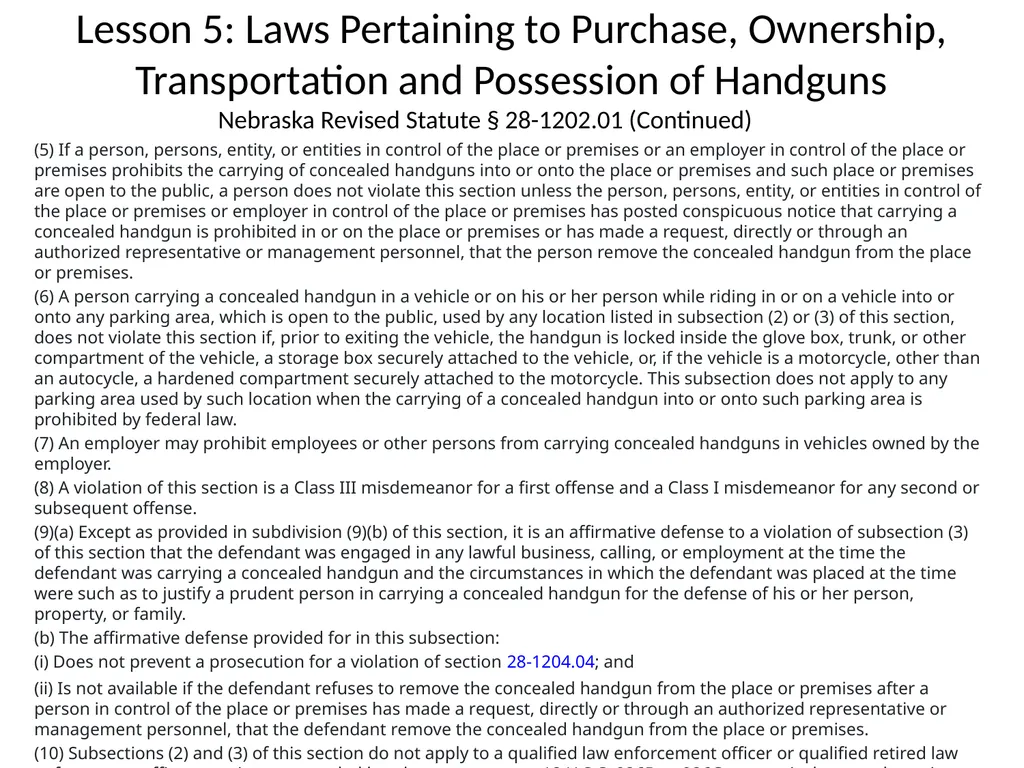
Lesson 5: Laws Pertaining to Purchase, Ownership, Transportation and Possession of Handguns (5) If a person, persons, entity, or entities in control of the place or premises or an employer in control of the place or premises prohibits the carrying of concealed handguns into or onto the place or premises and such place or premises are open to the public, a person does not violate this section unless the person, persons, entity, or entities in control of the place or premises or employer in control of the place or premises has posted conspicuous notice that carrying a concealed handgun is prohibited in or on the place or premises or has made a request, directly or through an authorized representative or management personnel, that the person remove the concealed handgun from the place or premises.
(6) A person carrying a concealed handgun in a vehicle or on his or her person while riding in or on a vehicle into or onto any parking area, which is open to the public, used by any location listed in subsection (2) or (3) of this section, does not violate this section if, prior to exiting the vehicle, the handgun is locked inside the glove box, trunk, or other compartment of the vehicle, a storage box securely attached to the vehicle, or, if the vehicle is a motorcycle, other than an autocycle, a hardened compartment securely attached to the motorcycle. This subsection does not apply to any parking area used by such location when the carrying of a concealed handgun into or onto such parking area is prohibited by federal law.
(7) An employer may prohibit employees or other persons from carrying concealed handguns in vehicles owned by the employer.
(8) A violation of this section is a Class III misdemeanor for a first offense and a Class I misdemeanor for any second or subsequent offense.
(9)(a) Except as provided in subdivision (9)(b) of this section, it is an affirmative defense to a violation of subsection (3) of this section that the defendant was engaged in any lawful business, calling, or employment at the time the defendant was carrying a concealed handgun and the circumstances in which the defendant was placed at the time were such as to justify a prudent person in carrying a concealed handgun for the defense of his or her person, property, or family.
(b) The affirmative defense provided for in this subsection:
(i) Does not prevent a prosecution for a violation of section 28-1204.04; and
(ii) Is not available if the defendant refuses to remove the concealed handgun from the place or premises after a person in control of the place or premises has made a request, directly or through an authorized representative or management personnel, that the defendant remove the concealed handgun from the place or premises.
(10) Subsections (2) and (3) of this section do not apply to a qualified law enforcement officer or qualified retired law enforcement officer carrying a concealed handgun pursuant to 18 U.S.C. 926B or 926C, respectively, as such sections existed on January 1, 2023. Nebraska Revised Statute § 28-1202.01 (Continued)<br>
(6) A person carrying a concealed handgun in a vehicle or on his or her person while riding in or on a vehicle into or onto any parking area, which is open to the public, used by any location listed in subsection (2) or (3) of this section, does not violate this section if, prior to exiting the vehicle, the handgun is locked inside the glove box, trunk, or other compartment of the vehicle, a storage box securely attached to the vehicle, or, if the vehicle is a motorcycle, other than an autocycle, a hardened compartment securely attached to the motorcycle. This subsection does not apply to any parking area used by such location when the carrying of a concealed handgun into or onto such parking area is prohibited by federal law.
(7) An employer may prohibit employees or other persons from carrying concealed handguns in vehicles owned by the employer.
(8) A violation of this section is a Class III misdemeanor for a first offense and a Class I misdemeanor for any second or subsequent offense.
(9)(a) Except as provided in subdivision (9)(b) of this section, it is an affirmative defense to a violation of subsection (3) of this section that the defendant was engaged in any lawful business, calling, or employment at the time the defendant was carrying a concealed handgun and the circumstances in which the defendant was placed at the time were such as to justify a prudent person in carrying a concealed handgun for the defense of his or her person, property, or family.
(b) The affirmative defense provided for in this subsection:
(i) Does not prevent a prosecution for a violation of section 28-1204.04; and
(ii) Is not available if the defendant refuses to remove the concealed handgun from the place or premises after a person in control of the place or premises has made a request, directly or through an authorized representative or management personnel, that the defendant remove the concealed handgun from the place or premises.
(10) Subsections (2) and (3) of this section do not apply to a qualified law enforcement officer or qualified retired law enforcement officer carrying a concealed handgun pursuant to 18 U.S.C. 926B or 926C, respectively, as such sections existed on January 1, 2023. Nebraska Revised Statute § 28-1202.01 (Continued)<br>
90
Lesson 5: Laws Pertaining to Purchase, Ownership, Transportation and Possession of Handguns Carrying concealed handgun; consumption of alcohol or controlled substance; effect; applicability; violation; penalty.
(1) Except as provided in subsections (2), (3), and (4) of this section, a person not otherwise prohibited by state law from possessing or carrying a concealed handgun shall not carry a concealed handgun while such person:
(a) Is consuming alcohol; or
(b) Has remaining in such person's blood, urine, or breath any previously consumed alcohol or any controlled substance as defined in section 28-401.
(2) A person does not violate this section if the controlled substance in such person's blood, urine, or breath was lawfully obtained and was taken in therapeutically prescribed amounts.
(3) A person does not violate this section if:
(a) Such person is storing or transporting a handgun in a motor vehicle for any lawful purpose or transporting a handgun directly to or from a motor vehicle to or from any place where such handgun may be lawfully possessed or carried by such person; and
(b) Such handgun is unloaded, kept separate from ammunition, and enclosed in a case.
(4) This section does not apply to a qualified law enforcement officer or qualified retired law enforcement officer carrying a concealed handgun pursuant to 18 U.S.C. 926B or 926C, respectively, as such sections existed on January 1, 2023.
(5) A violation of this section is a Class III misdemeanor for a first offense and a Class I misdemeanor for any second or subsequent offense. Nebraska Revised Statute § 28-1202.02<br>
(1) Except as provided in subsections (2), (3), and (4) of this section, a person not otherwise prohibited by state law from possessing or carrying a concealed handgun shall not carry a concealed handgun while such person:
(a) Is consuming alcohol; or
(b) Has remaining in such person's blood, urine, or breath any previously consumed alcohol or any controlled substance as defined in section 28-401.
(2) A person does not violate this section if the controlled substance in such person's blood, urine, or breath was lawfully obtained and was taken in therapeutically prescribed amounts.
(3) A person does not violate this section if:
(a) Such person is storing or transporting a handgun in a motor vehicle for any lawful purpose or transporting a handgun directly to or from a motor vehicle to or from any place where such handgun may be lawfully possessed or carried by such person; and
(b) Such handgun is unloaded, kept separate from ammunition, and enclosed in a case.
(4) This section does not apply to a qualified law enforcement officer or qualified retired law enforcement officer carrying a concealed handgun pursuant to 18 U.S.C. 926B or 926C, respectively, as such sections existed on January 1, 2023.
(5) A violation of this section is a Class III misdemeanor for a first offense and a Class I misdemeanor for any second or subsequent offense. Nebraska Revised Statute § 28-1202.02<br>
91
Lesson 5: Laws Pertaining to Purchase, Ownership, Transportation and Possession of Handguns Carrying concealed handgun; identification document, required; applicability; violation; penalty.
(1)(a) This section applies to a person who is not otherwise prohibited by state law from possessing or carrying a concealed handgun.
(b) This section does not apply to a qualified law enforcement officer or qualified retired law enforcement officer carrying a concealed handgun pursuant to 18 U.S.C. 926B or 926C, respectively, as such sections existed on January 1, 2023.
(2) Except as provided in subsection (3) of this section, any time a person is carrying a concealed handgun, such person shall also carry such person's identification document. The person shall display the identification document when asked to do so by a peace officer or by emergency services personnel.
(3) A person is not required to comply with this section if:
(a) Such person is storing or transporting a handgun in a motor vehicle for any lawful purpose or transporting a handgun directly to or from a motor vehicle to or from any place where such handgun may be lawfully possessed or carried by such person; and
(b) Such handgun is unloaded, kept separate from ammunition, and enclosed in a case.
(4) For purposes of this section:
(a) Emergency services personnel means a volunteer or paid firefighter or rescue squad member or a person licensed to provide emergency medical services pursuant to the Emergency Medical Services Practice Act or authorized to provide emergency medical services pursuant to the EMS Personnel Licensure Interstate Compact; and
(b) Identification document means a valid:
(i) Driver's or operator's license;
(ii) State identification card;
(iii) Military identification card;
(iv) Alien registration card; or
(v) Passport.
(5) A violation of this section is a Class III misdemeanor for a first offense and a Class I misdemeanor for any second or subsequent offense. Nebraska Revised Statute § 28-1202.03<br>
(1)(a) This section applies to a person who is not otherwise prohibited by state law from possessing or carrying a concealed handgun.
(b) This section does not apply to a qualified law enforcement officer or qualified retired law enforcement officer carrying a concealed handgun pursuant to 18 U.S.C. 926B or 926C, respectively, as such sections existed on January 1, 2023.
(2) Except as provided in subsection (3) of this section, any time a person is carrying a concealed handgun, such person shall also carry such person's identification document. The person shall display the identification document when asked to do so by a peace officer or by emergency services personnel.
(3) A person is not required to comply with this section if:
(a) Such person is storing or transporting a handgun in a motor vehicle for any lawful purpose or transporting a handgun directly to or from a motor vehicle to or from any place where such handgun may be lawfully possessed or carried by such person; and
(b) Such handgun is unloaded, kept separate from ammunition, and enclosed in a case.
(4) For purposes of this section:
(a) Emergency services personnel means a volunteer or paid firefighter or rescue squad member or a person licensed to provide emergency medical services pursuant to the Emergency Medical Services Practice Act or authorized to provide emergency medical services pursuant to the EMS Personnel Licensure Interstate Compact; and
(b) Identification document means a valid:
(i) Driver's or operator's license;
(ii) State identification card;
(iii) Military identification card;
(iv) Alien registration card; or
(v) Passport.
(5) A violation of this section is a Class III misdemeanor for a first offense and a Class I misdemeanor for any second or subsequent offense. Nebraska Revised Statute § 28-1202.03<br>
92
Lesson 5: Laws Pertaining to Purchase, Ownership, Transportation and Possession of Handguns Carrying concealed handgun; contact with peace officer or emergency services personnel; procedures for securing handgun; applicability; violation; penalty.
(1)(a) This section applies to a person who is not otherwise prohibited by state law from possessing or carrying a concealed handgun.
(b) This section does not apply to a qualified law enforcement officer or qualified retired law enforcement officer carrying a concealed handgun pursuant to 18 U.S.C. 926B or 926C, respectively, as such sections existed on January 1, 2023.
(2) Except as provided in subsection (5) of this section, whenever a person who is carrying a concealed handgun is contacted by a peace officer or by emergency services personnel, the person shall immediately inform the peace officer or emergency services personnel that the person is carrying a concealed handgun.
(3) Except as provided in subsection (5) of this section, during contact with a person carrying a concealed handgun, a peace officer or emergency services personnel may secure the handgun or direct that it be secured during the duration of the contact if the peace officer or emergency services personnel determines that it is necessary for the safety of any person present, including the peace officer or emergency services personnel. The person shall submit to the order to secure the handgun.
(4)(a) When the peace officer has determined that the person is not a threat to the safety of any person present, including the peace officer, and the person has not committed any other violation that would result in his or her arrest, the peace officer shall return the handgun to the person before releasing the person from the scene and breaking contact.
(b) When emergency services personnel have determined that the person is not a threat to the safety of any person present, including emergency services personnel, and if the person is physically and mentally capable of possessing the handgun, the emergency services personnel shall return the handgun to the person before releasing the person from the scene and breaking contact. If the person is transported for treatment to another location, the handgun shall be turned over to any peace officer. The peace officer shall provide a receipt which includes the make, model, caliber, and serial number of the handgun. Nebraska Revised Statute § 28-1202.04<br>
(1)(a) This section applies to a person who is not otherwise prohibited by state law from possessing or carrying a concealed handgun.
(b) This section does not apply to a qualified law enforcement officer or qualified retired law enforcement officer carrying a concealed handgun pursuant to 18 U.S.C. 926B or 926C, respectively, as such sections existed on January 1, 2023.
(2) Except as provided in subsection (5) of this section, whenever a person who is carrying a concealed handgun is contacted by a peace officer or by emergency services personnel, the person shall immediately inform the peace officer or emergency services personnel that the person is carrying a concealed handgun.
(3) Except as provided in subsection (5) of this section, during contact with a person carrying a concealed handgun, a peace officer or emergency services personnel may secure the handgun or direct that it be secured during the duration of the contact if the peace officer or emergency services personnel determines that it is necessary for the safety of any person present, including the peace officer or emergency services personnel. The person shall submit to the order to secure the handgun.
(4)(a) When the peace officer has determined that the person is not a threat to the safety of any person present, including the peace officer, and the person has not committed any other violation that would result in his or her arrest, the peace officer shall return the handgun to the person before releasing the person from the scene and breaking contact.
(b) When emergency services personnel have determined that the person is not a threat to the safety of any person present, including emergency services personnel, and if the person is physically and mentally capable of possessing the handgun, the emergency services personnel shall return the handgun to the person before releasing the person from the scene and breaking contact. If the person is transported for treatment to another location, the handgun shall be turned over to any peace officer. The peace officer shall provide a receipt which includes the make, model, caliber, and serial number of the handgun. Nebraska Revised Statute § 28-1202.04<br>
93
Lesson 5: Laws Pertaining to Purchase, Ownership, Transportation and Possession of Handguns (5) A person is not required to comply with subsections (2) and (3) of this section if:
(a) Such person is storing or transporting a handgun in a motor vehicle for any lawful purpose or transporting a handgun directly to or from a motor vehicle to or from any place where such handgun may be lawfully possessed or carried by such person; and
(b) Such handgun is unloaded, kept separate from ammunition, and enclosed in a case.
(6) For purposes of this section:
(a) Contact with a peace officer means any time a peace officer personally stops, detains, questions, or addresses a person for an official purpose or in the course of his or her official duties, and contact with emergency services personnel means any time emergency services personnel provide treatment to a person in the course of their official duties; and
(b) Emergency services personnel has the same meaning as in section 28-1202.03.
(7) A violation of:
(a) Subsection (2) of this section is a Class III misdemeanor for a first offense, a Class I misdemeanor for a second offense, and a Class IV felony for a third or subsequent offense; and
(b) Subsection (3) of this section is a Class I misdemeanor. Nebraska Revised Statute § 28-1202.04 (Continued)<br>
(a) Such person is storing or transporting a handgun in a motor vehicle for any lawful purpose or transporting a handgun directly to or from a motor vehicle to or from any place where such handgun may be lawfully possessed or carried by such person; and
(b) Such handgun is unloaded, kept separate from ammunition, and enclosed in a case.
(6) For purposes of this section:
(a) Contact with a peace officer means any time a peace officer personally stops, detains, questions, or addresses a person for an official purpose or in the course of his or her official duties, and contact with emergency services personnel means any time emergency services personnel provide treatment to a person in the course of their official duties; and
(b) Emergency services personnel has the same meaning as in section 28-1202.03.
(7) A violation of:
(a) Subsection (2) of this section is a Class III misdemeanor for a first offense, a Class I misdemeanor for a second offense, and a Class IV felony for a third or subsequent offense; and
(b) Subsection (3) of this section is a Class I misdemeanor. Nebraska Revised Statute § 28-1202.04 (Continued)<br>
94
Lesson 5: Laws Pertaining to Purchase, Ownership, Transportation and Possession of Handguns Transportation or possession of machine guns, short rifles, or short shotguns; penalty; exception:
(1) Any person or persons who shall transport or possess any machine gun, short rifle, or short shotgun commits a Class IV felony.
(2) The provisions of this section shall not be held to prohibit any act by peace officers, members of the United States armed services, or members of the National Guard of this state, in the lawful discharge of their duties, or persons qualified under the provisions of federal law relating to the short rifle, short shotgun, or machine gun.
*See Annotations for 28-1203 Nebraska Revised Statute § 28-1203<br>
(1) Any person or persons who shall transport or possess any machine gun, short rifle, or short shotgun commits a Class IV felony.
(2) The provisions of this section shall not be held to prohibit any act by peace officers, members of the United States armed services, or members of the National Guard of this state, in the lawful discharge of their duties, or persons qualified under the provisions of federal law relating to the short rifle, short shotgun, or machine gun.
*See Annotations for 28-1203 Nebraska Revised Statute § 28-1203<br>
95
Lesson 5: Laws Pertaining to Purchase, Ownership, Transportation and Possession of Handguns Unlawful possession of a revolver; exceptions; penalty:
(1) Any person under the age of eighteen years who possesses a handgun commits the offense of unlawful possession of a handgun.
(2) This section does not apply to the issuance of handguns to members of the armed forces of the United States, active or reserve, National Guard of this state, or Reserve Officers Training Corps, when on duty or training, or to the temporary loan of handguns for instruction under the immediate supervision of a parent or guardian or adult instructor.
(3) Unlawful possession of a handgun is a Class I misdemeanor.
*See Annotations for 28-1204 Nebraska Revised Statute § 28-1204<br>
(1) Any person under the age of eighteen years who possesses a handgun commits the offense of unlawful possession of a handgun.
(2) This section does not apply to the issuance of handguns to members of the armed forces of the United States, active or reserve, National Guard of this state, or Reserve Officers Training Corps, when on duty or training, or to the temporary loan of handguns for instruction under the immediate supervision of a parent or guardian or adult instructor.
(3) Unlawful possession of a handgun is a Class I misdemeanor.
*See Annotations for 28-1204 Nebraska Revised Statute § 28-1204<br>
96
Lesson 5: Laws Pertaining to Purchase, Ownership, Transportation and Possession of Handguns Unlawful transfer of a firearm to a juvenile; exceptions; penalty; county attorney; duty:
(1) Any person who knowingly and intentionally does or attempts to sell, provide, loan, deliver, or in any other way transfer the possession of a firearm to a juvenile commits the offense of unlawful transfer of a firearm to a juvenile. The county attorney shall have a copy of the petition served upon the owner of the firearm, if known, in person or by registered or certified mail at his or her last-known address.
(2) This section does not apply to the transfer of a firearm, other than a handgun, to a juvenile:
(a) From a person related to such juvenile within the second degree of consanguinity or affinity if the transfer of physical possession of such firearm does not occur until such time as express permission has been obtained from the juvenile's parent or guardian;
(b) For a legitimate and lawful sporting purpose; or
(c) Who is under direct adult supervision in an appropriate educational program.
(3) This section applies to the transfer of a handgun except as specifically provided in subsection (2) of section 28-1204.
(4) Unlawful transfer of a firearm to a juvenile is a Class III felony. Nebraska Revised Statute § 28-1204.01<br>
(1) Any person who knowingly and intentionally does or attempts to sell, provide, loan, deliver, or in any other way transfer the possession of a firearm to a juvenile commits the offense of unlawful transfer of a firearm to a juvenile. The county attorney shall have a copy of the petition served upon the owner of the firearm, if known, in person or by registered or certified mail at his or her last-known address.
(2) This section does not apply to the transfer of a firearm, other than a handgun, to a juvenile:
(a) From a person related to such juvenile within the second degree of consanguinity or affinity if the transfer of physical possession of such firearm does not occur until such time as express permission has been obtained from the juvenile's parent or guardian;
(b) For a legitimate and lawful sporting purpose; or
(c) Who is under direct adult supervision in an appropriate educational program.
(3) This section applies to the transfer of a handgun except as specifically provided in subsection (2) of section 28-1204.
(4) Unlawful transfer of a firearm to a juvenile is a Class III felony. Nebraska Revised Statute § 28-1204.01<br>
97
Lesson 5: Laws Pertaining to Purchase, Ownership, Transportation and Possession of Handguns Confiscation of firearm; disposition:
Any firearm in the possession of a person in violation of section 28-1204 or 28-1204.01 shall be confiscated by a peace officer or other authorized law enforcement officer. Such firearm shall be held by the agency employing such officer until it no longer is required as evidence. Nebraska Revised Statute § 28-1204.02<br>
Any firearm in the possession of a person in violation of section 28-1204 or 28-1204.01 shall be confiscated by a peace officer or other authorized law enforcement officer. Such firearm shall be held by the agency employing such officer until it no longer is required as evidence. Nebraska Revised Statute § 28-1204.02<br>
98
Lesson 5: Laws Pertaining to Purchase, Ownership, Transportation and Possession of Handguns Firearms and violence; legislative findings:
The Legislature finds that:
(1) Increased violence at schools has become a national, state, and local problem;
(2) Increased violence and the threat of violence has a grave and detrimental impact on the educational process in Nebraska schools;
(3) Increased violence has caused fear and concern among not only the schools and students but the public at large;
(4) Firearms have contributed greatly to the increase of fear and concern among our citizens;
(5) Schools have a duty to protect their students and provide an environment which promotes and provides an education in a nonthreatening manner;
(6) An additional danger of firearms at schools is the risk of accidental discharge and harm to students and staff;
(7) Firearms are an immediate and inherently dangerous threat to the safety and well-being of an educational setting; and
(8) The ability to confiscate and remove firearms quickly from school grounds is a legitimate and necessary tool to protect students and the educational process. Nebraska Revised Statute § 28-1204.03<br>
The Legislature finds that:
(1) Increased violence at schools has become a national, state, and local problem;
(2) Increased violence and the threat of violence has a grave and detrimental impact on the educational process in Nebraska schools;
(3) Increased violence has caused fear and concern among not only the schools and students but the public at large;
(4) Firearms have contributed greatly to the increase of fear and concern among our citizens;
(5) Schools have a duty to protect their students and provide an environment which promotes and provides an education in a nonthreatening manner;
(6) An additional danger of firearms at schools is the risk of accidental discharge and harm to students and staff;
(7) Firearms are an immediate and inherently dangerous threat to the safety and well-being of an educational setting; and
(8) The ability to confiscate and remove firearms quickly from school grounds is a legitimate and necessary tool to protect students and the educational process. Nebraska Revised Statute § 28-1204.03<br>
99
Lesson 5: Laws Pertaining to Purchase, Ownership, Transportation and Possession of Handguns Unlawful possession of a firearm at a school; penalty; exceptions; confiscation of certain firearms; disposition.
(1) Any person who possesses a firearm in a school, on school grounds, in a school-owned vehicle, or at a school-sponsored activity or athletic event is guilty of the offense of unlawful possession of a firearm at a school. Unlawful possession of a firearm at a school is a Class IV felony. This subsection shall not apply to (a) the issuance of firearms to or possession by members of the armed forces of the United States, active or reserve, National Guard of this state, or Reserve Officers Training Corps or peace officers or other duly authorized law enforcement officers when on duty or training, (b) the possession of firearms by peace officers or other duly authorized law enforcement officers when contracted by a school to provide school security or school event control services, (c) firearms which may lawfully be possessed by the person receiving instruction, for instruction under the immediate supervision of an adult instructor, (d) firearms which may lawfully be possessed by a member of a college or university firearm team, to include rifle, pistol, and shotgun disciplines, within the scope of such person's duties as a member of the team, (e) firearms which may lawfully be possessed by a person employed by a college or university in this state as part of an agriculture or a natural resources program of such college or university, within the scope of such person's employment, (f) firearms contained within a private vehicle operated by a nonstudent adult which are not loaded and (i) are encased or (ii) are in a locked firearm rack that is on a motor vehicle, (g) firearms which may lawfully be possessed by a person for the purpose of using them, with the approval of the school, in a historical reenactment, in a hunter education program, or as part of an honor guard, or (h) a handgun carried as a concealed handgun by a valid holder of a permit issued under the Concealed Handgun Permit Act in a vehicle or on his or her person while riding in or on a vehicle into or onto any parking area, which is open to the public and used by a school if, prior to exiting the vehicle, the handgun is locked inside the glove box, trunk, or other compartment of the vehicle, a storage box securely attached to the vehicle, or, if the vehicle is a motorcycle, other than an autocycle, a hardened compartment securely attached to the motorcycle while the vehicle is in or on such parking area, except as prohibited by federal law. For purposes of this subsection, encased means enclosed in a case that is expressly made for the purpose of containing a firearm and that is completely zipped, snapped, buckled, tied, or otherwise fastened with no part of the firearm exposed. Nebraska Revised Statute § 28-1204.04<br>
(1) Any person who possesses a firearm in a school, on school grounds, in a school-owned vehicle, or at a school-sponsored activity or athletic event is guilty of the offense of unlawful possession of a firearm at a school. Unlawful possession of a firearm at a school is a Class IV felony. This subsection shall not apply to (a) the issuance of firearms to or possession by members of the armed forces of the United States, active or reserve, National Guard of this state, or Reserve Officers Training Corps or peace officers or other duly authorized law enforcement officers when on duty or training, (b) the possession of firearms by peace officers or other duly authorized law enforcement officers when contracted by a school to provide school security or school event control services, (c) firearms which may lawfully be possessed by the person receiving instruction, for instruction under the immediate supervision of an adult instructor, (d) firearms which may lawfully be possessed by a member of a college or university firearm team, to include rifle, pistol, and shotgun disciplines, within the scope of such person's duties as a member of the team, (e) firearms which may lawfully be possessed by a person employed by a college or university in this state as part of an agriculture or a natural resources program of such college or university, within the scope of such person's employment, (f) firearms contained within a private vehicle operated by a nonstudent adult which are not loaded and (i) are encased or (ii) are in a locked firearm rack that is on a motor vehicle, (g) firearms which may lawfully be possessed by a person for the purpose of using them, with the approval of the school, in a historical reenactment, in a hunter education program, or as part of an honor guard, or (h) a handgun carried as a concealed handgun by a valid holder of a permit issued under the Concealed Handgun Permit Act in a vehicle or on his or her person while riding in or on a vehicle into or onto any parking area, which is open to the public and used by a school if, prior to exiting the vehicle, the handgun is locked inside the glove box, trunk, or other compartment of the vehicle, a storage box securely attached to the vehicle, or, if the vehicle is a motorcycle, other than an autocycle, a hardened compartment securely attached to the motorcycle while the vehicle is in or on such parking area, except as prohibited by federal law. For purposes of this subsection, encased means enclosed in a case that is expressly made for the purpose of containing a firearm and that is completely zipped, snapped, buckled, tied, or otherwise fastened with no part of the firearm exposed. Nebraska Revised Statute § 28-1204.04<br>
100
Lesson 5: Laws Pertaining to Purchase, Ownership, Transportation and Possession of Handguns (2) Any firearm possessed in violation of subsection (1) of this section shall be confiscated without warrant by a peace officer or may be confiscated without warrant by school administrative or teaching personnel. Any firearm confiscated by school administrative or teaching personnel shall be delivered to a peace officer as soon as practicable.
(3) Any firearm confiscated by or given to a peace officer pursuant to subsection (2) of this section shall be declared a common nuisance and shall be held by the peace officer prior to his or her delivery of the firearm to the property division of the law enforcement agency which employs the peace officer. The property division of such law enforcement agency shall hold such firearm for as long as the firearm is needed as evidence. After the firearm is no longer needed as evidence, it shall be destroyed in such manner as the court may direct. Nebraska Revised Statute § 28-1204.04 (Continued)<br>
(3) Any firearm confiscated by or given to a peace officer pursuant to subsection (2) of this section shall be declared a common nuisance and shall be held by the peace officer prior to his or her delivery of the firearm to the property division of the law enforcement agency which employs the peace officer. The property division of such law enforcement agency shall hold such firearm for as long as the firearm is needed as evidence. After the firearm is no longer needed as evidence, it shall be destroyed in such manner as the court may direct. Nebraska Revised Statute § 28-1204.04 (Continued)<br>
101
Lesson 5: Laws Pertaining to Purchase, Ownership, Transportation and Possession of Handguns (4) Whenever a firearm is confiscated and held pursuant to this section or section 28-1204.02, the peace officer who received such firearm shall cause to be filed within ten days after the confiscation a petition for destruction of such firearm. The petition shall be filed in the district court of the county in which the confiscation is made. The petition shall describe the firearm held, state the name of the owner, if known, allege the essential elements of the violation which caused the confiscation, and conclude with a prayer for disposition and destruction in such manner as the court may direct. At any time after the confiscation of the firearm and prior to court disposition, the owner of the firearm seized may petition the district court of the county in which the confiscation was made for possession of the firearm. The court shall release the firearm to such owner only if the claim of ownership can reasonably be shown to be true and either (a) the owner of the firearm can show that the firearm was taken from his or her property or place of business unlawfully or without the knowledge and consent of the owner and that such property or place of business is different from that of the person from whom the firearm was confiscated or (b) the owner of the firearm is acquitted of the charge of unlawful possession of a handgun in violation of section 28-1204, unlawful transfer of a firearm to a juvenile, or unlawful possession of a firearm at a school. No firearm having significant antique value or historical significance as determined by the Nebraska State Historical Society shall be destroyed. If a firearm has significant antique value or historical significance, it shall be sold at auction and the proceeds shall be remitted to the State Treasurer for distribution in accordance with Article VII, section 5, of the Constitution of Nebraska. Nebraska Revised Statute § 28-1204.04 (Continued)<br>
102
Lesson 5: Laws Pertaining to Purchase, Ownership, Transportation and Possession of Handguns Unlawful possession of a firearm by a prohibited juvenile offender; penalty; exceptions; reinstatement of right to possess firearm; procedure; court; considerations; order; how construed.
(1) Except as provided in subsections (3) and (4) of this section, a person under the age of twenty-five years who knowingly possesses a firearm commits the offense of possession of a firearm by a prohibited juvenile offender if he or she has previously been adjudicated an offender in juvenile court for an act which would constitute a felony or an act which would constitute a misdemeanor crime of domestic violence.
(2) Possession of a firearm by a prohibited juvenile offender is a Class IV felony for a first offense and a Class IIIA felony for a second or subsequent offense.
(3) Subsection (1) of this section does not apply to the possession of firearms by members of the armed forces of the United States, active or reserve, National Guard of this state, or Reserve Officers Training Corps or peace officers or other duly authorized law enforcement officers when on duty or training.
(4)(a) Prior to reaching the age of twenty-five years, a person subject to the prohibition of subsection (1) of this section may file a petition for exemption from such prohibition and thereby have his or her right to possess a firearm reinstated. A petitioner who is younger than nineteen years of age shall petition the juvenile court in which he or she was adjudicated for the underlying offense. A petitioner who is nineteen years of age or older shall petition the district court in the county in which he or she resides.
(b) In determining whether to grant a petition filed under subdivision (4)(a) of this section, the court shall consider:
(i) The behavior of the person after the underlying adjudication;
(ii) The likelihood that the person will engage in further criminal activity; and
(iii) Any other information the court considers relevant.
(c) The court may grant a petition filed under subdivision (4)(a) of this section and issue an order exempting the person from the prohibition of subsection (1) of this section when in the opinion of the court the order will be in the best interests of the person and consistent with the public welfare.
(5) The fact that a person subject to the prohibition under subsection (1) of this section has reached the age of twenty-five or that a court has granted a petition under subdivision (4)(a) of this section shall not be construed to mean that such adjudication has been set aside. Nothing in this section shall be construed to authorize the setting aside of such an adjudication or conviction except as otherwise provided by law.
(6) For purposes of this section, misdemeanor crime of domestic violence has the same meaning as in section 28-1206. Nebraska Revised Statute § 28-1204.5<br>
(1) Except as provided in subsections (3) and (4) of this section, a person under the age of twenty-five years who knowingly possesses a firearm commits the offense of possession of a firearm by a prohibited juvenile offender if he or she has previously been adjudicated an offender in juvenile court for an act which would constitute a felony or an act which would constitute a misdemeanor crime of domestic violence.
(2) Possession of a firearm by a prohibited juvenile offender is a Class IV felony for a first offense and a Class IIIA felony for a second or subsequent offense.
(3) Subsection (1) of this section does not apply to the possession of firearms by members of the armed forces of the United States, active or reserve, National Guard of this state, or Reserve Officers Training Corps or peace officers or other duly authorized law enforcement officers when on duty or training.
(4)(a) Prior to reaching the age of twenty-five years, a person subject to the prohibition of subsection (1) of this section may file a petition for exemption from such prohibition and thereby have his or her right to possess a firearm reinstated. A petitioner who is younger than nineteen years of age shall petition the juvenile court in which he or she was adjudicated for the underlying offense. A petitioner who is nineteen years of age or older shall petition the district court in the county in which he or she resides.
(b) In determining whether to grant a petition filed under subdivision (4)(a) of this section, the court shall consider:
(i) The behavior of the person after the underlying adjudication;
(ii) The likelihood that the person will engage in further criminal activity; and
(iii) Any other information the court considers relevant.
(c) The court may grant a petition filed under subdivision (4)(a) of this section and issue an order exempting the person from the prohibition of subsection (1) of this section when in the opinion of the court the order will be in the best interests of the person and consistent with the public welfare.
(5) The fact that a person subject to the prohibition under subsection (1) of this section has reached the age of twenty-five or that a court has granted a petition under subdivision (4)(a) of this section shall not be construed to mean that such adjudication has been set aside. Nothing in this section shall be construed to authorize the setting aside of such an adjudication or conviction except as otherwise provided by law.
(6) For purposes of this section, misdemeanor crime of domestic violence has the same meaning as in section 28-1206. Nebraska Revised Statute § 28-1204.5<br>
103
Lesson 5: Laws Pertaining to Purchase, Ownership, Transportation and Possession of Handguns Use of a deadly weapon to commit a felony; possession of a deadly weapon during the commission of a felony; carrying a firearm or destructive device during the commission of a dangerous misdemeanor; penalty; separate and distinct offense; proof of possession.
(1)(a) Any person who uses a firearm, a knife, brass or iron knuckles, or any other deadly weapon to commit any felony which may be prosecuted in a court of this state commits the offense of use of a deadly weapon to commit a felony.
(b) Use of a deadly weapon, other than a firearm, to commit a felony is a Class II felony.
(c) Use of a deadly weapon, which is a firearm, to commit a felony is a Class IC felony.
(2)(a) Any person who possesses a firearm, a knife, brass or iron knuckles, or a destructive device during the commission of any felony which may be prosecuted in a court of this state commits the offense of possession of a deadly weapon during the commission of a felony.
(b) Possession of a deadly weapon, other than a firearm, during the commission of a felony is a Class III felony.
(c) Possession of a deadly weapon, which is a firearm, during the commission of a felony is a Class II felony.
(3)(a) Any person who carries a firearm or a destructive device during the commission of a dangerous misdemeanor commits the offense of carrying a firearm or destructive device during the commission of a dangerous misdemeanor.
(b) A violation of this subsection is a:
(i) Class I misdemeanor for a first or second offense; and
(ii) A Class IV felony for any third or subsequent offense.
(4) A violation of this section shall be treated as a separate and distinct offense from the underlying crimes being committed, and a sentence imposed under this section shall be consecutive to any other sentence imposed.
(5) Possession of a deadly weapon may be proved through evidence demonstrating either actual or constructive possession of a firearm, a knife, brass or iron knuckles, or a destructive device during, immediately prior to, or immediately after the commission of a felony. Nebraska Revised Statute § 28-1205<br>
(1)(a) Any person who uses a firearm, a knife, brass or iron knuckles, or any other deadly weapon to commit any felony which may be prosecuted in a court of this state commits the offense of use of a deadly weapon to commit a felony.
(b) Use of a deadly weapon, other than a firearm, to commit a felony is a Class II felony.
(c) Use of a deadly weapon, which is a firearm, to commit a felony is a Class IC felony.
(2)(a) Any person who possesses a firearm, a knife, brass or iron knuckles, or a destructive device during the commission of any felony which may be prosecuted in a court of this state commits the offense of possession of a deadly weapon during the commission of a felony.
(b) Possession of a deadly weapon, other than a firearm, during the commission of a felony is a Class III felony.
(c) Possession of a deadly weapon, which is a firearm, during the commission of a felony is a Class II felony.
(3)(a) Any person who carries a firearm or a destructive device during the commission of a dangerous misdemeanor commits the offense of carrying a firearm or destructive device during the commission of a dangerous misdemeanor.
(b) A violation of this subsection is a:
(i) Class I misdemeanor for a first or second offense; and
(ii) A Class IV felony for any third or subsequent offense.
(4) A violation of this section shall be treated as a separate and distinct offense from the underlying crimes being committed, and a sentence imposed under this section shall be consecutive to any other sentence imposed.
(5) Possession of a deadly weapon may be proved through evidence demonstrating either actual or constructive possession of a firearm, a knife, brass or iron knuckles, or a destructive device during, immediately prior to, or immediately after the commission of a felony. Nebraska Revised Statute § 28-1205<br>
104
Lesson 5: Laws Pertaining to Purchase, Ownership, Transportation and Possession of Handguns (6) For purposes of this section:
(a) Dangerous misdemeanor means a misdemeanor violation of any of the following offenses:
(i) Stalking under section 28-311.03;
(ii) Knowing violation of a harassment protection order under section 28-311.09;
(iii) Knowing violation of a sexual assault protection order under section 28-311.11;
(iv) Domestic assault under section 28-323;
(v) Assault of an unborn child in the third degree under section 28-399;
(vi) Theft by shoplifting under section 28-511.01;
(vii) Unauthorized use of a propelled vehicle under section 28-516;
(viii) Criminal mischief under section 28-519 if such violation arises from an incident involving the commission of a misdemeanor crime of domestic violence;
(ix) Impersonating a police officer under section 28-610;
(x) Resisting arrest under section 28-904;
(xi) Operating a motor vehicle or vessel to avoid arrest under section 28-905;
(xii) Obstructing a peace officer under section 28-906;
(xiii) Knowing violation of a domestic abuse protection order under section 42-924; or
(xiv) Any attempt under section 28-201 to commit an offense described in subdivisions (6)(a)(i) through (xiii) of this section;
(b) Destructive device has the same meaning as in section 28-1213;
(c) Misdemeanor crime of domestic violence has the same meaning as in section 28-1206; and
(d) Use of a deadly weapon includes the discharge, employment, or visible display of any part of a firearm, a knife, brass or iron knuckles, any other deadly weapon, or a destructive device during, immediately prior to, or immediately after the commission of a felony or communication to another indicating the presence of a firearm, a knife, brass or iron knuckles, any other deadly weapon, or a destructive device during, immediately prior to, or immediately after the commission of a felony, regardless of whether such firearm, knife, brass or iron knuckles, deadly weapon, or destructive device was discharged, actively employed, or displayed. Nebraska Revised Statute § 28-1205 (Continued)<br>
(a) Dangerous misdemeanor means a misdemeanor violation of any of the following offenses:
(i) Stalking under section 28-311.03;
(ii) Knowing violation of a harassment protection order under section 28-311.09;
(iii) Knowing violation of a sexual assault protection order under section 28-311.11;
(iv) Domestic assault under section 28-323;
(v) Assault of an unborn child in the third degree under section 28-399;
(vi) Theft by shoplifting under section 28-511.01;
(vii) Unauthorized use of a propelled vehicle under section 28-516;
(viii) Criminal mischief under section 28-519 if such violation arises from an incident involving the commission of a misdemeanor crime of domestic violence;
(ix) Impersonating a police officer under section 28-610;
(x) Resisting arrest under section 28-904;
(xi) Operating a motor vehicle or vessel to avoid arrest under section 28-905;
(xii) Obstructing a peace officer under section 28-906;
(xiii) Knowing violation of a domestic abuse protection order under section 42-924; or
(xiv) Any attempt under section 28-201 to commit an offense described in subdivisions (6)(a)(i) through (xiii) of this section;
(b) Destructive device has the same meaning as in section 28-1213;
(c) Misdemeanor crime of domestic violence has the same meaning as in section 28-1206; and
(d) Use of a deadly weapon includes the discharge, employment, or visible display of any part of a firearm, a knife, brass or iron knuckles, any other deadly weapon, or a destructive device during, immediately prior to, or immediately after the commission of a felony or communication to another indicating the presence of a firearm, a knife, brass or iron knuckles, any other deadly weapon, or a destructive device during, immediately prior to, or immediately after the commission of a felony, regardless of whether such firearm, knife, brass or iron knuckles, deadly weapon, or destructive device was discharged, actively employed, or displayed. Nebraska Revised Statute § 28-1205 (Continued)<br>
105
Lesson 5: Laws Pertaining to Purchase, Ownership, Transportation and Possession of Handguns Possession of a deadly weapon by a prohibited person; penalty.
(1) A person commits the offense of possession of a deadly weapon by a prohibited person if he or she:
(a) Possesses a firearm, a knife, or brass or iron knuckles and he or she:
(i) Has previously been convicted of a felony;
(ii) Is a fugitive from justice;
(iii) Is the subject of a current and validly issued domestic violence protection order, harassment protection order, or sexual assault protection order and is knowingly violating such order; or
(iv) Is on probation pursuant to a deferred judgment for a felony under section 29-2292; or
(b) Possesses a firearm or brass or iron knuckles and he or she has been convicted within the past seven years of a misdemeanor crime of domestic violence.
(2) The felony conviction may have been had in any court in the United States, the several states, territories, or possessions, or the District of Columbia.
(3)(a) Possession of a deadly weapon which is not a firearm by a prohibited person is a Class III felony.
(b) Possession of a deadly weapon which is a firearm by a prohibited person is a Class ID felony for a first offense and a Class IB felony for a second or subsequent offense.
(4) Subdivision (1)(a)(i) of this section shall not prohibit:
(a) Possession of archery equipment for lawful purposes; or
(b) If in possession of a recreational license, possession of a knife for purposes of butchering, dressing, or otherwise processing or harvesting game, fish, or furs. Nebraska Revised Statute § 28-1206<br>
(1) A person commits the offense of possession of a deadly weapon by a prohibited person if he or she:
(a) Possesses a firearm, a knife, or brass or iron knuckles and he or she:
(i) Has previously been convicted of a felony;
(ii) Is a fugitive from justice;
(iii) Is the subject of a current and validly issued domestic violence protection order, harassment protection order, or sexual assault protection order and is knowingly violating such order; or
(iv) Is on probation pursuant to a deferred judgment for a felony under section 29-2292; or
(b) Possesses a firearm or brass or iron knuckles and he or she has been convicted within the past seven years of a misdemeanor crime of domestic violence.
(2) The felony conviction may have been had in any court in the United States, the several states, territories, or possessions, or the District of Columbia.
(3)(a) Possession of a deadly weapon which is not a firearm by a prohibited person is a Class III felony.
(b) Possession of a deadly weapon which is a firearm by a prohibited person is a Class ID felony for a first offense and a Class IB felony for a second or subsequent offense.
(4) Subdivision (1)(a)(i) of this section shall not prohibit:
(a) Possession of archery equipment for lawful purposes; or
(b) If in possession of a recreational license, possession of a knife for purposes of butchering, dressing, or otherwise processing or harvesting game, fish, or furs. Nebraska Revised Statute § 28-1206<br>
106
Lesson 5: Laws Pertaining to Purchase, Ownership, Transportation and Possession of Handguns (5)(a) For purposes of this section, misdemeanor crime of domestic violence means a crime that:
(i) Is classified as a misdemeanor under the laws of the United States or the District of Columbia or the laws of any state, territory, possession, or tribe;
(ii) Has, as an element, the use or attempted use of physical force or the threatened use of a deadly weapon; and
(iii) Is committed by another against his or her spouse, his or her former spouse, a person with whom he or she has a child in common whether or not they have been married or lived together at any time, or a person with whom he or she is or was involved in a dating relationship as defined in section 28-323.
(b) For purposes of this section, misdemeanor crime of domestic violence also includes the following offenses, if committed by a person against his or her spouse, his or her former spouse, a person with whom he or she is or was involved in a dating relationship as defined in section 28-323, or a person with whom he or she has a child in common whether or not they have been married or lived together at any time:
(i) Assault in the third degree under section 28-310;
(ii) Stalking under subsection (1) of section 28-311.04;
(iii) False imprisonment in the second degree under section 28-315;
(iv) First offense domestic assault in the third degree under subsection (1) of section 28-323; or
(v) Any attempt or conspiracy to commit any of such offenses.
(c) A person shall not be considered to have been convicted of a misdemeanor crime of domestic violence unless:
(i) The person was represented by counsel in the case or knowingly and intelligently waived the right to counsel in the case; and
(ii) In the case of a prosecution for a misdemeanor crime of domestic violence for which a person was entitled to a jury trial in the jurisdiction in which the case was tried, either:
(A) The case was tried to a jury; or
(B) The person knowingly and intelligently waived the right to have the case tried to a jury.
(6) In addition, for purposes of this section:
(a) Archery equipment means:
(i) A longbow, recurve bow, compound bow, or nonelectric crossbow that is drawn or cocked with human power and released by human power; and
(ii) Target or hunting arrows, including arrows with broad, fixed, or removable heads or that contain multiple sharp cutting edges;
(b) Domestic violence protection order means a protection order issued pursuant to section 42-924;
(c) Harassment protection order means a protection order issued pursuant to section 28-311.09 or that meets or exceeds the criteria set forth in section 28-311.10 regarding protection orders issued by a court in any other state or a territory, possession, or tribe;
(d) Recreational license means a state-issued license, certificate, registration, permit, tag, sticker, or other similar document or identifier evidencing permission to hunt, fish, or trap for furs in the State of Nebraska; and
(e) Sexual assault protection order means a protection order issued pursuant to section 28-311.11 or that meets or exceeds the criteria set forth in section 28-311.12 regarding protection orders issued by a court in any other state or a territory, possession, or tribe. Nebraska Revised Statute § 28-1206 (Continued)<br>
(i) Is classified as a misdemeanor under the laws of the United States or the District of Columbia or the laws of any state, territory, possession, or tribe;
(ii) Has, as an element, the use or attempted use of physical force or the threatened use of a deadly weapon; and
(iii) Is committed by another against his or her spouse, his or her former spouse, a person with whom he or she has a child in common whether or not they have been married or lived together at any time, or a person with whom he or she is or was involved in a dating relationship as defined in section 28-323.
(b) For purposes of this section, misdemeanor crime of domestic violence also includes the following offenses, if committed by a person against his or her spouse, his or her former spouse, a person with whom he or she is or was involved in a dating relationship as defined in section 28-323, or a person with whom he or she has a child in common whether or not they have been married or lived together at any time:
(i) Assault in the third degree under section 28-310;
(ii) Stalking under subsection (1) of section 28-311.04;
(iii) False imprisonment in the second degree under section 28-315;
(iv) First offense domestic assault in the third degree under subsection (1) of section 28-323; or
(v) Any attempt or conspiracy to commit any of such offenses.
(c) A person shall not be considered to have been convicted of a misdemeanor crime of domestic violence unless:
(i) The person was represented by counsel in the case or knowingly and intelligently waived the right to counsel in the case; and
(ii) In the case of a prosecution for a misdemeanor crime of domestic violence for which a person was entitled to a jury trial in the jurisdiction in which the case was tried, either:
(A) The case was tried to a jury; or
(B) The person knowingly and intelligently waived the right to have the case tried to a jury.
(6) In addition, for purposes of this section:
(a) Archery equipment means:
(i) A longbow, recurve bow, compound bow, or nonelectric crossbow that is drawn or cocked with human power and released by human power; and
(ii) Target or hunting arrows, including arrows with broad, fixed, or removable heads or that contain multiple sharp cutting edges;
(b) Domestic violence protection order means a protection order issued pursuant to section 42-924;
(c) Harassment protection order means a protection order issued pursuant to section 28-311.09 or that meets or exceeds the criteria set forth in section 28-311.10 regarding protection orders issued by a court in any other state or a territory, possession, or tribe;
(d) Recreational license means a state-issued license, certificate, registration, permit, tag, sticker, or other similar document or identifier evidencing permission to hunt, fish, or trap for furs in the State of Nebraska; and
(e) Sexual assault protection order means a protection order issued pursuant to section 28-311.11 or that meets or exceeds the criteria set forth in section 28-311.12 regarding protection orders issued by a court in any other state or a territory, possession, or tribe. Nebraska Revised Statute § 28-1206 (Continued)<br>
107
Lesson 5: Laws Pertaining to Purchase, Ownership, Transportation and Possession of Handguns Possession of a defaced firearm; penalty:
(1) Any person who knowingly possesses, receives, sells, or leases, other than by delivery to law enforcement officials, any firearm from which the manufacturer's identification mark or serial number has been removed, defaced, altered, or destroyed, commits the offense of possession of a defaced firearm.
(2) Possession of a defaced firearm is a Class III felony. Nebraska Revised Statute § 28-1207<br>
(2) Possession of a defaced firearm is a Class III felony. Nebraska Revised Statute § 28-1207<br>
108
Lesson 5: Laws Pertaining to Purchase, Ownership, Transportation and Possession of Handguns Defacing a firearm; penalty:
(1) Any person who intentionally removes, defaces, covers, alters, or destroys the manufacturer's identification mark or serial number or other distinguishing numbers on any firearm commits the offense of defacing a firearm.
(2) Defacing a firearm is a Class III felony. Nebraska Revised Statute § 28-1208<br>
(1) Any person who intentionally removes, defaces, covers, alters, or destroys the manufacturer's identification mark or serial number or other distinguishing numbers on any firearm commits the offense of defacing a firearm.
(2) Defacing a firearm is a Class III felony. Nebraska Revised Statute § 28-1208<br>
109
Lesson 5: Laws Pertaining to Purchase, Ownership, Transportation and Possession of Handguns Failure to register tranquilizer guns; penalty.
(1) Any person who fails or neglects to register any gun or other device designed, adapted or used for projecting darts or other missiles containing tranquilizers or other chemicals or compounds which will produce unconsciousness or temporary disability in live animals, with the county sheriff of the county in which the owner of the gun or device resides, commits the offense of failure to register tranquilizer guns.
(2) Failure to register tranquilizer guns is a Class III misdemeanor. Nebraska Revised Statute § 28-1209<br>
(2) Failure to register tranquilizer guns is a Class III misdemeanor. Nebraska Revised Statute § 28-1209<br>
110
Lesson 5: Laws Pertaining to Purchase, Ownership, Transportation and Possession of Handguns Failure to notify the sheriff of the sale of tranquilizer guns; penalty; record:
(1) Any person, partnership, limited liability company, or corporation selling any gun or other device as described in section 28-1209 which fails to immediately notify the sheriff of the county of the sale and giving the name and address of the purchaser thereof and the make and number of the gun or device commits the offense of failure to notify the sheriff of the sale of tranquilizer guns.
(2) The sheriff shall keep a record of such sale with the information furnished pursuant to this section.
(3) Failure to notify the sheriff of the sale of tranquilizer guns is a Class III misdemeanor. Nebraska Revised Statute § 28-1210<br>
(2) The sheriff shall keep a record of such sale with the information furnished pursuant to this section.
(3) Failure to notify the sheriff of the sale of tranquilizer guns is a Class III misdemeanor. Nebraska Revised Statute § 28-1210<br>
111
Lesson 5: Laws Pertaining to Purchase, Ownership, Transportation and Possession of Handguns Presence of firearm in motor vehicle; prima facie evidence:
The presence in a motor vehicle other than a public vehicle of any firearm or instrument referred to in section 28-1203, 28-1206, 28-1207, or 28-1212.03 shall be prima facie evidence that it is in the possession of and is carried by all persons occupying such motor vehicle at the time such firearm or instrument is found, except that this section shall not be applicable if such firearm or instrument is found upon the person of one of the occupants therein. Nebraska Revised Statute § 28-1212<br>
The presence in a motor vehicle other than a public vehicle of any firearm or instrument referred to in section 28-1203, 28-1206, 28-1207, or 28-1212.03 shall be prima facie evidence that it is in the possession of and is carried by all persons occupying such motor vehicle at the time such firearm or instrument is found, except that this section shall not be applicable if such firearm or instrument is found upon the person of one of the occupants therein. Nebraska Revised Statute § 28-1212<br>
112
Lesson 5: Laws Pertaining to Purchase, Ownership, Transportation and Possession of Handguns Unlawful discharge of firearm; terms, defined:
For purposes of sections 28-1212.02 and 28-1212.04:
(1) Aircraft means any contrivance intended for and capable of transporting persons through the airspace;
(2) Inhabited means currently being used for dwelling purposes; and
(3) Occupied means that a person is physically present in a building, motor vehicle, or aircraft. Nebraska Revised Statute § 28-1212.01<br>
For purposes of sections 28-1212.02 and 28-1212.04:
(1) Aircraft means any contrivance intended for and capable of transporting persons through the airspace;
(2) Inhabited means currently being used for dwelling purposes; and
(3) Occupied means that a person is physically present in a building, motor vehicle, or aircraft. Nebraska Revised Statute § 28-1212.01<br>
113
Lesson 5: Laws Pertaining to Purchase, Ownership, Transportation and Possession of Handguns Unlawful discharge of firearm; penalty:
Any person who unlawfully and intentionally discharges a firearm at an inhabited dwelling house, occupied building, occupied motor vehicle, occupied aircraft, inhabited motor home as defined in section 71-4603, or inhabited camper unit as defined in section 60-1801 shall be guilty of a Class ID felony. Nebraska Revised Statute § 28-1212.02<br>
Any person who unlawfully and intentionally discharges a firearm at an inhabited dwelling house, occupied building, occupied motor vehicle, occupied aircraft, inhabited motor home as defined in section 71-4603, or inhabited camper unit as defined in section 60-1801 shall be guilty of a Class ID felony. Nebraska Revised Statute § 28-1212.02<br>
114
Lesson 5: Laws Pertaining to Purchase, Ownership, Transportation and Possession of Handguns Stolen firearm; prohibited acts; violation; penalty:
Any person who possesses, receives, retains, or disposes of a stolen firearm knowing that it has been or believing that it has been stolen shall be guilty of a Class IIA felony unless the firearm is possessed, received, retained, or disposed of with intent to restore it to the owner. Nebraska Revised Statute § 28-1212.03<br>
Any person who possesses, receives, retains, or disposes of a stolen firearm knowing that it has been or believing that it has been stolen shall be guilty of a Class IIA felony unless the firearm is possessed, received, retained, or disposed of with intent to restore it to the owner. Nebraska Revised Statute § 28-1212.03<br>
115
Lesson 5: Laws Pertaining to Purchase, Ownership, Transportation and Possession of Handguns Discharge of firearm in certain cities and counties; prohibited acts; penalty:
Any person, within the territorial boundaries of any city of the first class or county containing a city of the metropolitan class or primary class, who unlawfully, knowingly, and intentionally or recklessly discharges a firearm, while in any motor vehicle or in the proximity of any motor vehicle that such person has just exited, at or in the general direction of any person, dwelling, building, structure, occupied motor vehicle, occupied aircraft, inhabited motor home as defined in section 71-4603, or inhabited camper unit as defined in section 60-1801, is guilty of a Class IC felony. Nebraska Revised Statute § 28-1212.04<br>
Any person, within the territorial boundaries of any city of the first class or county containing a city of the metropolitan class or primary class, who unlawfully, knowingly, and intentionally or recklessly discharges a firearm, while in any motor vehicle or in the proximity of any motor vehicle that such person has just exited, at or in the general direction of any person, dwelling, building, structure, occupied motor vehicle, occupied aircraft, inhabited motor home as defined in section 71-4603, or inhabited camper unit as defined in section 60-1801, is guilty of a Class IC felony. Nebraska Revised Statute § 28-1212.04<br>
116
Lesson 5: Laws Pertaining to Purchase, Ownership, Transportation and Possession of Handguns Snowmobiles; carrying firearms; hunting; unlawful:
It shall be unlawful for any person to shoot, take, hunt, or kill or attempt to shoot, take, hunt, or kill any wild animal or bird from or with a snowmobile or for any person to carry or possess any shotgun or rimfire rifle while operating or riding on a snowmobile, or for any person to carry or possess any firearm, bow and arrow, or other projectile device on a snowmobile unless such bow and arrow or projectile device is enclosed in a car carrying case or such firearm is unloaded and enclosed in a carrying case. Nebraska Revised Statute § 60-6,342<br>
It shall be unlawful for any person to shoot, take, hunt, or kill or attempt to shoot, take, hunt, or kill any wild animal or bird from or with a snowmobile or for any person to carry or possess any shotgun or rimfire rifle while operating or riding on a snowmobile, or for any person to carry or possess any firearm, bow and arrow, or other projectile device on a snowmobile unless such bow and arrow or projectile device is enclosed in a car carrying case or such firearm is unloaded and enclosed in a carrying case. Nebraska Revised Statute § 60-6,342<br>
117
Lesson 5: Laws Pertaining to Purchase, Ownership, Transportation and Possession of Handguns Snowmobiles; violations; penalty:
(1) Any person who violates any provision of sections 60-6,320 to 60-6,346 or any rule or regulation promulgated pursuant to such sections shall be guilty of a Class III misdemeanor, and if such person is convicted of a second or subsequent offense within any period of one year, he or she shall be guilty of a Class II misdemeanor.
(2) Any violation of such sections which is also a violation under any other provision of Chapter 60 may be punished under the penalty provisions thereof. Nebraska Revised Statute § 60-6,343<br>
(1) Any person who violates any provision of sections 60-6,320 to 60-6,346 or any rule or regulation promulgated pursuant to such sections shall be guilty of a Class III misdemeanor, and if such person is convicted of a second or subsequent offense within any period of one year, he or she shall be guilty of a Class II misdemeanor.
(2) Any violation of such sections which is also a violation under any other provision of Chapter 60 may be punished under the penalty provisions thereof. Nebraska Revised Statute § 60-6,343<br>
118
Lesson 5: Laws Pertaining to Purchase, Ownership, Transportation and Possession of Handguns Snowmobile owner; prohibited acts:
It shall be unlawful for the owner of a snowmobile to permit such snowmobile to be operated contrary to the provisions of sections 60-6,320 to 60-6,346 or for purposes of carrying a shotgun or rifle thereon unless such shotgun or rifle is unloaded and encased. Nebraska Revised Statute § 60-6,344<br>
It shall be unlawful for the owner of a snowmobile to permit such snowmobile to be operated contrary to the provisions of sections 60-6,320 to 60-6,346 or for purposes of carrying a shotgun or rifle thereon unless such shotgun or rifle is unloaded and encased. Nebraska Revised Statute § 60-6,344<br>
119
Lesson 5: Laws Pertaining to Purchase, Ownership, Transportation and Possession of Handguns Legislative findings and declarations:
The Legislature hereby finds and declares that the state has a valid interest in the regulation of the purchase, lease, rental, and transfer of handguns and that requiring a certificate prior to the purchase, lease, rental, or transfer of a handgun serves a valid public purpose. Nebraska Revised Statute § 69-2401<br>
The Legislature hereby finds and declares that the state has a valid interest in the regulation of the purchase, lease, rental, and transfer of handguns and that requiring a certificate prior to the purchase, lease, rental, or transfer of a handgun serves a valid public purpose. Nebraska Revised Statute § 69-2401<br>
120
Lesson 5: Laws Pertaining to Purchase, Ownership, Transportation and Possession of Handguns Terms, defined:
For purposes of sections 69-2401 to 69-2425:
(1) Antique handgun or pistol means any handgun or pistol, including those with a matchlock, flintlock, percussion cap, or similar type of ignition system, manufactured in or before 1898 and any replica of such a handgun or pistol if such replica (a) is not designed or redesigned for using rimfire or conventional centerfire fixed ammunition or (b) uses rimfire or conventional centerfire fixed ammunition which is no longer manufactured in the United States and which is not readily available in the ordinary channels of commercial trade;
(2) Criminal history record check includes a check of the criminal history records of the Nebraska State Patrol and a check of the Federal Bureau of Investigation's National Instant Criminal Background Check System;
(3) Firearm-related disability means a person is not permitted to (a) purchase, possess, ship, transport, or receive a firearm under either state or federal law, (b) obtain a certificate to purchase, lease, rent, or receive transfer of a handgun under section 69-2404, or (c) obtain a permit to carry a concealed handgun under the Concealed Handgun Permit Act; and
(4) Handgun means any firearm with a barrel less than sixteen inches in length or any firearm designed to be held and fired by the use of a single hand. Nebraska Revised Statute § 69-2402<br>
For purposes of sections 69-2401 to 69-2425:
(1) Antique handgun or pistol means any handgun or pistol, including those with a matchlock, flintlock, percussion cap, or similar type of ignition system, manufactured in or before 1898 and any replica of such a handgun or pistol if such replica (a) is not designed or redesigned for using rimfire or conventional centerfire fixed ammunition or (b) uses rimfire or conventional centerfire fixed ammunition which is no longer manufactured in the United States and which is not readily available in the ordinary channels of commercial trade;
(2) Criminal history record check includes a check of the criminal history records of the Nebraska State Patrol and a check of the Federal Bureau of Investigation's National Instant Criminal Background Check System;
(3) Firearm-related disability means a person is not permitted to (a) purchase, possess, ship, transport, or receive a firearm under either state or federal law, (b) obtain a certificate to purchase, lease, rent, or receive transfer of a handgun under section 69-2404, or (c) obtain a permit to carry a concealed handgun under the Concealed Handgun Permit Act; and
(4) Handgun means any firearm with a barrel less than sixteen inches in length or any firearm designed to be held and fired by the use of a single hand. Nebraska Revised Statute § 69-2402<br>
121
Lesson 5: Laws Pertaining to Purchase, Ownership, Transportation and Possession of Handguns Sale, lease, rental, and transfer; certificate required; exceptions:
(1) Except as provided in this section and section 69-2409, a person shall not purchase, lease, rent, or receive transfer of a handgun until he or she has obtained a certificate in accordance with section 69-2404. Except as provided in this section and section 69-2409, a person shall not sell, lease, rent, or transfer a handgun to a person who has not obtained a certificate.
(2) The certificate shall not be required if:
(a) The person acquiring the handgun is a licensed firearms dealer under federal law;
(b) The handgun is an antique handgun;
(c) The person acquiring the handgun is authorized to do so on behalf of a law enforcement agency;
(d) The transfer is a temporary transfer of a handgun and the transferee remains (i) in the line of sight of the transferor or (ii) within the premises of an established shooting facility;
(e) The transfer is between a person and his or her spouse, sibling, parent, child, aunt, uncle, niece, nephew, or grandparent;
(f) The person acquiring the handgun is a holder of a valid permit under the Concealed Handgun Permit Act; or
(g) The person acquiring the handgun is a peace officer as defined in section 69-2429. Nebraska Revised Statute § 69-2403<br>
(1) Except as provided in this section and section 69-2409, a person shall not purchase, lease, rent, or receive transfer of a handgun until he or she has obtained a certificate in accordance with section 69-2404. Except as provided in this section and section 69-2409, a person shall not sell, lease, rent, or transfer a handgun to a person who has not obtained a certificate.
(2) The certificate shall not be required if:
(a) The person acquiring the handgun is a licensed firearms dealer under federal law;
(b) The handgun is an antique handgun;
(c) The person acquiring the handgun is authorized to do so on behalf of a law enforcement agency;
(d) The transfer is a temporary transfer of a handgun and the transferee remains (i) in the line of sight of the transferor or (ii) within the premises of an established shooting facility;
(e) The transfer is between a person and his or her spouse, sibling, parent, child, aunt, uncle, niece, nephew, or grandparent;
(f) The person acquiring the handgun is a holder of a valid permit under the Concealed Handgun Permit Act; or
(g) The person acquiring the handgun is a peace officer as defined in section 69-2429. Nebraska Revised Statute § 69-2403<br>
122
Lesson 5: Laws Pertaining to Purchase, Ownership, Transportation and Possession of Handguns Certificate; application; fee.
Any person desiring to purchase, lease, rent, or receive transfer of a handgun shall apply with the chief of police or sheriff of the applicant's place of residence for a certificate. The application may be made in person or by mail. The application form and certificate shall be made on forms approved by the Superintendent of Law Enforcement and Public Safety. The application shall include the applicant's full name, address, date of birth, and country of citizenship. If the applicant is not a United States citizen, the application shall include the applicant's place of birth and his or her alien or admission number. If the application is made in person, the applicant shall also present a current Nebraska motor vehicle operator's license, state identification card, or military identification card, or if the application is made by mail, the application form shall describe the license or card used for identification and be notarized by a notary public who has verified the identification of the applicant through such a license or card. An applicant shall receive a certificate if he or she is twenty-one years of age or older and is not prohibited from purchasing or possessing a handgun by 18 U.S.C. 922. A fee of five dollars shall be charged for each application for a certificate to cover the cost of a criminal history record check. Nebraska Revised Statute § 69-2404<br>
Any person desiring to purchase, lease, rent, or receive transfer of a handgun shall apply with the chief of police or sheriff of the applicant's place of residence for a certificate. The application may be made in person or by mail. The application form and certificate shall be made on forms approved by the Superintendent of Law Enforcement and Public Safety. The application shall include the applicant's full name, address, date of birth, and country of citizenship. If the applicant is not a United States citizen, the application shall include the applicant's place of birth and his or her alien or admission number. If the application is made in person, the applicant shall also present a current Nebraska motor vehicle operator's license, state identification card, or military identification card, or if the application is made by mail, the application form shall describe the license or card used for identification and be notarized by a notary public who has verified the identification of the applicant through such a license or card. An applicant shall receive a certificate if he or she is twenty-one years of age or older and is not prohibited from purchasing or possessing a handgun by 18 U.S.C. 922. A fee of five dollars shall be charged for each application for a certificate to cover the cost of a criminal history record check. Nebraska Revised Statute § 69-2404<br>
123
Lesson 5: Laws Pertaining to Purchase, Ownership, Transportation and Possession of Handguns Application; chief of police or sheriff; duties; immunity.
Upon the receipt of an application for a certificate, the chief of police or sheriff shall issue a certificate or deny a certificate and furnish the applicant the specific reasons for the denial in writing. The chief of police or sheriff shall be permitted up to three days in which to conduct an investigation to determine whether the applicant is prohibited by law from purchasing or possessing a handgun. If the certificate or denial is mailed to the applicant, it shall be mailed to the applicant's address by first-class mail within the three-day period. If it is determined that the purchase or possession of a handgun by the applicant would be in violation of applicable federal, state, or local law, the chief of police or sheriff shall deny the certificate. In computing the three-day period, the day of receipt of the application shall not be included and the last day of the three-day period shall be included. The three-day period shall expire at 11:59 p.m. of the third day unless it is a Saturday, Sunday, or legal holiday in which event the period shall run until 11:59 p.m. of the next day which is not a Saturday, Sunday, or legal holiday. No later than the end of the three-day period the chief of police or sheriff shall issue or deny such certificate and, if the certificate is denied, furnish the applicant the specific reasons for denial in writing. No civil liability shall arise to any law enforcement agency if such law enforcement agency complies with sections 69-2401, 69-2403 to 69-2408, and 69-2409.01. Nebraska Revised Statute § 69-2405<br>
Upon the receipt of an application for a certificate, the chief of police or sheriff shall issue a certificate or deny a certificate and furnish the applicant the specific reasons for the denial in writing. The chief of police or sheriff shall be permitted up to three days in which to conduct an investigation to determine whether the applicant is prohibited by law from purchasing or possessing a handgun. If the certificate or denial is mailed to the applicant, it shall be mailed to the applicant's address by first-class mail within the three-day period. If it is determined that the purchase or possession of a handgun by the applicant would be in violation of applicable federal, state, or local law, the chief of police or sheriff shall deny the certificate. In computing the three-day period, the day of receipt of the application shall not be included and the last day of the three-day period shall be included. The three-day period shall expire at 11:59 p.m. of the third day unless it is a Saturday, Sunday, or legal holiday in which event the period shall run until 11:59 p.m. of the next day which is not a Saturday, Sunday, or legal holiday. No later than the end of the three-day period the chief of police or sheriff shall issue or deny such certificate and, if the certificate is denied, furnish the applicant the specific reasons for denial in writing. No civil liability shall arise to any law enforcement agency if such law enforcement agency complies with sections 69-2401, 69-2403 to 69-2408, and 69-2409.01. Nebraska Revised Statute § 69-2405<br>
124
Lesson 5: Laws Pertaining to Purchase, Ownership, Transportation and Possession of Handguns Certificate; denial or revocation; appeal; filing fee.
Any person who is denied a certificate, whose certificate is revoked, or who has not been issued a certificate upon expiration of the three-day period may appeal within ten days of receipt of the denial or revocation to the county court of the county of the applicant's place of residence. The applicant shall file with the court the specific reasons for the denial or revocation by the chief of police or sheriff and a filing fee of ten dollars in lieu of any other filing fee required by law. The court shall issue its decision within thirty days of the filing of the appeal. Nebraska Revised Statute § 69-2406<br>
Any person who is denied a certificate, whose certificate is revoked, or who has not been issued a certificate upon expiration of the three-day period may appeal within ten days of receipt of the denial or revocation to the county court of the county of the applicant's place of residence. The applicant shall file with the court the specific reasons for the denial or revocation by the chief of police or sheriff and a filing fee of ten dollars in lieu of any other filing fee required by law. The court shall issue its decision within thirty days of the filing of the appeal. Nebraska Revised Statute § 69-2406<br>
125
Lesson 5: Laws Pertaining to Purchase, Ownership, Transportation and Possession of Handguns Certificate; contents; term; revocation.
A certificate issued in accordance with section 69-2404 shall contain the holder's name, address, and date of birth and the effective date of the certificate. A certificate shall authorize the holder to acquire any number of handguns during the period that the certificate is valid. The certificate shall be valid throughout the state and shall become invalid three years after its effective date. If the chief of police or sheriff who issued the certificate determines that the applicant has become disqualified for the certificate under section 69-2404, he or she may immediately revoke the certificate and require the holder to surrender the certificate immediately. Revocation may be appealed pursuant to section 69-2406. Nebraska Revised Statute § 69-2407<br>
A certificate issued in accordance with section 69-2404 shall contain the holder's name, address, and date of birth and the effective date of the certificate. A certificate shall authorize the holder to acquire any number of handguns during the period that the certificate is valid. The certificate shall be valid throughout the state and shall become invalid three years after its effective date. If the chief of police or sheriff who issued the certificate determines that the applicant has become disqualified for the certificate under section 69-2404, he or she may immediately revoke the certificate and require the holder to surrender the certificate immediately. Revocation may be appealed pursuant to section 69-2406. Nebraska Revised Statute § 69-2407<br>
126
Lesson 5: Laws Pertaining to Purchase, Ownership, Transportation and Possession of Handguns False information on application; other violations; penalties; confiscation of handgun.
Any person who willfully provides false information on an application form for a certificate under section 69-2404 shall, upon conviction, be guilty of a Class IV felony, and any person who intentionally violates any other provision of sections 69-2401, 69-2403 to 69-2407, and 69-2409.01 shall, upon conviction, be guilty of a Class I misdemeanor. As a part of the judgment of conviction, the court may order the confiscation of the handgun. Nebraska Revised Statute § 69-2408<br>
Any person who willfully provides false information on an application form for a certificate under section 69-2404 shall, upon conviction, be guilty of a Class IV felony, and any person who intentionally violates any other provision of sections 69-2401, 69-2403 to 69-2407, and 69-2409.01 shall, upon conviction, be guilty of a Class I misdemeanor. As a part of the judgment of conviction, the court may order the confiscation of the handgun. Nebraska Revised Statute § 69-2408<br>
127
Lesson 5: Laws Pertaining to Purchase, Ownership, Transportation and Possession of Handguns Automated criminal history files; legislative intent; system implementation; Nebraska State Patrol; superintendent; duties; purchase, lease, rental, or transfer; election.
(1) It is the intent of the Legislature that the Nebraska State Patrol implement an expedited program of upgrading Nebraska's automated criminal history files to be utilized for, among other law enforcement purposes, an instant criminal history record check on handgun purchasers when buying a handgun from a licensed importer, manufacturer, or dealer so that such instant criminal history record check may be implemented as soon as possible on or after January 1, 1995.
(2) The patrol's automated arrest and conviction records shall be reviewed annually by the Superintendent of Law Enforcement and Public Safety who shall report the status of such records within thirty days of such review to the Governor and the Clerk of the Legislature. The report submitted to the Clerk of the Legislature shall be submitted electronically. The instant criminal history record check system shall be implemented by the patrol on or after January 1, 1995, when, as determined by the Superintendent of Law Enforcement and Public Safety, eighty-five percent of the Nebraska arrest and conviction records since January 1, 1965, available to the patrol are included in the patrol's automated system. Not less than thirty days prior to implementation and enforcement of the instant check system, the patrol shall send written notice to all licensed importers, manufacturers, and dealers outlining the procedures and toll-free number described in sections 69-2410 to 69-2423.
(3) Upon implementation of the instant criminal history record check system, a person who desires to purchase, lease, rent, or receive transfer of a handgun from a licensed importer, manufacturer, or dealer may elect to obtain such handgun either under sections 69-2401, 69-2403 to 69-2408, and 69-2409.01 or under sections 69-2409.01 and 69-2410 to 69-2423. Nebraska Revised Statute § 69-2409<br>
(1) It is the intent of the Legislature that the Nebraska State Patrol implement an expedited program of upgrading Nebraska's automated criminal history files to be utilized for, among other law enforcement purposes, an instant criminal history record check on handgun purchasers when buying a handgun from a licensed importer, manufacturer, or dealer so that such instant criminal history record check may be implemented as soon as possible on or after January 1, 1995.
(2) The patrol's automated arrest and conviction records shall be reviewed annually by the Superintendent of Law Enforcement and Public Safety who shall report the status of such records within thirty days of such review to the Governor and the Clerk of the Legislature. The report submitted to the Clerk of the Legislature shall be submitted electronically. The instant criminal history record check system shall be implemented by the patrol on or after January 1, 1995, when, as determined by the Superintendent of Law Enforcement and Public Safety, eighty-five percent of the Nebraska arrest and conviction records since January 1, 1965, available to the patrol are included in the patrol's automated system. Not less than thirty days prior to implementation and enforcement of the instant check system, the patrol shall send written notice to all licensed importers, manufacturers, and dealers outlining the procedures and toll-free number described in sections 69-2410 to 69-2423.
(3) Upon implementation of the instant criminal history record check system, a person who desires to purchase, lease, rent, or receive transfer of a handgun from a licensed importer, manufacturer, or dealer may elect to obtain such handgun either under sections 69-2401, 69-2403 to 69-2408, and 69-2409.01 or under sections 69-2409.01 and 69-2410 to 69-2423. Nebraska Revised Statute § 69-2409<br>
128
Lesson 5: Laws Pertaining to Purchase, Ownership, Transportation and Possession of Handguns Data base; created; disclosure; limitation; liability; prohibited act; violation; penalty; report; contents.
(1) For purposes of sections 69-2401 to 69-2425, the Nebraska State Patrol shall be furnished with only such information as may be necessary for the sole purpose of determining whether an individual is disqualified from purchasing or possessing a handgun pursuant to state law or is subject to the disability provisions of 18 U.S.C. 922(d)(4) and (g)(4). Such information shall be furnished by the Department of Health and Human Services. The clerks of the various courts shall furnish to the Department of Health and Human Services and Nebraska State Patrol, as soon as practicable but within thirty days after an order of commitment or discharge is issued or after removal of firearm-related disabilities pursuant to section 71-963, all information necessary to set up and maintain the data base required by this section. This information shall include (a) information regarding those persons who are currently receiving mental health treatment pursuant to a commitment order of a mental health board or who have been discharged, (b) information regarding those persons who have been committed to treatment pursuant to section 29-3702, and (c) information regarding those persons who have had firearm-related disabilities removed pursuant to section 71-963. The mental health board shall notify the Department of Health and Human Services and the Nebraska State Patrol when such disabilities have been removed. The Department of Health and Human Services shall also maintain in the data base a listing of persons committed to treatment pursuant to section 29-3702. To ensure the accuracy of the data base, any information maintained or disclosed under this subsection shall be updated, corrected, modified, or removed, as appropriate, and as soon as practicable, from any data base that the state or federal government maintains and makes available to the National Instant Criminal Background Check System. The procedures for furnishing the information shall guarantee that no information is released beyond what is necessary for purposes of this section. Nebraska Revised Statute § 69-2409.01<br>
(1) For purposes of sections 69-2401 to 69-2425, the Nebraska State Patrol shall be furnished with only such information as may be necessary for the sole purpose of determining whether an individual is disqualified from purchasing or possessing a handgun pursuant to state law or is subject to the disability provisions of 18 U.S.C. 922(d)(4) and (g)(4). Such information shall be furnished by the Department of Health and Human Services. The clerks of the various courts shall furnish to the Department of Health and Human Services and Nebraska State Patrol, as soon as practicable but within thirty days after an order of commitment or discharge is issued or after removal of firearm-related disabilities pursuant to section 71-963, all information necessary to set up and maintain the data base required by this section. This information shall include (a) information regarding those persons who are currently receiving mental health treatment pursuant to a commitment order of a mental health board or who have been discharged, (b) information regarding those persons who have been committed to treatment pursuant to section 29-3702, and (c) information regarding those persons who have had firearm-related disabilities removed pursuant to section 71-963. The mental health board shall notify the Department of Health and Human Services and the Nebraska State Patrol when such disabilities have been removed. The Department of Health and Human Services shall also maintain in the data base a listing of persons committed to treatment pursuant to section 29-3702. To ensure the accuracy of the data base, any information maintained or disclosed under this subsection shall be updated, corrected, modified, or removed, as appropriate, and as soon as practicable, from any data base that the state or federal government maintains and makes available to the National Instant Criminal Background Check System. The procedures for furnishing the information shall guarantee that no information is released beyond what is necessary for purposes of this section. Nebraska Revised Statute § 69-2409.01<br>
129
Lesson 5: Laws Pertaining to Purchase, Ownership, Transportation and Possession of Handguns (2) In order to comply with sections 69-2401 and 69-2403 to 69-2408 and this section, the Nebraska State Patrol shall provide to the chief of police or sheriff of an applicant's place of residence or a licensee in the process of a criminal history record check pursuant to section 69-2411 only the information regarding whether or not the applicant is disqualified from purchasing or possessing a handgun.
(3) Any person, agency, or mental health board participating in good faith in the reporting or disclosure of records and communications under this section is immune from any liability, civil, criminal, or otherwise, that might result by reason of the action.
(4) Any person who intentionally causes the Nebraska State Patrol to request information pursuant to this section without reasonable belief that the named individual has submitted a written application under section 69-2404 or has completed a consent form under section 69-2410 shall be guilty of a Class II misdemeanor in addition to other civil or criminal liability under state or federal law.
(5) The Nebraska State Patrol and the Department of Health and Human Services shall report electronically to the Clerk of the Legislature on a biannual basis the following information about the data base: (a) The number of total records of persons unable to purchase or possess firearms because of disqualification or disability shared with the National Instant Criminal Background Check System; (b) the number of shared records by category of such persons; (c) the change in number of total shared records and change in number of records by category from the previous six months; (d) the number of records existing but not able to be shared with the National Instant Criminal Background Check System because the record was incomplete and unable to be accepted by the National Instant Criminal Background Check System; and (e) the number of hours or days, if any, during which the data base was unable to share records with the National Instant Criminal Background Check System and the reason for such inability. The report shall also be published on the web sites of the Nebraska State Patrol and the Department of Health and Human Services. Nebraska Revised Statute § 69-2409.01 Continued<br>
(3) Any person, agency, or mental health board participating in good faith in the reporting or disclosure of records and communications under this section is immune from any liability, civil, criminal, or otherwise, that might result by reason of the action.
(4) Any person who intentionally causes the Nebraska State Patrol to request information pursuant to this section without reasonable belief that the named individual has submitted a written application under section 69-2404 or has completed a consent form under section 69-2410 shall be guilty of a Class II misdemeanor in addition to other civil or criminal liability under state or federal law.
(5) The Nebraska State Patrol and the Department of Health and Human Services shall report electronically to the Clerk of the Legislature on a biannual basis the following information about the data base: (a) The number of total records of persons unable to purchase or possess firearms because of disqualification or disability shared with the National Instant Criminal Background Check System; (b) the number of shared records by category of such persons; (c) the change in number of total shared records and change in number of records by category from the previous six months; (d) the number of records existing but not able to be shared with the National Instant Criminal Background Check System because the record was incomplete and unable to be accepted by the National Instant Criminal Background Check System; and (e) the number of hours or days, if any, during which the data base was unable to share records with the National Instant Criminal Background Check System and the reason for such inability. The report shall also be published on the web sites of the Nebraska State Patrol and the Department of Health and Human Services. Nebraska Revised Statute § 69-2409.01 Continued<br>
130
Lesson 5: Laws Pertaining to Purchase, Ownership, Transportation and Possession of Handguns Nebraska Revised Statute § 69-2410 Importer, manufacturer, or dealer; sale or delivery; duties.
No importer, manufacturer, or dealer licensed pursuant to 18 U.S.C. 923 shall sell or deliver any handgun to another person other than a licensed importer, manufacturer, dealer, or collector until he or she has:
(1)(a) Inspected a valid certificate issued to such person pursuant to sections 69-2401, 69-2403 to 69-2408, and 69-2409.01; and
(b) Inspected a valid identification containing a photograph of such person which appropriately and completely identifies such person; or
(2)(a) Obtained a completed consent form from the potential buyer or transferee, which form shall be established by the Nebraska State Patrol and provided by the licensed importer, manufacturer, or dealer. The form shall include the name, address, date of birth, gender, race, and country of citizenship of such potential buyer or transferee. If the potential buyer or transferee is not a United States citizen, the completed consent form shall contain the potential buyer's or transferee's place of birth and his or her alien or admission number;
(b) Inspected a valid identification containing a photograph of the potential buyer or transferee which appropriately and completely identifies such person;
(c) Requested by toll-free telephone call or other electromagnetic communication that the Nebraska State Patrol conduct a criminal history record check; and
(d) Received a unique approval number for such inquiry from the Nebraska State Patrol indicating the date and number on the consent form.<br>
No importer, manufacturer, or dealer licensed pursuant to 18 U.S.C. 923 shall sell or deliver any handgun to another person other than a licensed importer, manufacturer, dealer, or collector until he or she has:
(1)(a) Inspected a valid certificate issued to such person pursuant to sections 69-2401, 69-2403 to 69-2408, and 69-2409.01; and
(b) Inspected a valid identification containing a photograph of such person which appropriately and completely identifies such person; or
(2)(a) Obtained a completed consent form from the potential buyer or transferee, which form shall be established by the Nebraska State Patrol and provided by the licensed importer, manufacturer, or dealer. The form shall include the name, address, date of birth, gender, race, and country of citizenship of such potential buyer or transferee. If the potential buyer or transferee is not a United States citizen, the completed consent form shall contain the potential buyer's or transferee's place of birth and his or her alien or admission number;
(b) Inspected a valid identification containing a photograph of the potential buyer or transferee which appropriately and completely identifies such person;
(c) Requested by toll-free telephone call or other electromagnetic communication that the Nebraska State Patrol conduct a criminal history record check; and
(d) Received a unique approval number for such inquiry from the Nebraska State Patrol indicating the date and number on the consent form.<br>
131
Lesson 5: Laws Pertaining to Purchase, Ownership, Transportation and Possession of Handguns Request for criminal history record check; Nebraska State Patrol; duties; fee.
(1) Upon receipt of a request for a criminal history record check, the Nebraska State Patrol shall as soon as possible during the licensee's telephone call or by return telephone call:
(a) Check its criminal history records and check the Federal Bureau of Investigation's National Instant Criminal Background Check System to determine if the potential buyer or transferee is prohibited from receipt or possession of a handgun pursuant to state or federal law; and
(b) Either (i) inform the licensee that its records demonstrate that the potential buyer or transferee is prohibited from receipt or possession of a handgun or (ii) provide the licensee with a unique approval number.
(2) In the event of electronic failure or similar emergency beyond the control of the Nebraska State Patrol, the patrol shall immediately notify a requesting licensee of the reason for and estimated length of such delay. In any event, no later than the end of the next business day the Nebraska State Patrol shall either (a) inform the licensee that its records demonstrate that the potential buyer or transferee is prohibited from receipt or possession of a handgun or (b) provide the licensee with a unique approval number. If the licensee is not informed by the end of the next business day that the potential buyer is prohibited from receipt or possession of a handgun, and regardless of whether the unique approval number has been received, the licensee may complete the sale or delivery and shall not be deemed to be in violation of sections 69-2410 to 69-2423 with respect to such sale or delivery.
(3) A fee of three dollars shall be charged for each request of a criminal history record check required pursuant to section 69-2410, which amount shall be transmitted monthly to the Nebraska State Patrol. Such amount shall be for the purpose of covering the costs of the criminal history record check. Nebraska Revised Statute § 69-2411<br>
(1) Upon receipt of a request for a criminal history record check, the Nebraska State Patrol shall as soon as possible during the licensee's telephone call or by return telephone call:
(a) Check its criminal history records and check the Federal Bureau of Investigation's National Instant Criminal Background Check System to determine if the potential buyer or transferee is prohibited from receipt or possession of a handgun pursuant to state or federal law; and
(b) Either (i) inform the licensee that its records demonstrate that the potential buyer or transferee is prohibited from receipt or possession of a handgun or (ii) provide the licensee with a unique approval number.
(2) In the event of electronic failure or similar emergency beyond the control of the Nebraska State Patrol, the patrol shall immediately notify a requesting licensee of the reason for and estimated length of such delay. In any event, no later than the end of the next business day the Nebraska State Patrol shall either (a) inform the licensee that its records demonstrate that the potential buyer or transferee is prohibited from receipt or possession of a handgun or (b) provide the licensee with a unique approval number. If the licensee is not informed by the end of the next business day that the potential buyer is prohibited from receipt or possession of a handgun, and regardless of whether the unique approval number has been received, the licensee may complete the sale or delivery and shall not be deemed to be in violation of sections 69-2410 to 69-2423 with respect to such sale or delivery.
(3) A fee of three dollars shall be charged for each request of a criminal history record check required pursuant to section 69-2410, which amount shall be transmitted monthly to the Nebraska State Patrol. Such amount shall be for the purpose of covering the costs of the criminal history record check. Nebraska Revised Statute § 69-2411<br>
132
Lesson 5: Laws Pertaining to Purchase, Ownership, Transportation and Possession of Handguns Records; confidentiality; destruction.
(1) Any records which are created by the Nebraska State Patrol to conduct the criminal history record check containing any of the information set forth in subdivision (2)(a) of section 69-2410 pertaining to a potential buyer or transferee who is not prohibited from receipt or transfer of a handgun by reason of state or federal law shall be confidential and may not be disclosed by the patrol or any officer or employee thereof to any person. The Nebraska State Patrol shall destroy any such records as soon as possible after communicating the unique approval number, and in any event, such records shall be destroyed within forty-eight hours after the date of receipt of the licensee's request.
(2) Notwithstanding the provisions of this section, the Nebraska State Patrol shall only maintain a log of dates of requests for criminal history record checks and unique approval numbers corresponding to such dates for not to exceed one year.
(3) Nothing in this section shall be construed to allow the state to maintain records containing the names of licensees who receive unique approval numbers or to maintain records of handgun transactions, including the names or other identification of licensees and potential buyers or transferees including persons not otherwise prohibited by law from the receipt or possession of handguns. Nebraska Revised Statute § 69-2412<br>
(1) Any records which are created by the Nebraska State Patrol to conduct the criminal history record check containing any of the information set forth in subdivision (2)(a) of section 69-2410 pertaining to a potential buyer or transferee who is not prohibited from receipt or transfer of a handgun by reason of state or federal law shall be confidential and may not be disclosed by the patrol or any officer or employee thereof to any person. The Nebraska State Patrol shall destroy any such records as soon as possible after communicating the unique approval number, and in any event, such records shall be destroyed within forty-eight hours after the date of receipt of the licensee's request.
(2) Notwithstanding the provisions of this section, the Nebraska State Patrol shall only maintain a log of dates of requests for criminal history record checks and unique approval numbers corresponding to such dates for not to exceed one year.
(3) Nothing in this section shall be construed to allow the state to maintain records containing the names of licensees who receive unique approval numbers or to maintain records of handgun transactions, including the names or other identification of licensees and potential buyers or transferees including persons not otherwise prohibited by law from the receipt or possession of handguns. Nebraska Revised Statute § 69-2412<br>
133
Lesson 5: Laws Pertaining to Purchase, Ownership, Transportation and Possession of Handguns Nebraska State Patrol; toll-free telephone number; personnel.
The Nebraska State Patrol shall establish a toll-free telephone number which shall be operational seven days a week between 8 a.m. and 10 p.m. for purposes of responding to requests under section 69-2410. The Nebraska State Patrol shall employ and train such personnel as is necessary to expeditiously administer the provisions of sections 69-2410 to 69-2423. Nebraska Revised Statute § 69-2413<br>
The Nebraska State Patrol shall establish a toll-free telephone number which shall be operational seven days a week between 8 a.m. and 10 p.m. for purposes of responding to requests under section 69-2410. The Nebraska State Patrol shall employ and train such personnel as is necessary to expeditiously administer the provisions of sections 69-2410 to 69-2423. Nebraska Revised Statute § 69-2413<br>
134
Lesson 5: Laws Pertaining to Purchase, Ownership, Transportation and Possession of Handguns Records; amendment; procedure.
Any person who is denied the right to purchase or receive a handgun as a result of procedures established by sections 69-2410 to 69-2423 may request amendment of the record pertaining to him or her by petitioning the Nebraska State Patrol. If the Nebraska State Patrol fails to amend the record within seven days, the person requesting the amendment may petition the county court of the county in which he or she resides for an order directing the patrol to amend the record. If the person proves by a preponderance of the evidence that the record should be amended, the court shall order the record be amended. If the record demonstrates that such person is not prohibited from receipt or possession of a handgun by state or federal law, the Nebraska State Patrol shall destroy any records it maintains which contain any information derived from the criminal history record check. Nebraska Revised Statute § 69-2414<br>
Any person who is denied the right to purchase or receive a handgun as a result of procedures established by sections 69-2410 to 69-2423 may request amendment of the record pertaining to him or her by petitioning the Nebraska State Patrol. If the Nebraska State Patrol fails to amend the record within seven days, the person requesting the amendment may petition the county court of the county in which he or she resides for an order directing the patrol to amend the record. If the person proves by a preponderance of the evidence that the record should be amended, the court shall order the record be amended. If the record demonstrates that such person is not prohibited from receipt or possession of a handgun by state or federal law, the Nebraska State Patrol shall destroy any records it maintains which contain any information derived from the criminal history record check. Nebraska Revised Statute § 69-2414<br>
135
Lesson 5: Laws Pertaining to Purchase, Ownership, Transportation and Possession of Handguns Records; rules and regulations.
The Nebraska State Patrol shall adopt and promulgate rules and regulations to ensure the identity, confidentiality, and security of all records and data provided pursuant to sections 69-2410 to 69-2423.
Nebraska Revised Statute § 69-2416
Licensed importer, manufacturer, or dealer; compliance not required; when.
A licensed importer, manufacturer, or dealer shall not be required to comply with the provisions of subdivision (2) of section 69-2410 and sections 69-2411 to 69-2423 in the event of:
(1) Unavailability of telephone service at the licensed premises due to (a) the failure of the entity which provides telephone service in the state, region, or other geographical area in which the licensee is located to provide telephone service to the premises due to the location of such premises or (b) the interruption of telephone service by reason of hurricane, flood, natural disaster, other act of God, war, riot, or other bona fide emergency or reason beyond the control of the licensee; or
(2) Failure of the Nebraska State Patrol to comply reasonably with the requirements of sections 69-2410 to 69-2423. Nebraska Revised Statute § 69-2415<br>
The Nebraska State Patrol shall adopt and promulgate rules and regulations to ensure the identity, confidentiality, and security of all records and data provided pursuant to sections 69-2410 to 69-2423.
Nebraska Revised Statute § 69-2416
Licensed importer, manufacturer, or dealer; compliance not required; when.
A licensed importer, manufacturer, or dealer shall not be required to comply with the provisions of subdivision (2) of section 69-2410 and sections 69-2411 to 69-2423 in the event of:
(1) Unavailability of telephone service at the licensed premises due to (a) the failure of the entity which provides telephone service in the state, region, or other geographical area in which the licensee is located to provide telephone service to the premises due to the location of such premises or (b) the interruption of telephone service by reason of hurricane, flood, natural disaster, other act of God, war, riot, or other bona fide emergency or reason beyond the control of the licensee; or
(2) Failure of the Nebraska State Patrol to comply reasonably with the requirements of sections 69-2410 to 69-2423. Nebraska Revised Statute § 69-2415<br>
136
Lesson 5: Laws Pertaining to Purchase, Ownership, Transportation and Possession of Handguns Nebraska State Patrol; licensee; liability defense; when.
Compliance with sections 69-2410 to 69-2423 shall be a defense by the Nebraska State Patrol and the licensee transferring a handgun in any cause of action under the laws of this state for liability for damages arising from the importation or manufacture, or the subsequent sale or transfer, of any handgun which has been shipped or transported in interstate or foreign commerce to any person who has been convicted in any court of any crime punishable by a term of more than one year.
Nebraska Revised Statute § 69-2418
Instant criminal history record check; requirements; exemptions.
Sections 69-2410 to 69-2423 shall not apply to:
(1) Any antique handgun or pistol; or
(2) Any firearm which is a curio or relic as defined in 27 C.F.R. 478.11. Nebraska Revised Statute § 69-2417<br>
Compliance with sections 69-2410 to 69-2423 shall be a defense by the Nebraska State Patrol and the licensee transferring a handgun in any cause of action under the laws of this state for liability for damages arising from the importation or manufacture, or the subsequent sale or transfer, of any handgun which has been shipped or transported in interstate or foreign commerce to any person who has been convicted in any court of any crime punishable by a term of more than one year.
Nebraska Revised Statute § 69-2418
Instant criminal history record check; requirements; exemptions.
Sections 69-2410 to 69-2423 shall not apply to:
(1) Any antique handgun or pistol; or
(2) Any firearm which is a curio or relic as defined in 27 C.F.R. 478.11. Nebraska Revised Statute § 69-2417<br>
137
Lesson 5: Laws Pertaining to Purchase, Ownership, Transportation and Possession of Handguns Criminal history records; prohibited acts; violation; penalty.
Any licensed importer, manufacturer, or dealer who knowingly and intentionally requests a criminal history record check from the Nebraska State Patrol for any purpose other than compliance with sections 69-2410 to 69-2423 or knowingly and intentionally disseminates any criminal history record check information to any person other than the subject of such information shall be guilty of a Class I misdemeanor.
Nebraska Revised Statute § 69-2420
False statement; false identification; prohibited acts; violation; penalty.
Any person who, in connection with the purchase, transfer, or attempted purchase of a handgun pursuant to sections 69-2410 to 69-2423, knowingly and intentionally makes any materially false oral or written statement or knowingly and intentionally furnishes any false identification intended or likely to deceive the licensee shall be guilty of a Class IV felony. Nebraska Revised Statute § 69-2419<br>
Any licensed importer, manufacturer, or dealer who knowingly and intentionally requests a criminal history record check from the Nebraska State Patrol for any purpose other than compliance with sections 69-2410 to 69-2423 or knowingly and intentionally disseminates any criminal history record check information to any person other than the subject of such information shall be guilty of a Class I misdemeanor.
Nebraska Revised Statute § 69-2420
False statement; false identification; prohibited acts; violation; penalty.
Any person who, in connection with the purchase, transfer, or attempted purchase of a handgun pursuant to sections 69-2410 to 69-2423, knowingly and intentionally makes any materially false oral or written statement or knowingly and intentionally furnishes any false identification intended or likely to deceive the licensee shall be guilty of a Class IV felony. Nebraska Revised Statute § 69-2419<br>
138
Lesson 5: Laws Pertaining to Purchase, Ownership, Transportation and Possession of Handguns Sale or delivery; violation; penalty.
Any licensed importer, manufacturer, or dealer who knowingly and intentionally sells or delivers a handgun in violation of sections 69-2401 to 69-2425 shall be guilty of a Class IV felony.
Nebraska Revised Statute § 69-2422
Obtaining handgun for prohibited transfer; violation; penalty.
For purposes of sections 69-2401 to 69-2425, any person who knowingly and intentionally obtains a handgun for the purposes of transferring it to a person who is prohibited from receipt or possession of a handgun by state or federal law shall be guilty of a Class IV felony.
Nebraska Revised Statute § 69-2423
Nebraska State Patrol; annual report; contents.
The Nebraska State Patrol shall provide electronically an annual report to the Judiciary Committee of the Legislature which includes the number of inquiries made pursuant to sections 69-2410 to 69-2423 for the prior calendar year, the number of such inquiries resulting in a determination that the potential buyer or transferee was prohibited from receipt or possession of a handgun pursuant to state or federal law, the estimated costs of administering such sections, the number of instances in which a person requested amendment of the record pertaining to such person pursuant to section 69-2414, and the number of instances in which a county court issued an order directing the patrol to amend a record. Nebraska Revised Statute § 69-2421<br>
Any licensed importer, manufacturer, or dealer who knowingly and intentionally sells or delivers a handgun in violation of sections 69-2401 to 69-2425 shall be guilty of a Class IV felony.
Nebraska Revised Statute § 69-2422
Obtaining handgun for prohibited transfer; violation; penalty.
For purposes of sections 69-2401 to 69-2425, any person who knowingly and intentionally obtains a handgun for the purposes of transferring it to a person who is prohibited from receipt or possession of a handgun by state or federal law shall be guilty of a Class IV felony.
Nebraska Revised Statute § 69-2423
Nebraska State Patrol; annual report; contents.
The Nebraska State Patrol shall provide electronically an annual report to the Judiciary Committee of the Legislature which includes the number of inquiries made pursuant to sections 69-2410 to 69-2423 for the prior calendar year, the number of such inquiries resulting in a determination that the potential buyer or transferee was prohibited from receipt or possession of a handgun pursuant to state or federal law, the estimated costs of administering such sections, the number of instances in which a person requested amendment of the record pertaining to such person pursuant to section 69-2414, and the number of instances in which a county court issued an order directing the patrol to amend a record. Nebraska Revised Statute § 69-2421<br>
139
Lesson 5: Laws Pertaining to Purchase, Ownership, Transportation and Possession of Handguns Rules and regulations.
The Nebraska State Patrol shall adopt and promulgate rules and regulations to carry out sections 69-2401 to 69-2425.
Nebraska Revised Statute § 69-2425
City or village ordinance; not preempted.
Any city or village ordinance existing on September 6, 1991, shall not be preempted by sections 69-2401 to 69-2425.
Nebraska Revised Statute § 69-2426
Firearm dealer; distribution of information; Firearm Information Fund; created.
(1) Any firearm dealer licensed pursuant to 18 U.S.C. 923 shall distribute to all firearm purchasers:
(a) Information developed by the Department of Health and Human Services regarding the dangers of leaving loaded firearms unattended around children; and
(b) Information on suicide prevention, including materials that provide evidence-based information aligned with best practices in suicide prevention. Such materials shall include information on the 988 Suicide and Crisis Lifeline or other similar resources. The Nebraska State Patrol shall maintain and publish a list of materials that may be used to comply with this subdivision.
(2) There is hereby created the Firearm Information Fund. Private contributions shall be credited by the State Treasurer to such fund for the implementation of the provisions of this section. Nebraska Revised Statute § 69-2424<br>
The Nebraska State Patrol shall adopt and promulgate rules and regulations to carry out sections 69-2401 to 69-2425.
Nebraska Revised Statute § 69-2425
City or village ordinance; not preempted.
Any city or village ordinance existing on September 6, 1991, shall not be preempted by sections 69-2401 to 69-2425.
Nebraska Revised Statute § 69-2426
Firearm dealer; distribution of information; Firearm Information Fund; created.
(1) Any firearm dealer licensed pursuant to 18 U.S.C. 923 shall distribute to all firearm purchasers:
(a) Information developed by the Department of Health and Human Services regarding the dangers of leaving loaded firearms unattended around children; and
(b) Information on suicide prevention, including materials that provide evidence-based information aligned with best practices in suicide prevention. Such materials shall include information on the 988 Suicide and Crisis Lifeline or other similar resources. The Nebraska State Patrol shall maintain and publish a list of materials that may be used to comply with this subdivision.
(2) There is hereby created the Firearm Information Fund. Private contributions shall be credited by the State Treasurer to such fund for the implementation of the provisions of this section. Nebraska Revised Statute § 69-2424<br>
140
Lesson 5: Laws Pertaining to Purchase, Ownership, Transportation and Possession of Handguns Unlawful Acts:
Straw Purchase (Knowingly purchasing a firearm on behalf of a restricted person)-The person shall be fined as provided in this title, imprisoned for not more than 10 years or both. (felony offense)
Unlawful transport of a firearm by a non-licensed dealer, importer, manufacturer, or collector-The person shall be fined under this title, imprisoned not more than 5 years or both. (felony offense)
Unlawful transfer of a firearm to a restricted person-The person shall be fined as provided in this title, imprisoned not more than 10 years, or both. (felony offense)
Unlawful possession of a firearm by a restricted person-The person shall be fined as provided in this title, imprisoned not more than 10 years, or both. (felony offense).
Unlawful possession of a firearm in a school zone-The person shall be fined under this title, imprisoned not more than 5 years or both (felony offense). 18 U.S. Code § 922<br>
Straw Purchase (Knowingly purchasing a firearm on behalf of a restricted person)-The person shall be fined as provided in this title, imprisoned for not more than 10 years or both. (felony offense)
Unlawful transport of a firearm by a non-licensed dealer, importer, manufacturer, or collector-The person shall be fined under this title, imprisoned not more than 5 years or both. (felony offense)
Unlawful transfer of a firearm to a restricted person-The person shall be fined as provided in this title, imprisoned not more than 10 years, or both. (felony offense)
Unlawful possession of a firearm by a restricted person-The person shall be fined as provided in this title, imprisoned not more than 10 years, or both. (felony offense).
Unlawful possession of a firearm in a school zone-The person shall be fined under this title, imprisoned not more than 5 years or both (felony offense). 18 U.S. Code § 922<br>
141
Lesson 5: Laws Pertaining to Purchase, Ownership, Transportation and Possession of Handguns Interstate Transport of Firearms:
Notwithstanding any other provision of any law or any rule or regulation of a State or any political subdivision thereof, any person who is not otherwise prohibited by this chapter from transporting, shipping, or receiving a firearm shall be entitled to transport a firearm for any lawful purpose from any place where he may lawfully possess and carry such firearm to any other place where he may lawfully possess and carry such firearm if, during such transportation the firearm is unloaded, and neither the firearm nor any ammunition being transported is readily accessible or is directly accessible from the passenger compartment of such transporting vehicle: Provided, That in the case of a vehicle without a compartment separate from the driver’s compartment the firearm or ammunition shall be contained in a locked container other than the glove compartment or console. 18 U.S. Code § 926A<br>
Notwithstanding any other provision of any law or any rule or regulation of a State or any political subdivision thereof, any person who is not otherwise prohibited by this chapter from transporting, shipping, or receiving a firearm shall be entitled to transport a firearm for any lawful purpose from any place where he may lawfully possess and carry such firearm to any other place where he may lawfully possess and carry such firearm if, during such transportation the firearm is unloaded, and neither the firearm nor any ammunition being transported is readily accessible or is directly accessible from the passenger compartment of such transporting vehicle: Provided, That in the case of a vehicle without a compartment separate from the driver’s compartment the firearm or ammunition shall be contained in a locked container other than the glove compartment or console. 18 U.S. Code § 926A<br>
142
Lesson 5: Laws Pertaining to Purchase, Ownership, Transportation and Possession of Handguns Possession of Firearms and Dangerous Weapons in Federal Facilities:
Knowingly possess or cause to be present a firearm or other dangerous weapons in a federal facility other than a federal court facility or attempt to do so shall be fined under this title or imprisoned not more than 1 year, or both.
With intent to use a firearm or dangerous weapon in the commission of a crime, knowingly possess or causes to be present such firearm or dangerous weapons in a Federal facility, or attempts to do so shall be fined under this title or imprisoned not more than 5 years, or both.
Knowingly possess or cause to be present a firearm in a Federal court facility, or attempts to do so shall be fined under this title, imprisoned not more than 2 years, or both.
Federal facility defined: A building or part thereof owned or leased by the federal government, where federal employees are regularly present for the purpose of performing their official duties.
Federal court facility defined: The courtroom, judges’ chambers, witness rooms, jury deliberation rooms, attorney conference rooms, prisoner holding cells, offices, and adjourning corridors of any court of the United States.
(Exemptions-Firearm Possession Allowed if:
Lawful performance of official duties by officer, agent, or employee of the United States, a state, or political subdivision thereof, who is authorized by law to engage in or supervise the prevention, detection, investigation, or prosecution of any violation of law.
Possession of a firearm or other dangerous weapons by a federal official or member of the armed forces if such possession is authorized by law; or
The lawful carrying of firearms or other dangerous weapons in a federal facility incident to hunting or other lawful purpose. 18 U.S. Code § 930<br>
Knowingly possess or cause to be present a firearm or other dangerous weapons in a federal facility other than a federal court facility or attempt to do so shall be fined under this title or imprisoned not more than 1 year, or both.
With intent to use a firearm or dangerous weapon in the commission of a crime, knowingly possess or causes to be present such firearm or dangerous weapons in a Federal facility, or attempts to do so shall be fined under this title or imprisoned not more than 5 years, or both.
Knowingly possess or cause to be present a firearm in a Federal court facility, or attempts to do so shall be fined under this title, imprisoned not more than 2 years, or both.
Federal facility defined: A building or part thereof owned or leased by the federal government, where federal employees are regularly present for the purpose of performing their official duties.
Federal court facility defined: The courtroom, judges’ chambers, witness rooms, jury deliberation rooms, attorney conference rooms, prisoner holding cells, offices, and adjourning corridors of any court of the United States.
(Exemptions-Firearm Possession Allowed if:
Lawful performance of official duties by officer, agent, or employee of the United States, a state, or political subdivision thereof, who is authorized by law to engage in or supervise the prevention, detection, investigation, or prosecution of any violation of law.
Possession of a firearm or other dangerous weapons by a federal official or member of the armed forces if such possession is authorized by law; or
The lawful carrying of firearms or other dangerous weapons in a federal facility incident to hunting or other lawful purpose. 18 U.S. Code § 930<br>
143
Lesson 5: Laws Pertaining to Purchase, Ownership, Transportation and Possession of Handguns Out-of-State acquisition of firearms by nonlicensees:
No person, other than a licensed importer, licensed manufacturer, licensed dealer, or licensed collector, shall transport into or receive in the State where the person resides (or if a corporation or other business entity, where it maintains a place of business) any firearm purchased or otherwise obtained by such person outside that State: Provided, That the provisions of this section:
(b) Shall not apply to the transportation or receipt of a rifle or shotgun obtained from a licensed manufacturer, licensed importer, licensed dealer, or licensed collector in a State other than the transferee's State of residence in an over-the-counter transaction at the licensee's premises obtained in conformity with the provisions of § 478.96 27 U.S. Code § 478.29<br>
No person, other than a licensed importer, licensed manufacturer, licensed dealer, or licensed collector, shall transport into or receive in the State where the person resides (or if a corporation or other business entity, where it maintains a place of business) any firearm purchased or otherwise obtained by such person outside that State: Provided, That the provisions of this section:
(b) Shall not apply to the transportation or receipt of a rifle or shotgun obtained from a licensed manufacturer, licensed importer, licensed dealer, or licensed collector in a State other than the transferee's State of residence in an over-the-counter transaction at the licensee's premises obtained in conformity with the provisions of § 478.96 27 U.S. Code § 478.29<br>
144
Lesson 5: Laws Pertaining to Purchase, Ownership, Transportation and Possession of Handguns Out-of-State disposition of firearms by nonlicensees:
No nonlicensee shall transfer, sell, trade, give, transport, or deliver any firearm to any other nonlicensee, who the transferor knows or has reasonable cause to believe does not reside in (or if the person is a corporation or other business entity, does not maintain a place of business in) the State in which the transferor resides: Provided, That the provisions of this section:
(a) shall not apply to the transfer, transportation, or delivery of a firearm made to carry out a bequest of a firearm to, or any acquisition by intestate succession of a firearm by, a person who is permitted to acquire or possess a firearm under the laws of the State of his residence; and
(b) shall not apply to the loan or rental of a firearm to any person for temporary use for lawful sporting purposes. 27 U.S. Code § 478.30<br>
No nonlicensee shall transfer, sell, trade, give, transport, or deliver any firearm to any other nonlicensee, who the transferor knows or has reasonable cause to believe does not reside in (or if the person is a corporation or other business entity, does not maintain a place of business in) the State in which the transferor resides: Provided, That the provisions of this section:
(a) shall not apply to the transfer, transportation, or delivery of a firearm made to carry out a bequest of a firearm to, or any acquisition by intestate succession of a firearm by, a person who is permitted to acquire or possess a firearm under the laws of the State of his residence; and
(b) shall not apply to the loan or rental of a firearm to any person for temporary use for lawful sporting purposes. 27 U.S. Code § 478.30<br>
145
Lesson 5: Laws Pertaining to Purchase, Ownership, Transportation and Possession of Handguns Prohibited shipment, transportation, possession, or receipt of firearms and ammunition by certain persons:
(a) No person may ship or transport any firearm or ammunition in interstate or foreign commerce, or receive any firearm or ammunition which has been shipped or transported in interstate or foreign commerce, or possess any firearm or ammunition in or affecting commerce, who:
(1) Has been convicted in any court of a crime punishable by imprisonment for a term exceeding 1 year,
(2) Is a fugitive from justice,
(3) Is an unlawful user of or addicted to any controlled substance (as defined in section 102 of the Controlled Substances Act, 21 U.S.C. 802),
(4) Has been adjudicated as a mental defective or has been committed to a mental institution, 27 U.S. Code § 478.32<br>
(a) No person may ship or transport any firearm or ammunition in interstate or foreign commerce, or receive any firearm or ammunition which has been shipped or transported in interstate or foreign commerce, or possess any firearm or ammunition in or affecting commerce, who:
(1) Has been convicted in any court of a crime punishable by imprisonment for a term exceeding 1 year,
(2) Is a fugitive from justice,
(3) Is an unlawful user of or addicted to any controlled substance (as defined in section 102 of the Controlled Substances Act, 21 U.S.C. 802),
(4) Has been adjudicated as a mental defective or has been committed to a mental institution, 27 U.S. Code § 478.32<br>
146
Lesson 5: Laws Pertaining to Purchase, Ownership, Transportation and Possession of Handguns (5) Being an alien -
(i) Is illegally or unlawfully in the United States; or
(ii) Except as provided in paragraph (f) of this section, has been admitted to the United States under a nonimmigrant visa: Provided, That the provisions of this paragraph (a)(5)(ii) do not apply to any alien who has been lawfully admitted to the United States under a nonimmigrant visa, if that alien is -
(A) Admitted to the United States for lawful hunting or sporting purposes or is in possession of a hunting license or permit lawfully issued in the United States;
(B) An official representative of a foreign government who is either accredited to the United States Government or the Government's mission to an international organization having its headquarters in the United States or is en route to or from another country to which that alien is accredited. This exception only applies if the firearm or ammunition is shipped, transported, possessed, or received in the representative's official capacity;
(C) An official of a foreign government or a distinguished foreign visitor who has been so designated by the Department of State. This exception only applies if the firearm or ammunition is shipped, transported, possessed, or received in the official's or visitor's official capacity, except if the visitor is a private individual who does not have an official capacity; or
(D) A foreign law enforcement officer of a friendly foreign government entering the United States on official law enforcement business, 27 U.S. Code § 478.32 (Continued)<br>
(i) Is illegally or unlawfully in the United States; or
(ii) Except as provided in paragraph (f) of this section, has been admitted to the United States under a nonimmigrant visa: Provided, That the provisions of this paragraph (a)(5)(ii) do not apply to any alien who has been lawfully admitted to the United States under a nonimmigrant visa, if that alien is -
(A) Admitted to the United States for lawful hunting or sporting purposes or is in possession of a hunting license or permit lawfully issued in the United States;
(B) An official representative of a foreign government who is either accredited to the United States Government or the Government's mission to an international organization having its headquarters in the United States or is en route to or from another country to which that alien is accredited. This exception only applies if the firearm or ammunition is shipped, transported, possessed, or received in the representative's official capacity;
(C) An official of a foreign government or a distinguished foreign visitor who has been so designated by the Department of State. This exception only applies if the firearm or ammunition is shipped, transported, possessed, or received in the official's or visitor's official capacity, except if the visitor is a private individual who does not have an official capacity; or
(D) A foreign law enforcement officer of a friendly foreign government entering the United States on official law enforcement business, 27 U.S. Code § 478.32 (Continued)<br>
147
Lesson 5: Laws Pertaining to Purchase, Ownership, Transportation and Possession of Handguns (6) Has been discharged from the Armed Forces under dishonorable conditions,
(7) Having been a citizen of the United States, has renounced citizenship,
(8) Is subject to a court order that -
(i) Was issued after a hearing of which such person received actual notice, and at which such person had an opportunity to participate;
(ii) Restrains such person from harassing, stalking, or threatening an intimate partner of such person or child of such intimate partner or person, or engaging in other conduct that would place an intimate partner in reasonable fear of bodily injury to the partner or child; and
(iii)
(A) Includes a finding that such person represents a credible threat to the physical safety of such intimate partner or child; or
(B) By its terms explicitly prohibits the use, attempted use, or threatened use of physical force against such intimate partner or child that would reasonably be expected to cause bodily injury, or
(9) Has been convicted of a misdemeanor crime of domestic violence. 27 U.S. Code § 478.32 (Continued)<br>
(7) Having been a citizen of the United States, has renounced citizenship,
(8) Is subject to a court order that -
(i) Was issued after a hearing of which such person received actual notice, and at which such person had an opportunity to participate;
(ii) Restrains such person from harassing, stalking, or threatening an intimate partner of such person or child of such intimate partner or person, or engaging in other conduct that would place an intimate partner in reasonable fear of bodily injury to the partner or child; and
(iii)
(A) Includes a finding that such person represents a credible threat to the physical safety of such intimate partner or child; or
(B) By its terms explicitly prohibits the use, attempted use, or threatened use of physical force against such intimate partner or child that would reasonably be expected to cause bodily injury, or
(9) Has been convicted of a misdemeanor crime of domestic violence. 27 U.S. Code § 478.32 (Continued)<br>
148
Lesson 5: Laws Pertaining to Purchase, Ownership, Transportation and Possession of Handguns (b) No person who is under indictment for a crime punishable by imprisonment for a term exceeding one year may ship or transport any firearm or ammunition in interstate or foreign commerce or receive any firearm or ammunition which has been shipped or transported in interstate or foreign commerce.
(c) Any individual, who to that individual's knowledge and while being employed by any person described in paragraph (a) of this section, may not in the course of such employment receive, possess, or transport any firearm or ammunition in commerce or affecting commerce or receive any firearm or ammunition which has been shipped or transported in interstate or foreign commerce.
(d) No person may sell or otherwise dispose of any firearm or ammunition to any person knowing or having reasonable cause to believe that such person:
(1) Is under indictment for, or has been convicted in any court of, a crime punishable by imprisonment for a term exceeding 1 year,
(2) Is a fugitive from justice,
(3) Is an unlawful user of or addicted to any controlled substance (as defined in section 102 of the Controlled Substances Act, 21 U.S.C. 802),
(4) Has been adjudicated as a mental defective or has been committed to a mental institution, 27 U.S. Code § 478.32 (Continued)<br>
(c) Any individual, who to that individual's knowledge and while being employed by any person described in paragraph (a) of this section, may not in the course of such employment receive, possess, or transport any firearm or ammunition in commerce or affecting commerce or receive any firearm or ammunition which has been shipped or transported in interstate or foreign commerce.
(d) No person may sell or otherwise dispose of any firearm or ammunition to any person knowing or having reasonable cause to believe that such person:
(1) Is under indictment for, or has been convicted in any court of, a crime punishable by imprisonment for a term exceeding 1 year,
(2) Is a fugitive from justice,
(3) Is an unlawful user of or addicted to any controlled substance (as defined in section 102 of the Controlled Substances Act, 21 U.S.C. 802),
(4) Has been adjudicated as a mental defective or has been committed to a mental institution, 27 U.S. Code § 478.32 (Continued)<br>
149
Lesson 5: Laws Pertaining to Purchase, Ownership, Transportation and Possession of Handguns (5) Being an alien -
(i) Is illegally or unlawfully in the United States; or
(ii) Except as provided in paragraph (f) of this section, has been admitted to the United States under a nonimmigrant visa: Provided, That the provisions of this paragraph (d)(5)(ii) do not apply to any alien who has been lawfully admitted to the United States under a nonimmigrant visa, if that alien is -
(A) Admitted to the United States for lawful hunting or sporting purposes or is in possession of a hunting license or permit lawfully issued in the United States;
(B) An official representative of a foreign government who is either accredited to the United States Government or the Government's mission to an international organization having its headquarters in the United States or en route to or from another country to which that alien is accredited. This exception only applies if the firearm or ammunition is shipped, transported, possessed, or received in the representative's official capacity;
(C) An official of a foreign government or a distinguished foreign visitor who has been so designated by the Department of State. This exception only applies if the firearm or ammunition is shipped, transported, possessed, or received in the official's or visitor's official capacity, except if the visitor is a private individual who does not have an official capacity; or
(D) A foreign law enforcement officer of a friendly foreign government entering the United States on official law enforcement business, 27 U.S. Code § 478.32 (Continued)<br>
(i) Is illegally or unlawfully in the United States; or
(ii) Except as provided in paragraph (f) of this section, has been admitted to the United States under a nonimmigrant visa: Provided, That the provisions of this paragraph (d)(5)(ii) do not apply to any alien who has been lawfully admitted to the United States under a nonimmigrant visa, if that alien is -
(A) Admitted to the United States for lawful hunting or sporting purposes or is in possession of a hunting license or permit lawfully issued in the United States;
(B) An official representative of a foreign government who is either accredited to the United States Government or the Government's mission to an international organization having its headquarters in the United States or en route to or from another country to which that alien is accredited. This exception only applies if the firearm or ammunition is shipped, transported, possessed, or received in the representative's official capacity;
(C) An official of a foreign government or a distinguished foreign visitor who has been so designated by the Department of State. This exception only applies if the firearm or ammunition is shipped, transported, possessed, or received in the official's or visitor's official capacity, except if the visitor is a private individual who does not have an official capacity; or
(D) A foreign law enforcement officer of a friendly foreign government entering the United States on official law enforcement business, 27 U.S. Code § 478.32 (Continued)<br>
150
Lesson 5: Laws Pertaining to Purchase, Ownership, Transportation and Possession of Handguns (6) Has been discharged from the Armed Forces under dishonorable conditions,
(7) Having been a citizen of the United States, has renounced citizenship,
(8) Is subject to a court order that restrains such person from harassing, stalking, or threatening an intimate partner of such person or child of such intimate partner or person, or engaging in other conduct that would place an intimate partner in reasonable fear of bodily injury to the partner or child: Provided, That the provisions of this paragraph shall only apply to a court order that -
(i) Was issued after a hearing of which such person received actual notice, and at which such person had the opportunity to participate; and
(ii)
(A) Includes a finding that such person represents a credible threat to the physical safety of such intimate partner or child; or
(B) By its terms explicitly prohibits the use, attempted use, or threatened use of physical force against such intimate partner or child that would reasonably be expected to cause bodily injury, or
(9) Has been convicted of a misdemeanor crime of domestic violence. 27 U.S. Code § 478.32 (Continued)<br>
(7) Having been a citizen of the United States, has renounced citizenship,
(8) Is subject to a court order that restrains such person from harassing, stalking, or threatening an intimate partner of such person or child of such intimate partner or person, or engaging in other conduct that would place an intimate partner in reasonable fear of bodily injury to the partner or child: Provided, That the provisions of this paragraph shall only apply to a court order that -
(i) Was issued after a hearing of which such person received actual notice, and at which such person had the opportunity to participate; and
(ii)
(A) Includes a finding that such person represents a credible threat to the physical safety of such intimate partner or child; or
(B) By its terms explicitly prohibits the use, attempted use, or threatened use of physical force against such intimate partner or child that would reasonably be expected to cause bodily injury, or
(9) Has been convicted of a misdemeanor crime of domestic violence. 27 U.S. Code § 478.32 (Continued)<br>
151
Lesson 5: Laws Pertaining to Purchase, Ownership, Transportation and Possession of Handguns (e) The actual notice required by paragraphs (a)(8)(i) and (d)(8)(i) of this section is notice expressly and actually given, and brought home to the party directly, including service of process personally served on the party and service by mail. Actual notice also includes proof of facts and circumstances that raise the inference that the party received notice including, but not limited to, proof that notice was left at the party's dwelling house or usual place of abode with some person of suitable age and discretion residing therein; or proof that the party signed a return receipt for a hearing notice which had been mailed to the party. It does not include notice published in a newspaper.
(f) Pursuant to 18 U.S.C. 922(y)(3), any individual who has been admitted to the United States under a nonimmigrant visa may receive a waiver from the prohibition contained in paragraph (a)(5)(ii) of this section if the Attorney General approves a petition for the waiver. 27 U.S. Code § 478.32 (Continued)<br>
(f) Pursuant to 18 U.S.C. 922(y)(3), any individual who has been admitted to the United States under a nonimmigrant visa may receive a waiver from the prohibition contained in paragraph (a)(5)(ii) of this section if the Attorney General approves a petition for the waiver. 27 U.S. Code § 478.32 (Continued)<br>
152
Lesson 5: Laws Pertaining to Purchase, Ownership, Transportation and Possession of Handguns Nebraska Revised Statute § 69-2440 Transferred to section 28-1202.04. Nebraska Revised Statute § 69-2441 Transferred to section 28-1202.01.<br>
153
Lesson 5: Laws Pertaining to Purchase, Ownership, Transportation and Possession of Handguns After discussing laws pertaining to purchase, ownership, transportation, and possession of handguns, the student is able to:
Identify the Nebraska State Laws as they pertain to purchase, ownership, transportation and possession of handguns
List the type of vehicle that cannot contain a firearm without being unloaded and properly secured
Describe the procedure for contact with law enforcement and emergency personnel in relation to CHP
List the two required documents when carrying a concealed handgun
Identify locations where CHP are not allowed Summary<br>
Identify the Nebraska State Laws as they pertain to purchase, ownership, transportation and possession of handguns
List the type of vehicle that cannot contain a firearm without being unloaded and properly secured
Describe the procedure for contact with law enforcement and emergency personnel in relation to CHP
List the two required documents when carrying a concealed handgun
Identify locations where CHP are not allowed Summary<br>
154
Lesson 6 Federal, State, and Local Laws Pertaining
to the Use of a Handgun
(Including Use of a Handgun for Self-Defense and Laws Relating to Justifiable Homicide and the Various Degrees of Assault)<br>
to the Use of a Handgun
(Including Use of a Handgun for Self-Defense and Laws Relating to Justifiable Homicide and the Various Degrees of Assault)<br>
155
Lesson 6: Federal, State and Local Laws
Pertaining to the Use of a Handgun At the end of this lesson, students will be able to:
Identify Nebraska State Laws pertaining to the use of a handgun for self-defense
Describe the three different levels of assault Objectives<br>
Identify Nebraska State Laws pertaining to the use of a handgun for self-defense
Describe the three different levels of assault Objectives<br>
156
Lesson 6: Federal, State and Local Laws Pertaining to the Use of a Handgun Terms, defined.
As used in sections 28-1406 to 28-1416, unless the context otherwise requires:
(1) Unlawful force shall mean force, including confinement, which is employed without the consent of the person against whom it is directed and the employment of which constitutes an offense or actionable tort or would constitute such offense or tort except for a defense such as the absence of intent, negligence, or mental capacity; duress; youth; or diplomatic status; not amounting to a privilege to use the force;
(2) Assent shall mean consent, whether or not it otherwise is legally effective, except assent to the infliction of death or serious bodily harm;
(3) Deadly force shall mean force which the actor uses with the purpose of causing or which he knows to create a substantial risk of causing death or serious bodily harm. Purposely firing a firearm in the direction of another person or at a vehicle in which another person is believed to be constitutes deadly force. A threat to cause death or serious bodily harm, by the production of a weapon or otherwise, so long as the actor's purpose is limited to creating an apprehension that he will use deadly force if necessary, shall not constitute deadly force;
(4) Actor shall mean any person who uses force in such a manner as to attempt to invoke the privileges and immunities afforded him by sections 28-1406 to 28-1416, except any duly authorized law enforcement officer of the State of Nebraska or its political subdivisions;
(5) Dwelling shall mean any building or structure, though movable or temporary, or a portion thereof, which is for the time being the actor's home or place of lodging; and
(6) Public officer shall mean any elected or appointed officer or employee of the State of Nebraska or its political subdivisions, except any duly authorized law enforcement officer of the State of Nebraska or its political subdivisions. Nebraska Revised Statute § 28-1406<br>
(1) Unlawful force shall mean force, including confinement, which is employed without the consent of the person against whom it is directed and the employment of which constitutes an offense or actionable tort or would constitute such offense or tort except for a defense such as the absence of intent, negligence, or mental capacity; duress; youth; or diplomatic status; not amounting to a privilege to use the force;
(2) Assent shall mean consent, whether or not it otherwise is legally effective, except assent to the infliction of death or serious bodily harm;
(3) Deadly force shall mean force which the actor uses with the purpose of causing or which he knows to create a substantial risk of causing death or serious bodily harm. Purposely firing a firearm in the direction of another person or at a vehicle in which another person is believed to be constitutes deadly force. A threat to cause death or serious bodily harm, by the production of a weapon or otherwise, so long as the actor's purpose is limited to creating an apprehension that he will use deadly force if necessary, shall not constitute deadly force;
(4) Actor shall mean any person who uses force in such a manner as to attempt to invoke the privileges and immunities afforded him by sections 28-1406 to 28-1416, except any duly authorized law enforcement officer of the State of Nebraska or its political subdivisions;
(5) Dwelling shall mean any building or structure, though movable or temporary, or a portion thereof, which is for the time being the actor's home or place of lodging; and
(6) Public officer shall mean any elected or appointed officer or employee of the State of Nebraska or its political subdivisions, except any duly authorized law enforcement officer of the State of Nebraska or its political subdivisions. Nebraska Revised Statute § 28-1406<br>
157
Lesson 6: Federal, State and Local Laws Pertaining to the Use of a Handgun Justification; choice of evils:
(1) Conduct which the actor believes to be necessary to avoid a harm or evil to himself or to another is justifiable if:
(a) The harm or evil sought to be avoided by such conduct is greater than that sought to be prevented by the law defining the offense charged;
(b) Neither sections 28-1406 to 28-1416 nor other law defining the offense provides exceptions or defenses dealing with the specific situation involved; and
(c) A legislative purpose to exclude the justification claimed does not otherwise plainly appear.
(2) When the actor was reckless or negligent in bringing about the situation requiring a choice of harms or evils or in appraising the necessity for his conduct, the justification afforded by this section is unavailable in a prosecution for any offense for which recklessness or negligence, as the case may be, suffices to establish culpability. Nebraska Revised Statute § 28-1407<br>
(a) The harm or evil sought to be avoided by such conduct is greater than that sought to be prevented by the law defining the offense charged;
(b) Neither sections 28-1406 to 28-1416 nor other law defining the offense provides exceptions or defenses dealing with the specific situation involved; and
(c) A legislative purpose to exclude the justification claimed does not otherwise plainly appear.
(2) When the actor was reckless or negligent in bringing about the situation requiring a choice of harms or evils or in appraising the necessity for his conduct, the justification afforded by this section is unavailable in a prosecution for any offense for which recklessness or negligence, as the case may be, suffices to establish culpability. Nebraska Revised Statute § 28-1407<br>
158
Lesson 6: Federal, State and Local Laws Pertaining to the Use of a Handgun Public duty; execution.
(1) Except as provided in subsection (2) of this section, conduct is justifiable when it is required or authorized by:
(a) The law defining the duties or functions of a public officer or the assistance to be rendered to such officer in the performance of his duties;
(b) The law governing the execution of legal process;
(c) The judgment or order of a competent court or tribunal;
(d) The law governing the armed services or the lawful conduct of war; or
(e) Any other provision of law imposing a public duty.
(2) Sections 28-1409 to 28-1416 shall apply to:
(a) The use of force upon or toward the person of another for any of the purposes dealt with in such sections; and
(b) The use of deadly force for any purpose, unless the use of such force is otherwise expressly authorized by law or occurs in the lawful conduct of war.
(3) The justification afforded by subsection (1) of this section shall apply:
(a) When the actor believes his conduct to be required or authorized by the judgment or direction of a competent court or tribunal or in the lawful execution of legal process, notwithstanding lack of jurisdiction of the court or defect in the legal process; and
(b) When the actor believes his conduct to be required or authorized to assist a public officer in the performance of his duties, notwithstanding that the officer exceeded his legal authority. Nebraska Revised Statute § 28-1408<br>
(1) Except as provided in subsection (2) of this section, conduct is justifiable when it is required or authorized by:
(a) The law defining the duties or functions of a public officer or the assistance to be rendered to such officer in the performance of his duties;
(b) The law governing the execution of legal process;
(c) The judgment or order of a competent court or tribunal;
(d) The law governing the armed services or the lawful conduct of war; or
(e) Any other provision of law imposing a public duty.
(2) Sections 28-1409 to 28-1416 shall apply to:
(a) The use of force upon or toward the person of another for any of the purposes dealt with in such sections; and
(b) The use of deadly force for any purpose, unless the use of such force is otherwise expressly authorized by law or occurs in the lawful conduct of war.
(3) The justification afforded by subsection (1) of this section shall apply:
(a) When the actor believes his conduct to be required or authorized by the judgment or direction of a competent court or tribunal or in the lawful execution of legal process, notwithstanding lack of jurisdiction of the court or defect in the legal process; and
(b) When the actor believes his conduct to be required or authorized to assist a public officer in the performance of his duties, notwithstanding that the officer exceeded his legal authority. Nebraska Revised Statute § 28-1408<br>
159
Lesson 6: Federal, State and Local Laws Pertaining to the Use of a Handgun Use of force in self-protection:
(1) Subject to the provisions of this section and of section 28-1414, the use of force upon or toward another person is justifiable when the actor believes that such force is immediately necessary for the purpose of protecting himself against the use of unlawful force by such other person on the present occasion.
(2) The use of such force is not justifiable under this section to resist an arrest which the actor knows is being made by a peace officer, although the arrest is unlawful.
(3) The use of such force is not justifiable under this section to resist force used by the occupier or possessor of property or by another person on his behalf, where the actor knows that the person using the force is doing so under a claim of right to protect the property, except that this limitation shall not apply if:
(a) The actor is a public officer acting in the performance of his duties or a person lawfully assisting him therein or a person making or assisting in a lawful arrest;
(b) The actor has been unlawfully dispossessed of the property and is making a reentry or recapture justified by section 28-1411; or
(c) The actor believes that such force is necessary to protect himself against death or serious bodily harm. Nebraska Revised Statute § 28-1409<br>
(1) Subject to the provisions of this section and of section 28-1414, the use of force upon or toward another person is justifiable when the actor believes that such force is immediately necessary for the purpose of protecting himself against the use of unlawful force by such other person on the present occasion.
(2) The use of such force is not justifiable under this section to resist an arrest which the actor knows is being made by a peace officer, although the arrest is unlawful.
(3) The use of such force is not justifiable under this section to resist force used by the occupier or possessor of property or by another person on his behalf, where the actor knows that the person using the force is doing so under a claim of right to protect the property, except that this limitation shall not apply if:
(a) The actor is a public officer acting in the performance of his duties or a person lawfully assisting him therein or a person making or assisting in a lawful arrest;
(b) The actor has been unlawfully dispossessed of the property and is making a reentry or recapture justified by section 28-1411; or
(c) The actor believes that such force is necessary to protect himself against death or serious bodily harm. Nebraska Revised Statute § 28-1409<br>
160
Lesson 6: Federal, State and Local Laws Pertaining to the Use of a Handgun (4) The use of deadly force shall not be justifiable under this section unless the actor believes that such force is necessary to protect himself against death, serious bodily harm, kidnapping or sexual intercourse compelled by force or threat, nor is it justifiable if:
(a) The actor, with the purpose of causing death or serious bodily harm, provoked the use of force against himself in the same encounter; or
(b) The actor knows that he can avoid the necessity of using such force with complete safety by retreating or by surrendering possession of a thing to a person asserting a claim of right thereto or by complying with a demand that he abstain from any action which he has no duty to take, except that:
(i) The actor shall not be obliged to retreat from his dwelling or place of work, unless he was the initial aggressor or is assailed in his place of work by another person whose place of work the actor knows it to be; and
(ii) A public officer justified in using force in the performance of his duties or a person justified in using force in his assistance or a person justified in using force in making an arrest or preventing an escape shall not be obliged to desist from efforts to perform such duty, effect such arrest or prevent such escape because of resistance or threatened resistance by or on behalf of the person against whom such action is directed.
(5) Except as required by subsections (3) and (4) of this section, a person employing protective force may estimate the necessity thereof under the circumstances as he believes them to be when the force is used, without retreating, surrendering possession, doing any other act which he has no legal duty to do, or abstaining from any lawful action.
(6) The justification afforded by this section extends to the use of confinement as protective force only if the actor takes all reasonable measures to terminate the confinement as soon as he knows that he safely can do so, unless the person confined has been arrested on a charge of crime. Nebraska Revised Statute § 28-1409 (Continued)<br>
(a) The actor, with the purpose of causing death or serious bodily harm, provoked the use of force against himself in the same encounter; or
(b) The actor knows that he can avoid the necessity of using such force with complete safety by retreating or by surrendering possession of a thing to a person asserting a claim of right thereto or by complying with a demand that he abstain from any action which he has no duty to take, except that:
(i) The actor shall not be obliged to retreat from his dwelling or place of work, unless he was the initial aggressor or is assailed in his place of work by another person whose place of work the actor knows it to be; and
(ii) A public officer justified in using force in the performance of his duties or a person justified in using force in his assistance or a person justified in using force in making an arrest or preventing an escape shall not be obliged to desist from efforts to perform such duty, effect such arrest or prevent such escape because of resistance or threatened resistance by or on behalf of the person against whom such action is directed.
(5) Except as required by subsections (3) and (4) of this section, a person employing protective force may estimate the necessity thereof under the circumstances as he believes them to be when the force is used, without retreating, surrendering possession, doing any other act which he has no legal duty to do, or abstaining from any lawful action.
(6) The justification afforded by this section extends to the use of confinement as protective force only if the actor takes all reasonable measures to terminate the confinement as soon as he knows that he safely can do so, unless the person confined has been arrested on a charge of crime. Nebraska Revised Statute § 28-1409 (Continued)<br>
161
Lesson 6: Federal, State and Local Laws Pertaining to the Use of a Handgun Use of force for protection of other persons:
(1) Subject to the provisions of this section and of section 28-1414, the use of force upon or toward the person of another is justifiable to protect a third person when:
(a) The actor would be justified under section 28-1409 in using such force to protect himself against the injury he believes to be threatened to the person whom he seeks to protect;
(b) Under the circumstances as the actor believes them to be, the person whom he seeks to protect would be justified in using such protective force; and
(c) The actor believes that his intervention is necessary for the protection of such other person.
(2) Notwithstanding subsection (1) of this section:
(a) When the actor would be obliged under section 28-1409 to retreat, to surrender the possession of a thing or to comply with a demand before using force in self-protection, he shall not be obliged to do so before using force for the protection of another person, unless he knows that he can thereby secure the complete safety of such other person;
(b) When the person whom the actor seeks to protect would be obliged under section 28-1409 to retreat, to surrender the possession of a thing or to comply with a demand if he knew that he could obtain complete safety by so doing, the actor is obliged to try to cause him to do so before using force in his protection if the actor knows that he can obtain complete safety in that way; and
(c) Neither the actor nor the person whom he seeks to protect is obliged to retreat when in the other's dwelling or place of work to any greater extent than in his own. Nebraska Revised Statute § 28-1410<br>
(1) Subject to the provisions of this section and of section 28-1414, the use of force upon or toward the person of another is justifiable to protect a third person when:
(a) The actor would be justified under section 28-1409 in using such force to protect himself against the injury he believes to be threatened to the person whom he seeks to protect;
(b) Under the circumstances as the actor believes them to be, the person whom he seeks to protect would be justified in using such protective force; and
(c) The actor believes that his intervention is necessary for the protection of such other person.
(2) Notwithstanding subsection (1) of this section:
(a) When the actor would be obliged under section 28-1409 to retreat, to surrender the possession of a thing or to comply with a demand before using force in self-protection, he shall not be obliged to do so before using force for the protection of another person, unless he knows that he can thereby secure the complete safety of such other person;
(b) When the person whom the actor seeks to protect would be obliged under section 28-1409 to retreat, to surrender the possession of a thing or to comply with a demand if he knew that he could obtain complete safety by so doing, the actor is obliged to try to cause him to do so before using force in his protection if the actor knows that he can obtain complete safety in that way; and
(c) Neither the actor nor the person whom he seeks to protect is obliged to retreat when in the other's dwelling or place of work to any greater extent than in his own. Nebraska Revised Statute § 28-1410<br>
162
Lesson 6: Federal, State and Local Laws Pertaining to the Use of a Handgun Use of force for protection of property:
(1) Subject to the provisions of this section and of section 28-1414, the use of force upon or toward the person of another is justifiable when the actor believes that such force is immediately necessary:
(a) To prevent or terminate an unlawful entry or other trespass upon land or a trespass against or the unlawful carrying away of tangible, movable property; Provided, that such land or movable property is, or is believed by the actor to be, in his possession or in the possession of another person for whose protection he acts; or
(b) To effect an entry or reentry upon land or to retake tangible movable property; Provided, that the actor believes that he or the person by whose authority he acts or a person from whom he or such other person derives title was unlawfully dispossessed of such land or movable property and is entitled to possession; and provided further, that:
(i) The force is used immediately or on fresh pursuit after such dispossession; or
(ii) The actor believes that the person against whom he uses force has no claim of right to the possession of the property and, in the case of land, the circumstances, as the actor believes them to be, are of such urgency that it would be an exceptional hardship to postpone the entry or reentry until a court order is obtained.
(2) For the purposes of subsection (1) of this section:
(a) A person who has parted with the custody of property to another who refuses to restore it to him is no longer in possession, unless such property is movable and was and still is located on land in his possession;
(b) A person who has been dispossessed of land does not regain possession thereof merely by setting foot thereon; and
(c) A person who has a license to use or occupy real property is deemed to be in possession thereof except against the licenser acting under claim of right. Nebraska Revised Statute § 28-1411<br>
(1) Subject to the provisions of this section and of section 28-1414, the use of force upon or toward the person of another is justifiable when the actor believes that such force is immediately necessary:
(a) To prevent or terminate an unlawful entry or other trespass upon land or a trespass against or the unlawful carrying away of tangible, movable property; Provided, that such land or movable property is, or is believed by the actor to be, in his possession or in the possession of another person for whose protection he acts; or
(b) To effect an entry or reentry upon land or to retake tangible movable property; Provided, that the actor believes that he or the person by whose authority he acts or a person from whom he or such other person derives title was unlawfully dispossessed of such land or movable property and is entitled to possession; and provided further, that:
(i) The force is used immediately or on fresh pursuit after such dispossession; or
(ii) The actor believes that the person against whom he uses force has no claim of right to the possession of the property and, in the case of land, the circumstances, as the actor believes them to be, are of such urgency that it would be an exceptional hardship to postpone the entry or reentry until a court order is obtained.
(2) For the purposes of subsection (1) of this section:
(a) A person who has parted with the custody of property to another who refuses to restore it to him is no longer in possession, unless such property is movable and was and still is located on land in his possession;
(b) A person who has been dispossessed of land does not regain possession thereof merely by setting foot thereon; and
(c) A person who has a license to use or occupy real property is deemed to be in possession thereof except against the licenser acting under claim of right. Nebraska Revised Statute § 28-1411<br>
163
Lesson 6: Federal, State and Local Laws Pertaining to the Use of a Handgun (4) The use of force to prevent or terminate a trespass is not justifiable under this section if the actor knows that the exclusion of the trespasser will expose him to substantial danger of serious bodily harm.
(5) The use of force to prevent an entry or reentry upon land or the recapture of movable property is not justifiable under this section, although the actor believes that such reentry or recapture is unlawful, if:
(a) The reentry or recapture is made by or on behalf of a person who was actually dispossessed of the property; and
(b) It is otherwise justifiable under subdivision (1)(b) of this section.
(6) The use of deadly force is not justifiable under this section unless the actor believes that:
(a) The person against whom the force is used is attempting to dispossess him of his dwelling otherwise than under a claim of right to its possession; or
(b) The person against whom the force is used is attempting to commit or consummate arson, burglary, robbery or other felonious theft or property destruction and either:
(i) Has employed or threatened deadly force against or in the presence of the actor; or
(ii) The use of force other than deadly force to prevent the commission or the consummation of the crime would expose the actor or another in his presence to substantial danger of serious bodily harm. Nebraska Revised Statute § 28-1411 (Continued)<br>
(5) The use of force to prevent an entry or reentry upon land or the recapture of movable property is not justifiable under this section, although the actor believes that such reentry or recapture is unlawful, if:
(a) The reentry or recapture is made by or on behalf of a person who was actually dispossessed of the property; and
(b) It is otherwise justifiable under subdivision (1)(b) of this section.
(6) The use of deadly force is not justifiable under this section unless the actor believes that:
(a) The person against whom the force is used is attempting to dispossess him of his dwelling otherwise than under a claim of right to its possession; or
(b) The person against whom the force is used is attempting to commit or consummate arson, burglary, robbery or other felonious theft or property destruction and either:
(i) Has employed or threatened deadly force against or in the presence of the actor; or
(ii) The use of force other than deadly force to prevent the commission or the consummation of the crime would expose the actor or another in his presence to substantial danger of serious bodily harm. Nebraska Revised Statute § 28-1411 (Continued)<br>
164
Lesson 6: Federal, State and Local Laws Pertaining to the Use of a Handgun (7) The justification afforded by this section extends to the use of confinement as protective force only if the actor takes all reasonable measures to terminate the confinement as soon as he knows that he can do so with safety to the property, unless the person confined has been arrested on a charge of crime.
(8) The justification afforded by this section extends to the use of a device for the purpose of protecting property only if:
(a) Such device is not designed to cause or known to create a substantial risk of causing death or serious bodily harm;
(b) Such use of the particular device to protect such property from entry or trespass is reasonable under the circumstances, as the actor believes them to be; and
(c) Such device is one customarily used for such a purpose or reasonable care is taken to make known to probable intruders the fact that it is used.
(9) The use of force to pass a person whom the actor believes to be purposely or knowingly and unjustifiably obstructing the actor from going to a place to which he may lawfully go is justifiable if:
(a) The actor believes that the person against whom he uses force has no claim of right to obstruct the actor;
(b) The actor is not being obstructed from entry or movement on land which he knows to be in the possession or custody of the person obstructing him, or in the possession or custody of another person by whose authority the obstructor acts, unless the circumstances, as the actor believes them to be, are of such urgency that it would not be reasonable to postpone the entry or movement on such land until a court order is obtained; and
(c) The force used is not greater than would be justifiable if the person obstructing the actor were using force against him to prevent his passage. Nebraska Revised Statute § 28-1411 (Continued)<br>
(8) The justification afforded by this section extends to the use of a device for the purpose of protecting property only if:
(a) Such device is not designed to cause or known to create a substantial risk of causing death or serious bodily harm;
(b) Such use of the particular device to protect such property from entry or trespass is reasonable under the circumstances, as the actor believes them to be; and
(c) Such device is one customarily used for such a purpose or reasonable care is taken to make known to probable intruders the fact that it is used.
(9) The use of force to pass a person whom the actor believes to be purposely or knowingly and unjustifiably obstructing the actor from going to a place to which he may lawfully go is justifiable if:
(a) The actor believes that the person against whom he uses force has no claim of right to obstruct the actor;
(b) The actor is not being obstructed from entry or movement on land which he knows to be in the possession or custody of the person obstructing him, or in the possession or custody of another person by whose authority the obstructor acts, unless the circumstances, as the actor believes them to be, are of such urgency that it would not be reasonable to postpone the entry or movement on such land until a court order is obtained; and
(c) The force used is not greater than would be justifiable if the person obstructing the actor were using force against him to prevent his passage. Nebraska Revised Statute § 28-1411 (Continued)<br>
165
Lesson 6: Federal, State, and Local Laws Pertaining to the Use of a Handgun Use of force in law enforcement:
(1) Subject to the provisions of this section and of section 28-1414, the use of force upon or toward the person of another is justifiable when the actor is making or assisting in making an arrest and the actor believes that such force is immediately necessary to effect a lawful arrest.
(2) The use of force is not justifiable under this section unless:
(a) The actor makes known the purpose of the arrest or believes that it is otherwise known by or cannot reasonably be made known to the person to be arrested; and
(b) When the arrest is made under a warrant, the warrant is valid or believed by the actor to be valid.
(3) The use of deadly force is not justifiable under this section unless:
(a) The arrest is for a felony;
(b) Such person effecting the arrest is authorized to act as a peace officer or is assisting a person whom he believes to be authorized to act as a peace officer;
(c) The actor believes that the force employed creates no substantial risk of injury to innocent persons; and
(d) The actor believes that:
(i) The crime for which the arrest is made involved conduct including the use or threatened use of deadly force; or
(ii) There is a substantial risk that the person to be arrested will cause death or serious bodily harm if his apprehension is delayed. Nebraska Revised Statute § 28-1412<br>
(2) The use of force is not justifiable under this section unless:
(a) The actor makes known the purpose of the arrest or believes that it is otherwise known by or cannot reasonably be made known to the person to be arrested; and
(b) When the arrest is made under a warrant, the warrant is valid or believed by the actor to be valid.
(3) The use of deadly force is not justifiable under this section unless:
(a) The arrest is for a felony;
(b) Such person effecting the arrest is authorized to act as a peace officer or is assisting a person whom he believes to be authorized to act as a peace officer;
(c) The actor believes that the force employed creates no substantial risk of injury to innocent persons; and
(d) The actor believes that:
(i) The crime for which the arrest is made involved conduct including the use or threatened use of deadly force; or
(ii) There is a substantial risk that the person to be arrested will cause death or serious bodily harm if his apprehension is delayed. Nebraska Revised Statute § 28-1412<br>
166
Lesson 6: Federal, State and Local Laws Pertaining to the Use of a Handgun (4) The use of force to prevent the escape of an arrested person from custody is justifiable when the force could justifiably have been employed to effect the arrest under which the person is in custody, except that a guard or other person authorized to act as a peace officer is justified in using any force, including deadly force, which he believes to be immediately necessary to prevent the escape of a person from a jail, prison, or other institution for the detention of persons charged with or convicted of a crime.
(5) A private person who is summoned by a peace officer to assist in effecting an unlawful arrest is justified in using any force which he would be justified in using if the arrest were lawful; Provided, that he does not believe the arrest is unlawful.
(6) A private person who assists another private person in effecting an unlawful arrest, or who, not being summoned, assists a peace officer in effecting an unlawful arrest, is justified in using any force which he would be justified in using if the arrest were lawful, if:
(a) He believes the arrest is lawful; and
(b) The arrest would be lawful if the facts were as he believes them to be. Nebraska Revised Statute § 28-1412 (Continued)<br>
(5) A private person who is summoned by a peace officer to assist in effecting an unlawful arrest is justified in using any force which he would be justified in using if the arrest were lawful; Provided, that he does not believe the arrest is unlawful.
(6) A private person who assists another private person in effecting an unlawful arrest, or who, not being summoned, assists a peace officer in effecting an unlawful arrest, is justified in using any force which he would be justified in using if the arrest were lawful, if:
(a) He believes the arrest is lawful; and
(b) The arrest would be lawful if the facts were as he believes them to be. Nebraska Revised Statute § 28-1412 (Continued)<br>
167
Lesson 6: Federal, State and Local Laws Pertaining to the Use of a Handgun (7) The use of force upon or toward the person of another is justifiable when the actor believes that such force is immediately necessary to prevent such other person from committing suicide, inflicting serious bodily harm upon himself, committing or consummating the commission of a crime involving or threatening bodily harm, damage to or loss of property or a breach of the peace, except that:
(a) Any limitations imposed by the other provisions of sections 28-1406 to 28-1416 on the justifiable use of force in self-protection, for the protection of others, the protection of property, the effectuation of an arrest or the prevention of an escape from custody shall apply notwithstanding the criminality of the conduct against which such force is used; and
(b) The use of deadly force is not in any event justifiable under this subsection unless:
(i) The actor believes that there is a substantial risk that the person whom he seeks to prevent from committing a crime will cause death or serious bodily harm to another unless the commission or the consummation of the crime is prevented and that the use of such force presents no substantial risk of injury to innocent persons; or
(ii) The actor believes that the use of such force is necessary to suppress a riot or mutiny after the rioters or mutineers have been ordered to disperse and warned, in any particular manner that the law may require, that such force will be used if they do not obey.
(8) The justification afforded by subsection (7) of this section extends to the use of confinement as preventive force only if the actor takes all reasonable measures to terminate the confinement as soon as he knows that he safely can do so, unless the person confined has been arrested on a charge of crime. Nebraska Revised Statute § 28-1412 (Continued)<br>
(a) Any limitations imposed by the other provisions of sections 28-1406 to 28-1416 on the justifiable use of force in self-protection, for the protection of others, the protection of property, the effectuation of an arrest or the prevention of an escape from custody shall apply notwithstanding the criminality of the conduct against which such force is used; and
(b) The use of deadly force is not in any event justifiable under this subsection unless:
(i) The actor believes that there is a substantial risk that the person whom he seeks to prevent from committing a crime will cause death or serious bodily harm to another unless the commission or the consummation of the crime is prevented and that the use of such force presents no substantial risk of injury to innocent persons; or
(ii) The actor believes that the use of such force is necessary to suppress a riot or mutiny after the rioters or mutineers have been ordered to disperse and warned, in any particular manner that the law may require, that such force will be used if they do not obey.
(8) The justification afforded by subsection (7) of this section extends to the use of confinement as preventive force only if the actor takes all reasonable measures to terminate the confinement as soon as he knows that he safely can do so, unless the person confined has been arrested on a charge of crime. Nebraska Revised Statute § 28-1412 (Continued)<br>
168
Lesson 6: Federal, State and Local Laws Pertaining to the Use of a Handgun Use of force by person with special responsibility for care, discipline, or safety of others:
The use of force upon or toward the person of another is justifiable if:
(1) The actor is the parent or guardian or other person similarly responsible for the general care and supervision of a minor or a person acting at the request of such parent, guardian, or other responsible person and:
(a) Such force is used for the purpose of safeguarding or promoting the welfare of the minor, including the prevention or punishment of his or her misconduct; and
(b) Such force used is not designed to cause or known to create a substantial risk of causing death, serious bodily harm, disfigurement, extreme pain or mental distress, or gross degradation;
(2) The actor is the guardian or other person similarly responsible for the general care and supervision of an incompetent person and:
(a) Such force is used for the purpose of safeguarding or promoting the welfare of the incompetent person, including the prevention of his or her misconduct, or, when such incompetent person is in a hospital or other institution for his or her care and custody, for the maintenance of reasonable discipline in such institution; and
(b) Such force used is not designed to cause or known to create a substantial risk of causing death, serious bodily harm, disfigurement, extreme or unnecessary pain, mental distress, or humiliation; Nebraska Revised Statute § 28-1413<br>
The use of force upon or toward the person of another is justifiable if:
(1) The actor is the parent or guardian or other person similarly responsible for the general care and supervision of a minor or a person acting at the request of such parent, guardian, or other responsible person and:
(a) Such force is used for the purpose of safeguarding or promoting the welfare of the minor, including the prevention or punishment of his or her misconduct; and
(b) Such force used is not designed to cause or known to create a substantial risk of causing death, serious bodily harm, disfigurement, extreme pain or mental distress, or gross degradation;
(2) The actor is the guardian or other person similarly responsible for the general care and supervision of an incompetent person and:
(a) Such force is used for the purpose of safeguarding or promoting the welfare of the incompetent person, including the prevention of his or her misconduct, or, when such incompetent person is in a hospital or other institution for his or her care and custody, for the maintenance of reasonable discipline in such institution; and
(b) Such force used is not designed to cause or known to create a substantial risk of causing death, serious bodily harm, disfigurement, extreme or unnecessary pain, mental distress, or humiliation; Nebraska Revised Statute § 28-1413<br>
169
Lesson 6: Federal, State and Local Laws Pertaining to the Use of a Handgun (3) The actor is a doctor or other therapist or a person assisting him or her at his or her direction and:
(a) Such force is used for the purpose of administering a recognized form of treatment which the actor believes to be adapted to promoting the physical or mental health of the patient; and
(b) Such treatment is administered with the consent of the patient or, if the patient is a minor or an incompetent person, with the consent of his or her parent or guardian or other person legally competent to consent in his or her behalf or the treatment is administered in an emergency when the actor believes that no one competent to consent can be consulted and that a reasonable person, wishing to safeguard the welfare of the patient, would consent;
(4) The actor is a warden or other authorized official of a correctional institution and:
(a) He or she believes that the force used is necessary for the purpose of enforcing the lawful rules or procedures of the institution, unless his or her belief in the lawfulness of the rule or procedure sought to be enforced is erroneous and his or her error is the result of ignorance or mistake as to the provisions of sections 28-1406 to 28-1416, any other provision of the criminal law, or the law governing the administration of the institution;
(b) The nature or degree of force used is not forbidden by section 28-1408 or 28-1409; and
(c) If deadly force is used, its use is otherwise justifiable under sections 28-1406 to 28-1416; Nebraska Revised Statute § 28-1413 (Continued)<br>
(a) Such force is used for the purpose of administering a recognized form of treatment which the actor believes to be adapted to promoting the physical or mental health of the patient; and
(b) Such treatment is administered with the consent of the patient or, if the patient is a minor or an incompetent person, with the consent of his or her parent or guardian or other person legally competent to consent in his or her behalf or the treatment is administered in an emergency when the actor believes that no one competent to consent can be consulted and that a reasonable person, wishing to safeguard the welfare of the patient, would consent;
(4) The actor is a warden or other authorized official of a correctional institution and:
(a) He or she believes that the force used is necessary for the purpose of enforcing the lawful rules or procedures of the institution, unless his or her belief in the lawfulness of the rule or procedure sought to be enforced is erroneous and his or her error is the result of ignorance or mistake as to the provisions of sections 28-1406 to 28-1416, any other provision of the criminal law, or the law governing the administration of the institution;
(b) The nature or degree of force used is not forbidden by section 28-1408 or 28-1409; and
(c) If deadly force is used, its use is otherwise justifiable under sections 28-1406 to 28-1416; Nebraska Revised Statute § 28-1413 (Continued)<br>
170
Lesson 6: Federal, State and Local Laws Pertaining to the Use of a Handgun (5) The actor is a person responsible for the safety of a vessel or an aircraft or a person acting at his or her direction and:
(a) He or she believes that the force used is necessary to prevent interference with the operation of the vessel or aircraft or obstruction of the execution of a lawful order unless such belief in the lawfulness of the order is erroneous and such error is the result of ignorance or mistake as to the law defining such authority; and
(b) If deadly force is used, its use is otherwise justifiable under sections 28-1406 to 28-1416; and
(6) The actor is a person who is authorized or required by law to maintain order or decorum in a vehicle, train, or other carrier or in a place where others are assembled, and:
(a) He or she believes that the force used is necessary for such purpose; and
(b) Such force used is not designed to cause or known to create a substantial risk of causing death, bodily harm, or extreme mental distress. Nebraska Revised Statute § 28-1413 (Continued)<br>
(a) He or she believes that the force used is necessary to prevent interference with the operation of the vessel or aircraft or obstruction of the execution of a lawful order unless such belief in the lawfulness of the order is erroneous and such error is the result of ignorance or mistake as to the law defining such authority; and
(b) If deadly force is used, its use is otherwise justifiable under sections 28-1406 to 28-1416; and
(6) The actor is a person who is authorized or required by law to maintain order or decorum in a vehicle, train, or other carrier or in a place where others are assembled, and:
(a) He or she believes that the force used is necessary for such purpose; and
(b) Such force used is not designed to cause or known to create a substantial risk of causing death, bodily harm, or extreme mental distress. Nebraska Revised Statute § 28-1413 (Continued)<br>
171
Lesson 6: Federal, State and Local Laws Pertaining to the Use of a Handgun Mistake of law; reckless or negligent use of force:
(1) The justification afforded by sections 28-1409 to 28-1412 is unavailable when:
(a) The actor's belief in the unlawfulness of the force or conduct against which he employs protective force or his belief in the lawfulness of an arrest which he endeavors to effect by force is erroneous; and
(b) His error is the result of ignorance or mistake as to the provisions of sections 28-1406 to 28-1416, any other provision of the criminal law, or the law governing the legality of an arrest or search.
(2) When the actor believes that the use of force upon or toward the person of another is necessary for any of the purposes for which such belief would establish a justification under sections 28-1408 to 28-1413 but the actor is reckless or negligent in having such belief or in acquiring or failing to acquire any knowledge or belief which is material to the justifiability of his use of force, the justification afforded by those sections is unavailable in a prosecution for an offense for which recklessness or negligence, as the case may be, suffices to establish culpability.
(3) When the actor is justified under sections 28-1408 to 28-1413 in using force upon or toward the person of another but he recklessly or negligently injures or creates a risk of injury to innocent persons, the justification afforded by those sections is unavailable in a prosecution for such recklessness or negligence towards innocent persons. Nebraska Revised Statute § 28-1414<br>
(1) The justification afforded by sections 28-1409 to 28-1412 is unavailable when:
(a) The actor's belief in the unlawfulness of the force or conduct against which he employs protective force or his belief in the lawfulness of an arrest which he endeavors to effect by force is erroneous; and
(b) His error is the result of ignorance or mistake as to the provisions of sections 28-1406 to 28-1416, any other provision of the criminal law, or the law governing the legality of an arrest or search.
(2) When the actor believes that the use of force upon or toward the person of another is necessary for any of the purposes for which such belief would establish a justification under sections 28-1408 to 28-1413 but the actor is reckless or negligent in having such belief or in acquiring or failing to acquire any knowledge or belief which is material to the justifiability of his use of force, the justification afforded by those sections is unavailable in a prosecution for an offense for which recklessness or negligence, as the case may be, suffices to establish culpability.
(3) When the actor is justified under sections 28-1408 to 28-1413 in using force upon or toward the person of another but he recklessly or negligently injures or creates a risk of injury to innocent persons, the justification afforded by those sections is unavailable in a prosecution for such recklessness or negligence towards innocent persons. Nebraska Revised Statute § 28-1414<br>
172
Lesson 6: Federal, State and Local Laws Pertaining to the Use of a Handgun Justification in property crimes:
Conduct involving the appropriation, seizure or destruction of, damage to, intrusion on or interference with property is justifiable under circumstances which would establish a defense of privilege in a civil action based thereon, unless:
(1) Sections 28-1406 to 28-1416 or the law defining the offense deals with the specific situation involved; or
(2) A legislative purpose to exclude the justification claimed otherwise plainly appears.
Nebraska Revised Statute § 28-1416
Justification an affirmative defense; available in certain civil actions. (1) In any prosecution based on conduct which is justifiable under sections 28-1406 to 28-1416, justification is an affirmative defense.
(2) The justification defenses provided for under sections 28-1406 to 28-1416 shall be available in any civil action for assault and battery or intentional wrongful death and, where applicable, shall be a bar to recovery. Nebraska Revised Statute § 28-1415<br>
(1) Sections 28-1406 to 28-1416 or the law defining the offense deals with the specific situation involved; or
(2) A legislative purpose to exclude the justification claimed otherwise plainly appears.
Nebraska Revised Statute § 28-1416
Justification an affirmative defense; available in certain civil actions. (1) In any prosecution based on conduct which is justifiable under sections 28-1406 to 28-1416, justification is an affirmative defense.
(2) The justification defenses provided for under sections 28-1406 to 28-1416 shall be available in any civil action for assault and battery or intentional wrongful death and, where applicable, shall be a bar to recovery. Nebraska Revised Statute § 28-1415<br>
173
Lesson 6: Federal, State and Local Laws Pertaining to the Use of a Handgun Terroristic threats; penalty:
(1) A person commits terroristic threats if he or she threatens to commit any crime of violence:
(a) With the intent to terrorize another;
(b) With the intent of causing the evacuation of a building, place of assembly, or facility of public transportation; or
(c) In reckless disregard of the risk of causing such terror or evacuation.
(2) Terroristic threats is a Class IIIA felony. Nebraska Revised Statute § 28-311.01<br>
(1) A person commits terroristic threats if he or she threatens to commit any crime of violence:
(a) With the intent to terrorize another;
(b) With the intent of causing the evacuation of a building, place of assembly, or facility of public transportation; or
(c) In reckless disregard of the risk of causing such terror or evacuation.
(2) Terroristic threats is a Class IIIA felony. Nebraska Revised Statute § 28-311.01<br>
174
Lesson 6: Federal, State and Local Laws Pertaining to the Use of a Handgun Assault in the first degree; penalty:
(1) A person commits the offense of assault in the first degree if he or she intentionally or knowingly causes serious bodily injury to another person.
(2) Assault in the first degree shall be a Class II felony.
Nebraska Revised Statute § 28-309
Assault in the second degree; penalty.
(1) A person commits the offense of assault in the second degree if he or she:
(a) Intentionally or knowingly causes bodily injury to another person with a dangerous instrument;
(b) Recklessly causes serious bodily injury to another person with a dangerous instrument; or
(c) Unlawfully strikes or wounds another (i) while legally confined in a jail or an adult correctional or penal institution, (ii) while otherwise in legal custody of the Department of Correctional Services, or (iii) while committed as a dangerous sex offender under the Sex Offender Commitment Act.
(2) Assault in the second degree shall be a Class IIA felony. Nebraska Revised Statute § 28-308<br>
(1) A person commits the offense of assault in the first degree if he or she intentionally or knowingly causes serious bodily injury to another person.
(2) Assault in the first degree shall be a Class II felony.
Nebraska Revised Statute § 28-309
Assault in the second degree; penalty.
(1) A person commits the offense of assault in the second degree if he or she:
(a) Intentionally or knowingly causes bodily injury to another person with a dangerous instrument;
(b) Recklessly causes serious bodily injury to another person with a dangerous instrument; or
(c) Unlawfully strikes or wounds another (i) while legally confined in a jail or an adult correctional or penal institution, (ii) while otherwise in legal custody of the Department of Correctional Services, or (iii) while committed as a dangerous sex offender under the Sex Offender Commitment Act.
(2) Assault in the second degree shall be a Class IIA felony. Nebraska Revised Statute § 28-308<br>
175
Lesson 6: Federal, State and Local Laws Pertaining to the Use of a Handgun Assault in the third degree; penalty.
(1) A person commits the offense of assault in the third degree if he:
(a) Intentionally, knowingly, or recklessly causes bodily injury to another person; or
(b) Threatens another in a menacing manner.
(2) Assault in the third degree shall be a Class I misdemeanor unless committed in a fight or scuffle entered into by mutual consent, in which case it shall be a Class II misdemeanor. Nebraska Revised Statute § 28-310<br>
(1) A person commits the offense of assault in the third degree if he:
(a) Intentionally, knowingly, or recklessly causes bodily injury to another person; or
(b) Threatens another in a menacing manner.
(2) Assault in the third degree shall be a Class I misdemeanor unless committed in a fight or scuffle entered into by mutual consent, in which case it shall be a Class II misdemeanor. Nebraska Revised Statute § 28-310<br>
176
Lesson 6: Federal, State and Local Laws Pertaining to the Use of a Handgun Use of Restricted Ammunition:
(a) (1) Whoever, during and in relation to the commission of a crime of violence or drug trafficking crime (including a crime of violence or drug trafficking crime which provides for an enhanced punishment if committed by the use of a deadly or dangerous weapon or device) for which he may be prosecuted in a court of the United States, uses or carries a firearm and is in possession of armor piercing ammunition capable of being fired in that firearm, shall, in addition to the punishment provided for the commission of such crime of violence or drug trafficking crime be sentenced to a term of imprisonment for not less than five years.
(2) For purposes of this subsection, the term “drug trafficking crime” means any felony punishable under the Controlled Substances Act (21 U.S.C. 801 et seq.), the Controlled Substances Import and Export Act (21 U.S.C. 951 et seq.), or chapter 705 of title 46.
(b) Notwithstanding any other provision of law, the court shall not suspend the sentence of any person convicted of a violation of this section, nor place the person on probation, nor shall the terms of imprisonment run concurrently with any other terms of imprisonment, including that imposed for the crime in which the armor piercing ammunition was used or possessed. 18 U.S. Code § 929<br>
(a) (1) Whoever, during and in relation to the commission of a crime of violence or drug trafficking crime (including a crime of violence or drug trafficking crime which provides for an enhanced punishment if committed by the use of a deadly or dangerous weapon or device) for which he may be prosecuted in a court of the United States, uses or carries a firearm and is in possession of armor piercing ammunition capable of being fired in that firearm, shall, in addition to the punishment provided for the commission of such crime of violence or drug trafficking crime be sentenced to a term of imprisonment for not less than five years.
(2) For purposes of this subsection, the term “drug trafficking crime” means any felony punishable under the Controlled Substances Act (21 U.S.C. 801 et seq.), the Controlled Substances Import and Export Act (21 U.S.C. 951 et seq.), or chapter 705 of title 46.
(b) Notwithstanding any other provision of law, the court shall not suspend the sentence of any person convicted of a violation of this section, nor place the person on probation, nor shall the terms of imprisonment run concurrently with any other terms of imprisonment, including that imposed for the crime in which the armor piercing ammunition was used or possessed. 18 U.S. Code § 929<br>
177
Lesson 6: Federal, State and Local Laws Pertaining to the Use of a Handgun Immediate Threat
Serious Bodily Injury
Gun Is Your Only Option Three Basic “Rules” in a Self-Defense Situation<br>
Serious Bodily Injury
Gun Is Your Only Option Three Basic “Rules” in a Self-Defense Situation<br>
178
Lesson 6: Federal, State, and Local Laws Pertaining to the Use of a Handgun
Title 272, Chapter 21
Rules & Regulations regarding Concealed Handgun Permits
(downloadable version available on NSP or Secretary of State website) Provides additional detail above and beyond statute regarding the CHP application process, training requirements and other information
Eligibility requirements
Reciprocity
Application form, process and required documentation
Issuance process
Fees
Renewal
Revocation
Rights of persons denied a permit
Change of name or address for a permit holder
Lost, stolen or damaged permits
Records maintained<br>
Eligibility requirements
Reciprocity
Application form, process and required documentation
Issuance process
Fees
Renewal
Revocation
Rights of persons denied a permit
Change of name or address for a permit holder
Lost, stolen or damaged permits
Records maintained<br>
179
Lesson 6: Federal, State, and Local Laws Pertaining to the Use of a Handgun
Title 272, Chapter 21
Rules & Regulations regarding Concealed Handgun Permits
(downloadable version available on NSP or Secretary of State website) Prohibited places and premises
Obligations of a permit holder
Reporting injury or damage caused by firearm
Police and EMS personnel procedures
Training and safety course requirements & content
Instructor qualifications
Instructor certification process
Handgun training and safety course instructor obligations
Training course administration
Penalties<br>
Obligations of a permit holder
Reporting injury or damage caused by firearm
Police and EMS personnel procedures
Training and safety course requirements & content
Instructor qualifications
Instructor certification process
Handgun training and safety course instructor obligations
Training course administration
Penalties<br>
180
Lesson 6: Federal, State and Local Laws Pertaining to the Use of a Handgun After discussing federal, state, and local laws pertaining to the use of a handgun in self-defense situations, the student is able to:
Identify Nebraska State Laws pertaining to the use of a handgun for self-defense
Describe the three different levels of assault Summary<br>
Identify Nebraska State Laws pertaining to the use of a handgun for self-defense
Describe the three different levels of assault Summary<br>
181
Lesson 7 Suicide Prevention<br>
182
Lesson 7: Suicide Prevention At the end of this lesson, students will be able to:
Understand the importance of suicide prevention
Identify risk factors
Identify protective factors
Actions to take when warning signs are observed
Identify suicide prevention resources Objectives<br>
Understand the importance of suicide prevention
Identify risk factors
Identify protective factors
Actions to take when warning signs are observed
Identify suicide prevention resources Objectives<br>
183
Lesson 7: Suicide Prevention The Centers for Disease Control and Prevention reports that in 2021:
48,183 deaths were due to suicide
26,328 of suicide deaths involved a firearm
A suicide death occurs every 11 minutes
12.3 million adults seriously thought about suicide
3.5 million adults made a plan for suicide
1.7 million adults attempted suicide Understanding the Importance of Suicide Prevention<br>
48,183 deaths were due to suicide
26,328 of suicide deaths involved a firearm
A suicide death occurs every 11 minutes
12.3 million adults seriously thought about suicide
3.5 million adults made a plan for suicide
1.7 million adults attempted suicide Understanding the Importance of Suicide Prevention<br>
184
Lesson 7: Suicide Prevention Suicide is a leading cause of death in the U.S.
Suicide was among the top 9 leading causes of death for people ages 10-64 in 2021
Suicide was the second leading cause of death for people ages 10-14 and 20-34 in 2021
Suicide rates increased by approximately 36% between 2000-2021 Understanding the Importance of Suicide Prevention (Continued)<br>
Suicide was among the top 9 leading causes of death for people ages 10-64 in 2021
Suicide was the second leading cause of death for people ages 10-14 and 20-34 in 2021
Suicide rates increased by approximately 36% between 2000-2021 Understanding the Importance of Suicide Prevention (Continued)<br>
185
Lesson 7: Suicide Prevention Groups with higher-than-average suicide rates include:
Non-Hispanic American Indian/Alaska Native people
Non-Hispanic white people
Veterans
People who live in rural areas
Workers in certain industries and occupations such as mining and construction
Young people who identify as lesbian, gay, or bisexual Identifying Risk Factors<br>
Non-Hispanic American Indian/Alaska Native people
Non-Hispanic white people
Veterans
People who live in rural areas
Workers in certain industries and occupations such as mining and construction
Young people who identify as lesbian, gay, or bisexual Identifying Risk Factors<br>
186
Lesson 7: Suicide Prevention Risk Factors:
History of depression/mental illness
Serious illness/chronic pain
Legal problems
Impulsive/aggressive tendencies
Substance use
Adverse childhood experiences
Sense of hopelessness
Victim or perpetrator of violence
Experiencing bullying
Loss of relationships
High conflict or violent relationships
Social isolation
Lack of access to healthcare/mental healthcare
Easy access to lethal means of suicide Identifying Risk Factors (Continued)<br>
History of depression/mental illness
Serious illness/chronic pain
Legal problems
Impulsive/aggressive tendencies
Substance use
Adverse childhood experiences
Sense of hopelessness
Victim or perpetrator of violence
Experiencing bullying
Loss of relationships
High conflict or violent relationships
Social isolation
Lack of access to healthcare/mental healthcare
Easy access to lethal means of suicide Identifying Risk Factors (Continued)<br>
187
Lesson 7: Suicide Prevention Warning Signs:
Talking about being a burden
Being isolated
Increased anxiety
Talking about feeling trapped or in unbearable pain
Increased substance use
Looking for access to lethal means
Increased anger or rage
Extreme mood swings
Expressing hopelessness
Sleeping too little or too much
Talking about wanting to die
Making plans for suicide Identifying Risk Factors (Continued)<br>
Talking about being a burden
Being isolated
Increased anxiety
Talking about feeling trapped or in unbearable pain
Increased substance use
Looking for access to lethal means
Increased anger or rage
Extreme mood swings
Expressing hopelessness
Sleeping too little or too much
Talking about wanting to die
Making plans for suicide Identifying Risk Factors (Continued)<br>
188
Lesson 7: Suicide Prevention Protecting against suicide risks:
Effective coping and problem-solving skills
Reasons for living (family, friends, pets, job, etc.)
Strong sense of cultural identity
Support from friends and family
Feeling connected to others (school, community, and other social institutions)
Availability of consistent and high quality physical and behavioral healthcare
Reduced access to lethal means of suicide among people at risk Identifying Protective Factors<br>
Effective coping and problem-solving skills
Reasons for living (family, friends, pets, job, etc.)
Strong sense of cultural identity
Support from friends and family
Feeling connected to others (school, community, and other social institutions)
Availability of consistent and high quality physical and behavioral healthcare
Reduced access to lethal means of suicide among people at risk Identifying Protective Factors<br>
189
Lesson 7: Suicide Prevention Don’t leave the person alone
If your loved one is actively suicidal and at immediate risk of physical harm or death, call 911 immediately
If your loved one agrees and is not actively harming themselves, bring them to the emergency room and report they are actively suicidal
Remove any firearms, knives, medications or other means that can be tools for self-harm
Tell a family member or friend-don’t try to handle the situation alone
If your loved one is having thoughts about suicide, call 911 or a crisis line or bring them to the emergency room
If you are experiencing thoughts of suicide, tell a loved one, go to the emergency room, call 911, or contact a crisis line Actions to Take if Warning Signs are Observed<br>
If your loved one is actively suicidal and at immediate risk of physical harm or death, call 911 immediately
If your loved one agrees and is not actively harming themselves, bring them to the emergency room and report they are actively suicidal
Remove any firearms, knives, medications or other means that can be tools for self-harm
Tell a family member or friend-don’t try to handle the situation alone
If your loved one is having thoughts about suicide, call 911 or a crisis line or bring them to the emergency room
If you are experiencing thoughts of suicide, tell a loved one, go to the emergency room, call 911, or contact a crisis line Actions to Take if Warning Signs are Observed<br>
190
Lesson 7: Suicide Prevention 988 Suicide & Crisis Lifeline
Call or text 988
Chat at 988lifeline.org
Nebraska Family Helpline
888-866-8660
Veterans Crisis Line
Dial 988 then Press 1
Text 838255
Veteranscrisisline.net Suicide Prevention Resources<br>
Call or text 988
Chat at 988lifeline.org
Nebraska Family Helpline
888-866-8660
Veterans Crisis Line
Dial 988 then Press 1
Text 838255
Veteranscrisisline.net Suicide Prevention Resources<br>
191
Lesson 7: Suicide Prevention After discussing evidence-based information and best practices in suicide prevention, the student is able to:
Understand the importance of suicide prevention
Identify risk factors
Identify protective factors
Actions to take when warning signs are observed
Identify suicide prevention resources Summary<br>
Understand the importance of suicide prevention
Identify risk factors
Identify protective factors
Actions to take when warning signs are observed
Identify suicide prevention resources Summary<br>