
NEWS gathering CODE: JST 04107 17 Credit hours
T
Published · 57 slides · 0 views

1 / 1

Description
NEWS gathering CODE: JST 04107 17 Credit hours BASIC TECHNITIAN CERTIFICATE 1st SEMESTER 1 Concepts related to news source and in journalism. Observation and listening skills when gathering information. Conducive environment and condition
Related Topics
Share
Embed code
Download this presentation From Below
"NEWS gathering CODE: JST 04107 17 Credit hours" is the property of its rightful owner. Permission is granted to download and print the materials on this website for personal, non-commercial use only, and to display it on your personal computer provided you do not modify the materials and that you retain all copyright notices contained in the materials. By downloading content from our website, you accept the terms of this agreement.
Presentation Transcript
01
NEWS gathering CODE: JST 04107
17 Credit hours
BASIC TECHNITIAN CERTIFICATE 1st SEMESTER 1<br>
17 Credit hours
BASIC TECHNITIAN CERTIFICATE 1st SEMESTER 1<br>
02
Concepts related to news source and in journalism.
Observation and listening skills when gathering information.
Conducive environment and condition for information gathering
Principals of conducting interviews for news reporting.
Interviewing skills in news gathering
Various types of news sources.
Observation technique in news gathering
Reading technique in gathering information from various documents
Using internet to gather information for news writing
Standard used in journalism for news gathering and writing. 2<br>
Observation and listening skills when gathering information.
Conducive environment and condition for information gathering
Principals of conducting interviews for news reporting.
Interviewing skills in news gathering
Various types of news sources.
Observation technique in news gathering
Reading technique in gathering information from various documents
Using internet to gather information for news writing
Standard used in journalism for news gathering and writing. 2<br>
03
INTRODUCTION WHAT IS NEWS?
Key areas of discussion
What is News?
Elements of News Values
Determinants
Components
News Virtues 3<br>
Key areas of discussion
What is News?
Elements of News Values
Determinants
Components
News Virtues 3<br>
04
What is News? We can now consider some definitions given by scholars and media professionals thus:
William S. Maulsbyl defined news thus:
News is an accurate, unbiased account of the significant facts of a timely happening that is of interest to the readers of the newspaper that prints the account. 4<br>
William S. Maulsbyl defined news thus:
News is an accurate, unbiased account of the significant facts of a timely happening that is of interest to the readers of the newspaper that prints the account. 4<br>
05
WHAT IS NEWS ? William G. Bleyer defines it like this:
News is anything timely that interests a number of people; and the best news is that which has the greatest interest for the greatest number.
Mitchel Chainley defined news as:
The timely report of facts or opinions that hold interest of importance, or both for a considerable number of people. 5<br>
News is anything timely that interests a number of people; and the best news is that which has the greatest interest for the greatest number.
Mitchel Chainley defined news as:
The timely report of facts or opinions that hold interest of importance, or both for a considerable number of people. 5<br>
06
WHAT IS NEWS ? Prof. Charles Coates defined it thus:
News is what interests the reader, the viewer, the reporter, the editor, the producer, their spouses and their neighbours. News is what affects their diets and their lives.
Sam Zelman of CNN says:
News is what is important because of its impact on society; it is what people need to know and what they want to know. 6<br>
News is what interests the reader, the viewer, the reporter, the editor, the producer, their spouses and their neighbours. News is what affects their diets and their lives.
Sam Zelman of CNN says:
News is what is important because of its impact on society; it is what people need to know and what they want to know. 6<br>
07
WHAT IS NEWS ? However, for this course, I will define news as an accurate, unbiased account of a current, timely event, which is reported in the mass media and is significant to a large number of people in a locality. Furthermore, in contemporary thinking, today’s news is about real life, real people, real events, real places or real issues in a real world reported in real time using any available means of communication. Agbese (2008). 7<br>
08
MODULE TWO Types of news
News has a very broad sense, many experts who have their own definition to describe the sense of news. Of the many notions of news, then came the kinds of news in the community. The types of news are as follows.
Straight News; is straight news, as it is, and is usually written or delivered a short and straightforward. 8<br>
Straight News; is straight news, as it is, and is usually written or delivered a short and straightforward. 8<br>
09
TYPES OF NEWS Depth News; is reviewed in depth news. The things that are under the surface of the problem was developed by the creators of news, but still contains facts about the surface of the same problem.
Investigation News; is news that raised and developed on the basis of various investigations or studies or from other sources we deem reliable. 9<br>
Investigation News; is news that raised and developed on the basis of various investigations or studies or from other sources we deem reliable. 9<br>
10
TYEPES OF NEWS Interpretative News; news is that developed by the interpretation or opinion-makers and the research conducted conveys news.
Opinion News: is the news that contains a person's opinions about an event or occurrence that was happening. Normally, this news is the opinion of important leaders, scholars, experts, or authorities 10<br>
Opinion News: is the news that contains a person's opinions about an event or occurrence that was happening. Normally, this news is the opinion of important leaders, scholars, experts, or authorities 10<br>
11
TYPES OF NEWS Though;News stories are divided into two types: Hard news and Soft news
Generally refers to “up-to-the- minute” news and events that are reported immediately after it takes place. Economics, politics, war and crime are all considered as hard news. The term hard news usually refers to news that is very serious. This news tends to be urgent. For example, if a tornado is in the area this would be considered hard news. 11<br>
Generally refers to “up-to-the- minute” news and events that are reported immediately after it takes place. Economics, politics, war and crime are all considered as hard news. The term hard news usually refers to news that is very serious. This news tends to be urgent. For example, if a tornado is in the area this would be considered hard news. 11<br>
12
TYPES OF NEWS A soft news story tries instead to entertain or advise the reader. It may be about certain gossip about celebrities of interest, fashion tips, new releases of technology etc. Soft news are usually of human interest.
One difference between hard and soft news is the tone of presentation. A hard news story takes a factual approach: What happened? Who was involved? Where and when did it happen? Why? Hard news tends to be more serious whereas soft news does not at all contain a serious tone. 12<br>
One difference between hard and soft news is the tone of presentation. A hard news story takes a factual approach: What happened? Who was involved? Where and when did it happen? Why? Hard news tends to be more serious whereas soft news does not at all contain a serious tone. 12<br>
13
MODULE THREE CHARACTERISTICS OF NEWS
TIMELINESS
IMPACT
CONFLICT OR CONTROVERSY
PROXIMITY
SINGULARITY (AKA NOVELTY)
PROMINENCE 13<br>
TIMELINESS
IMPACT
CONFLICT OR CONTROVERSY
PROXIMITY
SINGULARITY (AKA NOVELTY)
PROMINENCE 13<br>
14
THE SIX MOST IMPORTANT CHARACTERISTICS OF NEWS TIMELINESS
If it happened today rather than yesterday it just might be news. Journalists stress current information stories occurring today or yesterday, not several weeks ago and try to report it ahead of their competitors. When reporting a story that occurred even hours earlier, journalists look for fresh angles and new details around which to build their stories. If background is necessary, they usually keep it to a minimum and weave it throughout the story 14<br>
If it happened today rather than yesterday it just might be news. Journalists stress current information stories occurring today or yesterday, not several weeks ago and try to report it ahead of their competitors. When reporting a story that occurred even hours earlier, journalists look for fresh angles and new details around which to build their stories. If background is necessary, they usually keep it to a minimum and weave it throughout the story 14<br>
15
THE SIX MOST IMPORTANT CHARACTERISTICS OF NEWS IMPACT
If it affects readers physically or emotionally it just might be news. Reporters stress important information that has an impact on their audience: stories that affect, involve or interest thousands of readers or viewers. Tax increases that take money from my paycheck matter more than tax increases that don’t.
PROMINENCE
If it happened to a recognizable person, it just might be news.If a plumber catches a cold, no one cares, except that person’s friends and family. If the U.S. president catches a cold, the stock market could lose 500 points. 15<br>
If it affects readers physically or emotionally it just might be news. Reporters stress important information that has an impact on their audience: stories that affect, involve or interest thousands of readers or viewers. Tax increases that take money from my paycheck matter more than tax increases that don’t.
PROMINENCE
If it happened to a recognizable person, it just might be news.If a plumber catches a cold, no one cares, except that person’s friends and family. If the U.S. president catches a cold, the stock market could lose 500 points. 15<br>
16
THE SIX MOST IMPORTANT CHARACTERISTICS OF NEWS PROXIMITY
If it happened in a place that readers feel a connection to someplace they feel allied with, rather than some “faraway” place it just might be news.
The closer an event is to home, the more newsworthy it becomes: a hurricane in New Orleans matters more than an earthquake in Pakistan. However, proximity can be psychological: stories in Iraq feel “close to home” because America has troops there, so an explosion there is “local,”while an explosion in, say, Yemen, is not. 16<br>
If it happened in a place that readers feel a connection to someplace they feel allied with, rather than some “faraway” place it just might be news.
The closer an event is to home, the more newsworthy it becomes: a hurricane in New Orleans matters more than an earthquake in Pakistan. However, proximity can be psychological: stories in Iraq feel “close to home” because America has troops there, so an explosion there is “local,”while an explosion in, say, Yemen, is not. 16<br>
17
THE SIX MOST IMPORTANT CHARACTERISTICS OF NEWS SINGULARITY (AKA NOVELTY)
If something has never happened before, it just might be news.
Deviations from the normal—unexpected or unusual events, conflicts or controversies, drama or change—are more newsworthy than the commonplace. 17<br>
If something has never happened before, it just might be news.
Deviations from the normal—unexpected or unusual events, conflicts or controversies, drama or change—are more newsworthy than the commonplace. 17<br>
18
THE SIX MOST IMPORTANT CHARACTERISTICS OF NEWS CONFLICT OR CONTROVERSY
If somebody is struggling with a problem, it just might be news.
Two people arguing about a social issue is more newsworthy than two people who agree about that issue. The tension between the subjects creates the conflict that often makes a story dramatic and interesting to read. While conflict between groups can be viewed as negative news, it often provides readers and viewers with different opinions about policies and problems. 18<br>
If somebody is struggling with a problem, it just might be news.
Two people arguing about a social issue is more newsworthy than two people who agree about that issue. The tension between the subjects creates the conflict that often makes a story dramatic and interesting to read. While conflict between groups can be viewed as negative news, it often provides readers and viewers with different opinions about policies and problems. 18<br>
19
MODULE FOUR Elements of News Values
While definitions of news vary, the main determinant of what can be considered as news is “INTEREST.” To be news, an account of an event must be of interest to the readers, listeners or viewers. Interest in a story is determined by the news values. The elements that determine news
Values may be subdivided into two groups.
a. Determinants
b. Components 19<br>
While definitions of news vary, the main determinant of what can be considered as news is “INTEREST.” To be news, an account of an event must be of interest to the readers, listeners or viewers. Interest in a story is determined by the news values. The elements that determine news
Values may be subdivided into two groups.
a. Determinants
b. Components 19<br>
20
Determinants A determinant is a factor that sets the character of something, in this case, news. The determinants of news are as follow.
a. Timeliness
b. Proximity/geographic location
c. Prominence/personality involved
d. Consequence/impact/significance
e. Human interest
f. Novelty
g. Conflict
h. Necessity 20<br>
a. Timeliness
b. Proximity/geographic location
c. Prominence/personality involved
d. Consequence/impact/significance
e. Human interest
f. Novelty
g. Conflict
h. Necessity 20<br>
21
Determinants Timeliness
Today’s news may be stale tomorrow. Therefore, to attain that reader viewer or listener interest or appeal, facts must be fresh. However, some issues of great impact are timeliness. Therefore, the best time to tell an important story is as soon as it happens or as soon as possible. 21<br>
Today’s news may be stale tomorrow. Therefore, to attain that reader viewer or listener interest or appeal, facts must be fresh. However, some issues of great impact are timeliness. Therefore, the best time to tell an important story is as soon as it happens or as soon as possible. 21<br>
22
Determinants Proximity/Geographic Location
Distance between the news item’s place of origin and its place of publication determines its degree of reader – appeal, and the limits of reader – interest. Usually, the nearer an individual is to the location of a news event, the more relevant it becomes for him/her. This is referred to as geographic proximity.There are two types of proximity: Geographical Proximity - This has been described above.Proximity of Interest 22<br>
Distance between the news item’s place of origin and its place of publication determines its degree of reader – appeal, and the limits of reader – interest. Usually, the nearer an individual is to the location of a news event, the more relevant it becomes for him/her. This is referred to as geographic proximity.There are two types of proximity: Geographical Proximity - This has been described above.Proximity of Interest 22<br>
23
Determinants Prominence/Personality Involved
All men may be created equal, but some are more equal and more newsworthy than others. In fact, “names make news” goes a cliché. However, names do not always make news. Still, happenings that involve well-known people or institutions are likely to be interesting even if not very important. 23<br>
All men may be created equal, but some are more equal and more newsworthy than others. In fact, “names make news” goes a cliché. However, names do not always make news. Still, happenings that involve well-known people or institutions are likely to be interesting even if not very important. 23<br>
24
Determinants Consequence/Impact/Significance/Magnitude
How many people an event or idea affects and how seriously it affects them determine its importance as news, as well as the extent to which the information may be useful. Again, an item or event may give rise to thought not because of itself but because of its probable consequences –its significance. 24<br>
How many people an event or idea affects and how seriously it affects them determine its importance as news, as well as the extent to which the information may be useful. Again, an item or event may give rise to thought not because of itself but because of its probable consequences –its significance. 24<br>
25
Determinants Human Interest
Interest in human beings and events because they concern men and women in situations that might confront anyone else, is called human interest. In a general way, human-interest stories might be defined as those stories that arouse an emotion in the reader/ listener/ viewer and evoke emotional response. 25<br>
Interest in human beings and events because they concern men and women in situations that might confront anyone else, is called human interest. In a general way, human-interest stories might be defined as those stories that arouse an emotion in the reader/ listener/ viewer and evoke emotional response. 25<br>
26
Determinants Novelty/ unusual
This sounds like human interest but shows some differences. The unusual makes news. The bizarre makes news too. Remember the-manbite- dog principle. The principle applies here. The first flight to the moon was big news, so was Sandra Day O’ Connor’s appointment as the first woman Justice of the United States Supreme Court. The day a female becomes the Vice President of the URT it will be the biggest news around the country. “Firsts,” “Lasts,” and “Only” have always been newsworthy. So also are stories of freak occurrences and scientific or pseudo-scientific phenomena. 26<br>
This sounds like human interest but shows some differences. The unusual makes news. The bizarre makes news too. Remember the-manbite- dog principle. The principle applies here. The first flight to the moon was big news, so was Sandra Day O’ Connor’s appointment as the first woman Justice of the United States Supreme Court. The day a female becomes the Vice President of the URT it will be the biggest news around the country. “Firsts,” “Lasts,” and “Only” have always been newsworthy. So also are stories of freak occurrences and scientific or pseudo-scientific phenomena. 26<br>
27
Determinants Conflict
Nearly every story on each of our front pages is a report of conflict. Conflict is a central feature of most news. Sometimes it is physical, as in wars or sports. Sometimes it is more subtle and sophisticated like political conflicts. 27<br>
Nearly every story on each of our front pages is a report of conflict. Conflict is a central feature of most news. Sometimes it is physical, as in wars or sports. Sometimes it is more subtle and sophisticated like political conflicts. 27<br>
28
Determinants Necessity
The seven earlier discussed news values involve people, events and situations that call out for coverage. The value of necessity is, however, the journalist’s making (Mencher, 2010). According to the Mencher (2010), the journalist has discovered something he or she feels it is necessary to disclose. The essential element here is that the journalist considers a situation to be something everyone should know about and usually it is a situation that needs to be exposed and remedied. 28<br>
The seven earlier discussed news values involve people, events and situations that call out for coverage. The value of necessity is, however, the journalist’s making (Mencher, 2010). According to the Mencher (2010), the journalist has discovered something he or she feels it is necessary to disclose. The essential element here is that the journalist considers a situation to be something everyone should know about and usually it is a situation that needs to be exposed and remedied. 28<br>
29
B: COMPONENTS OF NEWS A component is a constituent part of something. They tend to have more news values or higher news values than stories that lack them. The more of news components you find in a story, the higher the news worthiness of such a story. Many items could easily fall into the components of news. However, we shall discuss eight that always sell a story anytime it is a content of such story. The eight components of news are: 29<br>
30
COMPONENTS OF NEWS Age
Animal
Sex
Conflict
Money
Children
Beauty
Human interest 30<br>
Animal
Sex
Conflict
Money
Children
Beauty
Human interest 30<br>
31
DEFINITIONS OF NEW GATHERING News gathering is a process on how reporters gather and assemble their information, how do they get access to information and information sources, and how do they sustain the daily publication of news in their media organizations.
News sources are the verified individuals, companies and documents that provide the information around which a journalist, website or publication might write a story. 31<br>
News sources are the verified individuals, companies and documents that provide the information around which a journalist, website or publication might write a story. 31<br>
32
Conducive environment and condition for information gathering 1 Be Prepared;
Identify the subject of the interview and the personality to be interviewed.
You must also have a good idea of the kind of information you seek, so that everything that is given to you will not seem like what you are looking for.
Book appointment through the telephone, you can go to his/her office or visit him/her at home as a last resort. Make sure you book an appointment first.
2. If the interviewee wants to know why you want to interview him/her, you could give him/her a general idea and nothing more. It is unprofessional to give out your entire questions to the interviewer ahead of time. You will end up with canned answers. 32<br>
Identify the subject of the interview and the personality to be interviewed.
You must also have a good idea of the kind of information you seek, so that everything that is given to you will not seem like what you are looking for.
Book appointment through the telephone, you can go to his/her office or visit him/her at home as a last resort. Make sure you book an appointment first.
2. If the interviewee wants to know why you want to interview him/her, you could give him/her a general idea and nothing more. It is unprofessional to give out your entire questions to the interviewer ahead of time. You will end up with canned answers. 32<br>
33
You then prepare you questions and arrange them in order of importance. You are not expected to forward the questions to the interview before the interview date.
Do a thorough background research on the subject matter and familiarize yourself with the historical background, social and economic activities of the interviewee.
On the day of the interview, arrive at the venue of the interview on time at least 15 minutes before the interview. This gives you a cool start. 33<br>
Do a thorough background research on the subject matter and familiarize yourself with the historical background, social and economic activities of the interviewee.
On the day of the interview, arrive at the venue of the interview on time at least 15 minutes before the interview. This gives you a cool start. 33<br>
34
Listen and listen well. Let the interviewee do the talking and encourage him by nodding your head, but do not overdo this. Do not interrupt to offer your opinion, but you can ask necessary follow-up questions when the need arises.
You should watch out for the interviewee’s emotional tone level (ETL) as the interview progresses. The ETL may fluctuate from time to time due to the intensity of the interview. If the ETL is too high, you should try to bring it low by asking trivial questions. If it is too low, you should try to raise it by asking sensitive and breath-taking questions. 34<br>
You should watch out for the interviewee’s emotional tone level (ETL) as the interview progresses. The ETL may fluctuate from time to time due to the intensity of the interview. If the ETL is too high, you should try to bring it low by asking trivial questions. If it is too low, you should try to raise it by asking sensitive and breath-taking questions. 34<br>
35
If you are conducting the interview with a microphone or tape recorder, always hold it yourself. Never allow your interviewees to hold the microphone otherwise they will take over the control of the interview.
When the interview reaches the central theme, the question should be short and delivered at a time. Try to make the interviewee answer the central questions. 35<br>
When the interview reaches the central theme, the question should be short and delivered at a time. Try to make the interviewee answer the central questions. 35<br>
36
Never feel intimidated about the personality you are to interview. Do not forget you are not there in your own capacity, you are representing majority of the audience who read or watch your media organisation. Therefore, be confident. It gives you a cool and calculated head
The first question is very vital. Settle for a simple, non-committal question. This will help to reduce any tension already in the atmosphere. 36<br>
The first question is very vital. Settle for a simple, non-committal question. This will help to reduce any tension already in the atmosphere. 36<br>
37
Do not ask dead-end questions. Dead end questions do not require detailed answers. They may end up with YES or NO kind of responses.
Do not be prosecutorial in your approach. Remember the interviewee is not on trial and you are not a lawyer or judge.
Do not lecture the interviewee; ask your questions as straightforward as possible.
Take note of the tape recorder, midget or any other electronic device you are using as anything they can easily develop fault. 37<br>
Do not be prosecutorial in your approach. Remember the interviewee is not on trial and you are not a lawyer or judge.
Do not lecture the interviewee; ask your questions as straightforward as possible.
Take note of the tape recorder, midget or any other electronic device you are using as anything they can easily develop fault. 37<br>
38
At the end of the interview, you should not hesitate to thank the interviewee and assure him that you may call again if the need arises for further clarification about issues raised in the interview.
Finally, when writing your story, never forget the off-the-record rule as some information might have been given to you off record. Never abuse privileges and confidences. Such abuses hinder the growth of the industry. 38<br>
Finally, when writing your story, never forget the off-the-record rule as some information might have been given to you off record. Never abuse privileges and confidences. Such abuses hinder the growth of the industry. 38<br>
39
Phrasing the Questions
The way an accomplished lawyer asks questions determines whether the lawyer will win his case or not. The journalist faces the same challenge. Reporters have missed many stories because they did not know how to ask questions. By the phrasing of the question, many reporters signal the response they expect or prejudices they have. There are basically two ways a reporter could phrase his/her questions to get the desired results. The first is through the open-ended questions and the second is through the close-ended question.
Open-Ended Questions
Open-ended questions allow the respondent some flexibility. In response to an open-ended question, the source often reveals more than he or she realises or intends to. Open-ended questions are less direct and less threatening. They are more exploratory and more flexible. However, if you want a person’s biographical data, do not say “Tell me about yourself”. 39<br>
The way an accomplished lawyer asks questions determines whether the lawyer will win his case or not. The journalist faces the same challenge. Reporters have missed many stories because they did not know how to ask questions. By the phrasing of the question, many reporters signal the response they expect or prejudices they have. There are basically two ways a reporter could phrase his/her questions to get the desired results. The first is through the open-ended questions and the second is through the close-ended question.
Open-Ended Questions
Open-ended questions allow the respondent some flexibility. In response to an open-ended question, the source often reveals more than he or she realises or intends to. Open-ended questions are less direct and less threatening. They are more exploratory and more flexible. However, if you want a person’s biographical data, do not say “Tell me about yourself”. 39<br>
40
Close-ended Questions
Close-ended questions are designed to elicit specific responses. Instead of asking a previous employee to appraise a Minister-designates’ managerial competence, you may ask, “How well does Chief Ekeanyanwu listen to the people who work for him?” “Does he explain his decisions?” When you ask vague questions, you may likely get vague answers. By asking a specific question, you are more likely to get a specific answer. 40<br>
Close-ended questions are designed to elicit specific responses. Instead of asking a previous employee to appraise a Minister-designates’ managerial competence, you may ask, “How well does Chief Ekeanyanwu listen to the people who work for him?” “Does he explain his decisions?” When you ask vague questions, you may likely get vague answers. By asking a specific question, you are more likely to get a specific answer. 40<br>
41
OBSERVATION AND LISTENING SKILLS Tips for listening
Look at interviewee when speaking with them and concentrate on their message.
Block out external distractions – for example, other activities and background noise
Pay attention – demonstrate that you are listening
Beware of daydreaming – if this happens, consciously refocus
Use reinforcing body language to encourage interviewee to talk
Do not think about how you are going to respond or rehearse what you are going to say next while the patient is speaking – this will distract you from listening 41<br>
Look at interviewee when speaking with them and concentrate on their message.
Block out external distractions – for example, other activities and background noise
Pay attention – demonstrate that you are listening
Beware of daydreaming – if this happens, consciously refocus
Use reinforcing body language to encourage interviewee to talk
Do not think about how you are going to respond or rehearse what you are going to say next while the patient is speaking – this will distract you from listening 41<br>
42
Establishing Rapport with a Source Rapport is the relationship between the reporter and the source and is very crucial to the source of the interview. The relationship is sometimes relaxed, sometimes strained. Often it is somewhere in between. The type of relationship you try to establish with your source is determined by the kind of story you are writing.
There are several approaches to establishing rapport with a source (These approaches also serve as interview approaches). They include 42<br>
There are several approaches to establishing rapport with a source (These approaches also serve as interview approaches). They include 42<br>
43
You can start off with small talk and allow the familiarity to graduate to the level you could take advantage of and then bring up the major issues of the interview.
Bring up something humorous about the interviewee you have found out during your research and which you think can interest the interviewee in your opening statements. This may be the small talk that will create the needed rapport for you 43<br>
Bring up something humorous about the interviewee you have found out during your research and which you think can interest the interviewee in your opening statements. This may be the small talk that will create the needed rapport for you 43<br>
44
Ask about something you know the source will want to talk about. If he is a premiership fan and ready to bet his life over Chelsea, take advantage and talk about the Chelsea versus Man U penultimate game that may decide who wins the EPL 2011 Season. Once he identifies he has same addictions and hobbies like you, he creates the rapport for you to talk to him.
Show sources what you have in common. This will support the Number 3 point made above. 44<br>
Show sources what you have in common. This will support the Number 3 point made above. 44<br>
45
Emphasize with your sources or subjects. Do not be judgmental. Sometimes, it may help to put yourself in their shoe and feel their pains. This may draw you closer during the interview process.
Conduct the interview where the source feels most comfortable. When you create such a relaxed mood for him, he comes out as if he has known you for a long time. The ultimate outcome may a great interview for you. 45<br>
Conduct the interview where the source feels most comfortable. When you create such a relaxed mood for him, he comes out as if he has known you for a long time. The ultimate outcome may a great interview for you. 45<br>
46
Where you sit in relation to the person you are interviewing could also be important in determining the kind of rapport you develop. Unless you are deliberately trying to make the interviewee feel uncomfortable, do not sit directly in front of him/her. Permit your sources to establish eye contact if and when they wish.
Tape recorders ensure accuracy of quotes, but they make many speakers self-conscious or nervous. Try to place it in an inconspicuous spot and ignore it. 46 Discuss four practical things you need to do to establish a rapport with a source you are about to interview.<br>
Tape recorders ensure accuracy of quotes, but they make many speakers self-conscious or nervous. Try to place it in an inconspicuous spot and ignore it. 46 Discuss four practical things you need to do to establish a rapport with a source you are about to interview.<br>
47
How to Ensure Accuracy in an Interview Accuracy is a major problem in all interviews. Both the question and the answer may be ambiguous. You may not understand what is said and you may record it incorrectly too. You may not know the context of the remarks and your biases may interfere with the message.
Techniques to Ensuring Accuracy
To ensure accuracy, the following techniques could be adopted.
a. Observing: Some reporters look but do not see. As a reporter, when you look, please, observe. 47<br>
Techniques to Ensuring Accuracy
To ensure accuracy, the following techniques could be adopted.
a. Observing: Some reporters look but do not see. As a reporter, when you look, please, observe. 47<br>
48
Understanding: Understanding what you see is crucial to the news gathering process, so also is the understanding of what you hear. Never assume you understand. Make sure you do. Ignorance is never an excuse in law.
Asking Follow-up Questions: If you understand what the source is saying, you should show this by asking meaningful follow-up questions.
Encourage the speaker to add more details.
Another devise to making the source talk is not a question at all; it is a pause. 48<br>
Asking Follow-up Questions: If you understand what the source is saying, you should show this by asking meaningful follow-up questions.
Encourage the speaker to add more details.
Another devise to making the source talk is not a question at all; it is a pause. 48<br>
49
Before you leave, ask if there is anything you forgot to ask. Put the burden on the source. You are also doing him a favour by giving him the chance to contribute to direction of the interview.
Quickly review your note and check facts, especially dates, numbers, quotes, spellings and titles.
As a matter of courtesy, tell the source when the story might appear. 49 Discuss the primary techniques adopted by reporters to achieve accuracy.<br>
Quickly review your note and check facts, especially dates, numbers, quotes, spellings and titles.
As a matter of courtesy, tell the source when the story might appear. 49 Discuss the primary techniques adopted by reporters to achieve accuracy.<br>
50
Practical assignment -library Reading technique in gathering information from various documents
Using internet to gather information for news writing 50<br>
Using internet to gather information for news writing 50<br>
51
Checking the Facts of a Story A lot of places and information are available for the reporter who is very thorough in his job and desires to verify every fact that goes into his story before publication. Some of these avenues are found in the reference manuals maintained in most newsrooms or in newspaper libraries. Below is a list of some of the avenues and places available for the reporter to check, crosscheck or even triple-check his facts before going to press. 51<br>
52
Local and Area Telephone Directories: This could be used to verify the spelling of names and addresses, and so on. They are usually reliable, but they are not infallible.
City/Town Directories: These provide the same information as the telephone directory but also provide information on the occupations of citizens and the owners or managers of businesses.
State Manuals/Brochures: These sources provide information on various government agencies. 52<br>
City/Town Directories: These provide the same information as the telephone directory but also provide information on the occupations of citizens and the owners or managers of businesses.
State Manuals/Brochures: These sources provide information on various government agencies. 52<br>
53
Maps of the City: County, State, Nation and World Local maps are usually posted in the newsrooms. Others may be found in atlases.
Bartlett’s Familiar Quotations: This will help you not to quote anyone out of context or state a quotation as anonymous when it actually has an author.
National Assembly Records, Gazettes and Hansards: These are where Government establishments and parastatals store its official information for retrieval and reference. 53<br>
Bartlett’s Familiar Quotations: This will help you not to quote anyone out of context or state a quotation as anonymous when it actually has an author.
National Assembly Records, Gazettes and Hansards: These are where Government establishments and parastatals store its official information for retrieval and reference. 53<br>
54
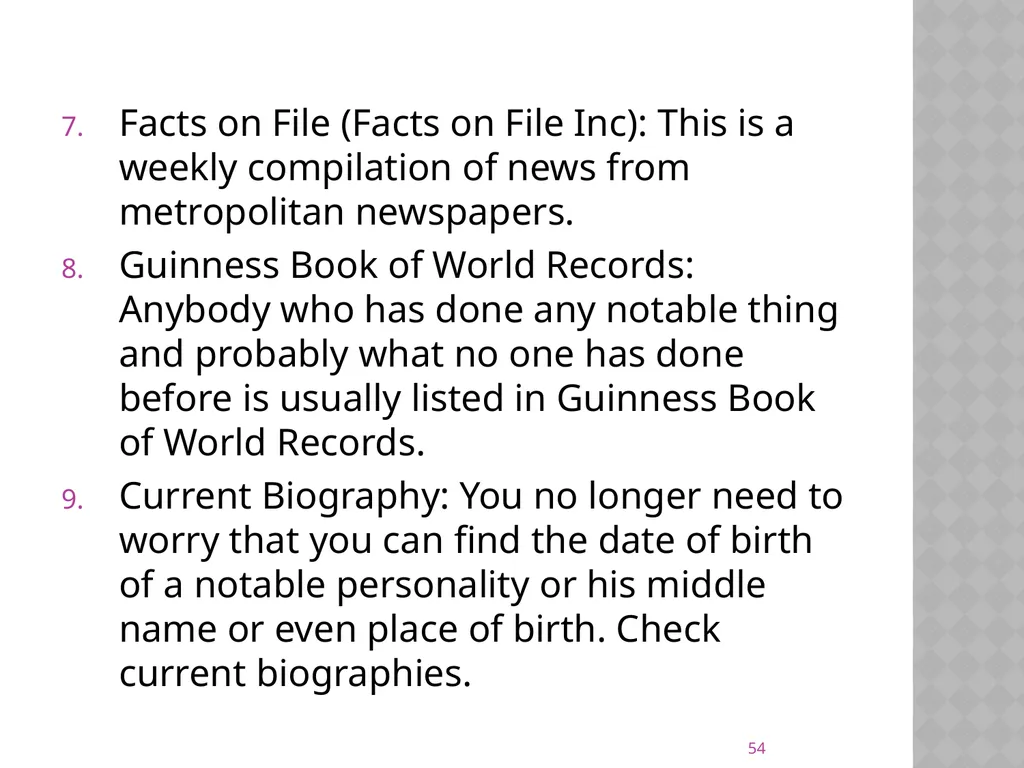
Facts on File (Facts on File Inc): This is a weekly compilation of news from metropolitan newspapers.
Guinness Book of World Records: Anybody who has done any notable thing and probably what no one has done before is usually listed in Guinness Book of World Records.
Current Biography: You no longer need to worry that you can find the date of birth of a notable personality or his middle name or even place of birth. Check current biographies. 54<br>
Guinness Book of World Records: Anybody who has done any notable thing and probably what no one has done before is usually listed in Guinness Book of World Records.
Current Biography: You no longer need to worry that you can find the date of birth of a notable personality or his middle name or even place of birth. Check current biographies. 54<br>
55
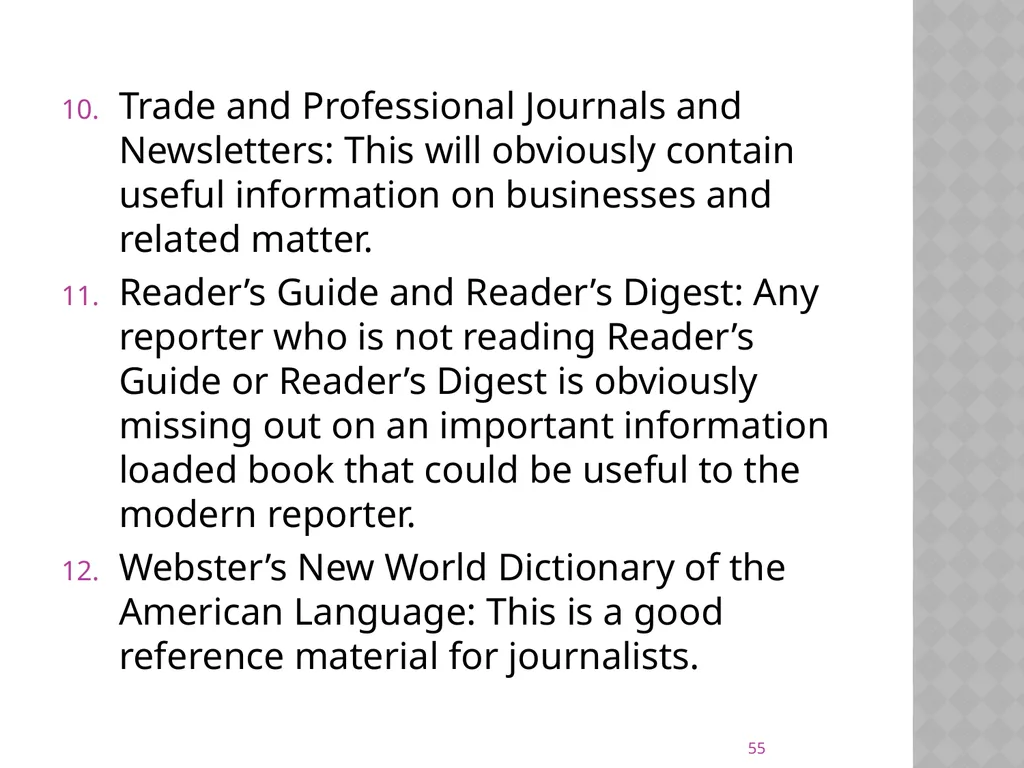
Trade and Professional Journals and Newsletters: This will obviously contain useful information on businesses and related matter.
Reader’s Guide and Reader’s Digest: Any reporter who is not reading Reader’s Guide or Reader’s Digest is obviously missing out on an important information loaded book that could be useful to the modern reporter.
Webster’s New World Dictionary of the American Language: This is a good reference material for journalists. 55<br>
Reader’s Guide and Reader’s Digest: Any reporter who is not reading Reader’s Guide or Reader’s Digest is obviously missing out on an important information loaded book that could be useful to the modern reporter.
Webster’s New World Dictionary of the American Language: This is a good reference material for journalists. 55<br>
56
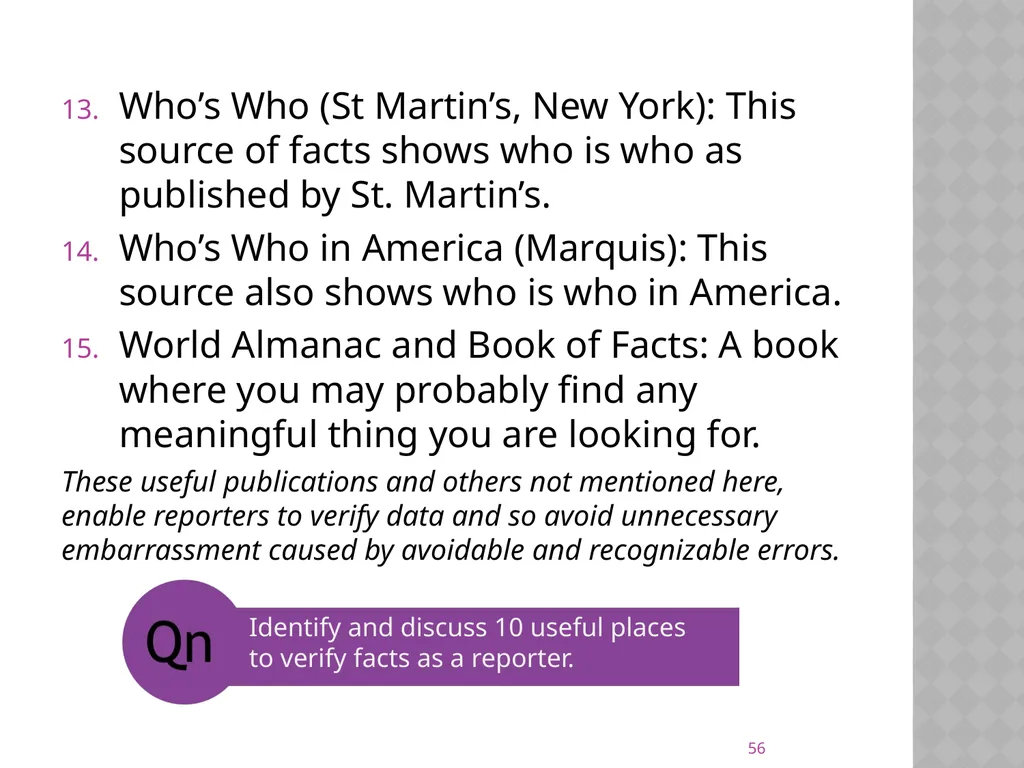
Who’s Who (St Martin’s, New York): This source of facts shows who is who as published by St. Martin’s.
Who’s Who in America (Marquis): This source also shows who is who in America.
World Almanac and Book of Facts: A book where you may probably find any meaningful thing you are looking for.
These useful publications and others not mentioned here, enable reporters to verify data and so avoid unnecessary embarrassment caused by avoidable and recognizable errors. 56 Identify and discuss 10 useful places to verify facts as a reporter.<br>
Who’s Who in America (Marquis): This source also shows who is who in America.
World Almanac and Book of Facts: A book where you may probably find any meaningful thing you are looking for.
These useful publications and others not mentioned here, enable reporters to verify data and so avoid unnecessary embarrassment caused by avoidable and recognizable errors. 56 Identify and discuss 10 useful places to verify facts as a reporter.<br>
57
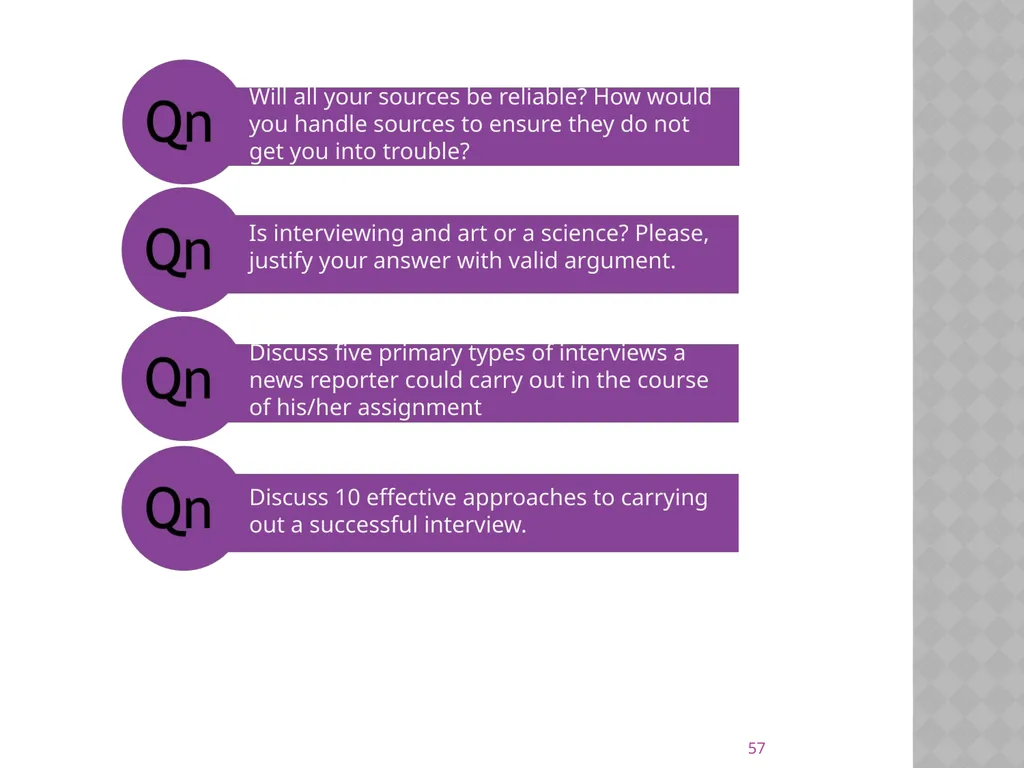
57 Will all your sources be reliable? How would you handle sources to ensure they do not get you into trouble? Is interviewing and art or a science? Please, justify your answer with valid argument. Discuss five primary types of interviews a news reporter could carry out in the course of his/her assignment Discuss 10 effective approaches to carrying out a successful interview.<br>