
Planning 101: Model Training Session on The Ryan


Description: Planning 101: Model Training Session on The Ryan White HIVAIDS Program Part A Planning Cycle This model training session was prepared for the PCS Compendium by EGM Consulting based on Session 6660, Planning Bodies 101, part of the planning
Related Topics
Download Presentation
"Planning 101: Model Training Session on The Ryan" is the property of its rightful owner. Permission is granted to download and print the materials on this website for personal, non-commercial use only, and to display it on your personal computer provided you do not modify the materials and that you retain all copyright notices contained in the materials. By downloading content from our website, you accept the terms of this agreement.
Presentation Transcript
slide1. Planning 101:
Model Training Session on The Ryan White HIV/AIDS Program Part
A Planning Cycle This model training session was prepared for the PCS Compendium by EGM Consulting based on Session 6660, Planning Bodies 101, part of the planning institute: Strengthening the Healthcare Delivery System through Planning, developed and presented by DMHAP and EGM Consulting, LLC as part of the 2016 National Ryan White Conference on HIV Care and Treatment, and funded through MSCG/Ryan White Technical Assistance Contract<br>
slide2. Introduction/Background Why This Session?
Session Objectives
Session Topics 2<br>
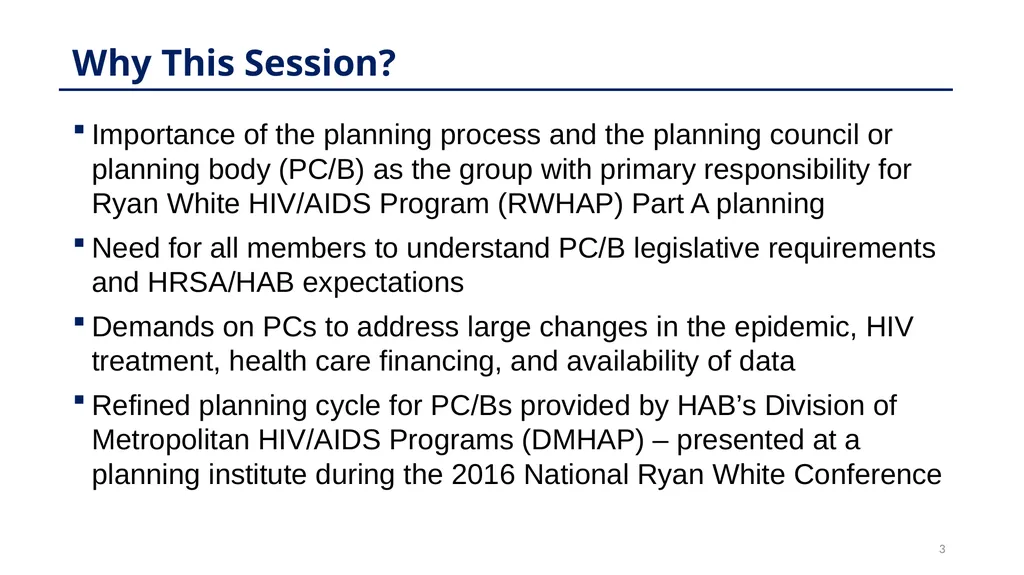
slide3. Why This Session? Importance of the planning process and the planning council or planning body (PC/B) as the group with primary responsibility for Ryan White HIV/AIDS Program (RWHAP) Part A planning
Need for all members to understand PC/B legislative requirements and HRSA/HAB expectations
Demands on PCs to address large changes in the epidemic, HIV treatment, health care financing, and availability of data
Refined planning cycle for PC/Bs provided by HAB’s Division of Metropolitan HIV/AIDS Programs (DMHAP) – presented at a planning institute during the 2016 National Ryan White Conference 3<br>
slide4. Session Objectives Participants will have shared knowledge and skills for carrying out PC legislative responsibilities and meeting HAB/DMHAP requirements and expectations, with focus on the following areas:
The PC/B as a community planning mechanism
The annual planning cycle
Expectations and best practices for key planning tasks 4<br>
slide5. Expectations for This Training Share your responses to these questions in a small group. Choose a facilitator to coordinate the work and a recorder/reporter to summarize your group’s responses to the full group:
What are your most important expectations for this training:
What do you most want to learn?
What questions about the PC and planning process do you most want answered? 5<br>
slide6. Community Planning in the RWHAP Part A Program 6<br>
slide7. What is Community Planning? “Community health planning is a deliberate effort to involve the members of a geographically defined community in an open public process designed to improve the availability, accessibility, and quality of healthcare services in their community as a means toward improving its health status
“That public process must provide broadly representative mechanisms for identifying community needs, assessing capacity to meet those needs, allocating resources, and resolving conflicts”
Source: American Health Planning Association, “Community Planning,” John Stern, 2008; http://www.ahpanet.org/files/community_health_planning_09.pdf 7<br>
slide8. Central Role of Planning in the Ryan White HIV/AIDS Program Captures the community’s experience and voice
Provides formalized opportunities/roles for continuous community input
Provides multiple roles and opportunities for input and decision making for consumers of Ryan White HIV/AIDS Program (RWHAP) services and other PLWH
Allows for shaping a system of HIV care at the local level, to reflect documented jurisdictional needs and priorities 8<br>
slide9. RWHAP Part A Planning Councils/Bodies Legislation requires EMAs to have PCs established by the Chief Elected Official (CEO)
TGAs funded after 2006 are not required to establish PCs if the CEO chooses another method for obtaining “community input (particularly from those with HIV)…for formulating the overall plan for priority setting and allocating funds from the grant”
2 of the 6 TGAs funded after 2006 chose not to have PCs
PC requirement for all TGAs ended as of FY 2014
In December 2013, DMHAP strongly urged TGAs to maintain PCs as described in the legislation
All 26 TGAs that had PCs have maintained them
All PCs are expected to meet requirements as specified in the legislation and in HAB/DMHAP policies and guidances 9<br>
slide10. Uniqueness of Planning Councils RWHAP planning councils are unique – no other federal health/human services programs require such bodies
Many federal programs require community planning, but planning bodies are usually advisory rather than decision making
Federally funded nonprofits are sometimes required to include consumers on their boards (for example, community health centers)
Some planning bodies require consumer input – but rarely 33% of voting members
Almost none have such specific legislative responsibilities 10<br>
slide11. DMHAP’s Suggested Guiding Principles for RWHAP Planning Ryan White planning:
Is community-based, including diverse stakeholders
Requires consumer input to needs assessment and decision making
Is a collaborative partnership between the planning body and the recipient
Is designed to meet National HIV/AIDS Strategy (NHAS) goals and strengthen performance along the HIV Care Continuum (HCC)
Is an ongoing, cyclical process
Requires data from multiple sources, gathered through varied methods
Uses data-based decision making 11<br>
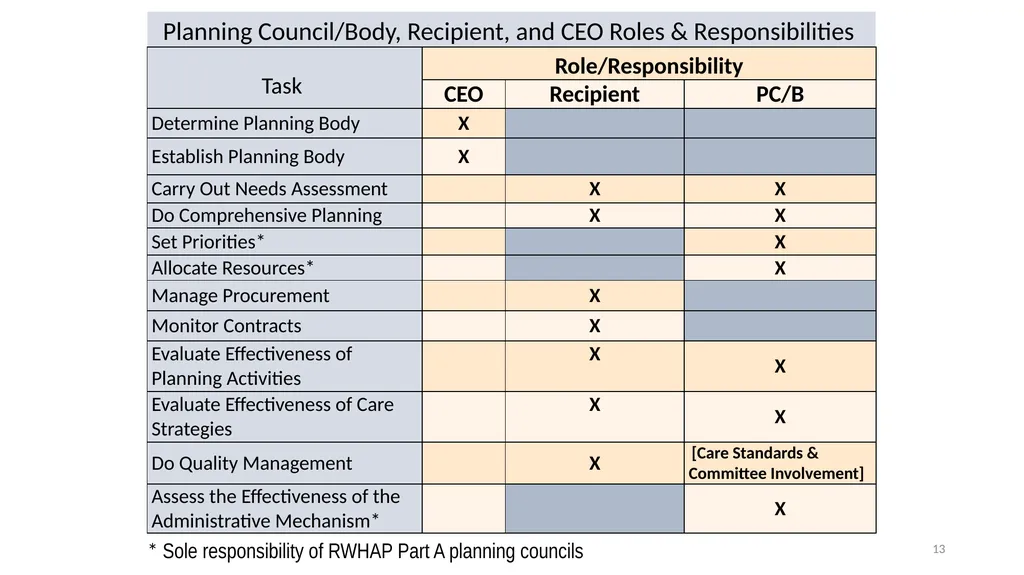
slide12. PC/B Roles and Responsibilities Most of the PC’s legislatively specified roles and responsibilities are related to planning
No legislative requirements exist for RWHAP Part A planning bodies that are not PCs, but DMHAP typically urges them to carry out the same roles as PCs – though they are usually advisory rather than decision-making bodies 12<br>
slide13. * Sole responsibility of RWHAP Part A planning councils 13<br>
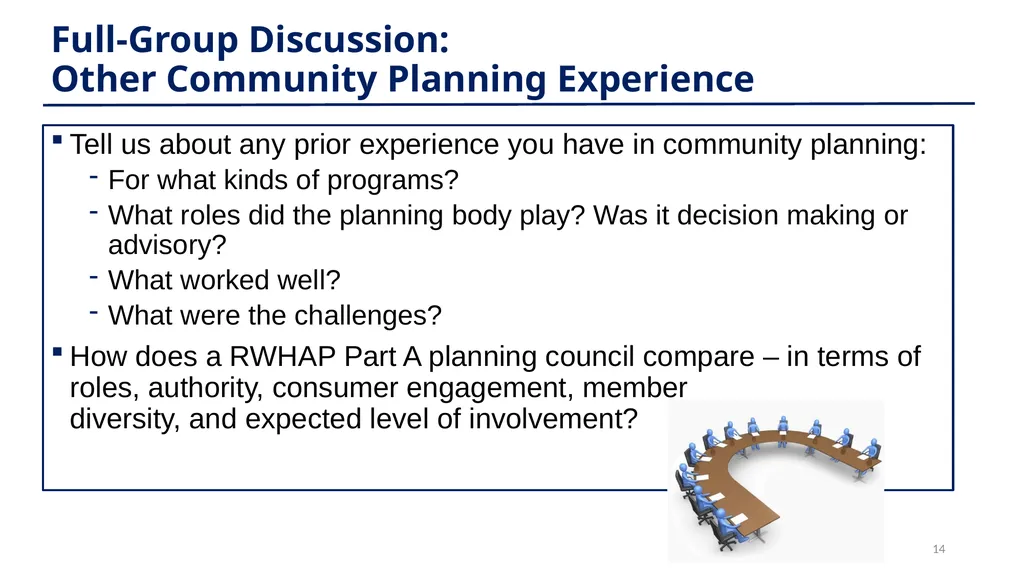
slide14. Full-Group Discussion: Other Community Planning Experience Tell us about any prior experience you have in community planning:
For what kinds of programs?
What roles did the planning body play? Was it decision making or advisory?
What worked well?
What were the challenges?
How does a RWHAP Part A planning council compare – in terms of roles, authority, consumer engagement, member diversity, and expected level of involvement? 14<br>
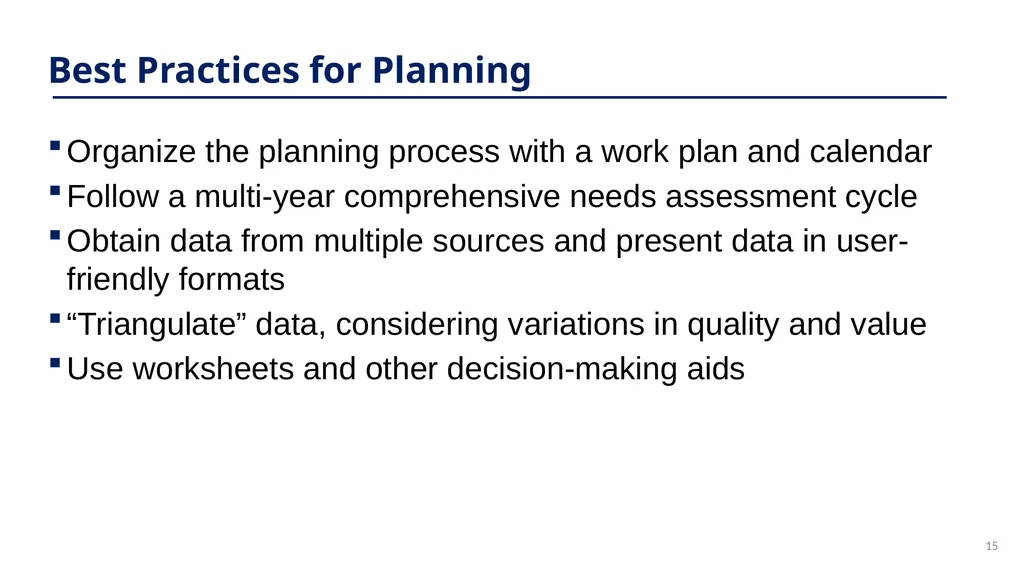
slide15. Best Practices for Planning Organize the planning process with a work plan and calendar
Follow a multi-year comprehensive needs assessment cycle
Obtain data from multiple sources and present data in user-friendly formats
“Triangulate” data, considering variations in quality and value
Use worksheets and other decision-making aids 15<br>
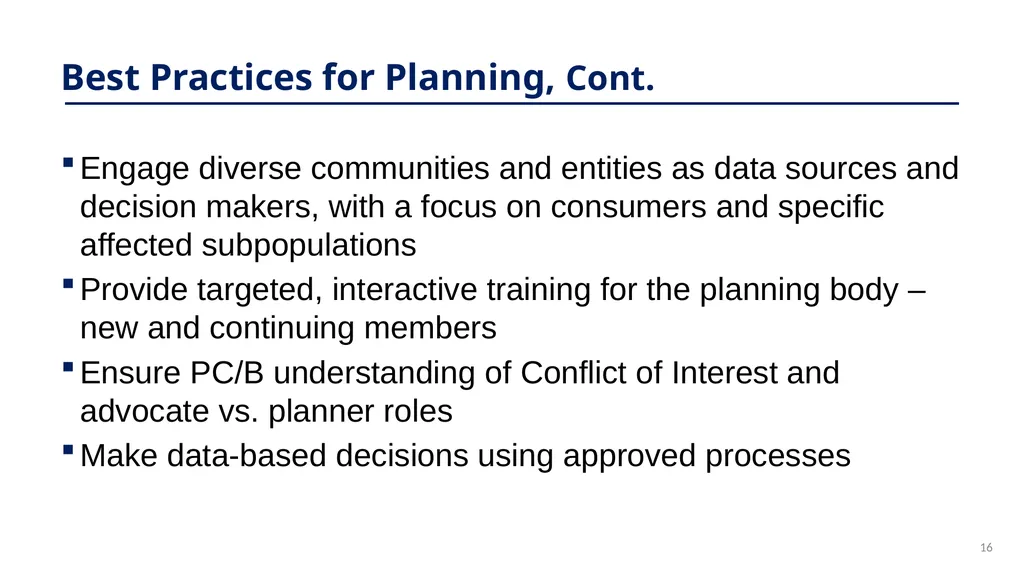
slide16. Best Practices for Planning, Cont. Engage diverse communities and entities as data sources and decision makers, with a focus on consumers and specific affected subpopulations
Provide targeted, interactive training for the planning body – new and continuing members
Ensure PC/B understanding of Conflict of Interest and advocate vs. planner roles
Make data-based decisions using approved processes 16<br>
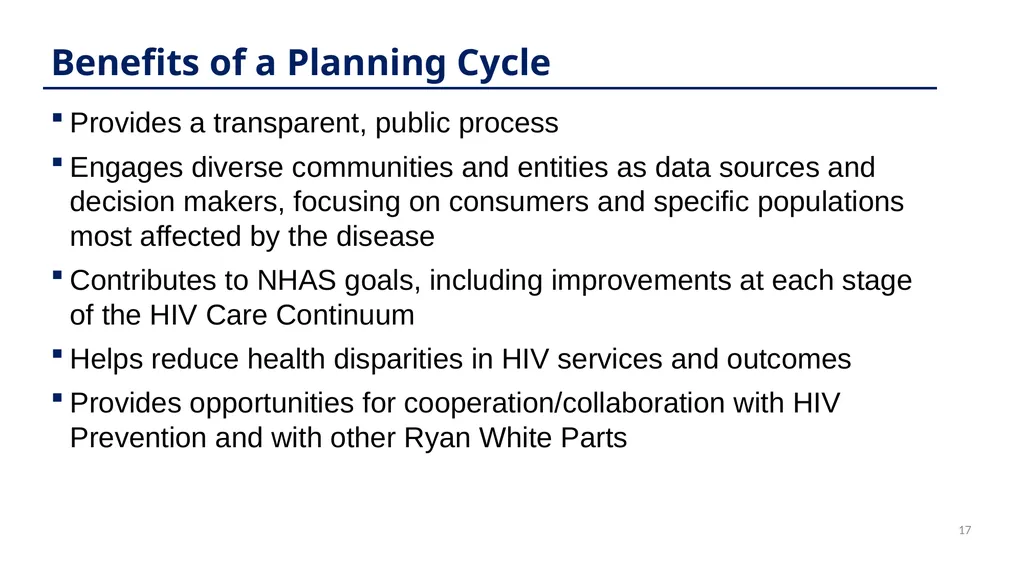
slide17. Benefits of a Planning Cycle Provides a transparent, public process
Engages diverse communities and entities as data sources and decision makers, focusing on consumers and specific populations most affected by the disease
Contributes to NHAS goals, including improvements at each stage of the HIV Care Continuum
Helps reduce health disparities in HIV services and outcomes
Provides opportunities for cooperation/collaboration with HIV Prevention and with other Ryan White Parts 17<br>
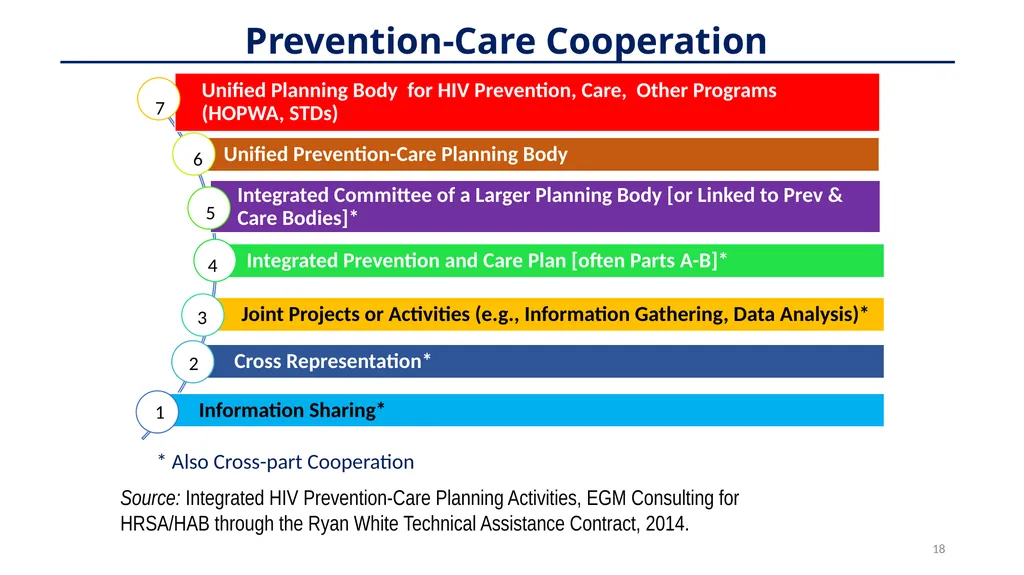
slide18. Prevention-Care Cooperation 7 6 5 4 3 2 * Also Cross-part Cooperation Source: Integrated HIV Prevention-Care Planning Activities, EGM Consulting for HRSA/HAB through the Ryan White Technical Assistance Contract, 2014. 1 18<br>
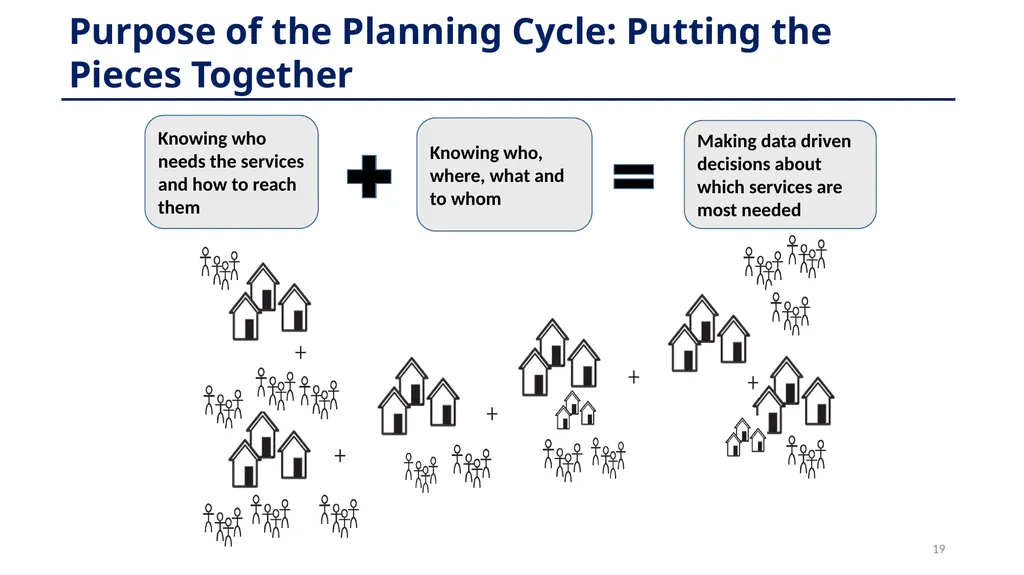
slide19. 19 Purpose of the Planning Cycle: Putting the Pieces Together Knowing who needs the services and how to reach them Knowing who, where, what and to whom Making data driven decisions about which services are most needed<br>
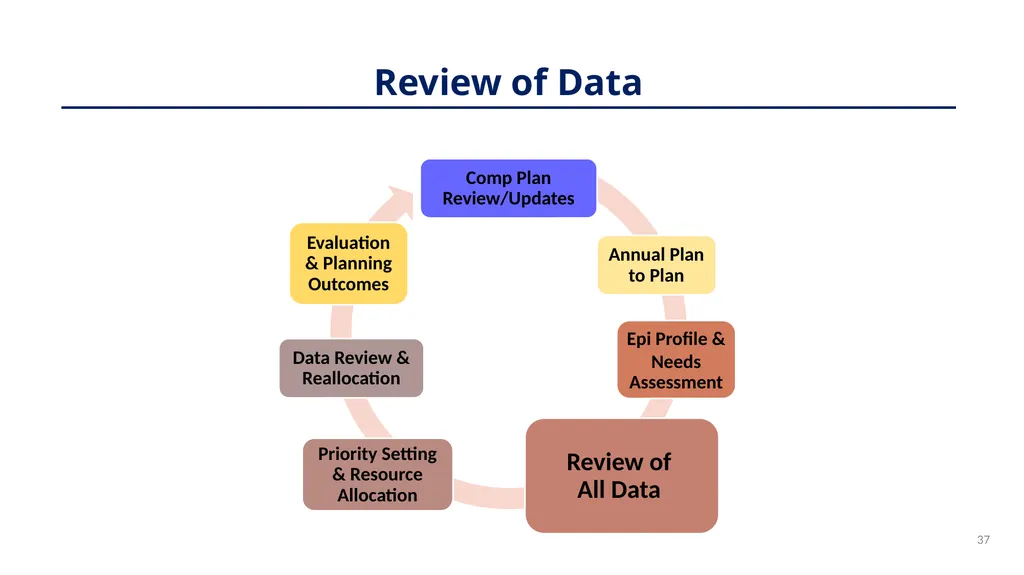
slide20. An Updated Annual Planning Cycle for RWHAP Part A Planning Councils/Bodies 20<br>
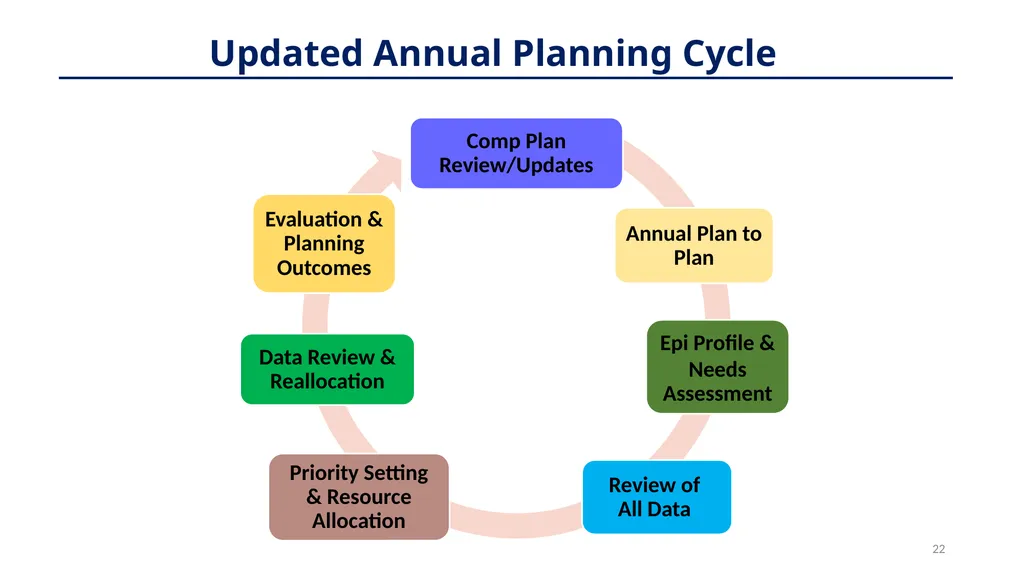
slide21. Updated Annual Planning Cycle Core responsibility of a PC/B: carry out community planning to establish and maintain the best possible system of care for PLWH in the jurisdiction – through a well-defined and fully-implemented planning cycle
Integrated/comprehensive/integrated plan: central role in the planning cycle
Importance of access to many types of data for decision making 21<br>
slide22. Updated Annual Planning Cycle 22<br>
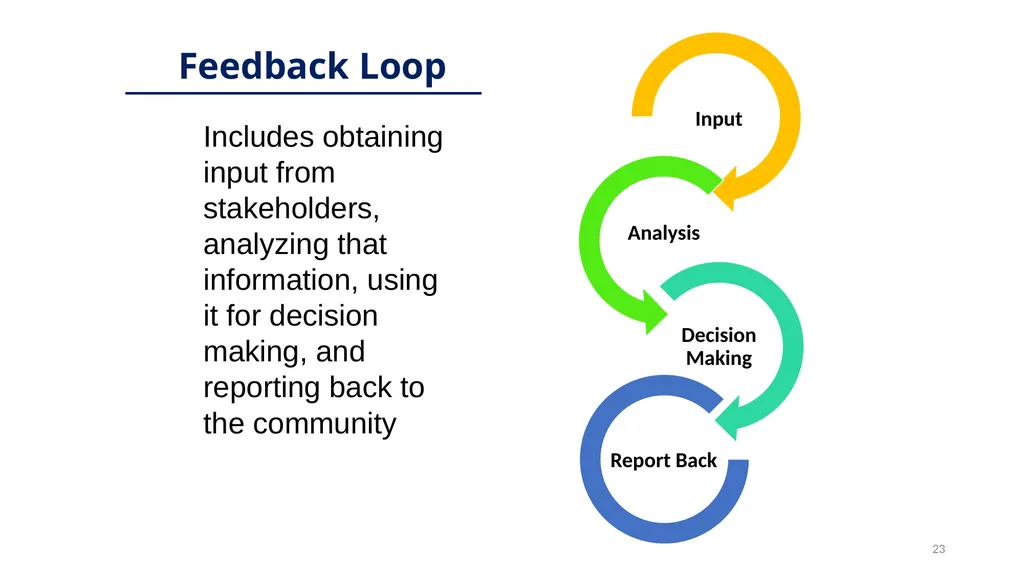
slide23. Feedback Loop Includes obtaining input from stakeholders, analyzing that information, using it for decision making, and reporting back to the community 23<br>
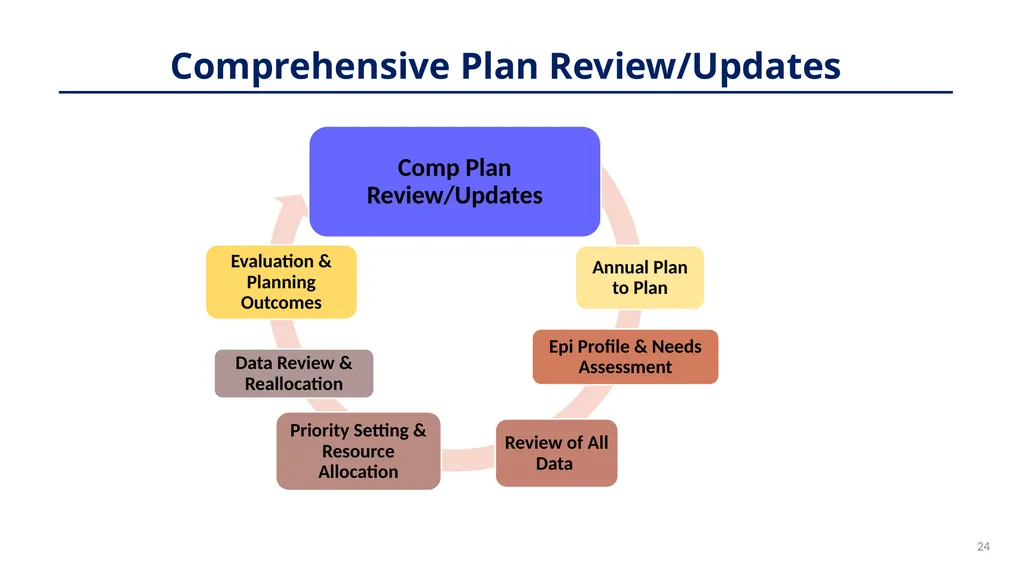
slide24. Comprehensive Plan Review/Updates 24<br>
slide25. Expectations for Comprehensive Plan Legislation requires RWHAP Part A and Part B programs to prepare comprehensive plans that set goals and objectives and guide the work of the program
All Parts expected to participate in the Statewide Coordinated Statement of Need (SCSN) process
In 2016, RWHAP Part A and Part B recipients prepared integrated plans based on a guidance from CDC and HRSA to submit 5-year Integrated HIV Prevention and Care Plans, including the Statewide Coordinated Statement of Need (SCSN)
Plans for 2017-2022 were submitted in September 2016 25<br>
slide26. Expectations for Comprehensive Plan, Cont. Combined guidance designed to help reach the goals of the National HIV/AIDS Strategy (NHAS) and improve performance along the HIV Care Continuum (HCC)/Treatment Cascade
Programs expected to regularly review Plan progress and refine objectives and strategies as needed – plan should be a living document that guides the annual planning cycle 26<br>
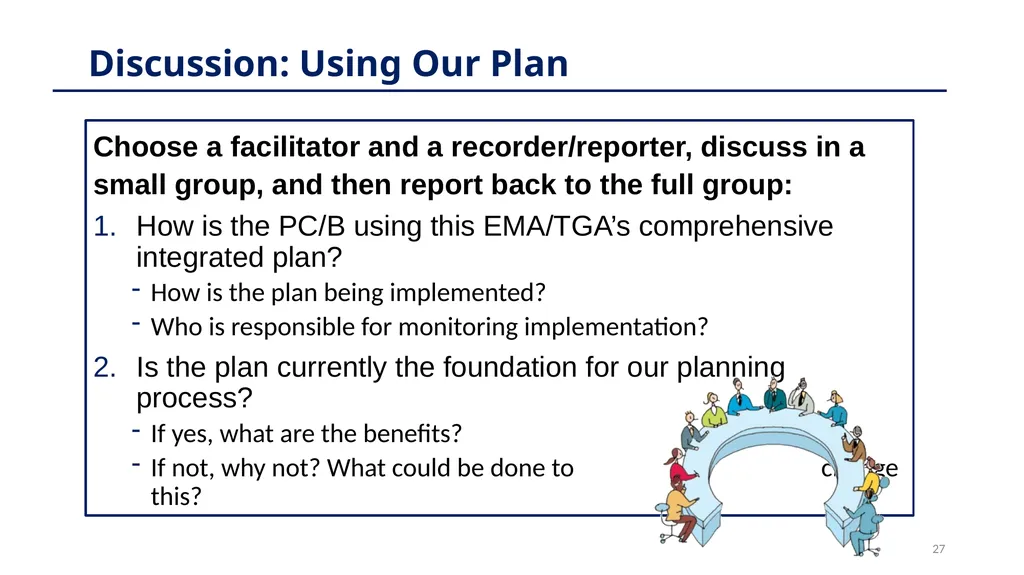
slide27. Discussion: Using Our Plan Choose a facilitator and a recorder/reporter, discuss in a small group, and then report back to the full group:
How is the PC/B using this EMA/TGA’s comprehensive integrated plan?
How is the plan being implemented?
Who is responsible for monitoring implementation?
Is the plan currently the foundation for our planning process?
If yes, what are the benefits?
If not, why not? What could be done to change this? 27<br>
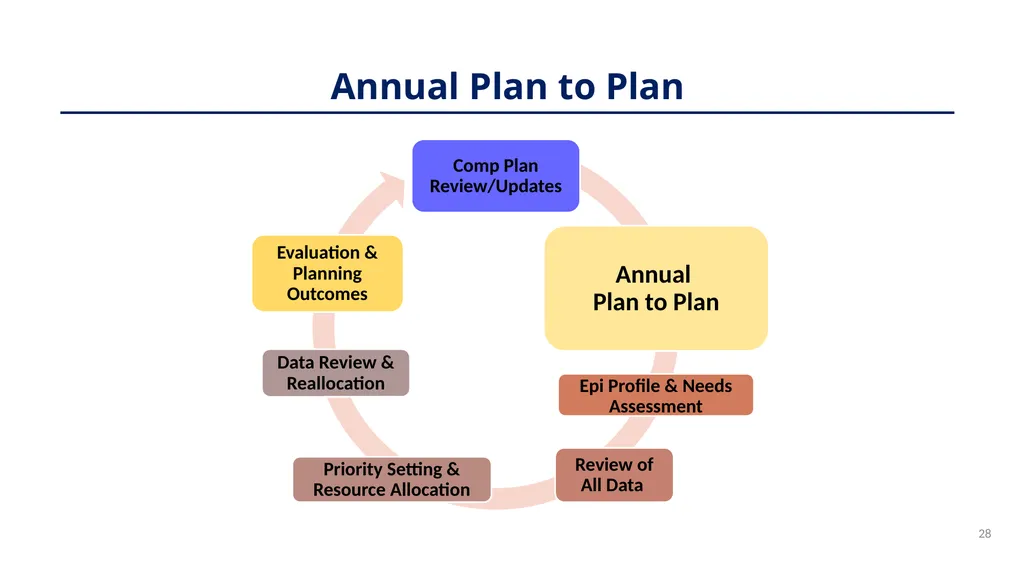
slide28. Annual Plan to Plan 28<br>
slide29. Expectations for Annual Workplan Annual work plan – often in chart format – to guide the planning process, based on the current comprehensive/integrated plan, annual application including the Implementation Plan, legislative and administrative requirements, and local structures and processes
Annual master calendar for the jurisdiction that integrates planning body and recipient meetings, events, products and deadlines
Committee work plans that provide for coordinated task completion
Continuing attention to engaging consumers and other diverse community stakeholders in the planning process 29<br>
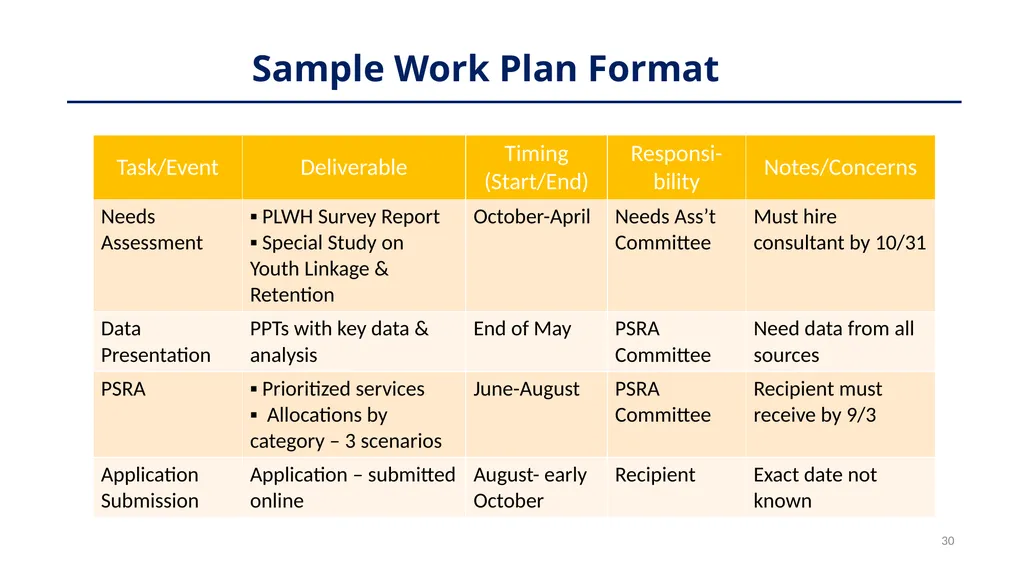
slide30. Sample Work Plan Format 30<br>
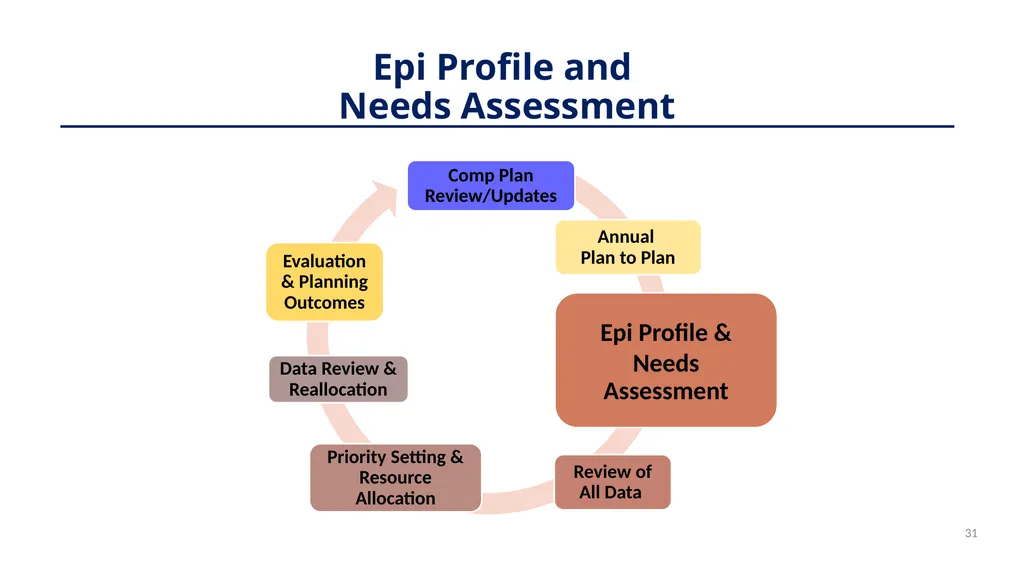
slide31. Epi Profile and Needs Assessment 31<br>
slide32. Expectations for Epi Profile Epidemiologic profile describes “the burden of HIV on the population of an area in terms of sociodemographic, geographic, behavioral, and clinical characteristics of persons with HIV”
Should be based on the CDC/HRSA Integrated Guidance for Preparing Epidemiologic Profiles, updated in August 2014*
Profile should include “advice on how to interpret the data in ways that are consistent and useful in meeting the planning needs of both HIV prevention and care programs”
Often prepared by State but should focus on jurisdictional data and needs
* Available online at: https://www.cdc.gov/hiv/pdf/guidelines_developing_epidemiologic_profiles.pdf 32<br>
slide33. Expectations: Needs Assessment Determine what services are needed, what services are being provided, and what service gaps exist, overall & for particular populations, in & out of care – including PLWH input on service needs and gaps
Components:
Epi profile of HIV & AIDS cases and trends
Estimate & assessment of unmet need and undiagnosed – PLWH who know their status but are not in care and PLWH who do not know their status
Service needs of PLWH in & out of care
Existing services, including a resource inventory & provider capacity/capability (availability, accessibility & appropriateness overall and for specific populations)
Barriers to testing and care
Service gaps for those in and out of care
Disparities in access to services for subpopulations 33<br>
slide34. Needs Assessment: Challenges Establishing a plan and budgeting funds annually to carry out specific needs assessment activities in the plan
Updating of methods and tools to reflect changes in the epidemic
Including each expected component of a comprehensive needs assessment
Ensuring appropriate sampling and data analysis to maximize data quality and make best use of available data
Avoiding over-dependence on small-sample methods like focus groups 34<br>
slide35. Needs Assessment: Best Practices Multi-year needs assessment plan that includes 1 major activity or component/year
Use of both qualitative and quantitative measures, and inclusion of some large-scale data gathering from PLWH based on a careful sampling
Innovative approaches to finding PLWH in and out of care
Training of PC members/consumers to conduct focus groups, chair Town Halls, and help with surveys
Use of technology 35<br>
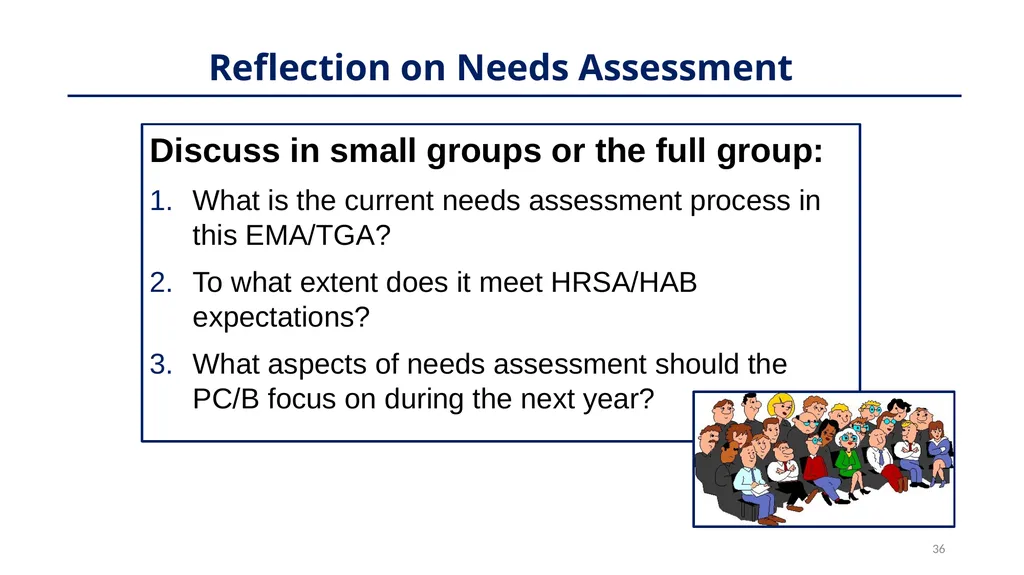
slide36. Reflection on Needs Assessment Discuss in small groups or the full group:
What is the current needs assessment process in this EMA/TGA?
To what extent does it meet HRSA/HAB expectations?
What aspects of needs assessment should the PC/B focus on during the next year? 36<br>
slide37. Review of Data 37<br>
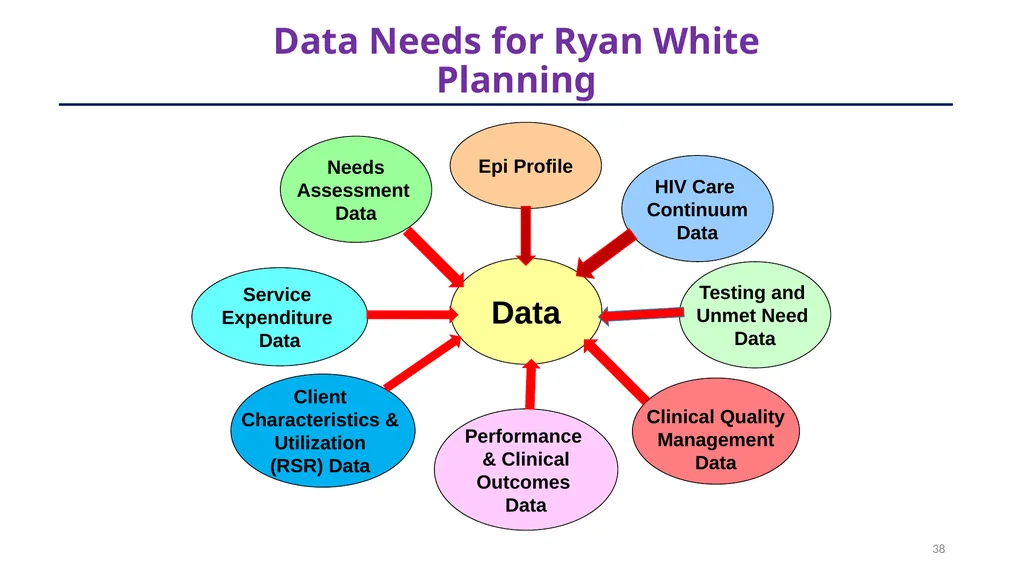
slide38. Data Needs for Ryan White Planning HIV Care
Continuum
Data Testing and
Unmet Need
Data Data Clinical Quality
Management
Data Performance
& Clinical
Outcomes
Data Client
Characteristics &
Utilization
(RSR) Data Service
Expenditure
Data Needs
Assessment
Data Epi Profile 38<br>
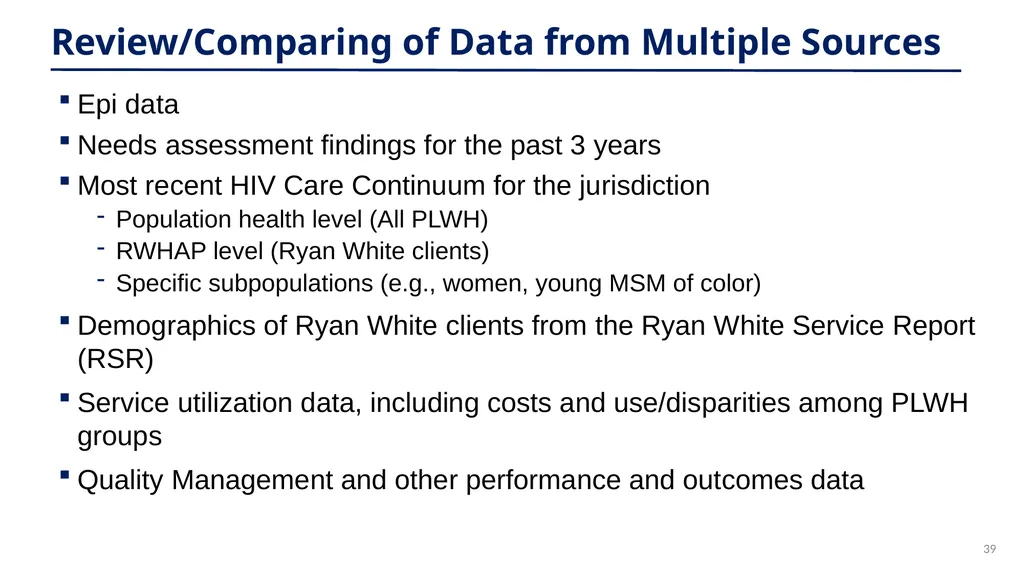
slide39. Review/Comparing of Data from Multiple Sources Epi data
Needs assessment findings for the past 3 years
Most recent HIV Care Continuum for the jurisdiction
Population health level (All PLWH)
RWHAP level (Ryan White clients)
Specific subpopulations (e.g., women, young MSM of color)
Demographics of Ryan White clients from the Ryan White Service Report (RSR)
Service utilization data, including costs and use/disparities among PLWH groups
Quality Management and other performance and outcomes data 39<br>
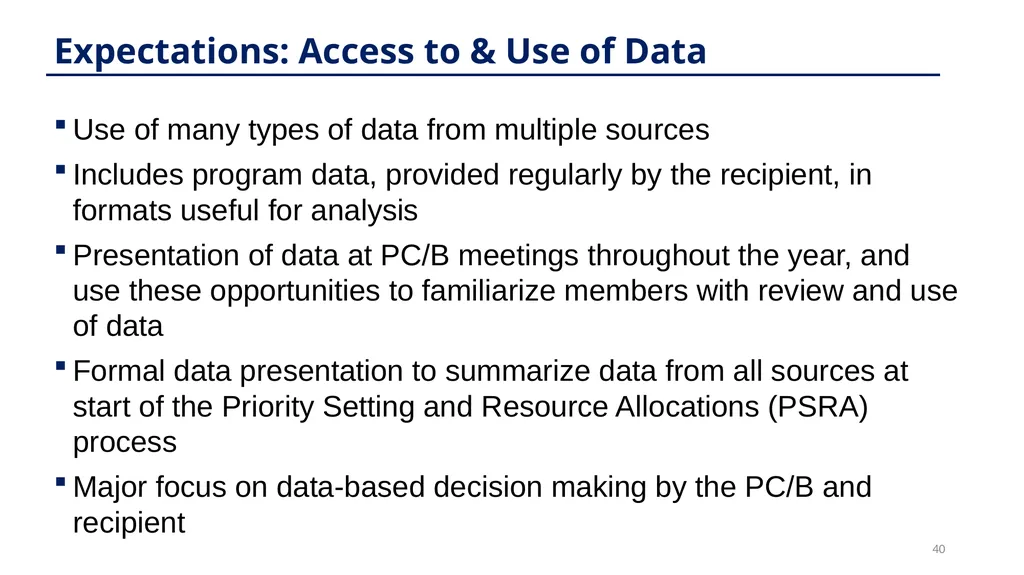
slide40. Expectations: Access to & Use of Data Use of many types of data from multiple sources
Includes program data, provided regularly by the recipient, in formats useful for analysis
Presentation of data at PC/B meetings throughout the year, and use these opportunities to familiarize members with review and use of data
Formal data presentation to summarize data from all sources at start of the Priority Setting and Resource Allocations (PSRA) process
Major focus on data-based decision making by the PC/B and recipient 40<br>
slide41. Expectations: Review of All Data Data needs are determined annually, negotiated with recipient & made a part of the work plan
Ideally, data sets and formats are specified in an MOU between the PC/B and the recipient
Data are provided in clear, user-friendly formats
Members received training on assessing & using data
Comparisons are made of data from various sources
Assessment of the quality of different data sets/reports
“Triangulation” of data: obtain and compare data from more than one source to see if findings are consistent 41<br>
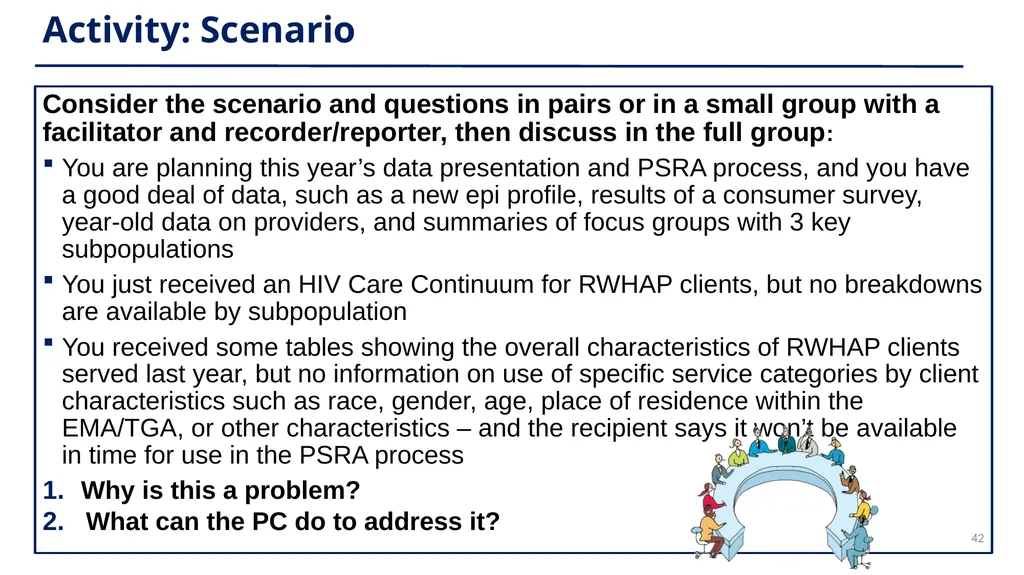
slide42. Activity: Scenario Consider the scenario and questions in pairs or in a small group with a facilitator and recorder/reporter, then discuss in the full group:
You are planning this year’s data presentation and PSRA process, and you have a good deal of data, such as a new epi profile, results of a consumer survey, year-old data on providers, and summaries of focus groups with 3 key subpopulations
You just received an HIV Care Continuum for RWHAP clients, but no breakdowns are available by subpopulation
You received some tables showing the overall characteristics of RWHAP clients served last year, but no information on use of specific service categories by client characteristics such as race, gender, age, place of residence within the EMA/TGA, or other characteristics – and the recipient says it won’t be available in time for use in the PSRA process
Why is this a problem?
What can the PC do to address it? 42<br>
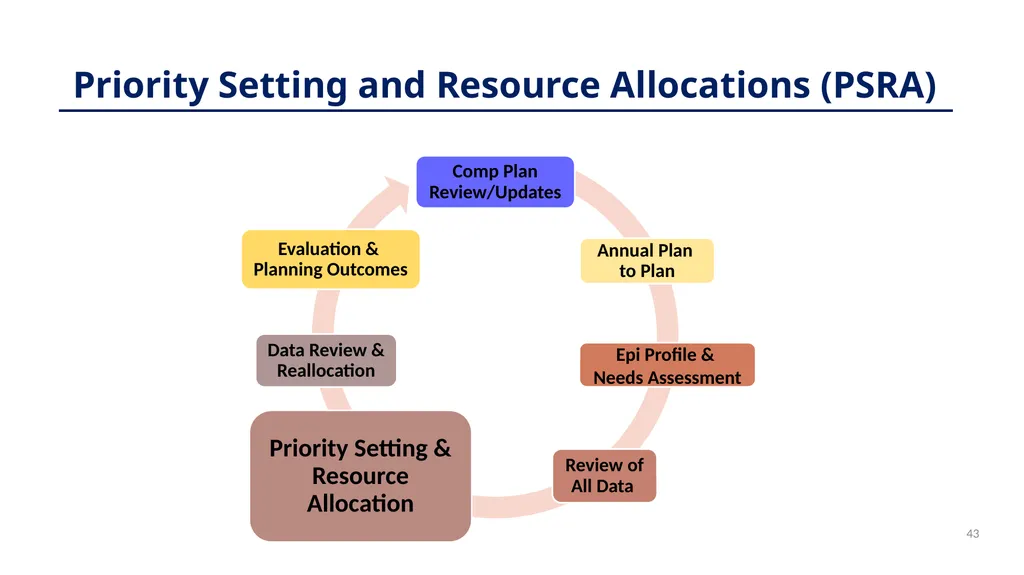
slide43. Priority Setting and Resource Allocations (PSRA) 43<br>
slide44. Expectations: PSRA Most important legislative responsibility of PC/Bs – should actively involve the whole PC/B (not just a committee)
Includes:
Priority setting: deciding what services and program support categories are most important for PLWH in the EMA or TGA
Resource allocations: deciding how much RWHAP Part A funding to provide for each service priority
Directives to the recipient on how best to meet these priorities – e.g., what service models for what populations in what geographic areas
Reallocations during the year – including a rapid reallocation process to use near the end of the funding year
Decisions based on data, not “impassioned pleas”
Ensure clarity: resource allocation does not mean procurement – PC/B has NO involvement in selection of particular entities to provide services 44<br>
slide45. PSRA: Issues and Best Practices Provide data presentations and discussions throughout the year – not only at PSRA time
Use these data presentations as an opportunity for training on use of data in decision making
Have a process to hear consumer needs and concerns during needs assessment, while avoiding “impassioned pleas” during PSRA meetings
Have a policy and process to manage conflict of interest – and enforce it fully
Ensure a process to weigh, summarize, compare, and use data to reach decisions 45<br>
slide46. Ensuring Fairness and Avoiding Grievances Every PC/B must have a grievance procedure regarding funding, and can face a grievance if the PSRA process does not follow established policies and procedures
For a fair process that is unlikely to face a grievance:
Have an updated, written PSRA process, guiding all steps from town halls through allocations – and follow it!
Manage Conflict of Interest
Involve the whole PC/B in decision making, ensuring diverse decision makers
Ensure that members understand when they need to be advocates and when they must plan for all PLWH in the EMG/TGA 46<br>
slide47. Members as Advocates and Planners Members often come as Advocates:
Bring passion
Provide a voice for their communities or for populations their organization serves
Also learn to advocate on behalf of other subpopulations that may be underrepresented in PC/B deliberations
Need to know when/how to be Planners:
Consider the entire community
Seek Win-Win versus Win-Lose
Listen to others/ask questions
Come prepared – review data and reports; ask questions
Use data to make decisions – not “impassioned pleas”
Understand boundaries 47<br>
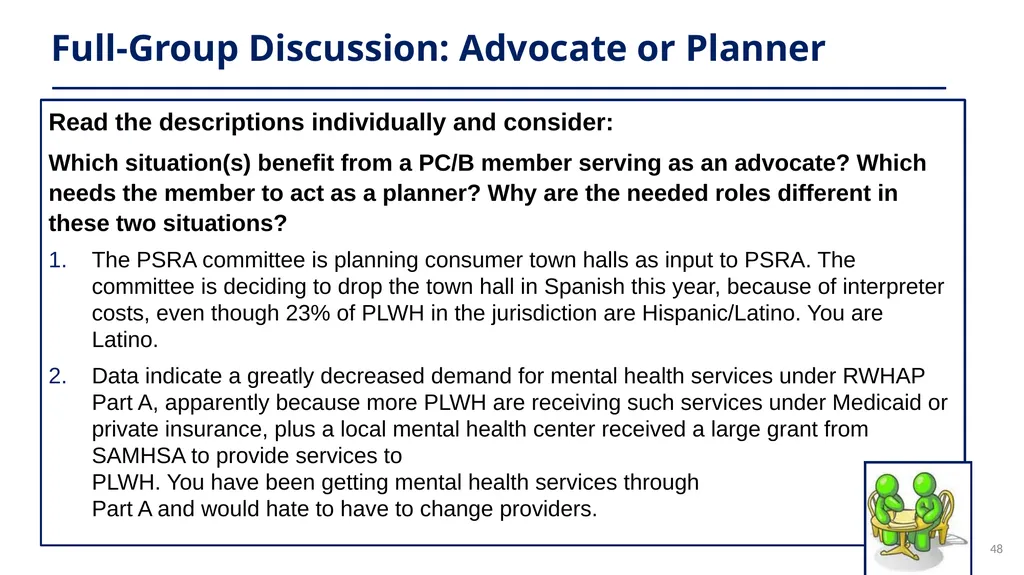
slide48. Full-Group Discussion: Advocate or Planner Read the descriptions individually and consider:
Which situation(s) benefit from a PC/B member serving as an advocate? Which needs the member to act as a planner? Why are the needed roles different in these two situations?
The PSRA committee is planning consumer town halls as input to PSRA. The committee is deciding to drop the town hall in Spanish this year, because of interpreter costs, even though 23% of PLWH in the jurisdiction are Hispanic/Latino. You are Latino.
Data indicate a greatly decreased demand for mental health services under RWHAP Part A, apparently because more PLWH are receiving such services under Medicaid or private insurance, plus a local mental health center received a large grant from SAMHSA to provide services to PLWH. You have been getting mental health services through Part A and would hate to have to change providers. 48<br>
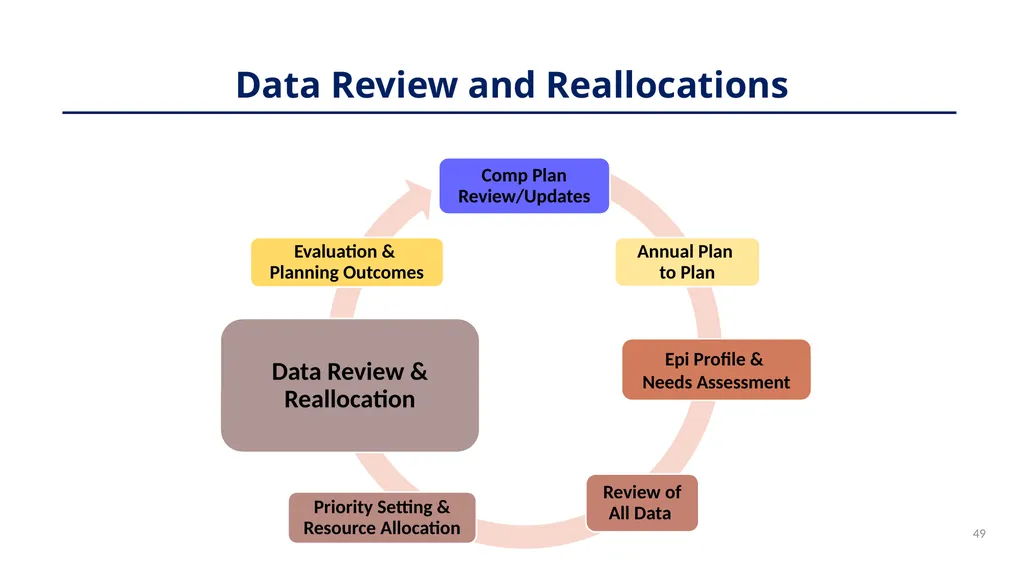
slide49. Data Review and Reallocations 49<br>
slide50. Expectations for Data Review and Reallocations Regular review of monthly expenditures by service category including over- and under-spending
Training to ensure that all PC/B members can read and understand financial reports, with more extensive training for members of the responsible committee
Identification of trends in expenditures and service utilization – including any serious under- or over-expenditures
Rapid reallocation procedure, especially during last quarter, to ensure full expenditures 50<br>
slide51. A Best Practice for Reallocations After the program receives its Notice of Grant Award and revises allocations, the PSRA committee reviews funding decisions and identifies service categories that would benefit from additional resources, overall or for particular service models or populations – e.g., funds to add community health workers as assistants to medical case managers to improve retention among specific subpopulations, additional funds for medical transportation to cover participation in support groups and enhance assistance to clients who live in outlying counties
These priorities, including amounts and directives on use of funds, are provided to the recipient
If funds become available and reallocations are necessary, the recipient is urged to recommend actions to address these priorities – which shortens the PC/B review process, since the recipient already knows the priorities 51<br>
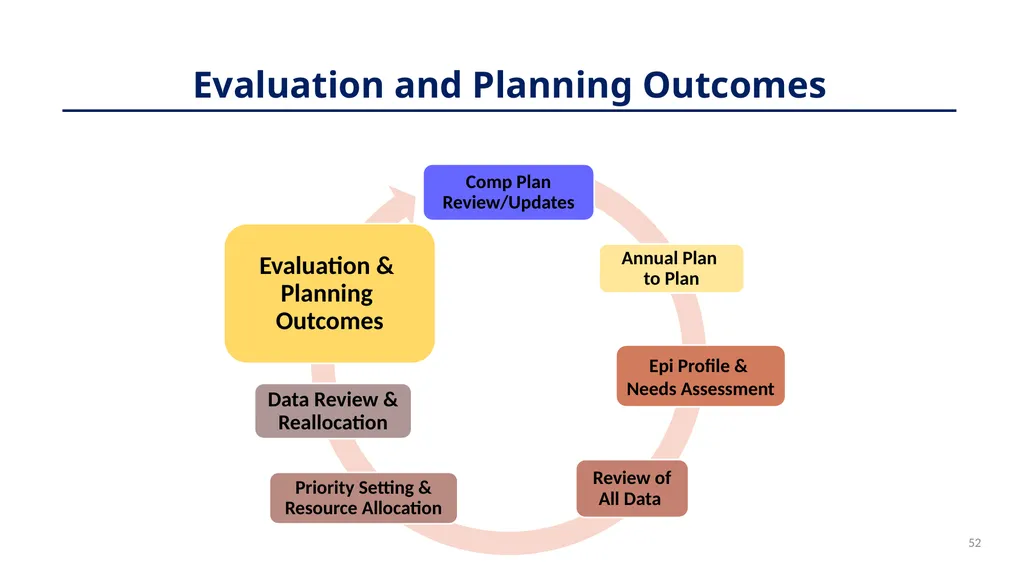
slide52. Evaluation and Planning Outcomes 52<br>
slide53. Expectations: Evaluation and Planning Outcomes Completes the updated planning cycle
Includes a “review of variances”
Actual versus planned services and performance (e.g., clients and subpopulations served, units of service, expenditures)
Actual versus planned quality measures and client/program outcomes
Requires comparing PSRA-approved priorities and allocations vs. actual use of funds
Provides an assessment of the planning process
Helps meet the requirements of the assessment of the efficiency of the administrative mechanism
Provides data for refining the integrated plan where appropriate 53<br>
slide54. Key Planning Challenges Insufficient PC/B and/or recipient:
Knowledge: of community planning, RWHAP legislation, COI
Skills: needs assessment, analysis & use of data, group decision making, negotiations, group process
Resources: for needs assessment, data analysis, PC/B staffing & support
Access to data: client characteristics, utilization, costs, service needs & gaps 54<br>
slide55. Discussion Re Planning Challenges Discuss in pairs, then in the full group:
Which of these challenges are most important for this PC/B?
What can you to prevent, resolve, or minimize challenges related to each of these areas:
Knowledge?
Skills?
Resources?
Access to data?
What should be the PC/B priorities in addressing these challenges? 55<br>
slide56. Discussion: Next Steps Discuss in a small group, with a facilitator and a recorder/reporter, then report back to the full group:
What action should the PC/B take to implement the planning cycle – identify up to 5 key tasks
What committee or entity should be responsible for each of these tasks?
What, if any, additional information or training does the PC/B need to implement the planning cycle? 56<br>
slide2. Introduction/Background Why This Session?
Session Objectives
Session Topics 2<br>
slide3. Why This Session? Importance of the planning process and the planning council or planning body (PC/B) as the group with primary responsibility for Ryan White HIV/AIDS Program (RWHAP) Part A planning
Need for all members to understand PC/B legislative requirements and HRSA/HAB expectations
Demands on PCs to address large changes in the epidemic, HIV treatment, health care financing, and availability of data
Refined planning cycle for PC/Bs provided by HAB’s Division of Metropolitan HIV/AIDS Programs (DMHAP) – presented at a planning institute during the 2016 National Ryan White Conference 3<br>
slide4. Session Objectives Participants will have shared knowledge and skills for carrying out PC legislative responsibilities and meeting HAB/DMHAP requirements and expectations, with focus on the following areas:
The PC/B as a community planning mechanism
The annual planning cycle
Expectations and best practices for key planning tasks 4<br>
slide5. Expectations for This Training Share your responses to these questions in a small group. Choose a facilitator to coordinate the work and a recorder/reporter to summarize your group’s responses to the full group:
What are your most important expectations for this training:
What do you most want to learn?
What questions about the PC and planning process do you most want answered? 5<br>
slide6. Community Planning in the RWHAP Part A Program 6<br>
slide7. What is Community Planning? “Community health planning is a deliberate effort to involve the members of a geographically defined community in an open public process designed to improve the availability, accessibility, and quality of healthcare services in their community as a means toward improving its health status
“That public process must provide broadly representative mechanisms for identifying community needs, assessing capacity to meet those needs, allocating resources, and resolving conflicts”
Source: American Health Planning Association, “Community Planning,” John Stern, 2008; http://www.ahpanet.org/files/community_health_planning_09.pdf 7<br>
slide8. Central Role of Planning in the Ryan White HIV/AIDS Program Captures the community’s experience and voice
Provides formalized opportunities/roles for continuous community input
Provides multiple roles and opportunities for input and decision making for consumers of Ryan White HIV/AIDS Program (RWHAP) services and other PLWH
Allows for shaping a system of HIV care at the local level, to reflect documented jurisdictional needs and priorities 8<br>
slide9. RWHAP Part A Planning Councils/Bodies Legislation requires EMAs to have PCs established by the Chief Elected Official (CEO)
TGAs funded after 2006 are not required to establish PCs if the CEO chooses another method for obtaining “community input (particularly from those with HIV)…for formulating the overall plan for priority setting and allocating funds from the grant”
2 of the 6 TGAs funded after 2006 chose not to have PCs
PC requirement for all TGAs ended as of FY 2014
In December 2013, DMHAP strongly urged TGAs to maintain PCs as described in the legislation
All 26 TGAs that had PCs have maintained them
All PCs are expected to meet requirements as specified in the legislation and in HAB/DMHAP policies and guidances 9<br>
slide10. Uniqueness of Planning Councils RWHAP planning councils are unique – no other federal health/human services programs require such bodies
Many federal programs require community planning, but planning bodies are usually advisory rather than decision making
Federally funded nonprofits are sometimes required to include consumers on their boards (for example, community health centers)
Some planning bodies require consumer input – but rarely 33% of voting members
Almost none have such specific legislative responsibilities 10<br>
slide11. DMHAP’s Suggested Guiding Principles for RWHAP Planning Ryan White planning:
Is community-based, including diverse stakeholders
Requires consumer input to needs assessment and decision making
Is a collaborative partnership between the planning body and the recipient
Is designed to meet National HIV/AIDS Strategy (NHAS) goals and strengthen performance along the HIV Care Continuum (HCC)
Is an ongoing, cyclical process
Requires data from multiple sources, gathered through varied methods
Uses data-based decision making 11<br>
slide12. PC/B Roles and Responsibilities Most of the PC’s legislatively specified roles and responsibilities are related to planning
No legislative requirements exist for RWHAP Part A planning bodies that are not PCs, but DMHAP typically urges them to carry out the same roles as PCs – though they are usually advisory rather than decision-making bodies 12<br>
slide13. * Sole responsibility of RWHAP Part A planning councils 13<br>
slide14. Full-Group Discussion: Other Community Planning Experience Tell us about any prior experience you have in community planning:
For what kinds of programs?
What roles did the planning body play? Was it decision making or advisory?
What worked well?
What were the challenges?
How does a RWHAP Part A planning council compare – in terms of roles, authority, consumer engagement, member diversity, and expected level of involvement? 14<br>
slide15. Best Practices for Planning Organize the planning process with a work plan and calendar
Follow a multi-year comprehensive needs assessment cycle
Obtain data from multiple sources and present data in user-friendly formats
“Triangulate” data, considering variations in quality and value
Use worksheets and other decision-making aids 15<br>
slide16. Best Practices for Planning, Cont. Engage diverse communities and entities as data sources and decision makers, with a focus on consumers and specific affected subpopulations
Provide targeted, interactive training for the planning body – new and continuing members
Ensure PC/B understanding of Conflict of Interest and advocate vs. planner roles
Make data-based decisions using approved processes 16<br>
slide17. Benefits of a Planning Cycle Provides a transparent, public process
Engages diverse communities and entities as data sources and decision makers, focusing on consumers and specific populations most affected by the disease
Contributes to NHAS goals, including improvements at each stage of the HIV Care Continuum
Helps reduce health disparities in HIV services and outcomes
Provides opportunities for cooperation/collaboration with HIV Prevention and with other Ryan White Parts 17<br>
slide18. Prevention-Care Cooperation 7 6 5 4 3 2 * Also Cross-part Cooperation Source: Integrated HIV Prevention-Care Planning Activities, EGM Consulting for HRSA/HAB through the Ryan White Technical Assistance Contract, 2014. 1 18<br>
slide19. 19 Purpose of the Planning Cycle: Putting the Pieces Together Knowing who needs the services and how to reach them Knowing who, where, what and to whom Making data driven decisions about which services are most needed<br>
slide20. An Updated Annual Planning Cycle for RWHAP Part A Planning Councils/Bodies 20<br>
slide21. Updated Annual Planning Cycle Core responsibility of a PC/B: carry out community planning to establish and maintain the best possible system of care for PLWH in the jurisdiction – through a well-defined and fully-implemented planning cycle
Integrated/comprehensive/integrated plan: central role in the planning cycle
Importance of access to many types of data for decision making 21<br>
slide22. Updated Annual Planning Cycle 22<br>
slide23. Feedback Loop Includes obtaining input from stakeholders, analyzing that information, using it for decision making, and reporting back to the community 23<br>
slide24. Comprehensive Plan Review/Updates 24<br>
slide25. Expectations for Comprehensive Plan Legislation requires RWHAP Part A and Part B programs to prepare comprehensive plans that set goals and objectives and guide the work of the program
All Parts expected to participate in the Statewide Coordinated Statement of Need (SCSN) process
In 2016, RWHAP Part A and Part B recipients prepared integrated plans based on a guidance from CDC and HRSA to submit 5-year Integrated HIV Prevention and Care Plans, including the Statewide Coordinated Statement of Need (SCSN)
Plans for 2017-2022 were submitted in September 2016 25<br>
slide26. Expectations for Comprehensive Plan, Cont. Combined guidance designed to help reach the goals of the National HIV/AIDS Strategy (NHAS) and improve performance along the HIV Care Continuum (HCC)/Treatment Cascade
Programs expected to regularly review Plan progress and refine objectives and strategies as needed – plan should be a living document that guides the annual planning cycle 26<br>
slide27. Discussion: Using Our Plan Choose a facilitator and a recorder/reporter, discuss in a small group, and then report back to the full group:
How is the PC/B using this EMA/TGA’s comprehensive integrated plan?
How is the plan being implemented?
Who is responsible for monitoring implementation?
Is the plan currently the foundation for our planning process?
If yes, what are the benefits?
If not, why not? What could be done to change this? 27<br>
slide28. Annual Plan to Plan 28<br>
slide29. Expectations for Annual Workplan Annual work plan – often in chart format – to guide the planning process, based on the current comprehensive/integrated plan, annual application including the Implementation Plan, legislative and administrative requirements, and local structures and processes
Annual master calendar for the jurisdiction that integrates planning body and recipient meetings, events, products and deadlines
Committee work plans that provide for coordinated task completion
Continuing attention to engaging consumers and other diverse community stakeholders in the planning process 29<br>
slide30. Sample Work Plan Format 30<br>
slide31. Epi Profile and Needs Assessment 31<br>
slide32. Expectations for Epi Profile Epidemiologic profile describes “the burden of HIV on the population of an area in terms of sociodemographic, geographic, behavioral, and clinical characteristics of persons with HIV”
Should be based on the CDC/HRSA Integrated Guidance for Preparing Epidemiologic Profiles, updated in August 2014*
Profile should include “advice on how to interpret the data in ways that are consistent and useful in meeting the planning needs of both HIV prevention and care programs”
Often prepared by State but should focus on jurisdictional data and needs
* Available online at: https://www.cdc.gov/hiv/pdf/guidelines_developing_epidemiologic_profiles.pdf 32<br>
slide33. Expectations: Needs Assessment Determine what services are needed, what services are being provided, and what service gaps exist, overall & for particular populations, in & out of care – including PLWH input on service needs and gaps
Components:
Epi profile of HIV & AIDS cases and trends
Estimate & assessment of unmet need and undiagnosed – PLWH who know their status but are not in care and PLWH who do not know their status
Service needs of PLWH in & out of care
Existing services, including a resource inventory & provider capacity/capability (availability, accessibility & appropriateness overall and for specific populations)
Barriers to testing and care
Service gaps for those in and out of care
Disparities in access to services for subpopulations 33<br>
slide34. Needs Assessment: Challenges Establishing a plan and budgeting funds annually to carry out specific needs assessment activities in the plan
Updating of methods and tools to reflect changes in the epidemic
Including each expected component of a comprehensive needs assessment
Ensuring appropriate sampling and data analysis to maximize data quality and make best use of available data
Avoiding over-dependence on small-sample methods like focus groups 34<br>
slide35. Needs Assessment: Best Practices Multi-year needs assessment plan that includes 1 major activity or component/year
Use of both qualitative and quantitative measures, and inclusion of some large-scale data gathering from PLWH based on a careful sampling
Innovative approaches to finding PLWH in and out of care
Training of PC members/consumers to conduct focus groups, chair Town Halls, and help with surveys
Use of technology 35<br>
slide36. Reflection on Needs Assessment Discuss in small groups or the full group:
What is the current needs assessment process in this EMA/TGA?
To what extent does it meet HRSA/HAB expectations?
What aspects of needs assessment should the PC/B focus on during the next year? 36<br>
slide37. Review of Data 37<br>
slide38. Data Needs for Ryan White Planning HIV Care
Continuum
Data Testing and
Unmet Need
Data Data Clinical Quality
Management
Data Performance
& Clinical
Outcomes
Data Client
Characteristics &
Utilization
(RSR) Data Service
Expenditure
Data Needs
Assessment
Data Epi Profile 38<br>
slide39. Review/Comparing of Data from Multiple Sources Epi data
Needs assessment findings for the past 3 years
Most recent HIV Care Continuum for the jurisdiction
Population health level (All PLWH)
RWHAP level (Ryan White clients)
Specific subpopulations (e.g., women, young MSM of color)
Demographics of Ryan White clients from the Ryan White Service Report (RSR)
Service utilization data, including costs and use/disparities among PLWH groups
Quality Management and other performance and outcomes data 39<br>
slide40. Expectations: Access to & Use of Data Use of many types of data from multiple sources
Includes program data, provided regularly by the recipient, in formats useful for analysis
Presentation of data at PC/B meetings throughout the year, and use these opportunities to familiarize members with review and use of data
Formal data presentation to summarize data from all sources at start of the Priority Setting and Resource Allocations (PSRA) process
Major focus on data-based decision making by the PC/B and recipient 40<br>
slide41. Expectations: Review of All Data Data needs are determined annually, negotiated with recipient & made a part of the work plan
Ideally, data sets and formats are specified in an MOU between the PC/B and the recipient
Data are provided in clear, user-friendly formats
Members received training on assessing & using data
Comparisons are made of data from various sources
Assessment of the quality of different data sets/reports
“Triangulation” of data: obtain and compare data from more than one source to see if findings are consistent 41<br>
slide42. Activity: Scenario Consider the scenario and questions in pairs or in a small group with a facilitator and recorder/reporter, then discuss in the full group:
You are planning this year’s data presentation and PSRA process, and you have a good deal of data, such as a new epi profile, results of a consumer survey, year-old data on providers, and summaries of focus groups with 3 key subpopulations
You just received an HIV Care Continuum for RWHAP clients, but no breakdowns are available by subpopulation
You received some tables showing the overall characteristics of RWHAP clients served last year, but no information on use of specific service categories by client characteristics such as race, gender, age, place of residence within the EMA/TGA, or other characteristics – and the recipient says it won’t be available in time for use in the PSRA process
Why is this a problem?
What can the PC do to address it? 42<br>
slide43. Priority Setting and Resource Allocations (PSRA) 43<br>
slide44. Expectations: PSRA Most important legislative responsibility of PC/Bs – should actively involve the whole PC/B (not just a committee)
Includes:
Priority setting: deciding what services and program support categories are most important for PLWH in the EMA or TGA
Resource allocations: deciding how much RWHAP Part A funding to provide for each service priority
Directives to the recipient on how best to meet these priorities – e.g., what service models for what populations in what geographic areas
Reallocations during the year – including a rapid reallocation process to use near the end of the funding year
Decisions based on data, not “impassioned pleas”
Ensure clarity: resource allocation does not mean procurement – PC/B has NO involvement in selection of particular entities to provide services 44<br>
slide45. PSRA: Issues and Best Practices Provide data presentations and discussions throughout the year – not only at PSRA time
Use these data presentations as an opportunity for training on use of data in decision making
Have a process to hear consumer needs and concerns during needs assessment, while avoiding “impassioned pleas” during PSRA meetings
Have a policy and process to manage conflict of interest – and enforce it fully
Ensure a process to weigh, summarize, compare, and use data to reach decisions 45<br>
slide46. Ensuring Fairness and Avoiding Grievances Every PC/B must have a grievance procedure regarding funding, and can face a grievance if the PSRA process does not follow established policies and procedures
For a fair process that is unlikely to face a grievance:
Have an updated, written PSRA process, guiding all steps from town halls through allocations – and follow it!
Manage Conflict of Interest
Involve the whole PC/B in decision making, ensuring diverse decision makers
Ensure that members understand when they need to be advocates and when they must plan for all PLWH in the EMG/TGA 46<br>
slide47. Members as Advocates and Planners Members often come as Advocates:
Bring passion
Provide a voice for their communities or for populations their organization serves
Also learn to advocate on behalf of other subpopulations that may be underrepresented in PC/B deliberations
Need to know when/how to be Planners:
Consider the entire community
Seek Win-Win versus Win-Lose
Listen to others/ask questions
Come prepared – review data and reports; ask questions
Use data to make decisions – not “impassioned pleas”
Understand boundaries 47<br>
slide48. Full-Group Discussion: Advocate or Planner Read the descriptions individually and consider:
Which situation(s) benefit from a PC/B member serving as an advocate? Which needs the member to act as a planner? Why are the needed roles different in these two situations?
The PSRA committee is planning consumer town halls as input to PSRA. The committee is deciding to drop the town hall in Spanish this year, because of interpreter costs, even though 23% of PLWH in the jurisdiction are Hispanic/Latino. You are Latino.
Data indicate a greatly decreased demand for mental health services under RWHAP Part A, apparently because more PLWH are receiving such services under Medicaid or private insurance, plus a local mental health center received a large grant from SAMHSA to provide services to PLWH. You have been getting mental health services through Part A and would hate to have to change providers. 48<br>
slide49. Data Review and Reallocations 49<br>
slide50. Expectations for Data Review and Reallocations Regular review of monthly expenditures by service category including over- and under-spending
Training to ensure that all PC/B members can read and understand financial reports, with more extensive training for members of the responsible committee
Identification of trends in expenditures and service utilization – including any serious under- or over-expenditures
Rapid reallocation procedure, especially during last quarter, to ensure full expenditures 50<br>
slide51. A Best Practice for Reallocations After the program receives its Notice of Grant Award and revises allocations, the PSRA committee reviews funding decisions and identifies service categories that would benefit from additional resources, overall or for particular service models or populations – e.g., funds to add community health workers as assistants to medical case managers to improve retention among specific subpopulations, additional funds for medical transportation to cover participation in support groups and enhance assistance to clients who live in outlying counties
These priorities, including amounts and directives on use of funds, are provided to the recipient
If funds become available and reallocations are necessary, the recipient is urged to recommend actions to address these priorities – which shortens the PC/B review process, since the recipient already knows the priorities 51<br>
slide52. Evaluation and Planning Outcomes 52<br>
slide53. Expectations: Evaluation and Planning Outcomes Completes the updated planning cycle
Includes a “review of variances”
Actual versus planned services and performance (e.g., clients and subpopulations served, units of service, expenditures)
Actual versus planned quality measures and client/program outcomes
Requires comparing PSRA-approved priorities and allocations vs. actual use of funds
Provides an assessment of the planning process
Helps meet the requirements of the assessment of the efficiency of the administrative mechanism
Provides data for refining the integrated plan where appropriate 53<br>
slide54. Key Planning Challenges Insufficient PC/B and/or recipient:
Knowledge: of community planning, RWHAP legislation, COI
Skills: needs assessment, analysis & use of data, group decision making, negotiations, group process
Resources: for needs assessment, data analysis, PC/B staffing & support
Access to data: client characteristics, utilization, costs, service needs & gaps 54<br>
slide55. Discussion Re Planning Challenges Discuss in pairs, then in the full group:
Which of these challenges are most important for this PC/B?
What can you to prevent, resolve, or minimize challenges related to each of these areas:
Knowledge?
Skills?
Resources?
Access to data?
What should be the PC/B priorities in addressing these challenges? 55<br>
slide56. Discussion: Next Steps Discuss in a small group, with a facilitator and a recorder/reporter, then report back to the full group:
What action should the PC/B take to implement the planning cycle – identify up to 5 key tasks
What committee or entity should be responsible for each of these tasks?
What, if any, additional information or training does the PC/B need to implement the planning cycle? 56<br>