
Problems of third world countries By Dr Rishu Raj

Description: Problems of third world countries By Dr Rishu Raj Assistant Professor MMC(PATNA UNIVERSITY) Introduction It is believed that the term was originally coined in times of the Cold War to distinguish those nations that are neither aligned with
Related Topics
Download Presentation
"Problems of third world countries By Dr Rishu Raj" is the property of its rightful owner. Permission is granted to download and print the materials on this website for personal, non-commercial use only, and to display it on your personal computer provided you do not modify the materials and that you retain all copyright notices contained in the materials. By downloading content from our website, you accept the terms of this agreement.
Presentation Transcript
slide1. Problems of third world countries By
Dr Rishu Raj
Assistant Professor
MMC(PATNA UNIVERSITY)<br>
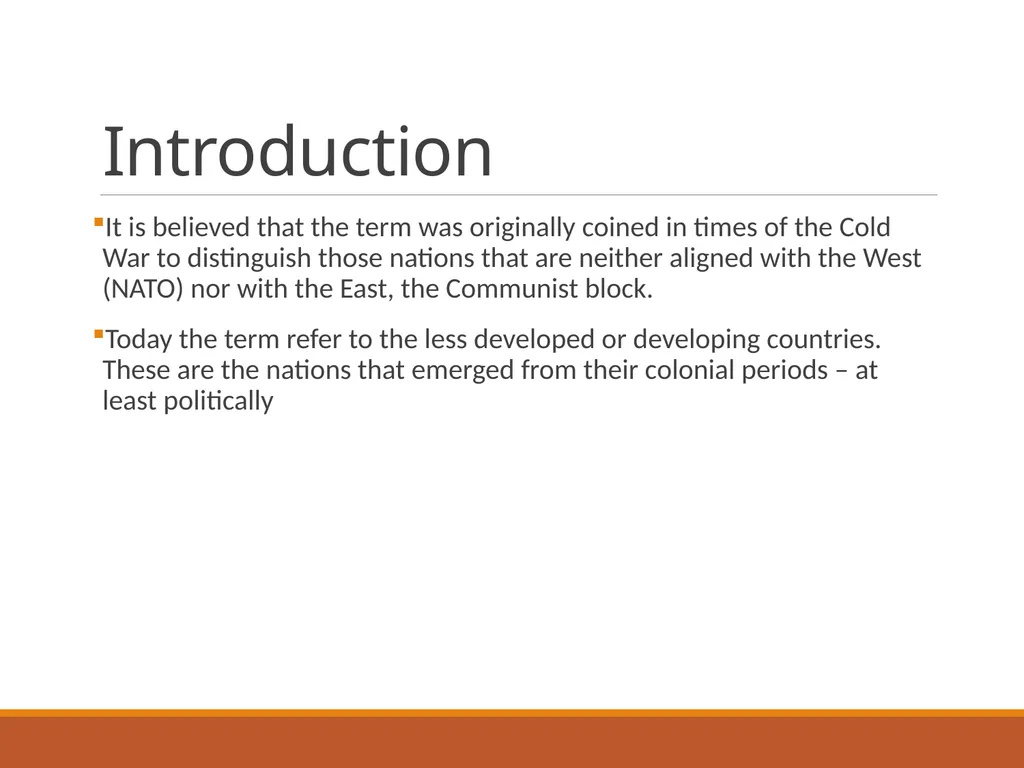
slide2. Introduction It is believed that the term was originally coined in times of the Cold War to distinguish those nations that are neither aligned with the West (NATO) nor with the East, the Communist block.
Today the term refer to the less developed or developing countries. These are the nations that emerged from their colonial periods – at least politically<br>
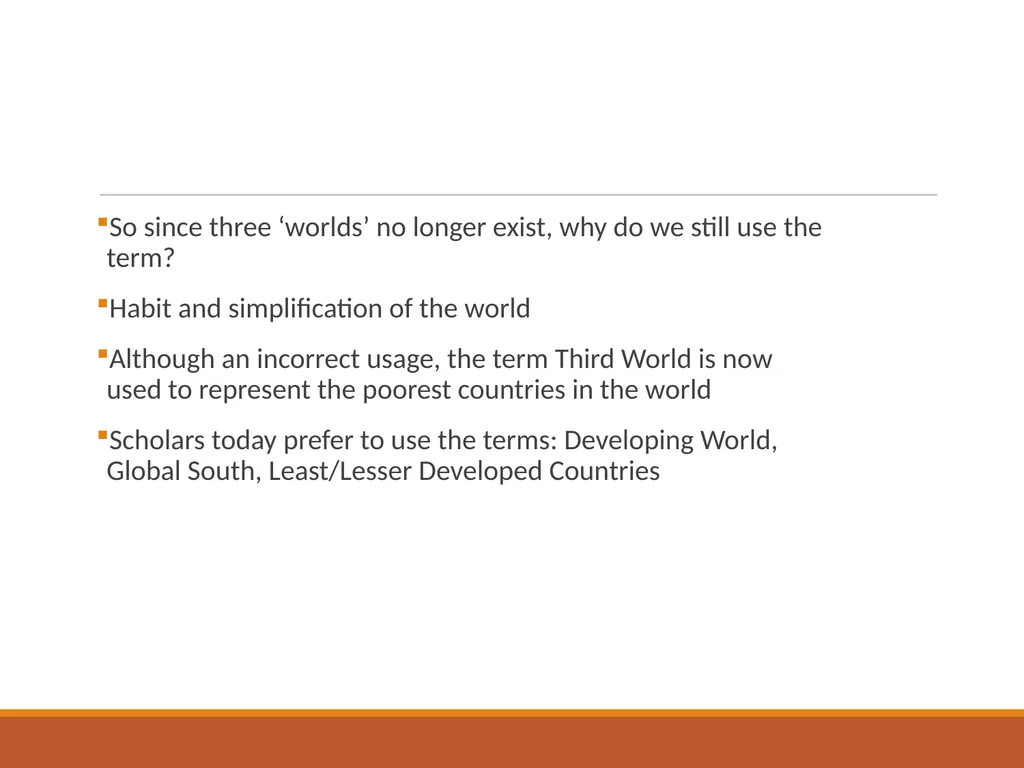
slide3. So since three ‘worlds’ no longer exist, why do we still use the term?
Habit and simplification of the world
Although an incorrect usage, the term Third World is now used to represent the poorest countries in the world
Scholars today prefer to use the terms: Developing World, Global South, Least/Lesser Developed Countries<br>
slide4. So how do we know if a country is developing and what does it mean to be developing?
No clear cut definition or guideline, although all countries have been classified
A lack of material wealth does not necessarily mean that one is deprived
A strong economy in a developed nation doesn’t mean much when a significant percentage of the population is struggling to survive<br>
slide5. Successful development can mean many things
Access to all basic needs such as food, water, shelter, clothing, health and education Stable political, social and economic environment
Ability to make free and informed choices
Ability to participate in a democratic environment
To have full potential for what the United Nations calls Human development<br>
slide6. What is Human Development? Human development is about much more than the rise or fall of national incomes. It is about creating an environment in which people can develop their full potential and lead productive, creative lives in accord with their needs and interests. People are the real wealth of nations. Development is thus about expanding the choices people have to lead lives that they value. And it is thus about much more than economic growth, which is only a means—if a very important one—of enlarging people’s choices.<br>
slide7. Problems faced by third world countries Poor household amenities.
Air, water and land pollution.
High birth rates
Lack of employment
High Illiteracy
Greater frequency of health problems.
Overpopulation<br>
slide8. Poor household amenities. The lack of basic services like a clean water supply, rubbish collection and sewerage disposal mean that the risks of disease are very high.
Poor hospital facilities especially in far-flung places
No access to support, information and services.
most of these countries have serious problems with Food and Water Security.<br>
slide9. Air, water and land pollution Pollution of air, land and water is a major problem in most developing world cities.
The drive to industrialisation brings with it inevitable problems, especially as legislation to protect the environment is often non-existent or rarely enforced.
Furthermore, the hidden economy can add to the levels of pollution as small, unlicensed industries are set up in peoples homes or on rooftops.
These industries release their pollutants into the air, land and water.<br>
slide10. High birth rates Many parents will have a lot of children in the expectation that some will die because of the high infant mortality rate
The children will be able to look after their parents if they become old or sick; there may not be a old age pension scheme
High birth rates leads to increase in population especially when birth rate is faster than mortality rate.<br>
slide11. Lack of employment The labor force is extremely underutilized in the less developed countries.
Unemployment refers to a situation where people who are willing and able to work cannot find a job<br>
slide12. High Illiteracy The upper classes may have access to it. But in various third world countries it is hard for the poor and/or women to get an education
Third World Countries lag behind since they may either have insufficient funds devoted to literary growth or these funds are wasted wrongfully.
A big part of the population is illiterate due to wrong planning.<br>
slide13. Overpopulation This biggest problem facing all Third World nations is the massive population/population growth-rate.
Due to illiteracy, lack of knowledge on family planning/contraceptives, younger age of marriages and the idea of "more hands, more work done" means that these countries have exceedingly high birth rates leading to a massively growing population who the Government struggles to provide for.<br>
slide14. Greater frequency of health problems Many people on the less developed countries are afflicted with poor health.
Many people in the less developed countries are either malnourished or undernourished. That make them susceptible to diseases.
Poverty comes with lack of hygiene and this favours the proliferation of various harmful bacteria which results in the development of diseases such as cholera, malaria, etc.<br>
slide15. Solutions Sewage rehabilitation
Housing developments
Rehabilitation
Better healthcare
Encouraging small and medium enterprises<br>
slide16. Conclusion These factors that are contributing to the slow growth of the developing nations
Third world issues that are mentioned here involve billions of people around the globe, which cannot be ignored. It needs attention from all the policy makers and world leaders to address and solve these problems.<br>
slide17. Thank you<br>
Dr Rishu Raj
Assistant Professor
MMC(PATNA UNIVERSITY)<br>
slide2. Introduction It is believed that the term was originally coined in times of the Cold War to distinguish those nations that are neither aligned with the West (NATO) nor with the East, the Communist block.
Today the term refer to the less developed or developing countries. These are the nations that emerged from their colonial periods – at least politically<br>
slide3. So since three ‘worlds’ no longer exist, why do we still use the term?
Habit and simplification of the world
Although an incorrect usage, the term Third World is now used to represent the poorest countries in the world
Scholars today prefer to use the terms: Developing World, Global South, Least/Lesser Developed Countries<br>
slide4. So how do we know if a country is developing and what does it mean to be developing?
No clear cut definition or guideline, although all countries have been classified
A lack of material wealth does not necessarily mean that one is deprived
A strong economy in a developed nation doesn’t mean much when a significant percentage of the population is struggling to survive<br>
slide5. Successful development can mean many things
Access to all basic needs such as food, water, shelter, clothing, health and education Stable political, social and economic environment
Ability to make free and informed choices
Ability to participate in a democratic environment
To have full potential for what the United Nations calls Human development<br>
slide6. What is Human Development? Human development is about much more than the rise or fall of national incomes. It is about creating an environment in which people can develop their full potential and lead productive, creative lives in accord with their needs and interests. People are the real wealth of nations. Development is thus about expanding the choices people have to lead lives that they value. And it is thus about much more than economic growth, which is only a means—if a very important one—of enlarging people’s choices.<br>
slide7. Problems faced by third world countries Poor household amenities.
Air, water and land pollution.
High birth rates
Lack of employment
High Illiteracy
Greater frequency of health problems.
Overpopulation<br>
slide8. Poor household amenities. The lack of basic services like a clean water supply, rubbish collection and sewerage disposal mean that the risks of disease are very high.
Poor hospital facilities especially in far-flung places
No access to support, information and services.
most of these countries have serious problems with Food and Water Security.<br>
slide9. Air, water and land pollution Pollution of air, land and water is a major problem in most developing world cities.
The drive to industrialisation brings with it inevitable problems, especially as legislation to protect the environment is often non-existent or rarely enforced.
Furthermore, the hidden economy can add to the levels of pollution as small, unlicensed industries are set up in peoples homes or on rooftops.
These industries release their pollutants into the air, land and water.<br>
slide10. High birth rates Many parents will have a lot of children in the expectation that some will die because of the high infant mortality rate
The children will be able to look after their parents if they become old or sick; there may not be a old age pension scheme
High birth rates leads to increase in population especially when birth rate is faster than mortality rate.<br>
slide11. Lack of employment The labor force is extremely underutilized in the less developed countries.
Unemployment refers to a situation where people who are willing and able to work cannot find a job<br>
slide12. High Illiteracy The upper classes may have access to it. But in various third world countries it is hard for the poor and/or women to get an education
Third World Countries lag behind since they may either have insufficient funds devoted to literary growth or these funds are wasted wrongfully.
A big part of the population is illiterate due to wrong planning.<br>
slide13. Overpopulation This biggest problem facing all Third World nations is the massive population/population growth-rate.
Due to illiteracy, lack of knowledge on family planning/contraceptives, younger age of marriages and the idea of "more hands, more work done" means that these countries have exceedingly high birth rates leading to a massively growing population who the Government struggles to provide for.<br>
slide14. Greater frequency of health problems Many people on the less developed countries are afflicted with poor health.
Many people in the less developed countries are either malnourished or undernourished. That make them susceptible to diseases.
Poverty comes with lack of hygiene and this favours the proliferation of various harmful bacteria which results in the development of diseases such as cholera, malaria, etc.<br>
slide15. Solutions Sewage rehabilitation
Housing developments
Rehabilitation
Better healthcare
Encouraging small and medium enterprises<br>
slide16. Conclusion These factors that are contributing to the slow growth of the developing nations
Third world issues that are mentioned here involve billions of people around the globe, which cannot be ignored. It needs attention from all the policy makers and world leaders to address and solve these problems.<br>
slide17. Thank you<br>